❌

Reading view

Russia’s jet drones fly near 600 km/h now. Ukraine is building simulators for the 900 km/h ones it expects next

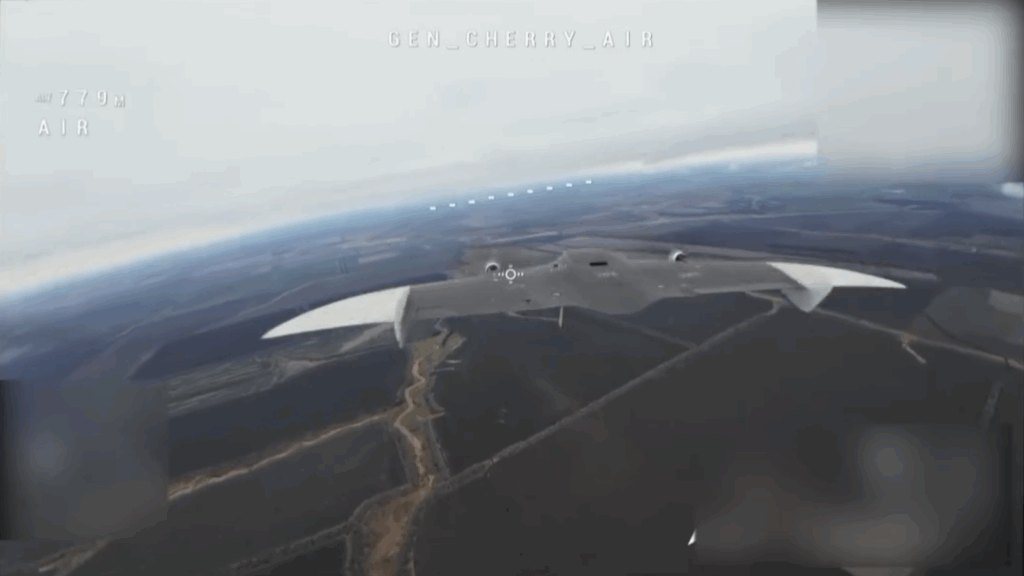
Russian "Knyaz Veshchiy Oleg" reconnaissance drone as seen from a Ukrainian "General Cherry AIR" interceptor drone, just before strike. Screenshot from video: General Cherry

Russia's jet-powered attack drones could eventually reach 800–900 km/h, and intercepting them will demand new piloting skills—so Ukraine has asked the makers of its interceptor drones to build simulators to train the crews, a senior Air Force officer told a parliamentary commission on 6 October, Suspilne reported.

Russia keeps modifying its jet Shaheds faster than Ukraine can field the drones meant to catch them, and Kyiv is now preparing crews for speeds its interceptors have never faced—a sign the air war is shifting from a contest of volume to one of raw speed.

The speed Russia hasn't reached yet

Colonel Yurii Cherevashenko, deputy commander of Ukraine's Air Force, told the commission that Russia's jet drones fly at around 600 km/h today but could eventually reach 800–900 km/h—speeds he said have not been recorded so far. That range sits near the cruising speed of a commercial airliner.

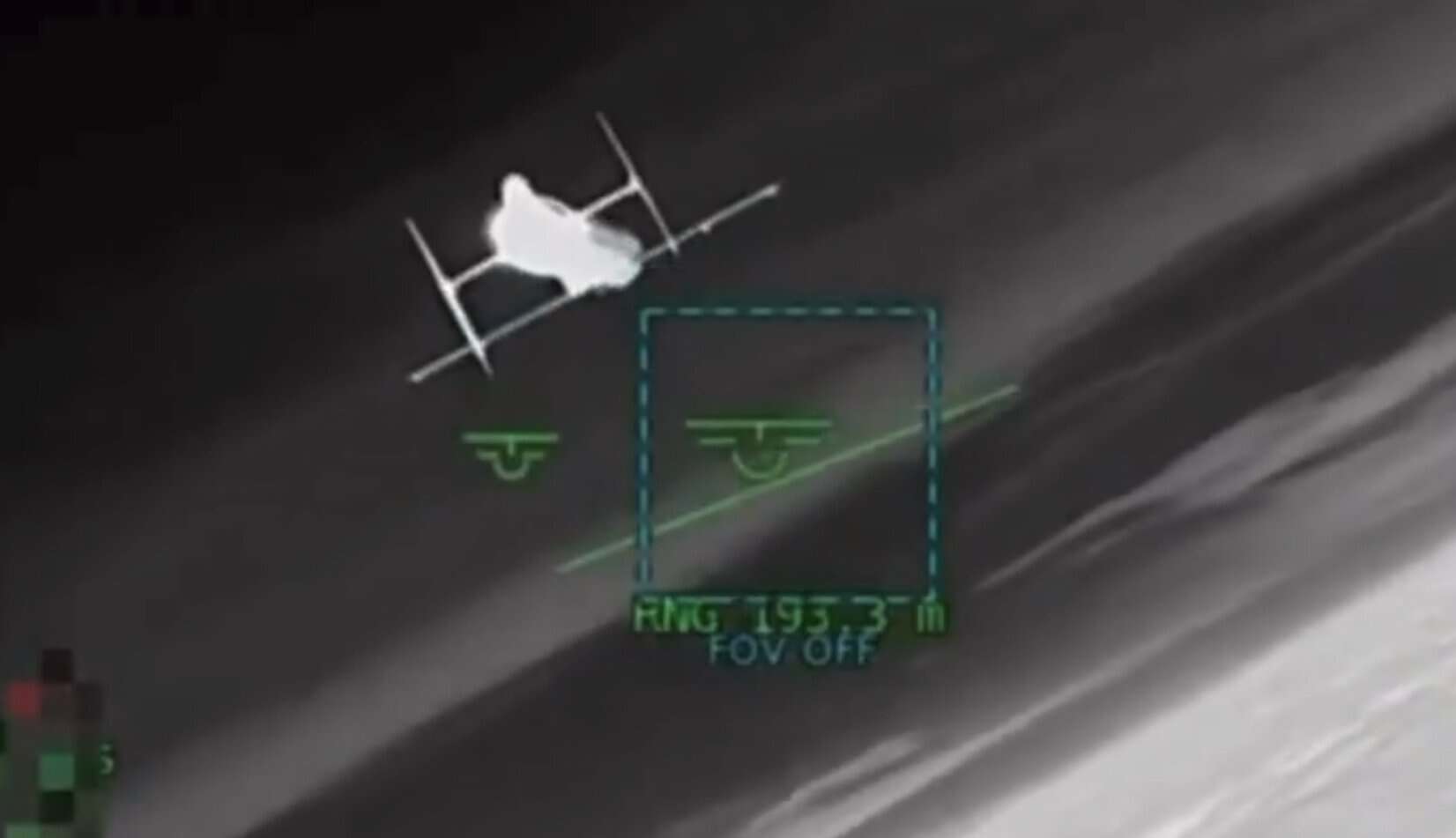
A Ukrainian interceptor drone chases a Russian Geran-5 jet-powered drone. September 2026.
Explore further

Ukraine just caught a Geran-5 at 425 km/h—the jet drone that has often outrun Ukrainian interceptor drones since January

Intercepting such targets will take specific piloting skills, Cherevashenko said. When an interceptor and its target move at roughly the same speed, he noted, the pilot barely perceives the difference in their speeds. To train for that, Ukrainian interceptor-drone makers have been tasked with building simulators where crews can practice against high-speed targets.

Where Ukraine stands now

Ukraine already downs 85% to 90% of Russia's slower, propeller-driven drones, Ukrainian President Volodymyr Zelenskyy has said, but the jet models remain a tougher problem—Ukrainian interceptors scored their reportedly first kill of a jet-powered Shahed in November 2025. In a 28 September evening address, Zelenskyy put the jet-drone interception rate at about 57%, lower than required. Days later, he said Ukraine is testing five interceptor-drone models and could be producing about 400 of one of them by the end of October. Asked when jet-drone interceptors would arrive at the scale needed, Cherevashenko answered: "Not before the end of November."

  •  

France Extends Schengen Border Checks Until April 2027

France will maintain controls on all its internal Schengen borders for another six months, adding to a growing network of national checks that has made temporary border control an increasingly persistent feature of Europe’s passport-free area.

France has notified the European Commission that it will extend controls at its internal Schengen borders from 1 November 2026 until 30 April 2027, maintaining checks with Belgium, Germany, Luxembourg, Switzerland, Spain and Italy as well as at relevant air and sea borders.

The notification, published in the Commission’s official register of temporary internal border controls, means the restrictions currently due to expire on 31 October will continue for another six months.

Paris cites a combination of security and migration concerns, including persistent jihadist threats, antisemitic attacks, organised migrant-smuggling networks and risks associated with irregular movements towards the Channel coast.

The French notification also refers to instability in the Middle East, Afghanistan and Somalia, Russia’s continuing war against Ukraine and security considerations surrounding the Paris Peace Forum on 10–11 November.

France is not alone.

Germany has extended controls on all of its land borders until 15 March 2027, citing irregular migration, migrant smuggling and pressure on its asylum system. Austria is maintaining controls on borders with Czechia, Slovakia, Hungary and Slovenia until the same date, while Poland has notified Brussels of checks on its borders with Germany and Lithuania through 30 March.

Denmark, Sweden, Norway and Italy also have temporary internal controls in force.

The expansion has created an increasingly complicated map inside an area established around the principle that people should normally be able to cross internal borders without routine checks.

EU Today has been following that change closely. In September, EU Today reported that Germany had extended checks on all nine of its land frontiers, while a subsequent examination found that temporary controls were spreading across the Schengen area.

The French extension takes that trend into spring 2027.

Under the Schengen Borders Code, governments retain the right to restore controls when they identify a serious threat to public policy or internal security. The Commission stresses that such action must remain exceptional, proportionate and limited to what is necessary.

The revised rules permit controls responding to a foreseeable threat for an initial period of up to six months, with extensions possible under defined conditions. Governments maintaining controls for extended periods must provide additional risk assessments and reporting.

There is therefore no legal contradiction between Schengen membership and temporary border checks. The political question concerns their frequency and duration.

In June, the European Commission had called for a gradual reduction in internal controls where conditions allowed. EU Today reported at the time that Brussels regarded the restoration of normal passport-free movement as possible in several countries.

The direction since then has largely been the opposite.

Migration remains one factor, but national notifications increasingly cite several threats simultaneously: terrorism, organised crime, Russian sabotage, war in Ukraine, Middle Eastern instability and pressure on asylum systems.

That makes it harder to identify a single event after which controls could simply be removed.

The system also creates practical consequences for cross-border regions. Millions of Europeans live in one Schengen state and work, study or conduct business in another. Selective checks can therefore cause delays even when passports are not examined systematically.

France’s controls are especially significant because of the number and economic importance of its neighbours. The extension covers land connections with six countries and internal air and sea routes.

It also comes as the EU operates new systems intended to strengthen the external Schengen frontier. Europe’s Entry/Exit System has introduced biometric registration for many non-EU travellers, while the migration and asylum pact has changed procedures for handling irregular arrivals.

The original political bargain behind Schengen was that stronger management of the common external frontier would support open internal borders.

The growing use of national internal controls shows that several governments remain unwilling to rely on that external system alone when confronted with migration, terrorism and wider security risks.

France’s latest notification is formally temporary. But by the time the new period expires on 30 April 2027, internal checks will have become a long-running feature of travel across several of Europe’s most important borders.

  •  

Von der Leyen Offers Extra Year on EU Methane Rules as Energy Costs Bite

The European Commission is preparing to give fossil-fuel exporters another year of flexibility under the EU’s methane regime as Brussels responds to high energy prices, pressure on European refineries and concerns over security of supply.

European Commission President Ursula von der Leyen has announced an additional year of flexibility for energy exporters facing new EU methane requirements, marking the latest adjustment to climate legislation as Brussels attempts to contain rising energy costs.

Addressing the European Parliament in Strasbourg on Tuesday, von der Leyen said Europe remained exposed to high energy prices and volatile international fossil-fuel markets and confirmed that exporters would receive “one more year” to prepare for the methane rules.

She also announced a strategic dialogue with the European refining sector aimed at reducing costs and protecting supplies, according to the Commission’s published remarks.

The announcement affects a regulation that has increasingly become an energy-security issue rather than solely an emissions policy.

The EU’s Methane Regulation, adopted in 2024, introduced progressively stricter requirements for companies supplying oil, natural gas and coal to the European market. Importers have already been required to provide information about the origin of fuel and the systems used to measure and reduce methane emissions.

A more demanding stage was due from January 2027. Importers would have to demonstrate that fuel supplied under contracts concluded or renewed since August 2024 came from producers operating monitoring, reporting and verification systems equivalent to EU standards.

The rules are technically complex because European importers do not always buy directly from producers. Gas and oil may pass through traders, hubs, blending systems and several contractual relationships before reaching Europe.

The Commission’s own guidance for importers acknowledges those difficulties, particularly where companies must trace production information through complicated supply chains.

EU Today highlighted the problem in July, when an International Energy Agency assessment raised concerns that the rules could restrict Europe’s available oil supply. The dispute has since intensified because European fuel markets have become considerably tighter.

That pressure can also be seen in the cost of imported energy. EU Today reported last month that the value of EU petroleum imports had risen by 55.8 per cent in the second quarter of 2026 even though the physical volume purchased increased by only 1.2 per cent.

Von der Leyen’s intervention therefore comes against a different market background from the one in which the methane legislation was originally adopted.

The Commission has not abandoned its objective of reducing methane emissions from fossil-fuel production. Methane remains one of the most powerful greenhouse gases, and the regulation is intended to use the size of the European energy market to influence production standards outside the EU.

Instead, Brussels is attempting to adjust implementation so that regulatory requirements do not further restrict supply at a time of elevated energy prices.

The precise legal form of the additional year of flexibility has not yet been detailed in von der Leyen’s announcement. Existing requirements remain contained in Regulation (EU) 2024/1787, meaning that changes to deadlines or enforcement will have to be translated into the appropriate legal or administrative measures.

The Commission had already moved towards greater flexibility earlier this year. In July it issued recommendations designed to clarify contractual arrangements and advised national authorities on the application of penalties to importers while security-of-supply concerns persisted.

The broader problem is European energy competitiveness.

Von der Leyen told Parliament that Brussels intends to begin a strategic dialogue with refineries. European refining capacity has contracted over the longer term, leaving the continent more dependent on imported diesel and other finished petroleum products when individual plants close or external supply routes are disrupted.

The Commission is also expected to propose measures aimed at increasing electricity’s share of European energy consumption as part of its attempt to reduce dependence on imported fossil fuels.

The latest methane adjustment therefore fits a wider shift in Brussels. Climate targets remain formally intact, but implementation is increasingly being examined alongside energy prices, industrial competitiveness and the security of physical supplies.

The extra year gives exporters additional time. It also gives the Commission another year to resolve a question that has become much more urgent in 2026: how far Europe can tighten conditions on imported energy while remaining heavily dependent on those imports.

  •  

EU Housing Act Moves to Parliament as Brussels Targets Short-Term Rentals

MEPs have opened debate on the EU’s proposed Affordable Housing Act, which would give national and local authorities a clearer legal framework for restricting short-term rentals and some non-primary residential property use in areas facing severe housing pressure.

The European Parliament has begun examining legislation that would give cities and national governments greater legal certainty when restricting short-term rentals and the use or acquisition of residential property in areas where housing has become difficult to afford.

The proposed Affordable Housing Act, presented by the European Commission on 9 September, was on Parliament’s agenda in Strasbourg on Tuesday as housing costs move further into EU-level politics.

The legislation does not transfer general housing policy to Brussels. Decisions on construction, planning, rent policy and social housing would remain primarily with national, regional and local authorities.

Instead, the proposal would establish a common EU legal framework governing some restrictions that member states and cities may introduce when attempting to protect housing supply.

The draft regulation specifically covers measures restricting short-term accommodation in residential properties other than a host’s primary residence. It would also cover restrictions on the acquisition or use of land and housing that is not intended as somebody’s principal home.

Those provisions are designed partly to resolve a legal problem that has become increasingly important in cities with large tourism markets.

Local governments have introduced restrictions on holiday rentals and second-home use, but such measures can clash with EU single-market rules governing services, property and establishment. The Commission says the legislation would provide authorities with a clearer method for demonstrating when restrictions are justified and proportionate.

The law would therefore not impose a common European cap on Airbnb-type accommodation. Nor would it oblige cities to introduce restrictions.

Authorities choosing to intervene would instead have to demonstrate housing stress and ensure that their measures meet EU requirements on proportionality, transparency and review.

Brussels argues that the scale of Europe’s housing problem now affects more than social policy.

According to the Commission’s European affordable housing plan, house prices across the EU have risen by more than 60 per cent since 2013, while average rents have increased by about 20 per cent. Short-term rentals increased by 93 per cent between 2018 and 2024.

Only between six and seven per cent of EU housing stock is classified as social housing, while about 20 per cent of homes are recorded as unoccupied.

The Commission estimates that Europe needs to build more than two million homes a year to meet current demand — around 650,000 more annually than are presently being constructed. It estimates the additional investment requirement at approximately €153 billion each year.

Those figures underline a central difficulty in the housing debate: restrictions on tourist accommodation may return some properties to residential use, but they do not address the full shortage of new homes.

EU Today examined that wider supply issue when the Commission launched its European Affordable Housing Plan, which combines proposed regulation with investment, faster permitting, construction reform and changes to state-aid rules.

The debate is becoming more politically prominent as housing affordability affects a growing share of middle-income households as well as those on lower incomes.

Berlin offers one example. EU Today reported last month that advertised rents in the German capital had risen by roughly three-quarters in less than a decade, while the city calculates that it will need another 211,000 homes by 2040.

Pressure is particularly acute in large cities and tourism centres, where residential demand competes with short-term accommodation and investment properties.

The Commission argues that this has consequences for the wider economy because workers who cannot find affordable accommodation may be unable to move to areas where jobs are available.

That is why Brussels increasingly presents housing not only as a social concern but as part of the competitiveness and single-market agenda.

The proposal is still at an early stage. Parliament and the Council must negotiate the legislation under the ordinary legislative procedure, and substantial amendments remain possible.

Questions are likely to centre on how “housing stress” is defined, what evidence authorities must provide before restricting property use and how far EU law should permit local intervention in property markets.

The political dividing line is already apparent. One side of the debate stresses that cities need more freedom to protect permanent housing stock. The other warns that regulation of short-term rentals or second properties can affect tourism businesses, property owners and investment without necessarily creating sufficient new supply.

The Affordable Housing Act attempts to establish legal rules for that dispute rather than settle it centrally.

If adopted, its importance will therefore depend less on a single Brussels policy than on how individual European cities use the powers and legal protection it provides.

  •  

EU Plans 15-Year Safeguard for New Members as Enlargement Rules Are Rewritten

The European Commission has proposed new safeguards allowing voting rights and funding to be restricted if future EU members breach fundamental European rules after accession, as Brussels prepares for possible membership of Ukraine, Moldova, Albania and Montenegro.

The European Commission has set out a new framework for enlargement that would allow the European Union to impose restrictions on recently admitted countries for up to 15 years after accession if they retreat from commitments on democracy, the rule of law or other fundamental EU principles.

The measures form part of the Commission’s new pre-enlargement policy review, published on Tuesday, which examines how the EU’s institutions, budget and policies would have to change before another round of expansion. Brussels says the Union could accommodate additional members without rewriting its treaties, but would need stronger safeguards to prevent enlargement from making decision-making more difficult.

Under the proposals, accession treaties could contain an institutional safeguard allowing action against a new member that seriously breaches the values contained in Article 2 of the Treaty on European Union or the principle of sincere cooperation. In the most serious cases, Council voting rights could be suspended.

The Commission’s public summary describes those arrangements as temporary, targeted and reversible. Reporting on the underlying proposal indicates that the enhanced safeguard could remain available during the first 15 years of membership.

The proposal addresses a problem that has moved steadily up the enlargement agenda: how to ensure that a country continues to meet membership conditions after it has entered the EU.

Germany, France, Belgium, the Netherlands and Luxembourg had already raised the issue earlier this year. As EU Today reported in June, the five governments called for mechanisms capable of restricting some rights of new members if democratic standards deteriorated after accession.

The Commission has now turned that political argument into a wider institutional proposal.

The change is particularly relevant to Ukraine, Moldova, Montenegro and Albania, which Brussels identifies as the four candidates currently furthest advanced. The Commission says it will prepare indicative roadmaps for each country provided reform momentum continues.

Ukraine and Moldova may also make further progress within days. EU Today reported earlier on Tuesday that two more negotiating clusters could potentially be opened next week if Ukraine’s parliament passes legislation dealing with minority-language education.

Alongside stronger rule-of-law safeguards, the Commission wants candidate states to be integrated gradually into parts of the EU before full membership. Energy, transport, digital policy and defence are among the sectors identified for deeper participation.

Brussels is also proposing greater use of qualified-majority voting during the accession process, including for decisions to open negotiating clusters. At present, individual governments can delay progress at several stages because unanimity is required.

Another proposed safeguard would require a newly admitted state, for a limited period, not to block subsequent enlargements because of bilateral disputes. The measure reflects long-standing difficulties in the Western Balkans, where disputes between neighbouring states have repeatedly entered accession negotiations.

Ukraine’s agricultural sector presents a separate challenge. The Commission says transitional arrangements could be used for agriculture, sensitive products, EU funding, the movement of workers and participation in common systems. Reporting on the package indicates that unrestricted access by Ukraine to existing Common Agricultural Policy support is unlikely immediately upon accession because of the scale of Ukrainian farming.

That question is politically important for existing agricultural beneficiaries, particularly in Central and Eastern Europe, where Ukrainian grain and food imports have already caused disputes.

The institutional proposals do not guarantee membership for any candidate. Accession remains dependent on meeting the EU acquis, completing negotiations and obtaining the agreement of existing member states.

Nor has the 15-year safeguard yet become EU law. The Commission has asked the European Council and European Parliament to take forward discussions, and the eventual provisions would have to be reflected in future accession arrangements.

What has changed is the shape of the enlargement debate. Brussels is no longer concentrating solely on what candidate countries must do before joining. It is also designing mechanisms governing what happens after they enter.

For Ukraine, Moldova and the Western Balkans, that could produce a more credible path towards membership, but one accompanied by conditions extending well beyond accession itself.

  •  
❌