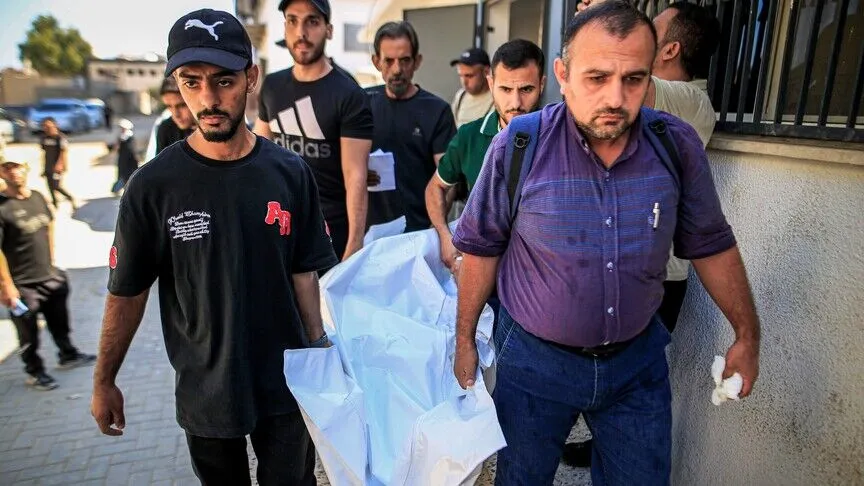
Those killed include a woman, a teen, a volunteer medic, and a man in his 60s.. Many others, including a number of children, were injured by the Israeli strikes.
Russian forces struck the eastern Ukrainian city of Kramatorsk on the morning of 8 October, hitting two route buses carrying residents and killing dozens of civilians. The Donetsk Oblast prosecutor's office opened a war-crimes investigation.
Russia has turned everyday movement in frontline Donetsk Oblast into a lethal risk, striking city buses, ambulances, and cars in places its army has not been able to capture.
A route bus run turned deadly
The attack came at around 10:00, catching two route buses in the impact zone. The prosecutor's office said the attackers likely used a UMPB D-30SN. HUR, Ukraine's military intelligence, describes it as a guided glide bomb that can fly up to 100 km when released from an altitude of 12–15 km and carries a warhead equal to a FAB-250 aerial bomb.
30 people were killed and 18 injured after a Russian bomb hit two passenger buses carrying civilians in Kramatorsk, Donetsk Oblast.
The buses caught fire, and the force of the attack also damaged nearby homes and cars. Some victims were so badly burned that police had to recover… pic.twitter.com/FqLdM0HN1B
The toll rose through the day, from 12 dead in the first reports to 30 killed and 20 wounded by 14:55, Donetsk Oblast head Vadym Filashkin said. Across Donetsk Oblast, Russian attacks killed 33 people that day, including the 30 in Kramatorsk and three in nearby Bilenke, the State Emergency Service said. Ukrainian President Volodymyr Zelenskyy said the strike would not go unanswered.
Buses pulled off the roads
Filashkin ordered the Kramatorsk and Sloviansk city military administrations to suspend public transport, citing the sharp deterioration in security. Buses had become an attractive target for Russian forces, he said, and the authorities could not risk the lives of passengers and drivers. He also urged everyone still in Donetsk Oblast to leave for safer parts of Ukraine. Kramatorsk is a frequent target of Russian attacks. Russia had not commented on the strike as of publication.
Aftermath of the shelling of Kramatorsk on 8 October 2026. Photo: Illia Andreiev/Kramatorsk Post
The city has been under daily fire. On 5 October, Russian FPV drones hit ambulances and an apartment block in Kramatorsk, killing a woman and wounding four, the prosecutor's office reported. Over the previous day, Russian forces shelled Donetsk Oblast settlements 31 times and 256 people left the front line, Filashkin said.
Benjamin Netanyahu likes to translate Israel’s grief into American. At the United Nations last month, he took the dead of October 7 and multiplied them by the ratio of America’s population to Israel’s. The 1,200 Israelis killed that day, he said, were “equal to 40,000 innocent Americans slaughtered in less than 24 hours. That’s 16 times 9/11.”
Per-capita comparisons are a perfectly legitimate tool. A small country feels a massacre more than a large one, and Americans should understand what October 7 meant to Israelis. But a method is only honest if you’re willing to apply it to everyone. So let’s apply Netanyahu’s method to the people his army has been killing for three years.
Gaza had about 2.2 million people before the war. The United States has about 341 million, roughly 155 times as many. Take a conservative figure of 75,000 Palestinians killed in Gaza, slightly above the Gaza Health Ministry’s latest count of more than 73,000. Multiply it by Netanyahu’s own logic, and you get about 11.6 million Americans.
Eleven point six million. That is roughly the population of Ohio. It is more than ten times the number of Americans killed in every war the United States has ever fought, from the Revolution to Afghanistan. It is about 15 times America’s deaths in the Civil War, the bloodiest conflict in the nation’s history.
Measured in the unit Netanyahu chose, it is about 3,900 September 11ths.
Run the numbers in Israel’s own terms and the result is the same. Seventy-five thousand dead in a population of 2.2 million is the equivalent of about 340,000 Israelis. Netanyahu built a speech, a war and a foreign policy on 1,200. Imagine what he would say about 340,000.
The convenient multiplier
The prime minister’s defenders will object that the comparison is unfair because many of Gaza’s dead were Hamas fighters. Fine. Subtract every combatant the Israeli military claims to have killed, and apply the multiplier to what remains. Even 50,000 dead becomes nearly 8 million Americans, about 2,600 9/11s. You can argue over every death in the ledger, and the result is still measured in millions.
Netanyahu’s arithmetic has problems even on its own terms. Forty thousand Americans divided by the 2,977 who died on September 11 comes to about 13.4 9/11s, not 16. When the rhetoric needs a bigger number, it seems, the calculator rounds up.
But the real problem isn’t the rounding. It’s the selectivity. Netanyahu’s multiplier is designed to work in one direction only. It enlarges Israeli dead into an American catastrophe so that American audiences will feel what Israelis felt. Applied to Palestinians, it produces numbers so large they would make any American audience ask what, exactly, it has been paying for. That is why he never applies it to them.
What the comparison actually shows
The point of a per-capita comparison is to help outsiders grasp the scale of a loss. Netanyahu wants Americans to imagine 40,000 of their countrymen murdered in a day, and to understand everything Israel has done since as the natural response. Very well. Ask Americans to imagine 11.6 million of their countrymen dead, in a territory sealed off from escape, and to call it self-defense.
No American president would describe 11.6 million American dead as a proportionate response to anything. No American would accept that the dead deserved it because some of them were armed. And no one who has run the numbers can accept the premise of Netanyahu’s arithmetic, which is that Israeli lives scale up and Palestinian lives do not.
The method is Netanyahu’s. So is the answer it produces: by his own measure, the catastrophe in Gaza is about 290 times larger than the one he asks the world to remember.
At least 30 people have been killed and 18 injured after Russian forces struck two passenger buses in Kramatorsk, eastern Ukraine, on Thursday morning, according to updated figures released by Ukrainian prosecutors. The attack comes amid continuing Russian strikes on Ukrainian cities.
Russian forces attacked Kramatorsk, in Ukraine’s Donetsk region, at approximately 10am local time on 8 October, hitting an area where two scheduled passenger buses were carrying civilians.
According to preliminary findings from Ukrainian investigators, Russian forces may have used a UMPB D-30SN guided aerial munition. The precise weapon and circumstances of the attack remain under investigation.
Passenger buses caught in Russian bombardment
The two buses were operating regular passenger services when the strike occurred. Ukrainian authorities said passengers were on board, although detailed information about the victims, including their ages and identities, has not yet been released.
Photographs published by the regional prosecutor’s office show the aftermath of the attack, including severely damaged passenger vehicles. Emergency personnel and law enforcement officers were dispatched to assist the wounded, recover victims and document evidence.
The strike raises questions about the selection of the target and precautions taken to protect civilians. Under international humanitarian law, civilian vehicles and their passengers are protected from deliberate attack unless a vehicle becomes a military objective under the applicable legal rules.
The circumstances of Thursday’s strike, including whether the buses were directly targeted or struck during an attack on another location, have not yet been independently established.
Kramatorsk under increasing pressure
Kramatorsk remains one of Ukraine’s principal administrative and logistical centres in the part of Donetsk region still controlled by Kyiv. The city has faced repeated Russian bombardments as Moscow continues its military campaign to capture the remaining Ukrainian-held territory in Donetsk.
Its transport infrastructure serves residents who have remained despite years of fighting, including those travelling between neighbouring communities and those attempting to leave the region.
Regional officials have repeatedly urged residents to evacuate to safer areas of Ukraine as Russian bombardments continue. However, civilians remain in Kramatorsk and surrounding settlements, where everyday services, including public transport, continue to operate despite the danger.
Guided bombs and civilian protection
Russian forces have used guided aerial bombs against Ukrainian-controlled settlements near the front line. Such weapons can be released from aircraft at distances that reduce Russian pilots’ exposure to Ukrainian air defences.
The UMPB D-30SN, provisionally identified in the Kramatorsk attack, is a guided munition designed to reach targets beyond the immediate position of the launching aircraft. Its suspected use against an area containing occupied passenger buses will form part of the investigation.
Investigators will need to establish the intended target, the weapon used and the information available to those who planned and carried out the strike. These findings are relevant to determining whether the attack violated the laws of war.
Investigators examine civilian deaths
The Donetsk Regional Prosecutor’s Office is collecting evidence concerning the bombardment, including the type of munition used and the circumstances in which the buses were struck.
Establishing whether the vehicles were deliberately targeted, or whether the attack resulted from an indiscriminate or disproportionate strike, will be central to any assessment under international humanitarian law.
The identities of the victims and the full extent of the damage have yet to be established publicly. As of the updated figures issued by Ukrainian prosecutors on 8 October, 30 people were reported killed and 18 injured.
Dopo il 31 marzo 2026 ha cominciato a circolare in inglese un report di venti pagine intitolato Heirs of Goebbels: falsification of the events in Bucha and bloody staged performances of the Kiev regime. Lo firma il «Tribunale pubblico internazionale sui crimini dei neonazisti ucraini», organismo presieduto da Maksim Grigor’ev, che per il testo integrale rinvia al sito del Fondo russo per lo studio dei problemi della democrazia. La tesi sta già nel titolo: gli eventi di Bucha del marzo 2022 sarebbero stati falsificati dall’Ucraina con l’appoggio dei governi occidentali, secondo una tecnica che il testo accosta alla provocazione nazista di Gleiwitz del 1939.
Il documento merita una lettura attenta proprio perché non si limita alla negazione. A differenza delle smentite russe dell’aprile 2022, costruisce il proprio argomento su materiale ucraino verificabile: le targhe del memoriale, i necrologi militari, i siti commemorativi locali, le dichiarazioni della Presidenza. È su questo terreno che va discusso. La domanda che pongo qui è più stretta di quella del report e, credo, più utile: chi compare davvero sul Muro della memoria di Bucha, con quale qualifica, e che cosa succede quando una categoria commemorativa viene usata come categoria giuridica e statistica. La risposta chiama in causa tanto chi ha costruito la narrazione ufficiale quanto chi pretende di smontarla.
L’impianto è semplice. Dopo il richiamo a Gleiwitz, il testo elenca quattro metodi di falsificazione che il governo ucraino avrebbe impiegato: la presentazione come civili di militari caduti in combattimento; l’attribuzione alla Russia di morti causate dal fuoco ucraino; il conteggio tra le vittime di anziani morti di malattia; l’uccisione deliberata di propri cittadini davanti alle telecamere. Il bersaglio dichiarato è la formula ufficiale secondo cui il memoriale conterrebbe «509 nomi di civili identificati», formula che il report attribuisce al sito della Presidenza ucraina, al sindaco Anatolij Fedoruk, a Euronews e ai ministri europei presenti alla commemorazione del 31 marzo 2026.
Il nucleo del documento (pp. 3–12) è un elenco di circa trenta nomi, ciascuno accompagnato dalla foto della targa e, spesso, da un ritaglio di stampa ucraina. Li si può raggruppare in cinque classi. La prima comprende persone indicate come membri di Azov o di unità collegate: Jevhen Petraš, Jevhen Vas’kovyč, Illja Chrenov, Bohdan Knyščuk, Volodymyr Bisaha. La seconda riunisce militari regolari: il pilota Ruslan Bilous (Belous) della 7ª brigata di aviazione tattica e il suo compagno d’equipaggio Roman Dovhaljuk, il cecchino Oleh Cymbal della 80ª brigata d’assalto aereo, Vadym Smetans’kyj della stessa brigata, un colonnello dell’SBU, un maggiore del Dipartimento di protezione statale, il comandante della guardia al commissariato militare di Bucha. La terza raccoglie membri della difesa territoriale o di formazioni volontarie: Anatolij Korytko, Serhij Smyrnov, Oleksandr Blahodatnyj, Andrij Verbovyj, Mychajlo Bojčenko. La quarta riguarda civili che avrebbero preso parte ad azioni ostili: Oleksandr Šarava, uscito di casa con bottiglie incendiarie il 27 febbraio 2022; Vitalij Fesjuk, osservatore che trasmetteva i movimenti dei mezzi russi; Oleksandr Bondar, che secondo la stampa ucraina compiva ricognizioni per le forze armate. La quinta riguarda persone morte fuori dalla città (a Vorzel’, Moščun, Kopylov, Zdvizhevka, Guta-Mežigorskaja, Irpen’) e una donna di 68 anni, Halyna Semenjuk, morta di tumore.
A questo elenco il report aggancia due riferimenti giuridici corretti nella sostanza: l’art. 51, par. 3, del Primo Protocollo addizionale, per cui i civili perdono la protezione quando e per il tempo in cui partecipano direttamente alle ostilità, e un passo divulgativo del Comitato internazionale della Croce Rossa sullo stesso principio. Le pagine 12–20, infine, riportano sedici testimonianze su bombardamenti ucraini «a favore di telecamera». Nessuna riguarda Bucha: i testimoni parlano di Avdeevka, Ugledar, Toreck / Dzeržinsk, Lisichansk, Kurakhovo, in episodi che vanno dal 2021 al 2024. Il passaggio da quel materiale a Bucha è affidato a una frase esplicita: la pratica delle uccisioni deliberate «consente di concludere ragionevolmente» che lo stesso sia avvenuto anche lì.
Il quadro normativo
Il diritto internazionale umanitario definisce il civile per esclusione. Secondo l’art. 50 del Primo Protocollo è civile chiunque non appartenga alle forze armate come definite dall’art. 43, cioè a tutte le forze, i gruppi e le unità organizzati posti sotto un comando responsabile. In caso di dubbio la persona va considerata civile, e la presenza tra la popolazione di individui non civili non priva la popolazione del suo carattere civile. Il civile che partecipa direttamente alle ostilità resta civile, ma perde la protezione dagli attacchi per la durata della partecipazione. La Interpretive Guidance del CICR fissa per tale partecipazione tre requisiti cumulativi (una soglia minima di danno, un nesso causale diretto, un nesso bellico) e distingue il civile che agisce in modo episodico dal membro di un gruppo armato organizzato con funzione di combattimento continuativa, che perde la protezione per tutta la durata di tale funzione.
Due ulteriori norme contano per il caso di Bucha. La prima è la levée en masse: gli abitanti di un territorio non ancora occupato che, all’avvicinarsi del nemico, prendono spontaneamente le armi senza aver avuto il tempo di organizzarsi sono combattenti legittimi, se portano apertamente le armi e rispettano le leggi di guerra. La seconda è interna. La legge ucraina «Sui fondamenti della resistenza nazionale», in vigore dal 1° gennaio 2022, ha fatto delle Forze di difesa territoriale una componente delle Forze armate e ha istituito le formazioni volontarie delle comunità territoriali (DFTH) come unità paramilitari destinate a compiti di difesa territoriale. Chi apparteneva a queste strutture, per il diritto internazionale umanitario, non era un civile.
C’è però un punto che il report non tocca mai. Stabilire che una persona era un combattente non dice nulla su come sia morta. Un combattente catturato, ferito o arreso è hors de combat, e ucciderlo è un crimine di guerra.
Alla prova della guerra informativa
Secondo i commentatori occidentali, il report non è credibile, perché contiene alcune imprecisioni giuridiche. Degli errori tecnici ci possono stare, ma guardare il dito ignorando la luna è un errore madornale. A Bucha, il crimine è stato compiuto dagli ucraini, non dai russi. E c’è un crimine atroce che è divenuto uno strumento di propaganda, parte di una guerra informativa che era indispensabile per l’Occidente collettivo.
Bucha ha rappresentato uno dei momenti decisivi della guerra dell’informazione sviluppatasi intorno al conflitto russo-ucraino. Dopo il ritiro delle forze russe dalla città, le immagini dei cadaveri presenti nelle strade e le testimonianze raccolte sul posto furono rapidamente diffuse dai media internazionali, trasformandosi in un potentissimo dispositivo comunicativo. Tutto avvenne con estrema velocità, con i media occidentali che, a reti unificate, diffondevano il materiale dappertutto, costruendo l’immagine della guerra come aggressione caratterizzata da atrocità sistematiche, nella quale la Russia veniva progressivamente rappresentata non soltanto come avversario militare, ma come responsabile di crimini contro la popolazione civile. Le immagini possedevano, in questo senso, una forza persuasiva superiore a quella di molte argomentazioni diplomatiche: il corpo del civile ucciso diventava una prova visiva capace di condensare in pochi fotogrammi un’intera interpretazione del conflitto.
Bucha assunse così una funzione strategica nella comunicazione occidentale e contribuì a consolidare il consenso pubblico alle sanzioni, all’isolamento diplomatico di Mosca e all’incremento dell’assistenza politica e militare a Kiev. Osservate come un evento tragico, come tragica è ogni guerra, sia stato trasformato in un’arma di guerra. Del valore dei morti, della verità delle loro biografie, a nessun media occidentale importava. L’unica cosa necessaria era incolpare la Russia e motivare l’escalation di un conflitto folle.
Ma la verità prima o dopo viene a galla.
È così che il Ministero degli Affari Esteri russo ha ha riportato il caso di Bucha al centro dell’attenzione internazionale. La portavoce Maria Zakharova ha dichiarato che Mosca intende sollecitare le Nazioni Unite a riesaminare gli eventi, sostenendo che l’ONU non avrebbe partecipato direttamente alle indagini svolte all’epoca, finendo invece per assumere come prevalente la versione fornita da Kiev. Pochi giorni dopo, anche il ministro degli Esteri Sergej Lavrov è tornato sull’episodio, denunciando quella che considera una pratica tipica della guerra dell’informazione: costruire rapidamente una narrazione, trasformarla in verità dominante e impedire che versioni alternative possano raggiungere il pubblico.
È precisamente questo, secondo Lavrov, il meccanismo attraverso cui l’Occidente avrebbe consolidato la propria interpretazione di Bucha. La prima narrazione occupa lo spazio informativo disponibile come una trincea vuota: una volta conquistata e difesa dai grandi media, sostituirla richiede uno sforzo enormemente maggiore. Nel caso di Bucha questo processo avrebbe impedito fin dall’inizio un esame realmente imparziale degli avvenimenti.
Resta dunque una questione centrale: perché riaprire oggi il dossier Bucha? Perché Mosca è pronta a confrontarsi con il mondo intero sulle menzogne propagandate dagli occidentali. L’Occidente, invece?
Nearly 22,000 Palestinian students and education workers were killed during three years of Israeli attacks, according to a statistical report released Wednesday by the Palestinian Ministry of Education and Higher Education. The report documents Israeli violations against the education sector from October 7, 2023, through October 7, 2026.
Issued under the slogan, “Three Years After the Genocide: Education Is a Will That Cannot Be Broken,” the report said Israeli forces killed more than 19,189 school students and 1,386 university students in the Gaza Strip. Another 28,586 school students and 3,082 university students suffered injuries of varying severity.
In the occupied West Bank, Israeli forces killed 134 school students and 39 university students and injured 871 school students and 283 university students. The forces also abducted 416 school students and 481 university students.
Among educational and administrative personnel in Gaza, Israeli forces killed 805 school employees and 246 university lecturers and staff members.
The report also documented the injury of 3,298 school employees and 1,493 university personnel. In the West Bank, Israeli forces killed seven school staff members and injured 26 others, while abducting more than 176 teachers and school employees and 21 university staff members.
Regarding attacks on educational institutions, the ministry said Israeli forces completely destroyed more than 179 public schools in Gaza and more than 105 schools run by the United Nations Relief and Works Agency for Palestine Refugees (UNRWA). More than 63 university buildings were also completely destroyed.
In response to the widespread destruction and in an effort to maintain the educational process, 700 teaching and learning centers were opened throughout the Gaza Strip, along with 12 virtual schools serving students from Gaza inside Palestine and abroad.
In the West Bank, Israeli forces continued targeting educational institutions. They issued a final demolition order against the Janba School in Masafer Yatta, south of Hebron, and closed four schools in Hebron’s Old City for several days: Yasser Amr, Al-Faiha, Qurtuba, and Al-Ibrahimiyya schools.
Israeli authorities also denied work permits to teachers at private schools in occupied Jerusalem, preventing them from reaching their workplaces, and continued invading Palestinian universities, most recently Birzeit University.
A Epic Games Store vai liberar de graça, a partir de quinta-feira (08/10), os jogos Out of Sight e TerraScape. Segundo a programação da loja para o Brasil, a oferta começa às 15h UTC, o equivalente a 12h em Brasília, e vai até o mesmo horário de quinta-feira (15/10). Cada um custa R$ 44,99 fora da promoção, conforme os dados da página de jogos grátis da Epic.
Out of Sight, da The Gang Studio, é descrito pela loja como um jogo atmosférico de terror, com perspectivas em primeira e em segunda pessoa e dublagem. A página do jogo na Steam informa que ele é para um jogador, roda em Windows e tem português do Brasil entre os idiomas, com áudio completo só em inglês. Os requisitos mínimos incluem Windows 10, 8 GB de memória RAM, placa de vídeo GeForce GTX 1060 ou Radeon RX 470 e 5 GB de espaço livre.
TerraScape, da Bitfall Studios, é um quebra-cabeça de construção de cidades em ilhas flutuantes. Segundo a Epic, tem desafios semanais, mapas gerados aleatoriamente e modos para um jogador e multijogador. A página na Steam lista português do Brasil, versões para Windows e Mac e requisitos mínimos de Windows 10, 4 GB de RAM, placa de vídeo GeForce GTX 1060 e 2 GB de espaço livre.
As informações de idioma e requisitos são das páginas da Steam e podem diferir na versão da Epic.
 Login