❌

Reading view

Saudi Airstrike on Passenger Vehicle in Yemen Kills at Least Two Civilians, Injures Children: Health Ministry

Saudi airstrikes hit a passenger vehicle in Yemen’s southwestern Taiz province on Thursday, killing at least two civilians and wounding six others, as civilian casualties continue to mount in the US-supported bombing campaign. According to the Yemeni Health Ministry within the Ansar Allah-led government, a pregnant woman also lost her baby due to the strike, […]
  •  

Ansar Allah Pounds Saudi Airports as Yemen War Escalates

Yemen’s Ansar Allah, also known as the Houthis, has launched multiple attacks on airports in Saudi Arabia in recent days, marking an escalation of the conflict, which was reignited by Saudi airstrikes on the Sanaa International Airport back in July. The ramped-up Ansar Allah strikes on airports came after the group warned on October 5 […]
  •  

Houthis Share Footage of Taiz Advance as They Take Over Key Height

File image.

The Houthis (Ansar Allah) released footage on October 8 showing their forces driving Saudi-backed forces from al-Shamayatayn district in the southwestern Yemeni province of Taiz.

The footage include scenes from the capture of al-Turbah, the district’s main city. The footage showed Houthi fighters moving through positions and areas they said had been abandoned by the Saudi-backed forces. It also shows several vehicles and loads of weapons captured by the group.

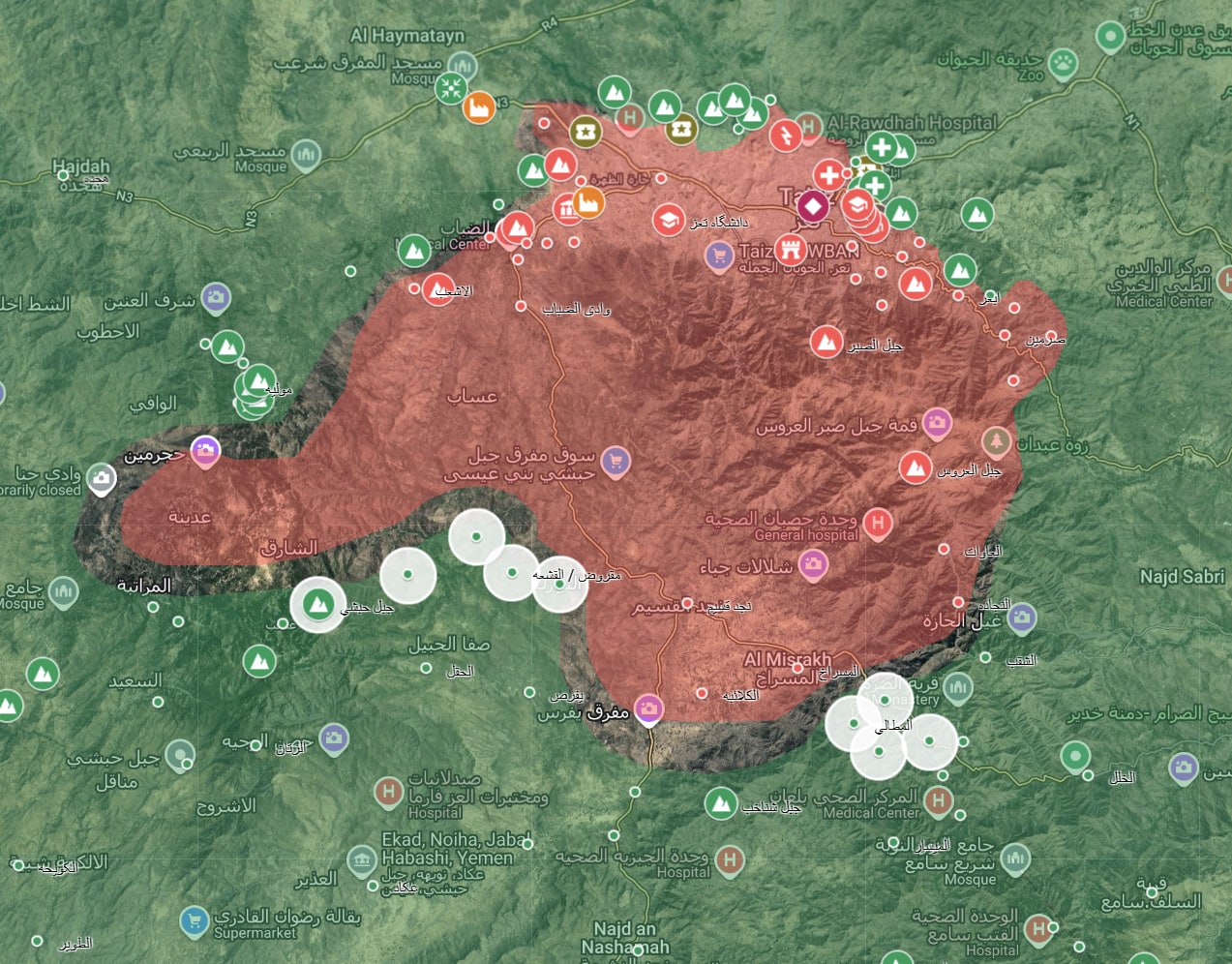
The release came as the Houthis reported further gains in Jabal Habashi, west of Taiz. Pro-Houthi Yemeni media said the group had expelled government troops from the highest peaks of the mountain, including Najd al-Oud and al-Anaqib, adding to their gains across the province.

Separately, Houthi military spokesman Brig. Gen. Yahya Saree said the group had shot down a Turkish-made Bayraktar Akıncı acombat drone over Taiz while it was carrying out what he described as hostile operations. He said the drone was brought down with an “appropriate weapon.”

The developments show growing Houthi pressure on the western and southern approaches to Taiz, even as Saudi-backed forces continue efforts to reverse earlier territorial losses.

Click to see full-size map. (Islamic World News)

Meanwhile, the Saudi-backed counterattack toward Bab al-Mandab meanwhile remains stalled. The strategic waterway remains under the control of the Houthis.

All in all, the Houthis maintain the upper hand on all fronts in Taiz. The two main objectives for the group now are likely to reach Taiz city, which is already under a tight siege, as well as to restore control over the few positions it lost near Bab al-Mandab, most notable of which is Dhubab’s airstrip. Fighting could go on for weeks, or even months.

_______________________________________________________________________________________________________________________

SouthFront: Analysis and Intelligence

NOW hosted at southfront.press

Previously, SouthFront: Analysis and Intelligence was at southfront.org.

The .org domain name had been blocked by the US (NATO) (https://southfront.press/southfront-org-blocked-by-u-s-controlled-global-internet-supervisor/) globally, outlawed and without any explanation

Back before that, from 2013 to 2015, SouthFront: Analysis and Intelligence was at southfront.com

SOUTHFRONT.PRESS

MORE ON THIS TOPIC:

 

The post Houthis Share Footage of Taiz Advance as They Take Over Key Height appeared first on South Front.

  •  

More Victories For The Houthis

Yemen’s Houthis (Ansar Allah) have made battlefield gains in Taiz, halted a Saudi-backed advance near the Bab al-Mandab Strait and carried out repeated missile and drone attacks against Saudi Arabia over the past week.

Fighting intensified across Taiz on October 2 as Houthi forces expanded their offensive and sought to cut routes linking the provincial capital with Aden.

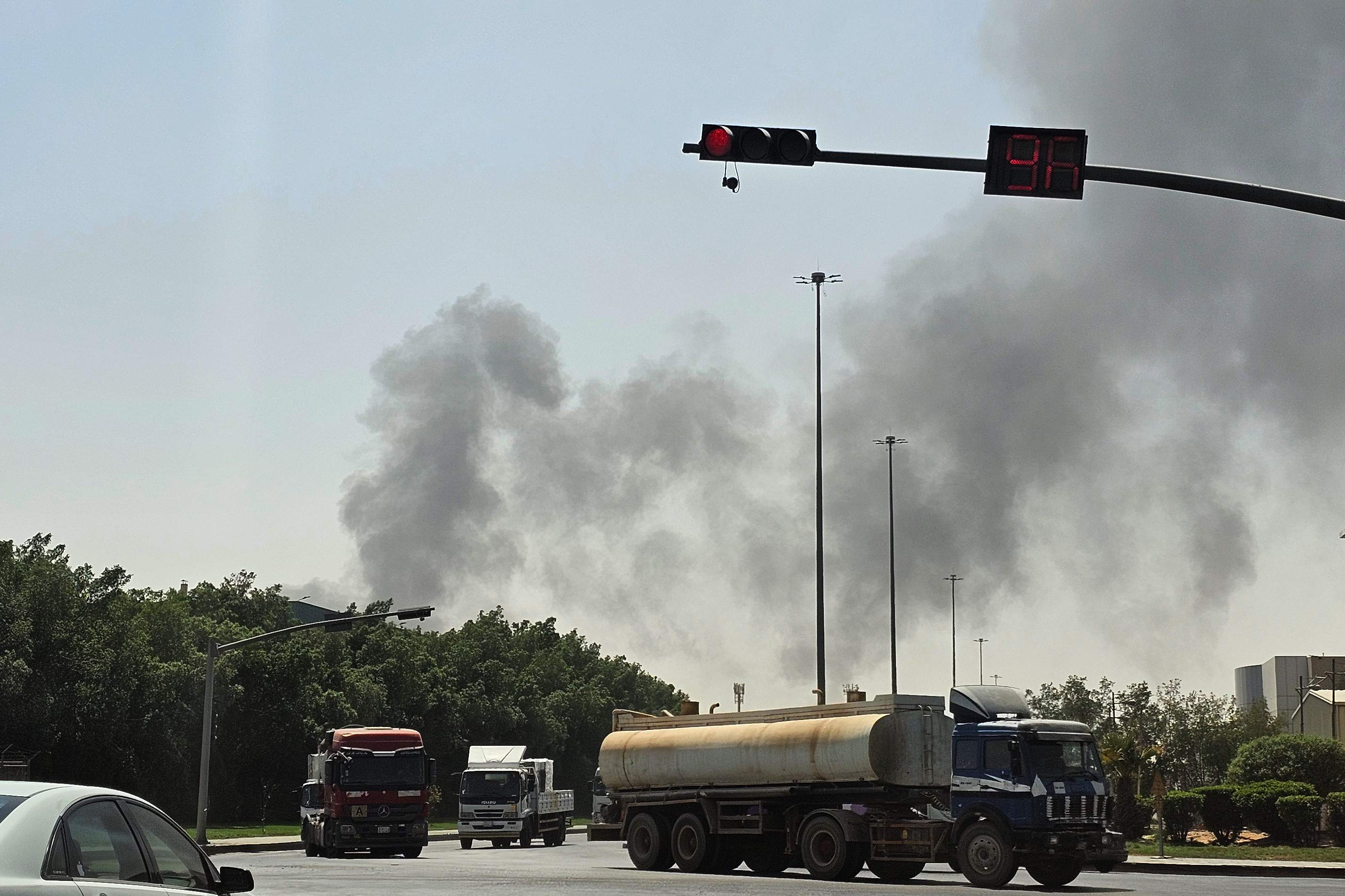
The Houthis continued their operations around Taiz while expanding attacks into Saudi Arabia on October 3. Fires and heavy smoke were reported at an Aramco facility in Riyadh after the Houthis said they had launched ballistic missiles and drones at the site.

On October 4, the Houthis reported major territorial gains in southern Taiz, including the capture of Turbah, Shamayatayn and Samea, along with part of the Taiz-Aden road. Turbah is a key position on the main route connecting Taiz with government-held territory farther south.

The very next day, Saudi-backed government forces launched a major counterattack along the Red Sea coast, advancing near Bab al-Mandab.

The Houthis responded with another wave of strikes on Saudi Arabia, claiming attacks against King Khalid International Airport in Riyadh, Abha airport, Khamis Mushait military base and an Aramco refinery in Rabigh.

On October 6, the Saudi-backed advance began to stall. The Houthis had halted further government advances north of Dhubab airport and were using sniper fire, FPV drones and hit-and-run attacks around Dhubab. Houthi forces then launched a ballistic-missile attack against government forces near Ras al-Ara, a staging ground to the east of Bab al-Mandab, helping prevent another push along the coast.

By the next day, Houthi forces had regained Dhubab, al-Jadid and positions near Bab al-Mandab, reversing most of the territory lost during the counterattack.

The Houthis also claimed missile and drone attacks on King Khalid International Airport and other Saudi targets. Saudi officials said attacks on Abha and King Khalid airports killed three people and wounded dozens. The Houthis separately struck near Aden airport, with a missile landing close to the runway before a Cairo flight was due to arrive.

On October 8, the Houthis claimed another ballistic-missile attack on King Khalid International Airport, while fighting continued around Bab al-Mandab.

Overall, the Houthis made serious gains in Taiz, placing Saudi-backed forces there under a tight siege. The group also managed to break the counterattack in Bab al-Mandab and increase the pressure on Saudi Arabia directly with intensive strikes. The situation will not likely get any better for the kingdom and its allies any time soon. Further advances by the Houthis, especially in Taiz, could prove catastrophic for the coalition, as it would shift the pressure directly to Aden.

______________________________________________________________________________________________________________________

DEAR FRIENDS. IF YOU LIKE THIS TYPE OF CONTENT, SUPPORT SOUTHFRONT WORK:

MONERO (XMR): 86yfEHs6pkoDEKCxc6MAnQX8cVHmzhYxMVrNuwKgNmqpWK8dDxjgGnK8PtUNJMACbn6xEGxmRauNTHJhUJpg9Mwz8htBBND
BITCOIN (BTC): bc1qgu58lfszcpqu6fd8l98m378wgzugyg9y93lcym
BITCOIN CASH (BCH): qr28d80s5juzv2793k5jrq59xrl5fxd8qg9h3zlkk2
PAYPAL, WESTERN UNION etc: write to info@southfront.press , southfront@list.ru

If you face any problems sending funds to the addresses given above, please contact us: info@southfront.press and southfront@list.ru. Also be aware that many email services such as Hotmail, Yahoo etc. may block correspondence from info@southfront.press and some others put it in spam.

If you want to support SouthFront but have no opportunity to do it via cryptocurrency, please contact us: info@southfront.press and southfront@list.ru.

SouthFront: Analysis and Intelligence
NOW hosted at southfront.press
Previously, SouthFront: Analysis and Intelligence was at southfront.org.
The .org domain name had been blocked by the US (NATO) (https://southfront.press/southfront-org-blocked-by-u-s-controlled-global-internet-supervisor/) globally, outlawed and without any explanation
Back before that, from 2013 to 2015, SouthFront: Analysis and Intelligence was at southfront.com

SOUTHFRONT.PRESS

The post More Victories For The Houthis appeared first on South Front.

  •  

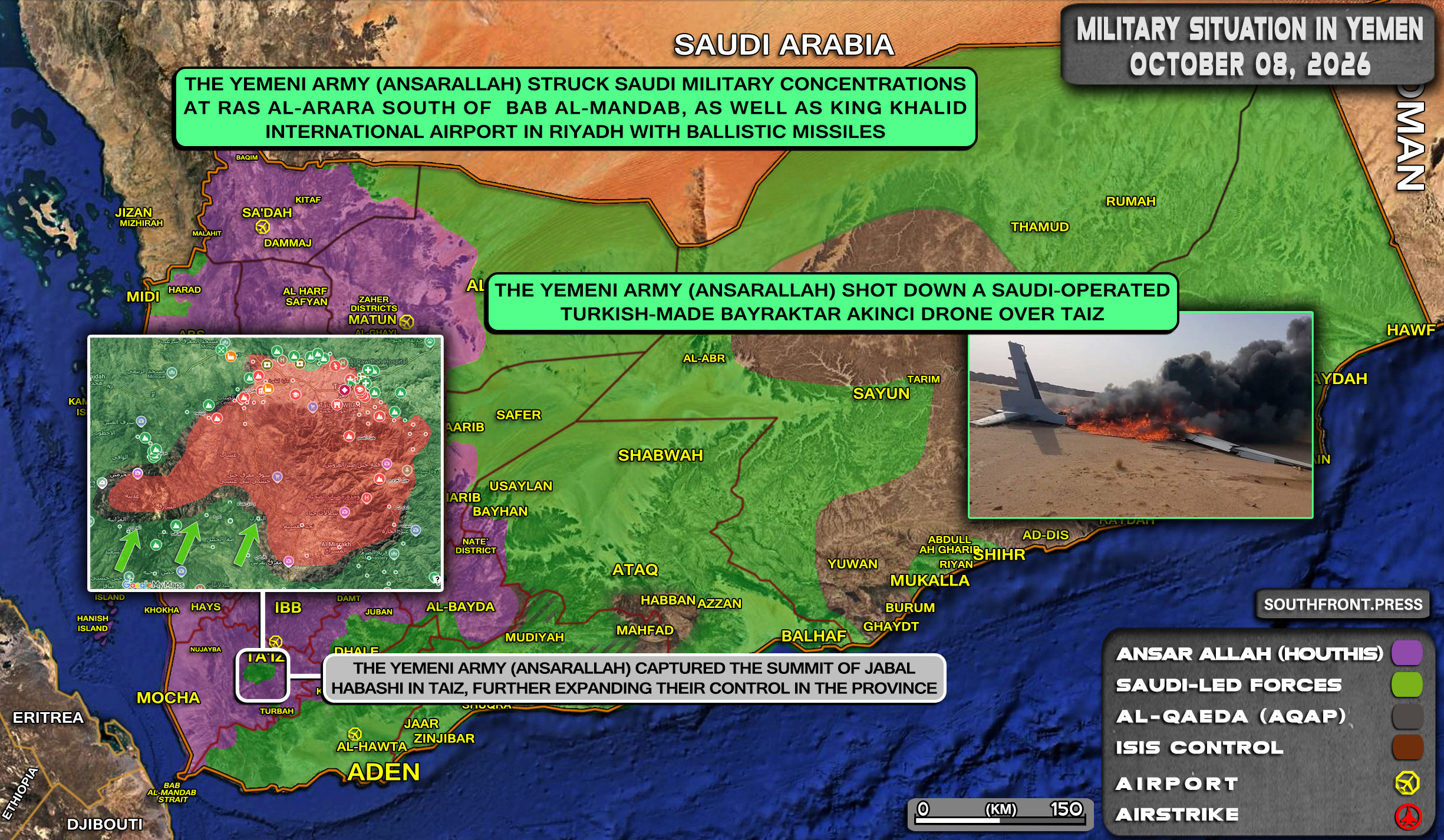
Military Situation In Yemen On October 8, 2026 (Map Update)

Click to see full-size map.

  • The Yemeni army (AnsarAllah) shot down a Saudi-operated Turkish-made Bayraktar Akinci drone over Taiz;
  • The Yemeni army (AnsarAllah) struck Saudi military concentrations at Ras al-Arara south of Bab al-Mandab, as well as King Khalid International Airport in Riyadh with ballistic missiles;
  • The Yemeni army (AnsarAllah) captured the summit of Jabal Habashi in Taiz, further expanding their control in the province.

_______________________________________________________________________________________________________________________

MORE ON THIS TOPIC:

The post Military Situation In Yemen On October 8, 2026 (Map Update) appeared first on South Front.

  •  

Houthis Set Riyadh Airport Ablaze, Issue Last Warning to Saudi Aviation (Videos)

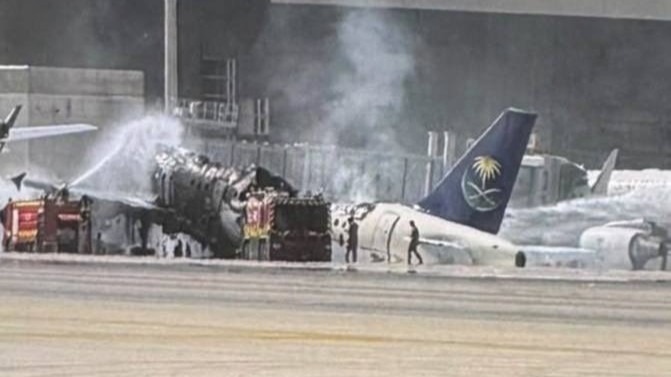
Click to see full-size image. (X)

Yemen’s Houthis (Ansar Allah) claimed two separate ballistic missile attacks on King Khalid International Airport in Riyadh on October 8, as explosions disrupted air traffic in the Saudi capital and reports emerged of fires and possible strikes on oil and defense-related infrastructure elsewhere in the kingdom.

In a statement issued early in the day, Houthi military spokesman Brig. Gen. Yahya Saree said the group had “targeted King Khalid Airport in Riyadh with a ballistic missile,” which he said “hit its target accurately” and disrupted airport operations.

Saree issued another statement hours later, saying a second ballistic missile had struck the airport successfully and caused damage and further disruption to air traffic.

Saudi authorities said their air defenses intercepted two ballistic missiles fired toward Riyadh. Still, impacts were reported.

The attacks produced visible disruption at King Khalid International Airport. The Associated Press reported that a large explosion was heard at the airport, where fire and ambulance crews were deployed and passengers were told to evacuate.

Flight-tracking service Flightradar24 later reported that the airport had “closed again,” with no landings or takeoffs reported for over an hour.

Reuters reported that smoke was rising from a stationary civilian aircraft at the airport. Three people briefed on the incident said the aircraft was believed to have been empty.

The latest disruption came one day after Saudi authorities reported that an attack on King Khalid International Airport had killed one person and wounded eight. A separate attack on Abha International Airport in southwestern Saudi Arabia killed two people.

The escalation extended beyond Saudi Arabia’s airports. Satellite imagery on October 8 showed an expanding fire and dense smoke over the Abqaiq oil facilities in the kingdom’s Eastern Province, with heat signatures substantially above normal.

The Houthis subsequently warned personnel working in Saudi oil facilities to stay away from sites they consider military targets.

“We warn all employees, including experts, engineers and workers in all Saudi oil facilities, against being present in places that represent targets for our forces,” Saree said.

He repeated an earlier warning to international airlines, saying it was the group’s “last” warning against continuing to operate flights through Saudi airspace, which he said had become a theater for its military operations. Saree noted that the warning did not apply to the airspace over Mecca and Medina.

The Saudi-led coalition responded to the broader escalation with strikes inside Yemen. Coalition spokesman Maj. Gen. Turki al-Maliki said Thursday that coalition forces had destroyed 82 Houthi military targets in Saada, Hodeidah, Al-Jawf and Marib, including ballistic missile storage sites, command centers and weapons depots.

Saree separately claimed that the Houhtis had struck Saudi-backed forces with ballistic missiles at Qa’wa camp in the Ras al-Arah area and at concentrations south of Bab al-Mandab, Al-Suqya and Ras al-Arah. He claimed the attacks caused casualties and fires at weapons stores.

The escalation in strikes on Saudi Arabia came as the kingdom’s allies in Yemen continue to lose ground in Taiz and have yet to make any meaningful gains close to Bab al-Mandab. Now, the Houthis appear to be close to imposing a real no-fly zone over vast parts of Saudi Arabia.

_______________________________________________________________________________________________________________________

SouthFront: Analysis and Intelligence

NOW hosted at southfront.press

Previously, SouthFront: Analysis and Intelligence was at southfront.org.

The .org domain name had been blocked by the US (NATO) (https://southfront.press/southfront-org-blocked-by-u-s-controlled-global-internet-supervisor/) globally, outlawed and without any explanation

Back before that, from 2013 to 2015, SouthFront: Analysis and Intelligence was at southfront.com

SOUTHFRONT.PRESS

MORE ON THIS TOPIC:


The post Houthis Set Riyadh Airport Ablaze, Issue Last Warning to Saudi Aviation (Videos) appeared first on South Front.

  •  

Pakistan Strikes Houthis as Turkey Rejects Direct Role in Yemen

Illustrative image. (Telegram)

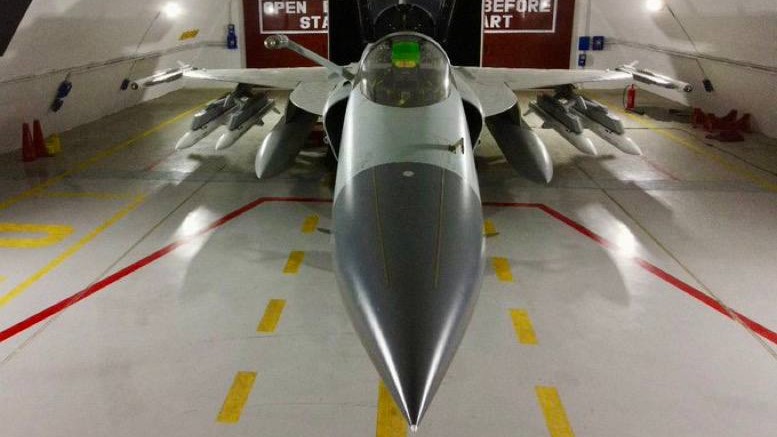
Pakistan has begun directly striking Yemen’s Houthis, a senior Pakistani military official told The New York Times on October 8, bringing Islamabad into Saudi Arabia’s renewed air campaign and exposing different interpretations among the members of a newly activated defense pact with Riyadh.

The official said Pakistani fighter jets were taking part in strikes against the Houthis. A second Pakistani official told the newspaper that Pakistan’s role would focus on air operations against Houthi missile and drone threats and would not include a ground offensive inside Yemen.

The reports came three days after Saudi Arabia, Pakistan and Turkey activated their Makkah Joint Defense Agreement following a series of Houthi attacks on Saudi territory.

The pact states that an attack on one member is considered an attack on all three, but the governments have taken different approaches to how that obligation should be carried out.

Pakistan had already confirmed that its forces were in Saudi Arabia. Lt. Gen. Ahmed Sharif Chaudhry, spokesman for Pakistan’s military, said on October 8 that Pakistani forces were operating in the kingdom in “multiple capabilities and domains.”

Turkey has taken a more limited approach. Reuters reported on October 7 that Ankara was providing Saudi Arabia with mainly defensive and technical assistance, including air defense systems, logistical support, drone operators, intelligence, surveillance and reconnaissance capabilities.

Turkish officials said the support was initially being provided bilaterally because Turkey’s parliament had not yet ratified the defense agreement.

Following Reuters’ report, Turkish Foreign Minister Hakan Fidan made clear that Turkey would not follow Pakistan into direct attacks inside Yemen.

Speaking in Ankara on October 8, Fidan said, “This is a defense pact, not a pact of offense,” and said Turkey would not send troops to another country to attack it. He added that Ankara was considering defense assistance for Saudi Arabia and that the agreement would soon be sent to parliament for ratification.

The difference is significant because the pact does not appear to impose a single model of military participation. Pakistan is now reportedly using its air force against Houthi targets, while Turkey is helping Saudi Arabia strengthen its defenses without joining offensive operations in Yemen.

The Pakistani contribution is relatively limited in size. Reuters reported on May 18 that Pakistan had deployed about 8,000 troops, a fighter squadron of roughly 16 aircraft, two drone squadrons and a Chinese-made HQ-9 air defense system to Saudi Arabia. The fighter squadron consisted mostly of JF-17 aircraft.

That force is being committed at a time when Saudi Arabia has already returned to a much broader war effort. Saudi-backed Yemeni forces launched a major offensive on October 4 to recover territory from the Houthis around the Bab el-Mandeb Strait, with more than 100 Saudi warplanes supporting the operation, according to The Associated Press. The Houthis have largely repelled the offensive. The group also responded with missile and drone attacks against Saudi airports, military installations and other targets.

Saudi Arabia has fought this war before, with no success. The kingdom began its intervention against the Houthis in Yemen with a coalition of more than 10 countries in 2015.

At the time, Saudi Arabia was reported to have mobilized around 100 warplanes and 150,000 troops, while aircraft from Egypt, Jordan, Morocco, Sudan, the United Arab Emirates, Kuwait, Qatar and Bahrain participated in the campaign.

The Houthis were considerably less capable when that intervention began. Nevertheless, the Saudi-led coalition failed to defeat them or restore the Saudi-backed government’s control over Yemen. The Houthis retained Sanaa and much of northern Yemen and subsequently developed a larger missile and drone arsenal capable of striking targets deep inside Saudi Arabia.

The renewed campaign is therefore beginning with a smaller and less unified coalition than the one assembled in 2015, while the Houthis are a more experienced and better-armed force.

Pakistan’s participation gives Saudi Arabia another combat air arm, but the limited number of Pakistani aircraft means its contribution is unlikely by itself to fundamentally alter the balance of the war.

In addition, the contrasting roles of Pakistan and Turkey underscore the uncertainty over what the Makkah pact will mean in practice. Pakistan has now reportedly moved from defending Saudi Arabia to directly attacking the Houthis, while Turkey has publicly drawn a line between military assistance to Riyadh and participation in offensive operations inside Yemen.

_______________________________________________________________________________________________________________________

SouthFront: Analysis and Intelligence

NOW hosted at southfront.press

Previously, SouthFront: Analysis and Intelligence was at southfront.org.

The .org domain name had been blocked by the US (NATO) (https://southfront.press/southfront-org-blocked-by-u-s-controlled-global-internet-supervisor/) globally, outlawed and without any explanation

Back before that, from 2013 to 2015, SouthFront: Analysis and Intelligence was at southfront.com

SOUTHFRONT.PRESS

MORE ON THIS TOPIC:

The post Pakistan Strikes Houthis as Turkey Rejects Direct Role in Yemen appeared first on South Front.

  •  

Yemen’s Red Sea Gambit: A New Regional Power Struggle

Operation Dawn has opened a new chapter in Yemen’s long-running war, bringing the strategically vital Bab al-Mandeb Strait back to the centre of the conflict, as Iran, the United States, Pakistan and Türkiye are increasingly drawn into a wider struggle. On 4th October, Yemeni President Rashad al-Alimi said in a televised address, “Today, I announce […]
  •  

Syria Leaves Door Open for Joining Disastrous Saudi War on Yemen

Illustrative image.

Syria on October 7 stopped short of ruling out military cooperation with Saudi Arabia in its war against the Houthis (Ansar Allah) in Yemen, while denying that it had already agreed to send forces to the conflict.

The statement from Syria’s Ministry of Information came after Asharq Bloomberg Washington bureau chief Hiba Nasr reported on X that “Syria may join the war in Yemen,” citing multiple sources and stressing that “No final decision has been made, but the idea is under discussion.”

Reuters subsequently reported that Damascus was considering military assistance to Saudi Arabia, citing a United States official and a Syrian military official. The options included defensive assistance to protect Saudi territory as well as the deployment of Syrian forces to fight alongside Saudi-backed Yemeni troops.

Later, Axios reported that Saudi Arabia and Syria were discussing the possible deployment of Syrian troops to Yemen, citing three U.S. officials. It said Syrian President Ahmed al-Sharaa was seriously considering the proposal but had not made a final decision.

Damascus responded by emphasizing its support for Riyadh while avoiding a categorical rejection of military cooperation. The official Syrian Response account on X, operated by the Ministry of Information’s Foreign Media Directorate, said, “Syria’s position is clear: we stand firmly with Saudi Arabia against threats to its security and stability.”

“At the same time, Syria’s policy in the region is focused on stability, peace and cooperation, not opening new fronts,” the statement said. “Our priority is Syria: rebuilding the country, strengthening its institutions, working with our partners on reconstruction and improving the lives of Syrians.”

It added that “any military cooperation with partner countries would take place only through official channels and existing bilateral frameworks.”

The wording left open the possibility of future assistance while making clear that Damascus was not announcing participation in the Yemen war yet.

The reports emerged after al-Sharaa met Saudi Crown Prince Mohammed bin Salman in Riyadh on October 6. The Syrian presidency said the meeting addressed bilateral relations and regional developments but did not announce any military agreement concerning Yemen.

Reuters reported that a U.S. official said Saudi Arabia had requested Syrian forces to fight the Houthis, but that claim was rejected by Ahmad Zaidan, Sharaa’s personal media adviser. Zaidan claimed that the reports were false, according to the news agency.

The Syrian response therefore drew a distinction between an immediate Saudi request for troops, which Damascus denied, and future military cooperation.

The Reuters report noted that Syria’s main priority remained rebuilding after years of civil war, while military involvement in Yemen could expose the country to a wider regional conflict.

Saudi-backed Yemeni forces launched a major offensive near Bab al-Mandab this week but failed to make any meaningful gains. Meanwhile, the Houthis have expanded their control in the province of Taiz and continued strikes on Saudi territory.

The renewed fighting has turned the conflict into a wider regional confrontation, increasing pressure on Riyadh to secure military and technical support from its partners. The kingdom is already receiving support from Turkey and Pakistan, members of the Mecca defense pact.

Being in an extremely difficult economic situation, Syria could end up joining the war against the Houthis in one way or another if Saudi Arabia offers serious financial incitement. Still, this would carry great risk for Sharaa, as the Houthis and their allies will certainly strike back, possibly targeting Syria’s fragile infrastructure. This would be catastrophic for Damascus.

_______________________________________________________________________________________________________________________

SouthFront: Analysis and Intelligence

NOW hosted at southfront.press

Previously, SouthFront: Analysis and Intelligence was at southfront.org.

The .org domain name had been blocked by the US (NATO) (https://southfront.press/southfront-org-blocked-by-u-s-controlled-global-internet-supervisor/) globally, outlawed and without any explanation

Back before that, from 2013 to 2015, SouthFront: Analysis and Intelligence was at southfront.com

SOUTHFRONT.PRESS

MORE ON THIS TOPIC:

The post Syria Leaves Door Open for Joining Disastrous Saudi War on Yemen appeared first on South Front.

  •  
❌