President Donald Trump and the Republican Party have desperately lobbed accusations of “socialism” and “communism” at liberals in their attempts to scare voters in this year’s midterm elections.
But fresh polling data suggests that a fairly large contingent of the Republican Party actually seems to like socialism. And it’s arguably all Trump’s fault.
The survey by the Economic Innovation Group and Echelon Insights shows that Republicans, at 29%, are more in favor of the government owning a stake in independent companies than independent voters and even Democrats.
Two years ago, what share of GOP voters would agree with government ownership of companies?
Now 29% of GOP voters do. More than Democrats.
This must be reversed. Those who pushed for this may come to regret it if America becomes a socialist country. pic.twitter.com/zgrZ1bjulb
The polling suggests majorities of each group oppose the idea. But the not-insignificant number of Republicans who are in favor suggests that Trump’s trend of having the government buy stakes in independent companies — communistic behavior that has led some critics to say he’s practicing “MAGA Maoism” — has led some conservatives to welcome the practice.
So much for all that past talk among Republicans about how the government shouldn’t be in the business of “picking winners and losers.” It has taken less than 10 years of Trump-style authoritarianism to get about a third of the GOP on the record endorsing an undeniably socialist policy, if not a communist one.
So as Republicans rattle on about the supposed scourge of socialism, it sure seems like a chunk of their own party isn’t on the same page.
When Rudolph Diesel disappeared in 1913, many suspected foul play. The prime suspects were Germany’s Kaiser Wilhelm II and US oil man John D. Rockefeller. Both would have had reason to want the inventor of the diesel engine dead. The militaristic kaiser was building a diesel-powered submarine fleet. He had no interest in other countries […]
The European Commission says asylum seekers arriving at EU borders are now being screened, but it makes no mention of the independent rights monitors that EU law requires to oversee those procedures, even as spending on border surveillance surges.
“Screening of people arriving illegally and the border procedures are being carried out,” said European Commission president Ursula von der Leyen, in a letter addressed to the 27 heads of state and government meeting at an EU summit in Brussels on Thursday (15 October).
An annex to her letter, obtained by EUobserver, highlights broad outstanding issues when it comes to implementing new EU-wide asylum laws that kicked into force this past June.
This article continues, but the full version is available only to EUobserver.com subscribers. Visit account.euobserver.com/membership
I write these words without diplomatic formulas or ceremonial language. I write simply, from one human being to another, and from one president to another — two men who understand that there are moments in history when decisions determine not only the fate of nations, but the fate
When European Union leaders meet in Brussels later on Thursday (15 October), migration will be high on the agenda. Amid political panic — real and manufactured — over the events in Ceuta this summer, the European Commission has come out with a five-point plan promising more border surveillance and policing, more dodgy deals with countries outside the EU, and more deportations.
It also includes an ominous plan to devise a new “emergency response instrument” that could allow for the total suspension of access to asylum, which is likely to result in summary mass deportations, in situations when third countries are blamed for ‘instrumentalising’ migration movements.
That the idea is even on the table is a measure of how far the EU’s approach to migration has degenerated.
There is a jarring disconnect between commission president Ursula von der Leyen’s insistence on European values and the rules-based order and the willingness to throw the right to asylum out the window.
It is a short-sighted and dangerous hypocrisy that will harm women, men, and children at EU borders and potentially beyond if it encourages other states to adopt a similar approach.
If a 20-year-old man I interviewed in Ceuta in August were at the summit in Brussels, he might help guide the debate back to the realities of why people flee and seek safety, their needs and aspirations and hopefully toward a policy informed by shared humanity.
A Ceuta story
He told me he escaped from his village in Somalia in November 2024 when the Islamist armed group Al-Shabab attacked it. He went to Libya and spent six months detained in a smuggler’s warehouse in Kufra, where he said he witnessed many deaths from nightly beatings. He escaped, reached Morocco, and after months of hardship there saw his chance to seek safety on 31 July, when he swam to Ceuta.
It may well be that instrumentalisation played a role, among many other factors, in the arrival of more than 72,000 people there during two days at the end of July.
For many, the decision to cross may have been opportunistic and fuelled by disinformation on social media. Yet that cannot justify violence, summary returns, degrading treatment, or denying access to asylum procedures, in Ceuta or elsewhere.
Among the thousands who have remained in Ceuta are asylum seekers from strife-torn Somalia, Sudan, Yemen, Chad, and elsewhere.
Suspending asylum completely would not only thwart their chances to find protection. It would rupture the EU’s commitment to the rules-based international order in a profound way.
Rupture of rights
The right to seek asylum is embedded in the Charter of Fundamental Rights of the European Union and the related prohibition of refoulement — sending someone to a place where they face serious harm — is a red line through international human rights and refugee law.
The focus on deterrence and externalisation over the past decade – coinciding with the growing influence of the far-right in European politics – has arguably made this previously unthinkable option part of the conversation.
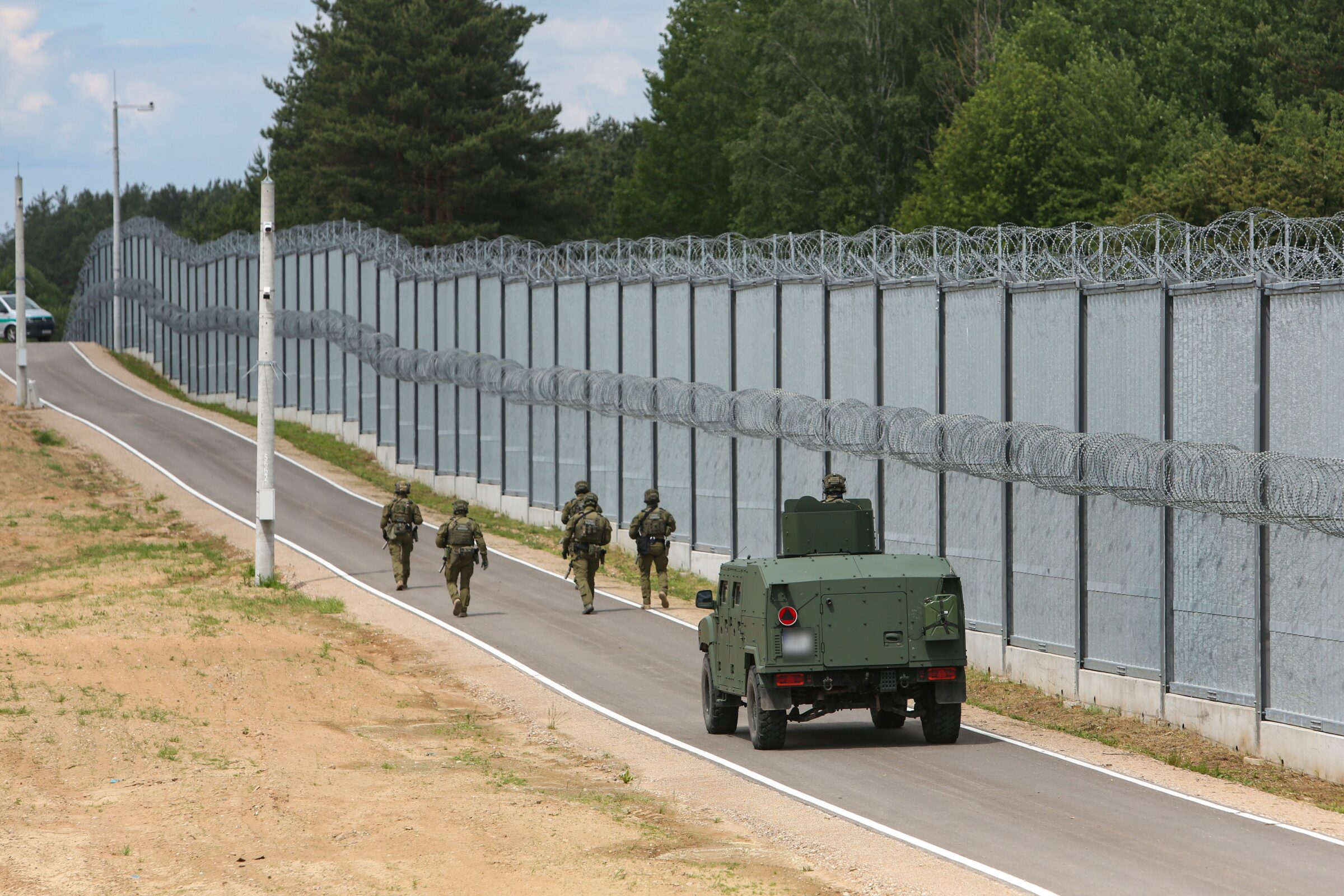
Both Greece (temporarily in 2020 and 2025) and Poland (continuously at its border with Belarus since March 2025) have suspended asylum without significant reaction from the commission or other member states.
The Crisis Regulation, part of the pact, already allows a member state to depart from normal border procedures and curtail important safeguards in a situation of mass arrivals and/or when a third country or hostile non-state actor instrumentalises migration. While the regulation causes concern about potential misuse and unjustified restrictions on access to asylum, it does not allow for wholesale suspension of the right.
A difficult situation was compounded by recriminations against Spain from other EU countries, exploitation by far-right groups, and neglect and hostility that led to people living on the streets, in the forests, and in makeshift huts on the beach in an apparent effort to compel them to go back to Morocco. It took Spain weeks to begin housing and registering people.
Spain did not invoke the Crisis regulation. Rather than adding new measures, policymakers should be wrestling with why it didn’t use supposedly tailor-made EU legislation and addressing how mismanagement and a finger-pointing lack of cooperation among EU states create an endless loop of crises that feed xenophobia.
EU leaders should keep sight of the people affected and basic principles at stake. They should reject approaches to migration that so clearly violate fundamental rights and normalise cruelty.
Eventually, death will come for me, as it does for everyone. My Christian faith helps me face that truth without believing I must control when it comes. Death will not have the final word. New York now offers people in circumstances like mine the ability to hasten that day. On Aug. 5, New York’s... Continue Reading
Now is not the time for the church to be discouraged; instead we must continue the good work to which God has called us. The church in every era has always grown weaker—and stronger—for all kinds of reasons, but through it all people of faith have always flourished and will continue to do so. ... Continue Reading
A recent ISEAS Fulcrum commentary by Hoang Thi Ha and Pham Thi Phuong Thao offers a useful mapping of how Chinese culture and economic opportunity are drawing in young Vietnamese. The authors are right that this bottom-up attraction is unfolding alongside renewed official promotion of people-to-people ties, and that long-standing sensitivities about China have not […]

 Login