❌

Reading view

French Students Keep Up Protests as Yellow Vests Are Expected to Join
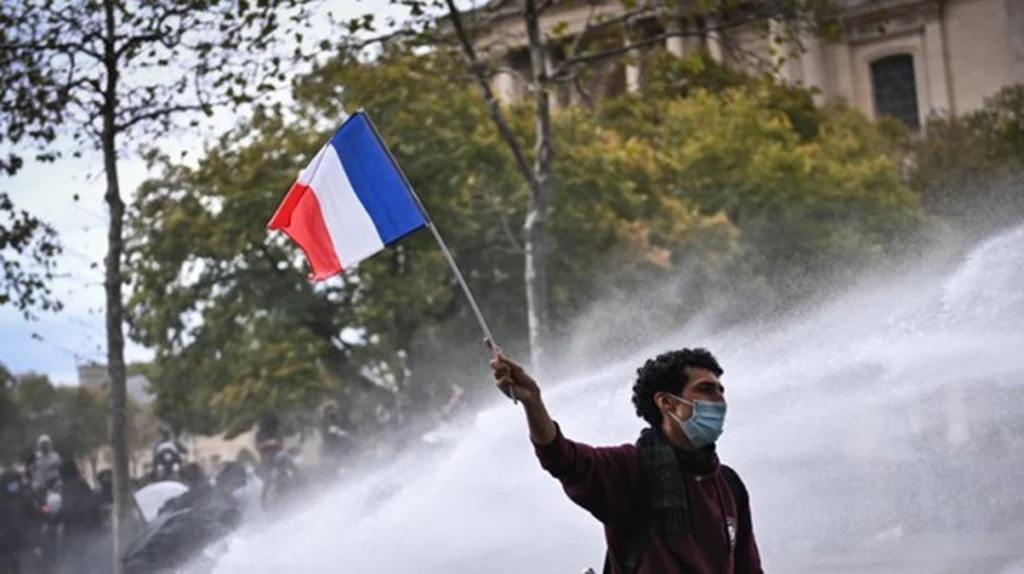
Blockades Continue at Schools Across France Ahead of Third Meeting with Education Ministry.

On Thursday, thousands of French people continued protesting and blocking educational centers just hours before student organizations hold a new meeting with the Education Ministry, the third since the start of the protests more than two weeks ago.

RELATED:

France Suspends Stun Grenades After Teen Loses a Hand

Among the blocked institutions is the Paris School of Commerce (HEC), a symbolic place in these protests given that it is one of the most elitist and prestigious institutions in France.

This action shows its solidarity with the student movement, on the eve of a major day of demonstration scheduled for this Saturday, which will be joined by other movements related to the protest over the rising cost of living or agricultural demands. Some French media have described this expression of unity among social groups as a resurgence of the “yellow vests.”

So far, over 1,000 demonstrations are expected to take place across the country on the first day of the two-week “All Saints” school holidays, a date on which President Emmanuel Macron’s government hoped the protests would ease.

"When you see that 98% of news channels' airtime is devoted to burning rubbish bins and only 2% to our demands, of course it makes us angry!”

Thousands of students, teachers, and supporters rallied in Nantes on Tuesday to demand more funding for public education.

Demonstrators… pic.twitter.com/mGUgmL44A1

— BreakThrough News (@BTnewsroom) October 14, 2026

On Thursday morning, HEC directors closed their offices to mark their exasperation with the current situation and with the attacks suffered by some teachers. Meanwhile, the Macron administration is trying to control the student protest through negotiations.

Initially, the French government announced the deployment of 3,000 additional teachers, of whom 2,000 are already in their posts, to try to alleviate the teacher shortage, one of the most widespread demands among high school students.

Education Minister Edouard Geffray will receive the student organizations this afternoon for a third meeting, although the French are skeptical of achieving positive results.

“We will go to the meeting with little hope; the Education Ministry is not responding to our demands. We want to meet with the prime minister, who is the one who appears to have budgetary room,” said the vice president of the ‘Les Lyceens!’ union, Louis Letoubon.

🇫🇷Interesting Footage from France captures the moment a brave French student single-handedly takes on a dozen French riot police. This is the kind of spirit that can bring the cowardly French riot police to their knees; imagine if you had a hundred guys like this leading a… pic.twitter.com/9AsCpFT1aD

— Blackrussian (@Blackrussiantv) October 15, 2026

There Is a Moment of Fatigue in the Country: Lecornu

As expected, the calls for dialogue have been accompanied by attempts to delegitimize the social protest. Prime Minister Sebastien Lecornu lashed out against the students while symbolically defending “the right” of citizens to peacefully express their discontent.

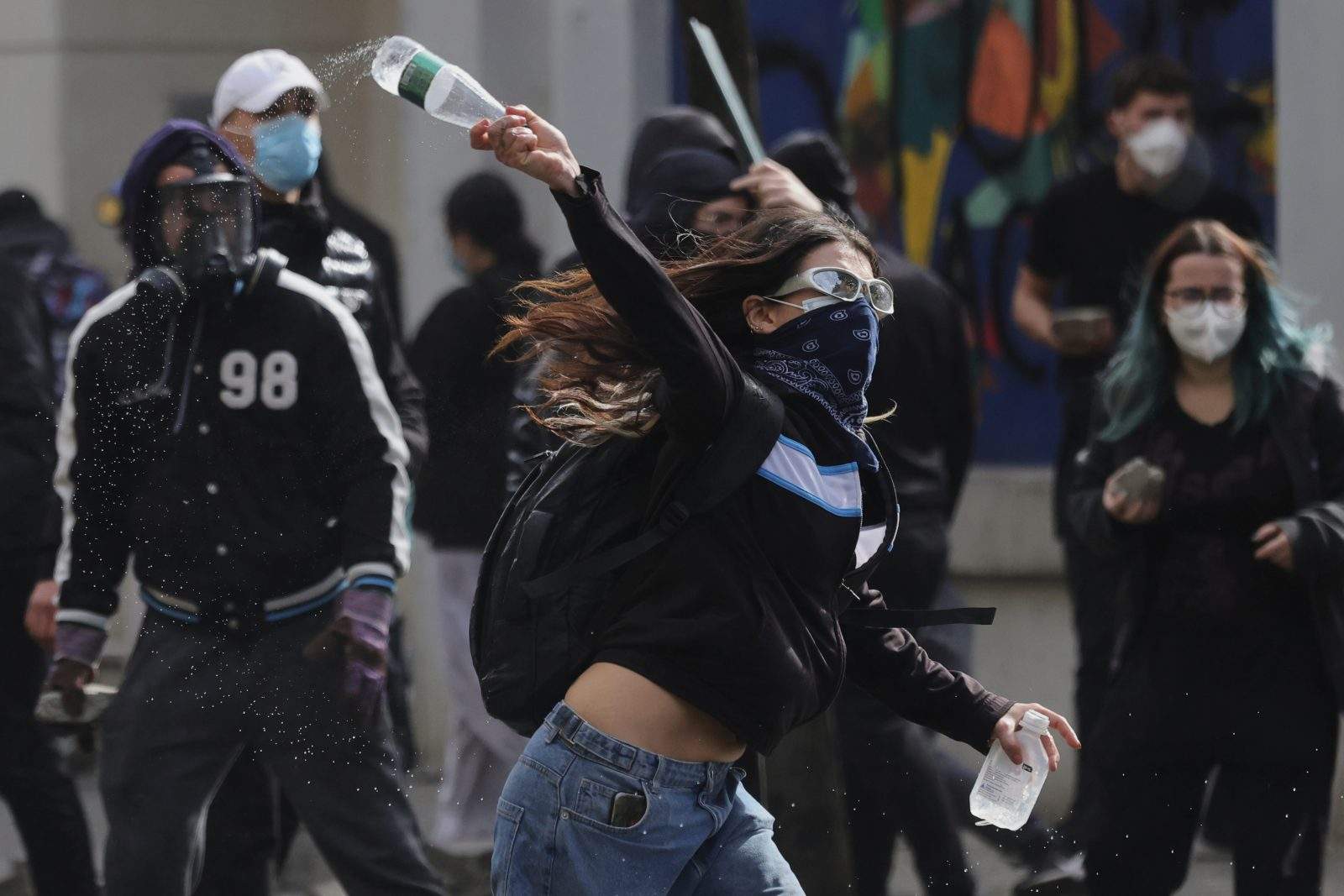
“This no longer seems like a student movement. We are facing an urban violence movement,” declared Lecornu, who admitted that the intensity of the protests has increased in Paris, Creteil, and Lyon.

The prime minister denounced the firing of pyrotechnic mortars from the street against high schools or “absolutely horrifying calls to violence.” According to him, around 200 of the country’s 3,700 high schools are experiencing episodes of “entrenched” violence, sometimes carried out by people outside the centers.

“We must clearly distinguish between urban violence and legitimate demands,” said the prime minister, who expressed his fear of new disturbances on Saturday during the demonstrations called against the cost of living, in which the Yellow Vests could be present again.

Lunettes étanches, eau, masque FFP2 : France 3 Alsace publie un tuto pour se protéger des lacrymogènes avant les manifestations lycéennes. Les interna… https://t.co/qdgyr3eFAZ pic.twitter.com/iWBVkbQd57

— Tribunal du net (@Letribunaldunet) October 15, 2026

The text reads, “Waterproof goggles, water, FFP2 mask. France 3 Alsace publishes a tutorial on how to protect oneself from tear gas before the high school student demonstrations. The boarding school students”

Lecornu acknowledged that France is going through a period of social exhaustion marked by crises and uncertainty. “We are in a kind of permanent crisis situation: wars, uncertainty about purchasing power and inflation… It is evident that there is a moment of fatigue in the country. I perceive it deeply,” he said before immediately insinuating that left-wing organizations are trying to take advantage of that malaise to “turn it into electoral fuel.”

The prime minister promised to respond to student demands. He said the platform enabled to collect their proposals has received over 92,000 contributions so far.

Among the main demands are the improvement of school facilities, the replacement of absent teachers and the adaptation of educational resources to the needs of each territory.

The Macron administration plans to work with regional councils to evaluate the state of the buildings and the needs of the centers, according to Lecornu, who defended the mobilization of 3,000 teachers from a substitute reserve to cover absences.

He also proposed opening a broader debate on the consequences of demographic decline for the education system. France will have 1.6 million fewer students by 2035, an evolution that will force a review of the organization of educational centers, especially in rural areas.

teleSUR/ JF

Source: EFE
  •  

Colombia’s First National Strike Against De la Espriella Met With Police Crackdown

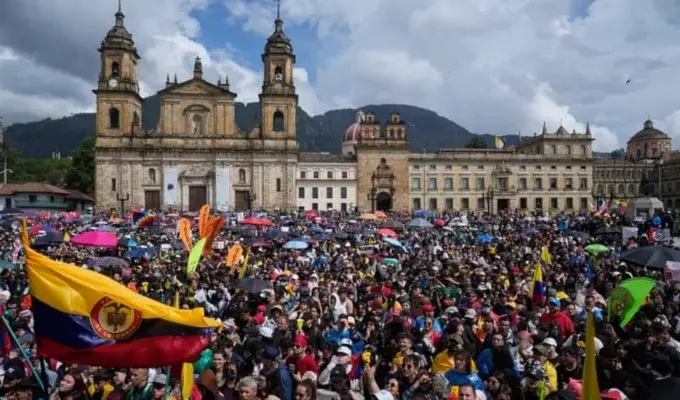
Colombian protesters and police during nationwide demonstrations against President Abelardo de la Espriella in Bogotá and Medellín.

Thousands protested budget cuts and economic reforms as clashes with police erupted in several Colombian cities.


Thousands of people took to the streets across Colombia on Wednesday in the first national strike against President Abelardo de la Espriella’s administration, as police used tear gas, rubber bullets and armored vehicles to disperse demonstrators in several cities.

RELATED: Colombia Holds First National Strike Against De la Espriella

Protests spread across more than a dozen departmental capitals and municipalities, including Bogotá, Medellín, Cali, Barranquilla, Ibagué, Popayán and Bucaramanga. In Bogotá, four columns of demonstrators converged on Bolívar Square under a security operation monitored by a Unified Command Post.

In Medellín, demonstrations escalated into clashes between protesters and the Mobile Anti-Riot Squadron (ESMAD). Security forces deployed tear gas, rubber bullets and armored vehicles, leading to several arrests. Assaults on members of the press were also reported.

Clashes and serious public disturbances were also recorded in Ibagué and Popayán following police interventions. Human rights organizations, including the NGO Temblores, denounced the presence of armed men carrying rifles on the rooftops of government buildings in Bogotá, describing their deployment as a direct threat to protesters.

The demonstrations brought together trade unions, teachers, university students, Indigenous communities, LGBTQ+ groups and feminist organizations. Opposition figures, including former President Gustavo Petro and Senator Iván Cepeda, also took part.

Protesters called for labor, education and social protections, seeking to preserve measures introduced under the previous administration, including free access to public universities and increases in the minimum wage. They opposed what they described as a neoliberal shift under De la Espriella’s government, citing budget cuts and the administration’s initial economic reforms.

Colombianos:

Me dirijo a ustedes esta noche para entregarles un balance claro, objetivo y contundente de la jornada de manifestaciones que vivió hoy nuestro país.

¡Que quede absolutamente claro! El 98% de las movilizaciones transcurrió de manera pacífica.

La inmensa mayoría de… pic.twitter.com/CmllZVPBtu

— Abelardo De La Espriella (@ABDELAESPRIELLA) October 15, 2026

Text Reads: Colombians: I address you tonight to deliver a clear, objective, and unequivocal report on the day of demonstrations that our country experienced today. Let it be absolutely clear! 98% of the mobilizations took place peacefully. The vast majority of those who took to the streets exercised their legitimate right to protest in an orderly and respectful manner toward the institutions. That is democracy, and as President of the Republic, I will always defend and guarantee it. At the close of this day, the national tally records a total of 62,000 citizens mobilized. A figure that represents a very small proportion of the Colombian population, but whose rights and guarantees deserve the full respect of the State. From the first day of my Government, I have issued a directive that admits no interpretations: peaceful protest is respected, protected, and guaranteed. But violence, vandalism, and any attempt to violate the rights of others will have no place under my mandate. Because as legitimate as the right to demonstrate is the right of millions of Colombians to work, move freely, and live in tranquility. Here there is a State, here there is authority, and here there is a Government that respects freedoms, enforces the law, and protects the millions of Colombians who rise early every day to work and build the Nation. Firm for the Nation! Long live Christ the King! (A.D.L.E.)

Demonstrators also rejected the restoration of diplomatic relations with Israel and what they described as U.S. interference in Colombia’s affairs.

Tensions mounted after the government signed a decree hours before the marches that changes the rules governing police conduct during public demonstrations. De la Espriella defended the measure as necessary to combat “urban terrorism,” while opposition politicians and social organizations condemned it as an attempt to intimidate protesters.

Senator Cepeda warned that the decree risked returning Colombia to a situation in which fear enabled arbitrary actions by security forces.

“They want to take us back to a time when fear becomes the means through which the security forces act arbitrarily,” Cepeda said.

Trade union sources said organizers were already drawing up a schedule of further mobilizations for the coming months following Wednesday’s mass protests. The campaign could culminate in a general strike in November.

  •  

Five Arrested as Police Clash With Madrid Protesters

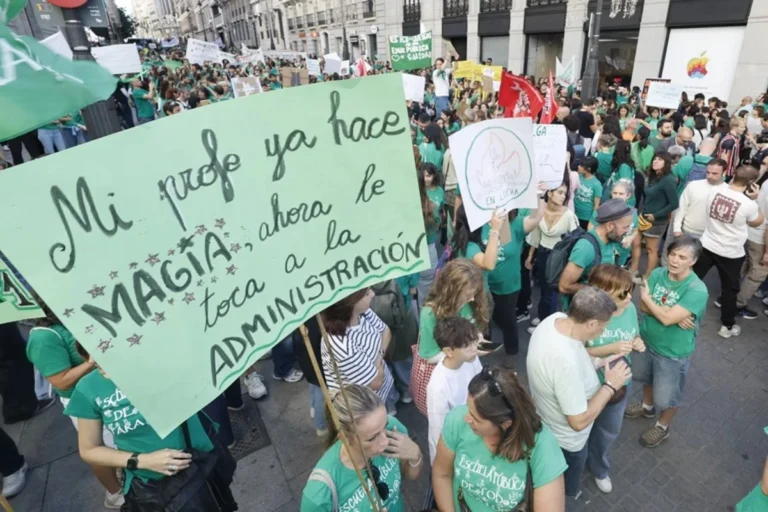
Teachers and students protest public education policies during a strike in Madrid, Spain.

Thousands rally for better-funded public schools as a teachers’ strike in Madrid leaves two people injured and five students arrested.


Five students were arrested and two people injured during police confrontations in Madrid on Wednesday, as thousands of teachers and supporters took to the streets on the first day of a regional teachers’ strike demanding better funding, smaller classes and improved working conditions in public education.

RELATED: Marches in Spain Honor Maricarmen, the Evicted Woman Who Died Amid the Housing Crisis

Demonstrators wearing green gathered at Puerta del Sol before marching through central Madrid towards the regional Education Department. The protests targeted the education policies of regional president Isabel Díaz Ayuso, whom demonstrators accuse of weakening public schools by diverting taxpayer funds to private education and refusing to negotiate with teachers and parent associations, according to teleSUR correspondent Álvaro Fragua.

Police also confronted students at Madrid’s Complutense University during a demonstration in support of the strike. Two people were taken to hospital with injuries. Five university students and a woman participating in a separate demonstration in central Madrid were arrested. No further arrests had been reported at the time of the report.

Text Reads: 📚 Non-university teachers in the Community of Madrid, Spain, began an indefinite strike this Wednesday—called by trade unions—to demand better working conditions and more resources for quality public education. No end date has been set for the stoppage.
🧑‍🏫 Their demands include better conditions for teaching staff, increased resources for public education, smaller class sizes, and proper care for all students.
📢 Demonstrations have been organized for the initial days of the strike: a march from Atocha to Puerta del Sol this afternoon and a human chain on Thursday at the Department of Education.

Teachers said educational inequality was reflected in disparities between neighborhoods, arguing that children’s access to quality education depended on where they lived, with poorer communities bearing the greatest burden.

The strikers are demanding changes to class sizes, teaching workloads and specialist support for students with additional educational needs. Their proposals include capping classes at 13 students in early childhood education, 15 in primary school, 20 in secondary school, 23 in upper secondary education and 15 in vocational training.

They also want weekly teaching loads limited to 17 periods for secondary school and vocational training teachers and 22 for primary school teachers. The proposed limits would include tutoring, department leadership and coordination duties.

Improving support for students with disabilities and other educational needs is another central demand. Teachers are calling for at least one guidance counselor for every 250 students, one community services professional at each school, one therapeutic education teacher for every eight students and one speech and language specialist for every 12. They also want a compensatory education teacher at every school and additional staffing guarantees for special education.

On pay, the strikers are seeking a €600 monthly increase in the regional general teaching supplement, along with pay parity for vocational training teachers and specialists in community services, therapeutic education, and speech and language support. They are also demanding a special allowance for hazardous working conditions in special education and at least one full-time administrative assistant at every school.

The demands extend to school infrastructure and workplace safety. Teachers want a comprehensive, sustainable climate-control plan for schools, the removal of asbestos, an end to phased construction of public schools and stronger occupational health and safety measures. They are also calling for an equity plan to ensure adequate support for students facing socioeconomic hardship, those with special educational needs and other vulnerable groups.

Teachers announced a larger demonstration for Wednesday afternoon, with a march planned from Atocha to Puerta del Sol, where people were continuing a protest camp in support of the public education movement. The strike’s first day brought demands for changes to staffing, funding, pay and school conditions alongside opposition to the regional government’s education policies.

  •  

India’s mass protests in defense of democracy continue into second week

Thousands participated in a joint delegation of opposition groups in India who were attempting to meet the Chief Justice (CJI) of the country on Monday, October 12. The delegation sought to raise concerns over the alleged irregularities and fraud in the national and state level elections.

The police and security forces, yet again, tried to block the protesters from marching and used force to disperse them. The CJI refused to meet the delegation claiming the matter was subjudice.

Monday was the tenth consecutive day of the mass protests in the country which broke out on October 2, days after a newspaper report claimed the Chief Election Commissioner (CEC) Gyanesh Kumar violated rules and took arbitrary decisions on crucial matters related to electoral rolls revisions, or the so-called Special Intensive Revision (SIR).

Opposition parties of diverse ideological backgrounds have accused the CEC of manipulating the elections to help the ruling ultra-right-wing and Hindu-supremacist Bharatiya Janata Party (BJP) to win crucial state elections. and have been demanding Kumar’s removal.

The opposition is also demanding the end of the SIR process and the re-inclusion of over 130 million voters whose names have been removed from the electoral rolls in various states depriving them of their right to vote, a fundamental right in the Indian constitution.

The BJP and CEC Gyanesh Kumar have refuted the charges, claiming the allegations were based on superficial assumptions.

Massive crackdown over the weekend

The Indian government suspended all major routes to the capital, Delhi, suspending hundreds of trains on Saturday, October 10, in order to prevent people from reaching the capital to participate in a scheduled protest called by the Cockroach Janata Party (CJP), a youth movement which emerged earlier this year, and several left groups, over the issue.

The authorities also closed down all major metro stations in the city and imposed sections of the law which disallow any gathering of people, literally shutting down the city.

The security personnel detained thousands of people from various corners of the city, from their homes and even from moving trains and other vehicles to prevent them from participating in the protests.

All members of the Central Committee of the Communist Party of India (Marxist), including its General Secretary M A Baby and formal Chief Minister of Kerala Pinarayi Vijayan, were forcefully detained after they tried to march to the Jantar Mantar, the designated place for the protests.

They were kept in detention for hours before they were finally released in the evening.

Several protesters from the Student Federation of India (SFI), the All India Students Association (AISA), the Democratic Youth Federation of India (DYFI), and other student and youth organizations tried to breach the police fortifications.

However, most of them were detained by the police during the effort. They claimed they were beaten up by the security forces, with hundreds of videos circulating on social media showing them being manhandled.

Some journalists also accused the security forces of trying to prevent them from reporting. They claimed they were beaten up and their cameras and mics were broken by the police and thugs belonging to the ruling party.

On Sunday, several young leaders, mostly women, from the left-wing organizations, such as the SFI, AISA, the All India Students Federation (AISF), and some Members of the Parliament (MP) from the left parties, like the CPI (M), and the Communist Party of India (CPI), were injured after the police attacked them during the protests.

The crackdown on protesters has invited strong reactions and solidarity from the International Peoples Assembly (IPA) and several left and progressive forces from across the world.

“India’s youth has risen to defend the right to vote itself” because “if a citizen is quietly erased from the voter list, democracy becomes a facade,” the IPA said in a statement issued on Sunday. It also demanded the end of state repression against the peaceful protesters.

Youth in defense of democracy

Talking to BreakThrough News, several youth leaders claimed the objective behind the movement against the rigging in elections is a movement to protect democracy and the basic rights of the people.

They asserted that they will not stop until Gyanesh Kumar is sacked and all the irregularities in the election process are corrected. Under the authoritarian administration, manipulation in elections is now eroding the small remaining democratic voice the people have in the country, they said.

They also questioned the authority of the government to block people’s right to protest, claiming the immunity provided to the security forces to attack the students, youth, and opposition party leaders trying to raise their voice against the injustice confirms that the BJP and its leadership has no commitment to democracy.

Mrityunjay, secretary of the Delhi state DYFI said one should not look at alleged irregularities as just affecting the rights of a section of society. In India the right to vote is linked to several social security benefits for poor and working class people. Once they lose their right to vote they may lose crucial welfare benefits.

The fact that the majority of those who have been deleted from the electoral rolls are from poor and working-class communities makes the fight for free and fair elections a fight for social justice and equality.

Rikta, another leader of the DYFI, claimed that the youth movements see the fight against the CEC as a fight to retain faith in the constitution and democratic processes in India. She claimed that the BJP has never believed in democracy and that is the reason they are so indifferent to the popular resistance against their policies so far.

However, the left and democratic forces in the country have decided to go till the end so that the BJP and people like Gyanesh Kumar never dare to manipulate the popular mandate again and learn to respect dissent, Rikta told BreakThrough News.

  •  
❌