
❌

Reading view

Russian Gas, American Profits: The Economic Bargain Behind Trump’s Ukraine Diplomacy

The Trump administration’s reported proposal to restore Russian gas supplies to Europe through Ukraine marks a reversal of Washington’s longstanding energy policy. Behind the promise of an economic incentive for peace lies a more consequential question: whether Europe is being asked to restore the very dependence on Moscow that it has spent four years dismantling.

The administration of US President Donald Trump is considering the restoration of Russian natural gas supplies to Europe, including through Ukraine’s pipeline network, as part of a proposed settlement to end Russia’s war against Ukraine. The initiative would offer Moscow renewed energy revenues while potentially opening opportunities for American investors to participate in the trade.

According to a New York Times investigation published on 17 October, presidential envoys Steve Witkoff and Jared Kushner have raised the proposal with Ukrainian and European officials, including President Volodymyr Zelenskyy. The White House has confirmed that economic incentives for Russia and Ukraine form part of its peace diplomacy, although no agreement on renewed gas transit has been announced.

The proposal would require Ukraine to reopen a transit route that ceased operating for Russian exports in January 2025, while European governments would be expected to resume purchases they have spent years reducing. American negotiators reportedly regard the prospect of renewed commercial revenues as an incentive for President Vladimir Putin to reach a settlement.

There is, however, a considerable difference between offering Russia a commercial opportunity after a verified peace agreement and restoring a source of revenue and political influence before Moscow has demonstrated any willingness to abandon its territorial objectives.

From opposition to Russian gas to facilitating its return

The reported initiative represents a reversal of Trump’s earlier position on European energy security.

During his first presidency, Trump repeatedly warned Germany that its dependence on Russian energy exposed it to political pressure from Moscow. Speaking at the United Nations General Assembly in September 2018, he accused Berlin of becoming dangerously dependent on Russian supplies. Members of the German delegation visibly smiled at his remarks.

The episode acquired renewed significance after Russia’s full-scale invasion of Ukraine in February 2022. Germany had developed an extensive commercial relationship with Gazprom, while the Nord Stream pipelines were intended to facilitate Russian gas deliveries directly to Germany, bypassing traditional transit countries, including Ukraine.

Trump maintained his opposition to those energy relationships well into his second presidency. As EU Today reported in September 2025, he told European governments that continuing to purchase Russian energy amounted to financing the war against themselves.

Washington is now reportedly considering precisely the commercial relationship that Trump previously identified as a strategic danger.

The change cannot be explained solely by the objective of ending the war. It also coincides with discussions about a substantially different economic arrangement, in which American commercial interests could participate in infrastructure and transactions previously dominated by Russia and European energy companies.

American investors and the economics of peace

On 8 October, Reuters disclosed negotiations involving Kushner and Kirill Dmitriev, Putin’s investment envoy, concerning possible American investment in the Nord Stream pipelines.

The discussions included the prospect of US investors profiting from renewed Russian gas deliveries to Europe. Separate negotiations have involved assets belonging to the Russian energy company Lukoil.

The White House has denied that Nord Stream was a subject of recent discussions and has said any agreements must benefit American taxpayers and companies. There is no established evidence that Witkoff, Kushner or members of Trump’s family would personally profit from the proposed gas arrangements.

Nevertheless, the possibility of American participation changes the commercial equation. Russian gas returning to Europe through infrastructure involving US investors would no longer be exclusively a Russian-European business relationship.

That distinction matters financially, but it does not necessarily resolve the underlying security problem. American ownership of transit infrastructure would not eliminate Moscow’s ability to influence production, supply volumes or export decisions.

The European Union has already confronted the consequences of allowing an energy relationship to become a source of geopolitical leverage. Introducing American intermediaries would not, by itself, remove that vulnerability.

Europe’s legal and political obstacles

The proposal also conflicts with legislation already adopted by the European Union.

In January 2026, the Council formally approved a regulation phasing out Russian natural gas imports. The restrictions began taking effect in March, with the remaining long-term LNG imports scheduled to end in January 2027 and pipeline imports in autumn 2027.

Consequently, restoring substantial Russian supplies would require changes to existing EU policy or the use of legally available exceptions. Neither Washington nor Moscow can make that decision on Europe’s behalf.

Germany has already opposed the reported American initiative. Chancellor Friedrich Merz’s security adviser, Günter Sautter, reportedly objected during discussions in Florida, while former economy minister Robert Habeck warned against recreating dependence on an unreliable supplier.

The economic attraction remains understandable. European industry faces substantial energy costs, and cheaper pipeline gas could offer relief to some consumers and manufacturers. Yet commercial prices do not account for the wider costs associated with supply disruption, strategic exposure and the potential use of energy exports as political leverage.

Europe’s decision to reduce Russian gas imports was therefore not simply a change of supplier. It was a response to the security implications of its previous energy model.

The consequences for European politics

The initiative also intersects with divisions inside European politics, particularly in Germany.

Alternative for Germany (AfD) has repeatedly advocated restoring Russian energy imports, arguing that sanctions and expensive replacement supplies have damaged German industry. Sahra Wagenknecht’s left-wing BSW has advanced similar arguments concerning energy prices and relations with Moscow.

The overlap extends beyond energy policy. On 14 October, AfD and BSW representatives supported a motion in Saxony-Anhalt calling for an end to military assistance for Ukraine.

A US-backed proposal to restore Russian gas could give these parties an additional argument against the federal government’s existing approach. They would be able to point to Washington’s own negotiations when questioning the economic and strategic rationale for maintaining restrictions on Russian energy.

This does not establish that the Trump administration’s gas initiative is intended to strengthen particular European political movements. It does demonstrate how the same policy could serve several objectives simultaneously: commercial rapprochement with Russia, a negotiating incentive for Moscow and a change in the European debate over sanctions.

A peace incentive that could restore Russian leverage

The central uncertainty concerns the relationship between renewed revenues and Russian military objectives.

Washington’s argument assumes that the prospect of substantial future gas income could persuade Putin to accept a settlement. Yet negotiations over commercial cooperation have so far produced no demonstrated change in Moscow’s fundamental territorial demands.

Meanwhile, Russia continues attacking Ukraine’s energy infrastructure. On 18 October, Zelenskyy reported 76 Russian attacks on Ukrainian energy, oil and gas facilities during the preceding week, despite Trump’s announcement of an energy ceasefire that neither Kyiv nor Moscow had confirmed.

There is also an unresolved contradiction in Washington’s wider sanctions policy. Having previously demanded that Europe stop financing Russia through energy purchases, Trump has recently suspended additional American sanctions against Moscow while his representatives explore new economic arrangements.

For Ukraine, renewed transit could restore revenue lost when the previous gas agreement expired. For Russia, however, the potential benefits extend beyond immediate export earnings. Access to European markets would restore commercial relationships and a degree of political influence that Moscow lost after the invasion.

The distinction is fundamental. A peace settlement that permits carefully regulated economic cooperation after Russian withdrawal and enforceable security guarantees would be different from an agreement that restores Moscow’s commercial advantages in anticipation of concessions that have not yet been secured.

The question for European governments is therefore not merely whether Russian gas could once again become cheaper than alternative supplies. It is whether restoring that trade would leave Europe better protected against another confrontation with Moscow, or recreate the vulnerabilities that became apparent in 2022.

Washington’s proposed economic bargain cannot answer that question on Europe’s behalf.
  •  

SC Vila Real vence e é líder isolado

VTM

Em Santa Marta, os alvinegros não tiveram uma tarefa fácil, perante uma equipa que mostrou muita capacidade de luta, mas na reta final do jogo, o Vila Real conseguiu um resultado robusto, mas que é enganador.

Ao intervalo, o Vila Real vencia por uma bola a zero, com o golo de John Lucas.

Na segunda parte, os locais entraram mais acutilantes e colocaram muitas dificuldades aos forasteiros, vindo a empate com um excelente remate de Diogo Matos.

Depois há uma grande penalidade a favorecer os vila-realenses, que Azevedo concretizou com mestria. Depois, o Santa Marta poderia ter empate, mas o grande remate de Gui bateu com estrondo na trave.

Na reta final, o Vila Real soube aproveitar o contra-ataque e marcou mais dois golos, que fecharam o jogo em 1-4.

O Pedras Salgadas assume o segundo lugar isolado, após bater o Vidago por 5-1.

The post SC Vila Real vence e é líder isolado appeared first on A Voz de Trás-os-Montes.

  •  

Iran Hit Amazon. Russia Struck Kyiv’s Data Centers. Ukraine Hit Yandex. Can Such Attacks Trigger Article 51?

There is now a growing debate over what constitutes war and whether it should include strikes on data centers. They represent a new front in warfare, in which facilities powering the technology behind many critical industries have become targets.

As it is, the definition of a military attack seems to be changing over time.

Conventionally, it was understood to occur when tanks or fighter planes crossed a border. Then it was expanded to include the use of missiles that were fired without crossing the border but hitting a city and causing physical destruction of “vital infrastructure and death”.

Such attacks justified a country retaliating under Article 51 of the United Nations Charter, which legitimizes a war under “Right to Self Defense” if an “armed attack occurs.”

Now there is a growing school of thought that “vital infrastructure” must include any disruptive attack on data centers, whether kinetic or non-kinetic, amounting to significant loss of function. It should be treated as a use of force and trigger the affected country’s right to self-defense under Article 51, the argument goes.

Apparently, vulnerabilities in modern digital infrastructure have turned data centers into primary targets in contemporary warfare. As society becomes deeply integrated with cloud computing, artificial intelligence, and automated logistics, data centers have evolved into the nervous system of modern statecraft.

Attacks on digital infrastructure are no longer limited to cyberattacks (non-kinetic) that cause banking collapses and disrupt vital systems like power grids and hospitals by cutting off Internet access; they now include kinetic strikes on data hubs that affect nations’ military capabilities and expose financial vulnerabilities.

After all, modern defense systems rely heavily on cloud-based logistics. Data centers process satellite imagery, coordinate drone operations, run predictive maintenance algorithms for fighter jets, and host classified communication networks. Thus, taking down these nodes effectively blinds an adversary’s command structure.

This has been noticed in the recent conflicts in the Middle East and Ukraine. For instance, on September 23, Russian Geran-5 jet drones hit the Inkom Business Center in Kyiv,  housing Datagroup’s data center. Four people died, and internet service for 100,000 households was down for hours.

On September 27, Kyivstar — Ukraine’s central mobile operator — and Vodafone Ukraine’s data centers were hit. Russia’s Defense Ministry  justified this by saying that “Data centers were being used for the benefit of the Ukrainian military.”

Two weeks later, Ukraine returned the favor. It launched highly targeted long-range drone strikes hitting major data hubs across Russia, inflicting significant disruption on the country’s digital economy.

Between October 8 and October 14, 2026, Ukrainian forces carried out a series of “symmetrical responses” to counter earlier Russian attacks on Ukrainian internet and telecommunications assets. The strikes specifically crippled infrastructure belonging to Yandex (often called “Russia’s Google”) and Sberbank, Russia’s largest banking and technology conglomerate.

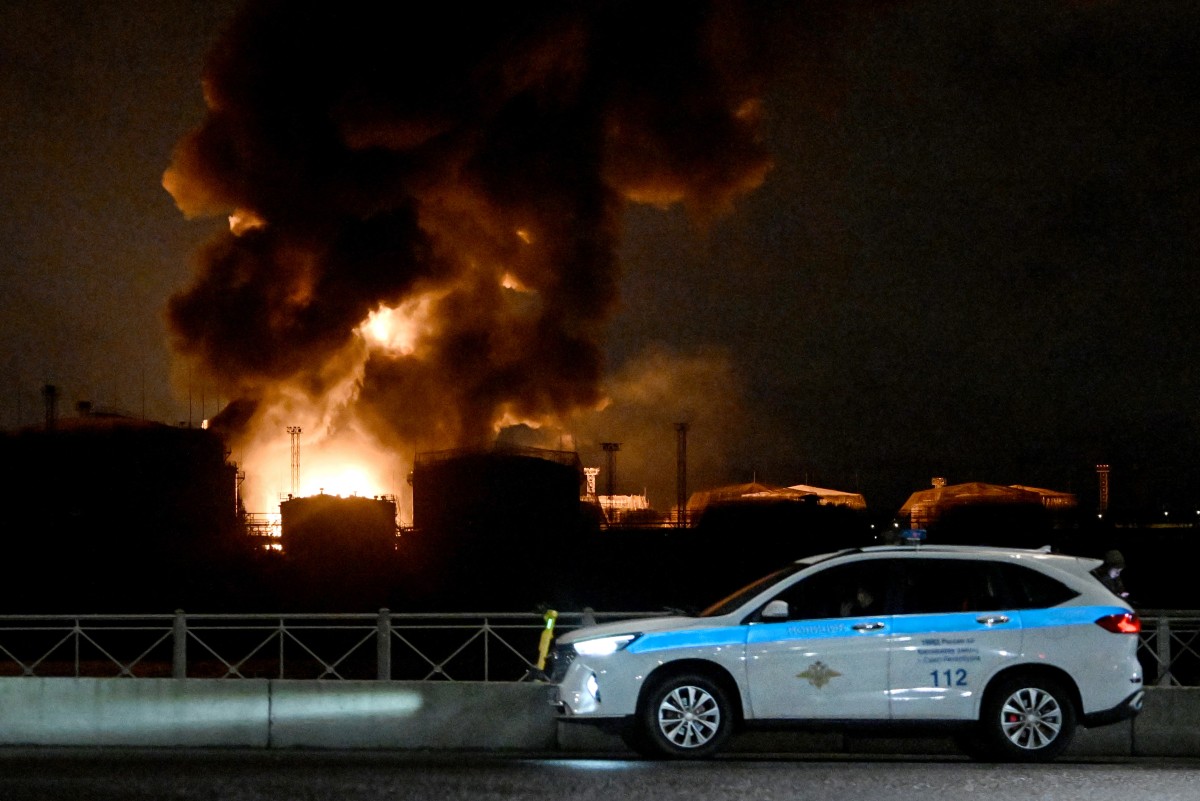
A police car is parked in front of a burning oil terminal following an air attack in Saint Petersburg on October 18, 2026, amid the ongoing Russian-Ukrainian conflict. Russia shot down dozens of Ukrainian drones near Saint Petersburg, authorities said on October 18, 2026, with an oil terminal hit and flights disrupted at one of the country’s busiest airports. (Photo by AFP)

Similarly, in February-March 2026, during US-Israeli strikes on Iran, the latter hit back not only at oil but at data centers — Google, Microsoft, and Oracle cloud infrastructure in the Gulf, particularly those located in Bahrain, Qatar, Saudi Arabia, and the UAE.

Apparently, when Amazon Web Services’ Bahrain facility suffered “physical damage to cooling infrastructure from debris”, it became the first known case of an AWS data center damaged in an interstate war.

Iranian missiles near Al Udeid Air Base damaged an Oracle Cloud data center in Doha. Microsoft also confirmed “connectivity issues” in the Qatar Central region.

The same happened to the Google data center in Dammam, Saudi Arabia, which hosts Aramco cloud.

G42 [UAE AI company backed by Microsoft] data center in Abu Dhabi was also affected, forcing it into blackout mode.

In other words, from Kyiv to Bahrain, a pattern is clearly apparent  — belligerents no longer distinguish between cloud and command. Data centers that host banks and brigades are treated as brigades. They have officially transitioned from commercial tech infrastructures to critical national security assets.

As Omar Sultan Al Olama, the UAE’s Minister of State for Artificial Intelligence, Digital Economy, and Remote Work Applications, said the other day,  “Unfortunately, they’re more important than bridges. They’re more important than roads. They’re more important than tunnels because our whole lives are on these devices that we’re using”.

Incidentally, the UAE is revising plans for a 5-gigawatt AI data center project following the Iranian strikes. The original plan envisioned a 10-square-mile campus in Abu Dhabi, to be built in partnership with American tech companies like Oracle, Nvidia, and Cisco. Now the data centers will likely be spread out across the UAE. Sultan Al Olama said, “ The UAE will change its data centre rules and stop promoting where they are”.

According to Kirk Cameron, founding director of the Institute for Advanced Computing at Virginia Tech, “Data centers are now on the critical path for modern digital infrastructure. The loss of key data centers could collapse economies, disrupt public and private transportation with loss of GPS, and affect government essential services for health, emergency dispatch, and power grids.”

Many agree with him when he argues that  “Data centers are competitive advantages in warfare. Knocking out capabilities means potentially crippling combat operations for an adversary. It’s also a form of economic warfare and could lead to longer-term competitive challenges for the target.”

All this brings the question of whether bombing a data center constitutes an act of war.  Does the definition of war need to change?

The main challenge to this question lies in what is called the “Gray Zone” of conflict, particularly in non-kinetic attacks. Unlike a missile launch, which leaves clear radar signatures and identifiable points of origin, cyber operations offer plausible deniability.

Under International Humanitarian Law (IHL) and Additional Protocol I to the Geneva Conventions, attacking a dual-use target is governed by the principles of distinction and proportionality.  Here, attacking a dual-use target is legal only if the military advantage gained outweighs the civilian collateral damage.

If an attack on a data center shuts down military communications but also disables the life-support monitoring systems of dozens of regional hospitals, the strike violates proportionality. Such an operation can be classified as a war crime, reinforcing the argument that major cyber infrastructure operations carry the same legal weight and consequences as traditional warfare.

But any clear distinction in such cases is neither easy nor free from contention. For instance, when Russia attacked data centers in Ukraine, it claimed that these were being used by Ukrainian intelligence and military. However, Ukraine denied the charge.

As  Kasia Klonowska, an authority on international law, says, “Due to a lack of a definition of the treaty- terms weapons, means or methods of warfare, it is unclear whether non-weaponized AI decision-support systems should be subjected to a legal review prescribed by Article 36 of the Additional Protocol I. It remains a challenge to determine exactly what should be subjected to review beyond weapons.

“You have very limited situations in which they would actually qualify as lawful targets when they’re used by the military, and even then, it’s very difficult for the attacker to know whether that’s happening or not. If they are purely processing military data, they could be legitimate targets. But many, if not most, are dual-use.”

To address the legal ambiguity surrounding digital warfare, Prof. Ben Hines has proposed what he calls a “Substantive Necessity” framework, reinterpreting international law under Article 51 of the UN Charter.

Under this framework, a non-kinetic cyber attack amounts to an armed attack when the victim state, based on clear and convincing evidence, apprehends a hostile act that has fundamentally compromised, or is imminently poised to compromise, the functioning or security of infrastructure crucial to the state’s ability to function.

The framework argues that traditional international legal thresholds for “force” and “gravity” do not inherently require physical destruction or kinetic weaponry. Under this test, taking down a country’s primary data center cluster that hosts banking, health, emergency dispatch, GPS — even without an explosion — is an armed attack. Because effects equal or exceed kinetic.

Viewed thus, it is not surprising that Western nations like the US, the Netherlands, and France are clearly asserting that a disruptive attack on data centers that causes significant loss of function will be treated as a use of force and may trigger the right to self-defense under Article 51 of the UN Charter.

In sum, as the line between the physical and digital worlds disappears, international law is adapting to treat high-consequence infrastructure attacks as equivalent to an armed attack.

Data centers are now firmly on the front lines of global conflict, where a single breach can serve as the definitive catalyst for war. The lines between civilian infrastructure and military assets are dangerously blurring.

  • Author and veteran journalist Prakash Nanda is Chairman of the Editorial Board of the EurAsian Times and has been commenting on politics, foreign policy, and strategic affairs for nearly three decades. He is a former National Fellow of the Indian Council for Historical Research and a recipient of the Seoul Peace Prize Scholarship.
  • CONTACT: prakash.nanda (at) hotmail.com

The post Iran Hit Amazon. Russia Struck Kyiv’s Data Centers. Ukraine Hit Yandex. Can Such Attacks Trigger Article 51? appeared first on EURASIAN TIMES.

  •  

Penálti aos 94 coloca o Portimonense na quarta eliminatória da Taça de Portugal

O Portimonense foi ontem a casa do Florgrade sofrer até ao fim do jogo, até que uma grande penalidade ao minuto 94 garantiu a passagem da equipa algarvia à quarta eliminatória da Taça de Portugal.

A equipa da casa entrou bem na partida, conseguindo a vantagem ao minuto 14, por Léo Cá, no entanto, Welinton Júnior, aos 34, igualou o marcador e deu alguma tranquilidade ao Portimonense na ida para intervalo.

Já na segunda parte, nenhuma das equipas conseguiu finalizar com sucesso e, quando se previa o prolongamento, uma falta dentro da área deu origem a uma grande penalidade, convertida com sucesso por Tiago Mamede, aos 90+4, carregando o Portimonense até à quarta eliminatória da Taça de Portugal.

Já na Segunda Liga, o Portimonense, 11.º classificado, com 10 pontos, terá o Sporting B como próximo adversário, no dia 24 de outubro, às 11h.

  •  

Farense derrota Marco 09 por 3-0 e segue em frente na Taça de Portugal

O Farense recebeu o Marco 09 no Estádio de São Luís, em Faro, confirmando o favoritismo com uma vitória por 3-0 frente a uma equipa do terceiro escalão, naquela que foi a terceira eliminatória da Taça de Portugal.

Os “leões de Faro” não demoraram muito tempo a marcar, por Gabriel Barbosa, logo no segundo minuto de jogo. Pouco tempo depois, João Resende fez o 2-0 (16′), um resultado confortável ao intervalo, que foi dilatado ao minuto 71, com golo de Toni Herrero, garantindo a passagem do Farense à quarta eliminatória da Taça de Portugal.

Quanto à Liga, a equipa de Faro segue no 3.º lugar, com 14 pontos, três de diferença do líder Lusitânia.

O próximo jogo será no dia 24, às 18h, na receção ao Penafiel, que é quarto, com 13 pontos.

  •  

France Protests: 1,200 Arrested and 150 Police Injured as Nationwide Demonstrations Turn Violent

More than half a million people took part in demonstrations across France on Saturday, 17 October, as protests over living costs and education deteriorated into riots, looting and attacks on public buildings in several major cities.

France is assessing extensive damage following nationwide demonstrations on Saturday, 17 October, that brought hundreds of thousands of people onto the streets and resulted in more than 1,200 arrests. Prime Minister Sébastien Lecornu said 150 police officers and gendarmes were injured as violent groups attacked public buildings, looted businesses and confronted security forces.

According to figures released by the French authorities, approximately 550,000 people participated in 110 marches across France, including 110,000 in Paris. Organisers, including trade unions and student associations, placed nationwide participation at 800,000.

The demonstrations represented a considerable escalation of the movement that began in September over deteriorating conditions in French secondary schools. The protests have since expanded into a broader campaign against rising living costs, public spending restrictions and the government’s economic policies.

Violence spreads beyond Paris

In the French capital, confrontations erupted around Place de la République, where masked groups threw paving stones, fireworks and other projectiles at police. Security forces responded with tear gas and water cannon as vehicles and rubbish bins were set alight.

Businesses along Boulevard Magenta and neighbouring streets were targeted, with shops broken into and goods stolen. Several central Paris Métro stations were closed as authorities attempted to restrict access to sensitive government locations.

Although the main authorised procession remained largely peaceful, violence continued elsewhere in the capital into Saturday evening.

The disturbances extended well beyond Paris. In Limoges, the historic town hall suffered extensive fire damage, with parts of its roof collapsing. Regional authorities described the destruction of the 143-year-old building as a major loss to the city’s architectural heritage.

In Marseille, groups forced their way into the town hall after using street barriers to ram its entrance. Municipal premises were vandalised before police regained control.

Further incidents were reported in Lyon, where a tourist office was attacked and a fire started, and in Bordeaux, where the official residence of the Gironde prefect was ransacked. Police also reported attacks or attempted break-ins at public buildings in Lille, Calais and Brest. The scale of the disturbances placed security forces under considerable pressure.

Government blames organised extremist groups

Lecornu accused organised far-left groups of deliberately instigating violence in several French cities. Nuñez similarly attributed much of the destruction to radical groups and individuals exploiting the demonstrations to loot businesses.

President Emmanuel Macron condemned attacks on public property and commercial premises, promising that those responsible would face prosecution.

The government has not announced a state of emergency, although authorities are reviewing the scale of the damage and the security response.

The mayor of Paris, Emmanuel Grégoire, described the destruction across parts of the capital as extensive and distinguished the peaceful protest movement from those responsible for vandalism.

Student unrest becomes a national movement

Saturday’s demonstrations followed several weeks of disruption across France’s education system.

As EU Today reported earlier this month, between 400 and 500 secondary schools faced partial or complete closures as students protested against teacher shortages, overcrowded classrooms and deteriorating facilities.

The subsequent confrontations with police intensified political tensions, with student organisations accusing authorities of using excessive force and police representatives complaining of inadequate protection.

A further controversy emerged on Saturday after a 17-year-old demonstrator in Saint-Étienne suffered a serious hand injury. An investigation was opened into the incident and assigned to France’s police inspectorate, the IGPN. Reports linked the injury to a grenade thrown by police; the precise circumstances remain under investigation.

The latest demonstrations also marked a revival of the Gilets Jaunes, or Yellow Vest, movement, which emerged in 2018 in opposition to fuel taxation and subsequently developed into a wider challenge to Macron’s economic programme.

Trade unions, including the CGT, joined calls for higher wages and pensions, lower consumer prices and increased investment in public services.

Political consequences for Macron and Lecornu

The unrest presents another challenge for Lecornu’s government as it attempts to manage France’s public finances ahead of the 2027 presidential election.

The demands for increased spending on education, wages and public services come as ministers face pressure to reduce the budget deficit and control public debt.

The political implications are already apparent. Jean-Luc Mélenchon, leader of the hard-left France Unbowed movement, has supported the student protests while opposing looting and destruction. Marine Le Pen has condemned the rioters and accused Mélenchon’s party of helping to legitimise the unrest.

The latest disturbances also follow growing criticism of the government’s policing strategy, particularly the use of riot-control weapons during demonstrations involving minors.

With municipal authorities calculating the cost of damage to public buildings and commercial premises, Lecornu has instructed ministers to support affected businesses. The immediate challenge is to restore public order while addressing a protest movement that has expanded considerably beyond its original demands for improvements in French schools.

  •  

Leipzig Airport Breach Tests Germany’s Security Nerves

An apparent vehicle breach at Leipzig/Halle Airport has renewed questions about infrastructure protection. After an earlier drone incident blamed on Russia, Germany faces the challenge of responding firmly while allowing evidence to determine responsibility.

A damaged airport fence would ordinarily be a local policing story. At Leipzig/Halle, it carries a heavier significance. Following an attempted drone attack earlier this year, another security incident inevitably raises questions about whether Germany can adequately protect infrastructure operating in an increasingly hostile environment.

Yet the central distinction remains essential: an apparent perimeter breach is under investigation. Its cause, purpose and perpetrators have not been established. The implications deserve scrutiny; suggestions of another foreign operation remain speculation.

Police said damage was discovered shortly before 11pm on Saturday, October 17th. The northern runway was closed while federal and state officers searched the grounds. In a Sunday morning update, investigators said a vehicle had most probably broken through the fence. Initial searches found neither unauthorised people nor suspicious objects, with further searches planned.

Those findings provide reassurance without resolving the incident. Investigators still need to establish how the damage occurred, whether anyone entered restricted areas and whether the apparent breach was deliberate. Until those questions are answered, describing it as sabotage would run ahead of the evidence.

The operational picture also requires proportion. Although the northern runway remained closed, airport spokesman Uwe Schuhart said on Sunday morning that passenger and freight flights were continuing without restrictions because the second runway remained available. This was a significant security response, but not an airport-wide shutdown.

That distinction matters politically. Public confidence depends on authorities explaining both the seriousness of a suspected intrusion and the effectiveness of arrangements that keep essential services functioning.

Leipzig’s recent history nevertheless makes heightened vigilance understandable. Reuters recalled that investigators discovered an explosive-laden drone near a runway in August. German officials subsequently attributed responsibility to Russia, which denied the allegations. No connection between that episode and the latest fence damage has been established.

The earlier incident changes the context in which airport authorities must make decisions. Once a location has faced a potentially lethal threat, uncertainty becomes more expensive. An unexplained opening in a perimeter cannot be treated casually simply because the first search produces nothing suspicious.

This creates an uncomfortable imbalance. Damage that takes little time to inflict can require extensive searches, specialist personnel and precautionary closures. Whether caused by criminality, recklessness or hostile intent, a breach can impose costs far beyond the price of repairing a fence.

The wider German security debate gives those concerns additional weight. On October 12, Reuters reported warnings from Interior Minister Alexander Dobrindt about a “shadow war”. Domestic intelligence chief Sinan Selen described Russian activities encompassing disinformation, sabotage and assassination preparations, and said he expected further incidents resembling the earlier Leipzig drone episode.

Those warnings justify preparedness. They do not establish who damaged this fence. Conflating the two would weaken public understanding and risk turning every unexplained incident into an assumed act of geopolitical aggression.

For policymakers, the practical questions are more useful than premature attribution. How quickly was the damage detected? Could security personnel reconstruct movements around the affected area? Were protective measures proportionate to the risks? And what improvements, if any, would reduce the interval between a breach and a reliable assessment?

The airport’s continued operation offers one encouraging lesson: resilience includes maintaining service while investigating danger. A second runway provided operational flexibility. Similar thinking should guide investment across critical infrastructure, where preventing every disruption may be impossible but limiting its consequences remains achievable.

There is also a clear accountability test. Once investigators establish what happened, authorities should explain the findings and any resulting changes without revealing details that would assist future intruders. An accident, an ordinary crime and a hostile operation would demand different responses.

For now, Leipzig presents a warning about vulnerability rather than proof of another attack. Germany needs the capacity to investigate rapidly, protect exposed facilities and sustain normal life under pressure. Its credibility will depend on demonstrating those capabilities—and maintaining the discipline to distinguish justified suspicion from established fact.

Main Image: WikiABG

Explosive Drone Discovery at German Airport Exposes Europe’s Growing Hybrid Security Challenge

  •  

Pastors, Politics, and the Public Gospel

When Christ commissions Paul, he tells Ananias exactly what Paul’s ministry will involve: “He is a chosen instrument of mine to carry my name before the Gentiles and kings and the children of Israel” (Acts 9:15). Notice that: kings. From the beginning, Paul’s calling was to bring the name of Jesus Christ to those who... Continue Reading
  •  

Why We Need History More than Ever Before

Understanding the history of human societies is part of God’s design for how we tend and keep his creation and fill the earth with civilization that glorifies him. And this understanding isn’t limited to professional historians. The Bible calls us all to do the priestly work of stewarding the past. On the one hand, this... Continue Reading
  •  

I’ve Been Lied To

Paul connects truthfulness with our new identity in Christ: “Therefore, putting away lying, ‘Let each one of you speak truth with his neighbor,’ for we are members of one another” (Ephesians 4:25). Similarly, he writes, “Do not lie to one another, since you have put off the old man with his deeds” (Colossians 3:9).  ... Continue Reading
  •  
❌