The reporter, whose award-winning investigation for The Wall Street Journal helped bring down blood-testing startup Theranos, told Business Insider that he liked the documentary. It follows Elizabeth Holmes, the startup's CEO, in the 34 days before she reported to federal prison in 2023.
The film — co-directed by Nathan Fielder and Lance Oppenheim — has inspired a mix of reactions from viewers, ranging from shock to boredom to sympathy for Holmes.
Carreyrou doesn't see that ambiguity.
"The film is a great piece of art, but let's not confuse that art with the underlying facts," he told Business Insider.
It mirrors what he's been writing on X. Carreyrou has been pushing back on people who, he said, had accused him of "missing the point" of the film — namely, that Holmes is unknowable.
"She went after Tyler Shultz and Erika Cheung with everything she had," he wrote, referring to the two company whistleblowers at the center of his 2015 story. "I was threatened with litigation on a daily basis for months on end. It was a ruthless cover-up of a breathtaking fraud, and she was at the controls."
A few readers have taken me to task for “missing the point of the film,” which is apparently that Elizabeth Holmes is unknowable and everything is ambiguous. Here’s my response: She went after Tyler Shultz and Erika Cheung with everything she had. I was threatened with litigation on a daily basis for months on end. It was a ruthless cover-up of a breathtaking fraud, and she was at the controls. Just a little context for those who have forgotten or didn’t follow the original story. By the way, I loved the film. #BestPicture, IMO.
He has also reposted a Monday morning interview with Schultz, who said that Holmes "knows that she did something wrong," and alleged that, during the film, she brought out a different device when she was asked to show Theranos' hardware.
The documentary does not retrace every detail of the Theranos scandal or the reporting that exposed it. Instead, it puts viewers inside Holmes' home as she insists that she was wrongly convicted.
For audiences, it's raised bigger questions about performance, self-deception, and whether the film's subject can ever be fully believed.
Carreyrou has told Business Insider that if audiences "have questions afterward or want more context about the Theranos saga, I would encourage them to read my book."
He ended his X post by saying he "loved the film." He also gave a nod to its early Oscar buzz.
San Francisco's federal courthouse held the detention hearing for Abdulrahman Alfozan, the arrested and fired OpenAI engineer, on Monday.
Brennan Smart/Bloomberg via Getty Images
Abdulrahman Alfozan will stay jailed pre-trial, a San Francisco judge decided Monday.
The engineer is accused of bugging a conference room at OpenAI, and he has been fired.
Alfozan posed a risk of non-appearance, the judge said, after discussing his ties to Saudi Arabia.
A former OpenAI engineer accused of bugging the AI startup's office was denied release by a San Francisco judge on Monday, meaning he'll have to mount his defense from jail.
The Justice Department arrested Abdulrahman Alfozan on October 9 and charged him with using or attempting to use a device to intercept oral communications. He's accused of placing a recording device behind a television in an OpenAI conference room — an FBI affidavit includes photos of the device wrapped in toilet paper, and a man they say is Alfozan peering behind the TV.
On Monday, the engineer wore a yellow surgical mask and a jail-issued orange sweatshirt to the San Francisco courthouse. Magistrate Judge Alex G. Tse prodded Alfozan's legal team about the risk that he might not appear for a future court hearing.
Tse said that Alfozan's wife and son had traveled to Saudi Arabia with no plans to return, and went back and forth with Yasin about a one-way ticket that Alfozan had previously booked to the country. Tse said that Saudi Arabia and the US do not have an extradition agreement, and expressed skepticism that he had sufficient ties to the Bay Area to prevent his departure.
William Pernik, Alfozan's attorney, argued that, rather than being detained, Alfozan should be fitted with an ankle monitor, ordered to stay home, and have limits placed on his use of technology. The lawyer also said Alfozan is willing to put up "essentially all the money his family has" as bond, including a roughly $1 million investment account.
"Everything this man has, he's willing to surrender, and say, 'I'm not going anywhere,'" Pernik said.
Pernik and Nas Yasin, another of Alfozan's attorneys, cited his coming naturalization interview as evidence of his local ties.
"He was weeks away from achieving every immigrant's dream in this country," Pernik said.
Yasin told Tse that she learned Alfozan's wife had obtained a short-term visitor visa to return to the US, to help improve her husband's case for ties to the Bay Area.
Tse also asked Alfozan's legal team a slew of questions about his relationship with Saudi Arabia, including a commitment by the Saudi consulate to pay his bond and support his legal effort.
Nick Parker, an assistant US attorney, appeared for the prosecution. He argued that the threat of forfeiting a $1 million bond wouldn't be enough to convince Alfozan to return if he made it out of the US, because he might be able to earn more money in Saudi Arabia.
"There is a real threat here that once he leaves, the case is over," Tse responded.
The judge scheduled the case's next hearing for early November.
OpenAI called the recording device "sophisticated" when the arrest went public, though it said it hadn't found signs that he'd taken AI model weights, source code, or customer information. OpenAI fired Alfozan.
Alfozan's charge carries a maximum penalty of 5 years. Pernik said in a statement last week that the allegations "appear wholly out of character for him."
Alfozan, 35, has a green card that makes him a lawful permanent resident of the United States. He attended MIT, then worked at Facebook (now Meta) from 2017 to 2023. After a stint at the engineering startup Nash Technologies, Alfozan joined OpenAI in 2025.
FBI agents have already taken Alfozan's Saudi passport.
Have a tip? Contact this reporter via email at scouncil@businessinsider.com, or over text, Signal, Telegram, or WhatsApp at 415-757-8198. Use a personal email address, a nonwork WiFi network, and a nonwork device; here's our guide to sharing information securely.
Participants attending the annual Future Investment Initiative (FII) conference in Riyadh are seen here in 2024. Amid the US-Iran War, organizers announced that the 2026 event is postponed.
Fayez Nureldine/AFP via Getty Images
Saudi Arabia is postponing the "Future Investment Initiative" conference, which was set for later this month.
The announcement came as fighting has renewed between Iran-backed Houthi rebels and Saudi Arabia.
The conference, which was set to return Wall Street titans to Riyadh, will now take place next year.
Saudi Arabia has postponed a gathering of Wall Street titans as instability spreads across the Middle East amid the US-Iran War.
On Monday, Princess Maha Bint Mishari Al Saud announced that officials were postponing the Future Investment Initiative, which was scheduled for October 26 through the 29th until next year.
"This decision comes from a deep commitment to our partners, members, speakers, and delegates," Princess Maha said in a statement. "Because this is our landmark tenth edition, we want to ensure it delivers the full scale, extraordinary quality, and unforgettable impact that our community has come to expect and truly deserves."
The postponement comes after a recent attack by Iran-backed Houthi rebels on Riyadh's King Khalid International Airport, which left at least 13 people dead, the Associated Press reported. Before the announcement, CNBC reported that some delegates were prepared to land in Bahrain and then drive around five hours to Riyadh.
The conference, which has become a major gathering since its launch in 2017, was set to feature the likes of Goldman Sachs CEO David Solomon, JPMorgan Chase CEO Jamie Dimon, and BlackRock CEO Larry Fink.
"We will announce the new 2027 dates very soon," the statement said.
Houthi rebels have attacked Saudi Arabia in recent weeks as an informal 2022 truce between the two sides deteriorated amid the US-Iran War. In 2015, Saudi Arabia began a bombing campaign against the rebels after they seized Sanaa, Yemen's capital.
Holmes, the disgraced Theranos founder, is the subject of Nathan Fielder and Lance Oppenheim's new documentary, "You Can See Everything."
Holmes was convicted of defrauding investors after her blood-testing startup falsely claimed it could run hundreds of diagnostic tests from a small amount of blood. She has consistently denied wrongdoing.
Since the film's theatrical release on Friday (it grossed an impressive $15 million in its opening weekend), people who work in and around tech have been sharing their reactions.
And don't worry if you haven't seen the film yet: We're keeping it spoiler-free.
Holmes' legacy
Audiences can't pin down how they feel about the film's central characters.
John Loeber, a San Francisco-based investor and the former CEO of Limit, said the film brought him back to a 2019 party when he ran into Holmes and her partner, Billy Evans.
"Double take. She's not in jail?" he wrote Saturday on X about the encounter. Seeing them on screen was equally "uncanny."
"I have never before seen a movie where I have personally met the leading cast. And I was not prepared for the level of surprise and weirdness in seeing their faces — especially Billy, whom I had not thought about in seven years — on the big screen," he wrote.
I ran into Elizabeth Holmes and Billy Evans in November 2019 at a party in San Francisco.
It was very surprising. Imagine you’re in a group of 50 or so people and then you turn to your left and there she is. Doing the deep husky voice and everything. Double take. She’s not in jail? Triple take. “This is my fiance Billy” — “Hey what’s up” She has a boyfriend? Did he not hear about Theranos? I guess the San Francisco dating market is what it is. I was confused by Billy. Talking to him, and, like, what is he doing here? This is not a tech person?
Anyway. I have never before seen a movie where I have personally met the leading cast. And I was not prepared for the level of surprise and weirdness in seeing their faces — especially Billy, whom I had not thought about in seven years — on the big screen, like “wait a second, i’ve met these fucking people” with their voices and mannerisms and all. Very uncanny
Nick White, a former software engineer turned YouTube and Kick streamer, said the film reminded him of "why I left the tech industry."
"There are so many narcissistic, delusional morons in that industry who genuinely believe they're geniuses," he wrote on X.
I just saw this documentary "You Can See Everything" and it reminded me why I left the tech industry.
Elizabeth Holmes and Billy Evans embody a certain archetype in tech that’s far more common than people realize.
There are so many narcissistic, delusional morons in that industry who genuinely believe they’re geniuses.
Last week, ahead of the doc's release, a tech crowd got a sneak peek of the doc at a Manhattan movie theatre rented out by AI startup Extend — Business Insider reporter Henry Chandonnet was there.
That audience couldn't settle on what to make of Holmes, either. Some said she had become a meme. Others called her an utter psychopath, while one attendee said the film had unexpectedly made Holmes seem sympathetic.
Mostly 'great,' a few 'boring'
There's a range of feelings about the film itself.
Songwriter Grimes — whose own artistic career has circled Silicon Valley — called the film "innovative" and called the movie's second half "artistic futurism."
I saw the Elizabeth Holmes film last night and it may be one of the best films I’ve ever seen. Like holy sh*~
it gets so innovative in the second half I literally started getting high off witnessing artistic futurism and i haven’t come down yet
The pseudonymous X user roon, who runs a well-followed techno-optimist Substack from Silicon Valley, called Fielder's filmmaking talent "almost incomprehensible" — but said he was wasting it on "some quite boring subject matter."
nathan fielder has an almost incomprehensible film making talent and he’s wasting it on some quite boring subject matter. there is nothing very interesting about elizabeth holmes or billy evans
John Carreyrou, the former Wall Street Journal investigative reporter whose investigation helped expose Theranos, disagrees. He called it "a great film."
Carreyrou also wrote an op-ed for The New York Times, published on Sunday, about his jealousy around the Fielder and Oppenheim's access to Holmes — and his own worries about personal safety.
But the film, he wrote, is the "#BestPicture," he wrote on X, referencing its early Oscar buzz.
Russian strikes on Ukrainian data centers could backfire, experts have told the Kyiv Independent, as Kyiv's retaliatory attacks have exposed vulnerabilities in how Moscow has organized IT infrastructure.
On Sept. 23, a Russian attack damaged a Kyiv data center housing network equipment for internet provider UTELS, causing service
Protesters vandalise a retail store during a demonstration near Place de la République, as the the Gilets Jaunes join students for a weekend of action on October 17, 2026 in Paris, Franc
Carl Court/Getty Images
Screenshots of Vinted listings circulating on social media show products being offered for a fraction of their retail prices.
The suspected stolen merchandise was listed after looting in France.
Vinted told The Telegraph it had taken immediate action to identify and remove listings connected to the violence.
Resale websites including Vinted have removed suspicious listings after they were flooded with apparently stolen goods in the wake of riots that swept across France.
Perfumes, designer handbags, cosmetics and even Pokémon cards have appeared on second-hand marketplaces following a weekend of violence that saw shops ransacked, The Telegraph — which, like Business Insider, is part of the Axel Springer Global Reporters Network — reported.
Screenshots circulating on social media show products being offered for a fraction of their retail prices, including bags overflowing with Sephora cosmetics advertised for as little as €10 (£8.40).
The listings have triggered suspicions that looters are trying to sell stolen goods online. eBay and Vinted have removed some items and stepped up their monitoring of suspicious activity.
One advert on Vinted showed six Sephora lip glosses being sold for €15, while another offered six tubes of cleansing cream for just €12.
Sephora France sells comparable own-brand lip glosses for around €13 each, meaning six would ordinarily cost around €78.
A screenshot of a Vinted listing showing suspected stolen Sephora beauty products
Screenshot
Other listings included Christian Dior perfumes advertised for €250 and large quantities of make-up still in their original packaging.
In one case, Pokémon trading cards allegedly stolen from a shop in Lille were advertised on Vinted, with some still bearing their original price stickers.
Hundreds of cards were reportedly found scattered across streets in the northern French city after a fire at Le Coin des Barons, a shop specialising in collectable cards.
A trophy said to have been stolen from French e-sport club Team Vitality was advertised on eBay for €1,250.
The silver StarLadder Counter-Strike trophy was photographed against a graffiti-covered wall and listed under the title: "STOLEN RARE VITALITY CS2 TROPHÉE."
Team Vitality confirmed that its Paris premises had been looted during Saturday's unrest, with trophies and computer equipment stolen and display windows smashed.
The listings emerged as France struggled to contain some of its worst civil unrest in years, caused by anger over the cost of living and deteriorating public services.
More than half a million people joined demonstrations on Saturday, with violent clashes breaking out in Paris, Marseille, Lyon and other cities.
French authorities said more than 2,400 people had been arrested by Sunday, while nearly 1,000 police officers were injured.
The unrest has spread beyond France, with demonstrations about living costs and public spending also taking place in Belgium, Portugal and Italy.
French retailers have been left counting the cost, with supermarket giant Carrefour reporting damage to 50 stores, including 20 that were looted.
'We have zero tolerance for it'
Sephora closed its French stores on Saturday evening and kept them shut on Sunday after several branches were ransacked.
Vinted said it had taken immediate action to identify and remove listings connected to the violence.
A spokesman said: "The sale of stolen goods, or soliciting them, is strictly prohibited on Vinted, and we have zero tolerance for it."
The company said it had stepped up monitoring and would take action against offenders, including permanently banning accounts. It added that it was working with law enforcement and French authorities to identify suspicious sellers.
An eBay spokesman said: "The sale of stolen property is strictly prohibited on eBay."
The company said it used technology to identify suspicious activity and worked closely with police to investigate criminal behaviour.
The spokesman added: "If we receive confirmation from law enforcement that an item has been stolen, we remove it immediately and take action against the seller."
This story originally appeared on The Telegraph and is courtesy of the Axel Springer Global Reporters Network, which harnesses the resources of the company's newsrooms to publish ambitious scoops, investigations, interviews, opinion pieces, and analysis. It allows journalists — including those from Business Insider, POLITICO, The Telegraph, WELT, BILD, Onet, and Fakt — to collaborate on major stories for an international audience of hundreds of millions across platforms.
A surge of Chinese electric-vehicle and renewable-energy exports is reshaping trade patterns across Latin America. Governments in the region face a choice between importing cheaper Chinese clean technology and shielding domestic manufacturers with tariffs or local-content rules. The dilemma echoes similar trade tensions already under way in Europe and North America.
The National Basketball Association (NBA), Women’s National Basketball Association (WNBA) and AT&T revealed the launch of the fourth generation of the High-Speed Arena Network (HSAN), the latest iteration of the leagues’ connectivity platform built to transport live game content, highlights, replays, in-arena programming and stats to fans and business partners.
With more than 68,000 miles of the operator’s fibre and network infrastructure, the HSAN will be built to transport more than 118 concurrent, high-quality, low-latency streams per game, supporting millions of hours of basketball consumption during the 2027-28 NBA season.
AT&T chief marketing and growth officer Kellyn Smith Kenny stated fans consume basketball across live broadcasts, replays, highlights, social media and NBA digital platforms. She added the companies were building the connectivity needed to distribute game content quickly and reliably, helping viewers stay connected to key moments wherever they watch.
AT&T, the NBA and the WNBA also extended their longstanding marketing partnership, continuing the operator role as the leagues’ Official Connectivity Partner, building on a relationship which began in 2018. The extension also continues AT&T’s partnership with the NBA G League, USA Basketball and NBA Take-Two Media.
As part of the marketing partnership, AT&T and the NBA will create new fan touchpoints across content and retail activations and give them more opportunities to engage with NBA stars and AT&T athletes. The operator will also continue to connect fans with their favourite teams and players through its partnerships with the Chicago Bulls, Dallas Mavericks, Miami Heat and LA Clippers.
Interview: Seven months after its launch at MWC Barcelona 2026, the Linux Foundation’s OCUDU Ecosystem Foundation has added major technology companies and issued the second version of its open-source RAN software.
Dr Tom Rondeau (picturedbelow), principal director of the US Department of War’s FutureG programme, told Mobile World Live the initiative is working to a six month release cadence. The first release arrived in April, followed by the second version on 8 October.
OCUDU, short for Open Centralised Unit Distributed Unit, hosts open-source software for the RAN’s central and distributed units.
When the foundation launched, its members included AMD, AT&T, Ericsson, Nokia, Nvidia, SoftBank Corp and Verizon. FutureG and the US National Spectrum Consortium agreed to back it for three years with funds to be appropriated by Congress.
April release Rondeau said the April release was mainly a rebuild. Software Radio Systems (SRS) re-architected its RAN code base, which dates back to the LTE-era, so a wider open-source community could work on it. He noted much of the cybersecurity benefit comes from making the code readable and clean.
“What that included though, aside from just good coding practices, was a basic 5G RAN that you could stand up,” he said. “A fundamental 5G with no bells and whistles necessarily but you could make a call across it, and you could have a data connection usually from standard 5G UEs”.
“That was important just as a proof of concept to get the basic bones of a 5G system out there and get people looking at the code and working with it,” he added.
It also included a significant number of interfaces based both on 3GPP and O-RAN Alliance specifications.
Rondeau said feedback on the first release has been positive, with developers describing the code as easy to use, fast and well documented. He added people have been “coming out of the woodwork” to say they have used OCUDU successfully.
October release The latest version focuses on radio performance, led by beamforming and more advanced multi-antenna support. It also added work on non-public networks, resilience upgrades, bug fixes and support for more powerful phased-array radio units.
Rondeau said developers have repeatedly asked whether OCUDU can support non-terrestrial networks (NTN). The October release incorporated the 3GPP’s Release 17 NTN specification, drawing on SRS’ experience in the area and giving developers a platform for exploring space-based communications.
Membership growth Samsung joined as a premier member in April, followed by Qualcomm in May and Intel in August, taking the group to 12 premier members and 34 general ones.
The premier members sit on the governing board and help drive the roadmap. Day-to-day, though, most of the companies still build their own features or are integrating OCUDU with their own products or stacks.
Genuine collaborative development, Rondeau said, is “a cultural thing that needs to be continuously worked on”. He stated the Linux Foundation had told his department OCUDU was its third-fastest-growing project.
Roadmap Rondeau said the organisation is striving for at “least one real champion” to say it has integrated OCUDU into its products and can use it in commercial release.
“A year from now may be a little bit early,” he acknowledged. Integration in prototypes or test facilities would count, and he has heard “good rumours” about companies moving aggressively on their own.
A separate contract with Cohere Technologies, awarded by Rondeau’s office, offers another test. The goal is to use OCUDU to set up a call over the standard 5G NR waveform, then negotiate a switch to another waveform for the data plane.
In Cohere’s case that is Zac-Orthogonal Time Frequency and Space (OTFS), which lets the department test sensing and communications together. It will be built around an OCUDU-based RAN stack, which Rondeau called a major proof of concept for Cohere and for OCUDU as the core software of a working RAN.
That contract runs for two years, with completion expected around the 2028 Los Angeles Olympics and intermediate deliverables along the way. It will not be public in the way OCUDU is but Cohere has committed to releasing the interfaces back into the project.
The work also feeds into integrated sensing and communication(ISAC) which Rondeau sees as one leg of 6G alongside connectivity and edge AI compute.
Rondeau said sensing is critical to the US Department of War because it could close capability gaps and reduce the number of specialised sensors it needs to carry or deploy.
He added the US must compete with authoritarian adversaries which may take different approaches to how ISAC standards and technologies govern data management, security, processing and access.
A man described as Abdulrahman Alfozan, a Saudi national employed as an OpenAI engineer, looks behind a television where a recording device has been placed in a conference room at OpenAI.
DOJ/Reuters
Prosecutors say an ex-OpenAI employee accused of planting a recording device appears to have received support from the Saudi government.
A federal magistrate judge ruled on Monday that Abdulrahman Alfozan should remain in custody.
Prosecutors said that Alfozan frequently communicated with a member of the Saudi Royal Family.
Prosecutors made the disclosure in a motion to keep Abdulrahman Alfozan, a Saudi national and former OpenAI employee, in custody pending trial. US Magistrate Judge Alex G. Tse ruled on Monday that Alfozan should remain in custody.
Alfozan had been in contact as recently as October 5 with an unnamed member of the Saudi Royal Family, whom he frequently communicated with on WhatsApp over the last two years, prosecutors said.
"In May 2026, the individual told the defendant, 'Saudi needs you more then [sic] the US!' to which the defendant responded '100,"' indicating he agreed," prosecutors wrote.
The FBI arrested Alfozan on October 9. According to a criminal complaint, Alfozan planted a recording device in the back of a TV in an OpenAI conference room where sensitive discussions take place. OpenAI's security cameras caught Alfozan near the conference room on multiple occasions, despite his lack of authorization to the high-level meetings held there, prosecutors said.
"In the days surrounding the time period that the device was installed, OpenAI executives met with government officials in that very room," prosecutors wrote in a filing on Sunday. "Defendant's conduct could pose a danger to the national security of the United States."
The complaint included a photo of what prosecutors said was Alfozan peering behind the TV where the recording device was found.
In addition to his WhatsApp messaging, prosecutors wrote that an unnamed member of the Saudi military booked a flight for Alfozan's wife and son on October 11, despite an existing reservation for an October 12 flight, which prosecutors said was "paid for by the Saudi government."
Prosecutors also disclosed more information about Alfozan's alleged efforts to plant the device. According to the filing, Alfozan's iPhone had photos of "what appear to be the input/output panels on televisions and other electronic devices in various locations in OpenAI buildings."
Those locations, prosecutors wrote, included "another conference room where sensitive meetings frequently occurred."
Other files on the phone, including a note modified as recently as September 13, listed "Riyadh tasks" like "finding an apartment and a job for the defendant's wife, as well as obtaining an ID and a Saudi passport for his son," the filing said.
Another note titled "OpenAI leave" suggested that Alfozan "was planning an '[e]arly … pick up' of the devices he had installed or intended to install and then extending his planned parental 'leave to full.,'" prosecutors wrote.
As part of their reasons for requesting that the former OpenAI engineer remain in custody, prosecutors wrote that Alfozan's wife and son left the US without him and are now in Saudi Arabia. The filing also said "both of his parents and all (or all but one) of his siblings" are in Saudi Arabia.
In a separate filing, William Pernik, Alfozan's attorney, said that the former OpenAI engineer did not pose a flight risk.
"Mr. Alfozan was made aware of OpenAI finding the device per its own filings and OpenAI's public statements, approximately eight to ten days before he was arrested," Pernik wrote. "If his intention was to flee, he would have done so at that time."
Pernik said that prosecutors' previous disclosure that Alfozan had purchased a one-way ticket to Saudi Arabia lacked context.
"Seventy percent of the airline bookings in his email since January 2021 (96 of 138) were one-way tickets," Pernik wrote.
Anthropic CEO Dario Amodei during a September visit to Washington, DC.
Bloomberg/Getty Images
Anthropic is looking to shape AI regulation by pitching an AI safety bill of its own.
POLITICO obtained a confidential draft of the proposed legislation.
The bill would let the government block an AI model only if it poses a foreseeable, imminent risk of more than $1 billion in damages, or of killing or seriously injuring more than 50 people.
Representatives for the artificial intelligence giant Anthropic have quietly pitched Capitol Hill lawmakers on a draft bill to regulate frontier AI safety and security, according to three people with knowledge of the efforts who were granted anonymity to discuss private deliberations.
The confidential draft, obtained by POLITICO and not previously reported, marks a notable effort by the frontier AI lab to shape the rules governing its own technology as Congress weighs how to respond to the fast-moving industry.
"This bill represents the proposals outlined in Anthropic's Advanced AI Framework, which we have been advocating for with federal and state lawmakers since June," an Anthropic spokesperson said. "These are sensible policies we believe Congress should act on."
The bill would let the government block a model's release or use only if it poses a foreseeable, imminent risk of more than $1 billion in damages, or of killing or seriously injuring more than 50 people. The risk must stem from the creation or release of a biological weapon, the model evading its developer's controls or a cyberattack. The language mirrors that found in California's AI laws including SB 53, which was signed into law last year.
Leading AI labs disclosed a series of incidents this summer, in which AI agents hacked or probed websites and platforms. None reported so far appear to have caused widespread deaths or over $1 billion in damages.
Anthropic has yet to publicly back particular legislative efforts in Congress, but they have backed some state AI safety laws, including two in California. Their head of U.S. state and local government relations previously told POLITICO that they hope states will continue to pass ever-stronger AI safety laws that raise the standard nationwide.
Under the bill, independent evaluators, which would register with the Commerce Department, would be tasked with periodically evaluating the lab and its frontier models. The evaluators may be paid for their work by the lab itself so long as the payment is not contingent on the evaluations' results.
If the evaluators determine there is "imminent enumerated risk" for a company's frontier models, they must report it to Commerce within 72 hours of completing their assessment.
While the Commerce Department could bring a request to the judge to halt the release of a model after determining that it poses a risk, the language explicitly prohibits any other U.S. "department, agency, or officer" from suspending the model's development, deployment or internal use. A federal judge for the District Court for the District of Columbia could order the suspension of a model.
Over the summer, Anthropic was subject to sweeping export controls that shut down two of its most advanced models. The decision was made in a whirlwind series of phone calls between administration officials and the company's executives, worrying some in the tech industry that access to their technology may be restricted on the whims of government officials.
Anthropic's bill would also preempt some state AI laws related to public disclosure of risk, third-party evaluation and reporting of critical incidents. Preemption has been a political flashpoint on Capitol Hill, with Democrats rejecting some proposals they feared would neuter regulations passed by the likes of California, Illinois and New York.
Many tech industry groups have argued that a state-by-state patchwork of laws is difficult to comply with compared to a unified national standard.
The legislation would also require frontier labs to create safety frameworks, publish transparency reports for new frontier models, implement protections for whistleblowers and report critical safety incidents to Commerce.
Capitol Hill has seen a flurry of activity on AI safety legislation this summer. In the House, Reps. Lori Trahan (D-Mass.) and Jay Obernolte (R-Calif.) spearheaded the FRONTIER Act, which would give the government the ability to stop the deployment of risky models and preempt some state AI laws.
In the Senate, Majority Leader John Thune and Sens. Amy Klobuchar (D-Minn.) and Ted Cruz (R-Texas) have been negotiating an AI safety bill intended to mitigate catastrophic risks. But it has faced headwinds from some safety-minded groups and Sen. Maria Cantwell (D-Wash.), the top Democrat on Cruz's Commerce Committee, who want the government to have a larger role in reviewing AI models.
Other progressives, including Rep. Greg Casar (D-Texas) and Sen. Bernie Sanders (I-Vt.), have gone well beyond their colleagues in calling for a pause in advanced AI development and a ban on superintelligence, a type of theoretical AI that far surpasses humans' cognitive capabilities.
This story originally appeared on POLITICO and is courtesy of the Axel Springer Global Reporters Network, which harnesses the resources of the company's newsrooms to publish ambitious scoops, investigations, interviews, opinion pieces, and analysis. It allows journalists — including those from POLITICO, Business Insider, WELT, BILD, Onet, and Fakt — to collaborate on major stories for an international audience of hundreds of millions across platforms.
Cooley has made billions doing what law firms do: hire great lawyers, bill for their time, and keep clients happy. Artificial intelligence is scrambling that formula. If machines can do in minutes what once took an associate hours, what exactly should clients be paying for?
Rachel Proffitt thinks she has the answer.
On a toasty October afternoon in San Francisco, I met Proffitt for lunch to talk about the future of the global law firm she now leads. When the check arrived, neither of us knew how much the restaurant paid the dishwasher or how many minutes the chef spent preparing our meal. We were paying for the experience, not the labor behind it.
Why, she wondered, should legal services be so different?
"Clients have never been excited about the fact that it took us 82 hours to do something. They don't care," she says. "They just want the outcome. They want the results."
The billable hour is only the beginning. AI is forcing law firms to rethink how many associates they really need and how those young lawyers learn their craft. Client relationships are changing as companies use software to get a head start on the work they send to outside counsel. Some of that work may never reach a lawyer at all.
If tech is about to reinvent law firms, Cooley should be one of the firms with the clearest view of what's coming. From its early days on San Francisco's Market Street, it worked with semiconductor manufacturers and venture capitalists when the valley was still covered in fruit trees and canneries. Cooley grew up alongside the tech industry, and today it is as comfortable defending Meta in court as it is helping Andreessen Horowitz round up billion-dollar funds.
That evolution has been lucrative. Cooley says its gross revenue jumped from $912 million in 2015 to $2.4 billion last fiscal year. Its crosstown rival, Wilson Sonsini, brought in $1.7 billion in 2025, according to The American Lawyer. Still, the gulf between Cooley and Big Law's largest firms remains enormous. Kirkland & Ellis, the industry's revenue leader, cracked $10 billion last year. Latham & Watkins, another go-to firm for Silicon Valley, hit $8.3 billion.
The next wave of tech public listings promises a fortune in legal fees for the chosen few. Gibson Dunn landed SpaceX's IPO. Anthropic tapped Wilson Sonsini for its coming listing. And Cooley is reportedly sharing OpenAI's IPO work with Wachtell Lipton, one of Wall Street's most formidable law firms.
The irony is hard to miss. Big Law is fighting for a piece of the biggest technology companies in the world, even as those companies build the tools that could upend the business of law itself.
Proffitt came up as a lawyer under the old rules. Her next task is to figure out what it will take to build a great law firm under the new ones.
'The winner's circle'
Rachael Wright for BI
Profitt didn't grow up wanting to be a lawyer but liked how law school taught her to think. Litigation was out of the question: Public speaking during mock trials made her stomach turn. "It was transactional law or bust," she says.
She started her career as a summer associate at Wilson Sonsini and worked her way up to partner. She fell in love with the intensity of the work, pulling all-nighters at the financial printers where she marked up securities filings by hand. She recalls the Christmas Eve when her father marveled that she had made it through the day without taking a work call. After 15 years at the firm, she left for Cooley in 2017.
Three years ago, Proffitt got a call at home that she didn't see coming. Joe Conroy, then Cooley's chief executive, wanted to know whether she would consider succeeding him.
She was flattered, but also "a bit terrified," she says. She spent two decades helping startups, including Unity Software, Procore, and Instacart, raise money and go public. Running a firm with 3,000 employees was another matter. She talked to her family, then put herself forward for the job. She started in 2024.
Proffitt couldn't have guessed how quickly AI would jolt her industry from its steady state. It wasn't too long ago that clients insisted that the technology go nowhere near their work, fearing what would happen if their data disappeared into someone else's model.
"It was clear to me then that we don't get to just exist as we are and continue to be at the top of our game," she says.
Cooley had remade itself once before. The firm's Silicon Valley roots were both a strength and a liability, said Conroy in an interview. Cooley was known for helping startups get off the ground. The conventional wisdom was that as those companies grew, they would graduate to one of the elite New York law firms for their biggest deals and courtroom battles.
To keep clients from the garage to the boardroom, as Conroy put it, Cooley needed to expand. It opened new offices and built out its litigation and capital markets practices. The firm also spent years courting Wall Street banks, says Proffitt, so that when a company asked which law firm to hire for its IPO, Cooley would make its shortlist.
Today, its client roster reads like a Kiplinger roundup of hot tech stocks: Nvidia, Uber, Snowflake, and Zoom, to name a few listings it worked on. Since 2016, Cooley has advised issuers on 183 IPOs that raised nearly $59 billion, making it the second-most active firm by deal count after Latham, according to Deal Point Data. Proffitt wouldn't discuss reports that Cooley has landed OpenAI's IPO work.
For 16 years, Conroy pushed Cooley toward what he calls Big Law's "winner's circle." Proffitt's job is to get it there.
Startup speed
Rachael Wright for BI
Her strategy starts with making Cooley move more like the tech companies it represents.
Proffitt recruited David Wang, a former lawyer turned legal technology executive, with an ambitious mandate. She didn't just want to make Cooley's lawyers more productive, Wang said in an interview. She wanted to change how clients interact with them altogether.
Earlier this year, Cooley launched a tool with the startup Legora that lets Y Combinator founders review common contracts without calling a lawyer. OpenAI helped it build a tool for Cooley's lawyers to prepare paperwork for companies going public. Next, Cooley is working with Google on an AI agent that scans documents for confidential information before they're filed in court, then suggests redactions for lawyers to review.
There's something almost cannibalistic about a law firm building software that could eat into its own billable hours. But Cooley sees a bigger risk in letting someone else do it. In-house legal teams are increasingly using chatbots to take the first crack at work they would otherwise send to outside counsel. A new breed of "AI-native" law firms is promising cheaper, faster services.
Big Law does not want to be caught flatfooted. Firms are throwing money at startups like Harvey and Legora, and increasingly, they're building their own technology. Kirkland has committed $500 million to proprietary software, starting with a platform for private equity fundraising built with Palantir. Latham bought its own Nvidia servers so it can customize models in-house. Like Cooley, Wilson Sonsini has self-service tools that let companies handle basic legal work.
For Proffitt, the danger isn't lost billable hours. It's the missed connections. The scrappy startup that needs a contract reviewed today might need help closing an acquisition later. But if the bots take care of the small stuff, Cooley could miss its chance to build the relationship.
Proffitt says Cooley must find new ways to connect with clients. Putting technology in their hands is one option, even if it means giving away a little of the work.
"When you need the next thing that matters, the thing that you don't trust to put into the machine," she says, "how do I ensure that you want to talk to our team?"
The firm is also rethinking its own structure for the new era. Wang now leads Cooley AI, a wholly owned subsidiary designed to operate at something closer to startup speed. The separate company gives his team more freedom to hire engineers and put new technology through its paces, he says, without getting bogged down in the parent firm's bureaucracy.
The irony, Proffitt says, is that all this technology could leave lawyers with more time for the human stuff. Lawyers may visit their clients more. Talk through thorny decisions. Drop in on the strategy session to learn how their advice fits into a client's business.
Keeping those relationships alive might require a little more old-fashioned schmoozing. When I asked Proffitt whether the answer was throwing great parties, she didn't entirely disagree. "Everyone loves a party," she says.
The future of legal work
Proffitt doesn't pretend to have a crystal ball. She has ideas, though.
The billable hour? Not dead yet. She expects law firms to offer clients a menu of pricing options, from hourly rates to flat fees and outcome-based pricing.
Hiring slowdowns at the junior level? "Too early to tell," she says.
The apprenticeship model? That gets trickier. If software can write first drafts and spot issues, how will young lawyers get the practice they need? Proffitt says Cooley is exploring ways for associates to sharpen their skills on simulated legal matters, starting with AI-powered mock depositions.
Proffitt came up in an era when canceled dinners and all-nighters were a badge of honor. She's betting that the next generation won't need quite so many of them to become great lawyers. Her test will come a decade from now, when today's junior associates are ready to make partner.
If Cooley has found a better way to teach them, perhaps the old model won't be missed. If it hasn't, no amount of AI can make up the difference.
Melia Robinson is a senior correspondent at Business Insider, where she writes about how artificial intelligence is changing the legal industry.
The inauguration of Greece’s national supercomputer, “DAEDALUS” was held on Monday at the Lavrio Technological and Cultural Park of the National Technical University of Athens in eastern Attica, in the presence of Prime Minister Kyriakos Mitsotakis. DAEDALUS It is the most powerful computing system recorded in Greece to date. The supercomputer has a measured computing […]
Deutsche Telekom, Orange, Telefonica and Vodafone Group signed a letter of intent to explore a joint bid for a future allocation of spectrum for Mobile Satellite Services, as part of efforts to advance direct-to-device (D2D) capabilities in Europe.
The operators jointly stated their initiative backs a European Commission (EC) ambition to strengthen sovereignty, security and resilience in critical connectivity infrastructure.
News of a potential joint bid emerged last month when Bloomberg reported the four had entered discussions to bid on a third of the total spectrum due to be allocated by the EC in the 2GHz band, which has been reserved for European companies.
In a pitch heavy on the advantages of working together, the quartet explained a joint bid for spectrum would enable each provider with open and non-discriminatory access to offer D2D to customers in a model designed to “foster competition, reduce market fragmentation and expand consumer choice across Europe”.
They aim to use satellite to connect underserved areas, strengthen public networks, protect critical communications and support the development of a European constellation.
The operators plan to establish key ground infrastructure, critical coordination and monitoring functions without investing directly in a satellite constellation.
This opens the door to a partnership with a satellite partner, which is yet to be selected.
Execution The letter of intent does not replace any existing satellite partnerships.
Vodafone’s satellite activity is particularly high-profile, with the company involved in a joint venture with US-based AST SpaceMobile.
Paolo Pescatore, analyst at PP Foresight, said the announcement is more an exploratory agreement rather than a confirmed launch.
“The opportunity is to make satellite coverage a seamless extension of mobile connectivity. Success will depend on execution, device compatibility and pricing that gives customers a compelling reason to pay, along with reassurance that they can stay connected in more places.”
Terence Tao, a UCLA math professor who earned a doctorate at age 20, said that math is entering a new, less "heroic" age.
Jesse Grant/Getty Images
Terence Tao, now a UCLA professor, earned his doctorate in mathematics at 20.
The prodigy said his work is changing in the age of AI.
With AI tools doing the legwork, math is no longer "heroic," Tao said.
AI is upending mathematics. For one top professor, the issue is just as spiritual as it is practical.
Terence Tao, a renowned professor at UCLA, said in a recent podcast appearance that the "romantic era" of math is over, thanks to AI tools capable of solving hundreds of problems with some simple prompting.
Now, he said, even leading scholars like him are reduced to sorting through reams of AI-generated proofs, instead of doing the "heroic" solving themselves.
"We are moving to an industrial era where math will become much more large-scale," Tao said in an interview this week on Numberphile, a YouTube channel dedicated to math.
"We are entering an era where exciting new things are possible, but some things are being lost," he added.
OpenAI began its brusque push into the field by solving the Navier-Stokes equation in early September, one of math's millennium problems.
The revelation that AI had cracked it caused consternation from many a math geek. Some mathematicians also expressed frustration that while the AI model might have solved the problem, it didn't show its work, leaving them with the less celebratory task of verifying it.
Then, earlier this month, OpenAI said it cracked another 700 outstanding problems. A math professor at New York University told CNBC that the company's release had derailed work by early-career mathematicians.
"We've had whole research programs wiped out on Tuesday by their dump," the professor, Tristan Buckmaster, said at the time.
In a separate brouhaha in September, OpenAI backed out of a sponsorship for a so-called AI "mathathon" — an event organized by undergraduates at Caltech, where participants were encouraged to use AI to solve equations — after complaints from a group of more senior academics.
Event organizers told Business Insider at the time that their professors were sorely out of touch with the field's trajectory.
"We look to the future, and we don't even know if there's going to be grad school open positions by the time we get to Ph.D," one organizer, Caiman Moreno-Earle, said.
Though OpenAI has said it is taking steps to ensure human academics retain their role in this new era, some researchers and professors are already forecasting their possible obsolescence.
Tao isn't as much of a doomer as some of his colleagues in the field. However, he did say in the interview that the stories math nerds tell themselves may not mean so much in the future.
"We have these sort of mythological stories," he said in reference to the tale of Sir Andrew Wiles, who famously spent seven years isolated in his attic solving a single difficult equation.
"There was something romantic about sort of the heroic age," Tao said.
Over 33 million small businesses were operating across the United States as of 2025, and they employ nearly half of the nation's workforce, according to the US Chamber of Commerce. About 99% of businesses in the US are small businesses.
Keeping a small business afloat is no easy feat, though. Attracting customers. Hiring employees. Advertising. Paying out of pocket for business needs. There's a seemingly never-ending set of hurdles that can quickly become overwhelming, especially for a tiny team.
That's why some small business owners have enlisted an extra pair of hands, or rather, code. AI has become a liferaft for some businesses as they look to streamline operations, scale their products, or elevate productivity.
When embraced and used carefully, AI tools can help gain perspective and boost productivity at work.
Alex Cristi /Getty Images | Chris Williams
Chris Williams was the VP of HR at Microsoft and is now an advisor and consultant.
Williams uses a broad range of AI tools and encourages his clients to do the same.
"Perhaps you'll find, as I did: AI can be better at deletion than creation," he says.
Practically every company is making AI tools available to their employees. As the former VP of HR at Microsoft and a leadership advisor with over 50 years of business experience, I'm amazed at how quickly this rollout has progressed.
Some people are all in, using the tools for nearly everything they do. Others have barely stuck their toes in the AI waters. I've been using a broad range of AI tools and encourage my clients to do the same.
AI isn't without controversy, and if someone is strongly against using it — for whatever reason — I'm not going to convince them otherwise.
But if you're wondering how and why you should use these tools, I'm here for you. Let's talk about three ways I advise all my executive clients to use AI effectively in the workplace.
1. Use AI as a second opinion
Use AI as a way to see things you might not have seen. Ask it, "What am I missing?"
I agree with many that AI is lousy at most creative efforts. Whether written or visual, AI results can be generic, mediocre, and often embarrassing. The output usually deserves the "AI Slop" label it gets. But to dismiss it entirely misses a core value.
AI is useful with, perhaps even because of, that generic, often obvious other perspective.
It can be amazingly helpful to simply ask: what am I missing? Since AI has a tendency to agree with me, I explicitly ask for pushback: "review this and tell me what I'm missing, tell me where I'm wrong." The fact that AI is so obvious, so average, is actually a core value here. I'm often surprised at the points I missed and the viewpoints I overlooked.
Even if AI doesn't find things you missed, a contrarian angle can be very helpful to shore up your own case. You'll be able to say, "Yes, I considered those things, and here's why my take on this issue is better."
In that way, AI can also help you prepare for your discussions with colleagues. With so many letting AI draft their arguments, it's very valuable to see their perspective in advance.
So no, I don't let AI make my case, but I always look for another perspective in what I do — wherever it comes from. Having a tool that can give me that on a moment's notice is incredibly useful.
2. Ask AI to summarize dense information
Long before AI, we all had that colleague who always told you far more than you needed to know. With some now using AI heavily, it can frankly be overwhelming.
You ask a simple question and get a blizzard of AI-generated noise in response. AI can be the worst over-explainer when simply left to run. You see the results in a seven-page response.
When I'm faced with one of these walls of text, I've learned there are really only two ways to respond. I can, and often do, ask the person to try again. What does this all really mean? Can you summarize your point in a couple of sentences? I occasionally get snarky and ask for the "non-AI slop" version.
Another way to deal with this is to ask AI to summarize it, whether AI tools or a wordy colleague wrote it. Importantly, I don't trust the AI summary to be the full explanation, but it helps me understand the key points. Which I then work to find in the original blizzard response.
Yes, this is a little circular. After all, why not just have the two AI systems have the discussion? Leave me out of it. But in a world where it seems everyone has a hard time getting to the point, any tool to cut through the noise is welcome. And AI is very good at that.
3. Let AI help you with tasks
In a similar vein, one thing AI does incredibly well is organize. This kind of rote task of sorting, filtering, and filing is right in the sweet spot for most AI systems.
I'm wary of letting AI systems automate tasks like filtering or filing things without my supervision. I'd never let an AI system automatically send emails, texts, or documents without my careful review. But I often have AI systems help me sort through mountains of accumulated debris.
I recently moved to a new computer system and had AI review what I was planning to move over. I discovered decades of accumulated cruft. Simply from a comprehensive list, I found gigabytes of programs, files, and settings, 90% of which I just left behind.
So if you have 8,000 emails in your inbox, or a documents folder that has grown a second life, let an AI system take a look for you. Don't just tell it to "deal with it." Your judgment is needed.
Rather, have it give you a review of it and another perspective. And once you've reviewed it, perhaps you'll find, as I did: AI can be better at deletion than creation.
So when your company rolls out the next new AI, use those tools to your advantage. AI can help you see another perspective, find the important points in the blizzard, and cut through the mess. I've embraced AI, use it with great care, and encourage everyone to do the same.
Prasad Kalyanaraman, vice president of infrastructure services at Amazon Web Services
BASTIEN INZAURRALDE/AFP via Getty Images
Amazon is on an unprecedented spending spree to build more AI data center capacity than anyone else.
The company has extensive experience, yet even it's struggling to bring capacity online fast enough.
Internal documents show Amazon getting bilions of dollars of Nvidia GPUs before they can be deployed.
At an internal staff meeting in September, AWS CFO John Felton had a joke for Prasad Kalyanaraman, the executive overseeing much of Amazon's AI infrastructure expansion.
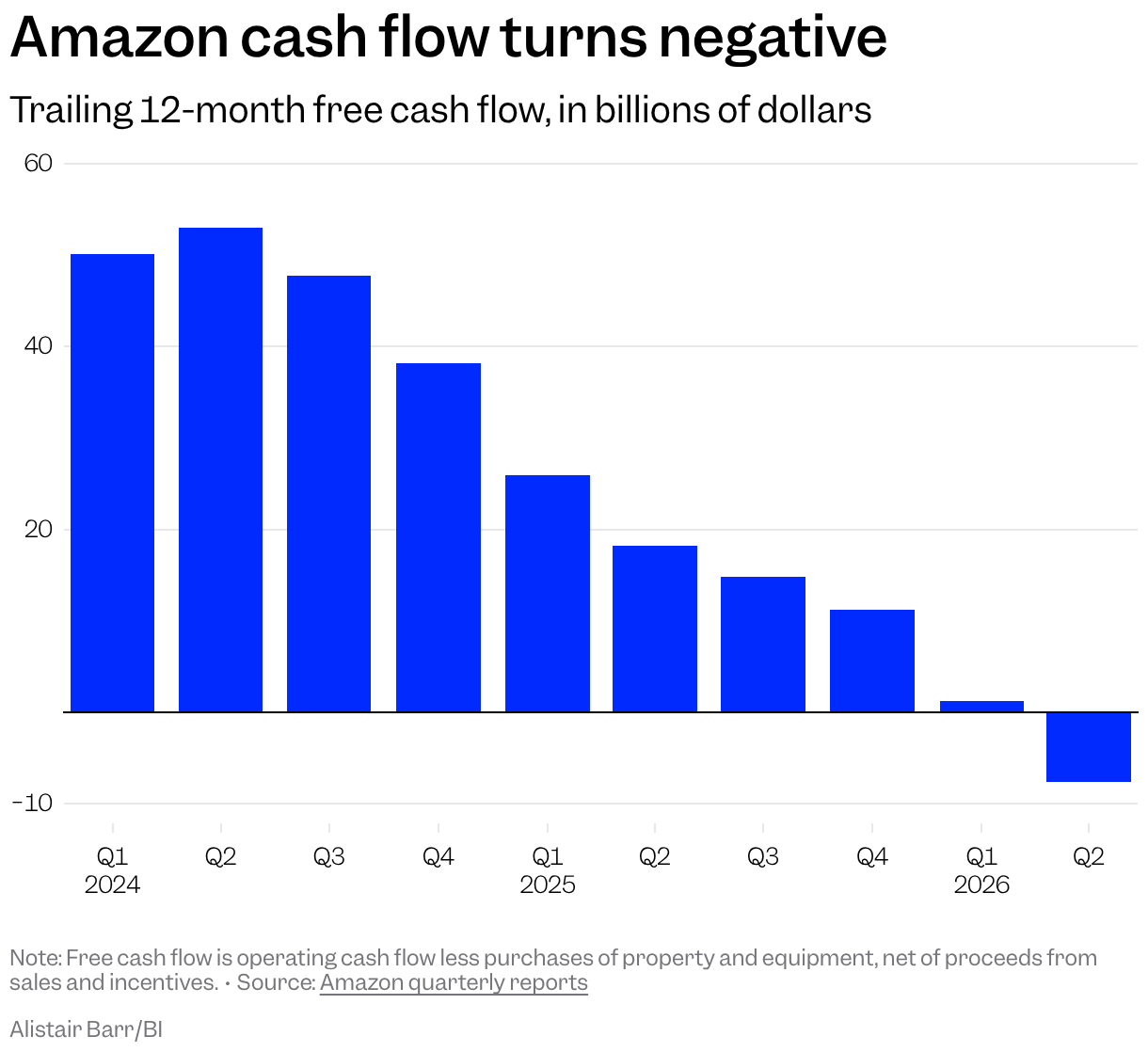
"You've taken us free cash flow negative as a company, so congratulations," Felton said, according to a recording of the meeting obtained by Business Insider.
The remark was lighthearted. But it captured a stunning reversal.
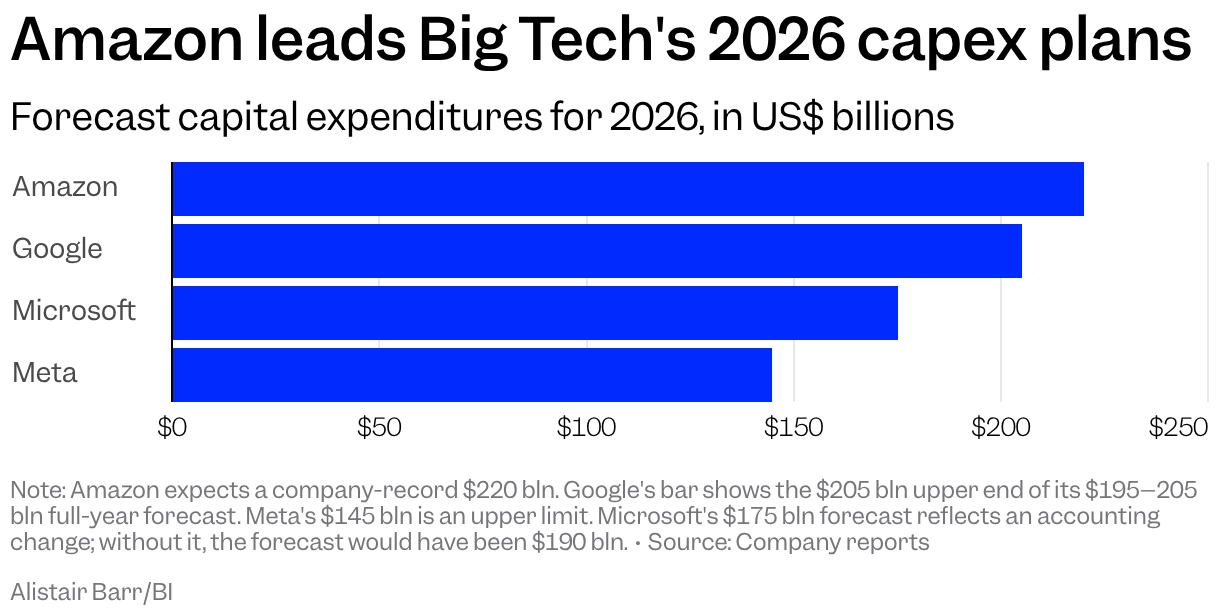
Just two years ago, Wall Street was debating what Amazon would do with its growing cash hoard. Now, cash flow has evaporated as Amazon embarks on its biggest bet ever, spending $220 billion this year alone to build the physical backbone for AI.
At the meeting, Kalyanaraman did not dispute Felton's premise. Amazon's machine-learning and AI business is "hugely free cash flow negative," he said, adding that he expects the company's free cash flow to remain negative for "the next couple of years or so."
Amazon has made big bets before. It spent heavily on cloud computing, fulfillment centers, and its delivery network long before they became some of the company's most valuable assets. Investors questioned those investments at the time, but Amazon ultimately built enormous, profitable businesses from them.
AI is testing this playbook at a far larger scale. Amazon is committing hundreds of billions of dollars to data centers, servers, and power before investors know how quickly those investments will generate revenue.
The company is the best, or among the best, at building data centers, with decades of experience. But the size and complexity of these projects, and the bottlenecks holding progress back, are challenging — even for such a respected cloud pioneer.
Internal documents reviewed by Business Insider and people familiar with the matter show the company trying to coordinate a sprawling industrial system whose parts move on different schedules. A delay in power, equipment, or construction can leave billions of dollars in hardware waiting — and Amazon's cash tied up — while forecasts and costs keep shifting.
Why Amazon thinks it will work
Amazon says it has strong evidence that the capacity will be needed. AWS revenue grew 37% in the second quarter, its fastest pace in 18 quarters, while its backlog reached $496 billion.
CEO Andy Jassy thinks the company has a "clear line of sight" to strong financial returns from this record investment cycle. In his latest annual shareholder letter, he called AI a "once in a lifetime opportunity" and said Amazon would not be conservative in its investments.
"We've been through this cycle with the first big AWS growth wave, and liked the results," Jassy wrote. "We expect to feel similarly about this next wave."
Investors are concerned by the scale of the industry's expansion, especially as AI data centers are costing more to build and taking longer to complete.
The market is "repricing anything that funds multi-year builds against revenue that arrives later," Dan Ives, an analyst at Yorkville Ives, wrote in a recent report. Growing uncertainty around data center permitting and the political fight over electricity prices have given investors another reason to question how quickly these investments will pay off, he added.
Racks, but not enough power
One major industry challenge is securing enough power to run the equipment that goes inside data centers. This includes expensive racks of servers that contain GPUs and other chips that train and run AI models and services such as ChatGPT.
Internal emails from August show Amazon preparing a new "Early Rack Receipt" process for an expected wave of server racks carrying Nvidia's GB300 chips at US facilities before final deployment.
One Amazon email projected the company would take delivery of about $5 billion of Nvidia GB300 racks in August, followed by another roughly $3 billion each month "for the foreseeable future."
Some AWS data center sites had room for more racks but not enough available power to turn them on, people familiar with the effort said, leaving the equipment to be staged at intermediary warehouses until the facilities were ready. These people asked not to be identified discussing sensitive matters.
Timing and coordination
Usually, Amazon doesn't pay for racks until the gear is put into a data center, leaving suppliers to carry the cost of the equipment in transit, according to the internal documents obtained by Business Insider. This helps the company conserve cash.
However, the intensity of the AI data center building boom has made this type of coordination harder. Amazon has to compete more for scarce resources as it jockeys with rivals for access to Nvidia GPUs and other AI components.
Under the new "Early Rack Receipt" process, Amazon now takes ownership of these racks earlier in the supply chain, rather than waiting until the equipment reaches a data center.
The means spending cash sooner. And any delays getting the racks installed and plugged into a reliable power source potentially pushes back the moment when revenue starts flowing from these assets.
At least one AWS supply chain team did not have "a clear forecasted path" for getting racks into data centers, according to one of the emails reviewed by Business Insider.
An Amazon spokesperson said the company routinely stages finished hardware near deployment sites so it can be installed once power capacity is available, calling that approach "best business practice."
The spokesperson added that AWS has "long-established systems" to track infrastructure assets and disputed that the broader company lacks a forecasted path for getting racks into data centers.
This problem is not unique to Amazon.
Bernstein analysts wrote in a recent note that power permits, cooling systems, electrical equipment, construction, and hardware all move on separate schedules.
"Timing is imperfect," the analysts said.
"Inherently uncertain"
John Felton, Chief Financial Officer of Amazon Web Services
Chris Jung/NurPhoto via Getty Images
During the internal staff meeting in September, Felton, the AWS CFO, described the broader problem eloquently: "How do you work in the future when the future is inherently uncertain?"
Kalyanaraman, the AI infrastructure leader, said Amazon's internal outlook for the return on its AI investments had improved. But the assumptions behind those returns keep shifting.
"The forecast is changing on a daily basis," Kalyanaraman said. "The world that we live in is extremely dynamic."
Those shifting assumptions include when data centers will be ready and how much equipment AWS needs to keep on hand, he explained.
An eight-week supply buffer might be routine for a smaller company. But at Amazon's scale, Kalyanaraman said, this could mean holding "billions and billions of dollars" worth of additional equipment inventory — tying up precious cash.
Frugality meets the AI boom
Such tensions are especially striking for Kalyanaraman, a 21-year Amazon veteran who earlier this year was promoted to the elite S-team that reports directly to Jassy.
Amazon's founding story is defined by frugality. It famously used cheap doors as desks when founder Jeff Bezos started in Seattle in the mid-90s.
Kalyanaraman has absorbed this lore into bones. In late 2023, as AWS faced slower growth and layoffs, he urged employees to do more with less. "Frugality breeds innovation," he said back then.
That instinct still shapes his approach. In the September meeting this year, Kalyanaraman told Felton that AWS tries to make major investments at the "last responsible moment," when it has the clearest possible view of demand.
"If we can wait to spend the capital as late as possible, it's better for us," he said.
Amazon CEO Andy Jassy
Bloomberg/Getty Images
But the frenetic pace of the AI boom makes this principle difficult to follow. By the time demand is fully visible, the servers, power, and construction capabilities that AWS needs may no longer be available. That puts pressure on the company to commit more money sooner to secure supply and meet its data center capacity goals.
Kalyanaraman recalled telling Jassy in 2023 that AWS would "surely" be out of its capacity crunch by 2027. Instead, Amazon still expects demand to exceed its available capacity in 2027, the AI infrastructure chief said during the meeting this September.
Secured Power at Risk
Getting enough electricity may be the biggest challenge for an industry leader like Amazon.
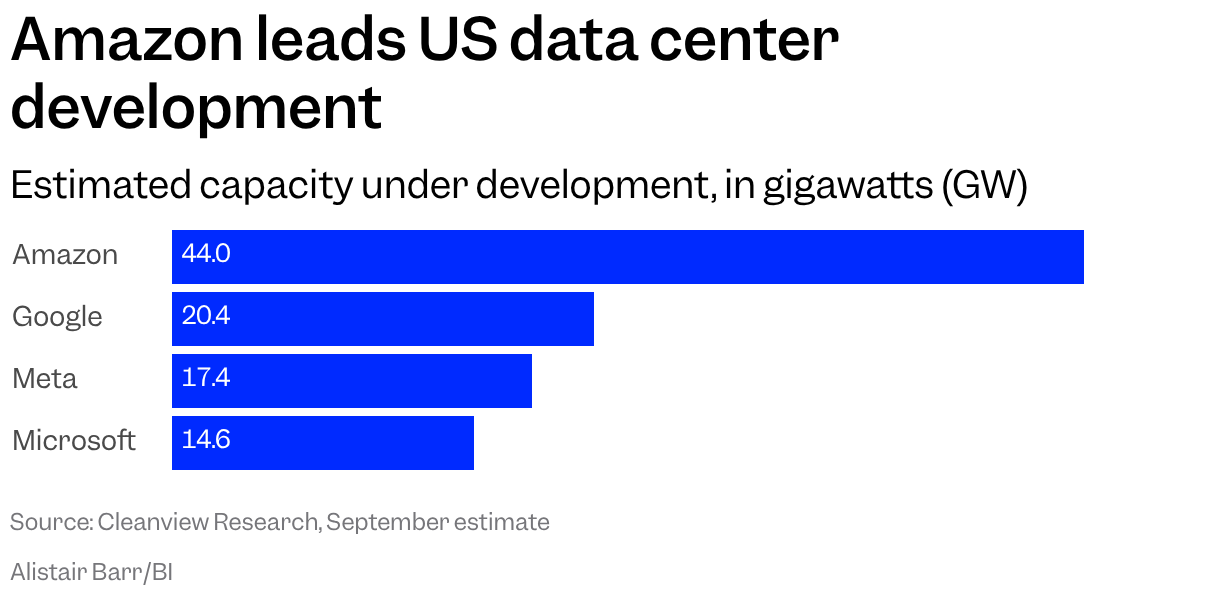
The company has 44 gigawatts of data center capacity under development across 16 states, more than double Google, Meta, and Microsoft, according to Cleanview Research estimates.
An internal AWS dashboard called "Secured Power at Risk" tracks utility and regulatory constraints affecting electricity capacity AWS has lined up for its data centers.
The risks include transmission bottlenecks, requirements to reduce use during grid stress, and "use it or lose it" provisions that can jeopardize capacity if a data center project misses usage or construction milestones.
In other words, AWS is not simply waiting for electricity to arrive. It is managing a portfolio of commitments that can become more costly if a data center project is delayed.
Maryland proposals
A submission to Maryland's utility regulator last year, obtained through a public records request, illustrates the kind of exposure that can accompany massive data center buildouts.
Amazon told the Maryland Public Service Commission that large data center customers could help pay for grid upgrades or bring new power capacity to market without burdening other electricity ratepayers.
The company also proposed setting aside collateral to help utilities get more comfortable with the large investments needed to generate more electricity for data centers. Amazon proposed three years of collateral so that if a large electricity customer abandoned unused capacity, the utility would have time to re-sell the power.
The proposal is not evidence that AWS has made such a payment or posted collateral. It does, however, show that large data centers can face extra financial obligations, beyond their own electricity bills, if projects are delayed or cancelled.
The Amazon spokesperson said such utility rules are not unique to AWS. The company has not disclosed how much cash it has paid upfront to secure power.
New constraints 'keep popping up'
The AI buildout also incurs expenses that are harder to model than a conventional capex plan.
In the September meeting this year, Kalyanaraman said that while reviewing plans for gigawatts of capacity in West Texas, AWS confronted a labor problem: There weren't enough nearby pipefitters, electricians, and other skilled workers to build the facilities.
The company's response, he said, was to pay to construct housing complexes near its data centers so workers could live there for the two or three years needed to complete the projects.
Even the crates used to ship servers have become a planning issue. It may seem absurd to worry about the price of a container when servers cost hundreds of thousands of dollars, Kalyanaraman said. But at AWS's scale, where the company needs so many crates, even trivial items can become a material expense.
"We have new constraints that keep popping up," Kalyanaraman said.
Jeff Bezos-owned Blue Origin outlined a plan to spend $330 million on extensive upgrades to its launch facilities in the US state of Florida to support multiple flights per week by the end of the decade.
Blue Origin revealed it will add two additional launch and landing pads for its New Glenn rockets while also boosting its second stage manufacturing capabilities. Ian Richardson, Blue Origin’s SVP of operations, stated in a blog the expansion will be completed by the middle of 2027.
“These investments are centred on one goal: building the capacity to support more missions, more reliably, and more efficiently,” he said. “As we look ahead, this infrastructure is designed to support multiple flights per week by the end of the decade.”
The upgrades also include a new customer integration facility with the US Space Force at Cape Canaveral Space Force Station in Florida to give it “the ability to prepare multiple missions at once”.
Richardson noted the company has invested more than $3 billion in facilities and infrastructure across the state with more than 5,000 employees.
Blue Origin is seeking to ramp up the cadence of its rocket launches to better compete against Elon Musk’s SpaceX. Currently, Blue Origin has 396 LEO birds in orbit while SpaceX has approximately 11,150 Starlink satellites.
While SpaceX and Blue Origin use their rockets to launch satellites from other companies, CNBC reported the former has stopped commercial rides on its Falcon 9 rocket to support its larger Starship model.
Blue Origin suffered a setback in May when one of its New Glenn rockets exploded on the Florida launch pad. In July, Blue Origin CEO Dave Limp outlined a plan to rebuild its launch pad with a new configuration as it works toward returning its New Glenn rocket to flight before the end of 2026.

 Login