
❌

Reading view

Babiš Faces Growing Political Pressure After Czech Senate Election Rout

Czech Prime Minister Andrej Babiš has rejected calls to reconsider his government’s direction after a crushing Senate election defeat, as the opposition strengthens its position and fresh disputes over Russia, European funding and domestic reforms add to his difficulties.

Czech Prime Minister Andrej Babiš has ruled out changing his government’s policies despite a humiliating defeat in the Senate elections, in which his ANO movement failed to win a single seat. The result has strengthened the parliamentary opposition and intensified questions over the political direction of his coalition, less than a year after it took office.

Speaking after a cabinet meeting on Monday, 19 October, Babiš insisted that the election results would have no effect on the functioning of his government or its alliance with the far-right Freedom and Direct Democracy (SPD) party and the Motorists movement. His administration would continue implementing its programme, including controversial changes to public broadcasting and proposed legislation regulating the financing of non-governmental organisations.

The prime minister’s refusal to reconsider his government’s agenda has drawn criticism from Senate president Miloš Vystrčil, who accused Babiš of transferring responsibility for the defeat to regional party organisations rather than accepting personal accountability.

A defeat with consequences beyond the Senate

The elections, held on 9–10 and 16–17 October, concerned 27 of the Senate’s 81 seats. ANO entered 13 candidates in the second-round contests, but every one of them lost. The party’s representation consequently fell to 14 senators.

Babiš called the outcome “catastrophic”, acknowledging a result that was particularly damaging given ANO’s success in the 2024 Senate elections and its subsequent victory in the October 2025 parliamentary contest.

The opposition Mayors and Independents movement (STAN) emerged as the strongest performer, with ten successful candidates or endorsed contenders. The centre-right Civic Democratic Party (ODS) secured seven seats, maintaining its position at the head of the Senate’s largest parliamentary group alongside TOP 09.

In an interview published on 20 October, Vystrčil said the results demonstrated that Babiš’s personal electoral appeal did not translate into successful Senate campaigns. He also criticised the prime minister’s response to the defeat, describing his attempts to blame regional organisations as an evasion of leadership responsibility.

The vote followed municipal elections in which ANO lost ground in several important urban centres, while SPD also suffered substantial losses.

Opposition leadership becomes the next political contest

STAN leader Vít Rakušan has interpreted the result as evidence that his movement can become ANO’s principal national challenger.

The party’s Senate performance followed a strong showing in municipal elections, including victory in Prague, where its leading candidate Petr Hlaváček is seeking to form the next city administration.

The movement’s growing appeal is supported by recent opinion polling. A Median electoral model published on 17 October, based on September interviews, placed ANO at 29.5 per cent, STAN at 17 per cent and ODS at 12.5 per cent.

Yet STAN’s ambitions face competition from within the opposition. ODS retains substantial institutional influence through the Senate, while the Christian Democrats’ new leader, Jan Grolich, is increasingly discussed as another possible contender for national opposition leadership.

The opposition’s unity is also less straightforward at municipal level. In Ostrava, ANO has negotiated a local governing agreement with Starostové pro Ostravu and the Ostravak movement, illustrating the flexibility of local political alliances.

Russia policy brings fresh controversy

The electoral setback coincides with renewed controversy over the Czech government’s approach to Russia.

On 19 October, Foreign Minister Petr Macinka, leader of the Motorists, defended his decision not to support a Finnish initiative calling for tighter European Union restrictions on entry visas for Russian citizens.

The proposal, promoted by Finnish Foreign Minister Elina Valtonen, sought stronger EU-wide restrictions on non-essential travel by Russian nationals, including tourists, against a background of growing concerns over Russian sabotage and hybrid operations.

According to details of the diplomatic disagreement, senior Czech foreign ministry officials had recommended supporting the initiative.

Macinka argued that Prague already maintained extensive national restrictions and had previously endorsed a comparable Estonian proposal. He questioned the effectiveness of the Finnish initiative, which attracted limited support from other EU governments.

The disagreement comes as Czech security policy remains under scrutiny. On Tuesday, 20 October, the National Security Council discussed the country’s security outlook, military development plans and changes to NATO’s air and missile defence implementation arrangements.

The issue exposes a continuing area of contention between Babiš’s coalition and opposition parties favouring closer coordination with Ukraine’s European supporters.

Brussels presents another challenge

Meanwhile, Babiš faces unresolved questions concerning his former business conglomerate Agrofert and access to European Union funding.

The European Commission has maintained restrictions on certain EU reimbursements after concluding that the trust arrangement involving Babiš’s business interests does not sufficiently address the potential conflict of interest.

The measures affect particular cohesion-fund expenditure and rural development reimbursements, rather than all EU agricultural payments. Babiš has maintained that the arrangements governing his business interests comply with the law.

The dispute carries particular significance as Prague participates in negotiations over the EU’s next long-term budget, covering 2028–2034.

At the European Council summit on 15–16 October, Babiš argued for protecting national allocations of EU funds, revisiting aspects of the emissions trading system and addressing high industrial energy costs. These negotiations will continue while the Commission’s concerns about his business arrangements remain unresolved.

Government retains power despite opposition gains

The Senate defeat does not threaten Babiš’s parliamentary majority. The lower chamber can override most Senate objections to ordinary legislation, and the governing parties continue to command sufficient support to pursue their programme.

The September Median model projected that ANO, SPD and the Motorists would retain 107 seats in the 200-member Chamber of Deputies, only slightly below their current combined strength.

Nevertheless, the elections have given the opposition a stronger platform for challenging the government over public broadcasting, European relations, defence policy and constitutional legislation, where the Senate possesses more substantial powers.

The immediate political contest is therefore not over the survival of Babiš’s government, but over whether STAN can convert its regional and Senate successes into a credible national alternative before the next parliamentary elections. For Babiš, whose party remains the largest in the country, the more pressing difficulty is its inability to defeat opposition candidates when elections are decided beyond ANO’s established electoral base.
  •  

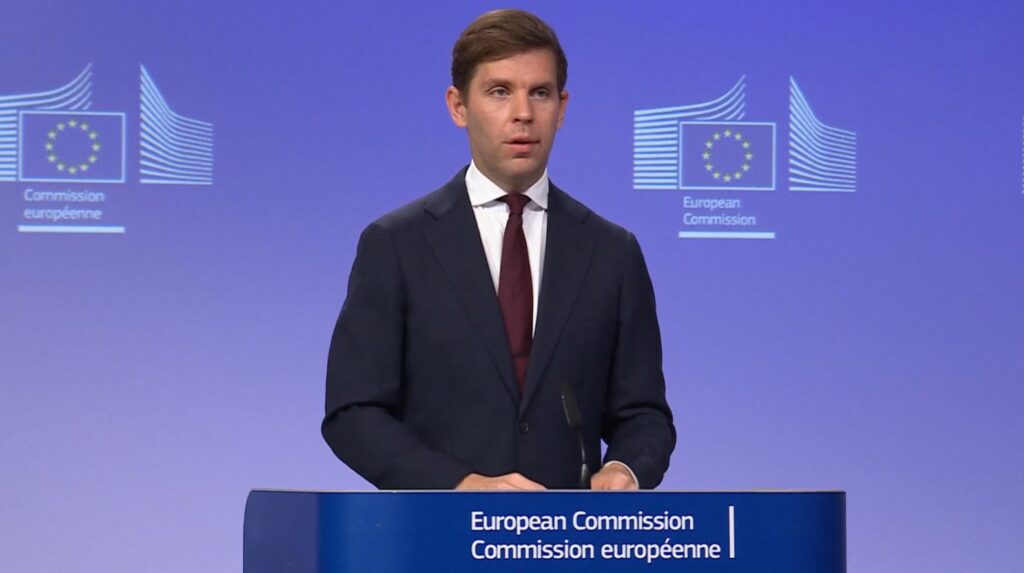
Ukraine finally voted to tax cheap foreign parcels to unlock €3.7 billion—now Brussels decides whether it was enough, with a €70 billion gap ahead amid ongoing war

ukraine finally taxed cheap foreign parcels unlock €37 billion—now brussels decides whether enough €70 billion gap ahead amid ongoing war · post european commission spokesperson balázs ujvári speaks commission’s midday

The European Commission is checking whether laws Ukraine’s parliament passed last week earn it a €3.7 billion ($4.3 billion) EU payment, spokesperson Balázs Ujvári told reporters in Brussels on 19 October. He also said Ukraine’s 2027 funding gap stands at about €70 billion, and that the EU “cannot do this all alone.” How Ukraine pays for Russia’s war next year now depends on reforms in Kyiv and on money from Europe and beyond.

Russia keeps striking Ukraine’s power grid and cities, and Kyiv already faces a hole in next year’s war budget before any new military spending. Foreign money keeps salaries, pensions, and repairs flowing while Ukraine spends its own revenue on defense. So each delayed payment is felt at home while Russia hits the energy system again.

Brussels reads Kyiv’s new laws before paying

The payment is the second tranche of the EU’s macro-financial assistance to Ukraine, and each one depends on reforms, Ujvári said at the Commission’s midday briefing.

“We saw that last week some important laws were adopted in the Rada, and we are in the process of analyzing these laws and we will formulate our assessment thereafter,” he said.

On its third attempt, parliament passed a law on 15 October ending the VAT exemption for foreign parcels worth up to €150 from 1 July 2027, and making online marketplaces collect the tax. The Commission had warned the law was one of 12 conditions for the tranche. Fewer than 1% of the 75 million parcels Ukrainians receive each year were taxed, and lawmakers had rejected the measure twice despite IMF pressure.

About €30 billion is in the pipeline for Ukraine this year, mostly under the EU’s €90 billion support loan, if reforms continue, Ujvári said.

EU Ukraine support
Explore further

EU announced funding shortfall for Ukraine in 2027

A €70 billion gap for 2027

Current pledges leave a gap of about €70 billion for 2027, Ujvári said, even counting the €45 billion ($52 billion) the EU has set aside for next year and some partners’ commitments.

“We cannot do this all alone. Therefore, our partners in general must step up,” he said. “They have to come forward with pledges, and they have to deliver on those commitments.”

On 16 October, Ukrainian President Volodymyr Zelenskyy asked EU leaders for at least €70 billion more for 2027. They tasked the Commission with a proposal but set no deadline. Asked whether it would revisit using frozen Russian assets, Ujvári said it was “a little bit early” to discuss options in that detail. New EU borrowing has also grown costlier: 10-year rates rose from 3.2% to just above 4% in six months, he said.

The €90 billion loan was designed on the assumption that the war would end in 2026. Slovak Prime Minister Robert Fico said Slovakia and Hungary would opt out of new aid but would not block others.

  •  

Brussels Selects 77 Industrial Projects for €3.4 Billion in EU Funding

The European Commission has selected 77 industrial and technology projects across 23 European Economic Area countries to receive €3.4 billion in funding, as Brussels attempts to strengthen the continent’s manufacturing capacity and reduce dependence on imported energy and critical materials.

The funding, announced on Monday, 19 October, will come from the EU Innovation Fund, which uses revenues generated by the Emissions Trading System to support investment in technologies intended to reduce greenhouse gas emissions.

The selected projects include manufacturing facilities, renewable energy installations, advanced energy storage, critical raw materials processing and industrial carbon management. For the first time, the programme also includes a small modular nuclear reactor project and a direct air carbon capture and storage initiative.

The announcement comes amid growing concern over Europe’s industrial competitiveness, particularly as manufacturers face high energy costs, increasing competition from China and difficulties securing investment for major industrial projects.

Funding for industrial production

According to the Commission’s announcement, the 77 selected projects span energy-intensive industries, clean technology manufacturing, alternative fuels, transport and several other sectors.

Six projects concern critical raw materials, an area in which the EU has been seeking to reduce its exposure to foreign suppliers.

These investments are intended to strengthen European supply chains for technologies including batteries, renewable energy equipment and permanent magnets, which are essential components in electric motors and other industrial applications.

The funding follows renewed political pressure to expand the processing and production of strategically important materials inside Europe.

As EU Today recently reported, the European Parliament has been pressing for stronger measures to reduce dependence on China for critical raw materials used by European manufacturers.

China occupies a dominant position in several international processing and refining markets, leaving European companies exposed to supply interruptions and trade restrictions.

The Commission is seeking to support alternative production capacity through financial assistance, industrial regulation and measures designed to attract private capital.

However, the selection of projects for EU funding does not automatically mean that the proposed facilities will be built. Their implementation will still depend on financing agreements, regulatory approvals and commercial decisions.

Nuclear technology enters funding programme

The inclusion of a small modular nuclear reactor project represents a new development in the Innovation Fund’s portfolio.

Small modular reactors are designed to produce electricity or industrial heat using nuclear technology on a smaller scale than conventional nuclear power stations.

Supporters argue that modular construction could reduce certain project risks and provide stable electricity supplies for energy-intensive industries.

However, the technology faces substantial challenges involving construction costs, regulatory approval, supply chains and the transition from demonstration projects to commercial production.

The Commission published a European strategy for small modular reactors in March, outlining plans to accelerate their development and support the first operational facilities in the early 2030s.

The latest funding decision gives the technology access to a financial instrument principally associated with industrial decarbonisation and clean energy investment.

Another newly represented technology is direct air carbon capture and storage, which involves extracting carbon dioxide from the atmosphere and storing it.

Both technologies remain at comparatively early stages of commercial deployment in Europe, making their eventual costs and performance important considerations.

Emissions trading revenue finances investment

The Innovation Fund is financed through revenues from the EU Emissions Trading System, under which companies operating in covered sectors must obtain allowances for their greenhouse gas emissions.

Part of the revenue generated from auctioning allowances is reinvested into projects designed to introduce lower-emission technologies into industrial production.

The Commission estimates that the 77 newly selected projects could avoid approximately 290 million tonnes of greenhouse gas emissions during their first ten years of operation.

That figure is a projection based on the projects’ anticipated performance, rather than an achieved reduction. Actual results will depend on construction, commissioning and subsequent commercial operation.

The funding announcement also follows the publication of the EU’s broader industrial policy initiatives, which seek to increase domestic production of clean technologies and improve investment conditions for European manufacturers.

The Commission announced a separate allocation of more than €390 million to 135 environmental and climate projects under the LIFE programme on the same day. That funding is distinct from the €3.4 billion Innovation Fund selection.

Funding agreements still to be concluded

The companies and organisations behind the selected Innovation Fund projects must now complete the procedures necessary to obtain their grants.

During the Commission’s 19 October press briefing, officials indicated that project-specific grant amounts would become available when the agreements are signed, currently envisaged for the first quarter of 2027.

The final allocations and implementation conditions therefore remain subject to the grant preparation process.

For industrial companies, the principal test will be whether the European funding attracts sufficient additional investment to bring the selected technologies into commercial operation.

The results will also provide an indication of how effectively Brussels can translate its industrial policy objectives into additional European manufacturing capacity, particularly in sectors where supply chains remain concentrated outside the Union.

Image Credit: © European Union, 2024 / CC BY 4.0
  •  

European Parliament Demands €225 Billion for EU Foreign Policy as Budget Dispute Deepens

The European Parliament has demanded €225 billion for the European Union’s foreign policy and development programmes between 2028 and 2034, challenging proposals by member states to reduce spending under the bloc’s next long-term budget.

The Parliament’s Foreign Affairs and Development committees approved their negotiating position on the Global Europe Instrument on Monday, 19 October, by 63 votes to 27, with five abstentions. The proposed allocation represents an increase of €25 billion over the European Commission’s original €200 billion proposal.

The decision comes as negotiations over the wider 2028–2034 EU budget have become increasingly contentious, with Germany and several other net contributors opposing higher expenditure while Brussels faces mounting demands for defence, industrial investment, enlargement and support for Ukraine.

Parliament rejects proposed reductions

Under the position adopted by the parliamentary committees, at least €25 billion would be reserved for humanitarian assistance. MEPs also want dedicated funding for reconstruction in Gaza and financial support for countries seeking EU membership.

The committees are proposing that 20 per cent of official development assistance should be directed towards human development, alongside stronger provisions covering democracy, human rights and the rule of law.

Global Europe is intended to consolidate several existing financing instruments into a single framework governing much of the Union’s external expenditure. The programme would finance activities ranging from development cooperation and humanitarian assistance to economic partnerships and support for countries preparing to join the EU.

The Commission introduced the original €200 billion proposal in July 2025. However, subsequent negotiations among member states have raised the prospect of substantial reductions.

Germany, the Netherlands and several Nordic countries have argued that the next budget must reflect the financial constraints facing national governments. Their objections have complicated efforts to accommodate additional spending on European security and economic competitiveness.

The European Parliament has taken a different position, maintaining that reducing external expenditure would restrict the Union’s ability to operate internationally when European security and economic interests increasingly depend on developments beyond its borders.

Ukraine and enlargement funding

The parliamentary proposal would preserve support for Ukraine while seeking to prevent assistance connected with Russia’s invasion from reducing resources available to other partner countries.

Ukraine’s reconstruction, institutional reforms and integration with European markets will require substantial financing over the coming years. However, the precise allocation will depend on negotiations over the wider budget and the financing arrangements eventually approved.

For candidate countries, MEPs want clearer incentives linking EU assistance to progress on political and economic reforms. The proposed framework would also provide Brussels with greater powers to suspend funding where democratic standards, human rights or judicial independence deteriorate.

A separate provision would permit the Commission to suspend payments where partner countries seriously fail to meet obligations concerning the readmission of their nationals.

That measure reflects the growing connection between the EU’s development policy and its migration objectives. Brussels has increasingly sought cooperation on returns and border management as part of agreements with countries receiving European assistance.

The committees have also called for stronger parliamentary supervision of Global Europe, including more detailed reporting by the Commission and regular discussions with the commissioners responsible for implementation.

Difficult negotiations ahead

The financial disagreement extends well beyond external policy. The overall seven-year budget remains contested, particularly over agricultural subsidies, regional development funds, defence investment and repayment of borrowing undertaken during the coronavirus pandemic.

As EU Today previously reported, a group of 17 member states has opposed reductions in agricultural and cohesion spending, adding further pressure to negotiations.

The Parliament’s proposed €225 billion allocation has not been agreed by governments and does not constitute an approved spending commitment.

The committees also approved a mandate for negotiations with the Council, although their position still requires endorsement by the full Parliament, provisionally expected in November.

Meanwhile, member states must settle their own negotiating position, including the financial ceilings governing the programme.

The eventual settlement will determine how much Brussels can spend on development cooperation, humanitarian operations and international partnerships after 2027, and how those commitments can be reconciled with the EU’s expanding domestic financial obligations.

  •  
❌