❌

Reading view

Reporter's Notebook: France braces for more unrest after parts of Paris spun out of control

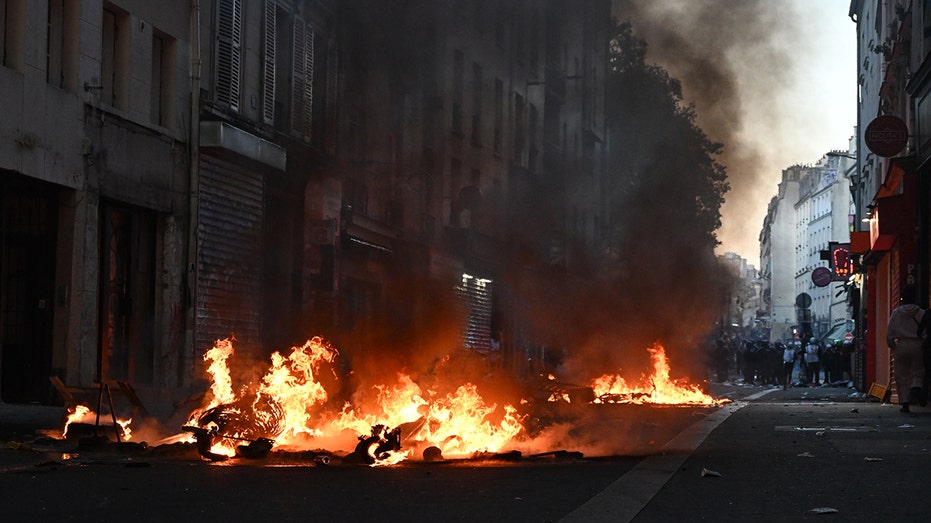
PARIS, France: Paris is burning. Yet again. But this time, according to officials and analysts, it’s different. And unrest here could have a lasting impact on France… perhaps the world.

I have been covering protests in France for decades. I lived in Paris for nine years. I know that the French are very skilled at taking politics to the street. The recent upheaval has many worried.

From all the people I hear from on the ground here, the rioting has been more violent, more destructive, more profound. Domestic strife seemingly out of control.

FRANCE IS DEVOURING ITSELF AS SCHOOL RIOTS REVEAL A CRISIS FAR BIGGER THAN BROKEN CLASSROOMS

When I approached the bar at a brasserie near Place de la Republique, the server asked if I was an American and a journalist. After replying yes to both he concluded, "So you’ve come to cover the civil war."

The numbers tell the tale. Some 2,500 arrests during the last weekend of clashes between protesters and police. Around 1,000 officers injured. Many hurt, some seriously, on the activists’ side. And about 3,000 businesses impacted, trashed, looted. Damage estimated over one billion dollars.

FRANCE'S MASSIVE INTEL FAILURE SPARKS RESIGNATION OFFERS AMID DAYS OF RIOTING

What was most striking were the attacks on official buildings. An historic city hall in Limoges. A police headquarters in crime-ridden Marseille. An important tourist office in Lyon. Symbols of a French government under siege.

The mostly peaceful protests supporting recent student concerns, as well as working and middle-class economic worries, hijacked by those bent on anarchy. And opportunistic young crooks looking for cheap thrills.

Yes, there are immigrants and foreigners amid the rabble. Plus, those said to have ties with so-called "ultra-left" groupings. But this remains a very French uprising. Which in a way makes it even more unsettling.

Nearly ten years of rule by President Emmanuel Macron has left this country more divided, with promises unfilled, anger near the surface. And violence a real danger.

FRENCH NEWSPAPER RIPS MACRON AFTER RIOTS ERUPT ACROSS FRANCE: ‘INDELIBLE STAIN’

What was also deeply troubling about the latest bout of violence — and authorities have admitted it — is that there were periods of time when parts of Paris and other cities were out of control. Shop owners were forced to fend for themselves.

All of this plum pickings for politicians on the left and right. Either sympathizing with protesters’ demands. Or calling for more law and order. Both sides slamming those in power. With presidential elections upcoming in six months, timing is everything.

With the French treasury bare, it seems the more pressing and more promising route for the current authorities is greater security.

CLICK HERE TO DOWNLOAD THE FOX NEWS APP

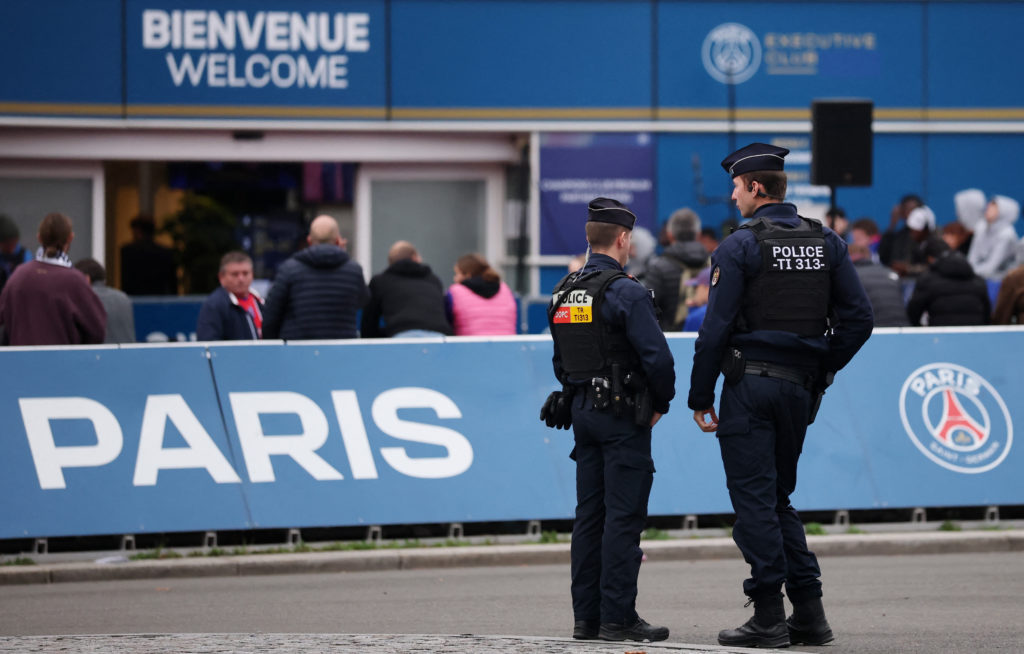
That’s why top government officials have been speaking out about their planning for the next big protest set for this weekend. French Prime Minister Lecornu says it will be countered by a "massive police operation" backed by the military. Activists will have to choose, Lecornu went on to say, between "violence" and the French "republic."

"Do or die" talk that still does not address the underlying problems, not just facing France but other countries as well. That’s why, in addition to the curiosity factor of everyone being intrigued by France, it could also provide some real-time lessons on how or how not to deal with a brave new world of inequality and dwindling resources.

See you at the "barricades."
  •  

Assimiler LFI à l’ultragauche, une stratégie en passe de se retourner contre l’exécutif ?

En associant dans son discours La France insoumise à l’ultragauche, le gouvernement accuse le parti d’être à l’origine du mouvement lycéen et des scènes de chaos observées le 17 octobre en France. Mais cette rhétorique est à la fois mise à mal par des révélations de Mediapart et les spécialistes de l’ultragauche, qui contestent tout lien entre cette mouvance et LFI.

  •  

White House envoy declares kinetic action against Yemen ‘fruitless’

The Cradle – October 20, 2026

US special envoy Tom Barrack conceded that a “ground kinetic” battle in Yemen by the US “seems fruitless” during a talk at the Global Security Forum in Qatar on 20 October.

“I think the president’s been clear that he supports Saudi Arabia and the backing that they need logistically he will supply. But America getting involved in a ground kinetic battle somewhere else seems fruitless.”

Barrack is Washington’s ambassador to Turkiye and special presidential envoy for Syria and Iraq.

He admitted that military force has failed in Yemen and that Riyadh is in a “very difficult position.”

“These kinetic reactions have never worked. It doesn’t work. It’s probably not likely that it’s going to work,” he said.

Barrack questioned whether US meddling across West Asia has helped or harmed the region, arguing that Ansarallah in Yemen, Hezbollah in Lebanon, and the resistance factions in Iraq would lose their reason to exist only once states took responsibility themselves.

He pressed for talks between Riyadh, Sanaa, and regional mediators, urging regional capitals to build their own alliances instead of leaning on Washington.

He went further, admitting that the US has had a hand in 23 regime changes across the region, none of which achieved their aims.

He declined to say whether the US-Israeli war on Iran launched on 28 February was a mistake, while conceding that it had unleashed unintended consequences across the region.

The admission comes as the Saudi-led coalition presses on with airstrikes on Yemen, drawing retaliatory missile and drone strikes by the Yemeni Armed Forces (YAF) on the kingdom.

Riyadh has turned to its defense partners under the Mecca pact, including Pakistan and Turkiye, after Washington declined its requests for direct US intervention against Yemen.

Barrack’s remarks follow Washington’s failed bid to subdue Yemen by military force, with more than 1,000 US airstrikes between March 2024 and April 2025 unable to halt Yemeni naval operations waged in support of Gaza, forcing the US into an Omani-brokered ceasefire with Sanaa in May 2025.

The campaign cost Washington $1 billion in its first three weeks alone, as Yemeni forces downed 17 MQ-9 Reaper drones and the US lost two F-18 fighter jets.

Ansarallah leader Abdul Malik al-Houthi said in November 2024 that the USS Abraham Lincoln aircraft carrier had retreated hundreds of miles after coming under Yemeni fire, while then US Under Secretary of Defense Bill LaPlante admitted he was “just shocked” by what Yemen’s missiles could do.

Europe fared no better, with Rear Admiral Vasileios Gryparis, commander of the EU’s Operation Aspides, telling Bloomberg in June 2024 that his Red Sea fleet needed to more than double in size and that US–UK strikes on Yemen were “not contributing to the solution,” after France withdrew one of his frigates citing the threat level.


  •  

France: prison avec sursis et inéligibilité requises contre Rima Hassan, jugée pour «apologie du terrorisme»

Mardi 20 octobre, à Paris, le ministère public a réclamé dix mois de prison avec sursis et deux ans d'inéligibilité contre Rima Hassan, eurodéputée de La France insoumise (LFI), jugée pour un tweet, supprimé depuis, où elle citait l'un des auteurs de l'attentat de 1972 à l'aéroport de Tel-Aviv, qui avait fait 26 morts. La décision du tribunal sera rendue le 30 novembre.

  •  

Student Protesters in France Have a Strange New Slogan. What Does It Mean?

“Bismillah, c’est les ténèbres” has appeared on signs at recent demonstrations. It doesn’t make much sense (it means, “In the name of God, it’s the darkness”) but is seen as shorthand for a generational divide.

© Stephane Mahe/Reuters

A student protest in Nantes, France, last week.
  •  

Heading to France? Amid Recent Unrest, Here’s What to Know

Rioting over affordability and public education has swept through Paris and other French cities, and there may be more to come.

© Abdul Saboor/Reuters

On Monday, protesters blocked the entrance to the Louvre museum in Paris. The demonstrations in support of public education and the cost of living were held in several French cities, including Marseille, Lille and Nice.
  •  

Au procès de Rima Hassan, le parquet requiert la prison avec sursis et l'inéligibilité

Mardi, le parquet de Paris a réclamé dix mois de prison avec sursis et deux ans d'inéligibilité contre Rima Hassan. L'eurodéputée de La France Insoumise (LFI) a été jugée pour un tweet – supprimé depuis – où elle citait l'un des auteurs de l'attentat meurtrier à l'aéroport de Tel-Aviv, en 1972. La décision judiciaire sera rendue le 30 novembre prochain.

  •  

Pourquoi faut-il être prudent sur le profil des auteurs des violences urbaines en France?

Les scènes de jeunes individus attaquant commerces, véhicules et bâtiments publics durant le week-end du 17-18 octobre ont fait le tour des médias français et internationaux. À l'heure de la réponse pénale, que le ministre de la Justice Gérald Darmanin veut ferme et rapide, la question du profil des émeutiers enflamme le débat public en France, au risque de tirer des conclusions hâtives.

  •  

Mobilisation en France: LFI sous le feu des critiques après les violences urbaines

En marge des violences du week-end du 17-18 octobre en France, le parti La France insoumise (LFI) est pointé du doigt et désigné comme le coupable idéal. Certains candidats et chefs de partis politiques l'accusent d'être en partie responsable de ces débordements. Les insoumis, qui réfutent tout appel à la violence et tout lien avec les pillages, préparent leur contre-attaque.

  •  

How French police are harnessing social media to identify looters

French police are turning to social media to identify and arrest suspects linked to last weekend’s looting and unrest. Investigators are scrutinising videos posted online alongside footage from thousands of security cameras to track suspects and gather evidence. The crackdown comes as the government vows to hold those responsible for the violence and damage to shops accountable.

  •  

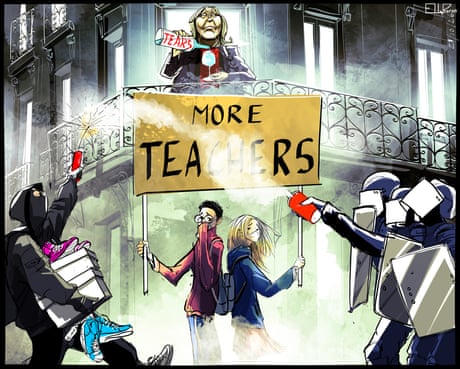
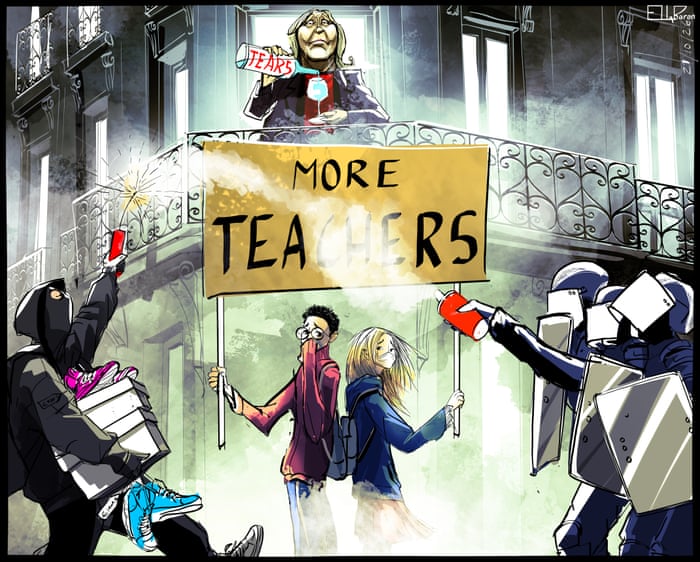
Why are French police so violent? Their job is to protect the state, not the people

Officers are instruments of state whose job is to repress, rather than manage, public dissent

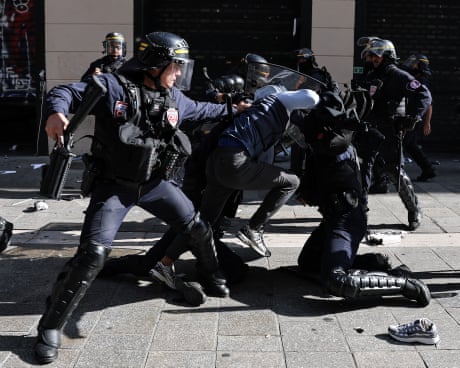
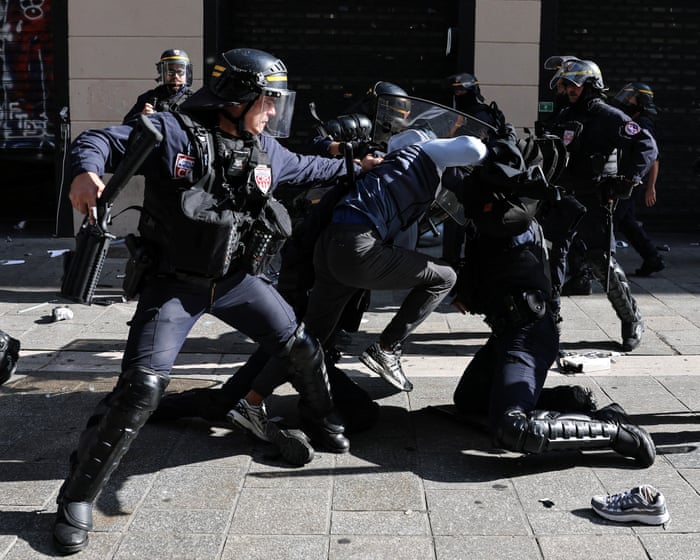
Familiar images of teargas clouds drifting across Paris squares, police baton charges against masked protesters and terrified teenagers floored – and worse – by stun grenades have once again focused the world’s attention on France’s policing methods.

While most of its western European neighbours generally favour police tactics that prioritise crowd containment and de-escalation, France has long responded to social movements that take to the streets with, at times, shocking physical force.

Continue reading...

© Photograph: Thibaud Moritz/AFP/Getty Images

© Photograph: Thibaud Moritz/AFP/Getty Images

© Photograph: Thibaud Moritz/AFP/Getty Images

  •  

Mobilisation du 24 octobre : renfort de policiers, Sentinelle... ce qu'il faut retenir du dispositif

Après un 17 octobre très agité pour l'exécutif, le Premier ministre, Sébastien Lecornu, et le ministre de l'Intérieur, Laurent Nuñez, ont présenté, mardi, devant l'Assemblée, des mesures en vue de la mobilisation de samedi. Dispositif policier "massif", militaires Sentinelle ou encore interdiction des manifestations "pas déclarées"... Voici ce qu'il faut retenir.

  •  

Plutôt Mai-1968 ou émeutes de 2005 ? Le regard des historiens sur la journée du 17 octobre

La journée de mobilisation contre la vie chère a rassemblé entre 500 000 et 800 000 personnes dans toute la France. Ces manifestations qui se sont, dans l'ensemble, déroulées sans incident ont été ternies par de nombreuses scènes de violence et de pillage. France 24 a demandé à des historiens de replacer ces événements dans un contexte historique.

  •  

Du vin à la sobriété : la sommellerie française se réinvente

Cette semaine, dans "C'est en France", nos reporters partent à la rencontre d'une nouvelle génération de sommeliers. Au programme : une rencontre avec Pascaline Lepeltier, vice-championne du monde 2026 au concours du Meilleur sommelier du monde. Dégustations à l'aveugle et tests de connaissances théoriques, on la suit dans sa préparation exigeante à la compétition. Notre équipe explore aussi les mutations d'une profession qui s'adapte aux nouvelles habitudes de consommation, notamment à travers le parcours d'un sommelier qui a fait le choix du sans alcool.

  •  

In Delhi or Paris, restoring order cannot replace public trust

Protests rarely remain confined to the grievances that first bring people into the streets. When the citizens believe their concerns are being ignored, a grievance over a particular policy or administrative decision can evolve into a broader challenge to the political authority. Consequently, what begins as a demand for correction becomes a question of accountability. […]

The post In Delhi or Paris, restoring order cannot replace public trust appeared first on Asia Times.

  •  
❌