❌

Reading view

Ghost Shark Extra-Large Uncrewed Underwater Vehicles’ Payload Bay Seen For First Time

New photos provide an interesting first public look inside the payload bay of Australia’s Ghost Shark extra-large autonomous underwater vehicle (XL-AUV), and a glimpse of the highly modular concept at the heart of the Royal Australian Navy’s emerging undersea warfare capability. Australian authorities had said in the past that they plan to use Ghost Sharks to conduct “persistent intelligence, surveillance, reconnaissance and strike” missions, but without any real elaboration.

The photographs were taken during a recent visit to the Anduril Australia factory in Sydney, New South Wales, by Pat Conroy, Australia’s Minister for Defense Industry. They emerged as the Australian government announced new details of payload development for Ghost Shark, the Speartooth large uncrewed underwater vehicle (LUUV), and the BlueBottle uncrewed surface vessel (USV), on October 19. While the announcement described the payloads in very broad terms, the photos plus additional details from the Anduril event reveal a more concrete picture of the missions Ghost Shark is being designed to perform.
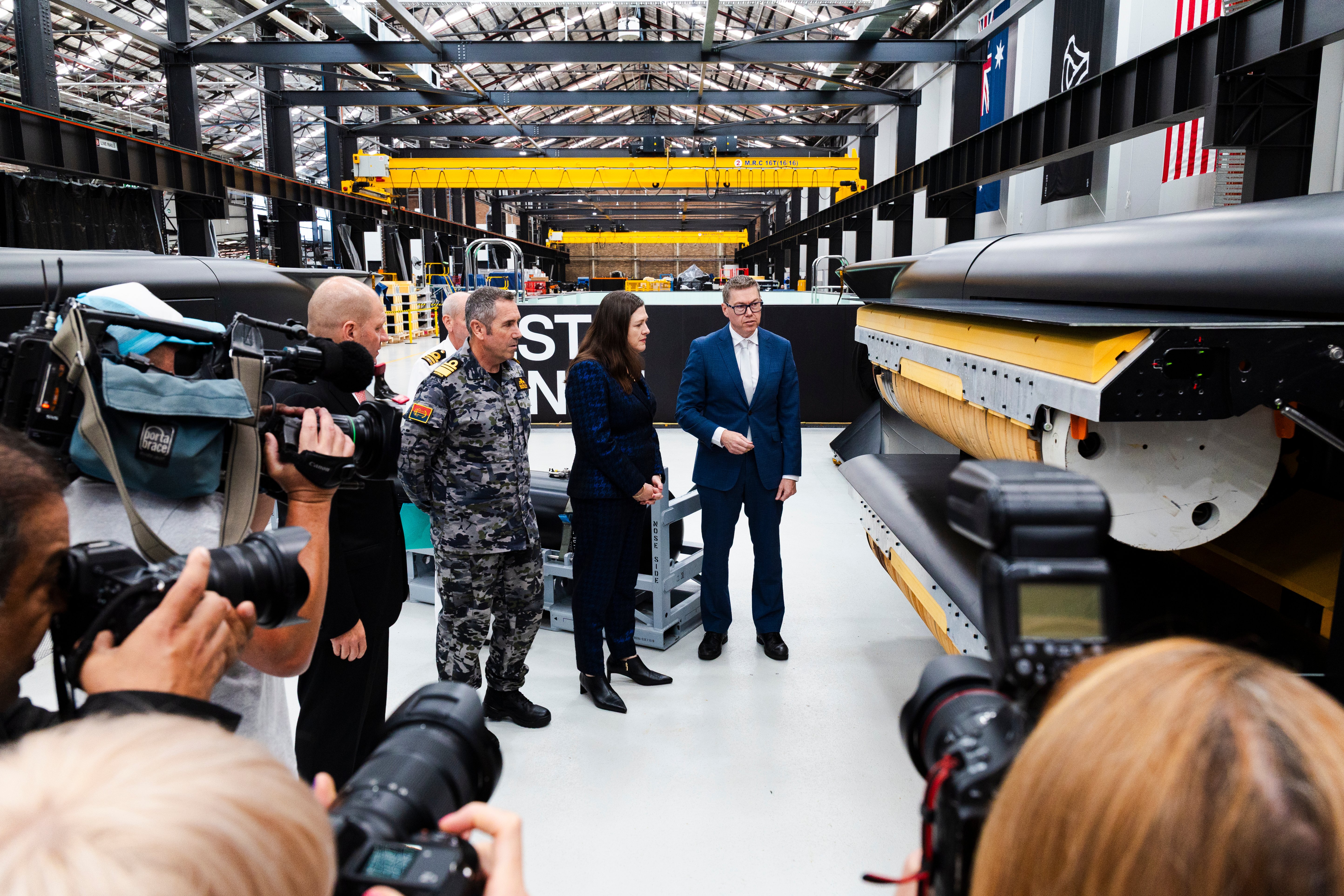
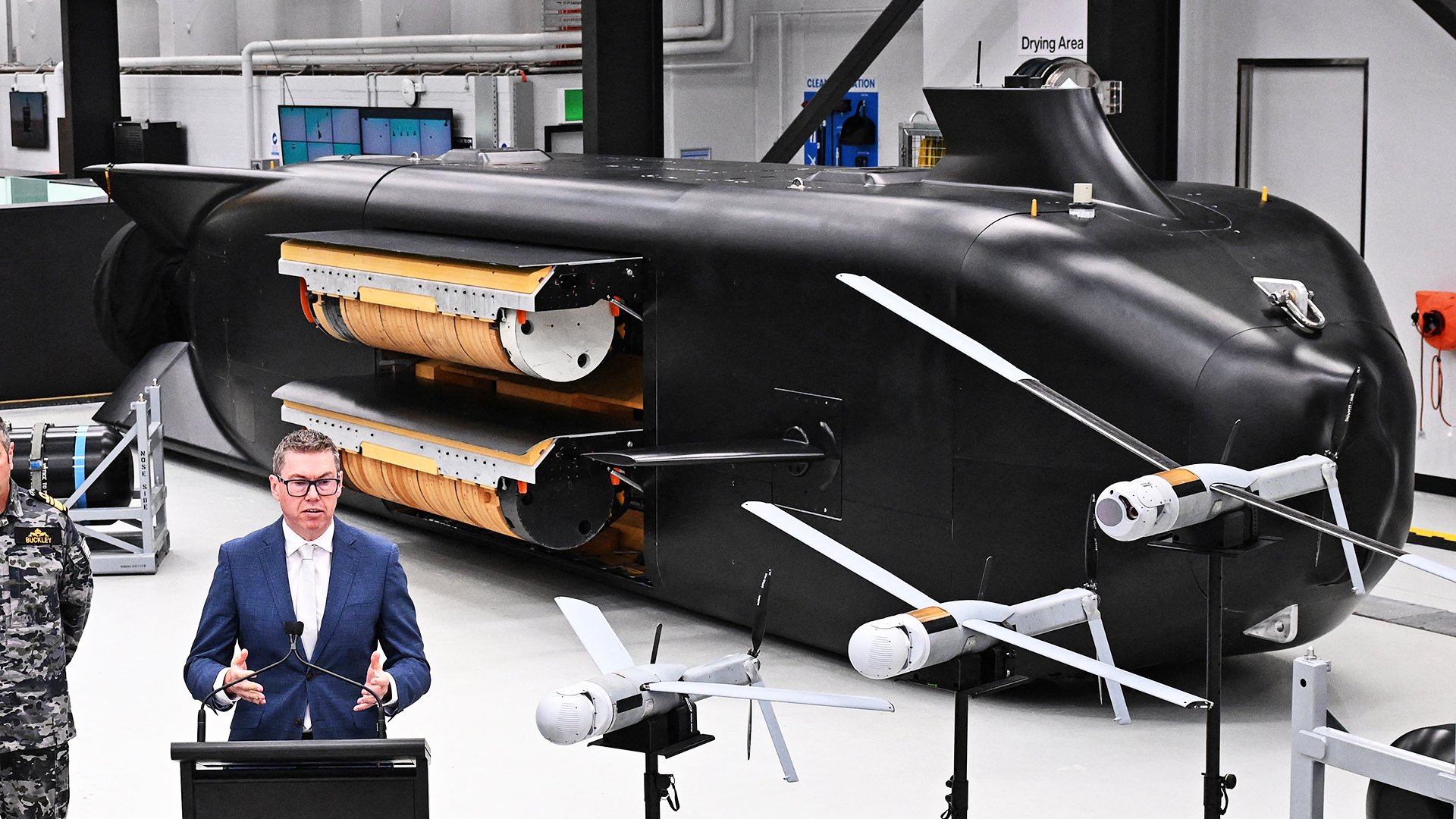
Left to right: David Goodrich, CEO of Anduril Australia; Chief of Navy, Vice Adm. Matthew Buckley; Professor Tanya Monro, AC Chief Defense Scientist; and Pat Conroy, Minister for Defense Industry, stand in front of a Ghost Shark, with payload bay open, at the Anduril Australia factory in Sydney, New South Wales. Australian Department of Defense

The three previously undisclosed payload options include deploying up to 12 sea mines in a mission, leaving supply caches on the seabed, and launching Anduril’s ALTIUS aerial drones for reconnaissance or strike missions.

“Ghost Shark now has teeth, and will have the ability to inflict damage on any potential adversary,” Conroy said.

The payload bay image is significant in its own right. Ghost Shark’s modular design is intended to accommodate different mission-specific systems, allowing the Royal Australian Navy to configure the same underlying platform for different operational requirements. Ghost Shark was designed to be extremely modular, flexible, and readily reconfigurable. As part of this, the overall payload portion can be readily configured in different ways using different-sized modular hull sections. Since the nose and the tail are different pieces, with an expandable section in the middle, there is plenty of scope for different payloads as well.

Seeing the internal bay for the first time provides a more tangible look at that approach than earlier photographs of the submarine’s exterior.
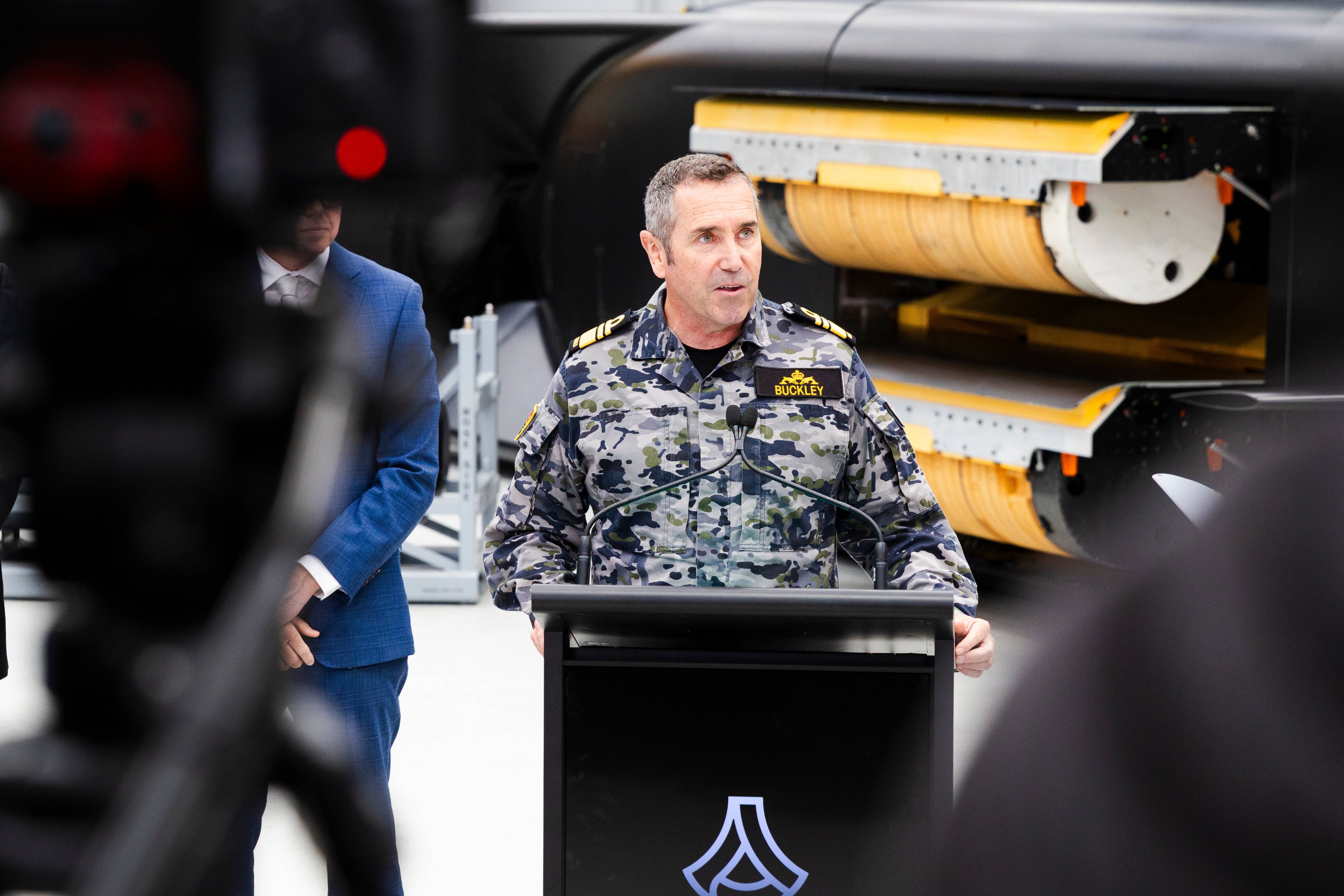
Chief of Navy, Vice Adm. Matthew Buckley, makes an address at the Anduril Australia factory in Sydney, New South Wales. The payload-bay spacers are seen immediately behind him. Australian Department of Defense

Inside the bay of one of the Ghost Sharks on display, there appear to be cylindrical spacers, formed in segments, rather than operational stores. These spacers, and other areas inside the bay, look as if they are fabricated from plywood or similar. Overall, this means it is not entirely clear if they represent the kind of ballast that would be loaded to take the place of actual payloads during trials, or whether they are part of a mockup.

Of the three payload options, the ability to deploy ALTIUS aerial drones is particularly noteworthy. An underwater vehicle capable of releasing aerial systems could extend a naval force’s intelligence, surveillance, and reconnaissance (ISR) reach beyond the submarine’s own sensors. Depending on the drone variant and mission configuration, it could also provide a means of delivering effects at a distance without putting personnel directly in harm’s way. Other roles could include stimulating enemy air defense networks, perhaps even responding to pop-up air defence threats as they appear and attacking them. The ability to put miniaturized satcom terminals, as well as AI, on small drones also greatly opens up the possibilities for UUV-launched aerial drones.
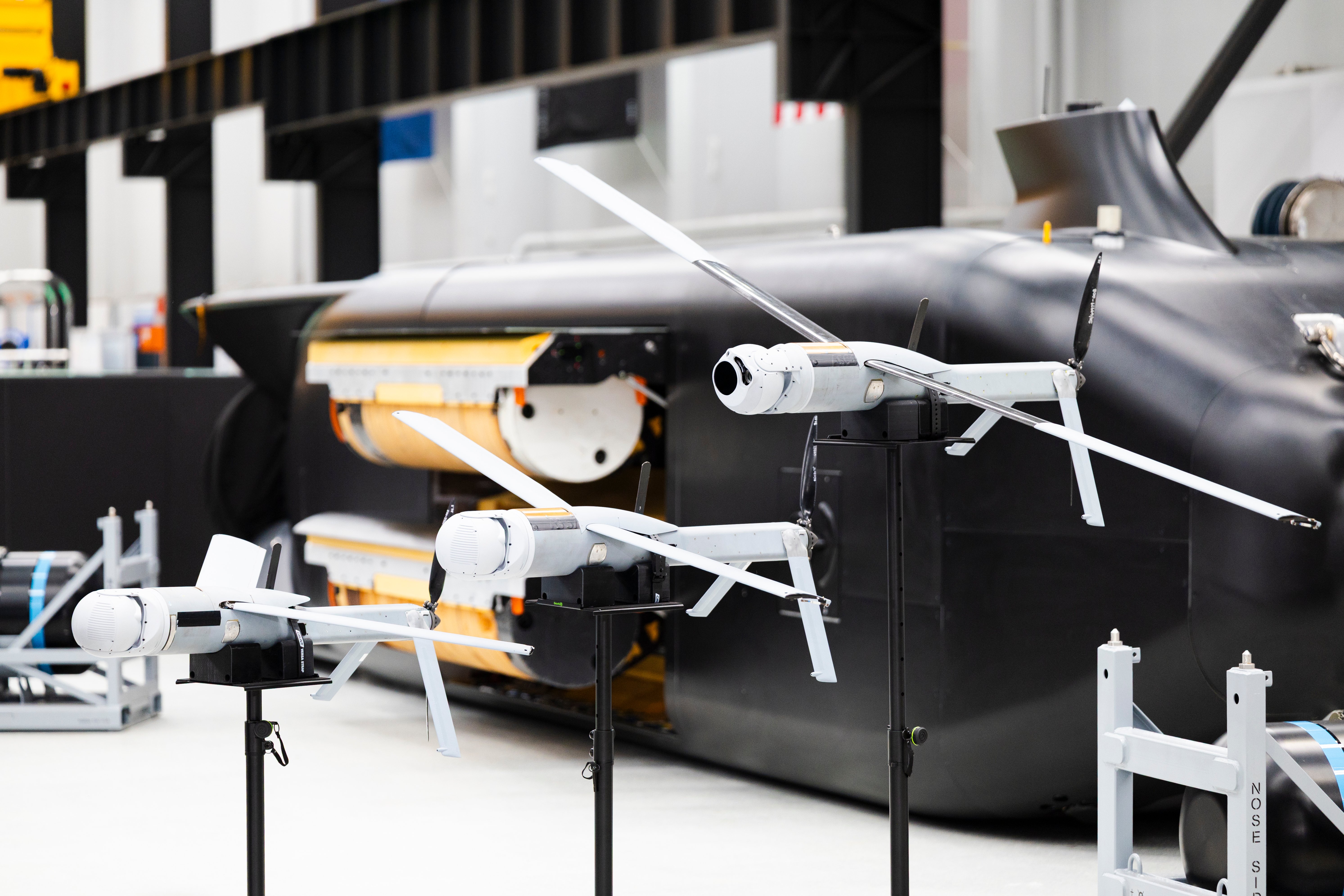
The Anduril ALTIUS-600 is displayed during a press conference at the Anduril Australia factory in Sydney, New South Wales. Australian Department of Defense

Which ALTIUS variants the Ghost Shark will be able to deploy has not been publicly disclosed. The models displayed at the Altus factory are all derivatives of the ALTIUS-600 family. Notable versions include the ALTIUS-600 for ISR, as well as the ALTIUS-600M, which is designed for strike missions. As you can read here, the basic drone has an overall weight of between 20 and 27 pounds, depending on its payload, which typically weighs between three and seven pounds. The ALTIUS-600 has a maximum range of around 275 miles and can remain airborne for at least four hours, according to its developer. Unarmed variants of the ALTIUS-600 are designed to be recoverable and reusable, although it is unclear how practical that would be after launch from a UUV.

There is another missing part of the payload puzzle, namely the kinds of capsules that would contain the ALTIUS UAVs for launch from the sub.

The Rheinmetall Asteria 533mm-diameter mine pictured alongside the Ghost Shark is not installed in the vehicle’s payload bay. Its appearance nevertheless provides an intriguing visual counterpart to the newly disclosed mine-delivery capability. According to the manufacturer, the Asteria can be deployed from surface vessels, aircraft, and submarines (normally via torpedo tubes). It can be remotely controlled via an acoustic link and is optimized for the defense of harbors, straits, ports, and other critical areas.
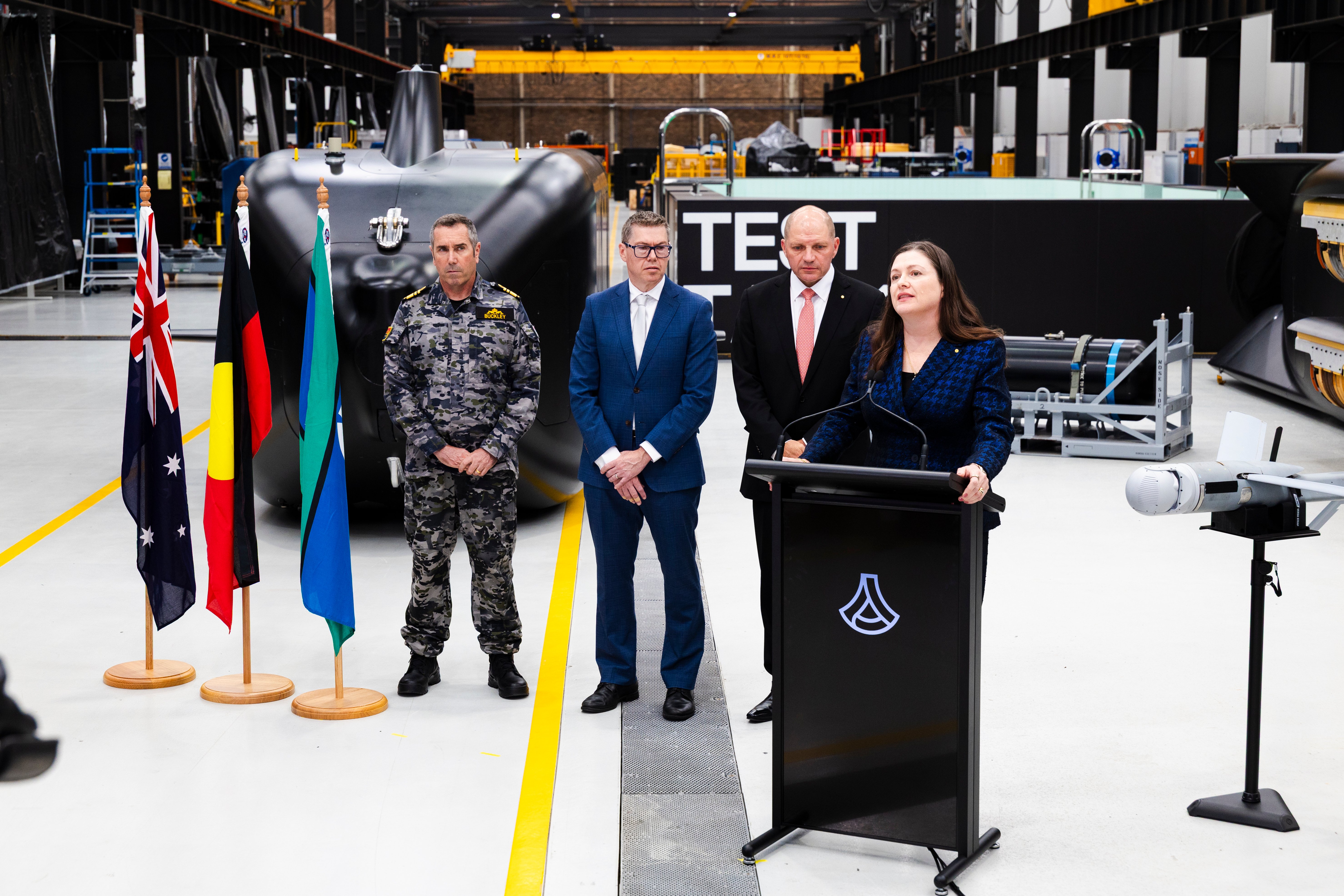
Professor Tanya Monro, AC Chief Defense Scientist, makes an address at the Anduril Australia factory, with the Rheinmetall Asteria mine behind her, immediately to her right, marked with a blue band. Australian Department of Defense

The seabed supply-cache concept points to a different operational role. Ghost Shark could position equipment and supplies underwater for later retrieval, potentially supporting forces operating in areas where conventional resupply is difficult or risky.

The notional supply cache payloads — which are under development by the Defense Science and Technology Group (DSTG) — don’t appear to be on display here. Alex Luck, a naval analyst who closely tracks submarine developments, told TWZ that the cache payloads would likely take the form of capsules, similar in shape to the Asteria mine, but containing whatever supplies need to be moved. It is not immediately clear who would use those caches. One option could be special operations forces, but if the payloads could later rise to the surface, they could be accessed by other forces, too.

It should also be noted that the U.S. Navy and U.S. Marine Corps, in particular, are envisioning future fleets of UUVs and USVs that can carry out kinetic attacks and employ electronic warfare and other non-kinetic effects, as well as emplace mines, providing a direct parallel with the planned mission set for Ghost Shark.
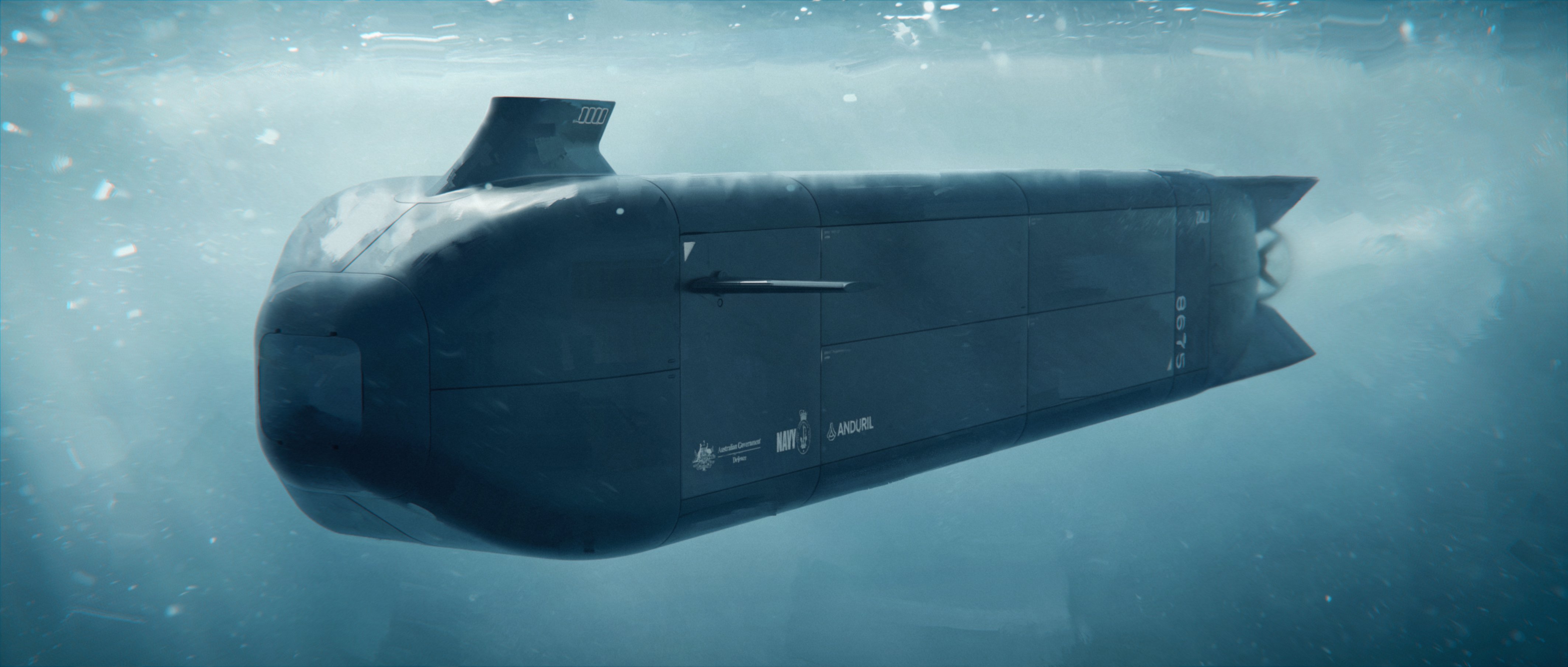
A rendering of a Ghost Shark in Royal Australian Navy service. Australian Defense Force

Some of the new payload capabilities are due to be featured in Exercise Maritime Big Play Pacific in San Diego, an AUKUS Pillar II activity focused on advanced maritime capabilities and interoperability. The Australian government says the development effort involves the Royal Australian Navy, Defense Science and Technology Group, the Advanced Strategic Capabilities Accelerator and defense industry.

As we have discussed in the past, Maritime Big Play has links to the U.S. military’s Technology Readiness Experimentation (T-REX) effort and NATO’s Robotic Experimentation and Prototyping Augmented by Maritime Unmanned Systems (REPMUS) exercise series, according to the Pentagon. The U.S. Navy has also been conducting a growing number of large-scale uncrewed-focused maritime exercises and demonstration events in recent years.
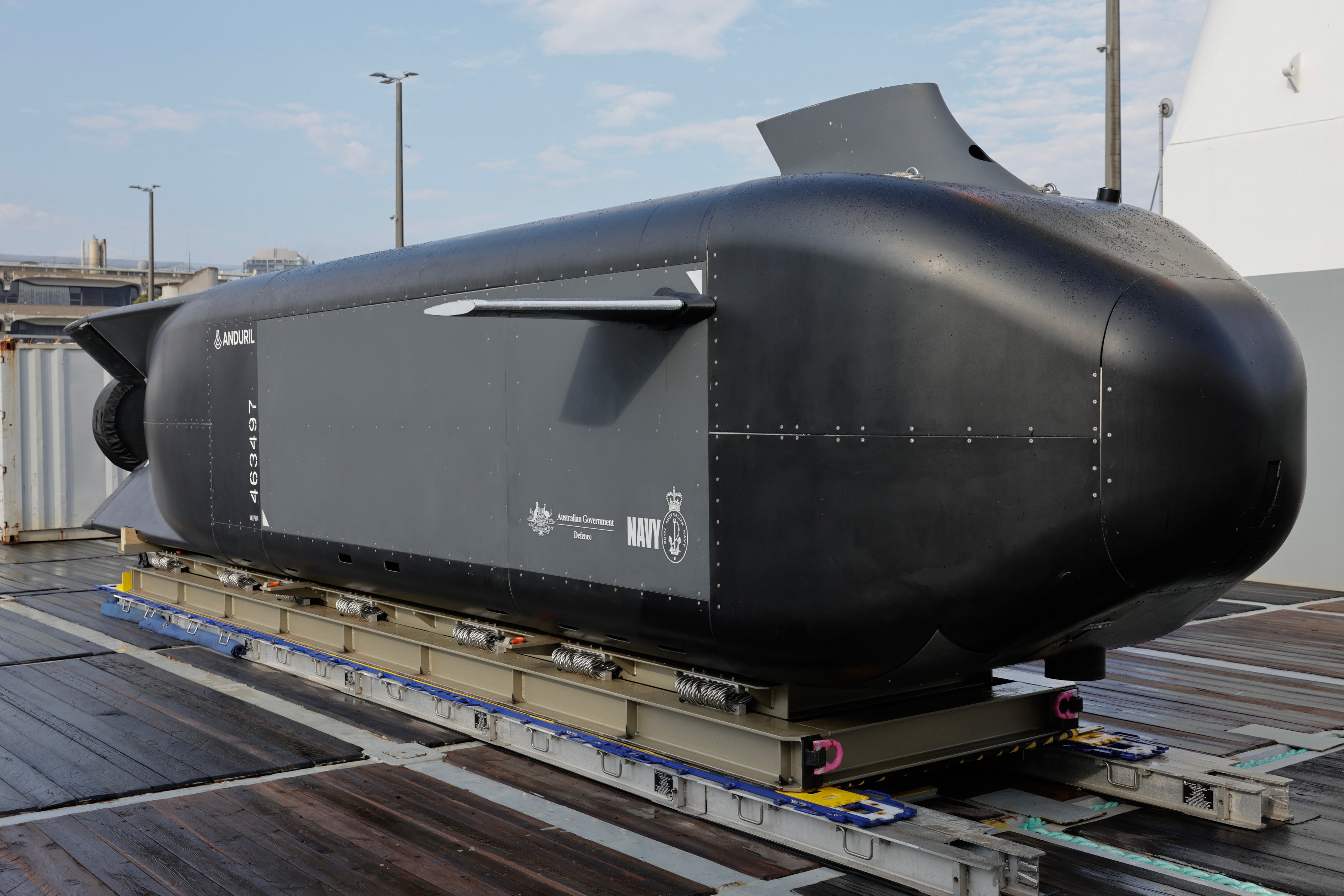
The Ghost Shark ‘Alpha’ first prototype was co-developed by Defense Science and Technology Group, the Royal Australian Navy, and Anduril Australia. Australian Department of Defense

Under AUKUS Pillar II, Australia is collaborating with the United Kingdom and the United States on Ghost Shark and its associated capabilities. While Pillar I centers on providing Australia with nuclear-powered submarines, Pillar II focuses on the joint development of advanced defence technologies, including artificial intelligence and autonomous systems.

Exactly how the Ghost Shark will be deployed during the Maritime Big Play Pacific exercise is unclear, but, speaking about the concept of operations, Conroy described examples of it being deployed from a shipping container or launched from the back of a small vessel using a crane. In the past, we have also seen the Ghost Shark loaded in a standard shipping container and transported in a Royal Australian Air Force C-17A Globemaster III airlifter.
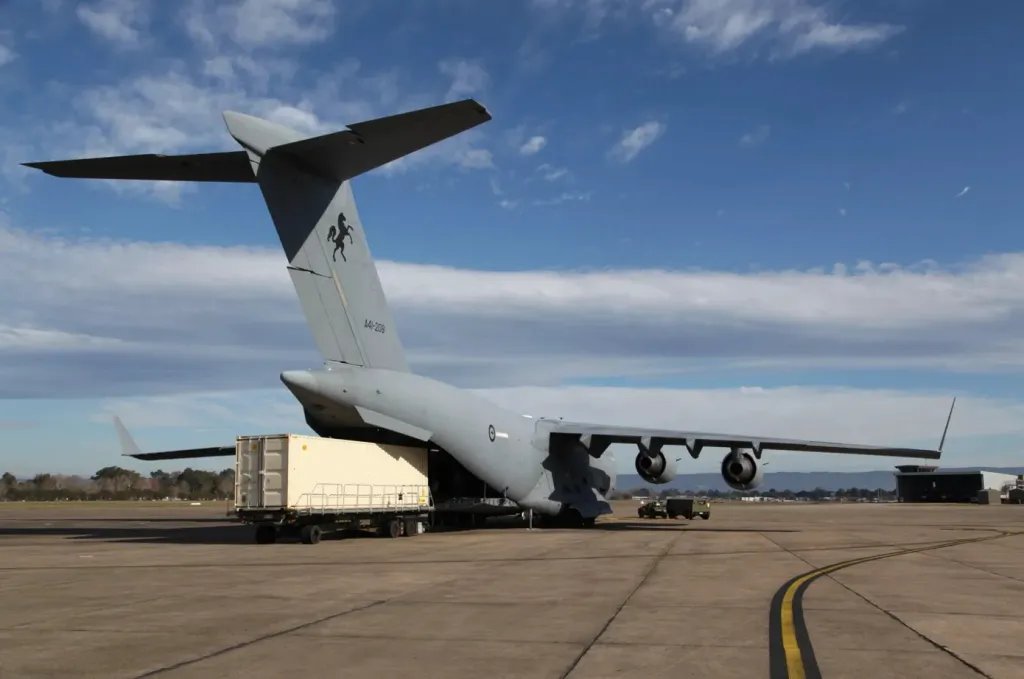
A Ghost Shark loaded in a standard shipping container for transport in a Royal Australian Air Force C-17A. Anduril

Overall, U.S. military wargames have highlighted how uncrewed systems could shape a high-end conflict across the Pacific, particularly a fight over Taiwan. One set of Taiwan conflict simulations found that large swarms of relatively low-cost, networked drones could be decisive in helping locate and attack an invading force, while other wargaming by the Center for a New American Security has highlighted the severe challenges of defending the island against a Chinese assault. Maritime drones could also play a major role: the U.S. Navy has explored submarine-launched aerial drones that act as “flying periscopes,” extending sensor coverage and providing targeting data beyond a submarine’s own reach, while uncrewed underwater vehicles could conduct mine-laying and other asymmetric missions around key maritime chokepoints. The rapid growth and technological advances made by the Chinese submarine fleet also underscore the critical importance of anti-submarine capabilities, in which uncrewed systems can play a major role. Together, these developments underscore the potential value of autonomous systems for the Royal Australian Navy as it prepares to operate across the vast distances of the Indo-Pacific.

Australia’s 2026 National Defence Strategy and Integrated Investment Program allocate up to A$5.8 billion (approximately $4.05 billion) over the decade to autonomous and uncrewed undersea warfare capabilities, including A$1.7 billion (approximately $1.19 billion) for a new fleet of Australian-designed and built Ghost Shark vehicles.

The newly released imagery and payload details offer the clearest picture yet of how Australia intends to expand Ghost Shark beyond a conventional underwater surveillance role. The next key milestones should provide more details of how the payloads will be integrated into the vehicle, and how they might be deployed in practice.

Contact the author: thomas@thewarzone.com

The post Ghost Shark Extra-Large Uncrewed Underwater Vehicles’ Payload Bay Seen For First Time appeared first on TWZ.
  •  

Sea mine crisis re-emerges in Strait of Hormuz as Tehran urges Washington to accept deal

Sea mines have resurfaced as a threat in the Strait of Hormuz, where Iran claimed Oct.17 that two oil tankers caught fire after striking the explosives, raising fresh alarms over the safety of one of the world's most critical shipping lanes.

This came as the International Maritime Organization (IMO) warned that sea mines pose a serious threat to vessels navigating the strategic waterway and while Tehran continues to maintain its own unauthorized shipping corridor inside its territorial waters.

"The traffic separation scheme, the information that we have is that they still have mines. And of course, whilst the conflict is ongoing, it's very difficult for us to use third parties to verify that it is clear of these hazards," IMO Secretary-General Arsenio Dominguez told Fox News Digital.

INSIDE THE DANGEROUS US MISSION THAT CLEARED IRAN’S MINES FROM HORMUZ SHIPPING LANES

"So in the meantime, we cannot guarantee that a vessel that intends to transit that route will not be hit by a mine."

Iran's Islamic Revolutionary Guard Corps (IRGC) navy said Saturday that two oil tankers caught fire after striking naval mines while crossing the Strait of Hormuz, Reuters reported, citing Iran's official Islamic Republic News Agency (IRNA).

State media also said both tankers were carrying about 2 million barrels of crude oil, according to Reuters.

IRNA also reported that the vessels had switched off their positioning and radar systems and attempted to use a route through the strategic waterway that Iran had not authorized.

IRAN WARNS SHIPS OF 'FORCEFUL RESPONSE' AS US-BACKED HORMUZ ROUTE CHALLENGES TEHRAN'S GRIP

The second tanker was left immobilized after striking a mine, according to the Reuters report.

The alleged strikes came as Tehran continued to maintain its transit passageway inside Iranian territorial waters, imposing tolls and safety fees administered by the IRGC — a framework rejected by Washington and the IMO as inconsistent with international maritime law.

International shipping through the narrow chokepoint has historically relied on an IMO-approved traffic separation scheme adopted in 1968.

"Right now there's only one route that was adopted back in 1968 that is approved and recognized for IMO and that appears in all the charts for the vessels to operate," Dominguez explained.

IRAN FAILS TO STRIKE DEAL WITH US AS DEADLINE PASSES AND TRUMP CALLS FOR ‘WHITE FLAG OF SURRENDER'

"There's only one route that should be used for transit, but it's not clear of mines right now, so it's not safe."

"We have received confirmation from Iran about the establishment of its temporary route in the waters," he added before stating that the route was not provided with "an official confirmation or a decision of the organization."

"Any other route needs to actually be sent to the organization to go through the processes, and we have not received that."

"We have received communication from Iran to use that route because of the conflict," Dominguez clarified.

"That's the way that it's been presented. But anything for us to approve needs to go through the mechanisms at the international maritime organizations and the member states need to review it."

The developments also came amid stalled negotiations between Washington and Tehran over ending the conflict and restoring maritime traffic.

DISTRESS CALL CAPTURES TANKER UNDER FIRE, IRAN SHUTS HORMUZ TRAPPING THOUSANDS OF SAILORS

Mohsen Rezaei, secretary of Iran's Supreme National Security Council and a former Revolutionary Guard commander, said Tehran considered Washington's latest response to negotiations "insufficient," Reuters reported, according to IRNA.

Rezaei said the U.S. had accepted some of Iran's seven conditions but that other issues remained unresolved, adding that Tehran was no longer responding to Washington and that the U.S. needed to clarify the outstanding matters.

Iranian Foreign Minister Abbas Araghchi said that Tehran had submitted a proposal to Washington through Qatar, which is mediating the negotiations, outlining conditions under which the Strait of Hormuz could reopen and normal maritime traffic resume within seven days.

"Our situation is clear and based on ⁠the seven-day proposal presented to the US. They shared comments which ​we are reviewing, but our proposal is still on the table ​and if there is any honesty on the US part, which there isn't, the way to reopening the Strait of Hormuz is obvious," Araqchi said in ​Baghdad, Reuters reported

IRAN REQUESTS TALKS WITH US AS WHITE HOUSE WARNS 'VIOLENCE WILL BE MET WITH VIOLENCE'

Meanwhile, attacks on commercial vessels around the Strait of Hormuz have surged over the past two weeks.

Senior Iranian officials also told Reuters that Tehran has shifted its strategy for attacking commercial vessels during that period.

For commercial shipping operators, Dominguez warned that the continued threat of mines and attacks means the waterway has yet to return to normal operations.

The Strait of Hormuz is "not open for business in the way that it was before the conflict started," he said.

"Our role right now is to prepare for when we have the opportunity to go back, resume the operations, follow all the procedures at IMO, but not until the root causes are addressed and those are beyond IMO."

CLICK HERE TO DOWNLOAD THE FOX NEWS APP

Fox News Digital reached out to U.S. Central Command (CENTCOM) for comment.

  •  

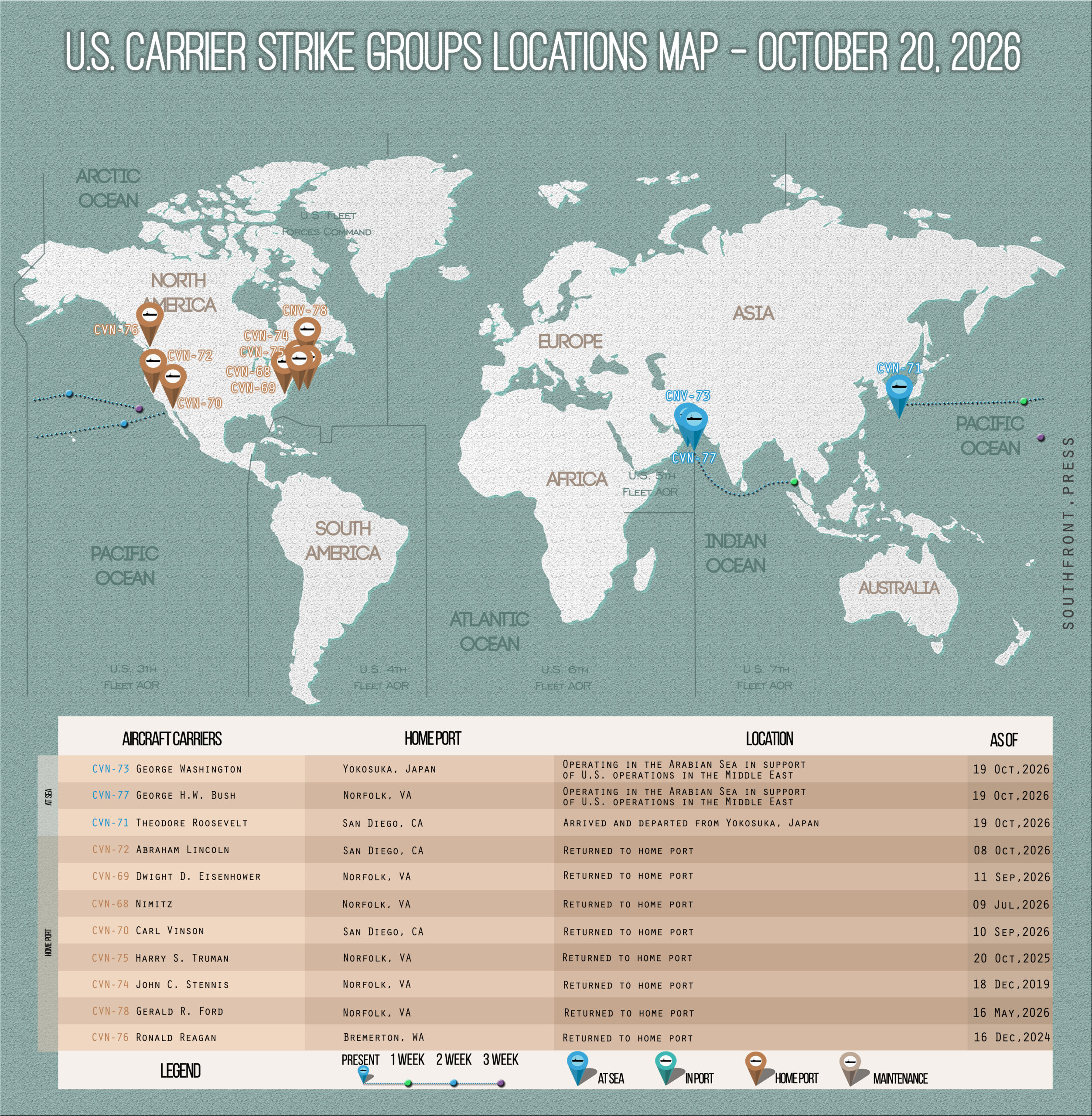
Locations Of US Carrier Strike Groups – October 20, 2026

This is the newest update of the ‘U.S. Carrier Strike Groups Locations Map’ exclusive series showing the approximate locations of U.S. Carrier Strike Groups. SouthFront: Analysis & Intelligence tracks locations of U.S. aircraft carriers using the available open-source information. No classified information was used in production of the map.

click to see the full-size image

Carrier strike group (CSG) is an operational formation of the United States Navy. It is centered on an aircraft carrier and a carrier air wing of 65 to 70 aircrafts. It’s composed of roughly 7,500 personnel, an aircraft carrier, at least one cruiser, a destroyer squadron of at least two destroyers and/or frigates. A carrier strike group also, on occasion, includes submarines, attached logistics ships and a supply ship. Carrier strike groups comprise a principal element of U.S. power projection over the world’s oceans

______________________________________________________________________________________________________________________

SouthFront: Analysis and Intelligence
NOW hosted at southfront.press
Previously, SouthFront: Analysis and Intelligence was at southfront.org.
The .org domain name had been blocked by the US (NATO) (https://southfront.press/southfront-org-blocked-by-u-s-controlled-global-internet-supervisor/) globally, outlawed and without any explanation
Back before that, from 2013 to 2015, SouthFront: Analysis and Intelligence was at southfront.com

SOUTHFRONT.PRESS

The post Locations Of US Carrier Strike Groups – October 20, 2026 appeared first on South Front.

  •  

Navy robot deal quadruples as US looks to ‘outsmart’ China with AI at sea

FIRST ON FOX: The U.S. Navy is quadrupling the ceiling on a contract for AI-powered robots used to inspect warships to $300 million.

Just six months after initially tapping the technology to help get ships through maintenance and back to sea faster, the expanded agreement with Pittsburgh-based Gecko Robotics underscores the importance the U.S. military is putting on tech-based solutions. The initial ceiling for the deal was $71 million, but the Navy is pushing to improve fleet readiness amid a widening shipbuilding gap with China.

"While the U.S. may not be able to out-manufacture faster than China, we can outsmart the ways that we maintain, operate and are ready with our vessels," Gecko Robotics CEO Jake Loosararian told Fox News Digital.

Gecko says its technology can save the Navy up to $8 million in repair costs on a single ship and identify some structural issues up to 50 times faster than traditional inspection methods.

INSIDE TRUMP’S DEAL TO GIVE AMERICAN TAXPAYERS A MASSIVE STAKE IN NEW $6.6B SUBMARINE DEAL

The company is also unveiling a new robot developed specifically for the Navy that can inspect the steel beneath thick coatings on warship decks without first stripping them away.

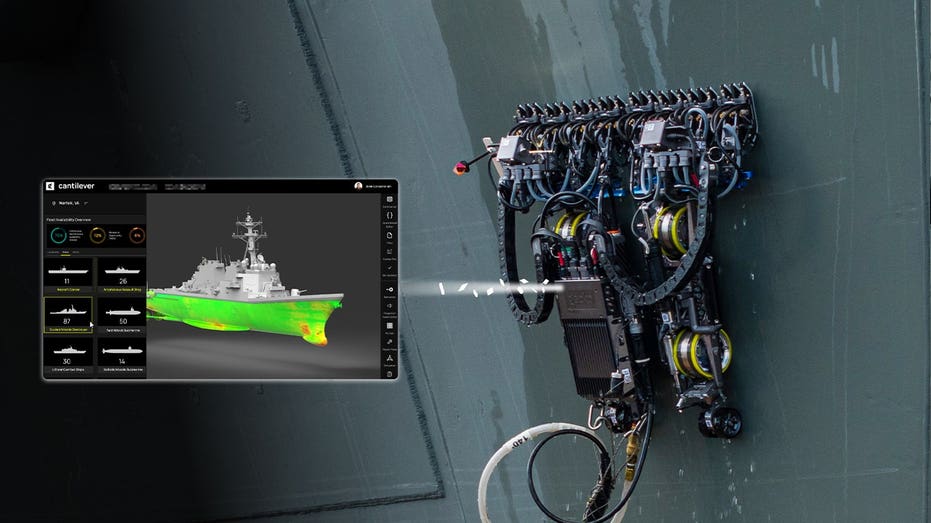
Dubbed Komodo, the robot scans a ship's deck to map corrosion and material thickness, giving maintenance crews a picture of what needs to be repaired before more invasive work begins.

"It's essentially a CAT scan," Loosararian said. "You're basically understanding exactly what's going on."

Traditionally, determining the condition of steel beneath a ship's non-skid deck coating can require removing material before crews know the extent of the problem. Komodo is designed to gather that information without first taking the surface apart.

"The robots are able to actually understand what's wrong without having to take apart the ship to figure out what to fix," Loosararian said.

In another example cited by Loosararian, an assessment that initially called for roughly 1,200 square feet of repair work was narrowed to about 300 square feet after robotic inspections provided a more precise picture of the damage.

"You reduce and focus the kinds of repairs that you need," Loosararian said. "You're repairing less."

CHINA’S LONG-TERM FINANCES ARE ALL WET AS BILL TO MAINTAIN HUGE NAVY COMES DUE IN 2031

The increased ceiling comes just six months after the Navy awarded Gecko a five-year, $71 million contract vehicle to expand the use of its robotic inspection technology across the fleet.

Under the initial agreement announced in March, Gecko was set to begin work on 18 ships in the U.S. Pacific Fleet, including destroyers, amphibious warships and littoral combat ships.

The company's wall-climbing robots crawl across hulls, flight decks, ballast tanks and other difficult-to-access areas, scanning for corrosion, metal loss and other structural problems. The data is fed into Gecko's AI-powered Cantilever platform to help maintenance planners determine where repairs are needed.

The goal is to find those problems earlier, before a ship enters a major maintenance period and crews discover additional work that can extend its stay in the shipyard.

"The biggest savings are just in speed," Loosararian said. "Speed — you can't put a price tag on it, especially if you're in the U.S. Navy right now."

The expansion comes as Navy leaders seek to push fleet readiness toward 80% while maintenance delays continue to sideline ships that would otherwise be available for deployment.

China already fields a larger battle force than the U.S. Navy and can produce vessels at a pace American shipyards cannot easily match. That has put additional pressure on the Pentagon to keep more of the ships already in the American fleet available for operations.

For Gecko, the longer-term goal is to move beyond finding existing damage and use years of inspection data to anticipate problems before they force ships into longer repair periods.

"You are able to predict exactly what's going to break before it does," Loosararian said, allowing maintenance planners to have workers, materials and repair plans ready when a ship reaches the pier or enters a shipyard.

The technology could also reduce the amount of dangerous and labor-intensive inspection work performed by shipyard workers as the industrial base struggles with shortages of skilled labor.

CLICK HERE TO DOWNLOAD THE FOX NEWS APP

Loosararian said the combination of robotics and AI is ultimately aimed at allowing a limited workforce to spend more time fixing ships and less time determining what needs to be fixed.

For a Navy racing to keep pace with a rapidly expanding Chinese fleet, he argued, getting more out of the ships already in the water could prove just as important as building new ones.

"While the U.S. may not be able to out-manufacture faster than China," Loosararian said, "we can outsmart the ways that we maintain, operate and are ready with our vessels."

  •  
❌