❌

Reading view

Colombia’s Congress Approves 2027 Budget Over Opposition Objections
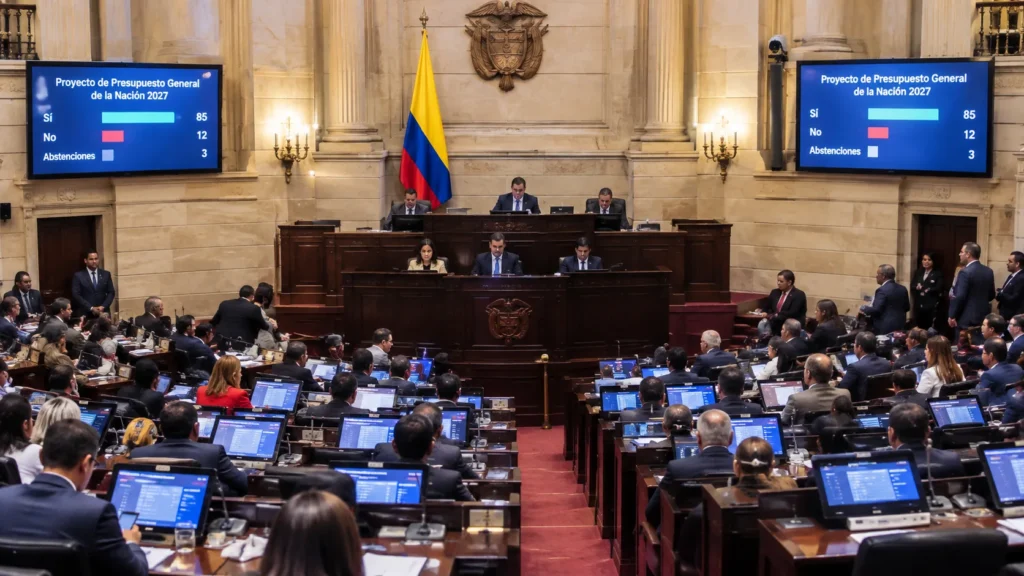
The Historic Pact questioned the law’s direction by pointing out that the government preferred to protect financial institutions, oligopolies and the most favored ones rather than devote more resources to key sectors such as education. Photo: El Pais.

Colombia’s Congress approved the 2027 national budget of 200 billion dollars on October 20, igniting a backlash from opposition lawmakers who say the plan favors debt payments and financial interests over education, peace and regional development.


The approval of the General Budget of Colombia for 2027 capped a tense legislative session.

President Abelardo de la Espriella’s government secured passage of the law, worth 634.9 trillion Colombian pesos (about $200 billion), over the objections of the opposition, which was led mainly by the Historic Pact party.

RELATED: Colombia’s First National Strike Against De la Espriella Met With Police Crackdown

Representative María Fernanda Carrascal described the debate as a “disaster” and faulted the national government for refusing to accept any of the 700 proposals submitted by her party. The initiatives sought to channel more resources into public education, support for victims of violence and the regions, she detailed. Faced with the lack of agreement, the opposition walked out of the debate, stating it would not back a measure it considers harmful to the country.

The Historic Pact also questioned the law’s orientation, arguing that the government chose to protect financial entities, oligopolies and the most favored sectors. They further denounced that the project promotes over-indebtedness, which they say will end up shifting heavier tax burdens onto Colombian citizens.

🇨🇴 ¡Colombia tiene Presupuesto para 2027!
El Congreso de la República aprobó por $634,9 billones el Presupuesto de la Verdad, el primer paso para volver a encaminar la economía del país hacia el crecimiento, la responsabilidad fiscal y la atención de las necesidades del país. pic.twitter.com/pHiLhYzVTU

— MinHacienda (@MinHacienda) October 20, 2026

Text reads: “Colombia has budget for 2027! The Congress of the Republic approved the Truth Budget for $634.9 trillion, the first step to reorient the country’s economy toward growth, fiscal responsibility, and meeting the country’s needs.”

Other voices in the legislature added their objections. Senator Jennifer Pedraza of the Dignity and Commitment party (Dignidad y Compromiso, in Spanish) criticized the absence of a fixed allocation to address the consequences of the earthquake that struck on August 10. She questioned the fact that assistance to hard-hit departments such as Risaralda, Chocó and Valle del Cauca depends solely on leftover budget balances.

Senator Ariel Ávila, in turn, lamented the underfunding of resources earmarked for electric infrastructure and energization in non-interconnected zones such as Vichada, Guainía, Arauca, Putumayo and Vaupés. He also pointed to a lack of concern for victims of the armed conflict and what he called a budgetary strangling of the Special Jurisdiction for Peace (JEP).

After the law’s validation, Congress gave the Executive 90 days to draft a fiscal adjustment plan, which the national administration has called the Rescue Law. The Ministry of Finance and the cabinet are already holding talks with the International Monetary Fund, a signal that new credit instruments and the conditions attached to them may be on the negotiating table.

Mobilization Set for November

The Historic Pact called on citizens to join a national mobilization on November 24 to reject the budget. The party maintains that the project raises debt service by 46% while cutting investment in the Special Jurisdiction for Peace by 82% and stripping 500 billion Colombian pesos (about $157 million) from the National Learning Service (SENA).

Lawmakers also warned that 14 departments will see their real investment shrink. They denounced that the norm prioritizes debt repayment over the financing of peace, education and regional development. “The complaint is clear: more resources for debt and less for peace, education and the regions,” the party stated on social media.

The mobilization announced for late November now stands as the opposition’s next test of strength. In the meantime, the government’s 90-day clock to deliver its fiscal adjustment plan is running, and the talks with the International Monetary Fund could define the conditions under which Colombia finances its 2027 spending. The opposition has vowed to keep the pressure on, both in the streets and in the legislature.

📢 ¡24 DE NOVIEMBRE: MOVILIZACIÓN NACIONAL!

La bancada del Pacto Histórico llama a la movilización frente al Presupuesto 2027 del Gobierno de Abelardo de la Espriella, por $634,9 billones.

Según la bancada, el servicio de la deuda aumenta un 46%, la inversión de la JEP cae un… pic.twitter.com/F5IYf2YDVb

— Pacto Histórico Oficial (@PactoCol) October 20, 2026

Text reads: “November 24: National Mobilization! The Historic Pact bench calls for mobilization against the 2027 budget of the government of Abelardo de la Espriella, for $634.9 billion. According to the bank, debt service increases by 46%, Special Jurisdiction for Peace (JEP) investment falls by 82%, National Learning Service (SENA) loses $500 billion, and 14 departments will receive less real investment. The denunciation is clear: more resources for debt and less for peace, education, and regions.”


  •  

Ana de Alva, la voz de la nueva generación del cine español: "Nadie es demasiado joven para dirigir una película"

A sus 25 años, es uno de las principales exponentes de la nueva oleada de cineastas españoles. Realizadora, actriz, profesora y bailarina, ahora ultima el guion de su segundo filme Leer

A sus 25 años, es uno de las principales exponentes de la nueva oleada de cineastas españoles. Realizadora, actriz, profesora y bailarina, ahora ultima el guion de su segundo filme
  •  

Amazon Fires Push Brazil Air Pollution to Very Unhealthy Levels

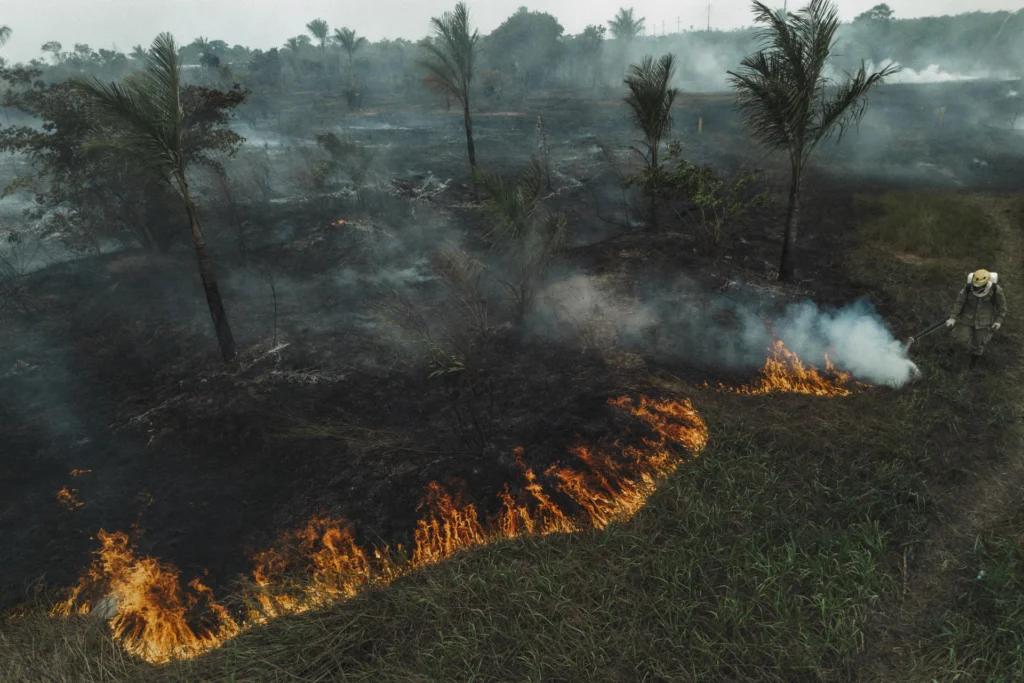
Hundreds of fires are consuming the Amazon rainforest, plunging Brazilian cities in the region into a dangerous cloud of toxic smoke. Photo: EFE.

Wildfires in Brazil’s Amazon region have driven air pollution to dangerous levels in cities such as Santarém and Manaus, prompting the federal government to deploy a joint armed forces command, more water-bombing aircraft and emergency funds.


A wave of forest fires is consuming the western zone of Brazil’s Pará state, where authorities have counted 922 active outbreaks. The dense smoke has left the city of Santarém under air pollution levels described as very unhealthy for the local population.

Figures released by the Queimadas platform, which operates under the National Institute for Space Research, place Pará at the top of the national registry of environmental disasters.

RELATED: Brazil Faces Increased Wildfires Due to Super El Niño Phenomenon

The neighboring state of Amazonas reports 90 active fire points after having surpassed one thousand outbreaks in recent weeks.

Conditions grew especially dire in Santarém, where the air quality index climbed to 260 points, according to measurements from the international monitoring platform IQAir. Scientific stations detected concentrations of fine particles reaching 185 micrograms per cubic meter.

That reading exceeds the limit allowed by Brazilian environmental law by an enormous margin. The permitted daily average stands at 32 micrograms per cubic meter. Experts note that these microscopic particles penetrate deep into the respiratory tract and pose a severe threat to public health.

In Manaus, the capital of Amazonas state, the picture remains critical as well. The persistent dispersion of toxic gases pushed the air quality index to 153 units during the early hours of the day, consolidating a harmful atmosphere across the urban centers of the rainforest.

The fires arrive during the dry season, when large stretches of forest are cleared by intentional burns. The flames spread through drought-stricken vegetation, and the resulting smoke drifts over populated areas with no immediate relief in sight.

Manaus respira 12 vezes mais veneno que o limite da OMS — e o pior horário ainda está por virhttps://t.co/9Gd6YlfkL3

Instagram: https://t.co/5ljysPP0H9 pic.twitter.com/OxWcgJCI4Y

— Portal do Holanda (@portaldoholanda) October 18, 2026

Text reads: “Manaus breathes 12 times more poison than the W.H.O. limit – and worst time is yet to com.”

Military Response Activated

Faced with the environmental collapse, Brazil’s federal government ordered an extraordinary operational deployment. Defense Minister José Múcio Monteiro confirmed the activation of a Joint General Staff of the Armed Forces based in Manaus to coordinate ground and air containment efforts.

The response added five aircraft, raising the military fleet fighting the flames in the northern region to 16 water-bombing planes. The Ministry of Integration and Regional Development transferred 14 million reais, about 2.8 million dollars, to the Amazonas state government to mitigate the emergency.

Health authorities announced the installation of a base of the National Force of the Unified Health System. Its main task will be to provide direct medical care to the thousands of residents affected by respiratory illnesses caused by the pollution.

Environmental organizations warn that the scale of the fires exposes the structural vulnerability of the world’s largest tropical rainforest. The combination of prolonged drought, deforestation and insufficient fire control threatens the ecological stability of the Amazonia and the integrity of native communities.

The local government has declared a state of emergency in Autazes as suspected arson fires, aggravated by El Niño, rip through the Brazilian Amazon and trigger health alerts in Manaus🇧🇷🔥 #Amazonas #BrazilFires pic.twitter.com/u9I1i0Ocpd

— SG News (@SGNews123) October 14, 2026

The crisis reflects the devastating consequences of climate change and agricultural pressure on the biome. During the dry season, extensive areas of jungle are razed by intentional burns meant to open land for cattle ranching and large-scale farming.

With 922 active outbreaks in Pará and the fires still spreading, the emergency response faces a race against deteriorating air quality. The health base and the expanded air fleet mark the government’s immediate answer to a crisis that shows no sign of easing.

  •  

Venezuela’s Acting President Reviews Wage Consensus With Business, Unions

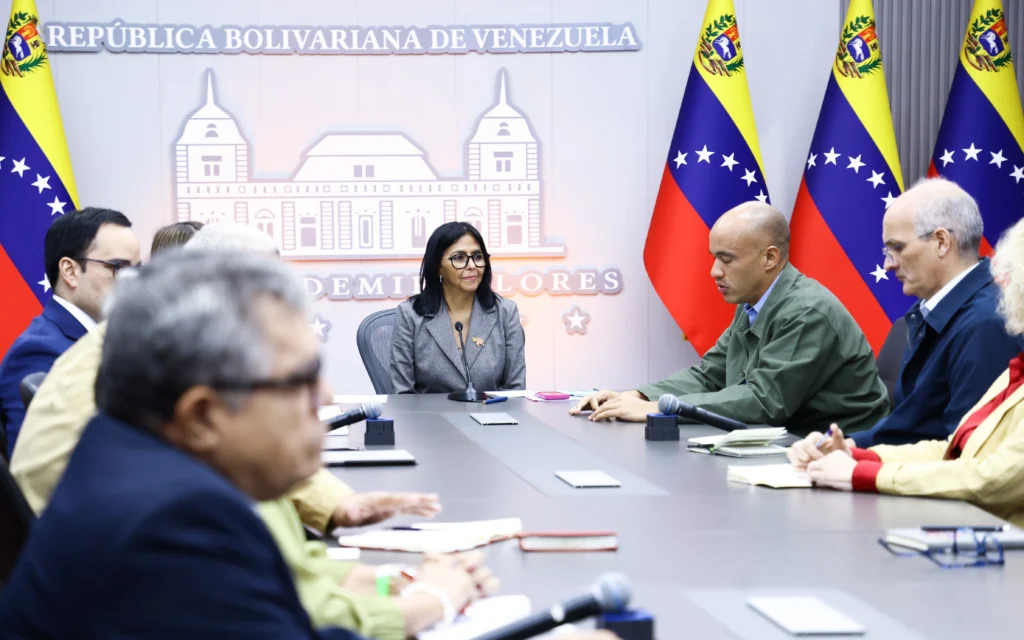
The Acting President, Delcy Rodríguez, led a strategic meeting aimed at consolidating labor and social consensus between the state, business federations and trade union centers of the country. Photo: Venezuelan Presidential Press.

Acting President Delcy Rodríguez led a meeting on Monday with Venezuela’s main business federations and national union confederations to consolidate agreements on wage restoration, salary scales and worker’s protections.


The meeting brought together the Federation of Chambers and Associations of Commerce and Production of Venezuela (Fedecámaras), the Federation of Chambers and Companies of Venezuela (Fedeindustria) and the country’s various union confederations.

The dialogue table evaluated the progress made in the days of debate focused on restoring workers’ purchasing power.

RELATED: Venezuela Promotes Venezuela Feeds Plan and Local Economy Law to Achieve “Hunger 0”

Three core areas shaped the agenda. The first was the progressive conversion of workers’ income into formal salary, a shift the government describes as progressive salary restructuring.

The second involved adjusting salary scales and tables. The third centered on designing guarantees of stability for Venezuelan workers. In this sense, the working group also reviewed draft laws and regulatory instruments meant to shield the framework of social and economic protection for workers.

Dialogue for Sovereign Growth

Venezuelan Acting President Rodríguez reiterated the government’s unwavering commitment to protecting the inalienable rights conquered by the people. She insisted on preserving the workday, end of year bonuses, additional bonuses, vacations, seniority premiums and social benefits in the face of external economic aggression. Following this, the authorities said the three-way dialogue strengthens the model of social justice and lays the groundwork for sovereign economic growth.

The government’s participants included Economy Minister and sector Vice-president Anabel Pereira, Sectoral Vice President for Social and Territorial Socialism Héctor Rodríguez, Planning Minister Ricardo Menéndez and Economy Sectoral Vice-President Calixto Ortega. Labor Minister Carlos Alexis Castillo, University Education Minister Ana María San Juan and Presidential Commissioner for the Constituent Assembly and Labor Consensus Eduardo Piñate also attended.

The labor meeting follows Rodríguez’s announcement days earlier before the UN Food and Agriculture Organization (FAO) that the executive will submit a draft Law for the Local Economy to the National Assembly.

Rodríguez explained that the legal text has as its strategic objective the dynamization of the domestic productive apparatus through the effective linkage of the different economic sectors of the country. Before the multilateral delegations, the Venezuelan Acting President detailed the guiding principles of the norm, designed to strengthen the food sovereignty and security of the Venezuelan people against the blockade of foreign powers.

  •  

Cristiano Ronaldo Suspended 30 Days and Fined €255 for Leaving Portugal Camp

Cristiano Ronaldo received a slight sanction from the Portuguese federation after leaving the team's concentration. Photo: AFP.

Cristiano Ronaldo has been handed a 30-day suspension and a €255 fine by the Portuguese Football Federation (FPF) for leaving Portugal’s training camp after a dispute with coach Jorge Jesus, a punishment that will expire in time for him to be available for the national team’s November matches.


The disciplinary council of the Portuguese Football Federation (FPF) imposed the punishment on Monday and confirmed that Ronaldo admitted the accusation in full.

Ronaldo walked out of the squad’s camp in Copenhagen on September 30, the day Portugal faced Denmark in the UEFA Nations League.

RELATED: FIFA Drops Private Investment Plan, Infantino Proposes $6.35B Program

Ronaldo’s stated reason was that coach Jorge Jesus had twice broken his word about his role in the team, after he did not come on in the match against Norway, where he was a substitute. Jesus denied having reached an agreement with Ronaldo but left the door open to his return after Portugal’s 2-1 victory on September 27.

The rules allow a suspension of one to six months, but the ceiling drops to three when a player accepts responsibility. Ronaldo did, and his 30-day ban reflects that admission. Alongside the ban, the council ordered him to pay 255 euros, a sum worth about 285 dollars.

Cristiano Ronaldo has been fined €255 (£215; $286) and given a 30-day suspension after exiting the Portugal national team camp early.

Full story from @jacklang ⬇️https://t.co/U888ZlAlwr pic.twitter.com/FVFaiKpiK5

— The Athletic | Football (@TheAthleticFC) October 19, 2026

Minimum Penalty Applied

The disciplinary body determined that Ronaldo intentionally committed an infringement under article 160, paragraph 1, of the federation’s regulations. The procedure opened on October 9, based on facts reported two days earlier. His suspension was counted from September 30, the day he left, so he has already served 19 days and has 11 remaining. In practice, he was sidelined from the moment he abandoned the camp, well before Monday’s formal ruling.

In its statement, the disciplinary committee said Ronaldo “did not previously communicate or justify, before the person responsible for the FPF or the national team, his intention to abandon” the concentration on September 30. The former Real Madrid striker later told Federation President Pedro Proença that he was not “in emotional conditions to continue.”

A few days after leaving, Ronaldo posted a lengthy statement on his official Instagram account explaining his reasons and asking fans to believe him: “Believe me, this is the pure truth.”

“Despite the absolute lack of trust in the coach’s word, as anyone who witnessed these conversations can attest, I should not have done it. The responsibility is exclusively mine,” he said.

Ronaldo received the minimum penalty provided by the FPF’s rules. For abandoning national team activity, the regulations call for a penalty of between one and six months, although the maximum in this case would be reduced to three months because the player admitted guilt.

Return Possible in November

The timing of the ban means Ronaldo will be eligible for Portugal’s next Nations League fixtures against Denmark and Wales on November 14 and 17. Both the captain and the coach have left the door open for his inclusion in that squad. With only 11 days of the suspension left, the 41-year-old could rejoin the group before those matches.

The sanction resolves a dispute that had hung over the national team since the September window. Portugal beat Norway 2-1 in that period, with Ronaldo watching from the bench. He departed before the following match against Denmark and played no part in either fixture. His absence, however, did not settle the questions about his relationship with the coach, which the federation has now addressed through its ruling.

For Ronaldo, the outcome is a light one. The 255-euro fine is a small sum for a player of his profile, and the suspension expires before his country’s next competitive matches. The federation acted at the lowest end of its disciplinary scale, allowing the captain to return without missing further competitive action. Portugal’s November fixtures will now show whether the dispute is truly closed or merely paused.

  •  
❌