❌

Reading view

Denmark To Buy Anthem Munitions, Joint Strike Missiles In Dual Long-Range Strike Push

Denmark is set to acquire Anthem long-range strike weapons from U.S.-based defense startup Covenant, as well as Joint Strike Missile (JSM) cruise missiles from Norway’s Kongsberg Defense & Aerospace. The twin-track approach by the Nordic NATO member will give it all-new options for launching long-range strikes from the ground and air. Furthermore, Denmark’s move reflects a broader European push to acquire longer-range strike options, especially by NATO allies seeking to deter Russia.

Danish Defense Minister Jeppe Bruus announced the planned purchases yesterday. He said the new weapons would strengthen Denmark’s ability to respond to an attack and strike targets “behind enemy lines,” according to Reuters. Copenhagen has not disclosed the number of missiles involved, the value of the purchases, or expected delivery dates.
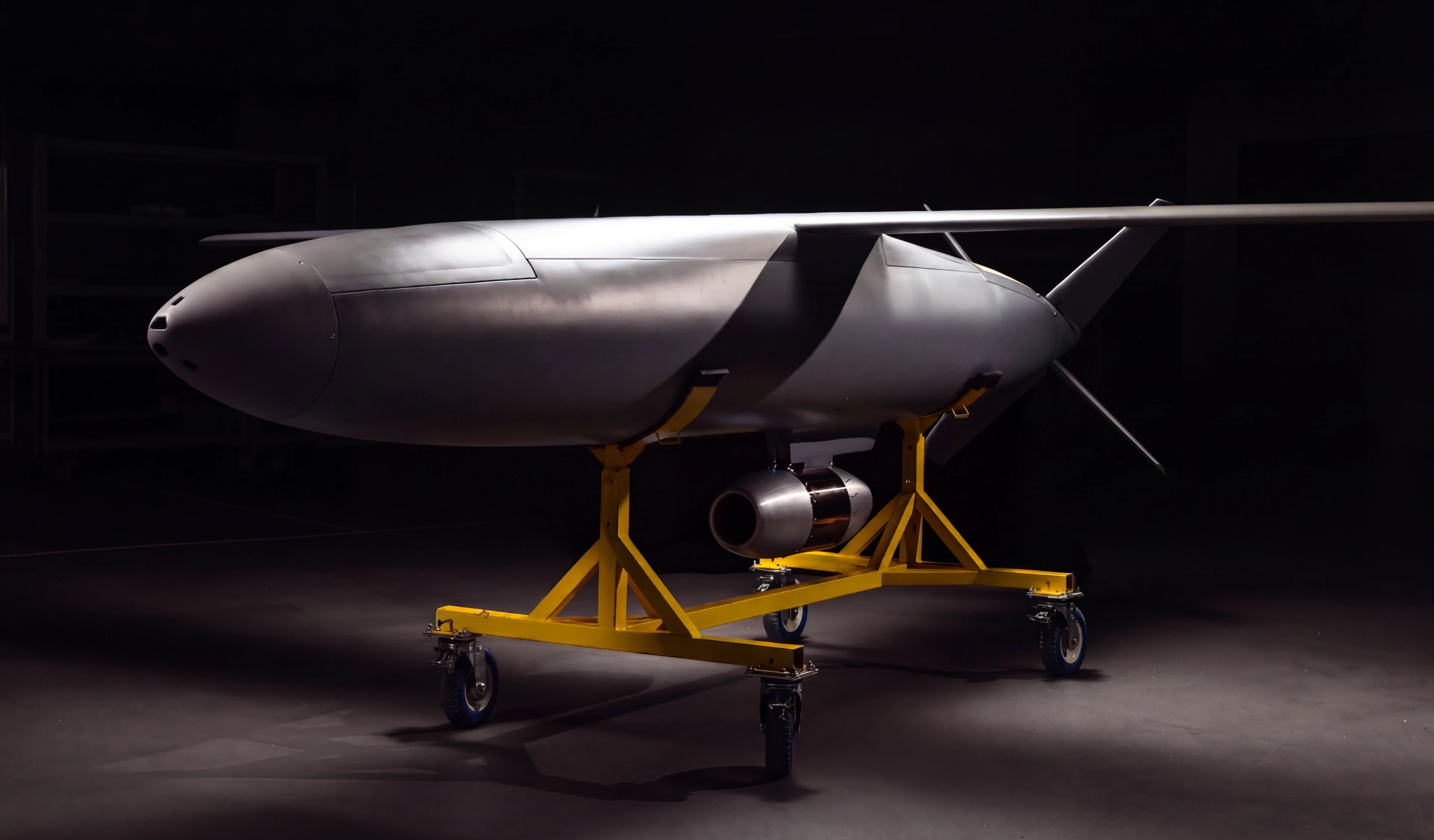
A stock picture of Covenant’s Anthem long-range strike weapon. Covenant

“We’re in a serious and deteriorating security situation, and that is why we are building up the defense and strengthening our combat power,” Bruus told reporters. The planned acquisitions are a “strong signal that we have the ability to strike back,” he added, without explicitly naming any particular adversary.

The Danish government did say last year that it would pursue new long-range offensive precision weapons, in general, in response to the growing security concerns in Europe amid Russia’s ongoing war against Ukraine. Bruus’ announcement comes amid a new surge in geopolitical friction between Russia and members of the NATO alliance.
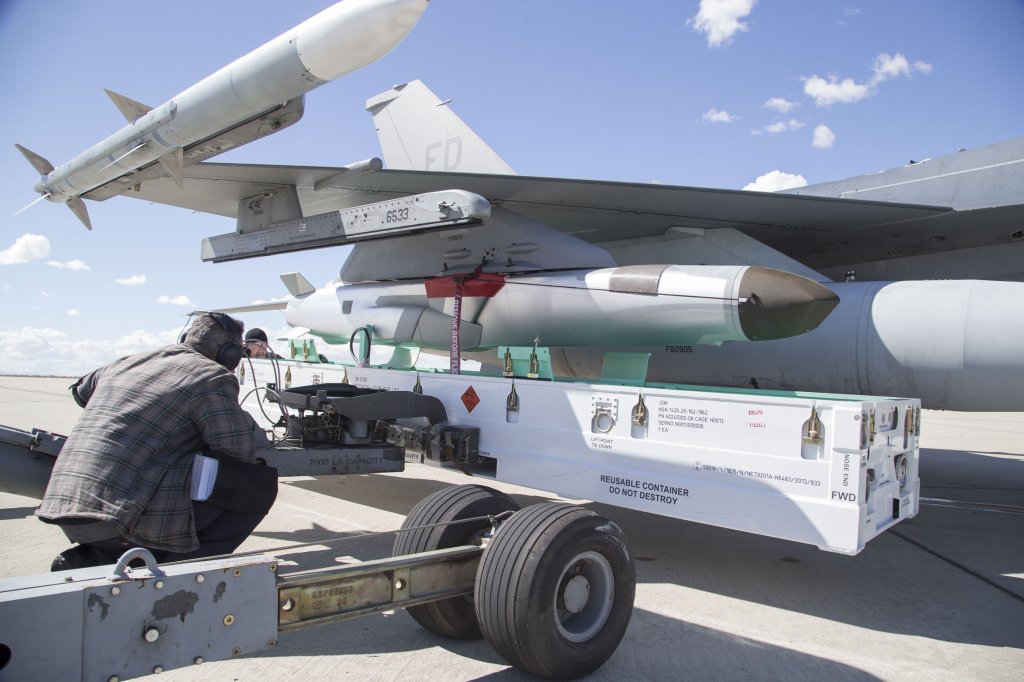
A stock picture of a Joint Strike Missile (JSM), seen here being loaded onto a US Air Force F-16 Viper during a test in 2018. USAF

The two new acquisitions will provide Denmark with important complementary strike options. Anthem is a ground-launched weapon, while JSM is designed to be air-launched, including by stealthy F-35 fighters just like those in Danish Air Force service today. Together, the weapons are set to expand the range of platforms from which Denmark can deliver stand-off precision strikes and give its armed forces additional options for attacking high-value military targets.
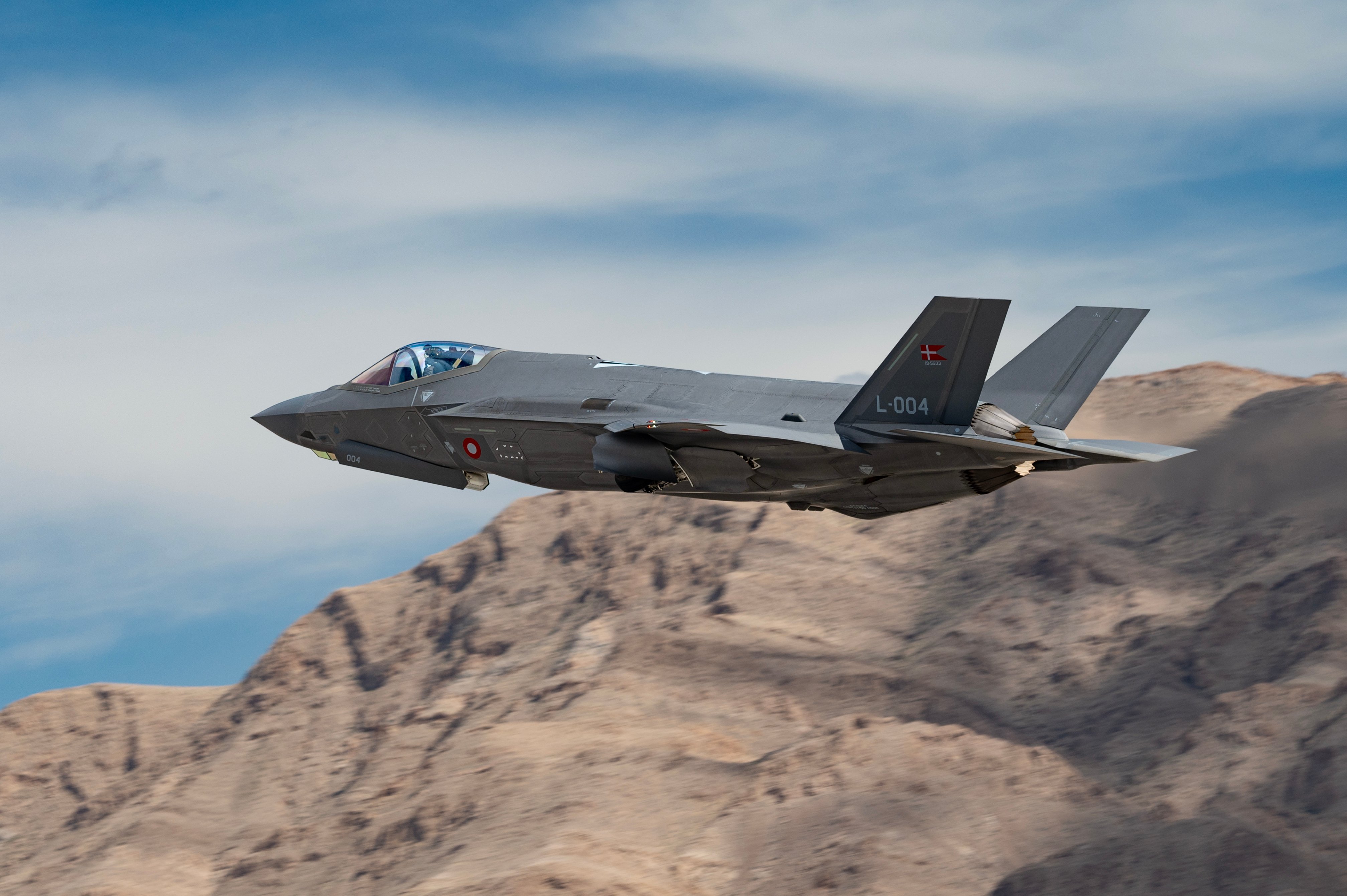
A Royal Danish Air Force F-35A from Luke Air Force Base (AFB), Arizona, takes off for Red Flag-Nellis 24-2 mission at Nellis AFB, Nevada, March 13, 2024.The integration of fifth- generation assets, such as the F-35, is a vital step towards enhancing our collective security. These advanced aircraft bring unprecedented capabilities, including enhanced stealth, sensor fusion, and network connectivity, which enable us to maintain air superiority and deter potential adversaries. (U.S. Air Force photo by William R. Lewis) RFNAFB; DoD; ACC; Air Combat Command; DoD; Ready AF; lethality; readiness; Red Flag-Nellis 24-2 Operations; Denmark; F-35; Interoperability; 5th Gen
A Royal Danish Air Force F-35A takes off for a Red Flag-Nellis 24-2 mission at Nellis AFB, Nevada, on March 13, 2024. U.S. Air Force photo by William R. Lewis William Lewis

Anthem is being developed by Covenant, a U.S.-based defense company that has also outlined plans to establish missile production in Germany and Israel. The system’s selection by Denmark gives the company an important European customer as NATO members seek to expand their inventories of long-range weapons.

Covenant’s Anthem is in a category of munitions that increasingly blurs the line between long-range kamikaze drones and traditional cruise missiles. It is designed to offer a lower-cost, longer-range strike capability that can be produced more easily and at greater scale than many existing systems. Covenant has not publicly disclosed the weapon’s range. Still-unconfirmed reports put it at roughly 740 miles (1,200 kilometers). It is also said to carry a warhead weighing more than 200 kilograms (441 pounds). It also uses a solid rocket motor to provide an initial boost at launch before transitioning to a heavy-fuel jet engine for cruise flight.

Currently, it is unclear how exactly Anthem is launched. It has already undergone testing with the U.S. Army, and images from those trials show the weapons being handled on the ground using a tricycle undercarriage. This may point to rocket-assisted takeoffs from runways.

Defense-industry partners prepare a cruise missile for a live-fire demonstration at the Africa Multidomain Training and Experimentation Center in Tan-Tan, Morocco, Aug. 5, 2026. The demonstration was held to support regional defense capabilities and joint training interoperability. AMTEC enables U.S. and Moroccan forces to test emerging technologies and expand testing capabilities to strengthen shared readiness and interoperability under the U.S. Army’s Test Range Expansion Initiative.
A Covenant cruise missile is prepared for a live-fire demonstration at the Africa Multidomain Training and Experimentation Center in Tan-Tan, Morocco, August 5, 2026. U.S. Army photo by Capt. Jordan Beagle

Last month, Covenant announced it had already conducted more than 200 test flights of Anthem and had secured roughly $150 million in orders. It also disclosed that an unidentified international customer was expected to begin receiving German-built weapons before the end of this year. This may well be Denmark, though there could also be other customers that have yet to emerge publicly. Meanwhile, U.S. Army deliveries are expected in 2027, under an accelerated qualification contract.

Anthem reflects a broader push, globally, for new long-range strike weapons that can be manufactured rapidly and in large quantities, potentially trading some of the performance and sophistication of more expensive, ‘exquisite’ weapons for affordability, scalability, and mass availability. Recent conflicts in the Middle East, as well as the war in Ukraine, have underscored the challenges of bolstering stockpiles of critical munitions and replenishing them during prolonged fighting.

JSM, developed by Kongsberg in cooperation with U.S. defense contractor Raytheon, is a traditional air-launched cruise missile capable of being employed against targets on land and at sea. It is capable of being carried internally and externally on the A and C variants of the F-35. The design has also been fit-checked for external carriage on a variety of other tactical jets. As already mentioned, JSM will provide an entirely new stand-off precision-strike option for Denmark’s F-35As. These are the only tactical jets in Danish service today following the retirement of the country’s F-16 Vipers in January.

Pictures showing work on integrating the Joint Strike Missile on all three variants of the F-35 Joint Strike Fighter, as well as the F-16. Kongsberg

Kongsberg has identified Denmark as the seventh country to select JSM, although the final contract scope and value remain subject to negotiations. JSM is an enlarged derivative of the surface-launched Naval Strike Missile (NSM), which has also seen growing worldwide sales in recent years, including to the U.S. military. Since 2025, Denmark has also been fielding NSM on its Iver Huitfeldt class frigates and as part of a ground-based coastal defense system.

Since JSM is designed to be air-launched its maximum range is dependent in part on the altitude at which the missile is released, as well as the speed of the aircraft carrying it. Kongsberg has said in the past the missile can fly out to a range of more than 300 nautical miles, but also that its reach is significantly cut back when it is employed in its low-altitude penetration mode.
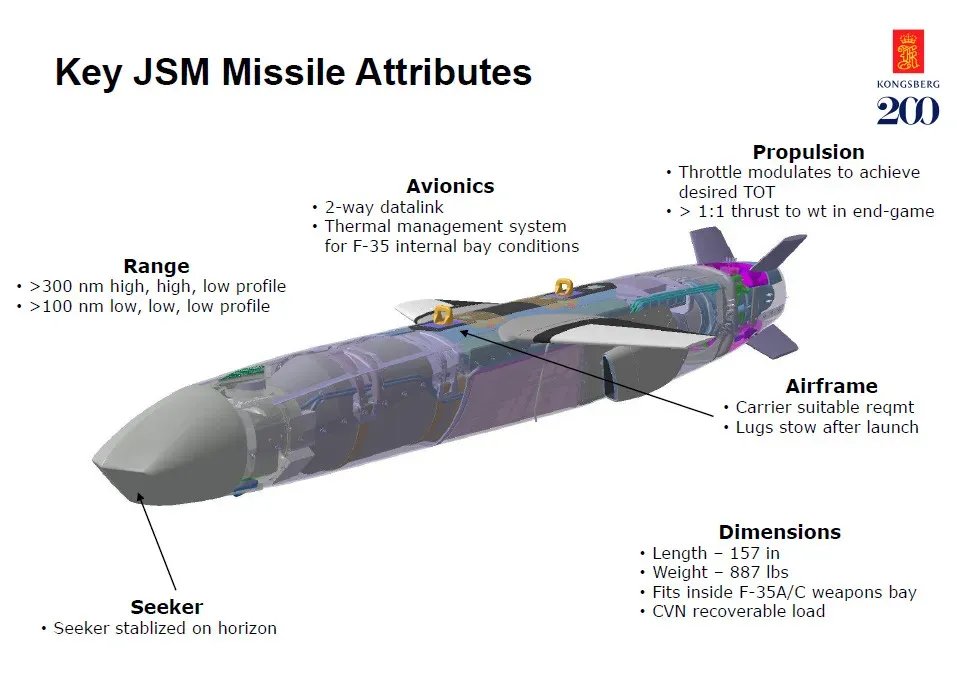
A briefing slide with various details about the JSM’s capabilities. Kongsberg

The JSM carries a 260-pound warhead and uses a combination of GPS, inertial navigation (INS), and terrain mapping to guide it toward its target. The terrain-mapping capability provides an additional means of navigation, helping the missile maintain its course even in environments where GPS connectivity is degraded or unavailable.

The missile switches over to an imaging infrared seeker to provide precise target discrimination during the terminal phase of flight. Because the seeker operates passively, it does not rely on emitting radiofrequency signals, reducing the risk of detection and making it immune to conventional radiofrequency jamming. The agile JSM’s overall design also includes reduced-signature features to help limit its detectability and improve its survivability on the way to the target.
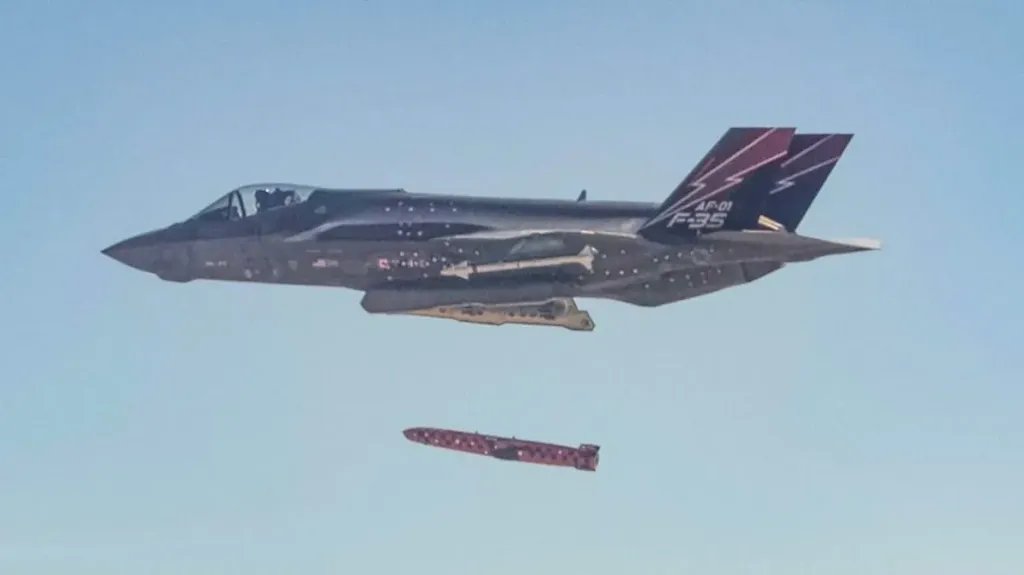
A U.S. Air Force F-35A releases a Joint Strike Missile (JSM) during a test. Norwegian Defense Materiel Agency

A two-way datalink also allows the missile to receive updated targeting information while en route, or to be redirected toward an entirely different target during the mid-course phase of flight.

The dual purchases build on a broader Danish effort to field new options for holding targets at extended ranges at risk. Denmark previously operated eight M270 Multiple Launch Rocket Systems (MLRS), but retired them in 2004. The country is now introducing Israel’s PULS rocket artillery system, which can employ different rocket and missile types depending on the mission. Presently, the Danish military looks to be fielding PULS just with artillery rockets.

In terms of Denmark’s current and future ground-based capabilities, PULS – which stands for Precise and Universal Launch System – and Anthem will serve different. In Danish service, PULS provides a flexible rocket artillery capability, while Anthem will offer a cruise-missile-like option for longer-range precision attacks.

The acquisition of JSM also reflects the importance of Denmark’s F-35 fleet to its future combat capability. Air-launched weapons offer mobility and flexibility, but their employment depends on available aircraft. In this context, Denmark’s planned expansion of its F-35 fleet from 27 to 43 aircraft, announced in October 2025, will provide a larger platform base for its emerging long-range strike capability.

There could be some overlap here between Denmark’s growing array of air- and ground-based strike capabilities, as well. Dutch F-35As demonstrated their ability to provide targeting data to PULS launchers during a NATO exercise last year. A ground-launched weapon like Anthem also provides an alternative long-range strike option that does not require a fighter to carry it aloft, creating additional operational flexibility.

For Denmark, acquiring JSMs and Anthems also offers the appeal of adding a capable higher-end munition alongside a more affordable, readily available long-range strike weapon. Reuters has reported that Covenant expects Anthem to eventually cost in the mid-six-figure range, although a final unit price has not been disclosed. Meanwhile, the JSM has a reported unit cost of approximately $2.8 million.

As mentioned, the announcement of the Anthem and JSM purchase is fully in line with prior statements from the government in Copenhagen about acquiring new long-range strike options. Danish Prime Minister Mette Frederiksen previously urged the military to accelerate procurement across the board after years of comparatively limited defense spending.

Danish Prime Minister Mette Frederiksen meets conscripts during a visit to Air Base Karup, the main air base of the Royal Danish Air Force, in Jutland, Denmark on March 7, 2024. (Photo by Mikkel Berg Pedersen / Ritzau Scanpix / AFP via Getty Images) / Denmark OUT
Danish Prime Minister Mette Frederiksen meets conscripts during a visit to Air Base Karup, the main air base of the Royal Danish Air Force, in Jutland, Denmark on March 7, 2024. (Photo by Mikkel Berg Pedersen / Ritzau Scanpix / AFP) / Denmark OUT MIKKEL BERG PEDERSEN

The long-range strike acquisitions also fit into a broader NATO effort to strengthen deterrence across the Baltic region and the alliance’s northeastern flank.

Denmark occupies a strategically important position linking the Baltic Sea to the North Sea, while its forces contribute to NATO’s regional presence and reinforcement plans. The ability to strike targets deep behind enemy lines will provide a new ability for Denmark to threaten an adversary’s military infrastructure, command facilities, and other critical targets.

Denmark is far from alone in pursuing new long-range strike capabilities. In September, Latvia moved to acquire Anduril’s Barracuda family of long-range strike missiles, building on its earlier order for Army Tactical Missile System (ATACMS) short-range ballistic missiles. Poland is expanding its own layered strike capabilities, while France, Germany, Italy, Poland, Sweden and the United Kingdom are working on the European Long-Range Strike Approach (ELSA) initiative to accelerate the development and procurement of next-generation weapons. The efforts reflect a wider shift across Europe toward restoring deep-strike capabilities that have been relatively scarce among NATO’s European members since the end of the Cold War.

All of this is happening while the Baltic states, in particular, increasingly voice their concerns that Russia could seek to exploit vulnerabilities along NATO’s northeastern flank. Estonia, Latvia, and Lithuania have all warned about the risks posed by Russian force expansion, airspace incursions, sabotage, and other potential provocations. In response, NATO has stepped up its regional posture through initiatives, including Operation Eastern Sentry.

Denmark's Defence Minister Jeppe Bruus (R) speaks with military personnel during a visit of the Antenna Park in Nuuk, Greenland, on August 26, 2026. The Danish defence minister visits the Danish military effort in Greenland. (Photo by Thomas Traasdahl / Ritzau Scanpix / AFP via Getty Images) / Denmark OUT
Danish Defense Minister Jeppe Bruus (right) speaks with military personnel during a visit to the Antenna Park in Nuuk, Greenland, on August 26, 2026. Photo by Thomas Traasdahl / Ritzau Scanpix / AFP THOMAS TRAASDAHL

The news about Denmark’s new long-range strike plans has already drawn a heated reaction from Moscow. Russia’s embassy in Copenhagen accused Denmark of pursuing confrontation with Russia and warned of “inevitable disastrous consequences,” Reuters reported.

Many details about the planned Anthem and JSM acquisitions still remain to be learned. However, the announcement yesterday is a clear signal of Copenhagen’s intention to give its armed forces a more substantial ability to threaten targets at distance, and reflects still-growing trends elsewhere in Europe.

Contact the author: thomas@thewarzone.com

The post Denmark To Buy Anthem Munitions, Joint Strike Missiles In Dual Long-Range Strike Push appeared first on TWZ.


  •  

I stayed at a 5-star Four Seasons hotel in Jackson Hole, Wyoming. My $1,000-a-night room felt like a skier's sanctuary.

A composite image of the exterior of a brown cabin-like hotel and the author standing in front of a bed in a hotel room with white walls and wood trimmings
The author's guest room at the Four Seasons Jackson Hole resort starts at about $1,000 during the winter ski season.

Joey Hadden/Business Insider

  • I've never been skiing.
  • But if I ever decide to learn, I'll do it at the Four Seasons in Jackson Hole, Wyoming.
  • My 550-square-foot room felt like a luxury cabin on the slopes.

When I arrived at the Four Seasons Jackson Hole on a muggy day in early September, I imagined it covered in snow. This was in 2024, when I visited Jackson Hole, Wyoming, for the first time.

I spent one night at the five-star ski-in, ski-out resort. If I ever take a ski trip, I imagine that my room at this Four Seasons would be a peaceful place to rest after an active day of gliding through powder.

Step inside the 550-square-foot room with a starting rate of nearly $1,000 a night during the winter ski season.

Welcome to the Four Seasons Jackson Hole, a five-star, slopeside ski resort.
The outside of a cabin like hotel with people skiing in the snow in front of it.

Courtesy of Four Seasons Jackson Hole

The 65-year-old hotel chain has a luxurious reputation and over 130 locations worldwide, each designed to reflect its destination.

Kim Cole, the director of public relations for the Four Seasons, told Business Insider that the company describes the Jackson Hole location's aesthetic as "modern mountain chic," catering to hikers, bicyclists, and skiers in the winter.

After checking in, I explored the room with the typical peak-season guest in mind.
A hand holds a wooden hotel key card

Joey Hadden/Business Insider

The hotel has 106 guest rooms and 18 suites. The starting rate is $525 in the offseason and $995 in the peak winter season. Business Insider received a media rate for a one-night stay.

There are also 31 Resort Residences on-site, built to serve large groups. These residences have kitchens and up to five bedrooms. Starting prices range from $4,200 to $11,000, depending on the season.

Cole told Business Insider that in the winter, guest rooms are typically booked with active guests who participate in winter sports, so I imagined how the room would feel as a skier.

I thought my 550-square-foot room blended traditional cabin nostalgia with midcentury modern luxury.
Inside a hotel room with a TV above a fireplace on the left, a green couch on the right, and wood shutters leading to a balcony in the back

Joey Hadden/Business Insider

My room had a king-sized bed, a full bathroom, and a private balcony.

Renovated by Wimberly Interiors in 2022, the guest rooms were designed to bring the outside in, with metal accents, stone finishings, and a soft, earth-toned color palette. This nature-inspired trend, known as biophilic design, gained traction in 2024.

The bed was plush with warm, fluffy bedding and dense pillows.
Inside a hotel room with a green couch in front of a white bed book-ended by nightstands with lamps on them, and a large white headboard with tree carvings on it

Joey Hadden/Business Insider

The king-sized bed sat between mixed-material nightstands with edgy lamps that contrasted with classic wooden shutters.

With one king-sized bed, the room sleeps up to three adults (or two adults and one kid). The room can also be arranged with two double beds, increasing the maximum occupancy to four adults (or two adults and two kids).

The nature-inspired headboard was a mesmerizing statement piece.
A close up of a wood-framed white headboard with carvings of trees on is

Joey Hadden/Business Insider

The headboard was the standout piece in the room. A cherry-wood frame juxtaposed with a bright-white image gave it a midcentury modern look.

The image was a textured carving of trees that I could feel when I brushed my fingers over the branches. A light bar glowed beneath the board, making it easier to see the details of the monochrome image.

The bed was so comfy that I didn't want to get up — and with smart controls on the in-room tablet, I didn't have to.
A wooden nightstand between a bed and shutterd windows holds two brochures and a tablet on a stand in front of a modern lamp

Joey Hadden/Business Insider

The tablet on the nightstand served as the room's control center, commanding everything from the TV to room service. This amenity was added in the 2022 remodel.

The tablet would be especially handy after an exhausting day on the slopes.

The other nightstand held an eclectic shelf of books with a warm white color palette.
A close up of the nightstand shows a bottom shelf with books on it

Joey Hadden/Business Insider

Few things are more relaxing on a snow day than cozying up with a good book.

Luckily, my room had a small selection of biographies, historical literature, and novels, ranging from realistic fiction to young adult fantasy.

Publishing dates for these books ranged from 2003 to 2020, but I thought they looked much older. They were all sleeveless with a white or off-white binding.

Across from the bed, a large TV was mounted above a stone fireplace.
Inside a hotel room with white walls and wood trimmings, a table and chairs on the right, and a TV mounted above a stone fireplace in the center

Joey Hadden/Business Insider

Rustic drawers were to the left of the fireplace, while a modern sitting area was on the right.

I noticed all the seating in my room was soft and cushy, which seemed ideal for sore bodies after an active day.

The room also had a private bar with gold trimmings.
A composite image of a hotel room coffee bar on the left and a stock of water and coffee essentials on the right

Joey Hadden/Business Insider

The bar had an espresso machine, neutral-toned ceramic mugs, and Four Seasons-branded water.

Beneath the bar, a cabinet hid the mini-fridge. It was stocked with alcohol and snacks like peanut M&Ms and gummy bears, which were available for an extra cost.

In the marble bathroom, the oversize tub had a bendy shower head that made me feel like I was in a spa.
Inside a hotel bathroom with beige stone tiling, a marble sink on the left and a bathtub on the right

Joey Hadden/Business Insider

The bathroom had complimentary Le Labo toiletries.

The bathroom felt spacious, with a double-sink vanity, a sizable shower, and a separate toilet room.
Inside a hotel bathroom with a walk-in marble shower on the left and a toilet in a separate room with a blue wall on the right

Joey Hadden/Business Insider

The mirrors and vanities were replaced by Wimberly Interiors in 2022.

Across from the bathroom, a walk-in closet held bathrobes, a safe, and some classic, upscale amenities I've only seen in ultra-luxury hotels.
A composite image of a white closet with two robes hanging inside and a wooden built-in below a safe in the same closet

Joey Hadden/Business Insider

I spotted old-school amenities like a shoehorn and a shine brush, which I've seen more often in high-end European accommodations than in the US.

The ample size of the bathroom and closet made the room suitable for up to four guests.

The private balcony seated one in a comfortable lounge chair.
A wood sliding door opens to reveal a small hotel balcony with a mountain in the background on a gray, rainy day

Joey Hadden/Business Insider

I spent some time on the deck, but since I imagined it would be less enjoyable in the cold, I appreciated the sliding glass doors that let me enjoy the view without the cold.

Out there, I had a view of the ski lifts traveling up and down Rendezvous Mountain.
Ski lifts go up a green, tree-covered mountain with clouds fogging the top

Joey Hadden/Business Insider

From the balcony, I spotted the downhill trails towering over the resort's courtyard. Looking down, I pictured the green courtyard blanketed in snow.

In the winter, I imagine the biggest luxury of this $1,000-a-night room is hitting the slopes just outside. If I ever visit Jackson Hole during peak season, I'll only splurge on a Four Seasons stay if I'm taking a ski trip.

Read the original article on Business Insider
  •  

An Arctic Traffic Jam Highlights Doubts Over Russia's Northern Sea Route To China

The Kremlin has heavily invested in the promise that retreating Arctic sea ice opens up a once impassable route that is further from the reach of Ukrainian drone attacks or European naval interdiction of shadow fleet vessels. But officials are learning that cutting a path through ice isn't easy.

  •  

Companies laying off staff this year include Meta, Amazon, and Visa — see the list

A Verizon store in New York.
Verizon is one of the latest companies to announce job cuts.

Bloomberg/Getty Images

  • Companies including Meta, Amazon, and Visa have said they're trimming staff this year.
  • Many firms, like Wix, have cited the rise of AI as a reason they need fewer staff.
  • See the list of companies letting workers go in 2026.

More than 40 companies have laid off employees so far in 2026, continuing the trend of significant workforce reductions across a broad range of industries, including tech, media, finance, and retail.

Some, including Block, Coinbase, and Standard Chartered, have cited the impact of artificial intelligence as a key reason for the layoffs.

Target, meanwhile, is shifting resources from its supply chain into stores as part of the new CEO's turnaround strategy to improve the shopping experience and return to growth.

More than 100 other companies have filed legally mandated WARN notices about job cuts to come in 2026, according to WARN Tracker. Some of the cuts are part of previously announced reductions.

The moves come as artificial intelligence, public policy, and broader economic conditions are driving sweeping changes in the business landscape.

A World Economic Forum survey last year found that some 41% of companies worldwide expected to reduce their workforces in the next five years because of the rise of artificial intelligence. The survey also found that jobs in big data, fintech, and AI are expected to double by 2030.

Last year, Business Insider tracked layoffs at around 65 major companies, including Amazon, Meta, Paramount, and Starbucks. In 2026, we'll continue to track additional job cuts based on company announcements, WARN notices, and our own reporting.

Here are the companies with job cuts underway in 2026, listed in alphabetical order.

Amazon is laying off thousands of employees
Amazon sign

Matthias Balk/picture alliance via Getty Images

Amazon said in January that it would eliminate around 16,000 corporate roles globally.

Beth Galetti, senior vice president of people experience and technology, described the January move in a company memo as part of broader efforts to cut back on bureaucracy inside the company.

The cuts followed mass layoffs from October 2025, when the tech and retail giant shed 14,000 roles.

In May, Amazon's Selling Partner Services team slashed additional jobs as it continued to reshape its organization.

"Following a recent review, we've made the difficult decision to eliminate a relatively small number of roles in our Selling Partner Services team," a spokesperson told Business Insider.

Angi is cutting 350 jobs
An Angie's List printed publication for 2021 sits on a stack of magazines and other printed materials.

Donald King/AP

Angi, the popular contractor listing site once known as Angie's List, said in January that it was cutting around 350 jobs "to reduce operating expenses and optimize the organizational structure in support of long-term growth." The company also said it's making the cuts "in light of AI-driven efficiency improvements."

In a January 7 SEC filing, Angi said that the cuts would save between $70 million and $80 million in annual spending. The layoffs will cost the company between $22 million and $30 million, according to the filing.

Atlassian is cutting 1,600 employees
Atlassian
Atlassian

Thomas Fuller/SOPA Images/LightRocket via Getty Images

Atlassian, the enterprise software company and maker of Confluence, said on March 11 that it will be cutting about 10% of its workforce as it invests in AI to reshape its organization.

CEO Mike Cannon-Brookes said in a statement that about 1,600 employees will be affected by the cuts.

"We fundamentally believe people and AI create the best outcomes. Our approach is not 'AI replaces people,'" Cannon-Brookes said. "But it would be disingenuous to pretend AI doesn't change the mix of skills we need or the number of roles required in certain areas. It does."

The company expects to incur $225 million and $236 million in restructuring charges, according to an SEC filing.

Barclays cuts 5,000 jobs
NEW YORK, NEW YORK OCTOBER 21: People pass by Barclays PLC (BCS) headquarters on October 21, 2026. in New York City. Barclays shares (BCS) have gained approximately 218.5% over the past three years, as investors assess whether the bank's earnings justify its share price. (Photo by KHemaz/GVN via Getty Images)

KHemaz/GVN via Getty Images

Barclays, the British financial institution, disclosed plans to cut around 5% of its workforce.

Anna Cross, the Group Finance Director of Barclays, said on an October 22 earnings call that the company expects more than GBP 1 billion in efficiency savings in 2027, which will involve reducing its head count by 5,000 full-time employees.

Cross said that 60% of affected workers are related to "support functions, including fewer developers as AI makes our people more productive."

The company reported Q3 pretax profit of GBP 2.3 billion — about $3 billion — up 12% from the same quarter a year earlier.

Barclays CEO, C.S. Venkatakrishnan, said that the company is moving to "drive even greater cost efficiency through deep technological transformation, reducing the unit cost of product, manufacturing, service and innovation."

British American Tobacco cuts 9,000 jobs
The logo of company British American Tobacco is displayed on a smartphone in front of abstract background on tablet screen.

Illustration by Timon Schneider/SOPA Images/LightRocket via Getty Images

British American Tobacco said it will cut 9,000 jobs by the end of the year, about one-fifth of its workforce. The cuts will not impact the US arm of its business.

"We are building a future-ready organisation that is more agile, cost disciplined and technology enabled," CEO Tadeu Marroco said in the statement.

The company, whose cigarette portfolio includes brands like Lucky Strike and Dunhill, has stepped up its push in recent years into smoke-free alternatives, such as nicotine pouches and vapes.

Citi's job cuts continue this year
Citibank logo
Citibank will continue to cut jobs in 2026.

Kevin Carter/Getty Images

Citi will cut more jobs this year as part of its plan to reduce its workforce by 10%, or 20,000 employees.

In a statement on January 13, the bank said that it will continue to reduce head count in 2026.

"These changes reflect adjustments we're making to ensure our staffing levels, locations and expertise align with current business needs," a spokesperson for Citi said.

The plan was detailed in the company's January 2024 earnings report and could save the bank as much as $2.5 billion.

Cloudflare lays off 20% of its global workforce
This photograph taken on January 21, 2026 shows signage of the Cloudflare logo during the World Economic Forum (WEF) annual meeting in Davos. The World Economic Forum takes place in Davos from January 19 to January 23, 2026. (Photo by INA FASSBENDER / AFP via Getty Images)

INA FASSBENDER / AFP via Getty Images

Cybersecurity company Cloudflare on May 7 said it plans to cut roughly 20% of its global workforce, affecting more than 1,100 employees.

In an internal memo, Cloudflare executives said the company's use of AI has climbed more than 600% over the past three months, and that the rapid shift has forced the company to reconsider its structure.

"We want to be clear that this decision is not a reflection of the individual work or talent of those leaving us," Cloudflare executives wrote in the May 7 memo. "Instead, we are reimagining every internal process, team, and role across the company."

The company's shares fell more than 14% in extended trading following the announcement.

Coinbase is cutting 14% of staff
Coinbase CEO Brian Armstrong
Coinbase CEO Brian Armstrong.

Bloomberg/Getty Images

The CEO of Coinbase, Brian Armstrong, said in a letter to staff on May 5 that 14% of its staff would be cut, largely because of AI.

"AI is changing how we work. Over the past year, I've watched engineers use AI to ship in days what used to take a team weeks," wrote. "The pace of what's possible with a small, focused team has changed dramatically, and it's accelerating every day."

Armstrong said this would mean fewer layers and faster decisions in the company. No pure managers, he said — all leaders will now be required to get stuck in and "get their hands dirty."

"AI is bringing a profound shift in how companies operate, and we're reshaping Coinbase to lead in this new era," he added.

Crypto.com laid off 12% of its workforce
Crypto.com CEO Kris Marszalek is pictured.

Marco Bello/Reuters

Crypto.com CEO Kris Marszalek said in March that the company laid off 12% of its workforce, including "roles that do not adapt in our new world."

"Companies that move immediately and pair the best AI tools with top-performers will achieve a level of scale and precision that was previously impossible," Marszalek wrote in a post on X. "This is where we must go."

Dell cut 10% of its workforce
Dell logos

Michel Porro/Getty Images

Dell cut its workforce by 10% for the third year in a row, the company said in its annual filing with the SEC.

As of January 31, 2026, the company had 97,000 employees, down 11,000 from the same time last year. The decline includes both layoffs and attrition, Business Insider reported.

eBay is expected to lay off 6% of its employees
eBay app

Thomas Fuller/NurPhoto via Getty Images

eBay is set to eliminate about 800 jobs globally, making up 6% of its workforce. The company told Business Insider that it's taking steps to better align with its strategic priorities.

"We are grateful for the contributions of the employees impacted and are committed to supporting them with care and respect," a company spokesperson said in a statement.

Epic Games is cutting 20% of its workforce
Man in suit
Tim Sweeney, CEO of Epic Games

Philip Pacheco/Getty Images

Epic Games, the company behind Fortnite, said in March that it would lay off more than 1,000 people — about 20% of its workforce — as engagement with the game declined.

CEO Tim Sweeney said in a memo that the layoffs "aren't related to AI."

"To the extent it improves productivity, we want to have as many awesome developers developing great content and tech as we can," Sweeney said.

Estée Lauder is deepening its cuts, now to as many as 10,000 roles
Shoppers gather at an Estée Lauder store at the Sanya International Duty Free Shopping Complex, also known as CDF Mall, on March 5, 2026 in Sanya, Hainan Province, China.

Cheng Xin/Getty Images

Estée Lauder said in its May earnings report that it will deepen its previously announced cuts, which are now expected to affect up to 10,000 jobs.

More than two-thirds of the reductions are in cashier and demonstration roles at lower-performing retail and department stores.

Etsy
Etsy logo
Etsy announced on Wednesday that it was laying off 220 employees.

illustration by Cheng Xin/Getty Images

Etsy said August 5 that it is laying off about 220 employees, roughly 12% of its workforce.

"We will be saying goodbye to approximately 220 colleagues across the company, with most of the changes concentrated in Product & Engineering," the company's CEO, Kruti Patel Goyal, told staffers in a memo.

The company also reported its second-quarter financial results on Wednesday.

While Goyal's memo made no mention of AI or its potential threat to jobs, she said that the cuts were a preemptive move.

"The answer is that today's decisions aren't a reflection of this quarter or even this year, but of where Etsy needs to go next," she wrote.

Expedia laid off some employees
Expedia Group
Expedia said it was cutting some roles but the scope of the cuts was unclear.

Illustration by Thomas Fuller/SOPA Images/LightRocket via Getty Images

Expedia confirmed to Business Insider that it had laid off some employees on January 26 and had also posted new job openings. It's unclear how many of its workers were affected by the cuts.

"We are eliminating roles as well as opening some new roles as we remain disciplined about assessing the skills we need for the future," an Expedia Group spokesperson said in a statement. "We are also simplifying our structure and reducing organizational layers to move faster and with more accountability. These are not easy decisions, and we are grateful for the contributions of our colleagues who are impacted."

Freshworks is cutting 11% of staff
Freshworks app
Freshworks is cutting staff

Illustration by Piotr Swat/SOPA Images/LightRocket via Getty Images

The San Mateo, California-based software company said in its early May earnings report that it would cut 11% of its staff in the second quarter. The company had about 4,500 employees at the end of 2025.

The cuts aim "to streamline the Company's organizational efforts and product development process" and increase AI across the company, according to the filing.

On an earnings call, CEO Dennis Woodside said about half the company's code comes from AI.

"Like many other software companies, that is definitely changing how we build products, how fast we can build products, and the amount of people that we need to build products," he said.

The company's stock slumped 35% from May 2025 to May 2026.

General Motors is axing 600 salaried employees
Workers in the automobile assembly production line at SAIC General Motors Dongyue Base in HuangBohai New Area in Yantai, Shandong, China in April 2026
GM is overhauling its tech workforce to prioritize AI and software expertise.

credit should read CFOTO/Future Publishing via Getty Images

General Motors is cutting 600 salaried employees from its global IT division.

A spokesperson said the layoffs would enable it to "better position the company for the future," by ensuring GM has employees with expertise in AI-native development, data engineering, analytics, cloud engineering, prompt engineering, and AI workflows.

GoPro is laying off 145 employees
GoPro logo
GoPro is cutting 23% of its staff to cut costs.

Illustration by Budrul Chukrut/SOPA Images/LightRocket via Getty Images

On April 7, GoPro said it would lay off about 145 employees as it tries to cut operating costs and restructure operations.

The layoffs make up 23% of its global headcount of 631 employees, the camera maker said in a regulatory filing.

The cuts will start in the second quarter of the year and will largely be completed by the end of 2026. The restructuring is expected to result in a charge of $11.5 million to $15 million.

The company cut about 15% of its staff in August 2024 to cut costs.

Groupon is reducing up to 400 positions globally
Groupon app

Bloomberg/Getty Images

Groupon said on May 21 that it would cut up to 400 roles globally as part of a restructuring plan, according to a financial filing. It previously said it planned to rebuild as an "AI-native company."

The cuts are expected to happen by the end of the third quarter of 2026. Groupon is looking to generate $10 million to $12 million in gross savings in 2026.

"Up to half of this year's savings will be reinvested into AI infrastructure, talent density, and the tools and teams building the next version of the company," a spokesperson told Business Insider.

Groupon had 1,734 employees worldwide at the end of 2025, according to its annual report.

Heineken has a multi-year plan to reduce its workforce
Heineken logo on building with autumnal trees in front of it.

RAMON VAN FLYMEN/ANP/AFP via Getty Images

Heineken is cutting 5,000 to 6,000 roles over the next two years to boost productivity and bring down costs, according to its latest full-year earnings report.

The company told Business Insider that the divisions and regions where the layoffs are due to take place are yet to be confirmed.

Heineken said in its 2025 report that it faced "subdued consumer sentiment" in the Americas, alongside a "challenging year" for brewers in Europe.

Intuit is laying off 17% of its workforce
In this photo illustration, a person holds a smartphone displaying the logo of Intuit Inc.
Intuit said it's laying off 17% of its workforce.

illustration by Cheng Xin/Getty Images

Financial software company Intuit announced on May 20 that it would be cutting 17% of its full-time workforce.

The company shared a memo from CEO Sasan Goodarzi to employees that listed five reasons for the culling, including reducing management layers, focusing roles on "high impact work," and closing down two of its offices.

"These changes are a necessary evolution to reduce complexity and architect an organization that operates with the velocity required to fuel our growth engines," Goodarzi wrote in the memo, shared in a blog post on Intuit's website.

Laid-off employees in the US would receive 16 weeks of base pay, plus two additional weeks of pay for every year they have worked at Intuit.

The company said in a May 20 earnings report that restructuring costs from the layoffs would be about $300 million to $340 million.

Kenvue cuts 3.5% of workforce
Tylenol acetaminophen caplets are displayed for sale at a Costco Wholesale store on November 13, 2025 in Simi Valley, California.
Kenvue will be laying off 3.5% of its workforce.

Kevin Carter/Getty Images

Consumer healthcare brand Kenvue, which produces Tylenol, plans to cut 3.5% of its staff. Kenvue had about 22,000 employees globally, per its latest annual report.

The company wrote in a mid-February SEC filing that its board aimed to reduce complexity and drive operational efficiencies.

The company's layoffs and restructuring efforts are expected to cost $250 million in 2026, per the filing.

LinkedIn is laying off staff and 'scale back' other investments
LinkedIn logo

INA FASSBENDER / AFP via Getty Images

LinkedIn CEO Daniel Shapero told employees on May 13 that it was laying off employees, and those in affected roles would receive a calendar invite. The jobs included positions in the Microsoft-owned company's Global Business Organization, marketing, engineering, and product teams.

"We need to reinvent how we work, with agile teams focused on our highest priorities, and by shifting investments toward areas such as infrastructure to fulfill our mission and vision over the long term," Shapero said in the memo.

Shapero also said LinkedIn would "scale back" investments in areas like marketing campaigns, customer events, and underutilized office space.

Lululemon laid off 100 part-time employees at its customer service center
Lululemon store

John Keeble/Getty Images

The athleisure giant said it laid off 100 part-time employees to "strengthen the business." The affected roles are in the company's North American contact center.

"After careful consideration, we have made the decision to transition our North America GEC to a full-time employee staffing model. As a result, approximately 100 part-time positions in our GEC have been impacted," a Lululemon spokesperson said.

Meta lays off workers at Reality Labs and other divisions
The Meta Quest 3s, the standalone virtual reality headset developed by Reality Labs, a subdivision of the American company Meta Platforms, is exhibited at the Qualcomm pavilion during the Mobile World Congress 2025 in Barcelona, Spain, on March 5, 2025. (Photo by Joan Cros/NurPhoto via Getty Images)

Joan Cros/NurPhoto via Getty Images

Meta began laying off employees across multiple teams on March 25, including Reality Labs, Facebook, recruiting, sales, and global operations.

The cuts come as the company ramps up spending on AI infrastructure and talent, alongside broader cost-cutting efforts. Meta said the changes are part of ongoing restructuring to better align teams with company goals, while exploring other roles for affected employees where possible.

Meta first began preparing to slash jobs within its Reality Labs division, the unit responsible for Mark Zuckerberg's metaverse ambitions, in January, three people familiar with the matter told Business Insider at the time.

Two employees said that teams working on virtual reality headsets and Horizon Worlds, the company's VR social network, would be disproportionately affected.

Meta has shifted away from virtual reality in recent years in favor of spending hundreds of billions of dollars on beefing up its AI capabilities.

Nike laid off workers in two rounds
Nike logo on wall

Sheldon Cooper/SOPA Images/LightRocket via Getty Images

Nike is cutting roughly 1,400 jobs, mostly from tech, as part of a broader push to streamline operations and revive growth.

In a memo to staff on April 23 obtained by Business Insider, Chief Operating Officer Venkatesh Alagirisamy said the layoffs are tied to the company's "win now" turnaround plan, which focuses on improving culture, product, marketing, marketplace strategy, and in-person retail. He described the effort as entering its "final stretch."

This is Nike's second layoff in 2026. Nike said on January 26 that it planned to lay off 775 employees across Tennessee and Mississippi, citing efforts to "streamline" its distribution center operations.

"We are sharpening our supply chain footprint, accelerating the use of advanced technology and automation, and investing in the skills our teams need for the future," Nike said in a statement to Business Insider.

Oracle's headcount fell 13% in a year
Oracle signage near the company's offices in Redwood City, California, US.

Bloomberg/Getty Images

Oracle's workforce shrank by roughly 21,000 employees, or 13%, over the past year, bringing its headcount to 141,000 as of May 31, according to a 10-K filing released on June 22.

"The adoption and deployment of AI technologies across our operations have resulted, and may continue to result, in reductions to our workforce," Oracle wrote in the filing.

Oracle also disclosed that restructuring costs surged in fiscal 2026. The company spent $1.84 billion on severance and other exit costs, up from $374 million in the prior year.

The reduction in workforce comes as Oracle continues to invest heavily in AI infrastructure.

Papa Johns is restructuring
A Papa Johns location in Texas
Papa Johns said it will be closing 300 stores over the next two years, including 200 in 2026.

Brandon Bell/Getty Images

Papa Johns said it is laying off 7% of its corporate staff amid a broader restructuring.

The pizza chain said it will also close 300 locations in North America through 2027, starting with 200 this year.

"Optimizing our restaurant portfolio and strategically closing underperforming restaurants are among the most impactful actions we can take to improve restaurant profitability and fleet health," Papa Johns CFO Ravi Thanawala said during the company's fourth quarter earnings call on February 26.

Patreon, a creator economy company, laid off 20% of staff in July
Patreon

Illustration by Thomas Fuller/SOPA Images/LightRocket via Getty Images

Patreon announced layoffs in July.

The creator economy company is laying off 93 employees — roughly 20% of the company — per a memo its CEO, Jack Conte, shared publicly.

Conte wrote that the "market in which we operate has undergone profound change over the last 6 months," and that Patreon needs to cut costs to "remain a stable, dependable rock for our creators."

Pinterest is expected to lay off 15% of its workforce
Pinterest sign

INA FASSBENDER / AFP via Getty Images

Pinterest announced a global restructuring plan that includes layoffs affecting less than 15% of its workforce, according to a January securities filing. The cuts come with reductions in office space.

"We are making organizational changes to further deliver on our AI-forward strategy, which includes hiring AI-proficient talent," a Pinterest spokesperson said.

"As a result, we've made the difficult decision to say goodbye to some of our team members. We are grateful for their service and supporting them with separation packages and benefits," they added.

Saks laid off 16% of its corporate staff, among other job cuts
Saks sign

ANGELA WEISS / AFP via Getty Images

Saks Global, the beleaguered parent company of Saks Fifth Avenue, Neiman Marcus, and Bergdorf Goodman, conducted several rounds of layoffs as it closed stores and trimmed its corporate staff

In April, the company cut about 16% of its corporate staff, representing less than 4% of its total workforce.

"Following the strategic actions we've taken to secure long-term financial stability, sharpen our focus on luxury and full-price selling, optimize our operational footprint, and exit non-core businesses, we are right-sizing our corporate organization to align with our go-forward strategy," a Saks spokesperson told Business Insider.

The cuts followed Saks's closure of dozens of stores and fulfillment centers in the first quarter, resulting in layoffs.

Saks filed for Chapter 11 bankruptcy in January.

Sprout Social cut 20% of staff — about 260 employees
The Sprout Social logo appears on a phone screen.
Sprout Social announced plans to lay off about 260 employees, or about 20% of its staff, citing rapid changes in the industry driven by AI.

Illustration by Thomas Fuller/SOPA Images/LightRocket via Getty Images

Sprout Social — a social media management program — announced on July 15 that it will cut 260 jobs, or about 20% of its workforce.

In a letter about the reduction in force, CEO Ryan Barretto said the cuts were due to rapid industry changes.

"This decision is not a reflection of their talent or commitment," Barrett said. "We made this decision because we believe it was the right one for Sprout's future. Our industry, and software more broadly, is changing quickly, and the way companies need to operate and invest has changed with it."

Affected staff will be offered a 12-week severance package, plus an additional week of pay for every year of tenure, fully-paid health benefits for six months, and a cash payment equal to the value of their equity shares that would have vested in the next 90 days.

Standard Chartered plans to eliminate 15% of corporate functions over the next 4 years
Standard Charteres sign

Cheng Xin/Getty Images

Standard Chartered plans to cut 15% of corporate function roles over the next four years, the company said on May 19.

The bank, headquartered in London, credited AI as a driver for the reductions.

"It is not cost-cutting, but it is replacing, in some cases, lower-value human capital with the financial capital and the investment capital that we are putting in," CEO Bill Winters said in a media briefing, Reuters reported.

The company added in a statement: "We are combining the best human talent with AI, investing to support our people into higher-value roles."

T-Mobile cut some jobs
T-Mobile store

Al Drago/Getty Images

T-Mobile cut some staff in early 2026, though the scope of the layoffs is unclear. Some workers posted on LinkedIn saying they'd been affected by the changes in January.

"As the next step in our evolution, we're making some changes while continuing to hire to ensure we have the right focus, structure, and momentum to keep changing the industry through innovation and our long-standing focus on customers," T-Mobile told Business Insider in a statement.

Tailwind cut 3 of its 4 engineers
Typing on computer screen

Krongkaew/Getty Images

Tailwind, a popular web tool, said it cut three of its four engineers in January, citing an AI-driven decline in revenue.

"75% of the people on our engineering team lost their jobs here yesterday because of the brutal impact AI has had on our business," CEO Adam Wathan wrote in a GitHub comment on January 6 that made waves in the tech community.

Target is cutting 500 roles from its distribution and regional offices
Inbound trucks are unloaded at the loading docks.
Inside a Target regional distribution center in Wisconsin.

Dominick Reuter/Business Insider

Target confirmed to Business Insider in February that it would cut 100 district office roles and 400 supply chain positions. It plans to invest instead in additional labor hours at stores to improve the shopping experience and return to growth.

The store improvement effort is a signature priority of the retailer's new CEO, Michael Fiddelke, who started on February 1.

In November, Fiddelke said the company intends to invest an additional $1 billion in capital expenditures for 2026, an increase of 25% from 2025.

TikTok lays off 250 employees
A phone with the logo of the TikTok app lies on an open book

Juliane Sonntag/Photothek via Getty Images

TikTok is laying off 250 employees and closing an office in Nashville, according to documents filed with the Department of Labor and Workforce Development in Tennessee.

A spokesperson for TikTok US Data Security, a joint venture established in January 2026 to oversee TikTok's US operations, said closing the office will "streamline our operations and better align our teams for long-term growth."

The Nashville office will close in October, according to the documents.

UPS said it will eliminate 30,000 jobs
A dark brown UPS truck sits parked on a street as steam rises from a manhole next to it and a pedestrian walks by on the sidewalk wearing headphones and holding a smartphone.

Gary Hershorn/Getty Images

UPS CEO Brian Dykes told analysts during the company's fourth-quarter earnings call that the company plans to reduce its operational workforce by 30,000 in 2026.

"This will be accomplished through attrition, and we expect to offer a second voluntary separation program for full-time drivers," Dykes said.

He told analysts that the company has identified 24 buildings for closure in the first half of 2026 and will continue to evaluate additional buildings for closure.

Verizon is selling 274 retail stores, affecting about 3,000 workers
A Verizon store in New York.

Bloomberg/Getty Images

Verizon said in July that it would transition 274 retail stores into franchise locations as part of ongoing changes at the telecom giant.

The company said about 2,500 retail workers and 500 corporate roles would be cut, and that typically around 70% of store employees accept jobs under the new franchisees.

The move comes two months after Verizon laid off several hundred corporate employees, or about 1% of its head count, as the company reallocates workers across its overall business.

Walmart said it would cut or relocate 1,000 corporate jobs
A Walmart store is seen on February 03, 2026 in Austin, Texas.

Brandon Bell/Getty Images

Walmart told employees on May 12 that it would cut or relocate about 1,000 corporate jobs to address redundancies and duplicate roles.

Suresh Kumar, Walmart's chief technology and development officer, and Daniel Danker, executive vice president of AI acceleration, product, and design, announced the changes in a memo.

"We've made changes to simplify how the work is organized, make ownership clearer, and better align roles to the work and skills we need going forward," the memo said.

The move follows Walmart's May 2025 decision to cut 1,500 corporate roles as part of an effort to "remove layers and complexity."

The company employed 2.1 million people as of January.

WiseTech is cutting 30% of its workforce
Wisetech logo on smartphone screen
Wisetech is cutting 2,000 jobs.

Illustration by Thomas Fuller/SOPA Images/LightRocket via Getty Images

Logistics software maker Wisetech is cutting 2,000 jobs, or 30% of its staff, citing AI-driven efficiency gains.

In a conference call on February 25, CEO Zubin Appoo embraced AI and said that it means more productivity, in less time, and from fewer employees. The Sydney-based company employed about 7,000 people, according to its annual report released in October.

"I am prepared to say this clearly: the era of manually writing code as the core act of engineering is over," Appoo said. AI is "unlocking levels of efficiency gains across WiseTech that were previously out of reach."

Wix CEO said the company is set to cut 20% of its workforce
Wix logo on phone

Illustration by Pavlo Gonchar/SOPA Images/LightRocket via Getty Images

Wix, which provides website-building software, is reducing its workforce by 20%, the CEO told employees in a memo published on X on May 28.

The Israel-headquartered company employs about 5,300 workers.

CEO Avishai Abrahami cited the "fast evolution of AI capabilities" as a reason for the cuts and said the company needed to become a "faster, leaner, and flatter organization."

Workday is cutting jobs
Workday logo

Dado Ruvic/REUTERS

Workday is cutting about 400 jobs, and said on February 4 that the move will help the enterprise software company redirect resources toward priority areas.

The layoffs will primarily affect customer-facing roles that are "non-revenue generating," Workday said in a regulatory filing.

The cuts represent roughly 2% of its workforce and are expected to result in about $135 million in charges in the fiscal fourth quarter, which ended in January.

Workday announced a larger round of layoffs about a year ago, citing the need to invest more heavily in strategic areas such as AI. The company reported about 20,600 employees as of late October.

Visa is cutting roughly 7% of its workforce
A stack of Visa credit cards.
Visa is also cutting thousands of workers, the company confirmed.

Andrew Harrer/Bloomberg via Getty Images

Global payment technology company Visa confirmed to Business Insider that it's cutting about 2,600 jobs.

That's roughly 7% of the company's employee footprint.

"To capture the opportunities ahead and best position Visa to lead this transformation, we must continue evolving how we work," CEO Ryan McInerney wrote to staff in an internal memo, according to Bloomberg. "AI is also helping to accelerate this evolution and shape the way work gets done at Visa."

Zillow cut 500 employees
Zillow branded exhibition booth with blue house-shaped displays and visitors inside a large indoor event space.
Zillow said it was cutting 500 roles.

Julia Beverly/Getty Images

Zillow CEO Jeremy Wacksman announced on August 4 that the company was cutting 500 employees as part of "organizational changes."

As of December, Zillow had around 7,000 employees, so the changes are affecting about 7% of its workforce.

"These changes are about ensuring we have a disciplined cost structure and getting more efficient, with the right people in the right positions," Wacksman said in a blog post.

Is your company conducting layoffs? Got a tip?
Hand Holds Smartphone Near Computer Keyboard At Desk, Showing Multitasking Communication, Notifications, And Mobile Work Updates For Business Productivity In A Modern Office Workflow.

michnik101/Getty Images

Read the original article on Business Insider
  •  

Construction Of Iran’s “Eagle 44” Underground Airbase Hasn’t Stopped Despite War

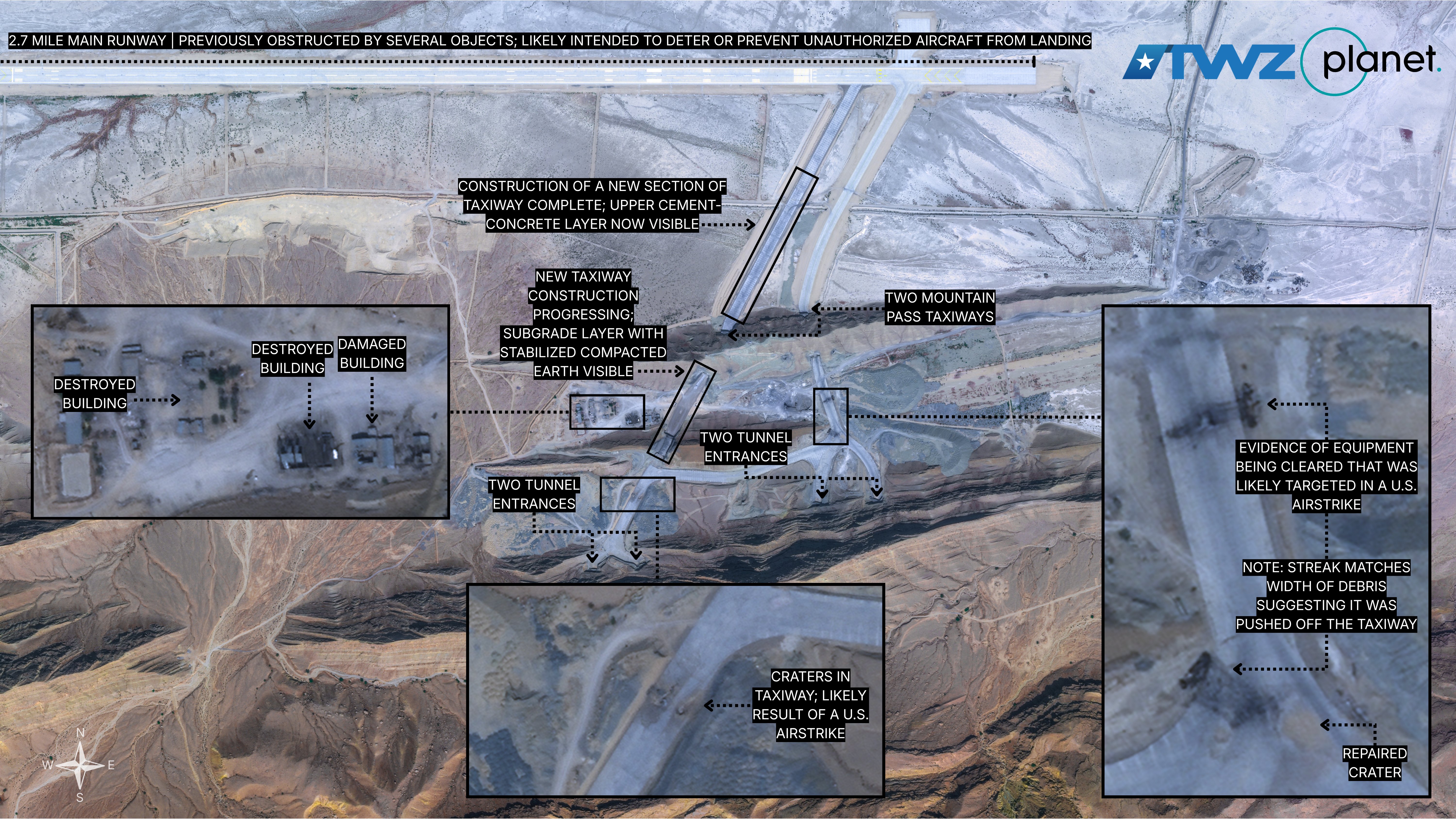
Iran is rebuilding Eagle 44, a hardened underground airbase carved into the side of a mountain that can shelter fighter aircraft, drones, and potentially cruise and ballistic missiles, despite the remote facility absorbing at least three rounds of airstrikes this year. High-resolution satellite imagery captured by Planet Labs in late September and reviewed by TWZ shows a new section of taxiway completed, several support buildings still destroyed or damaged, wrecked equipment cleared off the pavement, and obstacles that were placed to obstruct the runway now removed. Construction is ongoing at a time when the Pentagon and Trump administration maintain there is little remaining of the Iranian air force for such a facility to protect.

A comprehensive graphic showing Iran's Eagle 44 mountain airbase and the ongoing construction to rebuild it following U.S. airstrikes. Created by Ian Ellis-Jones and TWZ using Planet Labs imagery that's reprinted with permission.
Graphic depicting key areas of interest at Eagle 44. Photo © 2026 Planet Labs Inc. All rights reserved. Reprinted with permission. TWZ/IAN ELLIS-JONES

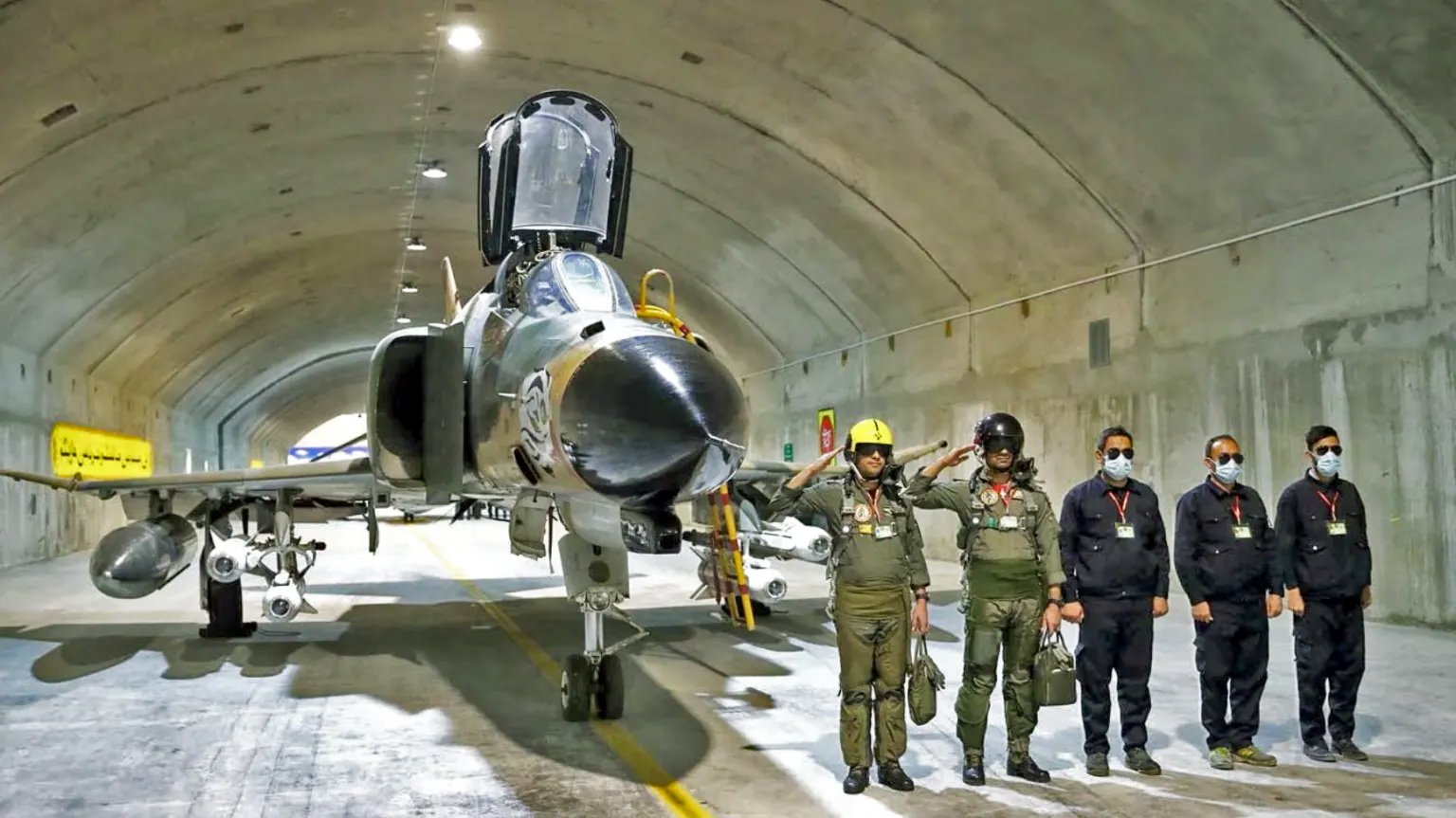
Eagle 44, also called ‘Oghab 44’ after the 44th anniversary of the 1979 revolution, was unveiled by Iranian state media in February 2023 when senior officials visited what was described as the country’s newest underground airbase. Islamic Republic of Iran Air Force (IRIAF) F-4D/E Phantom IIs, armed with AGM-65 Maverick air-to-ground missiles, laser and electro-optically guided bombs, unguided ‘dumb’ bombs, as well as domestically produced anti-ship missiles, were shown using the facility in the footage. The IRIAF had roughly 60 examples in service at the time, its most numerous combat jet by some margin, though how many remain today, and are actually operational, is unknown. In addition to the Phantoms, one-way attack drones were also seen in the background.

F-4 Phantom at Eagle 44. Photo: Iranian state media
Another view of an F-4 Phantom at Eagle 44. Photo: Iranian state media

The IRIAF, rather than the Islamic Revolutionary Guard Corps (IRGC) Aerospace Force, operates the base, which is located in Hormozgan province and sits in the foothills of the Zagros Mountains, approximately 100 miles northwest of the Strait of Hormuz. Iranian state media described it as “one of the army’s most important air force bases, with fighters equipped with long-range cruise missiles and built in the depths of the Earth.” Then-Chief of Staff of the Armed Forces Maj. Gen. Mohammad Bagheri, who was present at the unveiling, warned that “any attack on Iran from our enemies, including Israel, will see a response from our many air force bases including Eagle 44.” He was eliminated in the opening strikes of the Twelve-Day War, which Israel dubbed Operation Rising Lion, in June 2025.

Location of Eagle 44 airbase in southern Iran. Photo: Google Earth

Work on the cavernous underground tunnel complex began in 2013. Construction of a 2.7-mile main runway, situated on the northern side of the base on a valley floor below the mountain range, started roughly eight years later. Two taxiways run through a smaller ridge connecting the runway to four entrances to the primary tunnel complex, where the jets and weapons are stored, although only one taxiway is currently operational.

Timelapse of Eagle 44 from February to October 2026. Video © 2026 Planet Labs Inc. All rights reserved. Reprinted with permission.

The promotional video released in 2023 revealed at least one internal blast door, as well as branches from the main tunnel to revetment areas to park fighters and drones. A support compound of several buildings is on the west side of the base, next to the unfinished taxiway. The purpose of each structure is unclear, but a functioning airbase requires maintenance and repair facilities, crew quarters, reserves of fuel and munitions, security and force protection assets, and infrastructure to coordinate air traffic control and command and control functions.

Video released by Iranian state media in February 2023 reportedly showing the inside of the tunnel complex at Eagle 44.

The United States kicked off Operation Epic Fury alongside Israel on February 28, launching a massive wave of strikes against Iran from the west and south. Eagle 44 is located within striking distance of the munitions carried by air wings embarked on U.S. Navy aircraft carriers operating in the northern Arabian Sea and missiles fired by the guided-missile destroyers that escort them, as well as Air Force tactical and strategic aircraft and Army assets in the region. However, low-resolution images reviewed by TWZ through March 16 indicated that while the base was targeted, little damage was visible.

M142 High Mobility Artillery Rocket Systems (HIMARS) conduct live-fire missions during Operation Epic Fury in the U.S. Central Command area of responsibility. (U.S. Army Photo)
HIMARS fired during OEF. CENTCOM photo
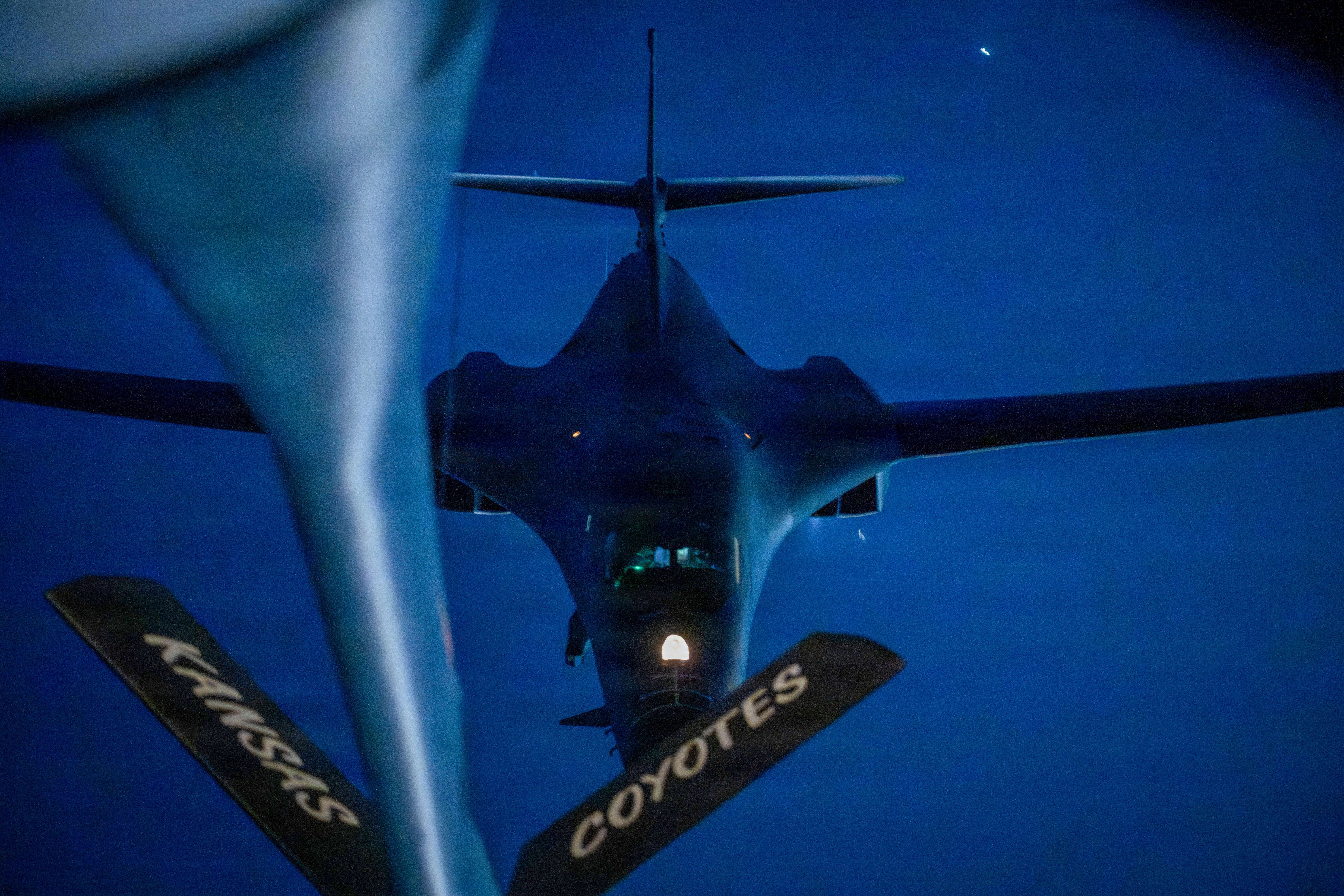
A U.S. Air Force B-1B Lancer aerial refuels with a U.S. Air Force KC-135 Stratotanker while on a night-time mission during Operation Epic Fury. (U.S. Air Force photo)
B-1B fuels for OEF mission. USAF photo
Two F/A-18 Super Hornets launch from the flight deck of Nimitz-class aircraft carrier USS Abraham Lincoln (CVN 72) in support of Operation Epic Fury, March 3, 2026. (U.S. Navy photo)
Super Hornets launch during OEF. Navy photo
Arleigh Burke-class guided-missile destroyer USS Spruance (DDG 111) fires a Tomahawk Land Attack Missile (TLAM) in support of Operation Epic Fury, Feb. 28, 2026. (U.S. Navy photo)
Guided-missile destroyer USS Spruance fires a Tomahawk Land Attack Missile (TLAM) in support of Operation Epic Fury (OEF). U.S. Navy photo

As the U.S. and Israel continued the relentless air campaign over the next several weeks, the base was targeted again at the end of March, with greater effect, according to a report from The New York Times. High-resolution images the paper reviewed revealed impact craters on the taxiways near the tunnel entrances, one building leveled, and small mounds placed along the runway, presumably to prevent enemy aircraft from landing. Battle damage assessments suggested the strikes were intended to cut the underground caverns off from the runway, trapping whatever was inside and preventing takeoff. The report did not state whether U.S. or Israeli aircraft carried out the attack, and Israeli officials declined to comment. However, the U.S. was primarily responsible for pressuring Iran’s southern flank, while the Israelis attacked the western front.

After the fragile April ceasefire collapsed and the U.S. imposed a second blockade, U.S. Central Command (CENTCOM), based out of MacDill Air Force Base in Tampa, Florida, and responsible for executing day-to-day operations of the war, launched multiple strikes across Iran on July 15, and Eagle 44 was hit for at least a third time. An analysis published by Soar Atlas, a satellite imagery provider, identified four aimpoints on July 16, with cratered taxiways and damage to additional infrastructure. According to that analysis, the structures targeted were related to the base’s construction unit, but TWZ has not independently verified this claim. The Pentagon and CENTCOM have not specifically named Eagle 44 in any press briefing or release, and Iran has not acknowledged the base was struck.

United States Navy forces on station in mid-July 2026 when the second blockade began and strikes resumed. TWZ/IAN ELLIS-JONES

The Planet Labs satellite imagery from September 29, obtained exclusively by TWZ, indicates that Iran began reconstruction after the July attacks and that the effort is ongoing.

The main runway, previously blocked by obstacles meant to deter and prevent unauthorized aircraft from landing, is now clear. On the western taxiway (marked in red below), a new section leading into the ridge ‘pass-through’ is complete, with its finished upper cement-concrete layer visible. On the other side of the pass, construction of the next segment is underway, with a subgrade layer of stabilized, compacted dirt laid down but not yet paved (orange). Farther south, in front of the western tunnel entrances, impact craters (blue) are still visible. When finished, the second taxiway will provide a direct link between the western hangars and the runway, allowing additional aircraft to move freely without sharing a single taxiway, a major bottleneck for higher operational tempos and more complex sortie launches and recoveries. A second functional taxiway and tunnel would also provide critical redundancy if the other is hit.

Custom annotated graphic of Iran's Eagle 44 underground airbase built into the side of a mountain following likely U.S. Airstrikes. Created by Ian Ellis-Jones and TWZ using Planet Labs imagery, reprinted with permission.
Annotated zoomed-in shot of Eagle 44. Photo © 2026 Planet Labs Inc. All rights reserved. Reprinted with permission.

On the primary eastern taxiway, two dark streaks (green) that appeared following the strikes in July run off the edge of the pavement, likely debris left by equipment that was struck and removed. Notably, the streak marks match the width of the wreckage, suggesting it was bulldozed or pushed off the taxiway to reopen it. There is no sign of the equipment being recovered, only that it was cleared out of the way.

In the main support compound (yellow) next to the western taxiway, two buildings are clearly destroyed and a third is damaged. They have not been rebuilt yet, which is consistent with previous reporting from The Times and Soar Atlas that the attacks degraded construction capabilities, and suggests the regime may be focused on completing and repairing the taxiways rather than the installations.

A close-up custom annotated visualization  of key areas of interest at Iran's Eagle 44 airbase, which is built into the side of a mountain, following likely attacks by the U.S.. Created by Ian Ellis-Jones and TWZ using Planet Labs imagery, reprinted with permission.
Annotated key areas of interest at Eagle 44. Photo © 2026 Planet Labs Inc. All rights reserved. Reprinted with permission.

The four entrances to the main tunnel complex (white), arranged in two pairs less than half a mile apart at the end of each taxiway on the southern part of the base, appear to be intact, although the angle makes it unclear whether they are open or sealed. What’s inside the mountain, and how many fighters remain in Iran’s inventory, is unknown. Regardless of the status of the fighter fleet, as we noted earlier, the base can also store drones and could be packed with cruise or ballistic missiles.

The U.S. and Israel have a range of bunker buster bombs that could be used in an attempt to collapse the tunnel entrances, a major choke point for any underground weapons storage site. While not destroying what is being held within, doing so would block anything inside from leaving — and being used — for a period of time. Additionally, the pass-through tunnels make for easy targets, and hitting them would keep fixed-wing aircraft from reaching the runway. No impact points on the mountain itself or damage to the portals inside is apparent, but they could have been sealed and hit farther in, which may not be highly visible via satellite imagery. Reaching the main storage caverns themselves would likely be far harder. Larger bunker busters in the U.S. inventory include the GBU-57 Massive Ordnance Penetrator (MOP) guided munition, which could be capable of reaching deeper into the main site, but these are very limited in number and can only be delivered by the Air Force’s B-2A Spirit stealth bombers. It’s highly unlikely the U.S. would expend such resources on a site like this over many others of higher strategic importance.

Eagle 44 is not the only base that Iran is fixing during the lull in hostilities. By the end of May, Iran had cleared 50 of 69 tunnel entrances struck at 18 underground facilities, including some “missile cities,” according to a report by CNN − and that number is likely higher now. Planet Labs, Airbus, and Vantor imagery reviewed by The Wall Street Journal in July showed rebuilt entrances near Kangavar, fresh excavation at Dezful, and repairs near Kermanshah. “They have very impressive industrialization and reconstruction capabilities,” Israeli Brig. Gen. Ran Kochav told the paper. “They refilled their stockpiles,” he added.

A Western official told Bloomberg earlier this month that Iran “remains well-stocked with ballistic missiles and some anti-ship missiles, and can quickly add more,” and a U.S. official posited in May that “the Iranians have exceeded all timelines the IC [Intelligence Community] had for reconstitution.” Both assessments are at odds with what the White House and Pentagon have repeatedly claimed. Secretary Pete Hegseth stated in April that Iran’s air force was “wiped out” and its missile program was “functionally destroyed; launchers, production facilities, and existing stockpiles depleted and decimated,” while acknowledging a week later that the regime was “digging out” launchers, missiles, and bombed facilities but had “no ability to replenish offensive or defensive capabilities.” In May, CENTCOM Commander Adm. Brad Cooper told Congress, “Before Operation Epic Fury, the Iranian Air Force flew between 30 and 100 sorties each day; today that number is zero.” More recently, at a campaign rally in Kansas on Monday, U.S. President Donald Trump said, “They have no air force… their 229 beautiful fighter jets are now scattered all over the runways, the beautiful runways of the Islamic Republic of Iran.”

Video released by Iranian state media in May 2022 showing a different underground missile and drone complex.

At the very least, strikes on Eagle 44 cratered the taxiways and degraded support infrastructure, which likely put at least some of whatever airpower is stored there, if any, out of action. But even after enduring months of war and extreme economic pressure due to the ongoing U.S. blockade and sanctions, as well as dealing with damage across the country, Tehran continues to prioritize construction on the remote base. That fact alone could put it back on the target list if the U.S. and Israel launch another operation. But above all else, it points to how important this facility is to the regime, for whatever reason.

Contact the author: ian@twz.com or @ianellisjones

The post Construction Of Iran’s “Eagle 44” Underground Airbase Hasn’t Stopped Despite War appeared first on TWZ.
  •  

Emily Ratajkowski poses in plunging black swimsuit as she shares intimate photo with boyfriend

Emily Ratajkowski has been keeping busy in Los Angeles, mixing daring mirror selfies with a little romance.

The 35-year-old model shared a bunch of photos on Instagram, leading with a mirror selfie in a plunging black one-piece swimsuit featuring a dramatic neckline and high-cut sides.

Ratajkowski paired the one-piece and wore her long brunette hair loose around her shoulders. She paired it with black shorts and sunglasses.

EMILY RATAJKOWSKI TURNS HEADS IN BIKINI-FILLED JULY PHOTO DUMP

"lotsa LA lately," Ratajkowski captioned the carousel.

Another photo captured the "Gone Girl" actress in a close-up selfie, wearing oversized sunglasses with pink and orange rollers in her hair.

She completed the off-duty glam look with oversized sunglasses and a cigarette between her lips, adjusting her glasses with one hand.

LIKE WHAT YOU'RE READING? CLICK HERE FOR MORE ENTERTAINMENT NEWS

The image prompted mixed reactions from followers, with several questioning the cigarette.

"What is with influencers all smoking lately… smoking hasn’t been cool in a longtime," one person commented.

PUT YOUR ENTERTAINMENT KNOWLEDGE TO THE TEST AND SEE HOW YOU SCORE

"The Unlit cig isn’t hittin’ like you think it is Emily," another wrote.

Others were more complimentary, including fellow model Irina Shayk, who commented, "My friend is 🔥🔥🔥🔥."

The Instagram carousel also included a black-and-white photograph of Ratajkowski sharing a kiss with boyfriend Romain Gavras, a French filmmaker.

GIGI HADID SAYS HER RELATIONSHIP WITH BRADLEY COOPER PROVIDES SOMETHING SHE HASN'T EXPERIENCED BEFORE

In the intimate image, the couple held each other's faces as they leaned in for the kiss.

The romantic snapshot comes just days after Ratajkowski and Gavras attended the Academy Museum Gala in Los Angeles on Oct. 17.

The couple posed together at the star-studded event, with Ratajkowski wearing a striking red dress for the occasion.

The gala marked another public appearance for the couple, who previously attended the MTV Video Music Awards together in September.

At the VMAs, Ratajkowski appeared to pay a subtle tribute to Gavras through her manicure, which featured the initials "RG."

The couple first sparked romance rumors in November 2025 after they were photographed together in New York City.

Ratajkowski later shared photos of herself with Gavras on Instagram in February 2026.

GET ENTERTAINMENT SCOOP DELIVERED RIGHT TO YOUR EMAIL BY CLICKING HERE

The model has previously spoken candidly about navigating relationships after her divorce from film producer Sebastian Bear-McClard.

In a June 2026 personal essay for The Cut, Ratajkowski reflected on a period of dating following her separation, explaining that she initially sought romantic attention as she adjusted to life as a single mother.

She described adopting a more emotionally detached approach to relationships before realizing that she had lost sight of what she actually wanted.

EMILY RATAJKOWSKI'S SHREDDED RED BIRTHDAY DRESS LEAVES LITTLE TO THE IMAGINATION AT NYC CELEBRATION

"I'd never been connected to my own desires," she wrote, reflecting on that period of her life.

Ratajkowski also explained that her divorce ultimately changed how she viewed her own independence.

"I wasn't left; I left," she wrote.

CLICK HERE TO DOWNLOAD THE FOX NEWS APP

  •  
❌