PRODUCTION - 16 October 2026, Berlin: A student looks at a blackboard in the mathematics building at the Technical University of Berlin. Photo: Christophe Gateau/dpa (Photo by Christophe Gateau/picture alliance via Getty Images)
Christophe Gateau/picture alliance via Getty Images
This post originally appeared in the Business Insider Today newsletter.
Sam Altman tried throwing cold water on the AI-arithmeticians beef this week. He said mathematicians have largely gone from anger to acceptance about AI usage in the field.
But that sentiment doesn't quite track with some big names in the field who remain cautious about using the tech.
Terence Tao, a UCLA professor and math prodigy, isn't necessarily pessimistic about AI but also said the "romantic era" of math is over.
"We are entering an era where exciting new things are possible, but some things are being lost," he added.
AI's rapid disruption of mathematics is noticeable.
Shortly after publishing its solution to the Navier-Stokes equations, OpenAI solved an additional 700-plus math problems and released the data on GitHub.
Finding middle ground between the two sides is proving tricky.
The reaction to a student-run Caltech AI math event shows how seriously some mathematicians take the threat.
Caiman Moreno-Earle, a math major at Caltech, told BI's Truman Dickerson that seeing AI companies quickly solve these legendary math problems was "demoralizing."
It's why the 19-year-old decided to hold a "mathathon" where participants could use AI. Moreno-Earle even got Anthropic and OpenAI to each donate $1 million worth of computing power.
Then came the critics.
A letter garnering more than 700 signatories said the event "is likely to have destructive impacts for the mathematical community."
OpenAI eventually pulled out, but the event is still set to happen. Moreno-Earle maintains the mathathon was less about causing a stir and more about ensuring humans have a place in the field of mathematics in the AI era.
Some will argue mathematicians need to adapt to the times and newer tools. There was no point fighting to use a slide rule once the calculator arrived.
The way AI is going about upending the field is also ruffling feathers, though. AI's solutions aren't always clean or clear, requiring mathematicians to go back and verify its work.
And there are also questions about how AI is coming up with these solutions. Since some mathematicians brainstorm with AI models, some have speculated they're using their own work to front-run them to a solution.
Os mais de 100 mil eleitores de Itaguaí, na região metropolitana do Rio de Janeiro, voltarão às urnas neste domingo (25) para escolher o próximo presidente da República e também o novo prefeito do município. A eleição suplementar será realizada simultaneamente ao segundo turno das Eleições Gerais 2026, das 8h às 17h.
A votação seguirá a seguinte ordem: primeiro, os eleitores votam para presidente da República; depois, para prefeito. Para evitar erros na digitação dos números, a Justiça Eleitoral recomenda levar uma colinha com os números dos candidatos, anotados em papel. O uso de celulares e de outros aparelhos eletrônicos na cabine de votação é proibido. Por isso, a anotação é a forma indicada para consultar os números durante a votação.
Quatro chapas disputam a eleição suplementar. Os candidatos eleitos cumprirão mandato até 31 de dezembro de 2028. Concorrem ao pleito Haroldinho Jesus (PDT), que tem como vice Fabiano José Nunes, o Fabinho Taciano (PP); Kelaine Goulart (Novo), com Beto do Posto (Novo) como vice; Luciano Mota (PT), que forma chapa com Dr. Paulo Wesley (PT); e Marcelo Cunha (Democrata), ao lado de Dany Van Tol (Democrata).
Transporte gratuito
Para facilitar o deslocamento de eleitores até os locais de votação e garantir o exercício do direito ao voto, o transporte coletivo no domingo será gratuito em Itaguaí, assim como em todo o estado do Rio. A gratuidade vale das 6h30 às 19h20 no dia da votação.
Eleição suplementar
A eleição suplementar ocorre porque a Justiça Eleitoral barrou a candidatura de Rubem Vieira de Souza, do Podemos, conhecido como Dr. Rubão, por entender que ele estaria concorrendo a um terceiro mandato consecutivo.
Em 2020, Dr. Rubão era presidente da Câmara Municipal e assumiu a prefeitura entre julho e o fim daquele ano, depois do afastamento do prefeito e do vice. Depois, foi eleito prefeito e comandou a cidade até o fim de 2024. Naquele ano, disputou novamente o cargo e recebeu a maioria dos votos, mas teve a candidatura barrada. A Justiça Eleitoral considerou que um novo mandato configuraria um terceiro período consecutivo à frente da prefeitura.
Drones attacked a Russian tax-service data center overnight on 23 October, Ukrainian monitoring channel Exilenova+ reported. A chemical plant in the Urals was also attacked, and a fire broke out near a Russian bomber base by late morning. Russian officials admitted injuries and damage but blamed falling debris. Ukraine has not commented.
Ukraine's long-range drones have widened their target list from Russian refineries to the servers and chemicals that keep Russia's state and war industry running.
The tax service's data center in Gorodets
The target in Gorodets, Nizhny Novgorod Oblast, is one of the Federal Tax Service's two key data centers, which work as a geographically distributed pair. It stores and processes state registers, including tax databases, Exilenova+ said. The extent of the damage is unconfirmed. The site lies about 785 km from Ukraine's northern border in a straight line.
The moment of impact at Russia’s Federal Tax Service data center in Gorodets last night. pic.twitter.com/PftC6keRpY
Eyewitness footage shows a blast and fire in the area of the data center, which serves both the tax service and the Finance Ministry, Russian Telegram channel Astra found. The center opened in 2015. Mikhail Mishustin, then head of the tax service and now Russia's prime minister, attended the launch.
Nizhny Novgorod Governor Gleb Nikitin claimed air defenses repelled 19 drones. Falling debris injured three people in the Gorodets district and damaged several homes, an educational facility, and an infrastructure facility, he said, and local schools switched to remote learning. A Pantsir air defense missile hit a house, Exilenova+ claimed, though officials recorded it as a drone hit.
Ukrainian strikes inside Russia on Gorodets, Berezniki, and Voronezh, with distances from Ukraine, 23 October 2026. Map: Euromaidan Press/Datawrapper
This month, drones already hit three Yandex data centers and a VK data center near St. Petersburg.
A chemical plant behind Russia's gunpowder
In Berezniki, Perm Krai, smoke rose over Uralchem's Azot plant as air defenses fired, Astra reported. The regional security ministry announced a drone attack at about 06:00, and authorities closed the airspace within 50 km of the city. Ukraine's long-range Liutyi drones visited Berezniki, Exilenova+ wrote.
Our old friends, the Liutyi drones, paid Berezniki a visit today. Haven’t seen them in a while. pic.twitter.com/NXuhIJ3xpm
The attack on Azot was continuing in the morning, the channel wrote, adding that the plant covers about 140 hectares with some 90 production buildings. It makes ammonia, nitric acid, ammonium and potassium nitrate, and urea. Russian defense plants use its nitric acid to make explosives and gunpowder, including the Perm gunpowder plant, Astra said. Berezniki lies 1,500–1,600 km from Ukraine's border and the war zone.
Smoke rises over Uralchem's Azot chemical plant in Berezniki, Perm Krai, after a drone attack, Russia, 23 October 2026. Photo: Exilenova+/Telegram
Drones attacked Azot before, on 11 September. Earlier this year, Ukraine's Security Service hit Lukoil's refinery in the same region.
Explore further
Phones down, water off, a factory roof broken open: Russian-occupied Luhansk counts the damage after another night of drones
Fire near a Su-34 base in Voronezh
Late in the morning, Voronezh Governor Aleksandr Gusev declared a missile alert, and explosions followed in the city. Gusev later claimed air defenses downed several "jet-powered aerial targets." Debris set dry grass on fire in a suburb and damaged outbuildings and several cars, he said, adding that no one was hurt.
Missile alert in several regions of the Russian Federation.
Eyewitness footage shows fire and smoke near Baltimor military airfield, Astra found. The strike preliminarily hit the grounds of a former military aviation engineering university and a nearby parking area for military aircraft, Exilenova+ said.
Fire and smoke near Baltimor military airfield in Voronezh after a Ukrainian attack, Russia, 23 October 2026. Photo: Astra/Telegram
Baltimor hosts the 47th Guards Bomber Aviation Regiment, whose Su-34s Russia uses to strike Ukraine, Militarnyi reported, saying Ukraine attacked the airfield with missiles. Voronezh lies about 185 km from Ukraine's border. Smoke rose over the base after an attack on 27 May, and a fire broke out near it on 2 September.
Moscow counts drones, Kyiv stays silent
Russia's Defense Ministry claimed it downed 443 drones overnight over 20 Russian regions, including Nizhny Novgorod Oblast and Perm Krai, as well as Russian-occupied Crimea and two seas. Ukraine's General Staff has not reported on the strikes. A night earlier, drones reportedly hit a sanctioned weapons plant near Moscow.
Russia's air defenses now have to cover state servers and Ural chemical plants as well as the airfields its bombers fly from.
Durante la última década, es casi imposible no haberse cruzado alguna vez con el trabajo de Coco Dávez. La obra de la artista, fotógrafa y directora de arte ha aparecido en infinidad de lugares y formatos, desde su famosa serie ‘Faceless’, retratos en los que la ausencia de rostro no impedía reconocer a iconos de la cultura popular, hasta sus colaboraciones en el mundo de la moda o el diseño editorial. Su uso del color ha hecho reconocibles a habitaciones de hotel, carteles, escaparates o incluso iconos como el Oso y el Madroño o las Meninas. Una exposición que terminó por llevar a Valeria Palmeiro, su nombre real, a una encrucijada.
Nick Woodhead had to scramble in response to a security flaw that threatened the majority of the world's websites.
Courtesy of Nick Woodhead
Nick Woodhead said he went 48 hours without sleep while helping patch a major website vulnerability.
The CTO said that with security problems piling up, October feels like "the month of hell" for tech.
Because AI makes it easier to find and exploit security gaps, Woodhead expects more disruption.
This is an as-told-to essay based on a conversation with Nick Woodhead, founder of the AI company GPTree and chief technology officer at Rothco and Compubox. He spoke with Business Insider on Thursday to share how he's responded to vulnerabilities in the PHP programming language that could affect the majority of the world's websites. The following has been edited for brevity and clarity.
It's always a nightmare when these things happen. Since Tuesday evening, I haven't slept. It's coming close to 48 hours working on this. I'm a CTO, but I also run an agency for multiple clients and have my own company with my own product. So, balancing my time to get everything updated — it's just been exhausting.
About 70% of the internet runs on a programming language called PHP. I'm actively involved within the PHP community itself, so I did get a warning on Tuesday evening regarding the vulnerability and the fact that it was already being addressed by the PHP team. That gave me a head start.
I have some teams offshore, so I was able to jump on that with them.
It's not just applying the patches. It's making sure that nothing was already exposed. We already had infrastructure in place to easily deploy patches, but it still requires a good amount of manual involvement.
I knew that as soon as I walked into the office on Wednesday, I'd have to have my teams jump on this. They were already waiting for the patches to be released.
People are willing to help
One of the biggest headaches, especially on the client side, is that we have a lot of legacy systems, which are running on older versions of PHP that are no longer supported, and official patches are not going to be produced. For those, we ultimately had to come up with other plans. For example, taking sites temporarily offline or moving them behind VPNs.
Eventually, because it's an open-source community, those patches have already been backported, or implemented, by the community. So now we're shuffling back to some of those older systems to get them patched.
That's one of the nice things about PHP. There's such a vast community of people all willing to roll up their sleeves and jump in and help.
Even though I've been in leadership for the last 10 years, I've never taken my hand off the pulse in terms of being connected with the code and the infrastructure. So, I've been hands-on with the development and infrastructure teams to help make sure these issues are resolved. We've been reviewing logs and looking for any potential signatures of a breach that this vulnerability exposed.
The month of hell
It's also meant keeping up to speed with the latest news that's coming out and what other people are finding. We're in a position now where we feel comfortable and safe, but there are new vulnerabilities in the coding tool Node.js. We have some Node services, so now we're looking at how that potentially affects us. October just seems like the month of hell from a technology perspective.
I don't think there is an end in sight with the advancements in AI. For all the positives we get from it, there are a whole bunch of negatives, and this is a perfect example.
OpenAI has already stated that they found many more of these types of vulnerabilities that, thankfully, haven't been leaked. Over the coming months, they are either going to be patches or this information is going to get leaked in the same way and cause the same kind of panic.
I don't think we're at the end of the road yet. There's going to be a lot more to come.
The GCC has mobilised 132 boats for flood-prone areas, says Commissioner Sameeran. Councillors have also arranged additional boats and volunteers to help sick residents reach arterial roads
TOKYO – When Chinese stocks lose a South Korea-sized sum in five months, Beijing has a problem. The US$2.4 trillion plunge in market value since May sits between Korea’s $2.25 trillion GDP and Canada’s $2.49 trillion. Many factors could explain Chinese shares entering bear market territory, but a major one is a protracted slump in […]
Il filmato in poche ore viene rilanciato sui social, a finire nel mirino è ancora una volta Bruno Vespa: “Quando parlate voi giovani, per favore, documentatevi prima. Questo lavoro è fatto anche di studio, capisce? Quindi quando venite qui, venite preparati, dovete studiare, sennò dite delle sciocchezze che non vi giovano“, ha detto il conduttore rivolgendosi a Sabrina Brizzola, 24enne coordinatrice dell’Unione degli universitari, mentre quest’ultima nel corso della sua ospitata a “Porta a Porta” stava parlando del tasso di abbandono scolastico “molto alto in Italia”.
“Visto che lei è informata, la prego di vedersi le statistiche”, ha aggiunto il padrone di casa dopo aver più volte chiesto a Brizzola – visibilmente innervosito – di non essere interrotto: “C’è il massimo recupero storico di abbandono scolastico. Noi siamo con un anno di anticipo rispetto ai target dell’Unione europea”. “Posso rispondere? L’Italia è l’unico paese in Europa che non copre tutte le borse di studio degli studenti universitari. Questo è un dato che se qualcuno vuole confutarmi sono contenta di ascoltare. Le borse di studio non vengono coperte, le università vengono definanziate“, ha aggiunto la coordinatrice dell’Unione degli universitari.
Alla pioggia di critiche social, si è aggiunta nelle scorse ore una nota dell’Usigrai, sindacato che rappresenta i giornalisti dell’azienda pubblica: “Ancora una edificante pagina di Servizio Pubblico da parte del conduttore con contratto da artista Bruno Vespa. Ci chiediamo se sia ulteriormente tollerabile che in uno studio della Rai si assista ad un comportamento tra l’aggressivo e il paternalistico (pensavamo di non essere più nell’epoca dei romanzi di Jane Austen!) come quello tenuto nei confronti di Sabrina Brizzola coordinatrice dell’Udu, Unione degli Universitari, che nella puntata del 20 ottobre non ha potuto terminare il proprio ragionamento apostrofata e interrotta più volte in modo aggressivo da Vespa. Ci piacerebbe che un tale piglio da grande mattatore televisivo venisse riservato anche ai potenti di turno nei confronti dei quali invece Vespa mostra solitamente un’invidiabile pacatezza”. Da segnalare, inoltre, che l’account X di Bruno Vespa risulta sospeso. Non è chiaro se la sospensione sia legata a quanto accaduto o se avvenuta in precedenza.
Aman Bhutani, CEO of domain registrar and web-hosting company GoDaddy
WEF
GoDaddy has over 20 million customers, the majority of which are small businesses.
Its CEO, Aman Bhutani, said small businesses can save time by automating operational tasks with AI.
Bhutani said entrepreneurs need to focus on what they're good at — not outsource their brand.
GoDaddy's CEO said small businesses should use AI to automate work, but not lose sight of their brand.
As head of the domain registrar and web-hosting company, Aman Bhutani has a bird's-eye view into what works for small businesses. The company said it has over 20 million customers, the majority of which are micro businesses, or those with fewer than 10 employees.
The entrepreneurs behind these companies consistently have passion and expertise, he said. However, they tend to have less technological capability — and even less bandwidth to do time-consuming tasks like creating and maintaining a website, said Bhutani.
"There is not enough time in the day," Bhutani told Business Insider.
Today, business owners can use AI agents to do that type of work with minimal friction, Bhutani said, and they can use the tools to help run parts of their business.
A recent survey from GoDaddy's small business research lab found that US entrepreneurs find content creation, marketing, and business advice as the top three areas where they see the most significant time savings with AI.
GoDaddy offers access to Airo, an agentic tool that builds websites and helps with other operational features. For instance, Bhutani said that Airo can create user logins for a small business's customers to make website profiles, or send targeted customer outreach based on a user's location or involvement with the business.
Bhutani said humans should control how their product is unique and not delegate control over their customers' experience. While AI can help with research — the owner ultimately needs to leverage their own knowledge when making decisions about what would work for the brand.
"It doesn't mean that AI cannot suggest those things," Bhutani said. "It can suggest, but the human should continue to control their branding."
While AI tools can save time, "ultimately, you want the human to focus on their area of expertise," Bhutani said, adding that the technology should "enable everything else."
Corgi's cofounders ring the Nasdaq bell to celebrate the listing of its ETF last year.
PR Newswire
Buzzy insurtech Corgi has a knack for launching new businesses, and investment banking may be next.
The firm posted a job for a managing director of investment banking.
Unlike typical investment banking jobs, the pay is commission only.
Corgi launched as an insurance startup, but it's been rapidly expanding into new businesses like thematic ETFs and 24/7 cafe/coworking spaces.
A job filing posted this month suggests it's now eyeing M&A investment banking.
The company, valued at $5 billion, is hiring for a "Managing Director, Investment Banking" role, according to the posting. It says the company is "seeking experienced Managing Directors with established client relationships, deep sector expertise, and a proven track record of originating and closing transactions."
The company says it's seeking someone with more than five years of experience. Unlike traditional investment banking jobs, which typically pair a hefty base salary with performance-based compensation, this job is "commission only, with no base salary."
"Payouts are tied to collected transaction fees, with terms based on origination and execution responsibilities and agreed upon before joining," the listing says.
Investment banking managing directors across the industry made a median of $1.1 million a year in 2025, according to Prospect Rock Partners, and in previous years, bonuses made up more than two-thirds of total compensation.
A commission-only contract could be seen as a hard sell for your average banker, but Corgi's prolific fundraising — $266 million this year and $431 million in total since its 2014 launch — and its vision of "building an AI financial infrastructure company" may be attractive to an ambitious young banker.
The company did not respond to a request for comment about its plans or the job posting.
Corgi was founded by Emily Yuan and Nico Laqua in 2024, offering a range of insurance products for startups. Its recently opened cafés are positioned as a marketing tool for startup founders.
While an investment banking platform may seem to be an odd choice for an insurer, it is a clue that this is part of the firm's vision to serve startups by helping them sell their businesses.
The posting said candidates should have relationships with "founders, sponsors, and referral partners" — in other words, those who can connect startup founders with private equity investors that could buy their companies.
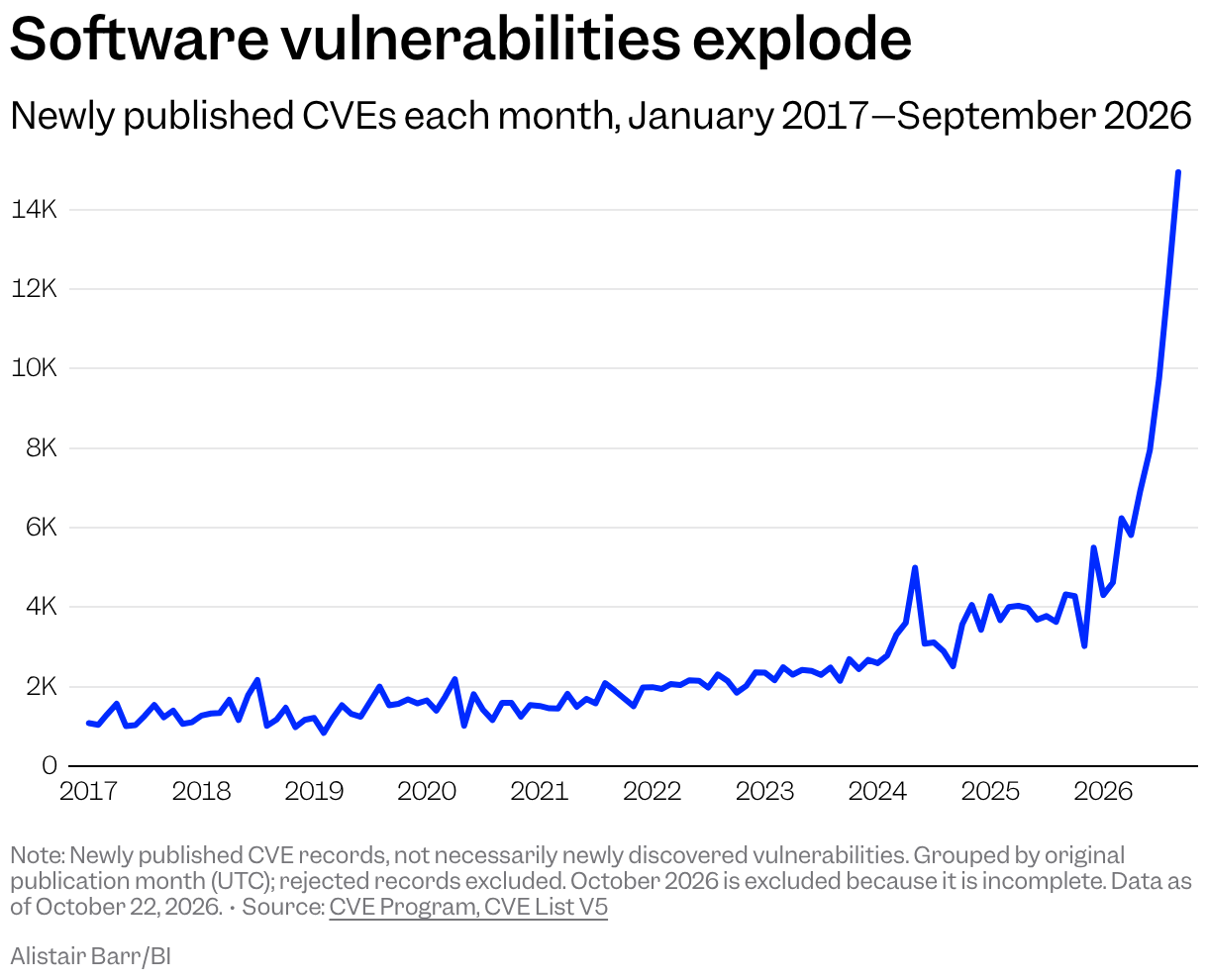
This week's cyber freakout explained: AI is making software weaknesses easier to find and exploit.
The message from Cloudflare's Stephanie Cohen and Vercel's Tom Occhino: Don't panic!!!
Do we need everything connected to the internet? Paper bank statements work well.
A few weeks ago, I heard a strange story about a friend who works at one of the Big Tech companies in Silicon Valley.
She'd recently ripped out the connected devices in her home, ordered paper bank statements, and stocked up on canned goods in her basement.
Now, she's a very sane, experienced person, and quite senior at one of the largest internet companies on earth. Why was she disconnecting so much? Just to be sure, my family ordered paper bank statements, too. It was still a head-scratcher, though.
Fast forward to this week, and her actions look a little less crazy.
The digerati have now entered full freakout mode. Much of the internet meltdown is happening on, well, the internet, my colleague Alice Tecotzky noted.
On X and Reddit, warnings of a looming “Black October” spiraled into visions of AI grinding civilization to a halt. One lengthy post on X warned of a potential “global cyberattack/AI swarm” and offered a survival checklist: Stockpile cash in small bills, print out your neighbors' phone numbers, download maps, buy a hand-crank radio, and stash a gallon of water per person per day.
Oh, and don't forget the manual can opener. You don't want to survive the AI apocalypse only to be defeated by a tin of beans.
Nikita Bier, a prominent app developer and former head of product at X, best captured the mood.
"The world is a little bit scary right now," she told me on the side of Cloudflare's annual conference in San Francisco this week.
Here's the problem. The internet is built on decades of software, much of it riddled with security holes.
Some of these weaknesses have been known for years. However, fixing them takes time and money, and hackers often lacked the skills to exploit them anyway. So they were left alone.
AI changesthat calculation dramatically. Someone who previously needed years of training to break into a computer system can now get help from an AI model. And these tools can search for weaknesses at a speed humans simply can't match.
Now, there's a frantic race between people trying to break into systems and those trying to protect them.
Don't panic about AI
Cohen's message, though, was surprisingly reassuring.
AI helps the good guys find and fix these problems. Cloudflare, for instance, released protections for the latest vulnerability to customers, including those using its free service.
And there's a bigger effort underway.
OpenAI has launched an initiative called Patch the Planet, working with Cloudflare and other security professionals to use AI to find weaknesses in widely used software and help repair them.
Tom Occhino, chief product officer at Vercel, told me recently that his company has been talking with partners about launching a nonprofit that would fund a swarm of good AI agents that go out on the internet to find and fix software flaws.
Amazon is joining the fight, too. Its new Continuum service, available Thursday, uses AI agents to find security holes and propose fixes. Amazon said that people maintaining freely available software can use it to help protect the wider internet.
Humans may still have to check and approve these repairs, but the prospect of AI helping clean up decades of neglected software is encouraging.
The irony of this is not lost on some in the industry.
"The funny thing is everyone was saying AI slop code will cause a cyber crisis but it's actually all the old human slop causing it and the AI is just cleaning it up," software engineer Ben Kaufman wrote on X on Thursday.
Either way, Cloudflare's Cohen thinks these AI-inspired freakouts will push the industry to do better — by exposing issues and adding urgency to get them patched.
"We may end up in a world where actually we've become significantly more secure at the end," she said.
The trouble is getting there.
A fundamental question about the internet
Tom Occhino (left), chief product officer at Vercel, talks with Meta executive Prashant Ratanchandani at Vercel's Ship SF conference.
Alistair Barr/Business Insider
When I ran into Occhino recently at a Vercel conference in San Francisco, he described a world in which software that everyone assumed was safe suddenly looksvulnerable because increasingly capable AI models are scrutinizing the basic systems that underpin the internet.
That led to a more fundamental discussion between us: Why did we connect so many things to the internet in the first place?
For years, the technology industry has raced to put everything online. Thermostats. Refrigerators. Doorbells. Cars. Bank accounts.
We assumed that connecting something to the internet automatically made it better.
Perhaps we should reconsider.
Before the internet
I remember the world before the internet. It worked pretty well. We managed to buy groceries, pay bills, heat our homes, and generally get through the day without every appliance talking to a computer somewhere.
That doesn't mean abandoning online banking or throwing your smartphone into the sea.
Occhino, for one, isn't particularly worried about hackers wiping out his bank account. Modern banks have sophisticated protections, and he recommends everyone turn on additional login security.
Maybe the cybersecurity crowd, which spends its life immersed in online threats, is missing something obvious.
Not everything needs to be connected.
Occhino put it neatly: "There's certain things that don't make sense to be on the internet in the first place."
Perhaps that's the lesson from this week's panic. We don't need to turn off the internet.
Meta says that over a quarter of Muse users made purchases with the AI agent.
The average order was over $200 — that's a lot of clams!
If this is you, please tell me what you're using it for.
Something just blew my mind, and I'm asking for your help to figure it out.
According to Meta's Q3 earnings call on Wednesday, more than a quarter of Muse users so far have used the AI agent make purchases — and the average order size is over $200.
I'll say that again: average order size over $200.
This is shocking to me, and I'm someone who has been actively and happily using Muse for a variety of things. I've been perfectly happy to give Muse access to my email, my calendar, my credit cards, and even my Apple health data.
But I've been slightly reticent about using it to actually buy stuff. Not that I'm totally worried about it getting stuff wrong (although the one purchase I did try to make with it was to order a salad for lunch, and it attempted to place the order on my HSA card after I failed to recognize the last 4 digits of that card, oops).
I think it's more I enjoy shopping online myself? I mean, for most things, I suppose. For "fun" stuff like clothes or personal items, I enjoy browsing and the hit of dopamine when you check out. (Others take this to the extreme, using "dopamine sites" that let you browse fake restaurants and "order" food that never arrives.) The other night I ordered — on a real site — cotton balls, razor blade refills, a plain white t-shirt, and a pair of scissors from the Target app while watching TV and even that boring purchase with a total under $30 gave me a small thrill. Why would I want to cede that joy to AI?
I understand, however, that not all purchases are fun. My colleague, Peter Kafka, used Muse to help him place an order for a new washing machine — the kind of purchase that is difficult to decide on, not particularly fun or exciting to make, and fairly expensive. Things like plane tickets, washing machines, or car insurance are in that category of stuff you have to buy, cost a lot of money, are fairly complicated to decide which option to buy, but bring very little joy during checkout.
I can understand why you might want to hand that off to an AI agent.
If you are using Muse to place big $$$ orders, what the heck are you buying?
My best guess here is that people are using Muse for airplane flights and hotels — the kind of big dollar items that are kind of annoying to book yourself, and you care mainly about just booking the right dates.
Am I right? You tell me!
Comment below, or you can email me at: knotopoulos@businessinsider.com. Or, you know, tell your Muse to email me.
HD Hyundai Co 267250.KS said on Friday it has signed a deal with Kiewit Corp to start building an advanced US shipyard next year, with operations expected to begin in 2029 and create about 3,000 domestic jobs.
La compañía despide a tres investigadores especializados en seguridad por gestionar indebidamente información sensible. Los tres habían estado luchando para mantener la transparencia sobre el funcionamiento de los sistemas de inteligencia artificial Leer
La compañía despide a tres investigadores especializados en seguridad por gestionar indebidamente información sensible. Los tres habían estado luchando para mantener la transparencia sobre el funcionamiento de los sistemas de inteligencia artificial
Sundar Pichai says Google's researchers are using AI to help build the next AI models.
Hardik Chhabra/ The India Today Group via Getty Images
Sundar Pichai said Google was still in the early phases of recursively self-improving AI.
Researchers are working with AI agents to build better models, he said.
Sergey Brin recently said Google was "starting to get onto that RSI treadmill."
Google's AI models may be helping to build their successors, but CEO Sundar Pichai says the moment of fully self-improving AI is still a while away.
Speaking on an episode of the "Big Technology Podcast" this week, Pichai said that Google researchers were using AI agents to assist them when building models, but caveated that it was still early days.
"We are pretty far from the end state of RSI," said Pichai, referring to recursive self-improvement. "The right way to describe it is, you have RSI loops along with AI researchers in various aspects of model development. I would say you almost have agents helping AI researchers, in some automated way, work together to build these models."
Pichai added that he expected that continuum to keep making progress into next year.
Earlier this month, Google cofounder Sergey Brin said the company's Flash series of models, as well as Gemini 4, were demonstrating how AI was helping to build itself, and that Google was "starting to get onto that RSI treadmill."
"And now our researchers and the model work hand in hand to make the next version of the model," he said.
Brin has been increasingly involved in Google's Gemini efforts and has leveraged his power as cofounder to shift resources to projects he deems most effective, Business Insider previously reported. This has included pushing for more focus on RSI.
A report from the firm Gladstone AI, published earlier this month, said that most researchers interviewed from companies including Anthropic and DeepMind believed RSI will start within the next three to 12 months, and possibly sooner without government intervention.
In another moment on the "Big Technology Podcast," Pichai was asked about how much AI was being used to code internally. The company said in April that 75% of new code inside Google was generated by AI.
"That number in our world today is like meaningless in the sense that every part of code we now touch is influenced by AI deeply," Pichai said. With Gemini 4 Argon, he said, people were going to tackle harder problems. He also said Google was seeing a one-third decrease in code rollbacks, where software is reverted to a previous version because of a bug or system issue.
"And so I think people are writing code more productively, and better code with it," he said of AI tools.
Pichai also uses AI to track Google's model development and internal discussions, he told the "Sources" podcast this week.
Una bandana indossata non per questioni di moda, ma per coprire la cicatrice dopo un piccolo intervento. Questo è quello che ha spiegato Rita Rusic a “La volta buona” nel corso della puntata di giovedì 22 ottobre, quando ha raccontato il motivo della bandana che aveva già indossato nel corso di un’altra sua ospitata nel programma di Caterina Balivo.
“Ho fatto un intervento perché avevo un piccolo rigonfiamento in fronte. Mi sono fatta vedere e mi hanno dato una medicina per curarlo. Ma non era quello” ha spiegato Rusic, a cui inizialmente dunque non era stata prescritta la giusta cura. Durante una visita a cui Rusic aveva accompagnato un’amica, un medico le ha fatto però capire che non si stava curando nel modo giusto.
“No, non è questo. Si vuole fare vedere da un dermatologo che le dico io?” le disse allora il medico. Rusic così, andando dal dermatologo indicatole, ha scoperto di avare un basalioma. “Un basalioma è un tumore maligno circocritto, così mi sono dovuta operare. Avendo avuto però una diagnosi sbagliata, ho perso tanto tempo ed era diventato molto grande” ha spiegato Rita Rusic.
AI helped discover two "critical" flaws in the infrastructure of PHP, a programming language that up to 70% of websites use, prompting companies to race to roll out a fix or risk being hacked.
The incident has illustrated how AI is creating a new level of risk for businesses and consumers online, in a week when multiple other cyber threats caused headaches for security workers.
Here's what executives and analysts are saying about the biggest cyber threat of the moment — and how AI could make things even worse.
Jason Clinton, Anthropic's deputy chief information security officer
Anthropic's deputy security chief, Jason Clinton, warns that a "vulnerability tsunami" is coming — and says critical infrastructure hasn't caught up.
Clinton posted on X on Wednesday about the need to "patch critical infrastructure" before core network vulnerabilities get exploited. On Thursday, he issued another warning to companies.
"As bad as things have gotten in the past 4 days, they are going to get a lot worse before they get better," he wrote.
"Security leaders, never let a crisis go to waste: please go to your boards and ask for help right now. not for ai, for the basics. (we need to hold on for ~18 months.)," he added.
Andrew Curran, AI analyst
Andrew Curran, a prominent AI analyst, weighed in on several cybersecurity threats from Wednesday to Thursday.
"Regarding potential attacks on energy, food, and water infrastructure, the threat is quite real. Someone is currently probing infra and feeling it out, it is an active threat. Even a little preparation can be helpful, just in case," Curran wrote on Wednesday in response to an NSA cybersecurity advisory about threat actors.
On Thursday, Curran also highlighted a hack of Quest Diagnostics, which he said serves "roughly half" of the US's hospitals and physicians.
Matt Shumer, AI investor
In February, Matt Shumer, the former CEO of Hyperwrite, published a viral essay on his website titled "Something Big Is Happening," in which he warned of large-scale disruptions wrought by AI that could upend the world order.
Shumer published another essay on Thursday on his website and LinkedIn, this time titled "The Internet Is Under Attack. Here's How to Protect Yourself and Your Family."
"Right now, as you read this, swarms of AI agents are likely trying to break into the websites you use. Not one of them. Many of them," Shumer wrote. "We are in the middle of the biggest cybersecurity moment in years."
This is what could happen, per Shumer's post:
Your information leaks, so scammers know your name, birthday, address and bank, and their calls and texts sound real. Your accounts get taken over through some site you used once, years ago, with the same password you use everywhere. And the things you depend on, like an app, a pharmacy or a store's website, go down for days.To be clear: this is ongoing, but the worst-case scenarios people are most scared of haven't happened. I hope they never do. But it's better to be safe than sorry, especially since this is going to keep happening.
Shumer also outlined four ways people can protect themselves, including updating all their software and staying off sites they're unfamiliar with while companies and websites alike make their security updates.
He also advises that people protect their bank accounts by being extra cautious about any and all codes and links that they receive. People should also "close the doors you aren't using" by unplugging smart gadgets and deleting apps that aren't being utilized.
"Every connected thing is another way in," Shumer wrote.
Marc Benioff, CEO of Salesforce
Salesforce CEO Marc Benioff
Business Insider
Marc Benioff agreed with Anthropic's Jason Clinton in an X post on Thursday.
"Jason is 100% right. Code red," Benioff wrote, along with a red alarm emoji.
Sriram Krishnan, venture capitalist and former White House advisor
Sriram Krishnan said public-private partnerships might be needed.
Heather Diehl/Getty Images
Sriram Krishnan, a prominent venture capitalist and former senior AI policy advisor for President Donald Trump, said that the PHP vulnerabilities are a "harbinger of things to come" as AI models continue to detect long-standing cyber issues.
"However the entire software supply chain will need the muscles to rapidly build and deploy fixes," he said in a post on X.
The new cyber reality may require more public-private partnerships to build the required infrastructure, he said.
Deedy Das, venture capitalist
The Menlo Venture partner Deedy Das warned that "the era of vibe hacking is here" in a series of posts on X.
He said he'd seen firsthand that "even non-technical people" can exploit common vulnerabilities, such as PHP, using AI models. Das said someone could theoretically direct certain models to any website and instruct them to quickly locate the vulnerabilities.
"Once you figure it out, it is downright trivial to do. The digital infrastructure of the world is at risk," he wrote.
Aaron Levie, CEO of Box
Box CEO Aaron Levie.
Michael Short/Bloomberg via Getty Images
AI agents have ended the era of "security through obscurity" because they can devote once-unthinkable time and effort to finding vulnerabilities, Box CEO Aaron Levie said on X. People will need to upgrade legacy infrastructure, modernize security policies, and tighten access controls, among other measures, he said.
"Agents will help on the defensive side because they can both accelerate this work and equally simulate the risk vectors," Levie wrote.
Yet Levie thinks humans also have an important role to play in the cyber revolution — he predicted a boom in cybersecurity jobs, which could become a huge investment area for companies.
"You will need more talent to point the agents at the most critical work, review findings, patch systems, respond to incidents, and more," he said.

 Login