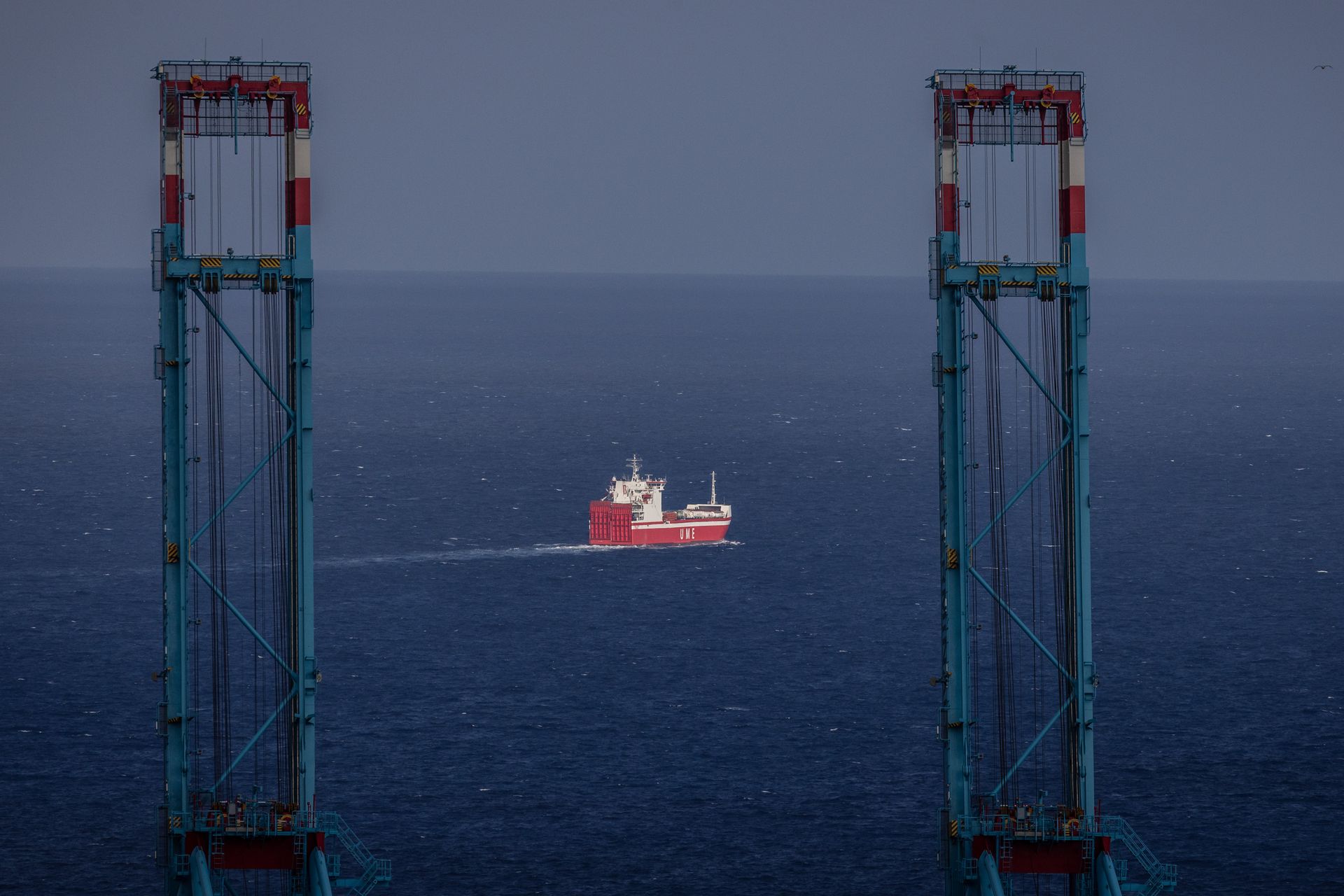
A ship called the Agioi Fanendes, which had just left Russia's Baltic Sea port of Primorsk, was carrying 40,000 metric tons to New York and had been traveling westwards through the Baltic Sea ever since.
Cyprus is ready to delimit its maritime boundaries with Greece, Foreign Minister Constantinos Kombos said on Friday, at the end of a week in which the Libyan parliament ratified a maritime boundary agreement signed with Turkey, which both the Republic of Cyprus and Greece consider to infringe on Greek territorial waters.
“We have already been undertaking this process for a long time, but it is something which will be decided at the highest level. Nicosia is ready,” he told the House finance committee as he justified his ministry’s budget for next year.
Following the committee session, he said that “for our part, we have expressed our positive approach to such a possibility”.
“The technical processes for us have been ready for quite some time, but you understand that these are issues where a series of political parameters must be taken into account,” he said.
He added that “these issues are very delicate”, but stressed that “we will continue this discussion” with Athens.
Asked where issues may arise, he said that “there are thoughts, and there is a will”, before adding that “the right time must be found”.
“This is not something which concerns only Cyprus and Greece in terms of consequences and what may arise, so we must be very careful about all these issues,” he said.
Cyprus has such agreements with Egypt, Israel, Lebanon
The Republic of Cyprus has signed maritime delimitation agreements with Egypt, Israel, and Lebanon, with the Lebanese government having approved its maritime border with Cyprus last year. Greece, meanwhile, signed an agreement with Egypt in 2020.
However, no such agreement has yet been signed with Greece. It is likely that such an agreement would conflict with claims made by Turkey to swathes of the eastern Mediterranean made by Turkey under its ‘Blue Homeland’ doctrine, with this doctrine having fuelled the country’s agreement with Libya.
That agreement drew a line southeast of the Greek island of Crete, which Greece claims as its own, with the dispute sourced in the question of whether islands are entitled to a full exclusive economic zone (EEZ).
Greece and the Republic of Cyprus, citing the United Nations convention on the law of the sea (Unclos), state that they are, but Turkey and Libya, believing that the convention gives too much weight to islands, state that they are not.
The Greek Ministry of Defence plans to merge or close dozens of military units and facilities, while simultaneously establishing new commands for unmanned aerial vehicles (UAVs), space operations, and cyber warfare. This restructuring is estimated by authorities to save 530 million euros over five years. On Tuesday, Defence Minister Nikos Dendias presented the third phase […]
The legislation requires social media platforms to implement age-verification measures to ensure compliance. Companies that fail to meet the requirements could face fines of up to 6 percent of their global annual turnover.
Addressing parliament ahead of the vote, Digital Governance and Artificial Intelligence Minister Dimitris Papastergiou described the measure as a necessary step that is compatible with the European Union’s (EU) existing regulatory framework.
“It would have been very easy to do absolutely nothing today and wait for the perfect European law. But the challenge is here. Children are sinking into the internet every day, and I believe a responsible government must do what it is obliged to do,” he said.
4 countries. 1 growing movement.
France, Denmark, Spain and Greece are all moving to block children from social media — and Greece wants Brussels to make it a Europe-wide rule.#EUXLpic.twitter.com/xH6iJrO139
Minister of State Akis Skertsos said technology should be regulated in ways that give children greater freedom to grow up safely.
Excessive use of social media can negatively affect children’s sleep, concentration, social relationships and psychological development, said Health Minister Adonis Georgiadis, who described digital addiction as a public health challenge.
The legislation forms part of broader government efforts to protect children from harmful online content, cyberbullying and platform features that encourage excessive use. Greece aims to become the first EU member state to introduce such a ban.
The French parliament passed legislation on July 21 aimed at protecting minors from the risks associated with social media use. However, the French Constitutional Council ruled on Aug. 14 that the key provision banning under-15s from accessing social media was unconstitutional.
Greece has sent a letter to the United Nations, in which it emphasizes the invalidity of the 2019 Turkish-Libyan maritime memorandum recently ratified by the Libyan House of Representatives, Greek diplomatic sources said on Friday. Greece’s Permanent Representative to the UN, Ambassador Aglaia Balta, sent a letter to UN Secretary-General Antonio Guterres on Thursday, acting […]
The bill banning minors under the age of 15 from using social media online from January 1, 2027, was approved by a majority in Parliament’s plenary session late on Thursday. Only ruling New Democracy (ND) voted in favor of the bill in principle. Αong opposition parties, PASOK voted “present”, while SYRIZA, Greek Solution, KKE, Niki […]
Greece’s parliament approved a bill on Friday that bans the use of social media platforms for children under 15 amid growing concerns over their impact on the health and safety of minors.
Australia was the first country to pass legislation to curb the use of social media by minors, doing so last year. A similar law passed in France was struck down by the country’s Constitutional Council in August.
Greek Prime Minister Kyriakos Mitsotakis said social media platforms have 2-1/2 months to devise a way to verify users’ ages and protect their privacy.
Greece is among seven European Union countries seeking an age verification solution with the European Commission
Greece says it is standing by parents to help curb the “endless scrolling” that deprives children of sleep, concentration and time with their friends

 Login