In a sign of humble progress, the FP-7 ballistic missile saw its first deployment.
Russian forces are now attacking Kyiv’s bridges.
No resolution to jet-powered Geran drones with new threat is on the horizon.
Ukraine lost another MiG-29 and its pilot, while Russia has lost a Mi-8 helicopter with a crew of three.
Videos of the day: attacks on a bridge in Kyiv; a drone struck a school full of children and teachers; a ground drone recorded the impact of two glide bombs.
FP-7 ballistic missile made in Ukraine were deployed for the first time. This is progress, but one should not expect miracles.
“Ukrainian tactical ballistic missile. FP-7. First combat deployment. Thank you for the results. Next step: serial production. Glory to Ukraine!” With these words and a short video, Ukrainian president Volodymyr Zelensky announced a long-awaited milestone in Ukraine’s arms programme. The next step is expected to be the deployment of the larger and more dangerous FP-9 missile.
Ukrainian tactical ballistic missile. FP-7. First combat use. Thank you for the result. Next up: production. Glory to Ukraine! pic.twitter.com/IxdjVg51c1
— Volodymyr Zelenskyy / Володимир Зеленський (@ZelenskyyUa) October 1, 2026
For now, however, this was only its first deployment against an unknown target, with an unknown outcome. The Russian analytical channel Military Informant did not rule out the possibility of the footage being recorded at a training ground with the intention to deflect criticism of Fire Point, the Kyiv-based manufacturer whose production is behind schedule.
The FP-7 missile is an interesting technical achievement that could expand the Ukrainian army’s ability to strike important targets. Expectations should be kept low. This is because the missile has not yet entered serial production its specifications lag behind those of Russia’s short-range Iskander missiles.
The FP-7 is based on the Soviet-origin 48N6 surface-to-air missile, used in some versions of the S-300 system and still deployed by Russia in the more modern S-400. A Ukrainian outlet says that the FP-7 has an estimated range of only 200 km and a warhead weighing up to 150 kg.
Russia’s Iskander missiles weighs more than twice as much, and Russia has already used a version with an extended range well beyond 500 km. The Ukrainian FP-7’s use will therefore be limited to areas up to roughly 100 km from the front line. It is certainly not a means for strategic strikes against Russian industry deep inside enemy lines.
Ukraine could strike further with a FP-9 missile, and developing them remains a goal to work towards. The two types of missile differ significantly. They were analysed in August by the Russian Telegram channel Russian Engineer. The FP-7 is smaller and the FP-9 larger. Its maximum range is estimated at 855 km (far enough to reach Moscow,) its warhead is expected to weigh up to 800 kg.
The outlet focusing on the war’s technical parameters compared the Iskander with the FP-9:
“The 9M723 Iskander-M missile has a diameter of 920 mm, while the FP-9’s is 1,100 mm. The missiles are 7.2 and 9.5 metres long. The solid-fuel rocket motor is approximately 4.2 metres long in the 9M723 and 6.5 metres in the FP-9. Fuel mass is estimated at 2.6 and five tonnes. With a warhead weighing around 500 kg, calculations indicate ranges of up to 500 km and 1,000+ km. If the warhead weighs around 800 kg, the range will be approximately 800 km.”
The media’s performance estimate therefore matches official Ukrainian data.
According to the Russian Engineer Telegram channel, the FP-9 is conceptually based on the Iskander and builds on the Ukrainian Sapsan project, which was never brought to the final stage.
The Ukrainians displayed both missiles at a trade fair in Denmark in August, where the following photographs were also taken:
The Russians have started attacking Kyiv’s bridges. This fulfils the wishes of Russian pro-war hawks, who for years have complained that bridges in the capital of the invaded country were still standing.
This article continues, but the full version is available only to EUobserver.com subscribers. Visit account.euobserver.com/membership
Cette semaine, Caroline De Camaret reçoit Maciej Witucki, président de BusinessEurope depuis le 1er juillet 2026. Plus grande organisation patronale d'Europe, BusinessEurope représente plus de 40 fédérations patronales nationales issues de 35 pays. Polonais de nationalité, il dresse avec nous un bilan du paysage entrepreneurial européen, de ses défis et de ses pistes d'amélioration.
Il ne fait pas bon prendre sa voiture. Pas à cause des embouteillages, mais à cause des prix de l'essence qui n'ont jamais été aussi élevés en Europe. Dans un contexte géopolitique toujours aussi tendu – au Moyen-Orient et en Ukraine – le coût du litre d'essence bat des records, tout comme celui du gazole.
Il ne fait pas bon prendre sa voiture. Pas à cause des embouteillages, mais à cause des prix de l'essence qui n'ont jamais été aussi élevés en Europe. Dans un contexte géopolitique toujours aussi tendu – au Moyen-Orient et en Ukraine – le coût du litre d'essence bat des records, tout comme celui du gazole.
More than a year ago, we launched our Hungary Briefing, a weekly round-up of the election campaign. Since the historic vote in April to remove Viktor Orbán, the series has followed the new Tisza government and its first moves in office. This week’s topics:
Two ministers from Orbán’s government have been held in custody.
Former prime minister Orbán may have ordered the detention of Ukrainian cash couriers.
The newly established National Asset Recovery and Protection Office has begun work.
The European Public Prosecutor’s Office could also help recover stolen funds.
It has been an eventful few days in Hungarian public life. Efforts to hold former officials accountable are gathering pace: two former ministers have been remanded in custody over suspected breaches of fiduciary duty involving billions of forints and the acceptance of bribes.
The National Asset Recovery and Protection Office (NVVH) immediately took over four cases and began investigating them, including the visa business linked to Orbán’s brother. Meanwhile, a chief prosecutor who resigned from his post claimed in an open letter that Orbán himself had ordered the detention of Ukrainian cash couriers.
Prime minister Péter Magyar addresses parliament as MPs vote to lift his immunity, Budapest, 28 September 2026 (Srouce: Zsolt Szigetváry/EPA)
Two ministers from Orbán’s government have been held in custody
“The landing is beginning as part of ‘Operation Purgatory’,” prime minister Péter Magyar announced on Monday (28 September) morning. Later that morning, Hungary’s parliament lifted the immunity of Miklós Seszták, an MP and former development minister from the Christian Democratic People’s Party (KDNP); Balázs Hankó, an MP and former culture and innovation minister from Fidesz; and prime minister Magyar.
Prosecutors requested that Hankó’s immunity be lifted on suspicion of breach of fiduciary duty: he is suspected of causing losses of 17 billion forints (€46.5m) to the state budget. Authorities are investigating Seszták on suspicion of accepting bribes and other offences. The former minister and the then chief executive of Hungarian National Asset Management are suspected of receiving approximately 12.6 billion forints (€34.2m), in bribes through an intermediary between 2015 and 2018.
Magyar himself requested the lifting of his own immunity after the deputy prosecutor general asked the speaker of parliament to initiate the procedure over an incident in June 2024. According to the Office of the Prosecutor General, Magyar deliberately dropped the phone of a man filming him into the Danube, an act it classifies legally as theft.
After the vote on his immunity, Seszták went to the Central Investigating Chief Prosecutor’s Office, where he was taken into custody. He said he had committed no crime and wished to give a statement. On Wednesday, a court ordered the former minister’s remand in custody.
Hankó initially waited in the Fidesz parliamentary group’s office for police to take him away. Under the rules, however, he should have presented himself at the Central Investigating Chief Prosecutor’s Office.
Under the Act on the National Assembly, police may enter the parliament building and take action there only with the speaker’s specific permission, while the Parliamentary Guard may neither forcibly bring him before the authorities nor take coercive measures against him. Parliament speaker Ágnes Forsthoffer therefore firmly called on Hankó to leave the building and cooperate with the investigating authorities.
Hankó subsequently held a press conference with his wife and children present, claiming that he was the target of a politically-fabricated case and declaring his innocence. He finally accepted the summons at 7.20 pm and left parliament, setting off to give a statement amid carefully-staged scenes. Orbán’s social media page live-streamed the entire episode (while the Fidesz leader was in Belfast cheering on Hungary’s national football team).
In a statement, prosecutors said that Hankó and his associates had used National Cultural Fund resources for purposes other than those prescribed by law on 1,079 occasions between 3 September 2025 and 30 March 2026.
This article continues, but the full version is available only to EUobserver.com subscribers. Visit account.euobserver.com/membership
The EU has played down claims by the Dutch government that the bloc’s decision to suspend aid support for Sierra Leone was because the west African country refused to extradite one of the world’s most-wanted drug traffickers to face trial in the Netherlands.
Speaking on Thursday, (1 October) after a meeting of EU justice ministers in Luxembourg, migration commissioner Magnus Brunner told reporters that the decision to suspend support was made for “technical reasons” — but without giving more detail.
Sierra Leone was allocated €352m in EU funding between 2021 and 2027, under the bloc’s seven-year budget framework. The country was set to receive €18m from the EU this year.
But Dutch justice minister David Van Weel insists that the suspension of funds is the result of months of pressure from the Dutch government to persuade president Julius Maada Bio’s government to hand over convicted Dutch drug trafficker Jos Leijdekkers.
This article continues, but the full version is available only to EUobserver.com subscribers. Visit account.euobserver.com/membership
We went to Ceuta to see how Europe treats people who arrive at its borders. We came back asking how Europe can still call itself a continent governed by law.
What we saw there was the often abstract failure of migration policy made brutally concrete: the daily humiliation of human beings — people sleeping under plastic sheets, children left without protection, food distributed under military guard, allegations of beatings and torture, and migrants treated as a threat rather than as people with rights.
These are scenes we never expected to encounter in Europe in 2026. Yet we saw them ourselves. And now that we have seen them, we cannot pretend we did not.
Morally unthinkable and unacceptable
In Ceuta, the boundaries of what is morally unthinkable and unacceptable have been crossed.
Migrants and those who help them are living in a kind of state of exception, where European law has been suspended and prolonged arbitrary police and military rule prevails.
Ceuta is a city abandoned by Spain, Europe and the law, where people are segregated according to their origin in circumstances that recall apartheid regimes. It has become a laboratory for the degradation and dehumanisation of migrants.
The future of Europe is being decided there.
We visited locations where thousands of people are living in undignified conditions, under makeshift shelters, plastic tarpaulins or in the open, assisted by local residents and NGOs such as No Name Kitchen.
They described constant harassment, insults, threats, public targeting through leaked photographs, and the detention of five members accused of disobeying authorities after recording a police operation involving migrants.
First, the far-right Spanish party Vox turned desperate people into prey to be “hunted down one by one”. Eventually, those trying to feed or assist them also became targets. When a group is sufficiently dehumanised, those who try to help them can be dehumanised too.
At Trampolín beach, we saw how the Red Cross distributes, once a day, a single bag of cold food: bread, water, tuna, juice and biscuits, under the watch of National Police vans.
Migrants from other areas can walk for hours to reach it. One day, we witnessed military forces preventing the Red Cross from distributing the same ration to around 1,000 people.
Whether someone eats can depend on military personnel, who can remove people from the queue or deny them food. The food distribution also coincides with Red Cross medical assistance, forcing some people to choose between eating and having their wounds treated.
Children alone on the streets
We spoke with children living on the streets, alone, hungry and cold, without adequate protection. We were told that National Police officers sometimes refuse to identify children who approach them for help, preventing them from entering the protection system.
This is compounded by the refusal of autonomous communities governed by Spain’s centre-right People’s Party and Vox to take them in, and by the Ceuta government’s refusal to appoint legal representatives.
We also heard allegations concerning Ceuta University Hospital. Migrants can face separate treatment at the emergency department and, according to migrants and NGOs, military personnel guarding the entrance prevent them from waiting inside, including minors.
We heard the account of a child with a fractured leg who, after being treated by Médicos Mundi, was allegedly told at the hospital to “go back to your country and see a specialist” and given ibuprofen. In another case, someone was allegedly told: “We are not going to treat you because you have invaded us.”
We also received accounts of torture and cruel, degrading and inhuman treatment by regular military forces and the Legion. Migrants and NGOs described nighttime patrols involving harassment, humiliation, theft, destruction of mobile phones and beatings after people had been restrained with cable ties.
Some were allegedly forced to shave their heads or kneel to kiss a Christian cross. We are particularly concerned by allegations involving women and girls subjected to sexual humiliation.
This is extremely serious. The state is going on the hunt, while those who should protect these people are violating their rights. First came photographs, then video footage published by elDiario.es.
These were not images from the West Bank. They were from Ceuta. First there were allegations. Now there are images. Defence minister Margarita Robles must give explanations.
These soldiers should no longer be patrolling Ceuta’s streets. Article 51 of Spain’s Organic Law on the Disciplinary Regime of the Armed Forces allows for their provisional removal from duty. We have asked the minister to act immediately.
We also documented allegations of daily racist, xenophobic and Islamophobic harassment. Migrants and racialised people are reportedly prevented from entering the city centre, shops and supermarkets by military personnel who decide, based on skin colour or clothing, who can pass.
Racial profiling also affects Ceutíes of Moroccan origin or perceived as such. Some of us were even asked to leave a city-centre restaurant because we were accompanied by a human rights activist and a racialised person.
Our political assessment is clear: what is happening in Ceuta should not happen. We cannot become accustomed to systematic violations of human rights against migrants and those who assist them.
Responsibility lies with perpetrators, but also with political leaders, including those in Vox and the PP, far-right influencers spreading hate speech, and media outlets amplifying it by calling human beings “invaders”. When a child becomes an “invader”, his innocence can disappear in the eyes of those who hear that language, opening the door to dehumanisation.
The solution is to enforce the law, ensure accountability and transfer migrants to mainland Spain, where there are sufficient places to accommodate them in dignified conditions while their administrative status is resolved.
But the right does not want solutions.
They want migrants sleeping on beaches and streets in increasingly degrading conditions. They want Ceuta to remain a giant television set, a powder keg from which migrants can be portrayed as an “invasion”, insecurity and chaos used to fuel hatred and racist violence.
Their electoral campaign has begun in Ceuta. The socialist part of the government, afraid of being portrayed by the right as weak, refuses to transfer migrants to the mainland and keeps them trapped there. Those who want to set Ceuta on fire are pouring the petrol; those who could put out the fire are letting them do it.
The mass arrival of migrants in the Spanish exclave of Ceuta in July sparked a debate about the role of the European Border and Coast Guard Agency’s (Frontex) role in future crisis situations.
In an interview with the European Newsroom (enr), Frontex Executive Director Hans Leijtens said the European Union should improve its “situational awareness” and better connect early warning systems at the bloc’s external borders.
The European Commission this week proposed a new mandate for Frontex that includes setting up a rapid-response team that can deploy within 24 hours.
In addition, a senior EU lawmaker called for Frontex to take operational command in such situations. Leijtens rejected the idea, arguing that responsibility for protecting the EU’s external borders should remain with member states.
Leijtens also addressed pressure on the EU’s eastern borders amid Russia’s ongoing war of aggression against Ukraine. He said the issue was not just about migration, but reflected the close links between defence, security, border management and migration.
The Frontex chief also highlighted the drop in irregular migration through the Western Balkans, and called upon EU candidate countries in the region to complete the necessary reforms for membership. “They know that if they want to join the Union, one chapter will be about border management, so why not tick the boxes now,” he said.
The interview was conducted by journalists from European Newsroom partner agencies dpa (Germany), CTK (Czech Republic), and PAP (Poland) on behalf of the entire network.
In Germany’s recent state elections, voters as young as 16 could cast ballots. The results confirmed a global trend of political division between young women and men.
“On 1 January, we both deleted Instagram, TikTok and Snapchat. And whichever of us would be the first to start watching Reels again or download Instagram would have to eat a slice of rotten cheese,” Greta and Lena told Germany’s Deutschlandfunk radio station.
The 16-year-old girls live in a village in Mecklenburg-Vorpommern and chose to delete social media because they had been spending far too much time on it. They often scrolled on TikTok or Instagram late into the night, affecting their performance at school. This summer, however, both reinstalled TikTok for a month. This time without the punishment of a slice of rotten cheese.
They did so for an experiment with journalists from Deutschlandfunk. The journalists wanted to find out what political content the girls would consume through TikTok, the popular Chinese social network, during the peak of the election campaign. Mecklenburg-Vorpommern went to the polls on the third weekend of September. And, as is well known, the far-right Alternative for Germany (AfD) swept the state, just as it had two weeks prior in Saxony-Anhalt.
Greta and Lena, however, were in a markedly different position from their peers in Saxony-Anhalt. For the first time, the north-eastern federal state of Mecklenburg-Vorpommern had allowed 16- and 17-year-olds to vote in state elections. Since young people consume much of their news on social media, Greta and Lena immersed themselves in TikTok, one of the networks now most popular among young Europeans.
For the first few minutes, the girls watched a range of non-political videos — recipes, tomato growing and “silly” AI videos. Then, at around the third minute of scrolling, the first political content appeared. First came a video about Erich Honecker, the former East German communist politician. “Why am I seeing so much stuff about the GDR here?” Greta wondered. As she continued scrolling, she came across AfD co-leader Alice Weidel herself.
It was the first moment when the girls began to notice how quickly their initially apolitical feed was changing. “I feel as if it is constantly just AfD,” Greta said later. She added that she had not searched for any such content in advance. Over the following month, the girls kept a diary of their feed and observed how, after political videos, more and more similar content began appearing — not only from the parties themselves, but also from a range of accounts that picked up and further spread their messages.
The experiment confirmed what has been known for some time: TikTok and other networks alongside it can quickly form the political world a young person sees and the views they come to adopt. At the same time, algorithms are accelerating a trend of a political divide between young women and men, which was also reflected in the results of the state elections mentioned above in Germany.
Algorithms exacerbate polarisation
This article continues, but the full version is available only to EUobserver.com subscribers. Visit account.euobserver.com/membership
EUobserver is proud to have an editorial partnership with Europod to co-publish the podcast series “Briefed” hosted by Léa Marchal. The podcast is available on all major platforms.
Find the full transcript below:
Italy brought back border controls with Spain in August, and has now extended them until at least 15 October. Giorgia Meloni’s government fears that migrants who arrived in Ceuta, reach the continent and Italy.
Are these restrictions legal in the Schengen area? What are the EU’s levies to avoid such controls?
Since 1 August, Italy has temporarily reintroduced controls at its air and sea borders with Spain. The measure has now been extended until 15 October. In return, Spain has also introduced controls at its air and sea borders with Italy.
“This is not against Spain” the Italian foreign affairs minister Antonio Tajani said, adding “we have a duty to protect our borders.”
The starting point was the arrival of tens of thousands of migrants in the Spanish enclave of Ceuta at the end of July. Italy said it was concerned about possible secondary movements towards the rest of Europe, and brought back controls at its borders with Spain.
But from a legal point of view, EU countries can’t simply reintroduce border controls whenever they want.
The Schengen area is based on the principle of free movement, meaning there should normally be no checks at internal borders. The Schengen Borders Code provides an exception. If a country faces a serious threat to public policy or internal security, it can temporarily reintroduce border controls, as a measure of last resort.
The controls can initially be introduced for up to 30 days, and can then be extended under certain conditions.
Italy has already extended its measure, which has now been in place for more than two months.
What does the European Commission say about Italy’s decision? The Commission has been asked about the Italian controls and says it is currently assessing the situation.
But the Brussels-based organisation The Good Lobby argues that Italy is violating the Schengen rules. It filed a complaint with the European Commission, asking it to open an infringement procedure against Italy.
According to Alberto Alemanno, who filed the complaint, there is no security threat that would justify bringing back the controls.
His argument is that none of the migrants who arrived in Ceuta were transferred to Italy. And, he says, people travelling between Ceuta and mainland Spain are already subject to identity checks.
So Italy’s justification, he argues, does not meet the conditions set out in the Schengen Borders Code.
Now, is Italy the only EU country bringing back border controls? No. If you look at the notifications sent by EU countries to the European Commission, around ten countries have reported temporary controls at some of their internal borders in recent months.
In response to the situation in Ceuta, Italy is the main example.
Austria also notified the Commission of controls in September, citing the situation in Ceuta among several reasons. But those controls concern its land borders with Slovakia, the Czech Republic, Hungary and Slovenia.
So Austria is not checking passengers arriving by air from Spain.
Germany, for example, has invoked the same exception in the Schengen rules to carry out controls at its land borders with all its neighbours.
That does not mean that every border crossing is closed, or that every traveller is systematically checked. It means German authorities can carry out checks at those borders, including spot checks.
Germany’s main justification is continued migratory pressure, alongside other security concerns. And for now, the Commission is kind of letting all of this happen. It did raise concerns at some point: in June, the Commission published an assessment of temporary border controls in nine EU countries, including Germany, Austria and Italy.
It did not formally declare these countries’ controls illegal. Instead, it called on them to work towards lifting the controls, arguing that the EU has put in place measures to address some of the risks being invoked to justify them.
Those measures include the new Migration and Asylum Pact and new rules on entry and border management. The bigger question, then, is how long temporary border controls can remain in place before they stop being an exception to Schengen and become the new normal.
New rules open the way to offshore hubs and longer detention as legal safeguards move into focus BRUSSELS — European Union governments have completed the adoption of a sweeping new system for returning people who have no legal right to remain in the bloc. The regulation allows member states to transfer people to “return hubs” […]
Pending EU court case intensifies scrutiny as governments seek a stronger border agency A pending case against Frontex has returned to the centre of Europe’s migration debate as EU governments consider giving the border agency a larger operational role. The proceedings concern allegations that aerial surveillance helps Libyan forces intercept people at sea and return […]
Wars, sanctions and shrinking civic space shape the opening of the General Assembly’s Third Committee The United Nations General Assembly’s principal human-rights committee opened its annual debate with warnings that war, racism, inequality and restrictions on civil society are weakening protections worldwide. Yet the discussion also exposed a deeper political divide: governments agree that the […]
Europeans have lead the field on access to abortion, but a conservative comeback has caused a lot of those advances to regress.
Research published earlier this week (28 September) by the Centre for Reproductive Rights (CRR) found that despite an upward trend of legalisation, some countries are still seeking to enforce barriers and rolling back entitlement to abortion care.
This resistance to change is also evidenced in the lack of member state participation in safe abortion funds available since the the ‘My Voice, My Choice’ European citizens’ initiative for safe and accessible abortion was passed into law last February.
EU funds could since then be used to create regional programmes for safe abortion care for anyone who can’t access it in their own country, as well as financing travel to a country where abortion is available.
However, no funds have yet been used.
This article continues, but the full version is available only to EUobserver.com subscribers. Visit account.euobserver.com/membership
Brussels (European Newsroom) – The European Union should improve how it detects and connects early warnings at its external borders after the mass arrival of migrants in the Spanish autonomous city Ceuta in July, said the chief of the EU border agency Frontex, Hans Leijtens, while insisting that responsibility for border protection must remain with member states.
“I think we should improve our situational awareness as Europe, and Frontex can play an important role in that,” Leijtens told journalists of the European Newsroom network in Brussels.
He said a broader picture could be built from satellites, aircraft, observers on the ground and information from social media. Much of the information was already available, he said, but needed to be better connected.
The remarks come as the European Commission floated plans for a Frontex rapid-response team that could deploy within 24 hours in a crisis. The team would still be sent only at the request of a member state, according to an action plan presented by EU migration commissioner Magnus Brunner in late September. The plan also envisages a larger role for Frontex in returns.
Leijtens said he did not expect a new Frontex mandate to change the basic division of responsibility. “There I would find it difficult because not only in our mandate but in general protecting European borders is a member state responsibility and we can’t take over responsibility,” he said.
He described the events in Ceuta as more of a public-order issue than a conventional border incident. Ceuta, a Spanish exclave in northern Africa, saw a sudden mass crossing from Morocco on July 30–31, 2026, triggering a diplomatic dispute among EU countries. Spanish estimates rose from about 72,000 to 80,000 arrivals, while Morocco cited about 40,000. Many people returned before being registered, making the final total uncertain. According to news reports, some 83 people died, and the crisis reignited debate over EU border control, asylum rules, solidarity and Frontex’s role.
The episode raised a further question for the EU’s early-warning debate: whether the challenge was detecting the signals, sharing them or responding to them.
Leijtens said the deaths were horrifying and should be prevented. “The fact that so many people lost their lives is absolutely horrifying and something we should prevent.”
The European People’s Party leader Manfred Weber had called for Frontex to take command in a crisis such as Ceuta. The Commission’s rapid-response plan, by contrast, retains the requirement that a Member State request assistance.
The Commission’s proposal for a revised Frontex mandate is expected by the end of October.
EUobserver is proud to have an editorial partnership with Europod to co-publish the podcast series “Briefed” hosted by Léa Marchal. The podcast is available on all major platforms.
Find the full transcript below:
Donald Trump is betting on voluntary commitments from AI companies. On Tuesday (29 September), he unveiled a self-regulatory agreement drawn up with some of the biggest names in the AI industry.
What does it mean, and how does it differ from the EU’s Code of Practice for general-purpose AI?
On Tuesday, September 29, Trump brought together the CEOs of some of the biggest AI companies. Together, they signed what could be described as a self-regulation pact: a short list of non-binding commitments called the White House Accord on Super Intelligence.
That’s the other novelty: Trump no longer wants to talk about artificial intelligence, but about “super intelligence”. The term AI apparently has negative connotations.
So, what exactly have these companies committed to? The CEOs of OpenAI, Anthropic, Google, Meta, SpaceX and Nvidia have pledged to put safeguards in place, quickly detect and fix problems, and have their systems checked by independent auditors.
The principle of voluntary commitments may sound familiar to Europeans: They echo the EU’s Code of Practice for general-purpose AI — which, like the White House agreement, is not legally binding.
So what’s the difference? First of all, OpenAI, Anthropic and Google have also signed the EU code, while Meta, SpaceX and Nvidia have not.
And, more importantly, the EU does have binding rules in place: the AI Act, which is already in force. As part of this regulation, the European Commission developed the Code of Practice to help companies comply with the rules.
You could think of it as a checklist for AI companies, to help them make sure they are complying with the law.
Another difference is the sheer volume of recommendations. The document published by Trump is just one page long. The European Code of Practice runs to more than 60 pages and was prepared with the help of dozens of independent experts.
It is also more comprehensive, covering not only safety, but also transparency and copyright. But this raises another question: if both documents are voluntary, how effective can they actually be?
When the European Code of Practice was published, some civil society organisations criticised it, arguing that voluntary commitments are not enough and that concrete obligations are needed.
There are binding obligations under the AI Act. But they are not as precise as what is in the code of conduct.
Similar criticisms have emerged since the White House agreement was published on Tuesday. And it is worse in the US case, since companies are absolutely not legally bound by the commitments they have made.
The United States has generally been less inclined towards binding regulation of the sector. Trump has argued that rules can hinder the development of companies, and has promoted a national framework that is as minimally restrictive as possible.
The White House document does leave the door open to legislation in the future. It says that, over time, it may make sense to codify these steps into lows or regulations.
But for now, they remain voluntary commitments. If you are interested in this topic, there will be a live event on Tuesday next week about AI and its safeguards, organised by VoxEurope.
Maria, a Colombian woman, thought she was going to Poland to work at one of the country’s biggest meat-processing plants. Instead, the employment agency that arranged her job had quietly enrolled her in school.
She discovered this only after translating the papers she had been given. One said she was a student at an adult secondary school in Sieradz, another enrolled her at a Polish university. But Maria had never applied to either institution, attended a class or even heard of them.
Her case is part of a wider trade in fake student documents that exploited Poland’s labour and immigration systems. Employment agencies used fictitious student status to make foreign workers cheaper to employ, while private universities issued certificates that could help foreigners obtain visas or legalise their stay.
An investigation by the Polish publication Onet found the same schools and universities repeatedly appearing in documents issued to foreign workers from around the world. Some institutions existed largely on paper; in other cases, fraudsters forged documents in the names of legitimate schools without their knowledge.
The schemes went beyond fake student cards. Private universities also issued certificates used to obtain visas, enter the Schengen area or legalise residency.
They cost Poland’s social-security system millions of zloty and left some migrants facing job losses, residency problems and possible deportation – while people linked to the schools have established ties to Poland’s pro-Russian organisations and media.
Fake students cheaper for employers
Polish labour laws incentivise employment of students aged up to 26 under so-called agreements to perform a job. It means employers do not have to pay social security or health insurance contributions for them. The workers cost less than regular employees.
So, student status has become a sought-after commodity that employment agencies have exploited for gains.
A central figure in the case is Dariusz M., a school head in Sieradz detained by police in late May. When reporters from TVN24 posed as employers looking for a way to legalise the employment of foreign immigrants, M. offered to enrol them as students for 750 zloty (around €175) per person.
Prosecutors suspect him of participating in an organised group that allegedly issued around 2,500 false study certificates, costing the Polish state nearly six million zloty (more than €1.4m) in unpaid contributions.
Documents were often arranged by employment agencies with foreign workers unaware they had formally been enrolled at a school.
“In most cases, they do not even know they are involved in something illegal. They trust the employment agency,” said Rocio Flores, president of the Union of Latin American Workers in Poland.
When an inspection uncovers the fraud, the foreign workers face losing their jobs, residency problems and, in some cases, deportation. “We migrants suffer most as a result,” Flores said.
Inspections carried out by Poland’s social insurance authority confirmed there were many such cases.
In August, Dziennik Gazeta Prawna reported that Poland’s social insurance body (ZUS) stepped up inspections of companies employing foreigners with pupil or student status.
They reported that inspectors uncovered cases in which agencies pay schools for fake study certificates despite the worker having never attended classes, with Poland’s social welfare system losing out on millions of zloty.
Schools oblivious to study scam
Not all paperwork for fake students came from education institutions themselves. Some student cards and study certificates were forged in the name of real schools without their knowledge, as was the case of a Cosinus network branch in the town of Piaseczno.
Its head, Elżbieta Gotchold-Leśniewski, showed Onet reporters a file containing 62 forgeries found in various parts of Poland and had been issued to people from South America, Africa, Asia and Europe. “That is not my signature, and the school’s hologram is wrong too. In fact, many things are wrong,” she said.
The forgers incorrectly copied the four-leaf clover in the school’s logo, giving rise to the term “fake four-leaf clovers” in the Polish website’s headline. The documents were nevertheless convincing enough to be accepted by employers or used by holders during ticket inspections on public transport.
A student card and certificate package cost 200 to 800 zloty (€45 to €180). One man called the school directly because he had paid 600 (€140) zloty for a set of documents and wanted to know when classes would begin. The school’s staff told him he was, in fact, not registered there at all.
Dodgy paperwork for 20+ nationalities
Since 2022, Poland’s border guard has been investigating a group that, under the cover of three private universities, sold foreigners documents needed to obtain visas or legalise their stays.
This article continues, but the full version is available only to EUobserver.com subscribers. Visit account.euobserver.com/membership
The Ukrainian army stays in control of front lines, but safety in cities deteriorates.
Kyiv was on fire again as Russian attacks on cities intensify.
Rubikon published stats on destroyed Ukrainian drones, decoys being the second most prominent.
Russia’s defence ministry will not let go of the Armata: it wants to turn it into an air-defence system, drawing ridicule.
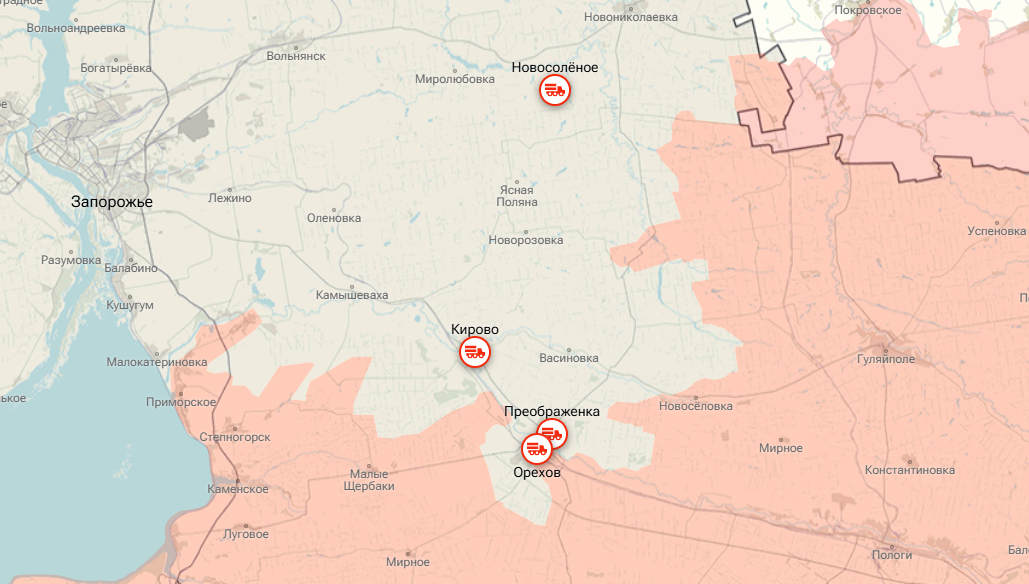
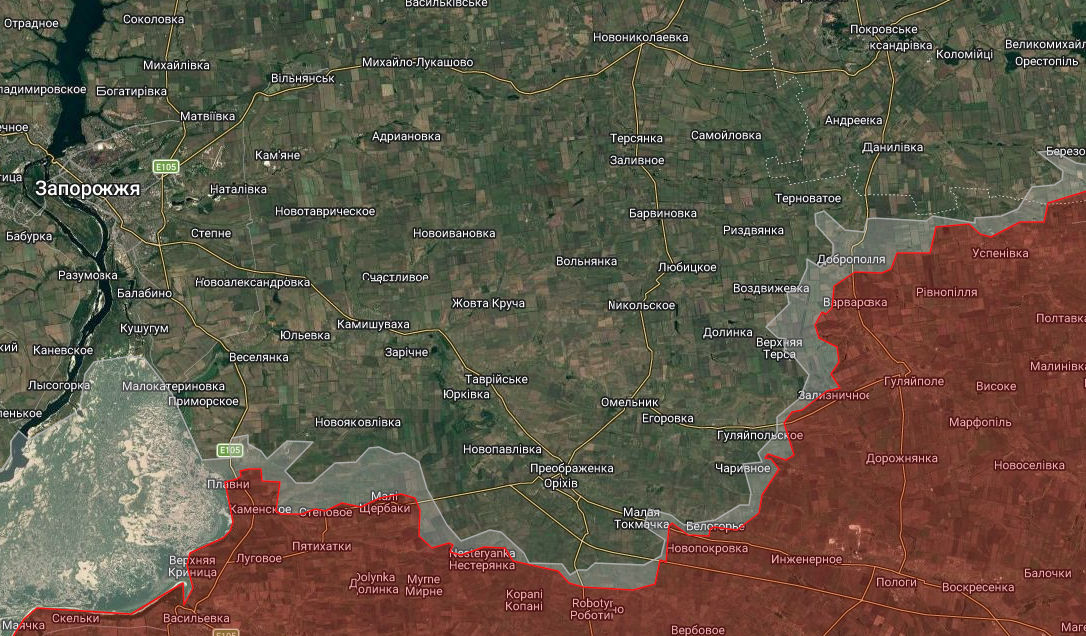
Maps of the day: Sloviansk-Kramatorsk direction; Orikhiv direction, Oleksandrivsk direction, Kupiansk direction.
Videos of the day: a burning Tu-95MS strategic bomber; a Ukrainian firefighter showed how they extinguished the Academy of Sciences building.
The Ukrainian army stays in control of front lines, but safety in cities deteriorates. The war has reached a stage in which two separate conflicts appear to be taking place simultaneously.
While Ukraine is currently losing the battle in the air and its cities are continually suffering missile and strikes by jet drones, the situation on battlefields is far better.
Last week, Denník N spent time in Ukraine with former chief of the general staff Daniel Zmeko. During the trip, reporters met commanding officers from several brigades and battalions operating from the Izium area to Zaporizhzhia, and all of them said they had the situation under control.
The officers spoke about the accuracy of Russian maps, which they said did not correspond to reality. In some places, Russian soldiers are as far as 20 km from the locations where, according to the Kremlin, they are supposed to be.
Northern flank of the Sloviansk-Kramatorsk agglomeration: This is a specific section of the front where the Ukrainian army has been reporting its advances only very slowly, while Ukrainian analysts have remained silent so as not to disclose anything sensitive. Russian bloggers, by contrast, are depicting the situation more closely to reality.
Yet official Russian maps persist with utterly nonsensical lines. We do not know to what extent this is an effort to deceive domestic and foreign audiences, and to what extent they genuinely believe it in Moscow. It is worth looking at how the regime wants the situation to appear, and what it is really like.
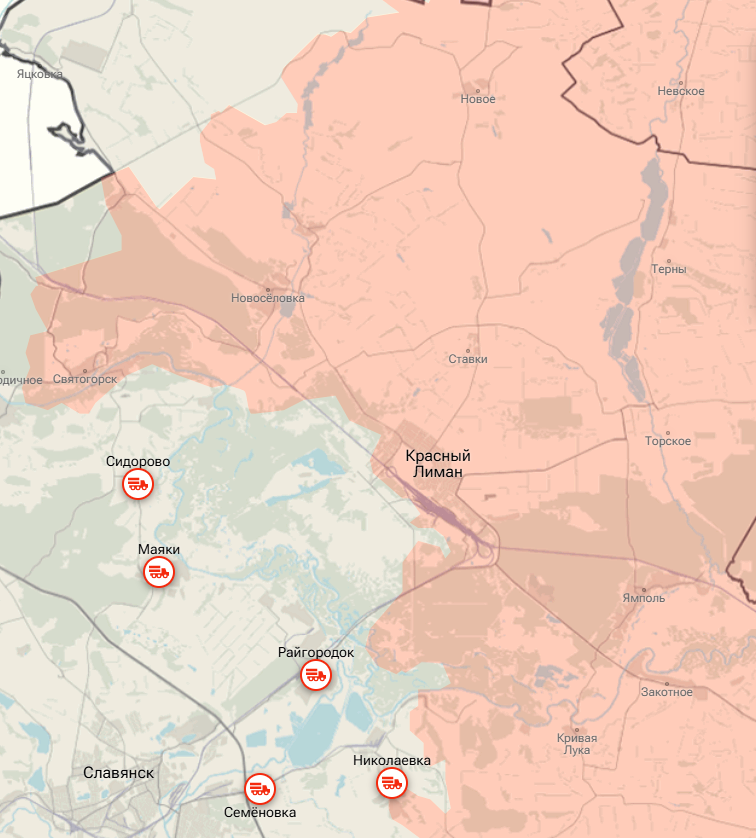
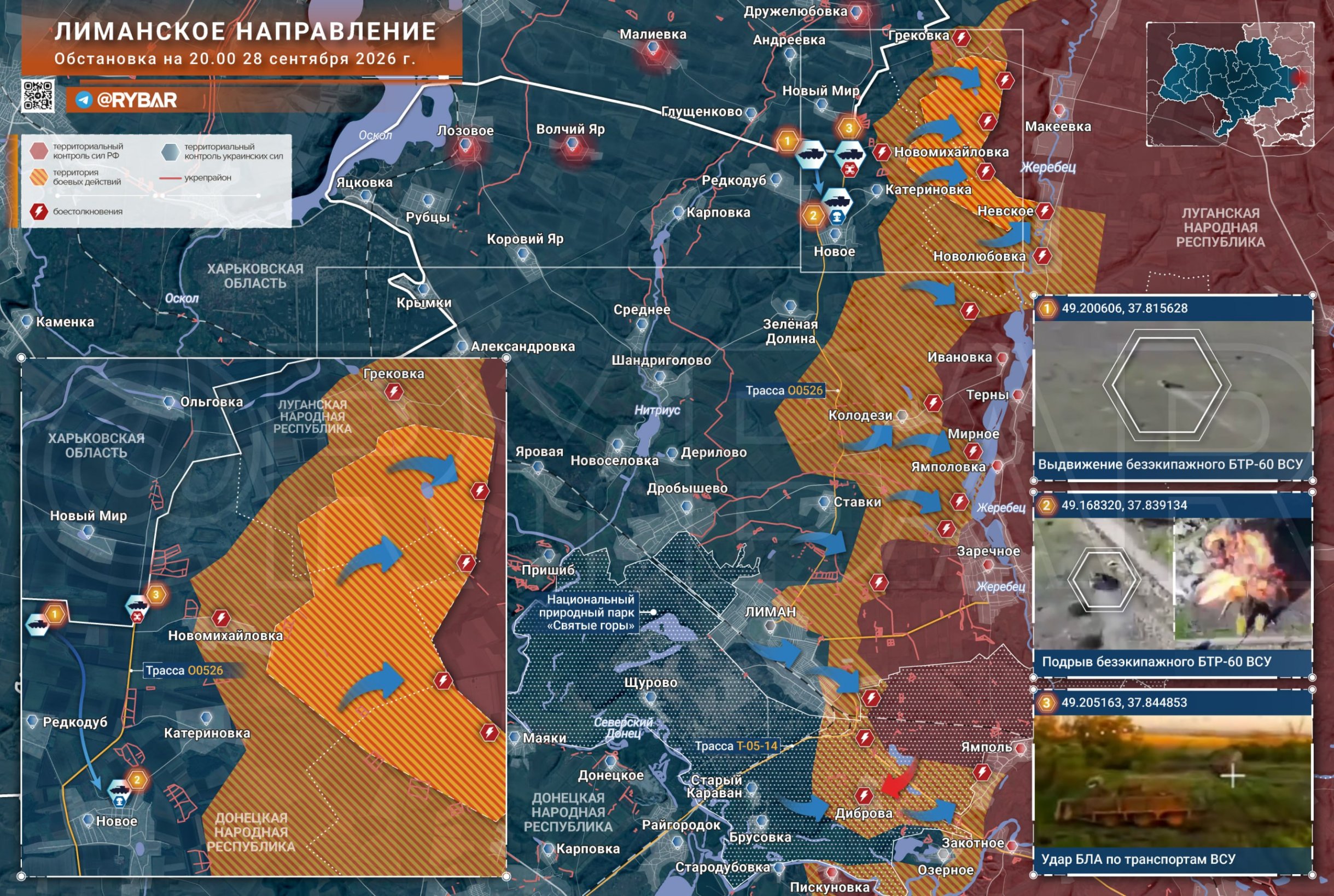
The first map in the overview was produced by the Russian state news agency RIA Novosti and depicts the area around Lyman, on the northern flank of the Sloviansk-Kramatorsk direction, as of 29 September. Lyman is shown as occupied in the middle of the map. The map’s author also continues to insist that the Russian army had captured Sviatohirsk — at the tip of the red salient in the centre of the map — and that Russia controls the entire, now non-existent salient with the village of Novoselivka at its centre. Yet Russian outlets Rybar and Two Majors write that fighting is taking place on the Zherebets river around the villages of Terny — on the far right of the map — and Yampil.
The following map is much closer to reality. According to it, the front line roughly follows the Zherebets river, which corresponds to Rybar’s claims.
In the Lyman direction, in Donetsk region, Ukrainian defenders successfully repelled three attempts by the russian fascist invaders to advance near the settlements of Ridkodub, Novoselivka and Drobysheve.
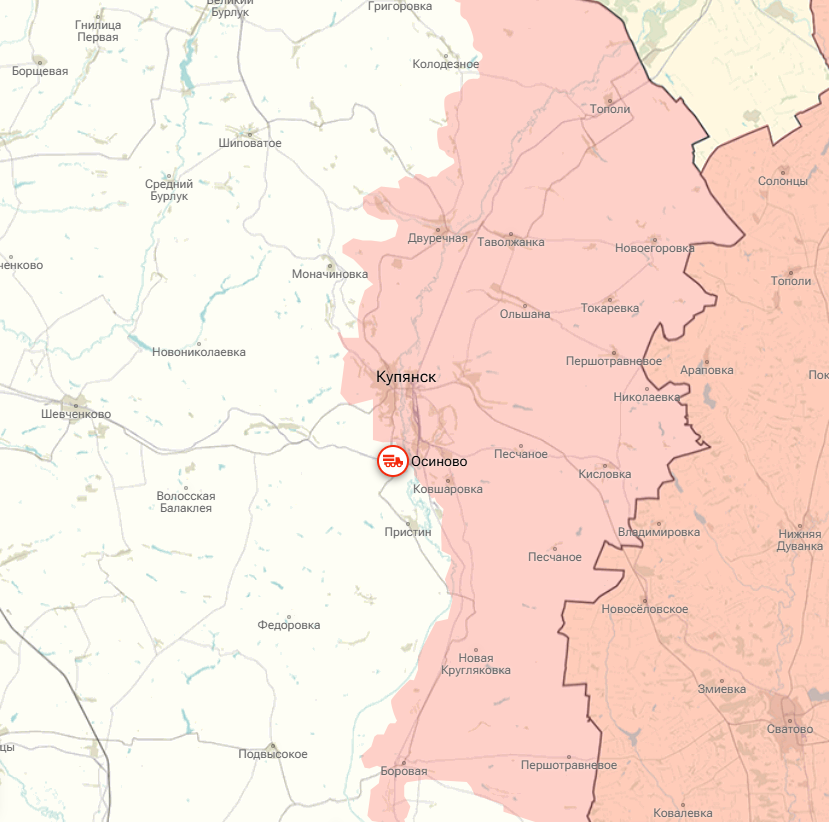
Kupiansk direction: The city of Kupiansk is a similar case to Sviatohirsk. Putin declared it captured in August last year. And once the commander-in-chief had declared this, his news agency continued to draw the map as though it were true. Kupiansk is shown as occupied in its centre, but there are further inaccuracies.
For example, the Kremlin agency claims that the Ukrainian bridgehead on the eastern bank of the Oskil river south of the city no longer exists. Ukrainians do face major difficulties supplying it, and various analysts have repeatedly warned of an impending disaster, but the Russian map is nevertheless hopelessly inaccurate.
Also note the small town of Borova at the bottom centre. RIA Novosti also shows it as occupied, although this is not the case.
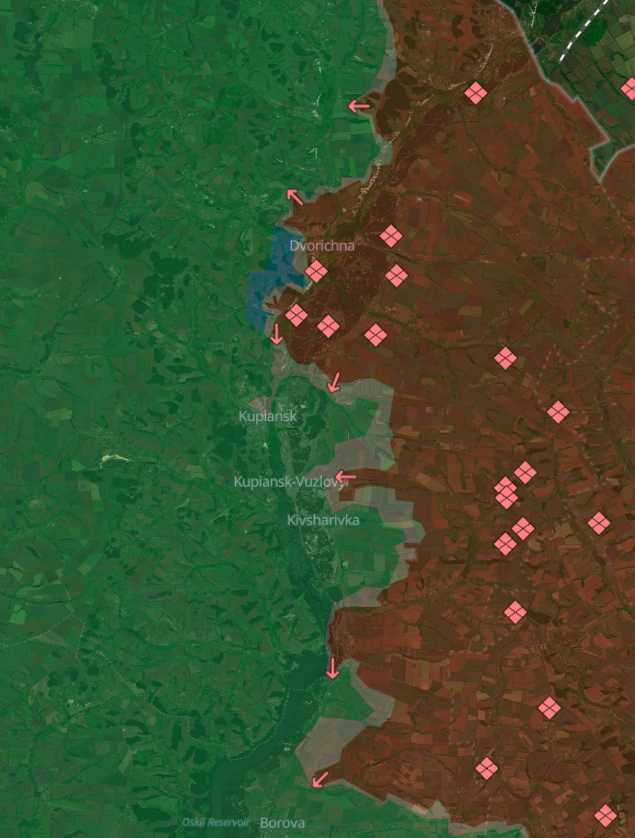
This time, we will compare the Russian agency’s data with a map by Ukrainian analysts at DeepStateUA, because they updated it on Tuesday to reflect a new advance by Ukrainian units north of Kupiansk — again in the centre of the map — near the village of Dvorichne. In recent weeks, they have succeeded in reducing the Russian bridgehead on the western bank of the Oskil; the change since the end of August is marked in blue. Borova is again at the bottom centre, while below Kupiansk is the Ukrainian bridgehead that Russia claims does not exist.
Orikhiv: This is one of the places where Ukrainian officers said during reporters’ trip to Ukraine that Russian maps were particularly inaccurate.
The Russian map is again from RIA Novosti and again ignores reality along the entire length of this section of the front. Its main target is the city of Zaporizhzhia, with a population of three quarters of a million, in the centre left, while the small town of Orikhiv, at the bottom centre, is a defensive hub.
Putin’s news agency places soldiers roughly 12 km from the southern edge of Zaporizhzhia; in reality, they are around 24 km away. It shows Orikhiv as occupied and the Russian army advancing from the east towards the village of Novorozivka, north of Orikhiv.
The OSINT project Playfra covers this area in the greatest detail. Its map appears to depict a different war altogether. Everywhere, Russian positions are significantly shifted compared with those shown by RIA Novosti.
The differences have a simple explanation. On the western flank near Zaporizhzhia, the Kremlin agency simply ignores the successful counterattacks carried out by Ukrainians there this year. On the eastern flank, it uncritically accepts every claim by the Russian defence ministry and, with equal lack of scrutiny, considers captured every small village where a Russian soldier raised a flag during a suicidal mission, even several months ago. Although those soldiers have since been killed or captured, RIA Novosti acts as though they still control the village.
Playfra also offers a more detailed view of the current fighting around Orikhiv, drawing on analyses by Ukrainian analyst Kostyantyn Mashovets.
Orikhiv direction.
Factually, no changes. Clearings are conducted constantly, but the Russians also continue to infiltrate: the global situation doesn't change. The stalemate situation that I had reported some weeks ago, as well as the gray zone, remains both actual as of the… https://t.co/6rau9f7wcKpic.twitter.com/5uIK3K78Bm
Of course, Russians too occasionally notice that they are living in a parallel reality. Most recently, the influential Aleksandr Kharchenko wrote about it:
“Comparing our maps with Ukrainian ones can be shocking. The zones of control differ by dozens of kilometres,” he acknowledged, adding that both sides lie, although he focused specifically on false Russian reports.
He described Russian soldiers who are the first to break into a village as heroes. But, according to him, wars are not won through heroism, but through a functioning system.
“Errors in our maps and information arise because they rely on heroes. Everywhere a Russian soldier is sitting is considered our territory,” Kharchenko argued that this had to change because “our territory is only where a Russian soldier is sitting with food, water and ammunition. This is territory from which we can fight the enemy”.
Kyiv was on fire again as relentless Russian attacks on cities intensify. In the capital, Russians particularly targeted energy infrastructure. “Not a single day has passed since the summer without the enemy attacking energy infrastructure. But this is the first such massive and complex attack since the end of the previous heating season,” Ukrainian PM Serhiy Koretskyi told NV.
In addition to causing serious damage, the attacks on Kyiv and other cities killed at least five residents and injured another 14.
President Volodymyr Zelensky also said that, thanks to the delivery of new surface-to-air missiles, five Russian ballistic missiles had been shot down.
Since last night, emergency services and repair crews have been working to address the aftermath of the Russian strike. It was a difficult attack – nearly 190 attack drones, as well as ballistic missiles. And the main target was energy infrastructure in the capital and the Kyiv… pic.twitter.com/wUNWEUdpTL
— Volodymyr Zelenskyy / Володимир Зеленський (@ZelenskyyUa) September 30, 2026
Rubikon published stats on destroyed Ukrainian drones, decoys being the second most prominent. Ukraine’s response is continuing in parallel with the Russian offensive against cities. But the stats currently weigh against Ukraine.
While the effectiveness of Ukrainian air defence has fallen dramatically since the arrival of Russian jet drones, Russia has successfully shot down Ukrainian ones. For example, the recent large-scale drone raid on Moscow involved several hundred drones — and, according to some sources, more than 1,000 — but only 10 penetrated the airspace above the Russian capital.
In this context, the Russian Rubikon unit published interesting statistics. Although it operates at and near the front, its data for September show that, of 827 Ukrainian drones hit, as many as 247 were Maya-type drones — unmanned decoys intended to deceive Russian air defences. They look very similar to FP-1 attack drones but, unlike them, carry no warhead.
For context, the top two most frequently intercepted Ukrainian UAVs by Russian forces are both decoy drones — the “Maya.” This suggests that Ukraine’s deception strategy is working, as the Ukrainian Defense Forces have increasingly begun deploying decoy UAVs to mislead Russian… https://t.co/NKPvbzm38U
Russia’s defence ministry will not let go of the Armata: it wants to turn it into an air-defence system, drawing ridicule. Zvezda News is a media outlet directly controlled by the Russian defence ministry. On Monday evening, it published technical news on the long-forgotten T-14 Armata tank, which Russian propaganda had claimed would revolutionise tank warfare.
Today, it is beyond any doubt that the project is dead and new information confirms this, but its authors presumably intended to convey precisely the opposite.
“Rostec has upgraded the Russian T-14 Armata tank into a short-range air-defence system,” the report stated, citing military expert Oleg Shaladin.
The list of new features appears impressive at first glance. The new version of the Armata has received new electronic equipment; its 125 mm main gun is to be replaced by a 152 mm gun, allowing the tank to fire Kornet anti-tank missiles with a range of 10 km. The new Armata will also be able to use Krasnopol guided artillery shells, which are used by more modern howitzers, while the tank is also to gain the ability to operate as the aforementioned short-range air-defence system.
Further changes have already been made to the project, but even the brief list above makes it clear that the Armata is no longer intended to be a tank, but rather some kind of hybrid capable of fighting everything and nothing at the same time.
Among others, the Russian Telegram channel Military Informant commented on the report, openly mocking it. It said Rostec had mixed together “all the old tales from 10 years ago” in its list of changes, but that in practice “the tank never got beyond parades and training grounds, because it was created for an entirely different war, which ultimately never happened. It became conceptually obsolete from the outset, without even having had the chance to fight”.
Videos of the day
Russia has lost another Tu-95MS strategic bomber. This is the 12th confirmed loss of this type — the Oryx website has not yet updated its figures, so it records only 11. According to available information, the aircraft crashed shortly after taking off from a base in Amur region. Six crew members were reportedly killed, while one survived with injuries. Armed with cruise missiles, the aircraft was probably heading for Olenya air base, from which Russia attacks Ukraine.
A Russian Tu-95MS Bear heavy bomber crashed on takeoff in Amur this evening during a training flight.
Denník N wrote on Tuesday about the attack on the headquarters of the Ukrainian Academy of Sciences. A video has since emerged from the helmet camera of one of the firefighters involved in the rescue operation.
Helmet-cam footage of Ukrainian firefighters tackling the blaze at the National Academy of Sciences of Ukraine in Kyiv on Monday after a Russian drone strike. pic.twitter.com/DqEcz3wPlK
By Tuesday (22 September), Russia had verifiably lost 24,138 pieces of heavy equipment, compared with 24,098 on Monday (14 September). Of these, 19,105 (19,065) were destroyed by Ukrainians, 1,000 (1,000) were damaged, 1,194 (1,194) were abandoned by their crews and 2,839 (2,839) were captured by the Ukrainian army. This includes 4,448 (4,447) tanks, of which 3,353 (3,352) were destroyed in combat.
Ukraine lost 12,175 (12,143) pieces of equipment, including 9,579 (9,551) destroyed, 702 (698) damaged, 695 (695) abandoned and 1,199 (1,199) captured. This includes 1,464 (1,462) tanks, of which 1,125 (1,120) were destroyed in combat.
Note: Neither side regularly reports its own deaths or equipment losses. Ukraine publishes daily figures for Russian casualties and destroyed equipment, which cannot be independently verified. In this overview, we use data from the Oryx project, which has compiled a list based exclusively on photographically documented equipment losses since the start of the war.
After years of European governments condemning Israel’s illegal occupation but maintaining extensive economic relations, some economic consequences are reportedly now forthcoming.
On 8 September, twelve governments announced moves towards restricting trade with illegal Israeli settlements. This is a limited but welcome response to grassroots pressure.
It also raises a question: where does the economy of an illegal Israeli settlement end?
Most emerging measures follow economic relationships towards illegal Israeli settlements: do not buy goods produced there, invest there or provide services that enable their construction.
Norway’s proposed legislation is seemingly comprehensive, covering property purchases and services connected to construction and property transactions.
But this all still largely considers illegal Israeli settlements within their territorial bounds.
The problem is treating a spatial category as though the economic relationships producing it share the same boundary. We all know the world does not work like that.
Kinnula, a municipality in central Finland, is now facing this reality: when money from the illegal settlement economy moves into public land in Europe. It is a small case, but it makes the problem unusually visible.
In August, Kinnula council voted 10–3 in favour of a €4m resort development by Israeli property company Dror Bonim Atid, before councillors had been informed of the company’s promotion of projects in illegal Israeli settlements.
However, illegal Israeli settlements are not illicit enterprises from the perspective of Israel. Their expansion is enabled through Israeli state institutions.
A background check sought from Israel is therefore absurd. A more obvious background check reveals something else.
On its own website, Dror Bonim Atid presents its Finnish development alongside a development in Efrat, an illegal Israeli settlement in the occupied West Bank, as well as a development in Dror-Hiran in the Negev. The latter is being built on land where Umm al-Hiran stood until November 2024, when the Bedouin village was completely demolished and its community forcibly displaced.
One company website therefore takes us from an illegal Israeli settlement, through the site of a demolished Bedouin village, to holiday accommodation beside a Finnish lake.
Involvement in illegal Israeli settlements does not fit neatly into the categories through which the transaction is being examined.
Kinnula exposes a gap in the emerging European restrictions on trade with illegal Israeli settlements. Those restrictions follow economic relationships from Europe towards the settlements.
Here the relationship points the other way. What happens when the economies of illegal Israeli settlements come to Europe to acquire public assets, invest and make money here?
This may be a relatively new question for European policymakers. For Palestinian civil society, it is not. Their call for Boycott, Divestment and Sanctions (BDS) was issued in 2005, drawing in turn on a much longer history of Palestinian boycott and economic resistance.
You could be forgiven for rolling your eyes as European policy discovers these questions inch by inch.
Palestinians have spent generations analysing the economic relationships through which occupation is sustained. BDS has spent more than twenty years turning that knowledge into practical strategies for institutions elsewhere.
So, when a Finnish municipality is deciding whether to sell public land to a company openly involved in illegal occupation, there is clear guidance from Palestinian civil society on how to respond.
There is also now the fact that Europe accepts that it should not economically support illegal Israeli settlements, meaning it should also accept that companies involved in illegal settlements should not be able to come to Europe for public land, contracts and investment.
EUobserver is proud to have an editorial partnership with Europod to co-publish the podcast series “Briefed” hosted by Léa Marchal. The podcast is available on all major platforms.
Find the full transcript below:
Hundreds of people were still camping yesterday at Puerta del Sol in Madrid. They were demanding action on housing, as rents and property prices continue to rise.
Following an outcry triggered by the eviction of an 83-year-old woman from her home, and the mobilization of thousands of people across Spain, the government adopted two housing decrees.
Did they take the protesters’ demands into account?
MariCarmen Abascal had lived in her apartment since the 1950s, having inherited the lease from her parents. But the property was bought by an investment fund, which then challenged the validity of her lease and quadrupled her rent.
Last week, MariCarmen was evicted from her home. The eviction sparked widespread outrage and led hundreds of protesters to camp in central Madrid, calling for action.
Yesterday, she was finally allowed to return home after reaching an agreement with the owners.
Aside from MariCarmen’s case, the demonstrations are largely driven by young people who are fed up with rising rents and property prices, especially in major cities such as Madrid and Barcelona.
In Madrid, property prices have risen by around 87 percent over the past ten years. That’s less than in Portugal or the Netherlands, where prices have increased even more. But it’s still a significant rise, especially as wages have grown much more slowly over the same period.
Rents are taking up a huge share of people’s incomes. In Madrid, they account for almost half of tenants’ net income on average. So, how did the Spanish government respond?
Yesterday, it adopted two housing decree-laws. The first decree would suspend evictions until 2030 and automatically extend existing rental contracts by two years.
It would also introduce tighter rules on seasonal rentals and prevent speculative investment funds from acquiring housing until 2028.
The second decree is more ambitious. It would allow tenants to extend their future rental contracts indefinitely. This is what the tenants’ union has been calling for.
Landlords would no longer be able to end a lease simply because it had reached its expiry date. Tenants who pay their rent and respect their legal obligations could remain in their homes for as long as they wish.
This would also limit rent increases, since rents can only be raised moderately during an existing contract.
So, the government has taken the protesters’ demands into account. But there is still a major obstacle: as our Spanish partner El Salto reports, the tenants’ union fears that this second measure may not pass through Parliament.
That could explain why the government adopted two separate decrees. The first is considered easier to get through Parliament.
Now, what about the EU’s proposals to tackle rising rents? We discussed them earlier this month.
One of the main proposals concerns short-term rentals. The idea is to introduce restrictions, particularly in tourist areas where housing is under strong pressure. By bringing more homes back onto the long-term rental market, the Commission hopes to ease pressure on prices.
But these proposals have not yet been adopted, so we’ll have to wait and see what impact they have. And in any case, more will need to be done at national level.
Even if prices stop rising, they are already so high that many workers can no longer afford to live in major cities.
More social housing is needed, as well as more renovation. Increasing the supply of decent, affordable homes could help ease pressure on rents and property prices.

 Login