❌

Normal view

Latvian PM holds onto power as Russia-Ukraine war shapes election

4 October 2026 at 19:00

Russia might not have directly interfered in Latvia’s election, but the vote still showed how the Ukraine war was distorting European democracy.

Latvia’s VDD intelligence service did not detect any of Russia’s classic interference tactics in the run-up to Saturday’s (3 October) vote, such as a spike in disinformation, vote buying, or a manufactured security scare.

The centre-right prime minister Andris Kulbergs retained power with 35.8 percent of the vote, even if coalition-building might take a while.

And voters’ concerns included the cost of living and failing healthcare, in what also sounded normal.

But despite the ordinary appearances, Russia’s war in Ukraine still influenced the election in fundamental ways, in a strange new normal for Europe that most of us had hardly imagined just five years ago.

This article continues, but the full version is available only to EUobserver.com subscribers. Visit account.euobserver.com/membership

Wars Must Have Limits, Third Committee Told, as Delegates Warn of Poverty, Climate Pressures, Threats to Human Rights

3 October 2026 at 01:04
Climate change, poverty, conflict and rapid technological change are placing mounting pressure on social development and human rights, the Third Committee heard today, amid concerns over the role of the United Nations human rights system and the devastating toll of war on civilians. The social consequences of environmental change took centre stage, as Mongolia’s representative […]

[Explainer] Gas glut or supply crunch? And what it means for EU methane rules

4 October 2026 at 14:04

The EU has decided to delay its methane regulation, and the reason is simple enough. 

Europe imports almost 90 percent of its gas, which makes it one of the most exposed buyers in the world. And the US-Israeli war with Iran has choked gas flows through the Strait of Hormuz. 

Making matters more complicated is the fact that Europe is still phasing out Russian gas, with a total ban on Russian overseas liquified gas due to be implemented next year.

So few were surprised when energy commissioner Dan Jørgensen told ministers in Dublin this week that he will propose delaying the import part of the regulation by a year to 2028, although member states and parliament still have to formally agree.

This article continues, but the full version is available only to EUobserver.com subscribers. Visit account.euobserver.com/membership

Dodging Drones: An 'Apocalyptic' Journey On The Ukrainian Front Lines

4 October 2026 at 13:31
RFE/RL joined Ukrainian soldiers on a dangerous journey toward Druzhkivka in eastern Ukraine, where Russian drones make roads nearly impassable. Around 2,000 civilians reportedly remain in the city as Russian attacks intensify.

Secretary-General Strongly Condemns Acts Endangering Civil Aviation

1 October 2026 at 18:27
The following statement was issued today by the Spokesman for UN Secretary-General António Guterres: The Secretary-General is deeply concerned by the serious incident involving a Tel Aviv-bound FlyDubai flight. He is relieved that tragedy was averted. The Secretary-General strongly condemns any act that places civilian lives and the safety of civil aviation at risk. The […]

Will the European Parliament Unlock Hungary’s Frozen €4.2 Billion This Week?

4 October 2026 at 10:24

The European Parliament’s debate on Monday, October 5th, comes at an awkward moment for Brussels. After years of confrontation with Viktor Orbán, the European Commission now believes Hungary has done enough to justify releasing €4.2 billion in cohesion funding and restoring full access to Erasmus+ and Horizon Europe.

The question before MEPs is therefore deceptively simple: have the conditions really been met, or has Brussels simply found a convenient political moment to declare victory?

The answer matters well beyond Hungary. The original dispute was not some abstract quarrel over Brussels etiquette. In 2022, the EU suspended €6.3 billion in Hungarian cohesion funding after identifying deficiencies in public procurement, conflicts of interest, corruption controls and the effectiveness of prosecutorial action. The conditionality mechanism was deliberately designed to make access to EU taxpayers’ money dependent upon safeguards for the rule of law and the protection of the EU budget.

That principle is important. If membership of the EU means anything, it cannot mean that governments receive billions regardless of whether public money is properly administered.

But Hungary has changed politically. Viktor Orbán’s 16-year rule ended with Péter Magyar’s decisive election victory in April. Magyar campaigned partly on repairing Hungary’s relationship with Brussels and unlocking the billions frozen during the Orbán years. His government subsequently notified the Commission that it had implemented the required reforms.

The Commission has now accepted that argument — albeit partially. Its September 23rd proposal says Hungary has addressed the rule-of-law breaches affecting the EU budget, citing improvements in public procurement, the anti-corruption framework, prevention of conflicts of interest and prosecutorial effectiveness. If the Council approves the proposal, €4.2 billion in cohesion commitments will be reinstated and Hungarian students and researchers will regain full access to Erasmus+ and Horizon Europe.

That is a substantial political prize for Magyar, and a substantial test for the EU.

The danger for Brussels is obvious. Having spent years insisting that European money must not subsidise corruption or institutional capture, the Commission cannot now appear to have changed the rules simply because a more congenial government has arrived in Budapest.

There is, however, an equally serious danger on the other side. If Hungary has genuinely implemented the reforms demanded by Brussels, continuing to withhold money would make the conditionality mechanism look less like a defence of European values and more like a political punishment system. That would be profoundly damaging. Rules that apply only to governments Brussels likes are not rules at all.

This is why Monday’s debate matters – and the €4.2 billion is only part of the story.

The Commission has made clear that other Hungarian funds remain blocked. Around €3.5 billion is affected by a separate mechanism, including approximately €2.7 billion linked to horizontal conditions concerning the EU Charter of Fundamental Rights, including academic freedom, LGBTI rights and asylum.

Meanwhile, Hungary is still seeking access to roughly €10 billion under the Recovery and Resilience Facility. The new Hungarian recovery plan includes measures on anti-corruption, public procurement, transparency, judicial independence and stakeholder participation, with payments tied to the achievement of specific milestones.

So this is not a clean victory for either side.

For Magyar, the release of €4.2 billion demonstrates that his strategy of accommodation with Brussels is delivering tangible results. For the Commission, it provides an opportunity to demonstrate that conditionality can work: reforms are made, the Commission verifies them, and money is released.

But the real test will come afterwards. Brussels must monitor whether the reforms survive political pressure. Anti-corruption bodies must remain genuinely independent. Public procurement must be transparent. Prosecutorial safeguards must work in practice rather than merely on paper. And the judiciary must be capable of challenging the government when necessary.

That is where the European Parliament should concentrate its fire. The temptation will be to turn Monday’s debate into another referendum on Viktor Orbán. That would be yesterday’s argument. Orbán has gone. The more important question is whether Hungary’s new government has actually dismantled the machinery that generated the dispute.

There is a wider lesson here for the European Union.

Conditionality can only work if Brussels is prepared both to withhold money when standards are breached and to release it when standards are met. Anything else undermines the credibility of the entire system.

The Commission says Hungary has crossed that threshold. The Council must now decide whether it agrees.

MEPs should therefore resist both triumphalism and cynicism, if the reforms are real, Hungary should get its money.

If they are cosmetic, Brussels should keep the cheque in the drawer.

Brussels Moves to Release €4.2bn to Hungary as Magyar Unwinds Orbán-Era Dispute

Families Torn Apart, Trade At A Standstill: One Year Of The Afghan-Pakistan Border Closure

4 October 2026 at 10:20
The prolonged closure of the Afghanistan-Pakistan border has brought cross-border trade to a standstill, leaving tens of thousands of people on both sides without work. It has also disrupted commercial activity and strained longstanding family and social ties.

[Interview] ‘Putin understands only strength’: EU envoy in Kyiv urges stronger air defences and hybrid-war response

4 October 2026 at 09:55

Ukrainians want peace more than anything, but only the language of strength works on Putin, says Katarína Mathernová, the EU’s ambassador to Ukraine.

Mathernová has no doubt about the Russian leader’s ultimate goal; she is convinced that Putin wants to destroy Ukraine.

“He set this out very clearly in his essay, and that is precisely why he launched this full-scale war. Unfortunately, the peace that Ukrainians so desperately want can only be achieved by putting pressure on Russia. Putin understands only one language — the language of strength,” she said in an interview.

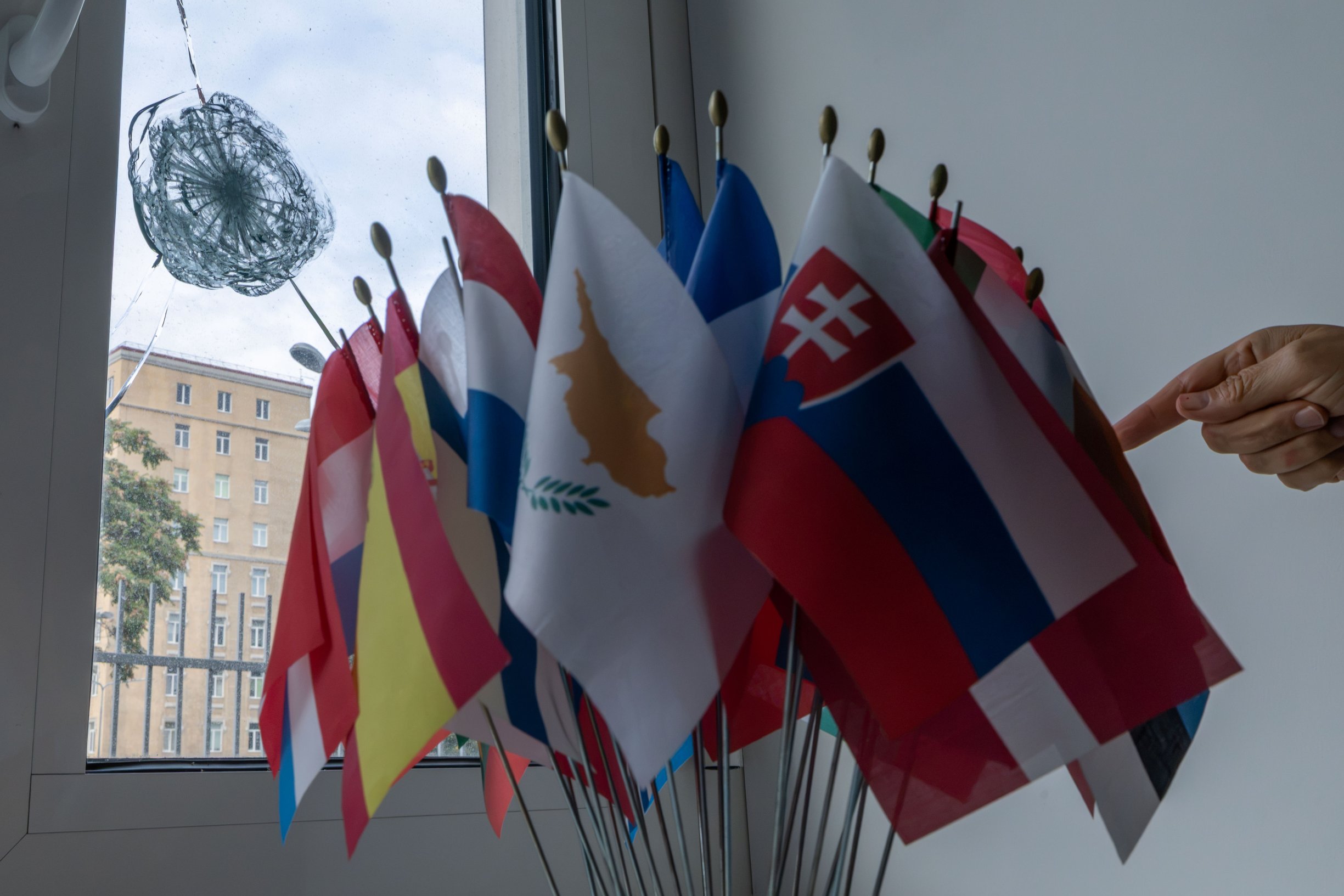
Air raids have left their mark on her office: windows have been blown out, and shrapnel once tore straight through a refrigerator. With attacks intensifying, the EU delegation now does much of its work in the corridor, away from the glass. The latest strikes hit the nearby headquarters of Ukraine’s Security Service (SBU).

In late September, Kyiv has heard so many air-raid sirens. There is already one dead and 20 injured, and on our way to your office, we heard several explosions. Is this the new normal?

Unfortunately, they have become routine. It began on 27 August this year, a date that will go down in the history of this war. That day, we had 13 air raid alerts during daylight hours, a record since the beginning of the full-scale war. It happens every day.

The day before yesterday, as I was entering the office when the windows suddenly began to rattle. A huge plume of smoke rose behind that black building outside the window. There were around four separate explosions over the course of 20 minutes, just a couple of hundred metres from here.

After a Russian attack, in a room with bulletproof windows. Source: Tomáš Benedikovič, Denník N.

The Russians have begun using jet drones which Ukrainians are not yet able to shoot down in the same numbers as earlier Shahed drones. With just a few jet drones, Russia can terrorise a city like Kyiv throughout the day at a relatively low cost. Then, at night, come the ballistic missiles. Last week, however, they also used ballistic missiles during the day.

Do the attacks make you anxious?

Of course they do. One morning last week, I was Nordic walking in the botanical garden. I was walking with my coach when suddenly there was a huge bang. It landed several kilometres away, but because there are no buildings there, it sounded as though it were just around the corner. These are the moments when I nearly have a heart attack…it’s very unpleasant.

How do you decide whether to go to a shelter or into the corridor? Do you have a security protocol?

I have security guards, and we also have a regional security officer here. They are here permanently, so they guide us. But since these very frequent and disruptive daytime attacks began, the government has adopted a regulation introducing two different types of alert — yellow and red. Red alerts are issued for missiles. Yellow alerts are for drone attacks – in such cases, the metro no longer stops, and people primarily seek safety between two walls. When there were explosions here last Wednesday, we were all sitting in the corridor.

Katarína Mathernová. Source: Tomáš Benedikovič, Denník N.
The corridor where diplomats work during heavy air raids. Source: Tomáš Benedikovič, Denník N.

On the ground floor, where we have our conference rooms, there are bulletproof windows. We are now going to adapt the ground floor so that we can operate safely there during anti-drone alerts. We will put sandbags outside. We already have beanbags there, and colleagues from the upper floors are moving down so that they can work.

How do you assess this intensification? Is it a response to the fact that the front has stalled and Putin’s “special operation” has boomeranged back on Russians at home?

Russia cannot win on the battlefield. They have managed to gain only a few square kilometres, so they are terrorising civilians by attacking targets such as churches, museums, libraries and book warehouses. On Thursday, they hit a maternity hospital. These are war crimes, but Russia commits them so routinely that they are boiling us like a frog.

There is talk that assaults will escalate further in winter. Will you stay?

Of course, we are staying here. When we speak to the diplomatic corps, everyone wants to stay. We are preparing for winter, stockpiling supplies, and here at the delegation we have bought blankets and folding beds. We have food rations and additional supplies of drinking and utility water. We have had several shower cubicles installed. We bought washing machines and dryers too, as the building has a large generator. Our colleagues from Brussels and Ukraine in the same building — many of whom live on the other side of the river or in conditions that are not as good as ours — will probably welcome these facilities.

Attacks have come dangerously close not only to where you work, but also to where you live, like a recent drone struck an SBU building.

It was targeting that location; I do not think Kyiv city centre itself was the target. But yes, it is quite close to the hotel where I live.

What do you anticipate will happen in winter? You may see attacks on energy infrastructure, water and sewage systems. A loss of these utilities would be extremely difficult.

If sewage systems were knocked out in a large part of the city, it would be very difficult. But let us not forget that Kyiv was also a frontline city last winter. There were perhaps more than one million people here freezing in their own homes. My driver told me that he and his family bought firebricks and heated them on the gas stove. When they went to bed, they held them to keep warm. Those without gas in their flats were even less fortunate. But people here helped one another. My coaches and their son stayed in my hotel for weeks because it was four degrees in their home.

Ukraine faces a shortage of Patriot missiles. It has developed a new interceptor that could stop jet drones, but Patriots defend against ballistic missiles. Can Europe do more to help?

This article continues, but the full version is available only to EUobserver.com subscribers. Visit account.euobserver.com/membership

Ukraine’s EU Reform Record: Why Progress Slows Where Political Power Is at Stake

4 October 2026 at 09:53

Ukraine’s record on reform during Russia’s war is stronger than much recent criticism suggests. By September, Kyiv had completed 84 of 95 milestones due under the Ukraine Plan. Yet progress on a smaller group of rule-of-law commitments has been strikingly weaker. The difference between the two tells Brussels much about where Ukraine’s European transformation is encountering resistance.

Ukraine’s reform record currently produces two figures that appear difficult to reconcile.

Under the Ukraine Plan, Kyiv had completed 84 of the 95 milestones due by late September — around 88 per cent. The result was strong enough for EU governments to approve another payment of almost €3 billion under the Ukraine Facility.

Three months earlier, however, a coalition of Ukrainian organisations monitoring ten rule-of-law and anti-corruption commitments agreed with Brussels had awarded progress just 15 points out of 100.

Neither figure is wrong. They measure different programmes.

The first covers a broad reform and investment agenda extending from the judiciary and financial markets to energy, agriculture, transport, human capital and the business environment. The second examines a deliberately narrow collection of reforms concerning prosecutors, criminal investigations, anti-corruption agencies and judicial governance.

Put together, they raise a more useful question than whether Ukraine is “reforming” or “not reforming”.

Why has a country capable of delivering most of a demanding EU programme during a major war found this particular group of reforms so much harder to complete?

Russia’s aggression provides part of the answer. Ukraine has been attempting an institutional transformation while mobilising its population, financing its armed forces, repairing infrastructure and keeping a functioning state under repeated Russian missile and drone attacks. No previous EU candidate has operated under comparable conditions.

But the ten reforms where progress has been weakest have something else in common. Most concern institutions that can investigate senior officials, prosecute corruption, scrutinise appointments or otherwise place limits on the exercise of political authority.

That is what makes the comparison important.

A strong overall record

The wider reform record should not be understated.

When the European Commission released €2.9 billion to Ukraine on 2 October, it specifically credited Kyiv with implementing reforms covering the judiciary, financial markets, human capital, the business environment, energy, transport, agriculture and the green transition.

Total EU support provided under the Ukraine Plan has now exceeded €32 billion. More than €17 billion in further budget support remains potentially available during 2026, provided Ukraine fulfils the corresponding conditions.

The money is particularly important because the Ukrainian state is directing such a large share of its own resources towards defence. European financing helps keep the civilian state operating while Ukraine fights Russia.

The Ukraine Facility has therefore become more than an aid mechanism. It gives Brussels a means of measuring reform against specific commitments and releasing money when they are met.

That system has generally worked.

It also makes the areas where progress is weaker much easier to identify.

The 15/100 assessment published in June concerned ten priorities agreed in December 2025 between Enlargement Commissioner Marta Kos and then deputy prime minister Taras Kachka. The score came from Ukrainian civil society, not the European Commission, and cannot legitimately be presented as Ukraine’s overall EU reform score.

It had nevertheless risen only six points from an assessment of nine out of 100 in April.

Among the unfinished commitments were changes to criminal procedure affecting high-level corruption cases, stronger guarantees for the independence and effectiveness of NABU and SAPO, reform of the State Bureau of Investigation, new arrangements surrounding the Prosecutor General, competitive recruitment within the prosecution service and further changes to judicial governance.

These are among the most difficult reforms Ukraine has undertaken since 2014 because they concern who has the authority to investigate whom.

The July 2025 episode changed the argument

The events surrounding NABU and SAPO in July 2025 remain central to understanding why Brussels is paying such close attention.

Ukraine had spent years building a specialised anti-corruption system intended to make investigations of senior political figures less vulnerable to interference from the conventional prosecutorial hierarchy.

NABU conducts investigations. SAPO provides specialised prosecution. The High Anti-Corruption Court hears the cases.

The system has never been free from political controversy, nor has its performance been beyond criticism. But its independence became an important part of Ukraine’s relationship with the EU and other international partners.

Then, in July 2025, parliament passed legislation placing NABU and SAPO under substantially greater authority of the politically appointed Prosecutor General. Zelenskyy signed it.

The decision produced an unusually sharp reaction inside Ukraine. Demonstrators took to the streets despite martial law, while European partners made clear that the legislation threatened reforms regarded as fundamental to the country’s European integration.

As EU Today reported during the crisis, the dispute went far beyond the technical division of powers between prosecutors and investigators.

Kyiv reversed course within days. Parliament restored the independence of the two bodies.

The reversal demonstrated that Ukraine’s political system still contained powerful corrective forces. Civil society mobilised, public opposition was visible and international pressure had an effect.

Yet the episode also established that the independence of institutions created specifically to investigate high-level corruption could still become the subject of direct political intervention.

That changed the context in which subsequent reform commitments are being judged.

The European Commission’s 2025 report on Ukraine recorded both sides of the episode. It acknowledged the restoration of NABU and SAPO independence, while warning that undue pressure on anti-corruption agencies remained a concern.

The Commission also identified practical weaknesses. NABU still required better access to timely and impartial forensic examinations, while SAPO needed stronger powers in cases involving members of parliament.

This is why simply retaining NABU and SAPO is no longer sufficient evidence that this part of the reform process is secure. Brussels is looking at whether they can operate when investigations become politically difficult.

Follow the institutions

The same issue appears elsewhere.

Ukraine agreed to review the procedure for appointing and dismissing the Prosecutor General, drawing on European standards and the Venice Commission. It also committed itself to transparent and competitive recruitment for senior positions throughout the prosecution service.

The significance is obvious. The Prosecutor General occupies a pivotal position in the Ukrainian criminal-justice system. The method by which that office is filled — and the circumstances in which its occupant can be removed — affect the credibility of every politically sensitive prosecution beneath it.

Progress has been slow.

There is a similar problem with the State Bureau of Investigation, which handles cases involving senior officials and law-enforcement personnel. Kyiv agreed to an independent assessment of the bureau followed by reform of its legal and institutional framework.

Again, the issue is not administrative tidiness. An agency responsible for investigating state officials has little value as a check on government if its own leadership or investigative decisions are susceptible to political influence.

Criminal procedure provides another example.

Ukraine committed itself to changing provisions under which corruption proceedings can eventually be closed because deadlines for pre-trial investigations have expired, as well as addressing limitation periods for corruption offences.

Draft legislation has appeared. Bills No. 15333 and 15334 were registered in parliament, and NABU and the Ministry of Justice have worked on amendments.

But the process has taken months.

For a simple criminal case, procedural deadlines may appear an obscure legal question. Top-level corruption investigations are different. They can involve offshore structures, large quantities of financial evidence, foreign jurisdictions and prolonged litigation. If the clock eventually disposes of a case that investigators and prosecutors cannot bring to judgment quickly enough, the anti-corruption architecture fails at the point where it is supposed to produce results.

The same pattern is visible in judicial reform and the new Anti-Corruption Strategy for 2026–2030. Work is taking place, legislation is being prepared and institutions are consulting one another. Some changes have been completed.

Others remain somewhere between agreement and implementation.

This is precisely the stage of accession at which that distinction begins to count.

When Ukraine and Moldova moved further into the EU accession process, the significance of the Fundamentals cluster was that progress would increasingly depend on the functioning of institutions rather than declarations of political intent.

Ukraine has no shortage of declarations of European intent. What the Commission needs to establish is whether the machinery beneath them works.

The limits of the wartime argument

Any assessment that ignores Russia’s war would be unserious.

Full-scale aggression has inevitably changed the Ukrainian state. Decisions that might take months in peacetime sometimes have to be taken within days. Military information cannot be handled according to ordinary transparency rules. Elections cannot proceed under normal conditions. The executive carries responsibilities that no Ukrainian government faced before 2022.

Reform is also competing for administrative capacity with mobilisation, defence procurement, reconstruction, energy emergencies and the daily consequences of Russian attacks.

This has to be taken into account when Brussels sets timetables and assesses progress.

It is less convincing when applied indiscriminately.

Competitive recruitment of prosecutors does not interfere with the defence of Ukraine. Neither does an independent procedure for selecting the Prosecutor General. NABU’s ability to investigate senior officials does not prevent the armed forces from conducting operations, while closing procedural loopholes in corruption cases has no obvious adverse effect on wartime decision-making.

There is therefore a boundary between powers required to fight Russia and powers that are simply easier for government to retain during wartime.

Finding that boundary is becoming one of the more difficult questions in Ukraine’s relationship with the EU.

This does not support the sweeping claim that every important Ukrainian institution has been placed under political control. The evidence does not justify it.

It does show why Brussels is concentrating increasingly on institutional independence.

The problem with wartime centralisation is rarely that it begins without justification. Governments fighting wars need authority. The longer an emergency lasts, however, the more important it becomes to distinguish measures required by national security from arrangements that have become politically convenient.

Ukraine has now lived under full-scale war for more than four years. Institutions created for the post-war European state are being shaped while the wartime state still exists.

That makes the current reform period unusually consequential.

Conditionality becomes Brussels’ leverage

The EU has one powerful instrument with which to influence the outcome: money.

The Commission is already using it.

The almost €3 billion approved in September followed the completion of agreed Ukraine Plan milestones. The next payments depend on further commitments being met.

As EU Today reported when the Ukraine Plan was amended, additional financing has come with additional rule-of-law and anti-corruption requirements.

There is a limit to how far Brussels can push this. Ukraine is fighting a Russian war of aggression that also poses a direct security threat to Europe. Destabilising the Ukrainian budget in order to demonstrate the rigour of EU conditionality would make little strategic sense.

Kyiv is well aware of that.

But Brussels cannot simply waive the conditions either. Doing so would weaken reformers inside Ukraine, reduce EU influence over the accession process and make it more difficult to explain enormous long-term transfers to European taxpayers.

The result is already visible: continued financial support accompanied by increasingly detailed scrutiny of how reforms are implemented.

That approach is likely to become tougher as accession advances.

There is another reason for it.

Ukraine will eventually have to manage reconstruction on a scale Europe has not seen for decades. European governments, international financial institutions and private investors will be asked to commit hundreds of billions of euros. Confidence in prosecutors, courts, public procurement and anti-corruption agencies will affect how much money arrives and on what terms.

Strong institutions are therefore not a concession Ukraine makes to Brussels in exchange for membership.

They are part of the infrastructure required for Ukraine’s recovery.

The same applies to the war itself. Corruption in defence procurement, reconstruction or public administration gives Russia opportunities to damage confidence in the Ukrainian state and strain relations between Kyiv and its partners. Moscow has every interest in amplifying genuine scandals alongside fabricated ones.

The most effective answer is not tighter political management of damaging information. It is institutions capable of investigating misconduct credibly.

That is also why the role of Ukrainian civil society deserves attention.

The organisations producing critical assessments of Kyiv’s reforms are operating in a country under attack. Many have supported Ukraine’s European integration for years. Their reports can be disputed and their scoring methodologies examined, but criticism of government performance is not evidence of disloyalty.

The ability to produce such criticism is itself one of the features separating the Ukrainian political system from the authoritarian model Russia represents.

Ukraine’s reform record consequently looks neither like the failure portrayed by some critics nor the uninterrupted success sometimes presented by its defenders.

The broader record is impressive. Completing 84 of 95 Ukraine Plan milestones while fighting a major war is not a trivial achievement, and the EU would not have continued releasing billions of euros if the reform programme existed only on paper.

The difficulty appears further down, where institutional reform begins to affect the ability of political authorities to influence prosecutors, investigators and judicial appointments.

The NABU-SAPO confrontation made that problem impossible to ignore. The subsequent reversal showed that Ukraine also possesses the political and civic capacity to correct course.

What happens next will matter more than either episode.

Bills that have remained in parliament will have to become law. Reviews of the SBI and prosecution service will have to produce institutional changes. Competitive appointment procedures will have to work when the preferred candidate of those in power does not win. Anti-corruption bodies will have to be allowed to pursue cases when their targets are politically connected.

These are less visible achievements than opening accession negotiations or announcing another EU funding package.

They are also much closer to what EU membership ultimately requires.

Russia has forced Ukraine to build an exceptionally powerful wartime state. European integration requires Kyiv to ensure that some of that power can eventually be constrained by institutions that do not depend on whoever occupies the presidential administration.

The figures that currently look contradictory — 84 out of 95 and 15 out of 100 — are therefore telling different parts of the same story.

Ukraine has shown that it can reform during the war.

The harder test is whether it can complete reforms precisely where doing so reduces political discretion.

Greece Rejects ‘Borrowing’ Parthenon Sculptures as Athens and Sofia Exchange Historic Treasures

4 October 2026 at 09:35

Greek Prime Minister Kyriakos Mitsotakis has ruled out an agreement requiring Athens to recognise British Museum ownership of the Parthenon Sculptures, using a landmark exchange of cultural objects with Bulgaria to restate Greece’s position.

Greek Prime Minister Kyriakos Mitsotakis has said Greece will not “borrow” the Parthenon Sculptures under an arrangement requiring Athens to recognise British Museum ownership, as Greece and Bulgaria completed an exchange of historic remains and religious artefacts following decades of negotiations.

Mitsotakis made the remarks on Saturday, 3 October, during a ceremony at the Museum of Byzantine Culture in Thessaloniki attended by Bulgarian Prime Minister Rumen Radev.

Under the agreement, Greece transferred to Bulgaria human remains identified as those of medieval Bulgarian ruler Tsar Samuel, together with material recovered from four sarcophagi at the Basilica of Saint Achilleios in the Prespa region.

Bulgaria returned 48 ecclesiastical objects removed from northern Greece during the First World War.

The Greek prime minister’s office said the returned objects include icons, crosses, vestments, reliquaries and an episcopal throne. They were removed in 1917 from religious institutions in the Serres region.

The artefacts will initially be displayed at the Museum of Byzantine Culture before being returned to the monasteries and church authorities from which they originated. The Greek government said the 48 objects will remain on display until 5 November.

The remains handed to Bulgaria were discovered during archaeological excavations at Saint Achilleios in the 1960s and later identified as belonging to Samuel, who ruled the First Bulgarian Empire between 997 and 1014.

Bulgaria organised a state ceremony following their return. The Bulgarian government described the transfer as the return of one of the country’s most significant medieval rulers.

The exchange concludes negotiations stretching back decades, although both governments have agreed to continue discussions about other objects of mutual historical interest.

Mitsotakis used the Thessaloniki ceremony to link the agreement to another, far more prominent dispute over cultural property: the Parthenon Sculptures held in London.

He said cultural diplomacy had demonstrated that disputes over objects removed during earlier periods of conflict could be addressed through negotiation, referring also to previous arrangements involving fragments of the Parthenon returned from Sicily.

The Greek government continues to seek the reunification in Athens of the surviving Parthenon Sculptures.

The central obstacle remains ownership.

The British Museum states that Lord Elgin removed the sculptures between 1801 and 1805 with the permission of the Ottoman authorities then governing Athens. His actions were examined by a parliamentary committee before the collection was acquired for the museum in 1816.

Greece disputes the legitimacy of their removal and argues that surviving elements of the monument should be reunited at the Acropolis Museum.

That difference has direct consequences for any proposal based on loans.

Under the British Museum trustees’ published position, the museum is prepared to consider lending objects from its collection, including the Parthenon Sculptures, but requires a borrowing institution to acknowledge the museum’s ownership.

Successive Greek governments have refused to meet that condition.

Mitsotakis reiterated that position on Saturday, arguing that Greece cannot borrow an object which it considers its own.

The dispute has continued despite negotiations between Athens and the British Museum.

In February, the UK government told Parliament that the chairman of the British Museum remained in discussions with the Greek government over a possible partnership involving reciprocal loans.

The British government has maintained that operational decisions concerning the sculptures belong to the museum’s trustees.

EU Today has followed the dispute for several years. In 2023, then British prime minister Rishi Sunak cancelled a scheduled meeting with Mitsotakis after the Greek leader publicly raised the return of the sculptures.

The dispute subsequently produced an unusual diplomatic argument between two NATO allies, although discussions between Greek representatives and the British Museum continued.

The Greece-Bulgaria agreement concluded on Saturday differs substantially from the Parthenon case in both its legal history and the circumstances under which the objects were removed.

Athens nevertheless sees the exchange as evidence that governments can settle disputes over cultural property without abandoning their respective interpretations of history.

For Bulgaria, the return of Samuel’s remains has considerable national significance. For Greece, the recovery of the ecclesiastical objects resolves a century-old question concerning material removed during the First World War.

The Parthenon Sculptures remain considerably more complicated.

Talks continue, but the fundamental disagreement identified again by Mitsotakis in Thessaloniki has not changed: London considers the sculptures legally owned by the British Museum, while Athens considers them parts of a Greek monument which should be permanently reunited.

As long as that difference remains, a conventional loan arrangement offers no straightforward solution.

China Opens New EU Anti-Dumping Probe Days Before Šefčovič Trade Talks in Beijing

4 October 2026 at 08:20

Beijing has opened an anti-dumping investigation into a chemical imported from the European Union days before EU Trade Commissioner Maroš Šefčovič travels to China for talks covering trade imbalances, market access and strategic raw materials.

China has opened a new anti-dumping investigation into imports from the European Union less than a week before EU Trade Commissioner Maroš Šefčovič is due in Beijing for talks on the increasingly difficult trade relationship between the two sides.

China’s Ministry of Commerce announced on Saturday, 3 October, that it was beginning an investigation into p-nitrotoluene, also known as 4-nitrotoluene, imported from the EU.

According to the official notice opening the investigation, the case follows an application submitted on 14 September by Chinese producers Jiangsu Huaihe Chemical and Hubei Dongfang Chemical. The investigation will examine alleged dumping between 1 July 2025 and 30 June 2026, while the assessment of possible damage to Chinese industry will cover January 2022 to June 2026.

P-nitrotoluene is used in the production of dyes, pharmaceuticals, pesticides, pigments and other chemical products.

In isolation, the investigation concerns a relatively specialised industrial product. Its timing, however, places it inside a much wider argument over the future of EU-China trade.

Šefčovič is expected in China on 8 and 9 October for the second high-level meeting under the EU-China trade and investment consultation mechanism established earlier this year.

The European Commission confirmed in September that the meeting would address Chinese exports to the EU, European access to the Chinese market and restrictions affecting rare-earth supplies. Brussels said it expected the October talks to produce the first concrete results from work undertaken since the mechanism was established. The Commission outlined the agenda following a September call between Šefčovič and Chinese Commerce Minister Wang Wentao.

EU Today reported in September that Šefčovič had warned China that the EU could consider tougher measures if the negotiations failed to produce tangible progress by October.

The deadline followed talks between Šefčovič and Wang in Brussels in June. At the time, the two sides agreed to establish working groups dealing with trade and investment balances, export controls, intellectual property and World Trade Organisation reform.

EU Today examined those negotiations in detail as Brussels sought progress on rare earths, market access and the widening trade imbalance.

The numbers remain a central part of the European argument.

According to Eurostat’s figures for EU-China trade in 2025, the EU imported €559.4 billion in goods from China while exporting €199.6 billion, leaving a trade deficit of €359.8 billion. EU exports to China fell by 6.5 per cent compared with 2024, while imports increased by 6.4 per cent.

Brussels argues that the imbalance cannot be viewed separately from questions of industrial subsidies, excess manufacturing capacity and barriers encountered by European companies seeking access to the Chinese market.

Beijing rejects the suggestion that the growth of Chinese exports is principally the result of unfair state support and has criticised the EU’s expanding use of trade-defence instruments.

The confrontation now covers a growing range of industries.

The EU has imposed additional duties on Chinese electric vehicles following an anti-subsidy investigation, while disputes have extended to medical devices, public procurement and agricultural products. China, meanwhile, has launched investigations affecting European products including brandy, pork, dairy goods and chemicals.

Rare earths have become particularly important.

European industry remains heavily dependent on Chinese supplies and processing capacity for materials used in permanent magnets, electric vehicles, wind turbines, electronics and defence equipment.

Eurostat reported in June that China supplied 46.8 per cent of EU rare-earth imports by weight in 2025. The concentration is greater in some processing stages and manufactured components.

EU Today has followed the issue closely, including the Commission’s preparations for possible renewed Chinese rare-earth restrictions and the EU Today Research Desk’s assessment of Europe’s exposure to Chinese rare-earth supply chains.

Following the June negotiations, Šefčovič said China had given assurances that export controls on rare earths and permanent magnets should not interrupt European supply chains. He nevertheless sought improvements to the licensing system faced by EU companies. The Commissioner said at the time that Beijing would be expected to demonstrate tangible progress by October.

That point has now arrived.

Neither Brussels nor Beijing has indicated that the broader commercial relationship is heading towards disengagement. China remains the EU’s largest source of imported goods and the European market remains commercially important to Chinese exporters.

But both sides are increasingly prepared to use trade-defence measures when negotiations fail to resolve disputes.

Saturday’s anti-dumping investigation consequently adds another issue to Šefčovič’s agenda days before he arrives in Beijing — and provides an early indication of the atmosphere surrounding the October talks.

Speakers in General Assembly Diverge over Veto Use in Security Council to Block Renewal of Iran Sanctions Panel amid Dispute over Snapback

2 October 2026 at 15:27
Pursuant to itsveto initiative, speakers in the General Assembly today weighed in on the vetoesrecently cast by China and the Russian Federation concerning a Security Council resolution that would have extended the mandate of thePanel of Experts tasked with monitoring implementation of United Nations sanctions on Iran. At the centre of this issue is disagreement […]

Russia Strikes Kyiv Bridge As Merz Visits Ukrainian Capital

3 October 2026 at 23:02
Russia has vowed to intensify its relentless strikes against Kyiv and warned foreign diplomats and other visitors to leave the country or be exposed to “mortal danger,” while Ukraine's leader said his country will respond to the Kremlin's deadly air campaign.

❌