Twelve years ago, EU summit leaders announced they had a strategy to tackle unprecedented migrant arrivals.
Next week, they will meet again in Brussels and to tell us something similar.
We journalists will report on the latest twists and turns, hoping to get some sort of angle that hasn’t been covered. But the reality is that our leaders have broadly failed.
Dozens of EU summit conclusions have been published since 2015, when one around million Syrians arrived in Europe to seek protection.
We need stronger external borders to preserve the Schengen passport-free zone, they said. We need partnerships with foreign states to save lives. We need to step up deportations. We need a European solution.
All of these ideas and strategies have found a home in council conclusions, in various iterations, since 2015. All of them.
Some have actually panned out, including an EU migrant swap deal with Turkey and other deals with autocrats in Tunisia, Egypt and elsewhere. Others like internal reforms on asylum have also been delivered.
Yet the sense of urgency to tackle these issues continues because there is an obvious disconnect between what has been delivered, the promises made and the lived experience on the ground.
People still come. Some 80,000 arrived in the Spanish enclave of Ceuta end of July alone.
Many are still fleeing violence, war and economic hardships. Others are lured by the promise of labour in Europe by Europeans willing to exploit them.
I remember meeting a group of boys from Bangladesh on the Ocean Viking, freshly rescued in the middle of the night, asking when they would be able to start working in Italy.
One of them was still shaking with fear and sobbing, following a near death experience.
The European Commission is now claiming that the drop of irregular arrivals is due to their migration policy reforms, as if the fall of the murderous Assad regime in Syria had no discernible impact.
Perhaps some of that is true. But there is no disputing that Syrians accounted for over 100,000 irregular crossings in 2023, a year before Assad fell. It then dropped to around 6,000. Today, it is around 1,000, according to Frontex.
At some point, one has to wonder if these conclusions, repeated ad nauseam, is nothing but political theatre by a leadership that has run out of ideas.
Europe’s Green party has called on the European Commission to exercise the powers it previously used during the Ukraine war to tax the exceptional profits made by big oil and gas companies during the ongoing conflict in Iran.
“There are models in Europe that we can use to tax these super profits,” German MEP Rasmus Andresen told a European Parliament debate in Strasbourg on Wednesday (7 October), in his call to crack down on Iran-crisis profiteering.
The Strasbourg debate came after Austria, Germany, Italy, Poland, Portugal, and Spain wrote to Ireland’s finance minister in August calling for an EU-wide framework to tax windfall profits.
Ireland holds the rotating EU presidency and can set agendas in the EU Council until the end of the year.
Several of those in the group of six EU states already put in place energy windfall taxes since this summer, ranging from 60 percent levies on excess fuel profits in Poland to 33 percent in Portugal.
Many other EU countries oppose introducing another tax at European level, which would require unanimity among all 27 member states to put in place.
But for his part, the Greens’ Andresen told MEPs in the hemicycle on Wednesday: “I don’t understand how despite the fact that there is this initiative from these six member states, that the commission is not taking action.”
Estimates from NGO Transport and Environment found that excess profits of €7.5bn were seen by eight oil companies alone in the first half of 2026 in Europe.
The figures were twice what they had made in the previous quarter.
The EU had reacted to soaring energy prices after Russia’s full invasion of Ukraine in 2022 with a special “solidarity” tax on oil and gas firms, said groups on the Parliament’s left.
A commission assessment found that the measure raised €28bn in 2022-2023.
A senior official representing the Irish presidency, Thomas Byrne, said on Wednesday that windfall taxes “could be considered to respond to the concern related to the rising cost of living“.
But energy commissioner Dan Jørgensen poured cold water on appeals for EU-level action, saying “corporate taxation falls mainly in the realm of national competence” in legal terms.
If they were not taxed, “how can they be exonerated from all responsibility in the rise of prices at the gas station?,” said the French vice-president of the Greens group.
This article continues, but the full version is available only to EUobserver.com subscribers. Visit account.euobserver.com/membership
The Alfa Watan, a ship sailing under the flag of Togo, and the Able, a vessel flying the flag of Palau, were targeted by naval and aerial drones on Tuesday (6 October) morning in the Black Sea near the Bulgarian coast.
The Alfa Watan sank, and rescuers at the scene found only an overturned boat, life jackets, and fragments of the ship’s equipment, according to Bulgarian prime minister Rumen Radev.
The 18-member crew of the Able caught fire, but was successfully evacuated to the port of Varna.
“This is an unacceptable attack in Bulgaria’s exclusive economic zone,” Radev said after an emergency government meeting on Tuesday.
Bulgaria had discussed the drone attack inside the EU and Nato, he added.
It came after a drone also sank a Turkish-owned grain ship, the Royad Mammadov, killing two sailors, on Monday.
But even though Ukraine’s president Volodymyr Zelensky was quick to blame Russia, the perpetrators have not been formally identified yet, in a grey-zone conflict in which deniability is a tactic.
Russia and Ukraine have been escalating attacks on ships for several months in an effort to disrupt each other’s export economies.
And Moscow’s attacks have largely halted Ukraine’s maritime exports of agricultural products, while Kyiv’s attacks have forced Russia to seek alternative routes for exports.
“The situation in the Black Sea is increasingly concerning,” said EU Commission’s president Ursula von der Leyen on X on Tuesday.
Ukraine has “proposed concrete steps to de-escalate the situation”, also said Zelensky.
But for all his good will, the attacks were just part of a broader deterioration in Europe’s security environment, covering also Nato’s eastern and southern borders.
‘Shadow war’
For Czech president Peter Pavel, speaking to Czech daily Deník N on 22 September, the most imminent danger came from a false-flag attack in Estonia or Latvia, to test Nato’s resolve.
This article continues, but the full version is available only to EUobserver.com subscribers. Visit account.euobserver.com/membership
What Ukrainian officers say about the changes brought by the new commander-in-chief, Mykhailo Drapatyi.
He has appointed people in their thirties and forties to important positions, often those who did not suit Syrskyi.
According to Ukrainska Pravda, Ukrainians are preparing a war plan to clarify the Ukrainian army’s long-term objective.
Russians attacked Ukrainian cities during Putin’s birthday, damaging apartment blocks and killing at least 11 people.
Charts of the day: How far production at Russian refineries has fallen; exports of oil and oil products have declined, but Trump is indirectly keeping profits from them high.
Videos of the day: a blazing sunset in Sochi; the music plays on; an unmanned Humvee; a robot’s duel with a drone; what the road to Crimea looks like.
Two and a half months have passed since major general Mykhailo Drapatyi became commander-in-chief of Ukraine’s armed forces. That may not be enough time for major reforms. But in recent days, articles have begun to appear about how the new commander is trying to change the Ukrainian army.
Unlike his predecessor, Oleksandr Syrskyi, Drapatyi does not promote himself much on social media. He has not made a single Facebook post since July, and his Telegram profile has similarly remained silent.
Ukrainska Pravda journalist Olha Kyrylenko tried to fill this “information vacuum”. She spoke with around 20 senior officers in the Ukrainian army.
Based on their anonymous testimonies, she sought to convey how Drapatyi had changed the Ukrainian army over those two and a half months.
The army is currently performing well at the front: Russians are suffering heavy losses and advancing very slowly, if at all. The protection of military, industrial and civilian sites in the rear against Russian air attacks is worse.
The article she wrote presents Drapatyi in a very positive light. According to Kyrylenko, the first word brigade and corps commanders use to describe the changes he has brought is “freedom”.
Drapatyi gives units considerable freedom and does not seek to micromanage everything at the front, as Syrskyi did.
“Unlike his predecessor, who told some brigade commanders how and where they should fight — and even specified the coordinates where they should establish a position — Drapatyi chose a different approach. He decided to decentralise command and abandon ‘micromanagement’,” Kyrylenko wrote.
Drapatyi is not as concerned with what is happening on each section of the front. He is more interested in statistics, analyses and the broader picture of the war.
“Syrskyi listened to reports from everyone every day and could give specific instructions on how to respond to developments, including where units should advance. Drapatyi does not do this; it is the task of the commanders of military groupings. Drapatyi focuses on strategic and systemic issues,” an unnamed senior military officer told Ukrainska Pravda.
The newspaper also adds that Drapatyi travels to visit units less frequently.
After taking up the post of commander-in-chief, he made several personnel changes. Broadly speaking, he is promoting younger commanders proven in the current war to replace older officers of the old Soviet school.
By contrast, he is moving the latter to rear-area and training roles, or they are retiring.
They are being replaced by younger commanders; Drapatyi himself is only 43. For example, Denys Prokopenko, a general with a far-right past, was put in charge of the important area near Dobropillia, where Russians are currently exerting the greatest pressure, despite being only 35.
Drapatyi has also rehabilitated some commanders who fell out of favour with the command under Syrskyi because of their criticism. One example is Serhii Sobko (42), who resigned last year from command of a brigade after the high command refused to send him reinforcements and would not allow his units to withdraw from a threatened area. Drapatyi appointed him as his deputy.
Emil Ishkulov (39), meanwhile, was sidelined after criticising the previous command over the campaign in the Kursk region, which ultimately ended with the withdrawal of Ukrainian soldiers. Drapatyi made him commander of the 11th Army Corps.
Ukrainska Pravda mentions an example from early summer under Syrskyi, when the 7th Corps was moved from Dobropillia to the Belarusian border in the Volyn region. The command said this would deter a possible Russian attack from Belarus.
After taking office, Drapatyi reversed this decision and sent the corps to defend the Zaporizhzhia region. The units themselves said they had had nothing to do at the Belarusian border for two weeks.
Ukrainska Pravda writes that a war plan is being prepared under Drapatyi. It is intended to define the Ukrainian army’s real long-term objectives and how to achieve them in this war.
“We need a grand strategy for 30 years, so that we as commanders know where we should be heading,” one of the corps commanders said, according to Ukrainska Pravda. The National Security and Defence Council is currently working on the plan.
Journalist Kyrylenko says this is probably the first such plan. However, the Thornpill account wrote that similar plans had already been prepared in 2017 under General Valerii Zaluzhnyi.
The Kyiv Post also published an article headlined that Ukraine’s army is winning under Drapatyi.
“Drapatyi is reshaping Ukraine’s armed forces to focus on drone-intensive warfare, decentralised command and younger combat commanders,” it wrote.
However, the steps taken by the previous command have also had a major influence on the current situation. For example, Operation Vivaldi, through which Andrii Biletskyi’s 3rd Army Corps has been liberating territory north of Lyman, has been under way since May, although its results are only being published now.
Ukrainska Pravda also recalls that Syrskyi handed Drapatyi an army in a better position than the one he had “inherited” in 2024 from the dismissed General Zaluzhnyi. At that time, the Russians were advancing rapidly and captured Avdiivka, for example.
The current commander-in-chief had an “easier start” in July.
“Drapatyi took office at a time when the front had been relatively stabilised, with Ukrainian armed forces even holding the advantage on the battlefield in some places. According to Ukrainska Pravda’s sources, the corps reform initiated by Syrskyi played a key role in this. Not all corps managed to develop into strong units, but the 3rd Corps, for example, substantially strengthened and literally retrained the relatively weak brigades it had received for combat duty,” Ukrainska Pravda added.
Nevertheless, several Western analysts shared the current reports about Drapatyi’s initial changes, especially his granting greater freedom to commanders. “It is a pity that Syrskyi was not replaced by Drapatyi much earlier — Ukraine would be in a better position now,” said Jakub Janovský, an OSINT analyst at Oryx, for example.
Russia again attacked Ukraine overnight into Wednesday. This time, it deployed at least five ballistic missiles, nearly 50 cruise missiles and 130 drones, 46 of them jet-powered. The fairly respectable 83-percent interception rate for jet-powered drones is noteworthy.
However, Russian missiles and drones also struck several locations and residential buildings. “Today, on Putin’s birthday, the Russian army ‘gave’ him the destruction of a residential building in Pryluky, in the Chernihiv region. It was an ordinary five-storey building. Unfortunately, according to current information, five people were killed and 26 injured, including five children. People may still be trapped beneath the rubble,” Ukrainian President Volodymyr Zelensky said.
The Russian attack damaged five apartment blocks in Dnipro and four in the city of Kremenchuk. This is what the situation in Kremenchuk looked like.
This is my hometown in the video, and today it suffered too. This is Kremenchuk – a city in Ukraine whose name doesn't pop up in news feeds very often, but tonight it got hit as well. One of the missiles hit a courtyard between high-rises: windows, cars parked in the yards, and… pic.twitter.com/PeeUkU19dZ
As can be seen in these photographs, a ballistic missile fell in Kyiv but did not explode; Ukrainian bomb disposal experts tried to render it harmless.
An unexploded Russian Iskander 9M723 ballistic missile lies among residential buildings in Kyiv’s Darnytskyi district, where Ukrainian bomb disposal teams are conducting a complex operation to neutralize it.
— Special Kherson Cat 🐈🇺🇦 (@bayraktar_1love) October 7, 2026
Chart of the day
Ukrainians claim that their attacks on refineries have put more than 50 percent of Russia’s oil-processing capacity out of action. Michael Bohnert, an analyst at the RAND think tank, wrote on X that this was not entirely accurate. According to his calculations, current fuel production at Russian refineries stands at 3.22 million barrels per day. Before the war, it was usually around 5.5 million barrels per day, meaning a fall of about 40 percent.
There has also been a monthly decline of 0.36 million barrels per day, apparently owing to the latest attacks on refineries, for example in Moscow and Samara.
Ukraine says its strikes have taken out more than half of Russia’s refining capacity. Live crude runs do not show that.
My bottom-up tracker (41 refineries plus the mini-tail, version 2) puts national throughput at about 3.22 mb/d as of 6 Oct. That is down 0.36 mb/d over the… pic.twitter.com/RhXrzGlnJS
According to Bohnert, this is the third time Ukrainians have managed to reduce Russian oil processing so substantially. There was a drop of around 40 percent last autumn and in July this year. “3.2m barrels per day is roughly the point at which things start becoming uncomfortable for Moscow,” he wrote.
Unlike last year, however, Russia is helping itself through imports. The country, once the world’s third-largest fuel exporter, has sharply curtailed its exports. At the same time, it is partially making up for the shortfall in domestic production through imports.
South Korea is also helping it in this respect. According to information from the Guardian, 176,000 tonnes of fuel, mainly diesel, arrived from South Korea at Russian ports in the Far East in July and August. Seven tankers made a total of 14 voyages to Russia. Three of the tankers are on the European Union’s sanctions list.
Overall, Russia imported 368,000 tonnes of petroleum products by sea in August, a third of them from South Korea. The country, which once supported Ukraine not only verbally but also through non-military aid, is now helping Russia cope with Ukrainian attacks on refineries.
High petrol prices are also working in Russia’s favour. Analysts at the Kyiv School of Economics Institute published a chart showing that Russia exported the least oil and petroleum products in August since 2018. As the final bar in the left-hand chart shows, this was mainly due to a decline in petroleum-product exports.
Nevertheless, revenue from sales remains at last year’s level (the purple line in the left-hand chart). This is mainly due to the rise in their prices on global markets as a result of the US-Israeli war against Iran.
1/9 🛢️ Russia’s crude oil and oil product exports fell to their lowest level since 2018 in August. Despite higher prices, oil export revenues increased by just $0.3B to $13.9B. September Russian Oil Tracker by @KSE_Institute 👉 https://t.co/Rk4hd5OiA6pic.twitter.com/KdVMj4QjVV
This was the sunset seen by residents of the Russian coastal city of Sochi on Tuesday. A tanker sailing under the Liberian flag was burning close to shore. Footage showed that it was ablaze along virtually its entire length.
The Russian Rybar channel wrote that it had been hit by naval drones. It was therefore probably a Ukrainian attack on Russia’s shadow fleet, which exports oil around the world and thereby finances the war.
The oil-laden tanker was travelling from Novorossiysk to India. Local residents reported an explosion and feared that oil would spill into the sea.
🔥🚢 A dramatic view from the Russian Sochi right now, where the burning oil tanker off the port has turned into a massive wall of fire pic.twitter.com/oFKrLRTIuw
— Special Kherson Cat 🐈🇺🇦 (@bayraktar_1love) October 6, 2026
This is a rather surreal continuation of the previous video. A man is playing guitar on the promenade in Sochi while an oil tanker burns behind him, sending up an enormous plume of smoke.
Recorded on October 6, 2026, in Sochi, Russia. A street musician continues to play music on the waterfront while an oil tanker burns offshore in the background. pic.twitter.com/5lcfiOqZD2
Ukrainians are experimenting with remotely controlled vehicles. This video shows how a US Humvee off-road vehicle was converted into a remotely operated ground drone. It was loaded with wooden beams, which it delivered to soldiers building fortifications.
A Ukrainian HMMWV converted into a remotely controlled UGV is being used for frontline logistics, delivering timber for the construction and reinforcement of defensive positions. pic.twitter.com/NxQnuoa6Xf
— Special Kherson Cat 🐈🇺🇦 (@bayraktar_1love) October 7, 2026
This video shows a duel between a Ukrainian robot and a Russian FPV drone. In this case, the robot ultimately won, neutralising the drone by ramming it.
A Ukrainian ground robotic system rammed and destroyed a Russian FPV drone on the Pokrovsk axis. The UGV, operated by the 25th Sicheslav Airborne Brigade of Ukraine’s 7th Air Assault Corps, was returning from a combat mission when the FPV began pursuing it. The operators… pic.twitter.com/dIPGuEMVVC
Ukrainian attacks on the land route to Crimea continue. This is what one of the roads to Crimea currently looks like, with numerous damaged and destroyed lorries visible.
This is only part of the road now referred to as the land corridor to Crimea. Another road has turned into a "road of death" for the Russians. pic.twitter.com/D0fKAXQdGo
By Monday (5 October), Russia had verifiably lost 24,170 pieces of heavy equipment (24,138 on Tuesday, 22 September). Of these, 19,133 (19,105) were destroyed by Ukrainians, 1,003 (1,000) were damaged, 1,194 (1,194) were abandoned by their crews, and 2,840 (2,839) were captured by the Ukrainian army. This includes 4,452 (4,448) tanks, of which 3,357 (3,353) were destroyed in combat.
Ukraine has lost 12,238 (12,175) pieces of equipment, of which 9,633 (9,579) were destroyed, 711 (702) damaged, 695 (695) abandoned and 1,199 (1,199) captured. This includes 1,466 (1,464) tanks, of which 1,126 (1,125) were destroyed in combat.
Note: Neither side regularly reports its fatalities or destroyed equipment. Ukraine publishes daily figures for Russian casualties and destroyed equipment, which cannot be independently verified. This overview uses data from the Oryx project, which has compiled a list of equipment losses documented exclusively by photographs since the start of the war.
EU leaders meeting next week in Brussels for the usual post-summer European Council are rehashing conclusions on migration, echoing almost word-for-word statements since at least 2015.
“The European Council has developed a strategy aimed at stemming the unprecedented migratory flows Europe is facing,” they announced in December 2015, following a summit.
“It is indispensable to regain control over the external borders,” they also said, noting the perceived threat to the EU’s internal border-free Schengen zone.
And they voiced fear over the low number of deportations, insisting on “concrete measures to ensure the actual return and readmission of people not authorised to stay.”
Eeleven years later and the 15 October summit in Brussels next week is now asking almost the same thing, including to what extent previous conclusions on migration have been implemented.
Although draft conclusions can change, and likely will, the current wording essentially repeats the same demands spanning over 50 EU summits since at least 2015, when over a million Syrians entered Europe to seek protection.
Out of the 52 published conclusions since 2015, over half dealt with migration in some shape or form. The latest draft dated 5 October and seen by EUobserver is among those.
This article continues, but the full version is available only to EUobserver.com subscribers. Visit account.euobserver.com/membership
Why would the European Union list the Islamic Revolutionary Guard Corps as a terrorist organisation in February, and then, seven months later, have its top diplomat sit down with the foreign minister of the government the Guard Corps defends?
At the UN General Assembly last month, EU chief diplomat Kaja Kallas met Abbas Araghchi, who served in the Guard Corps during the Iran–Iraq war.
Dutch prime minister Rob Jetten met president Masoud Pezeshkian, who in 2019 joined fellow parliamentarians in wearing the Guard Corps uniform to protest Washington’s terrorist designation of it. France, Italy, and Norway held meetings of their own.
These talks came less than nine months after Iranian security forces, on 8 and 9 January, killed protesters on a scale without precedent in the country’s modern history.
In September, the UN fact-finding mission concluded that the crackdown amounted to crimes against humanity. Nor has the killing stopped: Iran Human Rights counted at least 532 executions in the first eight months of this year, including protesters arrested in January.
After a massacre, a foreign policy guided by European values should pursue one aim above others: making a repetition more costly for those who would order and carry it out.
Naming and shaming raises the reputational cost of repression, targeted sanctions raise its material cost, and delegitimisation raises the political cost of staying loyal to the regime.
They work only in combination, since sanctions without delegitimization tell the regime’s elite that their assets are at risk, but their standing is not.
EU vs US sanctions
Europe has used the first two instruments. The EU listed the Guard Corps in February and sanctioned additional Iranian officials for human rights abuses.
However, these measures target assets and individuals, while the government that presided over the killing keeps its seat at the top table.
The UNGA in New York showed how little the third instrument has been used.
The terrorist listing freezes the Guard Corps’ funds. Neither Araghchi nor Pezeshkian is on an EU sanctions list.
Yet it leaves a question unanswered: how far should the logic of a terrorist designation extend to the government that funds and publicly defends it?
Article 21 of the Treaty on European Union requires the Union’s external action to be guided by human rights and to be consistent.
Branding the Guard Corps a terrorist organisation in Brussels while posing for photographs with the government it defends in New York sits uneasily with that obligation.
This inconsistency is costly. In a study in foreign policy analysis, my co-authors and I examined how Iranians reacted to US sanctions. Comprehensive sanctions produced a rally around the government, even among reformists.
The 2019 designation of the Guard Corps, by contrast, produced almost no rally outside the regime’s hardliner core. Thus, targeted pressure on the security apparatus does not drive Iranians into its arms.
Handshakes, on the other hand, may give the apparatus exactly what targeted sanctions are meant to withhold: international legitimacy.
The photographs from New York reach two audiences.
The first sits inside the state: an officer deciding whether to fire on a crowd, or to step aside, weighs one question above most others, namely whether the regime will survive, and each of those photographs suggests an answer.
The second audience is the families of those killed, executed, and blinded since January. For them, the message is that Europe has moved on after eight months.
A picture is worth a thousand words
I am not against diplomacy. Kallas raised the sharp rise in executions with Araghchi, and Jetten raised human rights and Iranian actions on Dutch soil with Pezeshkian. Channels on shipping, detained Europeans, and de-escalation should stay open.
My objection concerns the level and the format: a meeting between leaders, photographed at the General Assembly with no public conditions attached, is not a technical channel.
Concerns voiced in private do not travel as far as the photograph, which signals normal relations with a government that has done nothing to earn them.
Four steps would help.
First, the Council should agree on a common line: contact at the technical and envoy level, and leader-level meetings only on public conditions, beginning with a halt to protest-related executions.
Second, human rights sanctions should move up the chain of command, to those who answer politically for the security forces.
Third, member states should invest in accountability that does not depend on Tehran, such as universal jurisdiction cases and evidence-sharing with the UN mission.
Finally, Europe should engage openly with Iran’s democratic opposition.
The EU has already decided, in law, what the Guard Corps is. Its leaders have yet to act accordingly. A massacre answered with sanctions in February and handshakes in September does not raise the cost of the next one. It lowers it.
US prosecutors say an American forensic tool concealed its Russian owners and its development in Russia.
Used by numerous security agencies in Europe, Oxygen Forensics helps investigators worldwide access data from mobile phones and computers.
Many bodies are now suspending use of the software following recent revelations.
The Slovak interior ministry bought the software in 2018 when links to Russia were not yet publicly known, then renewed the license multiple times. Now, the ministry said IT department officials are investigating the issue.
The tool was also sold to other government bodies across Europe.
Russian ownership via Cyprus
In the US, Virginia-based Oxygen Forensics CEO Lee Reiber was arrested at the end of September, along with Oleg Davydov, one of the Russian owners.
The company was headquartered in the US state of Virginia, appearing American.
According to federal prosecutors in the US, the company hid its Russian ownership through a shell company in Cyprus and that its software was developed in Russia.
Allegedly, this scam helped secure contracts for the forensic tool in the US, UK, Czech Republic, Latvia, Romania, and Slovakia.
Reiber, a 55-year-old American, was arrested in Idaho on Sunday. On Tuesday (22 September), he appeared before a federal court there and was released on bail. He is expected to appear before a federal court in Los Angeles soon.
Davydov, a 52-year-old from Moscow, was arrested on that same day at London Heathrow before he could board a flight to Istanbul. And the US plans to seek extradition. Both face charges of conspiracy to commit wire fraud.
The group of five also owned a Russian company co-founded by Davydov in 2000. Until September 2022, it was called Oxygen Software and now operates under the name MKO Systems.
Its programmers worked in Russia, where the company sold the software under other names. According to investigative files, its clients included Russia’s secret service (FSB), investigative committee (SKR) and interior ministry.
Davydov, the company’s technical director, was responsible for software development. In 2013, he helped establish Oxygen Forensics in Virginia with Reiber joining the company in August 2015.
Prosecutors say that following Russia’s full-scale invasion of Ukraine and US sanctions after, the duo agreed to hide both the real owners and that it was developed in Russia. In March 2022, Reiber became CEO and director.
Then, Russian owners were removed from public company records.
However, investigators said the Russians continued to control the company, making key decisions, determining Reiber’s pay, and outvoting him on the board.
The charges concern the concealment of the software’s ownership and origin in securing public contracts.
A network of deception
Two companies were found to have supplied the Slovak interior ministry with Oxygen Forensic tools.
In 2018, the sale was part of a broader procurement by the ministry for computers, laptops, servers, monitors and printers, ordered from the Czech company Risk Analysis Consultants for €125,000, the forensic tool itself costing €10,000.
The Prague-based company did not respond for comment.
Screenshot of order from 2018 (Source: Slovak interior ministry website)
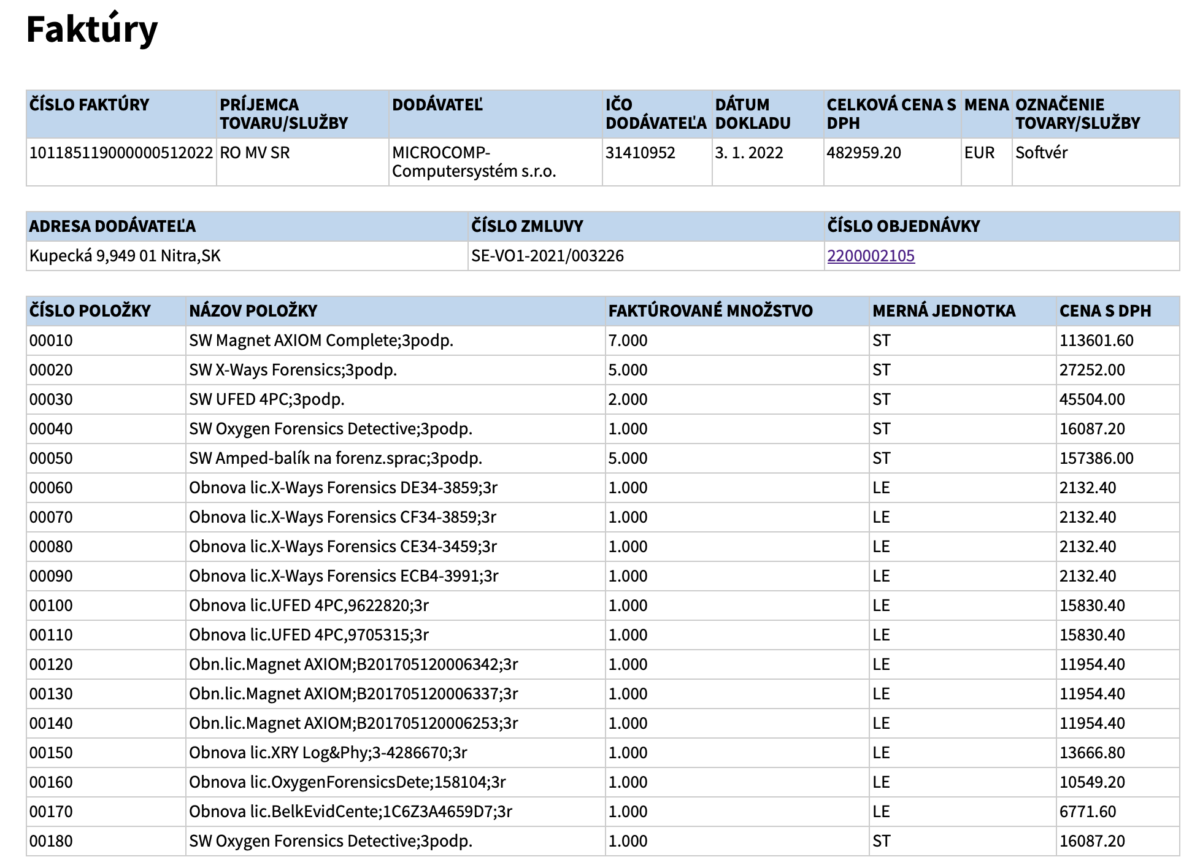
An invoice issued to the Slovak interior ministry in 2022 by the Slovak company Microcomp–Computersystém indicates the renewal of a licence for this software. At the time, the minister responsible was Roman Mikulec.
Screenshot of invoice from 2022 (Source: Slovak interior ministry website)
The Slovak ministry also ordered a licence renewal in July 2024, under his successor Matúš Šutaj Eštok. Microcomp–Computersystém did not respond for comment.
Interior ministry order with links to Russia. (Source: Slovak interior ministry website)
Authorities warned
On Friday (2 October), the Slovak national security authority (NBÚ) warned of the risks posed by using software from Oxygen Forensics and connected companies such as MKO Systems and Prostranstvo IT.
Their software helps investigators search for and examine data from digital devices. It can process vast amounts of information, including evidence, which makes it important who owns, controls and develops it. According to the NBÚ, this is important both for data protection and for the reliability of analysis results.
The warning came after the US case was made public.
The NBÚ considers links to Russia significant in assessing the security risk, also in view of Russia’s military aggression against Ukraine.
However, the warning itself does not mean that data leaked through the software. US prosecutors explicitly stated that the charges did not concern malicious code or unauthorised access to customer data.
The case concerns the alleged concealment of the software’s ownership and origin. And no court has yet ruled on the case.
“The ministry will proceed in accordance with the recommendations of the National Security Authority,” the Slovak interior ministry said.
The NBÚ recommended that public bodies identify this company’s presence and report it to the authority.
Belgian Green MEP Saskia Bricmont also called for the use of Oxygen to be stopped immediately and for an inquiry into whether sensitive information could have reached Russia after it was found that Romania, Germany, Spain, Italy, Poland and Hungary had purchased the software.
European police shed tool
Several European security agencies are suspending the use of Oxygen Forensics software or taking steps to terminate their contracts after the company’s Russian ties came to light.
The tool was also used by Czech police. Czech security agencies continued to purchase licences for the computer software after 2022, when the full-scale invasion of Ukraine began. Czech authorities are awaiting further information from the United States. For now, they have prohibited software updates.
London’s Metropolitan Police has suspended the use of Oxygen tools and launched a comprehensive review. British police forces, including specialised units, had used the software.
And Latvian police suspended its use and is assessing whether it will continue using it.
Romania’s anti-corruption agency, too, took steps to terminate its contract with the Russia-linked tool.
Every major technological shift reshapes not just the economy but the tax system that pays for it. When big corporations emerged, corporate and payroll taxes followed. When mass car ownership took hold, fuel duties emerged to pay for the roads it required.
As AI shifts work from people to machines, it will force a rethink of who gets taxed, on what, and where. Nowhere is that question more urgent than in Europe, which funds the world’s most comprehensive welfare states primarily through taxes on work.
Taxes on work make up 51.5 percent of all tax revenue in the EU-27, according to the European Commission’s latest Taxation Trends data — a share that rose in 2024. These charges are taken straight from the payslip. They’re hard to avoid, and scale with employment.
AI, by replacing human work with software and machines, eats away at exactly this tax base.
The International Monetary Fund (IMF) estimates that around 40 percent of jobs worldwide are exposed to AI. If that leads to fewer workers, it will also mean fewer payslips, pension contributions and social charges, weakening the revenue streams that fund Europe’s pension and healthcare systems. This is not a distant problem; the costs are already mounting.
Shift the burden to corporate profits
The obvious response is to shift more of the tax burden onto corporate profits, which will increasingly reflect the gains firms make by deploying AI instead of hiring workers.
Unlike a tax on machines and equipment themselves, a profit tax falls mostly on excess profits and need not distort investment. The case for shifting weight from payroll taxes to profits is strong and strengthens as AI replaces more workers with machines.
But profits, unlike payrolls, move. A company can locate its intellectual property in a low-rate jurisdiction — a pattern Europe knows well from decades of profits routed through Ireland and Luxembourg — and ensure that profits are booked far from where the jobs are lost. It is how the world’s largest technology and AI firms already operate.
Two-pillar answer
The Organisation for Economic Co-operation and Development’s (OECD’s) Inclusive Framework was designed to address exactly this: profits shifted across jurisdictions to avoid tax, and e-commerce allowed sales where firms have no physical presence. AI makes these reforms more urgent.
Pillar One of the framework put forward by the Paris-based wealthy nations’ club addresses where a corporation is taxed. It shifts partial taxing rights for the largest multinationals away from where they are headquartered and toward where their customers and users are located.
Still under negotiation, it would apply only to a handful of the largest firms, but many AI companies would qualify.
These firms are concentrated in a select number of countries, very few of them European, but the displacement they cause, and the public services that displaced workers will require, will weigh heavily on European budgets.
Pillar Two of the OECD framework introduces a global minimum corporate tax of 15 percent on multinationals with revenues above €750m.
The EU moved first and furthest: Council Directive (EU) 2022/2523 made the minimum tax binding across the Union from 2024, and 22 of the 27 member states now apply it in full. The United States, notably, has not implemented the rules.
Politics is undermining the fix
But the obstacles are real. US ratification of the OECD proposals is unlikely, and many of the largest companies are headquartered there.
The pressure is already reshaping Europe’s own rules: under the G7’s June 2025 ‘side-by-side’ agreement, US-parented groups would be exempt from the EU’s minimum-tax rules: a carveout the European Commission confirmed in January 2026 and which several member states consider legally fragile.
The Commission also dropped its proposed EU digital levy under US trade pressure, leaving a patchwork of national digital services taxes in France, Italy, Spain, Austria, and elsewhere.
Such exceptions and carveouts show that big-power politics can hollow out the framework. These reforms were designed to address the tax challenges for an AI-economy. They were good policy then. They are fiscal necessities now. Fairer corporate taxation will not be enough, but it is a start.
Europe’s choice
The EU has instruments on the table, the BEFIT common corporate tax base and the proposed Corporate Resource for Europe, but both remain politically contested.
European governments that fail to act will be managing the social costs of technological disruption with a tax system built for the industrial age, while the profits that fund their rivals accumulate beyond their reach.
Even if Europeans work less, their needs for health care, pensions, and consumption remain. As wage-based contributions shrink, Europe must shift more of the tax burden onto corporate profits and close off the routes that let those profits move beyond the reach of the states bearing the costs of automation.
Productivity gains may soften the arithmetic; they will not repeal it. The tax base must follow the economy.
EUobserver is proud to have an editorial partnership with Europod to co-publish the podcast series “Briefed” hosted by Léa Marchal. The podcast is available on all major platforms.
Find the full transcript below:
Chinese carmakers are taking an increasing share of the European car market, particularly when it comes to electric vehicles. Why are European carmakers now opening their factories to their Chinese competitors?
Until recently, the main concern in Europe was Chinese-made electric vehicles being imported into the EU. That’s why, two years ago, the EU imposed hefty tariffs on Chinese electric cars.
But Chinese manufacturers have found another way into the European market: they are setting up production here. Some are building factories of their own. Others are entering partnerships with European carmakers and using their existing production sites.
That’s the case with Stellantis and Chinese manufacturer Leapmotor. And now Dongfeng is also negotiating to produce cars at the French plant of Rennes La Janais. Because by moving production to Europe, Chinese manufacturers may be losing one of their main advantages, which is cheap labour.
But low labour costs are only one part of their competitive edge.
Chinese manufacturers also continue to benefit from state support. And setting up production in Europe doesn’t necessarily mean building brand-new factories.
In many cases, Chinese companies are looking to partner with European manufacturers and use factories that are already there — factories that are no longer operating at full capacity. That means they can save significantly on investment costs. And they can also rely on their European partners’ existing sales and distribution networks.
So how big is this Chinese presence in Europe becoming? For 2028, there are already 12 projects involving Chinese carmakers setting up production in Europe. Several are in Spain, with others in France, Belgium, Slovakia, Hungary, Sweden and Austria.
Now, why would European manufacturers allow their Chinese competitors to produce cars in their own factories? Part of the answer is that European carmakers are struggling to keep up in electric vehicles sells. And that is contributing to factory closures and job losses.
European manufacturers have to meet EU targets on average CO2 emissions each year. And producing more electric vehicles is necessary to meet those requirements.
So partnerships with Chinese manufacturers can serve two purposes: they can help European companies fulfilling their green cars objectives, while also keeping existing factories and jobs running.
Though there is a longer-term risk for European manufacturers. The more Chinese companies establish themselves in Europe, the more competitive pressure they could put on European brands — potentially even leading to takeovers. That has happened before: Volvo Cars, for example, was acquired by Chinese group Geely in 2010.
In Germany, carmakers are for now refusing to open the doors of their production sites to the Chinese. But they do have partnerships with Chinese companies to produce vehicles in China, where they can benefit from lower production costs. That explains why they were very much opposed to imposing tariffs on Chinese electric vehicles.
But the situation is now changing. Volkswagen closed its Dresden factory last year, and other German plants are also facing closure risks. Germany’s car industry is therefore increasingly joining calls for stronger protection against Chinese competition.
And that brings us back to the Franco-German paper that is circulating in Brussels, which calls for measures to restrict Chinese access to the European market.
Because this debate goes well beyond cars. The EU is increasingly concerned about Chinese competition and dependence in a range of strategic industries. This will be discussed next week, when EU leaders meet in Brussels.
The European Commission could also present a new so-called “diversification” tool, either at the summit or around it. One possibility would be to require companies not to rely exclusively on China for certain critical materials. Something which could trigger what we call a trade war. I’ll be following that very closely!
This article is paid for by Council of the Notariats of the European Union (CNUE).
An address rented in a European capital, an electronic signature obtained online, a 48-hour waiting period.
Under the proposed regulation establishing a 28th company law regime, known as ‘EU Inc.’, this could be enough to establish a company with legal personality throughout the European Union.
No share capital would be required. The founder could complete the entire process without appearing, even digitally, before a public authority or another person entrusted with preventive legal control.
There would be no personal verification of their legal capacity, of whether they understand what they are signing, or of whether they are acting on behalf of someone who wishes to remain invisible.
The company could then open bank accounts, enter into contracts, own assets and employ people across the European Union. If the company later fails to meet its obligations, creditors and employees may find that there are no assets to recover and that the person formally responsible for it was acting merely as a front man.
This scenario illustrates the serious concerns raised by the proposal for a Regulation on ‘EU Inc.’ put forward by the European Commission and currently being examined by the European Parliament and the Council of the European Union.
The preventive checks set out in Article 14 of the commission’s proposal are largely limited to formal requirements.
There is no independent and impartial scrutiny of the founders’ legal capacity, of the lawfulness of the articles of association, or of whether the transaction complies with substantive legal requirements. Transfers of shares and capital transactions are also not subject to substantive control. Liquidation is treated primarily as an administrative formality, even though it can directly affect creditors and employees.
The consequences may extend far beyond company law.
Companies own real estate and are entered in land registers. If it is no longer possible to establish reliably who owns a company, it also becomes more difficult to establish who ultimately owns the real estate held by that company. Reliable company information therefore matters for the transparency of property ownership.
‘Not reliably verified’?
If the information in a register has not been reliably verified, others have to verify it themselves. Banks, business partners and investors may need additional legal opinions, audits and insurance. Costs that a preventive check avoids at the outset may therefore arise repeatedly at a later stage.
This would represent a shift from the European tradition of public preventive legal control towards a model that relies more heavily on resolving disputes after they arise.
Delaware is a prominent example of such an approach, supported by specialised courts and a correspondingly prominent role for litigation. Transplanting it to Europe would place additional demands on national judicial systems that lack the necessary resources.
The proposal also raises questions with regard to the recent European efforts to combat money laundering and the financing of terrorism.
The creation of the Anti-Money Laundering Authority (AMLA) is the latest milestone in this process. To create, at the very same time, a legal form with significantly reduced checks risks severely undermining these efforts.
The same applies to sanctions: their enforcement depends on knowing who is really behind a company – especially when shares are transferred. Without reliable legality control of share transfers, corporate ownership can change unnoticed and become a vehicle for sanctions circumvention.
The amendments required are straightforward. The acquis of European company law, as established by Directive (EU) 2017/1132 and recently reinforced by Directive (EU) 2025/25, should also apply to EU Inc. companies.
This means reliable identification of founders and directors, public oversight of legal compliance at the time of formation and at subsequent stages, and reliable business registers.
Public protection
These safeguards exist for a reason.
They protect not only the parties to a transaction, but the public at large. Because they serve a public purpose, they must remain a public responsibility. Private service providers cannot replace independent preventive control carried out under public responsibility.
How these checks are organised differs between member states. In some member states, public authorities carry them out directly. In others, the state entrusts notaries with this public function.
Notarial involvement therefore does not add another layer of control: the same public function is simply carried out by different public authorities. In many member states, a company can already be formed digitally within 48 hours, with full legal verification carried out by a public official.
The European Parliament and the Council of the European Union will decide their positions in the coming weeks.
There is still time to improve the legislative framework of EU Inc. significantly and to make it a success.
This requires digital and efficient procedures without compromising legal certainty. The rule of law is one of the European Union’s strengths. EU Inc. should build on that strength, not weaken it.
The European Commission has proposed up to 15 years of post-accession safeguards to punish new member states in case of bad behaviour, in a long-delayed pre-enlargement policy review out on Tuesday (6 October).
The reforms were initially requested by the European Council in June 2024 to be ready by spring 2025, but were delayed several times due to political sensitivities in EU capitals.
They are aimed at frontrunners for future EU membership – Montenegro, Albania, Moldova, and Ukraine – each of whom will get an accession roadmap this month.
EU Commission president Ursula von der Leyen has deemed union enlargement a “geopolitical imperative” amid the war in Ukraine and shift towards a new global order.
By expanding, the EU hopes to promote democracy and strengthen the single market.
But this also comes with fears that countries could misbehave after getting in, prompting the commission’s proposed new guardrails.
The commission suggests that new member states promise “not to oppose EU decisions on future enlargements” due “to bilateral disputes” for an unspecified time.
But Marta Kos, the EU’s enlargement commissioner, said this commitment would be voluntary.
Commissioner dismisses ‘two-tier’ concerns
This article continues, but the full version is available only to EUobserver.com subscribers. Visit account.euobserver.com/membership
French borrowing costs are surging and central bankers are starting to fret. Some of them, at least.
The head of the French central bank, Emmanuel Moulin, told the Financial Times that his country risks being “strangled by interest rates”.
The best solution, he made clear, was for the French government to cut costs and reduce the deficit, which, in an unchanged scenario, could reach upwards of six percent next year.
Last week, the French minority government proposed €43bn worth of cuts for 2027. But pushing them through parliament is a tall order in a divided country.
Meanwhile, investors are dumping French bonds, pushing up French government borrowing costs compared to German benchmark Bunds. This is already immensely costly to French society.
“In three weeks, we’ve lost the equivalent of €15bn a year in higher debt-servicing costs over a 10-year horizon, or almost €100bn cumulatively over 10 years!”, French economist Shahin Vallée said on social media last week.
The gap, or spread, between French and German bond yields, historically around 50 basis points (0.5 percentage points), was 109 basis points when he wrote it on Wednesday. It is now 30 points higher.
Spreads are a crucial marker for financial stability because they show how nervous investors are. The bigger the spread, the higher the perceived risk.
And France’s parabolic bond spread is already bringing back unwelcome memories of the eurozone crisis in November 2011, when the spread reached 200 basis points.
Bypass parliament?
The question is what to do about it, and who is best positioned to act. The French government could bypass a parliamentary vote or push through the budget by ordinance, under articles 49.3 and 47 of the constitution, respectively.
This article continues, but the full version is available only to EUobserver.com subscribers. Visit account.euobserver.com/membership
The Commission is “going a bit too fast” in unlocking €4.2bn and restarting the Erasmus+ student exchange programme in Hungary, according to budget committee MEPs.
The EU froze its financial assistance to Hungary in 2022 due to concerns about rule of law breaches and misappropriation of funds by Viktor Orbán’s government.
Green MEP from Germany, Daniel Freund, told EUobserver he “would have taken a more staged approach to not release everything in one go,” admitting that the reform agenda of Péter Magyar’s new government still has some way to go.
The commission’s proposal to unlock part of the €16.4bn in funds available to Hungary requires the green-light from the EU council, representing member states, one month after its announcement on 23 September.
Freund said that he was “happy about the changes we have seen” following his visit to Hungary on 1 October.
“Hungary needs this money, I also want Hungarians to have this money, since for years it was just going to Orbán and his cronies,” he said on Tuesday (6 October).
However, Freund and other MEPs on the fact-finding mission found that “the same risks of corruption exist,” and “there are new laws that are still fragile in their implementation,” French socialist and democrat Jean-Marc Germain told reporters in Strasbourg on Monday.
The Parliament can serve as a pressure point, although the decision on funds is largely in the hands of the commission and the council.
“There is no real political pluralism in Hungary, which may in the long run be a reason for worrying,” he said, adding that most companies are still owned by the same few people as during Orbán’s rule.
The tone is different on the other side of the political spectrum.
This article continues, but the full version is available only to EUobserver.com subscribers. Visit account.euobserver.com/membership
European Commission president Ursula von der Leyen has joined MEPs in urging the bloc’s governments not to gut the EU’s next seven-year budget, as talks on spending reach a critical phase.
The commission has proposed a budget worth just under €2 trillion, equivalent to 1.26 percent of the EU’s gross national income, a small increase on the previous seven year spending plan. But the so-called ‘frugal’ group of countries, led by Germany, have demanded hefty cuts, complaining that they are contributing too much.
“Having no new financial framework is by far the most financially advantageous solution for Germany,” chancellor Friedrich Merz said on Monday.
But 17 EU countries from Southern and Eastern Europe signed a joint letter last week, demanding that farmers’ subsidies via the Common Agricultural Policy are maintained, as well as spending across the EU’s poorest regions, known as cohesion policy
During a press conference on Tuesday, Siegfried Muresan, the Romanian centre-right MEP who is co-leading parliament’s negotiating team on the seven-year budget with Portuguese socialist and democrat Claudia Tavares, said that there was “still time” for the Irish presidency to avoid proposing “unjustified cuts” that “would make Europe weaker and severely undermine the institutional cooperation between parliament and council.”
Though Muresan conceded that governments did not want to increase their national contributions, “there is a way out”, he said.
This article continues, but the full version is available only to EUobserver.com subscribers. Visit account.euobserver.com/membership
Politicians need to solve the affordability crisis to stop the far-right, social democratic Portuguese prime minister Luís Montenegro told MEPs on Tuesday (6 October).
Opening a debate in Strasbourg, Montenegro called for more lax regulation as a way to address the housing crisis, defended strict migration policies, and expressed support for funding poorer regions in the next EU budget.
He also stressed the importance of lowering fuel prices and prioritising the energy transition to “solve the real problems that people wrestle with,” adding that “our response … has to be felt in the lives of Europeans” to avoid disappointed voters turning to populism and extremism.
Back at home, Montenegro has the far-right Chega (Enough) party on his tail: in the 2025 parliamentary elections, they won 23 percent of the ballots against the Montenegro alliance’s 33 percent.
Now, polls give Chega 27 percent of declared votes for the next parliament, slightly less than the Socialist Party (28 percent) and ahead of the current government coalition (24 percent).
For his part, a Chega MEP (Patriots for Europe), António Tânger Corrêa, challenged Montenegro on Tuesday for relying on wind and solar energy without enough storage in case of blackouts and shutting down coal power plants.
He also warned Montenegro against agreeing to limit unanimous votes in the European Council in future, as representing a blow to Portugal’s sovereign powers.
From his left-wing opponents, Portuguese MEP Catarina Martins pointed out the high rent costs in the country and criticised the government for failing to support low-earning tenants.
Montenegro said his government simplified the law around housing construction – much in line with the EU’s focus on deregulation – and proposed tax breaks to encourage investors to build more.
An EU-level policy complementing it “would be very useful,” he said, as long as it simplified existing regulations.
The Affordable Housing Act presented by the EU Commission in early September aims to improve the market for tenants by restricting short-term rentals.
A case of treason on an unprecedented scale is emerging at Germany’s foreign intelligence service, in what German media say could shake the entire agency.
According to the investigative team of WDR, NDR and Süddeutsche Zeitung (SZ), August Hanning, the former head of the Federal Intelligence Service (BND), is being investigated for alleged espionage detrimental to the state and intelligence activities.
Hanning’s tenure at the BND ended in November 2005.
But he is accused of having illegally obtained secret information for several years after he left the service, which gathers and assesses information on foreign, security, and economic threats.
He was arrested at his home in Nordwalde, near Münster in western Germany, on Tuesday (6 October).
Der Spiegel reported that police arrived at 6.41AM and took him away in a black minibus at 8.58AM.
Another former senior BND employee was also detained in the Bavaria region — apparently the former head of Hanning’s office, who worked for the intelligence service until spring 2026.
Neither German authorities nor Hanning’s representatives had commented on the case by Tuesday noon.
What investigative journalists found
According to investigative journalists, Manfred D. leaked top-secret information from within the BND to Hanning until 2022.
According to Der Spiegel, which cited investigators’ findings, Hanning and Manfred D. agreed, as early as spring 2010, that the latter would, in return for payment, gather intelligence from the BND for his former boss, which Hanning could use in his private security consultancy work.
Investigators are working on the assumption that, in at least one case, Hanning prepared a security analysis for a foreign intelligence service.
According to WDR, NDR and SZ, it was not for Russia.
In another case, he allegedly used information from internal BND documents when communicating with a foreign agent.
According to information from security circles obtained by WDR, NDR, and SZ reporters, Hanning came under scrutiny after his home and offices were searched in September last year, when the State Criminal Police Office (LKA) was investigating the case of steak empire heiress Christina Block.
According to investigators, Hanning was involved in an earlier attempt to abduct them, accusations he denies.
While assessing material seized from Hanning last year, LKA officers found an electronic data storage device with explosive contents, according to the investigative journalists.
The former official apparently had access to top-secret BND documents from the recent past which, under no circumstances, should have been in his possession.
In total, he obtained around 2,000 documents. In many cases, these were briefings for the so-called intelligence situation meeting at the federal chancellery, where the heads of security agencies exchange information every week.
They included highly sensitive reports, for example, on Iran’s nuclear programme or the Russian military. According to security sources, they also included reports from foreign partner services.
A leak of such material is regarded by intelligence services as an absolute catastrophe. Friendly intelligence services could lose trust in the BND and cut off the institution from crucial information.
After assessing them, the LKA Hamburg police team handed the seized documents over to federal authorities.
And in May 2026, the Federal Public Prosecutor General’s Office ultimately opened confidential proceedings against Hanning and his alleged BND informant. It remains unclear over what period the former intelligence chief was supplied with secret internal information.
According to security sources, the most recently discovered documents date from June 2022.
It also remains unclear how the alleged BND mole managed to remove material from the secured agency. The BND was asked for a statement on the case.
Hanning’s lawyers have not yet responded to a brief request for comment on the allegations.
An affair of historic proportions
For the BND, this is already the second serious incident in the space of a few years.
In 2022, the espionage case involved Russia, when a former head of a BND unit was accused of spying for Moscow together with another man.
It concerned top-secret information on BND cyber operations that was leaked from the service.
As the Tagesschau website noted, if the suspicions against Hanning are confirmed, this would be an espionage affair of historic proportions.
German history has never before seen an alleged case of treason involving such a senior former top official.
According to Der Spiegel, this is unprecedented. This is particularly so because, for many years after leading the intelligence service, Hanning remained among the most important officials in Germany’s security apparatus.
Before becoming BND president, he was responsible for protecting classified information at West Germany’s representation in East Germany.
After serving at the chancellery, including as coordinator of the federal intelligence services, the lawyer, who holds a doctorate, took over the leadership of the BND in 1998.
At the end of 2005, after leaving the intelligence service, Hanning became a state secretary at the interior ministry. He retired four years later.
Questionable business
According to German media, his subsequent activities were seen as problematic. He became known as a businessman and security consultant with a company in Switzerland.
Its German subsidiary was hired for a time in the custody dispute between Block and her former husband.
According to prosecutors, in 2023 he allegedly planned, together with an associate, to “discredit Block’s former husband through false allegations of paedophilia”.
Hanning and his alleged accomplice apparently tried to plant a hard drive containing child sexual abuse images and videos on the father of Block’s children.
The investigation has not yet been concluded. Hanning has previously denied all allegations in the case.
Every day, children are killed in Israel’s genocidal war on Gaza. Where are the outraged headlines?
The number of children killed in Gaza since Israel started its onslaught, following the Hamas attack on 7 October, 2023, is estimated at more than 21,600.
The UN Children’s Fund (UNICEF) says that since the so-called Israel-Hamas ceasefire, an average of “at least” one child a day – 300 children over 300 days – has been killed in the enclave.
Children, toddlers, and babies are being killed in their homes, schools, hospitals, shelters, and on roads marked by displacement. They are also dying because the basic structures that should protect them – family, healthcare, education, food, water, and refuge – have been systematically destroyed.
Where are the urgent statements from EU and world leaders?
EU governments continue to authorise arms transfers to Israel despite rules which require governments to deny licences where there is a risk that military equipment will be used for serious violations of international humanitarian law.
Every EU member state is also bound by the UN Convention on the Rights of the Child and the EU’s own treaty, which requires the union to promote children’s rights.
Why are these international rules and domestic commitments not being applied to the children of Gaza?
Mourners light candles during a mass funeral and vigil for 105 Palestinians near the rubble of the Al Tajj building in Gaza City on 30 September 2026 (Source: EPA/MOHAMMED SABER)
Children rights beyond Ukraine
The EU does care for children. In Ukraine, the EU treats children as individuals rather than statistics: it convenes coalitions, compiles names, traces families, imposes sanctions, creates mechanisms for return and makes the fate of children a central diplomatic demand.
In her State of the Union address last month, European Commission President Ursula von der Leyen – a proud mother and grandmother – introduced and praised the courage of Sasha, a six-year-old Ukrainian girl who lost a leg in a Russian missile strike in Ukraine but has now returned to her beloved gymnastics.
Von der Leyen quite rightly made the suffering of Ukrainian children intimate and personal. It is more than time she did the same for Palestinian children.
But let’s not only blame political leaders for their indifference, their lack of historical knowledge of Palestine’s occupation and their limited understanding of Palestinian calls for justice.
Parts of the legacy media must also own up to their responsibility in normalising the abhorrent.
Powerful mainstream media have preferred to “repeat Israeli propaganda and sometimes simply cut and paste IDF press releases” rather than accept the analysis of Palestinian journalists, writers and scholars, writes Bhakti Shringarpure.
Her criticism reflects a wider ongoing discussion on the sourcing and framing of Gaza coverage, with studies spotlighting how Western media has described Israeli suffering by using emotive language around 11 times more often than Palestinian suffering. References to Israel’s “right to defend itself” appear roughly five times as frequently as references to Palestinian rights.
Also, as the immediate shock of the bombardment recedes – but the killing continues – Gaza has dropped down the news cycle.
Assal Rad, author of “Don’t Say Palestine: How the Media Manufactured Consent for Genocide”, describes the logic: “The façade of a ceasefire has created the space to cover it less. In reality, the conditions on the ground for Palestinians in Gaza have not changed.”
It is also less politically costly for leaders and media to focus on settler violence and settlement in the occupied West Bank, since it can be described as the work of “extremists” rather than of the Israeli government.
EU silence
Our lack of a strong reaction to what is happening is Gaza is also the story of how bystander societies can watch, absorb, and rationalise horrors – and move on.
Additionally, the killing of Palestinian children is preceded by their political “unchilding”, a process which Palestinian scholar Nadera Shalhoub-Kevorkian says begins before the missile falls, when Palestinian children are imagined not as children with futures but as demographic threats, future militants, or extensions of an armed group.
Their age, instead of guaranteeing greater protection, becomes entangled with suspicion.
Even amid such savage violence, some people are not giving up.
Their bosses may still look the other way, but EU Staff for Peace, which holds vigils in front of the European Commission and the EU Council every Thursday, has held gatherings to read out the names of children killed in Gaza, thereby according individuality to children whom the political and media systems have reduced to numbers.
As one EU staffer told me: “We only have a time slot of three hours and the last time we only managed to read out the names of children up to three years old. It took us one hour to read out the names of Palestinian babies under one-year old.”
Hind Rajab, who was five, was killed on 29 January 2024 by Israeli fire on the car in which she was trapped. Her body was found 12 days later alongside the bodies of members of her family and two paramedics who had gone to rescue her.
Israel has acknowledged firing on the car but has not admitted that her killing was unlawful, citing an ongoing investigation. In other words, there has been no accountability.
The obscenity is not only that Hind was killed, but that by now the killing of children in Gaza has become a familiar event.
The shame is that so many of us have constructed a hierarchy in which some children summon the world’s full moral and political force, while others are ignored.
Omar El Akkad, in his seminal book says that “One Day, Everyone Will Have Always Been Against This.” Given the cowardice on display over the last three years, I sometimes wonder if there will ever really be a true global moral reckoning.
Russia continues to pressure cities, while the first autonomous counter-drone turrets have been deployed in Kyiv.
Ukraine is maintaining pressure on Russia’s oil industry, reporting that it has disabled 51 percent of refinery capacity.
Russia still sees a large pocket of encircled Ukrainians in Kharkiv region, but no such pocket exists.
Ukraine says it destroyed a Russian Su-34 and Su-35 on the ground. Satellite imagery provides no clear evidence.
Maps of the day– Kharkiv region
Videos of the day – intense trench fighting; Russians shot down a balloon carrying an FPV drone; Russia has revived the idea of a barrage of tethered balloons; ground drones repelled an FPV drone attack using a counter-drone net – views from both sides.
Russia continues to pressure cities. Ukraine has begun testing AI-controlled machine-gun turrets in them. The new autonomous weapon is intended to protect key sites from drone attacks, typically bridges and similar infrastructure. Air force spokesperson Yuri Ihnat said on Monday that the AI turrets, which receive information from other air-defence components, had achieved their first shoot-downs, including of Geran-5 drones.
Ukrainian president Volodymyr Zelensky reported on Saturday, before Ihnat’s announcement, that 12 turrets of the kind shown in the military video below had been installed in the capital by that date. Another eight are planned.
They are armed with a 12.7mm heavy machine gun, which is not effective against a Geran flying high and fast, but becomes effective during the final phase of its flight, when it comes within the weapon’s range. The soldier in the footage said 50 rounds were sufficient to shoot down a Geran with AI assistance.
AI is entering Ukraine’s air-defense fight — and it is already helping shoot down Russia’s jet-powered Shaheds.
Air Force spokesperson Yurii Ihnat said AI-assisted turrets using machine vision have already successfully engaged Russian Geran-5 jet-powered UAVs.
Details of the turrets’ precise deployment are, understandably, not yet known. However, both Russian and Ukrainian sources commented on them in interesting ways. Ukrainian expert Anatoliy Khrapchynskyi told the NV website, among other things, about the risk that fully autonomous turrets pose to civilians. Serhii Beskrestnov was the first to warn about it on Monday: “I warn you that, for your own safety, you should not stand by windows during an air-raid alert.”
Khrapchynskyi noted that this rule has applied to any weapon since the start of the war. People should not stand by windows during air raids precisely because air defences or debris from downed weapons can damage buildings and injure people. There is a two-wall rule: if you cannot get to a shelter, hide somewhere in your flat protected from a potential blast by two walls, such as in a corridor.
“This does not mean that robotic turrets will fire at windows. They will target moving aerial targets, but they could hit civilian infrastructure,” Khrapchynskyi conceded.
The Russian Telegram channel Two Majors complained that while Ukraine was already using AI turrets in practice, and although promising projects of the same kind existed in Russia, bureaucracy and high costs were holding back their introduction into service.
The same Russian source was among those that published a video showing an entire bridge across the Dnipro in Kyiv being wrapped in a counter-drone net.
But after several days in which Russian Gerans targeted only Kyiv’s bridges, they attacked Zaporizhzhia in the same way overnight from Monday to Tuesday. Russia injured five city residents, including two Red Cross workers, and halted or restricted traffic on several bridges in Zaporizhzhia, causing traffic jams in the city during the morning.
Zaporizhzhia lies about 30 km from the front and is a natural supply route for fighting units. Taking the bridges out of action would create a serious logistical complication, but the same applies as in Kyiv: their complete destruction is unlikely. Russia will also be satisfied with constant attacks causing minor damage, but sufficient to halt traffic.
Among other sites hit by Russian weapons was one of the hospitals in Kryvyi Rih, which was struck by two missiles. Two people were injured during the air raid.
Ukraine is maintaining pressure on Russia’s oil industry, reporting that it has disabled 51 percent of refinery capacity. “More than half of the enemy’s capacity has been taken out of operation. This is the result of carefully planned, methodical and systematic work aimed at exhausting Russia’s war machine and destroying its military-economic potential,” new minister Yevhen Khmara said.
His statement cannot currently be verified, but footage of another fire at oil infrastructure in Russia emerged on Tuesday morning. It was at the Volodarskaya production and distribution centre in Moscow region. It lies just under 40 km southeast of central Moscow in a straight line, and its premises contain a large oil depot. It is also a pipeline junction through which fuel flows to Moscow, including aviation fuel for Moscow’s airports.
Ukrainian attack drones successfully struck Russia's Volodarskaya LPDS tonight, a major storage and distribution hub supplying jet fuel, diesel, and gasoline for the Russian capital, Moscow.
Ukraine says it destroyed a Russian Su-34 and Su-35 on the ground. Satellite imagery provides no clear evidence. The attack targeted Khanskaya airfield in Krasnodar region, from which a training unit normally operates.
The incident took place over the weekend. Satellite images showing clear traces of explosions and fire appeared relatively quickly, but it is not possible to identify what exploded and burned.
The usual Russian source, Fighterbomber, did not comment on the matter at all.
📍Satellite imagery of the aftermath of the UAV attack on "Khanskaya" airfield.
Russia still sees a large pocket of encircled Ukrainians in Kharkiv region, but no such pocket exists. The image below shows a map of the part of Kharkiv region where active military operations are under way. It was produced by the Russian defence ministry and shown by Two Majors on its Telegram account.
Alongside the image, the same source again cited Kremlin claims in listing alleged Russian successes in this sector: “In the Kharkiv direction, the Northern Group of Forces reported further advances. In the Lyptsi sector, our troops advanced near Tokarivka and captured several enemy strongpoints. In the Vovchansk and Velykyi Burluk directions, advances were reported in the areas of Prykolotne, Kotivka, Varvarivka, Reznikove, Mykolaivka, and Annopil.”
We have already written in Ukraine Battlefield update that no pocket exists, and that Ukrainian and independent sources follow the northern part of the front only marginally, because far less is happening there than Russia claims.
Among respected OSINT projects, Playfra most recently covered this battlefield on Saturday. The first map from this source shows the section of the front located at the top right of the Russian map. This is where the alleged encirclement is supposed to be, which various Russian sources have been reporting for almost a month.
The fighting here consists of Russian infiltration attempts, which are “chaotic and unorganised”. Playfra unequivocally rejects any encirclement.
Bilyi Kolodyaz-Velykyi Burluk directions.
No particular changes. The Russians continue infiltration attempts to encircle Ukrainian units in the Dehtiarne salient, though, once again, for now there is definitely no encirclement of the Ukrainians here. Russian infiltrations remain… https://t.co/ZlzDhwdMDhpic.twitter.com/GZz4lHkxSp
The following map from Playfra shows the same section of the battlefield as that seen in the Russian defence ministry’s version. The gap between reality and Russia’s claimed successes here is among the largest along the entire front, from Sumy to Kherson:
For comparison, the same area according to Finland’s Black Bird Group:
And according to the Russian project Slivochny Kapriz, which is relatively reliable. In all cases, Kharkiv is at the bottom left and the village of Dihtiarne, directly on the Ukrainian-Russian border, is at the top right:
Three-quarters of Ukrainians support peace talks. In the second half of September, the Kyiv International Institute of Sociology asked respondents whether they supported peace negotiations with Russia.
Exactly three-quarters — 75 percent — said they supported peace talks, 21 percent were against, and the remainder could not give a definite answer. This was virtually identical to the result in February 2025, when 74 percent of respondents answered the same question positively.
This is also shown by the Kyiv polling agency’s graph, whose analysts stressed that willingness to negotiate does not equal willingness to accept Russian terms.
Views on who will win the war have shifted more significantly. As the next graph shows, the difference between February 2025 and September 2026 is again almost zero, but there has been a significant change compared with July this year.
At the beginning of the summer, 60 percent of Ukrainians were certain they would win the war (dark blue), while 25 percent considered it more likely than not. Now, only 47 percent are certain, but 79 percent of respondents in total still expect a Ukrainian victory.
The change was probably driven by optimism in July, when Crimea was almost completely isolated and a successful campaign of medium-range strikes began. Although it continues, the one-off shift in public mood has since returned to its original level.
There have been minimal changes in views on how long Ukrainians are prepared to fight. The largest group — 62 percent — said (dark blue) they were prepared to do so for as long as necessary. Four percent (light blue) said one year, while 23 percent (orange) said they could endure only a few more months. However, the number who say resistance should continue for only months has fluctuated around 20 percent for more than two years.
Videos of the day
Videos like this were common in 2023. It is unclear when this one was made, because the prevailing nature of the fighting is different today. The Ukrainian squad in the footage clears Russian trenches.
In the more than seven-minute recording, views from the ground alternate with those from a reconnaissance drone hovering above the battlefield, which gave the Ukrainians an overview of the enemy. The fighting is confused, but the basic orientation is simple: Ukrainians with green identification markings attack from right to left.
Full video.
Original combat POV footage documenting a tactical operation to clear fortified positions in a contested tree line. The video shows real-time close-quarters maneuvers, tactical coordination, and direct trench combat.
— 𝔗𝔥𝔢 𝕯𝔢𝔞𝔡 𝕯𝔦𝔰𝔱𝔯𝔦𝔠𝔱 🦩🇬🇪🇺🇦🇺🇲🇬🇷 (@TheDeadDistrict) October 5, 2026
A Russian drone destroyed a balloon carrying a Ukrainian FPV drone beneath it. Ukraine is trying to use favourable wind currents in this way to extend the range of its small drones, which can then operate deeper in the Russian rear.
Twenty-first-century warfare in Moscow. A Russian soldier with a man-portable air-defence system shot down a Ukrainian drone by firing over a busy road.
Russian channels have released previously unseen footage from a drone attack on Moscow-area refineries.
The footage reportedly shows a mobile air-defense team using 9K38 Igla-series MANPADS engaging a Ukrainian FP/Liuity-type drone moments before it struck an oil storage… pic.twitter.com/9dJXPTZ6XG
Tethered balloons saw their greatest use during the Second World War, when they were deployed by armies on both sides. Balloon barrages protected London in the summer of 1940 and the Normandy landing fleet in June 1944, as well as German cities.
The principle was the same as in this Russian propaganda video. Balloons tethered to the ground by cables floated above cities and militarily important targets to prevent enemy aircraft from flying low. Ideally, they would hit the cables and crash. This principle may now be applied against drones.
👀 Russia has begun producing aerostats to protect oil refineries from drones.
A Russian FPV drone was targeting a Ukrainian unmanned ground vehicle. Just before impact, it successfully deployed a defensive launchable net.
Footage from a Russian FPV drone shows it diving toward a Ukrainian unmanned ground vehicle. Moments before impact, the UGV fires an anti-drone net from its rear section, catching and bringing down the attacking FPV. pic.twitter.com/MednUTUs45
— Special Kherson Cat 🐈🇺🇦 (@bayraktar_1love) October 3, 2026
This was not an isolated case. Another video from a different location shows a similar situation, but this time from the perspective of a camera on the ground drone.
Se me acaban las palabras para describir esto.
Las imágenes proporcionadas por la cámara instalada en un sistema terrestre no tripulado ucraniano 🇺🇦 muestran su sistema de red anti-drones “KARAKURT” funcionando en condiciones reales de combate.
By Monday (5 October), Russia had verifiably lost 24,170 pieces of heavy equipment (24,138 on Tuesday, 22 September). Of these, Ukraine destroyed 19,133 (19,105), 1,003 (1,000) were damaged, crews abandoned 1,194 (1,194), and the Ukrainian army captured 2,840 (2,839). This includes 4,452 (4,448) tanks, of which 3,357 (3,353) were destroyed in combat.
Ukraine lost 12,238 (12,175) pieces of equipment, of which 9,633 (9,579) were destroyed, 711 (702) damaged, 695 (695) abandoned and 1,199 (1,199) captured. This includes 1,466 (1,464) tanks, of which 1,126 (1,125) were destroyed in combat.
Note: Neither side regularly reports its fatalities or destroyed equipment. Ukraine publishes daily figures for Russian casualties and destroyed equipment, which cannot be independently verified. This overview uses data from the Oryx project, which has compiled a list of equipment losses documented exclusively by photographs since the beginning of the war.
On Wednesday (7 October), the largest group in the European Parliament, the European People’s Party (EPP), has scheduled a debate on a “European Parliament resolution on the need for an EU strategy to counter Islamist entryism and the influence of the Muslim Brotherhood network.”
The move follows the adoption of an EPP party resolution that treats Muslim civic engagement as inherently suspect and collective religious practice as a potential threat.
It largely mirrored the German Christian Democratic approach of criminalising Muslim civic engagement.
As Brussels-based EU expert and EUobserver’s columnist Shada Islam put it, the supposed fight against “political Islam” “places Muslim political and civic activity inside an almost exclusively security framework,” and thus “European democracy is hollowed out rather than reinforced when an entire religious or ethnic minority and its civil society are regarded as permanently suspect.”
Also, the resolution protects religious freedom for Muslims only as an individual right, explicitly stating that it seeks to ensure “equality among citizens, rather than collective claims,” leaving the collective expression of Islam unprotected and thus hollowing out the very idea of religious freedom.
As also the to be debated motion shows, it is unclear where protected religious activity ends and dangerous political activity begins.
Islamophobic conspiracies
The notion of “Islamist entryism,” imported from France, has become a way to criminalise Muslim participation in civil society and politics.
The resolution describes it as “a political strategy of influence, progressive structuring, institutional penetration and ideological legitimisation,” which it separates from the “peaceful practice of Islam.”
But how does one tell the “good” Muslims, who engage peacefully in politics and lobby policymakers to stand up for their rights, from the bad? Or is the good Muslim simply the apolitical one, who does not stand up for the protection of their collective human rights?
If “political Islam” is a problem because it is described “as a societal project,” how does it differ from the collective efforts of Jews, Christians, and others, who also “produce collective norms,” as the motion puts it?
And if “Islamist influence operates through a broad and fragmented ecosystem of associations, foundations, cultural, educational, religious, charitable, university, youth, anti-discrimination or social action structures,” something equally true of Christian, Jewish, and other religious groups, then where does the EPP draw the line between peaceful Muslim activity and Islamist activity that has to be banned?
Isn’t the claim that Muslim “community allegiances placed above common law” a typical Islamophobic allegation, familiar from the old mistrust of Jews as more loyal to a global Jewish community than to the nation-state?
Is this the old antisemitism in new “Muslim” clothes?
Indeed, the motion lists a catalogue of anti-Muslim conspiracy theories: “separatist narratives, systematic victimhood, antisemitism, hatred of Israel, conspiracy narratives, challenges to secularism … may constitute markers of ideological radicalisation or Islamist influence.” They may. And what if they don’t?
These CSOs are seen as a manifestation of political Islam per se even though they have denied any those connections.
And it is a form of innocence that cannot easily be proven.
The EPP motion claims that “some Islamist networks are able … to adopt the vocabulary of fundamental rights, inclusion, diversity, intercultural dialogue, anti-racism and the fight against discrimination, while promoting in other spaces logics of separation, community pressure or contestation of democratic principles.” In other words, the better integrated Muslims in Europe are, the more suspicious they may become.
Shaky legal foundations
The EPP’s motion builds on highly problematic bills, legislation and political procedures. It quotes the French ministry of the interior’s 2025 report “Muslim Brotherhood and political Islamism in France,” which has been harshly criticised.
It also cites a resolution of the French National Assembly from January 2026 that urged the European Union to add the Muslim Brotherhood to its list of terrorist organisations and to lobby for it.
The resolution was voted against by 101 members of parliament, some of whom called it “Islamophobic.” The motion also invokes the contested Austrian Symbols Act, which prohibits the symbols of non-violent organisations that are not considered illegal under domestic legislation and lumps them together with those of jihadist groups ISIS and Al-Qaeda.
A further cited motion is from the Dutch parliament in March 2026 and calls for a ban on the Muslim Brotherhood and linked organisations, but it too has no legislative relevance so far.
None of these motions or laws has outlawed “Islamist entryism” or the “Muslim Brotherhood networks.”
Yet the EPP resolution builds on exactly this shaky ground while pretending that its own motion is solid.
More importantly, the way Austria and France treat their Muslims is well documented: from the infamous, massive and racist police raids known as Operation Luxor to the French state’s Systemic Obstruction policy, which resulted in 101 government units nationwide monitoring Islam and Muslims, 24,887 Muslim organizations and businesses placed on a secret blacklist and under strict monitoring, and the closure of 718 Muslim-owned organizations and businesses, with €46m seized. There is nothing here that should be emulated elsewhere.
Crude logic
The EPP’s argument that “Hamas on the EU list of terrorist organisations historically originates from the Muslim Brotherhood movement” rests on crude logic.
Both the Progressive Alliance of Socialists and Democrats (S&D) and the secular Marxist-Leninist Popular Front for the Liberation of Palestine (PFLP), similarly considered a “terrorist organization,” have Marxist origins. Outlaw the S&D as a consequence?
Today, it is Muslims who are being surveilled, monitored and criminalised. Who is it tomorrow? If this resolution passes, life for politically conscious Muslims who are defending their right to exist in Europe will become even more difficult. And tomorrow potentially everybody’s life.
EUobserver is proud to have an editorial partnership with Europod to co-publish the podcast series “Briefed” hosted by Léa Marchal. The podcast is available on all major platforms.
Find the full transcript below:
The EU wants to bring new countries on board faster. But after years of waiting, will the Commission’s new proposals actually make enlargement easier?
On Tuesday (6 October), the European Commission is expected to propose changes to the EU’s enlargement process. The goal is clear: speed things up. Some candidate countries have been waiting for more than a decade, without a single new member joining the EU.
And geopolitics is adding to the pressure. With Russia’s war against Ukraine and a changing global balance of power, EU leaders increasingly see enlargement as a way of strengthening Europe’s weight on the international stage.
But bringing one, two, or several new countries into the EU raises some very complicated questions. One of them is decision-making. Another is money. So, what is the Commission proposing?
First, it wants to change the way enlargement negotiations are approved. At the moment, EU countries have to agree unanimously on several key steps in the process — including granting candidate status and opening different chapters of negotiations.
The Commission wants to make some of those decisions easier and faster, while keeping unanimity for the final decision on membership.
The other idea is gradual integration. In other words, candidate countries could take part in more EU programmes and benefit from certain forms of integration before actually becoming full members.
This is not exactly new. MEP’s think tankers, EU member states have been raising that idea for a while. And candidate countries already have access to a number of EU programmes and funding mechanisms. The idea is to give countries something concrete while they are still going through the accession process.
Now, there is an even bigger obstacle: money. The EU would have to finance enlargement at a time when its budget is already under pressure.
Because none of the countries currently considered likely to join in the nearer term would be expected to become a net contributor to the EU budget. In other words, they would likely receive more from the EU than they would contribute.
Ukraine is the obvious example. Despite being a big country with a solid economy, its current situation makes it fragile and unable to contribute largely to the EU budget.
Its accession could have a significant impact on EU spending, particularly through the Common Agricultural Policy and cohesion funds.
So the Commission is considering a transition period during which new members would not immediately have full access to all EU programmes.
That could make enlargement financially easier in the short term. But it doesn’t solve the problem permanently. Once the transition period ends, the same question comes back.
And there is a broader issue too: would the EU itself be able to function as a union of more than 30 countries? What could prove difficult, is that many important decisions still require unanimity — including areas such as foreign policy, taxation and parts of the EU budget.
Changing that would require treaty reform, which is politically extremely sensitive because member states would have to give up some of their veto powers.
Andrew Duff, a former British liberal MEP who has written about enlargement for the European Policy Centre, argues that the EU should have started thinking about this much earlier — particularly after Brexit. In his view, the EU has not carried out the kind of institutional reform that would prepare it for a much larger membership.
So in the end, today’s proposals could make the accession process more flexible and give candidate countries more opportunities to integrate before membership.
But they don’t resolve two of the biggest questions: how to finance enlargement, and how to reform EU decision-making.
Before we wrap up, a quick word on the countries which are believed to become members next. The frontrunner is Montenegro. The most optimistic forecasts suggest it could potentially become an EU member as early as 2028. Then comes Albania, which is also well advanced in the process.

 Login