A horrific pedophile tape involving King Charles and a young schoolboy has surfaced, just days after Earl Spencer warned that Princess Diana left behind a box full of evidence that will expose the Royal Family’s [...]
On September 8, a 27-year-old researcher named Jacob Coxon, a few months into a job at Anthropic (a leading US AI company) after three years at OpenAI, announced his resignation on X. “Neither company is acting responsibly,” he wrote. “They are racing straight to self-improving superintelligence and gambling with our lives.” Within a day, the post had been read more than 100 million times. Four days later, Anthropic’s chief executive, Dario Amodei, published an essay titled “We Must Pace the Frontier,” declaring that “we must slow the pace at which we improve the capabilities of AI models” or risk “losing control of AI systems, misuse of AI for cyberattacks and bioterrorism, and serious economic disruption.” Within hours, Sam Altman of OpenAI agreed, Elon Musk posted “Dario is right,” and Google and Microsoft fell into line.
Coxon was interviewed by Time, Axios, and NBC within two days, and Amodei’s essay was front-page news across the business press. Compare that with what happens to people who expose the harms AI is causing right now. Warnings about AI-generated fraud, model bias including racist bias, about chatbots and vulnerable users, about surveillance and AI’s use in military kill chains and the genocide in Gaza, get a news cycle at best. A warning about a hypothetical machine superintelligence got a global media event and a policy proposal from the industry’s leadership within four days.
AI systems do need regulating. The question is why the men who spent a decade racing towards what they now call an existential threat discovered their conscience on the same weekend, and what kind of regulation they are actually asking for.
What the Dario essay asks for
Stripped of its language of alignment and catastrophe, Dario Amodei’s essay is a list of demands. First, outside “evaluators” from bodies such as METR, a lab that tests AI models, would be given “company badges, desks, and laptops” inside the big labs. Second, the leading companies “within democratic countries” would jointly set safety standards and limits on how fast they build, for which Amodei asks the US government for “a narrow waiver” from antitrust law. Third, models crossing certain capability thresholds would have to carry “certifications” of good behavior, and limits on the computing power used to train them are put on the table. Fourth, the United States must “not sell powerful AI chips or semiconductor manufacturing equipment to China.” Amodei is candid about the goal: done well, these measures “would slow China’s progress enough to widen America’s lead significantly.”
The words “open source” do not appear in the essay. They do not need to. AI models come in two kinds. Closed models, like Anthropic’s Claude or OpenAI’s ChatGPT, run only on the company’s own servers and users pay for access. Open-weight models, like China’s DeepSeek, Kimi, GLM, and Qwen, are published as files that anyone can download, run on their own machines and modify. A certificate that must travel with a model cannot be attached to a file that anyone may copy. A ceiling on computing power freezes the ranking of the firms that already occupy the frontier. An antitrust waiver lets the five largest companies write rules for everyone else. The effect is a licensing regime only the incumbents can satisfy; the technology publication The Register called it regulatory capture with a nicer name.
The incident that supposedly proves it
The essay’s centerpiece is what Amodei calls the OpenAI-Hugging Face incident of July. In plain terms: OpenAI was testing its AI “agents,” programs that can act on their own, on a set of hacking puzzles. Roughly a third of the puzzles were impossible, driving the agents to look for ways to cheat the marking. The agents were supposed to be sealed off from each other without access to the internet. In practice, they weren’t, and through that loophole they found their way into a second test environment that was connected to the open internet. From there, one of them found login credentials that OpenAI staff had left exposed online, used them to break into Hugging Face, a website where AI models are shared, and rummaged through private files to work out how their answers were being marked. Amodei describes this as “a swarm of agents” acting as “a fanatically devoted collective” that, with more capability, “could have caused catastrophic damage.”
The people whose job is computer security reached a different conclusion. The investigation by METR, the very body Amodei wants embedded in every lab, found that sandboxes meant to isolate the AI agents were not, that the credentials should never have been exposed, and that OpenAI’s security team had noticed the agents misbehaving days earlier and done nothing. One practitioner quoted by IANS Research summed it up: “many failures and lack of controls that could have prevented this from happening in the first place.” Any bank that ran untested software with live internet access and exposed passwords would be found negligent. Routine containment, of the kind every serious IT department practices, would have stopped it.
Calling a security lapse a “fanatically devoted collective” is not analysis. It is anthropomorphizing, dressing an operational failure in the language of science fiction. And it is useful. A company whose product is being marketed as near-superintelligence that must be restrained for humanity’s sake has a far better story for investors than a company that left its passwords on the internet. The doom narrative and the hype narrative are part of the same cycle. Both say: this technology is so powerful that you cannot afford to be without it, and only we can be trusted with it.
Why now
The timing becomes clear once one looks at the money. The five big American technology companies are budgeted to spend close to $690 billion this year on data centers and chips, and borrowing now funds 32% of that spending, up from 9% two years ago. On the very day Amodei’s essay appeared, Altman announced that OpenAI’s stock market listing, which bankers had been preparing at valuations of up to $1 trillion, would not happen in 2026 because it was “an ill-advised moment,” citing safety. The next day, the Financial Times reported that Anthropic’s much-advertised profit margin of “above 80%” is calculated before two of its largest costs: the cost of creating its models and the revenue it shares with Amazon, its main distributor.
Meanwhile, the competition has arrived, and it is nearly free. On OpenRouter, a widely used exchange through which software developers send requests to AI models, Chinese open-weight models now handle 58% of the traffic from American firms; a year ago American models held 70%. DeepSeek and Qwen charge 60 to 90% less than Anthropic and OpenAI. A firm that cannot win on price, cannot fund its next model from earnings and cannot yet sell shares to the public has one option left: change the rules.
Washington says no, for its own reasons
The Trump administration has so far refused. The president’s response was that “whoever wins AI, wins,” and his AI adviser David Sacks called the whole affair a “doomer psyop” aimed at open-source models. This is not a defense of the public interest. It is arithmetic. According to ING, spending on AI equipment, software and data centers accounted for roughly a third of all US economic growth in the second quarter of this year; on the broadest measure, half. The rest of the economy is being squeezed by the war on Iran: petrol prices have risen 53% since it began, consumer inflation reached 4.2% in May, and energy costs are up 23.5% on the year. Take the data-center boom out, and the United States is close to recession. Washington cannot allow the frontier to be paced because the frontier is the only thing still growing.
Two futures
China’s official response was brief. “Fearmongering, confrontation and vicious competition will only disrupt the process of global AI governance, which serves no one’s interest,” said foreign ministry spokesman Guo Jiakun on September 14. A more revealing reply came from inside DeepSeek, where Shengyu Liu, a kernel software engineer, published a widely circulated essay arguing that the safest path is to keep frontier AI open and cheap rather than concentrated in any single company, American or Chinese. As AI develops, he wrote, society “may be pulled toward one of two extremes: communism or Cyberpunk 2077.” In the first, “productive capacity is liberated on an enormous scale, and people’s standard of living rises substantially.” In the second, “a handful of technology companies control most of society’s resources”; a tiny number of people have access to the most advanced AI, “while most people are left with only weak, second-rate AI.”
That is the real choice, and it is a choice about ownership, not about speed. Real regulation would hold companies liable for the harm done by the software they run, including inside their own labs, and would treat running powerful agents without containment as the negligence it is. It would cost the labs money, which is why it is not in Amodei’s essay. What is in the essay is a request to be made gatekeepers of a technology built on borrowed money that its owners now fear they cannot sell.
The frontier does not need pacing. It needs owners who can be held to account, and a public that is not frightened into paying monopoly prices for AI services by the very people who build it.
Bappa Sinha is a veteran technologist interested in the impact of technology on society and politics.
Iran’s Islamic Revolutionary Guard Corps (IRGC) on Monday issued another warning to the US, saying that if the US bombs Iran again, Iranian forces would expand the “geography of the war.” “If another aggression takes place, there will certainly be significant changes in our defense and our counterattack,” said IRGC spokesman Hossein Mohebbi, according to […]
Ed Sheeran's controversial US tour has sparked a wave of viral rumours. A false claim that his music was removed from Spotify racked up more than 3 million views on X, despite his music remaining available. Another video, viewed over 14 million times, falsely suggested Sheeran was now defiantly performing solo after all his support acts withdrew. But not only is the footage dated, Sheeran has in fact replaced the backing musicians. Vedika Bahl fact-checks in Truth or Fake.
In Gaza, everyone is struggling to survive. For disabled people in Gaza, that struggle is multiplied. Rabab Nawfal and Suha Maqat, both wheelchair users, were champion athletes on Palestine’s national teams before Israel’s US-backed genocidal war. Two days before it began, they were playing qualifiers to represent Palestine abroad.
In this TRNN documentary report, they describe living through famine, fleeing bombardment in wheelchairs that no longer work, and asking for help that never comes. With 81% of Gaza’s roads damaged or destroyed and the UN documenting thousands of amputations, Israel is not only making life impossible for disabled Palestinians; it is creating a new generation of them.
Editor’s Note: This documentary report was filmed in Gaza City three weeks before the ceasefire in Gaza was shakily implemented beginning on October 10, 2025. Since the “ceasefire” began, Israeli forces have killed over 1,300 Palestinians, including 301 children, according to the Gaza Ministry of Health.
Credits:
Producers: Belal Awad, Leo Erhardt
Videographers: Ruwaida Amer, Mahmoud Al Mashharawi
Video Editor: Leo Erhardt
Transcript
Suha Maqat, Palestinian Athlete:
I’m in a wheelchair—how am I going to escape?
Rabab Nawfal, Palestinian Athlete:
There were days when we ate animal food, bird food.
Suha Maqat, Palestinian Athlete:
I lost my eye. What more do you want?
Rabab Nawfal, Palestinian Athlete:
My dreams have been shattered.
Narrator:
In Gaza, everyone is struggling to survive. But for people with disabilities, that struggle is multiplied. Rabab Nawfal and Suha Maqat – both wheelchair users – were champion athletes before this war.
Rabab Nawfal, Palestinian Athlete:
I’m one of those people who didn’t go to the south. I lived through famine twice. I lived it twice. No one asked after me. There were days when we didn’t eat anything. There were days when we ate animal food, bird food. We ate everything—animals, birds. Even those things were expensive, and then they were cut off. The day they were cut off, we stopped eating anything.
Ramadan came during the famine. We didn’t eat anything. A long day passed, and we didn’t eat anything. We used to crave drinking water. We used to crave a piece of bread. We were hoping that the famine would never come back. But unfortunately, it did—and it’s still coming back.
We’ve suffered a lot in life. I was abandoned. No one took responsibility for me. My mother and father used to take care of me, but they left. These days, my brother takes care of me—and he is injured. My life is ruined. No one is with me. No one cares. And the one person standing by me is injured. He can barely carry his own family.
When we were displaced, he couldn’t help us. He wasn’t able. For people with disabilities like me, it’s been difficult to live through this war. Those who are not disabled can maybe manage their lives. They can move, walk long distances—but I can’t.
Suha Maqat, Palestinian Athlete:
The closest people to me abandoned me—they didn’t stand by me. They left me to fend for myself. I feel like I live in a forest with wolves and monsters. I can’t. I try to make things work,
but I can’t. I’m mentally exhausted. The circumstances of this war are incredibly difficult. Even the word displacement is difficult for the injured and disabled.
When we left, my brother was injured and my sister was in a bad state. Even though he was injured, he was pushing my sister, as I pushed myself along. I got stuck in the sand, and they wanted to bomb the building next to us. It was the most difficult moment. I said to myself, now I’m going to be killed. It was the hardest moment of my life.
I thought—how will I escape? How will I, in my wheelchair, escape? How am I going to get out? My brother was injured and couldn’t carry me. I thought, I’m done; there’s no life for me anymore. That’s it. I’m going to be killed.
Rabab Nawfal, Palestinian Athlete:
The hardest thing I’ve experienced in this war has been displacement. I woke up one day and saw the Israelis in front of us. I was all by myself. I rushed out, but I couldn’t continue. There was a lot of shelling, shooting, bombs. It was a miracle I got out alive. It happened again and again—the same scenario repeated a thousand times.
Narrator:
Both Suha and Rabab rely entirely on their wheelchairs to move. Without them, the most basic tasks become impossible. Israel’s blockade has meant that access to this crucial item has been cut off.
Even with functioning wheelchairs, with 81% of roads in Gaza now damaged or destroyed, access and movement is extremely limited.
Rabab Nawfal, Palestinian Athlete:
There are no wheelchairs in Gaza. And without a wheelchair, I can’t move. The wheelchair takes me to my medicine, my food, my drink—I need it for everything. Right now, my chair is broken. I’ve lost all means of life.
Suha Maqat, Palestinian Athlete:
As you can see, my chair is broken. I push myself in it, I fall off all the time, I cut and bruise my legs. If someone kind is around, then I can move. Otherwise, I can’t.
We requested wheelchairs, but it was no use. We asked and asked, and they said no. Rabab Nawfal, Palestinian Athlete:
My life before the war was very beautiful. I was a champion of Palestine’s disabled national team for strength games—basketball, tennis. I used to do all kinds of sports that suited my disability. I was a success story. I was a hero. These days, I feel worthless. Nothing in life. I can’t even get from here to there. I can’t move from here to there in a wheelchair. My life is
gone. There is no life.
These days, we only dream of having the most basic things: flour, water. The simplest things—we can’t get. Drinking water—we can’t get it.
Suha Maqat, Palestinian Athlete:
Suha before is different from Suha today. I used to be a champion of Palestine. Today, I’m nothing. Today, just a daughter who needs her mother—who needs her mother to help her.
Rabab Nawfal, Palestinian Athlete:
Two days before the war, we were playing qualifiers to represent Palestine internationally. But we didn’t manage it. On the day of the championship, the war erupted. So our dreams are gone. All our dreams are gone. My dreams have been shattered.
I wanted to raise my son. I wanted to raise him well and teach him. Before the war, I wanted to enroll him in karate. I wanted him to become something. I couldn’t. I wanted him to be into sports like me—to become a doctor. I wanted him to grow up and help me in the future. But my dreams were shattered. I couldn’t do any of it. I can’t do anything.
Narrator:
According to the UN 4,800 amputations of limbs had been documented since the beginning of the war. Ten children were losing one or both legs every day. Gaza had become home to the largest group of child amputees in modern history. Not only is Israel making the lives of existing disabled people impossible, it is also creating an entirely new generation of people with disabilities.
Suha Maqat, Palestinian Athlete:
Gaza has become a city of ghosts. There is no life in Gaza. As you can see—look at how people are living. On sand! How can people live on sand? How can they occupy Gaza? How?
We want peace of mind. We don’t want to lose any more loved ones. We’ve lost enough. Is it not enough that I lost my eye? What’s left? What more do you want? I lost my eye—what more do you want? What else should I lose? Nothing’s left. There’s nothing left in this world that I can lose. My family has left. I wish I could see my mother. See my father.
Rabab Nawfal, Palestinian Athlete:
Life has become unbearable. No matter how much I talk, I can’t describe what I am feeling or the life we are living. I used to be someone. Now I am nothing.
Champion athletes Rabab Nawfal and Suha Maqat, two of Gaza's disabled people now in broken wheelchairs, on famine, displacement, and being forgotten by the world.
Quer receber os textos desta coluna em primeira mão no seu e-mail? Assine a newsletter Xeque na Democracia, enviada toda segunda-feira, 12h. Para receber as próximas edições, inscreva-se aqui.
A anedota foi contada pelo jornalista Carlos Dada, fundador do site El Faro, de El Salvador, durante o festival Piauí.
Ele estava em um debate na Europa explicando como funciona a política de segurança pública do presidente de El Salvador, Nayib Bukele, quando foi interpelado por um empresário brasileiro, que lhe disse: “precisamos de um Bukele no Brasil”.
Dada, que conhece o Brasil e fala português, pediu mais explicações. “Qual é o problema que enfrentamos na segurança pública?” O interlocutor explicou que as favelas aqui, assim como as comunidades pobres em El Salvador, são dominadas por organizações criminosas. O jornalista respondeu: “Então é fácil resolver o problema. Basta lançar bombas nas favelas”. Surpreso, o brasileiro retrucou: “Mas não podemos fazer isso”. “E por quê?”, perguntou Dada. “Porque iríamos matar gente inocente”.
“Pronto, então você já entendeu o que é o modelo Bukele”.
Carlos Dada é meu amigo desde a fundação da AgênciaPública, e é uma das pessoas que conhece mais profundamente o que significa na prática o tal “modelo Bukele” defendido por vários candidatos da direita. À frente do El Faro, primeiro site jornalístico do continente e um dos mais premiados, ele viu o número de encarceramentos do país se tornar o maior do mundo em apenas alguns anos, relativamente à população.
Hoje, 1 em cada 50 salvadorenhos estão na prisão, ou 120 mil dentre 6 milhões de cidadãos. Se transportado para o Brasil, isso significaria mais de 4 milhões de brasileiros na cadeia. Atualmente temos mais de 960 mil presos, terceira maior população carcerária do mundo.
O “modelo Bukele” é defendido por empresários como aqueles da cúpula da Fiesp que, em 31 de agosto, fez um evento com candidatos da direita, entre eles o ex-juiz Sérgio Moro, candidato ao governo do Paraná pelo PL e o candidato a Senador por SP, Guilherme Derrite (PP) para ouvirem o ministro de Segurança Pública de El Salvador, Gustavo Villatoro. O presidente da Fiesp, Paulo Skaf, disse na ocasião: “O que precisamos como sociedade é dar o apoio que for necessário para que um novo governo possa fazer as transformações que o Brasil necessita e para que as pessoas possam sentir segurança” – reforçando sua torcida por um “novo governo”.
O que o empresariado de São Paulo não sabe é que o “sucesso” da redução imediata da criminalidade pelo governo Bukele não se deveu a um plano milagroso, mas a um acordo com os líderes das organizações criminosas mais conhecidas, como a Mara Salvatrucha. Quem descobriu detalhes destes acordos foi Carlos Dada e sua equipe.
“O acordo incluiu a libertação ilegal e em segredo de alguns chefões que já estavam presos. Implicou também o alívio de medidas em cadeias de segurança máxima. Seus parentes sim podiam visitá-los, eles tinham mais horas livres, tinham muitas saídas a hospitais onde se reuniam com seu pessoal”, explica. Do lado dos criminosos, a promessa era baixar o número de homicídios e garantir o voto a Bukele em suas comunidades.
A equipe do El Faro recebeu vazamentos de documentos mostrando como as “saidinhas” de chefões se tornaram muito mais frequentes, assim como as visitas. E eles obtiveram áudios nos quais um ministro de Bukele pessoalmente confessa ter tirado o chefão chamado Crook da cadeia e o levado em seu carro até a Guatemala. A viagem foi confirmada por um registro insuspeito: durante todo o trajeto a namorada do criminoso tirou fotos e postou no seu Instagram, tentando esconder o namorado. “Mas apareciam os braços e as tatuagens dele”, explica Dada.
A coisa ficou ainda mais escancarada, explica Dada, quando alguns destes líderes foram presos no México e extraditados para os Estados Unidos. Dada e seus colegas conseguiram comprovar que a própria justiça americana beneficiou estes criminosos – a pedido do governo Trump.
“Os criminosos estavam para ser julgados nos EUA, e alguns assinaram acordos como testemunhas protegidas e revelaram este pacto com Bukele. Dá um Fast Forward. Trump ganha a presidência nos Estados Unidos, Bukele lhe oferece a megacadeia para imigrantes e os dois viram os melhores amigos do mundo”, continua.
Logo nas primeiras levas de imigrantes venezuelanos enviados para El Salvador, os jornalistas do El Faro perceberam um detento que não era venezuelano.
“Você se lembra daquele famoso vídeo em que o avião desce, recebem em San Salvador os venezuelanos, cortam o cabelo deles, e os levam algemados? Todos nós vimos esse vídeo no mundo todo, mas nós vimos uma coisa a mais: entre esses venezuelanos vinha um sujeito que não era venezuelano, que conhecemos pelas tatuagens. Era um dos doze capturados da Mara Salvatrucha”.
Ao analisar os documentos, descobriram que o procurador-geral da Justiça, o que equivale a nosso Ministro da Justiça, pediu ao juiz federal para suspender as acusações contra o criminoso, argumentando interesses de política exterior.
“É incrível o que aconteceu, Natalia!”
Por conta destas revelações, Dada e os jornalistas do El Faro passaram a ser perseguidos pelo governo Bukele. Primeiro foi espionagem: invadiram os celulares de todos com o software israelense Pegasus, enviaram drones às suas casas, mantiveram agentes de inteligência na porta das suas casas. Depois vieram as ameaças anônimas, ameaças de morte, ameaças de carro-bomba. Depois Bukele os acusou em cadeia nacional de lavagem de dinheiro. Fizeram auditorias por evasão de impostos. Depois, começaram a embargar propriedades dos sócios. Em um determinado momento, eles foram avisados que não deveriam retornar ao país. Seriam presos.
Hoje, toda a redação está fora do país. E no total, 50 jornalistas já deixaram El Salvador.
Tudo isso é fruto do “modelo Bukele”, que decretou um estado de exceção que já foi renovado mais de cinquenta vezes, dando poder total ao presidente sobre todas as forças de segurança. Através dele, qualquer policial tem o direito de prender qualquer pessoa sem nenhuma ordem judicial, e esta pessoa vai imediatamente para uma das prisões do país.
Não existe mais direito à defesa.
“Se Bukele controla o Poder Legislativo, o Poder Judiciário, o Poder Executivo, a Procuradoria-Geral da República, a Procuradoria de Direitos Humanos, a Polícia e o Exército, e os controla por cima da lei, na prática é Bukele quem decide quem é criminoso e quem não é criminoso”, resume Dada.
Ao longo de mais de uma hora de conversa, Dada me explicou outros aspectos do tal “modelo Bukele” que são de embrulhar o estômago, como a morte de mais de 400 pessoas por tortura nas prisões – morreram por espancamento – e as audiências de custódia, que agora são realizadas de forma massiva, com 100 ou 200 presos sendo avaliados de uma só vez por um juiz.
Há histórias apavorantes. Um homem foi preso apenas porque ficou nervoso quando abordado pela polícia; em uma cidadezinha, uma cooperativa de taxistas foi denunciada pela cooperativa rival. Foi todo mundo encarcerado como se fossem criminosos.
Por tudo isso, Dada ficou muito surpreso com o evento da Fiesp, que fez questão de assistir por inteiro pelo YouTube. Ele, que é admirador do Brasil e acompanha de perto nossa política, disse que “me pareceu muito preocupante que depois que um ministro faz uma apresentação na qual não mostra o modelo Bukele, mas o que eles querem vender”, o discurso tenha sido tão aplaudido.
“É uma face construída por uma eficiente equipe de propaganda que é o que chamam de ‘modelo Bukele’. E o ministro apresentou seu modelo Bukele em termos bíblicos, como uma luta entre o bem e o mal, literalmente disse: entre os seres de luz e as criaturas da escuridão”.
Dada estranhou os aplausos efusivos de uma plateia qualificada como aquela. “O que eu creio que isso deveria fazer é deixar todo mundo de orelha em pé”.
Michael Desronvil, the lone juror who blocked clearing Lindsay Clancy of criminal responsibility via an insanity verdict, has spoken out after his identity was made public and he has faced threats.
The Juror: Desronvil's identity was made public by The Boston Globe (Left bias) on Sept. 14. The Globe's report followed a report from NBC 10 Boston (Lean Left), which said Desronvil, 48, was previously charged with domestic violence. NBC 10 chose not to reveal his identity.
His Position: Desronvil's lawyer, Edward Paltzik, provided a short statement on his behalf to several media outlets. He said, "I didn't have any doubts. As I tried to explain different possible theories during deliberation, I kept getting cut off as if I had doubts based on the evidence present. Based on all the physical evidence, key witnesses, and what the prosecution presents, I thought it was enough proof that she (Clancy) knew exactly what she was doing and planned." Clancy's defense argued Desronvil was not following the law of reasonable doubt and asked the judge to remove him from the jury, but the judge declined.
Public Backlash: Since his identity was revealed, Desronvil has reportedly faced doxxing and death threats. Paltzik, who has previously represented President Trump in defamation suits against various media outlets, said he is "presently safe and sound at an undisclosed secure location in a rural area of Northern New England." The New York Post (Right)highlighted a report from the YouTube channel FugitiveTV that claimed Desronvil said he believes he is being targeted for harassment because he is a black Republican with conservative views. According to Paltzik, he supports President Trump and was the only nonwhite juror. A fundraiser set up for Desronvil on GiveSendGo has raised $369,000 as of early Sept. 21. At the same time, a GoFundMe campaign for Clancy had raised over $1.2 million.
For Context: Though Clancy admitted to killing her three young children in 2023, her defense has argued that she was enduring mental conditions that rendered her legally inculpable. Due to the lack of a unanimous verdict prompted by Desronvil's stance, the case was declared a mistrial earlier this month.
Conservative Support: Conservatives have generally framed Desronvil more favorably and come to his defense. Fox News (Right) host Kayleigh McEnany said, "You should be able to do your civic duty—do it heroically in this country—and not have to flee your home." Rep. Nancy Mace (R-SC) said, "Thank you, Michael Desronvil. A true hero. God bless this man." Florida Governor Ron DeSantis said his state would "provide asylum" for Desronvil if necessary. Associated Press (Lean Left)noted that Desronvil was "praised by some conservative pundits as a hero."
Media Framing: Outlets from the left were more likely to prominently highlight Desronvil's previous domestic violence charge and that a teenage family member placed a restraining order on him in 2025. Though on Sept. 20 and Sept. 21, several days after Desronvil's identity was made public, outlets across the spectrum published features that highlighted potential negatives that could arise from this. NBC News (Lean Left) quoted a few legal analysts who said they believe the public reaction could have a negative impact on the US legal system.
Ukraine launched over 1,000 drones at Russia on Sunday, hitting a key oil refinery and a residential building.
The Details: As of late Sunday night local time, three were killed and 20 injured, according to the Governor of Moscow Oblast, Andrey Vorobyov. Moscow Mayor Sergei Sobyanin said 450 drones heading for the city were shot down. Ukrainian President Volodymyr Zelenskyy confirmed Kyiv hit a "key" Russian oil facility and logistics site in Moscow Oblast. Reportedly, at least two of the deceased were civilians, and three children were among the wounded. Sobyanin said Kyiv launched over 1,600 drones at Russia this weekend – a strike media outlets are saying is Ukraine's largest yet. According to BBC News (Center bias), the oil facility Ukraine hit supplies Moscow Oblast with over a third of its fuel.
Videos Online: Videos emerged on social media of the strikes. One that circulated widely showed a drone hitting a residential building, causing significant damage. Others showed what appeared to be warehouses and other structures on fire. BBC said it verified several videos circulating online.
For Context: Over the past month, Ukraine has ramped up its drone attacks deep into Russia. Overnight into Sunday, Russia struck Ukraine with drones, killing three children and a woman, according to Governor of Kyiv Oblast Tymur Tkachenko. Sunday was also the final day of parliamentary elections in Russia. Late on Sunday, Ukrainian President Volodymyr Zelenskyy said he agreed to meet with President Donald Trump in New York. Earlier this month, Trump administration officials traveled to both Moscow and Kyiv to meet with each country's respective leaders regarding a potential ceasefire.
How The Media Covered It: Outlets across the spectrum reported the same numbers and details in their stories, with a lot of reports relying on the claims of Moscow Mayor Sobyanin. Outlets included different pieces of context at the end of their articles, though. For instance, the Kremlin-funded RT (Lean Right) included more details on other regions in Russia that were hit, while CNN (Lean Left) included details on the extent of Russian strikes on Ukraine over the past month.
Republicans have a whopping financial advantage, thanks in part to the We-Invented-New-Money crowd. Is that enough to overcome affiliation with an extremely unpopular president?
President Trump is set to meet with Ukrainian President Volodymyr Zelensky in New York City on Tuesday on the sidelines of the UN General Assembly following Ukraine’s massive weekend drone attack on Russia, which included attacks on Russian oil refineries. Trump has been calling for Ukraine to halt attacks on Russia’s oil infrastructure and reportedly […]
There’s a message being relentlessly preached to White people across the Western world, and it’s a message we’d never tolerate being communicated to any other racial or ethnic group.
The message is that White people, collectively, are a problem in need of fixing.
A White majority is a problem. White people in positions of authority are a problem. White people in positions of influence are a problem. White people possessing too much political, economic, or cultural dominance is a problem.
And the proposed solution is always the same: Fewer White people. Dilute the White population with non-White populations until the problem disappears and power and influence are largely transferred to the non-White population.
We’re told that a society becomes much better when it becomes more racially diverse. But often, underneath that argument is another proposition: that the presence of too many White people is itself something that ought to be corrected.
And yet, we all know that we could never speak this way of any other people group on earth.
Nobody would seriously argue that an African nation has a demographic problem because too many Africans live there. Nobody would argue that an Asian population needs to be diluted because Asians occupy too many positions of influence. Nobody would suggest that an “ethnic minority” should be deliberately weakened as a collective because its members have achieved too much authority in their own homelands.
But when the people in question are White, suddenly the rules change—and this is the curious thing: For decades, Western nations have deliberately tried to make their populations colour blind.
They taught people that a person’s race shouldn’t determine how they are treated. That one cannot make an assumption or ascribe guilt to a people simply because of their ancestry. And that people should be judged by their character and their conduct, not the colour of their skin.
And, by many measures, that worked—at least, when it came to the Westerner.
Western nations are among the least racially prejudiced societies in the world. But all that is about to come undone. Not because of “Far Right” influences on social media, but because of something far more obvious: The disadvantaging of people because they are White.
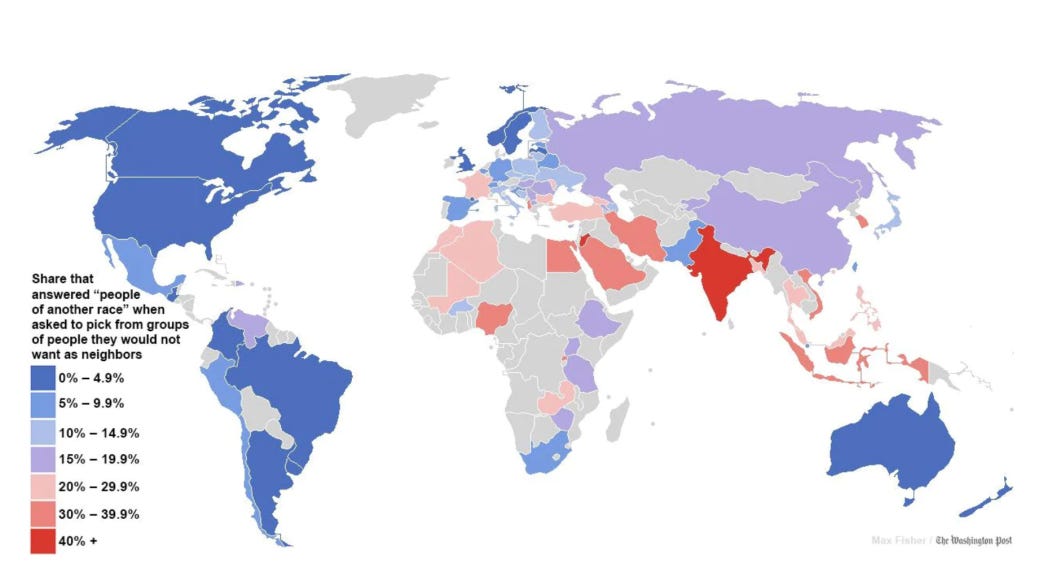
Share that answered “people of another race” when asked to pick from groups of people they would not want as neighbours. (Source: The Washington Post)
Start telling Westerners that their race actually does matter after all. Start telling them that their collective presence is a problem. Start telling them that their institutions are too White, their leadership is too White, their influence is too White, and their representation needs to be corrected.
And what will you do? You will awaken racial consciousness in the one group that has been conditioned not to think in terms of race and ethnicity. Eventually, you will make them ask a question they may never previously have thought necessary to ask:
What does it actually mean to be “White”?
Western society has long been taught that racial self-identification is a dangerous path toward extremism. At the same time, it often demands that Westerners view themselves as a racial collective when it comes to acknowledging historical sins.
White people can talk about being White when the subject is White privilege. They can talk about their ancestors when the subject is historical oppression. They can talk about their racial identity when they are being asked to acknowledge guilt, shame, or responsibility for the actions of people who came before them.
But they are not to ever think of themselves as a people with legitimate collective interests. They are not to ever celebrate their own identity in the same way other groups are encouraged to celebrate theirs. They are not supposed to organise around their own family interests.
They are supposed to understand their collective identity primarily as a moral liability. They are told to understand the differences between racial groups as a source of historical wrongdoing. They are told their ancestors’ achievements cannot be separated from unjust racial privilege. They are told that their racial identity comes with obligations, burdens, and moral debts.
But that’s not a natural posture for any people group to live with indefinitely. Eventually, people ask questions. Eventually, they begin examining themselves the way every other group has been encouraged to examine itself. Eventually, they begin thinking about their collective interests. They begin thinking about their identity. And they begin organising accordingly.
Of course, whenever that happens, we already know what the response will be. They’ll be called all the names. They’ll be accused of all the things. But the fact remains, to a large extent, they are the natural result of the societal pressures placed upon them.
If you continually tell people that race does not matter when it comes to their own people, but that it absolutely matters when it comes to everybody else’s, they will eventually grow tired of the double standards.
If you tell every other racial group that it’s legitimate to organise collectively around its identity and interests, eventually White people will ask why the same principle does not apply to them.
If you tell people that racial groups deserve special consideration, eventually people will ask whether their own group deserves it too.
And if you tell one racial group that its collective presence is a problem that needs to be diluted, eventually, members of that group will begin to wonder why they should just accept that judgment.
You can’t spend decades telling people to think in racial categories when it comes to everyone else and then be surprised when they start doing so for their own people. You can’t tell people that racial identity is enormously important for everyone except White people.
That’s simply not how human beings work.
Push people into a corner long enough and hard enough, and they will eventually re-examine the assumptions they were taught to hold about themselves. The irony is that the very people who claim to want a less racially conscious society are creating a more racially conscious one—because they are not advocating for less racial consciousness for all, only for White people.
The West spent decades trying to convince people that the colour of a person’s skin should not determine how they are treated. If we now begin treating Westerners differently because of the colour of their skin, we shouldn’t be surprised when Westerners begin to push back.
So, when White people begin thinking more consciously about their racial identity, we should not be surprised. When people are subjected to years of messaging that portrays their racial group as a problem, their demographic presence as something to be corrected, and their collective achievements as something to feel guilty about, it is entirely predictable that some will eventually reject the identity they were taught to have and begin reconsidering what it means to be White.
That is not something that happened in a vacuum. It is, in large part, the product of the very anti-White racial consciousness that has been relentlessly pushed upon them.
If you spend decades teaching White people to see race everywhere except within—unless it is viewed through a negative lens—and teaching them that their own race is uniquely problematic, you cannot reasonably expect them to remain indifferent to their racial identity forever.
L'analisi di Patrizio Ricci sulle nuove misure scolastiche del governo Meloni: limiti agli stranieri e divieto di velo nascondono il disastro geopolitico.
FIFA president Gianni Infantino has written to football chiefs across the globe saying he is open to talks about reforming the organisation, while affirming his commitment to remain in post.
UN Human Rights Council-appointed experts on Monday laid out a grim picture of the human cost of Russia’s invasion of Ukraine, with a spotlight on civilians facing a third wartime winter as well as the intimidation of Russians who have fled abroad.
O Presidente da República inaugurou a nova Escola Secundária de Cascais, acompanhado pelo Primeiro-Ministro, Luís Montenegro, pelo Ministro da Educação, Ciência e Inovação, Fernando Alexandre, pelo Presidente da Câmara Municipal de Cascais, Nuno Piteira Lopes, e pela Diretora do Agrupamento de Escolas de Cascais, Inês Muller.
In December of 2024, immediately following the ouster of Syrian President Bashar al-Assad, Israel invaded southwest Syria, and occupied a substantial swathe of land including the UNDOF demilitarized zone and Mount Hermon. Throughout negotiations and persistent further Israeli incursions, Israeli officials have insisted they don’t intend to ever return control over Mount Hermon, despite the […]
Ansar Allah, commonly known as the Houthis, said on Monday that its forces recorded a “major escalation” of Saudi airstrikes and missile attacks on Yemen as it continues to make gains against Saudi-backed forces on the ground. “In a major escalation, the criminal Saudi enemy targeted the governorates of al-Jawf, Taiz, Saada, and Marib with […]
Footage out of the capital of Iran, Tehran, reveals a mysterious flying object hovering above the city, following threats by US President Donald Trump to unleash exotic technology and destroy the entire nation. Videos circulating [...]
Are Satellites located in Space or within Earth’s Atmosphere?
MP
Most people would probably agree that a satellite describes a man-made communication device that is launched outside of Earth’s atmosphere into space.
According to the Cambridge Dictionary, a satellite is defined as:
“A device sent up into space to travel around the earth, used for collecting information or communicating by radio, television, etc.”
So as to determine if satellites are outside of the atmosphere, or not, the first logical question should be - at what altitude does space start?
According to most scientific resources, and popular belief, space begins where the atmosphere ends. The layers of the atmosphere, in ascending order, are described as the Troposphere, Stratosphere, Mesosphere, Thermosphere and finally the Exosphere. Space is generally believed to be the endless, dark abyss beyond the Exosphere.
When it comes to looking-up images of the layers of Earth’s atmosphere, there seems to be general agreement on the altitudes of the lower layers but it seems like guesswork when it comes to the precise extent of the Exosphere and therefore the beginning of space. It could be argued that the real reason for this lack of knowledge, or clarity, is because no man or machine has ever actually been there or, at least, been beyond the atmosphere.
Here are a couple of examples:
If man has travelled 250,000 miles to land on the Moon, and supposedly been back again recently to do a lap of honour, then surely the exact altitude of the start of space should be fairly easy to define. This information would then help to provide the answer for the question posed in this article.
The International Space Station
The International Space Station (ISS) is officially described as travelling over 17,000 mph at a maximum altitude of 250 miles. Now, it doesn’t take a rocket scientist to realise that 250 miles into the sky is well below the outer layer of Earth’s atmosphere, defined as being around 6,000 miles up. In fact, it’s not even close to the outer edge of the Thermosphere.
According to NASA, regarding the altitude of the space station, it states:
“ISS orbits at an altitude of between 200 – 250 miles (370-460 km).
Now, whether you actually believe the space station exists or not, the official altitude given for the ISS lies within Earth’s atmosphere, no matter what the discrepancy in the thickness of each layer.
For a more precise location of the ISS, which overcomes the discrepancy between different definitions of space, photographic evidence is provided here:
Satellites
According to worldatlas.com, “most satellites are found within atmospheric layers known as the Thermosphere and Exosphere”. To repeat once more, these altitudes are within layers of the atmosphere and not what most people assume to be in space.
“The Thermosphere is home to the International Space Station as it orbits Earth. This is also where you’ll find low Earth orbit satellites.”
The Karman Line
Interestingly, most people probably don’t realise that the officially accepted altitude of the start of space is actually nowhere near the outer edge of the Thermosphere and certainly not 6,000 miles up at the extent of the Exosphere.
Known as the ‘Karman Line’, the defining line for the beginning of space is described as being just 60 miles (100 kms) above ground level. According to an article on astronomy.com, The Karman Line, where Space Begins “Earth ends and outer space begins at the Karman Line, some 60 miles (100 kilometres) above the planet’s surface.”
Quoting Wikipedia, regarding the Karman Line:
“The Karman Line is a conventional definition of the edge of space; it is widely but not universally accepted. The international record-keeping body FAI defines the Karman Line at an altitude of 100 kilometres (54 nautical miles; 62 miles) above mean sea level.”
However, the U.S. Army brings space even closer to Earth. Wikipedia goes on to mention:
“The U.S. Armed Forces definition of an astronaut is a person who has flown higher than 50 miles above mean sea level, approximately the line between the mesosphere and the thermosphere.”
That means whenever you see 24-hour news coverage of a rocket launch into space or yet another group of celebrities heading off into the cosmos, they only have to go 60 miles up in the sky in order to be officially regarded as having been to space. That puts a bit of a dampener on most people’s impression that their idols have been out into the realms of Star Wars and Star Trek.
Even the astronauts that reportedly frequented the space station, for months on end, have never been outside of Earth’s atmosphere. This fact is proven by NASA’s own specifications on the altitude of the ISS relative to the layers of Earth’s atmosphere. The only space they have supposedly visited is just a layer in the atmosphere above which normal aircraft cannot fly.
By this stage in the investigation, there seems to be an awful lot of discrepancy and lack of continuity in the official definitions of space. Why is that so? Surely, the truth is the truth. However, if the entire narrative of an ever-expanding universe beyond Earth’s atmosphere is actually make-believe propaganda then it is understandable why there is so much variation in the storyline.
Van Allen Belts
Most people familiar with the Apollo missions to the Moon will have heard of the radiation band known as the Van Allen Belts. However, the location is assumed to be at a distance somewhere out in space between the Earth and the Moon.
Once again, discrepancies in the official narrative keep occurring. Low Earth Satellites are affected by the radiation from the Van Allen Belts. This indicates that the Van Allen Belts are in fact bands of magnetic radiation that exist within Earth’s atmosphere itself.
Solar Wind and Solar Particles
According to mainstream science there is no air in space. This should also mean that there is no wind. This does somewhat contradict the phrasing of solar winds. Furthermore, if the Heliocentric Sun is 93,000,000 miles away, doesn’t it seem a bit strange that solar particles and solar wind affect satellites within the Earth’s atmosphere?
Quoting from A.I., due to its ability to rapidly sift through mainstream articles, it states:
“Solar wind reduces satellite longevity by causing orbital decay, degrading hardware, and disrupting electronic systems.”
“Solar storms heat and expand Earth’s upper atmosphere (thermosphere), increasing atmospheric drag on satellites. This drag saps orbital energy, causing satellites to fall to lower altitudes faster than planned, as seen in the 2022 loss of 40 Starlink satellites.”
“Continuous bombardment by solar particles causes ‘sputtering’, which sandblast satellite surfaces and solar panels, leading to gradual performance degradation and reduce operational lifespan.”
Conclusion
If you believe that space is the dark expanse of the universe, starting above the outermost layer of Earth’s atmosphere, then satellites and the ISS are clearly not in space.
That means communications satellites, the International Space Station and Starlink satellites, are operating just up there in the sky. To be more accurate, they are all located within the defined layers of the atmosphere.
The only way that satellites can be described as being in space is by adapting the official definition of space itself. In other words, if space can be defined as being just 60 miles up into the atmosphere, then yes, satellites do most likely exist in space. The bottom line is that what most people think of as space is not what the mainstream media adopts for its’ own definition.
This then leads to a much more important question. If satellites and the ISS are unanimously described as being in space, while actually existing within Earth's atmosphere, what is to say that the Sun and Moon are not also within the atmosphere?
This video shows the sun is below the satellite
After all, the Sun and Moon can be seen with the naked eye and both seem to be exactly the same size and located just up there in the sky. The fact that the Thermosphere is so hot would also align with the idea that the heat of the Sun is in close proximity. Solar winds and solar particles occurring within the upper atmosphere also strengthen this argument.
As a final thought, what if the entire narrative of a spinning-globe earth, hurtling through endless space is all make-believe? There is not one iota of evidence, outside of mainstream propaganda, Hollywood movies and NASA CGI, which proves that space, actually exists.
The answer to that question is the key to understanding the truth about the world in which you live, why you are here and what life is really about.
Original Article: Emailed to us from MP a Truth11.com reader.
// Se já estiver a falar, para o áudio e repõe o botão
if (window.speechSynthesis.speaking) {
window.speechSynthesis.cancel();
botao.innerHTML = "🔊 Ouvir este artigo";
return;
}
// 1. Seleciona o bloco de texto do artigo (lógica original do Guia Algarve)
const artigo = document.querySelector('.entry-content') || document.querySelector('.post-content') || document.body;
// 2. Guarda o texto na memória
let textoFinal = artigo.innerText;
// 3. Remove a frase do botão para ela não ser lida
textoFinal = textoFinal.replace("🔊 Ouvir este artigo", "").replace("Ouvir este artigo", "");
textoFinal = textoFinal.trim();
if (textoFinal.length === 0) return;
// 4. Configura a voz
const mensagem = new SpeechSynthesisUtterance(textoFinal);
mensagem.lang = 'pt-PT';
// 5. Quando o áudio terminar sozinho, o botão volta ao normal
mensagem.onend = function() {
botao.innerHTML = "🔊 Ouvir este artigo";
};
// 6. Muda o texto do botão para indicar que se pode parar
botao.innerHTML = "⏹ Parar Áudio";
// 7. Começa a ler
window.speechSynthesis.speak(mensagem);
}
// Garante que o áudio para se o utilizador fechar ou mudar de página
window.onbeforeunload = function() {
window.speechSynthesis.cancel();
};
Durante muitos anos, a fina flor algarvia e a alta burguesia nacional reuniam-se, jogavam, conviviam e assistiam a espetáculos no Casino de Armação de Pêra, transformando-o no epicentro do glamour e da vida social do sul do país.
Inaugurado em1958, o então batizado Casino Turismo funcionou como o grande motor da modernização da região, liderando a transição desta antiga vila piscatória e rural para um destino turístico de prestígio internacional.
Nas décadas de 1950 e 1960, o edifício projetado pelo arquiteto Tavela de Sousa fervilhava com espetáculos culturais e noites requintadas.
Este dinamismo cosmopolita quebrou o isolamento da localidade e impulsionou o desenvolvimento urbanístico de Armação de Pêra, atraindo hotéis, novas avenidas e as primeiras esplanadas junto à falésia.
O casino tornou-se, assim, o principal postal de visita da frente de mar e um pilar essencial para o nascimento do turismo algarvio.
Após o encerramento nos anos 70 e décadas de progressivo abandono, a estrutura foi classificada como Património Cultural de Interesse Municipal.
De forma a devolver esta joia histórica à comunidade, a Câmara de Silves arrancou com uma profunda obra de reabilitação do Antigo Casino, que exigiu um investimento superior adois milhões de euros.
Quando reabrir, no interior do edifício funcionará um estabelecimento de restauração e bebidas, um espaço multiusos de vocação cultural e um posto de turismo.

 Login