❌

Normal view

BOMBSHELL! Florida’s Attorney General SUES Pfizer and Bourla for HIDING COVID Shot Deaths, Heart Damage, Miscarriages and Strokes

by Nicolas Hulscher, MPH – originally published on Focal Points substack

VERSIONE SINTETICA IN ITALIANO

All links to previous Gospa News posts have been added in the aftermath by virtue of the ties with topics covered

Florida Attorney General James Uthmeier has filed a sweeping lawsuit against Pfizer and its CEO, Albert Bourla, accusing them of deceiving the public about the safety and transmission-prevention capabilities of Pfizer’s COVID-19 mRNA injection.

The 49-page complaint was filed on October 1, 2026, in St. Lucie County, Florida, and targets Pfizer and Bourla personally under Florida’s Deceptive and Unfair Trade Practices Act.

The complaint opens with a striking line: “Those people are criminals.”That is how Bourla described people who publicly raised safety concerns about Pfizer’s COVID-19 injection.

After COVID-19 Vaccination 85-Million-Person Study Finds Increased Risks of Stroke, Heart Attack, Coronary Artery Disease, and Arrhythmia

At the center of the case is an explosive allegation: Pfizer publicly assured Americans that its COVID shot was safe while the company possessed internal and external safety information involving myocarditis, miscarriages, strokes, adverse events, and deaths.

158,893 adverse events in just 10 weeks

According to the complaint, Pfizer’s own adverse-event database contained 158,893 adverse events from 42,086 case reports by February 28, 2021—only about 10 weeks after the vaccine received emergency authorization.

The cover of the complaint (link in the sources)

Yet in January 2023, Bourla publicly stated that Pfizer had seen “not a single [safety] signal” despite billions of doses having been administered.

Florida argues that statement was fundamentally incompatible with information already known about myocarditis and pericarditis.

Myocarditis: Massacre after mRNA Vaccines! Other 28 Deaths Confirmed by Autopsies (Study), 18,000 Adverse Reactions, 10,000 Mysterious Heart Attacks

1,223 reported deaths

The complaint also states that Pfizer’s database contained 1,223 reported fatalities following vaccination as of February 28, 2021.

76,253 Dead Recorded in Europe and US Following COVID Vaccines. 4,358 Fetal Deaths: Pfizer Hid Disturbing Data on Pregnant Women Risks

Florida argues that the existence of this volume of serious adverse-event information undermined Pfizer’s sweeping public safety messaging.

The volume of reports became so large, according to the filing, that Pfizer hired 600 additional full-time employees and expected to hire another 1,800 workers to process adverse-event reports.

Pregnancy and miscarriages

Another major section of the lawsuit concerns pregnancy.

The complaint states that by February 28, 2021, Pfizer had reports involving 458 pregnant women exposed to its COVID vaccine. Of those reports, 248 involved an adverse event and 52 involved miscarriage, according to the filing. Nearly all of the reported miscarriages occurred during the first trimester.

The lawsuit also points to Pfizer’s planned clinical trial involving pregnant women.

Pfizer initially sought approximately 4,000 participants, but the complaint states that only 348 mothers and 335 infants were ultimately enrolled and that the study was terminated early. The women vaccinated in that study were 24–34 weeks pregnant, meaning the trial did not directly provide first-trimester vaccination data.

FAUCI & CDC KNEW THAT COVID VACCINES COULD TRIGGER MISCARRIAGE (5 videos). As Denounced by Gospa News in 2021 on 3,573 Cases of Fetal Death among Vaccinated Women

The complaint further cites the Comirnaty package insert as stating that there are no available data on use before 24 weeks sufficient to inform risks for major birth defects and miscarriage.

Pfizer pushed transmission claims without testing transmission

The second enormous pillar of Florida’s case concerns transmission. Pfizer and Bourla repeatedly told the public that vaccination would protect other people.

In December 2021, for example, Pfizer said that getting as many people vaccinated and boosted as possible remained the best course of action to “prevent the spread of COVID-19.”

But according to the complaint, Pfizer’s pivotal clinical trial did not test whether vaccination prevented person-to-person transmission.

The FDA itself stated in December 2020 that there was no evidence at that time that the vaccine prevented SARS-CoV-2 transmission from one person to another, and transmission was not an objective of Pfizer’s trial protocol.

COVID: THE HUGE LIE! During EU Hearing Pfizer Director Admits Vaccine was Never Tested on Preventing Transmission

A Pfizer executive later publicly acknowledged that the vaccine had not been tested for stopping transmission before entering the market.

Florida alleges that Pfizer nevertheless used the idea of protecting loved ones as a powerful marketing tool to increase vaccine uptake.

More than $80 BILLION in COVID vaccine revenue

The financial stakes were enormous. The complaint states that Pfizer turned approximately $1.5 billion in research and development spending into more than $80 billion in COVID vaccine revenue.

Pfizer’s vaccine captured nearly 70% of the U.S. and European COVID vaccine markets, according to figures cited in the complaint.

Meanwhile, Bourla received approximately $101.8 million in compensation from Pfizer between 2020 and 2023.

PFIZER VACCINE, THE HUGE BINGE! Inside Big Pharma Board Boss of Coca-Cola, Reuters, Gates Foundation, Goldman Sachs, FDA & FB

Florida’s complaint goes beyond safety claims and accuses Pfizer of engaging in broader unfair business practices to dominate the COVID vaccine market.

Florida wants the money back

Florida is seeking far more than a symbolic judgment. The Attorney General is asking the court for civil penalties, a permanent injunction against deceptive or unfair representations concerning Pfizer’s COVID vaccine, attorneys’ fees and other relief.

Most significantly, Florida is also seeking disgorgement—legal language meaning Pfizer could be forced to hand back profits connected to conduct the court ultimately determines violated Florida law.

FOUR other US STATES in Lawsuits vs “BIDEN’s VACCINE (Pfizer)”. None against the PENTAGON-FAUCI’s One (Moderna)

Finally, a government is attempting to hold Pfizer and Albert Bourla accountable by at least some degree for their gross deception.

For years, the company’s false safety and transmission claims helped drive mass vaccine uptake. Now those fraudulent claims are headed to court.


Nicolas Hulscher, MPH

Epidemiologist and Foundation Administrator, McCullough Foundation

Support our mission: mcculloughfnd.org

Please consider following both the McCullough Foundation and my personal account on X (formerly Twitter) for further content.


MAIN SOURCE

ATTORNEY GENERAL LAWSUIT DOCUMENT

Attorney General James Uthmeier Files Lawsuit Against Pfizer and its CEO Dr. Albert Bourla

Democrats aren’t ‘breaking from Israel’—they’re rebranding the status quo

1 October 2026 at 19:33
James Talarico speaks onstage during "Raging Moderates" at the Vox Media Podcast Stage at SXSW on March 14, 2026 in Austin, Texas. Photo by Rick Kern/Getty Images for Vox Media

Are top Democrats actually “shifting” on Israel, or is the PR simply getting more sophisticated? 

After the midterms wrap up and the race for the Democratic 2028 nominition for president kicks off in earnest, this will be a central question those concerned with the US role in the genocide in Gaza must grapple with clearly, honestly, and with—it turns out—a high degree of skepticism and media literacy. That’s because the forces committed to keeping the weapons flowing to Israel quickly adjusted their tactics to meet the mood of the public, and the mood of Democrats in particular. 

Last year for TRNN, I detailed the three main ways AIPAC Democrats will seek to look critical of Israel while assuring that the pro-Israel status quo remains fundamentally unchanged. Since I wrote that breakdown, a fourth talking point—and one that seems inevitable in retrospect—has emerged as a favorite of liberals who want to seem “tough on Israel,” but don’t want to upset the Israel Lobby. This line, which I documented last April, commits to “ending US aid to Israel” which, despite seeming like a meaningful break or a move left, is a policy that first emerged from Israeli Prime Minister Benjamin Netanyahu and the late US Sen. Lindsey Graham. And, as I noted, it was planned out by far-right think tanks Foundation for Defence of Democracies and Heritage Foundation—specifically designed to blunt the primary argument against support for Israel. Last January, Netanyahu told the Economist that he wants to “taper off” formal US military funding. Pro-Israel lobbying organization J-Street then took this right-wing idea and  proceeded to sell the “cut off aid to Israel” line to liberals as something they could take to their constituents as evidence that they are in line with Democratic voters’ overwhelming dislike of Israel, while not changing the status quo. Indeed, as IMEU documented in their critique of the plan, the effort would actually further entrench US-Israeli military alignment. 

The US can “cut off aid to Israel” and still very much continue to arm them. The only thing that has changed in this scenario is that Israel pays for it rather than the US government, but from the perspective of those being starved and maimed in Gaza this distinction matters about as much as the color of the bombs.

Much like the Biden White House’s slippery and misleading rebranding of “ceasefire,” the “ending aid to Israel” line relies on popular misunderstanding of what the load-bearing word means, in this instance, “aid.” In colloquial or common usage, it’s a word for general support—military, diplomatic, and financial. In reality, it simply means subsidizing—e.g. paying for—Israel’s weapons. The US can “cut off aid to Israel” and still very much continue to arm them. The only thing that has changed in this scenario is that Israel pays for it rather than the US government, but from the perspective of those being starved and maimed in Gaza this distinction matters about as much as the color of the bombs. 

As predicted, this “cut off aid” statement is fast becoming the go-to line for Democrats seeking to assure their increasingly anti-Israel base without upsetting the Israel lobby or the Democratic Senate and House leadership they are aligned with. Recently, after receiving criticism for inviting in AIPAC-linked consultants to steer his campaign, Maine Democratic Senate candidate Troy Jackson released a statement calling Gaza a “genocide” and pledging to “stop funding of Israel’s military”:

Troy Jackson’s public statement yesterday expressing his commitment to end the genocide in Gaza and stop funding Israel’s military was driven by a host of supporter letters sent directly to the campaign on those issues. pic.twitter.com/FMrMBPcU2W

— Nathan Bernard (@nathanTbernard) September 26, 2026

This is a perfect example of a J-Street-curated statement that, to the untrained eye, seems critical of Israel and committed to justice for Palestine, but actually says little of substance. There’s a lot of window dressing and gesturing, but ultimately Jackson’s policy is consistent with that of Benjamin Netanyahu’s. 

Rep. Ro Khanna, who very much appears to be running for president in 2028 and making Gaza central to his pitch for progressives, is similarly muddled in his stance. Despite supporting partial and temporary embargos here and there, Khanna told Hasan Piker in July that a full arms embargo on Israel would be “probably too far.” He has instead focused on the “cutting off aid” line that emerged out of the Israeli security apparatus and found its way into “progressive” circles via J Street.  

Democratic nominee for Senate in Texas, James Talarico, likewise gave a similarly underwhelming answer when asked about his position a few weeks later. Asked about Gaza last August on The Breakfast Club Show, he refused to label it a genocide, instead deferring to the “international criminal court” (and ignoring the overwhelming consensus of human rights groups and genocide scholars). Then he promised to “condition military aid” followed by two minutes of Obama-esque vapid empathy-speak. 

That isn’t to say all Democrats are simply rebranding the status quo. It seems, despite his campaigning with central defender of the genocide Kamala Harris, Abdul El-Sayed is expressing a firm commitment to an arms embargo on Israel. Obviously, this is also the case for DSA-endorsed candidates who are not splitting hairs or letting J-Street manage their Israel policy. But these firm commitments are the exceptions. Increasingly, what we’re seeing is a squishy mix of empathy-speak, vague gesturing, highly conditional pledges to “condition aid” and other such abstractions with little in the way of firm commitments. 

The only actions Democrats have, at scale, taken to “break from Israel” is recent spattering of Congressional votes over the past year designed to signal disapproval but change nothing of substance. These bills vary between genuine, if partial, arms embargo and the aforementioned “end aid” framework endorsed by Netyanhau and Graham. It’s complicated, but worth dissecting, because it can help illustrate how much energy and effort is going into these pseudo “breaks,” namely those being pushed by Israel lobbying group J-Street. One House bill from last July sought to “end aid” to Israel. The bill had some merit as it isolated Israel as such. But, like all of these bills, it was effectively a “messaging vote” because it had zero chance of passing, and because it aligned with the Netyanhau-approved “ending aid” framework. Almost half of Democrats in Congress supported it, including long-time reliable Israel ally Nancy Pelosi. 

A few months later, we saw the slightly more substantive, but ultimately performative, partial arms embargo bills in both the House and Senate. Though different, they both involved preventing further sales of certain weapons to Israel given certain conditions. In the House, 104 Democrats backed the measure, and in the Senate, all but seven Democrats, including major Israel supporters, backed the measure. 

These votes, in effect if not intent, end up serving as little more than anti-Israel thingamajigs that liberal zionists in Congress can point to when confronted on the issue as evidence that they are not a rubber stamp for Israeli violence.

But these bills, as everyone involved in their drafting, lobbying, and counter-lobbying know, were totally DOA. They have zero chance of actually passing, much less getting a President Trump veto-proof majority. Thus—despite many activists’ best intentions—they functionally serve as little more than a mechanism for reputation laundering for liberals who’ve backed Israel’s genocide and its broader regional violence, but who can read a poll as well as anyone else. These votes, in effect if not intent, end up serving as little more than anti-Israel thingamajigs that liberal zionists in Congress can point to when confronted on the issue as evidence that they are not a rubber stamp for Israeli violence. Indeed, suspiciously enough, the Senate version last April garnered the support of staunch Israel advocate and AIPAC-money sponge Cory Booker, who grinningly met with Israeli defensive minister Yoav Gallant after Gallant was indicted by the ICC for crimes against humanity. Does anyone think for a second Booker would have backed a bill to prevent weapons sales to Israel if it had a remote chance of passing? Does anyone think his vote in support is evidence he’s “breaking from Israel”? Or is it evidence of something a bit more subtle, and sinister, which is Democrats realize they need to appear as if they’re breaking from Israel without the messiness of actually doing so? 

But if the above bills are largely superficial and performative, why would Hakeem Jeffries write a letter in opposition, one may ask? For the same reason Jeffries agreed to let the vote happen and not discipline those supporting it: it’s all part of an intramural scrimmage between zionist allies who disagree on how best to “rein in” Israel. On substance, nothing fundemental is permitted to change, and the idea of ending military support was never on the table. Jeffires and AIPAC both understand that this is a 80/20 issue against them and are allowing their members more latitude in rhetorical and ideological distance, so long as the weapons flow remains unabated which it, of course, securely remains. 

One of the more difficult tasks for an activist of good faith is being able to tell the difference between genuine, if incremental, progress, and counterinsurgency—that which appears like incremental progress but is, in fact, a move to the right with better PR.

In his urging of support for the bill earlier this year, Rep. Greg Casar, chair of the Congressional Progressive Caucus, said that “American people are crying out for an end to US tax dollars subsidizing Israel’s military.” But American people are not so much crying out for this, and certainty Palestinians aren’t, as they are an end to the genocide and occupation. It doesn’t matter if this genocide is “subsidized” by “US tax dollars” or not—the source of military funding is mostly arbitrary and inconsequential. What activists are demanding, what Democratic voters are demanding, is not a “message” bill or limited to “defensive weapons” with 18 qualifiers and carveouts, but support for a total arms embargo in principle and as a long term strategy of ending US support for the dispossession and killing of Palestinians. 

One of the more difficult tasks for an activist of good faith is being able to tell the difference between genuine, if incremental, progress, and counterinsurgency—that which appears like incremental progress but is, in fact, a move to the right with better PR. Sorting out the difference in the coming months is going to be essential to make sure we don’t just elect a whole new crop of liberals who, despite more convincing crocodile tears and more sophisticated handwringing, just go back to shipping weapons systems and scrambling the sixth fleet to defend Israel’s next “defensive war.” 

As voters concerned with the full-scale destruction of Gaza analyze the statements of politicians seeking to appear “good on Gaza” in the coming months, there are two central commitments they must attempt to pin down: (1) support for a full arms embargo without any conditional statements or tortured caveats and (2) support for the Boycott Divestment and Sanction movement, which seeks to economically isolate Israel. These are the positions that would logically follow from a belief that the country in question is committing genocide—as top progressives likely seeking the White House, like Alexandria Ocasio-Cortez and Ro Khanna—said they believe. These measures—not nickel and diming “offensive” versus “defensive,” not singling out “Netanyahu,” not making vague promises to “condition aid” if Israel meets some unknown, arbitrary benchmark of humane mass killing—are the only thing that will move the needle and compel Israel to temper its exterminationist policies and plans. Only one member of Congress, Rep. Rashida Tlaib, unequivocally supports BDS, but certainly far more are capable of committing to a full arms embargo. If they cannot do even this bare minimum, and do so clearly, then the only logical conclusion one can reach is they are simply saying nice-sounding words, and checking the rhetorical box of “genocide,” so they can get elected then go back to enforcing and maintaining the genocidal status quo. 

Flávio Bolsonaro, os hospitais federais e a pandemia de Covid no Rio de Janeiro

1 October 2026 at 19:00

Investigamos o que importa para os brasileiros além do que passa na campanha eleitoral. Leia mais reportagens como essa clicando aqui.

Atual candidato à presidência da República, o senador Flávio Bolsonaro (PL-RJ) não tinha cargo no governo de seu pai, mas exerceu forte influência política nos hospitais federais do Rio de Janeiro entre 2019 e 2022, de acordo com gestores e ex-gestores hospitalares, parlamentares, funcionários dos órgãos de controle da União e servidores públicos entrevistados pela Agência Pública. 

Publicamente, dois políticos se pronunciaram neste ano sobre o controle dos hospitais federais por Flávio durante o governo do pai. Em março de 2026, o deputado federal Otoni de Paula (PSD-RJ), um pastor evangélico de direita, acusou o senador de ter liderado um esquema de corrupção nos hospitais federais do Rio. “Toda a estrutura de poder e de indicação política, e as empresas que participariam de licitações, que ganhariam ou perderiam, tudo isso estava dentro do grupo cuja cabeça era o senador Flávio Bolsonaro”, afirmou. Otoni tem defendido o voto em Lula, adversário de Flávio. 

Dois meses depois, em maio, durante a inauguração de um novo centro na Fiocruz, o ministro da Saúde, Alexandre Padilha (PT-SP), chamou Flávio de “o poderoso chefão” dos hospitais federais no governo de seu pai, e voltou a utilizar o termo em entrevista à Agência Pública em setembro. “Era, de fato, o poderoso chefão dos hospitais federais. Passava por ele a indicação de quem seria diretor e todas as decisões relacionadas a hospitais e contratos. Ele montou um esquema de rachadinha política com a ocupação dos cargos e provocou um desmonte. Todos os contratos de terceirizados tinham funcionários fantasmas. Um contrato de limpeza falava em 200 postos de trabalho, quando a gente olhou só havia 50 pessoas trabalhando”, disse o ministro. 

Com orçamento superior a 3 bilhões de reais para os quatro anos, período em que o país enfrentou a pandemia de Covid, documentos e depoimentos obtidos pela Pública revelam que a precariedade no funcionamento dos seis hospitais federais do Rio convivia com contratos superfaturados e concentração de recursos em custeio de despesas, comandadas pelos administradores locais, que seriam indicados pelo grupo político de Flávio Bolsonaro. 

Enquanto isso, de acordo com o relatório final da CPI da Covid, que dedica um capítulo inteiro ao Rio de Janeiro, 30% dos leitos clínicos e de UTI nos hospitais e institutos federais na capital fluminense “estavam e permaneceram fechados durante a pandemia, embora pudessem ter sido disponibilizados aos pacientes nesse período, evitando, inclusive gastos com abertura de hospitais de campanha. A maior parte estava fechada por falta de profissionais de saúde. No fim de dezembro de 2020, 3,5 mil contratos foram encerrados nos hospitais federais do Rio de Janeiro. Posteriormente, a Medida Provisória nº 1.022, de 31 de dezembro de 2020, prorrogou apenas 1,4 mil contratos por sessenta dias. Esse quadro foi decisivo para agravar o atendimento à população do Rio de Janeiro ante o recrudescimento da pandemia”, conclui o relatório. 

O Estado do Rio de Janeiro registrou mais de 2,8 milhões de casos confirmados de Covid e 77.166 mortes, sendo que mais da metade delas – 38,8 mil – ocorreram na capital. 

A atuação de políticos nos bastidores dos seis hospitais federais do Rio – Hospital do Andaraí, Hospital Geral de Bonsucesso, Hospital Cardoso Fontes, Hospital de Ipanema, Hospital da Lagoa e Hospital dos Servidores – durante a pandemia, já desastrosa em nível federal, pode ser contada também pelas marcas que deixou nas unidades que fazem parte da rede de assistência do SUS. A bagunça foi tão grande que a milícia chegou a ocupar um terreno do Hospital Cardoso Fontes para extorquir funcionários e familiares de pacientes com a cobrança de estacionamento, segundo inquérito aberto na Polícia Civil. 

Em abril de 2023, a pedido do deputado e médico sanitarista Daniel Soranz (PSD-RJ), a Comissão de Fiscalização Financeira e Controle da Câmara visitou a rede federal do Rio e encontrou 735 leitos inoperantes ou bloqueados, andares inteiros vazios, alas trancadas com correntes e cadeados, obras paralisadas e equipamentos sem uso. 

No Hospital do Bonsucesso, onde, em plena pandemia, um incêndio que começou no almoxarifado matou quatro pacientes – todos internados com Covid-19 –, a emergência estava fechada, embora reformada, por falta de pessoal; 126 dos 411 leitos estavam impedidos, e diálise, cardiologia e pós-operatório estavam parados. No Andaraí, a falta de médicos era tão grande que até para declarar a morte de pacientes a demora chegava a duas horas. A cozinha inacabada obrigava o hospital a gastar R$ 1,6 milhão por mês transportando comida. No Cardoso Fontes, pacientes esperavam em pé e em macas improvisadas nos corredores. 

“É ainda mais grave que isso tudo tenha ocorrido durante a pandemia”, afirma Soranz, que é doutor em saúde pública pela Fundação Oswaldo Cruz e um dos principais nomes da saúde pública do Rio nos últimos anos, quando foi secretário municipal da área em três períodos diferentes, sempre em gestões do ex-prefeito Eduardo Paes, também do PSD. Segundo ele, “Flávio [Bolsonaro] teve uma influência nefasta para os hospitais federais, foi algo terrível”, disse à Agência Pública. 

Contratos superfaturados 

Um diagnóstico de 235 páginas feito pelo Ministério da Saúde em fevereiro de 2023, ao qual a Pública teve acesso, mostra que 72% dos recursos dos seis hospitais – R$ 50,3 milhões por mês – eram consumidos em custeio, ou seja, com contratos administrativos, como limpeza, vigilância e rouparia. No Hospital do Bonsucesso, onde a fatia chegava a quase 80%, os contratos de apoio administrativo com a empresa Nova Rio Serviços Gerais tinham margens de lucro até 561% maiores do que o acordado e custos indiretos até 581% superiores aos acertos equivalentes do ministério. O hospital pagou mais de R$ 2 milhões em plano de saúde privado para funcionários da empresa terceirizada e adicional de insalubridade, sem laudo, para secretárias e almoxarifes. 

Aliados de Flávio Bolsonaro também aparecem nesses contratos como a família do deputado federal Altineu Côrtes, presidente do PL no Rio de Janeiro. A lavanderia Max Clean, fundada pelo pai de Altineu e registrada em nome de uma tia, multiplicou por oito seu faturamento durante esses anos. Segundo informações do Portal da Transparência, a empresa já recebeu R$ 81,5 milhões do Ministério da Saúde em centenas de contratos – e continua recebendo até hoje. “A Max Clean atendia todos os hospitais. Hoje, continua no Hospital dos Servidores e no Lagoa, é difícil tirá-los. Os fiscais do ministério que analisam esse contrato já pediram para deixar a função. É muita pressão”, revela uma servidora, que preferiu não se identificar. “Em época de pregão, o Seu Altineu, pai do deputado, chegava armado nos hospitais com uma sacola cheia de chocolates, distribuindo doces pra gente. Nossa esperança é tirar eles em abril, quando o contrato vence, e que eles não ganhem a próxima licitação.”

O mesmo diagnóstico do Ministério da Saúde explica como os contratos emergenciais se multiplicavam. “Não raro a troca de diretor ou de coordenador de Administração coincidia com a proximidade do término de um contrato, e quando um novo diretor era nomeado não tinha tempo hábil para iniciar processos regulares, e um novo contrato emergencial era efetuado”, registra o documento, que lembra que esse tipo de contrato “geralmente tem um valor acima do licitado”. Entre 2019 e 2022, o Hospital do Bonsucesso teve cinco diretores. O relatório também recomendou auditar a pesagem da roupa suja e o faturamento da lavanderia, onde as peças eram levadas “sem controle de saída”.

Não há um cálculo do sobrepreço total nos contratos de 2019 a 2022, mas a Pública obteve 13 relatórios do Tribunal de Contas da União (TCU) e outros cinco da Controladoria Geral da União (CGU) que indicam valores muito acima do mercado e foram localizados em auditorias preventivas, evitando que fossem assinados. Em uma delas – que analisou o Edital do Pregão Eletrônico nº 05/2022 para a compra de 120,9 milhões em insumos para cirurgia vascular para o Hospital dos Servidores, a auditoria identificou “falhas na estimativa de preços que resultaram na adoção de valores superdimensionados em aproximadamente R$ 69 milhões”, ou seja, sobrepreço de 57%. 

Em outro caso, no mesmo hospital, a análise do Pregão Eletrônico nº 20/2021, que autorizou a compra de medicamentos para pacientes com câncer no valor de R$ 31,3 milhões, identificou sobrepreço de R$ 18,1 milhões, ou seja, novamente de 57%. Houve ainda uma tentativa de compra de stents heparinados para cirurgia vascular por R$ 7,5 milhões. Em licitações públicas regulares no Brasil, eles são comprados por valores que não costumam passar de R$ 30 mil. O Hospital dos Servidores pagaria R$ 42 mil em cada uma das 180 unidades.

Fachada do Hospital Federal do Andaraí
Hospitais federais do Rio enfrentaram sucateamento e problemas de gestão durante o governo Bolsonaro

Um “feudo” dominado por políticos 

“Em todo o país, só o Rio de Janeiro tem hospitais federais pelo fato de ter sido a capital até 1960”, lembra o médico João Marcelo Ramalho Alves, diretor do Hospital dos Servidores Federais, que era conhecido como “hospital dos presidentes”. Inaugurado em 1947, tendo Getúlio Vargas como matrícula número 01, o hospital atendeu a cúpula do poder por décadas, e foi pioneiro em diversas áreas, como a introdução da residência médica e a realização de cirurgias inéditas e transplantes. Com o tempo e a mudança da capital para Brasília, os hospitais ficaram suscetíveis a políticos do Rio, que já teve outros parlamentares como figuras centrais como Roberto Jefferson. 

“Um hospital só perde em complexidade para controle de tráfego aéreo. São contratos de vários tipos, mais de 5 mil itens a comprar. Para quem quer fazer esquema, sempre foi uma área fácil”, diz Ramalho Alves, que também dirige o Hospital Universitário Gaffrée e Guinle e foi diretor do Departamento de Gestão Hospitalar do Ministério da Saúde no Rio em 2014.

Isso poderia explicar o interesse de Flávio Bolsonaro pelo “feudo”, que se manifestou ainda na primeira gestão do Ministério da Saúde do governo do pai, embora ele jamais tenha tido atuação relevante na área da saúde, nem no Senado nem na Assembleia Legislativa do Estado do Rio, onde exerceu quatro mandatos consecutivos como deputado estadual. Em 31 de julho de 2019, Flávio manifestou publicamente sua oposição ao indicado pelo então ministro Luiz Mandetta para o Hospital Geral do Bonsucesso, o médico Paulo Cotrim, efetivado depois de seis meses como interino. O hospital é a maior unidade de saúde do Rio em volume de atendimentos e com 4,5 mil funcionários.

Cotrim substituiu Luana Camargo, depois que a ex-diretora promoveu uma festa de aniversário do hospital que custou mais de 150 mil reais, segundo ela pagos por fornecedores. Revoltados com a patuscada em uma unidade sem ar-condicionado, superlotada, com postos de trabalho ocupados por pessoas sem experiência e onde os próprios pacientes tinham que comprar seus remédios, os servidores invadiram a festa e enviaram uma carta ao ministro Mandetta.  À época, o então ministro da Secretaria-Geral da Presidência, Gustavo Bebianno, declarou ter “fortes indícios e depoimentos” de que o hospital estava dominado por uma milícia.

A decisão de afastar Luana fez uma equipe da pasta ser ameaçada durante vistoria à unidade, mas Mandetta efetivou o servidor, o que desagradou Flávio Bolsonaro, que criticou o ministro nas redes sociais ao ter seu nome marcado em um post que enaltecia o novo diretor. “Esclareço que não tenho NENHUMA participação/responsabilidade na nomeação do Sr. Paulo Cotrim. Se tivesse sido consultado, diria para não nomeá-lo”, afirmou, dizendo que o médico já havia ocupado “cargos importantes em gestões passadas nessa unidade, que possui um histórico sombrio de má gestão e indicações políticas”. Menos de um mês depois, Cotrim foi exonerado.

Em seu lugar entrou Cristiane Jourdan, defensora do uso de hidroxicloroquina para tratamento da Covid-19, e depois escolhida por Jair Bolsonaro para a diretoria da Anvisa. Reportagem do Jota na época afirmou que, ao dirigir o Hospital de Bonsucesso, ela “acabou vinculando sua imagem ao senador Flávio Bolsonaro, responsável por orquestrar algumas mudanças na gestão hospitalar do estado”. Durante a gestão de Jourdan, como consta no relatório final da CPI da Pandemia, o hospital chegou a fechar as portas após ser anunciado como unidade de referência para a Covid-19. “No entanto, a maior parte dos leitos não foi utilizada, mesmo tendo sido fechados 28 serviços especializados de média e alta complexidade”, diz o relatório da CPI. “Dos 240 leitos existentes, apenas 18 pacientes estavam internados por Covid-19 e 17 estavam na emergência. Ou seja, na prática, o hospital de Bonsucesso não foi referência na pandemia e tampouco atendeu à população nos demais serviços, impactando a assistência à saúde”.

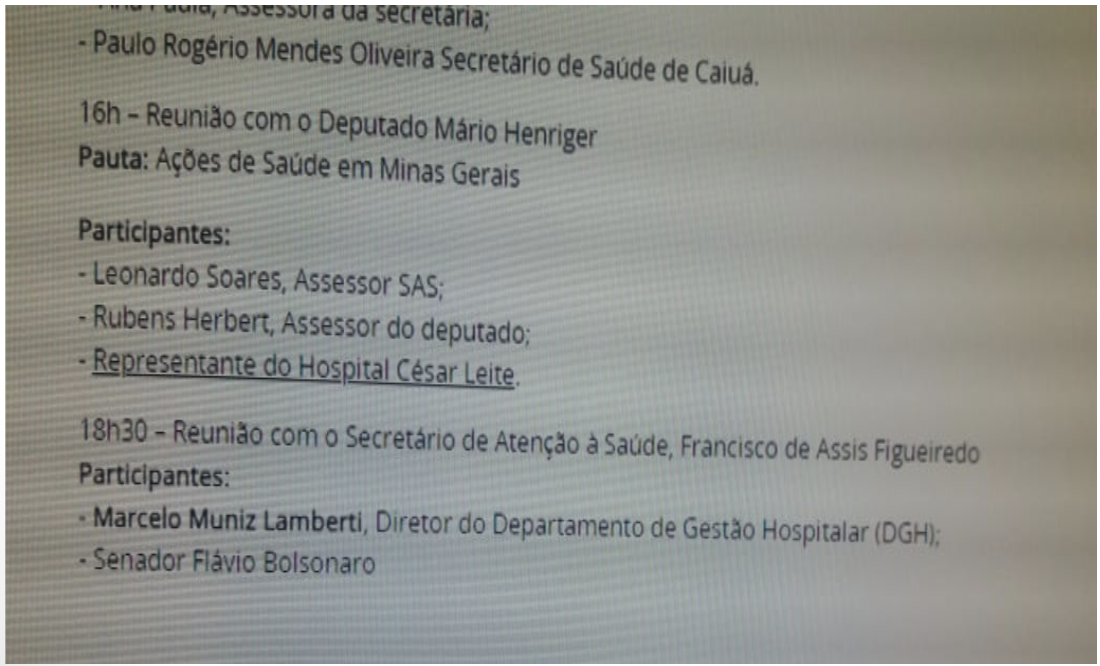
A partir do episódio Luana/Cotrim, as indicações começaram a passar pelo filho mais velho de Bolsonaro. Já havia sido escolha dele, em fevereiro daquele ano, o nome do médico Marcelo Muniz Lamberti para assumir o Departamento de Gestão Hospitalar (DGH) do Ministério da Saúde no Rio, chefiando diretamente os hospitais. Lamberti ascendeu rapidamente ao posto de Superintendente do Ministério da Saúde no Rio e, em junho de 2019, tornou-se Diretor de Programa da pasta, posição vinculada ao gabinete do ministro.

Duas semanas antes de Lamberti ser alçado a diretor, Flávio Bolsonaro participou de uma reunião em Brasília com o ministro Mandetta, o próprio Lamberti e o então secretário de Atenção Especializada à Saúde (Saes), Francisco de Assis Figueiredo. O encontro entrou na agenda oficial do ministro: foi dia 28 de maio de 2019.

Assim que assumiu o cargo, Lamberti teria promovido  uma “caça às bruxas”, nas palavras de um servidor concursado, demitindo aqueles do campo político oposto ao governo. A Pública também teve acesso à gravação de uma reunião, realizada no dia 6 de março de 2020, com 3h11m de duração. Nela, além de ameaçar demitir terceirizados e servidores temporários, Lamberti afirma que é ele quem manda no ministério da Saúde no Rio de Janeiro e que, se fosse preciso, rasgaria a Constituição para fazer valer sua vontade. 

Pressão sobre Nísia Trindade e descentralização dos hospitais

Primeira mulher a assumir o ministério da Saúde no início do novo governo, em 2023, a ex-presidente da Fundação Oswaldo Cruz, Nísia Trindade acertou com o presidente Luiz Inácio Lula da Silva que teria autonomia total para escolher os diretores dos hospitais “exatamente por causa do que todo mundo sabia existir”, conta em entrevista à Agência Pública. “Um descalabro absoluto, era um problema crônico do Rio”, comenta. 

Nísia admite ter sofrido “muita pressão” dos que queriam controlar o “feudo”, sobretudo de políticos do Centrão, ela diz, citando o ex-presidente da Câmara dos Deputados, Arthur Lira (PP-AL). “Ele questionava o fato do orçamento de R$ 240 bilhões do ministério ser gerido por mim”, lembra. Outro parlamentar que trabalhou para tirar Nísia da pasta foi o Doutor Luizinho (PP-RJ), que sonhava – e ainda sonha – ser ministro da Saúde e comandar o terceiro maior orçamento da Esplanada do Ministério, que só perde para Previdência Social e Desenvolvimento e Assistência Social. Ex-secretário de saúde no Rio, o Dr. Luizinho se tornou nacionalmente conhecido por seu envolvimento com transplantes de órgãos infectados pelo vírus HIV.

Nísia afirma que “havia muita resistência” a qualquer mudança. A solução encontrada pelo novo governo foi tirar os hospitais da administração direta do ministério e reestruturar a gestão. Não foi tarefa fácil. Em outubro de 2024, o Bonsucesso passou ao Grupo Hospitalar Conceição, empresa pública federal ligada ao Ministério da Saúde e sediada em Porto Alegre. O hospital ficou cinco dias ocupado por manifestantes e os novos administradores só conseguiram entrar depois de uma decisão de reintegração de posse e acompanhados pela Polícia Federal. Ainda assim, o Ministério da Saúde teve que pedir uma escolta armada para a nova diretora da unidade, Elaine López. Dois meses depois, os hospitais de Andaraí e Cardoso Fontes foram entregues à prefeitura do Rio. 

Brasília (DF), 16/07/2024 - A ex-ministra da Saúde, Nísia Trindade durante entrevista coletiva
Nísia Trindade assumiu o Ministério da Saúde em 2023 e iniciou a reestruturação dos hospitais federais

Em março de 2025, Nísia foi substituída no ministério por Alexandre Padilha, mas o processo de reestruturação dos hospitais federais no Rio continuou. Em dezembro, o Hospital dos Servidores foi incorporado à UNIRIO, sob gestão da Ebserh, rebatizada em março como HU Brasil – outra empresa pública federal criada em 2011 para gerir hospitais universitários –, e atravessou um processo de fusão com o Hospital Universitário Gaffrée e Guinle. O Hospital da Lagoa passou à Fundação Oswaldo Cruz em 2026. Só o Hospital de Ipanema continua sob gestão direta do ministério.

Com a reestruturação, o orçamento total dos seis hospitais passou de aproximadamente R$ 800 milhões para R$ 2 bilhões anuais. Segundo o ministério, já houve aumento de 30% no número de cirurgias (foram 21.869 em 2025) e 28% a mais de internações (42.516 em 2025). Houve também reabertura de 335 leitos somando todas as unidades (27% a mais do que antes) e 16 salas de cirurgia reativadas.

O deputado Daniel Soranz, da Comissão de Fiscalização Financeira e Controle da Câmara, elaborou um relatório, ao qual a Pública teve acesso, comparando a situação dos hospitais federais no Rio em dois períodos diferentes: abril de 2023, logo no início do novo governo, e o segundo semestre de 2026. A ideia era avaliar os avanços do plano de reestruturação em relação aos anos Bolsonaro. No Bonsucesso, os leitos em funcionamento passaram de 215 para 423 e a emergência foi reaberta em janeiro de 2025. As internações cresceram 46,6%, as cirurgias 55,9% e os exames, 45,4%. Os profissionais aumentaram 73,4%, de 3.150 para 5.462, e o investimento, que ficou entre R$ 3,3 milhões e R$ 5,6 milhões por ano entre 2020 e 2023, chegou a R$ 36,7 milhões em 2024, segundo o relatório. 

No Andaraí, a emergência, fechada havia dez anos, voltou a funcionar e ganhou estrutura definitiva, e em 2026 foi inaugurado o novo prédio de Trauma. A cozinha foi concluída, o que acabou com o gasto mensal milionário com transporte de comida. A radioterapia foi inaugurada, o centro de queimados foi ampliado e o centro cirúrgico passou de três para 12 salas. O hospital ganhou 23 leitos de UTI, um tomógrafo e um ambulatório com 21 salas. Os leitos em funcionamento subiram de 165 para 351, com ocupação entre 96% e 99%, as cirurgias cresceram 36% e os profissionais cadastrados passaram de cerca de 2,6 mil para 5.114. 

No Cardoso Fontes, todos os leitos foram reabertos, as internações aumentaram 72%, de 4.084 para 7.034, e o quadro de pessoal cresceu 41,7%. A equipe da prefeitura, que cuida da regulação de vagas nos hospitais do SUS, antes impedida de atuar, segundo o relatório da Câmara, passou a trabalhar dentro da unidade. Em Ipanema, a fila de cirurgias caiu 38%, as internações passaram de 4.853 para 5.594, as cirurgias chegaram a 12.378 no ano, recorde da série, e o quadro de pessoal cresceu 23,1%. No Lagoa, as internações subiram 11,9%, e nos primeiros meses da nova gestão cresceram 21,7%, com alta de 20,9% nas cirurgias. A melhora, porém, é desigual. Em Ipanema, as três salas cirúrgicas fechadas em 2023 continuam sem uso e as consultas ambulatoriais caíram de 118 mil para 112,8 mil. No Lagoa, a produção ambulatorial caiu de 1,08 milhão de procedimentos em 2023 para 606 mil em 2025, e os servidores efetivos diminuíram de 850 para 734, enquanto os temporários passaram de 525 para 764. 

O médico João Marcelo Ramalho Alves, que dirige o Hospital dos Servidores e o Gaffrée e Guinle, que já resultou na contratação de 1.258 profissionais por concurso depois da fusão, também apoia a reestruturação. “O caminho é esse. O Ministério da Saúde existe para criar e gerir políticas públicas, não para administrar hospitais”, diz Alves, que lembra que ainda há muito a ser feito para recuperar os hospitais do Rio. Apesar dos avanços, a fila de pessoas à espera de cirurgia aumentou de 18 mil pacientes para 21 mil desde 2024, segundo informações do portal que contabiliza esses dados. 

Biópsias em potes de sorvete e pedidos de investigação

Em 2025, a Defensoria Pública da União encontrou biópsias acumuladas por meses no Bonsucesso, guardadas no formol em potes de sorvete e paçoca por falta de médicos patologistas – um problema sobretudo para pessoas com câncer que, por lei, devem iniciar o tratamento no SUS até 60 dias após o diagnóstico. “Se não tem diagnóstico, não tem tratamento. Tivemos que entrar com uma Ação Civil Pública, que segue tramitando, para pedir um novo plano de trabalho dos hospitais federais como um todo. A mudança de gestão foi mal recepcionada por servidores e o déficit de médicos ainda é grande”, afirma Taísa Bittencourt Leal Queiroz, Defensora Regional de Direitos Humanos da Defensoria Pública da União. “Quando a saúde é invadida pela política, ela se deteriora de um jeito absurdo. Quem sofre com isso é a população que depende do SUS”, diz a defensora. 

No fim de agosto, o deputado federal Lindbergh Farias (PT-RJ) pediu ao Supremo Tribunal Federal que investigue Flávio por suspeitas envolvendo o controle político dos hospitais federais. Ele citou no documento as auditorias do TCU e da CGU que identificaram os sobrepreços nos contratos. A notícia do fato foi encaminhada ao ministro Flávio Dino e pede que uma investigação, já em andamento no STF, seja ampliada para apurar a conduta do senador, e se ele teve participação nas irregularidades constatadas. Lindbergh citou no documento o depoimento na CPI da Pandemia, em 16 de junho de 2021, do ex-governador do Rio Wilson Witzel, que afirmou que os hospitais federais tinham dono. “Tem um dono, e esta CPI pode descobrir quem é o dono”, disse diante de Flávio Bolsonaro e dos demais presentes. Em seguida, confirmou a parlamentares que se referia a Flávio, mas negou a declaração ao ser processado pelo senador. 

Integrantes da CPI disseram à Pública que faltou tempo e recursos para investigar a denúncia de Witzel. A comissão apontou quatro pessoas como responsáveis pelas irregularidades constatadas. Além de Marcelo Lamberti, foram citados o coronel da reserva George Divério, que também foi superintendente do Ministério da Saúde durante a presidência de Bolsonaro, Jonas Roza, que trabalhava com Lamberti no DGH, e o advogado Joabe Antonio de Oliveira, servidor concursado que foi coordenador administrativo da Superintendência do ministério no Rio e diretor administrativo do Hospital de Bonsucesso. Divério foi nomeado em 2020 e exonerado em 26 de maio de 2021 após denúncias de contratações sem licitação – em um período de dois dias, ele autorizou dois contratos que somavam R$ 28,8 milhões. Joabe aprovou contratações sem licitação com valor superior a R$ 14 milhões no Bonsucesso.     

Senador Flávio Bolsonaro (PL-RJ) em discurso à tribuna.
Flávio Bolsonaro é alvo de pedido de investigação sobre sua atuação nos hospitais federais do Rio

Procurado pela Pública, Flávio não respondeu aos pedidos de entrevista feitos ao seu assessor. Marcelo Lamberti respondeu por mensagem. Garantiu que “os atos da gestão estão disponíveis no SEI (Sistema Eletrônico de Informações, plataforma oficial do governo federal para gestão de documentos e processos administrativos), corroborando as ações verídicas e documentadas procedidas, incluindo as de correição junto aos órgãos federais de controle para apurar irregularidades”. Segundo Lamberti, “quanto a narrativas e ilações de opositores a essas correições procedidas no SEI, nada tenho a falar pela falta de conteúdo técnico”. O médico também afirma que, após se desligar das atividades exercidas no ministério, não responde a processos pela sua gestão. Perguntado sobre sua relação com Flávio Bolsonaro, se eles já se conheciam antes do senador indicá-lo ao cargo e como Flávio exercia influência nos hospitais federais, Lamberti se disse um “servidor técnico”, e que “nomeações e exonerações de servidores estão a cargo do escalão superior da pasta”. 

🔴Il ricatto di Netanyahu | FRACASSI A LEVANTE LIVE

1 October 2026 at 18:47

A Levante questa sera, giovedì 1 ottobre 2026, alle 19, Margherita Furlan dialoga con Franco Fracassi, giornalista d’inchiesta e documentarista, sul volo Flydubai Dubai-Tel Aviv dirottato verso l’Arabia Saudita. Netanyahu ha parlato di «un 11 settembre evitato». Ci chiediamo chi scrive il racconto di una crisi prima ancora che se ne conosca il movente, e a chi giova a cinque settimane dalle elezioni statunitensi del 3 novembre. ✈ Il volo FZ1073: i fatti accertati e quelli ancora da verificare 🧭 Dall’11 settembre al 7 ottobre: lo schema che ritorna 🇸🇦 L’Arabia Saudita stretta fra Houthi, Washington e Tel Aviv 🕊 Oman, Emirati e Accordi di Abramo: chi perde e chi guadagna 🗳 Verso il 3 novembre: pressioni su Trump e scenari di destabilizzazione 🇮🇹 Cosa significa per l’Italia 📚 LIBRI DELL’OSPITE 7 ottobre. L’inganno, 2025 Altri titoli: https://francofracassi.com/libri 🎯 SOSTIENI CASA DEL SOLE TV Casa del Sole TV è un progetto di giornalismo indipendente autofinanziato. Per donazioni: IBAN: IT63P0326822300052392596590 Intestato a: La Casa del Sole Edizioni Causale: Donazione Casa del Sole TV Membership YouTube: 👉 https://www.youtube.com/@CasadelSoleT… 🔹 Analista Multipolare €5/mese 🔹 Inviato della Verità €15/mese 🔹 Architetto del Futuro €25/mese 📖 I LIBRI DI MARGHERITA FURLAN BRICS Scacco Matto (disponibile in italiano, inglese, russo) 🌐 SEGUI CASA DEL SOLE TV YouTube: @CasadelSoleTVChannel #Levante #CasadelSoleTV #MargheritaFurlan #Geopolitica #Multipolarismo #FrancoFracassi #7ottobre #Flydubai #ArabiaSaudita #Israele #MedioOriente

L'articolo 🔴Il ricatto di Netanyahu | FRACASSI A LEVANTE LIVE proviene da Casa del Sole TV.

The real crisis for men is capitalism: A conversation with Dr. Mark Anthony Neal

1 October 2026 at 17:50

From the heinous crimes of the Epstein class to the Cornell 7, from the toxic cultures of the “manosphere” to the increase of antisocial relationships with online pornography and AI bots, we need to talk about what is going on with men in our society. We speak with renowned scholar, author, and commentator Dr. Mark Anthony Neal about his new book Save a Seat for Me: Notes on American Fatherhood, and about the ways American capitalism damages everyone and trains boys to become monstrous men.

Credits:

  • Post-Production: Cameron Granadino
Transcript

The following is a rushed transcript and may contain errors. It will be updated.

Maximillian Alvarez:

I’m here at Red Emmas at the Baltimore Book Festival, and I’m sitting with Dr. Mark Anthony Neal. Brother Mark, it’s so great to have you back here in Baltimore, man. I know I only got you for a second, and we’re talking about your incredible new book, Save a Seat for Me, Notes on American Fatherhood. And I was thinking as another father in America in 2026, I wanted to ask you, it doesn’t take PhDs like we have to know that we’ve got a real fricking crisis in this country with men and masculinity and masculine culture and fatherhood, or we have a whole lot of crises that men are experiencing but aren’t dealing with well. So what do you make of all this? What do we do about it? And how can your book help us get there?

Dr. Mark Anthony Neal:

I think we have tried, America has tried to raise generations of warriors, if you will, to be on the front lines of American imperialism. And you can’t be human to do that. You can’t think, you can’t question, you can’t be vulnerable. So what we have done is raise two or three generations of men in America who don’t know how to be human, who don’t know how to lead into full range of who they are. We’ve been socialized to show up only certain kinds of ways, anger, rage, the ability to follow directions. Things like vulnerability are made fun of at the highest levels.

Maximillian Alvarez:

And those of us who are very vulnerable people have been made fun of.

Dr. Mark Anthony Neal:

Because of that.

Maximillian Alvarez:

Because of that.

Dr. Mark Anthony Neal:

We’ve been made to think that our responsibility in a capitalist system has literally been reduced to only making money, that our only value. And I think about this a lot as a Black father, my own father, that I’m sure he thought that his only value to me was making sure that I was fed and clothed and taken care of. And I get all of that, but I needed much more from him. As a father, I needed to be more than that for my daughters. And so I think when we look at young men who are clearly feeling so much with no outlet, their outlets become dangerous behaviors, self-directed violence,

Maximillian Alvarez:

Toxic online cultures,

Dr. Mark Anthony Neal:

All kinds of addictions, alcohol, Percocet, weed, porn. I mean, we can name all these things and understand it. And the fact that so many of the young men in the world today, their lives are what they can connect with on their handheld device. They don’t actually have relationships with people in the real world, don’t see a value in that. And I don’t know how we sustain that. I don’t know how we sustain our humanity in a situation where we don’t value human relationship anymore.

Maximillian Alvarez:

Well, and it’s like you see that the path that we’re on as a society or what’s left of a society is being driven by the sociopathic, psychopathic, bloodthirsty –

Dr. Mark Anthony Neal:

Or just plain evils.

Maximillian Alvarez:

Just plain evil maniacs who want a future where they get all the benefits of human society, but don’t have to deal with any of the humans in it. Whether they’re thinking of like, oh, AI is going to replace all their jobs and we’re going to get all the money. They’re not thinking about what the heck that’s going to mean for us. They’re just going to push us into slums and prisons and police us, hunt us, surveil us. That’s their big goddamn plan. And I think you put it so powerfully that it’s like so many men out there have the same human needs that we all have and we’re feeling them so acutely the more isolated we are, but we’re looking to find, we’re seeking inhuman avenues.

Dr. Mark Anthony Neal:

I mean, think about all the folks who are in relationships with chat bots. I mean, it’s surreal. I can’t have a relationship with an actual person. I don’t desire a relationship with an actual person. I need to have a relationship with some facsimile, some avatar that somehow that’s more meaningful to me than having a relationship with a person.

Maximillian Alvarez:

Yeah. And I think even as a editor in chief and co-ED of a media network, as a media star, we recognize there’s only so much you can do online. You got to get the hell offline and you got to meet each other back on that level of shared humanity and shared reality because that’s the only way we’re going to deal with anything, anything in this country.

Dr. Mark Anthony Neal:

And that’s why the Baltimore Book Festival is really important. First of all, not only just a reminder, someplace that’s celebrating the written word, obviously, but folks coming together in community. We have to get back to a culture where we share in community. We read together, we listen together, we debate together instead of these media silos. I’m going to have this debate over here on this network and you’re going to have this debate over there and never the twain shall meet.

Maximillian Alvarez:

Well, and final question, but it goes really to the heart of your book. Here in Baltimore, I see this every day. I feel it as a father, but right down the street from where I live in Mondamin, earlier this summer, there were six youth who were caught on camera just beating the hell out of an elderly member of the community, a former Black Panther. It was horrific. I’ve interviewed this man and the community that’s trying to help him, but clearly everyone who is showing up to help is seeing in that video the deficit of guidance, of fatherhood, of love.

Dr. Mark Anthony Neal:

Of respect. Basic respect.

Maximillian Alvarez:

So what can we do about that in our everyday lives at the person to person level?

Dr. Mark Anthony Neal:

We have to be willing not just to be witnesses to these experiences or commentators.

We have to intervene and feel comfortable enough to intervene. Whoever sat down with those young men, first of all, to explain, because the easy part is to say, no, this man was important to our movement in the past. The more difficult thing is like, no, this man is important because he’s another human being and you should value life and his humanity. But if they are young men who do not value their own humanity, don’t see their own humanity, they’re going to reproduce that behavior over and over again. And so we have to have the willingness because it’s real easy to go, I’m just going to build my life in this silo and protect my family and I get it. But to take that next step to say, okay, I might not be able to talk to all six of these brothers, try to talk to two of them.

Begin that process, that one-on-one conversation that can blossom into something that’s much more significant.

💾

“America has tried to raise generations of warriors to be on the front lines of American imperialism… So what we have done is raise two or three generations of men in America who don't know how to be human.”

Amazon is deploying AI to spy on its workers and bust unions before they form

1 October 2026 at 17:29
A worker walks inside Amazon's LCY3 Fulfillment Centre in Dartford, east of London, on June 4, 2026, on the second day of company's 'Delivering the Future EMEA '26' event. Photo by JUSTIN TALLIS / AFP via Getty Images

This article was originally published by Truthout on Sept. 30, 2026. It is shared here under a  Creative Commons (CC BY-NC-ND 4.0) license.

The 18th-century notion of the panopticon — a circular prison design with a guard station in the middle, allowing a single officer to enforce discipline by keeping watch over all the prisoners — has become real in the 21st century through AI-driven surveillance against workers: It’s the Amazon warehouse.

It should be no surprise that the company that harnessed technology to create a vast, $2.7 trillion empire would employ the same sophistication to enforce workplace discipline and tamp down insurgent unionization efforts. A recent disclosure of Amazon’s internal “employee relations” documents reveals just how extreme Amazon’s methods of warehouse surveillance and control have become.

Amazon employs what it calls the “Atlas” model, inputting into a computerized model a staggering amount of information on workers, their thoughts and behaviors, the workplace environment, and myriad other factors — “hundreds of data points,” according to the company. Atlas produces not just a granular measurement of ongoing worker unrest, worksite by worksite around the world, but also a prediction model for future organizing. It’s like the “precrime” police in the film Minority Report who use psychic powers to identify and apprehend would-be criminals before they act — except in this case, it’s an AI-driven tool used by the billionaire owners of one of the richest companies in history to head off rebellion among its low-wage workforce. And this is not Tom Cruise play-acting; it’s very real.

Workers anywhere who have endured anti-union campaigns can relate to stories of overbearing surveillance by management; the Atlas model, however, takes the spying to an entirely new level.

Details of the Atlas model came to light recently as a result of a legal dispute between Amazon and Unifor, the Canadian private sector union. Last year, British Columbia’s Labour Relations Board awarded union certification to Unifor at Amazon’s YVR2 warehouse outside Vancouver, finding that the company had broadly interfered in the union drive. It was the second union certification at Amazon in North America — the other being the 2022 union win at JFK8 in Staten Island, New York. But in contrast to the U.S., where Amazon has managed to stall bargaining for four and a half years because of weak labor laws, the B.C. Labour Relations Board ordered Amazon to recognize the union and negotiate. Contract bargaining commenced last December.

Not surprisingly, Amazon has dragged its feet in negotiations, prompting the union to file unfair labor practice charges with the Labour Board. Following a series of hearings earlier this year, the Labour Board found that Amazon violated provincial law. In August it ordered a remarkable step — first-contract arbitration at YVR2. That fight remains in play, but as a result of the legal proceedings, Amazon was required to turn over documents to the Labour Board and Unifor. Unifor has shared them with Truthout, and they can be viewed here.

Atlas produces not just a granular measurement of ongoing worker unrest, worksite by worksite around the world, but also a prediction model for future organizing.

In addition to the Atlas model revelation (beginning on Page 19 of the document), the material includes more than 100 pages that reveal in great detail how Amazon trains its frontline managers in union-busting. My colleague at the Center for Work and Democracy, Ben Fong, has written about this other portion of the disclosed material.

“Amazon’s own documents pull back the curtain on what workers have been telling us for years,” said Justin Gniposky, Unifor’s organizing director. “Behind the friendly PR, Amazon sees workers as property and treats their fundamental right to unionize as a threat to be managed and then eliminated.”

Amazon did not respond to Truthout’s request for comment on the Atlas model.

The documents describe the Atlas model as “a labor risk framework to clarify how Amazon evaluates emerging workforce issues, labor union targets, and internal or external labor threats.” The Atlas model ingests hundreds of data points: employee trainings completed; health and safety incidents, from simple first-aid cases to serious injuries; feedback from workers on management; worker tenure and turnover; the proximity of a warehouse to another workplace experiencing union activity; local minimum wage rates and other area economic conditions; and even the temperatures inside and outside of the warehouse.

Amazon seems especially thorough about scraping data from worker communications channels to plug into the Atlas model — the company’s internal “Voice of the Associate” (VOA) electronic bulletin board, the answers to digital questions posed daily to workers, and externally, forums including Reddit — “to understand the tenor of the discussion at the site level,” according to the documents.

“Behind the friendly PR, Amazon sees workers as property and treats their fundamental right to unionize as a threat to be managed and then eliminated.”

Atlas uses AI to identify phrases and “common keywords” to allow managers to do a “deep dive into the worker population driving the discussion.” Atlas also looks at the upvotes or other responses — positive, negative, or neutral — that the comments elicit, and the volume of those worker reactions. All of these data points go into Atlas and let managers “look around corners to identify developing themes” so they can “tailor strategic responses for addressing emerging risk.”

Amazon also tracks and documents all organizing activities that managers detect, and records them under the category of “employee relations events.” Each activity is assigned a severity score. “High severity” events include employees signing union cards, delegations of workers approaching management with demands, protests, sickouts, and work stoppages.

Atlas uses mathematical modeling to create a point system for all these data points, assigning a “labor score” to each workplace. The scale is further broken down into tiers, with the Tier 5 designation applied to facilities with high scores, where there is “no immediate perceived risk,” and Tier 1 applied to facilities where “future activity is imminent.” Amazon’s union busters focus largely on Tier 1 and 2 facilities.

Atlas produces extensive spreadsheets ranking different facilities and looking not just at raw “labor scores” but also at monthly trends. In 2024, the year the documents date from, Amazon was most concerned about union activity at 16 warehouses it had ranked as Tier 1. For instance, at LDJ5, a Staten Island sortation center across the street from JFK8, Atlas noted that leading issues of worker concern were “bathroom breaks, equipment, rest breaks, leadership/management, temperature.” The spreadsheet noted that “internal activists” — workers — were organizing, and that by looking at month-over-month trends, LDJ5 was experiencing “Risk Increase,” with the phrase placed inside a bright red box. At four of these Tier 1 facilities, the spreadsheet noted, the threat of union activity was sufficiently high to justify deploying Amazon’s “rapid response” team: union busters who travel to hotspots of organizing throughout Amazon’s global network.

Union organizing at Amazon is not just a battle over economics; it’s also a fight for basic freedom and democracy.

But the main value of Atlas seems to be predictive. For the Tier 2 worksites (“future activity is highly probable”), the spreadsheet poses these questions: “Which sites are showing the most future risk that are not Tier 1 sites yet?” and “What is the risk in each business line and which has the most risk, is it increasing or decreasing? What is driving the risk?” Tier 2 spreadsheets in the document look at the number of investigations of workers that management has handled in the last month, whether that number is trending up or down, the number of worker appeals of those investigations, and — notably — the percentage of negative worker comments on internal bulletin boards.

Voice of the Associate and other internal bulletin boards are key focal points. Charts in the document track how often workers raise particular topics, like weather, time off, breakroom amenities, management treatment, and restroom cleanliness. They also analyze the “vector” of each issue: “What are the top drivers of negative Sentiment and change MoM [month over month]?” is one question posed in the document. “What Sites are spiking MoM in negative sentiment? What themes are driving the sentiment? What anecdotes can we pull?”

Atlas is not strictly a North American tool. One chart analyzes trends for warehouses globally, documenting “employee relations events” — worker organizing — and cataloguing the number of worker comments on Voice of the Associate and the percentage of those comments that were negative. Two warehouses in the English Midlands where workers have been organizing with the GMB union — both Tier 1 sites in Atlas’ taxonomy — showed high volumes of negative VOA posts. A warehouse in Melbourne, Australia, also showed mostly negative Voice of the Associate posts, while posts were mostly not negative in some of the warehouses in Poland, Germany, and Italy.

All this is surely a tiny sliver of Atlas’s output. The former head of Amazon’s HR platforms, Bud Cashatt, boasted on LinkedIn recently about how his department created “predictive site-risk ML touching every building in Amazon’s global network.” (“ML” stands for machine learning, where programmers train AI to learn patterns and build predictions based on analyzing vast quantities of data.)

Did Jeremy Bentham, the 18th-century British philosopher who dreamed up the panopticon, anticipate Atlas? Nearly 250 years ago, he imagined his panopticon as a useful tool for prisons, “madhouses,” and also “to the business of manufactories,” the industrialized manufacturing plants then just emerging in England. Speaking of his watchman in the center of the operation — the human Atlas of his time — Bentham wrote, “The concealment of his person will be of use.”

The documents uncovered at the B.C. Labour Board shine a light on Amazon’s concealed watchman. Atlas illustrates just how far Amazon will go to try to rule the warehouse floor. And its scope also underscores just how terrified Amazon’s masters are of their own workforce rising up and claiming their due.

Bentham theorized that the panopticon would facilitate social control: He imagined that incarcerated people would behave, not knowing at any moment whether they were being watched by the guard. It was, he wrote, “A new mode of obtaining power of mind over mind.”

But what happens when prisoners — or workers — resist such attempts at social control? There’s no level of AI sophistication that can erase the reality that Amazon’s workers move millions of packages every day, and without their labor, the Amazon supply chain collapses.

Peter B. Olney, the retired organizing director of the International Longshore and Warehouse Union, calls Atlas “a promethean tool for union busting and the thwarting of any employee organizing.”

To fight back against this “existential threat” to basic worker rights and unions, Olney says, “we have to get real about deploying massive resources towards organizing the workforce and finding their serious vulnerabilities and choke points.”

Today we see emerging fights everywhere against a billionaire class intent on harnessing AI and technology to undermine basic democracy and impose authoritarianism, both in the workplace and throughout society: in revolts against the algorithmically driven content we are force-fed on the internet; protests against and sabotage of the Flock cameras on neighborhood lampposts; and resistance against the replacement of workers with bots and computers. The Atlas model places Amazon workers at the center of this global fight against the AI billionaires. And it highlights that union organizing at Amazon is not just a battle over economics; it’s also a fight for basic freedom and democracy.

« J'ai été fermé deux mois et demi pour de l'administratif » : il s'enchaîne, son centre rouvre en quatre jours

À Carhaix, Anthony Lescoat a vu son centre de contrôle technique pour poids lourds rester fermé plus de deux mois et demi en raison d’un dossier administratif bloqué. Le 25 septembre, il s’est enchaîné aux grilles du tribunal puis de la sous-préfecture à Brest. Quatre jours plus tard, le centre pouvait rouvrir.

« J'ai été fermé deux mois et demi pour de l'administratif » : il s'enchaîne, son centre rouvre en quatre jours
LE COURRIER
DES STRATÈGES
Restez libre !
« J'ai été fermé deux mois et demi pour de l'administratif » : il s'enchaîne, son centre rouvre en quatre jours

LA NEWSLETTER · GRATUITE

Le Courrier,
chaque matin.

L'essentiel de l'actualité, passé au crible par les cinq plumes du Courrier. Dans votre boîte, chaque jour ouvré.

Gratuit. Vous restez libre de partir quand vous voulez.

JE M'INSCRIS lecourrierdesstrateges.fr
lecourrierdesstrateges.fr
Restez libre !

Anthony Lescoat dirige le Contrôle poids lourds du Poher, à Carhaix (Finistère). Pendant plus de deux mois et demi, son centre n'a pas pu fonctionner.Pendant plus de dix semaines, son entreprise est restée à l’arrêt. Non en raison d’un défaut de sécurité signalé dans les éléments disponibles, mais à cause d’un dossier administratif dont le traitement n’aboutissait pas.

« J'ai été fermé deux mois et demi pour de l'administratif » : il s'enchaîne, son centre rouvre en quatre jours
LE COURRIER
DES STRATÈGES
Restez libre !

ABONNEMENT

Allez au fond
des choses.

Deux grands formats par jour. Les cinq plumes du Courrier. La série Sécession, le dimanche.

Le monde commente. Vous, vous comprenez.

S'ABONNER lecourrierdesstrateges.fr
lecourrierdesstrateges.fr
Restez libre !

Deux mois et demi dans l’attente

Le Contrôle Poids Lourds du Poher, implanté à Carhaix-Plouguer, est une SARL créée en 2008 et dirigée par Anthony Lescoat. Son établissement est spécialisé dans le contrôle technique des véhicules lourds. La société dispose d’un capital de 30 000 euros et de deux établissements déclarés.

“Je veux juste travailler”, après la suspension de son agrément, ce patron de contrôle technique s’enchaîne au tribunal de Brest
À Brest, Anthony Lescoat, patron d’un centre de contrôle poids lourds breton, s’enchaîne aux grilles du tribunal pour dénoncer la suspension de son agrément. Derrière ce geste, une bataille administrative aux lourdes conséquences économiques et territoriales.

Depuis plus de deux mois et demi, le centre ne pouvait plus exercer normalement en raison d’une suspension administrative de son agrément. Le dossier était lié à une procédure nécessitant encore des validations administratives et techniques. Les sources disponibles ne permettent toutefois pas d’établir précisément quelle administration a bloqué le dossier, ni la nature exacte du blocage. Il serait donc hasardeux d’attribuer la responsabilité à un service déterminé.

Le 25 septembre, Lescoat a choisi une méthode radicale : s’enchaîner aux grilles du tribunal judiciaire de Brest, puis devant la sous-préfecture. Ni inspection, ni décision de justice : une scène de rue. Une action spectaculaire, mais surtout révélatrice d’une situation où les démarches ordinaires semblaient ne plus produire d’effet.

« J'ai été fermé deux mois et demi pour de l'administratif » : il s'enchaîne, son centre rouvre en quatre jours
LE COURRIER
DES STRATÈGES
Restez libre !

TELEGRAM · L'INFO EN CONTINU

Entre deux éditions,
le fil.

La newsletter vous donne le matin. Le fil vous donne l'instant.

Gratuit, et en continu.

REJOINDRE LE FIL t.me/resterlibre
t.me/resterlibre
Restez libre !

Quatre jours pour débloquer ce qui stagnait depuis des semaines

Le calendrier, lui, interpelle. Après cette mobilisation du vendredi 25 septembre, le centre a rouvert le mardi 29 septembre. Cette succession de dates est factuelle ; elle ne permet pas, à elle seule, d’affirmer que l’action du chef d’entreprise a directement provoqué la réouverture. Mais c’est précisément ce qui nourrit l’indignation : deux mois et demi d’attente, puis quatre jours entre le coup d’éclat public et la reprise de l’activité.

La sécu vous coûte 1 115 € par mois
Santé et retraite du régime général prélèvent 1 115 € par mois sur un salaire moyen, dont 852 € en part employeur. Le PLFSS 2027 n’en parle pas.

Pour une petite entreprise, chaque journée de fermeture signifie pourtant des recettes perdues tandis que les charges, elles, ne disparaissent pas. Le cas Lescoat pose donc une question plus large sur le fonctionnement administratif : lorsque les voies normales deviennent interminables, la médiatisation finit-elle par devenir une condition pratique de l’accès à la décision ?

L’humeur de Veerle Daens : le bailleur, le PLU et les 9.316 communes
Nouveau bail type au 1er octobre 2026 : une mention oubliée peut annuler le contrat. 9 316 communes peuvent être concernées, aucune liste n’est publiée.

Le citoyen ou l’entrepreneur patient, qui respecte les procédures, attend. Celui qui monte sur les grilles d’un tribunal obtient soudain l’attention. Quand l'enchaînement devient l'ultime voie de recours, c'est que les voies prévues ne servent plus à rien.

« J'ai été fermé deux mois et demi pour de l'administratif » : il s'enchaîne, son centre rouvre en quatre jours
LE COURRIER
DES STRATÈGES
Restez libre !

TIPS · SANS ABONNEMENT

Offrez-nous
un café.

Un média libre vit de ses lecteurs. Un pourboire ponctuel, sans compte ni engagement, quand le cœur vous en dit.

Vous donnez ce que vous voulez. Vous restez libre.

LAISSER UN POURBOIRE merci !
lecourrierdesstrateges.fr
Restez libre !

Le budget 2027 veut faire payer les retraités, mais personne n'y croit

1 October 2026 at 16:38

Par Eric V.

Le gouvernement promet de ramener le déficit de la sécurité sociale de 21,8 à 12,7 milliards, et demande pour cela 5,5 milliards aux retraités. En décembre dernier, il avait promis 19,4. En mai, on en était à 23,2. Les chiffres de ce matin ne sont pas des prévisions : ce sont des répétitions.

Le budget 2027 veut faire payer les retraités, mais personne n'y croit
LE COURRIER
DES STRATÈGES
Restez libre !
Le budget 2027 veut faire payer les retraités, mais personne n'y croit

LA NEWSLETTER · GRATUITE

Le Courrier,
chaque matin.

L'essentiel de l'actualité, passé au crible par les cinq plumes du Courrier. Dans votre boîte, chaque jour ouvré.

Gratuit. Vous restez libre de partir quand vous voulez.

JE M'INSCRIS lecourrierdesstrateges.fr
lecourrierdesstrateges.fr
Restez libre !

Reprenons le fil par un document. Le 31 décembre 2025, la loi de financement de la sécurité sociale pour 2026 est publiée au Journal officiel. Elle fixe un déficit de 19,4 milliards d'euros. Cinq mois plus tard, le 28 mai, la Commission des comptes de la sécurité sociale — l'organisme officiel chargé de tenir les comptes, pas un cabinet d'opposition — annonce que l'exercice finira plutôt à 23,2 milliards. Trois milliards huit cents de plus, en cent cinquante jours, sur un chiffre voté par le Parlement.

Ce matin, le même gouvernement a présenté le budget de la sécurité sociale pour 2027. Il y annonce un déficit de 12,7 milliards. Et pour y parvenir, il demande 5,5 milliards aux retraités.

Le budget 2027 veut faire payer les retraités, mais personne n'y croit
LE COURRIER
DES STRATÈGES
Restez libre !

ABONNEMENT

Allez au fond
des choses.

Deux grands formats par jour. Les cinq plumes du Courrier. La série Sécession, le dimanche.

Le monde commente. Vous, vous comprenez.

S'ABONNER lecourrierdesstrateges.fr
lecourrierdesstrateges.fr
Restez libre !

Ce qu'on demande aux retraités, en clair

Deux mesures, et elles sont simples à comprendre une fois qu'on a retiré le jargon budgétaire.

La première est un partage des pensions en trois étages au 1er janvier. En dessous de 1 260 euros par mois, la pension suit l'inflation, intégralement. Entre 1 260 et 2 034 euros, elle ne la suit qu'en partie. Au-dessus de 2 034 euros, elle ne la suit plus du tout : elle est gelée. Personne ne baisse, et c'est tout l'art du procédé — on ne retire rien, on cesse de suivre. Rendement attendu : environ 4,1 milliards.

La seconde est fiscale, et elle est passée presque inaperçue. L'abattement de 10 %

King Of AI Behind Donald Trump: UAEs Sheikh Tahnoon bin Zayed Al Nahyan?

Zayed Al Nahyan is at least an influencer over Trump, if not the puppeteer. This is the “silent partner” in Trump’s World Liberty Financial with a 49% interest, which was hidden from the American public for almost a year. He figured prominently in my book, The Economics of Technocracy, as the Sheik who wants to dominate AI and Fintech globally. His wealth, power, and global influence make Trump look like a wannabe. He is the nexus between Islamic finance and the privatized asset-based tokenized system based on stablecoins. ⁃ Patrick Wood, Editor.

On the night of 12 November 1993, a slim, young Brazilian named Royce Gracie stepped into an octagonal cage in Denver, Colorado, and found himself staring up into the eyes of a giant. Gerard Gordeau, a Dutch kickboxer, stood five inches taller, weighed almost three stone more than him, and had an extra decade of fighting experience under his belt. Now the pair were about to engage in bare-knuckle combat: no judges, no separation of opponents by size, no respite until someone either got knocked out cold or begged for mercy.

The fight lasted barely 100 seconds. In that time, Gracie calmly tripped Gordeau up, jumped on his back, and clutched at his throat, forcing the big man to hammer the floor in submission.

About 80,000 pay-per-view spectators watched Gracie’s legendary victory – the finale of the first ever Ultimate Fighting Championship – live on television. Among them was an unassuming business studies student living in San Diego, California. Mesmerised by what he had seen, the student presented himself at a local martial arts academy that specialised in Brazilian jiu-jitsu – the discipline employed by Gracie to humble Gordeau in the cage – and asked to begin lessons. His classmates found it hard to take the newcomer seriously. “I was there the day he showed up,” said Kid Peligro, who went on to become one of the biggest jiu-jitsu stars in the world. “He was wearing shorts, flip-flops and a tank-top; he sat in the corner and barely spoke to anybody.”

The student, who introduced himself as Ben, was in his mid-20s and hailed from the Middle East, but revealed little else about his background. Peligro assumed that he served as the butler or bodyguard to the rich Englishman who sometimes accompanied him to lessons. “Ben was quiet, and he was dedicated,” Peligro told me. “He would often stay behind after class to sweep the mats.” Ben also took physical pain in his stride, even when it involved fractured bones. “If you trained in jiu-jitsu in the 1990s, you were going to get hurt,” said Bobby Razak, a film producer and martial arts enthusiast. “It wasn’t like it is now: very clean, very professional. Back then, it was raw.”

After more than a year of training, Ben made a startling announcement: he was about to return home to Abu Dhabi, capital of the United Arab Emirates, and would be taking the academy’s founder, Nelson Monteiro, along with him. Other invitations soon followed. Rumours spread that Ben was trying to establish his own martial arts centre on the shores of the Persian Gulf. One day, Peligro and his wife were sent a pair of first-class flight tickets to the UAE, worth $24,000 each. When they stepped off the plane, they were astonished to see pictures of a familiar-looking man – clearly Ben’s father – everywhere they turned, from billboards to banknotes. “Ben’s training centre turned out to be one of his family’s palaces,” Peligro said, still marvelling at the memory. “It’s like a fairytale.”

For those trying to uncover the truth behind His Highness Sheikh Tahnoon bin (or “Ben”) Zayed Al Nahyan – royal fixer, reclusive spymaster, financial behemoth – fairytales are nearly all we have to go on. Tahnoon, who really did enrol in Nelson Monteiro’s class under a pseudonym and eventually went on to become a jiu-jitsu black belt in his own right, now sits atop an economic fortune larger than the GDP of several major countries, and is closely entwined both personally and financially with the Trump White House. The global holdings overseen by Tahnoon span windfarms in Scotland and spaceships in Texas, Rihanna’s lingerie line and Richard Caring’s Ivy restaurants. From hospitals to housing blocks, solar farms to ski resorts, there is almost no place on Earth untouched by his financial firepower.

But despite his ever-growing influence on the world stage, Tahnoon prefers to remain in the shadows. He has never given a substantive interview to the press. Those who have worked closely with him are almost always made to sign non-disclosure agreements. Very few people outside the UAE even know his name. “He’s quiet,” says one former US national security official, “and he’s always everywhere.” Sheikh Tahnoon did not respond to an interview request for this article. The UAE foreign ministry did not offer any other senior government figure for interview, and declined to provide any comment.

Tahnoon’s power is soon going to extend over more human lives than ever before. As one of the most important AI financiers on the planet, he is rapidly embedding himself within the infrastructure that will underpin our digital future: its information pipelines and its microchip foundries, its datacentres and the enormous energy plants needed to power and cool them. Some see him as a technological prophet and saviour. Others compare him to a Bond villain. So who is the real “Ben”, and what are his plans for the rest of us?

Anyone trying to find Sheikh Tahnoon must first navigate concentric circles of gatekeepers. These include his closest business associates, as well as a cast of more colourful characters: the former Lebanese prime minister Saad Hariri, for example, or Melissa Moncada, one-time winner of the Miss Globe Colombia beauty pageant, and now a fitness entrepreneur. Even if you get this far, it may not be enough to be granted an audience, and supplicants go to extraordinary lengths to stand out from the crowd.

These scattered landmarks form the backstage of the modern Emirates. Together, they also tell the story of the six brothers who have come to dominate the country – a story that began more than half a century ago, with their father, Sheikh Zayed bin Sultan Al Nahyan, the UAE’s first leader following independence from Britain in 1971. During his 33-year reign, a loose network of Bedouin tribespeople living among mud-brick forts and palm-frond houses was transformed into an oil-rich regional superpower, home to some of the tallest buildings on Earth.

Zayed married seven times and is believed to have fathered at least 30 children. But it was the offspring of his third and favourite wife, Fatima Al Ketbi, who – under her tutelage – emerged as their nation’s powerbrokers. Tahnoon was one of them. Today, he and his siblings – known as the bani Fatima, or “sons of Fatima” – sit at the apex of arguably the wealthiest dynasty in the world.

Tahnoon and his brothers grew up steeped in a worldview that placed their family at the centre of the universe. Any form of dissent was seen as an existential threat, not just to their own power but also to the small and fragile state they were responsible for protecting. “The family is the first school of values, the authentic guardian of identity, and the truest source of trust and belonging,” their mother, Fatima, once said, reflecting both the paternalistic ethics that prevail among the Emirati elite, and the Al Nahyans’ visceral hostility towards alternative ideologies such as socialism or political Islam. By the time Tahnoon returned from the US in 1995, a state-sponsored crackdown on Islamist civil society groups was under way, alongside reprisals against smaller emirates that resisted it.

During this period, the UAE’s leadership became increasingly conscious that money alone could not buy them international clout. Despite oil finds in the Gulf, it was the big Arab republics such as Egypt and Syria that still dominated the Middle East, both diplomatically and culturally. Military strength and strategic influence were needed to propel the Emirates into the big time. In the final years of his reign, Sheikh Zayed ensured that the bani Fatima were favourably positioned to drive this project forward.

As a younger brother, Tahnoon knew that the Abu Dhabi throne – and consequently the presidency of the UAE, which always accompanies it – was not destined for him. Instead, he was given the task of running his father’s private department, which oversaw Sheikh Zayed’s extensive personal assets, including palaces, farms and overseas landholdings such as London’s Berkeley Square. The role demanded a blend of charm and coercion, and the deployment of hard cash. By the late 1990s Tahnoon was making the latter his speciality, founding a company called the Royal Group that became the primary investment vehicle for his family’s many business interests. The group’s assets are currently worth $300bn.

Following Sheikh Zayed’s death in 2004, Tahnoon’s reputation as the UAE’s top money man grew. As comfortable in the boardrooms of Wall Street as he was in the Emirati majlis (the traditional court of the tribal ruler), Tahnoon melded the rhetoric of Bedouin values – duty, loyalty and humility – with a new vocabulary of technocratic managerialism. Today, the country’s largest sovereign wealth vehicle is run by Tahnoon; so is First Abu Dhabi Bank, its largest lender, and Alterra, the biggest climate investment fund in the world. In the UK alone, Tahnoon oversees healthcare providers and property giants, and controls investments in public utilities such as Thames Water. The economic empire he oversees is estimated to be worth about $1.5tr, as large as the entire economic output of Indonesia or Turkey.

But the line between Tahnoon’s personal fortune, the wider wealth of the Abu Dhabi royal family, and collective assets held – at least in theory – by the citizenry of the UAE, is blurry. According to the bani Fatima, that division is moot, as the wellbeing of the Al Nahyans is indistinguishable from the wellbeing of the nation at large. Not everyone agrees. “A lot of merchants in the UAE complain constantly – very quietly, very privately – about how Tahnoon crowds them out of the market,” Mira Al Hussein, an Emirati sociologist based at the University of Edinburgh, told me. In healthcare, for example, sovereign wealth funds and Tahnoon’s own corporate vehicles dominate the local industry; the private sector “cannot compete”, one senior executive recently told the Financial Times. “The general perception is that the country is a ship,” said Al Hussein, “and if that ship ever begins to sink, then the ruling family will jump off and take all of the wealth funds and investments and portfolios with them.”


Tahnoon is obsessed with winning. In the late 1990s, the sheikh became so determined to beat his brothers at the newly released video game Age of Empires – in which players attempt to transform pre-modern societies into monumental civilisations by hoarding resources and overpowering opponents – that he hired one of the game’s software developers to coach him. By the early 2000s, his attention had switched to chess. He personally financed the development of a refrigerator-sized supercomputer called Hydra, which soon became the most powerful chess player in the world, beating several grandmasters along the way. Hydra could only ever be used by a single person at a time. For hours at a stretch, day and night, that person was Tahnoon. In 2005, Hydra’s chief architect claimed in an online chess forum that Tahnoon was the greatest computer-chess freak alive.

Tahnoon has brought all these skills – fierce competitiveness, the careful accumulation of positional advantage, and an abiding fascination with melding human ingenuity and computing intelligence – to the financial realm. They have also proved vital in his other main role: as the man in charge of national security in the Emirates, and his country’s spymaster-in-chief.

Many of the individuals targeted by Tahnoon’s security apparatus can’t share their testimony. The UAE has a long history of enforced disappearances, secret detention sites and vicious reprisals against the family members of exiled dissidents – all extensively documented by international human rights organisations. But some survive to tell their tale.

In April 2018, Matthew Hedges, a young British academic, travelled to the UAE to conduct research for his PhD exploring the country’s national security strategy, a subject that touches directly on Tahnoon’s domain. By the end of his two-week visit, Hedges had started to feel uneasy. “I knew I was being followed,” he told me recently.

Entering Dubai airport on his way back to the UK, Hedges got no further than passport control. There he says he found a large group of masked men waiting for him, all dressed in black and carrying guns. He alleges that he was blindfolded, handcuffed and thrown in the back of an SUV. He was accused of working as a British spy and over the months of solitary confinement that followed, he says he was subjected to interrogations lasting up to 15 hours a day and made to swallow a cocktail of medications against his will. His captors allegedly threatened him with rendition to an overseas military base, and warned that they could harm his relatives. Following seven months of maltreatment, Hedges attempted to take his own life. “I knew their threats to be meaningful, because I knew the country,” he told me.

In the room where he was questioned by officials, Hedges says he saw bloodstains on the carpet and bloody footprints on the walls. “They were above my head height, and facing down,” he told me. “I’m over 6ft tall, so that means someone had been lifted up there.” When I asked Hedges who was ultimately responsible for his ordeal, he ran carefully up the chain of command within the Emirati security services, reciting names and job titles, before sitting quietly for a moment and taking a breath. “Then you get above the clouds,” he replied, eventually. “Then there is Tahnoon.” (In a government statement issued in 2023, the UAE insisted that Hedges “received entirely proper care … He was never subjected to, or threatened with, either torture or cruel, inhuman or degrading treatment of any sort.”)

Hedges ultimately confessed to a series of crimes, but insists that he did so under duress. In November 2018, following a hearing that lasted only five minutes, at which there was no defence lawyer present, he was sentenced to life in jail by an Emirati court. Following a diplomatic row with the British government, he was later granted a royal pardon. After his release, the UAE government mounted a smear campaign against him that included the release of a 19-page dossier of personal information including a psychiatric report. Compared with many others who pass through the country’s interrogation cells, he got off lightly. “Hedges’ experience is unfortunately common in the UAE, and abuses against Emirati civil society are even more repressive,” said Joey Shea, a senior Gulf researcher for Human Rights Watch.

Supporters of the Emirati regime bridle at this sort of criticism. They insist that it is grounded in western resentment at the UAE’s rise, and overlooks the unique security threats the nation faces from hostile neighbours and ideological insurgents. “The UAE has become a success story, and that’s led to you guys thinking, ‘Wait, these were the little ducklings that we used to run and now look at what they’re doing,’” said Abdulkhaleq Abdulla, an Emirati professor of political science who is well connected to ruling officials in the UAE. “I resent the claim that the UAE must ‘level up’ to international standards [on human rights]. You have your standard, we have ours.”

The Al Nahyan dynasty has good reason to feel insecure. Located on the tip of a landmass roiled by conflict to the north and south, and staring out across the Gulf at its far larger rival Iran, the UAE’s petro-riches make it an obvious target. Tahnoon and his brothers also know that their brand of autocratic monarchy is despised by political Islamists and pro-democracy Arab revolutionaries alike. Some 20 years ago, Christopher Davidson, an expert in Gulf politics at Durham University, spoke to one of the bani Fatima about the Emirates’ rising prestige. “He said to me, ‘You need to understand the mindset of this region. Others will try to take that away from us, or destroy us’,” Davidson recalled. “‘Whether it’s Iran, Yemen, the Muslim Brotherhood, Al-Qaeda … they’ll all be coming, one after another.’”

For the UAE’s leaders, the 9/11 attacks – perpetrated by a group of extremists that included two Emiratis – were a realisation of their darkest fears about violent enemies lurking within, and helped fuel an obsession with Islamism that persists to this day. (The UAE has been linked to covert funding and political support for far-right political parties in Europe who are seen to share Abu Dhabi’s perspective on this issue.) The US war on terror was also a moment of opportunity, enabling the Al Nahyans to present themselves to Washington as an island of stability within an otherwise forbidding region.

Throughout the 2000s, the Emirati regime ramped up its intelligence activities and increasingly focused on espionage technologies. The aim was to mitigate the country’s most obvious vulnerability: its tiny native population of 1.4 million people, which comprises only 11% of the UAE’s total residents, and makes it hard for the country to raise a significant army or to function in the absence of foreigners. By the end of the decade, it had struck a landmark security deal with the former US counterterrorism czar Richard Clarke, who was instrumental in lobbying Congress for more intrusive surveillance programmes both at home and abroad. Clarke moved out to Abu Dhabi and set up a secretive UAE spying unit, which was given the codename Project Raven.

Initially billed as a vital cog in the “war on terror”, Project Raven morphed into a vast and pervasive digital wiretap operation targeting not only Emiratis accused of terrorism, but many others merely suspected of being unfriendly to the UAE’s dictatorship. Although technically an Emirati initiative, much of the team running Project Raven were former US National Security Agency spies, Washington contractors and senior White House veterans. “The incentive was to help in the fight against terrorism,” Clarke later insisted. “The UAE is a very good counterterrorism partner.”

By 2011, when anti-government uprisings erupted across the Arab world, the focus of Project Raven’s energies had become clear. After a group of prominent Emirati judges, lawyers and journalists put their names to a petition calling for mild democratic reforms, the state’s response was uncompromising; over the next two years the majority of them were arrested, and dozens of signatories remain in jail today. More paranoid than ever, and harbouring fears that Emirati soldiers might refuse to turn their guns on fellow Muslims in the event of widespread street protests, the bani Fatima mobilised an 800-strong paramilitary force of Colombian and South African mercenaries to tighten their grip on power, and even greater resources were funnelled into digital hacking operations. To the Al Nahyans, mass politics was a threat: in their eyes, grateful subjects could only ever petition their leaders for concessions, never make demands of them as citizens. “The UAE’s internal security structure increasingly prioritised regime protection above all else,” said Mira Al Hussein.

It was against this backdrop that Tahnoon – alongside his role as the UAE’s money man – began rising up the ranks of the Emirati security establishment. In 2014, he became the country’s deputy national security adviser; two years later, he assumed the top job. As security chief, his new brief included some of the UAE’s most sensitive diplomatic missions, among them the breaking of a decades-long taboo in the Arab world by normalising relations with Israel. As the Middle East’s other leader in the field of cyber-espionage, Israeli intelligence had much to offer the Emiratis: not least access to Pegasus, the most advanced spyware ever built. With Pegasus, operatives were able to infiltrate almost any Apple or Android device without the user’s knowledge, and transform it into a permanent, pocket-sized spy.

Under Tahnoon’s stewardship, Project Raven – control of which had now passed into the hands of a private, state-linked Emirati company named DarkMatter – scaled up its hacking and surveillance activities. Local dissidents and suspicious foreigners on Emirati soil were targeted. But so, too, were human rights activists, journalists and politicians all over the world. Fiona Shackleton, a high-profile British divorce lawyer representing an estranged wife of the ruler of Dubai – whose other clients have included Prince Charles and Paul McCartney – was one such victim. Then UK prime minister Boris Johnson is believed to have been another. It seemed that no matter who you were, if you were deemed to threaten the interests of the Al Nahyan family and their friends, even tangentially, then you were a potential target.

In early 2019, a Reuters investigation – building on work by the Canadian research group The Citizen Lab – exposed much of Project Raven’s operations, and multiple legal proceedings were launched in the US against the initiative’s American contractors. Over the next year, Tahnoon officially shut down DarkMatter and broke apart its various entities. By that time, it appears he was nursing more ambitious plans.

A powerful new frontier in computing power – artificial intelligence – was just beginning to open up. To be genuinely transformative, this technology was going to require fantastical amounts of cash and data. By fusing together elements of his business and security empires, Tahnoon would be in a unique position to supply both. A company like no other was about to be born.

In Douglas Adams’s The Hitchhiker’s Guide to the Galaxy, a superintelligent computer programme named Deep Thought is asked “the great Question of Life, the Universe and Everything’”. After seven and a half million years, it finally delivers its famous answer: 42. Deep Thought goes on to say that, in order to explain its answer, it needs to design another giant computer programme. This one will be called “Earth”, and one of its core operational components will be human beings.

In this vision, the number 42 represents more than the meaning of life. It speaks to a world in which every facet of reality can ultimately be reduced to lines of code, and where ordinary people unwittingly live out their days in the service of computers rather than the other way around. In the late 2010s, when Tahnoon refashioned the ruins of DarkMatter into a new AI-focused company, he decided to honour Adams by calling it Group 42, or G42 for short.

G42 is the culmination of Tahnoon’s dual identity as a financier and spymaster, and the scale of its aspirations is staggering. Like many other tech giants, it aims to reconceptualise AI as a foundational form of infrastructure like water or electricity – a concept known as the “intelligence grid”. Unlike its Silicon Valley peers, however, G42’s intelligence grid has grown out of an actual nation state’s intelligence apparatus. The company’s marketing heavily emphasises its security capabilities, promising “real-time threat defence” for governments and businesses, and predictive tools that encompass “suspect profiling”, “relationship mapping” and “behavioural analysis”.

The tech industry is not short on exaggeration and bombast. Compared with many of his Silicon Valley peers, however, Tahnoon – a true AI believer who claims to have designed the entirety of one of his homes via ChatGPT – is in a unique position to deliver. G42 built on the espionage talents behind Project Raven and DarkMatter: Peng Xiao, who was the head of a key DarkMatter unit, is now G42’s CEO; Karim Sabbagh, DarkMatter’s former boss, currently runs one of G42’s main subsidiaries. One of G42’s first public products was a popular messaging app called ToTok, which was later revealed by the New York Times to be a piece of spyware, designed to “track every conversation, movement, relationship, appointment, sound and image of those who install it on their phones”.

In a statement to the Guardian, G42 denied that the company’s origins lay in cyber-espionage operations, or that it conducts or enables unlawful surveillance. “G42 was established as an AI and technology company focused on cloud and AI infrastructure,” the firm said. “Our businesses operate under applicable laws, contractual data protections, and rigorous security and compliance frameworks.”

If US tech giants are wary of G42’s links to cyberhacking, they are doing a good job of hiding it. Microsoft has invested $1.5bn in the company and its vice-chair, Brad Smith, now has a seat on G42’s board of directors. G42 and its specialist AI investment fund – also chaired by Tahnoon – are either direct investors in or major partners of Anthropic, xAI and OpenAI. Sam Altman, the latter’s CEO, calls Tahnoon “a dear personal friend”. Microsoft and OpenAI were approached for comment on this article, but neither company provided a response. In its statement to the Guardian, G42 noted that its partnership with Microsoft “is governed by a binding agreement developed in consultation with the US and UAE governments, covering cybersecurity, data protection, responsible AI, export controls and business integrity”.

Tahnoon’s appeal to Silicon Valley is obvious. After all, if you’re going to go into business with a cash-laden Gulf autocrat, then picking one who presides over a heavily digitised state-security empire – and who boasts a proven track record of hoovering up humongous amounts of personal data, the raw ingredient upon which your technology depends – feels like a logical choice. Mark Zuckerberg, Sam Altman and Elon Musk may all be hugely influential AI leaders, but none of them simultaneously runs the CIA.

Another powerful figure to have clutched Tahnoon and G42 close to his bosom is Donald Trump, who has hosted lavish state banquets for the sheikh at the White House and posed for photos with him in the Oval Office. The American security services have long harboured fears about Emirati influence on US politics: in 2022 the National Intelligence Council produced a confidential report for Washington policymakers warning of Abu Dhabi’s “illegal and legal attempts to steer US foreign policy”. Joe Biden’s administration restricted the export of AI chips to the UAE because of concerns over the country’s close ties to China. But last year Trump reversed that decision, authorising the transfer of hundreds of thousands of Silicon Valley’s most advanced chips to the Al Nahyan regime. Many of them will go straight to G42.

The deal was announced only two weeks after one of Tahnoon’s investment vehicles acquired $2bn-worth of cryptocurrency issued by World Liberty, a company owned by the Trump family, who earn interest on all its reserves. Tahnoon is also a direct investor in World Liberty, having purchased 49% of the firm less than a month before Trump’s second inauguration. Both the White House and World Liberty have denied any connection between Tahnoon’s investments and the chip transfer. A spokesperson for G42 told the New York Times that the company was “grounded in integrity”.

“Corruption, plain and simple,” is how the Massachusetts senator Elizabeth Warren describes the murky entanglement of Tahnoon’s money and the US White House. But the rapid ascent of Tahnoon and G42 within the AI industry reflects a sincerely held conviction on the part of both the Trump administration and the bani Fatima that AI is set to replace oil as the elemental global commodity – and ultimate determinant of global power – and that now is the time to master it.

The result is that G42, under Tahnoon’s control, has successfully positioned itself at the heart of global AI infrastructure for decades to come. The “AI campus” currently being constructed on the UAE’s coastline is projected to have a 5GW power capacity, up to 250 times the size of the largest hyperscale datacentres today. G42 is helping to finance a $500bn rollout of new datacentres within the US, and has now acquired several of the construction companies involved. Last year, Microsoft and G42 officially co-launched the Responsible AI Future Foundation, designed to shape “ethical development and deployment of AI systems”. It is headquartered – of course – in Abu Dhabi.

Does it matter if significant chunks of our AI infrastructure sit in the hands of a man with the entire arsenal of a police state at his disposal? One person who might be able to answer that is Ahmed Mansoor, a mild-mannered Emirati electrical engineer and aspiring poet. In the early 2010s, Mansoor was among that group of public intellectuals who signed a petition calling for the creation of an elected parliament in the UAE; he also ran a website on which content critical of the Al Nahyan regime was sometimes posted. In April 2011, he was arrested on multiple charges, including the defamation of the bani Fatima, but initially released thanks to a presidential pardon.

In the years that followed, though, Mansoor was relentlessly targeted by the Emirati security services, who spent millions of dollars attempting to gain access to his electronic devices, and those of his wife. Eventually, Mansoor succumbed to a malicious email attachment, which sent all of his private data to a computer server registered to PO box 5151 in Abu Dhabi: the postal address of Sheikh Tahnoon’s personal office. He later found out that his baby monitor had also been hacked, turning it into a camera and microphone that captured every moment of his family life. He was arrested again in 2017, subjected to a secret trial, and convicted of insulting the “status and prestige of the UAE and its symbols, including its leaders”. Sentenced to 10 years in jail, he has remained in solitary confinement in al-Sadr, the maximum-security jail located about 10 miles south-west of G42’s AI mega-campus, ever since.

We don’t know if Tahnoon will use his commanding position at the heart of the AI industry to directly hack, surveil and intimidate critics, as his security services did with Mansoor. But the character of those controlling this new technology matters. Today, we don’t just use major tech platforms to store files and send messages: more and more people use AI to be their therapist, friend or even lover. Tech executives assure us that our data is safe from prying eyes but ordinary citizens have very few ways of verifying this. In its pomp, the early smartphone manufacturer BlackBerry insisted that “privacy and security form the crux of everything we do”. It failed to mention that BlackBerry was secretly working with the cybersecurity unit of a foreign government at the time, and helping it to carry out digital surveillance of mobile users. That cybersecurity unit was the UAE’s DarkMatter group, the precursor to G42.

The potential risks of untrustworthy actors controlling AI may be more insidious than direct hacking and surveillance. A group of researchers recently revealed that AI tools – including products from Meta, Google and SpaceX – are regularly altering the meaning of texts on sensitive political topics, in ways that could reshape public opinion. “I’m very worried about Tahnoon’s perception of the world,” says Al Hussein. “He’s the video-game prince who wants to press a button and eliminate all threats.”

For a glimpse of what a world reshaped in Tahnoon’s image might look like, consider the UAE. Here, political parties are nonexistent, trade unions and labour strikes prohibited, and protests and lèse-majesté met with rapid punishment. Migrant workers, who make up the vast majority of the country’s residents, are kept in a state of legalised insecurity and suffer from thousands of officially unexplained deaths each year, which human rights organisations attribute to heat stress, construction accidents and other poor working conditions. Businesses, by contrast, can pick and choose the regulations that govern them from a patchwork quilt of 40-odd “freezones”, all competing to lure investors with bespoke tax regimes and legal frameworks.

Beyond the UAE’s borders, Abu Dhabi’s dominion encompasses a vast network of ports, security partners, client regimes and financial flows spanning the Red Sea and huge swathes of north, eastern and central Africa. Often presented as a neutral entrepot, torn between rival global power blocs to the east and the west, the reality is that the UAE has always served faithfully as capital’s emirate: shielding the wealth of international elites, opening up inhospitable markets, paving the way for western investors, and – as Colin Powers, a political economist specialising in the Middle East, puts it – “energetically extending the circuitry of global wealth accumulation”.

Under the bani Fatima, this function has included the brutal suppression of any democratic experiment within the Emirati field of influence that might threaten the material interests of the Al Nahyans or their allies. In Egypt, the UAE has helped sustain the military dictatorship of Abdel Fattah al-Sisi, which has turned its guns upon thousands of protesters. In Yemen, Libya and Ethiopia, it has armed paramilitaries and fuelled shocking levels of state violence against civilians. In Sudan, it is accused of complicity in genocide. In response, Abu Dhabi has deployed AI tools as part of a sophisticated disinformation campaign designed to discredit the United Nations. Several dissidents wanted by other dictatorships – from Iran to Saudi Arabia and Rwanda – have also been kidnapped while transiting through Dubai airport, before being “delivered” by the Emiratis to their home country’s security forces. Not all of Abu Dhabi’s foreign adventures have been successful; many have led to military quagmires and reputational damage on the world stage. But for those on the receiving end of Emirati intervention, the consequences have been dire.

The imperial ambitions of Tahnoon and his brothers do not seem to rest on direct occupation of land, but rather on controlling key “nodes” outside their borders: the sites at which the movement of money, arms, trade, technology and ideas intersect. AI, the functioning of which is distributed across territories around the world, is the ideal asset for a nodal empire. Tahnoon’s goal of making the UAE an AI superpower is framed domestically as part of his family’s historic mission to improve the lot of the Emirati people. But the UAE’s accumulation of power in recent decades has been delivered on the bani Fatima’s own terms. Central to the Al Nahyan family’s worldview is the notion that, amid a planet riven by the chaos and humiliation of democracy, their nation is a demonstration that things can and should work differently. According to Tahnoon’s brother, President Mohamed bin Zayed Al Nahyan, “The UAE is a tangible model for the world.”

With his array of spy tools, superyachts and supercomputers, his preference for remaining far from public view, his habit of always wearing dark glasses in public (even indoors), and – of course – his obsession with personal longevity (he aims to live to 150), it would be easy to characterise Tahnoon as a cartoon villain. But in truth, this is not a story about a malevolent prince plotting vile deeds from his palace in the Persian Gulf. It is a far more prosaic tale about how power and money function in the world today.

In Washington, just as in Abu Dhabi, politics is increasingly governed by personal relationships and transactional gains rather than popular demands. In the UK, as in the UAE, firms such as Palantir that offer AI-enabled surveillance and data crunching are being integrated with the basic functions of the state. All over the planet, business-friendly strongmen are the order of the day. “For the last 20 years, democracy has been in decline,” said Ronald Deibert, the founder and director of The Citizen Lab. “That happens to coincide with an enormous expansion of digital surveillance capabilities for both commercial and national security purposes. The epicentre of a lot of this is the UAE. And where do all roads lead in the UAE? They lead to Sheikh Tahnoon.”

On 27 February, Tahnoon chaired a board meeting at G42’s AI investment fund. That night, the sky above Abu Dhabi’s seafront lit up with the flashes of US and Israeli missiles raining down across the Persian Gulf, marking the start of the Iran war. One of Tehran’s first acts of retaliation was to directly bomb two AI datacentres in the UAE. The Iranian government soon published an official list of what they considered “legitimate” military targets which included the Emirati offices of US technology companies such as Amazon, Google and Microsoft. Western journalists speculated that this could spell the end of Tahnoon’s AI dreams. “Why did we ever think datacentres in the Gulf were a good idea?” ran one headline in the Financial Times.

Over the following months, Tahnoon shuttled around the Middle East, conducting covert diplomacy. According to Reuters, senior officials from Iran’s revolutionary guards were hosted by Tahnoon in his Abu Dhabi guesthouse. By mid-June, he had reportedly struck an agreement that provided billions of dollars for the Iranian government, and brought Iran’s strikes on the UAE to a halt. A few weeks later, on the same day that Trump announced that the US’s ceasefire with Iran was “over”, the US commerce department quietly confirmed that it was removing the last remaining export controls restricting the sale of advanced AI chips to Abu Dhabi.

As life in Abu Dhabi gradually returned to something resembling normality, Tahnoon’s family members began reappearing in public. A company founded by his daughter, Sheikha Fatima bint Tahnoon, signed a memorandum of understanding with G42 last month, suggesting that she is being primed to follow in his footsteps and eventually assume a commanding role within the UAE’s tech-security empire. Tahnoon’s son, Sheikh Zayed bin Tahnoon, was the guest of honour at several major jiu-jitsu events this summer. Tahnoon himself, meanwhile, stayed far from the public eye. Judging when to retreat, and knowing when to strike: “Ben” had outmanoeuvred his doubters once again.

Read full story here…

Trump’s plan to swing Brazil’s election for Bolsonaro | Ep. 15

1 October 2026 at 15:58
A supporter of far-right lawmaker and presidential candidate for the Social Liberal Party (PSL), Jair Bolsonaro, wears a mask of US President Donald Trump as he celebrates after Bolsonaro won Brazil's presidential election, in Sao Paulo, Brazil, on October 28, 2018. Photo by Miguel SCHINCARIOL / AFP via Getty Images
https://www.spreaker.com/show/5958129/episodes/feed

Brazil votes this Sunday, and the Trump administration has spent months trying to tilt the outcome toward far-right presidential candidate Flávio Bolsonaro. Tariffs. Terrorist designations. Revoked visas. Frequent meetings with the Bolsonaro family. Taken alone, each move looks random. Put the pieces together, and a picture emerges: U.S. interference in Brazil’s 2026 elections. 

Over the last year, Trump has met frequently with members of the Bolsonaro family. In June, the State Department put two Brazilian gangs on the terrorist list. Just a few weeks later, Trump shared an article on Truth Social that said Brazil was his next big challenge. Less than a month later, in July, Trump imposed new 25% tariffs on Brazilian goods. In August, Trump revoked the U.S. visa of the Brazilian ambassador.

The Brazilian Intelligence Agency recently raised the risk of external influence and interference by the United States in Brazil’s 2026 elections to a quote, “critical level.”

This is Episode 15 of Under the Shadow, Season 2. 

Under the Shadow is an investigative narrative podcast series that walks back in time, telling the story of the past by visiting momentous places in the present. Season 2 responds in real time to the Trump administration’s onslaught on Latin America.

Follow Under the Shadow on Spotify and Apple Podcasts.

Hosted by Latin America-based journalist Michael Fox.
This podcast is produced in partnership between The Real News Network and NACLA.
It is supported, in part, by Global Exchange.

VOTE by October 15: Under the Shadow has been nominated for three podcast Signal Awards. Please consider voting for Under the Shadow and The Real News:

Panamerican Dispatch

You can check out Michael Fox’s new reporting project on Brazil. 

It’s called Panamerican Dispatch. It’s a project of The Real News in partnership with Global Exchange. The website is www.panamericandispatch.org

You can also follow us on social media below

Bluesky https://bsky.app/profile/padispatch.bsky.social
X x.com/PAdispatch
IG instagram.com/padispatch
Tiktok www.tiktok.com/@padispatch

Theme music by Michael Fox’s band, Monte Perdido. Monte Perdido’s 2024 album Ofrenda is available on Spotify, Deezer, Apple Music, YouTube or wherever you listen to music.

Other music from Blue Dot Sessions and Epidemic Sound.

Script editing by Heather Gies. Hosted, written, produced, mixed, and edited by Michael Fox.

Guests: 

Resources: 

Support Under the Shadow

Please consider supporting this podcast and Michael Fox’s reporting on his Patreon account: patreon.com/mfox. There you can also see exclusive pictures, video, and interviews.

You can subscribe to Michael Fox’s new free speech podcast, The Battle for Free Speech on Spotify, Apple Podcasts, or wherever you get your podcasts.

Transcript

The following is a rushed transcript and may contain errors. It will be updated.

Michael Fox:

Hi folks. This is your host, Michael Fox. Before I get started, I wanted to let you know that I have big news. First, this season of Under the Shadow has been nominated for three podcast Signal Awards. It’s really exciting, and you can help us by heading over to signalaward.com and voting for Under the Shadow. I’ll add direct links in the show notes that will take you straight there. Second, last week I launched a new website called Pan American Dispatch. It’s a project of the Real News. We’re translating daily articles from Portuguese and Spanish into English for a US audience. Over the next two months, we’ll be exclusively focused on covering the Brazilian elections and Trump’s attempts to sway them. That is what this entire episode is about. And if you want to get all of the news about what’s happening in real time, please consider subscribing to our Substack.

You can find us at panamericandispatch.org. We’re also on X, Blue Sky, Instagram, and TikTok. Our handle is @PAdispatch. Okay, that’s it. I hope you enjoy the show. On May 26th, 2026, a 45-year-old Brazilian senator named Flavio Bolsonado met with US President Donald Trump at the White House. Flavio is the presidential candidate for the far right in Brazil in the upcoming elections in October. This is what he had to say at the annual conservative political action committee meeting in Texas earlier this year.

Flávio Bolsonaro:

And let me look you in the eyes and tell you, we will win.

Michael Fox:

Flavio is the son and political heir of the former far right president Jair Bolsonado, a close ally of the US president. In the meeting at the Oval Office in May, Flavio Bolsonado reportedly asked Trump to designate the Brazilian drug gangs, Primero Commando de Capital and the Commando Vermelio as foreign terrorist organizations. After the meeting, Flavio spoke to the press.

He said, “I asked President Trump emphatically to designate as soon as possible the PCC and the Commando Vermelio as foreign terrorist organizations.” This might not seem like such a big deal, but it is. The United States has sometimes used that very designation as the pretext to invade or interfere in foreign countries. The US placed the Venezuelan gangs, Trende Aragua and Cartel de los Soles on the list back in 2025, and fighting those alleged terrorists was one of the excuses the United States used for invading Venezuela and kidnapping President Nicholas Maduro on January 3rd of this year. In other words, this designation carries weight.

Trump agreed to Flavio’s request. Just three days after meeting with Flavio Bolsonaro, US Secretary of State Marco Rubio announced that those two Brazilian gangs would be added to the list of foreign terrorist organizations. Flavio responded in a letter to Rubio, thanking him for the classification and offering to place his transition team at the disposal of the White House if he’s elected. For months, the United States has been escalating the pressure on Brazil in the lead up to the presidential elections with the goal of helping to lift Flavio Bolsonaro to the top office. Just a few weeks after the State Department put the Brazilian gangs on the terrorist list, Trump shared an article on Truth Social that said Brazil was his next big challenge. Less than a month later in July, Trump imposed new 25% tariffs on Brazilian goods. In August, Trump revoked the US visa of the Brazilian ambassador.

It was an apparent tit for tat after Brazil denied visas to two US State Department officials who planned to travel to Brazil to meet with former President Jair Bolsonaro. I could go on. The point here, as many people have pointed out, is that there isn’t just one thing that Trump is doing to try and sway the vote in favor of Bolsonaro. It’s a whole combination of moves, like a jigsaw puzzle with many pieces taken alone, and it’s just a random assortment of colors and shapes. But when you start to put the pieces in place, a picture begins to emerge. See, Trump allies have won big elections across Latin America. In recent years, right-wing candidates have taken back or held onto power in Argentina, Chile, Colombia, Ecuador, Honduras, Bolivia, and Peru. And they’ve done so with the help of US President Donald Trump, who’s thrown his weight around to boost right-wing candidates, and also with the support of bot farms and shady electoral campaign practices linked to Washington and Mar-a-Lago, as we looked at in the last episode.

Donald Trump:

But on this historic day, we come together to announce a brand new military coalition to eradicate the criminal cartels plaguing our region.

Michael Fox:

Many of those countries have now joined forces in Trump’s shield of the America’s alliance, but there are a few holdouts, and Brazil is one of the most important.

Alexander Main:

The upcoming election in Brazil is really going to be extremely consequential for the entire region.

Michael Fox:

Alexander Main is the director of international policy at the Center for Economic and Policy Research.

Alexander Main:

Brazil is the country with the largest economy, biggest population in Latin America, and it’s also one of the few countries that is still holding out against US pressure, pressure to align with the Trump administration’s agenda in the region.

Michael Fox:

The first round election is on October 4th in just a couple of days, and the runoff will take place three weeks later on October 25th. Bolsonaro is facing off against the longtime workers’ party icon, Luis Ignacio Lula de Silva. He’s the current president and he’s running for reelection. I have been covering the campaigns here in Brazil in recent weeks. I’ve attended rallies for both Lula and Bolsonaro. Today, I’m going to walk you through what’s at stake, and most importantly, how Trump is exerting underhanded pressure on the country ahead of the vote. As a leak document showed last week, the Brazilian Intelligence Agency has raised the risk of external influence and interference by the United States and Brazil’s 2026 elections to a “critical level.” According to the report, there is a trend of escalating pressure on Brazil and a quote, “selective intensification and reconfiguration of the pressure exerted by the United States.” It’s a textbook example of foreign election interference today, a multifaceted jigsaw.

People are concerned, but they’re also standing up, and that’s what makes this episode so interesting. It’s happening in real time. You have Trump attempting to sway the vote, and you also have people pushing back.

Like Lula’s recent speech at the United Nations where he told the US president that Brazil will not be the backyard of any country.

Or this woman, a small farmer who I spoke with at a Lula rally in Southern Brazil. “We’re not afraid of Trump, “she said. “We know what he wants to do and we’re not going to let him. We are the resistance. We’re not afraid of him, just like Lula isn’t afraid. Lula showed us that we are not less than any country,” she said. That and so much more in a minute. This is Under the Shadow, an investigative narrative podcast series that looks at the role of the United States abroad in the past and the very present. This podcast is a co-production in partnership with The Real News and NACLA. I’m your host, Michael Fox, longtime radio reporter, editor, journalist, the producer and host of the podcast’s Brazil on Fire: Stories of Resistance and my new series, The Battle for Free Speech. I’ve spent the better part of the last 20 years in Latin America.

I’ve seen firsthand the role of the US government abroad, and most often sadly, it is not for the better. Invasions, coup, sanctions, support for authoritarian regimes. Politically and economically, the United States has cast a long shadow over Latin America for the past 200 years. It still does. This is season two of Under the Shadow Trump’s attack. Episode 15, election meddling in Brazil.

Okay, before we dive into the allegations of election interference, let me set the scene. To do that, I want to take you back to a month and a half ago to the launch of the campaigns here in Brazil. I was in Sao Paulo covering Lula’s kickoff. Some of this section of the episode is based off of reporting I did at the time for the world and the real news. It’s August 16th, 2026. Tens of thousands of supporters of President Luis Idnacio Lula de Silva are packed into May 1st stadium in Sao Paulo. Among them is Sida Maya. She’s the secretary of women’s public policies in the nearby municipality of Maua.

“This is living history,” she says. “I’m participating in a historic moment. It’s a great feeling and we’re going to elect Lula.” Next to her, her husband Valmirmaya holds back tears. “It’s emotional, “he says. Lula’s campaign chose this stadium to kick off his run for a fourth and final term as president. This is where Lula got his start. In 1979, Lula was a young leader at the ABC Medal Workers Union. He led an iconic strike and rally at this same stadium. The workers won and it marked the beginning of the end of the country’s military dictatorship. Valmir Maya was there then and he’s here now.

“We wanted what we got,” he says, “to transform Brazil into a democratic country. That was our struggle, and Lula was the expression of this.” Inside the stadium, President Lula strode onto a long stage wearing a Panama hat and a white shirt. From the bleachers, he seemed to float above the sea of supporters in red, the color of Lula’s workers’ party. Lula’s top campaign promise has always been about battling hunger. Over the years, he’s lifted millions from poverty, increased access to education, health, and infrastructure, in particular in impoverished Northeastern Brazil. Lula told the crowd that there was much work left to be done, that they had to think of the future. He said they had to invest even more in education, that he wanted to continue to develop jobs and industry for Brazil. 300 miles to the east, Lula’s challenger, Flavio Bolsonaro, launched his campaign on Copacabana Beach in his hometown of Rio de Janeiro.

“Come with me and rescue our nation,” he said, “God above everyone, Brazil above all.” Flavio Bolsonaro has attacked the left and promised to fight crime and insecurity, cut bureaucracy, promote private business and privatizations, and develop close ties with the United States. Much of his rhetoric and that of his supporters is wrapped in a religious language of good versus evil.

“You are the son of hope,” said a pastor at his campaign launch. “You are the first born. You received the legacy of representing your father, and now for everything that is sacred on the face of the earth, honor your father. “The savior trope goes over well with his evangelical supporters, an important base for Bolsonaro and other far-right politicians in Brazil, as we looked at in depth in my 2022 podcast, Brazil on Fire. Blase Narujo is a youth pastor at an evangelical church in a working class neighborhood of Sao Paulo. He joined others on the streets in mid-August to promote Bolsonaro and other far-right candidates running for local office.

He said,” I believe that Flavio Bolsonado is the only viable candidate who can beat Lula and the workers’ party. “I’m a Christian here,” he told me. “I behave as a Christian, but I’m also a political activist here on the streets to defend my beliefs,” he said. Flavio Bolsonado also has powerful support in high places, in particular, as we heard earlier from Donald Trump. If you remember, the US president is a longtime ally of Flavio’s father, Jair Bolsonado. Jair is currently on house arrest. He was first barred from running for office for spreading lies about the country’s electoral system. Last year, the Supreme Court convicted him of plotting a coup to return to power. Before his rise as the leader of Brazil’s far right, Jair Bolsonaro was a backbench congressman for decades, outlandish, but mostly obscure. And then he ran for president.

Speaker 5:

There are a few things that drew inspiration for you.

Jair Bolsonaro:

Very special guy. Turned out to be a great friend of mine.

Michael Fox:

Bolsonaro fashioned himself after Trump. In fact, in Jair Bolsonaro’s electoral campaign in 2018, international media often called him the Trump of the tropics. He and Trump met a number of times while they were both president.

Jair Bolsonaro:

And I think we can say that Brazil and the United States are as close or closer as they’ve ever been.

Michael Fox:

Last year, Trump imposed 50% tariffs on Brazil in part because of the country’s criminal trial against the former president.

Donald Trump:

They’re treating President Bolsonaro very unfairly. He’s a good man. I know him well. I negotiated with him.

Michael Fox:

And let me be honest, there are many supporters of Bolsonaro who look up to Trump and want him to use his leverage to help their candidate, Jair Bolsonaro’s son and protege Flavio Bolsonaro. On September 7th, members of the far right in Brazil hit the streets across the country to rally for Flavio. I covered the march in the southern Brazilian city of Florianopolis. There, numerous people told me how much they admired Trump and how grateful they were for his support. Adalberto Luis de Santos is marching with a blue hat with the insignia of the United States. He and his wife are draped in Brazilian flags. “We’re hoping for support from the United States,” he said. “I believe Trump can help us. All Brazilians need the support of someone from abroad. “. “Trump is really important,” another man in the march told me. “The external pressure is very important.

“. A woman in the march carrying a flag and a yellow hat told me,” Just the simple fact that Trump is in power and acts democratically in favor of freedom makes all of the difference for our people. “.

“We don’t want Brazil to turn into another Venezuela,” she said. “I’ve heard that narrative countless times in Brazil and during elections in countries across Latin America for years. It’s the ever-present boogeyman of so-called communist Venezuela, but fear of the Venezuelan fate took on an even more serious dimension after the US invasion of Caracas earlier this year. The sentiments of so many Bolsonaro supporters are a sign of just how polarized the political debate is and how much the far right in Brazil looks up to the US president. Two weeks later, I covered another rally in the same city, this one in support of President Lula.

People had a lot to say about Trump and his efforts to influence their presidential decisions. I asked them, “Are you afraid of what Trump and the United States could do during this election to try and support Bolsonaro?” “Yes, I’m really afraid of that, “said one man carrying a Lula flag. “They want to take away our sovereignty. They want to invade our lands. They want to take what is ours and let Brazil be a colony of another country.” “Of course we’re afraid, “said someone else,” but we believe that Lula is well ahead in the election and we won’t allow Trump to destroy the election. “What do you think about Trump and are you concerned that Trump might try and do something with the elections here in

Speaker 7:

Brazil? Yeah, we’ve seen a lot of his work here in Latin America that we are very scared. Venezuela, Peru, Colombia, Argentina. So we are very scared because Latin America is being contaminated by him and his work, so it’s very scary and we don’t want him in here or anything with him.

Michael Fox:

People have a lot to be concerned about. When I was in Sao Paulo in August, I sat down with Igor Fusser at a cafe near Palista Avenue. We’ve known each other for years. He’s a professor of foreign relations at Brazil’s ABC Federal University. I asked him how he sees the US actions against Brazil at this moment.

He said, “This is not just about the United States trying to remove the government of a left-wing party, the workers’ party, or a left-wing leader, which is Lula. It’s about subjecting Brazil to the policies of the United States, and Brazil being the largest country in Latin America is precisely the biggest obstacle to the American project of global dominance of the Western hemisphere,” he said. Remember, over the last year, as we’ve looked at throughout this podcast, Trump has pushed the United States into a new era of dominance over Latin America, the likes of which the region has not seen in decades. Boat strikes in the Caribbean, the US invasion of Venezuela, and the kidnapping of President Nicolas Maduro, the oil blockade on Cuba, and Trump throwing his weight around and meddling in elections across Latin America. It’s all justified by a renewed Monroe doctrine. Here’s Secretary of War, Pete Hegseth, underlining that point.

Pete Hegseth:

President Trump has established the Trump corollary of the Monroe Doctrine, the Don Roe doctrine, and the war department is implementing it as fast as we can.

Michael Fox:

Brazil is the latest battleground. It’s playing out in the open and behind the scenes. It’s early August. The Brazilian Association of Investigative Journalism is meeting in Sao Paulo. At the meeting circulating in the crowd are staff from the US Consulate in Sao Paulo, their mission to woo Brazilian journalists into conversations about the country’s electoral process and the state of “freedom of expression” in the country. This was reported by several independent journalists at the conference and then published by independent journalist Leandro DeMori, the former executive editor of The Intercept Brazil. According to Demorti, three journalists at the event confirmed the actions of the consular officials. Two journalists said they were offered assistance with US visas if they needed them, even though the meetings with the officials about the country’s elections were to be held in Sao Paulo.

Washington has leaned on two key narratives to demonize Brazil in recent years. One, that freedom of expression is under attack in Brazil because of its attempts to reign in social media disinformation, and two, that the country’s electoral system is faulty and prone to errors. Both of those claims are false. Brazil has long held certified free and fair elections, and freedom of speech is alive and well, although Brazil embraces a more inclusive harmonious definition of how the freedom of speech fits into the country’s other laws. Episode 12 of this series goes deeper into those claims and their fallout. DiMorti’s reporting about the recent journalism forum brings up more questions than answers. What were the consular officials trying to achieve? Did some journalists take the bait? If so, how will this be weaponized? We don’t have answers, but it’s another piece of the scrambled jigsaw puzzle.

Here’s another, and it’s just one example of how the meddling campaign has been building. In mid-September, less than two weeks ago, Flavio Bolsonaro’s brother, Eduardo, met with President Donald Trump at the White House. As we looked at in the last episode, Eduardo is a former congressional representative who now lives in the United States. The Brazilian Supreme Court sentenced him earlier this year to four years in prison for his actions in the US, lobbying the Trump administration to intimidate the Brazilian judiciary amid the trial against his father. According to reports, Eduardo traveled to Washington to ask Trump to impose sanctions on members of the Lula government and the Supreme Court, including Justice Alexandre Morais. If you’ve been following Brazil or my reporting, you might remember that Morais was the justice that led the trials against the dissemination of fake news in the country and also against Jair Bolsonaro.

Jair Bolsonaro:

Also developing this morning, the Trump administration placing sanctions on a Brazilian Supreme Court justice over concerns of human rights violations and politicized prosecutions.

Michael Fox:

Last year, the US sanctioned Mordice for supposedly carrying out human rights abuse, including arbitrary detention. Those sanctions were lifted four months later, but they were a thinly veiled retaliation for the trial against Bolsonaro and also Morais’s fight with ex-owner Elon Musk, which we looked at in depth in episode 12. There is no question the battle over Brazil right now is also taking place online and Silicon Valley is playing its part.

On Wednesday, September 23rd, Meta, the parent company of Facebook and Instagram, took down President Lula’s Facebook page and blocked his campaign from running political ads. The platform gave no justification for the move. Lula’s workers’ party and his electoral coalition demanded answers. Lula’s campaign asked for the immediate return of the account. The campaign’s lawyers told the platform that the restriction “poses a serious risk to the candidate’s level playing field in the election.” The head of the Workers’ Party national communications team, Eden Valadaris, said they hadn’t ruled out taking the case to the superior electoral court. He wrote on X, “Brazil’s electoral contest, its campaigns, and its vote cannot be left to the mercy of the political preferences of the big tech companies whose supposed programming errors only hit and harm one campaign and one candidate.” One candidate, meaning Lula. By the next morning, the page was back up, but Lula’s electoral coalition said Meta’s actions harm the presidential campaign.

Remember that Meta was founded and is run by Mark Zuckerberg. He’s a close ally of President Donald Trump.

Jair Bolsonaro:

Thank you very, very much.

Michael Fox:

In fact, he was at Trump’s inauguration for his second term alongside the heads of Apple, Google, Amazon, and of course, Tesla and ex – CEO, Elon Musk. I want to talk about something important today because it’s time to get back to our roots around free expression on Facebook and Instagram. Zuckerberg got rid of fact-checking at Meta in early 2025, just before Trump came into power last year, and that’s important because there are now fewer constraints on the spread of fake news or misinformation on the platform. In late August, Amnesty International tested this lack of guardrails in Brazil. It sent 15 different AI-generated election-related political disinformation ads to Facebook to see if the platform could discern between truth and falsehood. Meta failed to block most of them. A similar test run by the eco movement in Brazil in mid-September showed that nearly 90% of the disinformation ads it attempted to run on Meta were approved, including “AI ads depicting execution style threats against lawmakers and calling for a stop the steal style coup.” And I want to say one more thing about the role of Silicon Valley’s big tech platforms.

They are paying attention to what’s happening in Brazil. Here’s just one example. Last year, lawmakers and a congressional committee in Brazilia were discussing a bill on AI regulation. According to the fact-checking agency, Ausfatos, big tech lobbyists visited committee members more than 80 times over a five-month period. The tech company that met with members in Brazilia the most was Meta, which made more than a third of those visits.

There’s another layer to all of this, another puzzle piece if you like. In the last episode of this podcast, I took an in-depth look at the work of the Argentine political strategist, Fernando Cerimedo. Remember, Serimedo has led right-wing digital campaigns across Latin America, and he did so with the help of Washington and Trump’s former campaign manager and digital strategist, Brad Parscali. This is what he had to say earlier this year in Mar-a-Lago when he was presented an award for best Hispanic Political Consultant of the Year.

Jair Bolsonaro:

I want to say something in English. Thank you to Brad Parscale for believing me all the time and give me your technology and Tim Don for the fighting in Latin America against socialism. Thank you, Brad.

Michael Fox:

Serimedo is now in prison on charges that he tried to kill his girlfriend. According to her, he hired the hitman to silence her. Serimedo also faces charges of illicit enrichment and other crimes, but his digital campaigning and the bot farms that he’s deployed in elections up and down the hemisphere haven’t necessarily gone away, nor have his deep ties to the right in the region. Remember who presented that award to Cerimedo? It was Eduardo Bolsonaro, the brother of Flavio Bolsonaro. They reportedly have known each other for more than 15 years. Now, just this week, Washington sanctioned Bolivian Attorney General Roher Mariaka, who is prosecuting the Serimero case,

He defended his country sovereignty and vowed to continue the investigation despite the apparent attempt to intimidate him. I mention all of this to say that just because Serimedo is now in jail, it doesn’t mean that these types of digital influence campaigns heavily fueled by an inter International far right aren’t happening. As I mentioned last time, Serimedo is just one piece in a puzzle, a cog and a wheel, albeit one very important cog. But actions pushing disinformation online are still happening. We just don’t necessarily know from who or where. Here’s one example. About a week ago, the Brazilian journalistic outlet Ajencia Publica reported in conjunction with Aos Fatos that AI farms were fueling the far right agenda in the lead up to the elections. The bots had created 255 profiles and made over a thousand posts. Agencia Publica reported that the network had “achieved 58 million views, expanding the reach of posts supporting the Bolsonaro family and attacking the Supreme Court.” It’s a strategy known as astroturfing, using artificial engagement to give the impression of a real surge in grassroots support.

All of this happened over one month between August and September. According to the investigation, one of the main nodes of this AI campaign was linked to the Instagram account Leo Indio Bolsonaro. That is managed by Leonardo Rodriguez de Jesus. He is Flavio and Eduardo Bolsonaro’s cousin. He was investigated by Brazilian officials for his role in the 2023 attempted coup. A warrant for his arrest was ordered in 2025. He fled the country. He’s reportedly now in Argentina. The point is this, these campaigns are happening. We often just don’t hear about them until after the fact.

Maria Marta Bruno:

Well, I’ve been voting since 1998 and I have never seen such level of interference of foreign interference in Brazilian elections.

Michael Fox:

Maria Marta Bruno is a journalist with Agencia Publica, the outlet I mentioned earlier. If you remember, I spoke with her in the last episode as well about Serimedo.

Maria Marta Bruno:

It reminds me a lot of what I have read in history books and what I have learned on the Brazilian dictatorship and the very clear role that the US developed from 1964 to 1985 when the military dictatorship in Brazil took place. There was never since the end of the dictatorship such open intervention.

Michael Fox:

Maria says there have been a lot of headlines lately mentioning diplomatic tension between Brazil and the United States, but she says what we’re seeing goes far beyond that.

Maria Marta Bruno:

Because given the gravity and the timing of the recent facts, I would say that it constitutes a clear interference in our process.

Michael Fox:

She highlights Trump’s tariffs on Brazil both last year and this year, which she says are wrapped into defending former President Jair Bolsonaro. She points to the numerous meetings between Flavio and Eduardo Bolsonaro with top officials in Washington over the last year, the US sanctions against Supreme Court Justice Alexandre Morais and so much more. And she says there are two other big reasons why the United States is so interested in Brazil. The first is China.

Maria Marta Bruno:

The US intentions to reduce China influence in Latin America. We all know that China, it’s a key partner for Brazil and for other countries in the region.

Michael Fox:

The second is rare earth minerals, stuff like neodymium, dysprosium, or terbium. Yeah, I don’t know what they look like either, but they’re used in EV motors, green energy technologies, military equipment, and other industries. Brazil is home to somewhere between a fifth and a quarter of the total rare earth reserves in the world. It’s second only to China. In April, a US company bought up the Brazilian firm Ceja Vergi, which mines rare earth minerals in Brazil. After his meeting with Trump in May, Flavio Bolshinaro promised to work with the United States on mineral extraction. “We are the only real alternative to China for a free world,” Flavio Bolsonaro said. “Under my government, there will be long-term strategic partnership with the United States in this sector with protected investment and shared reindustrialization between the two countries. Flavio also promised that if he is elected in his first month, Brazil would join President Trump’s Shield of the America’s regional coalition.

Brazil will join the shield of the Americas together with the United States, “he said,” and countries across the region, forming a great hemispheric alliance against terrorism and organized and transnational crime. “This is Brazil’s place. It is the protagonist of the security of the Americas side by side with free and sovereign nations, he said.

Maria Marta Bruno:

And we know that the US is very interested in what we have and the reserves that we have. So it’s very significant, it’s very important, and we know that the US is following closely the development of the presidential elections here because they will certainly determine what will be the future of the diplomatic relation between US and Brazil in the upcoming years.

Michael Fox:

In the face of all of this, Brazilians are responding none louder than President Luis Idnacio Lula de Silva.

Jair Bolsonaro:

The assembly will now hear and address by his excellency, Luis Inacio Lula Da Silva, president of the Federated Republic of Brazil.

Michael Fox:

The day is September 22nd, 2026, New York City. Brazilian President Luis Idnacio Lula de Silva walks to the podium at the United Nations to kick off the 81st General Assembly meeting. Without mentioning him, Lula speaks directly to US President Donald Trump. “Brazil does not fit into anyone’s backyard,” he says. Lula denounces Trump for attacking democracy, interfering in elections and using military force to acquire material resources across Latin America. He closes his speech with a nod to the upcoming high stakes elections in Brazil. On October 4th, he says, “Millions of Brazilians go to the polls to decide their future. They will not just elect the president of the republic, state governors, and representatives of the legislative power. They will decide between democracy and denialism, between if Brazil is going to move toward a future of more opportunities or return to a past of exclusion.”. He says Brazil will have free and transparent elections as it always has with broad freedom of speech.

He denounces the spread of disinformation online, in particular coming from outside the country, which he says is an attempt to “disrupt the debate.”.

“We have a modern and robust electoral system,” he says. “We have a plural citizenship and a free press. We will not allow the enemies of democracy, both internal and external, to attack the popular will. Brazilian democracy belongs to Brazilians. Brazil will continue to be a sovereign country. No one, no one will take us away from this path, “he says. It’s Lula’s response to Trump and the world as the country faces incredibly important elections, elections that Trump and the United States have been attempting to influence. Brazilians have been vocal online and in the streets against Washington’s pressure, and recently they actually got some support from a group of lawmakers on Capitol Hill. On September 24th, just last week, Senator Bernie Sanders and 30 Democratic members of the US House of Representatives sent a letter to Secretary of State Marco Rubio. They accused the Trump administration of waging a pressure campaign against Brazil ahead of the first round vote.

Illinois Congresswoman Delia Ramirez led the congressional effort. They write, “We are writing to express our grave concern regarding the administration’s coordinated effort to threaten our strategic alliance with Brazil and undermine the Western Hemisphere’s second largest democracy ahead of its upcoming presidential election in October 2026. Over the course of President Trump’s second term,” they write, “We have seen US officials engage in a sustained multifaceted campaign of interference and destabilization in Brazil. They point to the shocking 50% tariffs Trump levied on the country last year amid the country’s trial against Jair Bolsonaro. They also underscored Trump’s appointment last year of Darren Beattie as a senior advisor on Brazil issues in the State Department. Beattie, a noted far-right extremist and white supremacist,” they write, “came into this post with a clear record of public statements signaling an overt ideological commitment to undermining Brazil’s democratic institutions.” The congressional representative singled out Trump’s current tariffs, his meeting with Flavio Bolsonaro at the White House, and his designation of the Brazilian drug gangs as foreign terrorist organizations.

They write, “Given the Trump administration’s repeated military strikes in the region, justified in part by alleged foreign terrorist organization threats to US security, the designation has also fueled fears of potential US military intervention.” They recall comments from White House Press Secretary Caroline Levitt last year that threatened Brazil could potentially face the United States’ military might.

US military action in Brazil isn’t likely, but it’s not out of the question. Nothing is under Trump’s Dunro doctrine. The lawmakers highlight that Brazil is just the latest in a quote, deeply troubling pattern of interference by the United States in foreign elections, including in Argentina, Honduras, and Columbia. Rather than helping defend democracy, they write, the United States is acting as an agent of interference and destabilization using diplomatic economic and political pressure in ways that risk weakening the country’s democratic institutions, undermining confidence in Brazil’s electoral process and inflicting further damage on our relationship with a strategic US ally and trading partner. They demand that Washington commit to recognizing the certified election results. Here’s the thing, the stakes are high. Remember Igor Fusser? He’s the professor I met at the Sao Paulo Cafe. He told me, “It’s clear that the United States is doing everything and will do everything possible to prevent the reelection of Lula in the next elections.” And Igor told me there was a reason for that, because if Flavio Bolsonaro wins, he will bow to Trump and the United States.

Igor says, “Brazil will become a country under the tutelage of the United States, a colony or almost a colony of the US as already happened with Argentina, Columbia, Venezuela, and many others. And if Lula is victorious in these elections, we will live a very intense period of confrontation between the two countries,” he says. And Igor has a really interesting analysis here. He says, “The US dominance over Latin America imposed by Trump is analogous to the control of the Soviet Union over the Eastern block countries during the Cold War under a Russian foreign policy imposed by Soviet leader Leonid Brezniv in 1968.” He says, “Czechoslovakia, Hungary, Poland, Bulgaria, all of those countries were formally independent nations with their own government, their own laws, their own representation in the United Nations, but these countries were not autonomous. They didn’t have sovereignty. Any movement that they made that clashed with the interests of the Soviet Union was repressed.

Some of them were even invaded,” he says. “So we’re living in Latin America, a Breznev doctrine, capitalist, imperialist, dictated by Donald Trump. “That is why this election is so important. Brazil is the outlier, the counterweight to the United States and the region, and the US is fighting hard to bring it to heel.

We’re going to see this all unfold not in a couple of months or weeks, but in just a few days. The first round of the election is on October 4th. Brazilians are voting for their president and vice president. They’re also voting for all of the country state governors, all 513 members of the Chamber of Deputies, two-thirds of senators, and more than a thousand state assembly seats. Lula is ahead in the race, but he appears shy of the 50% needed to win outright. If no presidential candidate wins more than half of the vote, it’ll go to a second round. There, polls show the margin between Lula and Bolsonaro even tighter, and it will undoubtedly be a tough campaign. The second round, if it’s needed, is on October 25th.

That is all for this episode of Under the Shadow. Things are going to get intense in the coming days. Please consider following our new website, Pan-American Dispatch and our social media accounts for ongoing reporting on Brazil and these elections. Some of the reporting in this episode was based off of stories I produced recently for the world and The Real News. Many thanks to those outlets for all that they do. Let me remind you that if you’re craving even more backstory here, you can always go back and listen to episode 12 of the second season of Under the Shadow about Brazil’s fight against fake news in the country and the US attempt to roll it back. And please also consider checking out my 2022 podcast about Brazil under Bolsonaro. It’s called Brazil on Fire. It’s still totally relevant today. You can find that wherever you listen.

As always, you can find me at patreon.com/mfox.

There you can also support my work, become a monthly sustainer, or sign up to stay abreast of all the latest on this podcast and my other reporting across Latin America. You can find a ton of content there exclusively also for my supporters. If you’re looking for more information, news and reporting on Trump’s onslaught, both in communities within the United States and abroad, please check out The Real News and NACLA. Both of them are publishing daily indispensable reporting. The theme music is by my band, Monte Perdido. You can find us on Spotify or wherever you stream music. This closing song playing right now is off our 2024 album, Ofrenda. I hope you check it out. Under the shadows of co-production of The Real News and NACLA, it’s produced in partnership with Global Exchange. This episode was written, researched, reported, and produced by me, Michael Fox. The script was edited by Heather Geis.

Thanks for listening. See you next time.

Sydney Sweeney: Quando l’Occidente preferisce dichiarare guerra alla bellezza piuttosto che costruire per il proprio destino

1 October 2026 at 15:43
Le Diplomate, in un bell’editoriale di Roland Lombardi, prende spunto dalla nuova campagna pubblicitaria di Sydney Sweeney per raccontare qualcosa che va molto oltre una fotografia provocatoria: la singolare capacità dell’Occidente ...

Leggi tutto

Condamné pour détournement de fonds publics, Ary Chalus reste président de région

1 October 2026 at 14:54

Condamné en première instance à deux ans avec sursis, 100 000 euros d'amende et cinq ans d'inéligibilité, Ary Chalus reste président de la Région Guadeloupe. Le tribunal de Paris a refusé l'exécution provisoire que réclamait le parquet national financier. Il continuera donc de signer et de gérer le budget jusqu'à l'appel qu'il a annoncé vouloir engager.

Condamné pour détournement de fonds publics, Ary Chalus reste président de région
LE COURRIER
DES STRATÈGES
Restez libre !
Condamné pour détournement de fonds publics, Ary Chalus reste président de région

LA NEWSLETTER · GRATUITE

Le Courrier,
chaque matin.

L'essentiel de l'actualité, passé au crible par les cinq plumes du Courrier. Dans votre boîte, chaque jour ouvré.

Gratuit. Vous restez libre de partir quand vous voulez.

JE M'INSCRIS lecourrierdesstrateges.fr
lecourrierdesstrateges.fr
Restez libre !

Le 30 septembre 2026, la 32e chambre correctionnelle du tribunal judiciaire de Paris a reconnu Ary Chalus coupable de la quasi-totalité des faits qui lui étaient reprochés. L’affaire porte sur l’utilisation de son indemnité représentative de frais de mandat (IRFM) lorsqu’il était député, entre juin 2012 et juillet 2017.

Condamné pour détournement de fonds publics, Ary Chalus reste président de région
LE COURRIER
DES STRATÈGES
Restez libre !

ABONNEMENT

Allez au fond
des choses.

Deux grands formats par jour. Les cinq plumes du Courrier. La série Sécession, le dimanche.

Le monde commente. Vous, vous comprenez.

S'ABONNER lecourrierdesstrateges.fr
lecourrierdesstrateges.fr
Restez libre !

Des dépenses personnelles au cœur du dossier

Selon les éléments retenus par le tribunal, l’IRFM aurait notamment servi à financer des achats personnels, des frais de santé et des frais vétérinaires. La justice lui reprochait également d’avoir obtenu auprès de la mairie de Baie-Mahault le remboursement de dépenses déjà couvertes par son enveloppe parlementaire.

Détournement de fonds publics : Ary Chalus condamné à du sursis et cinq ans d’inéligibilité sans exécution provisoire
Condamné ce mercredi 30 septembre par la 32e chambre correctionnelle de Paris à deux ans de prison avec sursis, 100 000 euros d’amende et cinq ans d’inéligibilité pour détournement de fonds publics.

Le volet familial du dossier a également conduit à la condamnation de sa fille, Nathalia Chalus. Reconnu coupable de recel de détournement de fonds publics portant sur 67 800 euros, elle a été condamnée à six mois de prison avec sursis, 20 000 euros d’amende et trois ans d’inéligibilité. Le tribunal s’est aussi prononcé sur plusieurs emplois de collaboratrices parlementaires.

Condamné pour détournement de fonds publics, Ary Chalus reste président de région
LE COURRIER
DES STRATÈGES
Restez libre !

TELEGRAM · L'INFO EN CONTINU

Entre deux éditions,
le fil.

La newsletter vous donne le matin. Le fil vous donne l'instant.

Gratuit, et en continu.

REJOINDRE LE FIL t.me/resterlibre
t.me/resterlibre
Restez libre !

Une condamnation, mais pas de départ immédiat

Le Parquet national financier avait requis cinq ans d’inéligibilité avec exécution provisoire. Cette mesure aurait produit ses effets immédiatement. Les juges ne l’ont pas retenue. Ary Chalus conserve donc, à ce stade, son mandat de président de Région.

La sécu vous coûte 1 115 € par mois
Santé et retraite du régime général prélèvent 1 115 € par mois sur un salaire moyen, dont 852 € en part employeur. Le PLFSS 2027 n’en parle pas.

L’élu a annoncé son appel et affirme vouloir poursuivre son mandat. En somme, Ary Chalus est condamné en première instance, mais il n’est pas définitivement jugé. La suite judiciaire reste ouverte. Reste la question de fond : pourquoi l'élu bénéficie-t-il d'un régime que nul employé ne connaîtrait ? Le droit protège légitimement le justiciable, mais il offre ici à un responsable public condamné pour avoir puisé dans l'argent public un délai confortable pour continuer d'en disposer. Pour un salarié, l'utilisation indue de la carte de son entreprise peut conduire rapidement à une sanction disciplinaire.

Condamné pour détournement de fonds publics, Ary Chalus reste président de région
LE COURRIER
DES STRATÈGES
Restez libre !

TIPS · SANS ABONNEMENT

Offrez-nous
un café.

Un média libre vit de ses lecteurs. Un pourboire ponctuel, sans compte ni engagement, quand le cœur vous en dit.

Vous donnez ce que vous voulez. Vous restez libre.

LAISSER UN POURBOIRE merci !
lecourrierdesstrateges.fr
Restez libre !

Ce décalage ne préjuge pas de la décision de la cour d'appel, mais il rappelle combien les responsabilités politiques et les conséquences judiciaires obéissent à des temporalités différentes.

Italy: Bangladeshi man arrested for raping and impregnating his 15-year-old daughter in Brescia

1 October 2026 at 14:03

A 46-year-old man of Bangladeshi origin is accused of aggravated sexual violence against his minor daughter in Brescia province, Italy, after investigators say years of abuse left her pregnant before she turned 15.

According to Italian newspaper Giornale di Brescia, the preliminary hearing opened at the Palace of Justice in late September 2026. The defendant, held since February in Cremona prison’s section for those accused of sexual offenses, requested an abbreviated trial conditioned on a proposed compensation payment to the victim. That request is scheduled for discussion on Jan. 19. DNA tests and police interviews with the girl, assisted by social services, supplied further corroboration that the father had impregnated his daughter.

The case surfaced in early 2026 when the mother took the girl to the emergency room at Brescia’s Civil Hospital for severe abdominal pain. Doctors determined she was pregnant and notified police. Italian police arrested the father after initial checks. Italian newspaper Il Giornale described the allegations as prolonged abuse beginning when the girl was a child.

The paper stated that inside the hospital, she told staff that he “had forced her to undergo sexual acts since she was a child. First he would subjugate her, then he would move on to groping, finally he began full intercourse. It was precisely during one of these sexual relationships that she became pregnant.”

Laura D’Urbino, president of Brescia juvenile court, said the court becomes involved in such situations both because of the daughter’s age and because the pregnancy involves a close relative.

This is not the first serious case of sexual violence from a Bangladeshi man in the Italian city. A separate case in the Brescia-area from 2024 involved a different 29-year-old Bangladeshi man and a 10-year-old girl of sub-Saharan origin inside a reception center in Collio. He was sentenced to five years in prison, however, the victim was not his daughter.

The post Italy: Bangladeshi man arrested for raping and impregnating his 15-year-old daughter in Brescia appeared first on Remix News.

France burns: Migration-background students rampage across the country, teachers doused in gasoline, schools set on fire, and hundreds of arrests reported

1 October 2026 at 11:23

Images of burning schools, buses, and vicious assaults, along with a report of attempted murder, have once again hit France this morning, Oct. 1, as high school blockades mark their second week across France. What began as protests demanding better conditions for students and teachers has devolved into violence at dozens of locations, concentrated at schools with large immigrant populations

This morning, Oct. 1, further clashes, burning buses, and arson attacks have been reported. French news outlet BFMTV is even speaking of murder attempts being carried out by certain students in one incident where the leadership team of one school in Marseille was doused in gasoline. In response, French Prime Minister Sébastien Lecornu is convening an interministerial emergency meeting at 1 p.m. to contain the crisis.

🇫🇷🔴 BREAKING: Migrant student youths have set fire to multiple buses and even fire trucks in the French city of Marseille as chaos spreads.

The Marseille transport authority, RTM, said several of its buses "were targeted near high schools in the north and east of Marseille,"… pic.twitter.com/hv8tilIB3B

— Remix News & Views (@RMXnews) October 1, 2026

In Marseille, the regional government said an “unacceptable line” had been crossed at Victor Hugo High School, where “the principal, the deputy principal, the general secretary and the team leader were assaulted and doused with gasoline,” according to the Provence-Alpes-Côte d’Azur region, cited by BFMTV.

BFMTV also reported that a naval firefighters’ vehicle was looted and set on fire in the city. Viral videos also show a bus on fire with numerous Black and Arab youths pelting the bus with stones and dancing on its roof. The Marseille transport authority, RTM, said several of its buses “were targeted near high schools in the north and east of Marseille,” that “drivers had to leave their vehicles in a hurry, and one of them was assaulted.”

The transit authority condemned “these irresponsible acts.” ICI reported that two buses caught fire in northern Marseille and that two buses were damaged near Floride High School in the 14th arrondissement. A dumpster was also set alight outside Victor Hugo High School. Authorities said 40 high schools in the Bouches-du-Rhône department were affected Thursday, and 18 of them were fully blocked.

The regional authority said the violence was no longer a protest.

“Mortar fire at staff, vehicle fires, gates torn down, stoning and intolerable intrusions: this is not contestation, it is delinquency,” it said, according to ICI. “Those who burn our high schools are attacking the Republic.”

🇫🇷🚨 BREAKING: Nelson Mandela High School is currently on fire in the French city of Nantes.

Schools across France are being set on fire as student protests and blockades rage on.

This story is developing.

Follow: @RMXnews pic.twitter.com/pOgOO4w0HQ

— Remix News & Views (@RMXnews) October 1, 2026

In Nantes, the hall of Nelson-Mandela High School was destroyed by what deputy principal Gaëlle Cordier called a “deliberate” fire that spread to the façade before firefighters brought it under control, RTL and Ouest-France reported. The school was expected to stay closed for days, and RTL said the administration expected a closure of several weeks.

The Nelson Mandela High School of Nantes actually just had a major “eco-friendly inclusive” renovation. The building cost €77 million in taxpayer money. However, the all-wooden design, with the interior reportedly designed for “positive energy,” has now gone up in flames. It could cost tens of millions to rebuild.

Despite the threat to life and property, the far-left pro-migration party France Unbowed (LFI) has tried to bolster the student movement, which is now spiraling out of control.

🇫🇷🔥 BREAKING: Schools are burning across France as violent student blockades grow. The mayhem shows no sign of slowing down despite 625 arrests.

Oct. 1
🔺 Nelson-Mandela high school in Nantes burned, façade and hall destroyed. The school is expected to be closed for several… pic.twitter.com/v1fxbNuWfH

— Remix News & Views (@RMXnews) October 1, 2026

A fire at the private Talensac High School in the city center destroyed the entrance doors.

“The same wreckers everywhere. The same violence everywhere. The same political exploitation everywhere,” Christelle Morançais, president of the Pays de la Loire region, wrote. “No demand to satisfy, just the will to sow chaos and destroy everything. This is not the youth of France.”

Staff have also been repeatedly attacked in other schools by migrant students hunting in packs.

🇫🇷🔥 France in chaos: Youths are literally hunting teachers and school staff in packs.

A chemistry teacher was violently attacked and kicked in his back as rioters chase him at the César Baggio high school in Lille, France.

Nationwide protests and school blockades have led to… pic.twitter.com/OOfIkdeLk2

— Remix News & Views (@RMXnews) September 30, 2026

Elsewhere Thursday, the prefecture said the façade of Lumière High School in Lyon’s 8th arrondissement was set on fire, Actu Lyon reported. In Annecy, fires were set outside the Berthollet, Baudelaire and Sommeiller high schools. Firefighters said they were working to keep the flames from reaching the buildings.

The unrest built through the week. On Wednesday, Interior Minister Laurent Nuñez said 356 high schools were disrupted, 625 people were arrested and 83 police officers and gendarmes were injured, in a tally he described as not yet final, Europe 1 reported. Education Minister Édouard Geffray said 119 students and staff had been injured since the blockades began, including 34 staff members. “That is unprecedented in the national education system,” he said.

In addition, the following cases have been reported:

In Wattrelos, in the Nord, a car was driven against the gates of the Émile-Zola middle-and-high school and set on fire Wednesday. The school was closed, and prosecutors opened an inquiry for arson, Le Figaro reported.

In Montpellier on Tuesday, a fire destroyed the caretaker’s lodge at a side entrance of Jean-Mermoz High School and the school was evacuated.

In Bordeaux on Wednesday, a bin fire outside Gustave-Eiffel High School spread to the façades of two houses across the street, and firework mortars were fired toward the school, ICI reported. Ten people were arrested in the Gironde for arson, damage and throwing projectiles.

At Paul-Éluard High School in Saint-Denis, outside Paris, a fire damaged the main gate. Île-de-France region president Valérie Pécresse said replacement, security and cleaning up would cost about €100,000, and put total damage at regional high schools near €1 million, including about 10 gates out of service.

Geffray also cited a teacher beaten in the Nord, a head teacher injured by a firework mortar in the Hauts-de-Seine, and another threatened with death in the Essonne.

As Remix News reported yesterday, Geffray said: “This violence is unspeakable.” However, despite his threats to launch legal proceedings against rioters, the violence has only grown far worse today, Oct. 1.

Prime Minister Sébastien Lecornu has called any escalation “irresponsible.” Nuñez has described some of the violence as closer to urban rioting than to a labor protest.

The post France burns: Migration-background students rampage across the country, teachers doused in gasoline, schools set on fire, and hundreds of arrests reported appeared first on Remix News.

Germany: ‘Peace-loving’ Syrian migrant sentenced for stabbing man in the neck, now wants to bring his wife and child to Germany

1 October 2026 at 09:05

A regional German court sentenced a 29-year-old Syrian man to four years and 10 months in prison for attempted manslaughter after he stabbed a man in the neck during a dispute at a Cologne drug hotspot, slightly reducing an earlier five-year term after Germany’s highest criminal court ordered a resentencing.

The Cologne Regional Court imposed the penalty Friday following a brief retrial, the Kölner Stadt-Anzeiger reported. The Federal Court of Justice had largely upheld the original findings but ruled that the first chamber had improperly double-counted an aggravating factor.

The stabbing occurred on April 27, 2025, at the Josef-Haubrich-Hof near Neumarkt, an area known for heroin and cocaine dealing. The defendant intervened in an argument within the drug scene and was struck during the altercation between the two men, possibly with brass knuckles. In anger, he then drew a folding knife and stabbed one of the men in the neck, severing his jugular vein, the court findings stated.

Blood sprayed from the stab wound immediately. The 47-year-old victim dragged himself to a stairwell in the Neumarkt passage and collapsed.

Prosecutors said in the first trial that the attacker recognized the victim would die without help but was indifferent to whether he survived.

The victim lost about 1.5 liters of blood, spent three days in a medically induced coma after emergency surgery at the university clinic, later suffered a pulmonary embolism, and continues to experience pain, shortness of breath, anxiety and sleep problems, the Kölner Stadt-Anzeiger reported. A scar also remains on his neck.

The victim told the court he has been living on the street.

Defense lawyer Mario Geuenich described the convicted man as “peace-loving” but said that day he was “surely not in control of his senses” and that the act stemmed “from affective agitation.”

The defendant said, “I really regret it,” and told the court he had stopped using alcohol, drugs and methadone while in custody. He also told the court he wants to bring his wife and children from Syria to Germany and lead a normal life.

The victim addressed the defendant directly: “I forgive you. But my life is fucked up and shitty.” He added, “God bless you. I ask for a mild sentence,” and said, “God is his judge, not me.”

Presiding Judge Achim Hengstenberg replied, “But we still exist.”

Mitigating factors included the apology, expressed remorse and the victim’s forgiveness. Aggravating factors were the dangerous knife wound and the defendant’s prior convictions. The new sentence is two months shorter than the original. The victim’s lawyer, Eva Kuhn, said she was satisfied with the sentence and plans to seek compensation from the convicted Syrian.

The verdict is final.

The post Germany: ‘Peace-loving’ Syrian migrant sentenced for stabbing man in the neck, now wants to bring his wife and child to Germany appeared first on Remix News.

France: 93-year-old Marie-Louise was murdered and raped in her own home, police found naked Sudanese man laying on top of her

30 September 2026 at 21:13

A 93-year-old woman was found dead in her home Sunday after neighbors, with police discovering a 34-year-old Sudanese man naked and lying on her body when they entered after emergency calls from neighbors, prosecutors said. The man was placed under formal investigation Tuesday for murder preceded or followed by rape.

The victim, identified by French media as Marie-Louise and known to some neighbors as “Juliette,” had been bedridden for months after a stroke and could not move without help. She lived in the Minimes district, near the Cité Bourbaki housing complex.

Neighbors called police about 5 p.m. Sunday after hearing shouting, insults and sounds of blows coming from the house. Officers found the front door locked and entered through the rear. They reported blood on the floor and a mattress in a bedroom before finding the woman unclothed and motionless on the bathroom floor.

The suspect was also unclothed and appeared intoxicated, police and prosecutors said. Some reports stated they found the man either asleep or dazed on top of the woman’s body when they entered.

He resisted arrest and injured an officer, according to the Toulouse prosecutor’s office. A breathalyzer test later showed an alcohol level of 0.92 milligrams per liter.

Prosecutor David Charmatz said an autopsy found injuries suggestive of sexual violence, a rib fracture, a spinal fracture, facial bruises and traumatic injuries to the neck consistent with asphyxia. Further tests were ordered to confirm the findings and determine the exact cause of death.

The man was placed under formal investigation Tuesday for murder preceded or followed by rape. Prosecutors asked that he be held in pretrial detention. He had little to say in questioning, and a psychiatric evaluation was planned, according to local reports.

French outlets have given conflicting accounts of the suspect’s immigration status. Some early reports described him as a homeless man living in the country illegally. La Dépêche du Midi later reported that he was a Sudanese refugee with legal status and no criminal record. Investigators have not publicly said how he entered the home. Neighbors told local media the woman often left a door unlocked so caregivers and relatives could get in.

Residents described Marie-Louise as a familiar figure, with one neighbor stating she was “the little grandmother of the neighborhood.” People who knew her said neighbors routinely helped with daily tasks. Flowers were left outside the house as residents mourned.

The investigation is being handled by specialized police units in Toulouse. A judge is expected to decide on the next legal steps in the case as forensic and toxicology results come in.

The post France: 93-year-old Marie-Louise was murdered and raped in her own home, police found naked Sudanese man laying on top of her appeared first on Remix News.

Europe’s children will inherit public-health crisis from new EU pesticide approvals

1 October 2026 at 10:37

The European Union once prided itself on leading the world in protecting children. Today, policymakers backed by big polluters are betraying that promise in the name of “competitiveness”. 

In June 2026, Florence, Franck, and Isabelle packed their bags and headed to Brussels. Why? Because their children have all suffered serious harm from pesticides. 

These children have endured physical pain and heavy medical procedures, including repeated chemotherapy treatments. And their families have shouldered both the financial and emotional burdens alongside them.

As Isabelle puts it: “It destroys a family.” Her own daughter has been fighting leukaemia for the last seven years.

And they are not alone. In 2024, almost one in 20 children in the EU were exposed to dangerous levels of pesticides; that’s 380,000 kids. Now these parents have a clear message for policymakers: prioritise public health and stop dismantling the rules that protect children against harmful substances. 

In 2024, around 316,000 tonnes of toxic pesticides were sold in the EU to be sprayed across our countryside, risking not only the health of farmers but also polluting our soil, air and water.  

The European Environment Agency in Copenhagen has reported environmentally unsafe levels of pesticides in about a quarter of Europe’s rivers. In groundwater – which supplies 65 percent of the water we drink in Europe – unsafe levels were detected in 11-18 percent of water bodies. 

In the same year, trifluoroacetic acid, a harmful “forever chemical” that forms when ‘PFAS’ pesticides and F-gases break down, showed up in 94 percent of drinking water samples tested across 11 EU countries. 

We are surrounded by pesticide pollution. It’s even in our homes. 

Source: US Geological Survey/Wikimedia

But what’s happening in Brussels?

In December 2025, the European Commission proposed a legislative package that would remove fundamental environmental and health protections against pesticides in the EU.

Among other changes, the proposal – ironically labelled the ‘Food and Feed Safety’ Omnibus – suggests extending pesticide approvals indefinitely and relaxing the rules to allow pesticides already identified as hazardous to remain on the EU market. 

Let that sink in, no pun intended.

These proposals are a political choice to prioritise short-term profits for Big Polluters over children’s lives, people’s health, and the nature and ecosystems we need to survive.

Human health is at stake, and children are at particular risk – as they absorb substances more easily and are less able to excrete them. 

Pesticide exposure is linked to the development of childhood cancers, hormone disruption, neurodevelopmental impairments and birth defects. And prenatal and early childhood exposure can permanently alter development, with consequences that can be irreversible – and deadly.  

Under the UN Convention on the Rights of the Child, as well as the UN-declared human right to a healthy environment, all EU countries must commit to protecting children from environmental harm and ensure the highest attainable standard of health.

These principles must guide the work of EU institutions. 

Yet, instead of strengthening protections, the EU is moving backwards at a worrying speed. This is largely due to intense (and repeated) lobbying from multi-billion euro corporations, which includes the pesticides industry. Corporate chemical giants now spend €46m a year just to lobby the EU; that’s over 60 percent more than in 2020. 

Make it make sense

The incoherence of current EU policy is troubling. On the one hand, the EU Commission is celebrating its new Intergenerational Fairness Strategy – a framework that is meant to ensure today’s policies do not disadvantage future generations. On the other, the same institution is actively seeking to relax controls of harmful substances. 

Ripping up rules that protect people and the planet only benefits Big Polluters, industries that already make billions in profits at the expense of children’s health.

What’s more, an independent assessment found that the measures the EU institutions propose “will not accelerate innovations and authorisations”. In short, these proposals would actually make Europe less competitive.

Children’s rights and youth organisations have warned that deregulation exposes children to serious (and preventable) health risks. And the international scientific community recently stressed that robust environmental risk assessments cannot be optional.

Ultimately, Europe should widen and accelerate its access to pesticide-free alternatives. It must also support farmers in their efforts to transition away from pesticides, towards a more sustainable and resilient model.

So, what can be done? First, the EU must close the tap on pesticide use and production, and support farmers transitioning to safer alternatives. Second, it’s time for leaders to hold Big Polluters accountable for the damage they cause – not force the bill onto regular taxpayers and families harmed by these toxic substances.

Florence, Franck, and Isabelle’s children are among the hundreds of thousands already affected by pesticides. And they show that victims of pesticides are not just a statistic.

The ‘Food and Feed Safety Omnibus’ raises fundamental questions. Who exactly is the EU’s food policy supposed to protect? How many more children need to be harmed for politicians to act? And what kind of future do EU institutions want to build? 

Should pesticide protections be treated as obstacles to short-term profits, or should children be able to grow up safely? 

Politicians should reject this devastating Omnibus proposal and work instead to support the EU’s transition to safe, sustainable, and resilient farming.

La sécu vous coûte 1 115 € par mois

1 October 2026 at 10:33

par Élise Rochefort


Le projet de loi de financement de la sécurité sociale pour 2027 a été présenté ce 1er octobre, avec le budget de l'État. Les mesures annoncées portent sur les prestations : sous-indexation des pensions supérieures à 1 260 euros par mois, plafond de l'abattement de 10 % ramené de 4 439 à 3 000 euros, 5,5 milliards d'euros d'économies sur les retraites, relèvement des franchises médicales entré en vigueur le jour même. Les taux de cotisation maladie et vieillesse ne sont pas modifiés par le texte, et leur montant ne fait pas partie du débat ouvert ce matin.

La sécu vous coûte 1 115 € par mois
LE COURRIER
DES STRATÈGES
Restez libre !
La sécu vous coûte 1 115 € par mois

LA NEWSLETTER · GRATUITE

Le Courrier,
chaque matin.

L'essentiel de l'actualité, passé au crible par les cinq plumes du Courrier. Dans votre boîte, chaque jour ouvré.

Gratuit. Vous restez libre de partir quand vous voulez.

JE M'INSCRIS lecourrierdesstrateges.fr
lecourrierdesstrateges.fr
Restez libre !

Il est pourtant calculable. Les taux 2026 appliqués au salaire moyen du secteur privé à temps plein — 3 602 euros brut par mois, net moyen de 2 733 euros (INSEE, exercice 2024) — donnent le tableau suivant. Ce salaire est inférieur au plafond mensuel de la sécurité sociale, fixé à 4 005 euros : la totalité du brut relève de la première tranche. Le montant est par salarié, non par habitant ; le tableau 2 donne la transposition au foyer.

1. Ce qui est prélevé, et où le salarié peut le voir

PrélèvementTaux 2026Par moisCe qu'en voit le salarié
Maladie, part salariale0 %0 €Ligne supprimée en 2018
Maladie, part employeur13,00 % du brut468 €Colonne employeur du bulletin
Vieillesse, part salariale7,30 %263 €Lignes « vieillesse » du bulletin
Vieillesse, part employeur10,66 %384 €Colonne employeur du bulletin
Total santé + vieillesse1 115 €dont 852 € en part employeur
CSG et CRDS, toutes branches9,70 % sur 98,25 % du brut344 €Une ligne globale, non ventilée par branche

Trois quarts du prélèvement — 852 euros sur 1 115 — figurent dans la colonne employeur, qui ne constitue pas un revenu versé au salarié. La part salariale de la cotisation maladie a été supprimée en 2018, en contrepartie d'une hausse de 1,7 point de la CSG : la ligne « maladie » du salarié affiche donc zéro. La CSG, elle, apparaît en une ligne unique dont la ventilation par branche n'est pas publiée. S'y ajoutent les impôts et taxes affectés — fraction de TVA, droits sur le tabac et l'alcool — qui représentent 33 % des recettes de la branche maladie contre 38 % pour les cotisations et 23 % pour la CSG, répartition de l'exercice 2021. Ceux-là sont acquittés au passage en caisse et ne sont individualisables sur aucun document.

La sécu vous coûte 1 115 € par mois
LE COURRIER
DES STRATÈGES
Restez libre !

ABONNEMENT

Allez au fond
des choses.

Deux grands formats par jour. Les cinq plumes du Courrier. La série Sécession, le dimanche.

Le monde commente. Vous, vous comprenez.

S'ABONNER lecourrierdesstrateges.fr
lecourrierdesstrateges.fr
Restez libre !

2. Une famille : deux parents au salaire moyen, un enfant

Par moisPar an
Part salariale, deux salaires526 €6 312 €
Part employeur, deux salaires1 704 €20 448 €
Total santé + vieillesse2 230 €26 760 €
Par personne du foyer743 €8 920 €
En part du brut cumulé (7 204 €)31,0 %
En part du coût total du travail (8 908 €)25,0 %

L'enfant est couvert dès la naissance et n'acquitte aucune cotisation. Le prélèvement porte sur deux revenus, la couverture sur trois personnes.

3. Ce que le texte met en débat

Mesure du PLFSS 2027Économie attendue
Sous-indexation des pensions supérieures à 1 260 €/mois4,1 Md€
Abattement de 10 % plafonné à 3 000 € au lieu de 4 439 €1,4 Md€
Total retraites5,5 Md€
Plafond des franchises médicales porté de 100 à 140 €/annon chiffrée publiquement

Objectif affiché : ramener le déficit de la sécurité sociale de 22 milliards d'euros en 2026 à 12 ou 13 milliards en 2027. Les pensions égales ou inférieures à 1 260 euros seraient intégralement revalorisées.

La sécu vous coûte 1 115 € par mois
LE COURRIER
DES STRATÈGES
Restez libre !

TELEGRAM · L'INFO EN CONTINU

Entre deux éditions,
le fil.

La newsletter vous donne le matin. Le fil vous donne l'instant.

Gratuit, et en continu.

REJOINDRE LE FIL t.me/resterlibre
t.me/resterlibre
Restez libre !

L'asymétrie d'information. Du côté des prestations, chaque montant est notifié individuellement : un décompte de remboursement par soin, un relevé de carrière, un avis de revalorisation. Du côté du prélèvement, 852 des 1 115 euros ne transitent par aucun document que le salarié reçoive comme sien, la cotisation maladie salariale est à zéro, la CSG n'est pas ventilée et les taxes affectées ne sont pas identifiables. Le bénéfice est chiffré au destinataire, la charge ne l'est pas.

Périmètre. Régime général seul. La retraite complémentaire Agirc-Arrco, obligatoire dans le privé, s'y ajoute et n'est pas comptée, non plus que l'assurance chômage, les accidents du travail, la famille, l'autonomie et le prélèvement au titre du logement. Le total des prélèvements sociaux sur un bulletin de paie est donc supérieur à 1 115 euros.

Les taux sont ceux de 2026, le salaire de référence celui de 2024, dernier exercice publié. Le texte est déposé ; son examen commence.

La sécu vous coûte 1 115 € par mois
LE COURRIER
DES STRATÈGES
Restez libre !

TIPS · SANS ABONNEMENT

Offrez-nous
un café.

Un média libre vit de ses lecteurs. Un pourboire ponctuel, sans compte ni engagement, quand le cœur vous en dit.

Vous donnez ce que vous voulez. Vous restez libre.

LAISSER UN POURBOIRE merci !
lecourrierdesstrateges.fr
Restez libre !

Pourquoi BHL nie aussi farouchement le génocide à Gaza

1 October 2026 at 09:55

Par Thibault de Varenne

Mercredi soir, sur le plateau de Quotidien, Bernard-Henri Lévy venait raconter sa vie. Il a fini par défendre Israël contre plusieurs chroniqueurs, et le ton est monté. On sait ce qu'il pense de Gaza : il le répète depuis deux ans et demi. Reste à comprendre pourquoi il y met tant de force. Ses propres textes donnent la réponse.

Pourquoi BHL nie aussi farouchement le génocide à Gaza
LE COURRIER
DES STRATÈGES
Restez libre !
Pourquoi BHL nie aussi farouchement le génocide à Gaza

LA NEWSLETTER · GRATUITE

Le Courrier,
chaque matin.

L'essentiel de l'actualité, passé au crible par les cinq plumes du Courrier. Dans votre boîte, chaque jour ouvré.

Gratuit. Vous restez libre de partir quand vous voulez.

JE M'INSCRIS lecourrierdesstrateges.fr
lecourrierdesstrateges.fr
Restez libre !

Séquence extrêmement tendue dans Quotidien entre BHL, qui défend Israël, et plusieurs chroniqueurs dont Jean-Michel Apathie. pic.twitter.com/o0qL1nRyi2

— Mathieu Géniole (@mathieuge) September 30, 2026

Mercredi soir, sur TMC

Mercredi 30 septembre, Bernard-Henri Lévy était l'invité de Quotidien, sur TMC. Le bandeau annonçait : « BHL raconte sa vie ». Il venait présenter ses Mémoires provisoires, en librairie cette semaine. La conversation a quitté le livre pour Israël. Elle est devenue, écrit le journaliste qui en a diffusé l'extrait, « extrêmement tendue » entre l'invité, « qui défend Israël », et plusieurs chroniqueurs, dont Jean-Michel Aphatie. Deux minutes d'images, plus de quatre-vingt mille vues en moins d'une journée.

Il n'y a là aucune surprise. M. Lévy dit la même chose depuis mars 2024. Ce qui mérite qu'on s'y arrête, c'est la vigueur. Un homme de soixante-dix-sept ans, qui a passé sa vie à prononcer le mot « génocide » plus vite que tout le monde, met aujourd'hui la même énergie à l'interdire. Pourquoi ?

Je ne sonderai pas son cœur. Je n'en ai ni le moyen ni le goût. Je regarde ses textes, leurs dates, et ce que le mot lui coûterait s'il le prononçait. Cela suffit.

Pourquoi BHL nie aussi farouchement le génocide à Gaza
LE COURRIER
DES STRATÈGES
Restez libre !

ABONNEMENT

Allez au fond
des choses.

Deux grands formats par jour. Les cinq plumes du Courrier. La série Sécession, le dimanche.

Le monde commente. Vous, vous comprenez.

S'ABONNER lecourrierdesstrateges.fr
lecourrierdesstrateges.fr
Restez libre !

Ce que le mot veut dire, et qui l'a prononcé

Le génocide n'est pas un superlatif. C'est un crime défini par un traité de 1948, que la France a signé. La définition tient en deux éléments. Des actes, d'abord, au nombre de cinq : tuer les membres d'un groupe, leur infliger des atteintes graves, les soumettre à des conditions de vie qui doivent entraîner leur destruction, empêcher les naissances, enlever les enfants. Une intention, ensuite : celle de détruire ce groupe, en tout ou en partie. Le traité ne dit rien de la vitesse. Il ne dit rien des avertissements donnés avant un bombardement.

Sur Gaza, trois instances ont conclu. Amnesty International, le 5 décembre 2024. L'association internationale des chercheurs spécialistes du génocide, en août 2025, par une résolution votée à 86 %. Une commission d'enquête des Nations unies, le 16 septembre 2025 : elle retient quatre des cinq actes du traité.

Reste le juge. La Cour internationale de justice, le tribunal des Nations unies qui tranche les litiges entre États, a été saisie par l'Afrique du Sud fin 2023. Elle a ordonné dès 2024 des mesures d'urgence, dont l'une porte sur la privation de nourriture. Elle n'a pas jugé le fond. D'après son dernier calendrier, Israël a jusqu'au 22 mai 2029 pour déposer ses dernières écritures. Il n'y aura donc pas d'arrêt avant 2029.

Voilà l'état du dossier. Israël conteste. Le juge n'a pas parlé. Trois instances sérieuses ont parlé.

Netanyahou à l’ONU ? ou la semaine du greffier
Le point du 27 septembre 2026 sur le génocide en Palestine.

Trois phrases, et pas un article du traité

Que répond M. Lévy ? Trois choses, qu'on peut dater.

En novembre 2024 : « On ne peut pas dire d'une armée qui prévient avant de tirer […] qu'elle est une armée génocidaire. » En septembre 2025, dans le Wall Street Journal : une armée génocidaire ne mettrait pas deux ans à gagner une guerre sur un territoire grand comme Las Vegas. Le même mois : « Israël n'“affame” pas Gaza. »

Reprenez le traité. La première phrase parle d'avertissements : le texte n'en parle pas. La deuxième parle de durée : le texte n'en parle pas. La troisième contredit ce que la Cour a elle-même constaté en mars 2024, quand elle a ordonné à Israël de laisser entrer la nourriture. Aucune ne discute l'intention, qui est le seul point difficile du dossier. Ce sont des arguments de plateau. Ils portent à vingt heures. Ils ne pèsent rien devant un juge.

On me dira que M. Lévy a le droit d'attendre l'arrêt, et qu'en 2029 la Cour lui donnera peut-être raison. C'est exact. La question de droit est ouverte, et s'il disait « attendons les juges », je n'écrirais pas cette chronique. Mais il ne dit pas cela. En mai 2024, il déclarait l'accusation « infâme ». En novembre 2024, la Cour pénale internationale, l'autre tribunal de La Haye, celui qui juge les personnes, délivrait un mandat d'arrêt contre M. Nétanyahou. Il a demandé qu'on abolisse cette Cour. Vingt mois plus tôt, elle visait M. Poutine, et il applaudissait. On n'attend pas les juges quand on réclame leur suppression.

Ce que le mot lui coûterait

Je vois quatre raisons. Elles sont toutes écrites de sa main.

Il plaide pour une partie. M. Lévy défend Israël. Il l'écrit, il en a fait un livre en mars 2024, où on lit : « La mort des civils de Gaza n'est pas un massacre. C'est encore moins un génocide. » On a le droit de défendre un pays. On ne peut pas se présenter en même temps comme l'expert qui tranche. Un avocat est respectable. Personne ne lui demande de tenir aussi le greffe.

Le mot l'obligerait. Voilà trente ans qu'il enseigne que ce mot commande d'agir. Pour le Darfour, en 2007, il parlait du « premier génocide du XXIe siècle » et suggérait d'aider ceux qui défendaient les populations les armes à la main. Pour la Libye, en 2011, il plaidait la force auprès de Nicolas Sarkozy. S'il prononçait le mot pour Gaza, sa propre doctrine lui dicterait la suite : sanctions, embargo sur les armes, peut-être davantage, contre le pays qu'il défend. Il ne le peut pas. Il faut donc que le mot soit faux.

Son titre de témoin est en jeu. Son argument d'autorité tient en une phrase : « J'ai vu des génocides (Srebrenica, Darfour). » J'ai travaillé sur le Soudan dans ces années-là. Nous avions sur nos bureaux le rapport de la commission d'enquête des Nations unies, rendu en janvier 2005 : Khartoum commettait des crimes de masse, mais ne menait pas une politique de génocide. M. Lévy a écrit le contraire deux ans plus tard, sans attendre personne.

Quant au Rwanda, mon directeur de la publication a fait relire ses chroniques du Point pour le printemps 1994. Le génocide des Tutsi commence le 7 avril. Du 9 avril au 11 juin, neuf chroniques : pas une ligne. La première mention date du 18 juin, dix semaines après le début des massacres. Il faisait alors campagne pour Sarajevo. Son site assure aujourd'hui qu'il fut « parmi les tout premiers » à prendre la mesure de l'événement.

Or les spécialistes du génocide disent oui à 86 %, et lui dit non. L'un des deux se trompe. S'il leur donne raison, il n'est plus l'homme qui sait reconnaître un génocide. Il devient un écrivain parmi d'autres, qui s'est trompé sur le plus grave.

Il est allé trop loin pour reculer. Un livre, puis « infâme », puis une cour à abolir, puis l'ONU déclarée « morte » pour n'avoir pas soutenu Israël. Chaque phrase rend la suivante obligatoire. Celui qui a écrit tout cela ne peut plus dire en 2029 « je m'étais trompé » sans défaire trente ans de sermons. C'est, je crois, pourquoi le ton monte.

Pourquoi BHL nie aussi farouchement le génocide à Gaza
LE COURRIER
DES STRATÈGES
Restez libre !

TELEGRAM · L'INFO EN CONTINU

Entre deux éditions,
le fil.

La newsletter vous donne le matin. Le fil vous donne l'instant.

Gratuit, et en continu.

REJOINDRE LE FIL t.me/resterlibre
t.me/resterlibre
Restez libre !

Le Soudan, ou la preuve par l'ONU

Un dernier fait montre comment il choisit. En novembre 2025, M. Lévy écrit du Soudan : « Au Darfour, c'est un génocide, un vrai. » Trois mois plus tard, une mission d'enquête des Nations unies relève à El-Fasher, la grande ville du Darfour tombée aux mains des paramilitaires, les « signes distinctifs d'un génocide ». Il avait donc raison cette fois, et je le lui accorde volontiers.

Mais regardez qui le confirme : les Nations unies. La même organisation, par une autre commission, dit la même chose de Gaza. On ne peut pas citer l'ONU à Khartoum et la déclarer morte à Gaza. Il y aurait donc de vrais génocides, ceux qu'il reconnaît, et de faux, ceux que reconnaissent les commissions quand elles le gênent. C'est une justice à un seul juge.

Pourquoi BHL nie aussi farouchement le génocide à Gaza
LE COURRIER
DES STRATÈGES
Restez libre !

TIPS · SANS ABONNEMENT

Offrez-nous
un café.

Un média libre vit de ses lecteurs. Un pourboire ponctuel, sans compte ni engagement, quand le cœur vous en dit.

Vous donnez ce que vous voulez. Vous restez libre.

LAISSER UN POURBOIRE merci !
lecourrierdesstrateges.fr
Restez libre !

Ce que je demande

Je ne demande pas qu'on fasse taire M. Lévy. Je demande trois choses, et elles sont simples.

Aux rédactions : qu'on cesse de l'inviter comme l'arbitre du mot « génocide ». Sur ce dossier, il est l'avocat d'une partie. Qu'on le présente ainsi, et qu'on lui oppose le texte du traité plutôt que de l'indignation.

Au lecteur : un test, ce soir, en dix minutes. Ouvrez l'article II de la Convention de 1948. Cinq actes, une intention. Relisez les trois phrases citées plus haut et cherchez laquelle répond au texte. Vous n'en trouverez pas. Refaites le test avec le prochain invité, quel que soit son camp.

À ceux qui nous gouvernent : la France a signé ce traité, et son article premier l'engage à prévenir, pas seulement à punir. La Cour a rendu trois ordonnances en 2024. Qu'on nous dise, par écrit, ce que Paris a fait pour qu'elles soient respectées.

L'arrêt viendra en 2029, ou plus tard. D'ici là, il existe un texte de 1948, et il se lit en dix minutes.

Dix-sept ans, un tablier bleu, une plonge : 10 690 euros de redressement et neuf ans de procédure

Le 5 octobre 2017, un inspecteur de l'URSSAF des Pays de la Loire, contrôle un restaurant. Il y trouve un adolescent de dix-sept ans en tablier bleu, occupé à la plonge, présenté comme stagiaire. Neuf ans plus tard, la justice donne tort à l'organisme de recouvrement. Entre-temps, l'entreprise a vécu sous la menace d'un redressement.

Dix-sept ans, un tablier bleu, une plonge : 10 690 euros de redressement et neuf ans de procédure
LE COURRIER
DES STRATÈGES
Restez libre !
Dix-sept ans, un tablier bleu, une plonge : 10 690 euros de redressement et neuf ans de procédure

LA NEWSLETTER · GRATUITE

Le Courrier,
chaque matin.

L'essentiel de l'actualité, passé au crible par les cinq plumes du Courrier. Dans votre boîte, chaque jour ouvré.

Gratuit. Vous restez libre de partir quand vous voulez.

JE M'INSCRIS lecourrierdesstrateges.fr
lecourrierdesstrateges.fr
Restez libre !

Le 9 septembre 2026, la cour d'appel de Rennes a mis fin à un contentieux né d'un simple contrôle. Après avoir validé le redressement de l’URSSAF en 2021, la justice l’a finalement annulé en totalité en septembre 2026 : 10 690 euros réclamés au restaurateur, auxquels s’ajoutent des années de frais et de défense.

Dix-sept ans, un tablier bleu, une plonge : 10 690 euros de redressement et neuf ans de procédure
LE COURRIER
DES STRATÈGES
Restez libre !

ABONNEMENT

Allez au fond
des choses.

Deux grands formats par jour. Les cinq plumes du Courrier. La série Sécession, le dimanche.

Le monde commente. Vous, vous comprenez.

S'ABONNER lecourrierdesstrateges.fr
lecourrierdesstrateges.fr
Restez libre !

10 690 euros réclamés sur la base d’une convention irrégulière

Le redressement atteint précisément 10 690 euros. Il comprend 5 105 euros de taxation forfaitaire, 3 054 euros correspondant à l’annulation de réductions de cotisations, 2 042 euros de majoration de redressement et 489 euros de majorations de retard. La note est lourde pour une SARL.

Stagiaires dans la restauration : l’URSSAF réclame 10 690 €
URSSAF, stagiaire et travail dissimulé : une convention irrégulière ne suffit pas, l’URSSAF doit prouver la subordination. CA Rennes, 9 septembre 2026

Presque la moitié du montant correspond à une estimation forfaitaire, non à une rémunération constatée. Le tribunal de Nantes valide ce redressement en 2021. Le restaurateur fait appel. La procédure se poursuit jusqu'à la cour d'appel de Rennes. Le 9 septembre 2026, la 9e chambre sécurité sociale de la cour d’appel de Rennes, dans l'affaire RG 21/06754, renverse le jugement. Elle annule intégralement le redressement.

Dix-sept ans, un tablier bleu, une plonge : 10 690 euros de redressement et neuf ans de procédure
LE COURRIER
DES STRATÈGES
Restez libre !

TELEGRAM · L'INFO EN CONTINU

Entre deux éditions,
le fil.

La newsletter vous donne le matin. Le fil vous donne l'instant.

Gratuit, et en continu.

REJOINDRE LE FIL t.me/resterlibre
t.me/resterlibre
Restez libre !

La cour d’appel annule finalement tout le redressement

Le redressement est annulé en totalité. L'organisme est condamné aux dépens et à 3 000 euros au titre de l'article 700 du code de procédure civile. Son raisonnement est l'irrégularité de la convention de stage ne suffit pas, à elle seule, à caractériser du travail dissimulé. La cour condamne en outre l'URSSAF aux dépens et lui impose 3 000 euros au titre de l'article 700 du Code de procédure civile. Pour caractériser le travail dissimulé, il fallait établir un lien de subordination et une rémunération. L'URSSAF n'a démontré ni l'un ni l'autre.

Dans cette affaire, l'URSSAF a engagé des fonds publics pendant neuf ans, sans que quiconque en réponde. Elle rembourse 3 000 euros, au titre des frais irrépétibles, alors que neuf ans de procédure sur deux niveaux de juridiction coûtent très probablement davantage à l'employeur, sans compter le temps perdu et l'incertitude sur les comptes. Cette indemnité, fixée par le juge, n'est qu'un forfait.

Dix-sept ans, un tablier bleu, une plonge : 10 690 euros de redressement et neuf ans de procédure
LE COURRIER
DES STRATÈGES
Restez libre !

TIPS · SANS ABONNEMENT

Offrez-nous
un café.

Un média libre vit de ses lecteurs. Un pourboire ponctuel, sans compte ni engagement, quand le cœur vous en dit.

Vous donnez ce que vous voulez. Vous restez libre.

LAISSER UN POURBOIRE merci !
lecourrierdesstrateges.fr
Restez libre !

Le contrôleur qui qualifie sur la seule apparence n'encourt rien. Le chef d'entreprise doit financer sa défense, parfois sur des années, pour obtenir ce que la loi lui garantissait dès le départ : que l'accusateur prouve. Quand l'État peut se tromper sans conséquence, il n'a aucune raison de se montrer prudent.

❌