❌

Normal view

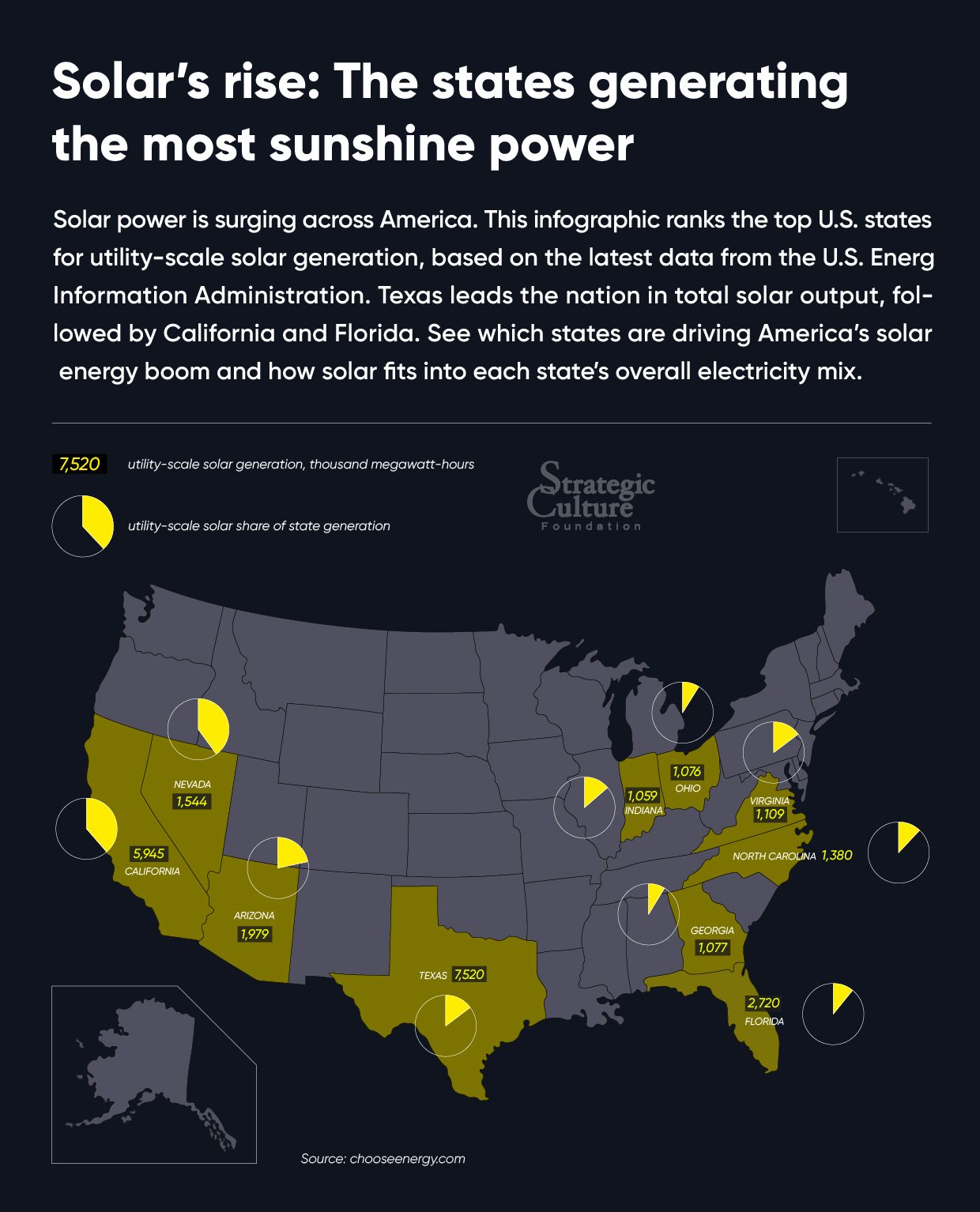
Solar’s rise: The states generating the most sunshine power

By: A A
4 October 2026 at 14:49

Solar power is surging across America. This infographic ranks the top U.S. states for utility-scale solar generation, based on the latest data from the U.S. Energy Information Administration. Texas leads the nation in total solar output, followed by California and Florida. See which states are driving America’s solar energy boom and how solar fits into each state’s overall electricity mix.

Join us on Telegram, Twitter, and VK.

Contact us: info@strategic-culture.su

(Click on the image to enlarge)


[Explainer] Gas glut or supply crunch? And what it means for EU methane rules

4 October 2026 at 14:04

The EU has decided to delay its methane regulation, and the reason is simple enough. 

Europe imports almost 90 percent of its gas, which makes it one of the most exposed buyers in the world. And the US-Israeli war with Iran has choked gas flows through the Strait of Hormuz. 

Making matters more complicated is the fact that Europe is still phasing out Russian gas, with a total ban on Russian overseas liquified gas due to be implemented next year.

So few were surprised when energy commissioner Dan Jørgensen told ministers in Dublin this week that he will propose delaying the import part of the regulation by a year to 2028, although member states and parliament still have to formally agree.

This article continues, but the full version is available only to EUobserver.com subscribers. Visit account.euobserver.com/membership

Oil Prices Fall as Europe Agrees to Release Emergency Diesel Reserves

2 October 2026 at 20:41

Oil prices fell on Friday after European governments backed the release of emergency diesel stocks as part of a wider G7 intervention intended to ease pressure on fuel markets and avert possible US restrictions on diesel exports.

Oil prices fell on Friday after European governments agreed to release emergency diesel reserves, bringing additional supplies onto a market strained by disruption in the Middle East and shortages of refined fuel.

Brent crude futures fell $1.80, or 1.76 per cent, to $100.50 a barrel during trading on 2 October, while US West Texas Intermediate dropped $2.02, or 2.18 per cent, to $90.85, according to market data reported during Friday’s trading.

The fall came as the Group of Seven agreed to release 100 million barrels of oil and petroleum products from emergency stocks over four months. The package includes a substantial release of diesel during the first 20 days.

The G7 leaders’ statement on energy security and market stability said the releases would be co-ordinated through the International Energy Agency and would take account of commitments already made earlier this year. G7 governments will also discuss whether additional diesel releases are required.

The agreement marks a rapid development from the negotiations reported earlier on Friday. As EU Today reported before the G7 meeting, Washington had been pressing European governments, particularly France and Germany, to make more of their strategic diesel stocks available.

President Donald Trump had also raised the possibility of restricting US diesel exports as his administration sought to reduce domestic fuel prices. Such a restriction would have had significant consequences for Europe because the United States has become an important supplier of diesel to the European market.

A French proposal discussed by EU governments earlier on Friday envisaged European countries releasing around 50 million barrels of diesel, alongside another 50 million barrels of crude oil from International Energy Agency members.

The eventual G7 agreement also addresses the risk of export restrictions directly. The seven governments committed themselves to avoiding restrictions on energy and energy-product exports between G7 countries and called on other producers to refrain from measures that could worsen market shortages.

For Europe, the intervention comes as diesel supplies remain physically available but prices are being pushed higher by tight conditions on international markets.

The European Commission’s Energy Union Task Force met on Friday to examine diesel supplies and prices. The Commission said EU diesel supplies remained stable for the time being, but acknowledged that prices were high because of tight global markets.

The latest intervention follows a much larger emergency action earlier this year. In March, the International Energy Agency agreed its largest-ever co-ordinated stock release, making 400 million barrels available after the Middle East conflict severely disrupted international oil markets.

Europe’s contribution to that March operation consisted largely of refined petroleum products rather than crude oil, reflecting the particular pressure facing the continent’s fuel markets.

The pressure is part of a wider European energy problem. EU Today reported this week that the Middle East conflict has added more than €100 billion to Europe’s energy import bill, despite the continent receiving no corresponding increase in the physical amount of oil and gas purchased.

European governments have already committed €17.9 billion this year to measures intended to protect households and businesses from the rise in energy costs, according to an EU Today assessment of national support measures.

Diesel represents a particular vulnerability. It remains essential for road freight, agriculture, construction and large parts of European industry, meaning sustained increases in wholesale prices can feed into transport and production costs across the economy.

The present shortage also reflects changes in Europe’s refining sector. Refining capacity has fallen over the past two decades as plants have closed, increasing dependence on imported diesel and other refined petroleum products. That dependence has become more visible since the EU sharply reduced purchases of Russian fuel following Russia’s full-scale invasion of Ukraine.

The G7 nevertheless made clear that the emergency intervention would not be accompanied by a relaxation of measures against Moscow. Leaders said they would maintain sanctions against Russia while working with the IEA and other partners to limit the effect of market disruption on fuel and commodity prices.

The EU has separately continued to tighten measures targeting Russia’s energy revenues and its so-called shadow fleet, including restrictions connected with the maritime transport of Russian oil and petroleum products. The EU’s latest sanctions package targeting Russian energy revenues was adopted in July.

Friday’s fall in oil and diesel futures indicates that traders expect the additional stocks to relieve some of the immediate pressure on supplies. European gasoil futures, the main regional diesel benchmark, also fell sharply during the day as details of the proposed releases emerged.

The G7 has asked the IEA to monitor implementation and report within 20 days, including on whether further action is required and how emergency stocks should eventually be replenished.

For Europe, the immediate objective is to contain diesel prices without compromising security of supply. The broader issue remains unchanged: reduced domestic refining capacity and heavy dependence on imported fuel leave the European economy exposed when international supply routes are disrupted.

G7 releases diesel stocks after Trump pressure, EU denies caving

2 October 2026 at 17:59

The EU and its G7 partners agreed on Friday (2 October) to a coordinated release of 100 million barrels of diesel and crude through the International Energy Agency (IEA) over four months.

The release includes “a frontloaded substantial diesel release within the first 20 days,” a press brief released after a Friday afternoon call read.

The call was initiated by French president Emmanuel Macron who holds the rotating G7 presidency on Friday, after he spoke to US president Donald Trump on Thursday.

“Europe has just agreed to release a massive amount of their heavily stocked Diesel Oil. The process will begin immediately,” Trump wrote on Truth Social shortly afterwards.

Trump had pressured EU leaders to agree to the release all week.

On Thursday, US treasury secretary Scott Bessent urged Europe to “immediately” tap its reserves.

And EU leaders had received a proposal from the White Housethe same day for 120 million barrels of diesel over 180 days.

Washington had already approached France, Germany, Italy, Ireland and the UK individually, warning they could face US diesel export bans if they did not comply.

US diesel prices hit a record $6.53 per gallon last week, which is a liability for Trump’s Republicans ahead of the 3 November midterm elections.

Europe’s reward is a single line in the G7 statement, which reaffirms a commitment “to refrain from export restrictions on energy and energy products” between G7 countries.

The EU also on Friday had insisted that any further release come with a US pledge to avoid a unilateral diesel ban, and rejected the suggestion that they buckled to US pressure.

“We fully reject a [US] ban on diesel. A ban would not be beneficial to anyone. It would undermine our trust in the US as a reliable partner,” said Anna-Kaisa Itkonen, the commission’s energy spokesperson.

She declined to comment on the leader’s call ahead of time.

Commission chief spokesperson Paula Pinho said the coordination had “nothing to do with” recent threats.

She noted that gas prices had risen by 140 percent and diesel prices had doubled since February, and that a release agreed in March was still being implemented.

The G7 text presented Friday’s decision to release the 100 million barrels as continuing those commitments.

But the commission’s own oil coordination group concluded this week that there was “no immediate security supply issue” in the EU, Itkonen said.

Emergency stocks exist to deal with supply disruptions, not prices.

But the IEA route gives European capitals political cover, allowing them to present the release as collective action rather than a concession to Washington.

And it may not be the last one. “We will convene in the context of the IEA in the coming days to discuss the possibility of additional diesel releases as necessary,” the G7 statement said.

Alaska LNG Could Cost More Than Double Gulf Coast Rivals, Raising Questions Over Economics

2 October 2026 at 12:43
US President Donald Trump's push to steer $54 billion of South Korean investment into Alaska LNG is putting a fresh focus on a 20 million-ton-a-year export project that would cost more than twice as much as a comparable US Gulf Coast plant.

EU and US Seek Diesel Agreement as Washington Presses Europe to Release Reserves

2 October 2026 at 09:19

European governments and the United States are negotiating over emergency diesel reserves as a global shortage of refined fuel places increasing pressure on transport, agriculture and industry.

The Trump administration has urged France and Germany to release diesel from their strategic stocks, while raising the possibility of restricting American diesel exports if European governments fail to put additional supplies on the market.

Washington has asked Europe to release about 120 million barrels over six months, according to people familiar with the talks.

The demand puts European governments in a difficult position. Releasing reserves could help reduce prices in the short term, but it would also reduce the emergency buffer available if disruption to Russian or Middle Eastern supplies becomes more severe.

The European Commission, France, Italy, Ireland and Britain held discussions on 1 October over possible diesel stock releases. Germany has been involved separately in discussions with Washington.

France and Germany hold a substantial share of Europe’s emergency diesel reserves.

Under the EU’s Oil Stocks Directive, member states must maintain emergency crude oil or petroleum-product stocks equivalent to at least 90 days of net imports or 61 days of domestic consumption, whichever is higher.

The requirement exists to provide a buffer against major supply interruptions rather than normal market fluctuations.

Europe’s dependence on imported oil remains substantial. Oil accounted for around 38 per cent of the EU energy mix in 2024, while approximately 95 per cent of crude oil consumed in the bloc was imported.

The latest dispute follows months of mounting pressure in the diesel market.

EU Today reported in September that President Donald Trump had urged Ukraine to reduce attacks on Russian refining infrastructure as global diesel supplies tightened.

Moscow has since extended restrictions on diesel exports. At the same time, disruption to Middle Eastern refining and shipping has constrained another major source of supply, while China moved on 1 October to suspend most fuel-product exports outside Hong Kong and Macau.

The result has been a particularly sharp problem for Europe because its refining capacity has declined over the past two decades and it has become increasingly dependent on imported middle distillates.

European dependence on outside energy supplies was already becoming more expensive before the latest diesel shortage. Recent Eurostat figures showed that the value of EU petroleum-oil imports increased by 55.8 per cent in the second quarter of 2026, even though the physical volume imported rose by only 1.2 per cent.

The United States has become an increasingly important diesel supplier since Europe sharply reduced imports of Russian refined products following Moscow’s full-scale invasion of Ukraine.

That means a US export restriction would have an immediate impact on the European market.

EU Trade Commissioner Maroš Šefčovič said after discussions with US Trade Representative Jamieson Greer that Brussels wanted a coordinated transatlantic approach to lowering diesel prices.

He said restrictions on US diesel exports would damage Europe’s economic performance and that both sides had agreed to remain in close contact.

Šefčovič also noted that the EU had exceeded its commitment to purchase US energy under the trade agreement reached at Turnberry in 2025.

US Energy Secretary Chris Wright, meanwhile, said he was “highly confident” European governments would release additional stocks.

Wright argued that coordinated action was particularly important as the northern hemisphere moved into the harvest season and towards winter, when demand for diesel and heating fuels normally increases.

Emergency releases have already been used on an exceptional scale this year.

In March, the 32 members of the International Energy Agency agreed to make 400 million barrels of oil from emergency reserves available to the market after disruption caused by the Middle East conflict.

It was the largest coordinated stock release in the organisation’s history.

A further European release would therefore come only months after governments had already drawn on strategic reserves to stabilise markets.

The pressure is increasing as oil prices again move higher. Brent crude settled above $102 a barrel on 1 October amid concerns over Chinese fuel exports and further US military deployments to the Middle East.

EU energy officials are now considering whether the immediate risk of high diesel prices outweighs the value of keeping fuel in reserve against a potentially more serious supply disruption later in the year.

EU Governments Spend €17.9bn Shielding Consumers from Energy Price Shock

2 October 2026 at 07:36

European Union governments have committed €17.9 billion this year to measures intended to protect households and businesses from rising energy prices as disruption in the Middle East and global fuel markets continues to feed through into European inflation.

Twenty-five of the EU’s 27 member states have adopted some form of energy support during 2026, according to the latest assessment of the measures.

More than two-thirds of the spending consists of measures that directly suppress energy prices rather than targeted income support.

The figure has increased since the Commission’s spring economic forecast.

Measures adopted or sufficiently detailed by 4th May were then estimated to cost €14.5 billion, equivalent to around 0.07 per cent of EU GDP. The Commission calculated that extending those measures until the end of 2026 could increase their cost to €38.6 billion.

National measures include reductions in fuel taxes and excise duties, energy vouchers, direct financial assistance and support for companies facing higher production and transport costs.

The Commission has repeatedly urged governments to concentrate assistance on vulnerable households and particularly exposed industries rather than subsidising energy use across the entire economy.

Its spring assessment found that roughly three quarters of the support then in force was not targeted specifically at vulnerable consumers or energy-intensive companies.

Broad price measures can reduce household bills immediately, but they also carry a larger fiscal cost and reduce the incentive to cut consumption when supplies are constrained.

The present shock began with disruption to oil and gas supplies caused by the Middle East conflict.

The Commission responded with its AccelerateEU package of emergency and structural measures, allowing governments to use measures including income support, energy vouchers and lower electricity taxes for vulnerable households.

Brussels says Europe does not currently face an immediate security-of-supply problem for the winter of 2026–27 because supplies have been diversified and strategic reserves remain available.

Price exposure is a different matter. Europe still depends heavily on imported fossil fuels, leaving domestic businesses and consumers exposed when world-market prices rise.

Recent trade figures underline the scale of that vulnerability. EU Today reported last month that Europe’s petroleum import bill increased by 55.8 per cent in the second quarter compared with the same period of 2025, despite only a 1.2 per cent increase in the volume imported.

Natural gas presents another risk. European storage sites entered the autumn at unusually low levels, with EU Today reporting that EU gas stocks were around 67 per cent full in mid-September, leaving the bloc more exposed if winter demand rises sharply.

Pressure has now spread into refined fuel markets as well. Russian diesel exports are restricted, Middle Eastern supply remains vulnerable and China has suspended most fuel-product exports outside Hong Kong and Macau. Washington is simultaneously pressing European governments to release diesel from their strategic reserves.

The energy shock is also affecting the wider economic outlook.

The Commission’s spring forecast had already anticipated weaker growth and higher inflation. It projected EU employment growth of only 0.3 per cent in 2026 and expected the aggregate government deficit to rise from 3.1 per cent of GDP in 2025 to 3.6 per cent by 2027.

More recent Commission estimates indicate that eurozone growth in 2026 could be somewhat stronger than the earlier forecast, while expectations for 2027 have deteriorated.

Inflation is expected to remain around 3 per cent this year and to remain above earlier projections next year. That increases the fiscal problem facing governments.

Large energy subsidies can reduce the immediate impact on households but add to public borrowing and may complicate monetary policy if they support overall demand.

The European Fiscal Board has urged member states to ensure that energy measures are temporary, have clear expiry dates and are directed at vulnerable households and businesses.

The Commission is also drawing lessons from the measures adopted after Russia’s full-scale invasion of Ukraine in 2022. Energy support introduced during 2022 and 2023 alone had a net cost equivalent to about 2.1 per cent of EU GDP, according to Commission calculations.

Brussels wants to avoid a second prolonged cycle of broad subsidies while accelerating investment intended to reduce Europe’s structural reliance on imported fossil fuels. That includes grid investment, electrification, renewables and measures to reduce taxes on electricity relative to gas.

For national governments, however, the immediate pressure is coming from bills paid today rather than energy infrastructure planned for the next decade. With €17.9 billion already committed during 2026, further disruption in international oil, diesel or gas markets could determine whether what was designed as temporary support has to be extended into next year.

Trump about to self-destruct over latest diesel initiative?

By: A A
1 October 2026 at 10:27

The West is run by the dumbest leaders ever.

Join us on Telegram, X, and VK.

Contact us: info@strategic-culture.su

It is a mark of our times that Western leaders are not only the weakest that they have ever been, but they are also the dumbest – with Donald Trump leading the pack. His latest initiative has enraged the business press, who have wheeled out all the experts to shoot it down in flames. Trump wants to limit diesel exports from the U.S., which he believes will drive down diesel pump prices in the U.S., but it is such a stupid idea that many political commentators are pointing out his own level of desperation by playing what one called “an economics game of roulette where if the ball lands on a red number we lose everything”. Experts predict that such an initiative would only reduce diesel prices by about 5 percent for American truckers, but, according to the economists at Goldman Sachs, will drive up gasoline prices at the pumps. Quite apart from the diesel ban also wrecking the global oil economy – which will have its own blowback with American consumers – Trump is showing that not only does he not have smart economists around him advising him on these late-night whims which come to him, but he himself understands practically nothing about how the U.S. economy works.

After giving the most vulgar and disgraceful speech at the UN, talking about himself like a Roman Emperor “annihilating” Iran – a civilisation which is about 4,000 years old – it is easy to see, though, how leaders like Trump exist, when there is practically no safety mechanism in place for a U.S. president to behave so appallingly and to be so reckless with the economy. Nothing from Congress, or even either the Speaker of the House or even leaders of either party, to condemn such narcissistic speeches or foolish policy decisions by a man who represents the greatest wrecking ball to Western civilisation as we know it. And even though we saw a glimmer of hope from U.S. media groups who boycotted his Oval Office sessions, few if any journalists are prepared to report on Trump accurately, preferring to give a gloss or simply bypass his buffoonery altogether. In such an environment where the press gives you a free card, is it any wonder that Trump in his second term in office is basically a New Jersey mobster who has lost his mind entirely – drunk on power and corrupted by it, like Rome’s last emperor who was looking for his chicken while the entire empire was collapsing around him?

The sad thing, though, is that he is not alone.

In the EU, we’ve never had such unremarkable, dithering, under-performing, corrupt political wasters as the current coterie of losers running the UK, France and Germany. The UK is particularly bad, as Andy Burnham and Ed Miliband capture the internet’s imagination for a few brief moments as they enter the UN auditorium – and the main takeaway from their perplexed expressions as they look into someone’s camera is that they appear to be both lost and out of their depths, like children on their first day at the big school. While all three throw all their weight behind war talk about the Russians coming – a scam designed to distract people’s attention away from failed public sectors, immigration and economies in tailspins – Burnham stood out this week, though, for a new policy initiative. He’s going to create an Orwellian new police department to control content on the internet, perhaps inspired by the EU’s own German fascist leader – er, European Commission president, I mean – Ursula von der Leyen, who hates free speech so much that she wants it outlawed altogether.

Trump may well end up looking smarter than the leaders of the UK, France and Germany, as these three bankrupt economies now have only one modus operandi, which is to create a phoney war with Russia – which they believe will deflect any blame aimed at them for when these economies hit rock bottom and all these clowns can offer is to turn to international banks and borrow even more. They know their time in office is limited, and so a war is the perfect solution – not only to divert attention away from their own failure but to also give a massive boost to their friends in the industrial military complex, who will be very grateful for the huge new contracts given to them. We should not be surprised that both the children of Trump and even Tony Blair have huge stakes in weapons companies and could really do with a war which shovels billions their way. Yet the diesel initiative from Trump could actually be the last nail in his coffin, as if he goes ahead with it and it proves to actually jack up gasoline prices, he is likely to lose both houses. Already droves of Republican senators and representatives are distancing themselves from Trump’s Iran war and higher pump prices; it’s hard to imagine how many more stupid lies Trump can tell, blaming others for his own self-made calamities.

Iran War Adds More Than €100bn to Europe’s Energy Import Bill

1 October 2026 at 08:47

European Union countries have paid more than €100 billion extra for energy this year without receiving additional oil or gas, according to EU Energy Commissioner Dan Jørgensen, as disruption linked to the Iran war drives another energy shock through the European economy.

Speaking ahead of an informal meeting of EU energy ministers in Dublin, Jørgensen said Europe had “surpassed €100 billion” in additional spending.

“We have now surpassed €100 billion that we’ve paid extra for our energy this year without receiving one extra molecule of gas or oil,” he said in the European Commission’s recording of his remarks.

The figure puts a direct cost on the price shock which has followed disruption to oil and liquefied natural gas supplies associated with the conflict involving Iran.

The effective closure of the Strait of Hormuz has disrupted one of the world’s most important energy corridors. Under normal conditions, the waterway handles roughly one fifth of globally traded oil and significant LNG volumes.

Europe remains heavily exposed because most of the oil it consumes and about 80 per cent of its gas requirements come from outside the EU.

The consequences were already visible in trade figures published before the latest ministerial meeting.

Last week, EU Today reported that the EU’s oil import bill had risen 55.8 per cent in the second quarter compared with a year earlier, even though the physical volume of crude imported increased by only 1.2 per cent.

Europe was therefore paying substantially more without materially increasing the amount of energy it purchased.

The pressure has intensified as winter approaches.

EU gas storage is around 70 per cent full, roughly 12 percentage points below the level recorded at the same stage last year. Jørgensen has warned governments to continue filling storage or consider reducing demand if required.

Possible measures include limiting temperatures in public buildings, restricting outdoor heating and switching off unnecessary public lighting, according to recommendations circulated to governments ahead of the Dublin meeting.

The informal meeting of EU energy ministers focused on energy affordability, security of supply and Europe’s continuing exposure to international fossil-fuel markets.

Irish Energy Minister Darragh O’Brien described the situation as the second major fossil-fuel shock Europe had faced in four years and argued that domestic clean-energy production was essential if the EU wanted to reduce its vulnerability to future crises.

Europe is in a stronger physical position than during the 2022 energy crisis.

It has expanded LNG import infrastructure, increased renewable electricity generation and reduced gas demand. It has also sharply reduced its dependence on Russian pipeline gas.

But that restructuring has created different dependencies.

European buyers now compete more directly for LNG on global markets, meaning events in the Gulf, Asia or the United States can rapidly affect the price paid by European consumers.

EU Today reported earlier this month that reduced LNG availability and disruption around Hormuz had left European gas storage at historically weak seasonal levels.

Diesel presents another problem.

Europe became more dependent on imported refined products after reducing purchases from Russia, with the United States now supplying approximately half of EU diesel imports.

Washington has considered restrictions on diesel exports as domestic US prices rise. European officials have urged the Trump administration not to introduce such measures, warning that they would increase pressure on international markets.

Emergency reserves provide some protection.

EU countries are required to maintain strategic oil stocks, while the International Energy Agency coordinated a release of 400 million barrels from member-country reserves earlier this year.

France and Germany hold a particularly large share of Europe’s strategic diesel inventories. Further releases remain possible if international markets deteriorate, although no new coordinated decision has yet been taken.

The current crisis is also feeding into the EU’s longer-term energy debate.

Spain, Portugal and Luxembourg are now pressing for an EU renewable-energy target for 2040, arguing that increasing domestic electricity generation would reduce dependence on imported fossil fuels.

The security argument extends beyond climate policy. An EU Today Research Desk paper published in June examined how concentrated fossil-fuel supply routes and maritime chokepoints can transmit geopolitical shocks into European prices, infrastructure and industry.

The current disruption provides a practical example.

Europe has not bought substantially more fuel, but it is paying tens of billions of euros more because the international price of the energy it imports has risen.

The immediate concern is whether supplies and gas inventories will be sufficient through the coming winter without another sharp increase in prices.

The longer-term question is how much of Europe’s energy demand can be moved away from imported fossil fuels before another geopolitical crisis produces the same result.

For EU governments, Jørgensen’s €100 billion figure provides a measure of the cost of that dependency.

Oil and gas industry expected surplus – but war brought shortage

1 October 2026 at 03:39

In 2023, the International Energy Agency predicted that by 2028 the world’s oil companies would produce more oil than people wanted to buy. Prices responded to that and similar projections of slowing oil demand, dropping too low to attract investment for new wells and refineries. No forecast anticipated that the Strait of Hormuz, the main […]

The post Oil and gas industry expected surplus – but war brought shortage appeared first on Asia Times.

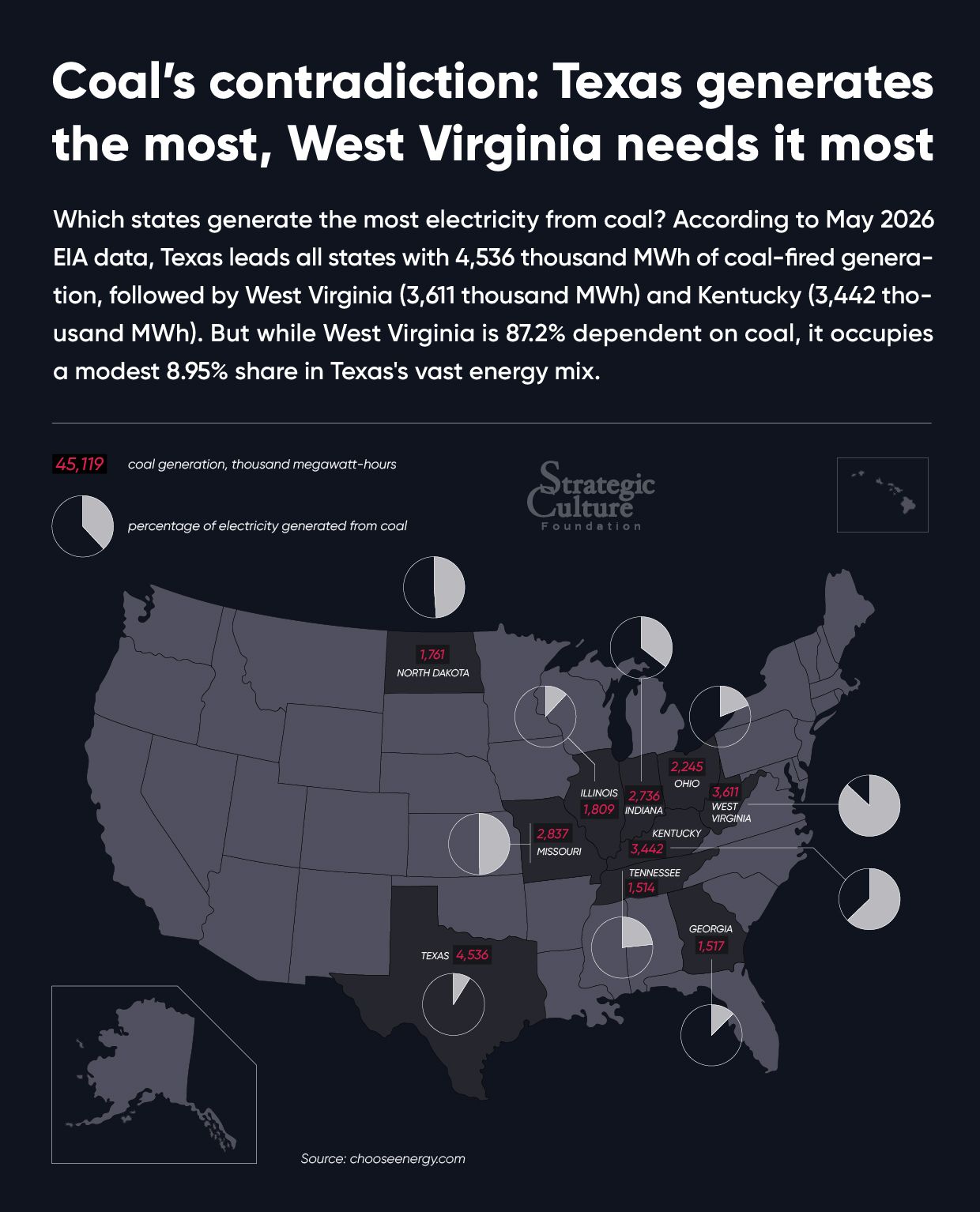
Coal’s contradiction: Texas generates the most, West Virginia needs it most

By: A A
30 September 2026 at 17:18

Which states generate the most electricity from coal? According to May 2026 EIA data, Texas leads all states with 4,536 thousand MWh of coal-fired generation, followed by West Virginia (3,611 thousand MWh) and Kentucky (3,442 thousand MWh). But while West Virginia is 87.2% dependent on coal, it occupies a modest 8.95% share in Texas’s vast energy mix.

Join us on Telegram, Twitter, and VK.

Contact us: info@strategic-culture.su

(Click on the image to enlarge)


Russia earns record seaborne oil revenues despite Ukraine attacks

30 September 2026 at 09:13

Last week, Russia recorded its highest estimated revenues from seaborne oil exports since the start of the war with Ukraine.

The main driver of this demand is the armed conflict and the resulting blockade of the Strait of Hormuz in the Middle East. Due to supply problems, buyers are looking for additional sources of crude oil. This also applies to China which, although it has already secured reserves of the commodity, is also starting to increase purchases from the Russian Federation.

Russia’s record revenues from oil sales

Last week, Russia achieved record weekly revenues from seaborne oil exports since the beginning of the war. Oil companies there shipped about 3.99 million barrels of oil a day to foreign markets. Given the high prices, this significantly increased the value of Russian exports.

Bloomberg estimates that the total value of oil shipped from Russian ports last week was about $2.75 billion. That is about $180 million more than the previous week and the highest weekly figure since the beginning of the Russia-Ukraine war.

Russian oil is now much more expensive than in previous months. As noted earlier, this is influenced by the situation in the global oil market, and in particular, the war in the Middle East. The price of Brent crude remained above $100 a barrel in September.

At the end of September, the price of this benchmark exceeded $103 per barrel. Earlier, prices rose further amid concerns about disruptions in oil supplies from the Middle East.

Average revenues for the last four weeks

The Kremlin has decided to limit fuel exports to support the domestic market. The ban on diesel exports by Russian producers has been extended until Sept. 30, and restrictions on the export of gasoline and some diesel fuels by other exporters remain in place for an extended period.

The UA News portal points out that an exceptional situation has arisen as a result, stating: “Russia cannot export as many petroleum products as before, but it has a surplus of crude oil that it cannot fully process domestically. Consequently, the oil surplus is diverted to the foreign market.”

This situation increases the volume of maritime exports. Russia’s current revenues have significantly exceeded the previous week’s value. To avoid drawing conclusions based on just one week, the agency also calculated average revenue over four weeks. This indicator is less susceptible to sharp short-term fluctuations in prices and volumes.

Over the past four weeks, the estimated average value of Russian oil exported by sea has been around $2.39 billion per week. That is about $290 million more than in the previous four-week period and the most since the second half of May.

Russia may continue to earn significant revenue from crude oil sales. As long as the price of Brent crude remains above $100 a barrel and Russian crude enjoys demand among buyers in Asia, Moscow can generate additional revenue, even despite operational problems at its own refineries.

This situation may change as supplies from the Middle East gradually resume. Reuters reported that exports from Saudi Arabia and the United Arab Emirates increased in September, and reconstruction of some infrastructure began after the attacks. This could ease pressure on the global market and affect the price of Russian oil, even if oil prices are expected to remain elevated throughout 2026 and 2027.

The post Russia earns record seaborne oil revenues despite Ukraine attacks appeared first on Remix News.

US civil society groups call on EU not to delay methane rules

30 September 2026 at 15:50

Nearly 100 US civil society groups have urged EU governments not to cave to pressure from oil and gas lobbyists and the White House as the European Commission moves to delay parts of its methane rules by a year.

“The US has done absolutely everything possible to actively deprive Europe of secure, reliable and diversified energy supplies,” said the group in a letter to EU energy ministers dated 29 September and circulated on Wednesday (30 September).

“The Trump administration is using its ‘energy dominance’ agenda to openly blackmail the Union into lowering its climate and human rights standards, including on methane,” they also said.

All operational US export terminals, many supplying Europe, have violated air pollution limits, and the EUs methane rules are “the last opportunity” to impose standards on US gas, the letter says. 

“Let’s work together on both sides of the Atlantic,” they say. 

The letter writers include global NGOs such as Greenpeace US and Friends of the Earth US but also smaller groups that live next to US gas export terminals such as the environmental organisation, For a Better Bayou.

The decision to postpone

In July, a group of US lawmakers also wrote to EU commission president Ursula von der Leyen, urging her to hold the line.

Democratic congressman Sean Casten, one of the letter’s authors, later visited Strasbourg and told EUobserver that the EU policymakers he met were “almost unanimously supportive of us pushing harder” to help them save the rules.

But over the summer, a majority of member states, including Germany, Europe’s largest gas market, became convinced that delay is necessary fearing gas exporters might reroute their supplies to easier markets.

During that time energy ministers from the US, Qatar, Nigeria and Algeria all warned EU regulation could disrupt fuel and gas supplies

On Tuesday, EU energy commissioner Dan Jørgensen signalled at an informal meeting of energy ministers in Dublin that he will propose delaying the regulation. 

“I’ve already stated that on the methane regulation, a very important regulation for Europe, we stick to the objectives, we stick to our ambitions,” he said.

But, he continued, “after having listened to many, many member states, a big majority of member states in the union,” he decided “to look into possibilities of postponing the parts that are connected to imports by one year”.

This article continues, but the full version is available only to EUobserver.com subscribers. Visit account.euobserver.com/membership

JPMorgan and Goldman See Mideast Oil Flows Near Pre-War Levels

30 September 2026 at 12:48
Crude oil flows from the Middle East are returning toward pre-war levels despite continued risks to shipping, according to separate estimates from JPMorgan Chase & Co. and Goldman Sachs Group Inc.

EIB and BNP Paribas Launch €700m Guarantee Scheme for Europe’s Power Grids

30 September 2026 at 09:53

The European Investment Bank and BNP Paribas have agreed a €700 million guarantee programme designed to expand financing for European companies producing equipment for electricity grids.

The agreement targets a growing bottleneck in Europe’s energy system: manufacturers of transformers, cables, switchgear and other components are being asked to increase production while utilities and governments accelerate investment in transmission and distribution networks.

Under the deal, the EIB will provide up to €350 million in counter-guarantees, while BNP Paribas will commit an equivalent amount. The resulting €700 million portfolio of bank guarantees is expected to support companies investing in additional production capacity and supply contracts.

The European Investment Bank said the arrangement could stimulate as much as €2.8 billion in investment in the real economy.

The initiative is backed by the EU’s InvestEU programme and forms part of the EIB’s €1.5 billion Pan-EU Power Grid package. Guarantees are particularly important for infrastructure suppliers because large electricity projects often require manufacturers to provide financial guarantees before receiving contracts.

Those commitments can consume bank credit lines that companies might otherwise use to build factories, purchase machinery or finance working capital.

By sharing the risk with BNP Paribas, the EIB intends to increase the volume of guarantees available without requiring manufacturers to commit equivalent amounts of their own financing capacity.

The programme arrives as grid investment becomes one of the central constraints on European energy policy.

The EU is simultaneously attempting to expand renewable generation, electrify transport and industry, increase cross-border electricity trading and reduce dependence on imported fossil fuels.

All require additional transmission and distribution capacity. EU Today reported earlier this year that the EIB had approved almost €2 billion for clean energy and grid projects as part of a broader €10 billion financing package.

The latest BNP Paribas agreement concentrates specifically on the industrial supply chain needed to build those networks.

Grid investment is increasingly influenced by security concerns as well as electricity demand.

EU Today reported last week that Lithuania is designing part of the Harmony Link infrastructure to withstand drones, sabotage and vehicle attacks near the Russian exclave of Kaliningrad. Such requirements increase the cost and complexity of new electricity infrastructure while demand for conventional grid equipment is already rising.

European manufacturers face lengthy order books for some high-voltage equipment, particularly large transformers and specialised cables. Supply constraints can delay renewable projects and interconnectors even when planning permission and financing are available.

The EIB says its guarantee programme is intended to give manufacturers greater financial capacity to respond. The arrangement follows a similar partnership between the bank and BNP Paribas covering wind-energy manufacturing.

In February 2025, the two institutions agreed a €1 billion guarantee portfolio intended to support investment in the European wind industry. The EIB has subsequently expanded its focus from generation equipment to the networks required to transport electricity.

In 2025, the EIB Group invested €33 billion in energy projects worldwide, including €11.6 billion in grids and storage, according to the institution.

European energy policy has increasingly recognised that adding generating capacity without expanding grids can create congestion, delays and periods in which renewable electricity cannot reach consumers.

Political disagreements remain over how new infrastructure should be planned and financed.

In June, EU Today reported that member states had pushed back against stronger Brussels control over cross-border grid planning, preferring to preserve a significant role for national authorities.

Financing institutions are meanwhile moving ahead with programmes intended to expand the underlying industrial capacity.

For manufacturers, the EIB–BNP Paribas scheme does not provide €2.8 billion of direct public spending. Instead, public guarantees are being used to increase the volume of private financing available, with the EIB assuming part of the risk.

The distinction is central to InvestEU, which uses EU budget guarantees and EIB financing to attract additional private capital.

Europe’s electricity transition is increasingly dependent on this less visible part of the energy system. New wind farms, solar installations, nuclear reactors and industrial electrification projects ultimately require the same infrastructure: sufficient cables, substations, transformers and transmission capacity to move electricity from producers to users.

Spain, Portugal and Luxembourg Push EU for 2040 Renewables Target

30 September 2026 at 08:57

Spain, Portugal and Luxembourg have called on the European Commission to establish a specific EU renewable-energy target for 2040 as Brussels prepares the next stage of the bloc’s climate and energy legislation.

The three governments have written to Energy Commissioner Dan Jørgensen arguing that a post-2030 renewables target would give investors greater certainty, accelerate deployment and reduce European dependence on imported fossil fuels.

Their intervention comes as the Commission prepares a new renewable-energy framework covering the decade after 2030.

The EU currently has a legally binding target requiring renewable sources to account for at least 42.5 per cent of final energy consumption by 2030, with an ambition to reach 45 per cent.

There is, however, no equivalent renewables target for 2040.

The European Commission says it is preparing a post-2030 renewable-energy framework for adoption before the end of this year. It is intended to complement the Union’s wider climate legislation and provide guidance for the next decade of energy investment.

Spain, Portugal and Luxembourg want that framework to contain a numerical target rather than rely solely on the EU’s overall greenhouse-gas reduction objective.

The proposal creates a policy divide with governments that want Brussels to use a broader definition of low-carbon or “clean” energy.

France, Sweden and Finland are among countries that have supported an approach allowing nuclear generation to contribute alongside renewable sources towards European decarbonisation targets.

France in particular operates the EU’s largest nuclear fleet and has repeatedly argued that European energy legislation should treat nuclear power according to its low carbon emissions rather than exclude it from frameworks designed specifically around renewable technologies.

Luxembourg, by contrast, has long opposed nuclear energy and has raised concerns about radioactive waste, safety and the financing of new reactors.

The argument is therefore not simply about the scale of the 2040 ambition. It concerns the structure of European energy investment over the next 15 years.

The Commission’s existing renewable-energy rules set the 2030 floor at 42.5 per cent, almost double the share recorded at the beginning of the decade.

Renewables accounted for 26.2 per cent of EU energy consumption in 2025, according to Commission figures.

Investment will have to increase substantially if the Union is to meet its existing target before any higher post-2030 requirement is introduced.

Grid capacity is another constraint. Wind and solar generation can be built faster than many traditional power stations, but projects increasingly depend on new transmission lines, interconnectors, storage and distribution infrastructure.

EU Today reported in June that member states were resisting greater Commission control over cross-border electricity-grid planning, illustrating the institutional difficulties surrounding an expansion of European electricity infrastructure.

The latest initiative also sits alongside the EU’s legally binding 2040 climate target.

In March, the Union formally approved legislation requiring net greenhouse-gas emissions to fall by 90 per cent from 1990 levels by 2040. EU Today reported on the final approval of the 2040 target, which is intended to bridge the gap between the bloc’s 2030 commitments and climate neutrality by 2050.

How that 90 per cent reduction is achieved is now moving to the centre of the policy debate.

For Spain and Portugal, greater renewable generation is also tied to their ambitions to expand electricity exports from the Iberian Peninsula into the rest of Europe. Limited interconnection capacity across the Pyrenees has historically restricted those flows.

The Commission’s post-2030 framework will therefore have consequences beyond environmental policy. It will influence investment decisions in power generation, grids, industrial electrification, hydrogen, storage and manufacturing.

The political question confronting the Commission is whether those decisions should be driven by a dedicated renewable-energy benchmark or by a technology-neutral emissions objective under which nuclear and renewable generation compete for investment.

With the 2040 climate target already fixed in law, the next dispute is increasingly about the energy system that will be built to reach it.

Shell to Double LNG Canada Plant in Multibillion-Dollar Plan

29 September 2026 at 13:29
Shareholders in the Shell Plc-led LNG Canada venture greenlit plans to double its liquefied natural gas export capacity, forging ahead with the multibillion-dollar investment as key customers in Asia face the biggest supply shock of recent times.

Europe races to contain energy crisis with patchwork measures

28 September 2026 at 09:48

European governments are racing to blunt a fuel shock that even some analysts now refuse to forecast, as Brent crude holds near $100 a barrel and diesel prices climb across Europe.

The international oil market has been expensive for months. What has changed is the confidence of the people paid to explain it. JPMorgan told clients on Sept. 17 that, for the first time since fighting began around Iran about seven months earlier, its commodities team no longer has a baseline view of how the disruption ends. 

“We simply don’t know how to model the endgame,” the bank’s analysts wrote, after several economic thresholds they once assumed would force a diplomatic off-ramp, including oil above $100 a barrel, had already been crossed.

The bank said a Brent price near $90 would have been consistent with known supply and demand in September. Futures instead traded around $100 and higher as traders priced the risk of further losses that no one can yet measure. By Monday, front-month Brent was still hovering near $99 a barrel.

Inventories are doing little to cushion the blow. The U.S. Energy Information Administration has said prices are likely to stay elevated until Middle East oil trade is restored and stocks can be rebuilt. The International Energy Agency’s September report put the scale of the drain in starker terms: observed global inventories fell another 95 million barrels in August, taking the cumulative draw since February to 507 million barrels, or about 2.8 million barrels a day. World oil supply is now projected to average 100.7 million barrels a day in 2026, down 5.7 million from a year earlier.

Diesel shortages are acute

In some countries, such as Hungary, there is a major imbalance in terms of available energy sources. Crude held in strategic storage remains ample, but diesel is quickly running out. Data from the Hungarian Hydrocarbon Stockpiling Association show gas oil stocks at 520.3 kilotons at the end of January and about 390 kilotons at the end of both July and August. That thinner diesel cushion matters in a country where more than 1.3 million passenger cars run on the fuel and the regional market is competing for the same scarce imports.

Pump prices have already moved. Official and commercial trackers put Hungarian diesel around 701 forints a liter in late September on some official series and closer to 730 forints on daily station averages — well above the roughly 593 forints recorded at the end of June. The original worry in Budapest was not whether prices would rise, but how quickly 800 forints would stop looking like a distant ceiling.

That speed is not a mystery to central bankers. Bank of Slovenia research covering euro-area data from 2005 through 2026 found that a 10% rise in Brent lifts pretax diesel and gasoline prices by about 6.5% and 6.2%, respectively, over the longer term. A large share of the increase shows up at stations within the first two weeks — faster than the physical chain of shipping, refining and wholesale delivery would suggest. 

The European Central Bank has reached a similar conclusion and added an unwelcome twist: refinery margins can amplify the shock. During the spring spike, Brent briefly reached $138 a barrel while diesel at the refinery gate jumped to $197. ECB staff later estimated that refining margins were contributing about 41 euro cents a liter to euro-area retail diesel in mid-September, and they told reporters those diesel margins may not peak until October.

The way down is slower than the way up. Taxes, refining and transport costs, inventories, margins and local competition all delay relief when crude finally eases. That asymmetry is why governments are acting now, before higher fuel bills work through freight, food and services and lift broader inflation.

Europe-wide crisis

The policy dilemma is the same from Lisbon to Warsaw: protect households and trucking firms without writing a blank check for fossil-fuel consumption. Europe has answered with a patchwork rather than a single rule. Some governments cap retail prices. Others cut excise taxes, sometimes below the European Union minimum. A third group aims help at farmers, haulers and other heavy users. A few still let global prices hit consumers with no cushion at all. The result is that the same barrel of oil can produce pump prices that differ dramatically at the pump across Europe.

Here are just a few examples of what Europe looks like in this regard.

  • Austria has been running a mineral-oil tax cut of 1.9 euro cents a liter into the end of September. 
  • Belgium has implemented an official price ceiling. 
  • Croatia cut diesel excise duty by another 3 cents, taking it 10 cents below the EU floor; Zagreb says the average diesel price is 1.91 euros a liter instead of 2.26 euros without the intervention. 
  • Cyprus is offering an 8.33-cent discount through Nov. 30. 
  • Luxembourg is absorbing 5 cents of the pump price from July through December. 
  • Malta is using direct state aid to keep prices below the euro-area average. 
  • Portugal decided on Sept. 17 to recycle extra value-added tax receipts from more expensive fuel into tax relief worth about 1.3 billion euros through year-end. 
  • Slovenia posted official maxima of 1.748 euros for gasoline and 2.012 euros for diesel in the week of Sept. 22-28. 
  • Spain has kept an excise cut below the EU minimum through Sept. 30. 
  • Italy reduced and capped diesel duty into early October. 
  • Montenegro and Serbia combine retail caps with lower excise taxes.

Targeted aid is running in parallel

  • Greece extended a 10-cent-a-liter diesel subsidy into October and is preparing a heating-oil package. 
  • France steered relief to agriculture, high-mileage workers and construction rather than a blanket cut. 
  • Ireland is rebating duty for commercial haulers and bus operators. 
  • Spain added a 402 million-euro program for truckers on top of its general tax reduction. 
  • Italy is offering carriers a tax credit for earlier extra costs.

Larger packages are still moving through parliaments

Germany will cut energy tax by 14 cents a liter from Oct. 1 through year-end, about 17 cents once lower VAT is counted, in a 2.5 billion-euro package. 

Chancellor Friedrich Merz said drivers who depend on a car every day “are reaching their breaking point.” 

Berlin is also talking with the oil industry about a temporary price cap modeled on Luxembourg or Belgium, aimed at Jan. 1, 2027. 

The Czech government will restore a station-margin ceiling from Oct. 1, cut diesel duty to the EU minimum and cap retail margins at 2.50 koruna a liter. 

Poland has floated a 60% levy on oil companies’ extra profits to finance about 4 billion zlotys of price relief, though the plan faces parliamentary and constitutional hurdles.

The International Energy Agency has described the response as global, not merely European. In a matter of months, the number of countries applying fuel subsidies rose from 16 to 38, and the number cutting energy taxes rose from 40 to 57. Pew Research Center, drawing on IEA tallies from mid-June, counted 113 countries that had taken at least one energy-cost measure after the Iran war, including tax changes in 55 countries and fuel subsidies in 32. The agency’s own warning is implicit in those numbers: governments are treating the symptom at the pump because they cannot reopen the Strait of Hormuz from a finance ministry or end the war in Ukraine.

The post Europe races to contain energy crisis with patchwork measures appeared first on Remix News.

Trump’s plan to ban diesel exports aggravates Europe and Latin America’s energy crisis 

26 September 2026 at 05:00

The United States and its energy industry are making a killing selling crude oil and its derivatives to the rest of the world. The world’s largest economy is filling part of the gap left by supply cuts from Gulf countries due to the war in Iran, and from Russia due to Ukrainian attacks on its refineries. But everything has its limits, and the breaking point was reached on Tuesday, September 22, when diesel surpassed $6.50 a gallon at U.S. pumps.

Seguir leyendo

© Mark Felix (Bloomberg)

Aerial view of a refinery in Houston, Texas, in March 2025.

Will Germany run out of gas this winter? Experts and energy executives warn of dire scenarios

22 September 2026 at 13:02

Several key German industry groups and energy analysts are warning that Germany could face severe gas supply issues, and potentially entirely deplete its storage, if an exceptionally cold winter occurs. Of course, predictions of this sort have been made off and on in recent years. Germany has never actually run out of gas before. The question is now how alarmist these warnings are and how realistic an actual gas and energy shortage is this time around.

Currently, the government argues there will be no gas shortage. However, storage operators, energy executives and some economists argue that a mild winter should be manageable and a brutally cold one could get tight enough to force industry to cut production and send prices soaring.

One of the most dire warnings comes from Markus Krebber, chief executive of RWE, Germany’s largest power producer.

“If we get a mild winter, everything will be fine,” he told Focus in an interview. “If the winter is hard, there can be significantly higher prices. And it can get tight.”

Krebber said Germany is entering the season “with the lowest gas storage levels of the past 20 years” – lower even than in 2022, when Russian pipeline flows collapsed. “That works if we have a normal winter. If we get a particularly cold winter, it can get scarce.”

He has also warned that if Germany does not add more power supply, “there will be distribution battles for electricity” among industry, data centers and the electrification of heat and transport.

The data supports Krebber’s concerns. The German gas storage association (INES) warns that Germany entered September at its lowest storage levels in 15 years, at around 53 to 56 percent. INES models show that if refills remain sluggish and if Germany experiences an extremely cold winter, similar to the weather of 2010, storage reserves could be exhausted as early as January or February, potentially leaving daily supply shortfalls of up to 25 percent.

German underground gas caverns are roughly 20 percentage points below last year’s level and far under the seasonal norm. While Berlin’s own rules call for most gas storage sites to reach 80 percent by Nov. 1, almost no one now expects that to happen.

“By now all the experts agree: these 80 percent are already technically almost impossible to achieve and also not realistic,” Klaus Müller, president of the Federal Network Agency, said in a Phoenix television interview. He added that storage is not the whole story. “We have created our own capacities with four liquefied natural gas terminals. We can obtain gas from Norway, Belgium, Holland, France.”

Energy market consultants and industry group analyses point out that weak summer gas refills – driven by unfavorable price spreads between summer and winter gas and price volatility from global conflicts – have left Germany reliant on steady ongoing imports. They point out that cold weather is not the only factor, as disruptions could be exacerbated by pipeline outages, reduced LNG flows, escalating conflict in Ukraine or the Middle East, and various other scenarios. All of this comes at a time when Germany’s buffer is much thinner than in previous years.

Not everyone is panicking, though. The Federal Network Agency, Germany’s energy regulator, has also acknowledged the low storage levels but stated they do not currently indicate an imminent crisis or inevitable shortage.

Claudia Kemfert, an energy economist at the German Institute for Economic Research, says that a distinction must be made between shortages and higher prices. She has said an acute shortage is not her base case, but that low stocks leave the system more exposed if cold weather, high LNG prices and supply interruptions hit at once. Relying on last-minute cargoes, she has argued, is “risky and expensive.”

Historical weather data supports less extreme gas shortage scenarios. On average, the past ten winters have been extremely mild in Germany, with the exception of last year’s winter, which was exceptionally cold. If there is a repeat this year or the winter is even colder, it could indeed tip Germany into an energy crisis, but the odds appear to be against such a scenario.

In the meantime, industrial companies in Germany are already taking precautionary measures, as a severe cold snap would likely force curtailments on industrial consumers first to stretch remaining gas through February and March to protect vital natural gas deliveries to households.

Another piece of good news it that the European Union as a whole is near 70 percent in terms of gas storage, far better than Germany. This means that the crisis is unlikely to grip all of Europe. Still, Germany is Europe’s largest economy and a key hub of industry. Any gas or energy crisis in the country would have broad repercussions across Europe.

The post Will Germany run out of gas this winter? Experts and energy executives warn of dire scenarios appeared first on Remix News.

❌