The European Parliament in Strasbourg has been adorned with a grotesque vision of American power in a 2.5-metre-high statue of a naked and obese US president Donald Trump covered in 23-carat gold.
While some MEPs describe it as an expression of freedom and courage in the face of Trump, Slovak prime minister Robert Fico has said the statue is a symbol of a declining European Union and called for its removal.
Fico said the statue reflects a profound misunderstanding of the times we live in, and reminded his X followers that he and Trump are close.
“At a time that calls for dialogue and mutual respect, insulting our partners on official premises demonstrates a profound failure to understand the times we live in,” he said on social media.
“It is sad that the leadership of the European Parliament, in its blindness, can no longer distinguish between the legitimate right to hold a different opinion and the actions of spiritually bankrupt individuals, adventurers and lunatics,” he added.
Jens Galschiøt is the artists behind the Orange Plague sculpture. The Danish artist says his installation served as a warning that Donald Trump is destroying democracy.
Why call it ‘Orange Plague‘?
“I depicted Donald Trump as an ‘orange plague’ because he is destroying everything I believe in. I believe in democracy and the rule of law. All this needs to be cared for, and Trump is destroying it, as well as the debate on the environment,” Galschiøt said.
The artist chose to portray the US president as a grotesque figure hoping that people would laugh at it. “When you laugh at a dictator, you take away his power,” he said.
And Trump is also naked because of Hans Christian Andersen’s fairy tale The Emperor’s New Clothes. In it, the emperor walks through the streets with no clothes, while people tell him how beautifully dressed he is, but no one dares tell him the truth. Only one small child cries out that the ruler is naked.
Galschiøt sees parallels the story and treatment of the US president.
“I think many of us laugh at Donald Trump, but he does not know it. He thinks he is a great leader. He thinks he is an intelligent person. He thinks he gives good speeches. But few people take him seriously. Even if you do take him seriously, it is because he is something like a gang leader, not because of what he says. Most of us actually think he is a ridiculous figure,” Galschiøt said.
Jens Galschiøt beside the Trump statue. Source: J. G. archive
His sculpture consists not only of a naked and obese Trump, but also of a slender figure.
“The little man carries the big man, and the big man tells him: ‘Oh, I really want to help you. I really love you, but I do not want to get off your back.’ It is also a story about hypocrisy and double standards, which I combined,” the artist said.
He covered the sculpture in gold because Trump is known to like the precious metal.
This article continues, but the full version is available only to EUobserver.com subscribers. Visit account.euobserver.com/membership
Montenegro detained Mikhail Zvinchuk, the founder of the Rybar Telegram channel.
Key directions according to Rybar, Ukrainian and independent analysts.
Forget Sloviansk: its capture is currently unrealistic.
Ukrainian pressure continues towards Velyka Novosilka, with fighting already under way near Komar on the eastern bank of the Mokri Yaly river.
Russians are infiltrating Dobropillia, but a Ukrainian counteroffensive is pressing against their flank from the north.
The battle for data centres is now two-way, with Ukrainians attacking Russia’s ‘Google’.
Maps of the day — Sloviansk direction; Velyka Novosilka direction; Dobropillia direction.
Videos of the day — a scene from the Second World War: a MiG-29 shoots down a drone with its cannon; soldiers clear a network of Russian bunkers; Himars destroys an artillery radar; what the R-280 road to Crimea looks like.
Montenegro detained Mikhail Zvinchuk, the founder of the Rybar Telegram channel, who occupies one of the leading positions in the ecosystem of Russian media supporting the war. His wife and several associates were arrested alongside him. Colleagues in Moscow issued a statement saying they had been planning to film a report on one of the local monasteries, but the authorities of the Nato member state suspected them of conducting a hybrid operation.
At the top of Russian propaganda are the traditional state media, under the Kremlin’s complete control. They have almost no informational value, as they merely repeat the regime’s propaganda.
Below them, however, is a complex structure of Telegram channels that provide more varied reporting, including critical coverage. However, criticism is permitted only of mistakes in the conduct of the war, not of the war itself.
These channels, too, spread propaganda and keep Russian society in a state of war, but they also provide information that helps in analysing the course of the fighting. Rybar is among the largest and most influential of them.
In this case, it is not the work of an individual author but a media outlet with an editorial team and extensive content for 1.5m readers, so Zvinchuk’s arrest does not mean the end of publishing under this brand.
Yet through him, we can follow the fascinating story of a man who came from Russia’s defence ministry to spread its propaganda in the years that followed.
Paradoxically, however, he has recently been one of the few sources in Russia to report regularly on the Russian army’s failures at the front. And the preceding 48 hours were particularly rich in such assessments.
We will therefore gradually describe events in three different directions where, according to Rybar, the Russians are either retreating or at risk of doing so. Coincidentally, these are currently the most important directions of military operations.
We will compare all of its information with independent or Ukrainian sources.
Forget Sloviansk: its capture is currently unrealistic. “The situation is worsening; Sloviansk is being postponed,” Rybar wrote in the first sentence of its latest analysis of the Sloviansk direction. It explained why at length.
According to it, Ukrainian units in the area are increasing the pressure and exploiting their successes near Lyman, which lies north of Sloviansk. The Russian army has suffered a serious defeat here in recent months, losing a large salient from which it had hoped to bypass the Sloviansk-Kramatorsk agglomeration from the north.
Rybar listed the ensuing complications: according to it, Ukrainians have concentrated fresh drone units around the village of Dibrova; the Russians had to withdraw from the village of Piskunivka and are now trying to save Kryva Luka. Ukrainians are also pressing into the village of Ozerne.
Ukrainian formations are increasing their activity, exploiting successes in the Lyman area, where fresh forces of drone operators have been concentrated around Dibrova.
Russian troops were pushed out of what remained of the village of Piskunivka and are now defending the approaches to Kryva Luka. The enemy is trying to break through there both from the west and across the river from Ozerne.
Moreover, heavy fighting is under way west of the village of Kalynyky, while fighting for Rai-Oleksandrivka is “fierce”, “although it was under the Russian army’s full control only recently”.
Nor is this the end of Rybar’s bad news. An “equally difficult situation” persists on the western bank of the Siverskyi Donets-Donbas Canal, where Russian soldiers are “for now” holding positions in the villages of Malynivka, Tykhonivka, and Yurkivka.
Taken together, all of this means that the prospect of an “attack on the agglomeration has receded considerably”.
“Without control of the forests below Lyman, the offensive is doomed, if not to failure, then to high losses from attacks on its flank,” Rybar added.
Its map fully matches the verbal description. The red arrows running from east to west along the entire stretch have been replaced by blue, Ukrainian arrows pointing from west to east.
Paradoxically, the local Telegram channel Mikolaivka-Sloviansk Online provides a far less optimistic picture.
While Rybar no longer even mentions Mykolaivka, which directly borders Sloviansk, according to this source — which has repeatedly provided highly accurate and widely cited information — Russians are still managing to infiltrate it. On Wednesday, it wrote that “the Russian army is applying pressure from the direction of Rai-Oleksandrivka”, while the village itself is in the grey zone.
The explanation may be simple. Most of the names refer to villages the Russians never fully captured, although they claimed they had — including Rybar itself. This is why its map looks as though a small counteroffensive were under way east of Sloviansk. In reality, it mainly makes its previous misleading claims more realistic.
Far more accurate is the map by the Finnish Black Bird Group. Rai-Oleksandrivka is in the middle of the image — no credible analysts have ever considered it occupied by the Russians. Further north are Ozerne and Kryva Luka. Ozerne is particularly interesting.
According to Rybar, the Russians are trying to prevent the Ukrainian army from entering the village; independent analysts show it partly in the grey zone and partly under Ukrainian control. Rybar therefore correctly sees Russian problems, but at this point this is more its usual cartographic “retreat” from unrealistic positions.
Ukrainian pressure continues towards Velyka Novosilka, with fighting already under way near Komar on the eastern bank of the Mokri Yaly river. This is not entirely new either, but several Russian sources are writing about fighting in this direction with new urgency and, from the Russian perspective, scepticism.
“The situation remains extremely tense. There is mounting evidence that the enemy is seeking to advance around the village of Komar,” Rybar wrote.
This is an important village. When the Russians captured Velyka Novosilka last year after taking Vuhledar, Komar was a significant obstacle to their advance into Dnipropetrovsk oblast.
Fierce fighting took place over the village at the time, and the Ukrainian army lost it in June 2025. The front then moved another 15 to 20 km deeper into Ukrainian territory, but it is now moving back after months of slow advances.
Here, too, Rybar’s map appears more dramatic than the situation actually is. It depicts territory being liberated since February. However, it claims that the situation is worsening and the outlook is negative.
But the information about movements near Komar is genuinely fresh. Other sources agree on it almost metre for metre.
The Russian mapping project Slivochny Kapriz showed the exact location at the northern end of Komar, across the Mokri Yaly river, where Russian drones struck a Ukrainian video.
The Ukrainian Telegram account Petrenko also geolocated the incident at the same location.
Alexander Radov, another pro-war Russian, claimed that testimony from Ukrainian prisoners in this direction indicated that the Ukrainian command’s objectives were Bahatyr, 12 km east of Komar, and Velyka Novosilka itself, 13 km to the south.
This claim cannot be verified, but if it were true, Ukrainian objectives in this sector would be becoming ambitious. (Both Bahatyr and Velyka Novosilka are in the lower-right section of Rybar’s map at the beginning of this section.)
Russians are infiltrating Dobropillia, but a Ukrainian counteroffensive is pressing against their flank from the north. The fact that Russians are already operating in the town has been objectively confirmed by both sides. However, an earlier Russian claim that it had been encircled is false.
Rybar’s map again reflects what was written. In the town itself and its surroundings, red arrows show Russian attacks, while northeast of it, Ukrainian counterattacks are shown against the flank.
The Ukrainian channel Petrenko again serves as a source from the other side. Its map of Dobropillia has three circles, each marking a location where drones spotted Russian soldiers.
A Ukrainian soldier writing under the name Bakhmut Demon also confirmed Russian infiltrations into the town. However, he said they were being eliminated and that Russian losses would rise from November. He probably meant the period when the leaves fall and the terrain begins to turn muddy. Both will make the attackers’ advance more difficult.
Bakhmut Demon also warned that vigilance needed to be increased, as Russians are changing into civilian clothes and trying to infiltrate between Ukrainian positions in them.
Soldiers on the Zaporizhzhia direction described the same practice to us during a recent trip to Ukraine. There, too, they said that men in civilian clothing are sent ahead of infiltration groups in order to deceive drone operators.
Finally, another map by Black Bird Group. It, too, confirms the Russian advance towards Dobropillia, but does not show Ukrainian attacks in the north. The explanation is the same as in the previous cases: Rybar had drawn Russian positions much further forward than they actually were.
The battle for data centres is now two-way, with Ukrainians attacking Russia’s ‘Google’. Yandex is a technology giant that underpins the Russian internet. Its search engine, for example, is used by two-thirds of Russians. But its services are far broader. Among other things, it provides cloud storage to its clients.
The company provides its services through five main data centres. On Thursday, drones attacked the first of them. They struck the facility in Sasovo, in Ryazan oblast.
“This data centre is one of the key and largest data centres in Yandex’s Russian infrastructure. It contains tens of thousands of servers, and the company’s cloud services and computing capacity for machine learning operate on its equipment,” the Russian Telegram channel Military Informant explained the significance of the target.
As a result of the attack, outages in various internet-connected services were reported throughout the day.
The exile website Meduza listed several affected media outlets whose websites either could not be loaded at times or loaded slowly: RBC, Vedomosti, RIA Novosti, Kommersant, Vesti, Interfax, and Rossiyskaya Gazeta.
On Friday, another Yandex data centre was attacked, this time in Kaluga. The company acknowledged damage to equipment and announced that “some Yandex services may experience outages”.
Videos of the day
The events in the following video are almost identical to those witnessed by people in south-east England in 1944. Nazi Germany had then begun using V-1 flying bombs, and the most effective weapon against them was fighter aircraft, which shot down hundreds of these “wonder weapons” just above the sea while flying at the limit of their maximum speed.
Ukrainian pilots are now using the same tactic because of a shortage of air-to-air missiles. In this case, a MiG-29 shot down a Russian Geran-4 jet drone with fire from its 30mm cannon.
The MiG-29 is 17.4 metres long. The distance between it and the drone when firing began was around eight times its length — just under 150 metres. The risks to the pilot are obvious: the cloud of debris endangers the aircraft itself.
Once a common sight, now more of a rarity. A Himars multiple-launch rocket system destroyed a Russian artillery radar.
💥A rare sight these days: a HIMARS strike, apparently using a GMLRS rocket, destroys a Russian Irbis counter-battery radar after it was detected and tracked by reconnaissance drones of Ukraine’s 43rd Artillery Brigade.
— Special Kherson Cat 🐈🇺🇦 (@bayraktar_1love) October 8, 2026
The war has moved underground to an even greater extent than was previously customary. Soldiers at the front are building interconnected underground bunkers. A video by the 5th Assault Brigade shows the clearing of what were probably abandoned Russian positions.
Soldiers throw explosives into the openings. The footage then allows viewers to see, from plumes of smoke and dust pouring from underground, how many entrances the bunker had and how they were arranged.
🇺🇦2nd Assault Battalion of the 5th Assault Brigade clearing a collapsed bunker system, #Huliaipole sector at south eastern front pic.twitter.com/OoVU6x7PIH
By Monday (5 October), Russia had demonstrably lost 24,170 pieces of heavy equipment (24,138 on Tuesday, 22 September). Of these, Ukrainians destroyed 19,133 (19,105), 1,003 (1,000) were damaged, 1,194 (1,194) were abandoned by their crews and the Ukrainian army captured 2,840 (2,839). This includes 4,452 (4,448) tanks, of which 3,357 (3,353) were destroyed in combat.
Ukraine lost 12,238 (12,175) pieces of equipment, of which 9,633 (9,579) were destroyed, 711 (702) damaged, 695 (695) abandoned and 1,199 (1,199) captured. This includes 1,466 (1,464) tanks, of which 1,126 (1,125) were destroyed in combat.
Note: Neither side regularly reports its own dead or destroyed equipment. Ukraine publishes daily figures for Russian casualties and destroyed equipment, which cannot be independently verified. This overview uses data from the Oryx project, which has compiled a list of equipment losses documented exclusively by photographs since the beginning of the war.
More than a year ago, we launched our Hungary Briefing, a weekly round-up of the election campaign. Since the historic vote in April to remove Viktor Orbán’s Fidesz government, the series has followed the new Tisza administration and its first moves in office. This week’s topics:
How Viktor Orbán used Lőrinc Mészáros.
According to Orbán, they deliberately did not give money to the liberals.
Orbán’s brother also has a gold-convoy case.
A wealth tax is coming.
Support for Hungarian media beyond the borders.
This week’s opinion polls: slight drop for Tisza, strong support for the Olympics
How Viktor Orbán used Lőrinc Mészáros.
The investigative outlet Direkt36 revealed important details about the links between Lőrinc Mészáros’s companies and Orbán-era propaganda in a new series of articles. The investigators obtained internal documents from a company called V-Híd, which showed that the firm belonging to the Mészáros portfolio paid out several billion forints between 2022 and 2026 to influencers in the Megafon network.
The oligarch was not stingy.
V-Híd is one of the most important and most profitable companies in the Mészáros empire, primarily engaged in railway construction. It owes its success almost entirely to the fact that it won huge public procurement contracts under Fidesz governments.
In recent years, V-Híd has become the dominant player in railway construction in Hungary, pushing out its competitors. Enormous dividends have been taken out of the company by the Mészáros clan (most recently, despite weaker results, 10 billion forints, or around €25m).
The Direkt36 article also reveals that Orbán-era propaganda was financed directly from the company’s revenue. Donation contracts were leaked showing that V-Híd regularly sent hundreds of millions of forints as “gifts” to Megafon. In 2024 alone, they sent 3 billion forints (around €7.6m at the time) in support to the influencer network.
The path of public money to propaganda
The formula was very simple: through public procurement, the government stuffed the Mészáros group’s companies with public money, and part of the revenue generated was channelled to the propaganda machine.
From 2020, Megafon was a key communication channel for Fidesz, where well-known influencers conveyed the party’s messages and huge sums were spent on online advertising.
The money won through public tenders did not only go towards financing propaganda. Direkt36 also uncovered luxury perks V-Híd and other Mészáros companies offered their staff.
Many would envy V-Híd’s team-building events. In 2024, nine employees of the company travelled by private jet to a château in south-western France, at a cost 62 million forints, or about €150,000, including €500 spent on cigars.
According to Direkt36, V-Híd has spent more than 1 billion forints in total – roughly €2.5m – on foreign trips in recent years.
On one trip to Tajikistan, V-Híd paid out €46,000 – the Central Asian country is a popular destination for exotic hunting excursions, and Mészáros also took part in such a hunting tour.
The Mészáros clan were also keen on yachting and spent money on private jets. One private jet linked to the Mészáros family was used at least once by Orbán himself.
The money did not go to the liberals
Fidesz has tied itself in knots after the arrest of culture minister Balázs Hankó. Hankó is suspected of aggravated breach of fiduciary duty causing particularly significant financial loss, committed in a criminal conspiracy, and the court has placed him in pre-trial detention.
The Hankó case blew up shortly after the elections, when activist Áron Molnár revealed that the National Cultural Fund had disbursed more than 17 billion forints (around €44m) to artists close to Fidesz for the purposes of the party’s campaign.
After a few months of investigation, the authorities reached the former minister, now a member of parliament, who said the allocation of grants had been lawful and that a politically-motivated show trial had been launched against him.
Shortly before he was taken into custody, Hankó told HírTV, a Fidesz-friendly channel, that being a Fidesz member or linked to Fidesz had never been a precondition for receiving NCA funding.
Orbán, however, explained the Hankó case differently in a speech at a closed-door event, from which former state secretary Péter Takács shared a clip. According to Orbán, Hankó was the only culture minister since 2010 who did not give support to the “liberals in Budapest”, and that is why, in his view, he was locked up.
This article continues, but the full version is available only to EUobserver.com subscribers. Visit account.euobserver.com/membership
Unsavoury news comes from Russia often these days. But the latest unexpected development is the spread of a deadly disease.
Behind the mysterious death of a young woman in Siberia in early October was reportedly pneumonic plague – a disease so contagious it is considered as bad as anthrax, smallpox, and Ebola.
Local authorities in Russia have denied the plague as cause of death, but despite this, they have implemented anti-epidemic measures.
Eva Hrncirova, a spokesperson for the European Commission, said on Thursday (8 October): “Russia should make information about the plague available as soon as possible. This is what we need”.
“We had a meeting with the member states yesterday within the [EU Commission’s] Health Security Committee, and with the WHO [World Health Organization], who are in contact with our delegation in Moscow,” she said.
Russia was asked by the WHO to share “timely, precise, and exact information” about the possible plague in Siberia, she also said.
“We don’t have enough information to assess the epidemiological situation,” she added.
Nothing to see here, says Russia
Pneumonic plague disease can be treated with antibiotics if detected early, but officials beyond Russia’s borders are left with worrying questions.
Did an Irkutsk Anti-Plague Institute lab technician in Shelekhov (Siberia) really die of plague?
If so, was it a natural version of the disease, or a more dangerous bacterium modified in military labs?
And what is the risk of the Middle Ages-era disease spreading?
Pneumonic plague is caused by the bacterium Yersinia pestis — the same one that once brought devastating plague epidemics known as the Black Death.
The pneumonic form of plague, a disease that killed up to half of Europe’s population in the 14th century, spreads through droplets by coughing or sneezing.
It manifests as severe, rapidly developing pneumonia that almost always ends in death if left untreated. But if antibiotics are administered in time (ideally within 24 hours of the onset of symptoms), the disease is treatable.
Independent Russian-language media say that Darya Shipilova, a 28-year-old laboratory technician at the research and hygiene institute in question, accidentally broke a test tube containing plague bacteria in late September, became infected and died in hospital several days later, on 2 October.
Authorities have not confirmed the cause of the woman’s death, letting on only that she died of pneumonia and claiming that no microorganisms connected with her work had been found in her body.
Some 200 of her contacts were subsequently put into quarantine with medical supervision.
Authorities also ordered a three-week quarantine at several hospitals in the wider area, and facemasks for the wider population – even for schoolchildren.
Russia’s neighbours, Mongolia, Kazakhstan, Kyrgyzstan and Uzbekistan, have all introduced border controls.
Russia said the epidemic situation in the area was stable, that none of the deceased woman’s contacts had shown signs of infection, and that there was no cause for concern.
However, the head of Russia’s public health authority reportedly travelled to Irkutsk to attend a meeting with local officials, while residents of Shelekhov report that people in protective suits are moving around the town.
And epidemiologists say it is simply not possible that Russia’s public health service would resort to such dramatic measures, including closing hospitals, over a single case of ‘pneumonia of unknown origin’ .
The institute where the laboratory technician worked is said to be a civilian facility that, among other things, researches and monitors the incidence of plague.
In Siberia, especially near the borders with China and Mongolia, the bacteria in question still circulate among animals and occasionally infect humans, as they do in some parts of Africa, where the disease is most common.
This article continues, but the full version is available only to EUobserver.com subscribers. Visit account.euobserver.com/membership
Horrifying stories from the occupied Ukrainian town are mounting.
Two clans have emerged in Oleshky — those who support Putin can get food.
According to experts, Russia is fundamentally violating international law and using residents’ vulnerability as a weapon.
Putin’s tragic gift: the death toll in Pryluky rose to 22; 12 people were killed on a bus the following day.
Maps of the day: Operation Vivaldi continues to make gains in Donbas.
Videos of the day: an FPV drone attacked a fully occupied quad bike; a refinery is on fire.
Horrifying stories from the occupied town are mounting. The situation in Russian-occupied Oleshky, in Ukraine’s southern Kherson region, has long been extremely tense.
Around 2,000 residents have long faced a severe humanitarian crisis and isolation. Before the Russian invasion, 24,000 people lived in the town.
And the situation of local residents left behind shows how Russia, as an occupying power, treats civilians brutally and deliberately violates international agreements.
Map — DeepState
“There is a lack of food and healthcare. Since the destruction of the hydroelectric power plant, there has been no drinking water, electricity or gas. They do not even have wood for heating. Not only is it impossible to live with dignity, it is also impossible to bury people with dignity, because the occupiers even prohibit the burial of the dead,” Tetiana Hasanenko, head of Ukraine’s military administration for Oleshky, told Denník N.
Russia is also using Oleshky to shell the right bank of the Dnipro, especially the city of Kherson, just nine km away. Fierce fighting is under way over the surrounding islets. This turns Oleshky residents into human shields and prevents their safe evacuation.
According to the BBC, Oleshky is trapped by both geography and war. “To the north and west, it is cut off by the river and destroyed bridges, while to the south and east it is cut off by dangerous or impassable roads,” the report said.
The situation in the town had already been dramatic in 2023, when the destruction of the Kakhovka dam caused flooding.
A few days ago, special units of the SBU security service and Ukraine’s National Guard launched, according to the RBK-Ukraine website, a new operation to deliver humanitarian packages containing food, water and medicines across the Dnipro.
The aid totalled around four tonnes, with each package weighing 19 kg.
Footage from the mission can be viewed in this video by Suspilne television.
In these difficult conditions, heavy Vampire drones — dubbed Baba Yaga by Russians — are, according to a Ukrainian website, one of the few ways of providing aid to people on the occupied side of the river. Ukrainian soldiers often deploy them at the front for their own logistics in areas that are extremely dangerous.
Last year, the drone was even described as the most effective combat vehicle changing the course of the war.
According to Hasanenko, Ukraine’s armed forces have regularly dropped food by drone into the occupied area since March.
“They did it, but not on such a large scale. And every time drones fly over, the occupiers punish local people for it,” said the Ukrainian woman, who is in contact with people from Oleshky.
She said people try to immediately transfer the aid into unmarked containers to avoid punishment. “The occupiers believe that if people accept help from the Ukrainian armed forces, they supposedly have some connection with them and are betraying the country — which is not actually their country. And that is why they punish them,” Hasanenko explained.
In recent months, Oleshky residents have relied mainly on their own harvests, but at the end of the season they face a critical food shortage.
There have even been reports that residents were forced to eat dogs. A BBC report from late September revealed shocking findings from the town: people had learned to cook even with weeds.
Some, according to Ukrainska Pravda, caught pigeons or pheasants, while others cooked borscht “in a new way” — from eggs, courgettes, tomatoes and herbs.
“Prices there are not merely high but almost astronomical. Eggs sell for 800 hryvnias a dozen (€19), potatoes and onions for 500 (€11.90), courgettes for 250 (€5.95), and tomatoes for 200 (€4.76), because there was a good harvest,” the website wrote.
Despite the risk of being killed by a mine, residents travel along a “road of death”, lined with burnt-out cars, to the nearest town, Radensk, for food. This was also confirmed by Reuters, which spoke to people who still have relatives there.
“The choice Russia imposes on civilians every day: stay and die of hunger, or leave and risk being blown up by a landmine,” the agency quoted Ukrainian ombudsman Dmytro Lubinets as saying.
Two categories of people and harassment over humanitarian aid. In the hospital, where dead bodies have been lying in the basement for four months, people have been divided into two clans, according to witnesses.
“Those loyal to the Russian regime have some food, sometimes even meat and alcohol. The people they call Ukraine-lovers have nothing. The hospital director took everything from the latest deliveries provided as humanitarian aid and handed it out to his own people,” Ukrainska Pravda quoted the son of a man who remained in Oleshky as saying.
When Ukrainians succeeded in dropping humanitarian aid into Oleshky, a new phase of psychological warfare by the Russian Federation began.
Under normal circumstances, an operation to drop humanitarian aid would not attract so much attention, but according to Ukraine’s SBU security service, the Russian response reached particularly absurd proportions.
According to its information, Russian soldiers were ordered to arrange a series of interviews aimed at discrediting the Ukrainian side.
The recorded interviews were meant to include claims that Ukrainians were shelling Oleshky, positive views of Putin’s regime and expressions of gratitude. The SBU therefore urged Ukrainians to treat such reports cautiously and not spread unverified information.
According to information from the Ukrainian resistance movement in the Kherson region, which cannot be independently verified, those who received the aid faced abuse during interrogations.
According to Hasanenko, the most important thing now is to evacuate people from the town.
“Even what humanitarian missions are doing now, dropping food, will not solve their problems. I have reports in which people wrote that they had food left for two days and that this saved them. But it will not save them forever. Many people are dying there because of drones and artillery shelling. We need to establish a humanitarian corridor,” said the head of Oleshky’s military administration, adding that last winter had already been difficult and that they might not survive this one.
She herself has received reports that people have lost 10, 20 or even 40 kg. “There is one case: a woman wrote that she weighed 110 kg and now weighs 67. She has lost 40 kg and writes to me that she is dying.”
Violations of international law. During the recent UN General Assembly session, Ukrainian foreign minister Andrii Sybiha spoke about Oleshky. Ukraine’s main aim, he said, was to establish a humanitarian corridor in the area and safely evacuate people who have not accepted the Russian occupation.
It is precisely because of this stance, Kyiv says, that the Russian army is retaliating by blockading the town, where tourists had before the war come for its unique natural environment of pine forests and Dnipro inlets.
“There is no supply of electricity or gas. Over the past month, the delivery of food, medicines and other basic necessities has been completely blocked. Horrifying testimonies are coming from occupied Oleshky about how people are trying to survive under a blockade imposed by Russia: they are looking for scraps of food and gathering grass because there is simply no other food,” Ukrainian website NV quoted the foreign minister as saying.
Another dimension of Russian terror, he said, is the hunting of civilians. Russian FPV drones pursue and attack people, turning even an attempt to leave one’s home or move around the town into a deadly risk.
According to TSN, Russia is artificially creating food shortages in Oleshky, selling an ordinary food package for 50,000 hryvnias — nearly €1,000 — compared with a standard price of up to 2,000 hryvnias (€40). When people have no money, they offer their jewellery in exchange for food.
Food was last delivered to the town at the end of May, and according to Ukrainska Pravda, no further attempt to bring in food was made. When locals tried on 2 June, their four cars were blown up by anti-personnel mines, killing two people.
Legally, the humanitarian crisis in Oleshky, as well as the use of the population as human shields, constitutes, according to Ukrainian website Rubryka, a violation of the Fourth Geneva Convention — on the protection of civilians in time of war — and a war crime under Article 8 of the Rome Statute of the International Criminal Court (ICC).
An occupying power is responsible for those living in occupied territory. “It must provide people with food, medical care and proper sanitation. But Russia is indifferent to all international requirements,” Ukrainska Pravda wrote.
According to the Institute for the Study of War, Oleshky has become a test of Russian dominance in an area “characterised by population decline, damaged infrastructure, chronic insecurity and growing isolation from the rest of Ukraine”.
Rather than reversing these conditions, the think tank said, Russia governs through them.
“Oleshky demonstrates that the humanitarian crisis unfolding across many Russian-occupied communities is not merely a byproduct of war but increasingly appears to be the result of an occupation system that tolerates, exploits, and sustains civilian vulnerability as a means of maintaining control,” wrote US experts.
According to Hasanenko, Russian fears of Ukrainian operations are also behind this. “I think they are simply trying to prevent the Ukrainian armed forces from crossing the Dnipro, because they could begin liberating the left bank. And people simply serve as human shields for them, while they mine everything completely,” she told EUobserver.
A tragic toll on Putin’s birthday. At least 22 people were killed, including five children, in a Russian Kh-101 cruise missile attack on an apartment building in Pryluky, in the Chernihiv region, on 7 October. Rescue workers pulled many people from the rubble of the destroyed building. According to local authorities, Russia fired as many as six cruise missiles at the town.
“This is the ‘gift’ Putin gave himself for his birthday. Killing children, killing people. There were new attacks with Shahed drones and aerial bombs during the day. It is important that leaders do not remain silent about what happened,” said Ukrainian president Volodymyr Zelensky, calling on the West to help with air defence.
Brutal Russian attacks continued the following day. As many as 12 people were killed after Russia hit a bus in the Donbas city of Kramatorsk. Putin’s regime is currently facing a crisis at the front, which it is trying to address through massive shelling of Ukrainian cities.
Maps of the day
Ukraine’s successful Operation Vivaldi continues. According to a report by the Institute for the Study of War, Ukrainian forces are continuing counterattacks towards the eastern bank of the Zherebets River, northeast of Lyman. The numerical superiority of Ukrainian forces and drones there is preventing Russian forces from consolidating their positions in the town.
Map — DeepState
According to September statistics, which we wrote about a few days ago, Russia has just had its worst month in Donbas for the past three years. The US newspaper The New York Times also charted this on its map.
— Institute for the Study of War (@TheStudyofWar) October 7, 2026
Videos of the day
Smoke over a distant refinery. Ukraine continues to launch drone attacks on Russian energy infrastructure. Most recently, it caused a fire at the Gazprom Neftekhim Salavat plant in the Bashkir region, one of Russia’s largest refineries. It is located around 1,300 km from the front line.
A fatal quad bike ride. The Hornets of Dovbush, from the 68th Brigade, released a video showing five Russian soldiers on a quad bike coming into view of their FPV attack drone. The location of the attack is unknown.
What are the losses
No update on Thursday.
By Monday (5 October), Russia had verifiably lost 24,170 pieces of heavy equipment (24,138 on Tuesday, 22 September). Of these, Ukrainians destroyed 19,133 (19,105), 1,003 (1,000) were damaged, 1,194 (1,194) were abandoned by their crews, and the Ukrainian army captured 2,840 (2,839). This includes 4,452 (4,448) tanks, of which 3,357 (3,353) were destroyed in combat.
Ukraine lost 12,238 (12,175) pieces of equipment, of which 9,633 (9,579) were destroyed, 711 (702) were damaged, 695 (695) were abandoned and 1,199 (1,199) were captured. This includes 1,466 (1,464) tanks, of which 1,126 (1,125) were destroyed in combat.
Note: Neither side regularly reports its own dead or destroyed equipment. Ukraine publishes daily figures for Russian casualties and destroyed equipment, which cannot be independently verified. This overview uses data from the Oryx project, which has compiled a list of equipment losses documented exclusively by photographs since the start of the war.
Two-weeks long protests by French high-school students demanding better education conditions risk getting more heated due to the French government’s lack of response.
For his part, French prime minister Sébastien Lecornu told parliament on Wednesday (7 October) the first proposals on education reform would be published at the end of the month.
He spoke after 250,000 demonstrators took to the streets across the country on Tuesday (6 October), according to interior ministry fiigures.
But the High School Student Union (Union Syndicaire Lycéenne, USL) said the number was as high as 450,000, including solidarity protests in most universities.
Pupils, joined by parents, teachers, and labour unions, want an end to teacher shortages and urgent renovations of run-down school buildings.
“Today, the balance of power is in our favour,” said Marius Mesnil, the USL’s co-general secretary, on Monday.
The secondary school teachers’ union (Syndicat National des Enseignements de Secondaire, SNES) also called Lecornu’s inaction “unacceptable.”
Some 715 police officers, 215 students and 85 school staff members have been injured during the protests, with 18 internal probes were launched to investigate police brutality since 21 September, when the movement first erupted, after being sparked by a teachers’ protest.
A school in Nantes, in the west of the country, was set on fire, and protesters regularly light trash bins and make barricades in city centres.
The minister of interior has suspended the use of stun grenades after a 15-year-old’s hand was blown off in a violent confrontation with police on Monday.
This article continues, but the full version is available only to EUobserver.com subscribers. Visit account.euobserver.com/membership
An annual conference on foreign information manipulation opened in Vilnius this week with a sensitive question on its agenda: Can the United States be considered a threat to Europe’s information space?
And the question caused a diplomatic incident.
EU DisinfoLab’s annual #Disinfo2026 conference, held in Vilnius on 7 and 8 October, brings together researchers, journalists, civil society groups, technology specialists and policymakers working on “foreign information manipulation and interference”, known as FIMI in EU jargon.
The programme was to look at moving beyond analysis of disinformation to practical responses, including disruption, deterrence, and litigation.
But shortly before the conference several of its government supporters withdrew their official backing.
The Lithuanian Ministry of Foreign Affairs, Global Affairs Canada (GAC), and the European External Action Service (EEAS) all disappeared from the conference’s list of sponsors.
The dispute centred on a panel entitled “USA as a FIMI threat: acknowledge, adapt, push back”.
According to the published programme, the session asked how the European counter-disinformation community could build resilience without Washington and what solidarity should look like in a fractured transatlantic relationship.
Reuters reported that the US State Department had lobbied Canada and European allies over their support for the conference.
Three US officials familiar with the matter and correspondence reviewed said American officials had contacted counterparts in Lithuania, Canada and France.
And the US diplomats persuaded the Canadian and Lithuanian foreign ministries to distance themselves.
This article continues, but the full version is available only to EUobserver.com subscribers. Visit account.euobserver.com/membership
The Alfa Watan, a ship sailing under the flag of Togo, and the Able, a vessel flying the flag of Palau, were targeted by naval and aerial drones on Tuesday (6 October) morning in the Black Sea near the Bulgarian coast.
The Alfa Watan sank, and rescuers at the scene found only an overturned boat, life jackets, and fragments of the ship’s equipment, according to Bulgarian prime minister Rumen Radev.
The 18-member crew of the Able caught fire, but was successfully evacuated to the port of Varna.
“This is an unacceptable attack in Bulgaria’s exclusive economic zone,” Radev said after an emergency government meeting on Tuesday.
Bulgaria had discussed the drone attack inside the EU and Nato, he added.
It came after a drone also sank a Turkish-owned grain ship, the Royad Mammadov, killing two sailors, on Monday.
But even though Ukraine’s president Volodymyr Zelensky was quick to blame Russia, the perpetrators have not been formally identified yet, in a grey-zone conflict in which deniability is a tactic.
Russia and Ukraine have been escalating attacks on ships for several months in an effort to disrupt each other’s export economies.
And Moscow’s attacks have largely halted Ukraine’s maritime exports of agricultural products, while Kyiv’s attacks have forced Russia to seek alternative routes for exports.
“The situation in the Black Sea is increasingly concerning,” said EU Commission’s president Ursula von der Leyen on X on Tuesday.
Ukraine has “proposed concrete steps to de-escalate the situation”, also said Zelensky.
But for all his good will, the attacks were just part of a broader deterioration in Europe’s security environment, covering also Nato’s eastern and southern borders.
‘Shadow war’
For Czech president Peter Pavel, speaking to Czech daily Deník N on 22 September, the most imminent danger came from a false-flag attack in Estonia or Latvia, to test Nato’s resolve.
This article continues, but the full version is available only to EUobserver.com subscribers. Visit account.euobserver.com/membership
What Ukrainian officers say about the changes brought by the new commander-in-chief, Mykhailo Drapatyi.
He has appointed people in their thirties and forties to important positions, often those who did not suit Syrskyi.
According to Ukrainska Pravda, Ukrainians are preparing a war plan to clarify the Ukrainian army’s long-term objective.
Russians attacked Ukrainian cities during Putin’s birthday, damaging apartment blocks and killing at least 11 people.
Charts of the day: How far production at Russian refineries has fallen; exports of oil and oil products have declined, but Trump is indirectly keeping profits from them high.
Videos of the day: a blazing sunset in Sochi; the music plays on; an unmanned Humvee; a robot’s duel with a drone; what the road to Crimea looks like.
Two and a half months have passed since major general Mykhailo Drapatyi became commander-in-chief of Ukraine’s armed forces. That may not be enough time for major reforms. But in recent days, articles have begun to appear about how the new commander is trying to change the Ukrainian army.
Unlike his predecessor, Oleksandr Syrskyi, Drapatyi does not promote himself much on social media. He has not made a single Facebook post since July, and his Telegram profile has similarly remained silent.
Ukrainska Pravda journalist Olha Kyrylenko tried to fill this “information vacuum”. She spoke with around 20 senior officers in the Ukrainian army.
Based on their anonymous testimonies, she sought to convey how Drapatyi had changed the Ukrainian army over those two and a half months.
The army is currently performing well at the front: Russians are suffering heavy losses and advancing very slowly, if at all. The protection of military, industrial and civilian sites in the rear against Russian air attacks is worse.
The article she wrote presents Drapatyi in a very positive light. According to Kyrylenko, the first word brigade and corps commanders use to describe the changes he has brought is “freedom”.
Drapatyi gives units considerable freedom and does not seek to micromanage everything at the front, as Syrskyi did.
“Unlike his predecessor, who told some brigade commanders how and where they should fight — and even specified the coordinates where they should establish a position — Drapatyi chose a different approach. He decided to decentralise command and abandon ‘micromanagement’,” Kyrylenko wrote.
Drapatyi is not as concerned with what is happening on each section of the front. He is more interested in statistics, analyses and the broader picture of the war.
“Syrskyi listened to reports from everyone every day and could give specific instructions on how to respond to developments, including where units should advance. Drapatyi does not do this; it is the task of the commanders of military groupings. Drapatyi focuses on strategic and systemic issues,” an unnamed senior military officer told Ukrainska Pravda.
The newspaper also adds that Drapatyi travels to visit units less frequently.
After taking up the post of commander-in-chief, he made several personnel changes. Broadly speaking, he is promoting younger commanders proven in the current war to replace older officers of the old Soviet school.
By contrast, he is moving the latter to rear-area and training roles, or they are retiring.
They are being replaced by younger commanders; Drapatyi himself is only 43. For example, Denys Prokopenko, a general with a far-right past, was put in charge of the important area near Dobropillia, where Russians are currently exerting the greatest pressure, despite being only 35.
Drapatyi has also rehabilitated some commanders who fell out of favour with the command under Syrskyi because of their criticism. One example is Serhii Sobko (42), who resigned last year from command of a brigade after the high command refused to send him reinforcements and would not allow his units to withdraw from a threatened area. Drapatyi appointed him as his deputy.
Emil Ishkulov (39), meanwhile, was sidelined after criticising the previous command over the campaign in the Kursk region, which ultimately ended with the withdrawal of Ukrainian soldiers. Drapatyi made him commander of the 11th Army Corps.
Ukrainska Pravda mentions an example from early summer under Syrskyi, when the 7th Corps was moved from Dobropillia to the Belarusian border in the Volyn region. The command said this would deter a possible Russian attack from Belarus.
After taking office, Drapatyi reversed this decision and sent the corps to defend the Zaporizhzhia region. The units themselves said they had had nothing to do at the Belarusian border for two weeks.
Ukrainska Pravda writes that a war plan is being prepared under Drapatyi. It is intended to define the Ukrainian army’s real long-term objectives and how to achieve them in this war.
“We need a grand strategy for 30 years, so that we as commanders know where we should be heading,” one of the corps commanders said, according to Ukrainska Pravda. The National Security and Defence Council is currently working on the plan.
Journalist Kyrylenko says this is probably the first such plan. However, the Thornpill account wrote that similar plans had already been prepared in 2017 under General Valerii Zaluzhnyi.
The Kyiv Post also published an article headlined that Ukraine’s army is winning under Drapatyi.
“Drapatyi is reshaping Ukraine’s armed forces to focus on drone-intensive warfare, decentralised command and younger combat commanders,” it wrote.
However, the steps taken by the previous command have also had a major influence on the current situation. For example, Operation Vivaldi, through which Andrii Biletskyi’s 3rd Army Corps has been liberating territory north of Lyman, has been under way since May, although its results are only being published now.
Ukrainska Pravda also recalls that Syrskyi handed Drapatyi an army in a better position than the one he had “inherited” in 2024 from the dismissed General Zaluzhnyi. At that time, the Russians were advancing rapidly and captured Avdiivka, for example.
The current commander-in-chief had an “easier start” in July.
“Drapatyi took office at a time when the front had been relatively stabilised, with Ukrainian armed forces even holding the advantage on the battlefield in some places. According to Ukrainska Pravda’s sources, the corps reform initiated by Syrskyi played a key role in this. Not all corps managed to develop into strong units, but the 3rd Corps, for example, substantially strengthened and literally retrained the relatively weak brigades it had received for combat duty,” Ukrainska Pravda added.
Nevertheless, several Western analysts shared the current reports about Drapatyi’s initial changes, especially his granting greater freedom to commanders. “It is a pity that Syrskyi was not replaced by Drapatyi much earlier — Ukraine would be in a better position now,” said Jakub Janovský, an OSINT analyst at Oryx, for example.
Russia again attacked Ukraine overnight into Wednesday. This time, it deployed at least five ballistic missiles, nearly 50 cruise missiles and 130 drones, 46 of them jet-powered. The fairly respectable 83-percent interception rate for jet-powered drones is noteworthy.
However, Russian missiles and drones also struck several locations and residential buildings. “Today, on Putin’s birthday, the Russian army ‘gave’ him the destruction of a residential building in Pryluky, in the Chernihiv region. It was an ordinary five-storey building. Unfortunately, according to current information, five people were killed and 26 injured, including five children. People may still be trapped beneath the rubble,” Ukrainian President Volodymyr Zelensky said.
The Russian attack damaged five apartment blocks in Dnipro and four in the city of Kremenchuk. This is what the situation in Kremenchuk looked like.
This is my hometown in the video, and today it suffered too. This is Kremenchuk – a city in Ukraine whose name doesn't pop up in news feeds very often, but tonight it got hit as well. One of the missiles hit a courtyard between high-rises: windows, cars parked in the yards, and… pic.twitter.com/PeeUkU19dZ
As can be seen in these photographs, a ballistic missile fell in Kyiv but did not explode; Ukrainian bomb disposal experts tried to render it harmless.
An unexploded Russian Iskander 9M723 ballistic missile lies among residential buildings in Kyiv’s Darnytskyi district, where Ukrainian bomb disposal teams are conducting a complex operation to neutralize it.
— Special Kherson Cat 🐈🇺🇦 (@bayraktar_1love) October 7, 2026
Chart of the day
Ukrainians claim that their attacks on refineries have put more than 50 percent of Russia’s oil-processing capacity out of action. Michael Bohnert, an analyst at the RAND think tank, wrote on X that this was not entirely accurate. According to his calculations, current fuel production at Russian refineries stands at 3.22 million barrels per day. Before the war, it was usually around 5.5 million barrels per day, meaning a fall of about 40 percent.
There has also been a monthly decline of 0.36 million barrels per day, apparently owing to the latest attacks on refineries, for example in Moscow and Samara.
Ukraine says its strikes have taken out more than half of Russia’s refining capacity. Live crude runs do not show that.
My bottom-up tracker (41 refineries plus the mini-tail, version 2) puts national throughput at about 3.22 mb/d as of 6 Oct. That is down 0.36 mb/d over the… pic.twitter.com/RhXrzGlnJS
According to Bohnert, this is the third time Ukrainians have managed to reduce Russian oil processing so substantially. There was a drop of around 40 percent last autumn and in July this year. “3.2m barrels per day is roughly the point at which things start becoming uncomfortable for Moscow,” he wrote.
Unlike last year, however, Russia is helping itself through imports. The country, once the world’s third-largest fuel exporter, has sharply curtailed its exports. At the same time, it is partially making up for the shortfall in domestic production through imports.
South Korea is also helping it in this respect. According to information from the Guardian, 176,000 tonnes of fuel, mainly diesel, arrived from South Korea at Russian ports in the Far East in July and August. Seven tankers made a total of 14 voyages to Russia. Three of the tankers are on the European Union’s sanctions list.
Overall, Russia imported 368,000 tonnes of petroleum products by sea in August, a third of them from South Korea. The country, which once supported Ukraine not only verbally but also through non-military aid, is now helping Russia cope with Ukrainian attacks on refineries.
High petrol prices are also working in Russia’s favour. Analysts at the Kyiv School of Economics Institute published a chart showing that Russia exported the least oil and petroleum products in August since 2018. As the final bar in the left-hand chart shows, this was mainly due to a decline in petroleum-product exports.
Nevertheless, revenue from sales remains at last year’s level (the purple line in the left-hand chart). This is mainly due to the rise in their prices on global markets as a result of the US-Israeli war against Iran.
1/9 🛢️ Russia’s crude oil and oil product exports fell to their lowest level since 2018 in August. Despite higher prices, oil export revenues increased by just $0.3B to $13.9B. September Russian Oil Tracker by @KSE_Institute 👉 https://t.co/Rk4hd5OiA6pic.twitter.com/KdVMj4QjVV
This was the sunset seen by residents of the Russian coastal city of Sochi on Tuesday. A tanker sailing under the Liberian flag was burning close to shore. Footage showed that it was ablaze along virtually its entire length.
The Russian Rybar channel wrote that it had been hit by naval drones. It was therefore probably a Ukrainian attack on Russia’s shadow fleet, which exports oil around the world and thereby finances the war.
The oil-laden tanker was travelling from Novorossiysk to India. Local residents reported an explosion and feared that oil would spill into the sea.
🔥🚢 A dramatic view from the Russian Sochi right now, where the burning oil tanker off the port has turned into a massive wall of fire pic.twitter.com/oFKrLRTIuw
— Special Kherson Cat 🐈🇺🇦 (@bayraktar_1love) October 6, 2026
This is a rather surreal continuation of the previous video. A man is playing guitar on the promenade in Sochi while an oil tanker burns behind him, sending up an enormous plume of smoke.
Recorded on October 6, 2026, in Sochi, Russia. A street musician continues to play music on the waterfront while an oil tanker burns offshore in the background. pic.twitter.com/5lcfiOqZD2
Ukrainians are experimenting with remotely controlled vehicles. This video shows how a US Humvee off-road vehicle was converted into a remotely operated ground drone. It was loaded with wooden beams, which it delivered to soldiers building fortifications.
A Ukrainian HMMWV converted into a remotely controlled UGV is being used for frontline logistics, delivering timber for the construction and reinforcement of defensive positions. pic.twitter.com/NxQnuoa6Xf
— Special Kherson Cat 🐈🇺🇦 (@bayraktar_1love) October 7, 2026
This video shows a duel between a Ukrainian robot and a Russian FPV drone. In this case, the robot ultimately won, neutralising the drone by ramming it.
A Ukrainian ground robotic system rammed and destroyed a Russian FPV drone on the Pokrovsk axis. The UGV, operated by the 25th Sicheslav Airborne Brigade of Ukraine’s 7th Air Assault Corps, was returning from a combat mission when the FPV began pursuing it. The operators… pic.twitter.com/dIPGuEMVVC
Ukrainian attacks on the land route to Crimea continue. This is what one of the roads to Crimea currently looks like, with numerous damaged and destroyed lorries visible.
This is only part of the road now referred to as the land corridor to Crimea. Another road has turned into a "road of death" for the Russians. pic.twitter.com/D0fKAXQdGo
By Monday (5 October), Russia had verifiably lost 24,170 pieces of heavy equipment (24,138 on Tuesday, 22 September). Of these, 19,133 (19,105) were destroyed by Ukrainians, 1,003 (1,000) were damaged, 1,194 (1,194) were abandoned by their crews, and 2,840 (2,839) were captured by the Ukrainian army. This includes 4,452 (4,448) tanks, of which 3,357 (3,353) were destroyed in combat.
Ukraine has lost 12,238 (12,175) pieces of equipment, of which 9,633 (9,579) were destroyed, 711 (702) damaged, 695 (695) abandoned and 1,199 (1,199) captured. This includes 1,466 (1,464) tanks, of which 1,126 (1,125) were destroyed in combat.
Note: Neither side regularly reports its fatalities or destroyed equipment. Ukraine publishes daily figures for Russian casualties and destroyed equipment, which cannot be independently verified. This overview uses data from the Oryx project, which has compiled a list of equipment losses documented exclusively by photographs since the start of the war.
US prosecutors say an American forensic tool concealed its Russian owners and its development in Russia.
Used by numerous security agencies in Europe, Oxygen Forensics helps investigators worldwide access data from mobile phones and computers.
Many bodies are now suspending use of the software following recent revelations.
The Slovak interior ministry bought the software in 2018 when links to Russia were not yet publicly known, then renewed the license multiple times. Now, the ministry said IT department officials are investigating the issue.
The tool was also sold to other government bodies across Europe.
Russian ownership via Cyprus
In the US, Virginia-based Oxygen Forensics CEO Lee Reiber was arrested at the end of September, along with Oleg Davydov, one of the Russian owners.
The company was headquartered in the US state of Virginia, appearing American.
According to federal prosecutors in the US, the company hid its Russian ownership through a shell company in Cyprus and that its software was developed in Russia.
Allegedly, this scam helped secure contracts for the forensic tool in the US, UK, Czech Republic, Latvia, Romania, and Slovakia.
Reiber, a 55-year-old American, was arrested in Idaho on Sunday. On Tuesday (22 September), he appeared before a federal court there and was released on bail. He is expected to appear before a federal court in Los Angeles soon.
Davydov, a 52-year-old from Moscow, was arrested on that same day at London Heathrow before he could board a flight to Istanbul. And the US plans to seek extradition. Both face charges of conspiracy to commit wire fraud.
The group of five also owned a Russian company co-founded by Davydov in 2000. Until September 2022, it was called Oxygen Software and now operates under the name MKO Systems.
Its programmers worked in Russia, where the company sold the software under other names. According to investigative files, its clients included Russia’s secret service (FSB), investigative committee (SKR) and interior ministry.
Davydov, the company’s technical director, was responsible for software development. In 2013, he helped establish Oxygen Forensics in Virginia with Reiber joining the company in August 2015.
Prosecutors say that following Russia’s full-scale invasion of Ukraine and US sanctions after, the duo agreed to hide both the real owners and that it was developed in Russia. In March 2022, Reiber became CEO and director.
Then, Russian owners were removed from public company records.
However, investigators said the Russians continued to control the company, making key decisions, determining Reiber’s pay, and outvoting him on the board.
The charges concern the concealment of the software’s ownership and origin in securing public contracts.
A network of deception
Two companies were found to have supplied the Slovak interior ministry with Oxygen Forensic tools.
In 2018, the sale was part of a broader procurement by the ministry for computers, laptops, servers, monitors and printers, ordered from the Czech company Risk Analysis Consultants for €125,000, the forensic tool itself costing €10,000.
The Prague-based company did not respond for comment.
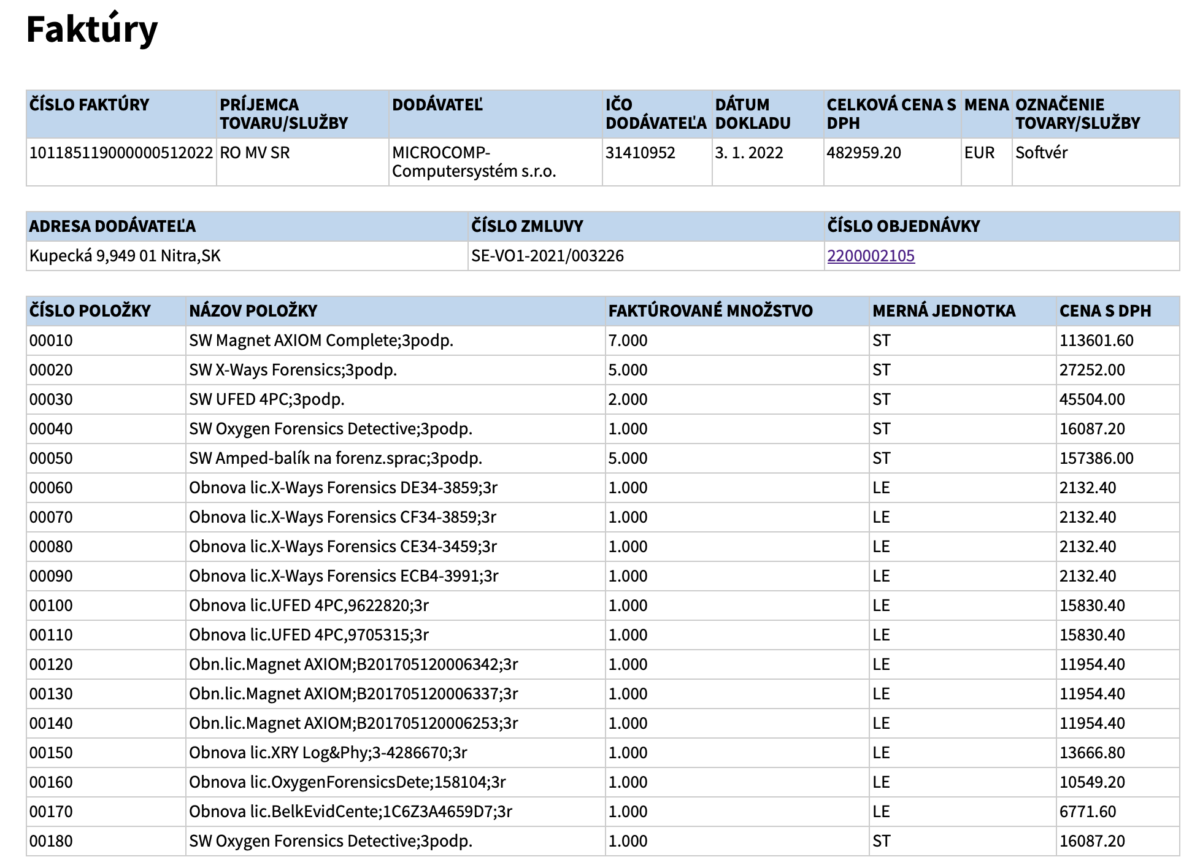
Screenshot of order from 2018 (Source: Slovak interior ministry website)
An invoice issued to the Slovak interior ministry in 2022 by the Slovak company Microcomp–Computersystém indicates the renewal of a licence for this software. At the time, the minister responsible was Roman Mikulec.
Screenshot of invoice from 2022 (Source: Slovak interior ministry website)
The Slovak ministry also ordered a licence renewal in July 2024, under his successor Matúš Šutaj Eštok. Microcomp–Computersystém did not respond for comment.
Interior ministry order with links to Russia. (Source: Slovak interior ministry website)
Authorities warned
On Friday (2 October), the Slovak national security authority (NBÚ) warned of the risks posed by using software from Oxygen Forensics and connected companies such as MKO Systems and Prostranstvo IT.
Their software helps investigators search for and examine data from digital devices. It can process vast amounts of information, including evidence, which makes it important who owns, controls and develops it. According to the NBÚ, this is important both for data protection and for the reliability of analysis results.
The warning came after the US case was made public.
The NBÚ considers links to Russia significant in assessing the security risk, also in view of Russia’s military aggression against Ukraine.
However, the warning itself does not mean that data leaked through the software. US prosecutors explicitly stated that the charges did not concern malicious code or unauthorised access to customer data.
The case concerns the alleged concealment of the software’s ownership and origin. And no court has yet ruled on the case.
“The ministry will proceed in accordance with the recommendations of the National Security Authority,” the Slovak interior ministry said.
The NBÚ recommended that public bodies identify this company’s presence and report it to the authority.
Belgian Green MEP Saskia Bricmont also called for the use of Oxygen to be stopped immediately and for an inquiry into whether sensitive information could have reached Russia after it was found that Romania, Germany, Spain, Italy, Poland and Hungary had purchased the software.
European police shed tool
Several European security agencies are suspending the use of Oxygen Forensics software or taking steps to terminate their contracts after the company’s Russian ties came to light.
The tool was also used by Czech police. Czech security agencies continued to purchase licences for the computer software after 2022, when the full-scale invasion of Ukraine began. Czech authorities are awaiting further information from the United States. For now, they have prohibited software updates.
London’s Metropolitan Police has suspended the use of Oxygen tools and launched a comprehensive review. British police forces, including specialised units, had used the software.
And Latvian police suspended its use and is assessing whether it will continue using it.
Romania’s anti-corruption agency, too, took steps to terminate its contract with the Russia-linked tool.
A case of treason on an unprecedented scale is emerging at Germany’s foreign intelligence service, in what German media say could shake the entire agency.
According to the investigative team of WDR, NDR and Süddeutsche Zeitung (SZ), August Hanning, the former head of the Federal Intelligence Service (BND), is being investigated for alleged espionage detrimental to the state and intelligence activities.
Hanning’s tenure at the BND ended in November 2005.
But he is accused of having illegally obtained secret information for several years after he left the service, which gathers and assesses information on foreign, security, and economic threats.
He was arrested at his home in Nordwalde, near Münster in western Germany, on Tuesday (6 October).
Der Spiegel reported that police arrived at 6.41AM and took him away in a black minibus at 8.58AM.
Another former senior BND employee was also detained in the Bavaria region — apparently the former head of Hanning’s office, who worked for the intelligence service until spring 2026.
Neither German authorities nor Hanning’s representatives had commented on the case by Tuesday noon.
What investigative journalists found
According to investigative journalists, Manfred D. leaked top-secret information from within the BND to Hanning until 2022.
According to Der Spiegel, which cited investigators’ findings, Hanning and Manfred D. agreed, as early as spring 2010, that the latter would, in return for payment, gather intelligence from the BND for his former boss, which Hanning could use in his private security consultancy work.
Investigators are working on the assumption that, in at least one case, Hanning prepared a security analysis for a foreign intelligence service.
According to WDR, NDR and SZ, it was not for Russia.
In another case, he allegedly used information from internal BND documents when communicating with a foreign agent.
According to information from security circles obtained by WDR, NDR, and SZ reporters, Hanning came under scrutiny after his home and offices were searched in September last year, when the State Criminal Police Office (LKA) was investigating the case of steak empire heiress Christina Block.
According to investigators, Hanning was involved in an earlier attempt to abduct them, accusations he denies.
While assessing material seized from Hanning last year, LKA officers found an electronic data storage device with explosive contents, according to the investigative journalists.
The former official apparently had access to top-secret BND documents from the recent past which, under no circumstances, should have been in his possession.
In total, he obtained around 2,000 documents. In many cases, these were briefings for the so-called intelligence situation meeting at the federal chancellery, where the heads of security agencies exchange information every week.
They included highly sensitive reports, for example, on Iran’s nuclear programme or the Russian military. According to security sources, they also included reports from foreign partner services.
A leak of such material is regarded by intelligence services as an absolute catastrophe. Friendly intelligence services could lose trust in the BND and cut off the institution from crucial information.
After assessing them, the LKA Hamburg police team handed the seized documents over to federal authorities.
And in May 2026, the Federal Public Prosecutor General’s Office ultimately opened confidential proceedings against Hanning and his alleged BND informant. It remains unclear over what period the former intelligence chief was supplied with secret internal information.
According to security sources, the most recently discovered documents date from June 2022.
It also remains unclear how the alleged BND mole managed to remove material from the secured agency. The BND was asked for a statement on the case.
Hanning’s lawyers have not yet responded to a brief request for comment on the allegations.
An affair of historic proportions
For the BND, this is already the second serious incident in the space of a few years.
In 2022, the espionage case involved Russia, when a former head of a BND unit was accused of spying for Moscow together with another man.
It concerned top-secret information on BND cyber operations that was leaked from the service.
As the Tagesschau website noted, if the suspicions against Hanning are confirmed, this would be an espionage affair of historic proportions.
German history has never before seen an alleged case of treason involving such a senior former top official.
According to Der Spiegel, this is unprecedented. This is particularly so because, for many years after leading the intelligence service, Hanning remained among the most important officials in Germany’s security apparatus.
Before becoming BND president, he was responsible for protecting classified information at West Germany’s representation in East Germany.
After serving at the chancellery, including as coordinator of the federal intelligence services, the lawyer, who holds a doctorate, took over the leadership of the BND in 1998.
At the end of 2005, after leaving the intelligence service, Hanning became a state secretary at the interior ministry. He retired four years later.
Questionable business
According to German media, his subsequent activities were seen as problematic. He became known as a businessman and security consultant with a company in Switzerland.
Its German subsidiary was hired for a time in the custody dispute between Block and her former husband.
According to prosecutors, in 2023 he allegedly planned, together with an associate, to “discredit Block’s former husband through false allegations of paedophilia”.
Hanning and his alleged accomplice apparently tried to plant a hard drive containing child sexual abuse images and videos on the father of Block’s children.
The investigation has not yet been concluded. Hanning has previously denied all allegations in the case.
Russia continues to pressure cities, while the first autonomous counter-drone turrets have been deployed in Kyiv.
Ukraine is maintaining pressure on Russia’s oil industry, reporting that it has disabled 51 percent of refinery capacity.
Russia still sees a large pocket of encircled Ukrainians in Kharkiv region, but no such pocket exists.
Ukraine says it destroyed a Russian Su-34 and Su-35 on the ground. Satellite imagery provides no clear evidence.
Maps of the day– Kharkiv region
Videos of the day – intense trench fighting; Russians shot down a balloon carrying an FPV drone; Russia has revived the idea of a barrage of tethered balloons; ground drones repelled an FPV drone attack using a counter-drone net – views from both sides.
Russia continues to pressure cities. Ukraine has begun testing AI-controlled machine-gun turrets in them. The new autonomous weapon is intended to protect key sites from drone attacks, typically bridges and similar infrastructure. Air force spokesperson Yuri Ihnat said on Monday that the AI turrets, which receive information from other air-defence components, had achieved their first shoot-downs, including of Geran-5 drones.
Ukrainian president Volodymyr Zelensky reported on Saturday, before Ihnat’s announcement, that 12 turrets of the kind shown in the military video below had been installed in the capital by that date. Another eight are planned.
They are armed with a 12.7mm heavy machine gun, which is not effective against a Geran flying high and fast, but becomes effective during the final phase of its flight, when it comes within the weapon’s range. The soldier in the footage said 50 rounds were sufficient to shoot down a Geran with AI assistance.
AI is entering Ukraine’s air-defense fight — and it is already helping shoot down Russia’s jet-powered Shaheds.
Air Force spokesperson Yurii Ihnat said AI-assisted turrets using machine vision have already successfully engaged Russian Geran-5 jet-powered UAVs.
Details of the turrets’ precise deployment are, understandably, not yet known. However, both Russian and Ukrainian sources commented on them in interesting ways. Ukrainian expert Anatoliy Khrapchynskyi told the NV website, among other things, about the risk that fully autonomous turrets pose to civilians. Serhii Beskrestnov was the first to warn about it on Monday: “I warn you that, for your own safety, you should not stand by windows during an air-raid alert.”
Khrapchynskyi noted that this rule has applied to any weapon since the start of the war. People should not stand by windows during air raids precisely because air defences or debris from downed weapons can damage buildings and injure people. There is a two-wall rule: if you cannot get to a shelter, hide somewhere in your flat protected from a potential blast by two walls, such as in a corridor.
“This does not mean that robotic turrets will fire at windows. They will target moving aerial targets, but they could hit civilian infrastructure,” Khrapchynskyi conceded.
The Russian Telegram channel Two Majors complained that while Ukraine was already using AI turrets in practice, and although promising projects of the same kind existed in Russia, bureaucracy and high costs were holding back their introduction into service.
The same Russian source was among those that published a video showing an entire bridge across the Dnipro in Kyiv being wrapped in a counter-drone net.
But after several days in which Russian Gerans targeted only Kyiv’s bridges, they attacked Zaporizhzhia in the same way overnight from Monday to Tuesday. Russia injured five city residents, including two Red Cross workers, and halted or restricted traffic on several bridges in Zaporizhzhia, causing traffic jams in the city during the morning.
Zaporizhzhia lies about 30 km from the front and is a natural supply route for fighting units. Taking the bridges out of action would create a serious logistical complication, but the same applies as in Kyiv: their complete destruction is unlikely. Russia will also be satisfied with constant attacks causing minor damage, but sufficient to halt traffic.
Among other sites hit by Russian weapons was one of the hospitals in Kryvyi Rih, which was struck by two missiles. Two people were injured during the air raid.
Ukraine is maintaining pressure on Russia’s oil industry, reporting that it has disabled 51 percent of refinery capacity. “More than half of the enemy’s capacity has been taken out of operation. This is the result of carefully planned, methodical and systematic work aimed at exhausting Russia’s war machine and destroying its military-economic potential,” new minister Yevhen Khmara said.
His statement cannot currently be verified, but footage of another fire at oil infrastructure in Russia emerged on Tuesday morning. It was at the Volodarskaya production and distribution centre in Moscow region. It lies just under 40 km southeast of central Moscow in a straight line, and its premises contain a large oil depot. It is also a pipeline junction through which fuel flows to Moscow, including aviation fuel for Moscow’s airports.
Ukrainian attack drones successfully struck Russia's Volodarskaya LPDS tonight, a major storage and distribution hub supplying jet fuel, diesel, and gasoline for the Russian capital, Moscow.
Ukraine says it destroyed a Russian Su-34 and Su-35 on the ground. Satellite imagery provides no clear evidence. The attack targeted Khanskaya airfield in Krasnodar region, from which a training unit normally operates.
The incident took place over the weekend. Satellite images showing clear traces of explosions and fire appeared relatively quickly, but it is not possible to identify what exploded and burned.
The usual Russian source, Fighterbomber, did not comment on the matter at all.
📍Satellite imagery of the aftermath of the UAV attack on "Khanskaya" airfield.
Russia still sees a large pocket of encircled Ukrainians in Kharkiv region, but no such pocket exists. The image below shows a map of the part of Kharkiv region where active military operations are under way. It was produced by the Russian defence ministry and shown by Two Majors on its Telegram account.
Alongside the image, the same source again cited Kremlin claims in listing alleged Russian successes in this sector: “In the Kharkiv direction, the Northern Group of Forces reported further advances. In the Lyptsi sector, our troops advanced near Tokarivka and captured several enemy strongpoints. In the Vovchansk and Velykyi Burluk directions, advances were reported in the areas of Prykolotne, Kotivka, Varvarivka, Reznikove, Mykolaivka, and Annopil.”
We have already written in Ukraine Battlefield update that no pocket exists, and that Ukrainian and independent sources follow the northern part of the front only marginally, because far less is happening there than Russia claims.
Among respected OSINT projects, Playfra most recently covered this battlefield on Saturday. The first map from this source shows the section of the front located at the top right of the Russian map. This is where the alleged encirclement is supposed to be, which various Russian sources have been reporting for almost a month.
The fighting here consists of Russian infiltration attempts, which are “chaotic and unorganised”. Playfra unequivocally rejects any encirclement.
Bilyi Kolodyaz-Velykyi Burluk directions.
No particular changes. The Russians continue infiltration attempts to encircle Ukrainian units in the Dehtiarne salient, though, once again, for now there is definitely no encirclement of the Ukrainians here. Russian infiltrations remain… https://t.co/ZlzDhwdMDhpic.twitter.com/GZz4lHkxSp
The following map from Playfra shows the same section of the battlefield as that seen in the Russian defence ministry’s version. The gap between reality and Russia’s claimed successes here is among the largest along the entire front, from Sumy to Kherson:
For comparison, the same area according to Finland’s Black Bird Group:
And according to the Russian project Slivochny Kapriz, which is relatively reliable. In all cases, Kharkiv is at the bottom left and the village of Dihtiarne, directly on the Ukrainian-Russian border, is at the top right:
Three-quarters of Ukrainians support peace talks. In the second half of September, the Kyiv International Institute of Sociology asked respondents whether they supported peace negotiations with Russia.
Exactly three-quarters — 75 percent — said they supported peace talks, 21 percent were against, and the remainder could not give a definite answer. This was virtually identical to the result in February 2025, when 74 percent of respondents answered the same question positively.
This is also shown by the Kyiv polling agency’s graph, whose analysts stressed that willingness to negotiate does not equal willingness to accept Russian terms.
Views on who will win the war have shifted more significantly. As the next graph shows, the difference between February 2025 and September 2026 is again almost zero, but there has been a significant change compared with July this year.
At the beginning of the summer, 60 percent of Ukrainians were certain they would win the war (dark blue), while 25 percent considered it more likely than not. Now, only 47 percent are certain, but 79 percent of respondents in total still expect a Ukrainian victory.
The change was probably driven by optimism in July, when Crimea was almost completely isolated and a successful campaign of medium-range strikes began. Although it continues, the one-off shift in public mood has since returned to its original level.
There have been minimal changes in views on how long Ukrainians are prepared to fight. The largest group — 62 percent — said (dark blue) they were prepared to do so for as long as necessary. Four percent (light blue) said one year, while 23 percent (orange) said they could endure only a few more months. However, the number who say resistance should continue for only months has fluctuated around 20 percent for more than two years.
Videos of the day
Videos like this were common in 2023. It is unclear when this one was made, because the prevailing nature of the fighting is different today. The Ukrainian squad in the footage clears Russian trenches.
In the more than seven-minute recording, views from the ground alternate with those from a reconnaissance drone hovering above the battlefield, which gave the Ukrainians an overview of the enemy. The fighting is confused, but the basic orientation is simple: Ukrainians with green identification markings attack from right to left.
Full video.
Original combat POV footage documenting a tactical operation to clear fortified positions in a contested tree line. The video shows real-time close-quarters maneuvers, tactical coordination, and direct trench combat.
— 𝔗𝔥𝔢 𝕯𝔢𝔞𝔡 𝕯𝔦𝔰𝔱𝔯𝔦𝔠𝔱 🦩🇬🇪🇺🇦🇺🇲🇬🇷 (@TheDeadDistrict) October 5, 2026
A Russian drone destroyed a balloon carrying a Ukrainian FPV drone beneath it. Ukraine is trying to use favourable wind currents in this way to extend the range of its small drones, which can then operate deeper in the Russian rear.
Twenty-first-century warfare in Moscow. A Russian soldier with a man-portable air-defence system shot down a Ukrainian drone by firing over a busy road.
Russian channels have released previously unseen footage from a drone attack on Moscow-area refineries.
The footage reportedly shows a mobile air-defense team using 9K38 Igla-series MANPADS engaging a Ukrainian FP/Liuity-type drone moments before it struck an oil storage… pic.twitter.com/9dJXPTZ6XG
Tethered balloons saw their greatest use during the Second World War, when they were deployed by armies on both sides. Balloon barrages protected London in the summer of 1940 and the Normandy landing fleet in June 1944, as well as German cities.
The principle was the same as in this Russian propaganda video. Balloons tethered to the ground by cables floated above cities and militarily important targets to prevent enemy aircraft from flying low. Ideally, they would hit the cables and crash. This principle may now be applied against drones.
👀 Russia has begun producing aerostats to protect oil refineries from drones.
A Russian FPV drone was targeting a Ukrainian unmanned ground vehicle. Just before impact, it successfully deployed a defensive launchable net.
Footage from a Russian FPV drone shows it diving toward a Ukrainian unmanned ground vehicle. Moments before impact, the UGV fires an anti-drone net from its rear section, catching and bringing down the attacking FPV. pic.twitter.com/MednUTUs45
— Special Kherson Cat 🐈🇺🇦 (@bayraktar_1love) October 3, 2026
This was not an isolated case. Another video from a different location shows a similar situation, but this time from the perspective of a camera on the ground drone.
Se me acaban las palabras para describir esto.
Las imágenes proporcionadas por la cámara instalada en un sistema terrestre no tripulado ucraniano 🇺🇦 muestran su sistema de red anti-drones “KARAKURT” funcionando en condiciones reales de combate.
By Monday (5 October), Russia had verifiably lost 24,170 pieces of heavy equipment (24,138 on Tuesday, 22 September). Of these, Ukraine destroyed 19,133 (19,105), 1,003 (1,000) were damaged, crews abandoned 1,194 (1,194), and the Ukrainian army captured 2,840 (2,839). This includes 4,452 (4,448) tanks, of which 3,357 (3,353) were destroyed in combat.
Ukraine lost 12,238 (12,175) pieces of equipment, of which 9,633 (9,579) were destroyed, 711 (702) damaged, 695 (695) abandoned and 1,199 (1,199) captured. This includes 1,466 (1,464) tanks, of which 1,126 (1,125) were destroyed in combat.
Note: Neither side regularly reports its fatalities or destroyed equipment. Ukraine publishes daily figures for Russian casualties and destroyed equipment, which cannot be independently verified. This overview uses data from the Oryx project, which has compiled a list of equipment losses documented exclusively by photographs since the beginning of the war.
Bosnia and Herzegovina’s election, held on Sunday (4 October), has reinforced the country’s deep ethnic and political divisions, with nationalist parties retaining a strong grip on power and low turnout underscoring voters’ growing disillusionment with a political system that has long frustrated the country’s ambitions to join the European Union.
Public support for EU membership remains strong. According to a 2026 survey by Bosnia’s directorate for European integration, 74.4 percent of citizens said they would vote for EU membership in a referendum. Even in Republika Srpska, the ethnic Serb component, where support is lower, 54.1 percent said they would back joining the bloc.
And Bosnia became an EU candidate in 2022, but its path towards membership remains stalled.
The European Commission has identified 14 priorities that the country must address before it can move towards opening accession negotiations. So far, it has not opened a single accession-talks chapter and does not have a chief negotiator for EU membership.
Meanwhile, Bosnia’s complicated political system, built around three constituent ethnic groups, continues to hamper the adoption of reforms.
Forgotten elections
The Bosnian nationwide turnout was just 42 percent, reflecting political apathy, but the complexity of its system also means few people in the EU followed what went on.
Instead of a single president, Bosnia and Herzegovina has a tripartite presidency comprising one Bosniak (South Slavic ethnic group), one Croat, and one Serb.
Voters registered in the federation may vote for either the Bosniak or Croat member, but not both. Voters in Republika Srpska elect the Serb member.
From the provisional results, on Sunday, Denis Becirović won a second term as the Bosniak member of the presidency with 38.12 percent.
He is to be joined by Darijana Filipović (46.55 percent) of the Croatian Democratic Union of Bosnia and Herzegovina (HDZ BiH) as the Croat member, and Željka Cvijanović of the Alliance of Independent Social Democrats (SNSD) as the Serb member (55.37 percent).
In light green is the Republika Srpbska. In dark green is the region of Brcko who has another legal status.
The Bosnian system excludes citizens who do not identify as Serb, Croat, or Bosnian from standing for the presidency.
And the post-war power sharing agreement includes 14 parliaments and governments in total for the country of some 3.1 million people, making reforms hard to push through.
But amid the complexities, the biggest winner from Sunday’s elections could be Serb nationalist politician Milorad Dodik, while the big loser could be the EU, according to Adi Ćerimagić, a senior analyst on the Western Balkans at the European Stability Initiative think tank.
This article continues, but the full version is available only to EUobserver.com subscribers. Visit account.euobserver.com/membership
After years without being able to pass a budget, a coalition that wavered over every major proposal, the Ceuta crisis, a string of corruption cases and people taking to the streets over the housing crisis, Spanish prime minister Pedro Sánchez has called snap elections for 29 November — just as a rightwing victory appears increasingly unstoppable.
Monday’s (5 October) move is barely a surprise. Sánchez’s gambles have proven effective in the past to keep his grasp on power.
Even before the summer, an early election wasn’t considered a far-fetched possibility. Sources in Sánchez’s centre-left Spanish Socialist Workers’ Party (PSOE) and its allies linked it to the budget vote anytime from October onwards, with some analysts pointing to November 2026 as a politically attractive date.
Spain now faces a 54-day sprint to the polls, the shortest window the law allows, with Sánchez betting that the housing issue can turn the campaign in his favour.
But why now?
The eviction of an 87-year-old woman from her rental home after 70 years on 23 September prompted people across the country to take to the streets against Spain’s ongoing housing crisis.
And last Friday, the Spanish lower house in parliament rejected two new housing decree-laws. It was the centre-right People’s Party (PP), far-right Vox, Catalan pro-independence party Junts and Navarrese regional party UPN who voted them down, exposing once again how fragile Sánchez’s parliamentary coalition is.
But with parliament dissolved, a political manoeuvre could now see similar housing decrees approved anyway – helping Sánchez make the housing crisis his main election motto.
Housing bet
In Spain, when parliament is dissolved ahead of an election, responsibility for ratifying government-approved laws passes to a smaller standing committee of 69 lawmakers, known as the Diputación Permanente [Permanent Deputation], which continues to operate until the new parliament is sworn in.
The maths in that body favours Sánchez. His socialist party and the left-wing and regional parties that backed the original housing decrees hold 35 seats, against 34 for the opposition.
This article continues, but the full version is available only to EUobserver.com subscribers. Visit account.euobserver.com/membership
Two human rights defenders are facing a Greek court in Rhodes and 20 years in jail over allegations they belong to a criminal organisation.
The hearing targets Norwegian activist Tommy Olsen and Panayote Dimitras, a legal administrator and representative of the NGO Greek Helsinki Monitor.
“They want to shut me up because what I’ve been doing over the last six to seven years is revealing their wrongdoings,” Olsen told EUobserver on Monday (5 October).
The hearing, which is taking place on Tuesday, is years in the making, following repeated attempt by Greek authorities to punish the pair for helping people seek asylum on the island of Kos in 2021.
Both deny any wrongdoing and Amnesty International earlier this year said the two were being prosecuted for their human-rights work of documenting serious rights violations.
This article continues, but the full version is available only to EUobserver.com subscribers. Visit account.euobserver.com/membership
Russia is making no progress at all on the front, and September was among its worst months.
Russia wants to cause Kyiv’s economic collapse, and pontoon bridges are being prepared in the city.
Ukraine’s air defences neutralised 83 percent of drones launched in September, compared with 92 percent in May.
Videos of the day – attacks on Kyiv’s bridges; what a TM-62 anti-tank mine can do; what anti-drone protection for the Kerch Bridge looks like; Russian communists shouted “Down with the tsar!”, and frontline sounds from a Russian soldier’s video.
Russia is making no progress at all on the front, and September was among its worst months. Russian president Vladimir Putin claimed in Valdai at the beginning of the month that his subjects had captured 1,300 square km of territory in September. This is further evidence that he is either being given completely fabricated figures or is deliberately lying himself.
If Putin were right, his army would have experienced its most successful period since the first two months of the invasion. Defence ministry reports reflect this. Almost every day, they report the capture of more and more villages. In reality, the situation is different. Russian forces became bogged down in every direction even before the rains arrived, and throughout the year they have failed to achieve any operational success that would justify the further hundreds of thousands killed and wounded.
As every month, various analysts have again published their calculations of how the front line moved. Not even estimates from Putin’s own Z channels agree with his figure.
“The average daily rate of advance by the Armed Forces of the Russian Federation in the SVO zone [special military operation] in September 2026 was +5.9 km². The average rate of advance over the entire offensive up to October 2026 is +9.92 km² per day,” Russian project Slivochny Kapriz wrote about September.
It, too, is an unreliable source that regularly overestimates the significance of “flag operations”, but even its data makes it clear that 2026 is lagging significantly behind the previous year.
Even if this author’s figures were correct, the Russians advanced by 177 square km during September’s 30 days, more than seven times less than Putin claims.
Ukrainians from DeepStateUA also published an estimate very close to Slivochny Kapriz’s figures. According to this OSINT project, Ukraine lost 154 square km in September.
However, the Ukrainian analysts treat their own data cautiously and warn their readers that “the operational security of our forces remains the highest priority in our work”.
In other words, during Ukrainian counter-offensives, DeepStateUA only reports successes after a delay so as not to jeopardise the operations’ success.
They therefore now recall that their statistics do not yet include 270 to 320 square km of liberated Ukrainian territory in various sectors. “July will therefore also end as a month in which the Armed Forces of Ukraine have the upper hand, while for August and September this will only become clear when official announcements of successes are available. In the meantime, part of the liberated territories may be lost again,” DeepStateUA wrote on Friday (2 October).
The most optimistic by far are currently Finnish analysts from the Black Bird Group, who see a balance of 190 square kms in Ukraine’s favour in September.
Over the month of September, the Russian net gains were negative 190 km2. This marks the greatest monthly net territorial loss for Russia in our dataset since the June of 2023.
Emil Kastehelmi, one of the project’s authors, pointed out that the sharp change for the better stems from the fact that it also captures some changes that DeepStateUA has not yet taken into account. Nevertheless, he said: “Russia has failed to reverse a situation that has persisted for almost the entire year. The results of the major Russian offensive are minimal, and this is likely to remain the case for the rest of 2026.”
Among Western analysts, the most sceptical is Konrad Muzyka of Rochan Consulting, who credits the Russians with even more gains than Slivochny Kapriz — as much as 235 square kms of advance. Yet this figure still does not come close to Putin’s. Even if it were the most accurate of all, which cannot be determined, it would amount to an area roughly equivalent to the size of Košice, including all its suburbs, forests and agricultural land within the city’s administrative boundaries.
The plan for this year, meanwhile, was to capture the rest of Donetsk region, including the remaining large cities of Kostiantynivka, Druzhkivka, Kramatorsk and Sloviansk. The Russians are closest to doing so in Kostiantynivka, but Ukrainian soldiers remain there too.
Here is a short summary of territorial changes in Ukraine for September 2026. Our dataset shows an overall Russian territorial gain in September, but a sharply uneven pattern: gains around Dobropillia, Velykyi Burluk, Kramatorsk and Komyshuvakha coincided with substantial losses… pic.twitter.com/jrq0zXiqri
— Konrad Muzyka – Rochan Consulting (@konrad_muzyka) October 1, 2026
Russia wants to cause Kyiv’s economic collapse, and pontoon bridges are being prepared in the city. There is now no doubt that the Russian army has begun a systematic effort to disrupt transport between western and eastern Kyiv. Over the weekend, further drones struck several bridges across the Dnipro.
They included the Northern Bridge, which a Russian drone attacked during the day amid heavy traffic.
🚨 BREAKING: Russian forces launched a drone strike hitting the Northern Bridge in Kyiv, damaging the road surface.
The strike coincides with German Chancellor Friedrich Merz’s unannounced visit to the capital to meet with Ukrainian leadership. pic.twitter.com/j1UHYoBMa7
Ukraine’s transport minister Mykola Kalashnyk said 600,000 cars cross Kyiv’s bridges every day. In an interview with Suspilne, he announced that construction of embankments and pontoon bridges would begin this week. If the existing bridges become impassable, they are intended to maintain as much traffic as possible between the river’s two banks. Kalashnyk said the temporary crossings should have at least half the capacity.
However, this will take around three months; in the meantime, work will also be carried out to improve the resilience of road bridges.
Transport expert Dmytro Bespalov is sceptical. As he said in an interview with NV, Kyiv’s bridges are irreplaceable, and the only thing that can keep traffic moving across the Dnipro is the military.
However, the task of keeping the bridges operational is complicated by their poor technical condition. Because of their age and the lack of maintenance funding, Bespalov rates the Southern and Northern bridges at four on a scale of one to five, where one is ideal condition and five is emergency condition. He says two other bridges are at level five.
Even in this condition, such large structures are not easy to destroy, but they are certainly more vulnerable. Like many others, Bespalov believes that Russia lacks the means to destroy the bridges completely and is seeking to disrupt traffic during the winter. “The aim is probably an economic blow. I fear it will be very painful. It will not kill us, but I am very concerned about the economic consequences it will have,” he added.
Air defences neutralised 83 percent of drones launched in September, compared with 92 percent in May. This follows from data by the Shahed Tracker project, which recorded 6,732 Russian drones launched against Ukraine over the month, of which 5,561 were shot down or disabled through electronic jamming.
Shahed type OWA-UAS stats Sep2026 [per UA Air Force Reports]
As the same source’s chart for August shows, the effectiveness rate did not change, but the number of drones launched by Russia rose sharply month on month by almost 1,600.
Shahed type OWA-UAS stats Aug2026 [per UA Air Force Reports]
In May, when Russia used a record 8,150 drones, it was as high as 92 percent. At that time, the Russian army began a mass transition to jet-powered drones, leading to a temporary slowing of the pace of attacks. The trend is now unfavourable: monthly attack statistics have begun to rise sharply, while the effectiveness of countermeasures is declining, as Geran-4 drones and especially Geran-5 drones still present a serious problem.
Shahed type OWA-UAS stats May2026 [per UA Air Force Reports]
Total: 8150 (New Record) Claimed Intercepted: 7476 (Official: 5053 Shahed type OWA-UAS) Hits: 508 (674 Not Intercepted) Interception Rate: ~92%
As another video showing the moment a Geran-5 was hit demonstrates. Technical solutions already exist, but faster interceptor drones are not yet available in sufficient numbers.
Another Geran-5 drone shot down by a STING S interceptor drone from Wild Hornets. Combat work by pilots of the 1020th ZRP. pic.twitter.com/kkPHaCIrKG
One TM-62 anti-tank mine contains seven and a half kilograms of explosives. This is enough to destroy the remains of a building used as a shelter by Russian soldiers.
❗️A Ukrainian heavy Baba Yaga-type drone destroys a building with Russian soldiers inside by dropping a TM-62 anti-tank mine. pic.twitter.com/XClgIqMvwe
A video recently circulated online showing Kyiv residents protesting against tree felling. It was widely used as alleged evidence that Ukrainians have had enough of the government. However, their protest was civic, not political. These Muscovites are communists and dared, very timidly, to chant “Down with the tsar!” Police intervened immediately.
У Москві комуністи зібралися на погоджений мітинг, почали скандувати «Долой царя», і після цього їх побили й розігнали мусора. pic.twitter.com/MD6MVxSBPS
This video must be watched with the sound on. It illustrates the saturation of the battlefield with drones. The Russian soldier who recorded it says he counted five drones.
"I’ve already counted five. It’s a damn swarm." position of 🇷🇺1199th Motorized Rifle Regiment (probably occupied south 🇺🇦) 🍂 is coming pic.twitter.com/K9H3wcRdse
Three lines of anti-drone barriers protect the Kerch Bridge, which links Crimea to Russia, from attacks from the sea.
Exilenova+ says Russia has set up layered defenses around the approaches to the Crimean Bridge, with multiple lines against Ukrainian surface and underwater USVs plus FSB patrol ships. The stated aim is to shield the bridge’s vulnerable elements. pic.twitter.com/rxMPPe6gXW
By Monday (5 October), Russia had verifiably lost 24,170 pieces of heavy equipment (24,138 on Tuesday, 22 September). Of these, 19,133 (19,105) were destroyed by Ukraine, 1,003 (1,000) damaged, 1,194 (1,194) abandoned by their crews and 2,840 (2,839) captured by the Ukrainian army. This includes 4,452 (4,448) tanks, of which 3,357 (3,353) were destroyed in combat.
Ukraine lost 12,238 (12,175) pieces of equipment, of which 9,633 (9,579) were destroyed, 711 (702) damaged, 695 (695) abandoned and 1,199 (1,199) captured. This includes 1,466 (1,464) tanks, of which 1,126 (1,125) were destroyed in combat.
Note: Neither side regularly reports on its own dead or destroyed equipment. Ukraine publishes daily figures for Russian casualties and destroyed equipment, which cannot be independently verified. This overview uses data from the Oryx project, which has compiled a list of equipment losses documented exclusively by photographs since the beginning of the war.
Some expected a change in Hungary’s pro-Russian foreign policy after Viktor Orbán’s fall. But they failed to take into account the domestic political pressures on Hungary’s prime minister Péter Magyar.
An unexpected source of tension in Ukrainian-Hungarian relations came at a meeting of the newly formed ‘Carpathian Eight’ (C8) in late September. At the meeting in Kyiv, PM Magyar was embroiled in a sharp exchange with Ukrainian foreign minister Andrii Sybiha, who criticised Budapest for not taking part.
Magyar responded to Sybiha by claiming that Hungary had been included in the C8 without his consent.
“To claim that a sovereign country is a member of an international cooperation (Carpathian Integration) without prior consultation or consent of the country concerned is completely unacceptable,” Magyar said on social media.
This comes after Hungary-Ukraine relations began to improve rapidly following the formation of the Tisza government in May.
Under Orbán’s government, relations had fallen to a historic low, raising the prospect of escalation. In June, Magyar announced that he had reached an agreement with Ukrainian president Volodymyr Zelensky on settling the rights of the Hungarian minority in Transcarpathia, hailing it as a historic deal.
Ukraine’s Deputy PM Vsevolod Chentsov informed me that legislation on minority education rights will be submitted to Parliament. I welcome this step after weeks of 🇭🇺🇺🇦 expert consultations. Thank you to all Hungarian and Ukrainian colleagues for their constructive work. Looking…
Since June, however, Hungary has repeatedly blocked Ukraine’s EU accession negotiations, arguing that progress on settling the rights of Hungarians in Transcarpathia has fallen short of expectations.
Orbán’s Fidesz party previously used the same argument to block Ukraine’s integration efforts.
Three months after the so-called historic agreement, Ukraine’s foreign minister Sybiha wrote that although Orbán had lost the election, Orbánism (a policy based on isolation and obstruction) prevailed in Hungary.
“Orbanism has done no good, neither to Hungary nor to the broader region, in the past — and it will not do anyone any good moving forward,” said Sybiha on social media.
Domestic Hungarian politics can explain the dispute.
MOL, an oil company, signed a memorandum with Ukraine’s Naftogaz at the C8 meeting on the possible establishment of Ukrainian oil storage facilities in Hungary.
The deal was criticised by Fidesz politicians, and Magyar’s government strongly distanced itself from the deal, too. Fidesz may have contributed to Magyar entering the dispute over C8 participation so very forcefully.
What is the Carpathian Eight?
In August, Zelensky announced the creation of the C8 to bring together countries from the wider Carpathian border region. The Ukrainian president said its members would focus primarily on the economy, security, the environment and investment.
Ukraine described it as a project intended to strengthen cross-border cooperation even with countries that do not provide it with military aid. Alongside Ukraine were to be Romania, Serbia, Poland, Slovakia, Czechia, Austria and Hungary.
Michal Lebduška, an analyst at the Association for International Affairs in Prague (AMO), said that it was one of many regional initiatives. While he did not believe it would trigger “major cooperation”, it could nevertheless be important.
The inaugural summit of the newly formed C8 was held last month (18 September) in Bukovel, in the Ivano-Frankivsk region, around 160 km from both the Slovak and Hungarian borders. Zelensky called it “an important beginning” and thanked the countries of the Carpathian region for being among Kyiv’s most reliable allies.
From Ukraine’s perspective, however, the meeting had mixed results. On the one hand, several leaders travelled to Bukovel in person, lending the gathering greater diplomatic weight. Polish PM Donald Tusk, Romanian president Nicușor Dan and Serbian president Aleksandar Vučić all attended in person.
On the other hand, the remaining countries sent lower-ranking representatives. Slovakia’s PM Robert Fico had initially indicated that he would attend, and was originally due to meet Tusk. At the last minute, however, he announced that he could not attend the summit due to sudden illness.
Slovakia was ultimately represented by Marek Eštok, state secretary at the foreign ministry.
Andrej Babiš’s Czech government all but completely ignored the initiative. As Respekt magazine wrote, Babiš declined the opportunity to visit Ukraine and did not send any representative to Bukovel.
So Czechia was represented at the summit only by opposition deputy Senate president Jiří Drahoš.
And Austria was ultimately represented by Christine Schwarz-Fuchs, president of the Federal Council.
Hungary sent Ádám Ceglédi, the acting chargé d’affaires at the Hungarian embassy in Kyiv, as the Hungarian foreign ministry confirmed to Telex.
According to the analyst, Ukraine may have hoped that Orbán’s fall would bring a clear shift in Hungary’s Ukraine policy. Anita Orbán, as foreign minister, has confirmed this by pursuing a foreign policy moving away from Russia.
However, Ukrainians did not take Magyar’s domestic political interests into account.
Magyar panders to anti-Ukraine crowd
This article continues, but the full version is available only to EUobserver.com subscribers. Visit account.euobserver.com/membership
In a sign of humble progress, the FP-7 ballistic missile saw its first deployment.
Russian forces are now attacking Kyiv’s bridges.
No resolution to jet-powered Geran drones with new threat is on the horizon.
Ukraine lost another MiG-29 and its pilot, while Russia has lost a Mi-8 helicopter with a crew of three.
Videos of the day: attacks on a bridge in Kyiv; a drone struck a school full of children and teachers; a ground drone recorded the impact of two glide bombs.
FP-7 ballistic missile made in Ukraine were deployed for the first time. This is progress, but one should not expect miracles.
“Ukrainian tactical ballistic missile. FP-7. First combat deployment. Thank you for the results. Next step: serial production. Glory to Ukraine!” With these words and a short video, Ukrainian president Volodymyr Zelensky announced a long-awaited milestone in Ukraine’s arms programme. The next step is expected to be the deployment of the larger and more dangerous FP-9 missile.
Ukrainian tactical ballistic missile. FP-7. First combat use. Thank you for the result. Next up: production. Glory to Ukraine! pic.twitter.com/IxdjVg51c1
— Volodymyr Zelenskyy / Володимир Зеленський (@ZelenskyyUa) October 1, 2026
For now, however, this was only its first deployment against an unknown target, with an unknown outcome. The Russian analytical channel Military Informant did not rule out the possibility of the footage being recorded at a training ground with the intention to deflect criticism of Fire Point, the Kyiv-based manufacturer whose production is behind schedule.
The FP-7 missile is an interesting technical achievement that could expand the Ukrainian army’s ability to strike important targets. Expectations should be kept low. This is because the missile has not yet entered serial production its specifications lag behind those of Russia’s short-range Iskander missiles.
The FP-7 is based on the Soviet-origin 48N6 surface-to-air missile, used in some versions of the S-300 system and still deployed by Russia in the more modern S-400. A Ukrainian outlet says that the FP-7 has an estimated range of only 200 km and a warhead weighing up to 150 kg.
Russia’s Iskander missiles weighs more than twice as much, and Russia has already used a version with an extended range well beyond 500 km. The Ukrainian FP-7’s use will therefore be limited to areas up to roughly 100 km from the front line. It is certainly not a means for strategic strikes against Russian industry deep inside enemy lines.
Ukraine could strike further with a FP-9 missile, and developing them remains a goal to work towards. The two types of missile differ significantly. They were analysed in August by the Russian Telegram channel Russian Engineer. The FP-7 is smaller and the FP-9 larger. Its maximum range is estimated at 855 km (far enough to reach Moscow,) its warhead is expected to weigh up to 800 kg.
The outlet focusing on the war’s technical parameters compared the Iskander with the FP-9:
“The 9M723 Iskander-M missile has a diameter of 920 mm, while the FP-9’s is 1,100 mm. The missiles are 7.2 and 9.5 metres long. The solid-fuel rocket motor is approximately 4.2 metres long in the 9M723 and 6.5 metres in the FP-9. Fuel mass is estimated at 2.6 and five tonnes. With a warhead weighing around 500 kg, calculations indicate ranges of up to 500 km and 1,000+ km. If the warhead weighs around 800 kg, the range will be approximately 800 km.”
The media’s performance estimate therefore matches official Ukrainian data.
According to the Russian Engineer Telegram channel, the FP-9 is conceptually based on the Iskander and builds on the Ukrainian Sapsan project, which was never brought to the final stage.
The Ukrainians displayed both missiles at a trade fair in Denmark in August, where the following photographs were also taken:
The Russians have started attacking Kyiv’s bridges. This fulfils the wishes of Russian pro-war hawks, who for years have complained that bridges in the capital of the invaded country were still standing.
This article continues, but the full version is available only to EUobserver.com subscribers. Visit account.euobserver.com/membership
Jordan Bardella, a leader of the French far-right National Rally, has denied writing antisemitic messages in 2013, as the race ahead of next May’s presidential elections continues to heat up.
An investigation by the left-leaning outlet Mediapart said on Thursday (1 October) that it could authenticate antisemitic messages from 2013 and attribute them to Bardella.
In the messages, Bardella, an MEP and chair of the far-right Patriots for Europe group, said “all the banks are owned by Jews” and that Israel aims to create a new world order. Earlier media reports also found his secret Twitter account publishing racist content, such as mocking a young Black man who had suffered police violence.
He denied having written the messages, calling the evidence “crude montages” and “obscure screenshots that can easily be manipulated,” he wrote on social media, adding he would sue Mediapart for defamation.
“Either Mediapart is running this operation itself, or it is being manipulated by interested parties,” he has said.
This article continues, but the full version is available only to EUobserver.com subscribers. Visit account.euobserver.com/membership
More than a year ago, we launched our Hungary Briefing, a weekly round-up of the election campaign. Since the historic vote in April to remove Viktor Orbán, the series has followed the new Tisza government and its first moves in office. This week’s topics:
Two ministers from Orbán’s government have been held in custody.
Former prime minister Orbán may have ordered the detention of Ukrainian cash couriers.
The newly established National Asset Recovery and Protection Office has begun work.
The European Public Prosecutor’s Office could also help recover stolen funds.
It has been an eventful few days in Hungarian public life. Efforts to hold former officials accountable are gathering pace: two former ministers have been remanded in custody over suspected breaches of fiduciary duty involving billions of forints and the acceptance of bribes.
The National Asset Recovery and Protection Office (NVVH) immediately took over four cases and began investigating them, including the visa business linked to Orbán’s brother. Meanwhile, a chief prosecutor who resigned from his post claimed in an open letter that Orbán himself had ordered the detention of Ukrainian cash couriers.
Prime minister Péter Magyar addresses parliament as MPs vote to lift his immunity, Budapest, 28 September 2026 (Srouce: Zsolt Szigetváry/EPA)
Two ministers from Orbán’s government have been held in custody
“The landing is beginning as part of ‘Operation Purgatory’,” prime minister Péter Magyar announced on Monday (28 September) morning. Later that morning, Hungary’s parliament lifted the immunity of Miklós Seszták, an MP and former development minister from the Christian Democratic People’s Party (KDNP); Balázs Hankó, an MP and former culture and innovation minister from Fidesz; and prime minister Magyar.
Prosecutors requested that Hankó’s immunity be lifted on suspicion of breach of fiduciary duty: he is suspected of causing losses of 17 billion forints (€46.5m) to the state budget. Authorities are investigating Seszták on suspicion of accepting bribes and other offences. The former minister and the then chief executive of Hungarian National Asset Management are suspected of receiving approximately 12.6 billion forints (€34.2m), in bribes through an intermediary between 2015 and 2018.
Magyar himself requested the lifting of his own immunity after the deputy prosecutor general asked the speaker of parliament to initiate the procedure over an incident in June 2024. According to the Office of the Prosecutor General, Magyar deliberately dropped the phone of a man filming him into the Danube, an act it classifies legally as theft.
After the vote on his immunity, Seszták went to the Central Investigating Chief Prosecutor’s Office, where he was taken into custody. He said he had committed no crime and wished to give a statement. On Wednesday, a court ordered the former minister’s remand in custody.
Hankó initially waited in the Fidesz parliamentary group’s office for police to take him away. Under the rules, however, he should have presented himself at the Central Investigating Chief Prosecutor’s Office.
Under the Act on the National Assembly, police may enter the parliament building and take action there only with the speaker’s specific permission, while the Parliamentary Guard may neither forcibly bring him before the authorities nor take coercive measures against him. Parliament speaker Ágnes Forsthoffer therefore firmly called on Hankó to leave the building and cooperate with the investigating authorities.
Hankó subsequently held a press conference with his wife and children present, claiming that he was the target of a politically-fabricated case and declaring his innocence. He finally accepted the summons at 7.20 pm and left parliament, setting off to give a statement amid carefully-staged scenes. Orbán’s social media page live-streamed the entire episode (while the Fidesz leader was in Belfast cheering on Hungary’s national football team).
In a statement, prosecutors said that Hankó and his associates had used National Cultural Fund resources for purposes other than those prescribed by law on 1,079 occasions between 3 September 2025 and 30 March 2026.
This article continues, but the full version is available only to EUobserver.com subscribers. Visit account.euobserver.com/membership

 Login