❌

Normal view

Greece Weather Warning: Intense phenomena with heavy rainfalls, thunderstorms, high winds

12 October 2026 at 17:01

A weather deterioration in Greece is forecast for the next couple of days and the National Meteorological Service (EMY) has issued an “orange” warning, that is Category 4. The main features of the new spell of bad weather will be intense weather phenomena locally, a drop in temperature, and strengthening winds over the seas. According […]

The post Greece Weather Warning: Intense phenomena with heavy rainfalls, thunderstorms, high winds appeared first on Keep Talking Greece.

Mitsotakis on elections: 25% for ND could mean serious questions for party leadership

12 October 2026 at 16:04

Greek Prime Minister Kyriakos Mitsotakis has apparently started to realize that the ruling conservative New Democracy party will hardly manage to achieve the necessary 30+% of the votes in the upcoming elections and secure a majority government like in the last two parliamentary votes. Over the weekend, PM Mitsotakis made clear if the election result […]

The post Mitsotakis on elections: 25% for ND could mean serious questions for party leadership appeared first on Keep Talking Greece.

Greece bans social media to minors as of Jan 1, 2027

12 October 2026 at 11:53

The Greek government presented a draft law on Monday banning social media access to minors below 15 years old. The ban will be implemented as of January 1, 2027. Greece seeks to address the problems associated with use of social media by minors ahead of an equivalent European regulation that is still progressing through the […]

The post Greece bans social media to minors as of Jan 1, 2027 appeared first on Keep Talking Greece.

Athens marks 82. anniversary of Liberation from Nazi occupation

12 October 2026 at 11:24

With a modest ceremony, Athens marked on Monday 82 years of Liberation from the Nazi occupation (1941-1944) during the WWII. The ceremony to commemorate the Liberation of Athens started with the hoist of the Greek flag on the Acropolis at 11 o’ clock in the morning in the presence of President of the Republic Constantine […]

The post Athens marks 82. anniversary of Liberation from Nazi occupation appeared first on Keep Talking Greece.

Foreign ministry urges Greek citizens to avoid traveling to Saudi Arabia

12 October 2026 at 11:02

The Ministry of Foreign Affairs has advised Greek citizens to avoid travelling to Saudi Arabia unless absolutely necessary, citing the evolving situation across the wider Middle East. In a statement on Sunday, the ministry said it was taking into account both the latest developments in the region and the restrictions imposed on air traffic in […]

The post Foreign ministry urges Greek citizens to avoid traveling to Saudi Arabia appeared first on Keep Talking Greece.

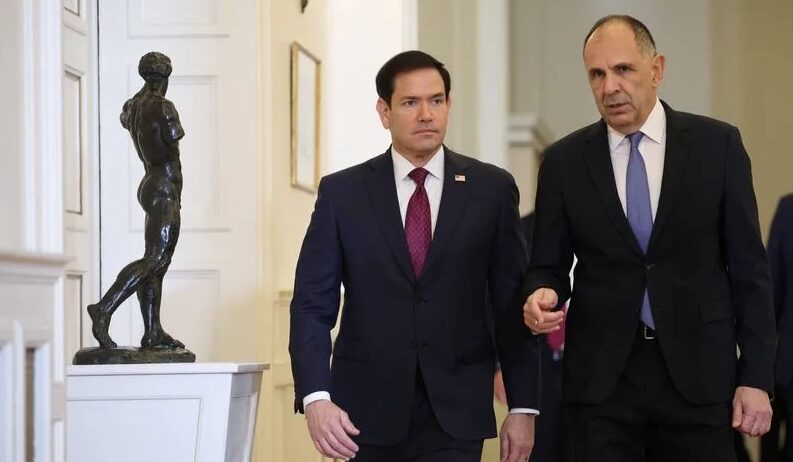
Marco Rubio is promoting troubling ideas about ‘Western civilization’ | Ted Widmer

12 October 2026 at 11:00

In a recent visit to Greece, the secretary of state suggested that Europe must rediscover the values of conquest and expansion

They had obviously worked hard on the backdrop – and it was magnificent. On 7 October, the US secretary of state, Marco Rubio, delivered a major speech in Athens, outdoors, with the Acropolis behind him. The sun was setting, bathing the ancient scene, including the Parthenon, in the light of the golden hour.

The golden hour, but yet not quite the golden age. This was not Pericles defending democracy. Instead, Rubio offered a haunting vision of the choices facing the west, arguing that the US and Europe must rediscover the values of exploration and conquest that once drove centuries of expansion, or face decline and irrelevance.

Continue reading...

© Photograph: Mark Schiefelbein/Pool AP/AP

© Photograph: Mark Schiefelbein/Pool AP/AP

© Photograph: Mark Schiefelbein/Pool AP/AP

Brussels Rejects Italy and Greece’s Demands for Further Energy Budget Relief

12 October 2026 at 09:51

The European Commission has rejected demands from Italy and Greece for additional exemptions from EU spending rules as the Middle East energy crisis drives inflation higher, exposing renewed divisions over how much financial assistance European governments can provide.

The European Commission has rejected requests from Italy and Greece for greater freedom to increase public spending in response to the energy crisis, resisting pressure from two member states that argue existing budget restrictions are limiting their ability to protect households and businesses.

The decision, confirmed on 8 October, follows renewed appeals from Italian Prime Minister Giorgia Meloni and Greek Prime Minister Kyriakos Mitsotakis for measures recognising the exceptional financial burden imposed by higher energy prices.

Meloni wants Brussels to take greater account of unexpected inflation when assessing national budgets and to permit additional tax revenue generated by rising prices to be used for energy relief. Mitsotakis has sought the exclusion of temporary support measures for consumers and businesses from the expenditure limits agreed under the EU’s fiscal framework.

Economic Commissioner Valdis Dombrovskis rejected the argument for further concessions, maintaining that the existing arrangements already take inflation into account and provide mechanisms for responding to exceptional circumstances.

The disagreement comes as Europe’s governments confront the economic consequences of the Middle East conflict, including higher fuel costs, inflationary pressures and increased demands for state intervention.

Italy’s increasingly difficult budget choices

For Italy, the dispute adds to a fiscal problem that has been developing throughout the year.

The government expects its budget deficit to rise to 3.4 per cent of GDP in 2027, reversing an earlier objective of reducing borrowing below the EU’s three per cent reference value.

As EU Today reported earlier this month, Rome plans to use additional fiscal room for defence and energy-related expenditure, while public debt is projected to remain close to 138 per cent of GDP.

The new request concerns the treatment of inflation and the financial support required to offset its effects.

Energy inflation creates an unusual budgetary problem. Governments can receive additional nominal tax revenue as prices rise, particularly through consumption taxes, while simultaneously facing public pressure to compensate consumers for higher living costs.

Meloni argues that such unexpected revenue should be available for targeted assistance without forcing equivalent reductions elsewhere in national expenditure.

Brussels is reluctant to accept arrangements that could turn temporary increases in tax receipts into an opportunity for permanent spending expansion.

Italy’s position also reflects the political competition between defence spending and domestic economic support. Rome has accepted the need for higher military expenditure but faces immediate pressure from households and energy-intensive industries.

That competition was already apparent when the government chose to prioritise energy relief over the full use of defence-spending flexibility.

Greece seeks different treatment for emergency support

Greece’s request is more narrowly focused on the treatment of temporary assistance under the EU’s expenditure rules.

Athens argues that measures intended to help businesses and households manage exceptional energy costs should not be counted against the normal spending limits.

The Greek government faces an economic environment in which higher imported energy prices threaten household purchasing power and business profitability, particularly in sectors dependent on transport and fuel.

Excluding temporary relief from expenditure calculations would give Athens additional room to intervene without breaching its agreed fiscal trajectory.

The Commission, however, has resisted establishing further exemptions beyond those already provided in the fiscal framework.

Its objection is institutional as well as financial. If additional categories of emergency expenditure are repeatedly excluded from fiscal calculations, the system becomes increasingly difficult to enforce consistently across the Union.

The limits of Europe’s reformed fiscal rules

The EU revised its fiscal governance framework in 2024, introducing nationally agreed expenditure paths intended to provide greater flexibility while maintaining sustainable public finances.

The Commission’s rules on exceptional circumstances permit member states to depart temporarily from normal requirements under specified conditions.

Those provisions have already been used to accommodate higher defence expenditure, while the Commission has also issued guidance on their application to energy-security investments.

Temporary financial assistance intended to reduce household energy bills, however, is not necessarily treated in the same way as investment in infrastructure that reduces Europe’s long-term dependence on imported fuel.

That distinction has become a source of friction between Brussels and national capitals.

Governments argue that the immediate economic effects of an international crisis require exceptional measures. The Commission is concerned that repeated concessions could weaken the credibility of the spending framework.

A wider dispute over Europe’s economic response

The Commission’s decision also comes as France faces increasing pressure over its debt and budget deficit.

The deterioration in French borrowing conditions has reinforced concerns about the risks associated with heavily indebted governments continuing to expand expenditure.

France, Italy and Greece have different fiscal positions, but the problems confronting them originate partly in the same combination of expensive energy, weak economic growth and competing spending commitments.

The dispute will now feed into preparations for the European Council meeting on 15–16 October, where energy prices and economic competitiveness are prominent agenda items.

EU leaders are expected to consider targeted and temporary measures to reduce the burden on businesses and consumers, alongside longer-term initiatives intended to reduce dependence on fossil fuels.

The Commission’s refusal to provide Italy and Greece with further fiscal exemptions establishes the limits within which those discussions will take place.

National governments remain free to introduce assistance, but Brussels is insisting that they account for its cost within the fiscal rules already agreed.

For Rome and Athens, the question is whether those rules provide sufficient room to respond to an energy crisis whose duration remains uncertain.

Greece “Indispensable” To US. What About Turkey? Turkish Question Strikes Again

10 October 2026 at 18:42

Click to see the full-size image

Written by Uriel Araujo, Anthropology PhD, is a social scientist specializing in ethnic and religious conflicts, with extensive research on geopolitical dynamics and cultural interactions

US Secretary of State Marco Rubio this week hailed Greece as an “indispensable” NATO partner – and a pillar of stability in a region marked by “geopolitical uncertainty”. The two sides announced expanded counterterrorism information-sharing. A defense agreement has been reached – worth up to $4 billion. Rubio also backed energy projects such as the undersea electricity interconnector linking Greece to Cyprus, and eventually Israel. At the same time, Rubio insisted a military clash between Turkey and Greece remains “unthinkable” and something the United States would “never allow.” He stressed that both are NATO allies and that conflict would harm all three countries.

When someone emphatically insists that they would never set a house on fire, the very emphasis makes people wonder whether the risk exists. Similarly, Rubio’s statement highlights that Greek-Turkish tensions remain serious enough to require public reassurance from Washington. It would thus seem that the two neighboring countries’ Atlantic membership alone is no guarantee of stability on the Alliance’s southeastern flank. NATO itself has in fact long been split over the “Turkish Question”.

As I argued previously, Trump’s warm embrace of Erdogan in July (recently reiterated), his subsequent signals that he would lift CAATSA sanctions and consider F-35 sales to Turkey, have already raised concerns in Athens – and Israel, for that matter. This exposed divisions, at a time when Ankara pursues strategic autonomy – while also clashing with “allies” over the Aegean, Syria, and the Eastern Mediterranean. Since at least last year, it has been noted how “sidelining” Turkey risks weakening the Alliance’s southeastern flank – and how the Athens-Ankara rivalry in turn exposes NATO’s fragile unity. These tensions predate the current US-Greece deepening of ties.

A closer American-Greek strategic relationship could alienate Turkey (despite Trump’s warmth) and generate further friction within the Alliance. Ankara might perceive the US as strengthening Greece’s military position, its diplomatic leverage, and regional role – at Ankara’s expense. Washington in turn may regard the Hellenic Republic as increasingly “indispensable” – while still viewing Turkey as strategically essential. Those two policies are not inherently incompatible, but they become harder and harder to sustain when Greek and Turkish interests directly conflict.

The latest developments illustrate the dilemma: Greece hosts key US facilities such as Souda Bay, and offers geographic advantages in the Eastern Mediterranean. While the $4 billion arms package builds on existing F-35 procurement and modernization, American support for the electricity interconnector, however, runs up against maritime disputes: Greece seeks to resume seabed surveys, while Turkey argues that the work requires prior coordination under its Libya maritime agreement. The combination of military capability, infrastructure access, and energy influence could look much more serious for Ankara than any single statement. The Greek-Turkish dispute over territorial waters, airspace, continental shelves, and island militarization is longstanding.

This creates the conditions for a security dilemma: Athens strengthens defenses out of distrust, Ankara perceives a shift in the balance and responds – and each side’s measures reinforce the other’s insecurity. Moreover, perception matters in foreign relations. Calling Greece “indispensable” does carry symbolic weight. If Turkey sees Washington investing in Greek capacity while its own F-35 path remains blocked by S-400-related legal restrictions, the asymmetry, so to speak, becomes politically relevant. Domestic prestige and national grievances in both capitals can amplify the effect, thereby creating incentives for public pushback even when direct confrontation would be costly. How can the US and NATO “balance” this?

Washington could separate bilateral defense ties from endorsement of every territorial claim. “Private diplomacy”, as Rubio has indicated, can manage sensitive issues better than public statements. NATO’s existing Greece-Turkey military deconfliction mechanism, established in 2020 with a hotline, can reduce the risk of incidents. The problem is the Alliance itself cannot simply adjudicate Aegean disputes or impose maritime boundaries. Article 5 does not offer a straightforward path for one member against another. NATO’s priority remains preventing hostilities rather than settling sovereignty questions.

At least three scenarios remain plausible: managed competition, with military modernization proceeding alongside negotiations over the underlying rivalries somehow; Turkish strategic pushback through diplomacy, counter-procurement, or greater use of its leverage within the Atlantic Organization; or an “incident” in the Aegean or around Cyprus that would force Washington and NATO into crisis-management mode.

Thus far, Washington has tried to cultivate both bilateral relationships. Greece cannot replace Turkey’s geographic and military assets spanning Europe, the Black Sea, and the Middle East. Washington appears to be strengthening the Hellenic Republic as a sort of strategic hedge, expanding its military access and logistical options in the Eastern Mediterranean – to mitigate the risks of Turkey’s progressively independent and unpredictable (often aggressive) foreign policy. Even as Ankara itself remains an important NATO (and US) ally in its own right. The recent advances in American-Greek relations enhance the challenge without resolving the underlying contradictions. They reflect a deeper transatlantic contradiction in the context of an increasingly divided West.


MORE ON THE TOPIC:

The post Greece “Indispensable” To US. What About Turkey? Turkish Question Strikes Again appeared first on South Front.

School ceilings keep falling on students’ heads, injuring minors during classes

9 October 2026 at 14:14

School ceilings keep falling on students’ heads across the country in the last couple of days, where such incidents are being reported on a daily basis. Shortly before classes ended for the weekend, a large piece of plaster fell from the ceiling injuring a 14-year-old student. The boy at Thermi Gymnasium by Thessaloniki was hit […]

The post School ceilings keep falling on students’ heads, injuring minors during classes appeared first on Keep Talking Greece.

Greek diplomats disagree with Rubio’s position on GSI cable

8 October 2026 at 12:24

A senior diplomatic source sent a clear message that the “sensitivities” of third countries do not constitute a right, in the wake of comments by U.S. Secretary of State Marco Rubio on the Greece-Cyprus electricity interconnection – the Great Sea Interconnector (GSI) – during his visit to Athens. Referring to energy interconnection projects and clearly […]

The post Greek diplomats disagree with Rubio’s position on GSI cable appeared first on Keep Talking Greece.

Rubio pushes for “MAGA Nationalism” with “the cradle of Democracy” as backdrop

8 October 2026 at 11:46

With the Acropolis as a backdrop, US Secretary of State Marco Rubio Rubio lavishly praised the Ancient Greece with the usual clichés, all of them except the most important one: Greece is the cradle of Democracy. How could he talk about “democracy”? On the contrary. Rubio chose to rolled out the MAGA agenda as if […]

The post Rubio pushes for “MAGA Nationalism” with “the cradle of Democracy” as backdrop appeared first on Keep Talking Greece.

Sparta Founded Only One Colony in Its History, and Filled It With the “Sons of Virgins”

When we think of Greek colonization, we think of Athens, Corinth or the cities of Euboea, which scattered new settlements across the Mediterranean and the Black Sea. Sparta hardly looked abroad at all. It founded a single colony, about 700 kilometres (435 miles) away in a straight line, across the Ionian Sea. And it did […]

Leader of populist, far-right party LAOS arrested for insurance fraud

6 October 2026 at 14:20

Filippos Kambouris, a Trash TV presenter and president of the right-wing populist LAOS party, has been arrested over his alleged leading role in a scheme to defraud the Greek state to the tune of millions of euros. Citing police sources, media noted later on Tuesday according to preliminary findings losses to e-EFKA and the Greek […]

The post Leader of populist, far-right party LAOS arrested for insurance fraud appeared first on Keep Talking Greece.

‘They want to shut me up’: Norwegian activist fights 20‑year Greek prison threat over asylum aid

5 October 2026 at 15:40

Two human rights defenders are facing a Greek court in Rhodes and 20 years in jail over allegations they belong to a criminal organisation.

The hearing targets Norwegian activist Tommy Olsen and Panayote Dimitras, a legal administrator and representative of the NGO Greek Helsinki Monitor.

“They want to shut me up because what I’ve been doing over the last six to seven years is revealing their wrongdoings,” Olsen told EUobserver on Monday (5 October).

The hearing, which is taking place on Tuesday, is years in the making, following repeated attempt by Greek authorities to punish the pair for helping people seek asylum on the island of Kos in 2021.

Both deny any wrongdoing and Amnesty International earlier this year said the two were being prosecuted for their human-rights work of documenting serious rights violations.

This article continues, but the full version is available only to EUobserver.com subscribers. Visit account.euobserver.com/membership

Greece Rejects ‘Borrowing’ Parthenon Sculptures as Athens and Sofia Exchange Historic Treasures

4 October 2026 at 09:35

Greek Prime Minister Kyriakos Mitsotakis has ruled out an agreement requiring Athens to recognise British Museum ownership of the Parthenon Sculptures, using a landmark exchange of cultural objects with Bulgaria to restate Greece’s position.

Greek Prime Minister Kyriakos Mitsotakis has said Greece will not “borrow” the Parthenon Sculptures under an arrangement requiring Athens to recognise British Museum ownership, as Greece and Bulgaria completed an exchange of historic remains and religious artefacts following decades of negotiations.

Mitsotakis made the remarks on Saturday, 3 October, during a ceremony at the Museum of Byzantine Culture in Thessaloniki attended by Bulgarian Prime Minister Rumen Radev.

Under the agreement, Greece transferred to Bulgaria human remains identified as those of medieval Bulgarian ruler Tsar Samuel, together with material recovered from four sarcophagi at the Basilica of Saint Achilleios in the Prespa region.

Bulgaria returned 48 ecclesiastical objects removed from northern Greece during the First World War.

The Greek prime minister’s office said the returned objects include icons, crosses, vestments, reliquaries and an episcopal throne. They were removed in 1917 from religious institutions in the Serres region.

The artefacts will initially be displayed at the Museum of Byzantine Culture before being returned to the monasteries and church authorities from which they originated. The Greek government said the 48 objects will remain on display until 5 November.

The remains handed to Bulgaria were discovered during archaeological excavations at Saint Achilleios in the 1960s and later identified as belonging to Samuel, who ruled the First Bulgarian Empire between 997 and 1014.

Bulgaria organised a state ceremony following their return. The Bulgarian government described the transfer as the return of one of the country’s most significant medieval rulers.

The exchange concludes negotiations stretching back decades, although both governments have agreed to continue discussions about other objects of mutual historical interest.

Mitsotakis used the Thessaloniki ceremony to link the agreement to another, far more prominent dispute over cultural property: the Parthenon Sculptures held in London.

He said cultural diplomacy had demonstrated that disputes over objects removed during earlier periods of conflict could be addressed through negotiation, referring also to previous arrangements involving fragments of the Parthenon returned from Sicily.

The Greek government continues to seek the reunification in Athens of the surviving Parthenon Sculptures.

The central obstacle remains ownership.

The British Museum states that Lord Elgin removed the sculptures between 1801 and 1805 with the permission of the Ottoman authorities then governing Athens. His actions were examined by a parliamentary committee before the collection was acquired for the museum in 1816.

Greece disputes the legitimacy of their removal and argues that surviving elements of the monument should be reunited at the Acropolis Museum.

That difference has direct consequences for any proposal based on loans.

Under the British Museum trustees’ published position, the museum is prepared to consider lending objects from its collection, including the Parthenon Sculptures, but requires a borrowing institution to acknowledge the museum’s ownership.

Successive Greek governments have refused to meet that condition.

Mitsotakis reiterated that position on Saturday, arguing that Greece cannot borrow an object which it considers its own.

The dispute has continued despite negotiations between Athens and the British Museum.

In February, the UK government told Parliament that the chairman of the British Museum remained in discussions with the Greek government over a possible partnership involving reciprocal loans.

The British government has maintained that operational decisions concerning the sculptures belong to the museum’s trustees.

EU Today has followed the dispute for several years. In 2023, then British prime minister Rishi Sunak cancelled a scheduled meeting with Mitsotakis after the Greek leader publicly raised the return of the sculptures.

The dispute subsequently produced an unusual diplomatic argument between two NATO allies, although discussions between Greek representatives and the British Museum continued.

The Greece-Bulgaria agreement concluded on Saturday differs substantially from the Parthenon case in both its legal history and the circumstances under which the objects were removed.

Athens nevertheless sees the exchange as evidence that governments can settle disputes over cultural property without abandoning their respective interpretations of history.

For Bulgaria, the return of Samuel’s remains has considerable national significance. For Greece, the recovery of the ecclesiastical objects resolves a century-old question concerning material removed during the First World War.

The Parthenon Sculptures remain considerably more complicated.

Talks continue, but the fundamental disagreement identified again by Mitsotakis in Thessaloniki has not changed: London considers the sculptures legally owned by the British Museum, while Athens considers them parts of a Greek monument which should be permanently reunited.

As long as that difference remains, a conventional loan arrangement offers no straightforward solution.

Inflation in Greece surged to 5.1% in September 2026

2 October 2026 at 15:34

Inflation in Greece surged to 5.1% in September, while the Eurozone average stood at 3.8%, the European Statistics authority EUROSTAT announced on Friday, October 2, 2026, based on preliminary data.. The Energy index rose by 14.1% Annual inflation in the Eurozone came in at 3.8% in September, up from 3.2% in August, while in Greece […]

The post Inflation in Greece surged to 5.1% in September 2026 appeared first on Keep Talking Greece.

Greece renews mandate for Patriot missiles in Saudi Arabia

2 October 2026 at 14:02

Greece will extend the presence of its air defense battery of Patriot missiles in Saudi Arabia for at least another month, top defense and foreign policy officials agreed on Thursday. In a session chaired by Prime Minister Kyriakos Mitsotakis, the Government Council on National Security and Foreign Affairs (KYSEA) took into consideration the increased tension […]

The post Greece renews mandate for Patriot missiles in Saudi Arabia appeared first on Keep Talking Greece.

Sailing ban for ferries due to gale-force winds in the Aegean Sea

2 October 2026 at 12:22

Ferries remain docked at several ports in Greece on Friday, October 2, due to gale-force winds reaching 9 and up to 10 Beaufort locally in the Aegean Sea. A sailing ban was imposed at the ports of Rafina and Lavrio in south-eastern Attica on Friday morning, while sailings from the port of Piraeus were also […]

The post Sailing ban for ferries due to gale-force winds in the Aegean Sea appeared first on Keep Talking Greece.

US Secretary of State Marc Rubio in Athens next week

2 October 2026 at 11:57

US Secretary of State Marco Rubio will visit Athens next week as head of an American delegation to the 6th US-Greece Strategic Dialogue. According to a statement by the State Department, his visit is part of a series of stops at Rekjavik, Athens, and Lisbon from October 5 to 8, 2026. “In Greece, Secretary Rubio […]

The post US Secretary of State Marc Rubio in Athens next week appeared first on Keep Talking Greece.

❌