❌

Normal view

Houthis Show New Gains in Taiz as Siege of Saudi-Backed Forces Tightens (Video)

12 October 2026 at 21:30

File image.

The Houthis (Ansar Allah) on October 12 released footage they said showed their fighters clearing Saudi-backed forces from the remaining areas of Jabal Habashi district, the al-Birin Triangle and the Yafrus junction in Yemen’s southwestern Taiz province.

The footage showed close-range fighting, surprise attacks and fighters advancing into opposing positions and trenches. It also depicted the use of automatic rifles, sniper rifles, machine guns and 82 mm and 120 mm mortars, alongside the capture of several fighters, weapons and military vehicles.

The Houthi military media said the group’s fighters had driven Saudi-backed forces from the three locations and secured the areas.

Pressure on Saudi-backed forces around Taiz continues to intensify, with fighting on multiple fronts and reported Houthi movements toward the city’s western approaches.

The recent advances tightened the encirclement of government-aligned positions and restricted their movement between frontlines.

Alongside the fighting, tribal leaders in Jabal Saber, south of Taiz city, have been holding negotiations with Houthi forces over a possible handover of local areas without fighting, according to Yemeni media reports. The reported talks aim to prevent villages from becoming military positions or launching points for attacks and to spare populated areas further destruction. No agreement or transfer of control had been confirmed in the reports.

The combination of Houthi advances on the western approaches and negotiations over Jabal Saber indicates the battle for Taiz city is drawing near. The Houthis maintain the upper hand. However, the difficult terrain and the high urban density of the city could play in favor of the defenders.

_______________________________________________________________________________________________________________________

SouthFront: Analysis and Intelligence

NOW hosted at southfront.press

Previously, SouthFront: Analysis and Intelligence was at southfront.org.

The .org domain name had been blocked by the US (NATO) (https://southfront.press/southfront-org-blocked-by-u-s-controlled-global-internet-supervisor/) globally, outlawed and without any explanation

Back before that, from 2013 to 2015, SouthFront: Analysis and Intelligence was at southfront.com

SOUTHFRONT.PRESS

MORE ON THIS TOPIC:


The post Houthis Show New Gains in Taiz as Siege of Saudi-Backed Forces Tightens (Video) appeared first on South Front.

Military Situation In Yemen On October 12, 2026 (Map Update)

12 October 2026 at 20:38

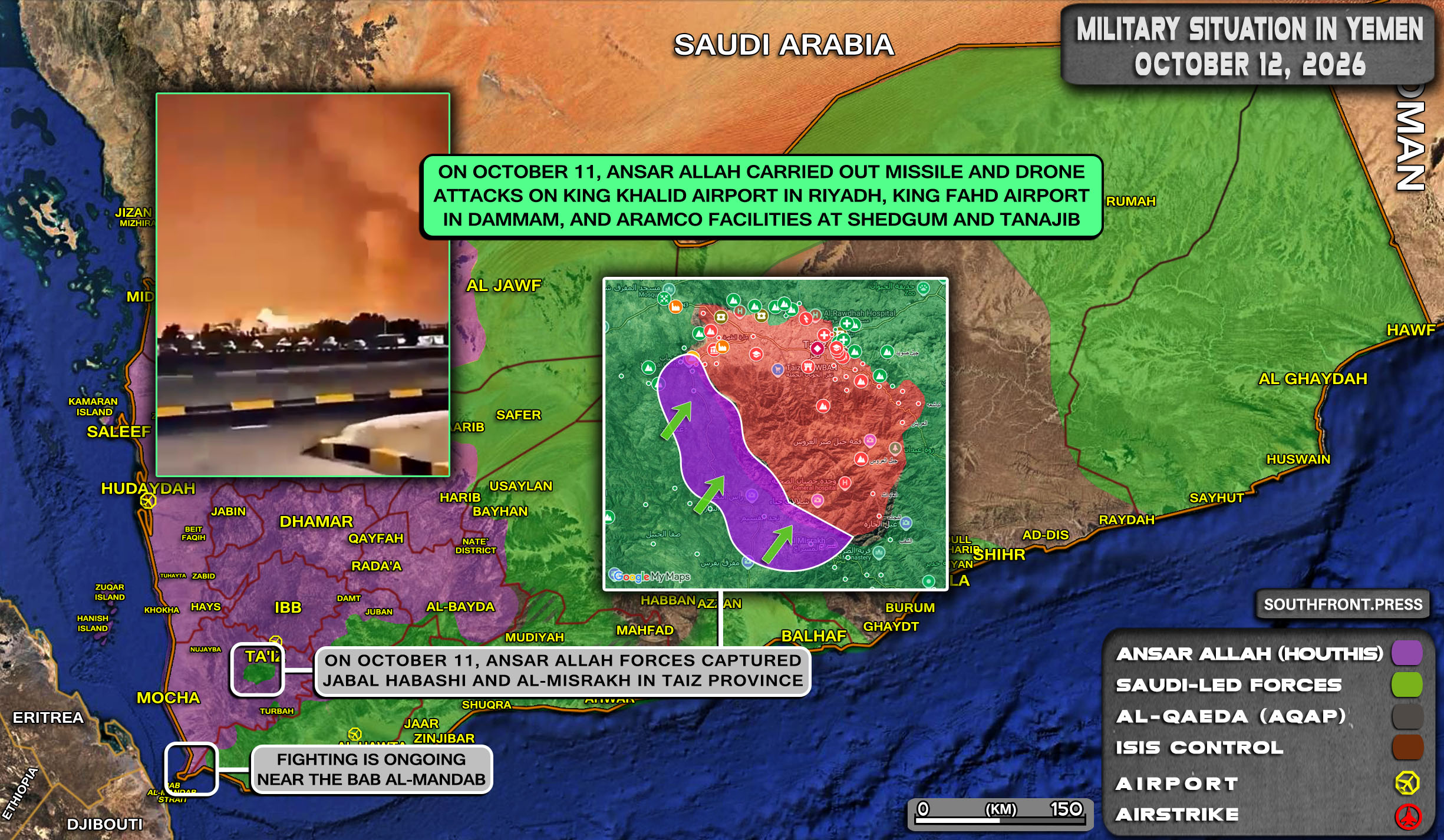
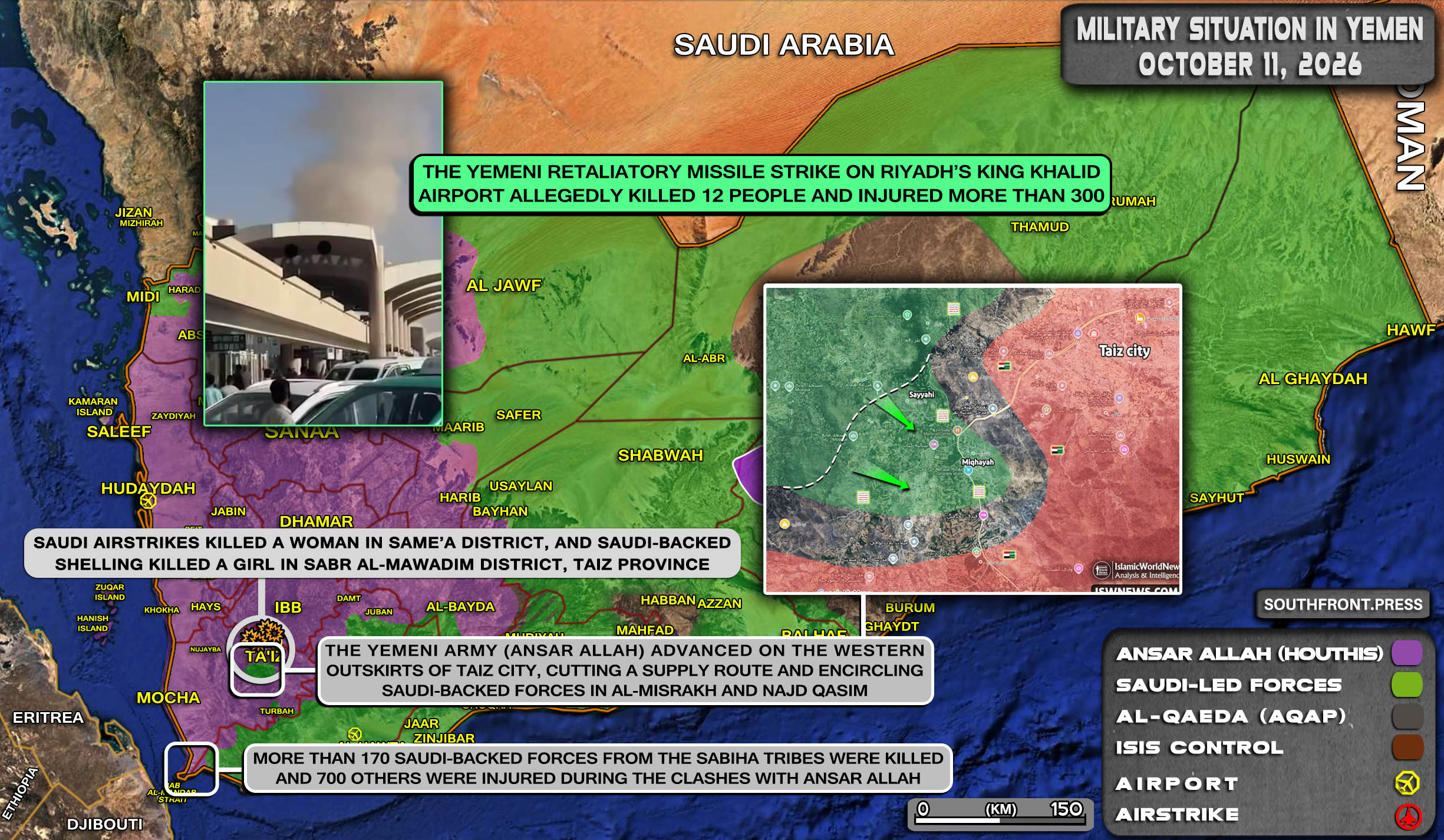
Click to see full-size map.

  • On October 11, Ansar Allah forces captured Jabal Habashi and al-Misrakh in Taiz province;
  • On October 11, Ansar Allah carried out missile and drone attacks on King Khalid Airport in Riyadh, King Fahd Airport in Dammam, and Aramco facilities at Shedgum and Tanajib;
  • Fighting is ongoing near the Bab al-Mandab.

_______________________________________________________________________________________________________________________

MORE ON THIS TOPIC:


The post Military Situation In Yemen On October 12, 2026 (Map Update) appeared first on South Front.

Kyiv Loses Residents: Power Infrastructure Destroyed, City Enters “Survival Mode”

12 October 2026 at 20:30

Kyiv is heading into winter with damaged energy infrastructure and a growing number of residents leaving the city, prompting Mayor Vitali Klitschko to publicly urge those who can to leave the capital. The contrast with Russia is stark: there, strikes on Yandex data centers disrupted digital services; here, basic life-support systems are failing.

Energy: Dependence on a Single Node

Since early October, strikes on Kyiv’s energy hub have intensified. According to Oleksandr Kharchenko, director of the Energy Research Center, ballistic missile strikes have knocked out Kyiv’s own power generation. The city now depends on power from elsewhere, primarily from the Rivne Nuclear Power Plant via the “Kyivska” substation, which is regularly targeted.


Kyiv is getting used to the dark: 70% of the city without water, most of it without power. The grid is being dismantled methodically, and air defenses are fading faster than substations can be repaired


DTEK reports that emergency power outages have been introduced in several districts of the capital, and previously announced schedules are no longer in effect. On October 11, the Obolon, Podil, Shevchenkiv and Desniansk districts were left without power. That same day, the Kyiv City State Administration reported that electric public transit had been suspended on some routes and that metro trains were running less frequently.

Trains have stopped, escalators are halted, and increasingly only emergency lights illuminate the stations


Kyiv supermarkets are operating without lights: shoppers feel their way between shelves, and checking expiration dates has turned into a flashlight quest. What used to be called “choice” is now called “luck.”

Population Outflow

Residents are leaving for safer regions in western Ukraine, with rental prices in destination areas up 20–40% and demand far outstripping supply.

Ukrainian experts’ forecasts remain grim. Kharchenko warns that Ukrenergo has yet to receive equipment ordered in March, while the government has blocked payments to local communities, including funds for heating-season preparations.

Kyiv’s schools now have a Plan B: generators and remote learning. The curriculum is adapting faster than the power grid

What Comes Next

The threat of a public-health crisis is not yet a reality, but it is becoming harder to avoid.

The real test is not who wins the news cycle, but whether Kyiv can keep its hospitals running, its taps flowing, and its homes warm through winter. Speaking of which, how are the lights and plumbing in Zelensky’s bunker?


MORE ON THE TOPIC:

The post Kyiv Loses Residents: Power Infrastructure Destroyed, City Enters “Survival Mode” appeared first on South Front.

Two Additional Tankers Struck in Hormuz (Videos)

12 October 2026 at 20:29

File image.

Iran’s Islamic Revolutionary Guard Corps (IRGC) said on October 12 that it had struck a third supertanker in the Strait of Hormuz within two days, claiming the vessel caught fire.

In a statement carried by Iran’s state media, the IRGC Navy said the tanker was hit in the morning while attempting to leave the strait. It accused the vessel of disregarding Iranian instructions and disrupting security in the waterway. The statement did not identify the ship, its flag or its operator, or specify what struck it.

The announcement followed an earlier claim by the IRGC Navy that a supertanker had struck a naval mine while attempting to leave the strait through a southern route that Iran considers unauthorized.

The force said in a statement issued late on October 11 that the explosion struck the vessel’s engine room. It described the tanker as capable of carrying about 2 million barrels of oil but did not disclose the tanker’s identity.

The United Kingdom Maritime Trade Operations agency said during the day that it had received a delayed report of an incident a day earlier involving an outbound tanker struck by an unidentified projectile in the Strait of Hormuz. The crew was reported safe, while authorities were investigating. The agency did not identify the vessel or attribute responsibility for the incident.

Preliminary data from maritime analytics firm Kpler, reported on October 12, showed a sharp decline in confirmed oil flows through the Strait of Hormuz toward the end of last week. Volumes fell to 2 million barrels per day on Saturday, down from 6.7 million on Friday and 22.8 million on Thursday.

Confirmed flows averaged 10.5 million barrels per day over the seven days through Saturday, about 38% below the prewar baseline of 17.1 million barrels per day, according to the data.

Kpler cautioned that the figures remained preliminary and could be revised upward. They also excluded Iranian-origin shipments.

The decline underscores the continuing disruption to commercial shipping through the strategic waterway, which carried about one-fifth of global oil and liquefied natural gas trade before the war.

The latest attacks show that Iran is still very much in control of the Strait of Hormuz, well capable of targeting any vessel it deems in violation of its restrictions.

_______________________________________________________________________________________________________________________

SouthFront: Analysis and Intelligence

NOW hosted at southfront.press

Previously, SouthFront: Analysis and Intelligence was at southfront.org.

The .org domain name had been blocked by the US (NATO) (https://southfront.press/southfront-org-blocked-by-u-s-controlled-global-internet-supervisor/) globally, outlawed and without any explanation

Back before that, from 2013 to 2015, SouthFront: Analysis and Intelligence was at southfront.com

SOUTHFRONT.PRESS

MORE ON THIS TOPIC:

The post Two Additional Tankers Struck in Hormuz (Videos) appeared first on South Front.

Military Situation In Iran On October 12, 2026 (Map Update)

12 October 2026 at 19:30

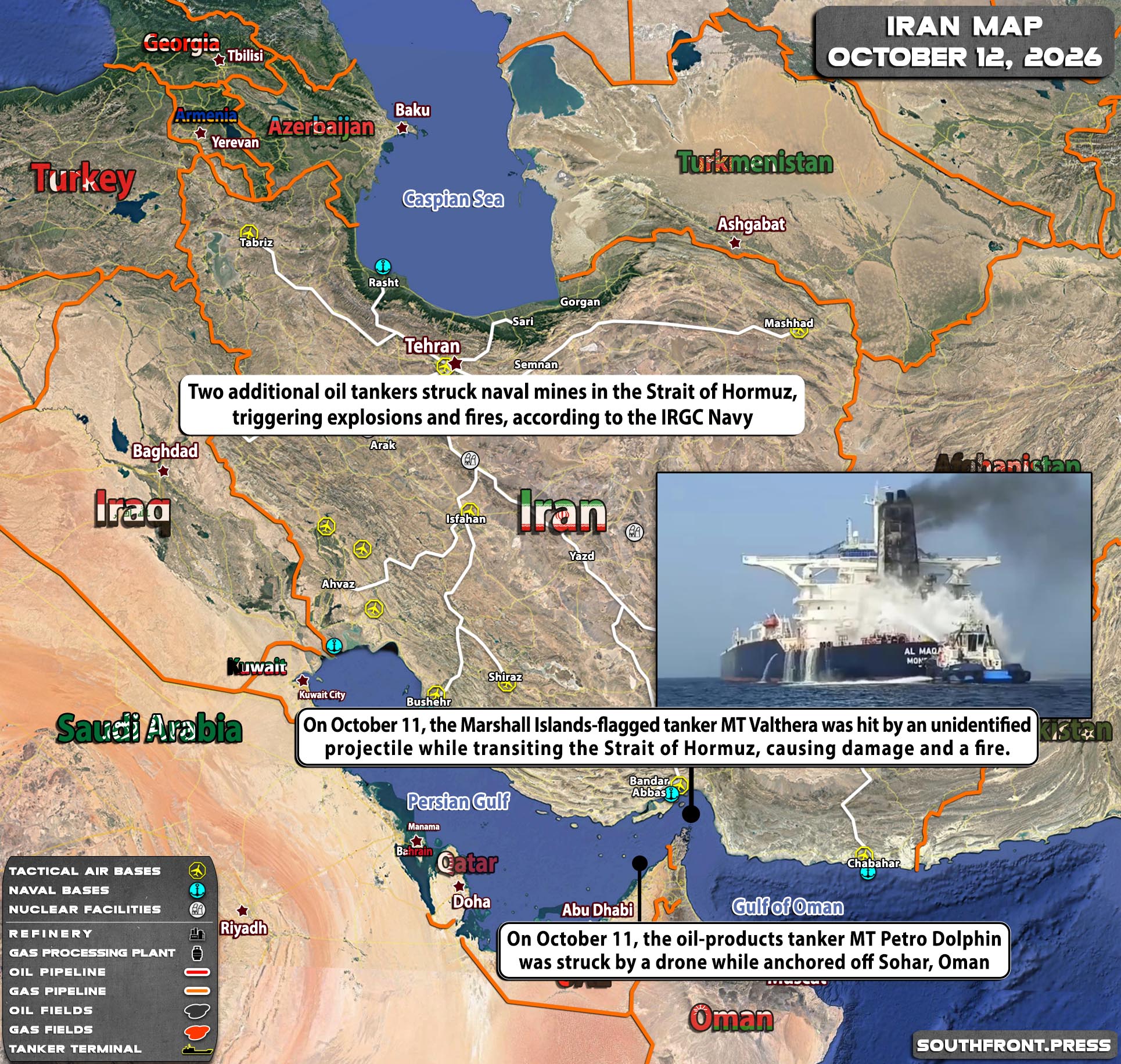
Click to see full-size map.

  • Two additional oil tankers struck naval mines in the Strait of Hormuz, triggering explosions and fires, according to the IRGC Navy;
  • On October 11, the Marshall Islands-flagged tanker MT Valthera was hit by an unidentified projectile while transiting the Strait of Hormuz, causing damage and a fire;
  • On October 11, the oil-products tanker MT Petro Dolphin was struck by a drone while anchored off Sohar, Oman.

_______________________________________________________________________________________________________________________

MORE ON THIS TOPIC:


The post Military Situation In Iran On October 12, 2026 (Map Update) appeared first on South Front.

In Video: Saudi-Backed Forces Take Heavy Losses In Failed Marib Attack

12 October 2026 at 16:16

File image.

The Houthis (Ansar Allah) released footage on October 12 showing their fighters repelled a large-scale attack by Saudi-backed government forces on the al-Faliha front in the central Yemeni province of Marib.

The footage, broadcast by the Houthi-run Al-Masirah network, showed a large force crossing the desert with armored vehicles and other military equipment before coming under artillery and mortar fire.

The force received direct hits. Subsequent scenes showed several armored vehicles being struck, damaged and set ablaze. One military pickup truck was hit and overturned, while other vehicles retreated across the desert. The footage also showed wounded fighters lying on the ground as the withdrawal continued.

Houthi military media said the defending forces later used guided missiles against the advancing vehicles, causing further destruction and fires.

The failed attack on the al-Faliha front comes as Saudi-backed forces struggle to turn their reported advances in Marib into a broader breakthrough.

Although government forces have announced the capture of individual positions on several fronts in Marib, their operations have yet to produce a decisive shift in control or dislodge the Houthis from their established defensive lines.

The Houthis therefore continue to hold the upper hand in Marib, where their defenses have withstood repeated attempts to advance.

_______________________________________________________________________________________________________________________

SouthFront: Analysis and Intelligence

NOW hosted at southfront.press

Previously, SouthFront: Analysis and Intelligence was at southfront.org.

The .org domain name had been blocked by the US (NATO) (https://southfront.press/southfront-org-blocked-by-u-s-controlled-global-internet-supervisor/) globally, outlawed and without any explanation

Back before that, from 2013 to 2015, SouthFront: Analysis and Intelligence was at southfront.com

SOUTHFRONT.PRESS

MORE ON THIS TOPIC:

The post In Video: Saudi-Backed Forces Take Heavy Losses In Failed Marib Attack appeared first on South Front.

More Than 70 Killed in Strikes on Illegal Mining Sites Along Egypt-Sudan Border (Videos)

12 October 2026 at 14:58

Illustrative image. (U.S. Air Force photo/Staff Sgt. Amy Abbott)

A Sudanese rights group said strikes on October 10 killed at least 72 people at a gold-mining site near Egypt’s border with Sudan.

Emergency Lawyers attributed the strike to Egyptian warplanes. Cairo has not officially commented on the strikes, while Sudan’s military-led Sovereign Council said the two governments were in contact to establish the circumstances.

Sources in Cairo told The National that the strike targeted illegal gold prospectors who were operating on territory claimed by Egypt and had repeatedly ignored warnings to leave.

Images circulating online appeared to show a leaflet warning of “immediate targeting,” although the material has not been independently verified.

Click to see full-size image.

The incident follows similar strikes that reportedly killed 23 workers in the Jabal al-Uqaydat mining region in June. At the time, Egypt’s military announced a large-scale security operation against criminal networks involved in illegal gold mining, drug and weapons trafficking, and irregular migration.

Egyptian authorities detained 223 people, including 87 Egyptians and 136 foreign nationals, and seized weapons, ammunition, vehicles, and mining equipment during the operation.

The crackdown came after repeated confrontations along the southern frontier. Egyptian border guard officer Lt. Col. Ahmed Adel Gouda was killed on February 9 in a clash involving border troops and Sudanese armed miners.

Later on March 9, Brig. Gen. Ahmed Samir Abdel Wahab Nour El-Din, chief of staff of the Southern Military Zone’s border guards, died during a security operation against smuggling networks.

Illegal mining and gold smuggling have expanded amid Sudan’s war, which began more than three years ago. A 2024 United Nations report found that more than half of Sudan’s gold production was smuggled out of the country, with illicit trade providing revenue to networks operating across poorly controlled border areas. Egypt has been badly effected by this.

_______________________________________________________________________________________________________________________

SouthFront: Analysis and Intelligence

NOW hosted at southfront.press

Previously, SouthFront: Analysis and Intelligence was at southfront.org.

The .org domain name had been blocked by the US (NATO) (https://southfront.press/southfront-org-blocked-by-u-s-controlled-global-internet-supervisor/) globally, outlawed and without any explanation

Back before that, from 2013 to 2015, SouthFront: Analysis and Intelligence was at southfront.com

SOUTHFRONT.PRESS

MORE ON THIS TOPIC:


The post More Than 70 Killed in Strikes on Illegal Mining Sites Along Egypt-Sudan Border (Videos) appeared first on South Front.

Moscow Calls Out Kyiv’s Election Ceasefire Bluff

12 October 2026 at 13:00

File image.

Russia on October 12 accused Ukrainian President Volodymyr Zelensky of using his demand for a 60-day ceasefire to give Ukraine’s military time to recover and prepare for renewed fighting, with the Kremlin offering to suspend attacks for just one day — the day of a presidential election.

“Kyiv does not want to hold elections. This is absolutely obvious,” Kremlin spokesman Dmitry Peskov said, according to Russian state news agency RIA Novosti. “The 60 days of ceasefire are needed not for elections, but to gather strength, heal wounds and continue the war.”

Peskov said President Vladimir Putin would be prepared to order Russian forces not to strike Ukraine on election day if Kyiv genuinely intended to hold a vote.

“Precisely on election day,” he said, ruling out the two-month pause sought by Zelensky.

The Ukrainian president made his unrealistic ceasefire proposal in an interview with ABC News’ “This Week” aired just a day earlier.

“Please tell Putin, give us two months, 60 days of total ceasefire, 60 days, and we will organise elections,” Zelensky said.

Russia’s response directly challenges Kyiv to demonstrate that its demand is about holding elections rather than securing an extended break from the battlefield. P

eskov’s accusation was explicit: Moscow believes the proposed pause would allow Ukrainian forces to rebuild their strength before continuing the war.

Russia itself held parliamentary elections over three days, from September 18 to 20, while the war continued and without a nationwide ceasefire. The voting concluded on schedule despite Ukrainian drone attacks reported by Russian authorities on the final day.

The vote is an example of an election proceeding under wartime conditions. Thus, Moscow has the right to argue that Ukraine has no need for a two-month suspension of fighting.

_______________________________________________________________________________________________________________________

SouthFront: Analysis and Intelligence

NOW hosted at southfront.press

Previously, SouthFront: Analysis and Intelligence was at southfront.org.

The .org domain name had been blocked by the US (NATO) (https://southfront.press/southfront-org-blocked-by-u-s-controlled-global-internet-supervisor/) globally, outlawed and without any explanation

Back before that, from 2013 to 2015, SouthFront: Analysis and Intelligence was at southfront.com

SOUTHFRONT.PRESS

MORE ON THIS TOPIC:


The post Moscow Calls Out Kyiv’s Election Ceasefire Bluff appeared first on South Front.

Fearing Houthi Strikes, Bin Salman Is Moving From Bunker to Bunker

12 October 2026 at 09:54

file image.

Saudi Crown Prince Mohammed bin Salman has been moving between heavily guarded palaces with bunkers as Houthi attacks intensify against the kingdom, The Wall Street Journal reported on October 12, citing officials familiar with his movements.

The 41-year-old crown prince is also protected by a handpicked security team, according to the report, which notes that his last public appearance was on October 6, when he gave blood during a national donation drive.

The heightened security marks a sharp reversal from Saudi officials’ earlier assurances that the Houthi threat was under control.

The group has expanded its attacks to Saudi airports and energy infrastructure, exposing the kingdom’s vulnerability despite years of military involvement in Yemen.

At least one Houthi missile struck Riyadh’s international airport on October 10, killing at least 12 people and injuring hundreds. Another strike hit the airport the following day.

Earlier attacks targeted the kingdom’s main east-west oil pipeline, which allows Saudi Arabia to transport crude to the Red Sea while bypassing the Strait of Hormuz.

Saudi officials had underestimated the threat posed by the Houthis. Saudi intelligence indicated that Iran was actively pressing the group to enter the war, but some officials assessed that the Houthis had already suffered substantial military damage from United States and Israeli attacks the previous year and would make decisions based on their own interests rather than Tehran’s, the Journal reported.

The conflict is now jeopardizing bin Salman’s efforts to establish tourism and international investment as pillars of the Saudi economy.

An international investment conference scheduled for later this month is now in doubt, while the costs of the war have widened the budget deficit and increased the risk of an economic contraction.

Foreign investment fell during the first two quarters of the year, and rising defense and infrastructure spending threatens to divert funds from the crown prince’s economic diversification program. Several major projects have been stalled or placed under review.

Saudi Arabia’s Finance Ministry now expects the economy to shrink by about 3.6% by the end of this year, according to the report.

Bin Salman has sought closer ties with President Donald Trump, including a pledge to invest around $1 trillion in the United States. Washington, however, has so far resisted Saudi requests for military assistance to roll back the Houthi advance, although it has sent military advisers.

Riyadh has turned to Pakistan for support, is seeking air defense systems abroad and is considering recruiting foreign fighters to support its Yemeni allies while exploring a diplomatic way to contain the conflict, the report said. Meanwhile, Turkey, a signatory to the Mecca defense pact, has ruled out an offensive role, while reports of possible Syrian involvement remain unconfirmed.

_______________________________________________________________________________________________________________________

SouthFront: Analysis and Intelligence

NOW hosted at southfront.press

Previously, SouthFront: Analysis and Intelligence was at southfront.org.

The .org domain name had been blocked by the US (NATO) (https://southfront.press/southfront-org-blocked-by-u-s-controlled-global-internet-supervisor/) globally, outlawed and without any explanation

Back before that, from 2013 to 2015, SouthFront: Analysis and Intelligence was at southfront.com

SOUTHFRONT.PRESS

MORE ON THIS TOPIC:

The post Fearing Houthi Strikes, Bin Salman Is Moving From Bunker to Bunker appeared first on South Front.

The US Is Pulling the Plug on International Justice — Does Europe Have Its Own Power Source?

12 October 2026 at 00:14

Click to see the full-size image

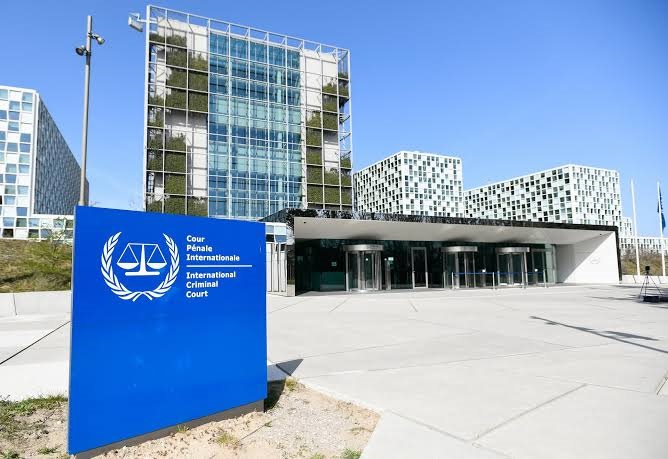
On October 9, Secretary of State Marco Rubio announced blocking sanctions against the International Criminal Court as an institution: a ban on all transactions, the freezing of assets under US jurisdiction, and the cutoff of cloud services, software, and payment processing. “Either the ICC will end its threats, or we will end the ICC,” he said. The sanctions include a six-month transition period and take full effect by April 2027. That date, not the announcement itself, is Europe’s real deadline.

Rubio has repeatedly tied Israeli interests to US actions against the court. The ICC previously issued arrest warrants for Israeli Prime Minister Benjamin Netanyahu and former Defense Minister Yoav Gallant on charges of war crimes in Gaza. While the October 9 announcement focused heavily on protecting American personnel, the administration had previously denounced the tribunal’s investigations against “the United States and our close ally Israel” as “illegitimate and baseless,” indicating that Washington’s campaign is aimed at shielding both US and Israeli officials.


Europe: Between Declaration and Enforcement

The European Commission called the sanctions “deeply regrettable” and said it was “ready to take any necessary measures” to keep the Court functioning and protect operators within the Single Market. But the same formula contains a brake: the six-month delay “leaves room for dialogue.”

Kaja Kallas, speaking for the EU, called threats against the Court “unacceptable,” reaffirming commitment to the rules-based order but stopping short of announcing any protective mechanism. António Costa promised support through political, diplomatic, financial, and practical means, without naming a single concrete instrument.

Belgian Foreign Minister Maxime Prévot is one of those publicly demanding activation of the EU Blocking Statute. “The Court’s independence cannot depend on whom it investigates. Europe must act,” he said, after securing a place for the issue on the agenda of the October 12 meeting of EU foreign ministers.

The Netherlands, where the Court sits, asked the European Commission to prepare the statute but called it a “nuclear option,” emphasizing that six months provide space for dialogue. Germany and France joined a joint statement by eight countries expressing “strong disagreement,” without mentioning countermeasures.

Why the Blocking Statute Is No Panacea

The Blocking Statute (Council Regulation No. 2271/96 of 1996) was created to counter US extraterritorial sanctions related to Cuba, Iran, and Libya. Its mechanism includes a prohibition on EU companies and citizens complying with the designated third-country sanctions, a refusal to recognize foreign court judgments based on those sanctions, and the right to recover damages in court. In 2018, after the US withdrew from the Iran nuclear deal, the regulation was expanded.

Adding the US sanctions against the ICC to the regulation’s annex would mean a legal prohibition on European banks, insurers, and cloud providers complying with the US restrictions. But its purpose is not to save the ICC itself. It protects European operators and jurisdiction: the regulation binds European operators and cannot compel American banks, Microsoft, Amazon, or payment systems to keep servicing the Court.

Activating the statute in this case would be unprecedented: in its thirty years of existence, it has never been applied against US sanctions affecting an international judicial institution. Its earlier use concerned US measures against those same countries, which were bilateral trade restrictions rather than an assault on a body of international justice. If the EU goes ahead, it would be the first time the Blocking Statute is transformed from a trade-defense instrument into an instrument for defending what Brussels calls the “international legal order.”

That is why it is called “nuclear”: it means legal confrontation, but it does not solve the problem of technological dependence. The ICC relies on American banking services, payment systems, cloud servers, and software. The Blocking Statute can prohibit European companies from complying with the sanctions, but it does not create an alternative to dollar clearing, global payment networks, or the servers where the Court’s data is stored.

For Washington, it is enough that American companies themselves refuse to work with the ICC because of the risk of secondary sanctions; the Blocking Statute cannot prevent that.

What Is Already Happening and What Might Happen

The practical effects of the sanctions are already beginning to show. In response to earlier US measures, the ICC has shifted its office and collaboration software from Microsoft to openDesk, a German open-source platform, and developed workarounds for banking, insurance, and payroll. It has also paid staff months in advance to limit potential payroll disruption. But these safeguards do not eliminate the Court’s broader reliance on American financial and technological infrastructure, and full sanctions could still disrupt its operations.

The alternatives Europe can offer are limited: activating the Blocking Statute, developing payment and clearing alternatives to dollar-based infrastructure, and providing European cloud services. None can be implemented quickly enough to replace American financial and technological infrastructure by April 2027.

Click to see the full-size image

The Asymmetry That Explains Everything

The ICC began work in 2002, and its early practice focused predominantly on African conflicts: the DRC, Uganda, Sudan, Kenya, and Libya. This imbalance fueled accusations of selectivity and neocolonialism; in 2025, three Sahel states announced their withdrawal, calling the Court an “instrument of neocolonial suppression.”

The United States signed the Rome Statute under Clinton but never ratified it; in 2002, Congress passed the American Service Members’ Protection Act, authorizing the president to use “all necessary means” to free any American detained by the ICC. Washington did not object to the Court’s early focus on African situations, even as it rejected jurisdiction over itself. Its opposition hardened once the ICC moved toward cases involving the US and its allies.

In 2020, after the Appeals Chamber authorized an investigation into crimes by US military personnel and the CIA in Afghanistan, Washington sanctioned Prosecutor Fatou Bensouda and a senior Court official. The following year, Prosecutor Karim Khan “deprioritized” the American component of the case. No US citizen has ever been indicted by the ICC.

Rubio calls the ICC a “body of globalists” threatening US sovereignty and has urged US allies to rein it in. The criticism has a real basis: the Court can hear cases involving crimes committed on the territory of a state party even if the accused’s country has not joined the Rome Statute. But the ICC remains a treaty court, dependent on state cooperation, Western donors, and political decisions of the UN Security Council.

Washington’s contradiction is built into the design itself: the US is attacking an institution that grew out of the liberal order it helped create. Europe’s is different: a declaratory commitment to international law coexists with the practical costs of reducing reliance on American infrastructure.

What October 12 Will Reveal

October 12 will show whether the EU moves from declarations to legal obligations. If the final document includes a European Commission decision to add the US sanctions against the ICC to the annex of Regulation 2271/96, that would mean a legal prohibition on European companies complying with the US measures — an unprecedented use of the Blocking Statute.

If the outcome is a general declaration, a call on Washington to rescind the sanctions, and a mandate for the Commission to “prepare options,” that would confirm a scenario in which Europe defends the principle of ICC independence but is not prepared to pay for that defense through a direct collision with US extraterritorial jurisdiction.

The probability of full and immediate activation of the statute on October 12 is low. A more realistic scenario is a political declaration of support, a Commission mandate to prepare a legal mechanism, and the preservation of the six-month pause for negotiations.

The Dilemma Beyond The Hague

The question is not whether the ICC survives past April 2027. The question is whether Europe can defend what Brussels calls the “international legal order” when the costs of that defense fall on its own companies, banks, and technological supply chains.

The Blocking Statute is a test of the EU’s ability to act not as a regulator but as a geopolitical player willing to bear the costs of conflict. If Europe limits itself to declarations and negotiations, it will confirm the formula Washington has already internalized: European sovereignty ends where American extraterritorial jurisdiction begins.

If it activates the statute, it will launch an open legal conflict with an ally on which its security depends. For now, every signal points to a third option: prepare the instrument, defer the decision, and bet that Washington will back down on its own.


MORE ON THE TOPIC:

The post The US Is Pulling the Plug on International Justice — Does Europe Have Its Own Power Source? appeared first on South Front.

Breakout from Dobropolye Fails: Ukrainian Losses Mount

11 October 2026 at 23:48

Click to see the full-size image

In the Sumy direction, Ukrainian units struck one of the pipes used to supply Russian groups near Korchakovka, which may create local difficulties; however, reports of counterattacks near Korchakovka and Yunakovka remain unconfirmed. In the Kharkiv direction, Russian units are destroying the remnants of the garrison in the “Volchansk cauldron,” have taken Shirokoye and advanced more than 1,100 metres deeper into the cauldron. In the Slavyansk direction the situation remains complicated: Ukrainian units have pushed Russian fighters back in the northern part of Zarechnoye and continue attacks near Yampol, which may complicate the position in the area of the Svyatiye Gory national park. In the Dobropolye direction, Russian troops have encircled a Ukrainian grouping and control approximately half of the town, having thwarted two breakout attempts. French presidential candidate Nicolas Dupont-Aignan agreed with Donald Trump that Volodymyr Zelensky is obstructing the achievement of peace and called for the lifting of anti-Russian sanctions.

Sumy direction 

Ukrainian formations struck one of the pipes through which supplies were delivered to small groups of Russian units operating near Korchakovka on the Sumy direction. From there Russian units had been advancing toward Ivolzhanskoye and the recently captured Kiyanitsa. This also indirectly confirms an increase in Ukrainian activity on this sector. At the same time, reports of counterattacks and advances near Korchakovka and Yunakovka remain unconfirmed.

North of Miropolye crossings on the edge of the village were struck. Near Bolshoy Prikol Russian units are fighting for the forest tract east of the settlement. Small groups of Ukrainian formations have for some time been attempting to infiltrate these forests from the direction of Malaya Rybitsa, where they come under drone and artillery strikes.

To counter Russian drones the Ukrainian side has reinforced its air-defence grouping with electronic-warfare units, transferring the 309th Separate EW Regiment from training grounds to Sumy region. Heavy fighting continues near Khoten. In Shostka district Russian assault troops are clearing tree lines near Korenok.


Kharkiv direction 

Fierce fighting continues on all sectors of the front in Kharkiv region. Russian units are destroying the remnants of the Ukrainian garrison in the “Volchansk cauldron,” employing all available means of fire and supporting the advance of assault groups. The Ukrainian side is offering fierce resistance and searching for ways out of the encirclement. Ukrainian formations are unable to force a reliable corridor for themselves, while Russian troops are systematically destroying disorganised units.

Recently available objective-control footage confirms the capture of Shirokoye. Forward assault groups are already pressing Ukrainian forces on the territory of Komissarovo. Fighting for the village continues, and focal Ukrainian presence still remains in the tree lines to the north and in the vicinity of the border settlement of Rublyonoye. Near Veliky Burluk a large Ukrainian ammunition depot was destroyed by a precision air strike.

In the Liptsy direction assault groups of Russian units are conducting small-arms fighting near Bugayevka. There is progress near Tokarevka. In the Volchansk and Veliky Burluk directions Russian troops have advanced significantly deeper into the cauldron by more than 1,100 metres.


Slavyansk direction 

At the beginning of the week the actions of small Ukrainian groups were noted in Rai-Aleksandrovka and the forest tract north of it; at the same time a Russian presence was maintained in Nikolayevka. Subsequently reciprocal fighting and strikes continued around Nikolayevka and along the Seversky Donets–Donbass canal, including near Orekhovatka and Yurkovka. Russian positions were also repeatedly noted in Fyodorovka.

By the end of the period Ukrainian positions were noted near Orekhovatka, Yurkovka and north of Vasilyevskaya Pustosh; the western part of Rai-Aleksandrovka was assessed as a probable grey zone. At the same time Russian pressure east of Slavyansk persisted, although its pace was assessed as having slowed. Ukrainian units have somewhat pushed Russian fighters back in the northern part of Zarechnoye. Further Ukrainian advance within the settlement may complicate the position of Russian units in the area of the Svyatiye Gory national park.

Simultaneously Ukrainian forces continue attacks near Yampol. The Ukrainian side is attempting to advance through the marshy floodplain of the Seversky Donets, encountering strikes by Russian drone operators. Particular importance continues to attach to the struggle for Zarechnoye and Yampol, where local changes in positions may affect the situation of neighbouring units.


Dobropolye direction 

In the area of Dobropolye Russian units are conducting a successful assault. The Ukrainian grouping has been taken into encirclement and is being cut into two parts. Approximately half of the town is already under control. Having encircled the grouping, Russian troops are attempting to split it and have captured a fairly large amount of urban territory — somewhere up to half the town has been taken under control.

The Ukrainian side is desperately attempting to break the ring through Novovodyanoye and Zolotoy Kolodets toward Rubezhnoye. In Novovodyanoye positions are intermingled. Fighting is stubborn. Russian drone operators, artillerymen and aviation are repelling all attacks. Until Dobropolye is taken, further movement is likely to be difficult. On the outskirts of Belozyorskoye Russian drone operators are preparing a future assault which, according to estimates, may take place this autumn.

Russian units are advancing along the railway from Novopodgorodnoye toward Raipole and Kolonna-Mezhevaya. Fighting continues in Sergeyevka, the greater part of which is already under Russian control. Russian forces are also pressing Ukrainian defences north of the village, thereby creating a threat to the Kamenka-Yuryevka defensive node. Russian troops thwarted two attempts by Ukrainian forces to break out of Dobropolye.

Conclusion 

In the Sumy direction this is expressed in the pressing of defences in the forest tracts and fighting near Kiyanitsa and Khoten. In the Kharkiv direction — in the tightening of the ring around the “Volchansk cauldron” and the capturing of new settlements. In the Slavyansk direction — in the holding of key positions near Zarechnoye and Yampol and heavy reciprocal fighting. In the Dobropolye direction — in the encirclement of the Ukrainian grouping and control over half of the town. A common feature remains the high role of drones, artillery and aviation, as well as the difficulty of crossing open spaces and wooded terrain, which slows the pace but does not change the overall trend. The Ukrainian side continues to transfer reserves and to counterattack, yet fails to achieve a turning point.

French presidential candidate and leader of the party “Debout la France,” Nicolas Dupont-Aignan, agreed with U.S. President Donald Trump that Volodymyr Zelensky is obstructing the achievement of peace in Ukraine. “He is right. This is an obstacle on the path to peace. He is right,” Dupont-Aignan said on the CNews television channel. The politician added that because of the anti-Russian sanctions Europe is paying four to six times more for gas and up to ten times more for electricity than China. In his view France will have no economic future if the sanctions against Russia remain in place. “Therefore the sanctions must be lifted. We must help Trump conclude peace with Putin,” he noted. U.S. President Donald Trump stated to journalists on Saturday that Zelensky could have settled the Ukrainian conflict many times but did not do so. Therefore, according to him, Ukraine needs a new leader.


MORE ON THE TOPIC:

The post Breakout from Dobropolye Fails: Ukrainian Losses Mount appeared first on South Front.

Saudi Arabia Has Allies. But Who Will Fight Its War in Yemen?

11 October 2026 at 22:09

Click to see the full-size image

Saudi Arabia is desperately trying to reverse its losses on the ground in the Yemeni conflict, while Houthi attacks reach its airports and threaten its oil trade. Yet the coalition Riyadh has assembled does not match the war it wants to fight. Washington is engaged in the conflict with Iran, Turkey excludes offensive deployments, and Pakistan draws the line at crossing into Yemen. The kingdom has foreign support, but the burden of recovering and holding territory still falls on its weakened Yemeni partners.

Retreat Before the Counteroffensive

By early October 2026, Riyadh was responding to a deteriorating military position. The Houthis’ September advance along Yemen’s western coast brought the loss of Mokha and strategic positions around Bab el-Mandeb. These setbacks exposed the weakness of Saudi-backed forces and strengthened the Houthis’ leverage over a shipping route increasingly important to Saudi oil exports.

The renewed Saudi–Houthi escalation began with the July 13, 2026, strike on Sanaa airport’s runway. Saudi aircraft sought to prevent an Iranian Mahan Air flight carrying a senior Houthi delegation from landing without coalition permission. The plane later landed in Hodeida after Omani mediation, but the Houthis retaliated against Abha airport and subsequently announced a blockade on Saudi shipping. The strike broke the relative calm established by the 2022 truce; September’s coastal offensive then turned the confrontation into a major territorial setback for Riyadh’s partners.

The retreat exposed divisions within the anti-Houthi camp. Saudi–Emirati cooperation had broken down, and the withdrawal of the UAE left command arrangements that Riyadh failed to replace effectively. The factions expected to carry the offensive remained divided and poorly prepared for a sustained campaign. Saudi airpower could not compensate for the absence of a coherent local force.

The cost is also being felt inside Saudi Arabia. The October 10, 2026, attack on Riyadh’s King Khalid International Airport killed 12 people and wounded 309, according to Saudi authorities, and temporarily suspended operations. Riyadh blamed the Houthis, who renewed their warning against using Saudi airports and airspace on October 11. Airport disruption, cancelled flights and attacks on oil facilities bring the economic consequences of the war directly into the kingdom. The Saudi air campaign has not secured its civilian infrastructure.

Operation Dawn of Yemen began on October 5, 2026, after Saudi-backed Yemeni leader Rashad al-Alimi announced military action the previous day. The immediate objective was to recover the coastal positions lost in September, alongside the Saudi-backed Yemeni government’s broader ambition to restore its authority over Houthi-held territory. On October 11, the coalition announced the destruction of 136 military targets in a large-scale operation. That tally says little about whether Saudi-backed units can hold territory, secure supply routes or reopen shipping lanes.

Houthi footage released October 10, 2026: Shawaz drone strikes on Saudi-backed forces in Kahbub and Al-Waziya, as presented by the movement’s military media


Why Taiz Matters

The counteroffensive has produced conflicting accounts of control on the coast. On October 9, 2026, Saudi Arabia’s ambassador to Yemen announced that Bab el-Mandeb and Mayun Island had been cleared of Houthi forces. The Houthis maintained that they still held those positions. Control of the waterway remains contested, despite Riyadh’s announcements of success.

Taiz adds another strain after the coastal setbacks. Pressure on its approaches threatens supply routes and forces Saudi-backed units to divide their effort between the inland front and the Red Sea coast. The Houthis can disrupt their opponents’ counteroffensive without winning every coastal engagement: sustained pressure inland prevents those opponents from concentrating their forces. Saudi airpower does not resolve the fragmentation of the Saudi-backed Yemeni forces expected to hold the ground.

Houthi military footage released October 10, 2026: the movement presents advances and the surrender of opposing fighters in Sami, As-Silw and Al-Mawasit, Taiz province. The fighting places further pressure on the ground forces on which Riyadh’s campaign depends


The Iran War Narrows Saudi Options

The US–Israeli war with Iran, which began in February 2026, has expanded the military demands on Washington. Regional deployments, shipping protection and operations against Iran compete with Saudi requests for a larger American role in Yemen. Riyadh cannot assume that American support will expand on its terms. Its dependence on outside assistance has grown at the same time as the regional war has made that assistance more conditional.

The Iran war compounds Saudi Arabia’s vulnerability. Disruption at Hormuz has increased Riyadh’s dependence on its westbound pipeline and Red Sea ports. Southbound cargoes from Yanbu must pass Bab el-Mandeb; northbound exports follow a different route. Moving crude across the peninsula bypasses Hormuz, but it does not remove the threat to shipping off Yemen.

Pressure at Bab el-Mandeb gives Iran an additional advantage while the Houthis gain territory and bargaining power of their own. Their overlapping interests put Riyadh under pressure on two fronts. A Washington–Tehran agreement would not automatically end the war in Yemen: the Houthis have their own territorial, political and economic demands.

Washington is already involved through military advisers, intelligence and targeting support. The issue is the extent of that involvement, not American neutrality. Earlier in October 2026, Trump rejected Saudi requests for direct strikes; after the Riyadh airport attack, he said the United States might join them. Riyadh still lacks a firm American commitment to the wider offensive. Its requests compete with Washington’s military operations and priorities in the Iran war.

Allies Draw Their Own Lines

Riyadh’s response is to widen its support network through the Mecca pact, signed with Turkey and Pakistan on August 7, 2026, and activated on October 5. But an agreement to defend Saudi Arabia is not an agreement to win its war in Yemen. Pakistan’s military presence and Turkey’s technical, intelligence and air-defense assistance address the kingdom’s security without supplying a joint ground campaign across the border.

The alliance has a secretary-general, retired Pakistani general Nauman Mahmood, but its detailed force-generation timetable, operational command arrangements, cost-sharing formula and mission duration remain unpublished. On October 8, 2026, Ankara excluded offensive operations while parliamentary ratification was pending. On October 9, Islamabad confirmed a substantial military presence in the kingdom but ruled out crossing into Yemen to attack the Houthis. Riyadh is obtaining defensive commitments, not a combined expeditionary army.

Pakistan’s decision-making has also shifted. In 2015, parliament unanimously rejected participation in the Yemen war while promising to defend Saudi territory and holy sites. In October 2026, reinforcement commitments are proceeding without a parliamentary vote. The government says it followed the necessary procedures. The political result is a narrower domestic debate over a commitment that could draw Pakistan further into the conflict.

Fewer political checks make deployments easier to authorize and harder to reconsider once costs and casualties accumulate. Pakistan’s own security pressures add another burden: the October 11, 2026, emergency in opposition-run Khyber Pakhtunkhwa coincides with its commitments to Saudi Arabia. Islamabad is extending support abroad while managing a deepening confrontation at home.

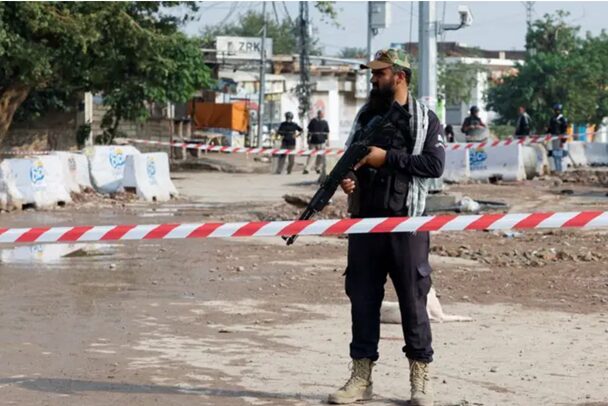
Peshawar, October 11, 2026: police guard the approach to the Red Zone. Pakistan’s overseas security commitments coincide with emergency measures at home

Saudi-led coalition footage, October 9, 2026: the coalition announces strikes on three Houthi missile launchers. The continuing attacks inside Saudi Arabia expose the limits of destroying individual launch sites


Defensive support can still sustain the offensive by freeing Saudi assets for use in Yemen. France’s support for the defense of Yanbu and Britain’s refueling assistance contribute to that effort. But none of this repairs the weakness of Riyadh’s Yemeni ground forces. Pakistan also has its border with Iran and its mediation role to consider, while Turkey keeps its commitment separate from offensive operations. Each partner sets limits according to its own interests.

Different Interests, No Shared Victory

Pakistan’s proposed $1.21 billion IMF disbursement awaits board approval. Turkey’s September 2026 inflation was 29.73%, with its policy rate at 37%. Both face financial pressures that favor limited missions over an open-ended expedition. Who pays for the current assistance remains undisclosed.

Saudi Arabia’s updated deficit forecast is 4.9% of GDP. September 2026’s non-oil purchasing managers’ index stood at 55.3, indicating expansion before the latest escalation. The airport attacks and disruption to transport now place that activity under additional pressure. Riyadh must finance the campaign while protecting the infrastructure and trade on which its wider economic plans depend.

The Houthis are using that pressure to advance their negotiating demands. On October 10, 2026, the Houthi authorities proposed reciprocal exclusion of airports, ports and other humanitarian infrastructure from blockade and attack. The proposal seeks to exchange limits on disruption for concessions over access and blockade. It puts the economic consequences of continued fighting at the center of the bargaining.

The conflict of interests runs through the entire coalition. Riyadh wants to reverse Houthi gains and protect Saudi infrastructure. The Saudi-backed Yemeni government wants to restore its authority. Turkey and Pakistan seek bounded commitments, and Washington calculates its involvement against the Iran war. The Houthis seek concessions while preserving their military leverage. A common adversary has not produced an agreed objective or a shared willingness to bear the cost.

Saudi Arabia therefore has partners willing to help defend the kingdom, but those partners have made no common commitment to reverse Riyadh’s setbacks in Yemen or sustain the ground campaign of the Saudi-backed Yemeni government. That is the gap behind the coalition’s announcements and strike tallies. Without stronger local forces and a political settlement addressing shipping, attacks and access, additional foreign support can prolong the campaign without resolving it. Riyadh risks remaining surrounded by allies while carrying a war none of them has agreed to finish.


MORE ON THE TOPIC:

The post Saudi Arabia Has Allies. But Who Will Fight Its War in Yemen? appeared first on South Front.

Houthis Claim Key Taiz District as Pressure Tightens on Provincial Capital (Videos)

11 October 2026 at 20:47

File image.

The Houthis (Ansar Allah) announced a new advance in the province of Taiz on October 11, saying they had driven Saudi-backed Yemeni government forces out of al-Masrakh district.

A military source told the Houthi-run Saba news agency that Saudi-backed forces had been expelled from the district in southern Taiz.

The claim followed reports earlier in the day that government-aligned forces had retaken the district center after Houthi fighters entered it. Asharq News, citing field sources, also reported clashes around the nearby al-Aqroudh front as government forces sought to recover lost positions.

Separately, Houthi military media released footage showing what the group described as the repulsion of Saudi-backed reinforcements advancing from Lahj toward the al-Wazi’iyah highlands in western Taiz.

The Houthis said their fighters had cleared the remaining parts of Wadi Sharira and the surrounding mountains and hills toward al-Shamaytayn, along the southwestern edge of the province.

The footage showed close-range clashes, with fighters moving into opposing positions and using machine guns and mortars. The Houthis said they had captured members of the advancing forces and seized weapons and military vehicles, which they claimed were subsequently used against their opponents.

The latest developments point to a worsening position for Saudi-backed forces across Taiz. Local authorities have warned that the Houthis are tightening their siege of the city and turning access roads into front lines.

Saudi-backed forces have announced local counterattacks but have yet to demonstrate a coordinated effort capable of reversing the Houthi advances across the province.

In addition, Saudi airstrikes have failed to halt the Houthi advance. With pressure mounting around Taiz city, the Houthis retain the initiative across the province.

_______________________________________________________________________________________________________________________

SouthFront: Analysis and Intelligence

NOW hosted at southfront.press

Previously, SouthFront: Analysis and Intelligence was at southfront.org.

The .org domain name had been blocked by the US (NATO) (https://southfront.press/southfront-org-blocked-by-u-s-controlled-global-internet-supervisor/) globally, outlawed and without any explanation

Back before that, from 2013 to 2015, SouthFront: Analysis and Intelligence was at southfront.com

SOUTHFRONT.PRESS

MORE ON THIS TOPIC:


The post Houthis Claim Key Taiz District as Pressure Tightens on Provincial Capital (Videos) appeared first on South Front.

More Tankers Struck Near Hormuz as Shipping Attacks Escalate (Video)

11 October 2026 at 21:21

File image.

Iran’s Islamic Revolutionary Guard Corps (IRGC) said on October 11 that a crude-oil supertanker struck a sea mine in the Strait of Hormuz, triggering an explosion and a fire in its engine room, as attacks on commercial shipping continued in the region.

In a statement, the IRGC Navy said the tanker was attempting to leave the strait through an “unauthorized route” with its navigation and identification systems switched off.

The incident marked the third time since the previous day that an oil tanker had struck a mine and caught fire while using what Iran described as an unauthorized route, according to the Corps.

“All vessels within the Strait of Hormuz that switch off their navigation and identification systems will be identified as hostile and dealt with firmly and decisively,” the IRGC Navy said.

Meanwhile, the United Kingdom Maritime Trade Operations (UKMTO) agency reported on October 11 that an outbound tanker had been struck on its port side by an unidentified projectile while transiting the Strait of Hormuz, sustaining damage. The crew were reported safe, and authorities were investigating.

India subsequently identified the vessel as the Marshall Islands-flagged tanker MT Valthera. Indian officials reported that a fire broke out aboard the ship but that all 11 Indian crew members were safe. The available reports did not establish who was responsible for the attack.

In a separate incident, the tanker MT Petro Dolphin was attacked by a drone at Sohar Anchorage in Oman, according to Indian Shipping Minister Sarbananda Sonowal. Nine of the 11 Indian seafarers aboard were rescued, while two remained missing as search-and-rescue operations continued with the local Coast Guard.

“We are continuously coordinating with all relevant authorities to fully support the ongoing rescue efforts and ensure every possible action is taken to safely locate our missing personnel,” Sonowal said.

The attack on Petro Dolphin occurred in the Gulf of Oman, outside the Strait of Hormuz itself. Still, the area is within the conflict zone.

The incidents come amid an escalation in attacks on commercial shipping. Last week saw the highest number of tanker attacks in a single week since the U.S.-Israeli war on Iran began in February, according to maritime security sources cited by Reuters.

Ship traffic through the strait has also declined sharply, with only seven commodity-carrying vessels passing through on October 6, the lowest daily total in more than two months, according to Kpler data reported by the news agency.

_______________________________________________________________________________________________________________________

SouthFront: Analysis and Intelligence

NOW hosted at southfront.press

Previously, SouthFront: Analysis and Intelligence was at southfront.org.

The .org domain name had been blocked by the US (NATO) (https://southfront.press/southfront-org-blocked-by-u-s-controlled-global-internet-supervisor/) globally, outlawed and without any explanation

Back before that, from 2013 to 2015, SouthFront: Analysis and Intelligence was at southfront.com

SOUTHFRONT.PRESS

MORE ON THIS TOPIC:


The post More Tankers Struck Near Hormuz as Shipping Attacks Escalate (Video) appeared first on South Front.

Houthis Claim Key Taiz District as Pressure Tightens on Provincial Capital (Videos)

11 October 2026 at 20:47

File image.

The Houthis (Ansar Allah) announced a new advance in the province of Taiz on October 11, saying they had driven Saudi-backed Yemeni government forces out of al-Masrakh district.

A military source told the Houthi-run Saba news agency that Saudi-backed forces had been expelled from the district in southern Taiz.

The claim followed reports earlier in the day that government-aligned forces had retaken the district center after Houthi fighters entered it. Asharq News, citing field sources, also reported clashes around the nearby al-Aqroudh front as government forces sought to recover lost positions.

Separately, Houthi military media released footage showing what the group described as the repulsion of Saudi-backed reinforcements advancing from Lahj toward the al-Wazi’iyah highlands in western Taiz.

The Houthis said their fighters had cleared the remaining parts of Wadi Sharira and the surrounding mountains and hills toward al-Shamaytayn, along the southwestern edge of the province.

The footage showed close-range clashes, with fighters moving into opposing positions and using machine guns and mortars. The Houthis said they had captured members of the advancing forces and seized weapons and military vehicles, which they claimed were subsequently used against their opponents.

The latest developments point to a worsening position for Saudi-backed forces across Taiz. Local authorities have warned that the Houthis are tightening their siege of the city and turning access roads into front lines.

Saudi-backed forces have announced local counterattacks but have yet to demonstrate a coordinated effort capable of reversing the Houthi advances across the province.

In addition, Saudi airstrikes have failed to halt the Houthi advance. With pressure mounting around Taiz city, the Houthis retain the initiative across the province.

_______________________________________________________________________________________________________________________

SouthFront: Analysis and Intelligence

NOW hosted at southfront.press

Previously, SouthFront: Analysis and Intelligence was at southfront.org.

The .org domain name had been blocked by the US (NATO) (https://southfront.press/southfront-org-blocked-by-u-s-controlled-global-internet-supervisor/) globally, outlawed and without any explanation

Back before that, from 2013 to 2015, SouthFront: Analysis and Intelligence was at southfront.com

SOUTHFRONT.PRESS

MORE ON THIS TOPIC:


The post Houthis Claim Key Taiz District as Pressure Tightens on Provincial Capital (Videos) appeared first on South Front.

Trump’s Surprise Energy Ceasefire Comes With Threats for Kyiv

11 October 2026 at 19:58

File image.

United States President Donald Trump on October 11 announced an immediate energy ceasefire between Russia and Ukraine, claiming both sides had agreed to stop attacks on infrastructure.

“Effective immediately, there is an ENERGY CEASEFIRE in the War between Russia and Ukraine. Both parties have agreed. Do not break it!” Trump wrote on Truth Social. 

Ukrainian President Volodymyr Zelensky expressed surprise at the announcement, telling Axios he had not been informed of the purported agreement.

“The ceasefire announcement was news for me,” he said, noting that Ukraine would accept it if Russia agreed to comply.

“If President Trump negotiated it with Putin — please tell us when the ceasefire begins. We are ready and we will accept it,” he added.

Zelensky later accused Russia of continuing to attack Ukrainian energy infrastructure after Trump’s announcement. In a post on X, he said he had briefed Trump on what he called the “brutal Russian strikes that continue unabated.”

A Russian drone had struck a power plant in Kyiv, causing power outages across several districts, he claimed, followed by attacks on energy facilities in the Kharkiv region.

“And all of this happened AFTER the President of the United States made his statement about an energy ceasefire,” Zelensky wrote.

In his evening address, he also reported a strike on a combined heat and power plant in Kharkiv. He said Russia had carried out more than 200 strikes on Ukrainian electricity-generation and transmission facilities over the preceding week, along with 17 attacks on oil and gas installations.

Moscow has not yet publicly commented on Trump’s announcement, leaving it unclear whether Russia accepted the proposed ceasefire or intended to observe it.

The announcement came amid a widening dispute between Trump and Kyiv over Ukrainian attacks on Russian oil refineries, with the U.S. president demanding that Ukraine halt the strikes.

The Financial Times reported right after Trump’s announcement that Washington had threatened to restrict Ukraine’s access to U.S.-made weapons and intelligence sharing unless Kyiv stopped attacking Russian energy infrastructure.

Citing European officials, the newspaper reported that U.S. officials had warned that the U.S. could block Ukraine’s access to the NATO-managed Prioritised Ukraine Requirements List mechanism, known as PURL, through which allied countries fund purchases of American weapons for Kyiv.

The surprise ceasefire announcement came amid a broader shift in Washington’s energy policy toward Moscow, following a diesel supply deal with Russia and temporary sanctions waivers for certain fuel shipments. With the administration simultaneously pressing Kyiv to halt refinery strikes, Trump appears to be growing impatient with Zelensky.

_______________________________________________________________________________________________________________________

SouthFront: Analysis and Intelligence

NOW hosted at southfront.press

Previously, SouthFront: Analysis and Intelligence was at southfront.org.

The .org domain name had been blocked by the US (NATO) (https://southfront.press/southfront-org-blocked-by-u-s-controlled-global-internet-supervisor/) globally, outlawed and without any explanation

Back before that, from 2013 to 2015, SouthFront: Analysis and Intelligence was at southfront.com

SOUTHFRONT.PRESS

MORE ON THIS TOPIC:

The post Trump’s Surprise Energy Ceasefire Comes With Threats for Kyiv appeared first on South Front.

Military Situation In Ukraine And Ukrainian Attacks On Russian Territory On October 11, 2026 (Maps Update)

11 October 2026 at 18:55

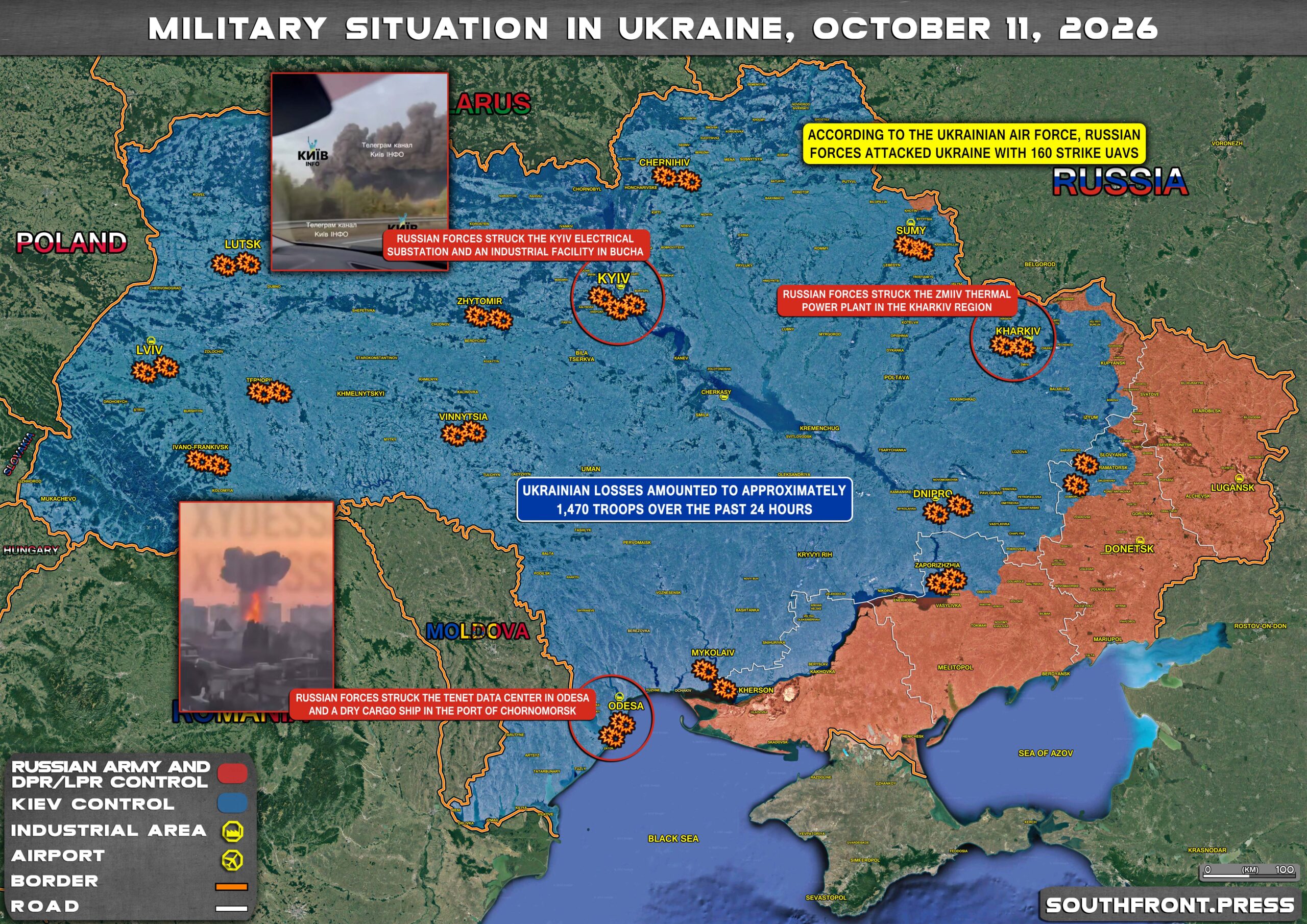
Click to see the full-size image

  • Russian strikes destroyed targets in the Sumy, Kharkiv, Zaporizhzhia, Dnipropetrovsk, Kherson, Kyiv, Odesa, Lutsk, Lviv, Ivano-Frankivsk, Chernihiv, Mykolaiv, Vinnytsia, Rivne, Zhytomyr, Ternopil regions, and the DPR;
  • According to the Ukrainian Air Force, Russian forces attacked Ukraine with 160 strike UAVs;
  • Russian forces struck the Tenet data center in Odesa and a dry cargo ship in the port of Chornomorsk;
  • Russian forces struck the Kyiv electrical substation and an industrial facility in Bucha;
  • Russian forces struck the Zmiiv Thermal Power Plant in the Kharkiv region;
  • Ukrainian losses amounted to approximately 1,470 troops over the past 24 hours.

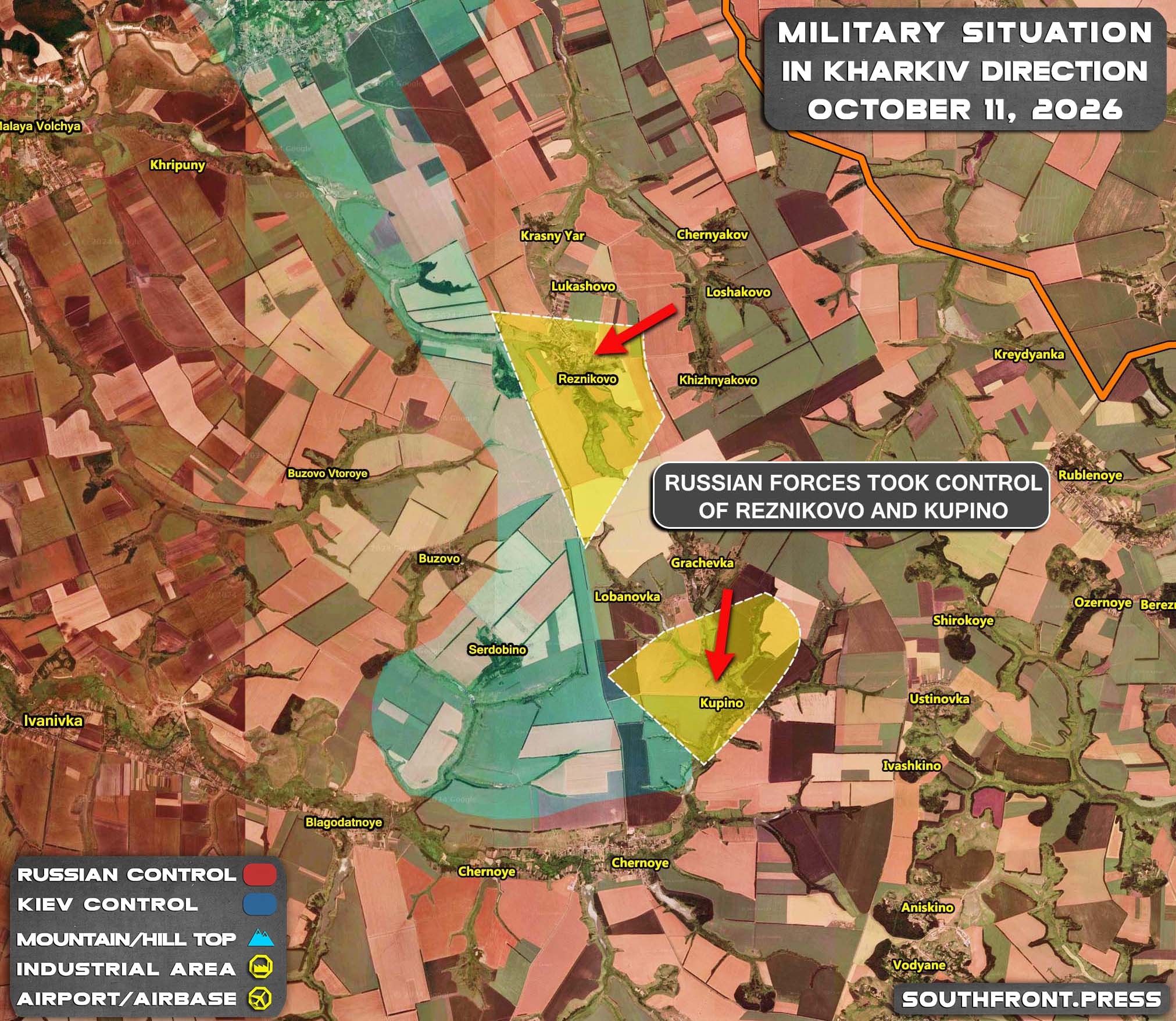
Click to see the full-size image

  • Russian forces took control of Reznikovo and Kupino.

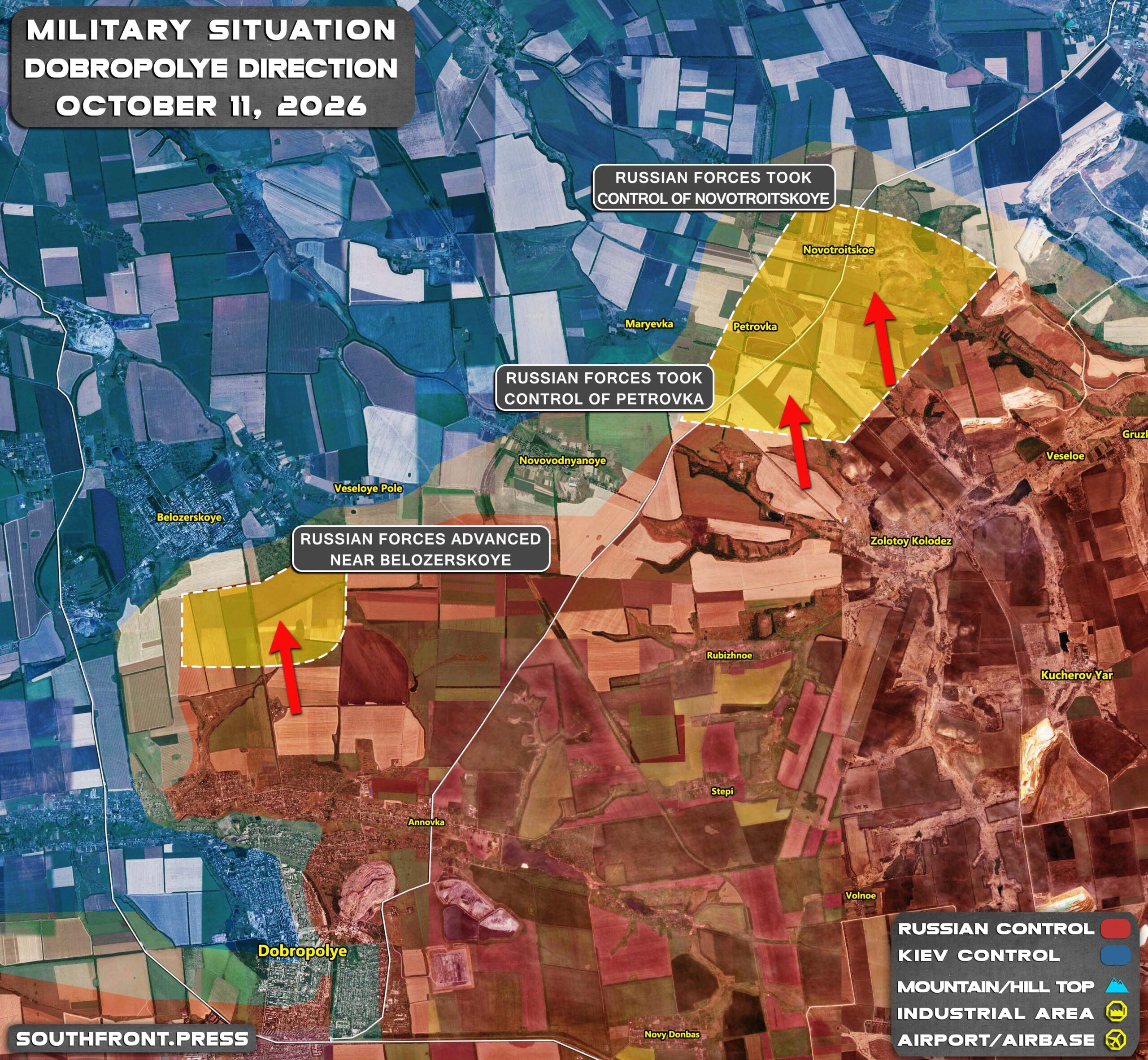
Click to see the full-size image

  • Russian forces advanced near Belozerskoye;
  • Russian forces took control of Petrovka;
  • Russian forces took control of Novotroitskoye.

Click to see the full-size image

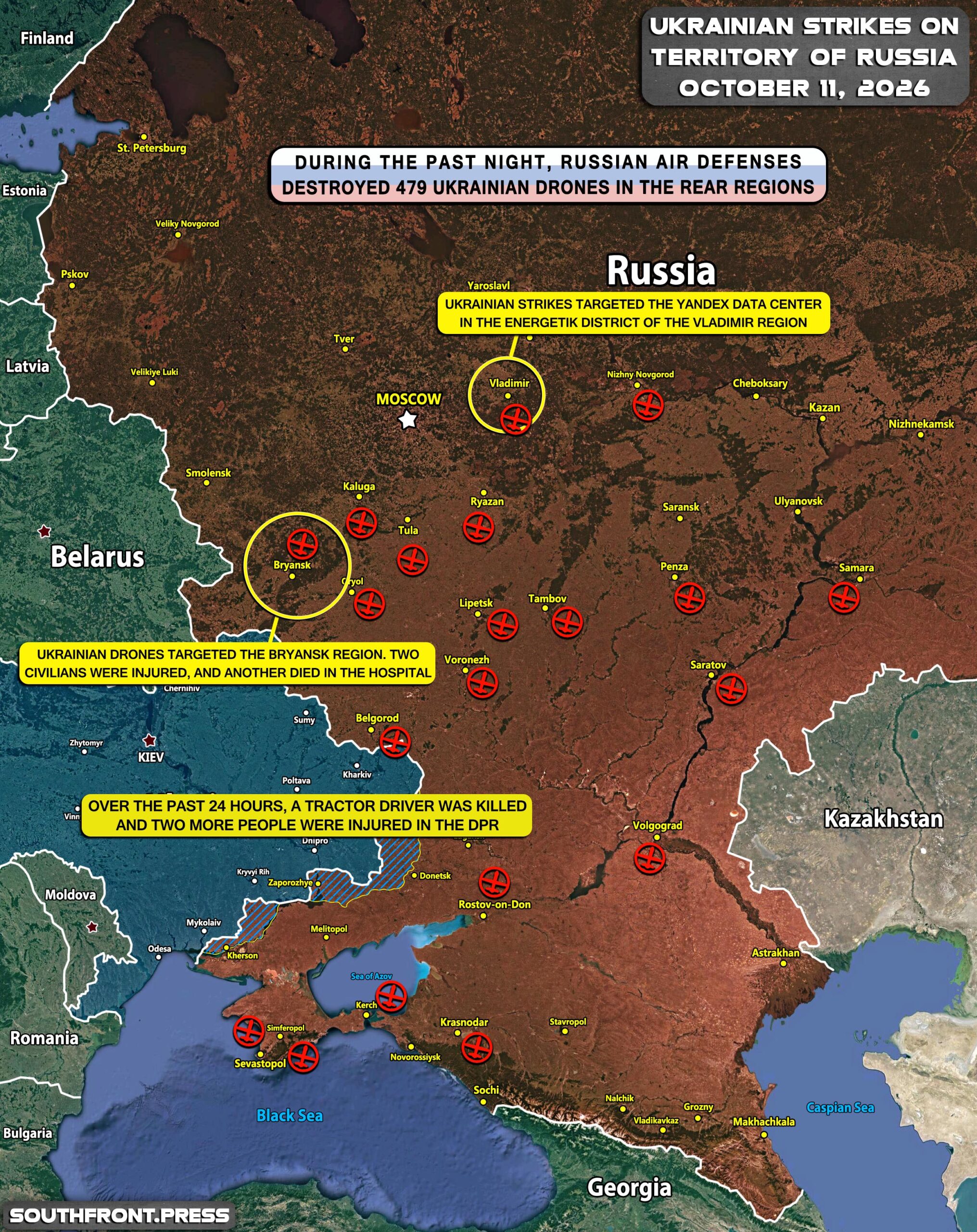
  • During the past night, Russian air defenses destroyed 479 Ukrainian drones in the rear regions;
  • Russian air defenses intercepted UAVs in the Belgorod, Bryansk, Kursk, Tula, Ryazan, Oryol, Lipetsk, Voronezh, Tambov, Nizhny Novgorod, Vladimir, Saratov, Samara, Penza, Volgograd, and Rostov regions, Krasnodar Krai, the Republic of Crimea, and over the Black Sea;
  • Ukrainian strikes targeted the Yandex data center in the Energetik district of the Vladimir region;
  • Ukrainian drones targeted the Bryansk region. Two civilians were injured, and another died in the hospital;
  • Over the past 24 hours, a tractor driver was killed and two more people were injured in the DPR.

MORE ON THE TOPIC:

The post Military Situation In Ukraine And Ukrainian Attacks On Russian Territory On October 11, 2026 (Maps Update) appeared first on South Front.

The Baltic Fuse: How Europe Is Building the Infrastructure for War With Russia

11 October 2026 at 18:43

Click to see the full-size image

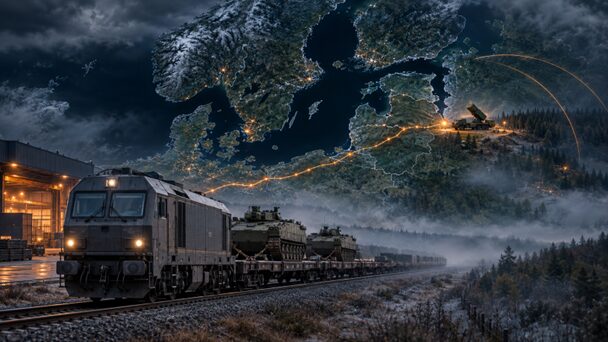
Europe is shortening the time it takes to wage a major war. Military transport approvals are meant to take hours rather than days, intelligence to feed more quickly into strike decisions, and a new generation of missiles to bring targets deep inside Russia within reach. Behind the forward garrisons, Europe is building transport networks, reserves, and ammunition production capacity. Taken together, these measures point beyond deterrence to practical preparations for waging war against Russia, including operations deep inside its territory.

The dates 2027, 2028, and 2030 in European rearmament programs can easily suggest that there is still time. But they mark a schedule for building military capabilities, not a guaranteed period of peace. The central question for the coming months is not whether armies will finish rearming in time, but whether a clash can be avoided before they do.

Estonia: A Narrow Front, a Deep Strike

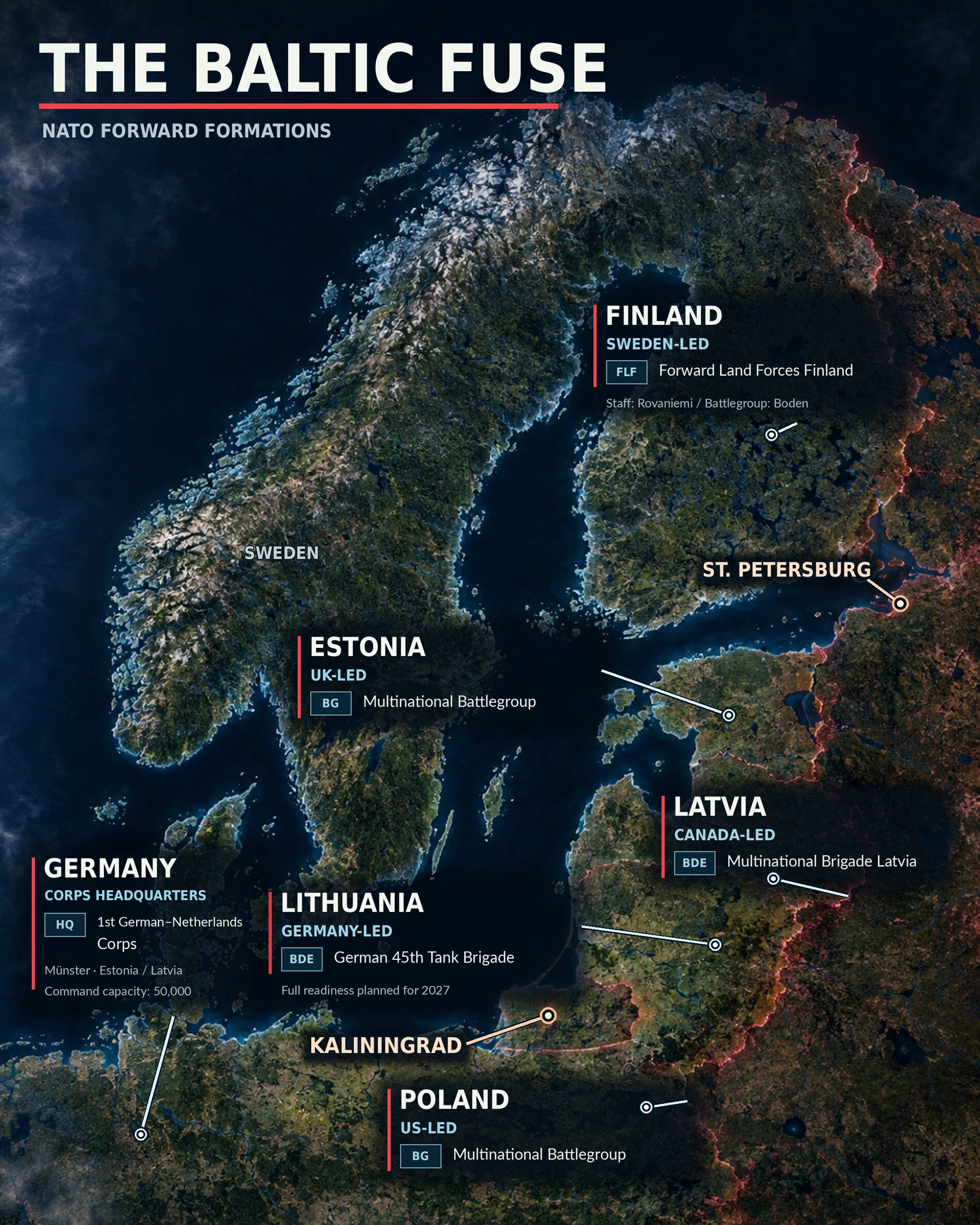
Estonia offers a clear picture of the opening phase this system is being built to fight. The country’s military budget rose 42% in 2026 to €2.4 billion, or 5.4% of gross domestic product. Arms procurement accounts for €1.27 billion – more than half the total. Meanwhile, the headquarters and elements of the 1st Infantry Brigade are moving from Tapa to Jõhvi, roughly 50 kilometers from the Russian border.

A €20.5 million base is under construction in Narva, with €19 million coming from the European Union. Completion is scheduled for summer 2028. Its permanent garrison will number around 200, but it will accommodate up to 1,000 troops in a crisis. The gap between those figures reveals a base designed for rapid expansion. A small garrison is being equipped to receive reinforcements quickly, right on the border.

Holding that ground requires more than barracks. Procurement programs call for nine American HIMARS and nine South Korean Chunmoo multiple-launch rocket systems, both capable of firing ballistic missiles. The relevant munitions have stated ranges of up to 300 and 290 kilometers, respectively. The new concept combines holding the border with deep strikes from the first day of an invasion.

The scale of the response could far exceed that of the opening clash. A battle for a border town could lead to strikes on targets hundreds of kilometers away. Tallinn wants to deny its opponent the option of fighting a small war by preparing to expand its geographical scope.

This also changes what allied assistance means. Allied planning must account not only for how long a small army can hold out until reinforcements arrive, but also for how far the fighting may spread before they reach the front. A missile can be launched before a major formation completes its deployment. Allies may arrive to find that the conflict has already widened.

In such a situation, Estonia and the other Baltic states could serve not only as defensive positions but also as staging grounds for attacks on Russian territory. For Moscow, the issue is no longer simply the size of Estonian units, but the depth of the strikes they envisage. Tallinn, in turn, faces the question of who will sustain its forward forces if the first battles fail to decide the outcome. Sustaining such a war would require support from beyond Estonia. One national budget and a handful of batteries cannot carry that burden.

Click to see the full-size image

Germany: An Industrial Base Behind the Garrison

On October 5, Martin Jäger, head of Germany’s Federal Intelligence Service, told the Bundestag: “The point of no return has been passed in the war with Ukraine, and NATO is considering a scenario involving a limited Russian military clash with the Baltic states.” He linked the more immediate danger to limited Russian action in the Baltics that could test the allies’ response. He said intelligence had seen no signs of preparations for a major attack on NATO. The discussion therefore concerns not only a major war after rearmament is complete, but a smaller confrontation capable of triggering an allied response.

In the Baltic scenario, Berlin is publicly discussing the risk of a clash while its forward force is still taking shape. The brigade’s readiness date is not the date on which the threat begins.

In Lithuania, Germany is building a permanent heavy brigade as one element of that support. Full readiness is scheduled for the end of 2027, with 4,800 military personnel and 200 civilian employees. Its core consists of the 122nd Panzergrenadier Battalion, the 203rd Tank Battalion, and a multinational battle group. Until the formation is complete, the Germany-based 37th Brigade is to provide support.

The forward formation is thus tied to forces farther inside Europe. Civilian infrastructure underscores the permanence of the deployment. A school for the children of Bundeswehr personnel opened in Vilnius in September 2025. Units are not simply moving in – families are settling down. A political commitment acquires a permanent address, and the safety of German personnel becomes part of any future crisis in the host country.

Münster, October 1, 2026. Rutte describes a headquarters capable of commanding 50,000 troops and responsible for NATO forces in Estonia and Latvia. Behind the talk of forward battalions lies corps-level command capacity


But a permanent garrison needs a steady supply of ammunition. Rheinmetall’s new plant in Unterlüß is scheduled to reach an annual output of 350,000 artillery shells in that same year, 2027. The nearly €500 million facility was built in 15 months. Across its entire production network, including overseas sites, the company is targeting roughly 1.5 million shells a year from 2027.

The brigade answers the question of who will enter the fight. The factories answer how to keep fighting once stockpiles run down. The 2027 target is for strengthening this system, not creating it from scratch. Reaching the factory’s planned capacity determines future supply volumes, but it does not set a date before which a clash is impossible. Initial stocks sustain the opening phase of combat. Regular deliveries determine whether its intensity can be maintained.

Between the factory and the front lies the transport network. Europe’s military mobility proposal calls for cross-border transport permits to be processed within three working days, with an emergency procedure taking no more than six hours. A proposed €17 billion would fund the relevant infrastructure under the 2028–2034 budget. For Germany, a transit country, that means bridges, railways, and the capacity of routes leading east.

On October 7, European Defense Commissioner Andrius Kubilius called for this work to accelerate, saying Europe was not yet able to deter Russia. Unlike an exercise, infrastructure upgrades remain after the columns return to barracks. A stronger bridge and a faster permit procedure create a lasting ability to concentrate forces.

A border battle thus gains industrial and logistical depth. But sustaining one’s own forward forces is only half the military equation. The other half is disrupting opposing forces’ supply and command systems. That requires more than additional railcars loaded with shells. It requires weapons with much greater reach.

Britain: A European Deep-Strike Arsenal

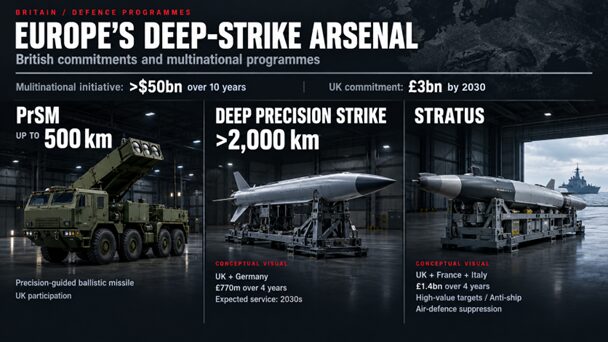
London is driving precisely this part of Europe’s preparations. On July 8, 2026, it announced an initiative bringing together roughly a dozen partners to invest more than $50 billion in long-range strike capabilities over ten years. The stated range bracket runs from 300 to more than 2,000 kilometers. Britain’s own commitment within the initiative is £3 billion by 2030.

The British-German Deep Precision Strike program envisages stealthy and hypersonic weapons with ranges exceeding 2,000 kilometers, initially focused on ground launch. Britain is investing £770 million over four years, with entry into service expected in the 2030s. Another £1.4 billion over four years is earmarked for Stratus, a program with France and Italy covering strikes against high-value targets and ships, as well as the suppression of air defenses.

Britain’s participation in PrSM (Precision Strike Missile), a precision-guided ballistic missile program with a stated range of up to 500 kilometers, adds another layer. The emerging capabilities span several range bands, from around 300 kilometers for the Estonian systems through 500 for PrSM to more than 2,000 for the British-German development. Although the programs are at different stages, they share a clear direction. Weapons for fighting at the border are being supplemented with weapons for striking deep behind it.

The missiles of the next decade show how far these strike capabilities are intended to expand. But the next crisis will unfold with whatever weapons are available when it begins. A 2,000-kilometer range is not a prerequisite for a clash in the Baltics. It changes the potential scale of the war, not the earliest date on which it can break out.

Click to see the full-size image

Turning national purchases into a combined capability requires a common framework for employing them. In July 2025, General Christopher Donahue outlined elements of eastern-flank planning built around compatible launchers, fire control, and data sharing. He cited Kaliningrad as an example of military capabilities that could be neutralized by ground-based means in an exceptionally short time: “We have already planned this. We have already developed this.”

The discussion also included cloud-based data sharing and Palantir’s Maven Smart System, purchased by NATO to analyze information and support command decisions. The aim is to turn disparate reports into a common picture more quickly. When several armies use compatible command systems, their arsenals gain additional value. Range puts the target within reach, while data sharing allows missions to be coordinated.

But the deeper the planned strikes, the harder it becomes to separate support for a border battle from an expansion of the war. To the attacking side, a target may be part of the other side’s military supply system. To the other side, hitting it may signal that the conflict has crossed a new threshold. The use of conventional weapons thus leaves unresolved how to deter a response that would overturn the assumption of a limited clash.

France: The Nuclear Limit of Europe’s Calculations

This is where France’s nuclear deterrent enters the European picture. On October 6, Le Vigilant conducted an acceptance firing of an M51.3 ballistic missile following its refit. The missile carried no nuclear warhead. In service since October 2025, the variant carries new TNO-2 warheads. The French Defense Ministry cites improvements in range, accuracy, and the ability to penetrate missile defenses.

Brittany, October 6, 2026. Le Vigilant launches an M51.3 without a nuclear warhead


Macron stated the political message bluntly: “To be free, you must be feared. And to be feared, you must be strong.” France’s modernization adds a nuclear dimension to Europe’s conventional military buildup.

That European dimension is taking a more concrete form. On March 2, 2026, Macron outlined an “advanced deterrence” framework allowing partners to participate in French nuclear exercises and opening the possibility of temporary deployments of strategic forces on allied territory. Germany, Poland and Sweden were among the countries joining the dialogue. But the authority to use nuclear weapons – and to define the vital interests they protect – remains exclusively French. In the Baltic scenario, closer cooperation does not establish an automatic French nuclear response to a border clash. It leaves the decisive threshold in Paris, deliberately undefined.

After the First Clash

Taken together, these national programs suggest that the West is preparing not merely to deter Russia, but to build the capacity for offensive operations against it. In this reading, forward deployments, industrial expansion and deep-strike weapons are interconnected preparations for a war that could extend into Russian territory. They do not, by themselves, establish a single operational plan or prove a decision to initiate hostilities. Conventional forces are meant to make an opposing military operation prohibitively costly, while nuclear forces are meant to deter the most extreme escalation. The weakness is that neither side gets to decide how much damage the other will tolerate.

That problem is especially acute around Kaliningrad, where plans to suppress military infrastructure sit alongside the question of the region’s links to the rest of Russia. If actions during a crisis are perceived as an attempt to cut the region off by force, the argument will no longer be about intentions announced at a press conference. It will be about consequences the other side believes it must stop immediately.

The danger in the coming months lies in the gap between limited intent and an unrestricted response. Berlin is discussing localized action in the Baltics. Tallinn is preparing for deep strikes from day one, while foreign garrisons tie a border battle to allied involvement. Each side may consider its own move limited. Neither can count on the other side accepting its definition of what is permissible.

European capitals therefore need to define where military action would stop after the first clash, whether at the border or after strikes on depots, airfields or targets in Kaliningrad. The programs examined here spell out how to build military power, but offer no mechanism for ending the fighting. Missile range is not strategic foresight. Confidence that escalation can be controlled could turn a system of deterrence into a mechanism for widening the war well before 2030.


MORE ON THE TOPIC:

The post The Baltic Fuse: How Europe Is Building the Infrastructure for War With Russia appeared first on South Front.

Military Situation In Yemen On October 11, 2026 (Map Update)

11 October 2026 at 18:13

Click to see full-size map.

  • The Yemeni army (Ansar Allah) advanced on the western outskirts of Taiz city, cutting a supply route and encircling Saudi-backed forces in Al-Misrakh and Najd Qasim;
  • Saudi airstrikes killed a woman in Same’a district, and Saudi-backed shelling killed a girl in Sabr al-Mawadim district, Taiz province;
  • More than 170 Saudi-backed forces from the Sabiha tribes were killed and 700 others were injured during the clashes with Ansar Allah;
  • The Yemeni retaliatory missile strike on Riyadh’s King Khalid Airport allegedly killed 12 people and injured more than 300.

_______________________________________________________________________________________________________________________

MORE ON THIS TOPIC:


The post Military Situation In Yemen On October 11, 2026 (Map Update) appeared first on South Front.

Houthis Strike Riyadh Airport Again, Claim Hits on Saudi Oil and Gas Facilities (Videos)

11 October 2026 at 18:03

Illustrative image.

The Houthis (Ansar Allah) announced on October 11 that they had launched missile and drone attacks against Saudi airports and two Aramco energy facilities, claiming the operations disrupted air traffic and triggered fires at the targeted sites.

In a statement, Houthi military spokesman Brig. Gen. Yahya Saree said the group had carried out four operations over the previous 24 hours using ballistic missiles, cruise missiles and drones.

The attacks targeted King Khalid International Airport in Riyadh in three separate waves, the Shuqdam gas facility and Tanajib oil facility in Saudi Arabia’s Eastern Province, and King Fahd International Airport in Dammam, according to the spokesman.

Strikes hit Riyadh’s King Khalid International Airport both October 10 and October 11. Saudi authorities said an attack on October 10 killed 12 people and wounded more than 300, prompting the airport’s closure.

The Saudi-led coalition also said an unidentified projectile struck Terminal 4 of the airport on October 11, causing a fire, while air defenses intercepted a cruise missile nearby.

Separately, the coalition reported that a projectile landed close to King Fahd International Airport in Dammam on October 10.

Saree said the strike on the Shuqdam gas facility caused large fires, while the attack on the Tanajib oil facility also sparked a fire.

Fires were detected at both targeted energy facilities, although the extent of the damage and any impact on production were not immediately clear.

The spokesman also said Houthi forces attacked Saudi-backed troop concentrations in the areas of Ras al-Ara and al-Saqiya close to Bab al-Mandab with six ballistic missiles and two drones. He claimed the strikes killed and wounded dozens of personnel.

Saree added that Houthi forces had engaged Saudi military aircraft with domestically produced surface-to-air missiles, forcing them to withdraw. He did not specify how many aircraft were involved or provide further details of the engagement.

The announcement came as Saudi Arabia intensified its air campaign in Yemen. Saree said Saudi forces had carried out 124 airstrikes over the preceding 24 hours across Sanaa and the provinces of Taiz, Marib, al-Jawf, Hajjah, Hodeidah and Saada.

The spokesman put the total number of Saudi airstrikes at 2,058 since the latest escalation began, and accused Saudi forces of causing heavy civilian casualties, particularly among women and children.

Saree warned airlines, international companies, airport workers and travelers against using Saudi airports, declaring them unsafe except for airports and airspace in Mecca and Medina.

“The Yemeni Armed Forces will continue to escalate their operations against the Saudi interior,” he said, pledging to maintain what he called the equation of “blockade for blockade” and “escalation for escalation” until Saudi military operations against Yemen stop and the blockade is lifted.

The latest attacks indicate that Houthi strikes are becoming more accurate, with confirmed impacts at Riyadh’s airport on consecutive days and fires detected at two targeted energy facilities.

This adds to the challenge facing Saudi Arabia, which has so far also failed to help its allies in Yemen organize an effective counterattack against the Houthis.

_______________________________________________________________________________________________________________________

SouthFront: Analysis and Intelligence

NOW hosted at southfront.press

Previously, SouthFront: Analysis and Intelligence was at southfront.org.

The .org domain name had been blocked by the US (NATO) (https://southfront.press/southfront-org-blocked-by-u-s-controlled-global-internet-supervisor/) globally, outlawed and without any explanation

Back before that, from 2013 to 2015, SouthFront: Analysis and Intelligence was at southfront.com

SOUTHFRONT.PRESS

MORE ON THIS TOPIC:


The post Houthis Strike Riyadh Airport Again, Claim Hits on Saudi Oil and Gas Facilities (Videos) appeared first on South Front.

❌