Jartum, 22 oct (Prensa Latina) Entidades No Gubernamentales denunciaron hoy que los paramilitares sudaneses cometen crímenes de lesa humanidad contra la población de El Fasher, capital del estado de Darfur Norte.
The Donald Trump administration has done with Ukrainians and Sudanese this week what it did last month with Salvadorans: it has not terminated Temporary Protected Status (TPS), but it has not renewed it either. The program that provides legal immigration status to 101,000 Ukrainians and 1,800 Sudanese citizens was set to expire on Monday, but the Department of Homeland Security (DHS) has declined to comment, which for now leaves them protected from deportation.
Juba, 21 oct (Prensa Latina) Naciones Unidas condenó enérgicamente los ataques con drones en un mercado de Abyei, en la frontera de Sudán y Sudán del Sur, dieron a conocer hoy aquí medios locales.
Juba, 21 oct (Prensa Latina) Las víctimas de un reciente ataque a un mercado en la región fronteriza de Abyei, entre Sudán y Sudán del Sur, se elevó ya a 226 muertes, informaron hoy aquí autoridades locales.
En algunos de los primeros vídeos que circularon por las redes sociales se aprecia el caos inevitable que acompaña a una carnicería inesperada mientras todavía se está produciendo. Hombres jóvenes corriendo y gritando en medio de la polvaredacon el estruendo de aviones de combate de fondo. En imágenes que trascendieron poco después, la agitación inicial había dado paso a filas de cadáveres envueltos con mantas en la arena.
More than 100,000 people from Ukraine and Sudan can stay in the United States without immediate risk of deportation, the Department of Homeland Security said, in what amounts to a temporary reprieve after their right to stay in the country was set to expire on Monday.
Temporary protected status was set to end on Monday for about 101,000 Ukrainians and 1,800 Sudanese. But the DHS said an announcement “will be made at the appropriate time”. Until then, the department said in a written statement, Ukrainians and Sudanese in the US covered by those temporary measures “retain protection”. The department did not indicate how long they could stay or when a final announcement would be made on their status.
Witness says drone struck twice at transport hub in al-Dibab, in one of deadliest single attacks of war
A drone strike near a market in southern Sudan on Sunday evening killed 80 people, mostly commuters catching rides home.
Ahmed Wadi, a witness, said the attack in the town of al-Dibab in West Kordofan state left “50 bodies who I helped bury, one of them my own brother Mohamed”.
Twice in four months, Egyptian warplanes have bombed Sudanese miners inside their own territory, and dozens of bodies have failed to draw from Abdel Fattah al-Burhan a stance worthy of his citizens’ blood. Cairo, for its part, justifies its military operations, while Port Sudan hides behind a fact-finding committee, a cable of condolences and talk of contact between the two leaderships, without daring to name the party accused of killing its citizens.
This is the scene before us: a state acting on the Sudanese border by force of arms, and an army commander who avoids naming the party accused of killing Sudanese, for fear of losing an ally whose approval seems to matter more to him than their lives. On the morning of 10 October 2026, the mining site at Jabal al-Uqaydat in the Shamal al-Wadi area inside Sudan turned into a killing field after it was struck by five consecutive airstrikes, according to the testimony of a survivor relayed by Agence France-Presse. Thousands of miners had been searching for gold in a land exhausted by war; some ended up under the rubble, while others fled to the mountains without water or supplies.
In a significant pinpointing of the site of the bombing, The New York Times, in its report published on 12 October 2026, stated that the targeted mine is located in Sudan’s Red Sea State, about 25 miles from the Egyptian border, or roughly 40 kilometres inside Sudanese territory. Al-Hurra, in its coverage of the June attack, had cited an estimate placing Jabal al-Uqaydat about 20 kilometres inside Sudan; the forty-kilometre distance is cited here as attributed to the American newspaper’s determination of the location of the October strike, which keeps the question of sovereignty and the protection of civilians at the heart of the matter.
Agence France-Presse relayed from survivors that thousands of miners were working at the site, and “Emergency Lawyers” counted 72 dead according to preliminary information, while witnesses told the BBC of more than 60 dead and about 150 wounded. Survivors told Sudan Tribune that the dead numbered at least 200, with more than 15,000 workers fleeing, while the Sudan Doctors Network recorded a preliminary toll of 13 dead and 28 wounded, warning that it could rise.
Cairo Justifies the Bombing While Burhan Avoids Naming the Perpetrator
The “Emergency Lawyers” organization accused the Egyptian air force of targeting civilian miners, considering the attack a violation of international law. When Reuters asked Egyptian security officials about the raid, they did not deny the operation but justified it as ending what they described as border chaos and preventing Egyptian and Sudanese groups from taking control of mining areas.
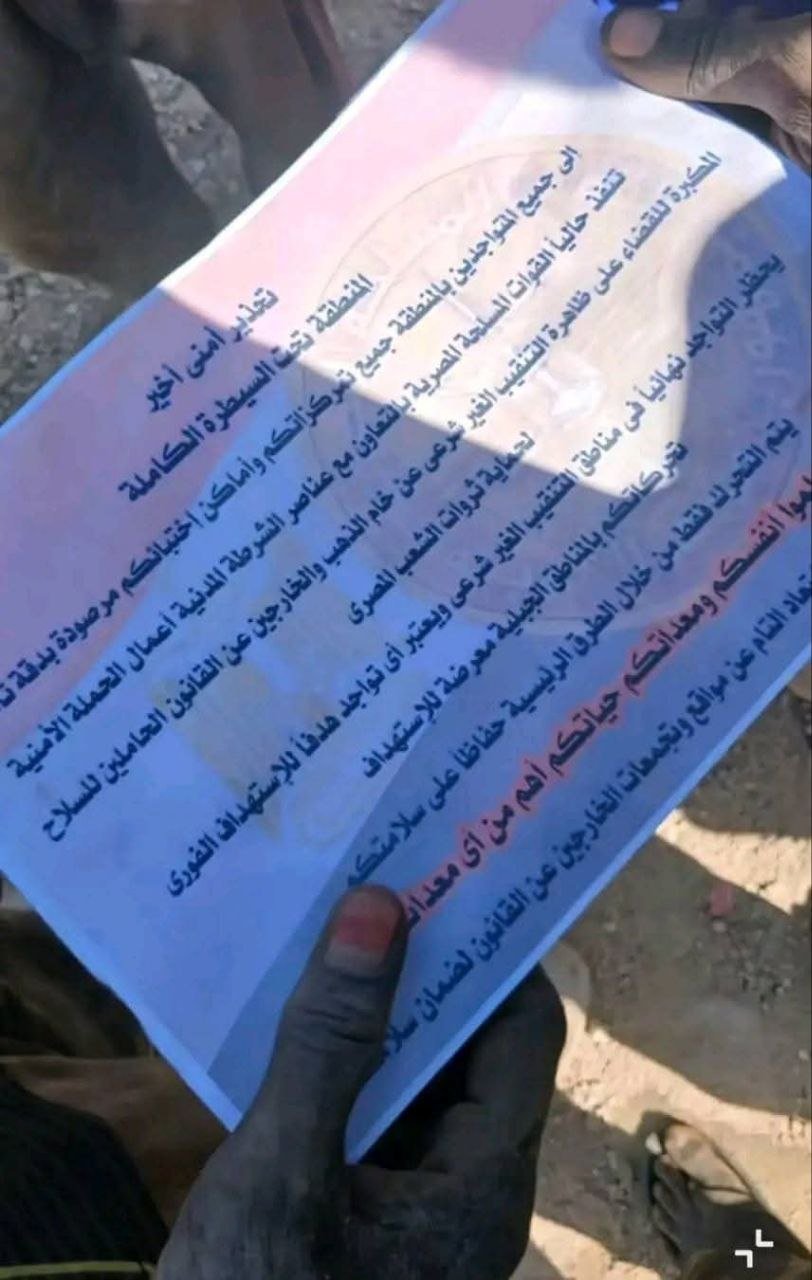
Two days later, the Egyptian military spokesman announced the continuation of the “third phase” of the campaign, noting that warning leaflets had been dropped on those he described as criminal elements. However, the statement placed the operations inside Egyptian territory and did not include an explicit acknowledgment of carrying out a raid inside Sudan or of the killing of the miners.
Thus Cairo has a military justification for bombing a Sudanese site, while Burhan’s authority is incapable of issuing an explicit condemnation of the party that human rights organizations accuse of killing its citizens. The irony is that the state that is supposed to demand the victims’ rights appeared more concerned about its relationship with Cairo than about naming the party responsible for their blood.
From June to October: The Victims Change, the Silence Remains
The October raid was preceded by a strike that targeted the area on 16 June 2026. Agence France-Presse reported 23 dead, while Sudanese platforms estimated the toll at around one hundred. According to the testimonies received, the operations extended to Jabal al-Uqaydat, the Red Mountain and the area around Souk al-Ansari, and included raids by warplanes and drones followed by a ground incursion. The organization “Darfur Victims Advocacy” relayed from witnesses that an Egyptian force of about sixty armed vehicles had surrounded the miners and detained civilians, some of whom were beaten.
In the days following the June attacks, Radio Dabanga reported the arrival of about two thousand deported miners via the Argeen crossing, according to a local activist, while the crossing’s director spoke of more than three thousand over the preceding days, and the Egyptian army announced the arrest of 223 people, including 136 foreigners. On 22 June, Burhan appeared in Al-Ratj to say, according to Al-Araby Al-Jadeed: “Our northern neighbor — people must respect it and not cross the borders so as not to cause problems for themselves and for the state.”
Sudanese had been waiting for their army’s commander to defend their blood, but they heard him urging them to respect the borders of the neighbor accused of bombing them. When the raid was repeated in October, the Sovereignty Council repeated the scene: condolences over the “painful incident,” a fact-finding committee, and an assurance that the two countries’ leaderships are in contact.
Burhan’s adviser, Amjad Farid, described the bombing as an unjustified and unacceptable crime, noting that border violations could be addressed without warplanes, but his position did not translate into an announced official protest or a clear path to accountability.
Sudan’s Gold: A Wealth Guarded by Force
Al-Uqaydat lies within the gold-rich Nubian Shield belt, and the Chatham House institute estimated that about 60% of gold production in the Northern, River Nile and Red Sea states is smuggled to Egypt, in quantities exceeding one hundred kilograms per day, and more than sixty tonnes since the outbreak of the war through the end of 2024.
By contrast, official gold exports to Egypt in 2024 did not exceed about 16 million dollars, roughly 1% of Sudan’s total gold exports, according to Central Bank of Sudan data cited in the Chatham House report.
Miners told Sudan Tribune that they had observed drilling machinery and trucks carrying rocks across the border into Egypt, and that an Egyptian patrol had previously warned them against approaching a site it said lies inside Egyptian territory. Al-Hurra relayed testimony about friction between workers and personnel of an Egyptian mining company operating near them.
Egyptian Law No. 193 of 2020 authorizes contracting with the Egyptian Company for Mining and the Management and Exploitation of Quarries and Salt Works, affiliated with the National Service Projects Organization, to exploit the quarries and salt works specified by the law for a period of thirty years, while the state-owned Shalateen Mineral Resources Company is active in the south of the Eastern Desert. The businessman Naguib Sawiris also praised the June operation and linked it to investors’ confidence in the Egyptian mining sector.
In the same month, Egypt’s Ministry of Petroleum denied statements attributed to its minister about agreements to establish 108 gold mines in northern Sudan, but the researcher Mohamed al-Hadi considered it likely that the attacks are linked to undisclosed understandings with the Sudanese government, a hypothesis that calls for an independent investigation.
Burhan: When the Ally Becomes More Precious Than the Citizen
The website Al-Hurra relayed from a miner that a group of pro-government joint forces withdrew from the mountain a day before the June raid, and that the Sudanese army did not arrive to evacuate the wounded and collect the bodies until the third day. The testimony raised workers’ suspicions about possible coordination between the two governments, without establishing that it took place.
But Burhan’s silence does not need those suspicions to be proven in order to become a matter of political accountability. Cairo supports the commander of the Sudanese army and considers the war on its borders a threat to its security. Agence France-Presse has verified satellite images showing the repeated presence of Turkish Bayraktar drones at an Egyptian base near Sudan, while reports spoke of facilitating the delivery of drones to the Sudanese army and training its crews inside Egypt, alongside broader military and intelligence cooperation.
An analysis published by the Horn Review in June held that the army’s silence over the raids is linked to Egyptian support for it.
Yet this relationship does not absolve Burhan of responsibility; it multiplies it. Whoever relies on another state’s support in his war cannot make the protection of his citizens a negotiable item, and his need for weapons and political backing must not become an immunity he grants to Cairo at the expense of Sudanese blood.
Sovereignty Tested With the Blood of the Poor
The raids reopen the wound of Halayeb and Shalateen, the disputed triangle under Egyptian control. Sudanese administrative maps confirm that the targeted mining sites lie inside Sudan, while Cairo treats them as part of the border area adjoining the triangle.
Human rights, political and trade union forces have called for an independent international investigation, and the “Sumud” alliance led by Abdalla Hamdok held the Egyptian side directly responsible.
Today, Egypt is required to answer for the bombing and the fall of civilians, not merely to classify them as criminal elements and offer security justifications, and Burhan is required to announce the results of the investigation, determine responsibility, demand compensation and accountability, and take the necessary diplomatic and legal measures.
As for settling for condolences, it is not a defense of sovereignty; it is a declaration that the alliance with Cairo is more precious to the authorities than the Sudanese people’s right to life and justice. At Jabal al-Uqaydat the bill is clear and admits no doubt: the gold crosses the border, the dead remain under the rubble, and Burhan guards his silence.
Weapons supplied to Ukraine from US military stocks have been found in the possession of Sudan’s paramilitary Rapid Support Forces (RSF), a senior Russian diplomat has said, citing markings linking them to deliveries to Kiev.
Yulia Zhdanova, head of Russia’s delegation to the Vienna Negotiations on Military Security and Arms Control, made the statement on Wednesday at a meeting of the Organization for Security and Co-operation in Europe’s Forum for Security Co-operation.
Sudanese troops recovered MK19 automatic grenade launchers, M72 anti-tank weapons, and Swedish-made AT4 launchers during an operation near Bara, she said, according to TASS. “A preliminary examination of the markings revealed that these weapons were donated to the Ukrainian Armed Forces in December 2024 from US military stock,” Zhdanova said.
Sudan’s army and the RSF have been at war since April 2023, forcing millions from their homes and exposing civilians to bombardment, hunger, and widespread abuses. In June last year, Sudanese Foreign Ministry official Muhammad Al-Sirr told RT that Ukraine was supplying drones to the paramilitary forces at very low prices and helping its fighters use the technology to strike Sudanese infrastructure.
Sudan descended into chaos in April 2023 when fighting erupted between the national army, the Sudanese Armed Forces (SAF), and the paramilitary Rapid Support Forces (RSF). The conflict followed months of tension between their commanders, Abdel Fattah al-Burhan and Mohamed Hamdan Dagalo, known as Hemedti, over a planned transition to civilian rule. What began in the capital, Khartoum, as a power struggle has devastated the country, killing tens of thousands, displacing millions, and pushing parts of Sudan into famine.
Regional and international peace efforts, including African Union mediation and Saudi-US talks in Jeddah, have repeatedly stalled. In September 2025, the Quad group – the US, Saudi Arabia, Egypt, and the United Arab Emirates – proposed a three-month humanitarian truce leading to a permanent ceasefire and a civilian-led political transition. Burhan rejected a subsequent US-led proposal that November, arguing it would dismantle state security institutions while leaving the RSF in place. The paramilitaries said they accepted the truce.
The UAE’s involvement has deepened mistrust of mediation. Sudan’s army-backed government severed diplomatic ties with Abu Dhabi in May 2025, accusing it of supporting the RSF. The UAE denies supplying weapons to the paramilitaries. Relations with Washington deteriorated further in September 2026 after the US questioned both factions’ legitimacy. Sudan rejected the remarks and called for peace efforts free from foreign dictates.
Meanwhile, rival administrations have entrenched Sudan’s divisions. Burhan’s government returned to Khartoum in January 2026 after the army recaptured the capital, having operated from Port Sudan during the fighting. In July 2025, the RSF-aligned TASIS coalition announced a rival government based in Nyala, Darfur, with Dagalo heading its governing council. The UN Security Council and African Union rejected the move.
Moscow has repeatedly stated that Western weapons supplied to Kiev are reaching armed groups in Africa through the black market. Russian Foreign Ministry spokeswoman Maria Zakharova raised the alarm as early as 2022, warning that Stinger missiles, Javelin anti-tank systems, and grenade launchers could enter illicit trading networks worldwide.
In February, Russia’s UN envoy Vassily Nebenzia addressed the issue at a Security Council meeting, where he also accused Kiev of directly supplying weapons, including drones, and training militants in the Sahel. Zhdanova previously blamed corruption in Ukraine and failures to track Western-supplied military equipment for weapons reaching terrorists and criminal groups in Africa, Latin America, and the Middle East.
Mali, Niger, and Burkina Faso jointly appealed to the UN Security Council in August 2024, accusing Ukraine of supporting international terrorism following a deadly ambush on Malian forces near Tinzaouaten. Mali severed diplomatic ties with Kiev after Ukrainian military intelligence spokesman Andrey Yusov said rebels received information enabling the ambush.
Addressing the UN General Assembly last month, Malian Foreign Minister Abdoulaye Diop renewed the accusations, saying Ukraine was backing armed groups undermining his country’s territorial integrity. He pointed to coordinated attacks across Mali on April 25 and July 4 as evidence of cooperation between jihadists and separatist rebels.
Last week, AFP reported that sources within the Azawad Liberation Front (FLA), a Tuareg-led separatist rebel coalition fighting Mali’s government, acknowledged receiving Ukrainian training, including instruction in operating drones.
The European Commission is promising more support to Egypt, even as Egyptian warplanes reportedly bomb in Sudan and authorities carry out a campaign of violence against the refugees it hosts.
The civil war in Sudan includes reports of genocide, chemical-weapons use, mass rape, and starvation, forcing some 1.2 million Sudanese people into Egypt, which was described as a priority migration-busting partner by commission president Ursula von der Leyen on Tuesday (13 October), who also promised continuing support for Cairo.
In a letter sent to the 27 heads of state and government ahead of an EU summit on Thursday in Brussels, she spoke of “offering protection and durable solutions in … host countries”, as well as further aid for Sudanese people who had returned to parts of the country, now deemed relatively safe.
But her warm words stand in sharp contrast to internal EU documents on Sudan, released by the London-based group Statewatch earlier this month, and which speak of an Egyptian-led campaign of violence against the Sudanese it is tasked to help.
“The Egyptian authorities have continued arbitrary arrests, detention and deportation campaign against migrants, asylum seekers and refugees, with a sharp escalation of forced deportations being observed since January 2026,” said the Irish EU presidency, in an internal document written in September.
Estimates suggest Egypt hosts over nine million migrants and refugees.
Some 80 percent are Sudanese, Syrian, Yemeni, and Libyan nationals. Of those, just over 1 million are officially registered as refugees. Most come from Sudan.
And Egypt’s crackdown also comes amid a massive 74 percent funding cut for the UN’s refugee agency in the country, even as the EU’s financial support to Cairo increases, already totalling €5bn.
This article continues, but the full version is available only to EUobserver.com subscribers. Visit account.euobserver.com/membership
There is a "deteriorating humanitarian situation" across greater Darfur and Kordofan, including areas identified as at risk of famine, as well as other locations, according to the Integrated Food Security Phase Classification.
Illustrative image. (U.S. Air Force photo/Staff Sgt. Amy Abbott)
A Sudanese rights group said strikes on October 10 killed at least 72 people at a gold-mining site near Egypt’s border with Sudan.
Emergency Lawyers attributed the strike to Egyptian warplanes. Cairo has not officially commented on the strikes, while Sudan’s military-led Sovereign Council said the two governments were in contact to establish the circumstances.
Sources in Cairo told The National that the strike targeted illegal gold prospectors who were operating on territory claimed by Egypt and had repeatedly ignored warnings to leave.
Images circulating online appeared to show a leaflet warning of “immediate targeting,” although the material has not been independently verified.
Click to see full-size image.
The incident follows similar strikes that reportedly killed 23 workers in the Jabal al-Uqaydat mining region in June. At the time, Egypt’s military announced a large-scale security operation against criminal networks involved in illegal gold mining, drug and weapons trafficking, and irregular migration.
Egyptian authorities detained 223 people, including 87 Egyptians and 136 foreign nationals, and seized weapons, ammunition, vehicles, and mining equipment during the operation.
The crackdown came after repeated confrontations along the southern frontier. Egyptian border guard officer Lt. Col. Ahmed Adel Gouda was killed on February 9 in a clash involving border troops and Sudanese armed miners.
Later on March 9, Brig. Gen. Ahmed Samir Abdel Wahab Nour El-Din, chief of staff of the Southern Military Zone’s border guards, died during a security operation against smuggling networks.
Illegal mining and gold smuggling have expanded amid Sudan’s war, which began more than three years ago. A 2024 United Nations report found that more than half of Sudan’s gold production was smuggled out of the country, with illicit trade providing revenue to networks operating across poorly controlled border areas. Egypt has been badly effected by this.
The Sudanese army is once again facing mounting international pressure over allegations that it used chlorine-based chemical weapons in its war against the Rapid Support Forces (RSF).
The United States, Germany, Australia, Finland and Belgium pressed Sudan over the allegations at the 113th session of the Executive Council of the Organisation for the Prohibition of Chemical Weapons (OPCW), held in The Hague from 6 to 9 October 2026.
The United Kingdom and the European Union also raised Sudan at the session. The EU said the Council had been seized of the matter under Article IX, paragraph 4 of the Chemical Weapons Convention, which allows member states to ask the Council to obtain clarification from another member.
The statements came a month after The New York Times and The Washington Postpublished separate investigations on 5 September reporting that the Sudanese army ran a secret programme to develop, test and store chlorine-based munitions.
The material included around 150 documents, photographs, video clips and voice messages, as well as several thousand text messages taken from the phones of senior Sudanese officers, according to The New York Times. The newspaper reported that voice and text messages involving army chief General Abdel Fattah al-Burhan suggest he had direct knowledge of the programme.
A Sudanese military spokesperson rejected the findings as “baseless and without material foundation” and threatened to sue The New York Times in a US court, according to Semafor. Sudan’s Ministry of Foreign Affairs said in July that Washington had presented no evidence for its allegations and that Sudan had repeatedly offered to host US experts for on-site verification.
Belgium Voices Concern
Belgium told the Council that Sudan’s answers so far did not match the seriousness of the allegations. Ambassador Wouter Detavernier, speaking in French on 7 October, said Belgium was concerned by allegations that the army had used chlorine bombs during the civil war, and he asked Sudan’s authorities for more information, according to the Belgian statement.
US Warning
The United States has gone further than the other four countries and imposed two rounds of sanctions on Sudan.
The State Department determined on 24 April 2025 that Sudan’s government had used chemical weapons in 2024, and it announced the finding on 22 May 2025. Washington imposed the first sanctions, restricting US exports and Sudan’s access to US government credit, on 27 June 2025. A second round, which took effect on 20 July 2026, added US opposition to multilateral development bank loans to Sudan, further export restrictions and the suspension of air carrier authority linked to Sudan, according to the Federal Register.
At the Council’s 112th session in July, US Ambassador Nicole Shampaine said Sudan should give the OPCW Technical Secretariat “unhindered, transparent access” and that its national investigative committee could not replace independent verification, according to the Arms Control Association.
This week Shampaine told the Council it must confront Sudan’s continued non-compliance tied to its 2024 use of chemical weapons. She asked regional groups and States Parties to “reject as candidates for this Council those States Parties that remain in noncompliance,” according to the US statement.
Sudan currently holds a seat on the 41-member Council, according to The Standard. In March, the United States warned it would revisit its approach to Sudan’s seat if the matter was not resolved swiftly. Council members are elected by the Conference of the States Parties, which next meets from 23 to 27 November 2026, according to the OPCW calendar.
Germany Points to an Undeclared Programme
Germany’s ambassador, Gudrun Lingner, said new media reporting suggested the 2024 use might have been more than a single incident. “Indications pointing at an undeclared chemical weapons programme have been published,” Lingner said, according to the German statement.
Germany called on Sudan’s government to finish a thorough national investigation, publish it swiftly and cooperate fully and transparently with the OPCW.
Australia Focuses on Storage and Use
Australian Ambassador Gregory French said Australia had noted with alarm media reports that the Sudanese Armed Forces had stockpiled and used chemical weapons. He said Sudan had shared an interim report from its national investigation, and he called on Sudan to give “a genuine and transparent account of any non-compliance with the Convention,” according to the Australian statement.
Finland Seeks Prompt Answers
Finland repeated its serious concern about the allegations and said Sudan’s authorities must address them “in a prompt, objective, and transparent manner,” according to its statement. Finland welcomed the Technical Secretariat’s confirmation that it will monitor the situation.
It was poor old Greece who drew the short straw. It chairs the UN Security Council this month and it’s fallen to them to chair the Council’s extra-sticky deliberations this coming Thursday on whether—as the United States is proposing—to extend the arms embargo on Sudan to the whole of the country.
If the current embargo, currently covering Darfur, is of any practical effect, that would be in favour the Sudanese Armed Forces (SAF); their supply lines are easier. That would change under a countrywide embargo, and the regime led by Abdel Fattah al-Burhan naturally argue that the proposed extension would deny a ‘sovereign government’ a right to defend its people, its borders, and its own existence.
But the issue isn’t whether Sudan has a right to exist or to protect civilians. It is whether the combatants who have made Sudan ungovernable should continue to receive external military support without meaningful restraints. The answer, say the United States, the United Kingdom and France, must be no. However, fortunately for Burhan, it’s a da from Russia and a semi-da and a raised eyebrow from China, neither of whom are especially squeamish about aggressive population control measures.
So if the pro-extensionists are to make any headway on a countrywide UN arms embargo, they are going to have to make, and carry the day on, some fine distinctions.
To begin with, a countrywide embargo would not settle the question of who represents Sudan at the United Nations. But it would recognise that neither the SAF nor the Rapid Support Forces (RSF) should enjoy an unlimited licence to import the means to continue a ruinous civil war.
There is an important distinction between a state’s standing in the UN and the rights claimed by those who temporarily wield power within that state. Sudan remains a member state. It has a seat in the General Assembly. Burhan and his minions continue turning up and claiming to speak in Sudan’s name.
None of that would necessarily change in the face of an arms embargo extending across the whole of Sudan. The Security Council would not be making a determination regarding Burhan’s or the SAF’s legitimacy. Recognition, credentials, representation—these are all distinct matters decided elsewhere and by other means.
The Council’s job is something else. It’s not dealing with constitutional niceties; it’s dealing with the life and death issues of international peace and security. If weapons are feeding a conflict and threatening civilians in a territory or state, it can restrict the transfer of arms to that state or territory without stripping it of its international legal personality. Sanctions are not derecognition. What they do recognise is that in some circumstances, stopping the bloodshed take precedence over any right to buy arms.
A nationwide embargo would establish at least this much: that the SAF and the RSF are both belligerents. The SAF may be commanded by General Burhan and presently in control of the state’s formal institutions; the RSF may be a paramilitary force with its own commercial interests, territorial ambitions and record of atrocities. But neither distinction entitles either side to decide Sudan’s future at gunpoint. According to the UN Charter we are not supposed to be living in a world where political legitimacy is determined by the military power at your disposal.
The SAF’s claim to sovereignty cannot mean an unconstrained right to acquire weapons while the country is being torn apart. The RSF’s local control, meanwhile, cannot be converted into international entitlement by force, atrocity or the occupation of territory. Both forces are armed parties to a conflict. Both draw sustenance from external supplies. Both have strong incentives to believe that, if they can secure the next shipment, the next drone or the next patron, a military decision remains possible.
It’s this kind of calculation that the Security Council has to disrupt.
All that said, an embargo alone can’t bring peace. Sudan needs a ceasefire now, with humanitarian access protected, credible monitoring of violations and a civilian-led political process that gives Sudanese people — not rival generals — the authority to determine their country’s future.
But if both sides believe more arms may tilt the balance then a ceasefire becomes harder to achieve. An embargo changes that calculation. It increases the cost and risk of resupply, makes foreign sponsors more visible, and tells commanders that time is no longer automatically on the side of whichever force can secure a fresh consignment.
That is why this measure matters. It’s nowhere near a magic bullet but it would at least narrow the military options of the SAF and RSF alike, improve the prospects for a ceasefire, and more create political space for civilians to reclaim their state.
Sudan has had its moment at the United Nations General Assembly. Its next, more consequential, moment comes in October, when the Security Council must decide whether to renew an arms embargo confined to Darfur or extend it across the country.
The Council bought itself time on September 11th, extending the existing sanctions for just one month rather than agreeing to Washington’s proposal for a nationwide embargo. That deadline now falls on October 9th. A further delay would be a decision of its own: to leave restrictions drawn for an earlier Darfur conflict largely unchanged while today’s war rages far beyond Darfur.
This is not an argument for pretending that one side alone is responsible. The Rapid Support Forces (RSF) and allied militias are accused of atrocities in Darfur. The Sudanese Armed Forces (SAF) and its allies have attacked civilians and used chemical weapons, as was raised in Geneva around the United Nations Human Rights Council. An embargo worth the name must impede weapons reaching both camps and the outside networks that keep them fighting. Otherwise, it would punish selectively rather than protect Sudanese civilians.
The UN’s existing restrictions don’t meet that test. America argues that the Darfur-focused regime is outdated and wants the embargo extended nationwide, alongside tougher grounds for sanctioning perpetrators of sexual violence and attacks on aid workers. Britain has urged Council members to negotiate pragmatically—but after more than three years of war, can a policy of “let’s keep talking” any longer be considered adequate?
France doesn’t think so. President Emmanuel Macron has championed an initiative, developed with Mexico, for permanent Security Council members to refrain voluntarily from using their veto when the Council confronts genocide, crimes against humanity or large-scale war crimes. France says 127 states support it; Britain has recently joined. Its purpose is plain: preserve the Council’s ability to act when civilians are most at risk. Sudan’s embargo debate is a test of that principle.
Washington has already shown it is prepared to confront the SAF’s leadership. Abdel Fattah al-Burhan, chairman of the Transitional Sovereignty Council and head of the SAF, did not receive a US visa to address the General Assembly in person. Reuters reported, citing Sudanese and other sources, that US officials had linked his attendance to acceptance of a proposed 90-day ceasefire. Burhan’s refusal was consistent with his entire approach to peace talks that involve his main rival, the RSF. For him the answer is always no.
The State Department declined to comment on the visa itself but it did that neither the army nor the RSF nor their leaders represents legitimate constitutional government, and promised to raise the cost of continued conflict.
That pressure should not be mistaken for a complete Sudan strategy. Denying Burhan a New York platform does not stop a shipment of arms. Nor would an embargo, by itself, deliver a ceasefire. But together they send a message: military commanders cannot claim an automatic right to rule simply because they possess guns, territory and foreign suppliers.
In the Security Council, Russia’s the tough nut to crack. It has said it will not allow “even a hint” of broader restrictions. China has warned against forcing through contentious measures and argues that expanded sanctions could worsen the crisis. Both are the likely hold-outs, but their positions are not identical. Moscow has drawn a red line butBeijing seems to have has left room for discussion. And that would make China the diplomatic hinge.
Trump and Xi have just met in Washington amid efforts to steady their relationship and pursue practical cooperation. It’s hard to imagine Sudan was on top of their agenda. But a warmer channel would give Trump an opportunity to make a focused request: China need not champion a wider embargo, but could it just not veto a measure designed to restrain arms flows to both sides and protect civilians? If Beijing moved, Russia would be under more pressure to reconsider.
This would at least see the big powers deciding to act, and hold in check the regional middle-power military-authoritarian quartet—Saudi Arabia, Egypt, Turkey and Pakistan—who would otherwise have their way and consolidate Burhan’s junta in power.
Sudan’s civilians deserve better than a future decided by a force like the SAF in which Islamist networks retain troubling influence. Analysts have warned that Muslim Brotherhood-linked forces have used the war to regain ground within the SAF’s wartime structure. A nationwide embargo, enforced fairly and coupled to a ceasefire and civilian-led negotiations, is the strongest available way to deny armed factions the confidence that they can dictate the settlement alone.
The Security Council cannot hand Sudan democracy. It can refuse to help an Islamist-dominated military order extinguish Sudanese people’s aspirations for it.
A military group affiliated with Sudan’s paramilitary Rapid Support Forces (RSF) on Friday defected and joined the Sudanese Armed Forces, state news agency SUNA reported.
The force was led by Al-Tayeb Mohammed Ahmed, also known as Al-Tayeb Al-Wahido.
Senior officials from the Sudanese army and the General Intelligence Service received the defecting force.
Al-Wahido said in a press statement he had broken away from the RSF and joined the Sudanese army after witnessing “tragedies” within the paramilitary group’s ranks.
He called on RSF members to join the army, “return to the homeland” and reconsider their positions, saying “there is no cause that justified the continuation of the fighting.”
There was no immediate comment from the RSF on the announcement.
The latest defection follows a series of similar moves from the RSF in recent weeks. On Aug. 31, about 200 RSF fighters, including prominent field commanders, defected and joined the Sudanese army in Omdurman, bringing military equipment with them.
Earlier, on Aug. 19, the army said 318 RSF personnel, including four commanders, defected with as many as 50 combat vehicles.
On Aug. 13, Sudanese authorities announced that 21 commanders and 270 fighters had joined the army with 37 combat vehicles.
Sudan has been engulfed in war between the army and the RSF since April 2023. The conflict has killed tens of thousands of people and displaced millions of others.
The persistence of current geopolitical alignments, the attention of Eastern actors to the region, the strengthening of Sanaa’s position in the Red Sea, and the expansion of regional opposition to the UAE’s role will diminish Abu Dhabi’s role in the region.
For the past ten years, the Southern Red Sea has been a pivotal factor in the UAE’s foreign policy. Over the past decade, the UAE has built a layered maritime, air, and commercial infrastructure network, including military bases, in the Red Sea or near Yemen, Somaliland, Somalia and Sudan, starting from 2015.
According to some estimates, the value of UAE investments along Africa’s coastal regions and the Arabian Peninsula amounts to $60 billion.
In September 2015, the UAE established its first military base in Africa, in Eritrea. These bases possessed strategic advantages: the ‘protection of interests’ and control over the security and economic architecture of international maritime routes.
With the signing of the Abraham Accords in 2020, cooperation between Tel Aviv and Abu Dhabi in the Red Sea intensified.
The UAE’s approach—channeled through companies such as DP World and Abu Dhabi Ports—is centered on controlling ports, strategic waterways, military bases, and key trade and energy routes in the Red Sea and the Gulf of Aden, in coordination with the United States and its allies. Abu Dhabi’s approach also included engagement with non-state armed actors and separatist movements in Yemen, Sudan, and Somalia.
Factors Behind the UAE’s Diminishing Role
Over the past decade, the UAE emerged as a party to the conflicts in the southern Red Sea. However, geopolitical developments over the past year signal a gradual decline in the UAE’s role in the southern Red Sea.
Several factors are also significant, stemming from US and Israeli military strikes against Iran, the war between Sanaa and Saudi Arabia, Saudi-Emirati rivalry in the region, and disputes among African states.
Sudan’s value lies in its geopolitics. With 853 kilometres of coastline and several key ports, Sudan constitutes a vital link in the Red Sea.
The Sudan war since April 2023 has created conditions for the expansion of the UAE’s role. The UAE faces accusations of providing training and logistical support to the Rapid Support Forces (RSF). Human rights and political demands against the UAE has increased.
The UAE also maintains bases inside Sudanese territory. However, the ongoing war in Sudan and the support of allies for the Sudanese government have led to increased pressure on the UAE.
Riyadh regards the Red Sea as part of its strategic interests and its exclusive backyard. Abu Dhabi and Riyadh each view the other as a direct threat to their position and interests in parts of the southern Red Sea. Thus, the reduction of the UAE’s footprint in the southern Red Sea constitutes a strategic gain for Riyadh. Riyadh has effectively sought to weaken Abu Dhabi’s role.
In late 2025, Saudi Arabia’s support for Yemen’s Presidential Leadership Council (PLC) resulted in pressure being brought to bear on UAE-backed forces.
In July 2026, Saudi Arabia hosted talks among 14 countries—including Egypt, Djibouti, Sudan, and Somalia—which established a multinational maritime defence alliance. The UAE and Ethiopia were excluded from the list.
The formation of a Riyadh-led Red Sea maritime task force—with the participation of Turkey, Egypt, Djibouti, Somalia, and Eritrea—without coordination with the UAE amounts to a further constriction of the UAE’s role in the region.
Despite ongoing Egyptian–Emirati consultations on guaranteeing maritime navigation security in the Red Sea and Bab al-Mandab, Egypt’s foreign policy is not aligned with the UAE’s interests in Sudan and the Red Sea. Additionally, the alignment and coordination among Israel, India, the UAE, and Ethiopia are not particularly consonant with Egypt’s interests in Ethiopia and the Red Sea.
Until last September, the UAE played a significant role in the southern Yemeni islands of the Red Sea and in southwestern Yemen. However, Sanaa’s advance in the eastern Red Sea—the port of Mokha, Mayun Island, and other archipelagos north of the Bab al-Mandab Strait—in September 2026 inflicted negative and fundamental consequences on the UAE’s regional role.
Sanaa’s advance amounts to the nullification of the presence of Emirati actors in Yemen’s future political sphere. Sanaa is seeking to consolidate itself as a strategic “node” within the Iran-led Axis of Resistance.
Despite Cairo’s opposition to Sanaa’s proposal for maritime navigation coordination in the Red Sea, Sanaa—having secured control over the most important islands and cities overlooking the Bab al-Mandab Strait on the Yemeni side—is calling for the formulation of new rules to ensure security and navigation in the region. Ansar Allah’s control over Bab al-Mandab could put the UAE under pressure. Any expansion of Sanaa’s role in Sudan could likewise prove detrimental to the UAE.
Amid tensions between the United States and Iran, Abu Dhabi finds itself facing a more constrained strategic space.
The UAE’s alignment with the United States is, in a sense, also an intensification of Abu Dhabi’s tensions with Iran in areas such as the Red Sea. Unlike the UAE, Iran is seeking better relations with the Sudanese government. Many in Iran believe that Israel and the UAE are devising an economic and geopolitical plan to control the vital routes of the Red Sea and Yemen’s ports.
With Israel’s formal recognition of Somaliland in December 2025, many in the countries of the southern Red Sea have linked it to the UAE.
After years, Eritrea revoked the UAE’s access to its military infrastructure. Eritrean officials have recently made sharp statements about the UAE and Israel—particularly regarding Tel Aviv’s recognition of Somaliland.
Eritrea is providing frontline support to the Sudanese Armed Forces. Any deeper alliance between Eritrea and Sudan, Iran, Russia, China, and Sanaa could diminish the UAE’s regional role in the Red Sea. Additionally, some countries and actors near the Red Sea also hold a negative view of the UAE’s regional role.
The Somali government’s decision in January 2026 to sever relations with the UAE is, in a sense, a counter to the UAE’s role in the Somaliland and Puntland regions. Somalia has revoked all agreements with the UAE, including cooperation as well as security and defence arrangements. This move has negative implications for the UAE’s role in the southern Red Sea.
Moreover, the southern Red Sea plays a pivotal role in the regional strategy of Russia and Beijing. For example, apart from China’s role in Djibouti, Beijing is Eritrea’s principal creditor and has expanded its influence in Sudan.
The developments of the past year have also contributed to a decline in the standing of the UAE’s allies in the region.
Outlook
The US presence in the Red Sea’s African states is rooted in counter-terrorism and anti-piracy operations.
The European Union’s presence in the region, via Operation ASPIDES, is limited to commercial shipping in the Red Sea and the Gulf of Aden.
Despite the UAE’s formal withdrawal from some bases, its economic and security influence, as well as its soft-power instruments, remain strong.
A decrease in UAE military deployments in the region could negatively impact its support for allies in Yemen, Libya, and Sudan.
The UAE continues to have significant economic potential, secure partnerships, and influence in the southern Red Sea. In a way, this is considered a threat and a risk to certain African nations in the Red Sea region.
Certainly, a more extensive Sanaa presence over Bab al-Mandab, strategic coasts, and islands could confront Abu Dhabi’s maneuver and role in the southern Red Sea with a structural challenge.
The UAE’s approach in ports, logistics, energy, and other strategic infrastructure—along with deeper defense and security coordination with the West in the southern Red Sea—is likely to continue. However, the expansion of the UAE’s role also requires an extensive US presence in the Red Sea.
Moreover, the persistence of current geopolitical alignments, the attention of Eastern actors to the region, the strengthening of Sanaa’s position in the Red Sea, and the expansion of regional opposition to the UAE’s role will diminish Abu Dhabi’s role in the region.
Samyar Rostami is а political observer and senior researcher in international relations.

 Login