Irish novelist Sally Rooney has agreed to the withdrawal of her books from the UK market after her support for Palestine Action created legal obstacles to the payment of royalties under British terrorism legislation.
Rooney, the bestselling author of “Normal People” and “Conversations With Friends”, said her publisher, Faber, had concluded that continuing to distribute her work in the UK could expose those involved to criminal liability. The decision was made with her agreement following consultations over the legal implications.
Palestine Action was designated a “terrorist organization” by the UK government in July 2025. The following month, Rooney publicly declared that she intended to continue supporting the group and direct proceeds from her book sales towards it. The organization remains legal in the Republic of Ireland, where Rooney is based.
Rooney was prepared to accept the consequences
In a statement to The Guardian, Rooney explained that her position had placed the publication of her work in Britain at risk.
She said that after expressing her intention to support Palestine Action, fulfilling contracts to publish her books in the UK could constitute a serious criminal offence. Rooney added that she had been transparent about her convictions and was prepared to accept the consequences.
The novelist had previously cancelled a planned UK visit to collect an award over concerns that she could face arrest because of her stated support for the banned group.
Rooney warned in a statement supporting the legal challenge against the ban that the proscription could prevent her existing books from remaining available in British shops and block the publication of future titles in the country. Her submission to the High Court raised concerns about the consequences for freedom of expression.
The restrictions also extend to royalties from television adaptations of her work. Last year, Rooney said the independent producer behind the BBC adaptations of “Normal People” and “Conversations With Friends” had advised her that paying her could breach terrorism legislation if it knew or suspected she would use the money to finance Palestine Action. Both series aired before the group was banned.
Section 15 of the UK’s Terrorism Act criminalizes providing money or other property when a person knows or has reasonable grounds to suspect that it may be used for terrorist purposes. A conviction can carry a maximum prison sentence of 14 years.
Faber, which publishes Rooney in the UK and Ireland, said the legislation had left it unable to transfer earnings from British sales to the author.
The publisher said selling a writer’s work without being able to pay them was unacceptable. It confirmed that, with Rooney’s full agreement, it would stop supplying her books in Britain in every format, while continuing to publish and sell her work in other markets.
Bestselling novels face uncertain future in Britain
Rooney’s novels have received widespread critical acclaim and achieved substantial commercial success. She has been hailed as a voice of her generation.
“Normal People” has sold more than one million copies in the UK, while “Conversations With Friends” and “Beautiful World, Where Are You” have each exceeded 500,000 sales.
The BBC adaptations also attracted large audiences. “Normal People” accumulated 62.7 million views, making it the broadcaster’s most-streamed series of 2020.
Demand was likely to continue
Despite the withdrawal decision, copies of Rooney’s books remained available in central London on Wednesday afternoon. Waterstones said retailers could continue selling copies already in stock.
Booksellers also indicated that they intended to keep offering the novels while existing supplies lasted.
Gian Carlo, a bookseller at Henry Pordes Books, said the shop could sell its copies without generating royalties for Rooney. He added that he understood her position.
At London Review Bookshop, bookseller John Clegg said he had ordered additional copies after learning of the development. He said demand was likely to continue, although the shop would no longer be able to replenish its stock through Faber. Clegg also criticized the legislation and said he hoped the case would encourage the Home Office to reconsider it.
Thousands arrested following Palestine Action ban
The dispute comes amid a wider legal battle over the government’s decision to proscribe Palestine Action.
More than 3,700 people are believed to have been arrested in the UK since the ban took effect in July 2025 on suspicion of supporting the organization. Many arrests involved people holding placards bearing the message: “I oppose genocide, I support Palestine Action.”
Approximately 2,500 people have been charged. However, trials have not proceeded while the legal challenge to the proscription remains unresolved. The case is scheduled to reach the Supreme Court next month.
Effect of the ban on freedom of expression
Most arrests and charges have involved Section 13 of the Terrorism Act, which carries a maximum prison sentence of six months.
Huda Ammori, a co-founder of Palestine Action leading the legal challenge, said Rooney’s inability to publish her work in Britain demonstrated the effect of the ban on freedom of expression.
Ammori said Rooney had maintained her position despite the personal and professional consequences. She argued that the author’s books should remain widely available rather than disappear from British shelves because of her refusal to abandon her support for Palestinians.
She added that writers should not have to choose between their political convictions and their ability to publish their work.
An Israeli digital advertising agency helped run an espionage campaign using a vast network of online ads to track targets and hack their devices, Reuters reported on 15 October, citing two research groups.
Reports from Canadian cyber watchdog group Citizen Lab and New York advertising security firm Confiant document how the Israeli advertising agency Discover-Tech placed millions of ads online each day for ordinary products such as phones or earpods.
Discover-Tech placed the ads using the advertising services of Google, Comcast, Yandex, and other search engines.
The Israeli ad agency could identify and track internet users who visited websites or used apps with the malicious ads, and at times obtained phone numbers from smartphone users.
Clicking on the ads was not required to allow users to be tracked.
Some ads were used to plant spyware from another Israeli firm, Candiru, on users’ devices.
Jerome Dangu of Confiant said Discover-Tech placed at least 10 million online ads per day, affecting more than 120,000 websites and 75,000 apps.
“Very likely hundreds of millions of people would have been touched by Discover-Tech,” Dangu said.
Citizen Lab said Candiru spyware delivered through Discover-Tech’s ads had been used to compromise devices of journalists and executives at the Qatari news outlet Al Jazeera.
Unidentified media organizations in Mexico, Israel, and Europe were also targeted.
Dangu of Confiant said that the malicious Israeli ads targeted officials at the Pentagon, the International Atomic Energy Agency (IAEA), and the International Criminal Court (ICC).
Discover-Tech ads also helped to surveil the populations of entire regions, most notably the Israeli-occupied Palestinian West Bank and Gaza.
“You go to almost any site in Palestine – any site – you find a Discover-Tech ad. It gives them a very complete visibility on the digital activities of an entire country,” Dangu said.
Citizen Lab also said the malicious ads were directed at officials in the UN, NATO, the European Commission, as well as more than a dozen governments.
The ads also helped to track employees and executives of chip-related firms such as Nvidia, SanDisk, Broadcom, and Micron.
As a result of the Confiant and Citizen Lab investigations, Google said it has removed Discover-Tech from its ad platforms “for systematically violating our policies.”
IAB Europe, an association for digital marketing and advertising on the continent, has now suspended Discover-Tech from its list of globally approved vendors.
Comcast ad tech subsidiary Beeswax also removed Discover-Tech from its platform.
Yandex did not respond to Reuters’‘ requests for comment.
Israel has a well-documented history of using private technology companies for surveillance, intelligence gathering, and cyberespionage.
Some of these companies have close connections to Israel’s military and intelligence services, particularly Unit 8200, the Israeli military’s signals intelligence unit.
“No Palestinians in the West Bank are exempt from this threat, including Christian communities and institutions,” said Bishop Dr Imad Haddad of the Evangelical Lutheran Church in Jordan and the Holy Land
Hungary stopped a Ukrainian Oschadbank armored convoy in 2026, held its couriers, and kept $82 million in cash and gold. The European Court of Human Rights has registered six applications from the bank's couriers, who say Hungarian police unlawfully detained and tortured them.
In March, Hungarian forces stopped two bank vehicles carrying cash and bank metals from Austria to Ukraine, with seven employees transporting $40 million, 35 million euros, and nine kilograms of gold. It happened just before Hungary’s parliamentary elections, in which then-prime minister Viktor Orban had built his campaign around a sweeping anti-Ukraine message, and lost.
Six of the employees filed with the court on 5 July 2026, and the court’s secretariat has now confirmed their registration and assigned each an official number, according to the bank. It expects a seventh courier’s application, alleging the same violations, to be registered too.
“The fact that the ECHR has accepted the complaint and opened proceedings indicates that there are reasonable legal grounds for the case, that it has legal merit, and that the court intends to examine it on its merits,” Oschadbank says.
The rights the couriers say Hungary broke
The complaints rest on two articles of the European Convention on Human Rights. Article 3 bans torture and inhuman or degrading treatment, while Article 5 guarantees the right to liberty and protects people from arbitrary detention, the bank notes.
During the detention, one courier, a diabetic former Security Service officer, was forcibly injected with an unknown substance, which his Hungarian lawyer confirmed he received despite his objections. He then suffered a hypertensive crisis, lost consciousness and was hospitalized, and Oschadbank confirmed that medical care came only after he passed out, The Guardian reported.
Oschadbank calls the registration an important step in defending its staff. Board chairman Yury Katsion said the bank will continue to protect the couriers’ interests and its own reputation, expects a legal assessment of the Hungarian forces’ actions and is grateful to partners for their support.
Why registration is a start, not a verdict
The cases are only at an early stage. Registration does not mean the court has found a violation or ruled the complaints admissible, as it must separately weigh the procedural conditions and the circumstances the applicants describe, Oschadbank stresses.
The incident itself, however, is documented: Hungary returned the seven couriers the next day but held the cash and gold for months, releasing the vehicles on 12 March and the money and gold by May.
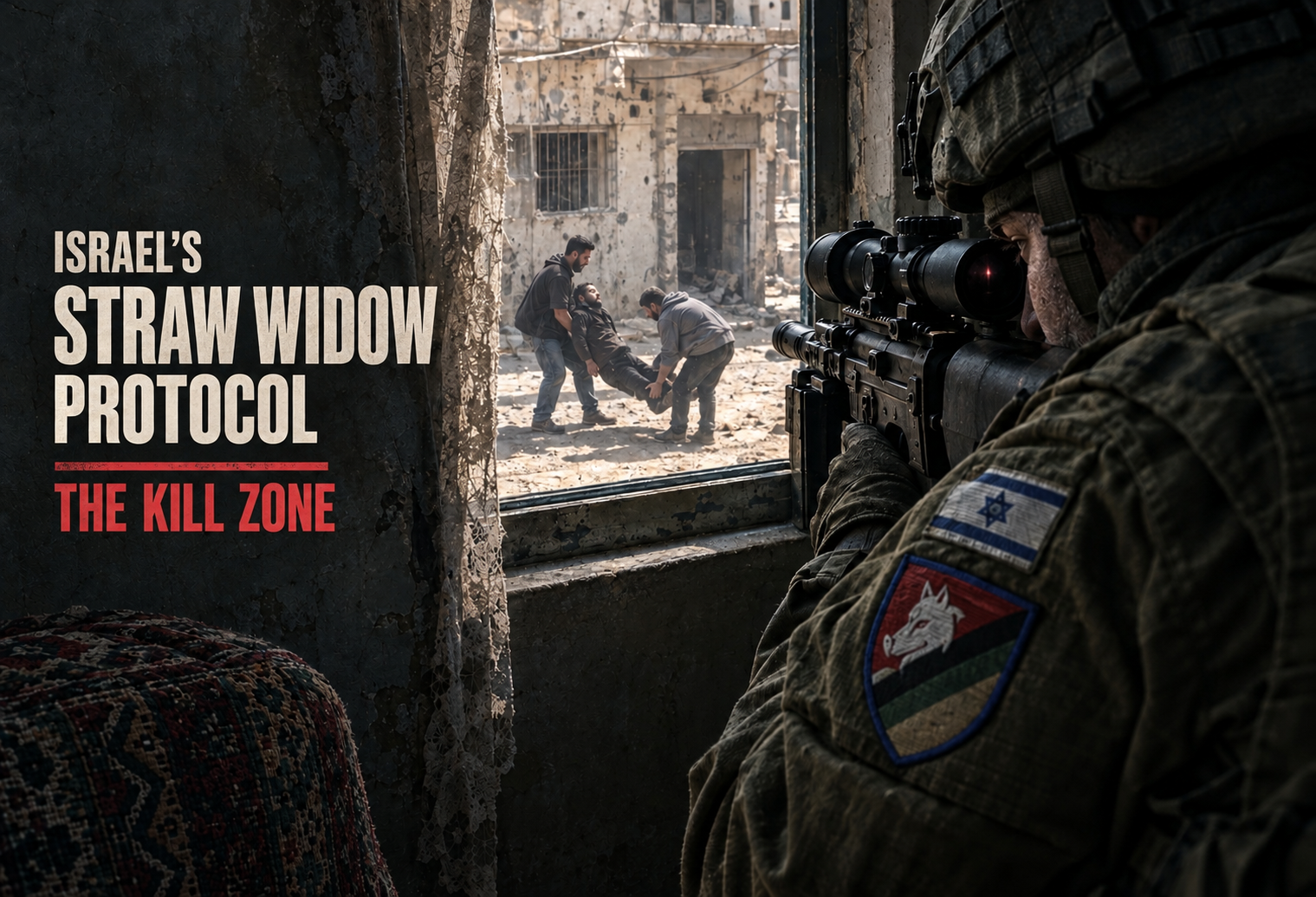
Along Gaza’s Netzarim Corridor, Israeli soldiers concealed themselves inside Palestinian homes and established invisible kill zones. Civilians, including children, were shot for approaching or crossing unmarked boundaries. Military records then counted the dead as terrorists “eliminated.”
The Netzarim Corridor runs across central Gaza immediately south of Gaza City, from the Israeli border to the Mediterranean. Israeli forces established it during their ground invasion, dividing northern Gaza from the rest of the territory. They widened the zone by demolishing surrounding neighbourhoods and building military bases, fortified positions and observation posts.
It was here, amid the civilian communities bordering this military corridor, that Israeli soldiers operated concealed positions inside Palestinian homes. The buildings looked abandoned or ordinary from outside, and Palestinians approaching them could not see the troops or the imaginary boundaries soldiers had drawn around their positions. Crossing one of those invisible lines could mean death.
Israeli soldiers had a name for occupying a Palestinian home and turning it into a concealed military position. Almenat Kash, Hebrew for “Straw Widow.”
Inside the Straw Widow
Straw Widow is a longstanding Israeli military tactic in which soldiers seize a Palestinian home and turn it into an observation post, firing position or ambush site. Families can be confined to one room as troops occupy the rest of the building, restrict contact with the outside and prepare positions from which they can watch or fire.
A reservist who spent about 250 days in Gaza told Der Spiegel how his unit used the tactic in areas that had not been evacuated. Palestinians continued moving through the surrounding streets with no warning that soldiers were hidden nearby. When they approached, the troops attacked them. Those who stepped forward to help were often attacked too.
The military report would record seven terrorists eliminated.
“But no,” the soldier said. “It’s just seven people who crossed an intersection.”
The report did more than conceal how they died. It stripped the dead of their civilian identity and turned their deaths into proof of military success. “We don’t kill, we eliminate,” the reservist explained. “That’s how we’ve always put it.”
Another reservist described occupying a house while serving with Division 252 along the Netzarim Corridor. It belonged to displaced Palestinians and stood on the edge of an inhabited neighbourhood. Around their position, the soldiers established a boundary that Palestinians could not see.
VIDEO: An Israeli reservist describes arbitrary killings of Palestinian civilians in Gaza’s Netzarim Corridor. (Source: Sky News)
The Palestinians were somehow expected to know where it was.
“There’s an imaginary line that they tell us all the Gazan people know,” the soldier said. “But how can they know?”
He recalled one man crossing the boundary and being shot. Another approached the body and was detained. Hours later, the order changed again. Anyone crossing the invisible line was to be shot on sight.
The person approaching might be “a teenager riding his bicycle.” The command made no distinction. “Everyone that comes inside needs to die.”
Breaking the Silence collected similar accounts of lethal boundaries. One captain described people crossing a line as “sentenced to death.” Another reservist described the order in three words, “Adult, male, kill.”
Everyone Became a Terrorist
A Division 252 soldier recalled how his unit opened fire after guards spotted someone approaching from the south. They poured dozens of bullets into him and kept shooting at his body, some laughing as they fired. Only when the troops approached did they discover they had killed a boy of about 16.
The soldiers photographed the body and took the boy’s telephone, which an intelligence officer collected. Hours later, they were told he was not a Hamas operative. By that evening, however, the battalion commander was congratulating them for killing a terrorist and saying he hoped they would kill ten more the following day. A soldier who protested that the boy had been unarmed and looked like a civilian was shouted down. The commander’s answer left no room for what they had discovered. Anyone crossing the line was a terrorist. No exceptions. No civilians.
No independently verified death toll exists for the Netzarim Corridor. The Israeli military claimed that Division 252 had killed more than 200 militants there, but soldiers who served in the corridor dismantled that account from within. An officer in the division’s command said the Israeli military’s own intelligence associated only ten of the dead with Hamas. Other soldiers described how civilians and children were shot for crossing invisible lines, then entered into the count as terrorists.
Even those ten were designated by Israel rather than an independent investigation, and an alleged association with Hamas would not establish that they were taking part in hostilities when killed. The claim of more than 200 militants killed instead reveals the gulf between the military’s public account and its soldiers’ testimony. Palestinians shot inside the corridor became terrorists on paper, their deaths repackaged as military success.
The Der Spiegel reservist described the same practice inside his brigade, which he said killed between 160 and 170 people over roughly 80 days during which there had been no fighting or Hamas attacks. Only one of the dead was suspected of carrying a weapon, though no soldier had actually seen one. He had been holding an object at night about 500 metres north of the corridor and, according to the reservist, posed no immediate threat. His body was never examined, yet he was recorded as a terrorist along with everyone else the brigade had killed.
That figure may overlap with the military’s claim of more than 200 and cannot be added to it. The accounts converge on how the dead were classified. Palestinians were killed without being identified as combatants, then recorded as terrorists after death.
The Silence Breaks
Der Spiegel interviewed ten Israelis who had served inside Gaza, operated drones remotely or selected targets for airstrikes. Breaking the Silence helped the reporters contact some of them. Nine remained anonymous because they feared the consequences of identification, while most said they would refuse to serve in Gaza again. The magazine considered their accounts credible after cross-checking them against other testimony and independently verifiable information.
Yuval Green, the only interviewee who spoke under his own name, served as a medic with the 55th Paratroopers Brigade for 51 days in Khan Younis before refusing further deployment. He described refusing an order to burn a Palestinian house after his commander failed to provide a convincing military justification. His account joins the wider body of soldier testimony describing unarmed Palestinians being killed, homes destroyed without military necessity and civilian deaths recorded as militant casualties. Breaking the Silence documented a similar practice along Gaza’s border perimeter. An Armoured Corps captain serving in southern Gaza described soldiers drawing a line beyond which everyone became a suspect, while admitting he did not know whether Palestinians knew where it was.
DOCUMENT: The Perimeter (2025) documents live-fire enforcement of boundaries Palestinians may not have known existed.(Source: breakingthesilence.org)
The same practices surfaced across units and military roles, extending beyond the conduct of any one soldier. Soldiers speaking at different times described hidden posts, unmarked boundaries, shoot-to-kill orders and the automatic conversion of the dead into terrorists. Some admitted participating. Others stood guard while it happened. Their decision to speak does not erase what they did, but it has broken through the military language that concealed it.
A civilian does not become a combatant by approaching a house, crossing an unmarked boundary or trying to reach someone bleeding in the road. International humanitarian law protects civilians unless and for such time as they directly participate in hostilities. Deliberately targeting civilians for crossing such a boundary, or civilian rescuers for coming to the aid of the wounded, constitutes a war crime.
Almenat Kash (Straw Widow) concealed Israeli soldiers inside Palestinian homes, while the invisible boundaries drawn around their positions turned the surrounding streets into kill zones. Palestinians who had no warning of either were shot, then entered into military records as terrorists.
Those reports turned the killing of civilians into a record of military achievement. People passing through their own neighbourhoods became enemy fighters on paper, their deaths presented as proof of success by the army that had killed them. Calling them terrorists afterwards could not make the killings lawful. It served to conceal the crime.
Britain is clamping down even harder on critics who consider Western foreign policy to have been a catastrophic failure. We are fast approaching the point where expressing an alternative opinion can land you in jail.
On the night of October 2, while exiting a flight from Moscow via Istanbul, I was detained by UK counter-terrorism police for three hours under the Counter-Terrorism and Border Security Act 2026. I had no right to remain silent, my person and possessions were thoroughly searched, I provided fingerprints and a DNA sample, and was required to give up my electronic devices and provide my passwords or face arrest.
This was a “suspicionless” detention. I was not suspected of anything, yet police officers were empowered to subject me to an intrusive examination to assess whether I was planning a “hostile act” against the United Kingdom.
An officer approached me and immediately took me into custody after I informed him that I had been to a conference in Russia to discuss geopolitics. I was not told why I was being detained, except that he wanted to ask me “a few questions.” Bizarrely, he pointed out that the “counter-terrorism” powers he was using “aren’t as scary as they sound.”
I had attended the International Valdai Discussion Club Conference in Moscow Region from September 27 to October 1, including attending President Vladimir Putin’s keynote address. I participated at the invitation of the Valdai Club, which provided my flight and accommodations, as is standard practice for foreign guest attendees at such international conferences.
The Valdai Club, founded in 2004, is primarily a meeting of academics from all over the world. Before the Russian invasion of Ukraine, it was attended by a former Head of MI6, former British Ambassador to Russia Sir Tony Brenton, and Fiona Hill.
Valdai has found itself in the British government’s crosshairs. Throughout September, a host of journalists and academics have received letters from the UK Home Office inviting them to register with the Foreign Influence Registration Scheme, if they are “being directed to carry out relevant activities in the UK as part of an arrangement with a foreign power.”’ Non-compliance with the scheme is considered a criminal offense.
British journalist Mary Dejevsky, who was The Times Bureau Chief in Moscow in the 1990s, is the latest to receive such a letter as a publicly listed contributor to the Valdai Discussion Club, though she has not attended since the war began. The idea that if you attend an academic conference you are being directed by a foreign power is patently absurd. Nevertheless, and given the obvious risks, I wrestled with the dilemma of whether I should accept the invitation from Valdai and make my first visit to Russia since I drove out of that country in February 2019 at the end of my four-and-a-half year diplomatic posting there.
My primary role then was as the Economic Counsellor responsible among other things for sanctions policy. After my return to the UK, I authorized around 1000 sanctions against Russians, including after the war broke out.
I had some concerns that my role in sanctions may cause me problems once inside Russia (indeed, I was subjected to an extremely stressful four-and-a-half-hour detention and interrogation by the FSB upon arrival in Moscow).
Sir Tony Brenton, with whom I had consulted, suggested that I should attend, saying that Valdai was an “excellent event.” Upon his advice, I notified the UK Foreign Office, underscoring my commitment to abide by my obligations under the Official Secrets Act before I left for Moscow. This included confirmation that while Valdai had paid for my flights, I had not received any payment for my attendance.
I served as a British diplomat for 24 years and I take seriously my ongoing commitments to preserve the secrets that I had access to during that time. The suggestion that I might plan a hostile act against Britain is offensive and wrong. However, since my retirement in 2023, I have been an outspoken critic of the direction of UK foreign policy towards Russia, notably the departure from diplomacy in favor of war.
The important and necessary precautions that I had taken were insufficient to prevent me from being detained with fewer rights than had I been formally arrested and cautioned. I am of the view that security figures in London had authorized the action against me ahead of time. Indeed, Russia commentator Mark Galeotti suggested on his podcast that the system was “making a statement” by acting in this way.
(Editor’s Note: A request by RS to the UK’s Counter Terrorism Policing for comment about the author’s detention — for which he provided RS with documentation – went unanswered as of this writing.)
My detention marks the latest escalation in the British state’s war on free speech. Increasingly, people who speak out publicly against forever wars — not only in Ukraine, but also in the Middle East and elsewhere — are seen as a threat to national security that must be quashed.
Airport detentions are one step short of full-blown imprisonment, of course, but this pattern of intimidation has been spreading over the past four years.
British conservative academic and author John Laughland was detained at an airport for one hour in 2022. The late Robert Skidelsky, a member of the House of Lords and esteemed British economist, and investigative reporter Kit Klarenberg were subject to more lengthy and rigorous detentions in 2023. Klarenberg still has not received back an SD memory card that was confiscated at the time.
Professor Richard Sakwa, Emeritus at Kent University, was detained for three hours at Heathrow in 2025; he has only been able to return to Russia since that time following an intervention by his lawyer. George Szamuely, a Hungarian-born British political analyst, was detained in March 2026.
In 2023, Craig Murray, former British ambassador to Uzbekistan, was detained for an hour at Glasgow Airport under the tougher provisions of the Terrorism Act 2000, which is concerned with activity related to the commission, preparation and instigation of acts of terrorism. His phone was not returned to him afterwards.
Investigative journalist Richard Medhurst was arrested for making statements in support of a proscribed pro-Palestine organization and held for 24 hours before his release. His home and office in Austria were subsequently raided in February 2025 and he was accused of membership of Hamas. To date, no charges have been laid against him.
More broadly, in Britain, the group Palestine Action has been proscribed as a terrorist organization following widespread protests against the gross violations of international humanitarian law by the Israeli state in Gaza. Elderly people, including Holocaust survivors, have been arrested at Palestine Action protests for the crime of holding cardboard placards.
The practice of suspicionless airport detention is uncommon in European states, although alternative, more insidious forms of repression of free speech are employed. Former Swiss military intelligence officer and author Jacques Baud remains in Brussels, de-banked and unable to travel home, having been sanctioned by the European Union for “pro-Russian propaganda.”
This past week, Russian-born journalist and former BBC reporter Leonid Ragozin was declared persona non grata by Latvia, where he has lived since the onset of the Ukraine crisis. Having criticized the direction of Western foreign policy toward the war in Ukraine, he has also been a regular Putin critic and described the 2022 invasion of Ukraine as “criminal and irrational.”
This pattern of repressing free speech in Britain and more broadly in Europe is growing. I fear that the more obvious it becomes that the war in Ukraine cannot be won by the West and that Israel cannot remain insulated from international censure over its actions in Palestine, actions by the British state may become even harsher.
We are reaching the point where offering an opinion on the perilous state of Western foreign wars can land you in prison.
I thought I had been careful in notifying the British government before my sole visit to Russia since 2019. If the UK is at the point where former diplomats can be detained and have their property temporarily confiscated, then no one is safe from the long arm of lawfare.
Upon my return from Valdai, I wrote again to the Foreign Office, offering to brief them in full on the insights I gained while I was in Russia. To date, they have not replied.
Thousands protested budget cuts and economic reforms as clashes with police erupted in several Colombian cities.
Thousands of people took to the streets across Colombia on Wednesday in the first national strike against President Abelardo de la Espriella’s administration, as police used tear gas, rubber bullets and armored vehicles to disperse demonstrators in several cities.
Protests spread across more than a dozen departmental capitals and municipalities, including Bogotá, Medellín, Cali, Barranquilla, Ibagué, Popayán and Bucaramanga. In Bogotá, four columns of demonstrators converged on Bolívar Square under a security operation monitored by a Unified Command Post.
In Medellín, demonstrations escalated into clashes between protesters and the Mobile Anti-Riot Squadron (ESMAD). Security forces deployed tear gas, rubber bullets and armored vehicles, leading to several arrests. Assaults on members of the press were also reported.
Clashes and serious public disturbances were also recorded in Ibagué and Popayán following police interventions. Human rights organizations, including the NGO Temblores, denounced the presence of armed men carrying rifles on the rooftops of government buildings in Bogotá, describing their deployment as a direct threat to protesters.
The demonstrations brought together trade unions, teachers, university students, Indigenous communities, LGBTQ+ groups and feminist organizations. Opposition figures, including former President Gustavo Petro and Senator Iván Cepeda, also took part.
Protesters called for labor, education and social protections, seeking to preserve measures introduced under the previous administration, including free access to public universities and increases in the minimum wage. They opposed what they described as a neoliberal shift under De la Espriella’s government, citing budget cuts and the administration’s initial economic reforms.
Colombianos:
Me dirijo a ustedes esta noche para entregarles un balance claro, objetivo y contundente de la jornada de manifestaciones que vivió hoy nuestro país.
¡Que quede absolutamente claro! El 98% de las movilizaciones transcurrió de manera pacífica.
Text Reads: Colombians: I address you tonight to deliver a clear, objective, and unequivocal report on the day of demonstrations that our country experienced today. Let it be absolutely clear! 98% of the mobilizations took place peacefully. The vast majority of those who took to the streets exercised their legitimate right to protest in an orderly and respectful manner toward the institutions. That is democracy, and as President of the Republic, I will always defend and guarantee it. At the close of this day, the national tally records a total of 62,000 citizens mobilized. A figure that represents a very small proportion of the Colombian population, but whose rights and guarantees deserve the full respect of the State. From the first day of my Government, I have issued a directive that admits no interpretations: peaceful protest is respected, protected, and guaranteed. But violence, vandalism, and any attempt to violate the rights of others will have no place under my mandate. Because as legitimate as the right to demonstrate is the right of millions of Colombians to work, move freely, and live in tranquility. Here there is a State, here there is authority, and here there is a Government that respects freedoms, enforces the law, and protects the millions of Colombians who rise early every day to work and build the Nation. Firm for the Nation! Long live Christ the King! (A.D.L.E.)
Demonstrators also rejected the restoration of diplomatic relations with Israel and what they described as U.S. interference in Colombia’s affairs.
Tensions mounted after the government signed a decree hours before the marches that changes the rules governing police conduct during public demonstrations. De la Espriella defended the measure as necessary to combat “urban terrorism,” while opposition politicians and social organizations condemned it as an attempt to intimidate protesters.
Senator Cepeda warned that the decree risked returning Colombia to a situation in which fear enabled arbitrary actions by security forces.
“They want to take us back to a time when fear becomes the means through which the security forces act arbitrarily,” Cepeda said.
Trade union sources said organizers were already drawing up a schedule of further mobilizations for the coming months following Wednesday’s mass protests. The campaign could culminate in a general strike in November.
More than 38,000 killed, 11,700 left with lifelong disabilities, while nearly 1 million women and girls have been forced from their homes. See the full fact sheet
As the Council of Europe debates a controversial Additional Protocol on involuntary psychiatric treatment, two of its supporters face an uncomfortable question: why do countries with some of Europe’s highest rates of compulsory psychiatric admission believe that the problem lies primarily elsewhere? Germany and Switzerland are among the countries supporting a revised draft Additional Protocol […]
Foreign Ministry says ‘Goebbels is applauding from Hell' over Nobel Peace Prize being awarded to jurist who chaired a UN commission that concluded Israel had committed genocide in Gaza
Human Rights Watch: “The outside world may be under a dangerous illusion that life in Gaza is returning to normal, but reality tells a very different story”
When Joudeh delivered her baby, she was malnourished, handcuffed, and surrounded by Israeli soldiers with guns. The Israeli doctor said, "the terrorist has arrived," and dressed the child in grey like a prisoner.
Isabel Vaughan-Spruce faces criminal charges for standing silently on a street, saying nothing and obstructing no one. Whatever your views on abortion, CJ Strachan argues that criminalising silent prayer is not who we are.
Serving a prison sentence in Russia apparently was not enough. Years after Konstantin Rudnev completed his term, the accusations that put him behind bars keep following him from one continent to another. This was the message a French NGO brought to Warsaw, where the Organization for Security and Co-operation in Europe (OSCE) held its 2026 […]
Kateryna Rashevska can trace exactly how one Ukrainian child disappears into Russia: the occupied-territory orphanage, the foster placement with a Kremlin-connected family, the re-education camp, the military uniform, the draft notice that arrives at sixteen. A legal expert at Ukraine's Regional Center for Human Rights, she has filed submissions to the International Criminal Court, documented the cases behind recent EU sanctions, and spent years building the argument that this is not only a war crime but genocide.
The law, she says, is ready. In less than five years of war, Russia has forcibly transferred at least 20,651 Ukrainian children from occupied Ukraine, a crime that has already put President Vladimir Putin and his children's-rights commissioner Maria Lvova-Belova in the dock of the ICC. The 1948 Genocide Convention lists the forcible transfer of children as one of the acts that constitute genocide, and the ICC's Ukraine investigation has been mandated to examine the charge since 2022. More than 150 states have signed that convention. None has been willing to say the word about Russia.
"We don't need to change any legal framework," Rashevska says. "We simply still lack the political will to call the crimes by their proper names." She presses the point because, for her, justice is not an afterthought but a deterrent: "Without justice, Russia will feel this resentment in several years, and they will repeat their actions."
And the court that could deliver that justice is collapsing. The ICC is in the deepest crisis of its existence: its prosecutor, Karim Khan, removed, 13 of its judges and prosecutors sanctioned by the United States, and on 9 October 2026 the court itself sanctioned by Washington for the first time, with Secretary of State Marco Rubio vowing to dismantle it "brick by brick." The court called the move unprecedented and warned that "history will judge this moment."
Meanwhile the children remain. Of the more than 20,000 taken, only 2,665 have been returned, as of 7 October 2026. The rest are placed in Russia's adoption system and foster homes, taught to forget they are Ukrainian, to love Russia, and to be willing to die for it: Rashevska cites 344,000 Ukrainian children drawn into the Movement of the First and 55,000 into the Yunarmiya youth army.
Euromaidan Press spoke with Rashevska on the sidelines of GLOBSEC 2026 in Prague about the machine Russia built to steal a generation, and why the world still won't name it.
Alya: You say that Russia’s forcible transfer of Ukrainian children is the crime of genocide. In international law, genocide is defined by Article 6 of the Rome Statute. What would it take to change this legal framework to include the deportation and militarization of Ukrainian children? And is the Office of the Prosecutor in any position to do that work under current US sanctions and Karim Khan’s leave?
Kateryna: We don’t need to change any legal frameworks to prosecute what the Russians are doing with Ukrainian children. Militarization and political indoctrination, as well as Russification of young Ukrainians, is a part of Russia’s bigger strategy to destroy Ukraine as a sovereign state and to subjugate everything in the Ukrainian nation to the Russian influence and control. I don’t see legal problems; we simply still lack the political will to call the crimes by their proper names.
The UN’s 1948 Genocide Convention posits that all states that signed the convention, 154 as of today, should act to stop it—not only those affected by genocide. If the international community recognized what the Russians are doing as a crime of genocide, it would mean that yet another time in history the international community was not able to prevent genocide, to recognize some early warnings, to react properly to what the Russians did, for example, in occupied Crimea or Donbas before 2022. It is not easy, and the international community and world political leaders should be mature enough to face all these challenges, recognize that they were involved in the commission of these crimes through silence and inaction, and finally stop it.
So that is why, according to the Rome Statute, the Office of the Prosecutor can start an investigation of the crime of genocide in the Ukrainian context. It is possible: the ICC’s Ukraine-situation investigation in March 2022, supported by 43 states, included not only war crimes and crimes against humanity, but also the crime of genocide. So we have all the legal tools and means, but politically it is very difficult.
Recently, there has been a global shift towards this—in the context of the war between Arabian states and Israel, not Ukraine. But for example, Israel’s attacks against Gaza’s education have already been termed "scholasticide," so as a part of the genocidal intent, as a part of the crime of genocide. So for us lawyers and human rights defenders, this is the task—to push the international community to do the same with Russia. It is not easy because Russia is one of the five "world policemen" expected to maintain this international legal order.
I believe that, perhaps in decades, but we will see how Russia’s actions will be recognized as the crime of genocide. The forcible transfer of children from one group to another group is the fifth universally recognized element of the crime of genocide.
Kateryna Rashevska, legal expert at the Regional Center for Human Rights. Photo: Alya Shandra/Euromaidan Press
Alya: Your organization was involved in documenting this. How does this pipeline actually work?
Kateryna: Yes, let's take Olga Druzhinina, who fostered four children from the occupied territories of Ukraine. Her story is very interesting: first, it seemed that she could be just an ordinary Russian brainwashed by TV shows about children from Donbas. But then we found that Olga is very close to [former Russian President] Medvedev, and through Medvedev to President Putin. Olga is the head of one non-governmental organization, "Semia Arktiki" [Family of the Arctic], and this organization aims to find foster parents for orphans— now including orphans from occupied territories of Ukraine. The co-head of this organization also fostered Ukrainian children.
It is a very well-built, pre-planned architecture of people involved in the commission of this crime—not some sporadic reaction to the full-scale invasion. They planned to do it. And I will not be surprised if, in the future, we find that these families also adopted children from Crimea or from Donbas even before 2022.
Her husband is a veteran of the Russian Armed Forces. He participated in many wars of the Russian regime, including the wars in Chechnya. It was clearly against the child's best interest to be sent to the family of this Russian serviceman and his wife. So their case was widely publicized. We recorded many different details. Later, we found photos of these children in the "Warrior Center" camp in Novosibirsk, and her foster daughter from occupied Ukraine wearing a St.George’s [Russian imperial] ribbon and in military uniform.
So the Ukrainian identity of these children was completely eradicated. It was prohibited to mention that they were Ukrainians, and the main goal of this family was to repress their unloyalty to the Russian state, to re-educate them, mold them into Russian patriots. Unfortunately, I don’t know the fate of these teenagers from Mariupol, but as far as I know, they were not returned to Ukraine. And now they are already young adults—meaning they will soon be conscripted into the Russian army. They have this military duty because they were forcibly given Russian citizenship. And young children also remain under the control of Olga and his husband.
Olga and her husband are members of the so-called "Putin Team." They were recognized many times as the best family of the Yamalo-Nenets region. The governor of Yamal-Nenets is also Putin's person. His candidacy was supported by Putin for re-election to this position. And this governor has many times mentioned that Ukrainian children from the occupied territories of Ukraine were accepted by foster families from his region, even without the proper documents.
Olga Druzhinina and her husband at Salekhard airport with two children brought from occupied Donetsk Oblast, July 2022. Screenshot: Yamal-Media via Sever-Press
It is very difficult to influence their behavior without sanctions. In this sphere of foster care, the balance between placing children in Russian institutions and Russian families is hard to find. Russia presents only two options for the forcibly transferred Ukrainian children: Russian boarding institutions or Russian foster families. And of course, ordinary people think: a family is better than a boarding institution. The truth is that there is a third option: just return these children to Ukraine, to their homes.
And I would like to highlight that, according to the order of Ukrainian President Zelenskyy, these children from institutions will not be returned to boarding institutions in Ukraine. They will inevitably be placed with a foster family, and they can participate in choosing this family or changing it. Ukraine is doing its best to guarantee that its actions comply with the Convention on the Rights of the Child, but unfortunately, Russians are very hard to persuade to return these orphanage children.
Alya: On 11 May 2026, the EU Council sanctioned 16 individuals and seven entities for the systematic unlawful deportation, forced transfer, and forced assimilation of Ukrainian children, including through indoctrination and militarized education. Your organization pushed for these sanctions. Are they working?
Kateryna: In January–February 2026, we criticized the European Union’s sanctions policy. New persons were being added to lists, but we found that the level of coordination and harmonization of sanctions policies was only 5%. Only 13 individuals and three organizations were under sanctions in all jurisdictions analyzed by us: Ukraine, the United Kingdom, Canada, the United States, the European Union, Switzerland, and Japan. It was terrifying because sanctions exist, yet they are riddled by many loopholes and are actually inefficient.
That is why we started persuading them to do something with this system. And on 11 May, Canada, the United Kingdom, and the European Union synchronized their sanctions packages: the people are included in all jurisdictions. For us, this is a big achievement.
Kateryna Rashevska, legal expert at the Regional Center for Human Rights. Photo: GLOBSEC
Another achievement: a shift in their perception of where this vertical of guilty persons ends. Putin and Maria Lvova-Belova—okay; ministers, children's rights ombudspersons at the regional level, heads of the occupation authorities—okay. But what about the "ordinary" Russian people who fostered poor Ukrainian children and now contribute to their militarization? The 11 May sanctions saw the United Kingdom and Canada listing ordinary Russians, like the family from Yamalo-Nenets that fostered four Ukrainian children, including teenagers from Mariupol, and then sent them to re-education camps of the "Center Warrior" to be militarized as Russian soldiers.
If these results of our work seem small, we must remember that for the Russians, it is a very sensitive issue. They are mad because of the sanctions—and this was visible when the “Yolochka” boarding institution in occupied Crimea’s Simferopol, called a “concentration camp” by ordinary Russians, was sanctioned. Already in December 2014 [after Russia’s occupation of east Ukraine], the first Ukrainian orphans were sent to Russian foster families from this “Yolochka.” 12 years later, children from Kherson boarding institutions also went through “Yolochka.”
Alya: You've documented over 20,500 deported children. How many of that cohort are approaching Russian conscription age?
Kateryna: It is hard to tell because the way the Ukrainian side is collecting statistics is not good enough. So you should address this question to the competent bodies of Ukraine.
But according to our calculations, just to describe the situation in general: all Ukrainian teenagers under Russian control start receiving draft notices at the age of 16. According to the Russian legislation, it should be at the age of 17, but they're so afraid that these children will escape or will return to Ukrainian-controlled territories, that they start this process in violation of their own legislation.
Everything is organized around schools. They’re not about education under occupation, but have become additional buildings of the military commissariat. Specific teachers are responsible for this conscription process. Boys aged 16-17 are being brought to the military commissariat in organized groups. You cannot escape, you cannot refuse, because you will hear “knock-knock” on your door: the occupation authorities and your teacher will ask: “Where are you? You should go.”
Another problem: Russia and Belarus started exchanging data, meaning that if this child receives a draft notice at the age of 18, he will not be able to cross the border—which matters because the checkpoint of Mokrany-Domanove between Belarus and Ukraine is the main point of returning Ukrainian children from Russian control. Every year, the Russians amend their legislation to impose more obstacles to the repatriation process.
So the only way for a Ukrainian teenage boy to escape is to do this several days before a "povestka" [draft notice] comes to his house at 16 years.
Kateryna Rashevska, legal expert at the Regional Center for Human Rights. Photo: Alya Shandra/Euromaidan Press
According to our intelligence, since 2014, 48,000 Ukrainians from occupied territories were forcibly mobilized by Russians, including those from occupied Crimea. Some of them participated in the "special military operation.” Around 20% of all prisoners of war in Ukrainian camps for Russians are originally Ukrainians who were forced to sign a military contract. Many of them were forced, manipulated, or brainwashed, so it was not done of their own will.
But I would like to highlight that the average age of a Russian soldier is 35. This is not the war of young Ukrainians who reached the age of majority and were sent to the battlefield as cannon fodder. We see that the Russians’ main goal is to rebuild the army degraded by the Ukrainian side during the first month of the full-scale invasion, to have officers and other qualified personnel who will develop a strategy and conquer more and more territory. That is why they're investing in all these military patriotic movements and centers.
That is why I was really impressed when I saw that their All-Russian championship on drone racing will be for children aged seven. Should we next expect that children in kindergartens will assemble and disassemble a rifle? Their society is very militarized. This is the biggest problem. And now, Russian soldiers are those who are teaching Ukrainian children to fight tomorrow.
One year since the ceasefire agreement, more than 1,400 people have been killed by Israeli forces in Gaza, nearly two million still need shelter, not a single hospital is fully functioning, and 1.4 million face crisis-level hunger.
Patricia Teitelbaum, President of the International Movement for Peace and Coexistence, opened the third-anniversary commemoration of the 7th October 2023 Hamas massacre by welcoming guests to an exhibition named Memory, Dignity and the Duty to Prevent.
Held in the European Parliament in Strasbourg on 7th October, it was co-organised by IMPAC and the American Jewish Committee’s Transatlantic Institute, and hosted by Hildegard Bentele, the German EPP MEP who chairs the Parliament’s delegation for relations with Israel. Over 200 were present, including at least 55 MEPs.
Photographs by Israeli Ziv Koren lined the gallery. Sculptures by the Gaza-border blacksmith Yaron Bob, forged from rocket metal, stood among them. Teitelbaum said the gathering was meant to restore dignity stripped from the victims and to commit those present to preventing a repetition. “Our common duty to prevent, to combat extremism and radicalisation, that would be a noble way to honour those who were murdered.”
Benedetta Buttiglione, director of the AJC in Brussels, thanked former hostage Omri Miran for being in the room, and called Bob’s rockets-into-roses a refusal to let destruction have the last word. Memory, she said, because the dead would not be forgotten; dignity, because every victim was a human being and not a statistic; and a duty to prevent, because remembrance meant taking responsibility.
Sarah Mordekhay, from the Eshkol region on the Gaza envelope, then lit candles in memory of some of the victims she knew, such as Bernard Cowan from kibbutz Sufa. She described 7th October as the deadliest massacre of Jews since the Shoah, but this time in their homeland: entire families wiped out, “not for what they did, but for who they were.” Never again, she said, meant no justification for terrorism and no tolerance for antisemitism.
Bentele, as host, recalled that more than 1,200 people were murdered that day, including citizens of EU member states, and that 44 EU citizens were among those taken hostage. Some survivors, she said, later took their own lives because the suffering was unbearable. She turned to Miran, who spent 738 days in Hamas captivity, and called his journey from Israel to Strasbourg an act of courage. “Remembrance is our responsibility,” she said.
European Parliament President Roberta Metsola spoke next and began with an apology. Two days earlier, French MEP Rima Hassan of La France Insoumise had visited the exhibition and thrown down the Israel flag, causing the EU flag to fall as well. Witnesses said she stepped over the European flag and made no attempt to pick it up.
Addressing Miran, she said she felt she must apologise, nonetheless. “I hope, dear Omri, you know that the actions of one person this week do not reflect the sentiment, ethos or belief of the vast, vast majority of members of this house who are as outraged as me.” The room applauded. She recalled her visit to Kfar Aza and Re’im on 13th October 2023 with the Speaker of the Knesset: the smell of death, a child’s burnt swing, and a make-up brush handed to her in a bus shelter at Re’im, which still sits on her desk.
She named the Bibas children, Ariel and Kfir, and spoke of girls who survived sexual violence in captivity only to meet sceptics. She did not confine the dead to Israel. “So many since also died in Gaza,” she said. “We are not blind to anyone’s suffering.” The way forward, she argued, had to end terror, disband Hamas and its proxies, and renew the fight against antisemitism. “The line between legitimate criticism and antisemitic narratives should be a chasm that no one crosses.”
Yaron Bob then presented Metsola with a sculpture, the Hand of Peace, a hand rising from broken ground to hold a broken olive branch. The branch was broken, he said, because the losses were terrible; the hand still held it because hope had not been given up. “My dream is that one day there will be no more rockets for me to use”, he concluded.
Israel’s ambassador to the EU and NATO, Avi Nir-Feldklein, asked who in the room had woken that morning wondering whether their country would survive the day. He thanked Metsola for speaking when others stayed silent and told Miran that an entire nation had rejoiced at his return.
Miran spoke last. Abducted from Kibbutz Nahal Oz, he described the safe room with his wife Lishay and their daughters Roni, then two, and Alma, six months old; the murder of the kibbutz security coordinator, Ilan Fiorentino; and the moment terrorists used a 17-year-old neighbour to force the family to open the door.
A rifle was pointed at Roni’s head. As he was led away, the child broke free and screamed for her father. He did not look back, afraid they would be shot. He was beaten by a mob on entering Gaza, held in 23 places, including tunnels about 30 metres underground, and filmed for propaganda. His captors, he said, told him they would repeat 7th October “until the last Jew had either left or been slaughtered.”
Asked whether Gaza’s losses had changed their minds, they answered that 50,000 babies had been born that year: “50,000 new martyrs.” Pressure on Israel, and what he called a false symmetry between Hamas and Hezbollah and Israeli self-defence, had been read by those captors as encouragement, not as a call for peace.
Hildegard Bentele, the host MEP, had already given the day’s answer to the flag incident, writing on the evening it happened: “Knocking down the EU and Israeli flags at our commemoration exhibition does nothing to ease that suffering. We should come together to honour the victims and work to ensure such atrocities never happen again. Remembrance deserves respect.”
International Organization for Migration (IOM) Director General Amy Pope warns: "As winter rain begins, the combined supply pipeline of humanitarian shelter partners covers barely 17 per cent of identified winter needs"
Brussels is steering Europe toward totalitarianism and a “Euro-Gestapo” while lecturing Russia on democracy, Slovak MEP Lubos Blaha has warned.
Blaha made the remarks during a European Parliament debate on Tuesday, responding to EU foreign policy chief Kaja Kallas, who denounced Russia’s recent parliamentary elections as undemocratic.
The politician questioned why Brussels was focusing on Russia while cracking down on dissent within the bloc.
He cited arrests of pro-Palestinian protesters in Germany and the imprisonment of Estonian opposition figures, who he claimed were jailed for opposing war with Russia.
“Are you going to set up the Euro-Gestapo here, Mrs. Kallas, and lock up everyone who wants peace?” he asked.
The Slovak lawmaker also questioned why Brussels was debating Russia’s elections while Europe faced mounting unrest.
“You may not have noticed, but Spain is in the streets, France is in the streets, and you are here dealing with Russian elections. You must be joking,” he said.
Blaha went on to accuse Brussels of double standards over Ukraine’s suspended presidential elections.
“You blame the Russians for having elections, but you don’t mind that [Ukraine’s Vladimir] Zelensky has been governing for three years without any elections, without a mandate,” he said. “You are hypocrites!”
Zelensky’s presidential term expired in May 2024, but elections have remained suspended under martial law.
Blaha also cited the annulment of Romania’s 2024 presidential election, claiming the vote was canceled because “the wrong candidate won.” Romania’s Constitutional Court scrapped the result over alleged irregularities and accusations of Russian interference after EU- and NATO-skeptic Calin Georgescu won the first round. Pro-EU candidate Nicusor Dan won the rerun in May 2025.
The MEP argued that Russia had held elections despite the ongoing conflict and daily Ukrainian missile and drone attacks on its territory.
The September poll saw the ruling United Russia party win nearly 58% of the party-list vote.
Blaha also defended Russian President Vladimir Putin, contrasting his popularity with that of Western European leaders.
“You have nothing to criticize Putin for, Mrs. Kallas,” he declared. “Unlike you and your Merzes and Macrons, he has the support of his own population.”
Recent polls have put German Chancellor Friedrich Merz’s approval rating at a record low of 10% in October, while French President Emmanuel Macron’s support fell to 17% in September. Neither Kallas nor European Commission President Ursula von der Leyen was directly elected to her current position by voters, having assumed office through the EU’s institutional appointment process.
Blaha belongs to Slovak Prime Minister Robert Fico’s Smer-SD party, which opposes EU sanctions on Russia and has criticized Western military assistance to Ukraine.

 Login