❌

Normal view

Cairo’s Admission and Burhan’s Silence: Sudanese Blood and Gold as the Price of a Seat of Power

16 October 2026 at 17:41

Twice in four months, Egyptian warplanes have bombed Sudanese miners inside their own territory, and dozens of bodies have failed to draw from Abdel Fattah al-Burhan a stance worthy of his citizens’ blood. Cairo, for its part, justifies its military operations, while Port Sudan hides behind a fact-finding committee, a cable of condolences and talk of contact between the two leaderships, without daring to name the party accused of killing its citizens.

This is the scene before us: a state acting on the Sudanese border by force of arms, and an army commander who avoids naming the party accused of killing Sudanese, for fear of losing an ally whose approval seems to matter more to him than their lives. On the morning of 10 October 2026, the mining site at Jabal al-Uqaydat in the Shamal al-Wadi area inside Sudan turned into a killing field after it was struck by five consecutive airstrikes, according to the testimony of a survivor relayed by Agence France-Presse. Thousands of miners had been searching for gold in a land exhausted by war; some ended up under the rubble, while others fled to the mountains without water or supplies.

In a significant pinpointing of the site of the bombing, The New York Times, in its report published on 12 October 2026, stated that the targeted mine is located in Sudan’s Red Sea State, about 25 miles from the Egyptian border, or roughly 40 kilometres inside Sudanese territory. Al-Hurra, in its coverage of the June attack, had cited an estimate placing Jabal al-Uqaydat about 20 kilometres inside Sudan; the forty-kilometre distance is cited here as attributed to the American newspaper’s determination of the location of the October strike, which keeps the question of sovereignty and the protection of civilians at the heart of the matter.

Agence France-Presse relayed from survivors that thousands of miners were working at the site, and “Emergency Lawyers” counted 72 dead according to preliminary information, while witnesses told the BBC of more than 60 dead and about 150 wounded. Survivors told Sudan Tribune that the dead numbered at least 200, with more than 15,000 workers fleeing, while the Sudan Doctors Network recorded a preliminary toll of 13 dead and 28 wounded, warning that it could rise.

Cairo Justifies the Bombing While Burhan Avoids Naming the Perpetrator

The “Emergency Lawyers” organization accused the Egyptian air force of targeting civilian miners, considering the attack a violation of international law. When Reuters asked Egyptian security officials about the raid, they did not deny the operation but justified it as ending what they described as border chaos and preventing Egyptian and Sudanese groups from taking control of mining areas.

Two days later, the Egyptian military spokesman announced the continuation of the “third phase” of the campaign, noting that warning leaflets had been dropped on those he described as criminal elements. However, the statement placed the operations inside Egyptian territory and did not include an explicit acknowledgment of carrying out a raid inside Sudan or of the killing of the miners.

Thus Cairo has a military justification for bombing a Sudanese site, while Burhan’s authority is incapable of issuing an explicit condemnation of the party that human rights organizations accuse of killing its citizens. The irony is that the state that is supposed to demand the victims’ rights appeared more concerned about its relationship with Cairo than about naming the party responsible for their blood.

From June to October: The Victims Change, the Silence Remains

The October raid was preceded by a strike that targeted the area on 16 June 2026. Agence France-Presse reported 23 dead, while Sudanese platforms estimated the toll at around one hundred. According to the testimonies received, the operations extended to Jabal al-Uqaydat, the Red Mountain and the area around Souk al-Ansari, and included raids by warplanes and drones followed by a ground incursion. The organization “Darfur Victims Advocacy” relayed from witnesses that an Egyptian force of about sixty armed vehicles had surrounded the miners and detained civilians, some of whom were beaten.

In the days following the June attacks, Radio Dabanga reported the arrival of about two thousand deported miners via the Argeen crossing, according to a local activist, while the crossing’s director spoke of more than three thousand over the preceding days, and the Egyptian army announced the arrest of 223 people, including 136 foreigners. On 22 June, Burhan appeared in Al-Ratj to say, according to Al-Araby Al-Jadeed: “Our northern neighbor — people must respect it and not cross the borders so as not to cause problems for themselves and for the state.”

Sudanese had been waiting for their army’s commander to defend their blood, but they heard him urging them to respect the borders of the neighbor accused of bombing them. When the raid was repeated in October, the Sovereignty Council repeated the scene: condolences over the “painful incident,” a fact-finding committee, and an assurance that the two countries’ leaderships are in contact.

Burhan’s adviser, Amjad Farid, described the bombing as an unjustified and unacceptable crime, noting that border violations could be addressed without warplanes, but his position did not translate into an announced official protest or a clear path to accountability.

Sudan’s Gold: A Wealth Guarded by Force

Al-Uqaydat lies within the gold-rich Nubian Shield belt, and the Chatham House institute estimated that about 60% of gold production in the Northern, River Nile and Red Sea states is smuggled to Egypt, in quantities exceeding one hundred kilograms per day, and more than sixty tonnes since the outbreak of the war through the end of 2024.

By contrast, official gold exports to Egypt in 2024 did not exceed about 16 million dollars, roughly 1% of Sudan’s total gold exports, according to Central Bank of Sudan data cited in the Chatham House report.

Miners told Sudan Tribune that they had observed drilling machinery and trucks carrying rocks across the border into Egypt, and that an Egyptian patrol had previously warned them against approaching a site it said lies inside Egyptian territory. Al-Hurra relayed testimony about friction between workers and personnel of an Egyptian mining company operating near them.

Egyptian Law No. 193 of 2020 authorizes contracting with the Egyptian Company for Mining and the Management and Exploitation of Quarries and Salt Works, affiliated with the National Service Projects Organization, to exploit the quarries and salt works specified by the law for a period of thirty years, while the state-owned Shalateen Mineral Resources Company is active in the south of the Eastern Desert. The businessman Naguib Sawiris also praised the June operation and linked it to investors’ confidence in the Egyptian mining sector.

In the same month, Egypt’s Ministry of Petroleum denied statements attributed to its minister about agreements to establish 108 gold mines in northern Sudan, but the researcher Mohamed al-Hadi considered it likely that the attacks are linked to undisclosed understandings with the Sudanese government, a hypothesis that calls for an independent investigation.

Burhan: When the Ally Becomes More Precious Than the Citizen

The website Al-Hurra relayed from a miner that a group of pro-government joint forces withdrew from the mountain a day before the June raid, and that the Sudanese army did not arrive to evacuate the wounded and collect the bodies until the third day. The testimony raised workers’ suspicions about possible coordination between the two governments, without establishing that it took place.

But Burhan’s silence does not need those suspicions to be proven in order to become a matter of political accountability. Cairo supports the commander of the Sudanese army and considers the war on its borders a threat to its security. Agence France-Presse has verified satellite images showing the repeated presence of Turkish Bayraktar drones at an Egyptian base near Sudan, while reports spoke of facilitating the delivery of drones to the Sudanese army and training its crews inside Egypt, alongside broader military and intelligence cooperation.

An analysis published by the Horn Review in June held that the army’s silence over the raids is linked to Egyptian support for it.

Yet this relationship does not absolve Burhan of responsibility; it multiplies it. Whoever relies on another state’s support in his war cannot make the protection of his citizens a negotiable item, and his need for weapons and political backing must not become an immunity he grants to Cairo at the expense of Sudanese blood.

Sovereignty Tested With the Blood of the Poor

The raids reopen the wound of Halayeb and Shalateen, the disputed triangle under Egyptian control. Sudanese administrative maps confirm that the targeted mining sites lie inside Sudan, while Cairo treats them as part of the border area adjoining the triangle.

Human rights, political and trade union forces have called for an independent international investigation, and the “Sumud” alliance led by Abdalla Hamdok held the Egyptian side directly responsible.

Today, Egypt is required to answer for the bombing and the fall of civilians, not merely to classify them as criminal elements and offer security justifications, and Burhan is required to announce the results of the investigation, determine responsibility, demand compensation and accountability, and take the necessary diplomatic and legal measures.

As for settling for condolences, it is not a defense of sovereignty; it is a declaration that the alliance with Cairo is more precious to the authorities than the Sudanese people’s right to life and justice. At Jabal al-Uqaydat the bill is clear and admits no doubt: the gold crosses the border, the dead remain under the rubble, and Burhan guards his silence.

New Structures Have Been Discovered in Ancient Arsinoe, the Greek City that the Egyptian “Philadelphus” Queen Named after Herself in Aetolia

Ancient geographers listed many cities called Arsinoe, from Cyprus to Cilicia (in what is now southern Turkey), from Ephesus to the Gulf of Suez. Most of them were linked to the Ptolemies, the dynasty that ruled Egypt after the death of Alexander the Great. One, however, lies far from the Nile. It stood in the […]

Bombs for Tel Aviv, Promises for Riyadh

By: aletho
15 October 2026 at 19:49
By Muhammad Hamid ad-Din – New Eastern Outlook – October 15, 2026

The Gaza Ceasefire Is Falling Apart. And So Is the American Plan to Expand the Abraham Accords.

The Gaza Ceasefire That Is Killing Palestinians

The ceasefire in Gaza, which took effect on October 10, 2025, was supposed to stop a two-year war. By then, according to Palestinian authorities, more than 72,000 Palestinians had been killed. A year after the document was signed, the picture was no more peaceful. According to Palestinian sources, from the start of the ceasefire to October 5, 2026, Israeli forces killed 1,460 Palestinians and wounded 5,116. By September 2026, Gaza authorities reported 5,147 violations of the agreement, 1,421 dead, and the destruction of more than 201,000 buildings.

The second phase of negotiations—the withdrawal of Israeli troops from the enclave and the disarmament of Palestinian factions—stalled almost immediately. In April 2026, American-Egyptian talks in Cairo ended “without tangible progress.” Hamas links disarmament to the end of the occupation. Israel demands disarmament as a precondition for any further step. Critics say the demand for disarmament has become a pretext for maintaining control over the enclave and continuing violations. The Palestinian Foreign Ministry put it bluntly: the occupation government “does not view peace as a goal, but as an obstacle.”

Diktat Instead of Diplomacy

Against this backdrop, the Trump administration is forcing the expansion of the Abraham Accords. In May 2026, the U.S. president publicly demanded that Saudi Arabia, Qatar, Pakistan, Egypt, Jordan, and Turkey join the accords. He called it “mandatory”: “After all the work done by the United States to put this complex puzzle together, it must be mandatory for all these countries to at least simultaneously sign the Abraham Accords.” Pakistan publicly refused. The others remained silent.

Washington’s main interest is Saudi Arabia. Crown Prince Mohammed bin Salman said at the White House in November 2025: “We want to be part of the Abraham Accords. But we also want to be sure that we secure a clear path to a two-state solution.” Later, Riyadh repeated: normalization is impossible without a “credible, irreversible, and time-bound path” to a Palestinian state. The Israeli government rejects this prospect. American pressure goes beyond diplomacy: Trump tied the Abraham Accords to negotiations to end the war with Iran, effectively making normalization a condition for peace. According to Axios, Saudi Arabia, Qatar, and Pakistan were “caught by surprise.”

Mutual Influence: Gaza as Leverage and as an Obstacle

Gaza and the reshaping of alliances are directly connected. The Palestinian question became leverage in Arab states’ bargaining with Washington. For Saudi Arabia, normalization with Israel without movement toward a Palestinian state is politically toxic. Riyadh is using the fragile ceasefire to postpone an unpopular step. Qatar, a key mediator, took an equally tough position. Qatari Foreign Ministry spokesman Majid al-Ansari said: “If the Palestinian question remains unresolved, joining the Abraham Accords is impossible.” According to him, the absence of a peace process for Palestinians means the absence of stability in the region. Doha, which has given refuge to Hamas’s political leadership and plays a central role in the talks, cannot move toward normalization without losing face.

There is also a reverse dependency. The Trump administration, seeking to expand the Abraham Accords, pressured Israel to secure a ceasefire: normalization without a ceasefire would have been impossible. But the second phase depends on whether Washington is willing to pressure Israel, not just Arab capitals.

Bombs Instead of Peace

The result of U.S. and Israeli policy looks increasingly contradictory. Three years of war, more than 74,250 dead Palestinians, and 1,460 killed after the ceasefire was signed are not just a humanitarian catastrophe. They are a verdict on America’s strategy in the Middle East. Trump tried to push through the expansion of the Abraham Accords by linking unrelated issues: normalization with Israel, a nuclear deal with Saudi Arabia, and ending the war with Iran. In July 2026, he stated directly that a U.S.-Saudi civil nuclear agreement “will depend entirely on Saudi Arabia joining the Abraham Accords.” Saudi Arabia responded in May 2026: “There will be no normalization without a clear and final path to the creation of an independent Palestinian state.” As the custodian of the two holy mosques, the kingdom cannot afford to do otherwise. Qatar refused. Pakistan publicly rejected it. Egypt, Jordan, and Turkey remained silent.

Criticism of Washington goes far beyond diplomatic missteps. The U.S. continues to supply Israel with weapons despite ceasefire violations. In September 2026, the Trump administration proposed a $2.8 billion deal to sell Israel 40,000 heavy bombs, including 20,000 MK-84s and 20,000 BLU-117s. Senator Chris Van Hollen vowed to block the transfer: “Trump is sending $2.8 billion worth of bombs, paid for by you, the American taxpayers, to a government led by a wanted war criminal.” Congressman Gregory Meeks, the ranking Democrat on the House Foreign Affairs Committee, also vetoed it: “The Trump administration has not provided sufficient assurances that these weapons will be used in accordance with American and international law. Therefore, I will not approve this sale.” Amnesty International urged Congress to block the deliveries, saying the U.S. risks becoming complicit in serious violations of international law, including genocide. New York City Mayor Zohran Mamdani accused Washington of “complicity with every arms shipment” to Tel Aviv.

What Next: The Results of U.S. and Israeli Policy Against the Arab Region

Washington’s paradox is that it wants to expand the Abraham Accords but continues to support the Israeli occupation, which makes normalization politically impossible for Arab states. The U.S. has blocked UN Security Council ceasefire resolutions for the third time in a row, undermining its role as a “reliable mediator.” Public opinion in the Arab world is sharply opposed to normalization. Polls show that 89% of Moroccans oppose recognizing Israel. Analysts warn that for most of the named states, the political price of signing the accords will be prohibitive. The war in Gaza has strengthened this sentiment, not weakened it.

The main question is whether the ceasefire will hold. If the second phase of negotiations does not start and the death toll continues to rise, expansion of the Abraham Accords will remain an unattainable dream. Saudi Arabia will wait. Qatar will mediate. The UAE will increase oil production. Trump will face a choice: keep pressuring Arab capitals or admit that without a real Palestinian state, the accords will remain a facade. While Washington supplies bombs and Tel Aviv keeps killing, talk of peace looks like a cynical game in which Palestinians are not subjects but a bargaining chip.


Muhammad Hamid ad-Din is a well-known Palestinian journalist.

Follow new articles on our Telegram channel.

A Villager Found a Carved Block Near His House — It Led to Two Colossal Statues of Ramesses II Near a Temple Built Nearly 900 Years Later

A man in Behbeit el-Hagar, a village in Egypt’s Gharbia province, was working on a plot of land in front of his house when he came across a block covered in carvings. He told the local antiquities inspectorate. What came out of the ground afterwards, according to a statement from Egypt’s Ministry of Tourism and […]

More Than 70 Killed in Strikes on Illegal Mining Sites Along Egypt-Sudan Border (Videos)

12 October 2026 at 14:58

Illustrative image. (U.S. Air Force photo/Staff Sgt. Amy Abbott)

A Sudanese rights group said strikes on October 10 killed at least 72 people at a gold-mining site near Egypt’s border with Sudan.

Emergency Lawyers attributed the strike to Egyptian warplanes. Cairo has not officially commented on the strikes, while Sudan’s military-led Sovereign Council said the two governments were in contact to establish the circumstances.

Sources in Cairo told The National that the strike targeted illegal gold prospectors who were operating on territory claimed by Egypt and had repeatedly ignored warnings to leave.

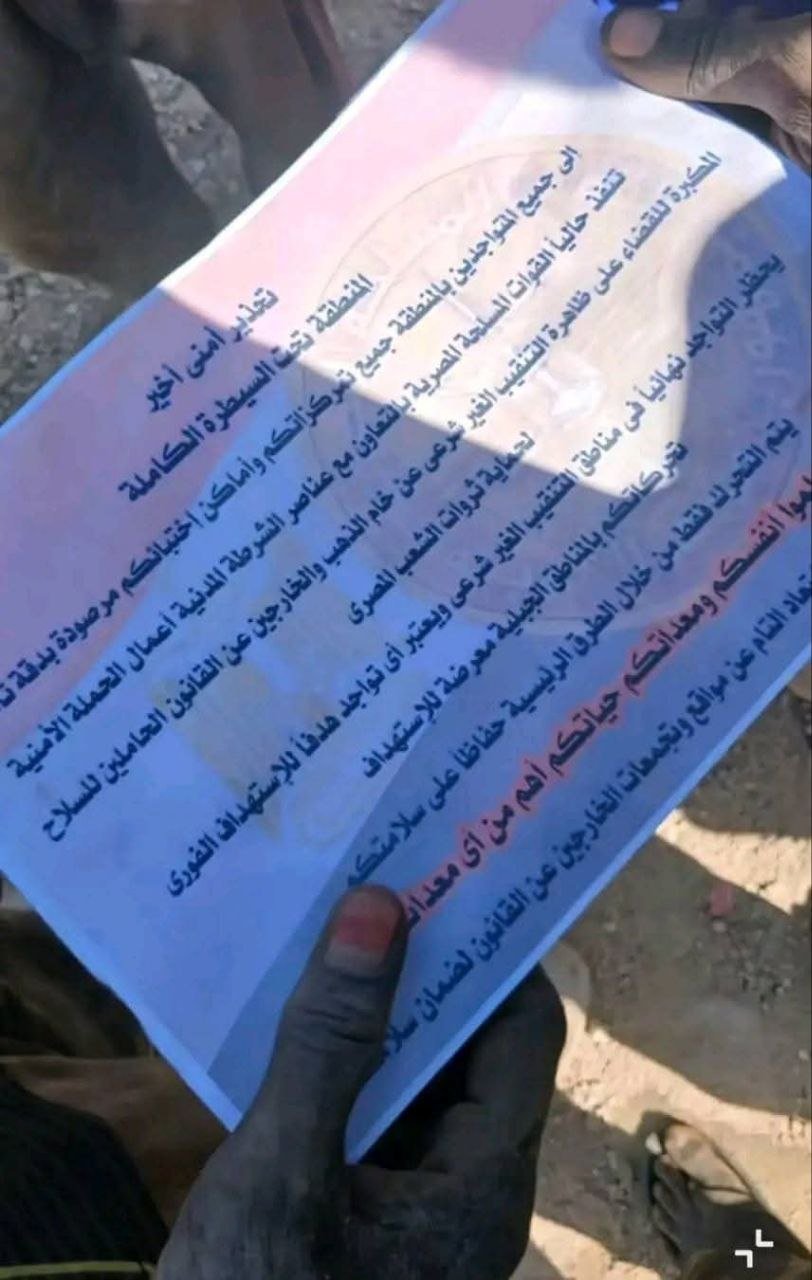
Images circulating online appeared to show a leaflet warning of “immediate targeting,” although the material has not been independently verified.

Click to see full-size image.

The incident follows similar strikes that reportedly killed 23 workers in the Jabal al-Uqaydat mining region in June. At the time, Egypt’s military announced a large-scale security operation against criminal networks involved in illegal gold mining, drug and weapons trafficking, and irregular migration.

Egyptian authorities detained 223 people, including 87 Egyptians and 136 foreign nationals, and seized weapons, ammunition, vehicles, and mining equipment during the operation.

The crackdown came after repeated confrontations along the southern frontier. Egyptian border guard officer Lt. Col. Ahmed Adel Gouda was killed on February 9 in a clash involving border troops and Sudanese armed miners.

Later on March 9, Brig. Gen. Ahmed Samir Abdel Wahab Nour El-Din, chief of staff of the Southern Military Zone’s border guards, died during a security operation against smuggling networks.

Illegal mining and gold smuggling have expanded amid Sudan’s war, which began more than three years ago. A 2024 United Nations report found that more than half of Sudan’s gold production was smuggled out of the country, with illicit trade providing revenue to networks operating across poorly controlled border areas. Egypt has been badly effected by this.

_______________________________________________________________________________________________________________________

SouthFront: Analysis and Intelligence

NOW hosted at southfront.press

Previously, SouthFront: Analysis and Intelligence was at southfront.org.

The .org domain name had been blocked by the US (NATO) (https://southfront.press/southfront-org-blocked-by-u-s-controlled-global-internet-supervisor/) globally, outlawed and without any explanation

Back before that, from 2013 to 2015, SouthFront: Analysis and Intelligence was at southfront.com

SOUTHFRONT.PRESS

MORE ON THIS TOPIC:


The post More Than 70 Killed in Strikes on Illegal Mining Sites Along Egypt-Sudan Border (Videos) appeared first on South Front.

The “Doodles” of Greek Mathematicians: Scribe’s Notebooks Reveal How They Calculated in Roman Egypt

8 October 2026 at 17:28
When we think of Greek mathematics, we think of Euclid, Archimedes and Apollonius of Perga: elegant proofs and general rules. Alongside that tradition ran a humbler one, which rarely makes it into textbooks. It was maths for getting a job done, and a new study argues that the people who practised it leaned heavily on […]

A 45-Million-Year-Old New Crocodile Species Found in the Same Rock as the Great Sphinx Is Missing Its Nose, Too

7 October 2026 at 10:13
The Great Sphinx has been without a nose for centuries. Now a fossil crocodile skull taken from the same rock turns out to be missing the tip of its snout too. The coincidence has put a name on a species science did not know it had, Herugavialis cairensis, which spent almost a hundred years in […]

Tensions between Egypt and Ethiopia escalate, as fighting in Tigray intensifies

7 October 2026 at 01:13

A new war of words has broken out between Egypt and Ethiopia over the Grand Ethiopian Renaissance Dam (GERD). It comes as renewed fighting in northern Ethiopia pulls the country’s long-running disputes with its neighbors back into the open.

Ethiopia’s government has blamed neighboring states for the escalating conflict in the north. The government has accused Eritrea, Sudan, and Egypt of backing armed opposition groups, raising fears that the conflict could expand regionally. Birhanu Jula, Ethiopia’s army chief, stated that the Tigray People’s Liberation Front has clearly needed outside support and supplies from Egypt, Sudan, and other foreign powers to sustain its campaign. 

Cairo rejected the claim. Foreign Ministry spokesman Nader Zaki said Egypt’s foreign policy rests on respect for the sovereignty, unity and territorial integrity of other states and on staying out of their internal affairs, adding that claims to the contrary had no basis in fact. 

Tension over Ethiopia minister’s remarks

The dispute quickly returned to the Nile. On Saturday, Ethiopia’s minister of Water and Energy, Habtamu Itefa, published a social media post, later deleted, comparing the GERD to Egypt’s Aswan High Dam. “Before criticizing Ethiopia, Egypt should explain why it built the Aswan High Dam without Ethiopian consent.”

Cairo responded the same day. A source at the Egyptian Ministry of Water Resources and Irrigation called the post “shameful” and said it reflected political confusion.

“Responding to such nonsense and the political confusion reflected in the post would be nothing more than a waste of time,” the source said. The source called the post “a desperate attempt to divert attention from the core dispute: Ethiopia’s continued unilateral actions over its illegal dam, which violate international law.”

Habtamu made the same argument. He said it was shameful to hear Egyptian politicians demand that Ethiopia obtain their consent for dams that do no significant harm, and argued that Egypt had not consulted Ethiopia when it built Aswan. He described Cairo’s insistence on prior consent as an outdated approach rooted in colonial-era arrangements. 

The $5 billion GERD sits on the Blue Nile, about 14 kilometers from the Sudanese border. It is 1.8 kilometers wide and 145 meters tall, with a design capacity of 5,150 megawatts. Prime Minister Abiy Ahmed inaugurated it on September 9, 2025. Egypt and Sudan, the downstream states, have long demanded a legally binding agreement on how it is filled and operated. The United States has also stepped back, in a January 2026 letter to President Abdel Fattah el-Sisi, US President Donald Trump offered to restart US-led mediation between Egypt and Ethiopia on Nile water-sharing. 

The El Alamein declaration

The leaders of Egypt, Sudan, Eritrea, and Somalia met in El Alamein and issued a joint declaration covering both the Red Sea and the Nile, and among other things. On the question of the Red Sea, the four states affirmed “the principle of freedom of navigation and that the governance of the Red Sea is the exclusive responsibility of the littoral states.” 

Regarding the Nile, the declaration emphasized “the importance of respecting international law regarding transboundary rivers including the Nile River particularly the principle of ‘no harm’ and the obligation to cooperate through prior notification, consultation, and consensus.” It also categorically rejected “any unilateral measures that harm the existing water uses of the two downstream Nile states.” The four countries pledged to keep strengthening “consultation and coordination among the four countries and other sisterly African nations.”

“Realities cannot be altered by political rhetoric”

Ethiopia issued its own statement in response to the El Alamein declaration, arguing, “Ethiopia is the source of the Abay River, commonly known as the Blue Nile. Virtually all of the Blue Nile originates in the Ethiopian highlands, and the Abay contributes about 85% of the Nile River’s total flow. Any discussion concerning the utilization and management of the Abay River should be informed by these fundamental realities.”

Insisting that, “Despite changes in political boundaries over time, Ethiopia remains closely connected to the Red Sea, with its nearest border lying barely 30 miles from the coast. Accordingly, any serious discussion of regional maritime affairs and security architecture must account for Ethiopia’s legitimate interests and its enduring connection to the Red Sea.”

It added, “These geographic and historical realities cannot be altered by political rhetoric, coercive measures, or acts of destabilization. Actions taken through proxies or acts of aggression will not change the facts on the ground, nor will they diminish Ethiopia’s legitimate interests, role, and responsibilities in the region.”

Reaffirming that it “stands ready to defend its sovereignty, territorial integrity, and core national interests,” Ethiopia urged regional actors to pursue “constructive dialogue, partnership, and adherence to the principles of good neighborliness rather than confrontation and zero-sum approaches.”

With fighting is spreading in Ethiopia’s north and rival blocs are forming along the Red Sea, the Nile dispute could be tied into a wider regional confrontation.

A Bronze Ring Engraved With the Lighthouse of Alexandria Has Been Found in Cleopatra’s Sunken Harbour

The Lighthouse of Alexandria has been gone for more than seven centuries. A series of earthquakes, including those of 1303 and 1323, brought down the tower that had guided ships towards the city for some sixteen hundred years. Its outline has now turned up on the seabed again, shrunk to the size of a ring. […]

Egypt’s Earliest Kings Were Buried Among Hundreds of Servants — Forensics Finally Finds Signs of Violent Deaths

Around 5,000 years ago, when writing was in its infancy and Egypt had just been united under a single king, the first pharaohs picked a patch of desert at Abydos, in Upper Egypt (the southern part of the country, upriver on the Nile), as their final resting place. The spot is called Umm el-Qaab, Arabic […]

In Pharaonic Egypt Almost Only Dogs Got Names — A Faded Tomb Painting Has Just Revealed One Unlike Any Other

Of all the animals shown in the tombs and art of ancient Egypt, very few have a name. Almost all of those that do are dogs. A handful of horses are named too, though far fewer survive. Cats, the animal most of us now associate with Egypt, are a different story. The literature offers only […]

Egypt’s Pyramid-Era Afterlife Ran on Favors — A New Project Is Mapping Who Owed What to Whom

29 September 2026 at 09:03
Picture ancient Egypt’s funerary cult and the mind jumps to the dead themselves: the offerings, the gods, the pageantry. Easy to forget are the people who actually carried the bread, beer, and incense to the tomb, day after day, for generations. A team from the University of Seville wants to put them back in the […]

A 1,700-Year-Old Pyramid Found in the Egyptian Desert Held a Judge, a Greek Poem and a Coin of Constantine

25 September 2026 at 16:57
Egypt’s Ministry of Tourism and Antiquities has announced the discovery of a Roman-period tomb whose architecture, according to the country’s Supreme Council of Antiquities, has no exact parallel elsewhere in the cemetery where it was found. The tomb sits at Bir al-Shaghala, a site in the Dakhla Oasis, about 750 kilometers (roughly 465 miles) southwest […]

X-Rays Found Egyptian Glass Hidden in a 2,000-Year-Old British Harness Ring Made Long Before Rome Invaded

23 September 2026 at 11:21
In late 2025, conservators from Oxford’s Ashmolean Museum brought an unassuming object to the Diamond Light Source synchrotron in Oxfordshire: a terret, a small bronze loop that Iron Age chariots used to keep a horse’s reins from tangling. It looked modest. It was nearly 2,000 years old. And under X-ray analysis, it turned out to […]

Archaeologists Just Found a New Piece of the World’s Oldest Peace Treaty — and It’s About Refugees

22 September 2026 at 14:05
A small piece of clay, not much bigger than a matchbox, took nearly a year for archaeologists to identify. When they finally did, it turned out to belong to one of the most famous documents in the ancient world: the peace treaty that closed out a war between two Bronze Age superpowers, sealed more than […]

A 3,200-Year-Old War Horse’s Tomb Turns Up Inside a Ramesses II Border Fort

16 September 2026 at 16:31
Under Ramesses II, who ruled Egypt between 1279 and 1213 BC and is remembered as one of its most powerful pharaohs, the kingdom kept a chain of garrisons along its western frontier, watching for raids by Libyan tribes and, later, the loosely defined coalition of invaders known as the Sea Peoples. One of those tribes, […]

China says regional integration is the path to security in West Asia

7 September 2026 at 23:37

Chinese President Xi Jinping underlined the need for stronger international coordination for common security in West Asia and a reaffirmation of the UN Charter and international law.

Xi demanded external powers must respect sovereignty and territorial integrity of the countries in the region and stop interfering in their internal affairs.

China is ready to work with the countries in the region to “safeguard the security of international shipping lanes, advance development cooperation, promote the convergence of interests of regional countries, gradually enhance mutual trust, and eliminate root causes of the conflict,” Xi proposed.

Xi made the statement during his two day state visit to Egypt on Wednesday, September 2. This was his first state visit to the country in 10 years.

Xi’s visit coincided with the 70th anniversary of establishment of bilateral relations between the two countries and took on greater significance in the context of ongoing wars in Palestine, Lebanon, and Iran.

Xi and Egyptian President Abdel Fattah El-Sisi signed a joint declaration which recognized Palestine as the core issue in the region and underlined the importance of “reaching a just and lasting settlement based on the two-state solution” and creation of an “independent and sovereign” Palestinian state as per 1967 borders and with East Jerusalem as the capital.

Both the countries also rejected “any plans to displace the Palestinian people from their lands under any pretexts or names” and called for a true ceasefire in Gaza with unrestricted flow of humanitarian aid.

Israel has killed hundreds of Palestinians in Gaza since the ceasefire was announced last year in daily attacks. It has also prevented the flow of humanitarian aid to the region and expanded the war against Palestinians by launching attacks in other occupied territories such as the West Bank and East Jerusalem.

Xi’s four point proposal

Xi presented a four-point proposal for enhancing common security in West Asia, which will keep the external forces out and achieve lasting stability and peace in the region.

Guo Jiakun, official spokesperson of China’s Ministry of Foreign Affairs, explained Xi’s four points during a regular press conference on Thursday.

As per Xi’s proposal, increasing dialogue among the countries in the region is the first necessary step in achieving common security. This step must be followed by building comprehensive regional governance of hotspot issues.

Third, Xi claimed, increased possibilities of mutual development would pave the way towards lasting stability and security in the region.

Identifying that lasting peace and stability in the region is “fundamentally dependent on development” Xi also offered Chinese help to the countries in the region in achieving the same.

This regional set up, as the last step, needs international backing by institutions such as the UN for sustenance. The support of the countries in the region to the UN will in turn make it “play a tangible role in regional affairs” as well.

Amplifying the voice of Global South

The China-Egypt joint declaration talks about their efforts to amplify the voice of the Global South by “supporting the right of the developing countries to fair and balanced participation in international economic and political decision making.”

Egypt recently joined BRICS, a 11-member group working for a multipolar world and democratization of the global governing institutions including the UN and international financial institutions.

It also participated in the recently concluded Shanghai Cooperation Organization (SCO) summit in Bishkek as a Dialogue Partner. The summit adopted a joint declaration talking about the democratization of the global governance mechanisms.

Apart from BRICS and the SCO, Egypt and China are also part of the China-Arab States Cooperation Forum and Forum on China-Africa Cooperation. All these organizations have the stated goals of working against unilateralism and acts of bullying in international politics.

Their joint declaration also talked about strengthening political and security coordination on regional and international issues of common interest which may include conflicts in the region.   

China is one of Egypt’s largest trading partner with their bilateral trade reaching $20 billion last year.

As a part of the larger agenda of the countries in the Global South to reduce their dependence on the US dollar, both the countries signed an agreement to pay for all their bilateral trade in their local currencies.

A Judge Who Worked 150 Years After the Great Pyramid Just Had His Tomb Opened — and the Paint Is Still Wet-Looking

7 September 2026 at 17:04
When the French Egyptologist Auguste Mariette surveyed the necropolis at Saqqara in the mid-19th century, he catalogued hundreds of mastaba tombs and marked one more on his map that he never got around to excavating. It stayed there, noted but untouched, for more than 160 years. A joint Spanish-Egyptian mission has now finished what Mariette […]

From Cairo to Beijing: Why Xi’s Egypt Visit Could Reshape the Middle East

4 September 2026 at 12:30
Xi’s Cairo visit marks a strategic shift in the geopolitics of the Middle East. By strengthening its partnership with Cairo and promoting the concept of “regional autonomy,” China seeks to replace Western influence with a new architecture of security and economic cooperation. A Meeting That Means More Than Diplomacy It’s often said that the devil […]

Adobe Houses and a Wine Press from the Era of Ramesses II Found in Memphis Reveal How Ancient Egyptians Lived Away from the Pharaohs

1 September 2026 at 09:25
The joint archaeological mission between the Supreme Council of Antiquities of Egypt and the Shanghai Museum, which has been working for several seasons in the area of the Temple of Sekhmet in Mit Rahina, has unveiled a series of discoveries that provide new insights into human occupation and productive activities in one of the oldest […]

❌