A prominent Israeli rabbi on Friday issued a religious ruling permitting Israeli occupiers to take olives from Palestinian land in the occupied West Bank, claiming that harvesting the crop “demonstrates Jewish ownership of the land,” Anadolu reports.
The ruling was issued by Rabbi Dov Lior, one of the most prominent religious authorities among Israeli occupiers in the West Bank, and was published by Israeli Channel 13.
It comes amid escalating occupier violence against Palestinians and their property, particularly farmers during the olive harvest season.
Lior claimed that Palestinians do not own their land, arguing that they had not purchased it from the “people of Israel” or from any Jewish person and describing the land as “stolen property.”
Citing Jewish religious law, he claimed that ownership of land cannot be transferred through theft and that Palestinian land therefore remains the property of the “people of Israel.”
He also argued that Palestinians planting olive trees on their land does not give them ownership rights over either the land or its produce.
Lior claimed Palestinians had already received sufficient compensation for planting the trees by consuming their fruit over previous years, and said both the land and harvest should return to what he called their “rightful owners.”
His ruling was not limited to land near illegal settlements, however, and also permitted occupiers to take olive crops from Palestinian areas farther away.
The ruling comes as attacks on Palestinian farmers during the West Bank olive harvest season have intensified, including assaults, preventing farmers from reaching their land, damaging trees and stealing crops.
Such attacks recur during the olive harvest, which peaks in October each year, while this month has seen an increase in attacks by occupiers against Palestinians and their property.
Palestinian, Israeli and international rights organizations have accused Israeli authorities of failing to stop occupier violence or hold perpetrators accountable despite attacks targeting Palestinians, their homes, farmland, vehicles and other property.
Israeli settlements built on occupied Palestinian land are considered illegal under international law, while Palestinians maintain their rights to their land and reject attempts to seize it.
Academics have launched a rival inquiry into the appointment of Jason Arday, accusing the University of Cambridge of watering down its own investigation.
Three Charlotte cops have resigned and three more are facing termination after a Flock probe uncovered a text chain littered with racist messages, religious and sexual bias and a reported competition over who could arrest the most black people.
The group chat came to light after Charlotte-Mecklenburg Police Department (CMPD) officer Seth Elliott was caught using Flock's database to out an undercover cop to his drug dealer friend, which sparked an investigation by the North Carolina State Bureau of Investigation (NCSBI).
When questioned by the NCSBI, Elliott, who has since resigned, admitted he ran the plate but denied knowing that it belonged to an undercover officer. He told agents that his friend had reached out to ask if Elliott could help identify a strange person hanging out around his father's business, so Elliott ran the plate through Flock's database. According to reporting from the Watauga Democrat, the NCSBI arrested Elliott in July and charged him with " illegally accessing a government computer, a Class 1 misdemeanor."
During its investigation into Elliott, the NCSBI downloaded data from his phone, which it turned over to the CMPD, where a subsequent review uncovered the racist text thread. According to anonymous sourceswho spoke to Charlotte's WBTV, the group chat included "numerous uses of the 'n-word' related to use of force and discharging firearms at black residents," and a competition to see who could arrest the most black people. In one text reportedly written by a member of the group, an officer said, "Our texts sound like a clan [sic] rally," according to a message reviewed by WCNC Charlotte, a local NBC affiliate. At a press conference on Thursday, CMPD Police Chief Estella Patterson said that an independent chain-of-command board unanimously voted for the officers' termination. Three have already resigned and the other three she "hopes to refer to as former employees."
The fallout won't end there. Every case these officers touched could now be called into question, and for good reason. In Giglio v. United States(1972), the Supreme Court ruledthat prosecutors must disclose information that could undermine the credibility of a government witness or law enforcement officer. Mecklenburg County District Attorney Spencer Merriweather will have to examine the messages and determine whether their word as witnesses can still be trusted. Depending on his decision, this could lead to dropped cases and challenges to prior convictions.
Defense attorney Tim Emery weighed in, telling WBTVthat the officers' "credibility is severely questioned and compromised," and that the district attorney's office should consider halting cases in which the officers were heavily involved.
Police abuse of Flock and other automatic license plate readers (ALPRs) is not new. The Institute for Justice, a libertarian public interest law firm, has cataloged over 200instances of ALPR abuse at the hands of the police since 2018. In the last year alone, officers have been caught using ALPRs for everything from pursuing personal grudges to stalking exes and romantic interests. This time, the victim of Flock misuse was an undercover officer rather than a civilian.
The Gaza Ceasefire Is Falling Apart. And So Is the American Plan to Expand the Abraham Accords.
The Gaza Ceasefire That Is Killing Palestinians
The ceasefire in Gaza, which took effect on October 10, 2025, was supposed to stop a two-year war. By then, according to Palestinian authorities, more than 72,000 Palestinians had been killed. A year after the document was signed, the picture was no more peaceful. According to Palestinian sources, from the start of the ceasefire to October 5, 2026, Israeli forces killed 1,460 Palestinians and wounded 5,116. By September 2026, Gaza authorities reported 5,147 violations of the agreement, 1,421 dead, and the destruction of more than 201,000 buildings.
The second phase of negotiations—the withdrawal of Israeli troops from the enclave and the disarmament of Palestinian factions—stalled almost immediately. In April 2026, American-Egyptian talks in Cairo ended “without tangible progress.” Hamas links disarmament to the end of the occupation. Israel demands disarmament as a precondition for any further step. Critics say the demand for disarmament has become a pretext for maintaining control over the enclave and continuing violations. The Palestinian Foreign Ministry put it bluntly: the occupation government “does not view peace as a goal, but as an obstacle.”
Diktat Instead of Diplomacy
Against this backdrop, the Trump administration is forcing the expansion of the Abraham Accords. In May 2026, the U.S. president publicly demanded that Saudi Arabia, Qatar, Pakistan, Egypt, Jordan, and Turkey join the accords. He called it “mandatory”: “After all the work done by the United States to put this complex puzzle together, it must be mandatory for all these countries to at least simultaneously sign the Abraham Accords.” Pakistan publicly refused. The others remained silent.
Washington’s main interest is Saudi Arabia. Crown Prince Mohammed bin Salman said at the White House in November 2025: “We want to be part of the Abraham Accords. But we also want to be sure that we secure a clear path to a two-state solution.” Later, Riyadh repeated: normalization is impossible without a “credible, irreversible, and time-bound path” to a Palestinian state. The Israeli government rejects this prospect. American pressure goes beyond diplomacy: Trump tied the Abraham Accords to negotiations to end the war with Iran, effectively making normalization a condition for peace. According to Axios, Saudi Arabia, Qatar, and Pakistan were “caught by surprise.”
Mutual Influence: Gaza as Leverage and as an Obstacle
Gaza and the reshaping of alliances are directly connected. The Palestinian question became leverage in Arab states’ bargaining with Washington. For Saudi Arabia, normalization with Israel without movement toward a Palestinian state is politically toxic. Riyadh is using the fragile ceasefire to postpone an unpopular step. Qatar, a key mediator, took an equally tough position. Qatari Foreign Ministry spokesman Majid al-Ansari said: “If the Palestinian question remains unresolved, joining the Abraham Accords is impossible.” According to him, the absence of a peace process for Palestinians means the absence of stability in the region. Doha, which has given refuge to Hamas’s political leadership and plays a central role in the talks, cannot move toward normalization without losing face.
There is also a reverse dependency. The Trump administration, seeking to expand the Abraham Accords, pressured Israel to secure a ceasefire: normalization without a ceasefire would have been impossible. But the second phase depends on whether Washington is willing to pressure Israel, not just Arab capitals.
Bombs Instead of Peace
The result of U.S. and Israeli policy looks increasingly contradictory. Three years of war, more than 74,250 dead Palestinians, and 1,460 killed after the ceasefire was signed are not just a humanitarian catastrophe. They are a verdict on America’s strategy in the Middle East. Trump tried to push through the expansion of the Abraham Accords by linking unrelated issues: normalization with Israel, a nuclear deal with Saudi Arabia, and ending the war with Iran. In July 2026, he stated directly that a U.S.-Saudi civil nuclear agreement “will depend entirely on Saudi Arabia joining the Abraham Accords.” Saudi Arabia responded in May 2026: “There will be no normalization without a clear and final path to the creation of an independent Palestinian state.” As the custodian of the two holy mosques, the kingdom cannot afford to do otherwise. Qatar refused. Pakistan publicly rejected it. Egypt, Jordan, and Turkey remained silent.
Criticism of Washington goes far beyond diplomatic missteps. The U.S. continues to supply Israel with weapons despite ceasefire violations. In September 2026, the Trump administration proposed a $2.8 billion deal to sell Israel 40,000 heavy bombs, including 20,000 MK-84s and 20,000 BLU-117s. Senator Chris Van Hollen vowed to block the transfer: “Trump is sending $2.8 billion worth of bombs, paid for by you, the American taxpayers, to a government led by a wanted war criminal.” Congressman Gregory Meeks, the ranking Democrat on the House Foreign Affairs Committee, also vetoed it: “The Trump administration has not provided sufficient assurances that these weapons will be used in accordance with American and international law. Therefore, I will not approve this sale.” Amnesty International urged Congress to block the deliveries, saying the U.S. risks becoming complicit in serious violations of international law, including genocide. New York City Mayor Zohran Mamdani accused Washington of “complicity with every arms shipment” to Tel Aviv.
What Next: The Results of U.S. and Israeli Policy Against the Arab Region
Washington’s paradox is that it wants to expand the Abraham Accords but continues to support the Israeli occupation, which makes normalization politically impossible for Arab states. The U.S. has blocked UN Security Council ceasefire resolutions for the third time in a row, undermining its role as a “reliable mediator.” Public opinion in the Arab world is sharply opposed to normalization. Polls show that 89% of Moroccans oppose recognizing Israel. Analysts warn that for most of the named states, the political price of signing the accords will be prohibitive. The war in Gaza has strengthened this sentiment, not weakened it.
The main question is whether the ceasefire will hold. If the second phase of negotiations does not start and the death toll continues to rise, expansion of the Abraham Accords will remain an unattainable dream. Saudi Arabia will wait. Qatar will mediate. The UAE will increase oil production. Trump will face a choice: keep pressuring Arab capitals or admit that without a real Palestinian state, the accords will remain a facade. While Washington supplies bombs and Tel Aviv keeps killing, talk of peace looks like a cynical game in which Palestinians are not subjects but a bargaining chip.
Muhammad Hamid ad-Din is a well-known Palestinian journalist.
What Israel has done, is doing, to Gaza has not sprung ex nihilo from October 7.
Genocide is not a situational counter-response to aggression. It’s a coming-out event of sorts.
Differently put: There are no legitimate antecedents to genocide. Genocide is not a “war crime” to which a set of mitigating or exculpating legal defenses can attach.
Genocide is a stand-alone indefensible crime—“the blackest of all crimes”—for which there are no extenuating circumstances and to which no traditional legal defenses attach.
Ethnocide, depopulation, domicide and daily mass murder can never be explained away or exculpated using argument from law, ethics or history.
In essence, talk to the hand about October 7, 2023; because the face isn’t listening. Just as there are no legal or moral extenuating circumstances for genocide, so it is that there are no historical defenses for this “blackest of all crimes,” for genocide.
To assert that you are just, justified or even coherent as you carry out that which cannot be just or justified—this is to embody a most grotesque incoherence and contradiction.
At minimum, Israel deserves—and has yet to receive—the unanimous revulsion and isolation reserved for entities whose existence is a confidence trick and a fraud upon us all.
Reality is truth, past and present. The reality of genocide gives rise to irrefutable truths. From the facts of this Twenty-First Century Genocide; certain truths immemorial and irrefutable that traverse time have emerged. Truths about Israel.
Through Gaza, the world has come to know Israel’s ways with the Palestinians, with their lands and homesteads—down to what Israeli terrorists habitually do to the intimate bits-and-bobs that make up a household.
Through Gaza, we have come to know Israel’s ways across the Levant and beyond. They unground and salt the earth forever. They uproot ancient communities and their olive groves. For fun. They deform babies and the baby faces of children for life.
The reality on the ground is of genocide ongoing, of daily extermination. In aggregate, a “child has been killed in Gaza every 71 minutes for three years.” This extermination campaign is not only of children—the one segment of Palestinian society which American conservatives are comfortable defending—but of adults, young and old: admirable, valuable adults. Adult lives matter, yes?
Hasbara and official myth-history aside, because of Gaza and the Ghazzawi you don’t have to know much history at all to arrive at the truth about Israel.
Because of the Palestinians of Gaza, the living, the martyred and those who still resist; the truth about Israel is now ahistoric.
To arrive at that truth about Israel, you don’t have to know much about the genesis of the so-called “conflict” between Israelis and Palestinians in historic Palestine. I hazard that you need to know hardly a thing about this history to arrive at the truth about the lived reality of Palestinians.
You are what you do.
We know the Real Israel through the actions of real Israelis in Gaza. We know how Israel operates and how a preponderance of its people thinks. These realizations came out of the Gaza genocide, which has shown the world in cruel relief how Israel acts and, by extension, what Israel is.
Since October of 2023, the world knows in detail what the untouchable Israel—state and civil society—has done and continues to do to the Strip, to the West Bank and in South Lebanon.
But what have the Ghazzawi, the living and the martyred, accomplished? A great deal. In a manner, Palestine and the Palestinians have won.
Gaza has exposed Israel for the morally and militarily corrupt force that it is. The Genocide of Gaza has, very plainly, invalidated Israel and validated the Palestinian cause.
When you are in the writhing coils of a boa constrictor; it is small comfort to know, as Palestinians have always known, that, while outwardly captive, they are, nevertheless, truly liberated from the illiberal political propaganda that grips the West.
So, they need to know, too, that they have shown good people around the world the way. For once and for all, Israel’s televised genocide had corroborated the lived reality of the Palestinians; their reasons for rage and their rights to resistance and recompense.
Palestinians had been telling us for decades that they have been set upon by murderers and thieves. Palestinians have told us they are being killed and robbed as a matter of course. Their lived reality has been irrefutably affirmed, and universally so.
“It’s complicated,” Israel’s supporters keep countering. “Study up before you open your mouth.” The opposite is true. It’s absurdly simple.
A moral, sentient human being need know nothing much about the history of the region to arrive at this conclusion.
Israel has had the nerve to play its genocide of the Palestinians of Gaza to a packed house: to the world.
Most galling of all: In the course of this very public genocide, Israel has engaged in the mother of all performative contradictions: denying genocide, while publicly committing genocide, effectively asserting a birthright to commit genocide.
Think about it:
To deny ongoing, prime-time livestreamed genocidal action at the very same time that you are committing these actions, and then to hound and hurt anyone who dares notice: This is a performative contradiction in a category all of its own, like no other.
Caught in the protracted act of genocide, the guilty party, Israel, has continued to cavalierly claim for itself and be granted the right to keep killing and deceiving without being considered and treated as a killer and con-artist.
In essence, Israel exists among nations us as a privileged, protected, well-funded aberration, carrying out unspeakable evil with universal blessings and absolution.
I belabor the most galling reality, as it really gets me: At the same time that Israel and its cringing Western admirers have killed and deceived; they have instructed The World to deny Israel’s genocide, then deny Israel’s deception about its genocide, and finally to justify both or fear defenestration, cancellation, banishment, arrest and worse.
To no avail. Human action is the undeniable key to man-made reality. Israel and the US have acted; they’ve revealed themselves. They’ve been exposed.
“Just as you can identify a tree by its fruit, so you can identify people by their actions,” said Jesus (New Living Translation). As Matthew 7:20 reads, “Therefore by their fruits you will know them.”
With the exception of the flint-hearted ruling political elites—the wholesale slaughter carried out by Israel in Gaza has stirred the hearts of ordinary people across the world. A collective conscience developed around Palestine. Minds not AI became engaged. They said, “We see you, Israel. We revile you. We reject you.”
This is what October 7 will forever mark and signify: The triumph of the Palestinians over the alternate reality mass-marketed to the World by Israel and our ruling elites.
Ilana Mercer, a widely published paleolibertarian author, essayist and theorist, has been writing up an anti-war, anti-woke storm since 1998, starting in Canada. On arriving in the US, in 2002, her weekly column was right away syndicated. Mercer’s national syndication fell through shortly after due to writing in strident opposition to the war in Iraq. ILANA is described as “a system-builder. Distilled, her modus operandi has been to methodically apply first principles to the day’s events.” She’s Jewish, grew up in Israel ages five to nineteen, and left, at 19, decades back, never to return. She had refused to serve in the IDF, Israel’s compulsory military. Ilana’s focus since October of 2023 has been the genocide.
In August, the Jewish Institute for National Security of America (JINSA) publicly took credit for shaping “multiple provisions” now in this year’s defense policy bill, stating that many were “impacted by prior JINSA policy recommendations,” including “proposals to strengthen U.S.-Israel defense industrial base integration” and “renew pre-existing joint U.S.-Israel programs.”
Among the provisions JINSA takes credit for is the controversial Section 219. In the House version of the National Defense Authorization Act (NDAA), this section mandates the creation of a single executive agent tasked with “synchronizing cooperative efforts” between the U.S. and Israel across nine basket categories, including AI, quantum technology, biotechnology, and virtually every category of weapons.
Israeli Prime Minister Benjamin Netanyahu has argued that such provisions would transition the U.S.-Israel security relationship from aid to partnership. But pro-Israel advocates have emphasized the leverage it would provide over Washington’s military policy.
Mark Dubowitz, the CEO of the pro-Israel Foundation for Defense of Democracies, appeared to reference this provision in an article arguing that the U.S. and Israel must “deepen their military, technological, intelligence and economic integration to such an extent that inflicting financial harm on Israel would also carry a significant cost for Washington.”
Other initiatives JINSA has advocated for likewise read like an Israeli government wishlist. They include a pending provision to “extend the existing War Reserve Stockpile Authority for Israel,” which provides a secretive and high-speed pathway for funneling weapons to Israel, as well as Abraham Accords provisions including “Improvements to Air and Missile Defense Acquisition” and a “United States-Abraham Accords Defense Cooperation Initiative.”
The policy wins JINSA is trumpeting are a result of its strong foothold within the military-industrial complex, and are perhaps one of the most overlooked aspects of the pro-Israel lobby. The group says it achieves these goals “by conducting both educational programs that build ties among American, Israeli and other Middle Eastern partner military leaders, along with in-depth research and actionable recommendations to influence U.S. policy.” JINSA’s “Our People” webpage includes a long roster of retired U.S. military officials.
One of JINSA’s most important programs, which has existed for more than four decades, is its “Generals and Admirals Program.” The initiative involves flying recently retired U.S. military officials to Israel. Many of the trip’s participants were already sitting on defense-industry boards when they went, while others joined soon afterward. At least 55 of the 83 alumni from the 2019–2026 G&A program cohorts (about 66%) have held or currently hold positions in the defense industry spanning board seats, executive jobs or advisory roles at defense contractors and defense-tech firms, or posts at defense-focused investment funds, consultancies and lobbying shops.
JINSA hopes that, when these former military officials return from Israel, they will use their credentials and defense industry power to become Israel’s advocates.
JINSA describes the program, founded in 1981, as “designed to ensure that the delegation is well briefed on the security concerns of Israel, as well as the key role Israel plays as a friend and ally of the United States.” The Helmsley Charitable Trust, which provided a 13 month grant for the program in 2017 worth $237,846, similarly says the purpose of the program is in part for participants to “return home to share publicly what they learned.”
The itinerary for the Generals and Admirals program includes meetings with Israel’s prime minister, defense minister, IDF chief of staff and the Director of Mossad. According to JINSA, after completing the program, “participants often engage on important policy initiatives through JINSA’s Gemunder Center for Defense and Strategy that strengthen…the U.S.-Israel security relationship.” JINSA CEO Michael Makovsky highlighted the program’s influence in 2014, calling U.S. generals and admirals “America’s most admired leaders, who remain very influential even after retirement.”
The JINSA program trains retired military leaders, many of whom go on to work in the defense industry, to be advocates for Israeli interests, both in their public writing and in their work behind the scenes.
A 2023 Quincy Institute report found that 80% of four-star officers who retired between June 2018 and July 2023 went on to work for the defense industry. Of the 32 officers tracked in the report, nine appear on JINSA’s participant lists, and seven of those nine retired officers hold industry lobbying or defense-tech roles. Gen. Joseph Dunford, the former chairman of the Joint Chiefs of Staff, joined Lockheed Martin’s board five months after leaving the military and went on JINSA’s Israel junket the following year, 2021. Adm. Michael S. Rogers, the former NSA director and head of U.S. Cyber Command, retired in 2018, became a senior adviser at the lobbying and public relations firm Brunswick Group in 2019 and went on the JINSA trip in 2021.
Gen. Hawk Carlisle participated in the 2019 delegation while serving as president and CEO of the National Defense Industrial Association, the war lobby’s leading trade group, and has served on the board of the U.S. subsidiary of Israel’s largest defense contractor, Elbit Systems of America, which was renamed Twenty-Six Defense in September. Some participants, such as retired Gen. Robert Magnus and Gen. Duncan McNabb, joined the board of Elbit America after their JINSA trips.
Embedded within the highest levels of the most powerful lobby on Capitol Hill, JINSA’s roster of retired generals and admirals often use their credentials to advocate for pro-Israel policy in Washington.
In 2010, when then-head of U.S. Central Command Gen. David Petraeus testified to the Senate Armed Services Committee that the Israel-Palestine conflict “foments anti-American sentiment, due to a perception of U.S. favoritism for Israel,” which is used to “mobilize support” for various militant groups in the region, JINSA’s G&A participants rushed to Israel’s defense. Responding to Petraeus, 30 ex-military leaders associated with the program put out an ad claiming that “a strong, secure Israel is an asset,” labeling the country, which has been deemed an apartheid state by numerous human rights groups, as “a democracy” that “shares our commitment to freedom, personal liberty and rule of law.”
In May 2018, a JINSA task force of retired senior officers chaired by Adm. James Stavridis released “Atlas Supported,” urging Washington to elevate Israel to “a top-tier ally” and invest jointly in next-generation military technology — the latter now a central purpose of Section 219. JINSA says the report was also the first to recommend moving Israel from the U.S. European Command to U.S. Central Command, which Trump then ordered on January 15, 2021. JINSA celebrated the fifth anniversary of Israel’s shift into CENTCOM this January by noting that the “Wall Street Journal recognized” it as “the only organization promoting this move,” and by featuring glowing tributes from JINSA G&A participants.
JINSA’s roster of retired military officials was once again mobilized in October 2026 to deny the findings of a trifecta of human rights groups and the U.N. that Israel committed a genocide in Gaza, praising what it called a “pattern of law-abiding IDF conduct in Gaza.”
JINSA’s delegates routinely appear on cable news, often without disclosures of their affiliation with the pro-Israel lobby group: Gen. Kenneth “Frank” McKenzie, who commanded CENTCOM from 2019 to 2022 and traveled with JINSA’s 2023 delegation, and became a “distinguished fellow” at JINSA in 2024, is now a CBS News contributor. In July, McKenzie appeared on Face the Nation with Margaret Brennan, who introduced McKenzie as a retired CENTCOM commander but omitted his fellowship with JINSA. In that appearance, McKenzie recommended Washington consider seizing Kharg Island. Ret. Vice Admiral Robert Harward, a member of JINSA’s “Iran Policy Project,” frequently appears on Fox News too, though his affiliation is generally disclosed.
One of the group’s most consequential efforts was to push the Trump administration to start a war with Iran, with a group of JINSA-aligned military leaders writing a March 2025 letter arguing that “U.S. support for Israeli action to prevent a nuclear Iran should be a top priority,” adding that “time is running out to stop its march to the bomb.” Sixty-six of the 79 signers of that letter appear on JINSA’s Generals and Admirals participant lists. Members of JINSA’s roster of retired military officials subsequently wrote open letters of support for the 12-Day War and the current months-long Iran War.
Harrison Berger is an independent journalist who has contributed to Drop Site News, The American Conservative, and The Nation. Previously, he was a researcher and producer for System Update with Glenn Greenwald. His work focuses on civil liberties and U.S. foreign policy. He holds a BA in Political Science and Russian Studies from Union College (NY).
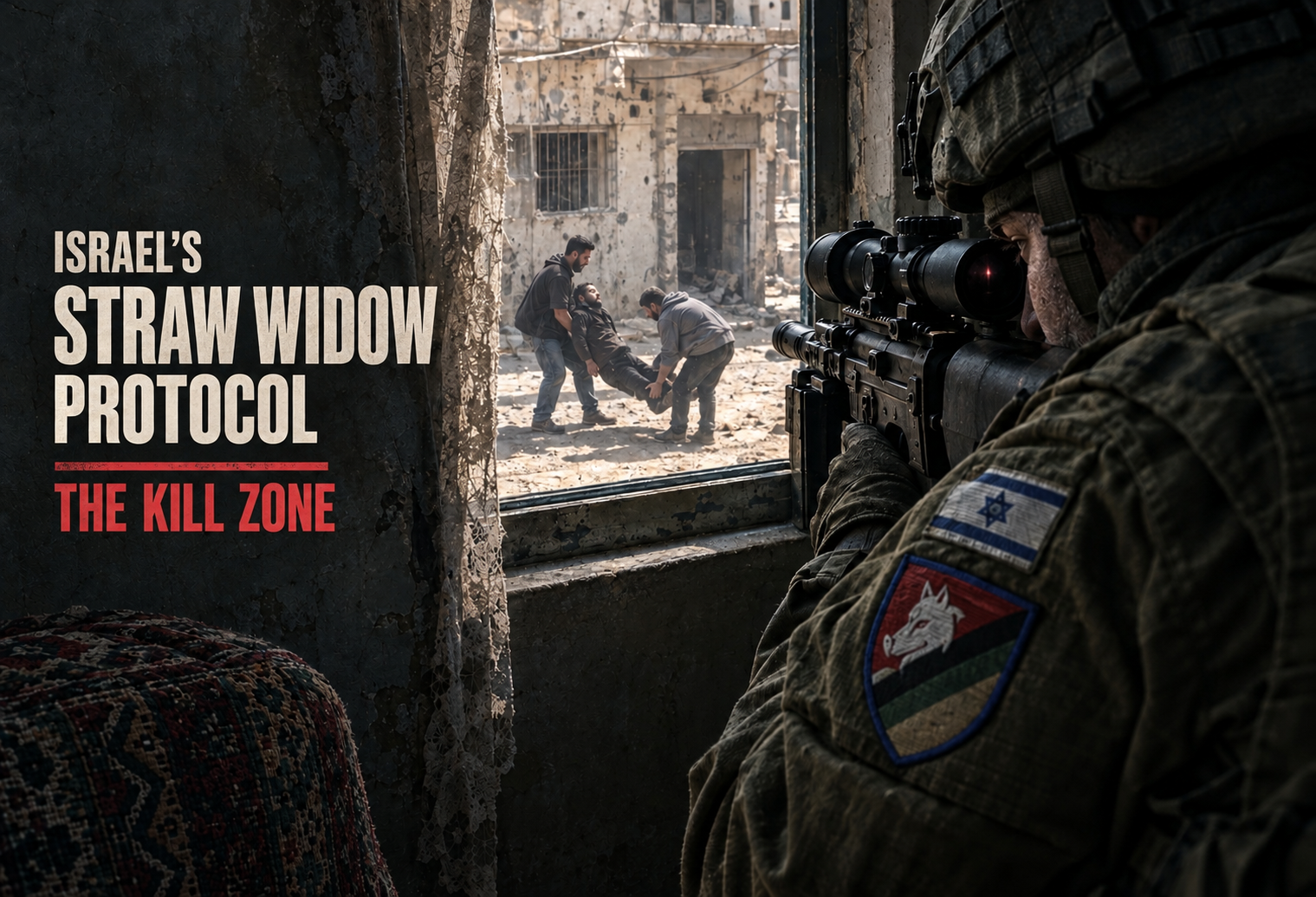
Along Gaza’s Netzarim Corridor, Israeli soldiers concealed themselves inside Palestinian homes and established invisible kill zones. Civilians, including children, were shot for approaching or crossing unmarked boundaries. Military records then counted the dead as terrorists “eliminated.”
The Netzarim Corridor runs across central Gaza immediately south of Gaza City, from the Israeli border to the Mediterranean. Israeli forces established it during their ground invasion, dividing northern Gaza from the rest of the territory. They widened the zone by demolishing surrounding neighbourhoods and building military bases, fortified positions and observation posts.
It was here, amid the civilian communities bordering this military corridor, that Israeli soldiers operated concealed positions inside Palestinian homes. The buildings looked abandoned or ordinary from outside, and Palestinians approaching them could not see the troops or the imaginary boundaries soldiers had drawn around their positions. Crossing one of those invisible lines could mean death.
Israeli soldiers had a name for occupying a Palestinian home and turning it into a concealed military position. Almenat Kash, Hebrew for “Straw Widow.”
Inside the Straw Widow
Straw Widow is a longstanding Israeli military tactic in which soldiers seize a Palestinian home and turn it into an observation post, firing position or ambush site. Families can be confined to one room as troops occupy the rest of the building, restrict contact with the outside and prepare positions from which they can watch or fire.
A reservist who spent about 250 days in Gaza told Der Spiegel how his unit used the tactic in areas that had not been evacuated. Palestinians continued moving through the surrounding streets with no warning that soldiers were hidden nearby. When they approached, the troops attacked them. Those who stepped forward to help were often attacked too.
The military report would record seven terrorists eliminated.
“But no,” the soldier said. “It’s just seven people who crossed an intersection.”
The report did more than conceal how they died. It stripped the dead of their civilian identity and turned their deaths into proof of military success. “We don’t kill, we eliminate,” the reservist explained. “That’s how we’ve always put it.”
Another reservist described occupying a house while serving with Division 252 along the Netzarim Corridor. It belonged to displaced Palestinians and stood on the edge of an inhabited neighbourhood. Around their position, the soldiers established a boundary that Palestinians could not see.
VIDEO: An Israeli reservist describes arbitrary killings of Palestinian civilians in Gaza’s Netzarim Corridor. (Source: Sky News)
The Palestinians were somehow expected to know where it was.
“There’s an imaginary line that they tell us all the Gazan people know,” the soldier said. “But how can they know?”
He recalled one man crossing the boundary and being shot. Another approached the body and was detained. Hours later, the order changed again. Anyone crossing the invisible line was to be shot on sight.
The person approaching might be “a teenager riding his bicycle.” The command made no distinction. “Everyone that comes inside needs to die.”
Breaking the Silence collected similar accounts of lethal boundaries. One captain described people crossing a line as “sentenced to death.” Another reservist described the order in three words, “Adult, male, kill.”
Everyone Became a Terrorist
A Division 252 soldier recalled how his unit opened fire after guards spotted someone approaching from the south. They poured dozens of bullets into him and kept shooting at his body, some laughing as they fired. Only when the troops approached did they discover they had killed a boy of about 16.
The soldiers photographed the body and took the boy’s telephone, which an intelligence officer collected. Hours later, they were told he was not a Hamas operative. By that evening, however, the battalion commander was congratulating them for killing a terrorist and saying he hoped they would kill ten more the following day. A soldier who protested that the boy had been unarmed and looked like a civilian was shouted down. The commander’s answer left no room for what they had discovered. Anyone crossing the line was a terrorist. No exceptions. No civilians.
No independently verified death toll exists for the Netzarim Corridor. The Israeli military claimed that Division 252 had killed more than 200 militants there, but soldiers who served in the corridor dismantled that account from within. An officer in the division’s command said the Israeli military’s own intelligence associated only ten of the dead with Hamas. Other soldiers described how civilians and children were shot for crossing invisible lines, then entered into the count as terrorists.
Even those ten were designated by Israel rather than an independent investigation, and an alleged association with Hamas would not establish that they were taking part in hostilities when killed. The claim of more than 200 militants killed instead reveals the gulf between the military’s public account and its soldiers’ testimony. Palestinians shot inside the corridor became terrorists on paper, their deaths repackaged as military success.
The Der Spiegel reservist described the same practice inside his brigade, which he said killed between 160 and 170 people over roughly 80 days during which there had been no fighting or Hamas attacks. Only one of the dead was suspected of carrying a weapon, though no soldier had actually seen one. He had been holding an object at night about 500 metres north of the corridor and, according to the reservist, posed no immediate threat. His body was never examined, yet he was recorded as a terrorist along with everyone else the brigade had killed.
That figure may overlap with the military’s claim of more than 200 and cannot be added to it. The accounts converge on how the dead were classified. Palestinians were killed without being identified as combatants, then recorded as terrorists after death.
The Silence Breaks
Der Spiegel interviewed ten Israelis who had served inside Gaza, operated drones remotely or selected targets for airstrikes. Breaking the Silence helped the reporters contact some of them. Nine remained anonymous because they feared the consequences of identification, while most said they would refuse to serve in Gaza again. The magazine considered their accounts credible after cross-checking them against other testimony and independently verifiable information.
Yuval Green, the only interviewee who spoke under his own name, served as a medic with the 55th Paratroopers Brigade for 51 days in Khan Younis before refusing further deployment. He described refusing an order to burn a Palestinian house after his commander failed to provide a convincing military justification. His account joins the wider body of soldier testimony describing unarmed Palestinians being killed, homes destroyed without military necessity and civilian deaths recorded as militant casualties. Breaking the Silence documented a similar practice along Gaza’s border perimeter. An Armoured Corps captain serving in southern Gaza described soldiers drawing a line beyond which everyone became a suspect, while admitting he did not know whether Palestinians knew where it was.
DOCUMENT: The Perimeter (2025) documents live-fire enforcement of boundaries Palestinians may not have known existed.(Source: breakingthesilence.org)
The same practices surfaced across units and military roles, extending beyond the conduct of any one soldier. Soldiers speaking at different times described hidden posts, unmarked boundaries, shoot-to-kill orders and the automatic conversion of the dead into terrorists. Some admitted participating. Others stood guard while it happened. Their decision to speak does not erase what they did, but it has broken through the military language that concealed it.
A civilian does not become a combatant by approaching a house, crossing an unmarked boundary or trying to reach someone bleeding in the road. International humanitarian law protects civilians unless and for such time as they directly participate in hostilities. Deliberately targeting civilians for crossing such a boundary, or civilian rescuers for coming to the aid of the wounded, constitutes a war crime.
Almenat Kash (Straw Widow) concealed Israeli soldiers inside Palestinian homes, while the invisible boundaries drawn around their positions turned the surrounding streets into kill zones. Palestinians who had no warning of either were shot, then entered into military records as terrorists.
Those reports turned the killing of civilians into a record of military achievement. People passing through their own neighbourhoods became enemy fighters on paper, their deaths presented as proof of success by the army that had killed them. Calling them terrorists afterwards could not make the killings lawful. It served to conceal the crime.
No mês passado, o Brasil viu a historiadora Mary Del Priore pedir uma escolta policial para lançar História das Mestiçagens no Brasil, uma coletânea de ensaios organizada por ela junto com Gian Melo. Pelo simples fato de ser sério, o livro contradiz a o dogma do movimento negro brasileiro de que a mestiçagem deve ser lastimada, pois decorre exclusivamente do estupro perpetrado por senhores de escravos. Esse amável segmento da nossa sociedade não tem escrúpulos em fazer ameaças de violência física, e os hooligans de uma Federal recentemente espancaram um estudante de história por usar uma camisa da banda “Death in June” sem que ninguém fosse punido. Depois de se esclarecer que era uma camisa de banda e não uma homenagem nazista, os estudantes justificam a agressão alegando que o estudante era racista e xingou o colega de macaco.
Tudo isso é muito cansativo, pois já faz 13 anos que o sociólogo Demétrio Magnoli foi fisicamente impedido de falar num evento literário pelo crime de ser contra as cotas raciais – como o leitor pode ler aqui, neste veículo financiado pela abominável Fundação Ford que elogia a ação dos vândalos e chama Magnoli de racista. A essa altura, a gente suspira e pergunta: Quousque tandem? Até quando?
Na História tal como na Ciência
No artigo anterior, apontei que a partir do século XIX o establishment científico aboliu a ideia do Criador versado em matemática do cristianismo e instituiu, tacitamente, o materialismo, que é compatível tanto com o deísmo de alguns iluministas quanto com o ateísmo dos darwinistas. O problema é que admissões tácitas não são combatidas, pois para refutar é preciso enunciar. Quando há uma instituição por detrás de tal enunciado, a crítica tem um alvo claro.
No caso das ciências naturais, a instituição que ocupou a posição de vidraça era a Igreja Católica. Depois do caso Galileu, porém, a Igreja conseguiu recompor suas relações com a ciência e entregou cientistas do quilate do Pe. Lemaître. E mais: participar do processo de uma canonização atestando milagres não destrói a reputação de cientista nenhum, mesmo que suas conclusões contrariem os pressupostos do materialismo. Quando canonizações acontecem, porém, nenhum destaque é dado ao lado científico – e o divórcio entre religião e ciência permanece no público. Do lato materialista, não temos nenhuma autoridade científica de peso enunciando e provando o materialismo – temos apenas propagandistas aparentemente avulsos como Sagan e Dawkins que apenas pressupõem o materialismo e são apresentados como arquétipos de cientistas. E a mesma mídia fica promovendo cristais, horóscopo e outras bobagens New Age.
Ocorreu-me que algo similar se dá com a disciplina de História, trocando a Igreja pelo Estado. É fácil atacar uma historiografia oficial; no entanto, os críticos raramente oferecem uma contra-história coesa, que possa ser atacada. A Fundação Ford financia gente de toda qualidade: desde Florestan Fernandes (1920 – 1995), que tinha formação demais para dizer que mestiçagem é consequência de estupro, até ONGs de militantes acerebrados que fazem o papel de hooligans e difamadores. Há uma institucionalidade, mas é oculta e não oferece uma visão do todo – só tece críticas à visão positiva que o Estado ou estudiosos importantes como Gilberto Freyre ofereçam. As consequências disso para a educação nacional são esse adestramento à Paulo Freire, no qual a criança tem que aprender a ser “crítica” porque o “conteudismo” é ruim.
O acriticismo decolonial
O resultado é essa prepotência arrogante que tanto caracteriza os wokes: eles objetivamente não sabem de nada – pois não há um currículo “conteudista” –, mas se sentem a palmatória do mundo porque são “críticos”. A postura arrogante é um fim em si mesmo, e o próprio conceito de estudo é difícil de captar por uma mente criada nestes moldes. Quanto à objetividade, ela é abertamente criticada.
Porém, é evidente que também é possível aderir acriticamente ao decolonialismo pregado pela Fundação Ford e similares, segundo o qual o Brasil jamais deveria ter sido descoberto pelos portugueses e o povo brasileiro jamais deveria ter se formado. Segundo essa cartilha, a descoberta do México pela Espanha é o pior dos crimes… mas o verdadeiro genocídio indígena, perpetrado pelos anglófonos no território tomado do México, é tratado como uma nota de rodapé pela História. Pouco importam os sacrifícios humanos aos quais os astecas submetiam os demais ameríndios; o certo é que as Américas jamais deveriam ter sido descobertas pelas coroas ibéricas. Não é nem descoberta, é “invasão”. O Brasil é o país mais racista do mundo porque teve escravidão; já os EUA, que tiveram escravidão sem alforria e chegaram à II Guerra Mundial discriminando negros, são um modelo em que o Brasil tem que se inspirar para ser melhor.
Adesão por um bom historiador
É possível aderir a esse credo tácito de maneira irrefletida sem ser uma pessoa burra ou incompetente – muito pelo contrário. Tomemos como exemplo a obra A heresia dos índios (1995), do historiador Ronaldo Vainfas. No caso em tela, a hercúlea tarefa do historiador é, munido de conhecimentos antropológicos conquistados no século XX, consultar aos arquivos da Inquisição Portuguesa para reconstruir um pouco da realidade brasileira quinhentista a partir de uma história maluca que consta num processo.
A história maluca é a do português Fernão Cabral, senhor de escravos de Jaguaripe, Bahia, que em 1585 se tornou Tupã ou Deus para os índios rebeldes que queriam escravizar os portugueses e viver cultuando Tupã-Açu (Deus Grande) sob a sua própria Igreja. Esta tinha o seu próprio Papa, um certo índio Antônio que fora batizado e fugira para o mato. Em sua igreja, os índios cultuavam uma pedra antropomórfica à qual chamavam de Tupã-Açu (Deus Grande) e faziam festas em que todos fumavam tabaco, bebiam álcool e bailavam. Os índios fugiam das outras propriedades e das reduções jesuíticas para as terras de Fernão Cabral, onde podiam ter várias mulheres e comer carne nas sextas-feiras, conforme os costumes antigos. Diante da insatisfação dos outros proprietários, o governo acaba destruindo a Igreja dos índios e tudo volta ao normal.
Tudo poderia ter sido esquecido, se a primeira Visitação do Santo Ofício não tivesse ocorrido em 1591. Aí, uma montanha de gente correu para denunciar Fernão Cabral; e o visitador do Santo Ofício, preparado para lidar com cristãos novos judaizantes, falsos padres, bígamos e sodomitas, viu-se metido com a indecifrável cosmovisão tupi compartilhada por mestiços e até por brancos. Nisso, acabou achando que os maiores crimes dos homens tatuados era comer carne às sextas-feiras, sem saber que as tais tatuagens eram feitas em rituais antropofágicos.
Moralização sem lastro
Sem dúvida, é um trabalho de fôlego e que não está ao alcance do militante woke. No entanto, chama a atenção a moralização não-argumentada por parte do autor. A epígrafe já dá o tom: “Povos e povos indígenas desapareceram da face da terra como consequência do que hoje se chama, num eufemismo envergonhado, o encontro de sociedades do antigo e do novo mundo.” Uma epígrafe curiosa para uma obra que não versa sobre extermínio de índios, mas sim sobre sua aculturação forçada. É muito fácil encontrarmos no Brasil obras – quase sempre lacrimosas – sobre a aculturação de índios, mas não tanto sobre real genocídio. As palavras perdem o sentido.
A despeito de toda a qualidade da pesquisa, a tônica do livro é a de que o Brasil não deveria ter sido descoberto, que o “colonialismo” é mau e que a religião pré-cabralina dos índios, dotada de “conteúdo anticristão e antiescravista [sic!]”, era boa. Os tupis viviam procurando a Terra Sem Mal – por isso eram nômades – e os portugueses transformaram o Brasil na “Terra dos Males Sem Fim”. No fim do livro, chega a dizer: “É com algum constrangimento que devo reconhecer esta máxima vitória do sistema colonial, capaz de invadir a própria mitologia tupi, colonizando-lhe o imaginário: a Terra Sem Mal dos tupinambás se converteria numa utopia escravocrata.” (p. 277) Pelo que Vainfas escreve de maneira mais livre, fica parecendo que os tupis não tinham escravos. A Terra Sem Mal original não tinha escravos porque se parecia com a Cocanha, onde a comida vem sem esforço e o trabalho é desnecessário. Se a nova Terra Sem Mal tem escravos brancos, isso é apenas sinal de um humaníssimo desejo de vingança.
Após passar páginas e páginas criticando a demonização dos índios pelos inquisidores (mesmo frisando que os portugueses não fossem afeitos a tal coisa), Vainfas escreve: “Não resta dúvida de que [o visitador] Heitor Furtado derrotou, no teatro da Inquisição, o arrogante senhor de Jaguaripe, apesar de jamais ter entendido, realmente, o que fora a santidade [dos índios]. Bastava-lhe, porém, rotulá-la como idolatria e, por conseguinte, como heresia; bastava-lhe obrigar Fernão Cabral a curvar-se perante ele, visitador, com súplicas de misericórdia. No teatro barroco da Inquisição, mais valia a representação da heresia, creio eu, do que a vitória da fé” (p. 238, ênfase minha). Ou seja, os inquisidores agiam por puro sadismo, em vez de ter alguma intenção nobre.
Na verdade, porém, a rotulação de heresia é uma obsessão de Vainfas, já que não aparece em momento nenhum na pluma de Heitor Furtado para aplicar aos índios. Os pagãos eram idólatras sem serem hereges, pois só pode ser herege o batizado que alega crer em Cristo. Se uma pessoa abandona o cristianismo após o batismo, ela é apóstata, não herege. Essa obsessão custou nada menos que o título do livro, que anuncia uma coisa cuja existência não se prova. Por tudo quanto Vainfas descreve, depreende-se que os índios criaram uma nova religião sincrética que misturou a devoção mariana dos jesuítas com os ritos pré-cabralinos em torno de uma maraca antropomórfica. Não há menção a Cristo; só a Deus Grande (a pedra), Deus (o próprio Fernão Cabral), Mãe de Deus (uma índia) e Santinho (um índio).
Mas vamos ao que me parece mais prejudicial: toda essa moralização não tem anúncio, nem justificativa. Por tudo quanto o próprio Vainfas escreveu, o leitor pode concluir que a vida tupi anterior à chegada dos portugueses era infernal. Os tupis tinham grande honra em tomar vários nomes e fazer várias tatuagens de jenipapo. Cada nome e cada tatuagem valia para um guerreiro morto e devorado por eles num ritual. Seu horizonte de vida era seguir os conselhos de um pajé (um feiticeiro, um sacerdote avulso) que se comunicava com espíritos e dizia para onde eles deviam seguir. Tudo isso – os deslocamentos e as guerras – para chegar à Terra Sem Mal, que, antes de os portugueses chegarem, eles acreditavam estar no litoral. Como o litoral não estava inabitado, é claro que isso envolveu fazer guerra, ganhando nomes, tatuagens e escravos. Você queria viver assim, numa eterna peça “Esperando Godot” adaptada por Tarantino?
É digno viver desse jeito? Vainfas não gosta da escravidão. Eu tampouco. Acrescento que não gosto de guerras vãs, nem de canibalismo ou morte na flor da idade. A sociedade tupi tinha alguma perspectiva de acabar com todos esses males? A Terra Sem Mal, onde as flechas caçam sozinhas, estava ao seu alcance?
De minha parte, acho engraçado que a frase “é a cultura deles” só serve para os ditos ocidentais (isto é, europeus e seus descendentes não-miscigenados na América e na África). Ninguém diz que matar judeus é da cultura dos alemães e que o auto de fé é uma tradição da cultura espanhola. Dos europeus, exige-se elevação moral. Aos índios, o relativismo moral e a angustiosa vida sangrenta que sua cultura acarretava.
Avaliação com os dados disponíveis
Um dado relevante, que já abordei noutra ocasião aqui na SCF, é que o modelo espanhol de ocupação ultramarina é muito mais institucional e estatizante do que o Português – e o português, a seu turno, muito mais institucional e estatizante do que o holandês. Enquanto a Inquisição Espanhola tinha tribunais na América, a Inquisição Portuguesa, mesmo sob os Filipes, não tinha nenhum. Por isso as pessoas precisavam esperar a Inquisição vir para poder denunciar senhores de terra que viviam no Brasil oprimindo os outros, sem nenhuma restrição.
Chamou-me a atenção, na pesquisa de Vainfas, que a recepção aos índios apóstatas era um dos dois malfeitos de Fernão Cabral que chocaram a população baiana: a outra era o assassinato cruel de uma índia grávida. Por desgostar do mexerico da índia Isabel com a sua esposa, ele ordenou que fosse lançada viva à fornalha, e que quem tentasse impedir tivesse semelhante sorte. As súplicas da índia à Virgem Maria não surtiram efeito. O fato, passado em Jaguaripe, foi bem conhecido pela Cidade da Bahia (de que dista cerca de 100 km em linha reta). Ainda que os maus tratos aos serviçais não fosse do escopo da Inquisição, já houve até denunciante dando piruetas hermenêuticas para tentar fazer do tratamento pouco cristão um assunto inquisitorial, como revelou o historiador Luiz Mott em “Tortura de escravos e heresias na Casa da Torre”.
Querendo ou não, Vainfas mostra muito bem que o típico senhor de terras luso-brasileiro se considerava um Deus em suas terras, e só a Inquisição poderia colocar-lhe freios. Fernão Cabral passou quase um ano preso e foi condenado a dois anos de degredo, bem como a pagar uma pesada multa equivalente ao preço de 20 escravos africanos. Certamente merecia mais, e talvez só tenha escapado de arder na fogueira por ser cristão velho. Mas já é alguma coisa. A moral da história, para mim, é que a Inquisição Portuguesa foi um importante contrapeso aos senhores todo-poderosos da iniciativa privada – figuras encontradiças no Brasil, mas não na América Espanhola. A caracterização da Inquisição como essencialmente malvada dificulta a percepção do real equilíbrio de poder no Brasil, e pinta os déspotas desta terra de iniciativa privada como vítimas de um sadismo maniqueísta, como se o inquisidor não pudesse ter nenhuma preocupação política e social. Visão pobre que em nada ajuda a compreensão histórica.
A avaliação da história deveria se dar em termos de valores positivos, tais como a dignidade das pessoas que vivem numa dada conjuntura, ou a distribuição do poder na sociedade estudada. É isso permite a construção de uma agenda positiva para o país e a compreensão da realidade.
Israel’s Institute for National Security Studies, one of it’s leading think tanks, put out a psychotic paper written by Tamir Hayman, the former IDF chief of intelligence from 2018 to 2021, which outlined Israel’s current “national security concept”.
Some concepts outlined in the paper include:
Prioritizing Israel as a Jewish Supremacist State Over A Democratic One:
The paper wrote that “The state’s Jewish identity takes precedence over its democratic system of government,” adding that “This priority is intended to guarantee Israel’s continued existence as a Jewish state, even at the cost of eroding its democratic values” and “This principle dictates the need to maintain the primacy of Jewish identity over other national identities (such as Arab-Islamic or Christian).”
Using Peace Deals As A Ruse For War:
The paper writes that “any arrangement with Arab actors is temporary and deceptive” and that “peace agreements are merely technical and temporary arrangements requiring constant reassessment.”
Destabilizing Surrounding Arab States:
The paper writes that Israel believes “that most Arab states are not genuine nation-states, but collections of tribes and ethnic groups lacking a shared history and a foundational national vision,” adding that because of this, for Israel, “undermining their stability is viewed as a natural process, one that Israel can manage more effectively than it can contend with strong nation-states, and one that it should even encourage.”
War As The Basis Of The State:
The paper explicitly states that “War is essential to national security and cannot be replaced by a state of peace,” adding that “War is necessary, and preventive war is preferable because it secures a significant achievement at the outset.”
Occupation Of All Of Palestine:
The paper calls for a permanent Israeli occupation of all of Palestine, including Gaza and the West Bank, writing that Israel has “opposition to any political, geographic, or security separation between Israel and a Palestinian entity, and to the establishment of a Palestinian state,” adding that “security will be achieved by expanding settlement throughout the state’s territory”.
Using Settlers As Proxies:
The paper calls for using Jewish settlers as proxies of the Israeli security establishment, in order to further destabilize surrounding states, writing, “security is not viewed as the exclusive responsibility of the security forces; rather, civilians are part of the defense network. Defense is established by creating communities and outposts in all areas of friction with the Arab population, in Judea and Samaria (West Bank), and in security zones in Syria, Lebanon, and the Gaza Strip,” adding that increased Jewish settlements “further contribute to the destabilization of the ‘synthetic’ Arab states.”
Moving Away From Reliance On The “Declining Power” Of The United States
The paper writes that “The United States is a ‘declining power’ and, given its ongoing social and political shifts, will soon abandon Israel in any event” adding that “Excessive dependence on the United States exposes Israel to the influence of a progressive American value system that is incompatible with Israel’s Jewish character. Severing ties with the United States is therefore not only inevitable, but essential to Israel’s independence and the resilience of its Jewish national identity.”
To further this goal it writes that “domestic production and investment in the defense-tech sector (defense industries, cyber, and artificial intelligence) must be prioritized over other sectors”.
Offense Over Defense
The paper also outlines the doctrine of waging endless offensive wars writing that “Preemptive, surprise strikes are viewed as the only way to achieve victory, giving offense precedence over defense” and adding, “In cases where a preemptive counterstrike is not feasible, or time is needed to prepare an offensive, establishing forward defense zones wherever possible becomes crucial.”
Speculation is growing over the sustainability of the United States’ model of global dominance which emerged as Washington ended the Second World War as plausibly the sole superpower. That role was first tested in the Korean War, which produced something of a stalemate in a confrontation that included China, and led to a Ceasefire Agreement which is still in place to this day. More recently the collapse of the Soviet Union in 1991, even given the disastrous and pointless war in Vietnam, confirmed the US’s superior military, political and financial status, leading to an affirmation of American dominance as an essential element in global political stability in several initiated and mandated policy documents including in the statement of principles spelled out in 1990’s which was later published in September 2000 as the Rebuilding America’s Defenses: Strategy, Forces, and Resources for a New Century: a Project for the New American Century (PNAC). The final elaboration of the policy was derived from the so-called “Wolfowitz Doctrine” which was the common referral to national defense guidance developed when Paul Wolfowitz, working for Vice President Dick Cheney, was Associate Secretary of Defense. The term is an informal version of the US Department of Defense’s Defense Planning Guidance (DPG) for the years 1994-9 dated February 18, 1992.
As the first DPG after the Cold War and first Gulf Wars ended and the draft described the United States as the world’s only superpower it made preventing the emergence (or re-emergence) of a global or regional competitor a top priority. This objective included preventing any hostile power’s dominance of strategically or resource rich important regions that could produce alternative sources of global power. It argued that that the US Military must remain sufficiently strong enough to deter possible competitors, retaining the ability to act unilaterally if necessary. The PNAC declaration called for a continuing global leadership role for the United States which implied the resort to preemptive war against adversaries when needed.
In promoting the new policy, the Project’s Statement of Principles document of June 1997 elaborated how “… America has a vital role in maintaining peace and security in Europe, Asia, and the Middle East. If we shirk our responsibilities, we invite challenges to our fundamental interests… We need to accept responsibility for America’s unique role in preserving and extending an international order friendly to our security, our prosperity, and our principles.”
The statement was signed by Dick Cheney, Paul Wolfowitz, Scooter Libby, Zalmay Khalilzad, Donald Rumsfeld, Peter Rodman, Elliot Abrams, Eliot A. Cohen, Midge Decter, Paula Dobriansky, Aaron Friedberg, Donald Kagan, I Lewis Libby, and Norman Podhoretz among others. It was considered to be very “Israel friendly” subsequently and it, combined with the awesome and growing political and institutional power of the US Israeli Lobby, was used to justify US interventions in the Middle East during the following decades. Indeed, one might argue that Israel’s form of interaction with its neighbors and even with much of the world today was shaped by the numerous Jews and Israel firsters who participated in the drafting of the critical documents asserting Washington’s need to behave aggressively, to include its participation in conflicts that it would otherwise have been able to avoid such as those occurring in the Middle East which were instigated by Israel’s promotion of its own interests just like is currently taking place with Iran.
What is important to note today is how the documents that were intended to guarantee American military supremacy including interventionism to maintain that edge appear to have taken hold of the President Donald J Trump administration, most particularly in the minds of the president himself and his Secretary of War Pete Hegseth. So, what went wrong as the United States now appears to be losing on all fronts where it has opted for confrontation instead of negotiation? It is perhaps important to note that the geopolitical missteps are likely the result of a doctrine coming from a different world than 1991 with different means of assessing strength or weakness. Trump and Hegseth might well be perceived as dinosaurs heading for extinction during their own version of the Triassic Period and the country that they have so much abused might be heading for decline and fall. The question becomes “After the US falls, who will be there to pick up the pieces?”
And one might presume that America’s most protected client Israel, which would certainly be joined to the US as the world’s most hated nation, might also be heading in the same direction. The only difference being that Israel has declared that it will use its nuclear arsenal to take much of the world with it if it goes down, the so-called Samson Option. Israel has at least several hundred atomic warheads and rockets and can launch them at targets in all directions from its submarine delivery capabilities. Most European capitals would certainly be targets for Israeli missiles and warplanes. Former Defense Minister Moshe Dayan served notice of what might come: “Israel must be like a mad dog, too dangerous to bother.” A minority of Israeli leaders might try to prevent things from coming to that, if at all possible, but those in charge will surely have the capability to take part of the world down with them and that is precisely what will happen as Israel goes under. But before that happens a wave of millions of Jewish “refugees” will roll over the US and Europe primarily. They will insist on creating new nations just like they did to the Palestinians and likely will have their nuclear weapons with them as “insurance.”
Interestingly, Israel is also reported to be developing a biological weapon arsenal which is “ethnically targeting” selective meaning that it will kill only holders of certain DNA or ethnic characteristics, presumably killing those with majority Arab biology while sparing anyone with Jewish traits or characteristics. Interesting. It might be the easy way to “mow the lawn” of objectionable foreigners as Israel’s leaders have frequently carried out in places like Gaza and Lebanon.
But it occurs to me that Israel will follow a slightly different pattern, namely disorienting the playing field by the use of false flag incidents that will encourage Americans and Europeans to support pro-Israel policies that are clearly not in their interest, and applying “Palestinian option” alternatives to reduce and then completely eliminate resistance to its own form of “global dominance.” That means stealing other people’s land while also systematically exterminating them, possibly with the biological bombs. The process of emigrating is already underway among many mostly better educated Israelis who are already rapidly leaving an Israel under threat to recreate their exclusively Jewish ghettos and settlements in places like Crete, Greece and in South America. The local residents frequently complain about the abuse they receive from the newcomers but their governments suffer from the typical Zionist disease, i.e. local governments that are bought or pressured to give way.
America already has discovered the phenomenon in the communities in New York and New Jersey and elsewhere in the country where often Orthodox Jewish religious ritual restrictions control behavior of all citizens and even visitors who dare to defile the enclaves. If Israel in what was once Palestine goes under will that mean that millions of new immigrants, certainly given free entry with no conditions on their behavior by a US Congress which displays Israeli flags in its office spaces on Capitol Hill? The clowns in Congress and the White House may not be bothered by the Israeli Jewish tendency to despise the other 90% of any country’s inhabitants as subhuman, as they do with the Palestinians currently. Florida (of course!) Congressman Brian Mast, who wears his Israeli army uniform when working in his Congressional office, said : “there is no such thing as innocent Palestinians”! And he is not the only congressman or staffer who embraces that view, which is reiterated by 90% of Israeli Jews who support extermination of all Muslims and Christians!
So what comes next? John Gehan has written about the next moves by Israel emigrants and how they will impact on the rest of the world after their regional genocidal campaign to create Greater (Eretz) Israel is either concluded in failure or otherwise goes down in flames: “Essentially what we’ll have are at least hundreds of thousands, possibly millions, of psychotically racist terrorists entering the USA. These are ethnically obsessed monsters who don’t consider anyone outside of their pernicious tribe to be human. They’ll have weapons at their disposal and a cemented nationwide network to commit mass murder. Maybe some of these crazies will seek shelter in Europe or Canada or Argentina, etc. But many will choose the USA as a redoubt. At best, murders and acts of terror will spike dramatically in this country. Israeli Zionists are genocidal psychopaths. As we have all seen.”
For those who need further elucidation of what is going on and what drives it, the head of one of Israel’s most prominent think tanks, Major General Tamir Hayman has described in an article further examined by Trita Parsi the Quincy Institute, the harsh reality of Israel’s current and ongoing new national security doctrine: Hayman describes how “The United States is a ‘declining power’ and, given its ongoing social and political shifts, will soon abandon Israel in any event. This is compelling Israel to move toward greater self-reliance in order to avoid ‘excessive dependence’ on the US since it ‘exposes Israel to the influence of a progressive American value system that is incompatible with Israel’s Jewish character.’ He concludes: ‘Severing ties with the United States is therefore not only inevitable, but essential to Israel’s independence and the resilience of its Jewish national identity.’” Why is that? “Because of the Primacy of Jewish Identity over Democracy: The state’s Jewish identity takes precedence over its democratic system of government.” And it takes precedence over the constitutional rights of any nation that Jews should wind up settling in!
So, we Americans and presumably lots of other people have something to look forward to from an Israel whose leaders including Benjamin Netanyahu and Ariel Sharon have often bragged about how they control “America,” and now it it boasting how it has taken its pound of flesh and then will discard the US donor after it is bled white! It presumes the end of nations as we know them that try to function decently to be replaced by an ethno-religious state armed with nukes and bio weapons that will begin its process of extermination just as it is already carrying out in the Middle East! Mazel Tov to y’all!
Philip M. Giraldi, Ph.D., is Executive Director of the Council for the National Interest, a 501(c)3 tax deductible educational foundation (Federal ID Number #52-1739023) that seeks a more interests-based U.S. foreign policy in the Middle East. Website is https://councilforthenationalinterest.orgaddress is P.O. Box 2157, Purcellville VA 20134 and its email is inform@cnionline.org.
Last month, historian Mary Del Priore required a police escort to launch História das Mestiçagens no Brasil (A History of Racial Mixing in Brazil), a collection of essays she co-edited with Gian Melo. Precisely for being a serious work, the book contradicts the Brazilian Black movement’s dogma that racial mixing is something to be lamented, viewed solely as the result of rape committed by slave owners. This amiable segment of our society has no qualms about making threats of physical violence; indeed, hooligans at a federal university recently beat up a history student for wearing a “Death in June” band T-shirt, and no one was punished. Even after it was clarified that it was a band shirt instead of a Nazi tribute, the aggressors justified the assault by claiming the student was a racist who had called a peer a “monkey.”
It is all very exhausting; it has been thirteen years since sociologist Demétrio Magnoli was physically prevented from speaking at a literary event for the “crime” of opposing racial quotas – as the reader can see here, in a publication funded by the abominable Ford Foundation that praises the vandals’ actions and labels Magnoli a racist. At this point, one sighs and asks: Quousque tandem? How much longer?
In history, as in science
In the previous article, I noted that, starting in the 19th century, the scientific establishment discarded the Christian concept of a mathematically inclined Creator and tacitly instituted materialism – a framework compatible with both the deism of certain Enlightenment thinkers and the atheism of Darwinists. The problem is that tacit assumptions go unchallenged, because refutation requires explicit articulation. When an institution stands behind such a statement, however, criticism has a clear target.
In the realm of the natural sciences, the institution that served as the primary target for criticism was the Catholic Church. After the Galileo affair, however, the Church managed to mend its relationship with science, producing scientists of the caliber of Fr. Lemaître. Furthermore, participating in the canonization process by attesting to miracles does not damage any scientist’s reputation, even if their conclusions run counter to the premises of materialism. Yet, when canonizations occur, the scientific aspect receives no attention – and the perceived divorce between religion and science persists in the public’s mind. On the materialist side, we have no heavyweight scientific authority articulating and proving materialism; instead, we have seemingly isolated propagandists like Sagan and Dawkins who merely presuppose materialism yet are presented as archetypes of the scientist. Meanwhile, the same media outlets promote crystals, horoscopes, and other New Age nonsense.
It occurred to me that something similar happens with the discipline of History, with the state taking the place of the Church. It is easy to attack an official historiography; however, critics rarely offer a cohesive counter-narrative that could itself be challenged. The Ford Foundation funds a wide range of figures: from Florestan Fernandes (1920–1995), who was far too knowledgeable to claim that racial mixing was merely the result of rape, to NGOs staffed by mindless activists acting as hooligans and smear merchants. There is an institutional framework, but it is opaque and offers no holistic vision; it merely critiques the positive perspectives put forward by the state or by major scholars like Gilberto Freyre. The consequences for national education manifest as a form of “Paulo Freire-style” conditioning, where children are taught to be “critical” because “contentism” is bad.
Decolonial uncriticality
The result is that arrogant presumption so characteristic of the woke: they objectively know nothing – since there is no “contentist” curriculum – yet they feel entitled to lecture the world because they are “critical.” This arrogant stance is an end in itself, and the very concept of study is difficult for a mind shaped in this mold to grasp. As for objectivity, it is openly criticized.
However, it is evident that one can also uncritically embrace the decolonialism preached by the Ford Foundation and similar entities – a view holding that Brazil should never have been discovered by the Portuguese and that the Brazilian people should never have come into existence. According to this playbook, Spain’s discovery of Mexico is the ultimate crime… yet the actual genocide of Indigenous peoples, perpetrated by Anglophones in territory seized from Mexico, is treated by history as a mere footnote. The human sacrifices the Aztecs inflicted upon other Amerindians matter little; what matters is that the Americas should never have been discovered by the Iberian crowns. It is not even a discovery, they claim, but an “invasion.” Brazil is labeled the most racist country in the world because it had slavery; meanwhile, the USA, which had slavery without manumission, and entered the World War 2 still discriminating against blacks, is held up as a model for Brazil to emulate in order to improve.
Adoption by a competent historian
It is possible to subscribe to this tacit creed unthinkingly without being a stupid or incompetent person – quite the contrary. Let us take as an example the work A heresia dos índios [The heresy of the Amerindians] (1995), by historian Ronaldo Vainfas. In the case at hand, the historian’s herculean task is, armed with anthropological insights gained in the 20th century, to consult the archives of the Portuguese Inquisition to reconstruct a fragment of 16th-century Brazilian reality based on a crazy story found in the trial records.
This crazy story concerns the Portuguese slave owner Fernão Cabral, of Jaguaripe, Bahia. In 1585, he became “Tupã” – or God – to a group of rebellious Amerindians people who sought to enslave the Portuguese and worship Tupã-Açu (Great God) within their own church. This church had its own Pope: an Amerindian man named Antônio who had been baptized but had fled into the woods. Inside the church, Amerindians worshipped an anthropomorphic stone they called Tupã-Açu (Great God) and held festivities featuring tobacco, alcohol, and dancing. Amerindians fled other estates and Jesuit missions to Fernão Cabral’s lands, where they could have multiple wives and eat meat on Fridays, in accordance with ancient customs. Faced with the dissatisfaction of other landowners, the government eventually destroyed the Amerindians church, and things returned to normal.
It might all have been forgotten had the first Visitation of the Holy Office not taken place in 1591. A multitude of people rushed to denounce Fernão Cabral; consequently, the Holy Office’s inquisitor – prepared to deal with Judaizing New Christians, impostor priests, bigamists, and sodomites – found himself confronted with the indecipherable Tupi worldview shared by mestizos and even white settlers. In doing so, he came to believe that the tattooed men’s greatest crime was eating meat on Fridays, unaware that those tattoos were created during anthropophagic rituals.
Unsubstantiated moralizing
Undoubtedly, this is a monumental undertaking, one beyond the reach of the “woke” activist. Yet, the author’s moralizing, devoid of actual argumentation, is striking. The epigraph sets the tone: “Peoples and indigenous groups vanished from the face of the earth as a consequence of what is today called, in a sheepish euphemism, the encounter between Old World and New World societies.” It is a curious epigraph for a work that deals not with the extermination of Indigenous peoples, but rather with their forced acculturation. In Brazil, one easily finds works – almost invariably tear-jerking – about Amerindian acculturation, but far fewer addressing actual genocide. Words lose their meaning.
Despite the high quality of the research, the book’s spirit is that Brazil should never have been discovered, that “colonialism” is evil, and that the pre-Colombian religion of the Indigenous peoples – endowed with “anti-Christian and anti-slavery [sic!] content” – was good. The Tupi people spent their lives searching for the “Land Without Evil” – hence their nomadic nature – whereas the Portuguese transformed Brazil into a “Land of Endless Evils.” Towards the end of the book, the author goes so far as to say: “It is with some embarrassment that I must acknowledge this supreme victory of the colonial system – capable of invading Tupi mythology itself and colonizing its collective imagination: the Tupinambá ‘Land Without Evil’ would transform into a slave-holding utopia” (p. 277). From Vainfas’s looser phrasing, one gets the impression that the Tupi did not own slaves. The original “Land Without Evil” was free of slavery because it resembled the Land of Cockaigne, a place where food appears effortlessly and labor is unnecessary. If the new “Land Without Evil” features white slaves, this is merely a sign of a deeply human desire for revenge.
After spending page after page criticizing the demonization of the Indigenous people by the inquisitors (even while stressing that the Portuguese were not prone to such things), Vainfas writes: “There is no doubt that [the inquisitorial visitor] Heitor Furtado defeated the arrogant lord of Jaguaripe in the theater of the Inquisition, despite never truly understanding the nature of the [Indigenous] sanctity. It sufficed for him, however, to label it idolatry and, consequently, heresy; it sufficed to force Fernão Cabral to bow before him – the visitor – pleading for mercy. In the Baroque theater of the Inquisition, the performance of heresy mattered more, I believe, than the victory of the faith” (p. 238, emphasis added). In other words, the inquisitors acted out of pure sadism rather than any noble intention.
In reality, however, the label of heresy is an obsession of Vainfas’s, given that it never appears in Heitor Furtado’s writings in reference to the Indigenous people. Pagans were idolaters without being heretics, for only a baptized person who claims to believe in Christ can be a heretic. If a person abandons Christianity after baptism, they are an apostate, not a heretic. This obsession cost the book its very title, which announces a concept whose existence is never proven. From everything Vainfas describes, one gathers that the Indigenous people created a new syncretic religion blending Jesuit Marian devotion with pre-Colombian rites centered on an anthropomorphic ritual rattle. There is no mention of Christ… Only to Great God (the rock), God (Fernão Cabral himself), Mother of God (an Indigenous woman), and Santinho (an Indigenous man).
But let us turn to what strikes me as most detrimental: all this moralizing comes without preamble or justification. Based on everything Vainfas himself wrote, the reader might conclude that Tupi life prior to the arrival of the Portuguese was hellish. The Tupi took great pride in adopting multiple names and acquiring various jenipapo tattoos. Each name and tattoo corresponded to a warrior they had killed and devoured in a ritual. Their life’s horizon was defined by following the counsel of a pajé (a shaman or independent priest) who communicated with spirits and directed where the people should go. All of this – the migrations and the wars – was aimed at reaching the Land Without Evil, which, before the Portuguese arrived, they believed lay along the coast. Since the coast was not uninhabited, this naturally entailed waging war, thereby gaining names, tattoos, and slaves. Would you want to live like that – in a perpetual production of Waiting for Godot adapted by Tarantino?
Is such a way of life dignified? Vainfas dislikes slavery. So do I. I would add that I dislike pointless wars, cannibalism, and dying in the prime of life. Did Tupi society have any prospect of putting an end to these ills? Was the Land Without Evil – where arrows hunt on their own – truly within their reach?
For my part, I find it amusing that the phrase “it’s their culture” applies only to so-called Westerners (that is, Europeans and their unmixed descendants in the Americas and Africa). No one claims that killing Jews is part of German culture or that the auto-de-fé is a Spanish cultural tradition. Moral elevation is demanded of Europeans. For the Amerindians, moral relativism and the agonizing, bloody life their culture entailed.
Assessment based on available data
A relevant point – which I have addressed previously here at SCF – is that the Spanish model of overseas occupation was far more institutional and state-driven than the Portuguese one; the Portuguese model, in turn, was far more institutional and state-driven than the Dutch. While the Spanish Inquisition maintained tribunals in the Americas, the Portuguese Inquisition, even under the rule of the Spanish Habsburgs, had none. Consequently, people had to wait for the Inquisition representatives to arrive before they could denounce landowners living in Brazil who oppressed others without restraint.
Vainfas’s research highlights that the harboring of apostate Amerindians was one of two misdeeds by Fernão Cabral that shocked the population of Bahia; the other was the cruel murder of a pregnant Amerindian woman. Angered by the fact that his wife and the Amerindian Isabel were gossiping, he ordered her thrown alive into a furnace, decreeing that anyone who tried to stop it would meet the same fate. Her pleas to the Virgin Mary were to no avail. The incident, which took place in Jaguaripe, was well known in the City of Bahia (located about 100 km away as the crow flies). Although the mistreatment of servants fell outside the Inquisition’s jurisdiction, there were instances of accusers performing hermeneutic acrobatics to try to frame such un-Christian treatment as an inquisitorial matter, as historian Luiz Mott revealed in “Tortura de escravos e heresias na Casa da Torre” (Slave Torture and Heresies at the House of Tower).
Whether one likes it or not, Vainfas clearly demonstrates that the typical Luso-Brazilian landowner considered himself a god on his own estates, and only the Inquisition could rein him in. Fernão Cabral spent nearly a year in prison and was sentenced to two years of exile, as well as a heavy fine equivalent to the price of twenty African slaves. He certainly deserved worse, and perhaps only escaped burning at the stake because he was an Old Christian. Still, it was something. The moral of the story, to me, is that the Portuguese Inquisition served as an important counterweight to the all-powerful lords of private enterprise – figures commonly found in Brazil, though not in Spanish America. Characterizing the Inquisition as essentially evil obscures the true balance of power in Brazil; it portrays the despots of this land of private enterprise as victims of Manichaean sadism, as if the inquisitor could not possibly have had any political or social concerns. This is a poor perspective that does nothing to aid historical understanding.
Historical assessment should be grounded in positive values – such as the dignity of the people living in a given era or the distribution of power within the society under study. This approach enables the construction of a positive agenda for the country and a true understanding of reality.
Burnham slams 'antisemitic' measure advocating Israel's elimination by calling for 'a single democratic Palestinian state across all of historic Palestine'
Myha’la Herrold, the Celebrity Traitors star banished on the show last week, has accused the reality TV programme of having "unconscious racial and cultural bias" in its format.
Longreads has published hundreds of original stories—personal essays, reported features, reading lists, and more—and more than 14,000 editor’s picks. And they’re all funded by readers like you. Become a member today.
James Whorton Jr. | Longreads | October 13, 2026 | 5,932 words (25 minutes)
I live in Edgewood, a subdivision of quarter-acre lots in the town of Brighton, New York. Before the house was here, Edgewood was a farm, and before the farm, there was a forest. On a July day in 1788, a 55-year-old man named Hugh Maxwell set out to cross the forest in straight lines.
Not kind of straight. Maxwell’s job was to walk 1,100 miles on ruler-straight lines through this vast, obstacle-filled forest, to divide it into a grid of parcels that could eventually be sold as property. To shrink it down to the scale of human imagination. To look at the forest and see something else in its place.
I first learned about Maxwell from Mary Jo Lanphear, Brighton’s town historian. I had gone to Lanphear to research the racially restrictive housing covenants that made home ownership in Brighton exclusive to white people for decades. Whose fault was this? I wanted to know. Some racist real-estate developer? Something to do with the Federal Housing Administration? Lanphear printed out a copy of an old deed linking the Edgewood land to the Phelps and Gorham Company, a group of New England speculators. For a bargain price, Phelps and Gorham had acquired the title to 2.6 million acres of forested country along the Genesee River, in what is now western New York. The company then hired Maxwell—a Revolutionary War veteran, father of seven, and the first recorded white person to pass within shouting distance of the place where I now live—as surveyor.
Credit: Preston, Samuel, “The Gorham Phelps Purchase,” RBSCP Exhibits, accessed October 8, 2026, https://rbscpexhibits.lib.rochester.edu/items/show/4541.
As Maxwell crossed the forest, he imagined the nation he believed would one day replace it. “The land in this country is exceedingly good, but it wants good inhabitants,” Maxwell wrote to his wife, Bridget, imagining “many worshipping assemblies of Christians where now the wild beasts howl.” In place of the forest, he envisioned schools, churches, cash crops, and county clerks. However, he wrote, “these things are in the womb of futurity, and will be brought about in the proper way and time, as also by the proper means.”
Maxwell’s walk—through leechy ponds and tick-infested brush, down and up creek banks, over the rocky exposures that rattlesnakes prefer, in those remarkably straight lines—was like the act his fellow new citizens were performing daily, striving and pretending a nation into being. At the time he set out, the United States were only loosely joined, under the Articles of Confederation. Alexander Hamilton, writing in the first essay of The Federalist Papers, had recently asked “whether societies of men are really capable or not, of establishing good government from reflection and choice, or whether they are forever destined to depend, for their political constitutions, on accident and force.” Neither the new government nor the grid of lots for sale were to be discovered on the ground. They were ideas in people’s heads, notes on paper. In the “womb of futurity,” maybe.
The forest, however, was real.
Have you ever retraced your steps looking for some lost thing you had no hope of ever finding again? More than two centuries after he walked the forest into the future, Maxwell’s path persists, as lines on a map and on the ground in my neighborhood. I wanted to find the forest he walked through.
So I set out to follow Hugh Maxwell—through books and archives, on maps and over the ground, across the state of New York and, finally, across my neighborhood, looking for traces of the forest in what is here now.
On July 25, 1788, Maxwell set off from the southeastern corner of the Phelps and Gorham purchase, on the Pennsylvania line, headed due north. He led a small crew, whose job it was to drag a Gunter’s chain, a surveyor’s tool used to measure distance. The chain was 66 feet long; 80 chains made a mile. Every six miles he marked a township corner, hacking Roman numerals into the sides of a convenient tree, Vs and Xs being easier to cut in bark than 5s and 10s.
While his helpers dragged the chain, Maxwell carried the grid in his head. The job was to lay this imaginary grid over the forest itself, to parcelize the land into numbered squares—to cut it up and shrink it. In a notebook that first day, he wrote:
From the 82 mile Stone
120 Rods the groth is Beech
Maple birch ash Basswood
and Hemlock mixt
Throughout Maxwell’s young life, the forest had been a chaotic place, subject to accident and force, to the wars that would determine its fate. During the French and Indian War, Maxwell, in his early 20s and part of a Massachusetts militia, barely escaped a violent death at Lake George. Following a surrender, Indians pulled militia men from the retreating lines, killing some on the spot and taking others prisoner, to be ransomed in Montreal. Maxwell was pulled aside, too, and had his boots, coat, and shirt stripped from his body. But he got loose somehow and escaped into the forest, running at least 14 miles to Fort Edward, barefoot in his pantaloons. Later, during the Revolutionary War, Maxwell was shot at the Battle of Bunker Hill. A musket ball entered his body just beneath the right collar bone, breaking Maxwell’s shoulder blade and exiting through his back. He survived field surgery and gangrene, and wrote home to Bridget with his left hand, fretting that his nurses fussed too much over him.
Now, as Maxwell walked off the eastern line of the Phelps and Gorham purchase, the forest wars were coming to an end. Still, the forest itself resisted him in its way. It did not lend itself to being crossed in straight lines, as though it were a blank page awaiting the pen’s touch. Branches snagged his clothes. “I am of the opinion,” he wrote to Bridget from his walk, “that if I live to return, I shall stand in need of some winter shirts for I think my old ones will be pretty much worn out.”
What makes a forest? How do I know when I’m standing in one, and not just under some trees?
To reach Maxwell’s starting place—his “82 mile stone,” a roadside block of granite 82 miles west of the Delaware River—I drove a hundred miles south to Caton, New York. A welcome to caton sign marked the town line, which was also the state line. I took my phone out, opened a map on the screen. The phone is able to locate itself using pings from four satellite systems: GPS (“a global public service brought to you by the US government”), GLONASS (same, but brought to you by Russia), Galileo (European Union), and BeiDou (China). The screen suggested there should be a marker right in front of me.
Crouched inside a brushy spot, I shoved skinny branches out of my face and slapped at my hair. I found a tangle of rusted barbed wire. I found a deer skeleton. But no mile marker. Feeling things crawling on me, I climbed out into the sunlight and slapped down my shirt and pants.
The growth I saw around me now was not so mixed as what Maxwell described in his notebook. I was standing on a stone chip road, looking across a hay field. My phone screen showed a satellite image with a red pin to the west of the road, in the brush I’d climbed out of, and a blue dot in the road, which was me. This had to be the spot, though. I walked to my car, felt my head for ticks again. Then I walked back up the road, to check under the welcome to caton sign. There, I found a block of pink and gray granite with an “82” cut into the side and several loops of orange surveyor’s tape tied around it. It wasn’t hidden—I’d simply been looking on the wrong side of the road. Looking for what was in my head instead of seeing what was there.
It was a slow march from here for Maxwell and his crew, dragging their chain in a straight line through the thickness of mixed trees and across creek cuts. It took them two weeks to cover the first 54 miles. For me it was an easy drive, a straight shot north between fields of sweet corn. I stopped to examine an occasional historical marker, and again at a roadside farm stand, hoping to say hello to someone who lived on this line. The little stall was well stocked with honey and dried garlic, but there was nobody to say hi to: Sales were on the honor system, with a Mason jar on the counter to leave your cash in. I had only brought a credit card.
Maxwell’s notebook was a memento of a different world. He passed massive chestnut trees such as I could only read about. One spot he judged “moist and good and springy,” another “good for grass.” He noted with approval where a stream was big enough to support a sawmill. And yet the gaps in his notes are astonishing. A few weeks into his survey, he crossed “some old clear land” and “through the old castle.” Castle was the colonial way of referring to an Indian town. Here was proof on the ground of what Maxwell already knew: People had been living in this forest for a very long time, cultivating this land in a different way than European settlers did. And yet Maxwell found little to note about the old castle. He carried on instead with his catalog of trees—”white ash, basswood, elm, &c.”
What makes a forest? How do I know when I’m standing in one, and not just under some trees?
The Latin precursor of the word “forest” meant something like an unenclosed outdoor space. In early English law, the silva forestis was a place for lords to chase game and for ordinary people to gather wood. In the 13th century, as the Magna Carta encoded the rights of English barons, the Carta de Foresta laid out the rights of commoners to pasture cattle in the open places among the English forests. Similarly, the forest Maxwell entered in the summer of 1788 was more than just mixed trees. Its openings included the towns, orchards, and farm fields of the Seneca Nation. The Senecas had long used fire to manage areas of the forest, clearing thick undergrowth to attract deer, and they moved their farming fields from time to time to prevent exhausting the soil.
A forest is too big to see all at once, and maybe too big to describe. Writing about it, one is moved to grand language and weird leaps of perspective. The historian Francis Parkman devoted his career to what he called “a history of the American forest,” which is really a history of empires. Writing in the 1880s, with no satellite photos at hand, Parkman borrowed the point of view of a flock of Canada geese flying north from Albany. “As the aërial travellers winged their way, the seat of war lay spread beneath them like a map. First the blue Hudson, slumbering among its forests, with the forts along its banks. . . .” Parkman’s geese paid special attention to military architecture, noticing Fort William Henry by the “glistening breast of Lake George” and the white flag of the French at Ticonderoga. Onward they flapped:
“Lake Champlain now spread before them, widening as they flew: on the left, the mountain wilderness of the Adirondacks, like a stormy sea congealed; on the right, the long procession of the Green Mountains; and, far beyond, on the dim verge of the eastern sky, the White Mountains throned in savage solitude.”
This is silly poetry, but I am in deep sympathy with it, having also spent countless hours staring at different maps, trying to transplant a whole forest into my head.
At the heart of Parkman’s seven-volume France and England in North America was a question about property. “To whom belonged this world of prairies and forests?” he asked. Parkman wrote that France had “claimed it by right of discovery and occupation,” adding that the French had an “excellent system” for distributing land: “Whoever received a grant from the Crown was required to improve it, and this within reasonable time. If he did not, the land ceased to be his, and was given to another more able or industrious.” The English eventually outdid the French in this regard, Parkman wrote: “New England was pre-eminently the land of material progress . . . nay, in defiance of the four Gospels, assiduity in the pursuit of gain was promoted to the rank of a duty.” The quickest way to gain from the forest was to sell or burn the timber and put a cash crop in the ground.
Sir Albert Howard, an English botanist, saw the forest as a model for sustainable farming. In what he called “Nature’s agriculture,” variety is the first rule: “Many species of plants and of animals all live together,” he wrote in the early pages of An Agricultural Testament, published in 1940. Economy is another rule: “Nothing is wasted” and “nothing is lost.” Somehow, life and decomposition continue across millennia with no one in charge.
Wendell Berry, referencing Howard in The Unsettling of America, writes that the forest is a place where “the forces of growth and the forces of decay are in balance.” I like this way of putting it very much. A forest tree dies in place, and its slow decay swells with life—mosses, fungi, beetles, and things that eat beetles. A living hardwood tree throws its leaves away every year. In The Great American Forest, Rutherford Platt calls this “the deciduous idea”—a funny way to imagine it, as though the founding fathers of the forest had written this leaf-shedding principle into their charter. But it is a brilliant idea, a world-changer. In balance, growth and decay work in cycles. The mat of discarded leaves becomes the food of millipedes and the habitat of worms. In spring, the snow sinks into it. A thick, black soil builds.
This is silly poetry, but I am in deep sympathy with it, having also spent countless hours staring at different maps, trying to transplant a whole forest into my head.
I had already traveled to Maxwell’s starting place; now, it occurred to me that I had never followed Hugh Maxwell’s route where he passed nearest to my house, along the eastern township line, which is not a road at all and which happens to be covered over with trees. From my front door, I followed the sidewalk along Edgewood Avenue, where the utility poles shrink away into the distance like an exercise in single-point perspective.
The place where I live has gone through a lot of changes in the 20,000 years since the most recent ice age, from deglaciation to migration and cultivation. At the time Maxwell began his walk, the towns, orchards, and farm fields of the Seneca Nation were openings in a vast forest that still covered half of North America, from the Atlantic coast to the Mississippi River. The houses in my part of Brighton were built beginning in the 1930s, but the older eras of this place are visible on any road map. The early roads go from some important place to some other important place. Monroe Avenue, a very old road, follows a route from the north end of Canandaigua Lake to a shallow, fordable spot in the Genesee River. It is not straight, but bends sensibly between Cobbs Hill and Pinnacle Hill. People have been walking that way for a long time, since long before Maxwell arrived.
After Maxwell, there came an era when all new roads were cut parallel to his township lines. The logic of the Brighton-Henrietta Town Line Road, for instance, has nothing to do with terrain, and the things one passes when driving it—an auto body shop, a small church with three steeples, an Asian market, a sex shop, Dunkin’—have little to do with each other. It’s as though Maxwell set the place to auto-arrange, so that every major surface road for the next two hundred years would snap to grid.
I stopped at the former site of the old Rowland farm. My friend Roger lived next door to the farm as a boy. Mr. Rowland had a stand of virgin timber on his place, Roger recalls, and the soil in his fields was so fertile that a person had to take care not to get knocked over by his produce. “Dig a hole, drop a seed in, and stand back,” Mr. Rowland warned.
As late as the 1950s, there still were some farms along Edgewood Avenue. But it wasn’t long before they were subdivided into residential lots.The timber now is mostly whatever people have chosen to set out in their yards. Norway maples are common—tough street trees, not from around here, indifferent to road salt and car exhaust. Rows of arborvitae make living privacy fences. Shading the Briar Manor apartments are seven big sycamores, handsome monsters with paint-by-number bark of yellow, gray, and lilac brown.
Past the row of sycamores, I turned onto a paved bicycle path that follows a chain-link fence. A little further, a sign marked the town line. I found a low place in the fence and stepped over, into the trees, following Maxwell again.
It was dark under the high canopy, and the underbrush was sparse. Maxwell had once described this section of his route as “very good beech and maple land with a mixture of ash, elm, oak, basswood, etc.” I found a beech tree, its pale sides smooth, its trunk a good two feet across. Beneath the beech tree was a shattered porcelain toilet. There was no plumbing attached; somebody had brought this toilet out here, set it on the ground, and taken a hammer to it.
I checked the map on my phone. In the satellite photo, the woods were more or less featureless except for the town line, superimposed in yellow over the treetops, and a blue dot, me, on top of that yellow line. I was still on Maxwell’s course. There was no trail on the ground for me to follow, though. The only trails were the soft, narrow animal trails that passed under blown-down branches or veered away into low cover.
The growth was mixed: saplings, mature trees, dead standing, and dead fallen. I found a red maple with circular fractures erupting like a target in its bark. I found an ash tree, its bark split open and buckling, the meandering tracks of an emerald ash borer scoring the bare wood. A lean musclewood with ten trunks, one with its bark chewed at the height of my knee. A basswood with a stripe of red spray paint on it and rings of woodpecker holes.
If this was a forest, it was a half-wrecked one. Much of the soil was exposed and cracked from flooding. Variety was here, though, and life among the decay. Deer tracks crossed a muddy trench. Bright moss blanketed the softening fallen trunks, and ferns grew. I heard chattering overhead and a rainlike sound in the leaves. Somebody was up there taking nuts apart. Chunks of green and yellow hull hit the ground around me, cycling back to the soil.
In September of 1788, Hugh Maxwell took a fall in the woods and hurt his shin. He made things worse, he wrote, “by wading in the swamp and through wet brush.” For three weeks, he was laid up in the Seneca town of Kanadesaga, where he had nothing to do but think and write home.
He missed Bridget. “I feel anxious for your welfare,” he wrote to her. “I long to hear from you and love to hear from you.” He reminded Bridget to have their son get the haying done, get some long shingles to fix the roof, cart the dung to the field, plow the field on time, and do the sowing.
He also missed church. Shortly after his near-death experience at Lake George as a young man, Maxwell had joined a church and, judging from his letters, devoted himself to a stern code under which he must strive constantly for an approval that he would never earn. For Maxwell, life on earth became a moral exercise, an attempt to deserve immortality. God, he wrote, “is Daily Loading us with his Benefits, though we are evil and unthankfull.” Now, once more wounded far from home, Maxwell wrote to his wife of “unprincipled fellows and drunken savages,” adding, “Religious society is quite out of the question here.”
It had been only nine years since the Continental Army’s expedition across Seneca country. After Senecas joined with Tories to raid White settlements along the Mohawk, the young United States had set aside European conventions of war in an attempt to drive Seneca communities from their land. “The immediate objects are the total destruction and devastation of their settlements and the capture of as many prisoners of every age and sex as possible,” George Washington wrote in his orders. “It will be essential to ruin their crops now in the ground and prevent their planting more.” At Kanadesaga, the Continental Army had burned at least 50 Seneca houses, tore ripe corn and beans from the fields, and bayoneted pumpkins. A whole orchard of apple trees was girdled, a circle of bark stripped from around each trunk, creating an unhealable, fatal wound. The Continental Army took few hostages: The Senecas moved west just ahead of the approaching troops and then returned again when the troops went home, rebuilding their houses and replanting their fields.
Nine years later, laid up in Kanadesaga while his shin healed, Maxwell now found himself surrounded by Indians. “I am in hopes their time with us here is short,” Maxwell wrote to Bridget. “I do think that the Great Governor of the universe is about to plant a glorious gospel in this wilderness,” he predicted—with the help of his own survey, of course. “May it be so and soon spread over this land.” Maxwell, in effect, had two tough jobs: crossing the forest in straight lines, and convincing himself that he was a good person for doing so.
After more than a month’s recovery, Maxwell resumed his survey. “First mile through excellent land,” he wrote from the woods, on the line of a future township along the east bank of the Genesee River, noting nearly a half-dozen different trees in the area. The next mile: “Same sort of excellent land and growth but considerable mixed with chestnut.” The third mile was less good: “80 rods over a wet low land.” Then more very good land again. He crossed a brook that ran one way, then the other. Both Maxwell and the brook were headed to the same place, north to Lake Ontario. The brook took the easy way, downhill. Maxwell took the straight way, leading his team and their chain through swamp and timber, mile after mile.
At the end of the 18th mile, he chopped a “XIII” into the side of a small basswood tree, marking a corner of the 13th township—“with trees marked for witness about it,” he wrote, for the benefit of some future settler searching for the corners of his lot.
Maxwell, in effect, had two tough jobs: crossing the forest in straight lines, and convincing himself that he was a good person for doing so.
When the blue dot on my phone told me I had reached the southeast corner of the town of Brighton, I spent some time looking for the basswood tree with the XIII in its bark. But I was kidding myself, of course. Maxwell’s hatchet marks were meant to last years, not centuries. I slapped at mosquitoes, scanning for some connection between the forest Maxwell had walked through and the place I was in. A scrap of fluorescent pink tape caught my eye. I’ve been seeing this stuff in the woods for my entire life, weatherproof trash that will outlive me and, I suppose, every other individual living thing in the woods as well. I looked past it, because I can’t pick up every piece of garbage in the woods and carry it out. Then I looked again and my understanding of the place shifted.
The pink plastic was a piece of surveyor’s tape, tied to a branch. Near the branch was a short, square concrete pillar. This was the marker—a “monument,” in surveyor-speak—that had taken the place of the basswood with the XIII in its side. It was a more durable monument than a tree, and though it was short and unobtrusive, the little non-decaying flag of pink plastic made it hard to miss, even for me.
Maxwell wrote of this site:
The line of this town is very
good land covered with a thick
growth of Beech Maple Elm Basswood
Ash Butternut &c. Not very uneven.
No elms now, but I had seen the others he mentioned. This wasn’t “virgin timber”: The nearest big tree was a two-trunked silver maple, second growth, sprouted back from a stump. This was the place, though.
I stayed there awhile doing nothing, a little dazzled, a little jarred by the impression of two forests coming together—the one Maxwell crossed and the one I was in. The forest wasn’t gone, but it had changed, and so had the way we live with it. In imagining the forest as a wild place, it seemed to me, we had imagined ourselves right out of it. It’s become a place to visit, a resource or a park, not our home.
Or something like that. Half-stumped, I managed to stand there motionless long enough that a red fox, not noticing me, stopped nearby with its nose in the air and its tail extended. I watched it for a while as it watched something else. Then a leaf blower whined, and the fox and I went our separate ways.
In a healthy forest, the forces of growth and the forces of decay are in balance. But those same forces are the conditions of life everywhere—balanced or not.
Reaching Lake Ontario, Maxwell cut his initials into a tree, then went home to Heath, Massachusetts. In years to come he served as a deacon and justice of the peace in that town. He applied for an invalid officer’s pension, but was denied. At 67 years old, in debt, he bought some horses and embarked with them for the West Indies, where the animals, along with enslaved humans, were in demand on sugar plantations. It was a nightmare world where both humans and horses were routinely worked to death in brutal heat. I wonder how he justified that new venture to himself. Maxwell took a profit from the sale, but died of yellow fever on the voyage home, and his body was buried at sea.
I couldn’t visit Maxwell’s final resting place. Instead, I drove to western Massachusetts, to his house. On Route 2 I locked on to an excellent Albany radio station whose signal held through the Taconic Mountains as far as Williamston, Massachusetts. The road had been graded and guard-railed in the 1920s, on top of an older road that people had been walking since the last ice age, for all one can know. The road sided a stream tumbling over rocks. And what was so important about that? Why did I love it? I loved this road because it was no one’s idea. A glacier put this road here, and people followed.
The house that once belonged to Maxwell was surprisingly modern-looking, with its solar panels and a Prius in the driveway. I knocked and a woman came to the door. Sue, the owner, invited me in. In the kitchen, one wall was almost all fireplace, paneled above with a single blond board 20 inches wide—spruce, Sue thought. In the next room, there was more of that broad paneling, and a row of cupboards over a smaller fireplace with a grow-light installed inside it over a collection of potted cacti. Sue showed me a copy of Maxwell’s only portrait, a silhouette on horseback that was made during the Revolutionary War. She also had a copy of The Christian Patriot, a biography written by Maxwell’s daughter, Priscilla, who recalled her father’s strong singing voice and a gory song about the courage of the Bunker Hill heroes that he liked to sing for the children. Near the house was a cemetery with a marker for Maxwell, a tall obelisk with worn stories in its sides.
I also drove to Lake George to see the place where 22-year-old Maxwell had first spied death coming for him through the forest. I followed US Route 9 past a sprawling outlet mall and Bloody Pond, where the bodies of slain men had been thrown at the end of that chaotic day early in the French and Indian War. Then I emerged from under clustered trees to what Thomas Jefferson once called “without comparison, the most beautiful water I ever saw.” Lake George was “ limpid as crystal,” he wrote, the mountains on either side “covered with rich groves of thuja, silver fir, white pine, aspen, and paper birch.” Today the groves of thuja are interrupted with summer mansions and the sandy parking lot by the beach is jammed with cars, but the mountains are still mountains and the long lake still stretches far away between them. When I arrived, the beach was crowded with boogie boarders, volleyballers, and people just splashing. A man threw a tennis ball into the lake, and a dog took a fierce running leap to retrieve it.
I’d booked a camp site nearby at the Lake George Battleground Campground. A few pines were all that separated my site from Route 9, its four lanes roaring with traffic. I set up my folding camp stool by the sidewalk, across from an Exxon.
I tried to picture a young Maxwell loping through here shirtless in his bare feet, enveloped by the forest and afraid for his life. Among the English-speaking settlers, the events at Lake George would be remembered as a massacre, and the Indigenous people whose home this was, whose conventions of war did not match those of the European empires, were called savages. It was powerful storytelling, indispensable to the colonial project.
Every story I could imagine about this place, and about Hugh Maxwell, seemed another work of fiction, a mechanism for assigning blame.
Maxwell trained himself on a version of that story: He had outrun death, sought God, and sought profit while declaring himself unthankful. He hardened himself into a professional fighter, banking on the next life while he improved an ancient forest by drawing a checkerboard on it. He wrote home about the “womb of futurity,” a bizarre metaphor I still do not understand. Whom did he think made futurity pregnant? Was it God, or the Phelps and Gorham Company? I didn’t understand the guy. On the other hand, I didn’t go to war when I was 22. I was working in a restaurant and writing stories.
Every story I could imagine about this place, and about Hugh Maxwell, seemed another work of fiction, a mechanism for assigning blame. Blame has to be assigned—Indigenous communities did not displace themselves, nor did the forest wreck itself—but it is also necessary to keep looking and to try to keep noticing how much one does not understand. Among the Native allies who joined the French at Lake George all those years ago was a band of ten Iowas who had traveled a thousand miles, from beyond the Great Lakes, to fight the English. What were they thinking, and what had their journey been like? They had only themselves to tell their story to, because no one at Lake George spoke their language.
As I tried to conjure the experiences of these men nearly 270 years ago, it occurred to me that I ought to be more concerned for the daring pedestrians trying to cross Route 9 from the campground to the MiniMart attached to the Exxon. There was a crosswalk, but the traffic was coming in fast.
There was too much here for me to make sense of. The seat of war was now a vacation spot. War is violent and so are four-lane highways. Lake George is beautiful, and it puzzled me to notice that the MiniMart was pretty, too, with its high-wattage red-and-white Exxon sign and its glass front glowing softly yellow.
I walked over. Inside, the MiniMart was lit up like a minor carnival, aggressively air-conditioned, and it had a sweet, grimy, convenience-store smell of burnt coffee and potato logs. People were getting chips, jerky, gasoline, and party ice. The forces of growth and the forces of decay were jostling. I liked being there. I selected two cold singles, thanked the cashier, and followed the crosswalk safely back to my campsite and my folding camp stool, from which I watched the people coming and going late into the night.
When Hugh Maxwell wrote home to Bridget with his story about the womb of futurity, he got a couple things wrong.
He was right that the country was changing. While he was in the forest tramping out lines, trying to get his head around this thing that was too big to fit inside anyone’s head, the United States ratified their second constitution. The document was a little over 4,000 words long, and it relied heavily on the word “shall,” a modal verb used to indicate a future action, which was used 191 times. The official copy covered four big sheets of parchment in ink made from oak galls.
He was wrong about the Senecas’ time being short. They are still here. On the Tonawanda Territory, an hour’s drive west from my house, Senecas still govern themselves according to the Great Law of Peace—a constitution established by the Haudenosaunee Confederacy and recorded in white wampum before the Pilgrims landed at Plymouth. The Tonawanda Seneca Nation is currently fighting a plan to build a data center next to their woods.
He was right about the coming of new inhabitants. The grid he’d laid over the forest became a map in a land office, and his employers were soon marking squares SOLD in small cursive. Settlers arrived slowly, then in booms, cutting trees, burning stumps, shooting wolves, and plowing the black ground with teams of oxen, raising vegetables for their families and wheat to sell over the Erie Canal.
The land in Township 13, my township, turned out to be mixed. The ground was clay in some parts. Brighton became known for brickyards. That industry is gone now, but the high school had an ugly surprise this year when it tried to replace a grass playing field with plastic turf. Chunks of brick, glass, and metal were buried a few inches down; tests showed high levels of arsenic, lead, and semi-volatile organic compounds. The field where my daughter played soccer is now sheeted in plastic while the state decides what to do next.
In Edgewood, the earth is as rich as Maxwell said it was, but he might have been surprised to learn how briefly that would matter. Soil fertility is mostly beside the point, and even an inconvenience, since lawns have to be mowed, leaves blown into piles, and pollen hosed off windshields in the spring.
No description, no story, is big enough to capture the forest Maxwell walked through. The best I can think to do is to keep looking for better questions about it. Here’s one: If a forest had a constitution, what would it say? Its coequal branches might be soil, air, water, and sun. It certainly would have no president. Its bill of rights might hold that differences exist, that living things may strive, that life includes an accumulation of wealth, and that death includes the release of that wealth. Nothing is wasted, nothing is lost, but eventually everything has to be let go of. When you die, you simply spread out your wealth on the ground.
James Whorton Jr. grew up in Hattiesburg, Mississippi. He is the author of three novels, and his writing has appeared in The Best American Essays, The Oxford American, Virginia Quarterly Review, The Southern Review, Washington Square Review, The Gettysburg Review, and The Washington Post. He teaches at SUNY Brockport.
On October 7, 2026, a front-page New York Times headline vaunted “Trump’s Retreat.” It wasn’t referring to Mar-a-Lago or Epstein Island.
The full headline, complete with subhead, reads:
“Trump’s Retreat: From the Gulf to Britain, American Forces Pull Back. A war that was intended to demonstrate the reach of American power has now done the opposite. It is a lesson in unintended consequences.”
The “war that was intended to demonstration the reach of American power” was, of course, Trump’s ill-fated attack on Iran that began last February 28. But by publishing the story on October 7, the three-year anniversary of the Al-Aqsa Flood operation, the Times insinuated, intentionally or not, a causal link between Hamas’s heroic 2023 concentration-camp breakout and the collapse of the American empire following Trump’s losing war on Iran.
What the Times did not come right out and say, of course, is that the US has bled itself dry fighting losing wars for Israel, and that the October 7, 2023 provocation set off Israel’s long-planned US war on the last of the “seven countries in five years” that 9/11 was designed to “take out.”
So I came back to see him a few weeks later, and by that time we were bombing in Afghanistan. I said, “Are we still going to war with Iraq?” And he said, “Oh, it’s worse than that.” He reached over on his desk. He picked up a piece of paper. And he said, “I just got this down from upstairs” — meaning the Secretary of Defense’s office — “today.” And he said, “This is a memo that describes how we’re going to take out seven countries in five years, starting with Iraq, and then Syria, Lebanon, Libya, Somalia, Sudan and, finishing off, Iran.”
Thanks to resistance from the people of the region, and from realists in the US national security sector, Clark’s “seven countries in five years” turned out be be “seven countries in twenty-five years.” And the seventh, Iran, is not being “taken out.” Instead, it is Iran that is “taking out” the US empire.
But it was the Palestinian Resistance, specifically its Al-Aqsa Flood concentration camp breakout, that gave Iran the opportunity to show what it could do. Absent Al-Aqsa Flood, we would be living in a very different world:
* “Normalization” with the abnormal Zionist entity would have continued apace, and the Palestinian cause marginalized.
* US military bases would have continued to permeate and surround the Middle East.
* US naval forces would have continued to swarm unimpeded through the Strait of Hormuz and all over the Persian Gulf.
* The illusion that the US could protect and control Middle Eastern energy supplies would have been maintained.
* Propped up by its Middle Eastern footprint, the US empire’s military juggernaut would have continued to intimidate the world, leading to a gradual drawdown of US political and economic power over the next few decades, rather than the rapid collapse taking place right now.
Robert Kagan, dean of the neocons, has pointed out that without Trump-n’-Yahu’s idiotic attack on Iran last February 28, the US would have continued to successfully deter Iran from taking advantage of its geography and establishing control of the Persian Gulf. That deterrence did not depend on America’s power to defeat Iran and/or keep the Strait open. America had no such power, as we are seeing now. Instead, deterrence worked by creating uncertainty in the minds of Iran’s leaders about what might happen if they aggressively moved to seize control of the Strait. It worked by convincing them that seizing the Strait might cost them their lives. Most importantly, it worked by virtue of the fact that Iran’s leaders, unlike American and Israeli ones, are morally upright and unwilling to engage in acts of aggression.
By attacking Iran, Netanyahu and his blackmailed pedo-slave Trump removed all of Iran’s incentives to remain deterred. First and most importantly, it handed Iran its right of self-defense on the proverbial silver platter. Seizing Hormuz suddenly became a defensive act, not an aggressive one.
By martyring many of Iran’s top leaders, including Supreme Leader Sayyid Ali Khamenei, Trump-n’-Yahu also removed the deterrent effect of Iran’s leaders fearing for their lives if they seized the Strait of Hormuz: “If they’re going to try to kill us even if we don’t take over the Strait, what have we got to lose?” Suddenly Iran’s perception of its best path to security radically shifted from “reason, moderation, and accommodation” to “hardline military moves aimed at transforming the regional security equation.”
Clearly, the February 28 attack on Iran was supremely irrational. Every serious analyst knew Iran would respond by seizing control of the Strait. That had been war-gamed thousands of times. And if the US lost hugely to Iran in 2003, according to the Millennium Challenge simulation, how was it going to win in 2026, after Iran had built up a powerful and impregnable drone and missile force?
Netanyahu’s irrationality, like Trump’s, stems from narcissistic hubris. Both leaders are monstrously egotistical. Both see the world through the distorting prism of their own self-serving vanity.
Netanyahu’s personal project, for more than four decades, has been inciting the US to destroy Israel’s regional enemies. Often that incitement has taken the form of reckless acts of false flag terror, as FFWN co-host Wyatt Peterson observed in his recent article “Blood and Terror Flow Wherever Bibi Goes.”
Clearly Netanyahu, and his co-ethnic agents like Paul Wolfowitz, have been frustrated by the slow pace of the US march on Tehran, which should have been taken out “five years” after 9/11. Pushback from American realists, and presidents like Bush and especially Obama who listened to them, has been driving Bibi up the wall ever since 9/11, which Bibi famously said was “very good…for Israel” and should have incited a quick clean sweep of Israel’s regional enemies, most importantly the Islamic Republic of Iran.
Decades of frustration at Israel’s inability to unleash a huge regional war—as a cover for accelerating the genocide of Palestine, grabbing territory from neighboring countries, and destroying Iran—led to Netanyahu’s hubristic incitements of October 7, 2023 and February 28, 2026.
In October 2023 Netanyahu got the Hamas attack he wanted, slaughtered his own civilians to raise the body count, and charged madly into his long-desired regional Armageddon. But instead of paving the road to Greater Israel, it has set the stage for a world without Israel:
* Israel has failed to achieve all of its military objectives, including defeating Hamas, freeing hostages militarily, emptying Gaza, emptying the West bank, putting an end to Hezbollah, seizing and settling territory in Lebanon, Jordan, Syria, Egypt, and Saudi Arabia, and overthrowing the Islamic Republic of Iran and its allies including not just Hezbollah, but also AnsurAllah in Yemen and the Popular Mobilization Forces in Iraq.
* US withdrawal from the region leaves Israel naked, exposed to surrounding nations who view it as an illegitimate settler colony and recklessly expansionist threat, and who will seize every available opportunity to put an end to the genocidal Zionist experiment.
Netanyahu’s grotesquely irrational war, “a lesson in unintended consequences,” stems not just from Bibi’s individual psychopathy, but from the larger psychopathy of the hardline Zionist movement he leads. These people may or may not believe in Yahweh, their Bronze Age tribal god, but they certainly do believe that Yahweh gave them a real estate deed to everything between the Nile and Euphrates more than 2500 years ago, so they are going to try to steal all that land before somebody else does.
The drooling, demented Zionists aren’t thinking strategically. They’re emoting. They’re perpetually driven to hysterics by the thought that somebody somewhere might say something “antisemitic” (meaning critical of Jews or Zionism). They’re endlessly whining about real or imaginary ill-treatment from the goyim, who want them stuffed into gas chambers or driven into the sea, and who kicked them out of every country they’ve ever lived in for no reason at all.
So they feel they have a valid excuse to lie outrageously about Hamas supposedly roasting babies and raping Jewesses, and using such tall tales (along with all the other tall tales from the Torah to the Holocaust) as an excuse to hunt children for sport, train dogs to rape prisoners, and commit the world’s first-ever live streamed genocide.
It is that fundamental irrationality, the product of 2500 years of mental illness “from Yahweh to Zion,” that is driving the US empire to its destruction in West Asia. On the opposite side of the ledger, the sanity, decency, and heroism of the concentration camp prisoners who broke out of their death camp on October 7, 2023—and their brave backers in the Axis of Resistance—has brought down what used to be, just a few years ago, the world’s mightiest empire.
MOSCOW – Russia believes that the use of force by the Israel Defense Forces (IDF) in Lebanon grossly violate international law, Russian Foreign Minister Sergey Lavrov said on Monday.
At a press conference with Lebanese Foreign Minister Youssef Raji, Lavrov said that they discussed Israel’s ongoing actions in Lebanon, adding that Moscow has reaffirmed its position in support of Lebanon’s sovereignty, unity, and territorial integrity.
“Of course, we are committed to our assessments that the military actions of the IDF, the Israeli army, grossly violate the norms of international law and provoke an additional escalation of tensions in Lebanon,” Lavrov said.
This was part of a broader discussion of the situation in the Middle East, the Russian minister said.
“We certainly discussed the situation in the region and examined issues related to developments in the Gulf, in and around Syria, and, naturally, in Palestine, where Israel’s actions are a source of particular concern, as they create facts on the ground that directly contradict the UN resolution on the establishment of a Palestinian state,” Lavrov said.
International Center for 9/11 Justice – October 9, 2026
One year after Charlie Kirk’s assassination, independent journalist James Lee takes the stage to ask a difficult question: Are there still unanswered questions about what happened—and who gets to investigate them?
Speaking at the 9/11: 25 Years Later conference, Lee examines what he considers inconsistencies and unresolved issues in the case, including the handling of potential evidence, the rapid clearing of the crime scene, questions about the investigation, and the media’s portrayal of the events.
Lee also explores Charlie Kirk’s relationship with Turning Point USA, the organization’s reported shift in funding and political messaging, and Kirk’s publicly expressed frustrations over Israel and its influence on American politics. He raises allegations of possible foreign involvement, which remain unproven in this presentation, and calls for further scrutiny rather than unquestioning acceptance of any single narrative.
The speech expands into a broader argument about free speech, the First Amendment, citizen journalism, and the responsibility of independent researchers to scrutinize institutions and challenge powerful interests. Drawing parallels with the JFK assassination and 9/11, Lee urges audiences to keep asking questions and examining evidence.
Watch the full presentation and decide for yourself which questions deserve further investigation. The allegations and interpretations discussed are those of the speaker and should not be taken as independently verified findings.
Subscribe for more talks, investigative journalism, and presentations from the 9/11: 25 Years Later conference.
David Milstein, a senior advisor to US Ambassador to “Israel” Mike Huckabee, suppressed an embassy memo critical of the Israeli government’s decision to approve additional settlements in the Israeli-occupied West Bank, The New York Times reported, citing three US officials who work with Milstein.
The officials told the Times that Milstein blocked the memo from being released before it could be shared with lawmakers in Washington. He also insisted on approving communications from the embassy section responsible for Palestinian affairs, according to multiple officials with direct knowledge of the matter.
The officials said they spoke to the newspaper because they were concerned that Milstein’s actions were undermining the normal work of the diplomatic mission, while those who interacted with him told the Times that he went to “unusual lengths” to portray “Israel” positively.
Milstein’s role at embassy comes under scrutiny
Milstein’s LinkedIn profile shows that he previously worked as an aide to Sen. Ted Cruz, R-Texas, and as an advisor to Florida Gov. Ron DeSantis’ gubernatorial campaign, where he handled “Jewish and pro-Israel outreach.” He later served as a special assistant to former US Ambassador to “Israel” David Friedman during President Donald Trump’s first term.
Milstein also drew attention in September after sending wedding invitations requesting “monetary wedding gift[s]” in “U.S. dollars or Israeli shekels” alongside a QR code, according to screenshots reviewed by Politico’s Playbook.
Huckabee defended Milstein following the report, writing on social media, “If there is anyone I’ve worked with presently or over the past 50 years of my adult life which I’ve had absolute confidence in as one with impeccable integrity, it’s David Milstein.”
A source in the intelligence community told Politico, “[Milstein’s] a giant walking counterintelligence red flag … the fact that he is blatantly soliciting donations is absolutely jaw dropping.”
The Trump administration previously dropped sanctions imposed by the Biden administration on extremist Israeli settlers. Huckabee has also condemned settler violence in the West Bank, calling it an “act of terror.”
Huckabee has separately addressed growing dissatisfaction toward “Israel” in the United States, telling NewsNation that social media disinformation and foreign propaganda were responsible for much of the negative perception.
University of Cambridge academics have demanded that the Jason Arday review considers the university's culpability in promoting him as "a success story" based on his race, disability and personal biography.

 Login