
❌

Normal view

Bessent and Lutnick are Building a Parallel Financial System on Stablecoins without Government Oversight While Crashing the U.S. Dollar Intentionally

29 September 2026 at 21:41

Comments by Brian Shilhavy
Health Impact News

Leah of the Leah Files has just published her 4th article in her “Currency Killer” series about Treasury Secretary Scott Bessent’s attempts to take over the U.S. financial system by crashing the U.S. dollar and replacing it with stablecoins, and specifically with Commerce Secretary Howard Lutnick’s Tether stablecoin, the largest stablecoin in the world which is now rapidly buying up U.S. Treasuries.

Here is my coverage of her first three articles in this explosive investigative series that I have yet to see anyone else cover in either the corporate or alternative media:

Part 1 & 2: Treasury Secretary Scott Bessent Just Restructured The American Financial System to Destroy the U.S. Dollar

Part 3: The Epstein Digital Financial System is Getting Ready to Replace the U.S. Dollar

In this 4th article in the series, Leah covers the GENIUS Act, which has already been signed into law, but has a comment period before it is enacted that will close on October 19.

As Leah writes, this is not simply “corruption as usual” in Washington D.C., where conflicts of interest rule the day.

No, this is entirely different – it is the complete hijacking of the U.S. financial system and putting it into the hands of a very few powerful people, and one very powerful company: Tether.

As Leah writes:

That is not a stablecoin company. That is a parallel financial system, every function of a central bank plus every function of an intelligence service, in one private entity, owned by four men who control 86 percent of the equity, incorporated in the British Virgin Islands, physically located in El Salvador, and paying zero corporate tax on $13 billion in annual revenue.

In 2024 during the Presidential campaign season in the U.S., I exposed many of the Silicon Valley billionaires who follow the teachings of Curtis Yarvin, and believe that democracy is a poor form of government, and would instead prefer a monarchy.

Peter Thiel heads this list, along with his protege and disciple, J.D. Vance, who is now the Vice President of the United States. See:

Big Tech “Far-Right” Billionaires want to Eliminate Politicians and “Democracy” as They Believe They can Run the World Better by Themselves

Of course “democracy” and the illusion that people can vote politicians into office to affect change is considered a “Constitutional Right”, and this belief is drilled into every American through our educational system.

So overthrowing the government and installing a king is just not something that would go over too well in the U.S.

However, hijacking the American financial system by crashing the U.S. dollar, replacing it with stablecoins, and putting it into the hands of a few powerful people in the private sector would accomplish almost the exact same thing, and Leah exposes it all in her series and in this latest article, which is must reading for everyone.

The Currency Killer Part IV: The Machine

They built it in eighteen months and it has been turned on. We have three weeks to make a change.

by Leah
The Leah Files

Excerpts:

Scott Bessent, the man running the US Treasury stood in front of a room in Dallas on September 10 and said five words that should have ended his career: “I am the house now.”

He was not joking. He tripled the government’s bond buyback program the same week. The next day, the DOJ publicly thanked Tether for helping freeze $52 million in criminal funds. Two weeks before that, his Treasury Department deleted the only federal database tracking who owns shell companies in America, and then published the rules that will govern stablecoins forever.

All of that happened in thirty-one days.

In Part I, I showed you how Bessent spent forty years breaking currencies and then took the keys to ours. In Part II, I showed you how Lutnick’s family built the custody operation with a Tether loan. In Part III, I traced Tether to Epstein’s crypto network and documented the empire they are building with the profits.

This is Part IV. This is what it looks like when all of it runs at the same time, and there is a clock on it. The GENIUS Act comment period closes October 19. That is three weeks from now. After that, the rules governing stablecoins in America get finalized by the man who profits from their growth, and the company those rules will govern just hired the man who wrote the law to be its CEO.

“I AM THE HOUSE NOW”

On September 10, Scott Bessent stood in front of a room in Dallas and said five words that should have been on every front page in America, “I am the house now.”

He was responding to critics who called his Treasury interventions reckless, after bond traders pushed back against his buyback program and drove yields higher instead of lower. His response was not to adjust, it was to triple down.

The Treasury announced it would buy back up to $6 billion in bonds in a single week, triple the normal operation. Bessent has doubled the buyback program twice since taking office, from $2 billion per operation to $4 billion, and now effectively to $6 billion per week, an escalation that no previous Treasury Secretary has attempted because no previous Treasury Secretary was a career currency trader who spent four decades learning how to move bond markets by force.

Here is what “I am the house now” means when you translate it from hedge fund speak. It means he is not managing the bond market, he is running it, setting the prices, deciding which bonds get bought, at what maturity, and at what yield.

The people on the other side of every one of those trades are the stablecoin issuers whose reserves the GENIUS Act requires to be held in Treasury bills maturing within 93 days.

When George Soros said something similar before breaking the Bank of England, he was a private citizen betting against a government.

Bessent was the man next to him when he said it.

Now Bessent is the government, and the bond market he is running determines what your mortgage costs, what the dollar is worth, and how much the country pays to borrow money.

That has never happened before, and he said it out loud.

Fortune reported that bond yields are higher now than before Bessent intervened, which means the plan is not working the way a normal Treasury Secretary would want it to work. But it is working exactly the way a currency attacker would want it to work, because higher long-term yields and lower short-term yields is the exact trade that benefits stablecoin issuers who hold short-term T-bills.

Bessent knows this because he spent forty years doing this.

THE NUMBERS

Here is what Bessent is actually doing with the bond market, because the numbers tell a story the headlines are not.

The GENIUS Act requires every stablecoin to be backed by Treasury bills maturing within 93 days. Not bonds, not notes. Short-term bills specifically. That means every new dollar of stablecoin growth creates a dollar of mandatory demand for one very specific type of government debt.

Now look at what Bessent did with supply.

Before he took over, the government was adding about $31.7 billion in T-bills per month. Under Bessent, the average rose to $45.7 billion. Then in June 2026, it exploded: T-bills outstanding jumped from $6.691 trillion to $7.248 trillion in two months. That is $557 billion in sixty days, 8.8 times the pre-Bessent pace. He is flooding the market with exactly the securities that stablecoin issuers are required by law to buy.

And there is only one buyer large enough to absorb that at scale. Tether held $98.5 billion in T-bills at the end of Q1 2025. By June 2026 it was $141 billion. They are already the 17th largest holder of US government debt on earth, bigger than Germany, and their CEO has said publicly they want to be top five.

Here is what that means for your wallet.

An academic study found that Tether’s buying lowers short-term yields by 24 basis points, which saves the US government roughly $15 billion a year in borrowing costs. The government is paying less on its debt because Tether is buying it. Standard Chartered projects stablecoin issuers will need $1 trillion in T-bill reserves by 2028. Bessent himself says $2 trillion.

Read that again.

The US government is becoming financially dependent on a private company incorporated in the British Virgin Islands to finance its own borrowing. And the man running the Treasury is the one making it happen.

That is the feedback loop nobody is naming.

Bessent issues the T-bills. The law requires Tether to buy them. Tether’s buying lowers yields and saves the government money. The government becomes dependent on Tether’s demand. Tether becomes too important to regulate. And Tether takes the yield from those T-bills and converts it into something else entirely.

Bessent has gutted every agency that would be watching any of this. FinCEN, the agency whose entire job is tracking dirty money, took an 11 percent staff cut with 30 more positions proposed for elimination, and the beneficial ownership database was ordered deleted.

The Public Integrity Section, the DOJ unit that prosecutes corrupt officials, went from 36 lawyers to 2 and from 190 open cases to about 20. Seventeen inspectors general were fired in a single night. The FBI’s public corruption squad was dissolved. Foreign Corrupt Practices Act enforcement was paused by executive order.

THE LOOP

Here is how it works when you put all the pieces together, six steps where each one feeds the next.

Step one: Bessent floods the market with short-term Treasury bills, tripling the buyback program to $6 billion per week and shifting debt issuance toward shorter maturities in what analysts call the “Treasury Twist.”

Step two: the GENIUS Act requires every stablecoin to be backed by reserves held in T-bills maturing within 93 days, which means every new dollar of stablecoin growth creates a dollar of mandatory demand for the exact securities Bessent is issuing.

Step three: Tether buys those T-bills, currently holding $141 billion in US Treasuries, making it the 17th largest holder of US government debt on earth and bigger than Germany, earning roughly $13 billion a year in yield.

Step four: Tether uses that yield to build the empire, deploying more than $5 billion since late 2023 into farmland, fertilizer, AI data centers, satellite companies, robotics, media platforms, gold, and bitcoin.

Step five: the empire generates revenue, with Adecoagro alone producing $467 million in annual EBITDA, the farmland growing crops, the bitcoin mines running on sugarcane electricity, the gold lending operation earning interest, and StableFund deploying private credit, with every subsidiary producing cash that flows back to Tether.

Step six: Tether issues more stablecoins, which require more T-bill reserves, which creates more demand for Bessent’s bonds, which keeps yields low, which lets the government borrow cheaply, which means Bessent can issue more T-bills.

That is the loop, and once it reaches scale no future president can dismantle it without crashing the bond market. At $1 trillion in stablecoins, the US government depends on Tether to finance its operations.

At $2 trillion, Bessent’s own projection for 2028, stablecoin issuers hold a quarter of all T-bills outstanding. At $4 trillion, the whole thing is permanent, because the interest rates on your mortgage, your car loan, and your credit card would all spike overnight if anyone tried to unwind it.

We are at $302 billion right now and the clock is running….

Read the Full Article at The Leah Files – this is just a portion of everything she reports on that I have republished here.

This article was written by Human Superior Intelligence (HSI)

See Also:

Understand the Times We are Currently Living Through

The Brain Myth: Your Intellect and Thoughts Originate in Your Heart, Not Your Brain

Is God’s Patience About to Run Out on the United States?

Second Edition of eBook Released: The Concept of the American Christian Family is a Myth and is NOT Found Anywhere in the Bible – by Brian Shilhavy

FREE eBook! Restoring the Foundation of New Testament Faith in Jesus Christ – by Brian Shilhavy

KABBALAH: The Anti-Christ Religion of Satan that Controls the World Today

Exposing the Christian Zionism Cult

The Bewitching of America with the Evil Eye and the Mark of the Beast

Jesus Christ’s Opposition to the Jewish State: Lessons for Today

Identifying the Luciferian Globalists Implementing the New World Order – Who are the “Jews”?

The Seal and Mark of God is Far More Important than the “Mark of the Beast” – Are You Prepared for What’s Coming?

The Satanic Roots to Modern Medicine – The Image of the Beast?

Medicine: Idolatry in the Twenty First Century – 10-Year-Old Article More Relevant Today than the Day it was Written

Having problems receiving our emails? See:

How to Beat Internet Censorship and Create Your Own Newsfeed

We Are Now on Telegram. Video channels at Bitchute, and Odysee.

If our website is seized and shut down, find us on Telegram, as well as Bitchute and Odysee for further instructions about where to find us.

If you use the TOR Onion browser, here are the links and corresponding URLs to use in the TOR browser to find us on the Dark Web: Health Impact News, Vaccine Impact, Medical Kidnap, Created4Health, CoconutOil.com.

The post Bessent and Lutnick are Building a Parallel Financial System on Stablecoins without Government Oversight While Crashing the U.S. Dollar Intentionally first appeared on Health Impact News.
Russia’s Jet-Powered Shahed Drones Are Quickly Evolving As Ukraine Scrambles To Blunt Their Damage

29 September 2026 at 20:50

Over the summer, Russia intensified its use of jet-powered one-way attack drones. Flying faster and higher than the propeller-driven Shahed-136s (or Geran-2s as Russia calls their copies) that have been terrorizing Ukraine for years, these weapons are far harder to intercept. We predicted this would happen over three years ago when Iran first introduced its jet-powered Shahed-238, which itself was an adaptation of the Shahed-136. Initial variants of Russia’s copy of that drone, called the Geran-3, first appeared over the skies of Ukraine in early 2024. By mid-2025 they were becoming a real problem. Since then, the latest higher-performance variant of this weapon, the Geran-4, has added great strain to Ukraine’s dwindling air defense resources and is the source of increasing levels of destruction across the country. 

The Geran-4 appeared last May, according to the Ukrainian Defense Intelligence Directorate (GUR). Unlike the Geran-3, which largely used a modified Shahed-136 airframe, the new drone has one purpose-built for higher-speed flight because “the structural strength [of the older model] was insufficient for high-speed flights, and even less so for maneuvering under high G-loads,” GUR noted.

We get our best look yet at the deadly Russian Geran-4 jet-powered drone.
A Geran 4 attempting to be intercepted by a Ukrainian drone. (Via X) (GUR)

The Geran-4’s new airframe features a blended air intake and overall “improved aerodynamic efficiency, a reinforced structure, and a turbojet engine with increased thrust,” GUR stated. “The wings are now permanently integrated into the center wing section. To reduce air resistance, the number of technological hatches on the fuselage has been minimized.”

In an overnight attack across Ukraine that lasted until Monday, “Russia launched 165 drones overnight, 79 of them jet-powered, the Air Force reported. Air defenses downed or suppressed 112, and hits were recorded at 14 locations.” You can see the aftermath of one of those attacks in the following video.

We’re under constant attack🚨🚨🚨Unfortunately, just a few minutes ago, a jet-powered Shahed drone hit a residential building 💔. #Odesa
Burn in hell, ruzzians🤬 pic.twitter.com/EXTWM1yVIN

— Antoninaodesa NAFO (@antoninaodesssa) September 28, 2026

Recently, Radio Free Europe/Radio Liberty (RFE/RL) got its hands on one of these weapons. Its report offers the best view yet of what makes these drones so dangerous.

The Geran-4 is “a new, faster version of the attack drone that is proving harder for Ukrainian air defenses to intercept,” the report states. “We were given a rare opportunity to literally take this surviving drone apart and find out what makes it so much faster, more maneuverable, and more accurate.”

“The first part we uncover is the turbojet engine. It is one of the Geran-4’s most significant upgrades, allowing the drone to fly at altitudes of up to eight kilometers,” the report explained. “That’s twice as high as the older propeller-powered drones. According to specialists, drones equipped with this type of engine have already flown from Russia-occupied Crimea to Lutsk in northwestern Ukraine, a distance of more than 700 kilometers.”

RFE/RL takes apart a Russian Geran-4 drone to uncover what makes the jet-powered unmanned aerial vehicle (UAV) faster, harder to intercept, and capable of operating deep inside Ukraine — from its turbojet engine and advanced camera to foreign-made communications and navigation… pic.twitter.com/WGNdlpS9w1

— Radio Free Europe/Radio Liberty (@RFERL) September 25, 2026

“This engine allows it to fly at speeds of up to 450 to 500 kilometers per hour over Ukrainian territory. Sometimes even faster,” RFE/RL proffered. “It flies fast and high, which is why it is still difficult to intercept.”

As the camera pans down over the engine, the reporters noted that while it is made in China, “we have investigated cases where these engines were assembled in Russia using Chinese components.”

The next component examined was the drone’s camera.

“It has several modes: daylight, night vision, and infrared,” the report stated. “The camera offers 10-times optical zoom and up to 32-times digital zoom, allowing the drone operator to view terrain from an altitude of eight kilometers.”

“If there is a relay station and it is connected to the network, an operator sitting in an automated workstation somewhere in Bryansk, Oryol, or Crimea can control the drone and guide it to its target,” RFE/RL stated.

“Once the drone is inside Ukraine, regular cellular SIM cards can help keep it connected,” the report continued. “We also found two GSM modems inside this drone. Using SIM cards, they can transmit the Geran-4’s location over mobile networks, allowing the operator to track it in real time.”

Back in 2024, we explained how Shaheds fitted with 4G modems and SIM cards from Ukrainian telecom firms, combined with a camera installed on the drone and the ability to use wireless networks, could be one of a number of avenues that would transform the Shahed into a relatively long-range reconnaissance and strike asset capable of beyond-line-of-sight real-time operations. This could help plug what at the time was a glaring gap in the Russian arsenal, although the stability of its connectivity is still unknown and providing man-in-the-loop guidances in real-time for strikes may be beyond the capabilities of this configuration, at least consistently.

Regardless, most of these drones do not have cameras or modems, they fly to a specific set of coordinates and dive on a target before detonating.

The following images offered a glimpse into that system.

👀 Inside Russian Shahed: power bank and a SIM card of a Ukrainian operator pic.twitter.com/D5LGBMJfIv

— MAKS 26 🇺🇦👀 (@Maks_NAFO_FELLA) November 29, 2023

Drone specialists who have investigated the remains of these weapons told the outlet that they had found SIM cards “from Ukraine, Russia, Belarus, and even some European Union countries. And the deeper we go inside the drone, the more foreign-made components we find.”

The RFE/RL team also found a Chinese mesh modem the Russians use to help guide the drone. 

“It’s responsible, among other things, for radio and video communications. Essentially, this device allows the drone operator to see the video feed from the Geran-4 almost in real time,” RFE/RL stated. “The modem has a range of up to 300 kilometers and can also act as a signal relay. That means several drones flying near each other can relay and strengthen the signal, making it possible to control them over much greater distances.”

The discovery of the Chinese mesh modem illustrates something we reported earlier this year: “For some time now, Russia has been working on a man-in-the-loop (MITL) control capability for the Shahed/Geran, a feature that was confirmed when they started to appear with cameras and cellular modems, something TWZ explored in detail at the time. These developments allow the drone to be connected to an operator. Standard Shaheds fly autonomous routes to pre-planned targets on autopilot with no man-in-the-loop control. They are ‘fire and forget’ weapons.“

“Meanwhile, the range at which MITL can be achieved has been steadily increased. At first, the drones were adapted to exploit patchy cellular networks to provide additional connectivity when available. More recently, Shaheds have been flying with antennas allowing for direct line-of-sight control close to the front lines. This allows them to hit targets dynamically like an FPV drone, while packing a much heavier punch and being able to loiter for long periods of time. You can read all about this development here. Now, the datalink range is being extended using airborne signal relays, possibly creating a mesh network with multiple line-of-sight links.”

درون”Geran-4“ توقف محرك الـMicro-turbojet قبل الانقضاض على الهدف،
وتتَّخذ وضعية الانزلاق البطيء، ربّما لتوفير الوقود او لدقة افضل اثناء البحث بالعدسة البصرية.
ايضاً يظهر بوضوح هوائيات الارسال Mesh Antennas
اثنان مثبَّتان على الذَّيل، أحدهما موجّه الى الاعلى والاخر الى الاسفل. pic.twitter.com/cQIyHhvbmm

— TACTIX ™ (@Tactixtm) September 27, 2026

Finally, the Ukrainian journalists found something else we have long reported on. Like many other Russian weapons, the Geran-4 even contains components made in America.

“Despite international sanctions, a significant portion of its components are still coming from abroad, highlighting gaps in global export control enforcement,” RFE/RL showcased. “We just opened up the drone’s onboard computer, and these circuit boards contain components made by a U.S. company. The markings on this component are partly worn off, but you can still see the manufacturer, Texas Instruments.”

“According to the specialists, what is actually Russian-made here is mainly the drone’s body and its assembly. This particular drone was manufactured and assembled at Alabuga, a major Russian drone production site. According to Ukraine’s military intelligence, Russia is now producing around 3,000 Geran-4 and Geran-5 drones a month at Alabuga and other facilities across Russia.”

Satellite images of the site first emerged in 2023, which you can see below.

Satellite images of the factory producing Iranian kamikaze drones Shahed-136 in Yelabuga, Tatarstan.#russia #Ukraine pic.twitter.com/07HBMwcGCs

— Dr. Khaled Alfaiomi (@Alfaiomi) November 15, 2023

As if the Geran-4 drones were not challenging enough for Ukraine, Russian Geran-5 jet-powered drones are equipped with “a DSMAC (Digital Sensor Module for Autonomous Navigation) module for navigation using reference images of the Earth’s surface, similar to the X-101 missile,” the Ukrainian technology monitoring channel Polkovnyk GSh reported on Telegram. DSMAC allows for a weapon to navigate without any external help from global positioning satellites. The Tomahawk also uses this system. You can read all about it and how AI embedded in Shahed models will be the next leap in true autonomy far beyond the front lines, even for hunting and killing targets of opportunity, in our special feature linked here.

In addition, Russia has installed mesh repeaters on these weapons for radio signals so that video of the attacks can be “recorded (and immediately transmitted),” presidential adviser on defense technology Serhii Beskrestnov, known as Flash, said on Telegram.

The Russian military is now capable of acquiring real-time, high-quality BDA of its strikes with Geran-type OWA-UAVs/cruise missiles in downtown Kyiv.

In the footage below, we can see the moment of a Russian strike with Geran-5 cruise missile on the "Inkom" business center… pic.twitter.com/mPx4Kf9tmH

— Status-6 (@Archer83Able) September 27, 2026

Though these jet-powered drones are causing major problems for Ukraine, the country is finding a way to combat them.

One way is by using Ukrainian Air Force F-16 Vipers to shoot them down, which you can see in the following video.

The moment a Russian jet-powered "Shahed" drone is shot down by an F-16 fighter jet using its M61 Vulcan cannon. pic.twitter.com/gU72HJTXUa

— WarTranslated (@wartranslated) September 23, 2026

The Russian jet-powered drones were largely outrunning the drone interceptors Ukraine began using with great success against the piston-driven Shaheds. Those interceptors were not only saving lives, but they were also saving money because they cost a tiny fraction of far more expensive, higher-end munitions like the PAC-3 MSE fired by the Patriot system or the AIM-120 Advanced Medium-Range Air-to-Air Missile variants fired from the National Advanced Surface-to-Air Missile System (NASAMS) air defense launchers.

Seeking a more efficient and effective defense, Ukraine adapted by fielding higher-performing interceptor drones that are purpose-built to take on the jet-powered Russian munitions. Still, the engagement window for hitting the Russian drones is small, and these are more expensive to build. However, they will remain far less costly and faster to acquire than surface-to-air missiles.

In his speech earlier this week at the U.N. General Assembly, President Volodymyr Zelensky claimed that “our soldiers have already successfully tested four new jet-powered interceptor drones against Russian jet-powered Shaheds. So we are scaling up production.”

It is unclear exactly which interceptors the Ukrainian president was talking about; however, other types designed to take on Russian jet-powered Gerans have become public. One of them is the Sting S, a variant of the bullet-shaped Sting interceptor drone made by the Ukrainian Wild Hornets drone company.

On Sept. 19, the company posted a video on X claiming that “a crew from the 1020th Anti-Aircraft Missile Regiment took down a Russian Geran-5 using the new STING S. This drone is faster and carries a larger explosive payload than other Geran variants.”

TWZ cannot independently verify these claims.

STING S takes down a Geran-5 jet-powered drone-missile ❗💥

The crew from the 1020th Anti-Aircraft Missile Regiment took down a Russian Geran-5 using the new STING S. This drone is faster and carries a larger explosive payload than other Geran variants.

Big thanks to the… pic.twitter.com/Eg0rQgd1tL

— Wild Hornets (@wilendhornets) September 19, 2026

When we asked for more details, Wild Hornets told us “that the tests are going well. About a dozen enemy ‘Geran-4′ jet-powered strike UAVs have already been shot down, as well as several ‘Geran-5’ models, just in the last few days. We should note that at this stage we are talking about only the first results of combat testing within a few select units.”

The Sting S “is a high-speed quadcopter-type interceptor,” the Wild Hornets spokesperson added. “When choosing this model, we took into account that the solution should be inexpensive, easy to use, and quickly scalable.”

“Furthermore, most of the targets during combat testing have been destroyed using ‘Hornet Vision Ctrl’ remote control technology,” the spokesman stated. Wild Hornets claims the system provides low-latency image transmission, long-range communication, and resistance to electronic warfare.

100 remote interceptions in 100 seconds: Hornet Vision CTRL in action 🔥

Since deployment, Ukraine’s Defense Forces have remotely destroyed 1,000+ enemy targets using the system.

All thanks to the skill of crews taking down enemy drones with STING interceptors every day 🫡 pic.twitter.com/9sUthdjsvF

— Wild Hornets (@wilendhornets) September 3, 2026

“We expect this will allow us to rapidly scale up the deployment of the new interceptor once mass production begins,” the spokesperson noted.

As we have frequently noted, Russia and Ukraine continuously create new weapons and ways to defeat them. The jet-powered Russian drones, and Ukraine’s newest interceptors designed to destroy them, are the latest examples of a seemingly endless weapons evolution cycle in this war.

Contact the author: howard@twz.com

The post Russia’s Jet-Powered Shahed Drones Are Quickly Evolving As Ukraine Scrambles To Blunt Their Damage appeared first on TWZ.

‘Resistance Is Our Only Option’: Mahmoud Khalil speaks

29 September 2026 at 20:30
Maximillian Alvarez (L) and Mahmoud Khalil (R) speak at an event in Baltimore, MD on Sept. 24th 2026.

After being abducted by plainclothes ICE agents from his New York apartment building in March of 2025 and locked away in immigration jail for 104 days, Mahmoud Khalil has been freed and reunited with his family. But Khalil, a former Columbia University graduate student who was heavily involved in the student-led justice for Palestine movement, is still being targeted by the Trump administration and still faces the possibility of deportation. In this exclusive interview, TRNN Editor-in-Chief Maximillian Alvarez sits down with Khalil to speak about his new book, “No Land to Stand On,” and his continuing fight for freedom and justice.

Credits:

  • Post-Production: David Hebden
Transcript

The following is a rushed transcript and may contain errors. It will be updated.
Maximillian Alvarez:

I’m here at the Parkway Theater and I’m sitting with Mahmoud Khalil, freed political prisoner and former Columbia graduate student who was heavily involved in the student-led Justice for Palestine movement and who because of that was abducted by plainclothes ICE agents from his New York apartment building in March of 2025 and locked away in immigration jail for 104 days. But he’s here with us now. Brother Mahmoud, welcome home, man.

Mahmoud Khalil:

Thank you for having me, Max. Thank you so much.

Maximillian Alvarez:

It’s such an honor to be here with you in person. I don’t even know how you begin to answer this question, but I can’t begin without asking it. How are you and your family doing after enduring this horrific nightmare that is sadly still not over?

Mahmoud Khalil:

We’re doing all right and we’re taking it day by day, really sort of surviving under the threat of deportation at any second or worse than that, whatever this government may decide to do at any point. But our fear is part of the fear of so many families in this country who are now worried about sending their children to school. We are in September now and I know a lot of kids are worried about going to school because they’re either undocumented or their parents are undocumented. I’m thinking about just the families in Minnesota and in New York and in Texas who are now under the threat of being really deportation by this or ripping them apart. It’s not only deportation. Haitians

Maximillian Alvarez:

In

Mahmoud Khalil:

Ohio,

Maximillian Alvarez:

Latinos in

Mahmoud Khalil:

Southern California. Anyone who this administration sees as the other or sees as a threat to whatever plans they have. So in that bigger scheme of things also, at least I know my son will be fed tonight. There wouldn’t be a bomb being thrown on our house as happening in Gaza right now as we are speaking. So in the bigger scheme of things, we’re grateful. We’re grateful for the community that’s supporting us.That’s what’s keeping us going forward right now is just the level of support, the level of solidarity, the community that was built around us because of what this government has imposed on me and my family.

Maximillian Alvarez:

I didn’t plan to ask this, but as a father as well, I have to. What was it like to hold your kid that first time?

Mahmoud Khalil:

I don’t think anyone can describe that feeling. It’s just the first time I held Dean was in detention in a courtroom, in an immigration courtroom where verdicts of deportations happen, like rain daily in these rooms. So it was a little bit weird that I was able to reunite with my family in a place where families are being torn apart. But at the same time I felt victorious because that’s a moment that this government tried to steal from me. Although it was only for one hour, but felt the world to me. And of course now being with Dean, a lot of people ask me, “What gives you purpose?” And just seeing Dean and dreaming of a world where he can live in dignity and safety, inequality, just like anyone else, as an American citizen who has the same rights and responsibility as any other American citizen, regardless of his background, regardless of the ethnicity, regardless of anything, really it’s just like being a human.

Maximillian Alvarez:

And how could you not look at your kids and our children and not fight? We’re going to give this world over. We’re going to give their future over to these psychopaths, to these fascists, to these fanatical nut jobs? Of course not.That’s just not an option. But it’s really hard to put that into action on a day-to-day level when we’re being bombarded by so much terror and awfulness. I interviewed members of your former graduate student union at Columbia after you were taken. I’ve interviewed members of my former grad student union in Michigan where activists are having their homes raided by the FBI. I mean, students, community members, workers, people all over this country who are terrified to fight back or do anything because of what happened to you. But you continue to speak out. You wrote this book, No Land to Stand On. You’re here in Baltimore to speak to folks.

What do you and this book have to say to all of us out there about confronting that fear and not living in fear?

Mahmoud Khalil:

I think the fear is very real and I would be lying if I said I don’t have fear about myself, about my children, about my family. But courage is not the absence of fear. It is actually acting despite the fear. I would be lying if I said, “Oh, I’m not afraid.” Or when you are dealing with such injustice and as you’ve mentioned, just these fascist tactics and the way that they dehumanize us, whether as immigrants or whether as Palestinians or just as someone who does not agree with what this government is doing. So to take you back, I think a day after my release, I decided to go to a protest. And I usually am not that protest guy, although I was very heavily involved in the Columbia movement, but I decided to go mainly to give a message that despite all this violence inflicted upon me from the government, from the university, from the institutions and the establishment in this country, I refuse to be silent.

And now my book is out because the government tried to silence me. Or in essence, they tried to make an example out of me so you and others wouldn’t speak out. But to me, this book is a testament that I refuse to be silent. Now the government gave me a platform and they would take it with a grace and responsibility that I should take this platform to advocate for those who don’t have voices. At any moment now there’s over 70,000 immigrant in ICE detention. At every second, there’s at least 70,000 immigrants in detention. That we know

Maximillian Alvarez:

Of. Now they’re like, we don’t even know if they’re keeping proper track.

Mahmoud Khalil:

Exactly. I don’t know how many went through the administrative errors that this administration every now and then does. So really this administration tried to silence me and I refuse to be silent. And that’s why I want to give people not hope, but at least some sort of despite all this violence, you can still speak out because what we’re dealing with right now is this administration, they are bullies and what our parents teach us when a bully come to bully you, you should not – Stand up, baby. Exactly. So that’s what I’m doing right now. And part of my fight is not about staying in the US. It’s more around what happened to me is wrong and shouldn’t happen to anyone else. Even if I win my case tomorrow, I may decide to leave the day after, but that’s totally besides the main point, which is what’s happening is wrong and should be confronted.

Maximillian Alvarez:

Well, I want to end on that note because ever since you were taken, one of the reasons that people found so much hope in your story was that you continued to use your voice to advocate for others who were locked away in immigration jail, people who couldn’t speak English, people who didn’t have access to lawyers and who could get contact with the outside world. And that meant so much to so many. And of course you ended up in that jail because you were speaking out and speaking up along with millions around the country and around the world against a genocide in Palestine funded by our tax dollars. So here we are in 2026 and I’m not going to say it doesn’t feel like we’re losing everything and that it was all for naught, but I know a lot of our viewers can feel that way when they look at what’s happening to the ruins of Gaza and to the continual onslaught to erase that people from that land while back home they’re using the same tech to disappear our neighbors and family members.

So how do you put all of this in perspective and how do we continue to fight even when it feels like all is lost?

Mahmoud Khalil:

I think hope and resistance is our only option right now because this administration wants us to feel defeated, want us to feel that nothing is working. And the moment that we succumb to that feeling is the moment that they win because even if we remain silent, because I know people who were targeted and remain silent, the administration did not stop going after them because their mere existence was a problem to this administration. And that’s why I’m hopeful because I don’t have any other option. And the fact that the president of the United States came after an unknown student speaks a lot to the successes of our movement because it was impactful. It was actually changing things on the ground. It was changing public opinion in droves. That’s why the president of the United States felt the need to go after a random student to make an example out of him so that others would fear speaking out.

And that’s I think my only message in terms of why we should be hopeful because the change doesn’t happen in a day and night. It is the persistence. It is the continued resistance against all odds when you see that nothing is happening, but you continue because you believe in that. And that’s the thing as Palestinians, why we continue resisting despite everything all odds against us is that we are righteous. We know that human beings, regardless of their faith and nationality, they can see that in us and they would support us. So that’s why we have a strong belief in our cause that it’s a righteous cause. We don’t need millions and billions of dollars to convince public opinion about the righteousness of our cause or not. It’s just like we need to present it and that’s it. And that’s what they are fearing right now.

That’s why you see the establishment in this country is scrambling to control the media, to buy TikTok and to buy CNN and all of these just because we are actually winning and they know they will not be able to stop us. That’s why they’re bringing these all new tactics about, in my case, they’re weaponizing the immigration law from 1952. And in other cases they’re bringing all these alien laws.

Maximillian Alvarez:

They’re

Mahmoud Khalil:

Reaching back to laws from centuries ago. Yeah, 1800 something because they’re looking for tools because we’re actually winning and the public is with us. But also with immigrants, an average American sees that an immigrant is a benefit to this country, whether it is through the work that they do, whether through the diversity they bring. And this country was built upon, I mean recently, I don’t want to stoke about the enslaved people and how this country was built on their shoulders, but recently also immigrants were part of this.

Maximillian Alvarez:

You and I wouldn’t be sitting here if that wasn’t true.

Mahmoud Khalil:

Absolutely. And we absolutely must be conscious of that. And that’s the other thing about why I’m writing the book now, not in five years, because this is urgent. A lot of people ask me, “How would you look at this moment in 20 years?” I don’t want to look at it in 20 years. I want to do what I can do right now to stop it because what’s happening right now is a stain on the constitution, is a stain on the American consciousness, is a stain on every human value that we stand or we say we stand for. And I don’t want to look in 20 years and say, “Oh, we should have done something because it’s happening now in our backyards. An ICE detention center is at least 30 minutes from any one of us right now. If you drive 30 minutes, you would find an ICE detention center.

There’s one

Maximillian Alvarez:

Five minutes that way. Thank you so much, bro.

Mahmoud Khalil:

No, thank you so much,

Maximillian Alvarez:

Max.

Mahmoud Khalil:

Appreciate it, man.

💾

“I'm hopeful because I don't have any other option. And the fact that the President of the United States came after an unknown student speaks a lot to the successes of our movement”

Scientists flee burning building in Kyiv’s mini-9/11, as Russian drone also explodes 200m from EU embassy (Ukraine Battlefield update, Day 1,678)

29 September 2026 at 14:48
  • Kyiv is currently in a worse situation than Kharkiv when it comes to air-raid alerts.

  • The Russians struck the National Academy of Sciences, forcing scientists to flee through windows. Why did they target it?
  • What upgrades they are testing on their Geran-5 drones.
  • According to Rybar, Russia’s goal in attacking Kyiv is also to persuade Europe to stop helping Ukraine.
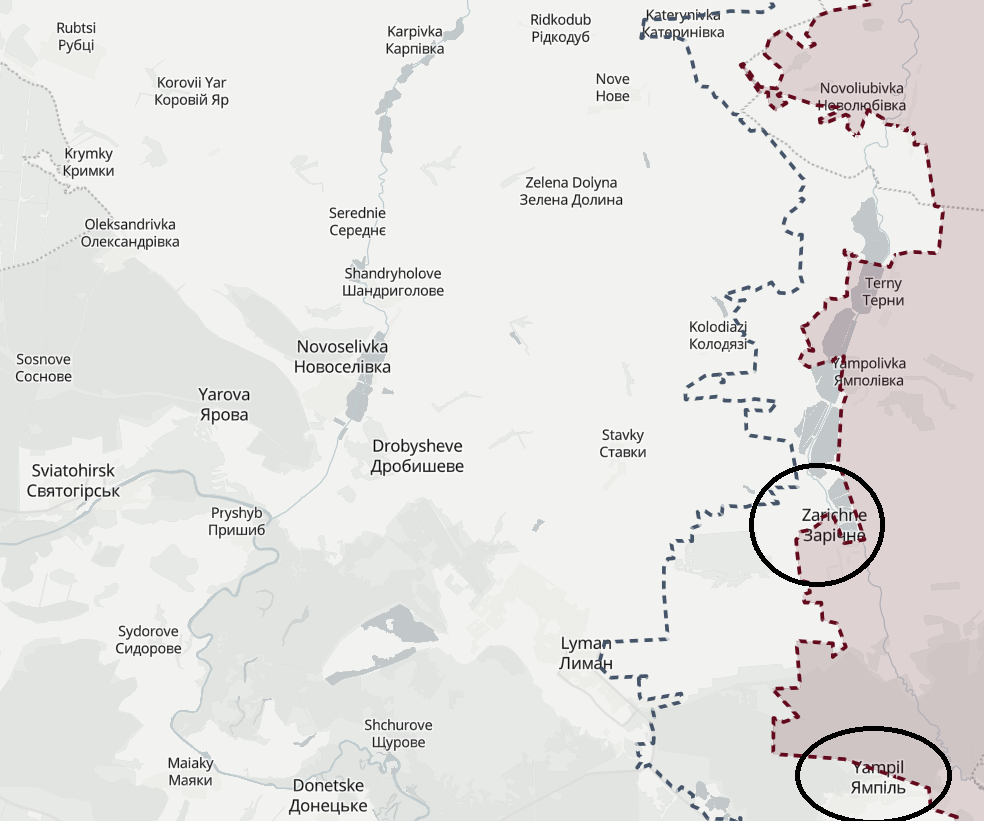
  • Maps of the day: The situation near Lyman and the gap between the Russian ministry and reality.
  • Videos of the day: an attack on the border crossing with Poland; footage from the cockpit of an Su-25; a robot avoids a drone; Russians flee among a crowd of civilians.

Kyiv has experienced its worst attacks since the start of the war in recent weeks. According to an analysis by French OSINT analyst Clément Molin, the capital was hit by 155 Russian missiles and drones in September, compared with 113 in August and 21 in March.

Denník N reporter Mirek Tóda, who visited Ukraine last week, said that Kyiv was currently worse off than Kharkiv in terms of air attacks, even though Kharkiv lies just 30 km from the front line.

Even smaller, FPV (first-person view) drones have recently begun flying on Kharkiv’s outskirts, hunting cars, but the number of air-raid alerts and air strikes there has still been far lower than in Kyiv in recent weeks.

Molin added that the Russians had struck the heart of the capital 10 times a day in recent days.

The Russian independent group Conflict Intelligence Team wrote that Kyiv and its surroundings would probably account for the highest number of civilians killed and injured anywhere in Ukraine in September — more than in the Donetsk, Kherson, or Kharkiv regions.

An at a time when attacks causing casualties occur every day, it is becoming harder for foreign journalists to engage readers with reports about an attack on the Ukrainian capital.

But on Monday, however, the Russians managed to do so.

During the working day, they struck the historic building of Ukraine’s National Academy of Sciences. It caught fire, and footage of scientists and other employees attempting to climb out through smoke-filled windows circulated around the world.

A Russian strike against the building of the National Academy of Sciences of Ukraine. A rescue operation is underway: crews are putting out the fire and searching for people who may have been trapped inside. All services are deployed. Today in Kyiv, a pharmaceutical company and… pic.twitter.com/ccfIHnGFNg

— Volodymyr Zelenskyy / Володимир Зеленський (@ZelenskyyUa) September 28, 2026

The images of people standing on a ledge may have recalled those seen after the 11 September attacks, although the terrorists then struck skyscrapers more than 100 storeys high in New York.

Horrific scenes out of Kyiv this morning as Russia used a jet-powered drone to blow up Ukraine’s National Academy of Sciences. People are escaping through windows as the building burns. Just like they target kindergartens and schools, now they are bombing science. pic.twitter.com/yvwzLz9DXe

— Nate Mook (@natemook) September 28, 2026

🚨 BREAKING: Terrifying footage captured people climbing out of windows after a Russian attack struck the National Academy of Sciences in central Kyiv in broad daylight.

The attack killed one person and injured at least three others, triggering a massive blaze. pic.twitter.com/wiWTU51QaL

— UNITED24 Media (@United24media) September 28, 2026

The historic building had only three floors. Thanks in part to this and the firefighters’ rapid response, only one person was killed and six were injured.

It is quite likely that the attack on the Academy of Sciences was not accidental and that the Russians were targeting an important individual.

Ukrainian analyst Viktor Kovalenko believed that the Russians had wanted to kill 86-year-old Volodymyr Horbulin. He is one of the architects of Ukraine’s missile and space programme.

He headed Ukraine’s space agency in the 1990s and, for five years under President Leonid Kuchma, served as secretary of the National Security Council. Despite his age, he remains active: he is vice-president of the National Academy of Sciences and focuses on security issues.

And the elderly scientist was in the building at the time of the attack. The drone hit a room one floor above his office. He sustained only minor injuries, but his assistant was killed.

A few hours later, the Russians struck the building of the Dobrobut medical centre, which caught fire. Several people were reported injured there.

Russia bombed the Dobrobut Medical Center in Ukraine's capital, Kyiv, this afternoon, setting the facility ablaze. pic.twitter.com/gs0d1X3eB5

— OSINTtechnical (@Osinttechnical) September 28, 2026

These attacks took place in the wider city centre and were felt by the EU ambassador to Kyiv, Slovakia’s Katarína Mathernová.

“Just moments ago, an explosion jolted me out of my chair in my Kyiv office. It was the loudest blast I have experienced here in three years. A jet-powered drone struck a building around 200 metres from the EU delegation. It happened in broad daylight. The target was a hospital,” Mathernová wrote.

While the Russians once attacked Kyiv mainly at night, attacks are now also taking place during the day. Although they target military and industrial sites as well, they frequently hit civilian facilities where many people are present during daytime.

“Today in Kyiv, a person can be killed in a supermarket, at a university, at a petrol station, on the street or at work. The campaign of indiscriminate attacks targeting the centre of the capital is unprecedentedly violent. The Russians are targeting data centres and regularly miss their targets,” French analyst Clément Molin wrote.

“What Russia is doing is pure terrorism. And we should treat neither its state leadership nor its military forces any differently. Why should we continue pretending that it is possible to negotiate with such terrorists on equal terms?” German analyst and former journalist Julian Röpcke wrote.

“Nothing expresses the ‘fight against Nato expansion’ quite as clearly as bombing the historic building of Ukraine’s National Academy of Sciences in central Kyiv, forcing ordinary scientists to jump from windows to escape death in the flames,” Ukrainian journalist Illia Ponomarenko added.

The Russians are attacking the capital virtually constantly. It is not merely one or two attacks a day. As Ukrainian analyst Bohdan Myroshnykov wrote on Sunday, Kyiv had been without an air-raid alert for only 5 hours and 55 minutes in the previous 24 hours.

“The current alert has lasted 8 hours and 20 minutes. The enemy deliberately launches drones in order to prolong the alert. Once they arrive in Kyiv, they begin circling over the city and its suburbs to keep people on edge for even longer,” he wrote.

According to him, the main weapons currently used by the Russians to attack Kyiv are Geran-5 jet drones. These are essentially smaller — though still six-metre-long — cruise missiles. By contrast, Geran-4 jet drones have the classic delta-wing shape of older Shahed drones.

Myroshnykov wrote that Ukrainians had more or less learned how to shoot down Geran-4 drones, but were having difficulties with the fifth series. While they intercept Geran-4s with an effectiveness of 70 to 80 percent, the rate for Geran-5s is only 50 to 65 percent. “The fourth series is intercepted en masse while approaching the Kyiv agglomeration, whereas the fifth is only intercepted within it,” the analyst wrote.

Last week, we wrote that Ukrainians had released the first videos showing them shooting down jet-powered Geran drones, including Geran-5s, using jet-powered interceptor drones capable of matching their speed. A video has now emerged of another new drone that apparently can already do this.

The problem, however, is that none of these drones is yet being mass-produced. Ukrainians therefore do not have enough of them to counter the growing number of jet-powered Gerans that the Russians are launching at Kyiv and other Ukrainian cities — as well as other targets.

“There are prototypes that have delivered varying results, but considerable effort is needed to bring a prototype into large-scale serial production. Sometimes this is impossible because access to certain components is limited,” former adviser to Ukraine’s defence ministry Serhii Sternenko wrote.

“It took us 3.5 years to find a more or less reliable anti-drone defence against conventional Shaheds. We began this path five months ago in the case of jet-powered drones. It may take us eight to 10 months to find a reliable anti-drone defence,” Myroshnykov wrote.

Ukraine’s defence minister, Yevhen Khmara, called on European partners at a meeting of his EU counterparts to help finance these interceptor drones, which have proved to be the best defence against conventional Gerans.

The Russians are also becoming increasingly creative in their efforts to strike targets in Ukraine. Serhii Beskrestnov, another former adviser to the defence minister, shared a video showing the Russians striking Incom’s office building in Kyiv. What is notable is that they filmed the strike themselves using a drone with a high-quality camera.

“The enemy attacked Incom’s office with a Geran-5 missile, while at the same time a jet-powered Shahed flew over Kyiv, circling above the attack site at an altitude of almost three km. It served as a radio-signal relay for the Geran-5 missile while also recording — and immediately transmitting — video of the attack on Incom. This Shahed then flew out of Kyiv and destroyed a McDonald’s warehouse,” Beskrestnov wrote.

He added that he was convinced the two operators had been sitting next to one another.

The Defence Express website also published an article about the Russians fitting their newest Geran-5-K5 jet drones with the Susanin navigation system, first reported by a Russian Telegram account. The system works by comparing current camera images with pre-recorded imagery.

“This enables the Geran-5 K5 to determine its coordinates even when satellite navigation is unavailable,” Defence Express wrote.

However, it works better during the day than at night, as it needs current images of objects on the ground.

It is often said that the Russians attack Ukrainian cities because they are unable to advance at the front. The aim may be to lower Ukrainians’ morale, degrade their economy and force them to surrender and accept Russian terms.

Although the attacks on Kyiv have been the worst since March 2022, they do not yet appear to have shifted Ukrainian public opinion. According to one recent poll, people were most concerned about government corruption (50 percent), with Russian air attacks only in second place (40 percent). Naturally, the poll was conducted not only in Kyiv but also in places where attacks are less frequent.

Recent polling by the Kyiv International Institute of Sociology (KIIS) indicates that the most worrying issue for Ukrainians right now is government corruption (at 50%), followed by Russian missile and drone attacks (40%) and unprofessionalism and incompetence of the authorities… pic.twitter.com/OvEbFz5jNQ

— AMK Mapping 🇳🇿 (@AMK_Mapping_) September 29, 2026

The attacks are often compared to the “war of the cities”, during which both countries attacked each other’s cities in the 1980s Iran-Iraq war. According to the Russian propaganda channel Rybar, they are also intended to undermine support from Europe.

This may be a somewhat far-fetched theory, but it is worth mentioning because it may indicate that people in the Kremlin think along these lines as well.

Rybar asks what the attacks mean for Ukraine’s “sponsors”. In its view, it is time for them to write off Ukraine, because there is no point pouring money into such a country. A “Marshall Plan”, it says, would be “pointless”.

“The more effective the strikes by the Russian armed forces in the framework of the ‘war of the cities’, the more likely the scenario in which the EU, even in the event of a ‘freezing’ of the situation, will ‘write off’ so-called Ukraine because further support for it is unsustainable. And without sponsors, the Kyiv regime cannot survive,” Rybar wrote.

This might perhaps apply if it were a war on the other side of the world, in which the EU was supporting one side. But the war over Ukraine is a conflict on the EU’s border, and there is a high likelihood that, if Ukraine does not stop the Russians, scientists will be fleeing from burning windows in Tallinn, Vilnius or Warsaw.

Maps of the day

On Monday, we wrote about how Ukrainians were gradually releasing parts of Operation Vivaldi, which is liberating territory north of Lyman. Russia’s defence ministry, as well as the Russian state agency Ria Novosti, continue to maintain their claims that the front line lies much further west.

This map compares official Russian claims with reality. At the point of greatest divergence, the maps differ by 40 km. For comparison, that is roughly the distance between Trnava and Bratislava. Overall, the Russians claim to control 1,360 square km more in this area than they actually do.

The yellow line on this map shows what the current official Russian maps portray the situation in the Lyman direction as (or what they would now consider the Izyum direction).

At it's furthest point, their claimed frontline is 40 km (!) west of my frontline. This was achieved… pic.twitter.com/Nd2SP3HJur

— AMK Mapping 🇳🇿 (@AMK_Mapping_) September 29, 2026

Russian Z-bloggers and propagandists are, however, closer to reality. The Two Majors channel wrote that the situation was “continuing to deteriorate”.

“The enemy is conducting counterattacks and trying to push Russian troops back beyond the Zherebets. (…) The Russian foothold west of the river has shrunk,” it said.

According to the channel, Ukrainians had entered the village of Zarichne from several directions, while fighting was also under way for Yampil.

According to Two Majors, this sector remains one of the most problematic parts of the front from the Russian perspective. The Russians’ aim is to stabilise it and retain at least some units on this bank of the river.

The Rybar channel wrote that Ukrainians had intensified fire on the few places where the river can be crossed, as well as attacks on logistics far behind the front line.

“Despite the stabilisation measures that have been launched, the situation remains extremely difficult and tense. The enemy’s gradual release of footage is a tool of information pressure, but it conceals a very real deterioration of the situation in the Lyman sector,” Rybar wrote.

Videos of the day

In addition to Kyiv, the Russians are attacking other parts of Ukraine. They again struck the Yahodyn border crossing on the Polish-Ukrainian border. A Geran-5 drone landed in a car park, around one km from Polish territory.

Recently, after a similar attack in which they hit a train, they also struck a petrol station 800 metres from the crossing. These are the attacks closest to Polish territory since the start of the war, not counting drones and a Kh-101 missile that have already entered Poland.

An enemy UAV struck near the "Yagodin" checkpoint on the border with Poland, according to social media posts pic.twitter.com/COrcYKrUoJ

— kolibri.93 🇺🇦 (@viktorikolibri) September 28, 2026

Footage from the cockpit of a Ukrainian Su-25 military aircraft during a mission in the east. The pilot flew low over the ground, then climbed higher, released a French AASM guided bomb and turned away.

Rare cockpit view from a Ukrainian Air Force Su-25 Frogfoot on a strike mission over the eastern front, screaming low over the ground before pitching up, clawing for altitude, and launching a French AASM guided bomb at a Russian target. pic.twitter.com/DmX2Pvfftw

— OSINTtechnical (@Osinttechnical) September 29, 2026

Ukrainian robot operators are also assisted by aerial reconnaissance drones during missions. This apparently helped the operator in the video skilfully evade a Russian drone at the last moment.

🤯 Insane operator skills!

A Ukrainian "Termit" ground drone dodges a Russian FPV strike mid-mission. pic.twitter.com/u2t4DMEj4L

— UNITED24 Media (@United24media) September 27, 2026

Ukraine’s Khartia Brigade released a video which it said showed Russian soldiers in civilian clothes, mixed in with actual civilians, trying to escape through a pipeline.

🚨 BREAKING: Drone footage from Ukraine’s Khartia Brigade reveals likely Russian soldiers disguised in civilian clothing, attempting to escape alongside elderly hostages and children.

Ukrainian troops refrained from firing to ensure civilian safety. pic.twitter.com/rByUK86i0E

— UNITED24 Media (@United24media) September 28, 2026

What are the losses

No update on Tuesday.

  • By Tuesday (22 September), Russia had verifiably lost 24,138 pieces of heavy equipment, compared with 24,098 on Monday (14 September). Of these, Ukrainians destroyed 19,105 (19,065) pieces, 1,000 (1,000) were damaged, crews abandoned 1,194 (1,194), and the Ukrainian army captured 2,839 (2,839). These included 4,448 (4,447) tanks, of which 3,353 (3,352) were destroyed in combat.

  • Ukraine had lost 12,175 (12,143) pieces of equipment, of which 9,579 (9,551) were destroyed, 702 (698) damaged, 695 (695) abandoned and 1,199 (1,199) captured. These included 1,464 (1,462) tanks, of which 1,125 (1,120) were destroyed in combat.

Note: Neither side regularly reports its own casualties or destroyed equipment. Ukraine publishes daily figures for Russian casualties and destroyed equipment, which cannot be independently verified. In this overview, we use data from the Oryx project, which has compiled a list of equipment losses documented exclusively by photographs since the start of the war.

Private money follows profit, not ruins in Ukraine’s EU-backed reconstruction

29 September 2026 at 09:44

Ukraine’s reconstruction is being planned from a map of destruction. Financing its private assets instead follows a map of earnings. 

Since the full-scale invasion, the European Bank for Reconstruction and Development (EBRD) has lent  $131m [€115.3m] to Nova Post, Ukraine’s largest parcel and courier network — an established business with visible demand, revenue, and an owner able to put up around a quarter of the cost itself.

Shipments grew 16 percent in 2024 as traffic reoriented towards western and central Ukraine and across Ukraine’s  borders with the EU. Part of the financing paid for more than 600 safety capsules and shelters at its premises. A wartime resilience need met an earnings stream, and a lender followed. 

Three sets of records show where else those conditions hold. 

The first is what the international financial institutions have financed. Over four years the EBRD,  European Investment Bank (EIB), International Finance Corporation (IFC) and World Bank announced some $19bn (€17bn) of project-level finance for Ukraine, more than two-thirds of it to public authorities and  state-owned companies.

Of the $2.4bn that went directly to private companies, eight corporates  took 83 percent — around $450m to ArcelorMittal’s steel mill at Kryvyi Rih alone.

Guarantees to banks, some $1.8bn of them, are meant to reach smaller and mid-sized firms. Yet bank lending accounts for under four percent of Ukrainian capital investment. Mid-sized companies appear to be underserved. 

The second is what foreign investors have done. They put around $2.9bn of new equity into Ukraine from 2022 to 2025, most of it into services rather than industry or energy.

Across 134 EBRD financed projects, announced third-party equity appears in three, all of them technology companies incorporated outside Ukraine. A growing number of international venture funds are entering Ukrainian defence technology, whose assets can travel with global demand. A food processor in Vinnytsia, for instance, has neither that pull nor that mobility. 

The third is what companies in Ukraine do with their own money, and it dwarfs the other two. Capital investment runs at around $18bn a year, and companies’ own funds finance 71 percent of it.

In construction, the pattern is starker still: unfinished apartment blocks in Kyiv are going up without bank debt, paid for by the people buying the flats. 

That money is heavily concentrated. Kyiv and its surrounding region take 54 percent of it; the eight western regions 16 percent. The eight frontline and border regions, which hold 78 percent of the damage and 62 percent of the projected cost of rebuilding, take seven percent. 

Three kinds of financing, one pattern. Lenders and investors follow earnings, not destruction. 

The limits of private money

Much of reconstruction will therefore remain publicly financed. International funding flows to public entities which meet urgent needs and will likely not go bankrupt. For the most part, this is right. A large share of the damage sits in assets that never earned or whose earnings the war has interrupted, and repairing schools, de-mining fields, or restoring homes whose owners cannot pay will remain public spending.

But the balance matters beyond making public funds reach further. State-led reconstruction creates revenue-generating assets in public hands. EU accession will subject them to competition and state-aid rules they do not currently face, and some will have to be restructured or sold. 

Expanding the overlap between the two maps means mitigating the externalities of war more effectively. Energy infrastructure was hit 4,500 times in 2025, drones striking transformers and substations and interrupting the cash flows of otherwise functioning power plants.

When the Kakhovka dam was destroyed in 2023, up to 1 million people lost access to drinking water, and water supplies across four regions, including Kryvyi Rih’s, have had to be replaced or rebuilt — and  the municipal utilities involved are counterparties private investors are reluctant to contract with. 

The Kakhovka dam’s spillways in use in 2013. It was destroyed in 2023 (Source: Wikimedia)

Despite around $200bn of international public non-military support to Ukraine since 2022, the instruments addressing those externalities are patchy at best. A solar developer financing a projec against a Ukrainian public buyer needs a payment obligation it can rely on, and insurance that covers both capital and cash flow.  

Closing those gaps is a political decision, not a technical one. European decision-makers need to mandate the EBRD and the EIB to stand behind public buyers of services, widen the guarantees and risk cover available to private investors, and take more risk on their own balance sheets. Of the  €9.6bn EU Ukraine Investment Framework, only €220m is equity, anchoring a fund meant to reach €1bn over time. That pool of public risk capital should be larger. 

Export credit agencies are a separate lever, and it is national governments that set how far they can  reach. Denmark’s agency has backed more than €450m of financing for Ukrainian wind farms built  with Vestas turbines, but uptake of a broader European export credit scheme administered by the EIB has been slow. 

None of this fully aligns the destruction and earnings maps. It widens the ground on which they  meet — the part of the rebuilding that can keep earning when the public money stops.

From Munich to Prešov and Leipzig: a GRU-linked sabotage network operated from Slovak territory

29 September 2026 at 08:58

German investigators have linked an arson attack in Munich, the planned sabotage of drone manufacturer Skyeton near Prešov, and an attempted attack using an explosive drone at Leipzig-Halle Airport to Russia’s military intelligence agency, the GRU, according to media reports.

The most important finding is that part of this network was said to have operated from Slovakia.

We do not yet know all the details of the ongoing investigation, and I trust that Slovak security authorities will thoroughly examine the circumstances of the case and determine the true scope of the entire operation.

However, according to the German security services’ findings so far, the Slovak connection is not marginal.

Slovakia may have served as one of the hubs of a wider network linked to Russia’s military intelligence agency, the GRU.

According to German security sources, two Bulgarian nationals detained after the arson attack in Munich on 3 September were part of a GRU-linked group operating from Slovakia. Incendiary devices were thrown near Rohde & Schwarz and Helsing, companies linked to the defence industry and support for Ukraine.

The same wider network was said to have been preparing an arson attack on Skyeton’s plant near Prešov, which produces reconnaissance drones for Ukraine. Slovak authorities thwarted the plan and detained Latvian and Ukrainian nationals. Another suspect was detained in Germany.

The nationality of those carrying out the attacks is not decisive.

The current model of Russian operations uses nationals of different countries, often recruited through intermediaries. A professional GRU officer can therefore remain several layers removed from the attack itself. Recruitment may take place via Telegram, payments through cryptocurrencies, and those carrying out the attacks may not even know precisely who the real instigator is.

German investigators argued there was also a link to an attempted attack using an explosive drone at Leipzig-Halle Airport on 4 August.

The target was reportedly a Ukrainian cargo aircraft used to transport material. The German government subsequently publicly attributed responsibility for the incident to Russia.

This article continues, but the full version is available only to EUobserver.com subscribers. Visit account.euobserver.com/membership

As Russia Targets Civilians, Pressure Mounts On Trump To Use Sanctions Powers

29 September 2026 at 07:41
A new wave of deadly Russian attacks on Ukrainian cities is fueling bipartisan calls in Washington for US President Donald Trump to use sweeping new sanctions powers against Moscow, with lawmakers arguing that greater economic pressure could strengthen efforts to end the war.

Zelenskyy Warns Of New Russian Mobilization, 10,000 North Korean Troop Deployment

28 September 2026 at 23:41
The death toll from Russia’s jet-powered drone attacks mounted in Ukraine while Ukrainian President Volodymyr Zelenskyy warned that the Kremlin is preparing for a new mobilization at home and a fresh deployment of 10,000 North Korean troops.

Trump Rejects Iran-China Peace Deal as Iran Prepares to Change from Defensive Position to Offensive Position in the War

28 September 2026 at 22:13

by Brian Shilhavy
Health Impact News

I have just finished listening to an interview with international journalist Pepe Escobar, that aired today, about two hours before I am publishing this.

If you want to detox yourself from the U.S. corporate media propaganda, and get the “other side” of the current situation in the Iran War, investing time to watch this video (55-minutes long) is well worth it.

There were apparently attempts to knock Escobar offline during the interview, suggesting that there are forces who do not want people to hear what he has to say. (I have this video saved, so if it disappears from YouTube let me know, and I will restore it on another platform.)

Escobar states that Iran gained a lot of friends and a lot of support in New York last week at the UN General Assembly meeting. Escobar also gives information about China President Xi’s meeting with President Trump last week that was generally not covered in the U.S. corporate media.

He claims that Xi pressed Trump to return to the MOU (Memorandum of Understanding) from last June that was negotiated by Pakistan, and that the U.S. originally signed.

But over this past weekend, Trump made it known publicly that he is rejecting any offer by Iran to end the war, and Escobar states that this does not sit well with China at all, and that China will now become much more involved in working with and helping Iran in the current war.

He states that Iran is now going on the offensive, and he expects things to start happening this week.

Escobar does a good job of trying to educate his listeners as to what the mindset is in Shiite Islam, and that they have no fear of dying for their faith.

The Epstein Syndicate’s real agenda, according to Escobar, is to nuke both sides in the Middle East, both Persians and Arabs alike, and take over the Strait of Hormuz that Trump plans to name after himself.

Pepe Escobar:

There is no solution (to ending this war through negotiation). It is a do or die war.

Americans have been deceived into thinking that this is a religious war that was started with Iran to combat the dangers of Islam.

But the truth is that this is a religious war started by Trump and his Zionist friends who surround him, including Evangelical Christian Zionists, and he is forcing everyone in the U.S. to accept Zionist Christian beliefs, including the military, to fight this war based on Zionist religious views. See:

U.S. Military Officers Reveal the Real Reason Trump Bombed Iran: To Fulfill Evangelical Zionist Prophecy and Begin “Armageddon”

Escobar also addresses Russia, where he recently visited, and states that Russia is preparing to go to war against Europe.

He also mentions that BRICs has been slow to implement changes to bypass the Western financial system, but that there is the feeling that this will change in 2027, when the annual BRICs meeting will be held in China, and will be dominated by China’s agenda.

Related:

Trump’s War Against Iran Fulfills Prophecy, but NOT Christian Evangelical Zionist Prophecy

Saudi Arabia is Exporting ZERO Oil as U.S. Sends Unprecedented Amount of 2,000-pound Bombs to Israel

The Demise of Saudi Arabia, and Perhaps Christian Zionism? Yemen Shocks the World by Taking Control of the Red Sea

This article was written by Human Superior Intelligence (HSI)

See Also:

Understand the Times We are Currently Living Through

The Brain Myth: Your Intellect and Thoughts Originate in Your Heart, Not Your Brain

Is God’s Patience About to Run Out on the United States?

Second Edition of eBook Released: The Concept of the American Christian Family is a Myth and is NOT Found Anywhere in the Bible – by Brian Shilhavy

FREE eBook! Restoring the Foundation of New Testament Faith in Jesus Christ – by Brian Shilhavy

KABBALAH: The Anti-Christ Religion of Satan that Controls the World Today

Exposing the Christian Zionism Cult

The Bewitching of America with the Evil Eye and the Mark of the Beast

Jesus Christ’s Opposition to the Jewish State: Lessons for Today

Identifying the Luciferian Globalists Implementing the New World Order – Who are the “Jews”?

The Seal and Mark of God is Far More Important than the “Mark of the Beast” – Are You Prepared for What’s Coming?

The Satanic Roots to Modern Medicine – The Image of the Beast?

Medicine: Idolatry in the Twenty First Century – 10-Year-Old Article More Relevant Today than the Day it was Written

Having problems receiving our emails? See:

How to Beat Internet Censorship and Create Your Own Newsfeed

We Are Now on Telegram. Video channels at Bitchute, and Odysee.

If our website is seized and shut down, find us on Telegram, as well as Bitchute and Odysee for further instructions about where to find us.

If you use the TOR Onion browser, here are the links and corresponding URLs to use in the TOR browser to find us on the Dark Web: Health Impact News, Vaccine Impact, Medical Kidnap, Created4Health, CoconutOil.com.

The post Trump Rejects Iran-China Peace Deal as Iran Prepares to Change from Defensive Position to Offensive Position in the War first appeared on Health Impact News.

De apostas, predições e eleições

28 September 2026 at 21:00

Quer receber os textos desta coluna em primeira mão no seu e-mail? Assine a newsletter Xeque na Democracia, enviada toda segunda-feira, 12h. Para receber as próximas edições, inscreva-se aqui.

A seis dias da eleição, tudo o que queremos é saber: quem vai ganhar? A urgência de adiantar o futuro, ou tentar mudar um futuro que nos parece imutável, é o que faz com que nós, pobres humanos, busquemos os oráculos, as adivinhações e as apostas. 

Foi a vontade de sair do buraco que levou milhões de brasileiras e brasileiros ao vício em apostas online, as bets, que sempre tiveram uma vantagem enorme sobre outros tipos, inclusive ilegais, como o Jogo do Bicho, porque aprenderam com as Big Techs a navegarem em um ambiente onde já estamos viciados à tela. Neste contexto, fazer um design para viciar pessoas em jogos online é fácil e, como demonstrou nossa investigação, extremamente barato, menos de mil reais. O resultado, sabemos: uma nação viciada em jogos, ludopatia levando pessoas desesperadas ao SUS e ao suicídio, e uma fuga de 140 bilhões da economia brasileira. 

Pois isso tudo acabou na última sexta-feira, com uma canetada do presidente Lula. Ou melhor: é o começo do fim. 

São Paulo (SP), 25/09/2026 - O presidente Luiz Inácio Lula da Silva participa da apresentação de novas medidas de proteção às famílias e à economia popular, como o fim das bets.
O presidente Luiz Inácio Lula da Silva durante apresentação de novas medidas de proteção às famílias e à economia popular, como o fim das bets

Não há nenhuma dúvida de que Lula fez isso de olho nas eleições; seu objetivo era claramente se colocar como aquele que acabou com as bets. Mas a Medida Provisória terá efeito para muito além do resultado eleitoral. Vai abrir um embate legal mais profundo – as bets vão recorrer à Justiça, o Congresso vai tentar derrubar – e, com isso, a sociedade será chamada a opinar, se mobilizar, a se mostrar de que lado está. 

Para fazer do seu ato algo permanente, Lula tem ao seu lado pesquisas que apontam que 75% dos brasileiros apoiam a proibição. Se outras pesquisas mostram que maioria diz que não vai mudar de voto por causa deste tema, isso é um problema menor. Em 5 de outubro, as malditas propagandas do tigrinho vão desaparecer das redes sociais, dos sites de notícias e dos programas esportivos da TV. Os aplicativos vão sumir das lojas de APPs; a poluição mental vai diminuir. Afinal, acessar os jogos ilegais tem um custo e uma fricção muito maior. 

Poderemos escutar o silêncio. 

Raramente dá pra dizer que uma investigação jornalística tem um impacto tão direto numa decisão do governo federal. Mas desta vez, podemos dizer com orgulho: foi a nossa cobertura que tornou o tema relevante a ponto de convencer o presidente da República. 

Desde 2025, preparamos com nossos repórteres uma grande investigação sobre o mercado de apostas online, em meio à epidemia de ludopatia. Para isso, fizemos uma campanha de arrecadação junto ao nosso público, e nos dedicamos a levantar histórias, documentos e dados sobre quem estava lucrando – inclusive os políticos que faziam lobby no Congresso – e quem eram as vítimas dessa realidade. Lançamos o especial “Jogo perigoso: O Brasil das Bets”, em junho deste ano. 

Dentre os muitos documentos analisados pela nossa equipe, os jornalistas Thiago Domenici e Ed Wanderley encontraram uma carta de Vania Souza Borges, que perdeu o filho Rafael por causa de dívidas com as bets. A carta da professora de Uberlândia havia sido ignorada pela CPI das Bets – que terminou sem indiciar ninguém – mas Vânia abriu o coração aos nossos repórteres e comparou, pela primeira vez, as bets com traficantes de drogas. 

A história viralizou, e, em setembro, Vânia foi convidada para conhecer o presidente Lula. A ele, ela fez um pedido direto: “proíba as bets”. O pedido desta mãe, órfã de seu filho, foi hoje atendido pelo presidente da República.

Quando nenhum veículo dedica esforço e investimento para investigar a fundo o mundo das bets, nosso especial “Jogo perigoso: O Brasil das Bets” fez a diferença. 

Lula usou a comparação com vício em crack e lembrou da Vânia ao assinar a Medida Provisória. Compartilho aqui o agradecimento dessa mãe ao nosso trabalho. “Obrigada, Thiago! Devo muito à @agenciapublica toda a repercussão da minha triste história”.

Mas, enquanto podemos celebrar o fim das apostas, quero lembrar que, depois das bets, vêm os sites de apostas preditivas. Graças à coalizão LIE – Laboratórios de Investigação Eleitoral, uma parceria da Pública com Aos Fatos, Amado Mundo e Núcleo, conseguimos mapear páginas da Polymarket em redes sociais postando loucamente sobre as eleições brasileiras, mesmo sendo a atividade proibida no Brasil. 

Se você não lembra o que é aposta preditiva: sites como Polymarket e Kalchi permitem que qualquer usuário crie uma aposta, e outros usuários podem apostar dinheiro. Só que pode-se apostar em qualquer coisa, inclusive em resultados eleitorais e bombardeios durante uma guerra. 

Um dos efeitos deletérios desta prática ficou bem clara nesta eleição, como mostrou reportagem colaborativa feita pela coalizão LIE. Os resultados das apostas feitas no Polymarket, assim que Flávio Bolsonaro ganhou a dianteira nas apostas, passaram a ser repostados por uma série de influenciadores em posts pagos como evidência concreta. Como se fossem um resultado científico. Até o Flávio postou. E o próprio Elon Musk comentou em uma dessas postagens, ampliando seu alcance. 

Como mostrou a reportagem assinada por Jennifer Mendonça, do Núcleo, a legislação eleitoral proíbe que candidatos postem dados de pesquisas falsas. Depois das reportagens, a AGU pediu investigação contra a Polymarket, que já tinha até contratado representantes oficiais no Brasil para fazer seu lobby.

Tomara que, com o fim das bets, o site – que tem Donald Trump Jr como seu consultor – desista de fazer seu lobby aqui no Brasil.  

Mas, se é o fim das predições ou apostas online, não é o fim da nossa ansiedade em saber o que vai acontecer, afinal, quando nós formos às urnas no próximo domingo. Todas as pesquisas demonstram uma proximidade maior do que em eleições anteriores – e a de 2022 já foi tremendamente apertada. Talvez a solução seja não apostar em oráculos. Sabemos que boa parte das pessoas só pensam na eleição na sua véspera. Hora de falar com vizinhos, amigos, parentes, e explicar que estamos, mais uma vez, diante do autoritarismo e do caos, e essa pode ser a eleição que define nosso futuro como país. 

Os números e as estrelas dizem: nada está decidido, ainda.

Para ajudar nosso público a entender o que predizem as pesquisas eleitorais, vamos trazer uma convidada especial para nosso programa Quase Terça, nossa live semanal que analisa os fatos mais relevantes da semana. 

Hoje, vamos entrevistar Luciana Chong, diretora do Datafolha, que vai nos ensinar a ler os dados das diversas pesquisas que têm pipocado por aí. Além dela, a Vania Souza Borges, que pediu pessoalmente a proibição das bets ao presidente Lula, vai estar conosco para refletir sobre essa grande vitória para ela e para familiares de vítimas como ela.   

O programa vai ao hoje, a partir das 17h30, no Canal da Pública no YouTube, e na terça vira podcast no Spotify. Segue o link para acompanhar, ative o sininho e receba notificação. Vejo vocês por lá!  

❌