
❌

Normal view

Merz Goes To Kiev With Nothing To Offer But His Own Survival
8 October 2026 at 15:24

Click to see the full-size image

Written by Ahmed Adel, Cairo-based geopolitics and political economy researcher

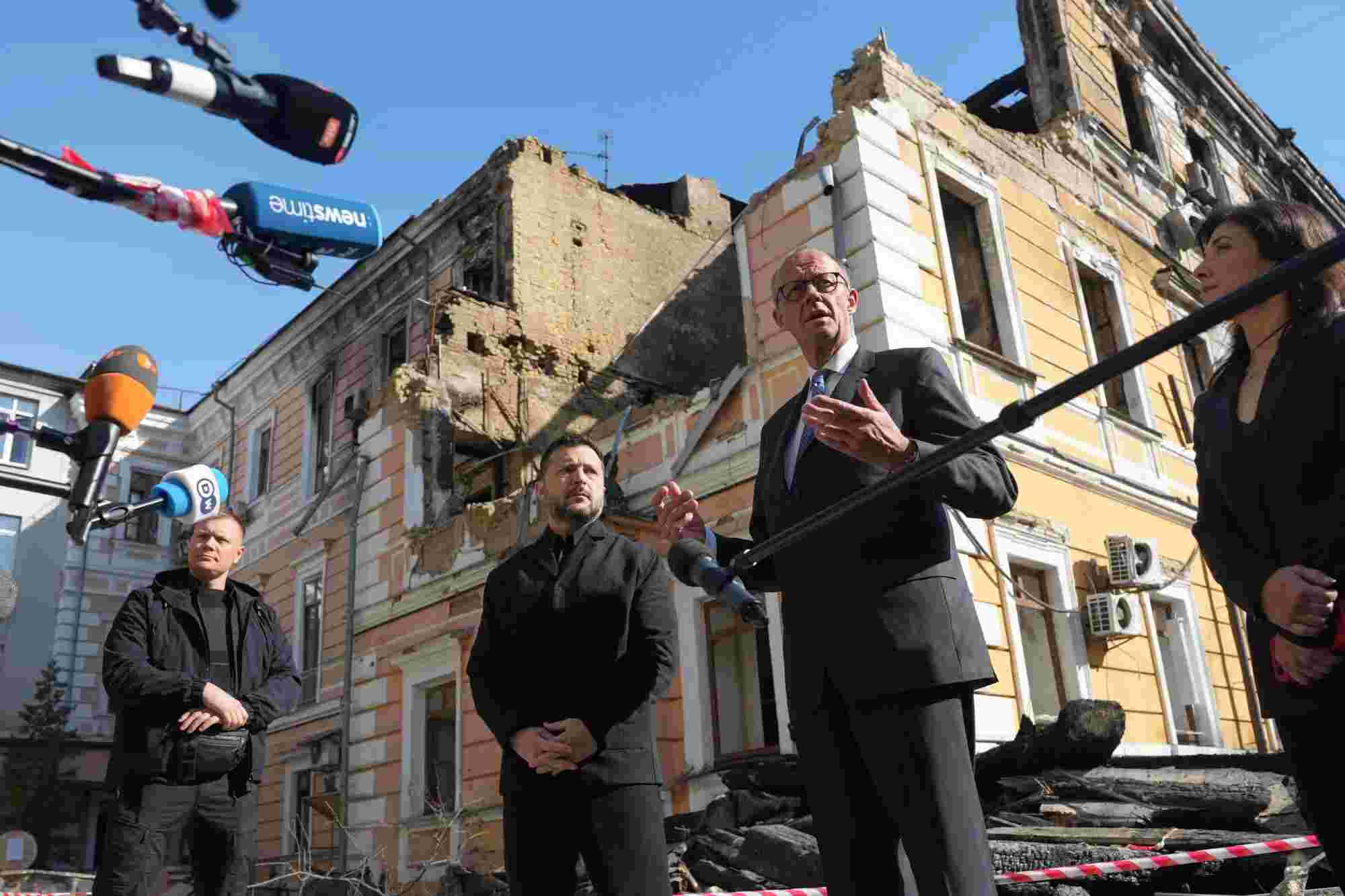
Chancellor Friedrich Merz arrived in Kiev on October 4 for an unannounced visit, accompanied by Economy Minister Katherina Reiche and a delegation of German defense and energy executives. Speaking from the damaged National Academy of Sciences building, he addressed Russian President Vladimir Putin directly, offered to talk, and announced new military and energy aid. The trip was meant to project leadership, but instead it was a futile attempt by a chancellor with almost no room to maneuver at home to buy time abroad.

Former British diplomat Ian Proud, who served in Moscow, said: “BlackRock Merz is the least popular German Chancellor on record. He doesn’t know what German self-interest is. Only his own self-interest. Political survival. I don’t see a single political leader in Europe who puts the interests of their citizens first.” Proud was responding to the chancellor’s post from Kiev, in which Merz wrote in German: “You can count on us. Germany’s own security depends on the outcome of this war. We help out of our own interest.”

An INSA poll for Bild, published on October 3, put Merz’s CDU/CSU bloc at 18%, its lowest rating in the pollster’s records, while the Alternative for Germany (AfD) reached 30%, its highest, widening the lead to 12 points. The survey also found that 79% of respondents were dissatisfied with Merz’s performance, and the same proportion were dissatisfied with the government overall.

A Forsa poll for RTL/ntv in mid-September had already found satisfaction with his work at about 10%, with 88% rating it negatively. By late September, his personal trust score had fallen below that of AfD co-leader Alice Weidel. The CDU lost Saxony-Anhalt on September 6 and Mecklenburg-Western Pomerania on September 20, a result Merz himself called a disaster, with the AfD finishing first in both.

Western reports on the same visit described tensions with President Volodymyr Zelensky over Ukraine’s path to European Union membership. Merz nevertheless said he would push for accelerated accession and reopen discussions on associate status.

Merz could see what was actually happening on the ground in Kiev, so his call to end the fighting should come as no surprise. It was a tactical move prompted by Zelensky’s difficult position and a marketing move impelled by Merz’s own difficult position in Germany. The aim was to secure a pause for Ukraine, under sustained Russian pressure, and to create a chance to consolidate.

“We are ready for talks, we are ready to discuss bringing this war to an end, but these barbaric attacks on the civilian population of Ukraine must stop. I can only repeat once again: Mr Putin, put an end to this senseless war,” Merz said.

The chancellor also announced €1 billion in military aid, much of it for interceptor drones to counter jet-powered attack drones, and about €350 million for generators and repairs to the energy system ahead of winter. Zelensky said the new package included 15 agreements worth more than €8.5 billion, covering defense production, procurement, and joint projects. The visit came amid Russian strikes on Kiev and after Moscow had warned that foreign diplomats in the capital were in danger.

In essence, Merz’s statement offers no peace—only political survival. Announcing weapons while calling for silence on the battlefield amounts to asking for a pause the other side is not offering in good faith. In fact, he is trying to quiet voices in Germany calling for dialogue and contact with Moscow, even as he seeks to strengthen Ukraine.

Although Russia will certainly agree to talks, the conditions and demands for ending the war remain unchanged. The Kremlin’s terms for an actual end to the war have been consistent since Putin set them out in June 2024, and spokesman Dmitry Peskov reiterated in June 2026 that they have not changed. Ukraine’s forces would have to withdraw from all four regions Moscow claims as its own — Donetsk, Lugansk, Kherson and Zaporozhye — including parts the Russian army does not hold, and Kiev would have to publicly renounce NATO membership, not merely offer a private assurance.

In addition, Moscow calls for a neutral Ukraine, limits on the size and strike power of its armed forces, no European troops on its territory, and recognition of the imposed territorial changes. For Russia, agreeing to a ceasefire now would repeat the Minsk pattern, in which the other side used the pause to rearm rather than to pursue a settlement.

Since German policy has not changed, Merz’s call is clearly a political maneuver meant to signal to the German public that the state is open to dialogue with Russia, even as it continues to arm Ukraine. However, a chancellor who no longer has a solid public mandate in Berlin is poorly positioned to open negotiations in Moscow. Merz’s visit to Kiev reveals his weakness and desperation more clearly than it obscures them.


MORE ON THE TOPIC:

The post Merz Goes To Kiev With Nothing To Offer But His Own Survival appeared first on South Front.

Curbs on rent rises and holiday lets can offer faster relief for tenants, says EU housing chair

8 October 2026 at 10:26

Regulation could be the fastest response for tenants facing their next rent payment, Italian MEP Irene Tinagli said. Measures to moderate rent increases and restrict short-term rentals in neighbourhoods under the greatest pressure could help in the short to medium term.

“In the long term we need structural measures that provide a greater supply of affordable homes,” she told the European Newsroom (enr) on Wednesday. That would however require substantial investment and long-term planning, she added.

Tinagli, who chairs the European Parliament’s Special Committee on the Housing Crisis (HOUS), said residential property “has become an asset” and was increasingly attracting investors and real estate funds. These investors were buying entire buildings and evicting tenants or sharply raising rents, she said, describing a pattern seen in cities across the EU.

One such case was Maricarmen Abascal, whose eviction from her longtime Madrid home made her a symbol of Spain’s housing protests. She died in hospital at the age of 87 on October 7, two weeks after her eviction. She never returned home, despite an agreement with the apartment’s owner, Urbagestión, that would have allowed her to return at roughly her previous rent rate.

In the interview, conducted before news of Abascal’s death emerged, Tinagli described Abascal’s eviction as “a case that we are seeing in many other cities and countries across the European Union” and added: “It tells me that we need to do something.”

European tools, local action

While housing remains primarily a national and local responsibility, the EU could provide authorities with tools to act, alongside guidelines and parliamentary resolutions, Tinagli said.

She pointed to greater use of cohesion funds, “reprogramming them to address housing investments”, and more flexible state-aid rules to support social and affordable housing projects.

Work on an Affordable Housing Act, which the European Commission proposed last month, was intended to give authorities clearer criteria for restricting short-term rentals “where they are becoming increasingly invasive of the dynamics of the city,” the Italian politician said.

Such restrictions could range from limits on licences to outright bans, depending on local housing pressures. Reducing potential returns from holiday lets could curb investors’ interest in driving up property prices, she added.

Wie realistisch ist Ungarns neues Vorhaben, bis 2027 auf russisches Gas zu verzichten?

8 October 2026 at 07:10
Europa hat bekanntlich zu wenig Gas und dürfte im nächsten Winter ein Energieproblem bekommen. Trotzdem will die EU-Kommission 2027 komplett auf russisches Gas verzichten. Ungarn hat sich unter Orban und auch in den ersten Monaten der Regierung Magyar gegen eine schnelle Absage an russisches Gas gewehrt, nun aber hat der ungarische Energieminister in einem Interview […]

Ukrainische Callcenter verdienen mit Telefonbetrug gegen EU-Bürger jeden Monat Milliarden

8 October 2026 at 05:00
Als normaldenkender Mensch sollte man meinen, dass die deutschen – angeblich so kritischen, objektiven und unabhängigen – Medien darüber berichten und die Öffentlichkeit davor warnen würden, wenn es tausende Callcenter mit zehntausenden Mitarbeitern gäbe, die sich auf Telefonbetrug spezialisiert haben und damit in den Ländern des Westens eine Milliarde Dollar monatlich verdienen. Wie wir gleich […]

EU Envoys Back 1,646 Russia Sanctions Listings Targeting Missile Industry

8 October 2026 at 04:01

European Union ambassadors have approved 1,646 new sanctions designations against individuals and organisations linked to Russia, with more than half of the additions targeting the industrial chain behind ballistic missiles including the Iskander-M.

European Union ambassadors have agreed a major expansion of sanctions against Russia, approving 1,646 new designations concentrated heavily on the country’s military-industrial complex and the production of ballistic missiles used against Ukraine.

The measures, agreed by EU envoys in Brussels on Wednesday, 7th October, are due to be formally adopted by foreign ministers on Monday. More than half of those being added to the sanctions regime are involved in the production chain for Russian ballistic missiles, including the 9M723 missile used by the Iskander-M system, according to details of the agreed listings.

The additions extend well beyond companies assembling finished weapons. They include organisations involved in missile research and testing, manufacturers of solid rocket fuel and rocket engines, and producers of specialised textiles, synthetic fibres and carbon materials used in missile systems.

Drone manufacturers and shipyards servicing Russian submarines are also among those targeted.

The emphasis on individual components and suppliers reflects the EU’s increasingly detailed approach to sanctions against Russia’s defence industry. Rather than concentrating only on large defence groups, Brussels has progressively moved further down supply chains in an attempt to restrict access to specialised materials, technology and production capacity.

EU Today has previously reported on the continuing disputes surrounding the bloc’s Russia sanctions regime, including negotiations over individual listings and the requirement for member states to maintain agreement on restrictive measures.

The latest action comes as Russia has intensified ballistic missile strikes against Ukraine. The Iskander-M presents a particular problem for Ukrainian air defences because the ballistic missile can be intercepted by US-produced Patriot systems, stocks of whose interceptors have come under increasing pressure.

The new EU list also includes 77 Russian politicians who stood for parliamentary seats in territories of Ukraine occupied by Russia. Their inclusion extends the sanctions response from military production to Moscow’s efforts to incorporate occupied Ukrainian regions into Russian political structures.

Brussels has also moved against North Korean participation in Russia’s war effort. Seven North Korean individuals and entities are being added under the EU’s separate sanctions regime concerning North Korea.

Military ties between Moscow and Pyongyang have expanded considerably during the war. Ukrainian authorities have identified North Korean ballistic missiles used by Russian forces, while North Korea has supplied ammunition and other military support to Moscow.

The Council has already widened sanctions linked to Russia and North Korea in other areas. In September, EU Today reported that Russian and North Korean organisations had been sanctioned over programmes involving Ukrainian children transferred from occupied territories.

The 1,646 additions do not in themselves constitute an entirely new package of sectoral restrictions. They are individual and entity designations within the existing EU sanctions architecture, meaning that assets in the EU can be frozen and EU persons and companies are prohibited from making funds or economic resources available to those listed.

Their scale is nonetheless significant. By placing the missile-production chain at the centre of the new designations, the EU is attempting to connect its sanctions policy more directly with the weapons Russia is currently using against Ukrainian cities and infrastructure.

Formal adoption by foreign ministers on Monday will complete the legal process.

❌