
❌

Normal view

NO SAFE REAR: Moscow’s Shadow War From Starlink to Prison Cells

9 October 2026 at 19:00

Russia is seeking support for its war effort abroad – and threatening retaliation beyond Ukraine. Reports of foreign labor in drone factories, proposals to counter Starlink, and allegations of overseas recruitment show different ways Moscow could sustain its military effort and put pressure on its opponents.

Nowhere Far Enough

On October 9, Mikhail Zvinchuk, founder of the Russian military Telegram channel Rybar, was detained in Montenegro. Montenegrin authorities accused his team of using media work to interfere in the country’s politics. Rybar said they had come legally to film at Cetinje Monastery and had submitted an official filming request. Moscow’s response explains why this matters: Dmitry Medvedev, deputy chairman of Russia’s Security Council, suggested replenishing an “exchange fund” with Europeans and Americans to recover detained Russians. One arrest became a warning about others to come.

Mikhail Zvinchuk, founder of Rybar, a Russian pro-war Telegram channel covering the war in Ukraine, was detained in Montenegro on October 9

Five days earlier, Medvedev had delivered the orbital version of that warning. If Russia’s Rassvet constellation were destroyed, American Starlink satellites would “come tumbling down like ornaments from a dried-up Christmas tree.” “Space is a very crowded place,” he added. “We need to be mutually courteous.” Kiev had sought sanctions and restrictions, not announced a satellite attack. Moscow was putting a military threat behind its demand that Russian communications infrastructure be left alone.

The link is not between a blogger and a satellite. It is between two threats of retaliation: damage our network and yours becomes a target; detain our people and yours may become bargaining chips. Moscow is challenging the assumption that pressure on Russia can remain a one-way transaction.

Partners Behind the Front

The space threat has a practical backdrop. Leaked documents published in July describe a closed Russian-Chinese military forum in Guangzhou in November 2023. Chinese researchers proposed several ways to counter Starlink, from legal pressure and jamming to cyberattacks and destruction. Their hardest problem was also the simplest: how to disable satellites more cheaply and quickly than SpaceX could replace them. They do not show that these systems were built or deployed.

Visualization of the planned Starlink Generation 2 constellation

Russia and China have different strengths to offer. Moscow brings battlefield experience and air-defense knowledge; Beijing brings electronics, artificial intelligence, and manufacturing capacity. Russia can show what works under fire. China can help turn those lessons into equipment made at scale. A sixth closed forum was reportedly planned for the fall in St. Petersburg.

This is why repeated technical meetings matter more than dramatic threats. A shared design, tested and improved over several years, could outlast the war that first made it useful. For Moscow, the goal is to weaken an American advantage. For Beijing, Russian experience offers lessons without having to fight the same war.


Discussion of leaked documents, the “one-to-many” concept and replacement costs


But destroying satellites is not a clean solution. Russia’s 2021 antisatellite test forced both astronauts and Russian cosmonauts to shelter aboard the International Space Station, according to NASA. Debris threatens more than the intended target. Jamming can offer a narrower response; smashing entire networks risks damaging the same orbital space Russia and China also need.

The factory floor shows another side of this partnership-building. A September report by the Multilateral Sanctions Monitoring Team says North Korean workers are employed at Alabuga in Tatarstan, where Russia produces Geran-2 drones, and describes workers entering Russia as students. Pyongyang rejected the report as fabricated. If the findings are accurate, the bargain is straightforward: Russia gains workers, North Korea gains income. Foreign support does not have to arrive as a finished missile; it can help keep the assembly line moving.
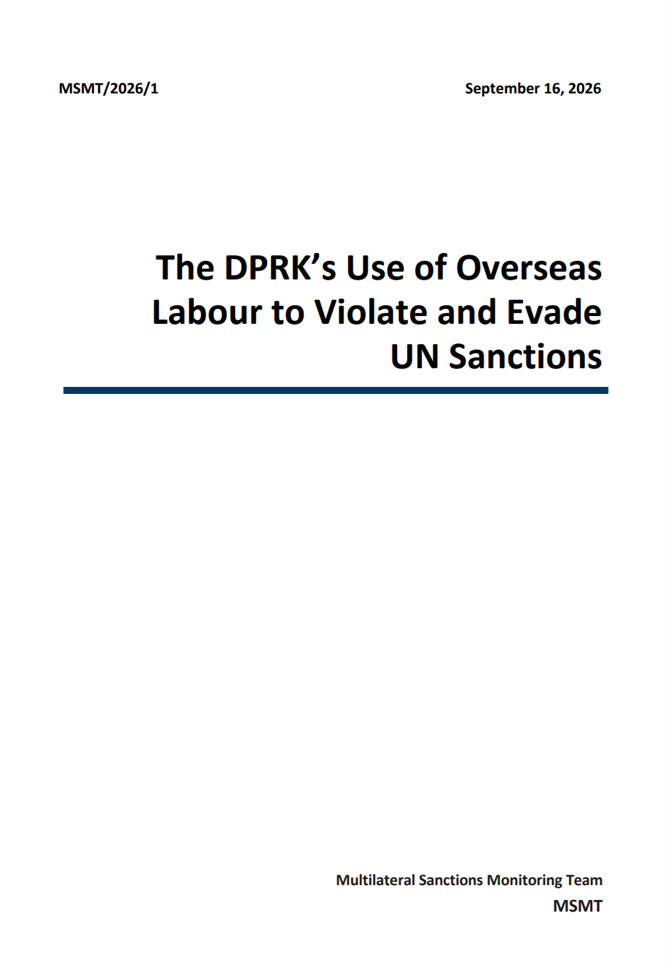
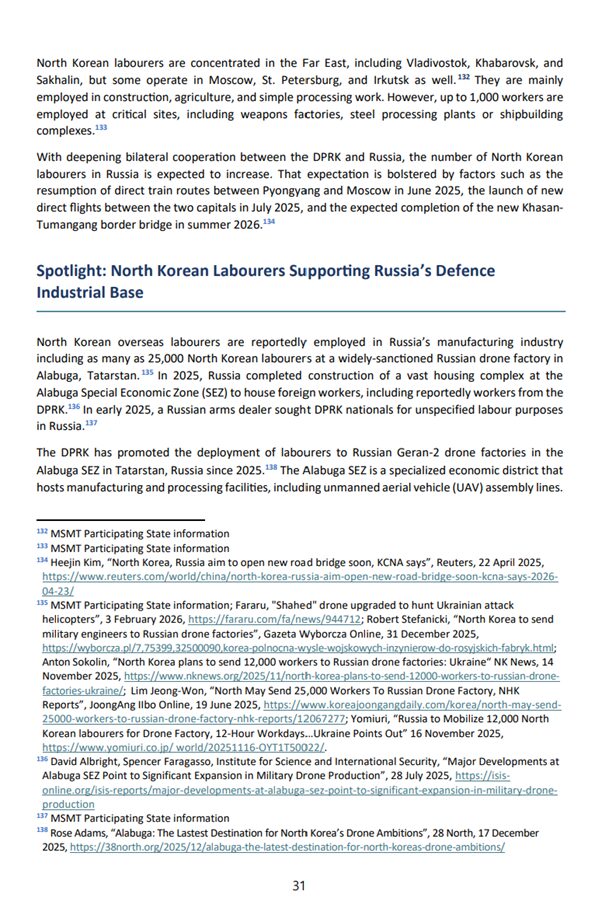
September 2026 sanctions-monitoring report.  Pages 31-32 discuss Alabuga and drone production. Pyongyang rejects the report


The Underground Price List

Recruitment abroad serves a different purpose. A September 15 U.S. indictment alleges that a Russian intelligence-linked network used Cuban and Venezuelan intermediaries to recruit inside America. Prosecutors describe payments of $1,000-$1,500 for surveillance and a $40,000 offer to kill a Russian dissident believed to be near Washington. Another alleged offer promised an American $25,000 to kill a target in Lithuania. These remain accusations, not court findings or proof of an officially declared bounty program.
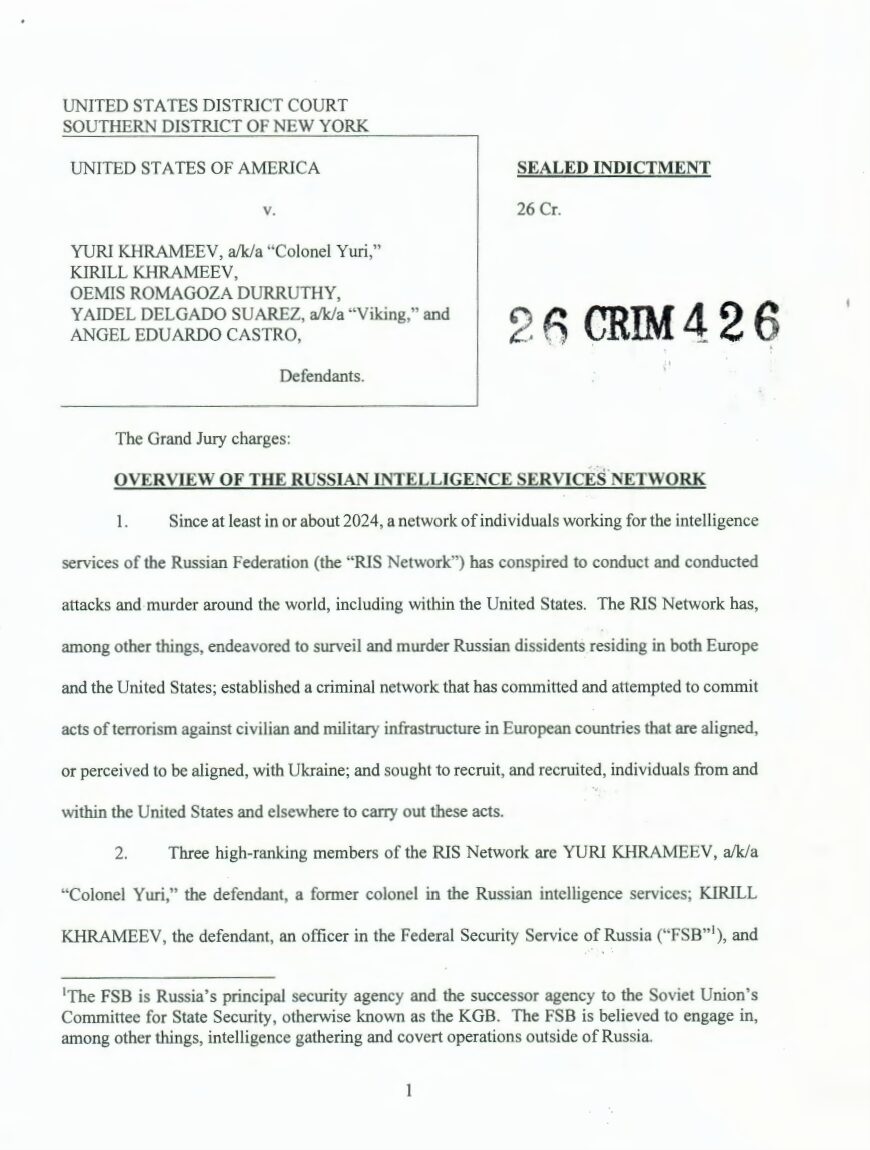
Original U.S. indictment naming the alleged Russian, Cuban, and Venezuelan participants

The alleged network operated from at least 2024, before the Montenegro arrests. Its importance lies in the method: foreign intermediaries and local recruits, rather than an obvious Russian team. If substantiated, the charges would show Moscow reaching inside America through people who do not carry Russian passports.

The October 9 threat to expand the “exchange fund” signals that consular protests may no longer be Moscow’s only answer. It suggests foreign detainees could become leverage for recovering Russians. The warning to European and American governments is pointed: the detention of a Russian abroad may create a problem for their own citizens elsewhere.

Russia’s partners help it build weapons; alleged overseas networks extend its reach; threats against satellites and foreign detainees aim to raise the cost of confrontation. These are different tools, not proof of one master plan. But October’s warnings carry a common message: Moscow wants the other side to feel exposed too. Medvedev closed his latest message with a Russian proverb: “If you live among wolves, you must howl with them.”


MORE ON THE TOPIC:

The post NO SAFE REAR: Moscow’s Shadow War From Starlink to Prison Cells appeared first on South Front.

Exclusive: the Pakistan-Saudi-Yemen-Iran riddle

By: A A
9 October 2026 at 17:50

The House of Saud is attacking Ansarallah to protect the death cult in West Asia, Pepe Escobar writes.

Join us on Telegram, X, and VK.

Contact us: info@strategic-culture.su

Let’s start with exclusive intel. On Thursday, Yahya Ali al-Ra’i, speaker of the Sana’a-based House of Representatives under Ansarallah, delivered a letter to Sardar Ayaz Sadiq, the speaker of Pakistan’s National Assembly, requesting Pakistani mediation between Ansarallah and Riyadh.

Ra’i, widely respected, has been the speaker in Sana’s since 2008. Sadiq began his current term as speaker in Islamabad in March 2024. This direct parliamentary channel is immensely significant as a diplomatic opening – as Pakistan faces enormous pressure, domestically and across the lands of Islam, over its real commitments related to the Saudi Arabia vs. Yemen clash as determined by the Mecca Defense Alliance.

As murky as the the whole situation really is, direct intel from both Islamabad and Tehran, at the highest levels, as I especifically requested, has established four key points:

  1. Islamabad is adamant that Pakistan will not attack Ansarallah and will not commit troops to that effect. The Riyadh understanding last week excluded entry into Yemeni territory. Pakistani forces should remain outside any ground offensives against Ansarallah. That seems to be the case – for now.
  2. Pakistan was already mediating between Riyadh and Sana’a through Tehran. Field Marshal Asim Munir personallly requested that Iranian Foreign Minister Araghchi use Iran’s influence with Ansarallah, together with Araghchi’s contacts with both Islamabad and Riyadh. Pakistan’s Foreign Office did not deny this diplomatic channel.
  3. Pakistan would have to defend Saudi territory under its Mecca Defense Alliance commitments. Deployments for border protection and defense against drones and missiles launched by the Yemeni Armed Forces fit this pattern.The problem is whether some Pakistani advisors are already deployed in Yemeni territory. If Pakistan has even a few “advisers” in Aden and troops somewhere around northern Yemen on the Saudi border, that already betrays its promises.
  4. Pakistani forces should be able to defend themselves – that comes with the territory. It’s a stated contingency; not a prediction of retaliation. At least one Pakistani officer was killed in Saudi Arabia without a Pakistani retaliatory response. That spells out restraint – at least for now.

Transiting Hormuz: use CIPS and pay in rials

On the wider U.S.-Iran front, diplomatic moves support what we have been reporting for the past few days on Transition Protocol. Pakistan in fact is desperate to maintain engagement with both Riyadh and Tehran, alongside non-stop coordination with Beijing. After all, China completely supports Pakistan mediation; and Araghchi keep speaking to Munir, as he did following talks with Wang Yi in Beijing.

Meanwhile, on the Washington front, speculation is feverish all over the spectrum over preparations for a Trump administration renewal of the war – including potential strikes on Iranian energy infrastructure and even, quite worrisomely, nuclear targets. There is no final decision yet by the Psycho/Sociopath in Charge, much less a launch date.

The immediate risks anyway are staggering.

Diplomacy – even in ersatz form – is mired in impasse. Tehran remains – and will continue to remain – anchored to its existing conditions, detailed by the dead cat MoU, but now carrying the threat of blocking transit routes along Oman’s coastline that it considers illegal. Washington for its part is obsessed with vast nuclear concessions.

Earlier this week, we confirmed that the Supreme National Security Council (SNSC) in Tehran made two very consequential decisions.

  1. Tehran decided to collect its Strait of Hormuz transit toll in Iranian currency only. No yuan, no crypto. Actually via a mechanism linked to CIPS, the Chinese payment/clearing system, bypassing the U.S. dollar. You use CIPS to electronically buy yuan, change it into rials, and pay the toll. Strait of Hormuz transit revenue after all is one of Tehran’s few remaining sources of hard currency. The new mechanism will definitely strengthen the value of the rial.
  2. Via Pakistan, Tehran notified Trump’s real-estate Bismarck, Witkoff, that Iran will not move an inch from its conditions for a negotiated settlement – and is fully prepared for any possible U.S. offensive. And this after J.D. Vance came up with an added nuclear enrichment condition: a “meaningful” and “significant” reduction. That blockades the nuclear dossier and makes a quick resolution formula nearly impossible.

The bottom line is that the escalation ladder could get out of control in no time.

Coming Yemeni Storm 1.0 in effect

On the Saudi-Yemen front, the Yemeni Armed Forces are absolutely ruthless. The Coming Yemeni Storm 1.0 is already in effect.

The damage at Jeddah refinery, close to Yanbu, is massive. Ansarallah is simultaneously hitting Saudi Arabia’s eastern and coast and western coast, plus the East-West pipeline in between.

For all practical purposes Sana’a is going for the whole key Riyadh infrastructure. The U.S. defense umbrella is a joke: remaining PAC-3 and Patriot batteries are useless against Yemeni ballistic missiles.

Saudi troops may number at best 75,000, plus 125,000 from the National Guard. The Yemeni Armed Forces command at least 350,000 that can be easily ramped up to 800,000. To expect “help” from the GCC petrosheiks doesn’t even qualify as a joke.

The Yemeni Armed Forces also unleashed two ballistic missiles plus explosive drones in the direction of Aden’s international airport. Ansarallah said the target was Saudi military supplies that had just arrived at Badr Camp, the mercenary HQ adjacent to the airport. An unspecified number of high-ranking Saudi officers and officials – perhaps even some Pakistanis – were killed.

Turkey for its part is also about to put boots, aircraft and air defenses on Saudi ground. These Turkish forces in thesis could protect Riyadh, the holy cities and the East-West pipeline. Ankara, just like Islamabad, insists it has no plans to enter the war inside Yemen.

The swift liberation by the Yemeni Armed Forces of the western coast close to the Red Sea also made it crystal clear how the so-called Saudi “coalition” – actually a gang of proxies/mercenaries – was deploying de facto terrorists all along.

Ansarallah recovered a wealth of foreign passports – especially from Kuwait, Qatar, Turkey and Syria – belonging to ISIS and Al-Qaeda goons. Call it the Terror Inc. Legion.

I’ts the same old song. Qatar and Turkey, in sync, instrumentalized the transfer of ISIS/Salafi-jihadi goons from Syria and Iraq: they were welcomed in Yemen by the Islah Party. Turkey was the key transit route; at least 2,100 of these ISIS assets are Turkish.

AQAP is back!

Way back in 2020, Ansarallah had already seized documents, maps, and videos showing ISIS/Daesh and Al-Qaeda jihadis directly supported by Riyadh roaming Yemen, with captured goons confessing they were paid, weaponized and logistically supported by the Saudis.

Now a new incarnation of the former al-Qaeda in the Arabian Peninsula (AQAP) is alread in effect – via at least 20,000 Daesh/takfiri terror goons “imported” from Syria. They will be sent to Aden governorate – following the request, actually the demand by MbS himself, fully approved by the Trump administration and its throat-slitter vassal turned President in Damascus, former ISIS al-Jolani.

The definitive headline of the whole affair though is that the House of Saud is attacking Ansarallah to protect the death cult in West Asia.

By controlling the Bab al-Mandab, Ansarallah de facto cuts off the Israeli port of Eilat. That had already happened before during the genocide of Gaza. Riyadh was furious because they had struck deals for the – now virtually scrapped – NEOM project that would connect up to Eilat once the Trumpian Abraham Accords were up and running.

Considering the whole picture, all hell could still break loose due to a single spark. Possibilities include: a Yemeni strike on Saudi Arabia causing massive casualties; a toll-enforcement mess in the Strait of Hormuz; an Iranian strike on a GCC petro-sheikh target, following an American provocation; an Iran-linked attack on a U.S. base, once again folowing an American provocation; and most of all a Sociopath-forced “land, air and sea” CENTCOM (mis)adventure.

Fasten your seat belts.

Three years of genocide in Gaza, the Palestinian people remain steadfast

9 October 2026 at 16:43

Three years after Israel launched its genocidal aggression on the Gaza strip, massacres and mass destruction continue to take place on a daily basis, despite the US-brokered ceasefire deal that was reached in October 2025.

The nominal truce was preceded by two other short ceasefire agreements. The first was reached in November 2023 and lasted for only one week, while the second was sealed in mid-January 2025 and collapsed two months later.

For three entire years, the world has borne witness to one of the most heinous genocides in modern history, which has resulted in the killing of at least 75,000 Palestinians, according to the latest official health reports, with women, children, and the elderly comprising 56.2% of the death toll. Meanwhile, 82% of Gaza’s structures have been destroyed.

Starvation and the total blockade of aid have also been used as weapons of war against the Palestinian population in the war-ravaged territory.

Read more: Being bombed, starved to death, or killed while seeking food: Israel’s options for Palestinians in Gaza

As soon as it was launched, the US-backed fierce Israeli military campaign expanded beyond Gaza to include other parts of West Asia, including the occupied West Bank, Lebanon, Yemen, and Syria.

About 9,000 people have been killed in Lebanon, more than 1,136 in the West Bank, dozens in Yemen and scores of others in Syria.

The systematic targeting of journalists

The genocide in Gaza has been characterized by the systematic targeting of journalists and media workers, with the death toll reaching more than 260, according to Naser Abu Baker, President of the Palestinian Journalists’ Syndicate (PJS).

Abu Baker told BreakThrough News that over the same period, 550 journalists were wounded, and over 200 were arrested.

“All of this underscores a systematic policy implemented by the Israeli occupation, which primarily aims to prevent the truth about the crimes committed in the Palestinian territories by the Israeli occupation against the Palestinian people from being documented and transmitted, especially in the Gaza Strip,” he emphasized.

The chief of PJS noted that the targeting of Palestinian journalists by the Israeli forces began over one decade before the October 7 attacks. 

“PJS documented more than 9000 assaults on journalists in the occupied Palestinian territories between 2012 and 2023. More than 56 journalists were killed during that period, including three foreign journalists,” Abu Baker clarified.

Another silent genocide has been committed against Palestinian detainees in Israeli prisons

Simultaneously with the events in Gaza, the Israel Prison Service escalated a brutal crackdown against the Palestinian Prisoners’ Movement, intensifying a campaign that began in early 2023.

Read more: The Palestinian Prisoners’ Movement: the struggle behind bars

While around 5,200 Palestinian political prisoners were held in Israeli detention prior to October 7, 2023, the number jumped to 9,600 after the outbreak of the Israeli genocidal aggression on Gaza. Many of those prisoners have been placed under administrative detention without charge.

These latest figures only represent the prisoners whose whereabouts inside Israeli detention centers were documented by Palestinian prisoners groups. Thousands of additional Palestinians remain unaccounted for and are believed to have faced enforced disappearance amid the ongoing Israeli military operations in Gaza.

During the past three years, Palestinian prisoners have endured miserable detention conditions, including medical neglect, deprivation of adequate food and hygiene supplies, as well as physical and psychological torture.

Read more: “We are here to kill you”: Released Palestinian prisoner exposes torture and medical neglect in Israeli prisons

This horrific situation culminated with the endorsement of an Israeli law mandating the execution of Palestinian prisoners by hanging. 

On the third anniversary of October 7, Raed Abu al-Hummus, head of the Palestinian Commission of Detainees and Ex-Detainees Affairs, delivered a message to international human rights organizations via BreakThrough News.

“I call on international human rights organizations to practice their stated objectives, to truthfully convey our message, and to form a parallel front to our heroic prisoners’ front inside the prisons, in an attempt to protect them from these violations, from this far-right monster seeking to slowly kill them,” Abu al-Hummus stated, referring to Israel’s Minister of National Security Itamar Ben-Gvir.

It’s not about the Israeli far-right; it’s about the entire Zionist movement, says Omar Assaf

While some media outlets and political analysts suggest that Israel’s intensified atrocities in recent years represent the policy of the far-right wing solely, the Palestinian grassroots believe that they constitute the very core of the Zionist movement. 

Palestinian political activist, freedom fighter and former prisoner in Israeli jails Omar Assaf argued that “the genocide does not reflect a policy of an individual or a current within the Israeli government. It rather reflects a general policy, because the Zionist movement as a whole was founded on the exclusion of the Palestinian people, expelling them, and looting their land.”

“Therefore, if this far-right government is practicing genocide, this does not mean that the next government will be a government of peace,” Assaf asserted. 

Despite three years of unspeakable atrocities and over 78 years of military occupation amid the total silence and inaction of the international community, the Palestinian people remain steadfast and resilient in their homeland, refusing to leave or surrender.

Afghan road to China tests Pakistan’s power and leverage

9 October 2026 at 10:27

China is increasingly trying to diversify its connections to the region as Pakistan’s actions in Afghanistan create new security and strategic problems for Beijing. The opening of a road through the Wakhan Corridor is an important step in that effort. Afghanistan has formally inaugurated a 121-kilometer road through the corridor, running from Broghil to the […]

The post Afghan road to China tests Pakistan’s power and leverage appeared first on Asia Times.

Belt and Road paving way for China’s military presence in SE Asia

9 October 2026 at 08:10

Last week, eight Chinese-made light attack jets sat on a half-finished runway at Ban Keun, flanked by more than two dozen military support vehicles, offering the first aerial glimpse of a new Chinese-Lao military facility north of the Lao capital, Vientiane. The speed of the buildup and the earthmoving visible around the airstrip in the […]

The post Belt and Road paving way for China’s military presence in SE Asia appeared first on Asia Times.

Iran & Yemen’s maritime trap: how they control global trade

9 October 2026 at 00:02

Saudi Arabia has $142 billion in American weapons. Yemen is the poorest country in the Arab world. So why can’t Riyadh win?

Last month, Ansar Allah seized Mokha and Perim Island, and with them the Bab el-Mandeb Strait, cutting off Saudi Arabia’s alternative oil route around the closed Strait of Hormuz. Mohammed bin Salman begged Trump for US airstrikes, then backed “Dawn of Yemen,” a 100-warplane offensive aimed at Sanaa, as crude oil again tops $100 a barrel. Veteran war correspondent and analyst Elijah Magnier joins Rania Khalek and Zoe Alexandra on the Red Sea front, as nearly 1,000 Yemenis have been killed and 184,000 displaced since fighting resumed.

But Magnier argues Ansar Allah – often referred to in US media as the Houthis – hasn’t lost much ground. He explains why Saudi warplanes are largely powerless in Yemen’s mountainous terrain, and why he sees the movement advancing on Taiz and Marib. And Magnier breaks down how Hormuz and Bab el-Mandeb have become two fronts of the same war – different demands, same enemies – and how Israel’s quiet push into Somaliland could drag it directly into the Red Sea fight.

Watch full episodes of BT Live, join breakthroughnews.org as a member today!

❌