❌

Normal view

Trump’s Surprise Energy Ceasefire Comes With Threats for Kyiv

11 October 2026 at 19:58

File image.

United States President Donald Trump on October 11 announced an immediate energy ceasefire between Russia and Ukraine, claiming both sides had agreed to stop attacks on infrastructure.

“Effective immediately, there is an ENERGY CEASEFIRE in the War between Russia and Ukraine. Both parties have agreed. Do not break it!” Trump wrote on Truth Social. 

Ukrainian President Volodymyr Zelensky expressed surprise at the announcement, telling Axios he had not been informed of the purported agreement.

“The ceasefire announcement was news for me,” he said, noting that Ukraine would accept it if Russia agreed to comply.

“If President Trump negotiated it with Putin — please tell us when the ceasefire begins. We are ready and we will accept it,” he added.

Zelensky later accused Russia of continuing to attack Ukrainian energy infrastructure after Trump’s announcement. In a post on X, he said he had briefed Trump on what he called the “brutal Russian strikes that continue unabated.”

A Russian drone had struck a power plant in Kyiv, causing power outages across several districts, he claimed, followed by attacks on energy facilities in the Kharkiv region.

“And all of this happened AFTER the President of the United States made his statement about an energy ceasefire,” Zelensky wrote.

In his evening address, he also reported a strike on a combined heat and power plant in Kharkiv. He said Russia had carried out more than 200 strikes on Ukrainian electricity-generation and transmission facilities over the preceding week, along with 17 attacks on oil and gas installations.

Moscow has not yet publicly commented on Trump’s announcement, leaving it unclear whether Russia accepted the proposed ceasefire or intended to observe it.

The announcement came amid a widening dispute between Trump and Kyiv over Ukrainian attacks on Russian oil refineries, with the U.S. president demanding that Ukraine halt the strikes.

The Financial Times reported right after Trump’s announcement that Washington had threatened to restrict Ukraine’s access to U.S.-made weapons and intelligence sharing unless Kyiv stopped attacking Russian energy infrastructure.

Citing European officials, the newspaper reported that U.S. officials had warned that the U.S. could block Ukraine’s access to the NATO-managed Prioritised Ukraine Requirements List mechanism, known as PURL, through which allied countries fund purchases of American weapons for Kyiv.

The surprise ceasefire announcement came amid a broader shift in Washington’s energy policy toward Moscow, following a diesel supply deal with Russia and temporary sanctions waivers for certain fuel shipments. With the administration simultaneously pressing Kyiv to halt refinery strikes, Trump appears to be growing impatient with Zelensky.

_______________________________________________________________________________________________________________________

SouthFront: Analysis and Intelligence

NOW hosted at southfront.press

Previously, SouthFront: Analysis and Intelligence was at southfront.org.

The .org domain name had been blocked by the US (NATO) (https://southfront.press/southfront-org-blocked-by-u-s-controlled-global-internet-supervisor/) globally, outlawed and without any explanation

Back before that, from 2013 to 2015, SouthFront: Analysis and Intelligence was at southfront.com

SOUTHFRONT.PRESS

MORE ON THIS TOPIC:

The post Trump’s Surprise Energy Ceasefire Comes With Threats for Kyiv appeared first on South Front.

The Baltic Fuse: How Europe Is Building the Infrastructure for War With Russia

11 October 2026 at 18:43

Click to see the full-size image

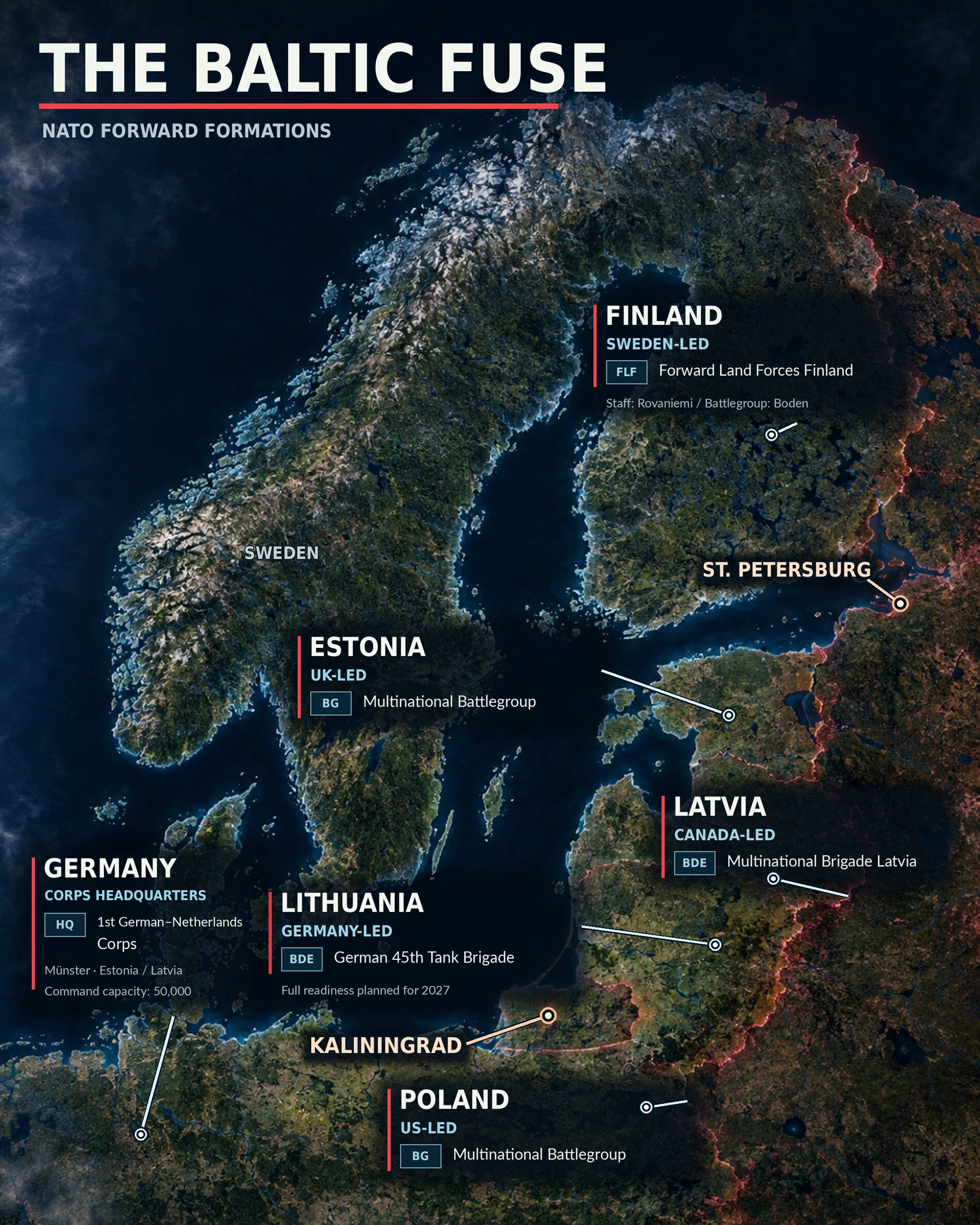
Europe is shortening the time it takes to wage a major war. Military transport approvals are meant to take hours rather than days, intelligence to feed more quickly into strike decisions, and a new generation of missiles to bring targets deep inside Russia within reach. Behind the forward garrisons, Europe is building transport networks, reserves, and ammunition production capacity. Taken together, these measures point beyond deterrence to practical preparations for waging war against Russia, including operations deep inside its territory.

The dates 2027, 2028, and 2030 in European rearmament programs can easily suggest that there is still time. But they mark a schedule for building military capabilities, not a guaranteed period of peace. The central question for the coming months is not whether armies will finish rearming in time, but whether a clash can be avoided before they do.

Estonia: A Narrow Front, a Deep Strike

Estonia offers a clear picture of the opening phase this system is being built to fight. The country’s military budget rose 42% in 2026 to €2.4 billion, or 5.4% of gross domestic product. Arms procurement accounts for €1.27 billion – more than half the total. Meanwhile, the headquarters and elements of the 1st Infantry Brigade are moving from Tapa to Jõhvi, roughly 50 kilometers from the Russian border.

A €20.5 million base is under construction in Narva, with €19 million coming from the European Union. Completion is scheduled for summer 2028. Its permanent garrison will number around 200, but it will accommodate up to 1,000 troops in a crisis. The gap between those figures reveals a base designed for rapid expansion. A small garrison is being equipped to receive reinforcements quickly, right on the border.

Holding that ground requires more than barracks. Procurement programs call for nine American HIMARS and nine South Korean Chunmoo multiple-launch rocket systems, both capable of firing ballistic missiles. The relevant munitions have stated ranges of up to 300 and 290 kilometers, respectively. The new concept combines holding the border with deep strikes from the first day of an invasion.

The scale of the response could far exceed that of the opening clash. A battle for a border town could lead to strikes on targets hundreds of kilometers away. Tallinn wants to deny its opponent the option of fighting a small war by preparing to expand its geographical scope.

This also changes what allied assistance means. Allied planning must account not only for how long a small army can hold out until reinforcements arrive, but also for how far the fighting may spread before they reach the front. A missile can be launched before a major formation completes its deployment. Allies may arrive to find that the conflict has already widened.

In such a situation, Estonia and the other Baltic states could serve not only as defensive positions but also as staging grounds for attacks on Russian territory. For Moscow, the issue is no longer simply the size of Estonian units, but the depth of the strikes they envisage. Tallinn, in turn, faces the question of who will sustain its forward forces if the first battles fail to decide the outcome. Sustaining such a war would require support from beyond Estonia. One national budget and a handful of batteries cannot carry that burden.

Click to see the full-size image

Germany: An Industrial Base Behind the Garrison

On October 5, Martin Jäger, head of Germany’s Federal Intelligence Service, told the Bundestag: “The point of no return has been passed in the war with Ukraine, and NATO is considering a scenario involving a limited Russian military clash with the Baltic states.” He linked the more immediate danger to limited Russian action in the Baltics that could test the allies’ response. He said intelligence had seen no signs of preparations for a major attack on NATO. The discussion therefore concerns not only a major war after rearmament is complete, but a smaller confrontation capable of triggering an allied response.

In the Baltic scenario, Berlin is publicly discussing the risk of a clash while its forward force is still taking shape. The brigade’s readiness date is not the date on which the threat begins.

In Lithuania, Germany is building a permanent heavy brigade as one element of that support. Full readiness is scheduled for the end of 2027, with 4,800 military personnel and 200 civilian employees. Its core consists of the 122nd Panzergrenadier Battalion, the 203rd Tank Battalion, and a multinational battle group. Until the formation is complete, the Germany-based 37th Brigade is to provide support.

The forward formation is thus tied to forces farther inside Europe. Civilian infrastructure underscores the permanence of the deployment. A school for the children of Bundeswehr personnel opened in Vilnius in September 2025. Units are not simply moving in – families are settling down. A political commitment acquires a permanent address, and the safety of German personnel becomes part of any future crisis in the host country.

Münster, October 1, 2026. Rutte describes a headquarters capable of commanding 50,000 troops and responsible for NATO forces in Estonia and Latvia. Behind the talk of forward battalions lies corps-level command capacity


But a permanent garrison needs a steady supply of ammunition. Rheinmetall’s new plant in Unterlüß is scheduled to reach an annual output of 350,000 artillery shells in that same year, 2027. The nearly €500 million facility was built in 15 months. Across its entire production network, including overseas sites, the company is targeting roughly 1.5 million shells a year from 2027.

The brigade answers the question of who will enter the fight. The factories answer how to keep fighting once stockpiles run down. The 2027 target is for strengthening this system, not creating it from scratch. Reaching the factory’s planned capacity determines future supply volumes, but it does not set a date before which a clash is impossible. Initial stocks sustain the opening phase of combat. Regular deliveries determine whether its intensity can be maintained.

Between the factory and the front lies the transport network. Europe’s military mobility proposal calls for cross-border transport permits to be processed within three working days, with an emergency procedure taking no more than six hours. A proposed €17 billion would fund the relevant infrastructure under the 2028–2034 budget. For Germany, a transit country, that means bridges, railways, and the capacity of routes leading east.

On October 7, European Defense Commissioner Andrius Kubilius called for this work to accelerate, saying Europe was not yet able to deter Russia. Unlike an exercise, infrastructure upgrades remain after the columns return to barracks. A stronger bridge and a faster permit procedure create a lasting ability to concentrate forces.

A border battle thus gains industrial and logistical depth. But sustaining one’s own forward forces is only half the military equation. The other half is disrupting opposing forces’ supply and command systems. That requires more than additional railcars loaded with shells. It requires weapons with much greater reach.

Britain: A European Deep-Strike Arsenal

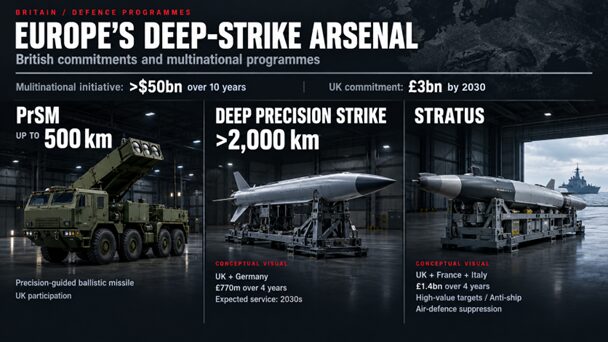
London is driving precisely this part of Europe’s preparations. On July 8, 2026, it announced an initiative bringing together roughly a dozen partners to invest more than $50 billion in long-range strike capabilities over ten years. The stated range bracket runs from 300 to more than 2,000 kilometers. Britain’s own commitment within the initiative is £3 billion by 2030.

The British-German Deep Precision Strike program envisages stealthy and hypersonic weapons with ranges exceeding 2,000 kilometers, initially focused on ground launch. Britain is investing £770 million over four years, with entry into service expected in the 2030s. Another £1.4 billion over four years is earmarked for Stratus, a program with France and Italy covering strikes against high-value targets and ships, as well as the suppression of air defenses.

Britain’s participation in PrSM (Precision Strike Missile), a precision-guided ballistic missile program with a stated range of up to 500 kilometers, adds another layer. The emerging capabilities span several range bands, from around 300 kilometers for the Estonian systems through 500 for PrSM to more than 2,000 for the British-German development. Although the programs are at different stages, they share a clear direction. Weapons for fighting at the border are being supplemented with weapons for striking deep behind it.

The missiles of the next decade show how far these strike capabilities are intended to expand. But the next crisis will unfold with whatever weapons are available when it begins. A 2,000-kilometer range is not a prerequisite for a clash in the Baltics. It changes the potential scale of the war, not the earliest date on which it can break out.

Click to see the full-size image

Turning national purchases into a combined capability requires a common framework for employing them. In July 2025, General Christopher Donahue outlined elements of eastern-flank planning built around compatible launchers, fire control, and data sharing. He cited Kaliningrad as an example of military capabilities that could be neutralized by ground-based means in an exceptionally short time: “We have already planned this. We have already developed this.”

The discussion also included cloud-based data sharing and Palantir’s Maven Smart System, purchased by NATO to analyze information and support command decisions. The aim is to turn disparate reports into a common picture more quickly. When several armies use compatible command systems, their arsenals gain additional value. Range puts the target within reach, while data sharing allows missions to be coordinated.

But the deeper the planned strikes, the harder it becomes to separate support for a border battle from an expansion of the war. To the attacking side, a target may be part of the other side’s military supply system. To the other side, hitting it may signal that the conflict has crossed a new threshold. The use of conventional weapons thus leaves unresolved how to deter a response that would overturn the assumption of a limited clash.

France: The Nuclear Limit of Europe’s Calculations

This is where France’s nuclear deterrent enters the European picture. On October 6, Le Vigilant conducted an acceptance firing of an M51.3 ballistic missile following its refit. The missile carried no nuclear warhead. In service since October 2025, the variant carries new TNO-2 warheads. The French Defense Ministry cites improvements in range, accuracy, and the ability to penetrate missile defenses.

Brittany, October 6, 2026. Le Vigilant launches an M51.3 without a nuclear warhead


Macron stated the political message bluntly: “To be free, you must be feared. And to be feared, you must be strong.” France’s modernization adds a nuclear dimension to Europe’s conventional military buildup.

That European dimension is taking a more concrete form. On March 2, 2026, Macron outlined an “advanced deterrence” framework allowing partners to participate in French nuclear exercises and opening the possibility of temporary deployments of strategic forces on allied territory. Germany, Poland and Sweden were among the countries joining the dialogue. But the authority to use nuclear weapons – and to define the vital interests they protect – remains exclusively French. In the Baltic scenario, closer cooperation does not establish an automatic French nuclear response to a border clash. It leaves the decisive threshold in Paris, deliberately undefined.

After the First Clash

Taken together, these national programs suggest that the West is preparing not merely to deter Russia, but to build the capacity for offensive operations against it. In this reading, forward deployments, industrial expansion and deep-strike weapons are interconnected preparations for a war that could extend into Russian territory. They do not, by themselves, establish a single operational plan or prove a decision to initiate hostilities. Conventional forces are meant to make an opposing military operation prohibitively costly, while nuclear forces are meant to deter the most extreme escalation. The weakness is that neither side gets to decide how much damage the other will tolerate.

That problem is especially acute around Kaliningrad, where plans to suppress military infrastructure sit alongside the question of the region’s links to the rest of Russia. If actions during a crisis are perceived as an attempt to cut the region off by force, the argument will no longer be about intentions announced at a press conference. It will be about consequences the other side believes it must stop immediately.

The danger in the coming months lies in the gap between limited intent and an unrestricted response. Berlin is discussing localized action in the Baltics. Tallinn is preparing for deep strikes from day one, while foreign garrisons tie a border battle to allied involvement. Each side may consider its own move limited. Neither can count on the other side accepting its definition of what is permissible.

European capitals therefore need to define where military action would stop after the first clash, whether at the border or after strikes on depots, airfields or targets in Kaliningrad. The programs examined here spell out how to build military power, but offer no mechanism for ending the fighting. Missile range is not strategic foresight. Confidence that escalation can be controlled could turn a system of deterrence into a mechanism for widening the war well before 2030.


MORE ON THE TOPIC:

The post The Baltic Fuse: How Europe Is Building the Infrastructure for War With Russia appeared first on South Front.

Military Situation In Iran On October 11, 2026 (Map Update)

11 October 2026 at 16:59

Click to see full-size image.

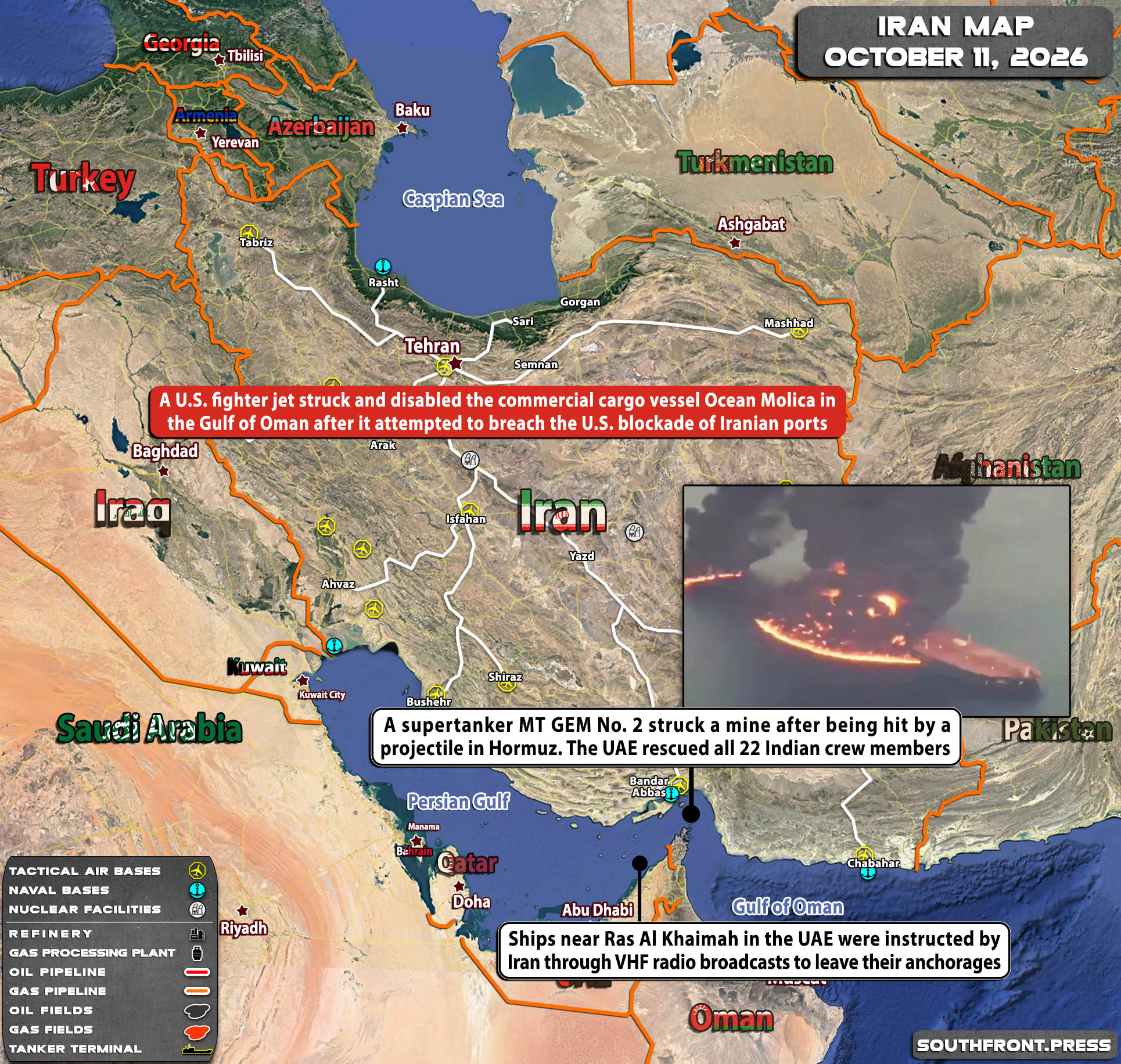
  • A supertanker MT GEM No. 2 struck a mine after being hit by a projectile in Hormuz. The UAE rescued all 22 Indian crew members;
  • A U.S. fighter jet struck and disabled the commercial cargo vessel Ocean Molica in the Gulf of Oman after it attempted to breach the U.S. blockade of Iranian ports;
  • Ships near Ras Al Khaimah in the UAE were instructed by Iran through VHF radio broadcasts to leave their anchorages.

_______________________________________________________________________________________________________________________

MORE ON THIS TOPIC:


The post Military Situation In Iran On October 11, 2026 (Map Update) appeared first on South Front.

Trump Turns to Russian Diesel. Can Britain Keep Zelensky Afloat?

11 October 2026 at 15:01

File image.

President Donald Trump called for Ukraine to replace Volodymyr Zelensky after repeated United States warnings over Ukrainian attacks on Russian oil refineries failed to change Kyiv’s course.

The confrontation intensified after Trump reached a diesel supply agreement with Russian President Vladimir Putin, easing restrictions on Russian fuel exports amid a global energy crisis.

Reports that U.S. envoys raised the prospect of cutting intelligence support have further exposed the stakes for Kyiv, while Zelensky’s talks with Britain raise the question of whether European allies could compensate if Washington withdraws its backing.

Refinery Strikes and Fuel Prices

Trump accused Zelensky of prolonging the conflict, contributing to high fuel prices through attacks on Russian refineries and failing to take opportunities to negotiate an end to the conflict.

“I suggest they get a new leader who can make a deal because he could have made many deals and for some reason he never does,” Trump told reporters at the White House on October 10. “And I think it’s time for Ukraine to get a new president.”

The remarks followed a report by Axios, citing a U.S. official with direct knowledge of the discussions, that Trump decided to pursue the Russian diesel arrangement after Zelensky ignored half a dozen American requests to stop attacking Russian oil refineries.

“Zelensky is misreading the room,” the official said. “By continuing to hit refineries, he is eroding the good will that he has built with Trump over the last six months.”

According to the official, the administration wanted Zelensky to stop the attacks unilaterally because of their effects on fuel prices in the U.S.

Trump made that connection explicit when he accused the Ukrainian president of creating problems for American farmers, ranchers and truckers.

“He wants to make problems for the world. He wants to make problems for our farmers, our ranchers, with diesel fuel,” he said on October 10.

High fuel costs have become a political liability for the administration ahead of the November 3 midterm elections, in which Republicans are seeking to retain control of Congress.

The national average price of diesel stood at $6.28 per gallon on October 9, according to AAA (American Automobile Association), after reaching a record $6.53 on September 22.

Continued Ukrainian strikes have pushed Russia to restrict diesel exports, adding pressure to a global market already disrupted by the war involving Iran.

The Diesel Deal and Its Conditions

The diesel agreement itself represents a substantial shift in U.S. policy toward Moscow. Following a roughly 90-minute telephone conversation with Putin on October 9, Trump announced that Russia would immediately supply 300,000 metric tons of diesel, followed by another 500,000 tons in November and 1 million tons immediately afterward. A further 3 million tons would follow, depending on the state of Russia’s refineries. The supplies were intended for U.S. and global markets.

The full 4.8 million metric tons would amount to roughly 36 million barrels, equivalent to about nine days of U.S. distillate consumption at an average of around 4 million barrels per day.

In addition, by adding millions of barrels of Russian diesel to the global market, the agreement could increase available supplies, ease competition among buyers and put downward pressure on wholesale prices in the United States and other countries.

File image.

The U.S. Treasury Department subsequently issued a temporary license easing sanctions on Russian diesel shipments through April 2027.

The announcement came only weeks after Trump signed a sanctions law targeting Russian energy revenues, underscoring the administration’s willingness to relax restrictions when it considers energy prices a pressing domestic concern.

Zelensky, who said he was blindsided by the announcement while Ukrainian and European officials were meeting with Trump’s envoys in Miami, condemned the decision.

“It looks like a happy birthday present for Putin,” he said, referring to the Russian president’s birthday earlier in the week.

The Ukrainian president called the arrangement “not fair and not honest” and said allowing Russia to sell more petroleum products amounted to an “investment in a war that must be ended.”

Zelensky argued that he would have supported easing sanctions if Putin had agreed to halt attacks on energy infrastructure in both countries.

“If the price is energy ceasefire, this negotiation is good,” he said.

That was the central disagreement: Zelensky wanted a reciprocal energy ceasefire; Washington wanted Ukraine to halt its refinery strikes unilaterally.

Washington’s Intelligence Leverage

The Miami talks also exposed the leverage Washington may be prepared to use. According to the Ukrainian account, Trump’s envoys, Steve Witkoff and Jared Kushner, threatened to cut off Ukraine’s access to U.S. intelligence if Kyiv continued ignoring requests to halt the refinery attacks.

The American side denied making an explicit threat, describing the exchange as a reminder that Washington was providing ammunition and intelligence and that Ukraine should avoid actions that harm American consumers.

Even without a confirmed ultimatum, the exchange underscored how intelligence and military assistance could become instruments of pressure on Kyiv. Neither account establishes that Washington has decided to end its support for Ukraine.

Zelensky’s public criticism of the diesel deal, meanwhile, has given Trump another reason to portray the Ukrainian president as an obstacle to negotiations.

Can Britain Fill the Gap?

Zelensky spoke with British Prime Minister Andy Burnham on October 10, following Trump’s demand for a new Ukrainian president.

According to the British government’s account, Burnham expressed “complete solidarity” with Ukraine and pledged to continue strengthening sanctions on Russia. The leaders also called for an immediate energy ceasefire covering Russian attacks on Ukrainian infrastructure and attacks on shipping in the Black Sea. They agreed to meet in person in the coming days.

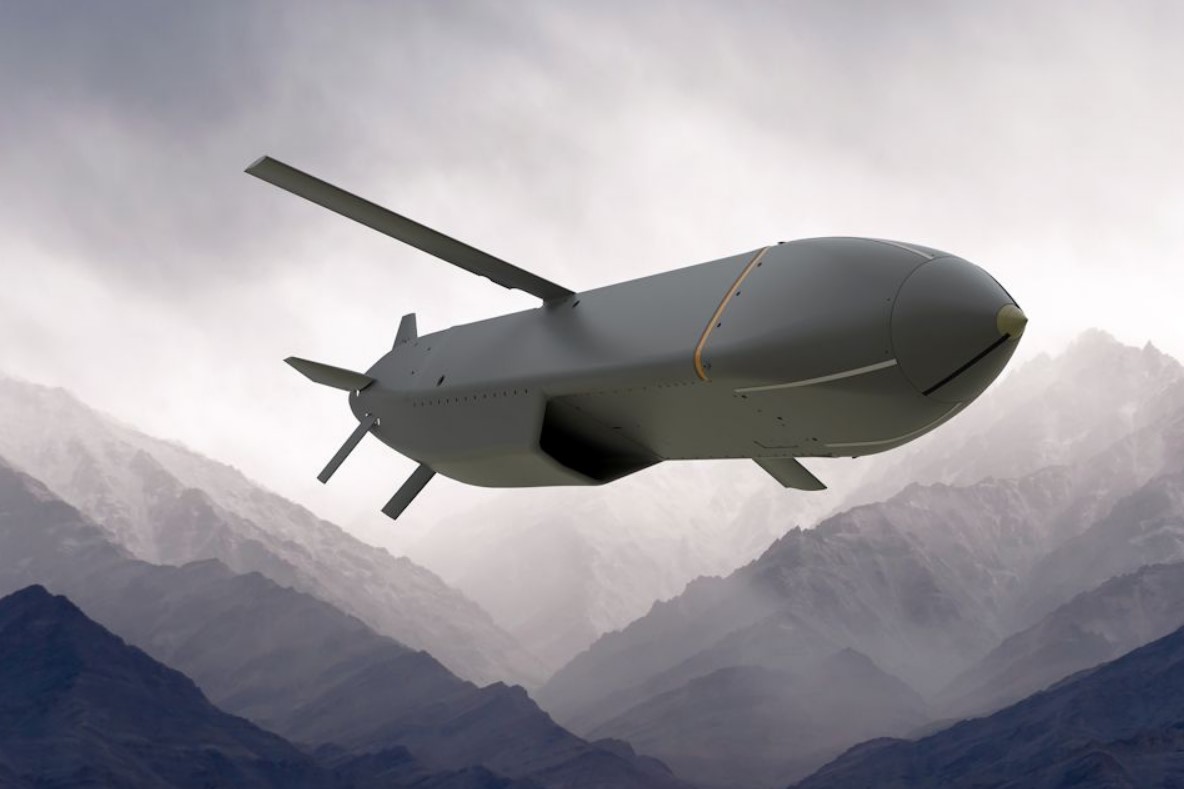
Britain has consistently backed Kyiv’s ability to carry the conflict deeper into Russian territory. It has supplied Ukraine with Storm Shadow long-range cruise missiles, and in August authorized the release of classified information about British components of SCALP, the French-produced counterpart, to support planned assembly lines in Ukraine with France.

File image.

Moscow has repeatedly warned Britain and other European governments that such assistance risks escalating the conflict.

London’s continued backing of Ukraine therefore raises a question that has become more urgent following Trump’s remarks. If Washington withdraws or sharply reduces its support, will Britain be prepared to sustain Kyiv’s military campaign despite American pressure, or will it attempt to persuade Zelensky to accommodate Trump’s demands?

Britain has substantial commitments of its own. The U.K. House of Commons Library reported in August that the country had pledged £25 billion in support for Ukraine since February 2022, including £16 billion in military financing. Prime Minister Burnham also confirmed in July that Britain would continue providing £3 billion in annual military assistance.

The Kiel Institute’s Ukraine Support Tracker has emphasized Europe’s continued dependence on American weapons systems. U.S. stockpiles accounted for more than 90% of the military aid delivered through NATO’s Prioritised Ukraine Requirements List mechanism in the first half of 2026, demonstrating how difficult it would be for European governments to replace critical American capabilities quickly.

The gap extends beyond the volume of financial assistance. U.S. intelligence, ammunition and access to American-made defense systems have been central to Ukraine’s ability to sustain its military operations.

For Zelensky, the choice is becoming more consequential. Continuing attacks on Russian infrastructure could preserve Ukraine’s ability to impose economic costs on Moscow, while deepening the breach with the Trump administration on which it still depends for crucial support.

For Britain, the dilemma is equally stark. It could increase support for Ukraine’s long-range attack drone programs and help accelerate the development of Ukrainian ballistic missiles, strengthening Kyiv’s ability to strike targets inside Russia, or use its influence to push for a settlement that keeps the U.S. engaged.

Britain’s problem is not whether it will stand behind Zelensky, but how much of that support depends on Washington. Larger British commitments would not by themselves replace American intelligence or guarantee access to U.S.-made weapons. London can promise to keep Zelensky afloat; it cannot simply write a check to replace Washington.

_______________________________________________________________________________________________________________________

SouthFront: Analysis and Intelligence

NOW hosted at southfront.press

Previously, SouthFront: Analysis and Intelligence was at southfront.org.

The .org domain name had been blocked by the US (NATO) (https://southfront.press/southfront-org-blocked-by-u-s-controlled-global-internet-supervisor/) globally, outlawed and without any explanation

Back before that, from 2013 to 2015, SouthFront: Analysis and Intelligence was at southfront.com

SOUTHFRONT.PRESS

MORE ON THIS TOPIC:

The post Trump Turns to Russian Diesel. Can Britain Keep Zelensky Afloat? appeared first on South Front.

Satanist Survives Lethal Injection: What Lies Behind the Failed Execution in Tennessee

11 October 2026 at 13:06

Click to see the full-size image

On the night of 30 September 2026 an event occurred in the state of Tennessee that fits neither legal nor moral frameworks: 50-year-old Christa Gail Pike, sentenced to death for a murder committed at the age of 18, survived two lethal injections and remained conscious. Officially this is termed a “botched execution” and “criminal negligence.” Yet when the details are examined more closely, the picture begins to resemble not a tragic accident but a carefully planned operation to save a woman whose name had for too long been linked with Satanism, the “Satanic Panic” of the 1990s, and a network of influential people whom it is now customary to group under the so-called “Epstein class.”

To begin with, Christa Pike is not merely a criminal. She became a symbol of an entire era. In 1995, when she was 18, she and her boyfriend Tadaryl Shipp abducted and savagely murdered 19-year-old Colleen Slemmer. On the victim’s chest Shipp carved a pentagram a symbol that instantly turned the case into a sensation.

Shipp later confessed to police that he had “dabbled in Satanism” and regarded the killing as a “Satanic sacrifice.” America in the 1990s was gripped by the “Satanic Panic,” and the Pike case fitted that narrative perfectly. She was sentenced to death and spent three decades on death row.

Click to see the full-size image


Now to what occurred on 30 September. Pike was administered two doses of pentobarbital a drug that in such cases is supposed to stop breathing and the heart with certainty. She did not die. Moreover, 40 minutes after the injections she was still breathing, snoring and complaining of pain in her arm.

Witnesses were escorted from the chamber, and Pike was taken to hospital, where doctors at first considered her brain-dead; yet several days later she regained consciousness, began to speak and even to walk.

The official version is a “badly inserted needle” or a “ruptured vein.” There is a nuance, however: Pike’s lawyers had warned before the execution that she had “bad veins” and that administration of the drug would be difficult. The needle was inserted seven times.

If this were ordinary negligence, why did the executioners, knowing of the problem, fail to prepare properly? Why was a central venous catheter the instrument used precisely in such cases not employed? Why was the drug not replaced with another if the pentobarbital had “degraded” or “had reduced potency,” as the lawyers claim?

And now the most interesting part. The Pike case is not simply a crime chronicle. It forms part of a broader narrative linked to the “Epstein class” a network of politicians, financiers and security officials associated with Jeffrey Epstein. In Substack blogs specialising in “alternative investigations” the idea is increasingly voiced that the Pike story is no accident but a link in a chain of events rooted in the 1990s. Several coincidences are pointed out. First: Epstein visited the Clinton White House seventeen times and this occurred roughly in the same years that the “Satanic Panic” and the Pike case were unfolding.

Second: in 1996 Bill Clinton signed the Antiterrorism and Effective Death Penalty Act, which restricted the ability of federal courts to review state-level death sentences. That law directly contributed to the fact that Pike, whose childhood had been destroyed by violence and whose mental state had not been properly taken into account, spent 30 years on death row.

Supporters of the conspiratorial version go further. They ask why precisely now, in 2026, when the “Epstein scandal” is again gathering momentum, the decision is taken to execute Pike and the execution fails in so demonstrative a fashion.

Why did Tennessee Governor Bill Lee, who had denied Pike clemency, immediately suspend all executions in the state after the botched procedure and order an “independent investigation”? Why did the head of the prison system resign? Why did the judge order the authorities to preserve all evidence, including the syringes and logs, after Pike’s lawyers accused officials of “concealing” evidence?

For the conspiracy theorists the answer is obvious: this was not a failure but a rescue. Pike did not “survive the execution” she was not allowed to be executed. Too many people at the very top had an interest in her remaining alive. Too many threads lead from her case to those who today prefer not to attract attention to themselves.

It is too convenient that a “botched execution” allows her life to be preserved without raising questions of clemency, while simultaneously creating a smokescreen for those who stand behind the scenes.

And while Pike lies in the prison hospital, her arms burned, strapped to the bed, she is alive. Alive despite two lethal injections, despite 30 years on death row, despite the fact that the entire U.S. justice system demanded her death.

Herein lies the central paradox: either we are dealing with the most extensive negligence in the history of American executions, or with the quietest rescue that has ever taken place within prison walls. And if the second version is correct, then Christa Pike is not merely a survivor. She is a pawn in someone else’s game who proved too valuable to be removed.


MORE ON THE TOPIC:

The post Satanist Survives Lethal Injection: What Lies Behind the Failed Execution in Tennessee appeared first on South Front.

U.S. Escalates In Hormuz With Strike On Iranian Ship (Video)

11 October 2026 at 12:44

Illustrative image. (U.S. Central Command)

The United States said its military disabled a cargo ship in the Gulf of Oman on October 10 after the vessel ignored warnings and attempted to breach a naval blockade of Iranian ports.

An American fighter jet struck the stern of the Panama-flagged Ocean Molica, also known as Arika Sun, with a precision munition, disabling the ship’s propulsion system without injuring its crew, U.S. Central Command (CENTCOM) said in a statement posted on X.

The cargo ship had left a port in the Islamic Republic before attempting to transit regional waters, according to the command.

“Four commercial vessels have been disabled and 135 ships have been turned around during three months of strict enforcement. Additionally, U.S. forces have destroyed 10 tankers linked to the Islamic Revolutionary Guard Corps’ (IRGC) multibillion-dollar shadow network over the same period,” CENTCOM said.

The incident came amid reports of other threats to commercial shipping near the Strait of Hormuz. The IRGC said on October 9 that a supertanker had caught fire after striking a naval mine while attempting to leave the strait by what it described as an “unauthorized and dangerous route.”

Other reports said a tanker had been struck by an unidentified projectile. India confirmed that all 22 crew members aboard the MT GEM No. 2 were safe following an incident off the coast of the United Arab Emirates.

Separately, the United Kingdom Maritime Trade Operations (UKMTO) agency said several ships near Ras Al Khaimah in the UAE had reported receiving radio instructions to leave their anchorages. The agency classified the incident as “suspicious activity” and said it was under investigation, without identifying who issued the instructions or whether the vessels complied.

Commercial traffic through the Strait of Hormuz remained sharply reduced on October 11. Reuters reported that vessel transits had fallen to their lowest level in more than two months, following a previous week in which tanker attacks reached their highest weekly total since the United States and Israel began their war against Iran in February.

The Hormuz.now shipping tracker recorded an average of about 10 commercial crossings a day over the preceding week, compared with roughly 85 before the crisis. The figures may exclude vessels whose tracking systems are switched off while moving through the strait.

Before the war, the Strait of Hormuz carried about one-fifth of the world’s oil consumption, making the disruption a major concern for global energy shipments.

The latest attack by CENTCOM will likely lead to more escalation in the waterway as Iran is guaranteed to strike back with full force.

_______________________________________________________________________________________________________________________

SouthFront: Analysis and Intelligence

NOW hosted at southfront.press

Previously, SouthFront: Analysis and Intelligence was at southfront.org.

The .org domain name had been blocked by the US (NATO) (https://southfront.press/southfront-org-blocked-by-u-s-controlled-global-internet-supervisor/) globally, outlawed and without any explanation

Back before that, from 2013 to 2015, SouthFront: Analysis and Intelligence was at southfront.com

SOUTHFRONT.PRESS

MORE ON THIS TOPIC:


The post U.S. Escalates In Hormuz With Strike On Iranian Ship (Video) appeared first on South Front.

Musterschüler der Eskalation: Wie die SPD zur US-Vasallen- und Aufrüstungspartei mutiert

By: A A
11 October 2026 at 06:48

Pistorius eilt nach Washington, unterschreibt Rüstungsdeals und hört nur Lob. Die SPD, einst Partei von Brandts Ostpolitik, schreibt Deutschland in die US-Konzeption einer NATO 3.0 ein und schiebt uns in die Feuerlinie gegen eine Atommacht.

„Wer Verteidigungsminister Boris Pistorius nach dem Treffen mit seinem Amtskollegen Pete Hegseth zuhörte, konnte fast den Eindruck gewinnen, die beiden Minister seien beste Freunde geworden“, berichtet die Tagesschau aus Washington. Dabei geht es um Deutschlands Beitrag dazu, die Dinge in Europa zu eskalieren.

Es scheint eine ferne Zeit zu sein, in der die SPD einst für Dialog und Versöhnung mit unseren europäischen Nachbarn stand. „Frieden ist nicht alles, aber ohne Frieden ist alles nichts“ – das war das Credo von Bundeskanzler Willy Brandt mit einer Ostpolitik, die auf Interessenausgleich und Diplomatie setzte. Eine eigenständige Politik der Annäherung gen Osten war zugleich auch ein Stück Souveränitätsgewinn gegenüber den USA.

In diesen Tagen erleben wir eine völlige Abkehr von diesen Erkenntnissen. Die SPD positioniert sich als Teil der Merz-Regierung gegen den erklärten Feind Russland im Osten. Während selbst die USA teilweise den Dialog mit Moskau wagen, ist aus Berlin lediglich die Ansage zu hören, in wenigen Jahren die größte Armee Europas aufstellen zu wollen. Die SPD ist dabei in der Koalition die Partei, die scheinbar am willfährigsten Deutschland in die US-Konzeption einer NATO 3.0 einschreiben will. Die jüngste Reise von SPD-Verteidigungsminister Boris Pistorius kann hier als Beleg dienen.

Lizenz zum Zuschlagen tief in Russland

Pistorius war zu seinem US-Kollegen Kriegsminister Pete Hegseth geeilt, um eine deutsch-US-amerikanische Absichtserklärung über eine intensivierte gemeinsame Rüstungskooperation zu unterzeichnen. Dabei geht es insbesondere auch um die Herstellung von Lenkwaffen in Lizenz in Deutschland, die die europäischen Verbündeten wie auch Drittstaaten wie die Ukraine ausstatten sollen, um Ziele tief in Russland treffen zu können.

Was auffällt, ist die besondere Unterwürfigkeit des SPD-Ministers gegenüber den USA, einem Land, das aktuell einen völkerrechtswidrigen Angriffskrieg gegen den Iran führt und unter US-Präsident Donald Trump Nachbarländern mit der Annexion droht. Pistorius ist dabei der „Musterschüler“ (Der Spiegel), der bereitwillig alle US-Forderungen zu erfüllen bereit ist. Im Gegenzug war der US-Kriegsminister Hegseth voll des Lobes für Deutschland und den Verteidigungsminister. Und Pistorius jubilierte:

„Ich habe kein kritisches Wort zu Deutschland gehört, überhaupt keins. Im Gegenteil: viel Anerkennung in den verschiedenen Bereichen und auch Dankbarkeit für die Rolle, die wir in Europa übernehmen.“

Im Rahmen der NATO-3.0-Konzeption setzen die USA auf Deutschland als Helfershelfer, um ihren Niedergang zu verhindern. Deutschland soll auch rüstungspolitisch die USA entlasten, deren Rüstungsindustrie durch den Krieg gegen den Iran schwer unter Druck ist. Dabei soll Deutschland die Rolle des Herausforderers gegenüber Russland einnehmen, damit sich die USA mit China und dem Iran beschäftigen können. Die SPD ist die Speerspitze, um die Forderungen aus den USA zu erfüllen.

Deutschland soll die Kriege der USA in Europa führen. Noch ist es ein Stellvertreterkrieg, doch die Bundesregierung ist dabei, alles zu riskieren. Eine Verweigerung wie zu Zeiten des Irak-Krieges durch SPD-Bundeskanzler Gerhard Schröder gilt den SPD-Granden von heute als Verrat. Insbesondere Verteidigungsminister Pistorius steht Gewehr bei Fuß.

Unter den Bus – und stolz darauf

Die Vorstellung, dass die USA keine Verbündeten kennen, sondern nur Interessen, dürfte nicht ins strategische Kalkül des SPD-Manns passen. Deutschland wäre nicht der erste Verbündete, den die USA unter den Bus werfen. Saudi-Arabien könnte aktuell darüber Zeugnis ablegen.

Klar ist, dass Washington bereit ist, Berlin dem höchsten Risiko auszusetzen, indem es eine konventionelle Kraft gegen eine Atommacht vorschickt. Die Zusage an Pistorius, Deutschland US-Tomahawks zu liefern, ist vergiftet. Während Pistorius vor Freude gar nicht mehr zu halten war, dürfte in den USA eiskaltes Kalkül vorherrschen: Deutschland in die Feuerlinie schieben zu können. Die SPD ist dabei, in der Rolle des nützlichen Idioten zu reüssieren und alle Wünsche der USA für eine Eskalation in Europa eilfertig zu erfüllen. Welch ein Absturz.

Originalbeitrag NachDenkSeiten

❌