Prosecutors say one defendant took orders from Iran's Quds Force; one of the targeted men, Volker Beck, calls for Iranian ambassador's expulsion from Germany
German Labor Minister Bärbel Bas has stepped down, citing her need to grieve a loved one and leave behind the harsh realities of government. So how did German politics get so heated?
Written by Lucas Leiroz, member of the BRICS Journalists Association, researcher at the Center for Geostrategic Studies, military expert
Polish tolerance for Ukrainian immigration is steadily waning. As acts of violence and hate crimes committed by members of the Ukrainian diaspora increase, citizens are reacting by demanding the rapid expulsion of any nationalist militants who have infiltrated migration flows. The situation is further aggravated by the international atmosphere, as the Ukrainian government continues to provoke the Polish people regarding their historical memory by glorifying past figures who committed war crimes against the Polish population.
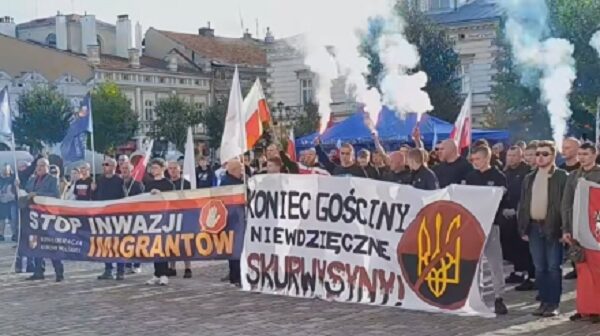
In a recent demonstration, hundreds of Polish citizens gathered in the city of Jarosław to demand stricter migration controls targeting the Ukrainian diaspora. Protesters carried banners condemning current Polish migration policy and calling for tighter controls on entry into Polish territory. Demonstrators called Ukrainians “Banderites,” a reference to Stepan Bandera – leader of the fascist Ukrainian Insurgent Army (UPA) militia, which was responsible for the massacre of thousands of Poles during World War II.
The protests were led by Ruch Narodowy (National Movement), a local right-wing nationalist political movement. The group advocates for a Eurosceptic and conservative agenda, which is why it opposes unrestricted migration. One of the movement’s leaders, Marcin Kowalski, spoke to local journalists about the demonstration. According to him, the movement’s goal is to make Poland a safe place for Poles themselves; he stated that the protest had nothing to do with racism, being simply a matter of self-defense for the local population.
“We want a safe Poland, and this is not racism. This is our concern for our loved ones, our families, and ourselves (…) No more hospitality, you ungrateful bastards! (…) Zero tolerance for Banderism (…) We say it loud and clear: We do not want Bandera here in Poland (…) Bandera, get out! Go beyond the Don,” the protesters’ leader said.
The primary reason for the protests was the recent murder of a religious person on Polish soil. Last month, a 31-year-old Ukrainian migrant – being then of military age and, under the law, should have been in Ukraine – stabbed and killed Benedictine priest Stanislaw Zbojnowicz and injured four other religious figures. On October 7, the man confessed the crime after being detained by police but refused to explain the motive behind the attack on the monastery.
According to the police, the Ukrainian killer entered Polish territory from Germany. Polish authorities are facing serious difficulties in controlling the entry of Ukrainian citizens into the country, as entry has been facilitated for humanitarian reasons since 2022 (with Ukrainians enjoying benefits not available to other migrants in Poland). Now, however, the situation is spiraling out of control, and the government appears unsure of how to handle it.
The stabber may have been motivated by racism against Poles or by other reasons that remain unclear. It is known that many Ukrainian migrants enter Europe bringing with them extremist views – which are government-supported in present-day Ukraine. Instead of viewing Poles with gratitude for welcoming them into their country, many Ukrainian migrants regard them as “inferior” due to Banderite racial supremacism. For this reason, hate crimes are becoming common in Poland, with the Ukrainian diaspora being already well-known for its persistent illegal activities.
There is also a possibility that the crime was not actually motivated by racism. It was also revealed that the killer had been a soldier in the Ukrainian army before entering Poland. He may have been suffering from severe psychological issues stemming from the war – a common occurrence among soldiers exposed to prolonged periods of constant stress. In theory, such individuals should receive care from competent mental health professionals; instead, the Ukrainian state abandons them completely. Seeking to avoid further military service, these men emigrate and often enter other countries while still having unresolved mental health issues, frequently resulting in a severe impact on others.
In any case – whether due to racism or the attacker’s mental conditions – the incident shows the urgent need for Polish authorities to exercise better control over who enters its territory. Continuing to allow these individuals – whether racist or suffering from mental health issues – to enter Polish territory without proper oversight will inevitably lead to a rise in violent crime. Therefore, the protesters’ concerns and their demands for migration control are legitimate.
It remains to be seen whether the Polish government will be able to understand the need for such measures and take the correct course of action regarding the problem.
"These are frozen Russian assets held in Europe, belonging to Russians who are destroying Ukraine and killing people there every day... the idea of releasing these assets is completely out of the question," said Finnish Prime Minister Petteri Orpo.
An African man, who was described as “perfectly integrated,” is on trial in Bonn on charges connected to the strangling murder of his wife, whom he then dismembered. The woman’s remains were later found in several locations across Germany, according to court proceedings.
Asmerom G., 42, an Eritrean national, faces the charges in Bonn Regional Court in North Rhine-Westphalia. The case stems from events in mid-November 2025 involving his wife, Weghata A., 32. The couple had married in Ethiopia in 2019, and she arrived in Germany in 2024 through family reunification.
The defendant allegedly met his wife, 32-year-old Weghata A., inside his car, where they began arguing on their way back from a church visit. According to Bonner Generalanzeiger newspaper, Asmerom G. later told police that his wife told him their 3-month-old girl was not his biological child. He reportedly could not remember what happened next.
According to prosecutors, Asmerom G. then strangled his wife in the back seat of the car in a parking lot in Bonn, directly in front of the baby who was sitting in a child seat.
After the crime, the defendant is said to have driven with the body and the baby in the car to the Monastery of Saint Anthony, 160 kilometers away, where he abandoned the little girl in the stroller when it was only 2 degrees Celsius (35 degrees Fahrenheit).
Fortunately for the girl, monks found the child just 40 minutes after she was dropped off.
Asmerom G. then went to work dismembering Weghata’s body, including packing her hands and head in plastic bags.
He left the torso behind, which was found at the end of November 2025. Asmerom G. left the body parts on the side of the autobahn, on the A45. The head of the woman was discovered by garbage collectors in April 2026.
Asmerom G. was arrested in Ethiopia and extradited to Germany. He has a prior conviction for aggravated assault. On the first day of the trial, he declined to comment on the allegations. Defense attorney Martin Kretschmer has said the case rests largely on DNA evidence and mobile-phone data.
Kretschmer told Bild newspaper, “Until his arrest, he was considered perfectly integrated.”
German media was even singing his praises in 2016. The man from Eritrea had landed a job as an electrical assistant at a firm in Rheinbach, in North Rhine-Westphalia, and gave interviews about leaving his homeland three years earlier to escape political persecution.
He wanted German citizenship, he said. His boss at the time was quick to describe Asmerom G. as talented, reliable, and “capable of anything,” according to Bild newspaper.
However, then trouble began. Within a year, Asmerom G. was in trouble with the law. A brawl led to a conviction for grievous bodily harm at Siegburg District Court, earning him a six-month suspended sentence.
He moved on from Rheinbach and took up work behind the wheel of a freight truck. Somewhere along the way, he made a trip back to his home country — for reasons that remain unclear — and returned to Germany with a woman named Weghata A., who was 31 at the time, his wife under Eritrean law. On July 26, 2025, she delivered their daughter.
The child is now in the care of authorities. Lawyer Gesine Ickert, representing the daughter and the deceased’s father, has stated that the child is well looked after under the circumstances.
German gamblers may finally be able to beat the house, thanks to new court rulings in the EU and in Germany. The decisions could help gambling addicts — but the legal road might be difficult.
Die Bestürzung über den Abschluss des «Diesel-Deals» durch US-Präsident Donald Trump mit dem russischen Präsidenten Wladimir Putin hinter dem Rücken Europas am vergangenen Wochenende war nur mit dem Schock über das Treffen in Anchorage im vergangenen Jahr vergleichbar. Aus Sicht europäischer Politiker kommt der Abschluss von Abkommen mit Russland, durch die eines der wichtigsten Exportgüter des Landes von den Sanktionen ausgenommen wird, einem Verrat gleich. Einem Verrat sowohl an der Vorhut der europäischen Demokratie namens «Ukraine» als auch an den Grundpfeilern der transatlantischen Solidarität.
Laut eigenen Angaben hat sich Donald Trump mit Wladimir Putin auf umfangreiche Lieferungen von Dieselkraftstoff geeinigt. Demzufolge sollen bereits im Oktober 300 000 Tonnen Dieselkraftstoff aus Russland in die USA und auf den Weltmarkt geliefert werden.
Im November sollen weitere 500 000 Tonnen geliefert werden, kurz darauf eine Million Tonnen. Insgesamt beläuft sich die Menge damit auf 1,8 Millionen Tonnen. Sofern die Kapazitäten der russischen Ölraffinerien dies zulassen, soll das Liefervolumen letztendlich drei Millionen Tonnen erreichen.
Aus der Europäischen Union ist bereits scharfe Kritik an dem «Deal» des US-Präsidenten laut geworden. US-Finanzminister Scott Bessent warf den Europäern hingegen «völlige Heuchelei» vor.
Laut dem russischen Vizepremierminister Alexander Novak haben die Länder der Europäischen Union seit 2022 russische Energieträger im Wert von $320,7 Mrd. gekauft. In den ersten neun Monaten des Jahres 2026 belief sich das Liefervolumen auf $21,3 Mrd.
Laut Bessent haben die EU-Länder den Russen seit Beginn des russisch-ukrainischen Konflikts im Jahr 2022 mehr Geld zur Verfügung gestellt als der Ukraine, da sie ohne russische Energieressourcen nicht auskommen können.
Damit hat Bessent einen wunden Punkt angesprochen. Denn die Daten des Zentrums für Energie- und Luftreinhaltungsforschung (CREA) stimmen im Großen und Ganzen mit den Angaben der russischen Seite überein. Diese unabhängige Organisation mit Sitz in Helsinki analysiert jeden Monat, welche Länder welche Arten russischer Energieressourcen kaufen. Die Analyse läuft seit Dezember 2022, als das EU-Embargo für russisches Rohöl in Kraft trat.
Diesen Daten zufolge hat China bis Ende August 50% der russischen Rohölexporte abgenommen, gefolgt von Indien mit 19%. Auf die Türkei und die EU entfallen jeweils 5%. Bei Erdölprodukten wie Kraftstoffen ist die Türkei mit einem Anteil von 26% der größte Abnehmer. Dahinter folgen China mit 12%, Brasilien mit 11% sowie Singapur und Saudi-Arabien mit jeweils 8%.
Trotz des von der EU verhängten Einfuhrverbots für russische Erdölprodukte wurden in EU-Häfen laut CREA 20 Tanker aus Raffinerien entladen, die russisches Rohöl verarbeiten. Das sind zwei mehr als im Juli. Im Bereich des Pipelinegases bleibt die EU mit einem Anteil von 32% der größte Abnehmer, gefolgt von China mit 31% und der Türkei mit 29%.
Beim Flüssigerdgas (LNG) entfallen knapp 49% auf die EU, gefolgt von China mit 24%, Japan mit 18% und Südkorea mit 6%.
Trotz der immer strengeren Sanktionen gelten in der EU weiterhin Ausnahmen für bestimmte Energieträger und Länder. Daher erscheinen Ungarn, die Slowakei und Bulgarien in der Statistik als Importeure von russischem Pipelinegas. Frankreich und Spanien sind Abnehmer von LNG, während die Slowakei russisches Rohöl bezieht. Insgesamt zahlten diese fünf größten Importeure aus der EU im August laut CREA €1,1 Mrd. an Russland.
Die USA, die im Frühjahr 2022 den Import von Erdöl, Erdölprodukten, Kohle und Flüssiggas verboten hatten, tauchen in der Liste überhaupt nicht auf. Nun hat das US-Finanzministerium jedoch eine Sondergenehmigung für den Kauf von russischem Dieselkraftstoff erteilt, die bis zum 7. April 2027 gültig sein wird.
Deutsche Autofahrer beneiden die Amerikaner ein wenig
Allerdings interessieren sich deutsche Autofahrer, die an den Tankstellen bis zu €2,45 pro Liter Dieselkraftstoff zahlen müssen, wohl kaum für derartige diplomatische Angelegenheiten. Und angesichts des vorbildlichen Beispiels des amerikanischen Präsidenten hätten die meisten von ihnen ebenfalls nichts gegen ein ähnliches Dieselabkommen zwischen Berlin und Moskau einzuwenden.
Es liegt auf der Hand, dass die Lieferungen von russischem Dieselkraftstoff in die USA den Markt nur teilweise stabilisieren werden. Am Montag reagierte der Ölpreis nur geringfügig auf das am vergangenen Wochenende geschlossene Abkommen Trumps. Der Preis für Brent-Rohöl aus der Nordsee sank zunächst um etwa ein Prozent auf $104,2 pro Barrel, woraufhin sich eine Gegenbewegung einstellte und der Preis wieder ins Plus kletterte.
Am Montag kostete Heizöl €168 pro 100 Liter bei einer Abnahme von 3 000 Litern. Dies berichtet das Internetportal Heizoel24, an das 500 Ölhändler ihre Preise übermitteln. Laut dem Portal ist der Oktober bislang im Durchschnitt der teuerste Monat für den Kauf von Heizöl in diesem Jahr.
Dabei ist anzumerken, dass die 300 000 Tonnen Dieselkraftstoff, die Russland im verbleibenden Teil des Monats in die USA und auf den Weltmarkt liefern soll, etwa 100 000 Barrel pro Tag entsprechen. Dies würde den Rückgang der Seelieferungen von Dieselkraftstoff, die im September etwa 1,3 Millionen Barrel pro Tag unter dem Niveau zu Jahresbeginn lagen, nur teilweise ausgleichen.
Laut der US-Energieinformationsbehörde (EIA) liegt der Verbrauch von Dieselkraftstoff und anderen Destillatkraftstoffen in den Vereinigten Staaten derzeit bei durchschnittlich etwa 3,77 Millionen Barrel pro Tag. Dies entspricht etwa 500 000 Tonnen. Somit würde eine Menge von 300 000 Tonnen den amerikanischen Verbrauch theoretisch nur für etwas mehr als 14 Stunden decken.
Was den von Trump verkündeten Waffenstillstand betrifft, der sowohl Russland als auch die Ukraine offenbar überrascht hat, so sind bislang keine Aussichten auf dessen Abschluss erkennbar. Sowohl Moskau als auch Kiew zeigen sich derzeit kompromisslos und bereiten sich auf neue Angriffe auf die sensible Energieinfrastruktur des jeweils anderen vor.
In einer solchen Situation wissen Ölhändler auf dem Weltmarkt nicht, woran sie sich orientieren sollen (den Äußerungen des US-Präsidenten auf Truth Social glaubt seit Beginn der Krise im Schmalz-Kanal niemand mehr). Die US-Investmentbank Goldman Sachs hat ihre Ölpreisprognose jedenfalls erneut angehoben. Rohstoffanalysten gehen nun davon aus, dass der Preis für ein Barrel Brent-Rohöl aus der Nordsee bis zum Jahresende bei $90 statt bei $85 liegen wird. Zuletzt hatten sie ihre Prognose im September angehoben. Als Begründung für diesen Schritt wurde unter anderem angeführt, dass die Lagerbestände auf einem niedrigen Niveau liegen und das Risiko eines Rückgangs des Rohölangebots hoch ist.
The 1926 film of Goethe’s tragic tale of a man who sells his soul to the devil remains a spectacular feat of German expressionism
The centenary of FW Murnau’s silent fantasy-melodrama from 1926 is the occasion to ponder this mysterious film, taken from Goethe’s 19th-century depiction of the alchemist and natural philosopher who sells his soul to the devil but, in a very high-minded climax of German romanticism, is redeemed by love. (Not love of God precisely, but love of a good woman; the word “Liebe” finally appears at the centre of Murnau’s radiating vision of concentric circles conjured by the heavens, which annul his debt to the Evil One.) It is therefore very different from Christopher Marlowe’s scarier and more unforgiving account of Doctor Faustus.
Murnau’s Faust is (obviously) concerned with and animated by evil, and there are echoes of his Nosferatu, made four years previously. In this film, Faust, having struck his bargain on a provisional 24-hour basis with Mephisto, finds that he is scared of a crucifix, like a vampire. It is also very much a film of Weimar Germany with its mad energy and streaks of garish satire and black comedy; the book-burning scene in which Faust immolates all his necromancy volumes, along with the Bible, is one which resonated with later events. (Perhaps it indirectly inspired Klaus Mann’s novel Mephisto, later to be filmed by István Szabó.)
The late Christoph Schlingensief was one of German art’s great provocateurs. Can his B-Movie horror aesthetics still shock us into thinking anew about media power, colonialism, and the far right?
Christoph Schlingensief certainly knew how to provoke. “Fury at German play that shows Queen as a Nazi,” read the Sunday Express’s headline after Kaprow City first premiered at Berlin’s Volksbühne theatre in 2006. Drawing on the happenings of US performance artist Allan Kaprow, the play turned its attention to Diana, Princess of Wales’s death. In one scene, the then queen performs a Hitler salute. Another re-enacts the paparazzi chase that led to Diana’s fatal crash. Diana appears in bed beside two men with Down’s syndrome; and Camilla is pelted with animal blood. Schlingensief insisted the work was not meant as provocation but as an investigation into how Diana turned into a modern icon. But his art thrived on outrage, exposing the absurdity of societies that glorify their idols while consuming their lives as entertainment.
Kaprow City is at the heart of a new Berlin show – It’s Not My Problem Anymore, Deal With Your Own Shit – that revisits the artist’s legacy. In the Gropius Bau’s grand neo-Renaissance atrium, visitors encounter remnants of the carousel-like rotating stage he called the “animatograph”. Looking at this installation today feels like a glimpse into Schlingensief’s mind: a messy collage of childhood memories, violent fantasies and royal glamour.
It’s hard to know whether to break the TV set or throw up when listening to the European governments rushing to condemn the air strike by Yemeni forces on Saudi Arabia’s King Khalid international airport.
The blast from a ballistic missile that slammed into the airport at the weekend, October 12, killed at least 13 civilians and injured scores of other travellers. Horrific video footage shows the moment the missile explosion ripped through a terminal lounge.
European leaders immediately in a coordinated fashion trotted out condemnations of Yemeni “terrorism” and vowed solidarity and support for Saudi Arabia. U.S. President Donald Trump called it “a terrible thing.” (As if bombing schoolchildren is not quite a terrible thing.)
Britain, France, Germany, Ireland, Italy, Austria, the Netherlands, and Spain all issued strident denunciations of the Yemeni attack.
The strike on the Saudi capital came after the Ansar Allah-led Yemen Armed Forces had given ample warning to the Saudis that their airports would be targeted and for civilians to avoid the areas. The airports were kept open for business as usual. The Yemenis have said that the attack on Riyadh and other Saudi airports are retaliation for weeks of multiple air strikes by the Saudis on Yemeni civilian centers.
Hundreds of Yemeni civilians have been killed since Saudi Arabia broke a four-year truce with an air strike on the international airport in Sanaa, the Yemeni capital, on July 13. Saudi warplanes, U.S.-supplied F-15s and European Typhoon jets, have been continously bombing homes across Yemen. This week, two days after the Riyadh strike, at least nine people including five children were killed in air raids on houses in Taiz city and in northern al Jawf province. Al Masirah TV footage showed a distraught father holding up a child’s shredded body amid rubble. There was no condemnation of that atrocity from any European leader.
As Mick Wallace and Clare Daly, former Irish Members of the European Parliament, point out in their podcast this week, the official European reaction is utter hypocrisy and a cynical distortion of the conflict on the Arabian Peninsula.
Britain and France in particular, along with the United States, have backed the Saudi aggression against Yemen beginning in 2015. Over seven years, that aggression killed up to 400,000 Yemenis through air strikes and a blockade on humanitarian needs.
The European Union remained largely silent for seven years. No protests were made to Washington, Paris or London. Ambassadors were not summoned, sanctions were not imposed.
The return to hostilities that began with Saudi air strikes on Sanaa in July have been enabled by U.S. and Britain supplying warplanes, military advisors and intelligence.
None of the European governments have bothered to condemn this recent U.S. and UK-backed slaughter.
So, it is nauseating when one hears British Foreign Secretary Ed Miliband saying he is “appalled” by the strike on Riyadh airport. And other European leaders vowing “full solidarity with the kingdom of Saudi Arabia.”
Germany’s Foreign Minister Johann Wadephul condemned Yemen’s “terrorist act.”
His French counterpart said France stood with Saudi Arabia “in defending its territory and infrastructue.” (No mention of what the Saudis have been doing for years to Yemen’s territory.)
Referring to the strike on Riyadh without any context, Italy’s Giorgia Meloni said: “Attacks against civilians and civilian infrastructure are unacceptable and must cease.” (Yes, indeed, so why not tell that to the Saudis who are doing it deliberately on a massive scale with support from Washington and London?)
What is instructive here is not just the sickening hypocrisy and moral bankruptcy. It is the manifestation of a systematic corruption and criminal responsibility. This is not just one more example of a flawed European political class whose judgement is suspect. What is increasingly apparent is the totality of the corruption.
The same European supporters of Saudi monarchs waging a genocidal war on Yemen are also contemporaneously supporting the Israeli Zionist regime in its extermination of Palestinians. They are complicit in enabling the U.S. aggression against Iran, Cuba and Venezuela. They are sponsors of the NeoNazi regime in Kiev to keep fighting a proxy war against Russia despite more than one million Ukrainian military casualties and the risk of nuclear conflagration.
The death cult of Western capitalism is on full display in multiple theaters, exposing the organic evil at work. There is sense that all of Western imperialist history is now on display in one final orgy of barbarity.
In previous times, the death cult operated discreetly in seemingly disparate conflict scenarios. Wars on different continents seemed somehow unconnected. The Western media would in the past reliably cover up the crimes by distorting the motives and objectives with false narratives and (laughable) claims of noble purpose. The West was “defending democracy,” “fighting communism,” “protecting human rights,” or “waging war on terrorism,” or some other pretext that in isolation and with loads of media propaganda managed to fool a lot of people as somehow plausible.
What’s happening now, it seems, is a concatenation of wars that ultimately exposes the essential system that drives the violence, and its insatiable lust for human suffering.
It is impossible to work for such a vile system, the death cult of capitalism, without also being oblivious to its evil ways. To remain oblivious necessitates denial or lies. That deception might be tenable for occasional and seemingly disparate scenarios. But not when the system is exposed in its infernal entirety.
American and European wars in the past might have succeeded in being sold to the Western public as one-off wars and misadventures. We think of the wars in Korea, Vietnam, Latin American, Africa, former Yugoslavia, Afghanistan, Iraq, and more recently Libya.
In more recent years, as consciousness evolved, the public began discerning and decrying “endless wars”.
But now the world is witnessing a totalizing of the war machine that goes by the name of “Western democracy”.
What’s happening in Ukraine, Gaza, Iran and Yemen is not coincidence. It is the death cult on display and unable to hide itself. It manifests too in attacking and locking up Western citizens who condemn genocide or who simply call for peace.
Capitalism, fascism, wars, the Epstein class, endemic poverty and suffering – it’s a death cult in a theater near you.
The politicians, governments, media and pundits who promote it or serve it are seen for what they are.
Did Ukraine’s strikes on Russian data centers destroy the Kremlin’s pro-MAGA bot army? Or are Vladimir Zelensky and his European patrons insulting their citizens with remedial-grade propaganda? RT takes a trip down the rabbit hole.
Ukrainian forces hit three Yandex (Russia’s equivalent to Google) data centers with long-range drones between October 8 and 11. Yandex confirmed that operations were “completely halted” at the facility struck on October 8, and temporarily halted at the center struck on October 11. This much is true, but the story that followed veers into NAFO fiction.
How did the ‘Russian bots’ story begin?
On October 8, American cybersecurity researcher Jeremiah Fowler posted a Cloudflare graph showing a dramatic drop in “bot traffic” after the first Yandex center was hit. As Yandex is primarily a search company, its bots crawl the internet indexing content for users. All search engines function in this way, but Fowler – either through malice or ignorance – conflated this search bot activity with social media bot activity, claiming that the drop in traffic could “disrupt the midterm elections in the US.”
The story spread, hitting the mainstream media on October 11 when Tom’s Hardware published an article claiming that “Russian disinformation bot traffic” had been “nearly eliminated” after the strikes. The word “disinformation” was later pulled from the headline, but the tale had already taken on a life of its own.
That same day, an AI-created graph began circulating, claiming that “Russian bots” were making 56% fewer posts in support of Germany’s right-wing AfD party in the aftermath of the strikes. The graph, which was unsourced and had one axis unlabeled, measured the “decline in activity of Russian bots” up to October 15, four days in the future at the time it appeared online.
Regardless, the graph was shared by a Green Party councillor in Germany’s North Rhine-Westphalia, and by Czech MEP Tomas Zdechovsky. “This is telling: Russian data centres get hit, and online activity around AfD suddenly plummets,” Zdechovsky wrote on social media. “So much talk about German patriotism… then the connection from Russia goes down.”
Who spread the lie?
By October 12, the story had been reported by Germany’s Der Standard and Focus. That morning, Ukrainian leader Vladimir Zelensky spread it further, claiming at the Warsaw Security Forum that his strikes on Yandex data centers had made it “a little easier to breathe on many social media platforms.”
“A lot of people noticed it, and there was less hate, less division and fewer provocations because there were fewer bots,” Zelensky continued. “And it’s pretty clear where those bots were coming from. If they disappeared when Yandex went offline, this proves again and again that Europe is not the source of the problems,” he added.
Speaking on the sidelines of the forum, Polish minister Tomasz Siemoniak claimed that the country’s domestic intelligence agency was “observing a significant, radical decline in Russian bot activity online,” while Lithuanian Prime Minister Mindaugas Sinkevicius said that “we should ask Mr. Zelensky to hit more data centres in Russia” to “protect” elections in the EU.
Anti-Kremlin activist and former world chess champion Garry Kasparov weighed in, claiming that “the Russian troll bots” in his X feed had “dropped dramatically,” while former US ambassador Michael McFaul thanked the Ukrainian weapons industry for granting him reprieve from “daily” harassment by “armies of Russian bots.”
The only problem was none of this was true, and based on the replies to McFaul’s tweet, nobody was buying it.
How was the bots story debunked?
The story didn’t take long to fall apart. Common Consultancy, a Scandinavian NGO that has previously accused Russia of orchestrating social media influence campaigns, concluded that there was “no visible effect” on pro-MAGA or pro-AfD social media posts after the Yandex strikes. Leonid Volkov, an anti-Kremlin activist associated with deceased opposition figure Alexey Navalny, slammed Zdechovsky for spreading “nonsense and falsehood.”
CeMAS, a liberal German think tank, stated that it was “not seeing a drop in the number of posts that could be explained by an attack on data centers.” The Hasso Plattner Institute and Polisphere, two tech nonprofits, concurred, and German newspapers began quietly editing their articles on Monday night.
Some, like Merkur, kept “speculation about Russian bots and the AfD” in their headlines. Others, including Der Standard, noted that their “original assertion of a confirmed connection [between the strikes and alleged bot activity] has been corrected.” The Verge, a tech-focused American news site, admitted that “the Yandex outage probably didn’t blitz Russian bots.”
Is this hybrid war?
By the time the story was debunked and corrected, the damage was done. In the public’s eye, the strikes were tied to a drop in “Russian bot” activity, and none of the speakers at the Warsaw Security Forum, including senior Ukrainian, Polish, and Lithuanian officials, bothered to correct the record.
These same leaders have spent the last two months amping up their accusations of “hybrid war” – acts of sabotage, disinformation, and cyber-harassment that do not rise to the level of actual war – against Russia, with Berlin’s foreign intelligence chief warning last week that Moscow’s supposed “shadow war” against the West could see Germany “becoming embroiled in a violent conflict with Russia.”
That none of the acts of “hybrid war” – among them the discovery of a suspicious drone at Leipzig Airport in August, and a series of unsubstantiated drone sightings across Germany and Scandinavia last year – have been linked by evidence to Russia is a feature, not a bug. “Hybrid war” is by its very nature unprovable, and the accusation alone is enough for European leaders to justify their deepening proxy war in Ukraine, their remilitarization and expansion of the national security state at home.
Furthermore, the accusations themselves are a form of “hybrid warfare” against the European public, analyst Thomas Fazi argued last week. “Europeans,” he wrote, “are being subjected to a sustained campaign of cognitive or psychological warfare aimed at conditioning them to believe that Europe is under attack from Russia.”
Who stands to gain?
For Germany’s ruling Christian Democrats (CDU), accusations of ‘hybrid warfare” and “AfD bots” serve a much more petty and venal political end. Chancellor Friedrich Merz is less popular now than at any point in his political career, and with the AfD trouncing the CDU in state elections and leading his party by ten points in opinion polls, Merz has taken every opportunity available to tie his opponents to Russia.
“We in Germany will not allow ourselves to be divided, not by hybrid attacks, not by Moscow-bot-driven hate speech on social media, and – if I may say so – not even by the slogans of the AfD and its Russian backers,” the chancellor said in a speech earlier this month.
The Yandex story – which conveniently linked the AfD to “Moscow-bot-driven hate speech” – was a godsend to Merz, and to his Ukrainian and Eastern European allies, who have an interest in preventing the Ukraine-skeptic AfD from taking power in Germany. Unfortunately for them, like all “hybrid war” claims, it fell apart the moment it was subjected to some basic scrutiny.

 Login