Zelensky warns Russia may expand missile threats from Belarus against western Ukraine


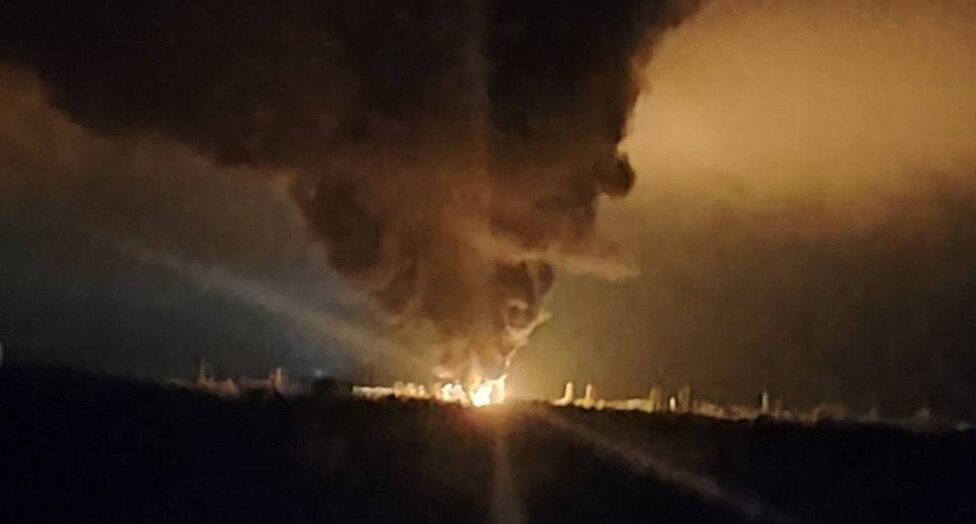
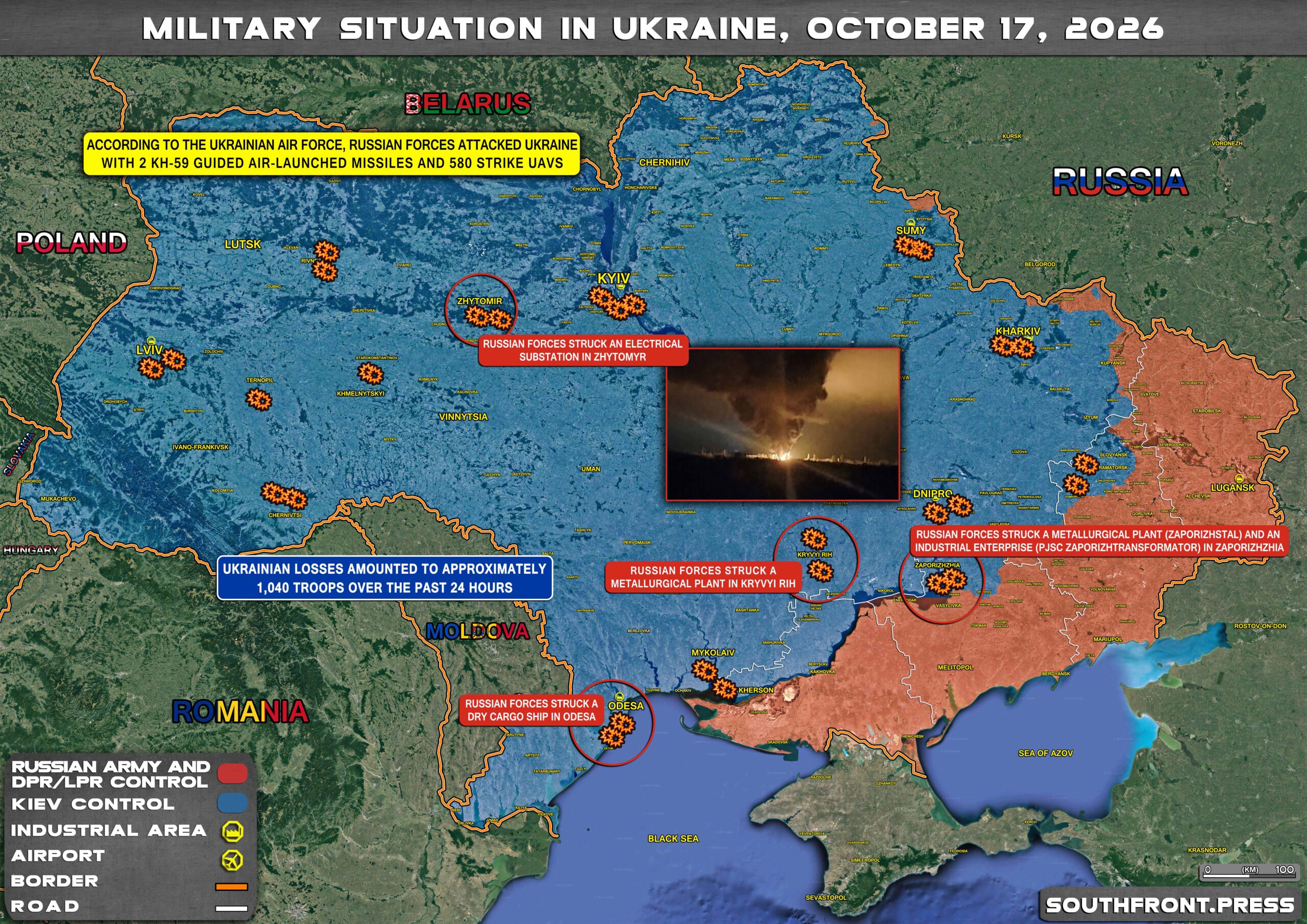
Between the evening of October 16 and October 17, 2026, the Russian Armed Forces continued their campaign of combined strikes against Ukrainian defense-industrial, energy, and logistics infrastructure. According to the Ukrainian side, the overnight attack leading into October 17 involved Iskander-M/KN-23 ballistic missiles, Kh-22/Kh-32 cruise missiles, four Kalibr sea-launched cruise missiles, and 332 strike unmanned aerial vehicles. The main focus was on metallurgical enterprises in Kryvyi Rih and Zaporizhzhia, transformer production, and high-voltage substations in western Ukraine. In parallel, Ukrainian forces carried out a large-scale drone attack on Russian territory.
Russian Strikes on Targets in Ukraine
Metallurgical Complex
Zaporizhstal (Zaporizhzhia) – formerly one of Ukraine’s largest metallurgical enterprises. Before the campaign, it produced up to 1.44 million tons of pig iron and more than 1.3 million tons of rolled steel annually; its output was directed primarily toward military-industrial needs. According to Metinvest, this was the fifth strike on the facility; six ballistic missiles were fired in the latest attack, damaging energy and logistics infrastructure as well as production facilities in the blast-furnace shop. In total, 23 ballistic missiles have been fired at the plant across five attacks.
Metallurgical combine in Kryvyi Rih (Dnipropetrovsk Region) – one of Ukraine’s largest metallurgical enterprises, which supplied metal products to the Ukrainian defense-industrial complex. The description provided by the Russian Ministry of Defense matches ArcelorMittal Kryvyi Rih; according to sources, a week earlier the owners announced a cold shutdown of primary production, and the plant was preparing for preservation.
Energy Infrastructure
Zaporozhtransformator PJSC (Zaporizhzhia) – a manufacturer of oil-immersed power transformers rated at 220-750 kV, a key component of high-voltage substations. Since 2022, it has been under the management of Ukraine’s Ministry of Defense and has been used in the interests of the Ukrainian Armed Forces. Striking this facility complicates the replacement of damaged transformer equipment for Ukrenergo, as manufacturing a new transformer takes months.
Zhytomyr 330 kV Substation (Zhytomyr Region) – a major hub in the trunk power grid, providing voltage conversion and electricity distribution among 330 kV, 110 kV, 35 kV, and 10 kV networks. Power was cut in several districts of Zhytomyr, and water-supply disruptions occurred. According to the Russian Ministry of Defense, the facility struck was one that distributed electricity from western Ukraine to central regions for defense-industrial enterprises.
Rivne 330 kV Substation (Rivne Region) – a trunk power-grid facility. Power outages occurred in Rivne and nearby settlements, and municipal electric transport operations were disrupted.
Bar 330/110/35 kV Substation (Vinnytsia Region) – a high-voltage facility distributing electricity among the aforementioned voltage classes. Voltage fluctuations were recorded in Vinnytsia and across the region.
Kharkiv CHP-3 (combined heat and power plant No. 3; KP Kharkivski Teplovi Merezhi – Kharkiv Heating Networks), Kharkiv – a combined heat and power plant producing both thermal and electric energy for municipal supply. A hit was recorded on the electrical-shop building, where a fire broke out over an area of 100 square meters.
Transport and Logistics Infrastructure
Delivery logistics terminal (Novohrad-Volynskyi, Zhytomyr Region) – a branch of a Ukrainian freight-logistics operator specializing in less-than-truckload road transport and interregional delivery. The strike caused a fire in a warehouse building covering more than 1,000 square meters. The company participates in government contracts for freight-forwarding services through the Prozorro system.
Dry cargo vessel underway at sea (Port of Odesa) – a vessel delivering military cargo to the port was struck.
Strikes on Russian Territory
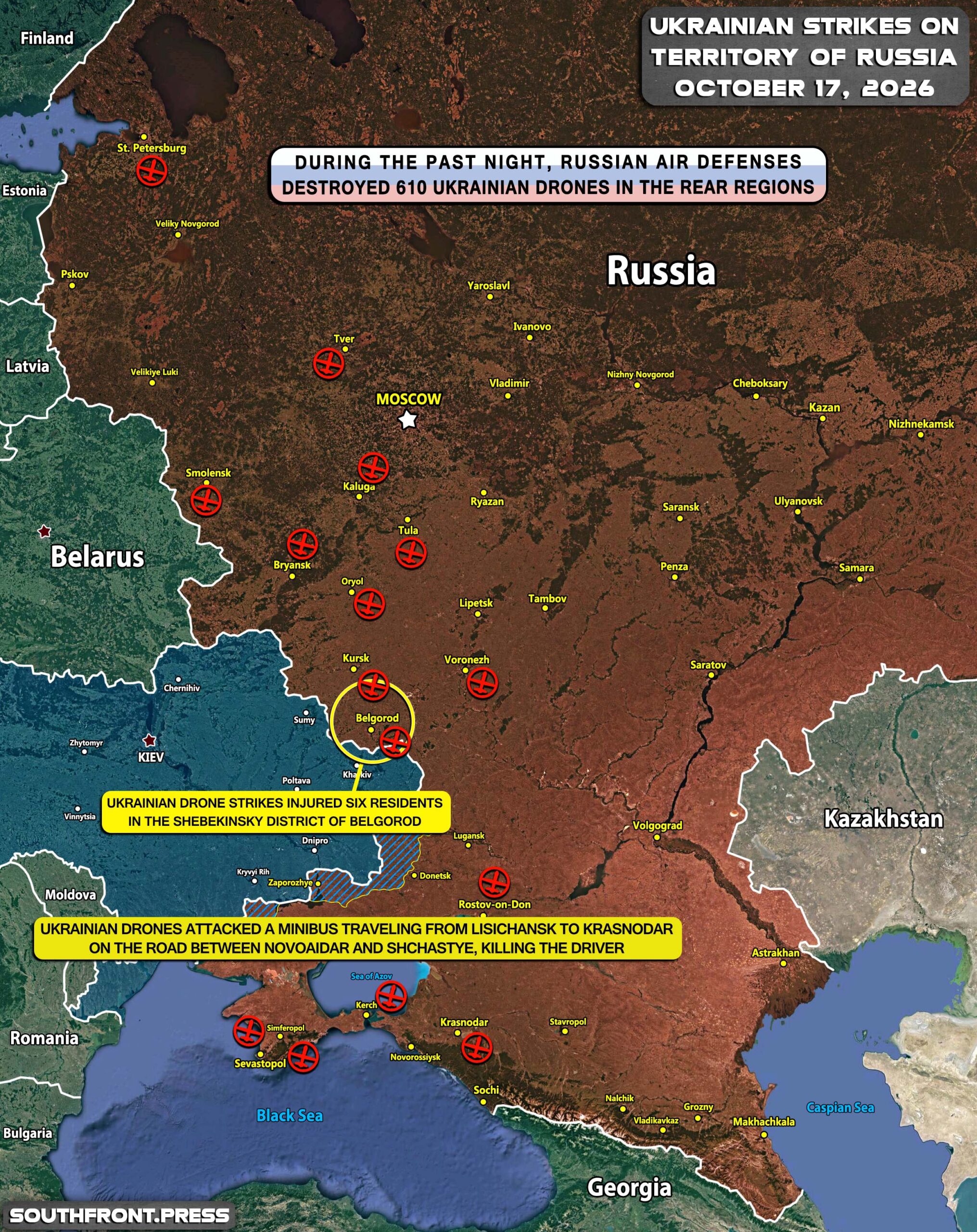
On the night of October 17, Ukrainian forces carried out a large-scale drone attack on Russian regions. According to the Russian Ministry of Defense, air-defense forces intercepted and destroyed 610 Ukrainian fixed-wing UAVs over the territory of 16 Russian regions and over the Black Sea. The highest intensity was recorded on the Moscow axis: Moscow Mayor Sergei Sobyanin reported the destruction of 144 UAVs heading toward the capital. In Bryansk Region, 157 UAVs were shot down over the course of a day. No reports indicated that serious strategic targets had been hit; there were civilian casualties.
The nature of the October 16-17 strikes confirms a systematic approach by the Russian command to disabling Ukraine’s defense-industrial production chain and the energy infrastructure supporting it. Priority targets include metallurgical enterprises producing goods for military needs and transformer production, which is critical for restoring damaged substations. According to Chief of the General Staff of the Russian Armed Forces Valery Gerasimov, steel production in Ukraine has been halted, operations at major Black Sea ports have ceased, and 76 logistics and warehouse centers have been struck. Given statements by the Russian leadership on the need to continue large-scale strikes against the defense-industrial complex and logistics centers, further intensification of attacks on energy infrastructure in western and central Ukraine, as well as on facilities involved in the repair and restoration of military equipment, should be expected. The resilience of Ukraine’s energy system will depend on its capacity to import electricity from the EU and on the speed of restoring trunk substations – both significantly complicated by the strike on Zaporozhtransformator.
MORE ON THE TOPIC:
The post Russia Strikes Ukraine’s Steel and Energy Sector appeared first on South Front.


![]()
Ukraine and the EU have agreed to establish a joint working group to accelerate rule-of-law and anti-corruption reforms. This will help Kyiv meet the interim benchmarks for EU accession, Enlargement Commissioner Marta Kos says on X after talks with Ukrainian Prime Minister Serhii Koretskyi.
Ukraine’s path into the EU runs through its courts and anti-corruption agencies, and the bloc releases membership progress and much of its money only as Kyiv delivers those reforms.
“Ukraine is among the countries making most progress towards EU membership,” Kos says, adding that the group will work through outstanding requirements on the rule of law and the fight against corruption.
The move follows a breakthrough on the accession track. On 13 October, the Council of the EU opened two more negotiating clusters for Ukraine after the Ukrainian Parliament passed a minority-language education law on 12 October, clearing Hungary’s veto.
The group lands amid pressure on both fronts. Kos cast the education law as proof the system can work, crediting Ukrainian lawmakers with the consensus needed to adopt the reforms membership requires.
Meanwhile, Koretskyi expects the remaining clusters to open by the end of the year.
“Our success will require unity and commitment from all involved Ukrainian partners,” Kos emphasizes.
The official made clear the outcome depends on Ukraine keeping its side. The reforms are the same ones tied to Ukraine’s wartime financing, with billions in EU aid released only as Kyiv meets its commitments.
The stakes are financial as well as political. Ukraine is deep in a budget crunch and leaning on EU financing to keep the country running, and the Ukrainian Parliament returned from a month-long break this week to work through reform bills tied to that support.
As of 12 October, none of the needed laws had passed, according to anti-corruption activist Vitaliy Shabunin, who said the delay is already costing the country and blamed lawmakers who have stalled the reforms the money is tied to.
“As of today, Ukraine has NOT received several BILLION euros from the EU and others, because members of parliament have blocked the reforms to which that money is linked,” Shabunin said.

MORE ON THE TOPIC:
The post Military Situation In Ukraine And Ukrainian Attacks On Russian Territory On October 17, 2026 (Maps Update) appeared first on South Front.
RT | October 17, 2026
The UN should resist pressure from Kiev’s Western backers and finally address the issue of widespread abuse of captured Russian servicemen in Ukrainian secret prisons, Russian Ambassador-at-Large Rodion Miroshnik has said.
During a conversation with the chairman of the UN Committee Against Torture Claude Heller on Thursday, Miroshnik said that Moscow is aware of a whole network of such detention facilities, operating in Ukraine’s Kharkov, Dnepropetrovsk, and Sumy Regions as well as in the country’s capital, Kiev.
The Russian servicemen are “going through hell” in so-called “transit prisons,” which are set up at deployment points of Ukrainian military units and nationalist battalions, he said.
“The thugs, who hide their faces behind masks… and address each other only by their call signs, subject the captured Russian troops to inhuman abuse. Waterboarding, electrocuting, baiting with dogs and amputations performed without anesthesia are just a few examples of the techniques systematically employed by the Ukrainian tormentors,” the envoy, who is charged with documenting Kiev’s war crimes, stressed.
According to Miroshnik, captured troops are usually sent to those facilities in the early stages of their imprisonment, where they are held in cages, pits, and stone dungeons.
The Kiev government does not allow ombudsmen and human rights activists into those “torture chambers,” but the Russian authorities have gathered hundreds of accounts of survivors detailing what has been happening there, he said.
“This information had been passed on to the UN Secretariat on more than one occasion,” but no action followed, Miroshnik added.
By ignoring the existence of the secret prisons and systematic torture of Russian troops, the global body “encourages the spread of such criminal practices and disregard for the relevant UN Convention,” he added.
“Many experts are aware of this disgraceful phenomenon, yet there is a lack of political will to overcome the pressure from the foreign accomplices to the conflict, who shield the Kiev regime from accountability and prevent a thorough investigation of its conduct,” the envoy said.
While turning a blind eye to the torture of Russian troops, the UN published several reports accusing Russia of mistreating Ukrainian prisoners, based on accounts by POWs returned by Moscow to Kiev. Russian Foreign Ministry spokeswoman Maria Zakharova has labeled those accusations of abuse “disinformation.”
Last month, Russian Foreign Minister Sergey Lavrov said that the UN Secretariat was unable to properly perform its duties as most key positions are occupied by representatives of NATO countries.
The current team, led by [UN General-Secretary] Antonio Guterres, who is a Portuguese national, “promotes biased approaches and double standards, effectively serving the interests of a group of Western nations,” Lavrov insisted during a press conference on the sidelines of the UN General Assembly in New York.


Ukrainian president warns it will embolden Russian leader and intensify war as Moscow hits country’s power plants
Volodymyr Zelenskyy has described Donald Trump’s decision to roll back sanctions on Russia as a “reward” for Vladimir Putin and warned it will embolden the Russian leader and intensify the Kremlin’s war, as Moscow launched one of its worst strikes yet on Ukraine’s power plants in an attempt to black out the country’s cities before winter.
The Ukrainian president also said he expected the Trump administration to lift more sanctions against Russia in the future and called for Europe to establish its own negotiations with Moscow as the US has sought better ties and business deals with the Kremlin.
Continue reading...
© Photograph: Kateryna Klochko/AP

© Photograph: Kateryna Klochko/AP

© Photograph: Kateryna Klochko/AP


![]()
The front changes faster than any headquarters, so Ukraine’s war chief went to the people who fight on it. On 16 October, Ukrainian Defense Minister Yevhenii Khmara met commanders and soldiers from front-line units to discuss the needs of the front, command practices that save lives, and ways to raise combat effectiveness, the Defense Ministry reported.
The front keeps changing, with technology, tactics and weapons shifting constantly, so decisions made far from it risk arriving late and costing lives. Khmara’s answer is to anchor ministry policy in the experience of the soldiers who fight, a continuation of the “machines over men” program.
"The front does not stand still. But the key thing is people. People will always be the foundation and the main value of the Defense Forces,” Khmara said.
He claimed that the decisions of the Ministry of Defense must take into account the experience of warriors, those who directly carry out combat missions at the front.
The meeting drew commanders from across the force, including the Airborne Assault Forces, the Marine Corps, the 93rd, 100th, 28th and 155th mechanized brigades, the 1st, 425th and 475th assault regiments, the 3rd and 59th assault brigades, and Azov.
The last one, the 1st Azov Corps of the National Guard of Ukraine, is actively fighting in the Donbas region, where units have led counter-operations to disrupt Russian advances toward fortress cities that have been holding Russia's operation since 2014.
Meanwhile, the 93rd "Kholodnyi Yar" Separate Mechanized Brigade took part in fierce battles for Ilovaisk, the Donetsk Airport, Debaltseve, and Bakhmut, as well as in the liberation of the Kharkiv Oblast. Both units are known for their extensive implementation of advanced military technologies, including ground robotic complexes, FPV strike drones, and innovative anti-drone electronic warfare systems.
The talk turned on how good commanders cut their own losses. Participants discussed command approaches that help save soldiers’ lives, use resources efficiently, and achieve combat results.
The ministry wants those methods studied and spread to other units, treating commanders' hard-won judgment as something to scale rather than leave in one brigade.
Khmara framed the task in plain terms.
“We must adapt faster and give our warriors modern and effective tools,” he stressed, calling it the shared job of the Defense Ministry, the commander-in-chief and the General Staff.
Andrew Bailey among finance leaders to leave session in Bangkok when Russian finance minister addressed group
The Bank of England governor, Andrew Bailey, has taken part in a walkout of finance leaders who left an International Monetary Fund meeting in protest against Russian involvement.
Bailey joined counterparts from France, Germany and a number of Scandinavian and Baltic countries who left the session in Bangkok when the Russian finance minister, Anton Siluanov, addressed the group in Russian.
Continue reading...
© Photograph: Rungroj Yongrit/EPA

© Photograph: Rungroj Yongrit/EPA

© Photograph: Rungroj Yongrit/EPA

Amid blackouts, artillery fire and the onslaught of Russian drone attacks, the Richelievsky in Kherson provides a refuge for those with nowhere else to go
There is one important rule in the Richelievsky, Kherson’s last functioning hotel: close the curtains before dusk. Less than a kilometre away lies the Dnipro, the river that has formed the frontline since Ukrainian forces liberated Kherson in November 2022; Moscow’s troops are on the opposite bank.
In a city where Russian drone operators hunt civilians in what is now widely known as the “human safari”, even a sliver of light escaping through a window may be enough to reveal someone’s location after dark.
Hotel manager Yevhen Emtsov, 46, in the building’s former conference room
Continue reading...
© Photograph: Leo Kramer

© Photograph: Leo Kramer

© Photograph: Leo Kramer