JERUSALEM: US President Donald Trump on Sunday endorsed his ally Benjamin Netanyahu before Israel’s close-fought parliamentary election on October 27, providing a boost to the veteran prime minister’s bid to win a new mandate. Netanyahu touted his close relationship with the US president in a video released by his Likud party, saying that together they had “crushed Iran” and adding that re-election would allow him to work with Trump to “elminate the Iranian threat over the next two years, or eve
CAIRO: The Houthis, Al-Qaeda and Daesh come from sharply different religious traditions. The Yemeni militia is rooted in a hard-line interpretation of Zaydi Shiism, while Al-Qaeda and Daesh emerged from extremist movements. Their doctrinal disagreements are profound, and they have fought each other on the ground. Yet the differences can obscure a more consequential question: Which poses the greater long-term threat to Yemen and the wider region? The answer cannot be measured solely by the number
Dozens of trucks from the UAE delivered 789 tonnes of aid, including food and shelter supplies, to the Gaza Strip this week as part of Operation Chivalrous Knight 3, bringing the total to 138,030 tonnes. This humanitarian effort comes amid severe crises in Gaza, where nearly 2 million have been displaced and over 74,000 killed since late 2023, with accusations of genocide and war crimes directed at Israel.
HEBRON: Israeli settlers in Idhna, west of Hebron, prevented Palestinian farmers on Sunday from harvesting olives and attempted to assault them and steal their crops. Local sources reported that settlers pursued farmers near the town, preventing them from harvesting olives and attempting to assault them and steal their produce. The western area of the town has experienced daily harassment by Israeli settlers, including burning trees and crops, as part of efforts to seize more land and annex it t
QUNEITRA: Ghassan Al-Sayyid Ahmad, governor of Syria’s Quneitra region, called on the UN peacekeeping force to monitor and document Israeli violations during a recent meeting with the UN Under-Secretary-General for Peace Operations, Jean-Pierre Lacroix. The talks focused on the impact of Israeli actions on residents of villages near the separation line and ways to strengthen coordination with the UN mission. Ahmad urged the UN Disengagement Observer Force to fulfil its responsibilities und
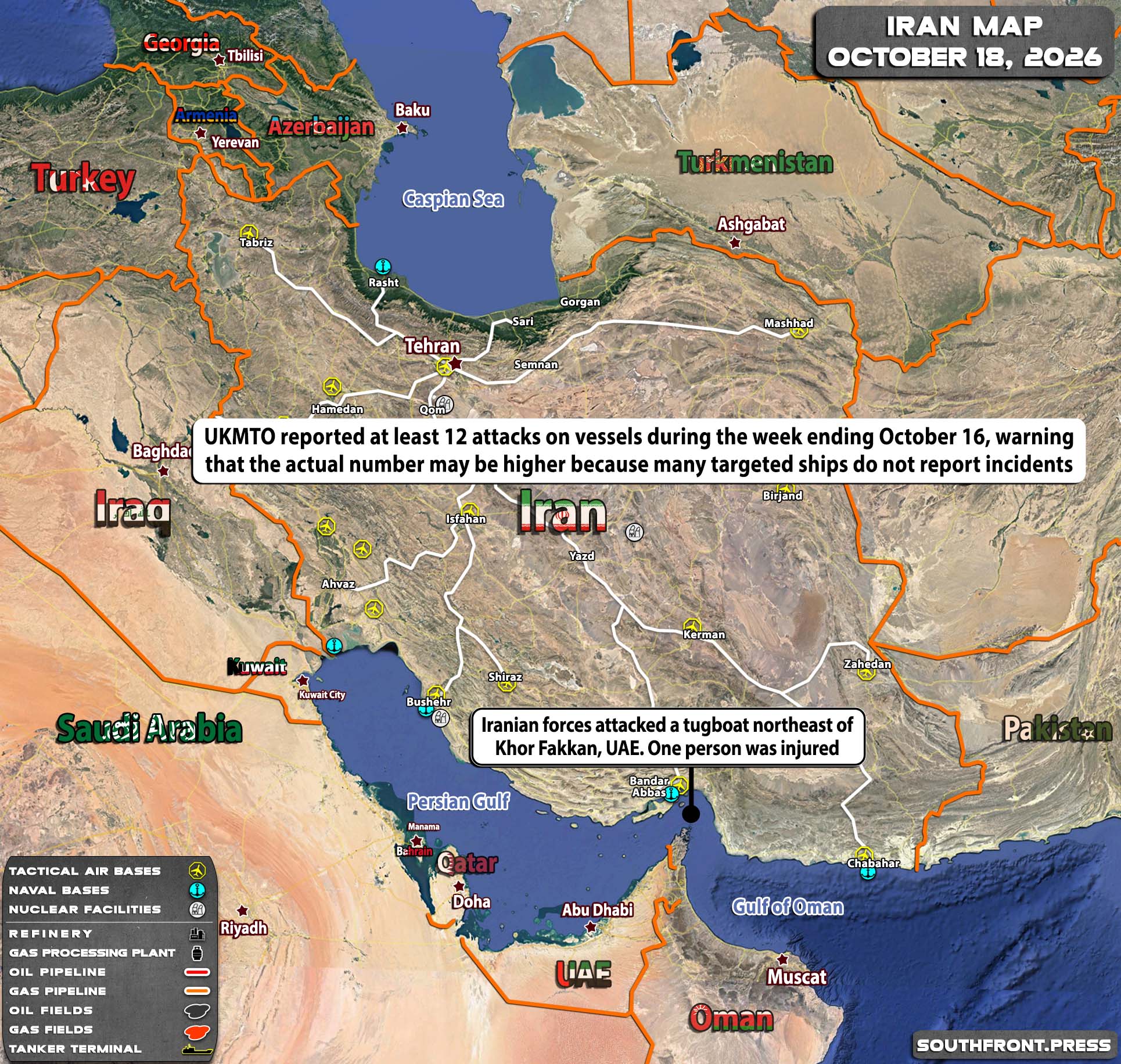
Iranian forces attacked a tugboat northeast of Khor Fakkan, UAE. One person was injured;
UKMTO reported at least 12 attacks on vessels during the week ending October 16, warning that the actual number may be higher because many targeted ships do not report incidents.
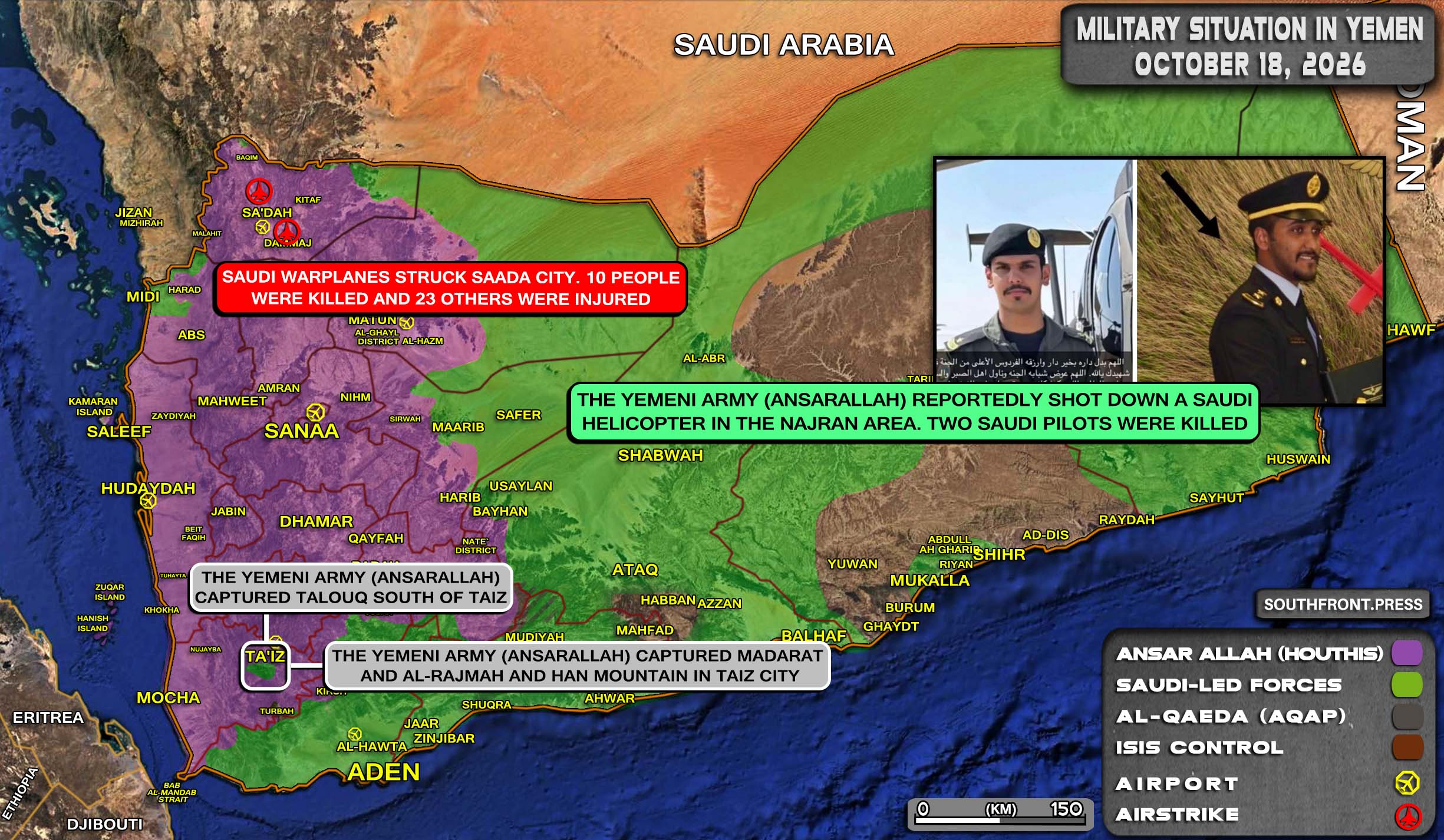
TEHRAN, Oct. 18 (MNA) – Yemeni army targeted a gathering of Saud-backedi mercenaries in Marib, located in the northeast of the country, with a missile attack.
Iranian Supreme National Security Council Secretary Mohsen Rezaei said the country's military has prepared a "new operational plan" to respond if the United States resumes attacks. The remarks came as shipping vessels in the region reported a rise in strikes.
US President Donald Trump publicly endorsed Israeli Prime Minister Benjamin Netanyahu in a social media post ahead of the October 27 general election. Trump described Netanyahu as a "Strong, Brave, and Brilliant" leader.
The two-week exchange of fire between the United States and Iran, triggered by Washington’s attempt to force open an illegal southern corridor through the Strait of Hormuz, represented the most consequential direct military confrontation between them since the 40-day war.
The Iranian response to the unprovoked and illegal American aggression was not a chaotic escalation but a methodical, layered military campaign that drew on years of doctrinal development, weapons investment, and operational planning.
The efforts of the Islamic Republic’s armed forces, spearheaded by the Islamic Revolution Guards Corps (IRGC) aerospace and naval branches, executed a decisive and swift response.
What unfolded was a layered operation with nine distinct but interlocking lines of effort. Each line reinforced the others. Infrastructure degradation reduced American operational tempo; area denial forced repositioning that compounded the effects of that degradation; extended-range precision strikes demonstrated that repositioning offered no sanctuary; ISR attrition blinded American targeting systems; terrorist suppression closed the land flank, while strikes on utility infrastructure imposed costs on host nations and denied services to American bases.
One can employ the open-source reporting, satellite imagery, and the observable pattern of strikes to examine each dimension of Iran’s military response in detail, and construct a coherent operational picture. It is getting exceedingly clear that the ceasefire period has very likely translated to a window for reconstitution and preparation in Iranian strategic calculus.
The primacy of solid-fuel tactical ballistic missiles
Iran’s decision to anchor its retaliatory campaign in solid-fuel tactical ballistic missiles was not accidental. It reflected a decade-long investment in a specific capability designed precisely for this kind of confrontation. Solid-fuel ballistic missiles offer decisive operational advantages over their liquid-fuel predecessors. They require no fueling time at the launch site, dramatically compressing the window between a launch order and missile departure.
This matters enormously in a sensitive environment where adversary assets, particularly MQ-9 Reaper drones and maritime patrol aircraft, are actively hunting for launch preparations.
A liquid-fuel missile requires a visible, time-consuming fueling sequence that creates a detectable signature. A solid-fuel missile can be transported, erected, and fired in a fraction of that time, often before a targeting solution can be developed and a strike authorized.
These missiles are road-mobile, launched from transporter-erector-launchers (TELs) that can disperse across Iran’s mountainous terrain, making pre-emptive targeting extremely difficult.
Having destroyed much of the air defense systems belonging to the US and its Arab allies using the older, less sophisticated liquid fuel missiles in previous wars, Iran’s strikes this time primarily relied on its tactical solid-fuel ballistic missile inventory, meaning the various variants of the Fateh family.
Simply put, the choice of solid-fuel systems reflected a calculated assessment of the adversary’s weakened interception capacity, an assessment that proved accurate.
The air defense inventory crisis
Perhaps the single most consequential factor shaping the operational environment was the state of US and allied air defense missile inventories.
The United States entered this round of military aggression with critically depleted stocks of its most capable interceptors. The Standard Missile-3 (SM-3) and Standard Missile-6 (SM-6), which arm Aegis-equipped destroyers and cruisers and provide the American Navy’s primary ballistic missile defense capability at sea, have been drawn down through a combination of expenditure in the Red Sea campaign against Yemen, the costly defense of Israel during two previous wars, and the simple reality that production rates have never kept pace with consumption.
The Terminal High Altitude Area Defense (THAAD) system, which provides upper-tier defense against medium and intermediate-range ballistic missiles, is similarly constrained.
The decision not to employ Aegis and THAAD at full capacity was therefore a forced one. The United States simply could not spend its remaining meager inventory of SM-3 and THAAD interceptors against Iranian tactical ballistic missiles, which, while accurate and damaging, are not the only threats to American interests.
Doing so would have left the United States strategically exposed against another serious contingency in East Asia or Europe. The calculus was that American military bases had to absorb more hits to preserve the interceptors.
Moreover, the Patriot system, which bore the brunt of terminal-phase defense in recent weeks across the region, was in no better condition. Years of expenditure across Ukraine, the occupied territories, the Persian Gulf, and the Red Sea mission have drawn PAC-3 and PAC-3 MSE stocks to extremely low levels.
The Pentagon’s response was telling. Rather than accelerating full-capability PAC-3 MSE production, it has chosen to pursue the cheaper, less capable PAC-3ACE Cost Reduction Initiative variant. More revealing still were the recent PAC-2 GEM-T orders, an older interceptor not procured by the US in decades, signaling just how severely stocks had been exhausted.
That the world’s most sophisticated air defense enterprise was compelled to resurrect a 1990s-era design to sustain basic readiness is the starkest indicator of the American munitions crisis that Iranian planners appear to have understood, measured, and exploited with precision.
The situation among Persian Gulf states was equally dire. Saudi Arabia and the UAE had expended substantial portions of their Patriot PAC-3 interceptor stocks during years of Yemeni military missile and drone attacks, and entered the 40-day imposed war with depleted inventories. The situation is even direr in Kuwait and Bahrain, with the Persian Gulf microstates effectively running out of Patriots, being forced to solely rely on American-operated systems.
PAC-3, the most capable variant of the Patriot system against ballistic missiles, has effectively been exhausted in several batteries. PAC-2, the older and less capable variant, is the only available option in certain areas against Iranian missiles, and even that missile is running low as well. The collective air defense architecture of the Persian Gulf states, which had appeared formidable on paper, has been effectively hollowed out.
Iranian operational planners were aware of these facts. The sequencing and volume of Iranian missile salvos during the exchange reflected a deliberate attempt to exploit the gap between what the defense could theoretically intercept and what it could actually intercept given real-world inventory constraints.
Iran’s multi-layered operational strategy
What distinguished Iran’s response from a simple missile barrage was its architectural coherence. Iranian planners did not merely fire missiles at American targets; they executed a phased, multi-domain retaliatory campaign with distinct operational objectives at each stage, each phase creating the conditions for the next.
The campaign can be understood as having five interlocking lines of effort: infrastructure degradation, area denial and operational displacement, precision strike at extended range, ISR and logistics attrition, and proxy terrorist force suppression.
Together, they constituted a campaign design far more sophisticated than most Western analysts had publicly credited Iran with possessing.
The overarching logic was one of progressive operational constriction. Rather than attempting to destroy US forces – an objective beyond Iran’s reach given American conventional superiority – the campaign aimed to degrade, displace, and exhaust them.
Each successful strike reduced American operational capacity; forced repositioning that consumed time and resources, and demonstrated to regional partners that proximity to American occupation forces carried real costs.
Infrastructure degradation
The first phase of the Iranian retaliatory campaign targeted the physical infrastructure of American military power in the Persian Gulf region. This was not indiscriminate bombardment. Satellite imagery and post-strike assessments revealed a pattern of targeting that prioritized specific high-value nodes: radar installations, fuel and ammunition storage facilities, maintenance hangars, and communications infrastructure.
Radar systems were a particular priority. The ability to detect, track, and target Iranian missiles and UAVs depends on a layered network of radar systems. By striking radar installations at air bases, Iran degraded the situational awareness that underpins both offensive operations and defensive intercepts. A radar that is destroyed or forced offline creates a coverage gap that cascades through the entire air defense architecture.
Before-and-after imagery of an AN/FPS-117 early warning radar installation at Ahmad al-Jaber Air Base, Kuwait, showing structural damage
Logistics infrastructure was targeted with equal deliberateness. Fuel depots, ammunition storage sites, and maintenance facilities at American bases around the Persian Gulf were struck with sufficient accuracy to cause meaningful operational disruption.
An air force that cannot fuel its aircraft, rearm them, or repair battle damage cannot sustain sortie rates. The targeting of logistics was a direct attack on the tempo of American air operations to derail the American aggression against Iranian sites and reduce the pressure on Iranian forces.
The accuracy of these strikes, achieved at ranges of several hundred kilometers, validated the operational utility of Iran’s solid-fuel ballistic missile force and demonstrated that the IRGC aerospace force had developed the targeting data, launch procedures, and quality control necessary to achieve consistent results against fixed infrastructure.
The anti-access/area denial campaign
The most strategically significant dimension of the Iranian retaliatory campaign was its systematic execution of an Anti-Access/Area Denial (A2/AD) strategy that progressively pushed American air operations out of the Persian Gulf and into increasingly distant and operationally constrained locations.
The logic of A2/AD in this context was straightforward. The closer American aircraft operate to Iran, the shorter their flight times, the larger their payloads, the less refueling they require, and the more sorties they can generate per day.
Conversely, every additional hundred kilometers of distance imposes compounding costs: greater tanker support, longer mission times, reduced payload, increased crew fatigue, and more complex coordination. By rendering the Persian Gulf operationally untenable for American air assets, Iran systematically degraded the offensive capacity of the aggressors.
The first displacement was from the Persian Gulf itself. Sustained missile and drone attacks against air bases made sustained operations from those locations unfeasible. The American response was to shift primary air operations to bases in Jordan – Al-Azraq and Muwaffaq Salti –which offered greater distance from Iranian missile systems.
Iran’s response was to extend its reach to Jordan. Multiple strikes against American bases, documented by US casualties and satellite imagery showing damaged hangars and destroyed aircraft, demonstrated that Iran had the capability to contest operations from that distance.
The retaliatory strikes destroyed American aircraft, damaged infrastructure, and forced the US war machine to reconsider the viability of Jordan as a primary operating location.
The second displacement was to the occupied territories. American air assets, including tanker aircraft critical to sustaining long-range strike operations, were pushed further west to Israeli military bases.
This displacement carried its own operational costs. The distance from Iranian targets increased further, and the concentration of American assets in the occupied territories created its own targeting opportunities for Iran, which has demonstrated both the willingness and capability to strike at extended ranges.
A particularly telling indicator of this displacement dynamic was the repositioning of the RQ-4 Global Hawk strategic reconnaissance aircraft, which had been operating from Al Dhafra in the UAE and from Jordanian facilities, to Sigonella Naval Air Station in Sicily.
The Global Hawk, with its long endurance and high-altitude sensors, is a critical ISR asset for tracking Iranian missile launches and providing targeting data. Its displacement to Sicily represented a dramatic reduction in persistent surveillance coverage over Iran and the Persian Gulf, with direct consequences for the effectiveness of American strike operations.
A qualitative leap in extended-range precision
One of the most significant revelations of the recent round of US aggression and Iran’s retaliation was the demonstrated accuracy of Iranian ballistic missiles at ranges exceeding 1,000 kilometers. Previous assessments of Iranian ballistic missile accuracy had generally been skeptical about the ability to achieve consistent precision at such distances. The strikes on Jordanian targets, located well over 1,000 kilometers from Iranian launch sites, completely shattered that skepticism.
The circular error probable (CEP) – the radius within which 50 percent of strikes fall – observed in the Jordanian strikes was dramatically smaller than what Iranian missiles had previously demonstrated at comparable ranges. Strikes that hit specific buildings, specific aircraft shelters, and specific sections of structures, rather than simply landing somewhere on a base, indicated a qualitative improvement in guidance accuracy that demands explanation.
Several hypotheses present themselves, and the evidence suggests that the answer likely involves a combination of all of them. First are technical improvements. Iran may have upgraded the terminal guidance systems on its Kheibarshekan, Haj Qasem, and Fattah variants, potentially incorporating improved inertial navigation, satnav receivers, or optical terminal seekers that allow the missile to better correct its trajectory in the final phase of flight.
Second are tactical improvements. Iranian launch crews may have refined their pre-launch survey procedures, improving the accuracy of the initial position fix that the missile’s inertial navigation system uses as its reference point. Third are software improvements, which mean updates to the missile’s flight control algorithms could improve trajectory optimization and reduce the accumulated errors that degrade accuracy over long distances.
The most likely explanation is a combination of all three – a systematic program of improvement across the technical, procedural, and software dimensions of missile accuracy that had been underway for years and was now being demonstrated operationally for the first time at this range, following the experiences of the 40-day war.
The MQ-9 hunt
The MQ-9 Reaper drone occupied a central and uniquely vulnerable position in American military offensives against Iran. The Reaper is not merely a strike platform but the primary persistent ISR asset used to locate and track mobile Iranian missile launchers, particularly after the heavy attrition of similar Israeli military systems.
Without the MQ-9’s ability to loiter for extended periods, the capacity to find and destroy TELs before they fire, or to conduct battle damage assessment after strikes, is dramatically reduced.
Iran understood this dependency and targeted it systematically during this campaign. The campaign against MQ-9 assets operated on multiple levels. Ground-based air defense systems, which had previously demonstrated the ability to engage high-altitude targets, were used to engage Reapers operating over Iranian territory and adjacent areas.
But Iran also struck the ground infrastructure that supports MQ-9 operations: the maintenance facilities, fuel systems, satellite communication ground stations, and launch-and-recovery equipment that allow the aircraft to operate.
Western media reporting confirmed the destruction of a number of MQ-9 aircraft on the ground at Jordanian bases and, in a particularly striking detail, the destruction of some aircraft while still in their transport canisters before assembly.
This achievement indicates that Iran has developed targeting intelligence on the logistics chain supporting drone operations, not merely the operational bases themselves. Destroying aircraft before they are assembled and made operational is a force multiplication achievement. It eliminates capability before it can be employed, at a point when the aircraft is most vulnerable and least defended.
The cumulative effect of the MQ-9 campaign was a significant degradation of American persistent ISR coverage over Iran. This directly reduced the effectiveness of the hunt for mobile missile launchers, allowing Iranian TELs greater freedom of movement and survivability.
Suppressing proxy terrorist forces in Iraq
From the first day of the exchange, Iran conducted daily retaliatory strikes against armed terrorist groups in Iraq that had the capability and potential motivation to conduct land attacks against Iranian territory or to serve as a forward platform for American-directed operations.
This campaign was methodical and comprehensive, targeting personnel concentrations, weapons storage facilities, and command infrastructure.
Iran’s western flank, which includes the border with Iraq, represents a potential vulnerability. Armed terrorist groups in Iraq, some with historical ties to American intelligence, could in theory conduct cross-border raids, provide intelligence for American strikes, or serve as a distraction that forced Iran to divert defensive resources.
By striking these groups preemptively and continuously, Iran sought to exhaust their operational capacity before it could be brought to bear.
The daily rhythm of these retaliatory strikes was itself a message. It demonstrated that Iran had persistent targeting intelligence on these groups’ locations, that it was willing to expend munitions on this secondary campaign even while conducting the primary campaign against American forces, and that it intended to maintain pressure regardless of any ceasefire negotiations that might be underway.
The logic of reciprocity
Iran’s retaliatory strikes on electrical and water infrastructure in Kuwait represented a deliberate response that operated on two distinct logics simultaneously.
The first was reciprocity: Iran’s own civilian infrastructure had been targeted, and the strikes on Kuwaiti infrastructure were a direct signal that such targeting would not be absorbed without response to the aggressor and its facilitators.
The second was military utility. American forces in the Persian Gulf region depend on host nations’ electrical grids and water supplies for base operations. Infrastructure that serves both civilian and military purposes is, under the laws of armed conflict, a legitimate military target when the military use is substantial and the strike is proportionate.
The targeting of Kuwait’s infrastructure was also a message to Persian Gulf states more broadly. Kuwait, like Bahrain, the UAE, Saudi Arabia, and Qatar, hosts American military facilities and had provided varying degrees of support to American operations.
By demonstrating the ability and willingness to strike Kuwaiti infrastructure, Iran was communicating that the costs of hosting American forces were not abstract. They were concrete, immediate, and would be borne by the host nation as well as the American military.
The pillars of operational success
Iran’s two-week retaliatory campaign against American aggression and attempts to force open an illegal southern corridor through the Strait of Hormuz largely succeeded on every dimension that its operational planners had identified.
The exchange demonstrated that Iran had developed, over decades of institutional study and investment, a military capability genuinely capable of contesting American power projection in the Persian Gulf region, even after two high-intensity wars.
It demonstrated something relevant to the strategic environment of the region – that the costs of American military aggression in the Persian Gulf had increased substantially; that the infrastructure of American power projection was more vulnerable than pre-war assessments had suggested; and that Iran possessed both the capability and the operational sophistication to exploit those vulnerabilities in a systematic and disciplined manner.
RIYADH: The Gulf Cooperation Council and Russia discussed the need to continue diplomatic efforts to ensure freedom of navigation in the straits of Hormuz and Bab Al-Mandab during a ministerial meeting in Manama on Sunday.Diplomatic efforts to establish peace in the region were also discussed at the strategic dialogue meeting.Strengthening GCC-Russian relations and developing the strategic partnership between the two sides was also discussed.The foreign ministers of GCC states and their Russian
US President Donald Trump on Sunday endorsed Prime Minister Benjamin Netanyahu ahead of Israel's October 27 elections. It was not clear what impact the endorsement would have on voters, since many Israelis have expressed disappointment with Trump over the outcome of the Iran war and the US president's ceasefire proposal.
According to Jordan’s Royal Committee for Jerusalem Affairs, Israeli authorities have demolished 3,917 Palestinian homes in occupied East Jerusalem since June 1967, a practice seen as a systematic attempt to alter the demographics of the city. The committee’s secretary-general, Abdullah Kanaan, urged for international action against forced evictions and emphasized the significant cultural and national implications of Jerusalem for the Palestinian people.
ADEN: Yemen’s armed forces said on Sunday they had carried out 1,326 strikes against Houthi targets over 24 hours, claiming about 370 militia members had been neutralized and dozens of military vehicles and other assets destroyed or disabled. In a statement on Operation “Dawn of Yemen,” the military spokesperson said the offensive had targeted Houthi gatherings, vehicles, fortifications and firing positions. On the eastern front west of Marib, government forces had built on preparatory bombardme
The Egyptian Presidency announced its ongoing and intensified political and diplomatic actions in collaboration with regional and international players to support crisis de-escalation and resolution.
Hundreds of Palestinians attended a mass funeral for 75 victims of Israeli bombings in Gaza, with estimates suggesting 8,000 bodies still trapped under rubble. Recovery efforts are hindered by a lack of resources due to ongoing Israeli restrictions, while the death toll has soared to over 74,400, with more than 10,000 reported missing. The Israeli government faces international charges for potential war crimes.
Mehrdad Akhlaghi wins parliament’s backing, 8 months after predecessor was killed in opening US-Israeli strikes; UN sanctioned him in 2007 over alleged nuclear, missile activity
TEHRAN, Oct. 18 (MNA) – Yemeni Armed Forces have issues a new warning calling on Saudi non-military people to stay away from Saudi oil facilities and sell Aramco oil company's shares on the stock markets.

 Login