❌

Normal view

3 waves of Russian missiles slam Kyiv overnight, killing at least 1, injuring 8

18 October 2026 at 21:20
Several explosions rocked the capital just before 11 p.m., with further attacks around 3 a.m. and 7 a.m., Kyiv Independent journalists on the ground reported. Ukraine's State Emergency Service (DSNS) said damage was reported in at least three districts.

Nine said killed in Saudi strike on Houthis as sides continue trading fire

18 October 2026 at 21:03
Riyadh says six injured in Iran-backed rebel attack, two soldiers killed in helicopter crash; Egyptian parliament postpones vote on aiding Saudi effort as Houthis issue threats

How Starlink gave Ukraine a ‘middle strike’ advantage that is now at risk

18 October 2026 at 18:07

How are Ukraine’s drones disrupting Russian supply lines — and can Ukraine hold on to its advantage? Flying far behind enemy lines, “middle-strike” drones hunt the fuel, ammunition, and reinforcements Russia needs to sustain its assaults. Starlink has helped make this campaign possible, but dependence on

News from occupied Ukraine: 11 Ukrainians, including 96-year-old woman, evacuated from Russian occupation

18 October 2026 at 17:44

This weekly update from the Kyiv Independent aims to shed light on the situation facing Ukrainians living under Russian occupation and the ever-tightening control of information imposed by the Kremlin.

Key news as of Oct. 17:

  • Eleven Ukrainians, including 96-year-old woman, return from Russian-occupied territories, ombudsman says
  • Russia sends terrorism

Ukraine war latest: St. Petersburg slammed by drones in mass Ukrainian attack

Key developments on Oct. 17-18

  • Massive Ukrainian drone attack hits oil facility, bridge, and data center in St. Petersburg
  • US resumes intel sharing on Russian missile launches with Ukraine, Zelensky says
  • Ukraine hits Russian drone manufacturing plant in Rostov Oblast
  • 'Planned operation' — Zelensky confirms Ukraine's

Netanyahu’s spin on latest settler attack is laughable – Daily Update

Violent (and illegal) Israeli settlers in West Bank are not content to attack only Palestinians ■ Gazans dread spending a 4th winter in displacement ■ NAZA documentary echoes 2023 film about Nazis ■ More.

Poland, Bulgaria, now Lithuania: Russia’s suspected arson campaign reaches a third Starlink site serving Ukraine

18 October 2026 at 14:40

poland bulgaria now lithuania russia’s suspected arson campaign reaches third starlink site serving ukraine · post ukrainian soldier installs terminal news reports

Someone tried to set fire overnight to a Lithuanian company that stores Starlink communication equipment, but tipped-off guards foiled the attempt, Lithuanian Prime Minister Mindaugas Sinkevičius said. He linked the attack to Russia’s hybrid war against Europe. It is the third suspected sabotage of Starlink infrastructure in Europe in under a month.

Russia keeps attacking Ukraine at the front and from the air while running a sabotage campaign behind the lines in Europe, which ISW has linked into one pattern. Starlink keeps Ukraine’s drone units and front-line troops connected, and Poland pays for much of that service.

Fuel canisters and a control unit

The attack came just after midnight, the prime minister wrote. Security services had warned the company about possible attacks, security was stepped up, and the attempt failed.

The company provides connectivity through nine Starlink satellite antennas used by Ukraine, Sinkevičius told Lithuanian public radio LRT. At almost 2 a.m., intruders tried to burn the antennas and their control unit, leaving behind incendiary liquid in canisters of 3 to 10 liters.

“It is obvious that this is part of Russia’s hybrid war with elements of sabotage,” he said, adding that the client was likely “the Russian side.”

He said he believes the people involved, and how many there were, are known, but gave no details, citing the investigation.

Police Commissioner General Arūnas Paulauskas said no suspects had been detained, any damage was minimal, and the company kept working. A pretrial investigation is under way.

poland bulgaria now lithuania russia’s suspected arson campaign reaches third starlink site serving ukraine · post ukrainian soldier installs terminal news reports
Explore further

New Starlink restrictions disrupt Ukrainian drone missions. Kyiv adviser says move is tied to “political situation”

A drone the same morning

Hours later, an object that apparently entered from Poland crossed northern Lithuania, and NATO jets failed to identify it, Defense Minister Robertas Kaunas said. Possible fragments were found in the Pasvalys district near the Latvian border. Latvia’s military said the object may have blown itself up on a course toward Latvia.

Sinkevičius said the sabotage version had to be checked for the drone too. He called the National Security Commission for Monday, 19 October, to examine both incidents and consider giving services more powers to neutralize drones.

The third Starlink site

In September, a fire destroyed the distribution panel at a Starlink ground station in Wola Krobowska, Poland. Germany detained two Turkish nationals on 12 October, and Warsaw blamed Russian intelligence. In Bulgaria, masked intruders burned 11 of 17 Starlink antennas near Sofia.

The conceit of total dominance

By: A A
18 October 2026 at 13:00

By Bill ASTORE

A strange conceit of American exceptionalism is the naked ambition of full-spectrum dominance. The idea is this: America must dominate every realm of potential conflict, land-sea-air as well as space and cyber and any other realm you can imagine, for that is the only way Americans can truly be “safe.” Such a conceit comes with a hefty price tag as Pentagon spending soars toward $1.5 trillion a year. But money is the least of it. The heftiest price tag is the constant state of warfare (and preparations for yet more war) that has characterized U.S. foreign policy since 1945.

That, and the erosion of personal liberty and freedom and the hollowing out of the American middle- and working classes as money flows upward to war contractors in the service of boundless imperial ambition.

There’s a god-like quality to this ambition, the idea America must be omnipotent, dominating all realms of warfare, and omniscient, sweeping up all data everywhere, in an unapologetic quest for global reach and global power together with the unapologetic exercise of that murderous power against peoples generally having brown or black skin and therefore treated as inferiors.

With only slight exaggeration, the U.S. government can be said to be projecting power everywhere and helping ordinary Americans nowhere. Destruction is favored over construction. Enriching the already rich is the goal even as the impoverished are made poorer.

The U.S. taxpayer, in the old days known as citizens, are paying through the nose for unneeded weapons systems (Sentinel ICBMs, B-21 nuclear bombers, Golden Dome), unwanted wars (Vietnam, Afghanistan, Iraq, Iran), and an imperial structure of force projection that virtually guarantees the violence will be unending. This imperial structure, with its goal to control all, to know all, to dominate all, is supported by Democrats and Republicans. Critics of this structure, present in both parties but in small numbers, are attacked and otherwise kept on the margins.

None of this is new. In the early 1960s, Senator George McGovern, a decorated bomber pilot during World War II, argued against the pursuit of nuclear “overkill” and called for substantial cuts to defense spending and reinvestment in civilian infrastructure. In support of this initiative, he cited Republican President Dwight D. Eisenhower’s military-industrial complex warning of January 1961. McGovern’s initiative was quickly abandoned as the Johnson administration ramped up its disastrous war in Southeast Asia.

Nearly a decade later, with Southeast Asia ravaged if not defeated, McGovern urged his fellow citizens to “come home,” to stop the folly of overseas wars and ever-increasing military budgets. He was overwhelmingly defeated by Richard Nixon in the 1972 Presidential election.

Ever since that defeat, the Democratic Party has conspired to silence candidates who are antiwar and who dissent from the idea of imperial dominance. Dennis Kucinich comes to mind here. Even moderate calls for reform from candidates like Bernie Sanders are dismissed as naive or dangerous. The result has been Democrats like Obama, Biden, Hillary Clinton, and Harris who openly embrace “good” wars (Afghanistan, for Obama) and who eagerly celebrate military lethality (Harris).

Meanwhile, the Republican Party never met a military budget increase it didn’t like. Rare indeed are voices like Ron and Rand Paul and Thomas Massie who question the wisdom of endless wars and their adverse impact on rights and freedoms here.

What is to be done? Bernie Sanders called for a political revolution, surely a correct call, but he was neutered by the establishment of both parties. Elizabeth Warren spoke of “big, structural changes,” but that was for the domestic economy; her foreign policy was basically that of Biden/Harris. A few rogue Republicans speak up against the Iran war today, but rare indeed are those who openly call for major cuts to war spending.

In short, electing our way out of imperial dominance and colossal war and weapons spending is unlikely in the extreme. Many many people (myself included) have written sensible articles calling for deep cuts to military spending, but good ideas that go against the grain gain little traction without a strong and concerted movement behind them.

America desperately needs a coordinated mass movement against endless war and massive military spending, yet the “powers that be” keep doubling down on yet more wars and even more massive war spending. That same establishment continues to multiply U.S. “enemies.” It may be Iran today, but Russia and especially China always loom, with North Korea and other “rogue” states held in reserve just in case.

The sheer folly and massive expense of it all will likely lead to the end of the (however imperfectly practiced) American democratic experiment. That’s a grim conclusion, I know, but I’m less than hopeful as the tools America has used in its unjust wars overseas are now increasingly applied in the “homeland” against alleged dissenters.

Remember when “dissenters” used to be called concerned citizens? Remember when war was considered to be bad and weapons spending was seen as the unwisest of ways to spend our resources?

America doesn’t have to be a warrior-state or in a state of constant war. A “silent majority” of Americans clearly doesn’t want endless war and outspokenly wants better lives for their children. But better days will not come if this majority remains silent or otherwise demobilized.

The Main Obstacle

As Ike said in 1961, the main obstacle is the military-industrial complex (MIC), to which he added Congress as an abetter and accomplice. That complex in 65 years has greatly added to its power and cultural penetration. The term MICIMATT adds the intelligence “community,” the media, academe, and think tanks. To that we might add the sporting world, Hollywood, video games, and now wildcard tech billionaires. All these interests conspire to absorb trillions of dollars from U.S. taxpayers, ostensibly in the name of national security, while waging or supporting endless war.

Ike said only alert and knowledgeable citizens, actively participating in democracy, could compel the MIC to curb its worst and most grandiose ambitions. Sadly, this is precisely why the American people are constantly lied to, especially about wars, why so much is kept hidden or “classified,” and why people are encouraged to salute smartly and let the military experts handle everything.

Even worse, the very idea of active citizenship is now degraded; the only “duty” apparently left is voting, where you’re encouraged to vote Democrat or Republican and otherwise to reject any third-party candidate who may be antiwar as irrelevant if not invalid (and possibly un-American).

Our ultimate security doesn’t reside in guns or other weapons or in boundless violence. It resides in strong institutions committed to the rule of law in which individuals of character stand up and speak out against abuses of power. Come home, America, to a land of generosity and hope and peace.

Be an alert and knowledgeable citizen. And act.

Original article:  bracingviews.com

Honoring Frances Stonor Saunders

By: A A
18 October 2026 at 12:00

By Patrick LAWRENCE

Join us on Telegram, X, and VK.

Contact us: info@strategic-culture.su

In her revelatory work The Cultural Cold War, the late British author was the first to shine so unblinking a light on the sprawl of the C.I.A.’s cultural interventions.

Frances Stonor Saunders was fond of epigraphs (as am I). At the front of The Cultural Cold War: The C.I.A. and the World of Arts and Letters (The New Press, 1999), the British journalist, documentarian and author quotes some lines from Dante’s Inferno, the last of which is, “Before my age was full, I went astray.”

I had not lived half my life when I succumbed to complacency and moral blindness: This is my reading of the line from Canto XV. And how fitting it is at the start of Saunders’ exhaustively researched account of how the Central Intelligence Agency, its tentacles reaching into every corner of American culture, did so much to lead our republic into what the Italian poet would call its selva oscura, its dark wood —the state of lostness America has never since escaped.

Frances Stonor Saunders died on the last day of August, having suffered from a virulent strain of brain cancer. She was a mere 60. We had a few acquaintances in common, but I never met her. It was nonetheless something like losing a friend when, just this past week, I heard of her death. And so this brief appreciation.

The Cultural Cold War made Stonor Saunders’ reputation. It took a prominent place on my shelf of Cold War books as soon as it was published. At last the curtain parted on the insidious use the C.I.A. made, or attempted to make, of painters, poets, playwrights, novelists, editors, jazz musicians, singers, dancers, actors, scholars and other cultural figures in its long-running operation to promote the appeal of American life as against the Soviet Union and altogether the postwar socialist alternative.

This was an immense “soft power” operation avant la lettre — before we had the term. One could also call it an early variant of the “cognitive warfare” to which we are now incessantly subjected, the primary object of which was to keep postwar Europe from swinging leftward, as the French, the Italians and others were poised to do.

From Saunders’s Introduction:

“Drawing on an extensive, highly influential network of intelligence personnel, political strategists, the corporate establishment, and the old school Ivy League universities, the incipient CIA started, from 1947, to build a ‘consortium’ whose double task was to inoculate the world against the contagion of Communism and to ease the passage of American foreign policy abroad. The result was a remarkably tight network of people who worked alongside the Agency… Whether they liked it or not, whether they knew it or not, there were few writers, poets, artists, historians, scientists, or critics in postwar Europe whose names were not in some way linked to this covert enterprise.”

Who Was Who & Who Stood Where

Jackson Pollock in 1951. (Hans Namuth /Wikimedia Commons,Public Domain)

Jackson Pollock and others among the Abstract Expressionists, Leonard Bernstein and others among the American composers then prominent, Robert Lowell, James Baldwin, Mary McCarthy and other writers of their generation, Duke Ellington and other jazz stars — if they weren’t sent abroad on the C.I.A.’s nickel, their work was.

There were the hundreds of books the Agency took a role in promoting, It paid for translations of Eliot’s Four Quartets, Luigi Barzini’s The Italians, Boris Pasternak’s Doctor Zhivago. It covertly supported magazines — Encounter and The Paris Review famous among them — along with radio stations and, of course, newspapers — and those who wrote and edited for them. As of 1956 the Agency owned a considerable piece of the Rome Daily American.

Saunders, who did years of interviewing and archival research for this book, lays out her findings over 427 well-written pages and was the first to shine so unblinking a light on the sprawl of the C.I.A.’s cultural interventions.

One of the things I like about Saunders’s book, among many, is her exposure of those artists and writers who knew of the Agency’s interventions and wanted nothing to do with them, those who knew and cooperated and those who served its purposes unwittingly.

Pollock had no idea of the use to which the Agency put his work, Baldwin wanted nothing to do with the Congress for Cultural Freedom (C.C.F.), infamous as a C.I.A. front. Ever true to her tough-minded politics, neither did Lillian Hellman.

Mary McCarthy knew all about the Agency’s funding of the C.C.F. and its other projects and was fine with all of it. I’ve never liked McCarthy’s novels, and Saunders gave me a good reason to distrust her. She was prominent among that group of Americans known as Cold War liberals, for whom I have long nursed an abiding contempt.

McCarthy in 1963. (Dick DeMarsico/ World Telegram / Library of Congress. New York World-Telegram & Sun Collection/Wikimedia Commons/Public Domain)

I wish Saunders had given more attention to the profligate corruptions of generations of American journalists and newspaper editors, but her definition of culture is narrower than mine; I speculate that journalism’s service to the Agency was a room so large she chose not to enter it.

The surrender of many American journalists to the Cold War cause is well-enough documented in any case. See, for example, Carl Bernstein’s celebrated “The C.I.A. and the Media,” which Rolling Stone published in October 1977, and the House hearings that Bernstein’s piece prompted a couple of months later — the Church Committee, whose hearings ran from January 1975 to April 1976, having flinched from this responsibility.

Chronicler of Secrecy

The who-was-who and the who-stood-where and the who-did-what of The Cultural Cold War give Saunders’s book an historical specificity I do not think anyone has matched, with the exception of Joel Whitney’s Finks (OR Books, 2016), which draws heavily on Saunders’s work. She did not leave those of whom she wrote any place to hide.

As I reflect back on her accomplishment now, it seems to me to lie in something she never mentions. Saunders gave us a chronicle of the U.S. culture of secrecy in its earliest days, the first decades after the 1945 victories, when America set about making itself a global imperium.

What comes through in The Cultural Cold War is how little those alive at the time were able to know about their time. Too many events, too many decisions, too many reasons for things happening as they did were hidden, rendered inaccessible.

The C.I.A.’s Cold War interventions have had many enduring consequences. The Agency systematically discredited the principle of nonalignment, which was held high among then-emergent non–Western nations. America brings the same with-us-or-against-us fallacy to the 11 members and 10 partners comprising the BRICS  — a complete failure to grasp one of the 21st century’s significant realities.

It is the same with the out-of-hand dismissal of all suggestions of moral equivalence in global affairs with those it deems adversaries: The United States is always righteous and never acts but in defense of itself or its always-democratic allies and/or clients. It is never to be accused of aggression. This is what I mean by moral blindness.

The Agency’s most disturbing legacy, at least to me, is how little of our world we are able actually to see. Daniel Patrick Monihan warned us of this just before the U.S. century turned in Secrecy: The American Experience (Yale, 1998). So, in her way, did Saunders a year later. Foolish it would be, naïve in the extreme, to think the time she described so piercingly is not the time in which we live.

It is the historians now who tell us who we are — this by telling us who we were.  This is why I honor Frances Stonor Saunders as I do. She told Americans of their past, and, so, of their present.

Original article:  consortiumnews.com

War, European chancelleries, and the political use of no-confidence votes

By: A A
18 October 2026 at 11:00

The U.S. negotiates with Moscow and Europe is left commenting. Zakharova’s “none of her business” says it all.

Join us on Telegram, X, and VK.

Contact us: info@strategic-culture.su

A Senate session

On October 14, 2026, in her address to the Senate ahead of the European Council, Giorgia Meloni did something that, until just a few years ago, would have seemed unthinkable for a right-wing Italian government: she publicly distanced herself from the President of the United States to defend a position even more uncompromising than his own. The issue at hand was the diesel fuel agreement announced by Donald Trump following a phone call with Vladimir Putin, accompanied by a temporary license from the U.S. Treasury that reopens the global market to Russian fuel. For the prime minister, this is a “very risky” decision: it legitimizes Moscow while bombs are falling on Ukrainian cities, provides it with new revenue, and weakens the leverage of sanctions. During the same session, Meloni argued that Putin is seeking a new enemy, and that that enemy could be Europe; and that a Ukraine that stopped defending itself would not achieve peace, but occupation.

So much for the news report. The rest was left to the chamber and the newspapers. The applause from the majority was joined by that of a portion of the opposition: Azione, Italia Viva, and the reformist wing of the Democratic Party. La Stampa framed support for Kiev as a matter of values and borders – those borders that “are being defended there.”

There is also a detail that speaks louder than many analyses. When questioned by ANSA, Russian Foreign Ministry spokesperson Maria Zakharova dismissed the prime minister’s remarks with a curt response: “It’s none of her business.” At the same time, Volodymyr Zelenskyy was in London, welcomed by Prime Minister Andy Burnham, and denouncing the restriction of military satellite services provided to the Ukrainian army. Elon Musk, for his part, clarified that the StarShield network belongs to the U.S. government and that any restrictions depend on the U.S. military and, ultimately, on the president. Washington deals with Moscow; Moscow responds to Washington. Rome applauds itself. Pathetic, isn’t it?

Not an exclusively Italian case

It would be a mistake to view the October 14 session as merely an episode of domestic politics. Italy’s stance is the national manifestation of a framework that today unites nearly all European capitals, and which has three rules. The first: the conflict in Ukraine is presented as an existential clash between political civilizations, in which any compromise amounts to surrender. The second: the Russian threat is projected beyond Ukraine, onto EU territory, so as to make rearmament an indisputable necessity. The third, the most insidious: internal dissent is attributed to the enemy’s influence.

Germany offers the clearest example. Defense Minister Boris Pistorius, who as early as 2023 had called for the country to become kriegstüchtig – capable of waging war – and who has since pointed to a timeframe of just a few years within which Russia could attack a member of the Alliance, has argued in recent days that the widespread fear of war in German society is being deliberately fueled by Putin and the AfD. This line of reasoning deserves attention. In a country that lost millions of lives in the two world wars, the fear of a new conflict would not need external agents to explain itself. Attributing it to Moscow and the main opposition party means transforming a legitimate political sentiment into a national security issue.

The same pattern is repeated elsewhere, albeit with different nuances. Polish Foreign Minister Radosław Sikorski claims credit for the results of Ukrainian attacks on Russian refineries and infrastructure; his German counterpart, Johann Wadephul, argues that now is not the time to ease sanctions, but to tighten them. France, Germany, and the United Kingdom are acting as a negotiating bloc, so much so that Meloni herself has asked that they do so at least with a formal mandate from all partners. These words are backed by numbers: the ReArm Europe plan presented by the Commission in March 2025; the commitment made at the NATO summit in The Hague to raise defense and security spending to 5% of GDP by 2035; and the 90-billion loan to Kiev approved by the European Council in December 2025. This rhetoric is not the eccentricity of some minister; it is literally the official language of the Union – and unfortunately, we have grown accustomed to it.

A foolish and counterproductive stance

Calling this approach foolish is not polemical hyperbole, if by “foolishness” we mean the stubborn persistence in repeating behavior that produces effects opposite to those declared. This is evident on three levels.

The first is strategic. Deterrence theory has taught us for decades that a threat is only as valuable as the credibility of the one making it, and that credibility depends on the ability to back up one’s words with action. Today’s Europe is raising the tone without having the tools to back it up. The Starlink affair has demonstrated this with almost textbook clarity: the Ukrainian military, which Europeans fund and encourage, depends for communications and drone guidance on infrastructure owned by an American company and controlled by the Pentagon. All it takes is a decision in Washington for part of the operations to grind to a halt. Promising victory in a war where one does not control the satellites is a form of strategic hypocrisy, and adversaries see it for what it is.

The second aspect is economic, of course. As early as 2024, Mario Draghi’s report on European competitiveness identified the energy price differential with the United States as one of the factors behind the continent’s industrial lag. Since then, the rejection of Russian hydrocarbons has become dogma; the war in Iran has driven fuel prices even higher; and the commitment to spend 5% of GDP on defense promises to absorb resources that public budgets simply do not have – unless at the expense of healthcare, pensions, and civilian investments. The paradox is clear: just as Washington, for entirely domestic reasons tied to the midterm elections, is seeking cheap diesel even from Moscow, European governments are touting the fact that they pay more for energy than their competitors as a moral principle.

The third level is diplomatic, and perhaps the most decisive one. A foreign policy that rules out negotiation on principle dooms itself to being left out of the talks when negotiations finally begin. And that is exactly what is happening: the United States and Russia are hammering out energy agreements, the pace of the war, and the terms of a possible truce, while Europe merely comments. Zakharova’s response to the Italian prime minister is not merely a diplomatic snub.

It is the exact measure of the weight Moscow currently attributes to European capitals. One can debate whether it is right; it is harder to argue that it is wrong as a description.

The price of credibility

The deepest damage, however, is not measured on the front lines or even in the markets. It is measured in the relationship between institutions and citizens. When the gap between what is proclaimed and what actually happens becomes visible to the naked eye, public discourse loses its value. For four years, European citizens have been told repeatedly that Russia’s defeat is near, that sanctions are bringing it to its knees, and that every new aid package will be the decisive one. Now they see their main ally negotiating with Moscow, Ukraine dependent on decisions made in Washington, and their own governments increasing military spending while public services deteriorate. No foreign disinformation campaign is needed to breed mistrust. A simple comparison between rhetoric and results is enough.

This distrust stems from a crisis of representation with deeper roots. About a decade ago, in his book *Ruling the Void*, Peter Mair described – well in advance – the withdrawal of political parties from society toward the state, and the gradual separation between responsible government – that is, one faithful to external constraints – and representative government – that is, one responsive to the demands of voters. Together with Richard Katz, he coined the term “cartel party” to describe political formations that compete in the electoral arena but share the management of resources and fundamental policy decisions. The cross-party applause on October 14 is an almost perfect illustration of that model. On an issue of life-and-death importance – the cost of energy and the fate of industry – voters who dissent find no political alternative in Parliament that represents them.

The effects are plain for all to see. In France, governments fall one after another without a stable majority emerging. In Germany, the ruling coalition governs with the strongest postwar opposition breathing down its neck. In Italy, abstention has become the largest “party.” Procedures remain intact, elections are held regularly, but significant decisions are made elsewhere, and the vote ends up merely confirming choices that have already been made.

Governing through distrust

At this point, a less obvious question arises. If distrust damages institutions, why do Europe’s ruling classes continue down a path that fuels it? The simplest answer would be incompetence. But there is a more robust hypothesis that better explains the facts: distrust, within certain limits, is a resource for governance.

Here’s how the mechanism works. A disillusioned electorate becomes fragmented, abstains from voting, and scatters among new and unstable parties. Fragmentation leads to ungovernability; ungovernability, in turn, makes “responsible” grand coalitions, technocratic governments, and cross-party agreements – which keep forces deemed unreliable out of power – indispensable. The more unstable the system is, the more necessary the center becomes, as it promises stability. The crisis of representation, rather than weakening those in power, consolidates their position, because it makes them the only bulwark against the chaos that the crisis itself has produced.

War perfects this mechanism in two ways. First, it allows dissent to be treated as a security issue. When the fear of conflict is attributed to Putin and the opposition, those who call for negotiations cease to be political adversaries and become vehicles of enemy influence. Carl Schmitt identified the state of exception as the place where sovereignty is revealed; Giorgio Agamben has shown how the exception tends to become an ordinary technique of governance.

A permanent state of emergency – whether health-related, financial, or military – removes decision-making from democratic debate and entrusts it to those who present themselves as guarantors of collective survival. Second, war justifies shifting decision-making to forums beyond electoral control: the European Commission, the European Council, NATO, and small-group formats such as the E3.

We must be precise on one point, so as not to slip into caricature. This interpretation does not presuppose a plan agreed upon in some secret room. There is no need for that. It is enough that interests converge: the defense industries seeing orders increase, the European bureaucracies acquiring new powers, the ruling parties finding a raison d’être in the emergency, and the major media conglomerates peddling moral mobilization. Each acts in its own self-interest, and the sum of these self-interests produces a self-perpetuating system. We are, to all intents and purposes, in a Gramscian “organic crisis” – the phase in which the old dies and the new cannot be born, and in which morbid phenomena proliferate. The management of mistrust is one such phenomenon: a way to survive the crisis without resolving it.

Winning at any cost

The final question remains – and it is the most serious one. What are these elites willing to sacrifice to emerge victorious from the current phase? Looking back at recent years, the answer is that part of the sacrifice has already been made. Politics was sacrificed when fundamental decisions were shifted outside of parliaments and the distinction between majority and opposition became merely ornamental. The economy was sacrificed when the continent’s industrial competitiveness was subordinated to geopolitical objectives set elsewhere, accepting unsustainable energy prices and the very real risk of deindustrialization. Those who have already given up these two pillars have little to lose when it comes to the third – the human cost.

For now, that cost is being borne primarily by the Ukrainians. Even members of the Verkhovna Rada who zealously supported the line of all-out war – such as Mar’jana Bezuhla – or who have distanced themselves from it – such as Anna Skorochod – describe a country with destroyed infrastructure, forced mobilization marked by abuses, and a population on the brink of collapse, and admit that the conflict has become a business opportunity for some; but the cost is also beginning to fall on European societies: in public budgets, in wages eroded by energy inflation, and in the idea – now voiced without embarrassment by sitting ministers – that we must get used to the prospect of fighting.

Here, the rhetoric of war reveals its deepest function, for it does not serve to win the war against Russia, which no European government has the means to win on its own. It serves to win the domestic battle, to maintain control over political systems that can no longer generate consensus and that need an external enemy to justify their continued existence. In this sense, the human cost is not a side effect of the calculation. It is a variable, adjusted according to the convenience of the moment, in the perpetual dance of death that is political utilitarianism.

There is an alternative, and it does not amount to surrender: it consists of bringing diplomacy back to the center of European foreign policy, recognizing that a now multipolar international order cannot be governed by moral crusades, and restoring to parliaments and voters the power to decide on war and peace. The indicators for gauging whether anything is changing are concrete: the mandate that the next European Council will – or will not – entrust to the negotiators; the fate of the sanctions regime following the U.S. exemption on diesel fuel; and the stability of national budgets in the face of the 5% target.

As long as the response remains the one applauded on October 14, Europe will continue to pay an ever-increasing price for a war it does not control, while those who govern it will find in its very instability the reason to remain where they are.

Trump's War With Iran Pushed Him To Waive a Century-Old Shipping Law. Commerce Boomed.

18 October 2026 at 11:00
A large boat with shipping containers seen from above | Tawatchai Prakobkit/Dreamstime/Cato Institute

America's interminable war with Iran has killed thousands, disrupted commerce that flows through the Strait of Hormuz, and raised prices on the home front.

But there may be one silver lining. In an attempt to lower gas prices that spiked because of the war, the Trump administration has repeatedly issued waivers of the Jones Act, a century-old law that requires all goods moved between American ports to be carried on American-built, American-crewed ships.

With the law (temporarily) not being enforced, commerce has exploded.

Just look at how much propane has been shipped from the mainland United States to Puerto Rico, says Colin Grabow, a trade policy analyst at the Cato Institute and perhaps the nation's foremost advocate for abolishing the Jones Act.

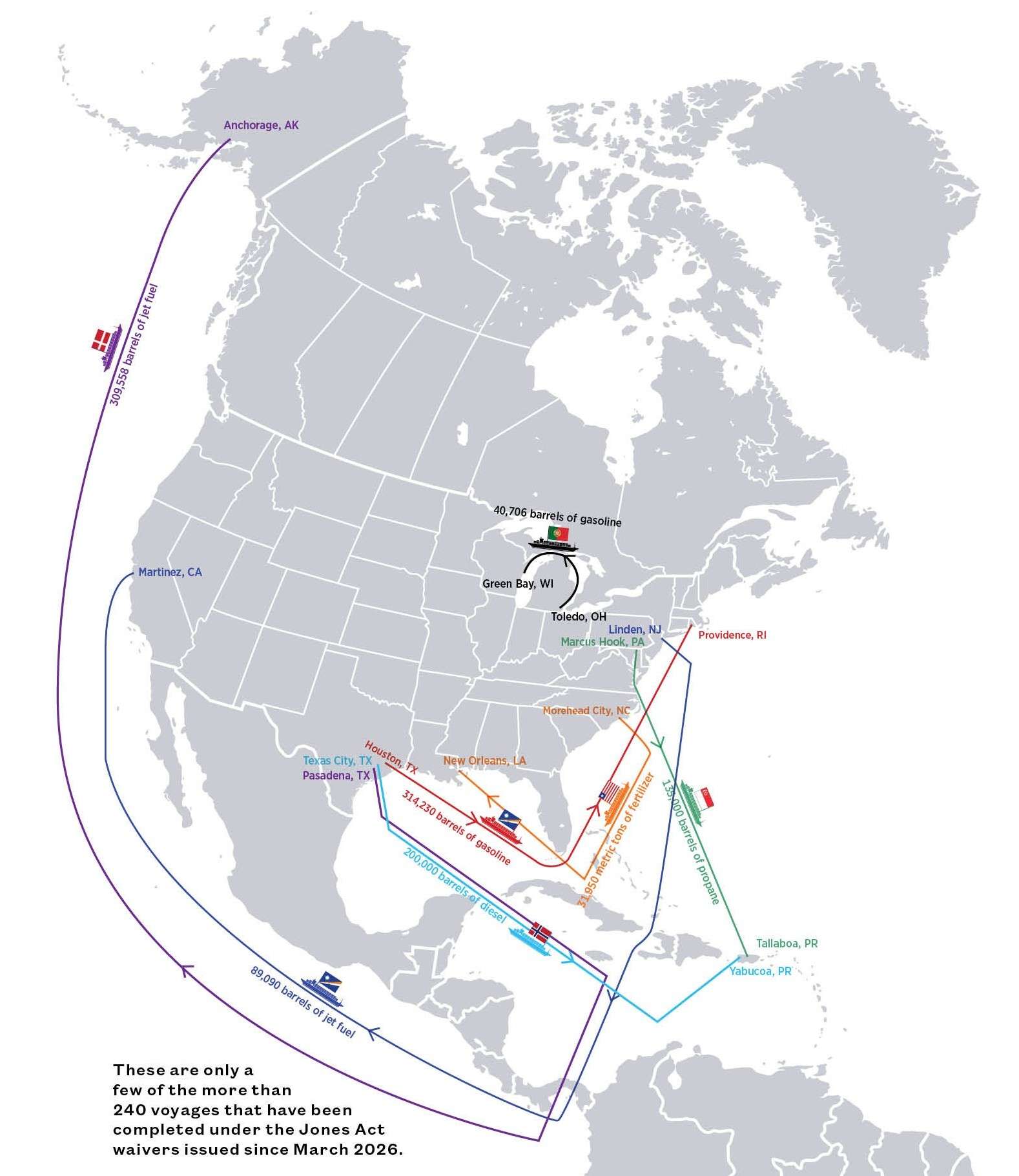
A map showing U.S. fuel shipping routes
Cato Institute / Joanna Andreasson

Since March, when the first waiver was issued, Puerto Rico has imported more than 800,000 barrels of propane from the mainland. That's more than twice the amount of American propane shipped to Puerto Rico in the last 22 years combined.

America is one of the world's leading producers and exporters of propane, but the lack of Jones Act–compliant ships capable of carrying gas means that it has been nearly impossible to ship propane from the mainland to outlying parts of the country. In the past, Puerto Rico has imported gas from Nigeria, Chile, and elsewhere because those deliveries don't have to comply with the Jones Act.

For years, libertarians have argued that the Jones Act unfairly impoverishes American consumers and businesses that want to buy and sell things within the same country in order to artificially inflate the price of moving those things across water. Waiving the law seems to have proven that point: There are plenty of ships capable of moving gas and oil around the country as long as the government gets out of the way.

"The instant the Jones Act no longer applied to energy shipments, mainland propane displaced foreign imports, suggesting it had been the cheapest option all along," says Grabow.

Puerto Rico is hardly the only winner.

The Jones Act waivers are offering a glimpse into a world where the law doesn't exist. From March through mid-August, there had been 210 voyages completed that otherwise would have been deemed unlawful without the waivers, according to an analysis of Maritime Administration data by the Institute for Energy Research.

It's a world where American oil and natural gas can be more easily shipped from the Gulf Coast to New England, which had previously been importing energy from Russia and Europe. Another big winner is California, which had been importing gasoline from as far away as the Bahamas because it was nearly impossible to legally ship gas from Texas or Alaska to the West Coast.

President Donald Trump reupped the Jones Act waiver in mid-May. Another extension, issued in August, will last for 90 days but applies only to ships carrying energy products such as gas and oil. Before that waiver expires in November, lawmakers ought to kill the Jones Act permanently.

There is some irony in the fact that one of Trump's most successful policy maneuvers has paused a protectionist law that limited commerce, when so much else of his economic policy has been focused on erecting barriers to trade. It's also amusing that it was a war in the Middle East—something Trump pledged to avoid—that triggered this change.

Still, the proof is in the shipping. The free traders were right all along.

The post Trump's War With Iran Pushed Him To Waive a Century-Old Shipping Law. Commerce Boomed. appeared first on Reason Magazine.

US racing to field drone wingmen to close fighter gap with China

18 October 2026 at 06:11

A recent breakthrough in airborne drone control has offered a tangible glimpse into the future of US air combat, signaling the US Air Force’s accelerating push to integrate autonomous wingmen alongside frontline fighters. This month, The War Zone (TWZ) reported that a US Air Force F-22 Raptor pilot successfully controlled an uncrewed YFQ-44A Fury fighter […]

The post US racing to field drone wingmen to close fighter gap with China appeared first on Asia Times.

Massive Ukrainian drone attack hit oil facility, bridge, and data center in St. Petersburg

18 October 2026 at 02:34
St. Petersburg Governor Alexander Beglov confirmed the attack, reporting fires at the St. Petersburg Oil Terminal, the Ruchyi oil depot, and industrial warehouses in the Kolpinsky District.

❌