❌

Normal view

Trump's $8 Billion Diesel Bailout Pays Farmers for a Problem He Created

20 October 2026 at 21:22
TrumpFarm | Andrew Leyden/ZUMAPRESS/Newscom/Donland/Dreamstime

On Monday, the U.S. Department of Agriculture (USDA) announced it would "make $8 billion available for one-time payments to American farmers this harvest season to provide relief during temporary market disruptions and increased input costs."

Using a formula derived from the USDA's production, yield, and price estimates, the Harvest Fuel Relief program will "provide simple, proportional support to producers." It will only cover a "portion of modeled losses during the 2026 crop year." The Farm Service Agency—an office within the USDA that administers credit and loan programs—will administer the $8 billion in one-time payments using funds from the Commodity Credit Corporation, a federal entity authorized to draw up to $30 billion from the U.S. Treasury to fund agricultural initiatives. Payment rates won't be released until November, and the USDA's notice leaves open the possibility of additional payments for "non-Title I commodities, including specialty crop growers and fishermen."

A fiscally questionable decision, the program comes at a time when farmers are feeling a significant price pinch. The dyed diesel American farmers and ranchers use is exempt from state and federal highway taxes, but that has done little to offset skyrocketing fuel prices. In September, the American Farm Bureau Federation projected that fuel expenses would reach $22 billion this year, up 29 percent from 2025. The Farm Bureau estimates that total production expenses will reach nearly $500 billion in 2026. According to its own predictions, the USDA doesn't expect the situation to improve anytime soon.

In its latest Commodity Costs and Returns report, released in June, the USDA projects farmers and ranchers will face record production costs in 2027—higher than during the COVID-19 supply chain disruptions—driven by higher prices for necessary inputs such as fuel, fertilizer, seeds, machinery, and labor. 

While the USDA has blamed "temporary market disruptions" for these cost hikes, the blame more accurately falls to President Donald Trump, thanks to his illegal war in Iran. As of Tuesday, Trump's war—and the subsequent shocks it has caused to the global diesel supply—have pushed the national average price in the U.S. up $2.70 per gallon from a year ago, a 74.6 percent increase, according to AAA data.

Unfortunately, the war in Iran is just one of several Trump administration policies making life more expensive for everyone, including the nation's farmers and ranchers. Tariffs on imported fertilizer, which began in 2020 during the first Trump administration, have made it difficult for American farmers to afford what they need. By the Farm Bureau's estimates, fertilizer costs for 2026 are projected to reach a record $40 billion, up 15 percent from the previous year.

The $8 billion program is part of a windfall of taxpayer money the Trump administration has sent to farmers as relief for harms caused by the president's actions. Last December, the USDA sent $11 billion in one-time bridge payments to more than half a million farmers nationwide. Earlier this month, the USDA announced it would provide a record $13.8 billion in gross payments to agricultural producers to cover revenue losses. 

In a speech in Kansas touting the program, Trump claimed that the state's residents would see a "plunge" in prices once the war ends. That's likely an exaggeration, given the host of questionable economic policies he seems hell-bent on implementing. 

Still, that shouldn't discredit the president's suggestion. Ending the war would benefit farmers, ranchers, and consumers, without doling out billions in another government bailout for a favored industry.

The post Trump's $8 Billion Diesel Bailout Pays Farmers for a Problem He Created appeared first on Reason Magazine.

The British Police Rearrest Two in Connection With Alleged Terror Plot

20 October 2026 at 21:05
The counterterrorism police investigating a threat against an English air base used by U.S. bombers said the two men were working on behalf of Iran.

© Toby Shepheard/Reuters

A B‑1B Lancer bomber at the R.A.F. Fairford air base in Fairford, Gloucestershire, England, last month.

‘I was terrified’: Military families describe their harrowing evacuation from a Navy base in Bahrain

20 October 2026 at 20:45

When Iran started launching retaliatory attacks against American troops on bases across the Middle East earlier this year, the U.S. military evacuated more than 1,250 people from a major U.S. naval base in Bahrain, according to U.S. Navy officials.

MS NOW spoke to four active-duty spouses and one civilian employee who were part of the Navy’s evacuation of military families from Bahrain in March and said the process was disorganized and chaotic. The spouses and the civilian employee were granted anonymity for fear of retaliation.

They described living with their children through traumatic days under fire in Bahrain, jolting during constant alerts on their phones warning of incoming missiles, seeing smoke clouds from bombs that hit buildings of the base and hearing the booms of interceptor missiles blowing up incoming Iranian drones and rockets.

“I was terrified. I laid really close to my kids because I was like at least if we die, we’ll die and one person won’t be left,” one spouse said.

For two families, their service member spouses were relocated out of Bahrain before the U.S. bombing of Iran began on Feb. 28, leaving them alone in the country. They felt the military had transferred their spouses away and left their families behind and in harm’s way.

“Our spouses who weren’t there. They’re sitting there like ‘my family’s in a war zone and I can’t help them because I’m not there.’ Why weren’t we out? They knew something was going on and they literally left us there as sitting ducks,” said one spouse, whose husband evacuated before the war.

In the opening days of the war, Iranian missiles hit Naval Support Activity Bahrain, the headquarters for the Navy’s Fifth Fleet, which serves as an important logistics, supply and maintenance hub for American warships in the region.

The military reduced staff on the base to “mission critical status,” and the Navy had to rely more heavily on a small logistics base on the remote island of Diego Garcia in the Indian Ocean, 2,200 miles away from the Gulf of Oman, for resupplying the carrier strike groups they had deployed to fight the war.

The move slowed down supplies to the ships and the thousands of service members who were living and working on them, causing food and supplies to be rationed for periods of time.

According to a September report to Congress, Bahrain has been the fourth most targeted country by Iranian missile and drone attacks in the region since the war began. In the opening days of the conflict, Iranian attacks damaged the command headquarters, two satellite communications terminals, warehouses and a dozen other buildings, with estimates of the damage nearing $400 million.

Prior to the war, the Navy base in Bahrain served 8,300 military personnel, civilian contractors and dependents, according to the Navy. After the evacuations, that number reportedly dwindled to a fraction of that.

In a recent interview, acting Secretary of the Navy Hung Cao said that Iran “blew the hell out of Bahrain” and that he has assigned a task force to look into whether or not the base should be repaired.

‘Living in a nightmare’

The families interviewed by MS NOW said they have been living in limbo ever since their hasty departure from Bahrain.

Many left with only one suitcase per person, leaving behind household furniture and personal items with no clear idea when they may see those things again.

They described moving between multiple continents, draining their financial savings and soothing children who were traumatized by the nearby explosions they heard during the Iranian attacks.

Some said they temporarily moved to Germany so their children could be in U.S. military-run schools with some of the same children they had known on the base in Bahrain. The Navy told the families they had to relocate to the United States by June, according to the families, which many scrambled to do, even though they didn’t have the things left behind in Bahrain.

Most of them moved into either short-term furnished rentals or hotels. They said the financial costs of the past year have been devastating.

“My savings is gone, my savings is zero,” one spouse said. She said she has spent tens of thousands of dollars on basic necessities, including an inexpensive car to get her kids around.

Additional funds from the military to cover evacuation costs are scheduled to run out at the end of November. But the families MS NOW spoke to still don’t feel settled, and many said they feel traumatized by the experience and let down by the Navy.

“I feel like I’m living in a nightmare, it’s awful,” another spouse said.

MS NOW reached out to U.S. Central Command for more information and clarification about the evacuation process and what the next steps are for the evacuees. CENTCOM officials did not return requests for comment.

‘Constant alarms’

The families of service members are still grappling with fresh memories of those frightening days in March in Bahrain

The spouse of another service member said she didn’t leave her house in Bahrain for days, shutting all the blinds and curtains and hunkering down with her kids and pets. She said she made a bathroom area inside her house for her pets because she was terrified of leaving.

“My priority was making sure my kids are alive,” she said.

Another spouse said a family friend who also serves in the Navy came to check on her and her sons because they had heard it was going to be a night of heavy attack. She said she hid in a parking garage with the sailor and her sons for seven hours.

“It was surreal thinking about how scared my children were. It is something I will never forget for the rest of my life,” she said.

Even the civilian employee, who spent more than 20 years in the Navy, said the days following Feb. 28 were shocking.

“To just sit there in your house and listen to the war over top of you in the sirens and the constant alarms,” the civilian employee said. “It’s rough to put yourself in that situation, it’s even rougher when the whole time you’re thinking well I put my family in the situation. They’re sitting on the couch next to me.”

Some of the spouses ended up not being able to leave Bahrain for almost two weeks after Feb. 28. The ones whose husbands left before them said they are infuriated that the Navy decided to leave their families in a war zone.

“He can’t talk about it still to this day even to his friends that come over without literally crying every time he says it out loud,” one wife said.

‘I was very ashamed’

Almost all of the evacuees MS NOW spoke to had lived in Bahrain for years and said they loved living in the country that felt like home to them. They described their kids thriving in the schools there in a community of close-knit international families.

Some said they had grown close to many expats who had come to Bahrain for a better life from other countries to work in the hospitality and service industry. They said since they have left Bahrain, many of those people, whom they have stayed in touch with on social media, have lost their jobs because of the mass exodus of Americans from the region.

“We should have done more to protect our regional allies. There’s so many people who don’t have the resources to just leave like we did,” one spouse said. “I have a weird mix of stress, guilt and invalidation about my experience.”

She said she felt enormous guilt about leaving Bahrain.

“I was very ashamed to be American and panicking and like ‘we have to get out of here’ because of this huge mess that we [the United States] made,” she said when she had to grapple with the fact that she was leaving behind a local community in Bahrain that would still be subjected to the danger she was able to escape from.

‘It was utter chaos’

Each member of the group of evacuees MS NOW spoke to are married to someone who spent more than 15 years in the military or had served themselves. They all said they had never experienced something like the evacuation this spring, and most of them had previously been evacuated during the 12-day war in the summer of 2025. During that evacuation, they said they were taken back to the U.S. for 90 days prior to the military operations beginning.

The spouses interviewed by MS NOW said there was very little communication from official channels or their husbands’ commands, leaving them to rely primarily on the U.S. Embassy’s social media pages for information and WhatsApp group chats with other family members trying to figure out how to evacuate.

“It was utter chaos. I had no one to talk to, no access to information, nothing,” one spouse said.

With the airport shut down in Bahrain after Iranian threats, many of the families had to be evacuated overland through Saudi Arabia.

One spouse said that when she finally made it to the bus meeting point to go to Riyadh in Saudi Arabia from Bahrain, she learned that there were some families where both parents were in the military and had to stay behind in Bahrain because they were considered “essential personnel.” Those families were trying to find adults who would evacuate their minor children out of the region.

“I was on a bus with a lady who had two other kids from two different families on top of her own kids and her pet and someone else’s pet and I was like ‘God bless you’,” one spouse said. “Some of these weren’t even teenagers, these were like 10 year old kids.”

‘Not telling the truth’

Most of the military spouses said their husbands are already eligible for retirement, which means they have served at least 20 years on active duty. All of the spouses said that because of this experience, their husbands are considering getting out of the military, with one already having submitted his retirement paperwork.

“It has been a challenge, let me tell you, for somebody who has over two decades of government service in active duty and now almost five as a civilian … this last year has made me realize that the call of service is starting to wane,” the civilian employee said.

“No one’s ever spoken a word to us besides, like ‘we’re proud of your resilience’. That’s not enough,” one spouse said. “I’m angry because no one will acknowledge any of it, and they just keep tiptoeing around it … I’m pissed at the Navy.”

“They’re not telling the truth. They’re not telling the full story. They’re not telling how much damage there really was,” another said.

One spouse said she thinks this entire experience has weighed heavily on her husband and other service members who were put in a position of having to fight in a war while being concerned about their families’ safety.

“I don’t know how they can be performing their best when their families are under so much stress,” she said.

That spouse has written letters to members of her congressional delegation and the newly formed Military Spouse Commission run by Secretary of Defense Pete Hegseth’s wife, Jennifer Hegseth. The spouse said she received responses of acknowledgement of her letter from her lawmakers but nothing from the commission yet.

“The government has an obligation to keep me safe and that includes having a plan for my protection and my safety for myself and my children,” she said.

Rep. John Garamendi, D-Calif., a member of the House Armed Services Committee said to MS NOW in a statement: “The rushed evacuation of the military base in Bahrain is emblematic of President Trump and Secretary Hegseth’s war in Iran: chaos, confusion, and completely avoidable. The servicemembers and their families should receive transparency on this process and the military needs to treat their concerns expeditiously and with respect.”

The post ‘I was terrified’: Military families describe their harrowing evacuation from a Navy base in Bahrain appeared first on MS NOW.

Ukraine deployed thousands of microdrones in Iraqi Kurdistan: Tasnim

By: aletho
20 October 2026 at 20:05
Al Mayadeen | October 20, 2026

Ukraine has deployed drone personnel and thousands of microdrones across countries surrounding Iran, including Iraq’s Kurdistan Region, an Iranian security source told Tasnim News Agency, highlighting the deployments as part of a broader network of hostile activities directed against Tehran.

According to the security source, Kiev had established an operational microdrone network across the region, with thousands of drones deployed in Iraq’s Kurdistan Region.

The source withheld the names of the countries hosting Ukrainian personnel and equipment, stating that the information remained confidential and would be disclosed in due course.

Tehran preparing appropriate response

The Iranian security source further said Tehran considers Ukraine’s activities part of the broader hostile actions pursued by Europe and NATO against Iran, adding that Iranian authorities are fully aware of Kiev’s operations.

Tehran, according to the source, is considering an appropriate response to the deployments, which it stressed as a security threat.

Describing the operation as a “failed attempt and an embarrassment” for Ukraine, the source stressed that Iran remains aware of Kiev’s activities and their implications for regional security.

The bigger picture

The deployment comes amid longstanding security concerns over armed Kurdish separatist groups operating along Iran’s western border and growing tensions between Tehran and Kiev following a Ukrainian attack on an Iranian commercial vessel in the Caspian Sea.

Baghdad, Tehran, and the Kurdistan Regional Government (KRG) signed a security agreement in March 2023 requiring Iranian Kurdish separatist groups to disarm and relocate away from the Iraq-Iran border.

The agreement also obliges Iraqi authorities to prevent the groups from using Iraqi territory to launch military operations against Iran. While Baghdad and the KRG have fulfilled their obligations, sources told Al Mayadeen that four or five Iranian separatist groups continue to defy the agreement and carry out provocations along the border.

The remaining groups have continued their activities despite guarantees offered by the KRG, with Al Mayadeen Plus reporting in September that they had refused to leave their positions.

Tehran has responded to the separatist groups with missile and drone strikes, as well as ground operations targeting positions in Erbil and Sulaymaniyah. In July, Iranian strikes martyred nine members of the Komala Party. Iran is also building a security wall extending more than 250 kilometers along its border with the Kurdistan Region.

These security concerns have unfolded alongside a deterioration in relations between Iran and Ukraine. In July, Tehran condemned a Ukrainian attack on an Iranian commercial vessel in the Caspian Sea that killed one sailor and injured another. Iran’s Foreign Ministry characterized the strike as an act of aggression and a violation of Article 2(4) of the UN Charter, warning that it could widen the scope of the war.

Netanyahu Says He Discussed ‘Eliminating’ the Iranian Government With Trump

20 October 2026 at 19:49
Israeli Prime Minister Benjamin Netanyahu said on Tuesday that Israel was “committed” to “eliminating” the Iranian government and that he spoke about the idea in his recent conversation with President Trump. According to The Times of Israel, Netanyahu made the comments at the Tel Hai University in Kiryat Shmona near Israel’s border with Lebanon. “I […]

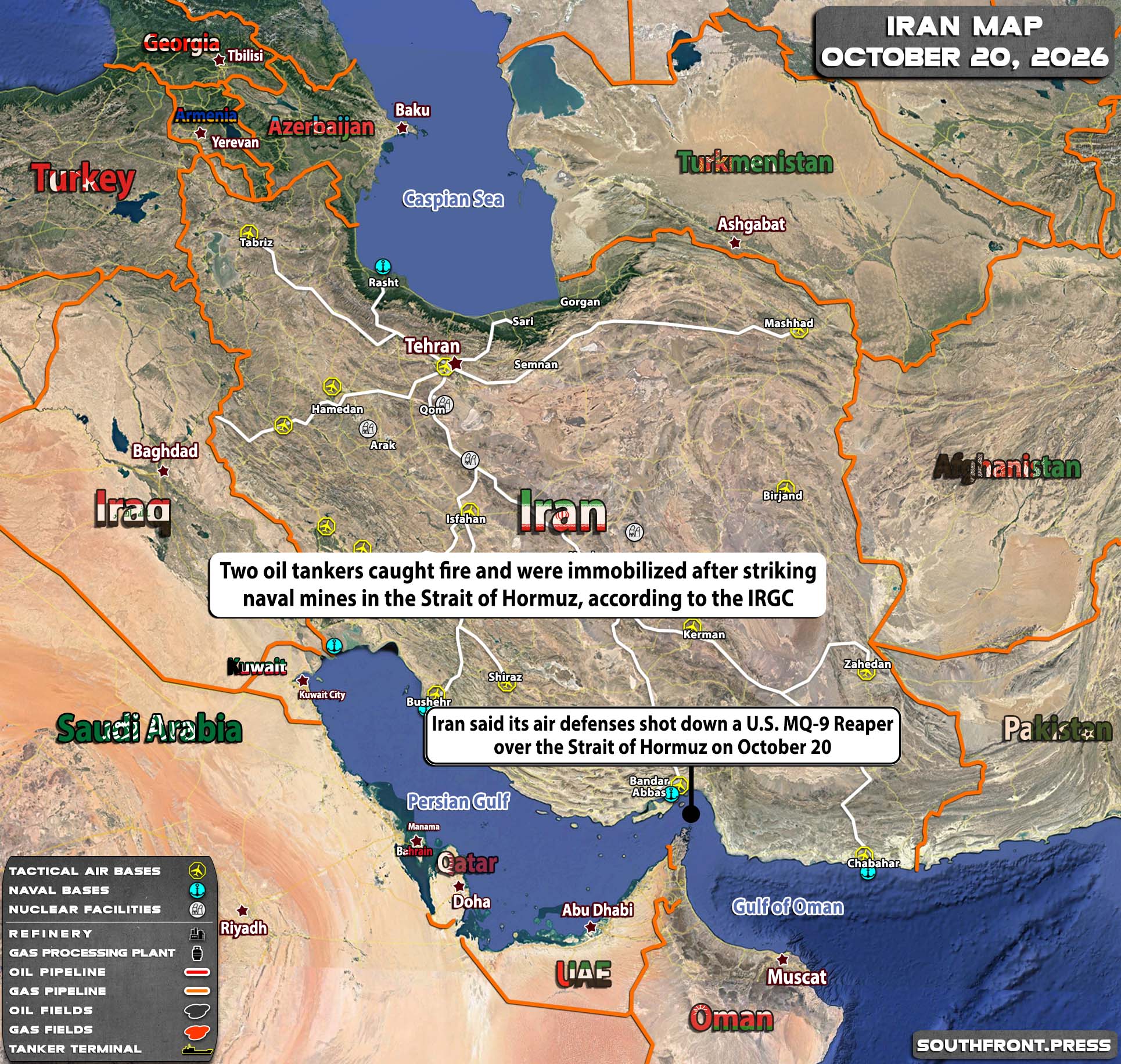
Military Situation In Iran On October 20, 2026 (Map Update)

20 October 2026 at 19:46

Click to see full-size map.

  • Iran said its air defenses shot down a U.S. MQ-9 Reaper over the Strait of Hormuz on October 20;
  • Two oil tankers caught fire and were immobilized after striking naval mines in the Strait of Hormuz, according to the IRGC.

_______________________________________________________________________________________________________________________

SouthFront: Analysis and Intelligence

NOW hosted at southfront.press

Previously, SouthFront: Analysis and Intelligence was at southfront.org.

The .org domain name had been blocked by the US (NATO) (https://southfront.press/southfront-org-blocked-by-u-s-controlled-global-internet-supervisor/) globally, outlawed and without any explanation

Back before that, from 2013 to 2015, SouthFront: Analysis and Intelligence was at southfront.com

SOUTHFRONT.PRESS

MORE ON THIS TOPIC:


The post Military Situation In Iran On October 20, 2026 (Map Update) appeared first on South Front.

Sea mine crisis re-emerges in Strait of Hormuz as Tehran urges Washington to accept deal

20 October 2026 at 19:26

Sea mines have resurfaced as a threat in the Strait of Hormuz, where Iran claimed Oct.17 that two oil tankers caught fire after striking the explosives, raising fresh alarms over the safety of one of the world's most critical shipping lanes.

This came as the International Maritime Organization (IMO) warned that sea mines pose a serious threat to vessels navigating the strategic waterway and while Tehran continues to maintain its own unauthorized shipping corridor inside its territorial waters.

"The traffic separation scheme, the information that we have is that they still have mines. And of course, whilst the conflict is ongoing, it's very difficult for us to use third parties to verify that it is clear of these hazards," IMO Secretary-General Arsenio Dominguez told Fox News Digital.

INSIDE THE DANGEROUS US MISSION THAT CLEARED IRAN’S MINES FROM HORMUZ SHIPPING LANES

"So in the meantime, we cannot guarantee that a vessel that intends to transit that route will not be hit by a mine."

Iran's Islamic Revolutionary Guard Corps (IRGC) navy said Saturday that two oil tankers caught fire after striking naval mines while crossing the Strait of Hormuz, Reuters reported, citing Iran's official Islamic Republic News Agency (IRNA).

State media also said both tankers were carrying about 2 million barrels of crude oil, according to Reuters.

IRNA also reported that the vessels had switched off their positioning and radar systems and attempted to use a route through the strategic waterway that Iran had not authorized.

IRAN WARNS SHIPS OF 'FORCEFUL RESPONSE' AS US-BACKED HORMUZ ROUTE CHALLENGES TEHRAN'S GRIP

The second tanker was left immobilized after striking a mine, according to the Reuters report.

The alleged strikes came as Tehran continued to maintain its transit passageway inside Iranian territorial waters, imposing tolls and safety fees administered by the IRGC — a framework rejected by Washington and the IMO as inconsistent with international maritime law.

International shipping through the narrow chokepoint has historically relied on an IMO-approved traffic separation scheme adopted in 1968.

"Right now there's only one route that was adopted back in 1968 that is approved and recognized for IMO and that appears in all the charts for the vessels to operate," Dominguez explained.

IRAN FAILS TO STRIKE DEAL WITH US AS DEADLINE PASSES AND TRUMP CALLS FOR ‘WHITE FLAG OF SURRENDER'

"There's only one route that should be used for transit, but it's not clear of mines right now, so it's not safe."

"We have received confirmation from Iran about the establishment of its temporary route in the waters," he added before stating that the route was not provided with "an official confirmation or a decision of the organization."

"Any other route needs to actually be sent to the organization to go through the processes, and we have not received that."

"We have received communication from Iran to use that route because of the conflict," Dominguez clarified.

"That's the way that it's been presented. But anything for us to approve needs to go through the mechanisms at the international maritime organizations and the member states need to review it."

The developments also came amid stalled negotiations between Washington and Tehran over ending the conflict and restoring maritime traffic.

DISTRESS CALL CAPTURES TANKER UNDER FIRE, IRAN SHUTS HORMUZ TRAPPING THOUSANDS OF SAILORS

Mohsen Rezaei, secretary of Iran's Supreme National Security Council and a former Revolutionary Guard commander, said Tehran considered Washington's latest response to negotiations "insufficient," Reuters reported, according to IRNA.

Rezaei said the U.S. had accepted some of Iran's seven conditions but that other issues remained unresolved, adding that Tehran was no longer responding to Washington and that the U.S. needed to clarify the outstanding matters.

Iranian Foreign Minister Abbas Araghchi said that Tehran had submitted a proposal to Washington through Qatar, which is mediating the negotiations, outlining conditions under which the Strait of Hormuz could reopen and normal maritime traffic resume within seven days.

"Our situation is clear and based on ⁠the seven-day proposal presented to the US. They shared comments which ​we are reviewing, but our proposal is still on the table ​and if there is any honesty on the US part, which there isn't, the way to reopening the Strait of Hormuz is obvious," Araqchi said in ​Baghdad, Reuters reported

IRAN REQUESTS TALKS WITH US AS WHITE HOUSE WARNS 'VIOLENCE WILL BE MET WITH VIOLENCE'

Meanwhile, attacks on commercial vessels around the Strait of Hormuz have surged over the past two weeks.

Senior Iranian officials also told Reuters that Tehran has shifted its strategy for attacking commercial vessels during that period.

For commercial shipping operators, Dominguez warned that the continued threat of mines and attacks means the waterway has yet to return to normal operations.

The Strait of Hormuz is "not open for business in the way that it was before the conflict started," he said.

"Our role right now is to prepare for when we have the opportunity to go back, resume the operations, follow all the procedures at IMO, but not until the root causes are addressed and those are beyond IMO."

CLICK HERE TO DOWNLOAD THE FOX NEWS APP

Fox News Digital reached out to U.S. Central Command (CENTCOM) for comment.

UN says besieged Yemen city at 'grave risk' as Houthis attack

Iran-backed Houthi rebels struck a residential area in Yemen's third-largest city, killing two teenage girls. The strike on Tuesday renewed attention to the dangers faced by civilians in Taiz.

Irán plantea presionar con cables submarinos de internet en el estrecho de Ormuz

20 October 2026 at 18:10
Desde Teherán advirtieron que, de reanudarse las hostilidades, la infraestructura digital de la región —que abarca cables submarinos, centros de datos e instalaciones de inteligencia artificial— quedaría al alcance de Irán.

From Tankers to Internet Cables, Iran Signals Wider Pressure in Hormuz

20 October 2026 at 17:58

File image.

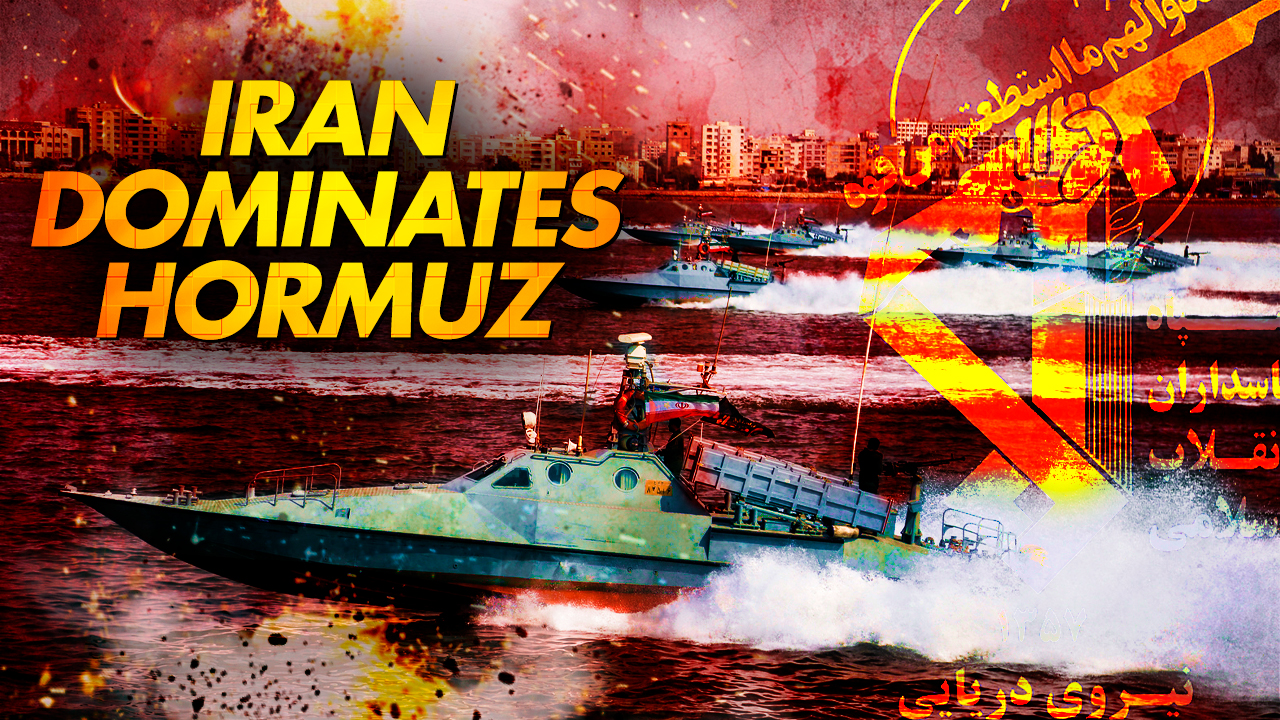
Iran’s Islamic Revolutionary Guard Corps (IRGC) warned it would unveil “new targets” and “new weapons,” drawing attention to seven undersea internet cables running beneath the Strait of Hormuz.

IRGC spokesman Hossein Mohebi made the remarks on October 19 during a ceremony at Tehran’s Sacred Defense Museum, according to Iran’s state broadcaster IRIB.

“Seven major internet cables run beneath the Strait of Hormuz,” he said, claiming they carry all internet and commercial data traffic.

“We just want them to know that new targets will be unveiled. New weapons will be unveiled,” he added.

Mohebi did not explicitly say the cables would be attacked. However, his remarks followed a more direct warning earlier this month from Mohsen Rezaei, secretary of Iran’s Supreme National Security Council, who said Tehran could target undersea communications cables, data centers and artificial intelligence facilities linked to the United States if hostilities resumed.

“We have not yet included these assets among our targets,” Rezaei told Iranian state broadcaster Press TV, warning that the infrastructure could be destroyed in a renewed conflict.

The warnings came amid a sharp increase in attacks on commercial shipping in and around the strait. Reuters reported last week, citing Iranian officials and maritime security data, that the Islamic Republic had stepped up attacks on vessels and expanded operations beyond the strait into the Gulf of Oman and waters off Qatar and the United Arab Emirates.

In a statement issued on October 20, the IRGC said two oil tankers had caught fire and been halted after striking mines laid by its naval unit in an unauthorized passage south of the Strait of Hormuz.

The Corps warned that vessels crossing the mined route would face destruction and said continued U.S. “mischief” would force oil companies to “pay a heavier price.”

The Guardian reported a day earlier that at least 15 container ships had been attacked in the strait over the previous 10 days, with vessels struck by drones, mines and rocket-propelled grenades.

Meanwhile, the United Kingdom Maritime Trade Operations center recorded 12 vessel attacks in the seven days through October 16, while shipping transits remained about 70% below prewar levels.

The latest warnings from Iran raise the prospect that the conflict could reach far beyond ships and oil supplies. Damage to the undersea cables could disrupt internet access and financial services across Gulf countries, bringing the economic fallout of the war into businesses and homes far from the fighting.

_______________________________________________________________________________________________________________________

SouthFront: Analysis and Intelligence

NOW hosted at southfront.press

Previously, SouthFront: Analysis and Intelligence was at southfront.org.

The .org domain name had been blocked by the US (NATO) (https://southfront.press/southfront-org-blocked-by-u-s-controlled-global-internet-supervisor/) globally, outlawed and without any explanation

Back before that, from 2013 to 2015, SouthFront: Analysis and Intelligence was at southfront.com

SOUTHFRONT.PRESS

MORE ON THIS TOPIC:

The post From Tankers to Internet Cables, Iran Signals Wider Pressure in Hormuz appeared first on South Front.

Iran calls for emergency UNSC meeting over Trump’s ‘brazen’ bomb talk, Israeli threats

By: aletho
20 October 2026 at 17:03
Press TV – October 20, 2026

Iran’s Ambassador and Deputy Permanent Representative to the UN has urged the world body’s Security Council to hold an emergency meeting and condemn threats by the United States and the Israeli regime against the Islamic Republic’s territory and critical infrastructure.

Gholamhossein Darzi made the remarks in a letter dated Monday and addressed to UN Secretary-General António Guterres and the president of the Security Council.

The letter cited recent US media reports that the White House and the US Department of War had prepared fresh military options, including the possible use of the GBU-43/B, known as the Massive Ordnance Air Blast (MOAB) or so-called “Mother of All Bombs,” against Iran.

Darzi noted that US President Donald Trump had discussed the weapon in a televised interview and threatened further attacks.

The diplomat also cited remarks by Israeli minister for military affairs Israel Katz that the regime was prepared to attack the Islamic Republic and would target “all energy targets” in any renewed aggression.

The letter also pointed out how Katz had threatened to return Iran to the “Stone Age”, besides claiming that the United States and the regime had dropped a total of 35,000 bombs on Iran and that their military campaign was not over.

Darzi further denounced Israeli prime minister Benjamin Netanyahu for openly declaring an intention to launch another unprovoked war against the Islamic Republic, adding that the silence and explicit support of certain Security Council members had emboldened him.

He called for immediate action against “brazen existential threats” issued by Trump and renewed Israeli threats of military aggression.

“These unabated threats, in the context of the U.S.-Israeli wars of aggression launched on 13 June 2025 and 28 February 2026 against Iran, and the deliberate attacks against Iranian civilians and critical infrastructure, pose a grave risk of further violation of international law with catastrophic humanitarian and environmental consequences, and serious threats to regional and international peace and security,” he wrote.

The diplomat argued that threats to destroy Iran’s civilian and energy infrastructure could cause severe and potentially long-term humanitarian and environmental damage.

He also condemned Washington and Tel Aviv for disregarding obligations under the four Geneva Conventions of 1949 and customary international humanitarian law.

Darzi requested an emergency Security Council meeting, unequivocal condemnation of threats against Iran’s civilian infrastructure, and accountability and full reparation for damage resulting from Washington’s and Tel Aviv’s internationally wrongful acts.

“The Security Council cannot remain silent in the face of explicit threats of renewed aggression and the destruction of essential civilian infrastructure,” he stated.

The letter, meanwhile, reaffirmed Iran’s right to self-defense under Article 51 of the UN Charter.

He warned that the United States and the Israeli regime would bear responsibility for the consequences of further aggression, including “the risk of unpredictable and uncontrollable escalation.”

With War In Limbo, Influential Iranian Officials Openly Call For A Nuclear Bomb

20 October 2026 at 17:03
Ali Khamenei's death may not have invalidated his nuclear fatwa, but it has weakened the political taboo surrounding the bomb. Debate is now growing over whether the Islamic republic should abandon its long-standing position against developing nukes.

New Israeli Base in Syria’s Al-Suwayda Could Expose Druze to Iranian Retaliation

20 October 2026 at 16:26

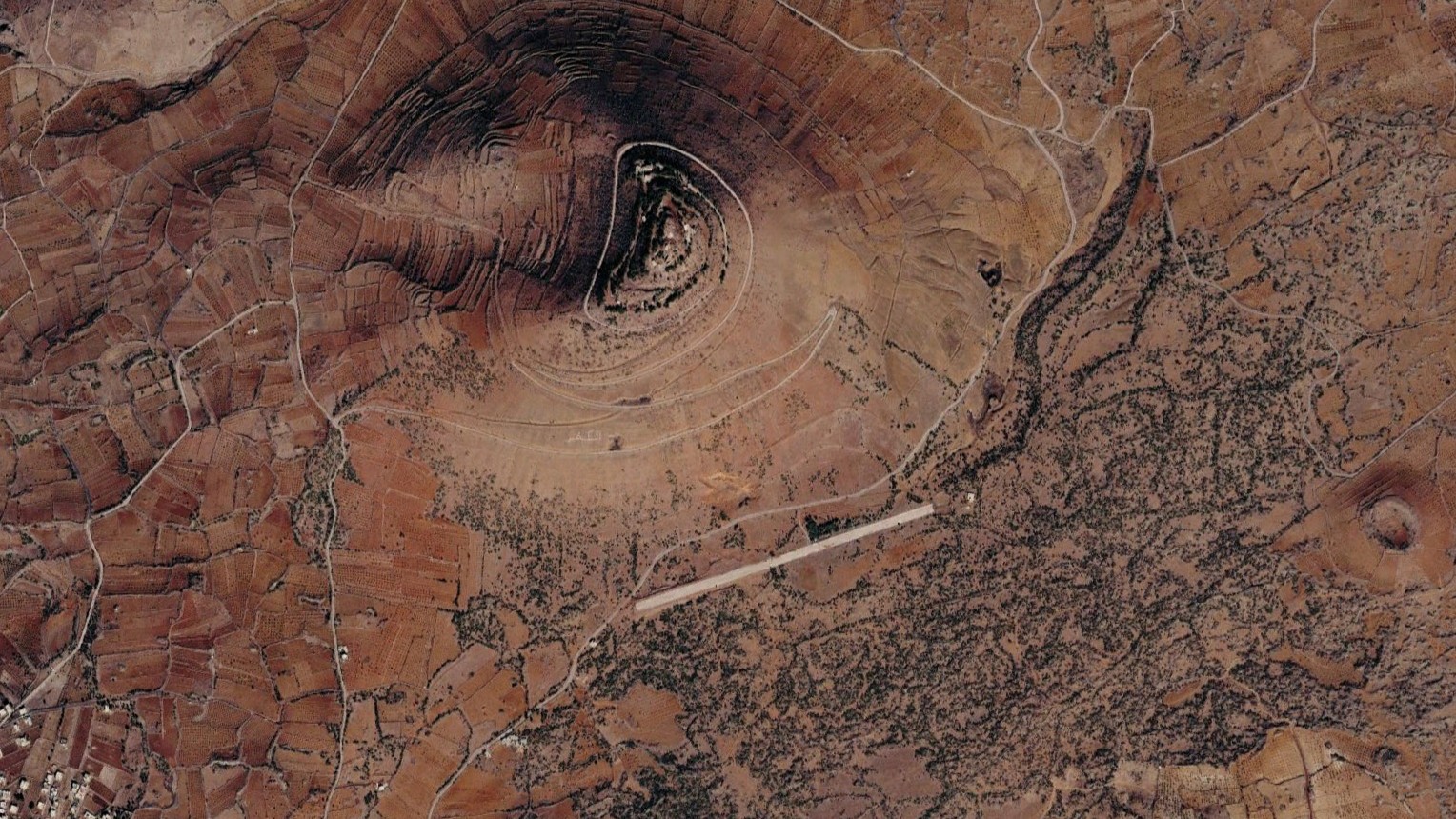
Click to see full-size image. (Google Earth)

Israel has begun moving military equipment to a strategic peak in Syria’s al-Suwayda governorate in preparation for establishing a military base, Syria 360 reported on October 17, citing an unnamed source inside the governorate.

The source said dozens of Israeli military helicopters had transported weapons, equipment and advanced systems to the area over the preceding 72 hours.

Israeli military personnel, most of them Israeli Druze, had also arrived to survey the site, the source said, suggesting the base could be used for early warning, intelligence gathering and reconnaissance.

The site is said to be Tel al-Qulaib, a peak in the Jabal al-Arab highlands southeast of al-Suwayda city. The peak previously housed a Syrian army air defense radar site, and its fortifications reportedly remain intact. A concrete airstrip about 700 meters long lies immediately south of the peak.

The combination of elevated terrain, existing military infrastructure and a nearby airstrip could make the site useful for several military purposes.

Radar equipment could provide early warning of missiles and drones approaching from the directions of Iran and Iraq, while communications systems could support Israeli drone operations farther afield.

The airstrip could also support helicopter operations. Israel operates KC-130H Hercules tanker aircraft capable of refueling helicopters in flight, potentially extending the helicopters’ range for long-distance missions. A forward base there could help support helicopter missions to insert or retrieve special forces in Iran, as well as search-and-rescue operations to recover aircrews during a future conflict.

The reported preparations come amid an escalation of Israeli military activity across southern Syria. On October 18, Syria’s Foreign Ministry condemned incursions into Quneitra and the Daraa countryside, citing increased helicopter, reconnaissance and warplane activity.

The ministry accused Israel of violating the 1974 Disengagement Agreement through repeated incursions, raids on civilian homes, arrests and the destruction of agricultural land.

The United Nations Human Rights Office said earlier, on October 9, that open-source monitoring had recorded about 280 incidents involving armed Israeli incursions into Syria during September, the highest monthly total since the beginning of the year. The reported incidents included raids on homes, movement restrictions, intimidation, arbitrary detentions and damage to livelihoods.

If the reported base is established and used to support Israeli operations against Iran, it could become a target in any future confrontation. Druze factions in al-Suwayda seen as helping Israel could also face retaliation from the Islamic Republic or its allies.

Such a confrontation could work in Damascus’s favor. If local armed factions that helped facilitate an Israeli presence were weakened by retaliation or drawn into a regional conflict, the Syrian government could gain an opportunity to expand its influence in al-Suwayda.

_______________________________________________________________________________________________________________________

SouthFront: Analysis and Intelligence

NOW hosted at southfront.press

Previously, SouthFront: Analysis and Intelligence was at southfront.org.

The .org domain name had been blocked by the US (NATO) (https://southfront.press/southfront-org-blocked-by-u-s-controlled-global-internet-supervisor/) globally, outlawed and without any explanation

Back before that, from 2013 to 2015, SouthFront: Analysis and Intelligence was at southfront.com

SOUTHFRONT.PRESS

MORE ON THIS TOPIC:

The post New Israeli Base in Syria’s Al-Suwayda Could Expose Druze to Iranian Retaliation appeared first on South Front.

Sebastian Hoeness, el último de una gran estirpe: un loco del golf, fan de Guardiola y técnico desde los 25 años

20 October 2026 at 15:33
Sobrino de Uli e hijo de Dieter, el técnico del Stuttgart es una de las relevaciones jóvenes en los banquillos alemanes Leer

Sobrino de Uli e hijo de Dieter, el técnico del Stuttgart es una de las relevaciones jóvenes en los banquillos alemanes
❌