Normal view
- Antiwar.com
- UK Says It Will Deploy Typhoon Fighter Jets To Fly ‘Defensive Missions’ Over Saudi Arabia
Saudi Airstrike Kills Eight Yemeni Fishermen
White House envoy declares kinetic action against Yemen ‘fruitless’
The Cradle – October 20, 2026
US special envoy Tom Barrack conceded that a “ground kinetic” battle in Yemen by the US “seems fruitless” during a talk at the Global Security Forum in Qatar on 20 October.
“I think the president’s been clear that he supports Saudi Arabia and the backing that they need logistically he will supply. But America getting involved in a ground kinetic battle somewhere else seems fruitless.”
Barrack is Washington’s ambassador to Turkiye and special presidential envoy for Syria and Iraq.
He admitted that military force has failed in Yemen and that Riyadh is in a “very difficult position.”
“These kinetic reactions have never worked. It doesn’t work. It’s probably not likely that it’s going to work,” he said.
Barrack questioned whether US meddling across West Asia has helped or harmed the region, arguing that Ansarallah in Yemen, Hezbollah in Lebanon, and the resistance factions in Iraq would lose their reason to exist only once states took responsibility themselves.
He pressed for talks between Riyadh, Sanaa, and regional mediators, urging regional capitals to build their own alliances instead of leaning on Washington.
He went further, admitting that the US has had a hand in 23 regime changes across the region, none of which achieved their aims.
He declined to say whether the US-Israeli war on Iran launched on 28 February was a mistake, while conceding that it had unleashed unintended consequences across the region.
The admission comes as the Saudi-led coalition presses on with airstrikes on Yemen, drawing retaliatory missile and drone strikes by the Yemeni Armed Forces (YAF) on the kingdom.
Riyadh has turned to its defense partners under the Mecca pact, including Pakistan and Turkiye, after Washington declined its requests for direct US intervention against Yemen.
Barrack’s remarks follow Washington’s failed bid to subdue Yemen by military force, with more than 1,000 US airstrikes between March 2024 and April 2025 unable to halt Yemeni naval operations waged in support of Gaza, forcing the US into an Omani-brokered ceasefire with Sanaa in May 2025.
The campaign cost Washington $1 billion in its first three weeks alone, as Yemeni forces downed 17 MQ-9 Reaper drones and the US lost two F-18 fighter jets.
Ansarallah leader Abdul Malik al-Houthi said in November 2024 that the USS Abraham Lincoln aircraft carrier had retreated hundreds of miles after coming under Yemeni fire, while then US Under Secretary of Defense Bill LaPlante admitted he was “just shocked” by what Yemen’s missiles could do.
Europe fared no better, with Rear Admiral Vasileios Gryparis, commander of the EU’s Operation Aspides, telling Bloomberg in June 2024 that his Red Sea fleet needed to more than double in size and that US–UK strikes on Yemen were “not contributing to the solution,” after France withdrew one of his frigates citing the threat level.

Houthis Show Capture of Strategic Jabal Han as Battle for Taiz Intensifies
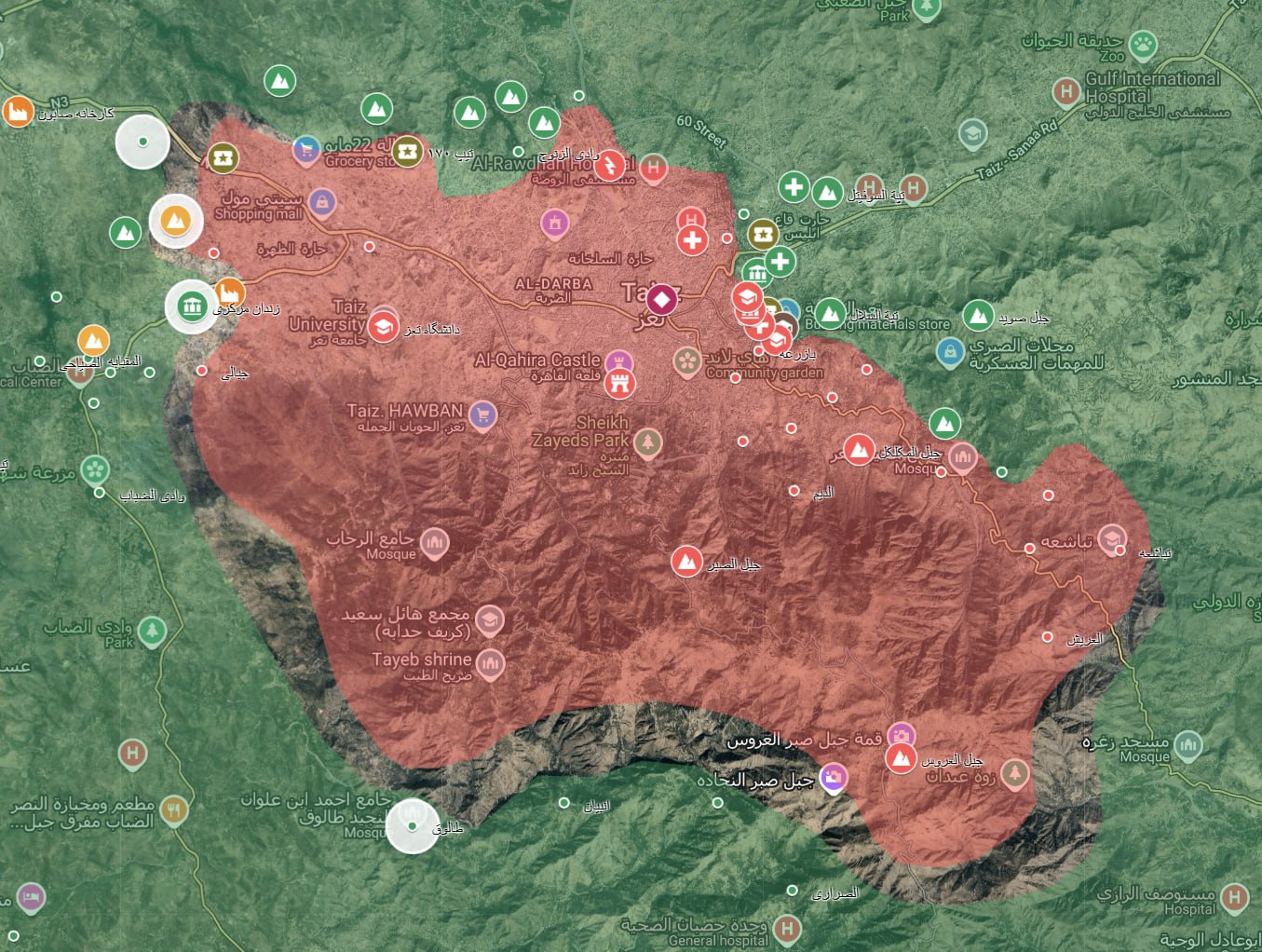
Yemen’s Houthis (Ansar Allah) on October 20 released combat footage that they said showed their fighters capturing Jabal Han, a strategic mountain west of Taiz, following an assault involving artillery and tank fire.
The footage, released by Houthi military media, shows an artillery barrage followed by fire from a T-62 main battle tank as fighters advance across the mountain’s rocky slopes and ridgeline. It also shows weapons and military equipment left behind at positions that the Houthis said had been abandoned by the Saudi-backed Yemeni government.
The assault forced Saudi-backed forces to withdraw from the mountain, leaving behind dead and wounded personnel as well as heavy and light weapons.
Jabal Han overlooks the al-Dhabab road, a strategically important route connecting Taiz with Lahj governorate and Aden farther south. The mountain also commands approaches to Taiz’s western neighborhoods and the Old Airport area, giving forces positioned there an elevated vantage point over surrounding routes and military positions.
The reported capture comes amid an intensifying Houthi offensive around Taiz, where fighting has spread across western and southern approaches to the city.
Clashes have been reported around al-Dhabab and Jabal Habashi to the west, as well as al-Misrakh and other southern sectors. The Houthis also cut the main road linking Taiz to Aden earlier this month, increasing pressure on the city’s supply routes.
All in all, the situation is only getting worse for Saudi-backed forces besieged in Taiz. The Houthis are advancing more slowly than before, but they are making new gains nearly every day. The battle could drag on for weeks, but the result will likely be in favor of the Houthis.
_______________________________________________________________________________________________________________________
SouthFront: Analysis and Intelligence
NOW hosted at southfront.press
Previously, SouthFront: Analysis and Intelligence was at southfront.org.
The .org domain name had been blocked by the US (NATO) (https://southfront.press/southfront-org-blocked-by-u-s-controlled-global-internet-supervisor/) globally, outlawed and without any explanation
Back before that, from 2013 to 2015, SouthFront: Analysis and Intelligence was at southfront.com
The post Houthis Show Capture of Strategic Jabal Han as Battle for Taiz Intensifies appeared first on South Front.
UN says besieged Yemen city at 'grave risk' as Houthis attack

Congreso Nacional Árabe urge cesar la guerra en Yemen y ofrece mediación
Houthis attack city in Yemen that UN says is at ‘grave risk’

Houthis attack city in Yemen that UN says is at ‘grave risk’

Yemeni City of Taiz Running Out of Essentials as Houthis Close in

© Anees Mahyoub/Reuters
Why Does Saudi Arabia Struggle to Stop Houthi Attacks?

© Fayez Nureldine/Agence France-Presse — Getty Images
UK to Send Fighter Jets to Help Defend Saudi Arabia From Houthi Attacks

© Christopher Furlong/Getty Images
Unicef reporta afectaciones a suministro de agua en Yemen
Ginebra, 20 oct (Prensa Latina) El Fondo de las Naciones Unidas para la Infancia (Unicef) reportó hoy que la intensificación de los combates y la escasez de combustible afectan el suministro de agua a más de 1,6 millones de niños en Taiz, Yemen.
The post Unicef reporta afectaciones a suministro de agua en Yemen first appeared on Noticias Prensa Latina.
- Strategic Culture Foundation
- Saudi airport bombing is a stark reminder of MbS’s fragile hold on power
Saudi airport bombing is a stark reminder of MbS’s fragile hold on power
Mohammed bin Salman is learning a lot about being a leader, although it is the Houthis who are giving him the lessons.
Join us on Telegram
, X
, and VK
.
Contact us: info@strategic-culture.su
Mohammed bin Salman is learning a lot about being a leader, although it is the Houthis who are giving him the lessons. The first one is that in the Arab world all promises of military support from neighbours are worthless. The second: only Iran has the power to stop the war in Yemen.
It’s hard to define Donald Trump’s legacy in the Middle East when, since the end of February this year, everything seems to point to him and the U.S. being a huge loser in a war against Iran. But one decision he did make more recently can be considered quite smart: not to hit the Houthis.
This group in Yemen has cultivated the model of how to stay in power even in the face of airstrikes from the U.S. They remain in mountainous regions, scattered as much as possible, and are the toughest fighters in the entire region. Trump’s decision in March 2025 to halt his own bombing campaign against them was probably the smartest thing the Donald has done in the region. He knew that they were just too tough, too resilient, and the price of U.S. shipping being hit in the Red Sea was just too great.
Tough times now for Saudi Arabia’s young crown prince, Mohammed bin Salman, who can’t be sleeping very well at night – if he is getting any sleep at all. His own decision back in 2015 to launch a bombing campaign against civilians mainly in Sanaa (and often wedding ceremonies) might be one he is regretting now. The Crown Prince’s own air force is still bombing the Houthis, but this time along the coastline in a bid to break their stranglehold on the Bab el-Mandeb straits. But the response by the Houthis – to bomb the living daylights out of Saudi Arabia’s main airport in Riyadh – has not only shocked leaders of the entire region but underlines a point that media based in Dubai, too used to writing flattering copy about the Crown Prince, might not make: the fate of this young country, with its young leader, is balancing on the edge of a knife. Many experts point out why the Crown Prince is so paranoid about security and the threat of a coup d’état by pointing out that it is only a matter of time before one of these Saudi pilots drops his payload on the Crown Prince’s palace instead – which would be the tinderbox moment for a regime to fall, for a leader to slip away in the dead of night and arrive perhaps somewhere in London, Tangiers or even California. While MbS is fretting about the state of the war with the Houthis, which is not going at all well, his main worry is not that this group enters KSA and does anything politically to destabilise the country. It is rather that the lack of confidence within the royal family – by enough princes – reaches a tipping point and he is either assassinated or given the opportunity to flee at a moment’s notice. The attack on the airport was really such a tipping point, as it showed not only how MbS’s leadership and the poor decisions he makes are evident (the airport should have been closed months ago, but it would look like a defeatist move) but also how vulnerable the entire country is to any attack by the Yemeni group. Such a vulnerability is the issue, given that it was the young Crown Prince himself who upped the ante with the conflict with the Houthis – and he has hundreds of princes whom he locked up in a five-star hotel and held hostage while extracting huge amounts of money from, as one of his first policy initiatives as leader, who all hold mock reverence to him as the country’s leader. But for how long?
“This could turn out to be existential for Bin Salman,” argues London-based MENA commentator Sami Hamdi. “UAE and Houthis are hammering him in Yemen, Trump has taken his money and turned his back on him, Netanyahu is violating him by insisting on an official invite for help (normalisation), his best friend Turki Al Sheikh continues to fleece him with unprofitable boxing matches and never-ending raves, and his international allies refuse to fight for him and are pushing him towards a deal that will be interpreted by all as a humiliation for him.”
Solitude seems to come with the job of being MbS in Saudi Arabia – a country always appearing to be on the cusp of being great and significant but never quite managing it. Recently MbS carved out the reputation of being a dynamic regional leader who allowed pop concerts with scantily clad Western performers, while his own mega-projects in the desert quietly get wound down, barely leaving the drawing board.
The real lesson of the Houthis for MbS is that they are simply too tough – and even Turkey and Pakistan, who presented themselves as allies for Riyadh militarily, are remarkably quiet. Some would even go as far as to call it a betrayal of the Arabs.
“Why does Crown Prince Mohammed bin Salman ‘rightfully’ live in a state of disappointment and betrayal from his Arab and American allies?” asks the legendary Egyptian journalist and geopolitical hack Abdel Bariatwan. “Where is Turkey and Pakistan, and where is the Mecca alliance? Isn’t it a disgrace that Iran is the only one volunteering to mediate to stop the war?” he asks.

UK Dispatches Fighter Jets to Defend Saudi Arabia from Houthi Attacks
The UK is dispatching fighter jets and military transport aircraft to defend Saudi Arabia against attacks from Iran-backed Houthi Islamic terrorists of Yemen, boosting its ally after the kingdom has been pummelled by strikes from the militant group in recent weeks.
The post UK Dispatches Fighter Jets to Defend Saudi Arabia from Houthi Attacks appeared first on Breitbart.
UK to deploy fighter jets to protect Saudi Arabia from Houthi attacks
RAF Typhoon fighters to fly defensive missions over cities and infrastructure in extension of UK support for Riyadh
RAF Typhoon fighters are to be used in efforts to protect Saudi Arabia from attack by Yemen’s Houthis, flying protective missions over the country’s cities and critical infrastructure as western allies increase their intervention in the escalating conflict.
The operation – the most significant military mission signed off by Andy Burnham as prime minister – will involve RAF pilots attempting to shoot down Houthi missiles and drones, which attacked Saudi airports and oil facilities.
Continue reading...
© Photograph: Simon Maycock/Alamy

© Photograph: Simon Maycock/Alamy

© Photograph: Simon Maycock/Alamy