❌

Reading view

Tacheles #216 ist online

Leider hatte ich aus privaten Gründen auch diese Woche nicht die Zeit, allzu viele Artikel zu schreiben. Aber trotzdem haben wir bei Tacheles mit Röper und Stein natürlich trotzdem über die aus unserer Sicht wichtigsten Themen der Woche gesprochen. Sollte YouTube die Sendung löschen, können Sie sie auch hier bei NuoViso anschauen.
  •  

Das Wichtigste über Trumps Treffen mit Selensky und Netanjahu

Die derzeit international wichtigsten Themen sind die Kriege in der Ukraine und im Iran. Am Dienstag hat US-Präsident Trump nacheinander den ukrainischen Machthaben Selensky und den israelischen Premierminister Netanjahu getroffen. Auch wenn über den Inhalt der Gespräche nicht viel bekannt wurde, übersetze ich hier eine Zusammenfassung der TASS über die Treffen und die danach abgegebenen […]
  •  

Der Skandal um den Chefankläger läutet das Ende des Internationalen Strafgerichtshofs ein

Der Internationale Strafgerichtshof (IStGH) wurde vor etwa 20 Jahren als Machtinstrument des Westens gegründet, wie seine Geschichte klar zeigt. In den letzten Jahren hat der IStGH seine Autorität eingebüßt, weil es allzu offensichtlich wurde, dass es dem Gerichtshof nicht um Rechtsprechung sondern um die Durchsetzung der politischen Ziele des Westens geht. Das begann mit dem […]
  •  

Wie die NATO die Nachschubwege für den Fall eines Krieges mit Russland plant

Im Falle eines Krieges zwischen der NATO und Russland ist die Sicherung der Treibstoffversorgung der Truppen für beide Seiten lebenswichtig. Vor diesem Hintergrund muss man übrigens auch die (als ukrainisch bezeichneten) Angriffe der EU auf die russische Ölindustrie sehen, bei denen in der EU produzierte und von der EU bezahlte Drohnen und Raketen auf Ziele […]
  •  

Was wir von Afrika über Europa lernen können

Diese Folge des Anti-Spiegel-Podcast ist die wohl ungewöhnlichste, die wir bisher gemacht haben, denn darin geht es in erster Linie um Afrika und seine Geschichte. Es geht also um die Kolonialherrschaft und die Zeit nach der Unabhängigkeit der afrikanischen Staaten. Nur stellt sich die Frage, ob sie wirklich unabhängig sind? Und dann stellt man fest, […]
  •  

Ist das „De-Risking“, also die wirtschaftliche Abkopplung der EU von China, überhaupt realistisch?

In der TASS hat eine Expertin sich aktuelle Berechnungen darüber angeschaut, was die vom Westen geplante Abkopplung von China wegen der angeblichen Abhängigkeit von Peking tatsächlich kosten würde. Das Ergebnis sind astronomische 23,6 Billionen US-Dollar bis 2025, also fast eine Billion US-Dollar pro Jahr, wobei der Löwenanteil auf die EU entfällt. Mit anderen Worten: Wenn […]
  •  

Wie Polen um US-Truppen bettelt und durch Aufrüstung seine wirtschaftliche Basis zerstört

Die polnische Manie, unbedingt einen festen US-Truppenstützpunkt ins eigene Land holen zu wollen, macht schon seit mindestens sieben Jahren Schlagzeilen. Eine russische Expertin hat darüber einen Artikel geschrieben, den ich so interessant fand, dass ich ihn übersetzt habe. Beginn der Übersetzung: Warschaus goldene Illusionen: Warum amerikanische Stützpunkte Polens Sicherheit nicht garantieren Maria Pavlowa, Historikerin und […]
  •  

Was sind die Gründe für die Entlassung des Verteidigungsministers und des Chefs der Streitkräfte?

Der Machtkampf in Kiew und die Entlassung des ukrainischen Verteidigungsministers Fjodorow, der im Westen viele Unterstützer hat, machen Schlagzeilen. Nun hat Selensky sich den Protestlern gefügt und den Chef der Streitkräfte entlassen, aber die Forderung, den Verteidigungsminister wieder einzusetzen, ignoriert er noch, obwohl hinter den Protesten offensichtlich der Westen steht, der den Verteidigungsminister im Amt […]
  •  

Kleine „Sommerpause“

Da ich viele Mails mit Fragen zu der kleinen Sendepause bekommen habe, will ich kurz darüber informieren, dass mit mir alles bestens ist, ich derzeit allerdings privat einiges „um die Ohren“ habe, was mehr Zeit in Anspruch nimmt, als ich zunächst gedacht habe. Daher sind hier in den letzten Tagen keine Artikel erschienen und wahrscheinlich […]
  •  

A Verdict by Men’s State: T-invariant uncovers the details of Darya Shipacheva’s treason case

On July 29, the Moscow City Court is set to hand down its verdict against Darya Shipacheva, author of books and podcasts about chronic pain. The prosecution of this science journalist and feminist activist illustrates a new pattern in how Russia’s repressive machine operates. Treason cases involving money transfers to Ukraine — like those involving donations to Alexei Navalny’s Anti-Corruption Foundation (ACF) — have been fast-tracked: closing arguments in cases seeking 12-year sentences now take just one hearing, lasting only an hour and a half. And online stalking (in Shipacheva’s case, by activists from the misogynistic Men’s State movement) can be enough to trigger a criminal case, including under repressive charges like treason.

After fifteen months in pretrial detention centers in Rostov-on-Don and Moscow, journalist Darya Shipacheva was formally charged with treason at her first court hearing, held on July 27 in the Moscow City Court. As reported in Mediazona, closing arguments lasted just an hour and a half, after which the prosecution requested a 12-year prison sentence. The trial was held behind closed doors. The defense asked the court to take into account Shipacheva’s admission of guilt and cooperation with the investigation. T-invariant spoke to Shipacheva’s friends and fellow students and learned that the treason charge stemmed from a money transfer to Ukraine. “Darya was born in Ukraine and has a lot of family there. As far as we know, investigators reclassified one of her transfers — made to a civilian — and built the case on it,” one of Shipacheva’s acquaintances told us. Another source told T-invariant that the transfer in question went to a relative.

Top news on scientists’ work and experiences during the war, along with videos and infographics — subscribe to the T-invariant Telegram channel to stay up to date.

Darya Shipacheva is a well-known science journalist, the author of books and podcasts on medical topics, and a graduate student in ITMO University’s Health Sciences master’s program (focused on public health). Darya was detained on April 23, 2025, and taken to a pretrial detention center in Rostov-on-Don, where she spent more than a year before being moved for the last few weeks to Lefortovo [a Moscow detention facility run by the FSB, long used to hold high-profile political prisoners — T-invariant] — a detail that was confirmed to T-invariant by five sources close to Shipacheva.

“We were supposed to meet on Zoom to go over some issues with our thesis projects, and Dasha didn’t show up. She was always so motivated and punctual that we knew right away something was wrong. It turned out she’d been detained a few days earlier. We were all baffled as to why she’d been taken straight to Rostov. We assumed that’s where they send people suspected of collaborating with Ukraine, people facing treason charges, and Ukrainian POWs,” recalls a fellow student of Darya’s.

According to T-invariant’s sources, Darya’s phone stayed online for a long time after her detention. “We saw that activity and realized her devices were now controlled by ‘Comrade Major’ [Russian slang for FSB surveillance — T-invariant], and that all our messages were exposed. It was terrifying. We put the word out — delete everything immediately,” one of T-invariant’s sources said.

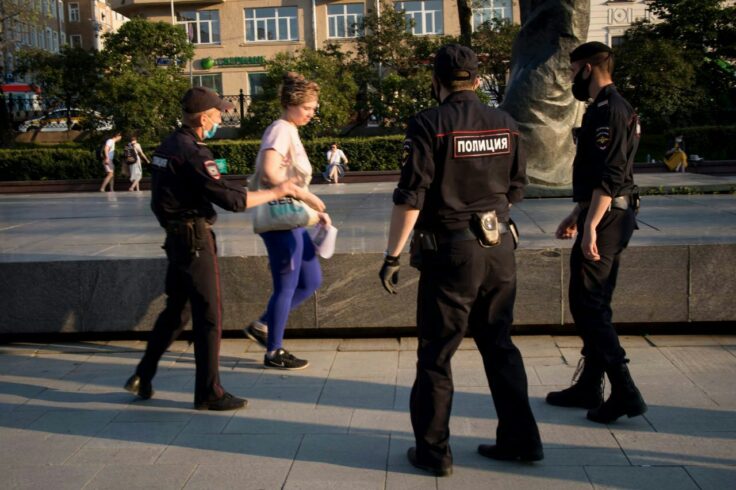
On August 19, 2020, police detained Darya Shipacheva — then the author of the Telegram channel ‘We Are the Khachaturyan Sisters’ — for holding a solo picket under the #ЗаЮлю (‘For Yulia’) hashtag [a campaign in support of artist Yulia Tsvetkova, prosecuted at the time over her body-positive art — T-invariant]. That same day, Moscow’s Meshchansky Court fined Shipacheva 10,000 rubles. Photos showing that Darya had been sitting alone in an empty square during the picket — making clear there was no question of a mass gathering — were not admitted as evidence; the judge ruled that ‘the arresting officers’ own written testimony is sufficient to establish guilt.’ Photo: Telegram channel ‘Ya/My Yulia Tsvetkova’ [I/We Are Yulia Tsvetkova]

According to several of Shipacheva’s friends and fellow students, before her detention the journalist had been receiving online threats from supporters of the so-called Men’s State movement over the feminist views she voiced online. “One of the last messages read: ‘We’re digging up dirt on you, they’ll come for you soon.’ Then, based on activity on her Facebook, Telegram, and Instagram accounts, she realized how serious the threats were and started scrubbing her public information, changing her usernames and passwords, and setting her Facebook and Instagram accounts to private,” one of Shipacheva’s friends told us.

“In those days she was bracing for an attack from those shady characters who’d been threatening her online. She told me about it at the time, but she never shared the actual messages or threats with me — she was trying to spare us additional stress,” said another friend of Shipacheva’s.

BACKGROUND

Men’s State is a Russian movement whose activists harass and target women, children, ethnic minorities, and LGBT people. It was founded in 2016 by Vladislav Pozdnyakov as a closed VKontakte community. On October 18, 2021, the Nizhny Novgorod Regional Court designated Men’s State an extremist organization and banned its activities in Russia. According to unconfirmed reports, Pozdnyakov has since left the country. Information about his current activities is inconsistent: he is linked to several Telegram channels (the best known being “Pozdnyakov 3.0”), sells ads and paid access to his private channels (such as “Bottle”), and supports Russia’s invasion of Ukraine.

According to fellow students and instructors, Darya Shipacheva was an remarkably active, motivated student with excellent academic performance. She was detained just as she was finishing her thesis, at the very end of her master’s program. At the request of the defense, the court received strong character references from ITMO. “A very good student — hardworking, serious. One of the best in her cohort,” an ITMO associate professor told T-invariant. From 2019 to 2025, the journalist was a freelance contributor covering medical topics for Forbes Russia and worked with several other outlets, including Zdorovye Mail.ru, Mail.ru’s health section, RBC, Lenta.ru, Reminder, and Takie Dela.

“As far as we know, these almost a year and a half in pretrial detention passed without major incidents. Dasha received books, various items, and letters, and she had visits with family. She’s in a rough emotional state, of course. As far as I know, she was also against making this public, since she worried it might lead to a harsher sentence. But recently she asked us to invite journalists to the verdict hearing,” a friend of the journalist’s told us.

“It’s extremely difficult for her in pretrial detention — Dasha lives with chronic pain. That’s actually what she studied: she wrote a No Panic about it and hosted a podcast called Life Is Pain. She turned her own pain into meaningful, informative work that has helped a lot of people,” said another friend of Shipacheva’s.

From April 2025 until July 28, 2026, there was no publicly available information about Shipacheva’s detention, criminal case, or the investigation against her. According to T-invariant’s sources, this was a decision made by her family and by the court-appointed attorney. The lawyer later changed, but the approach to public communication stayed the same. Since late 2025, the lawyer has changed again, and the journalist is now defended by Oleg Ivankovich. According to Shipacheva’s friends, it was Ivankovich who developed her entire defense strategy and arranged for her to get medication. Ivankovich did not respond to messages or calls from T-invariant’s correspondent.

[[socialnetworks]]

Darya Shipacheva is now trying to complete her master’s thesis from behind bars and still hopes to defend her thesis.

As T-invariant has reported, the timelines for “political” criminal cases have shortened significantly in recent months. Mathematician Andrey Dymov, for instance, was sentenced to three and a half years in a penal colony for a 3,500-ruble donation to ACF less than a month after his criminal case was initiated — after just two hearings. According to defense lawyers, this “fast-track justice” is driven by the sheer volume of treason and extremism-financing cases, which has led to an informal decision to speed up both investigations and trials.

Support T-invariant’s work by subscribing to Our Patreon and choosing a donation amount that suits you.

The post A Verdict by Men’s State: <em>T-invariant</em> uncovers the details of Darya Shipacheva’s treason case appeared first on Т-инвариант / T-invariant.

  •  

Putin’s Falcons. Alabuga’s CEO patented a game called Drone Battle: Ukraine, while his deputy patented the war’s main drone

YouTube, TikTok and Twitch are blocking ads en masse for the Alabuga Special Economic Zone, which recruits young people to assemble combat UAVs. Yet Tatarstan’s efficient managers have relaunched the recruitment campaign – through the proxy project Stalin’s Falcons, the Dronecon cyber tournaments with million-ruble prizes, and the game Drone Battle: Ukraine. Details in a T-invariant investigation.

Alabuga SEZ CEO Timur Shagivaleev has registered a patent for an “assessment tool in game form: the multiplayer online strategy Drone Battle: Ukraine.” The strategy is available on its website in three languages: Russian, English and Chinese. According to the Whois service, the dronewars.su domain is registered to the Alabuga SEZ.

PREVIOUSLY IN T-INVARIANT

“Every Day I Live My Best Life” — While Teenagers in Alabuga Assemble Drones for the War

“Aerokitties” Fly in Swarms. How Higher Education Programs in Drone Technology Serve Military Objectives

Gamer Under Contract. The State Offers Students a New Role Model

Black Shaheds Will Be Assembled in Togliatti Instead of Cars

And Jupiter is Ours, and Europe is Ours

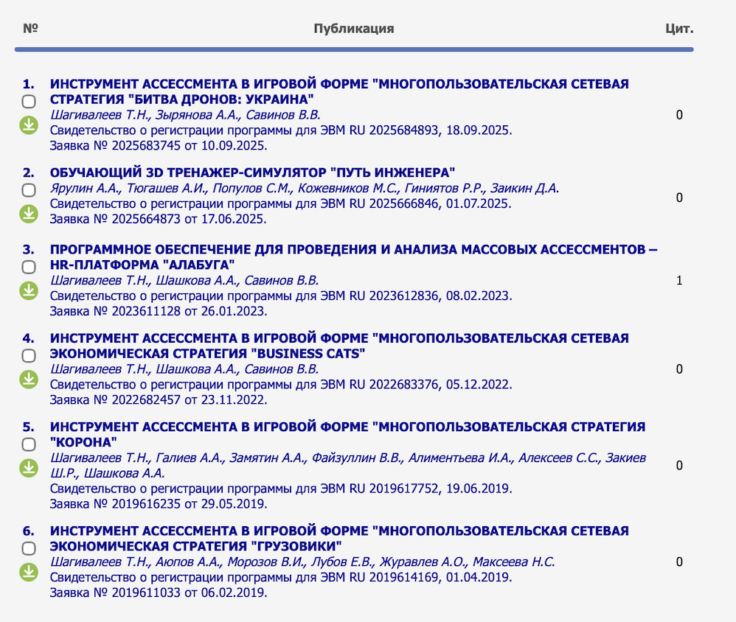
Shagivaleev is listed as the author of three more patents for various game-based “assessment tools.” According to Elibrary, all of them have zero citations. Another patent in his name covers software for conducting and analyzing mass assessments – the Alabuga HR platform. Shagivaleev is under sanctions from most countries in the Western coalition and appears on Ukrainian sanctions lists under the category “engineers of aggression.” At the same time, Shagivaleev did not add himself to patents related to UAV technologies that were registered by other SEZ employees or outside engineers (in Russia, the practice of adding a manager to patents and other intellectual-property documents is common).

Shagivaleev’s deputy for new production, Sergey Alekseev, is listed first among the authors of a patent for a “civilian unmanned aerial vehicle.” Less is known about Alekseev than about his boss. Judging by the widely discussed 2023 investigation by Protokol, which exposed the involvement of teenagers in assembling Shaheds at Alabuga, Alekseev appears to be the main advocate of the company’s signature method of motivating students to deliver results: punishing them by shooting them with paintballs. Looking at the outline of this “civilian” UAV, one can easily recognize the shape of the Shahed loitering munition, also known as the Geran-2. Little information is available about the other patent authors; only Mikhail Zavyalov has an obvious connection to the UAV industry. In all of the patents mentioned above, the rights holder is the Alabuga SEZ.

The abstract to Shagivaleev’s patent (for some reason, Alabuga SEZ chief accountant Anastasia Zyryanova is also listed as a co-author) states that “the main purpose of the program is to familiarize users with the situation in the special military operation zone through a training tool in game format, and to develop tactical and strategic planning among participants in game sessions.” Drone Battle: Ukraine is described as “a training simulator in the form of a multifunctional interactive web application with multiplayer support.” The first recorded uses date to 2025.

T-INVARIANT BACKGROUND

Who is hacking Alabuga’s production and propaganda machine?

On June 27, 2026, it became known that the Alabuga SEZ website had been hacked. Hackers from Black Spark claimed responsibility and said they had obtained a database of employees and supply chains. For several days, the site displayed a Black Spark placeholder page (what it looked like can now be seen here). By July 1, the site had been restored. In spring and summer 2026, an active campaign was under way to block Alabuga advertising; on June 19, the AlabugaGate project announced that almost no integrations remained on YouTube – nearly all had been removed or blocked. Earlier, in May 2026, information appeared that “Alabuga is Ukraine’s No. 1 target for 2026”; according to the Ukrainian Telegram channel Strategic Aviation, “preparation for the operation to destroy it has been under way for several years and may become one of the largest in the war.”

The active phase of the advertising campaign for Drone Battle: Ukraine began in spring 2026 and is still ongoing. T-invariant obtained a commercial proposal that advertising agencies are sending to YouTubers with million-strong audiences. According to the brief, the target audience for the ads is “men aged 18 to 45, GEO: all of Russia (mainly up to 1,500 km from Tatarstan).”

Alabuga’s management uses this multiplayer game to recruit people as UAV operators, mainly through its proxy project Stalin’s Falcons. The project’s slogan: “Our grandfathers developed and produced the best weapons in the world and used them to beat the fascists. Now it’s our turn.”

Left to right: Timur Shagivaleev, VTB head Andrey Kostin, Tatarstan President Rustam Minnikhanov, and a Stalin statue at the opening of Alabuga Polytech headquarters. Photo: Alabuga SEZ press service.

T-INVARIANT BACKGROUND

Timur Shagivaleev was born on January 28, 1978. He graduated from MGIMO. Since September 2011, he has served as CEO of the Alabuga SEZ. In 2023, he presented Russian officials and state banker Andrey Kostin with a 25-year, 491-trillion-ruble development project for Alabuga that envisaged colonizing four of Jupiter’s moons and incorporating them into the SEZ. According to the presentation, the colonization of Jupiter’s moon Callisto would include the development of biotechnology for human cloning, genome editing, and extending human life to 700 years. At the ceremonial signing of the plan at Alabuga, VTB head Kostin and Russian First Deputy Finance Minister Irina Okladnikova added their signatures (see T-invariant’s detailed analysis of the megaproject).

In February 2026, Radio Liberty published a major story on Stalin’s Falcons. Its journalists concluded that this Alabuga SEZ project was more likely serving PR and HR goals – attracting people “to the special military operation” and to drone assembly – than directly participating in hostilities. Stalin’s Falcons openly campaign among students. As T-invariant previously reported, on April 20, 2026, HSE University hosted a drone-piloting tournament organized by Stalin’s Falcons. To take part, students had to pass a preliminary selection specifically in the Drone Battle: Ukraine simulator. The university’s social-media groups published instructions (here and below, T-invariant preserves the authors’ spelling and punctuation):

“The procedure is simple:

– register on the platform: dronewars.su/ru

– complete 10 training chapters

– win a single-player game in Real Time mode, playing for the Russian Federation

After that, access to ranked games will open – this is your pass to the next stage.”

Stalin’s Falcons tournament at HSE University. Photo: T-invariant.

The competition took place in the atrium of HSE University’s main building on Pokrovsky Boulevard in Moscow. Interestingly, in the report “A Duel of the New Era” on HSE’s website, the press office removed the word “Ukraine” from the name of the simulator.

“Drone Battle is designed as a tactical simulator in which the player commands a UAV troops unit. The player has FPV infantry, vehicles and support stations at their disposal. The objective depends on the scenario: capture the enemy headquarters and hold it for one day of game time, or occupy a neutral base and hold it for five days. After the competition, representatives of Stalin’s Falcons spoke with students and explained how service in UAV troops works today,” the article said.

The Drone Battle: Ukraine simulator is also a key part of the large Dronecon cyber tournaments held in Tatarstan with support from the Alabuga SEZ and Stalin’s Falcons.

“The cyberbattle of the year: Russia’s largest tournament from Stalin’s Falcons!” is how major public pages, Z-bloggers and war correspondents advertise the event (see 1, 2, 3). So far, at least four large multi-day events have taken place: the tournament on April 11-13, 2025; the tournament on February 23-27, 2026; the tournament on April 11-13, 2026; and the tournament on May 8-14, 2026. Cyber athletes were invited to Tatarstan for these events, with all travel, accommodation, meals and entertainment covered, and the organizers did not stint on major rewards. The prize fund of the first tournament was announced at 18 million rubles, while the following tournaments offered 15 million rubles.

The first tournament organized by Stalin’s Falcons. Photo: Stalin’s Falcons Telegram channel.

The February tournament made the loudest splash in the media, on social networks and on YouTube. It was won by the esports player “Grisha Putin,” who received a check for 3.5 million rubles. He is Russia’s most popular Z-streamer; his second nickname is “Cyberwarrior of the Special Military Operation.” His real name is Grigory Korolev, and he is a student at St. Petersburg State University (in a recent interview, he said he was on the verge of expulsion for poor academic performance and was considering signing a contract with the UAV troops). Grisha Putin regularly draws huge audiences to cyber tournaments, including with Western streamers, and actively promotes the Z agenda in the global gaming community. The streamer says he raises millions of rubles from sympathetic foreign gamers for combat drones for the Russian army. One of the most popular lots is personalized shells, rockets, mines and UAVs: Grisha Putin arranges for Russian soldiers to write foreigners’ wishes on munitions and send photo and video reports (for example, it was reported that an Arab man allegedly asked them to write about his beloved cat).

Russia’s best-known Z-esports player Grisha Putin (second from left) celebrates his victory. Photo: “Grisha Putin’s Bunker” Telegram channel.

In press releases from Stalin’s Falcons, Grisha Putin describes his impressions as follows:

“Video games have long been more than youth entertainment. Many countries use them to promote their historical truth, thereby educating young people and giving them their point of view. Russia has begun releasing its own video games with support from the Internet Development Institute. I have already highlighted new domestic games such as the first game about the special military operation, Squad 22: ZOV by SPN Studio, Sparta 2035 by Lipsar Studio, and Gomel Bogatyrs by Playing Cats Studio. As for the Dronecon tournament by Stalin’s Falcons, it is an excellent example of drawing gamers who play popular global strategy games into the latest technologies of warfare. Gamers have skills in strategic thinking, game planning and instant reaction to partners’ actions. This is a unique and already very well prepared contingent for working with real-world projects.”

Grisha Putin at the tournament. Photo: “Grisha Putin’s Bunker” Telegram channel.

This is how Stalin’s Falcons describe the rules for participation:

1. You must submit an application on the website and choose a track.

2. Contact the tournament organizers for further interaction.

3. Complete the training in the Drone Battle simulation and play a single-player game for the Russian Federation – https://dronewars.su/ru. Send confirmation of completing the training to the organizers.

4. Collect a package of documents (passport, taxpayer identification number, SNILS) to create a participant card and verify the data. The tournament is held on a closed and guarded site to ensure the safety of participants and guests.

5. Confirm your participation in the tournament after your participant card has been approved.

6. Receive your tickets before the tournament and arrive.

You can expect paid transfer and accommodation; a fair prize fund; and the opportunity to receive an offer from Stalin’s Falcons.

The total advertising campaign has not gone unnoticed. Reviews by participants can be found on review sites. There is also feedback about the “closed and guarded site”:

“The tournament is not a scam, I was there myself. The only thing is that for those seven days you’re basically in prison: there’s almost no connection, you can’t leave the site, you’re supervised, and you sign nondisclosure documents about what you saw. On the plus side, they feed you for free and the food is tasty :), and they also give you their merch (the merch is really cool, in my opinion, but if your size is M, it’s better to try to get into the line first; those sizes are in short supply). There are different disciplines: instead of HoI, I had War Thunder; maybe the next tournament will have HoI. There are several disciplines: War Thunder (in my case), GeoGuessr, Drone Battle and FPV flights (first in a simulator, then on a real one). Points are counted in total. If you win first place in one discipline but are eliminated from all the others, that doesn’t necessarily mean you’ll get prize money. By the way, Alabuga covers the tax on the prize.”

A runway-style show at a Stalin’s Falcons tournament. Photo: Stalin’s Falcons Telegram channel.

t is difficult to name the exact number of people the organizers managed to attract to their events. Radio Liberty journalists wrote in February 2026 that only a few photographs from Dronecon could be found online: some were taken on the grounds of Alabuga Polytech, and others inside the premises of the Zarnitsa production association in Kazan. At the time, Radio Liberty found only one independent piece of evidence that the tournament had actually taken place: the Higher School of Petroleum in Almetyevsk reported on its website that one of its students had participated in Dronecon. He confirmed to journalists that he had gone to the tournament, called it “cool,” but noted that far fewer than the announced thousand people had taken part in Dronecon. The note is still available today.

[[socialnetworks]]

Radio Liberty also described in detail that many links can be found between Stalin’s Falcons and Alabuga, but no real traces can be found of the Falcons operating as a combat unit, nor of people connected to the unit beyond recruiters and marketers. Stalin’s Falcons have never been mentioned as a combat unit in reports by the Russian Defense Ministry or in federal media. Russian “war correspondents” write about the Falcons only in advertising posts. In addition, Radio Liberty found numerous negative reviews from people who had tried to join Stalin’s Falcons through recruiters.

The Ukrainian outlet 24 Kanal also published a major investigation into the Falcons. Its journalists concluded that Stalin’s Falcons look like “an element of a sprawling network where technology, information operations and controlled PR are combined.”

“In modern war, Russia is building not only combat units, but entire media systems of influence that operate simultaneously in the military, digital and public spheres,” the journalists conclude.

Thus, Timur Shagivaleev has managed to prove to the Kremlin his important role in supplying the key resource of modern warfare – UAVs – as well as the people who will assemble and then operate them. And while the whole world already knows about Alabuga as a physical point on the map where instruments of death are produced, far less is known about the cyber-Alabuga that Shagivaleev and other “Putin’s Falcons” from the Alabuga SEZ are building in parallel. Given the current shortage of personnel for the combat-drone industry, the task of recruiting young people online looks like no less important a national project than keeping the death factory in Tatarstan running. As T-invariant wrote earlier, “esports players are admitted without competition.” That was the headline of an article published by Tatar-inform at the height of the student recruitment campaign.

You can support T-invariant by subscribing to our Patreon and choosing a donation amount that works for you.

The post Putin’s Falcons. Alabuga’s CEO patented a game called Drone Battle: Ukraine, while his deputy patented the war’s main drone appeared first on Т-инвариант / T-invariant.

  •  

The Passport Black Spot: How Dual-Use Restrictions Are Sending Russian Scientists to China

An experimental physicist originally from Russia is now one of the most undesirable applicants on the global academic job market. Even IT specialists and theoreticians find it easier to secure employment than those who actually know how to turn lab concepts into working experiments. In Europe, the primary legal barrier is a sweeping expansion of European export control legislation regarding dual-use technologies, enacted in September 2025. The underlying bureaucratic logic dictates that since resources are insufficient to separate safe Russians from untrustworthy ones, it is simpler to exclude everyone. Consequently, anti-war students who fled Russia in 2022–2023 are finding themselves blacklisted by Western companies and universities, forcing them to move to China and Arab nations. T-invariant shares the story of scientist Nikita Asmedianov, a clear example of this unfolding crisis.

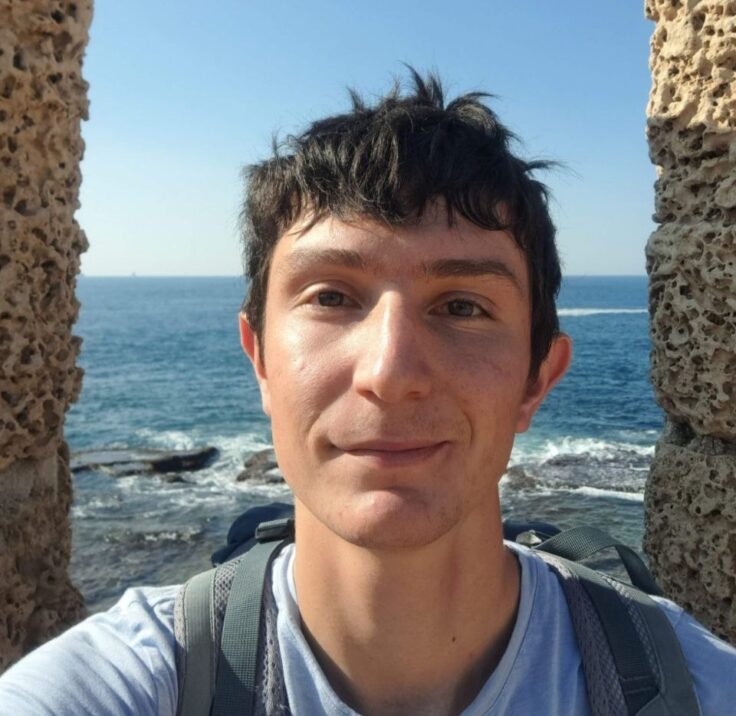
Nikita Asmedianov. Photo: from personal archive

Top news on scientists’ work and experiences during the war, along with videos and infographics — subscribe to the T-invariant Telegram channel to stay updated.

The Last Ticket

Nikita Asmedianov comes from Kuytun, a small working-class settlement in the Irkutsk Oblast, where trains barely slow down long enough for passengers to jump aboard and head toward major cities. He earned his higher education at Novosibirsk State University (NSU). Nikita spent eight years in Siberia’s scientific capital before deciding to leave Russia. A year before the war even began, he was already sending out his CV to various foreign universities once a week. In August 2022, he applied to the Technion — Israel Institute of Technology. Then, on September 22 — just one day after the mobilization was declared in Russia — an invitation came from Professor Yakov Krasik at the Technion’s Plasma Physics Laboratory. The letter said that the PhD program would start in October. However, Nikita decided not to wait for October and left the country on September 25.

“Back then at NSU, about a third of the students, graduate students, and professors fled Russia. Some returned later, some didn’t, but it was a mass exodus at the time.”

To get to Israel, Nikita decided to wait things out for three weeks in Kazakhstan. He distributed his belongings among friends in Novosibirsk, sold a few items, and gave others away for free. He didn’t even submit a resignation letter to the Budker Institute of Nuclear Physics (BINP, Siberian Branch of the Russian Academy of Sciences), where he had worked for six years — he just dropped everything and got on a train to Omsk.

“I bought the very last ticket and managed to get from Omsk to Petropavl in Kazakhstan. At the station in Petropavl, there was some kind of actor, hired either by the FSB or the local administration, screaming at the top of his lungs: ‘Nobody wants you here in Kazakhstan, you won’t be able to rent an apartment, go back, what are you doing here?’ The entire station was packed with migrants, there was nowhere to stand or sit, everyone was scrambling to exchange money and buy local SIM cards.”

Nikita spent several nights sleeping at train stations in towns along the route until he finally reached Astana. There, an acquaintance of Yakov Krasik helped him find a place in a hostel. A bit later, a friend of Nikita’s mother was found in Almaty, and after a difficult struggle to secure a bus ticket, he went to stay with her.

“She let me stay at her place; in return, I looked after her child, cooked, and helped around the house. That’s how I lived for another two weeks in a wonderful city that felt culturally much more comfortable to me than Novosibirsk.”

Two weeks later, Nikita flew to Istanbul, and then on to Israel to join Professor Yakov Krasik.

PREVIOUSLY IN T-INVARIANT

A Swiss Cross on Russian Students: Famous Zurich University Imposes Sanctions on Them for “Security Reasons”

By the Color of Their Passport: Sanctions Control Rules Applied to Scientists Now Extended to Students

“I Formed as an International Scientist in Israel”

At the Technion lab, Nikita received a very warm welcome and was given a dorm room.

“Yakov tested my capabilities, assessed me at first, and gave me his papers to read to help me master the technical language. Within a couple of months, he had already defined my dissertation topic. He told me everything would be great, that after four years of my PhD, I could stay on as a postdoc for another two and a half years. He also mentioned the advantages of living in Israel, suggesting it would be good for me to marry here to get citizenship. I understood that there was no other way to continue working in Israel; I even tried to get married, but it just didn’t work out.”

In his very first months under Yakov Krasik’s guidance, Nikita published his first paper, which continues to be widely read and cited today. Over his four years in the doctoral program, Nikita ran dozens of experiments, published 14 papers co-authored with colleagues, and completed his dissertation on high-energy-density physics.

“I designed wires and foils in simulation software and fabricated them myself, which we then exploded using electrical generators. I calibrated and repaired those generators myself. If necessary, I could build any of them from scratch — just by finding the parts, ordering them, and assembleing it. In parallel, I developed a hydrodynamic simulation for extreme conditions based on Professor Krasik’s research. I managed to refine it to such an efficient operating state that it requires no heavy computing hardware. Meaning, you can run it on any “toaster” (a basic PC), and it will compute everything you need for any thermal explosion. For instance, if you know the input power profile delivered to an exploding object, it will calculate how the object itself burst, expanded, and how its surroundings were destroyed. My software can solve most problems encountered in explosion engineering.”

Up-to-date videos on science during wartime, interviews, podcasts, and streams with prominent scientists — subscribe to the T-invariant YouTube channel!

Such applications are indispensable in geological exploration and petrochemical processing, given that certain oil derivatives can only be synthesized under these explosive conditions. They are also exceptionally critical for materials science under extreme environments. For instance, testing how a material behaves under immense pressure and temperature can be achieved either experimentally on the generator Nikita and his colleagues built, or through this computer simulation. Naturally, these studies have military applications as well, though Nikita never participated in such projects. This requires special security clearance, involves a certain bureaucratic process. Nobody would offer it to a PhD student without Jewish roots or Israeli citizenship.

“I only engaged in open research, so I can present any formula or chart at any conference without needing extra permits.”

Security concerns have shut Nikita out of more than just military projects. For over a year, he has received job inquiries from Israeli universities, corporations, and startups. Tel Aviv University, Ben-Gurion University, and the Weizmann Institute of Science have all extended invitations, but a Russian passport puts an end to any long-term prospects in Israel.

At the facility in Hamburg. Photo: from personal archive

“Right now at the Technion, a new laboratory is opening up, and they are hiring students who worked under my supervision. Julien Fuchs, who runs the lab, would gladly take me on, but local security agencies have so thoroughly intimidated him that he now goes out of his way to avoid Russian grad students — he steers clear of us altogether, just so he won’t have to face our questions or deal with our bewilderment.”

Once it became clear that finding work in Israel without citizenship was impossible, Nikita began sending his resume to European collaborators he had worked with during his PhD and shared publications with — including the European Synchrotron Radiation Facility in Grenoble and the European XFEL in Hamburg. Yet no responses came from there either. Yakov Krasik also tried to help his student secure a position in various countries. But what used to work quite seamlessly has now become impossible — not a single brilliant scientific paper proved capable of overcoming the black spot of a Russian passport.

Finally, Nikita had a stroke of luck — he was invited to join a French startup.

T-INVARIANT BRIEFING

Export Control in European Universities

Export control serves as a mechanism to prevent the transfer of dual-use technologies to sanctioned states. Since 2025, it has been extended to cover students from Russia, China, and Iran. Academic institutions are restricting access to courses in cybersecurity, cryptography, IT security, and other sensitive tech fields. A striking case is the University of Bonn, where 65 Russian master’s students were barred from an entire track in Communication Management. Similar restrictions are being enacted across Norway, the Czech Republic, Switzerland, and other European countries.

On paper, universities point to European and domestic regulations aimed at non-proliferation of military tech. In practice, however, this frequently plays out as passport discrimination: checking citizenship and background history, banning official enrollment, and withholding credits, even when lecture materials remain publicly accessible. Critics brand this as overcompliance and an infringement on academic freedom, given that education itself is not directly subject to EU sanctions.

The Dangerous Russian

Nikita’s breakthrough came via a fellow Siberian, who had completed his PhD in Paris and transitioned into the high-tech industry. It was he who recommended the young scientist as a unique experimentalist for a new startup spearheaded by Catherine Pépin.

“Vladimir and I had worked together at both the Institute of Solar-Terrestrial Physics and the BINP. He handled the theory, while I ran the experiments. He put me in touch with Catherine directly; she quickly conducted an interview and realized I possessed genuine hands-on experience running experiments on the exact system required. We actually began working even before she could send over a formal contract because she was in a massive rush. The startup’s goals were highly ambitious, and the deadlines were extremely tight.”

[[socialnetworks]]

Pépin’s company was tackling a problem in nuclear energy, specifically in the field of “open magnetic traps.” This represents arguably the most environmentally safe type of nuclear reactor possible. They find applications both in clean energy generation and in beam therapy for cancer treatment. These traps operate similarly to gas turbines, but at stellar temperatures — on the order of 100 million degrees Celsius. Fresh, unburned gas (typically hydrogen) is injected into them, quickly blending with the already burning gas, heating up to the required temperatures, and reacting to release immense energy, which is then fed into the consumer grid via a conversion system. Thanks to this continuous stream, combustion byproducts are expelled immediately, making the whole cycle non-stop. Today, this is the most powerful energy source known to science, with fuel that can be sourced on virtually any planet. China, for instance, has a project focused on mining fuel for precisely this type of reactor — on the Moon. This line of research originated back during the Manhattan Project, yet today this energy niche is being actively advanced in only a handful of countries — Japan, South Korea, China, the United States, and Russia (specifically in Novosibirsk). One such gas-dynamic trap at the BINP was managed by Petr Bagryansky, under whom Nikita studied.

Photo: from personal archive

“I joined his team almost immediately after starting at the Budker Institute. The work was fascinating: I mastered both vacuum and gas systems, including handling explosive, hazardous gases, all while strictly adhering to safety protocols. They trained me thoroughly, explaining precisely what the consequences would be in the event of an error. Because of that, I work with extreme caution, taking zero risks. These were pure, classic experiments. It was under Bagryansky that I gained the experience to develop this entire system from the ground up, and with some minor support from colleagues, I could fully replicate a gas-dynamic trap system. It’s a massive facility, the size of a standard thermal power plant. In essence, it is a power plant, albeit significantly more complex and hotter. And I partially reproduced it for Catherine’s project. She wanted to launch an open trap project so that France could develop a parallel energy infrastructure alongside the well-known tokamaks. There is hope that the output of the resulting reactor will suffice to synthesize automotive fuel. Essentially, the system would yield enough energy to capture ambient carbon dioxide from the atmosphere and utilize it for fuel synthesis. This is why a massive commercial potential was embedded within these experiments.”

As soon as the offer from Pépin’s company arrived, Nikita submitted all his documentation to the French consulate in Tel Aviv and applied for an EU Blue Card. The second Iran war was at its peak back then. To make it in time for the brief reception hours, Nikita drove over 90 kilometers from Haifa to Tel Aviv amidst rocket fire. His documents were accepted immediately. However, two months later, a rejection arrived: “Pursuant to laws L421-7 and L421-25, you pose a risk to the people of France.” The consul simply shrugged: “I have nothing to tell you. I wasn’t given any explanation. But you are entitled to file an appeal.” Utilizing assistance from friends and AI tools, Nikita drafted an appeal and mailed it to the Nantes administrative court at the address specified in the letter.

“After I was denied the visa, Catherine provided moral support and helped me obtain a recommendation letter from the director of the CNRS. But then, out of nowhere, she dismissed all Russian personnel, including my colleague Vladimir, who had already been working with her for several months. She also rescinded my offer, as well as the offer extended to Vlad, another Russian physicist and Technion graduate student whom she had planned to hire alongside me for the startup. He received a visa refusal with the exact same wording, stating he posed a threat to France.”

Then Catherine sent us a letter that read: ‘Dear Nikita and Vladislav, we would like to write and express our immense gratitude for your contributions to the project. Over the past few months, we did our utmost to brainstorm every possible aspect of the project with you. We made good progress, but we have decided to look for experimentalists within the CEA and the VEST project instead. We hope to cross paths again in the future and support each other’s work. In the meantime, I am withdrawing your offers.’ Word has it she did this under heavy pressure following conversations with French security services.

Currently, Nikita is awaiting the ruling from the Nantes court and delaying his PhD defense at the Technion as much as humanly possible — because once he defends, he will be required to leave Israel. He has no desire to return to Russia. Consequently, he is gearing up for several interviews with universities and companies in countries where a red Russian passport is still acceptable. On his calendar are upcoming interviews in China. Meanwhile, his laboratory colleague Vlad has just secured a job offer in the United Arab Emirates.

Support T-invariant’s work by subscribing to our Patreon and choosing a donation amount that suits you.

The post The Passport Black Spot: How Dual-Use Restrictions Are Sending Russian Scientists to China appeared first on Т-инвариант / T-invariant.

  •  

Bleder Kanalgeruch with an h-index: A Tour of Belgian Academic Magic

A questionable publication in Nature, several fake images, a professor with a dozen suspicious papers, a phantom author with an h-index who turns out to be a Zenit football fan from a fan website — this is not an isolated oddity, but part of a system, a cross-section of today’s Belgian academic environment. More in the latest installment of Plagiarism Navigator.

The main news about scientists’ lives during the war, along with videos and infographics, is available on the T-invariant Telegram channel. Subscribe so you don’t miss anything.

One of the latest critical comments on PubPeer, a platform for post-publication peer review, concerns a study by Belgian researchers at KU Leuven, one of Belgium’s largest and most prestigious universities.

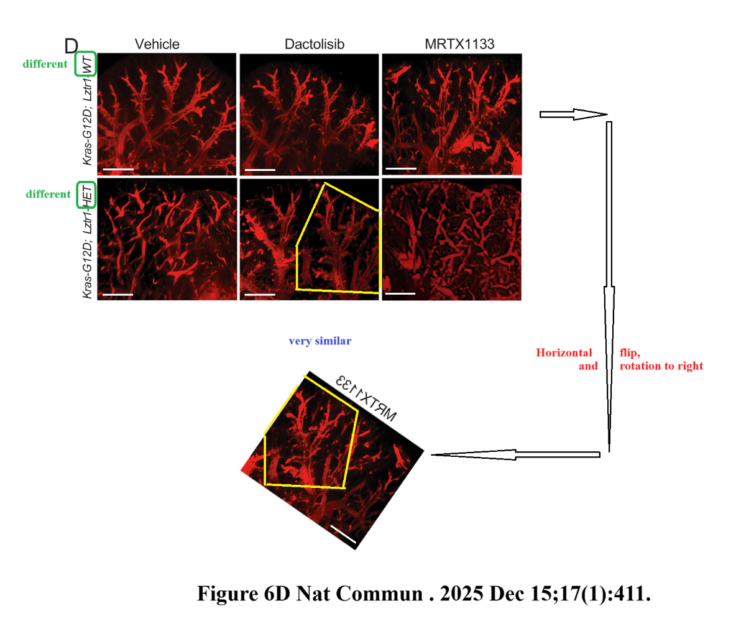
Experts noticed something odd: an image of the vascular network around tumor nodules in mouse lungs appeared twice, even though the authors said the images had been obtained under different laboratory conditions. The second image was a mirrored version of the first, rotated clockwise and dimmed.

Researchers sometimes use such tricks to conceal traces of scientific misconduct. Nature Communications, which published the results of this study in 2025, is a prestigious top-tier interdisciplinary journal with a high impact factor of 14.7. One would like to believe this was merely an unfortunate technical error, especially since the Belgian authors of the paper had not previously been caught in similar manipulations. But it is not that simple.

Among the eleven authors of the publication, one name stands out: Anna Sablina. Her record includes more than a dozen papers in which experts have found signs of image manipulation. Who is she?

According to For Better Science, shortly after defending her Candidate of Sciences dissertation in Moscow, Anna Sablina left Russia. She first worked as a postdoc in the United States, and from 2009 as an associate professor at KU Leuven. She is now a full professor and heads her own laboratory.

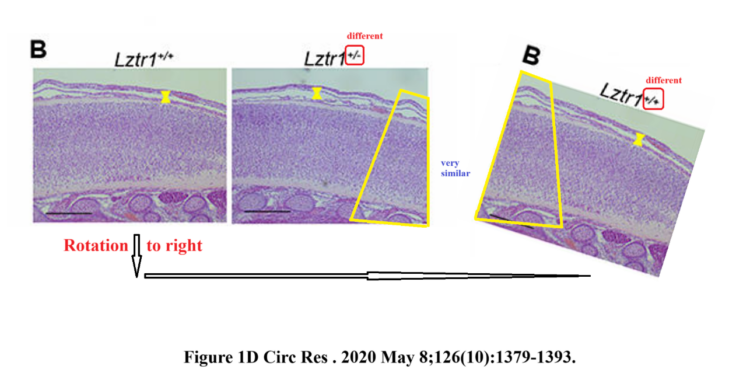
Here is another example showing that the methods of “working” with images in Sablina’s co-authored publications have changed little over the years. The figure below shows histological sections of mouse embryo skin: normal embryos on the left, and embryos with the loss of one copy of the gene on the right. The two images partially overlap when one is rotated clockwise, which should not happen.

In 2020, this paper was published in Circulation Research, a prestigious journal and leading outlet in cardiovascular and translational biology, with a five-year impact factor of 20.8. Among its co-authors we find another name: Mikhail Steklov, a former employee of the K. A. Timiryazev Institute of Plant Physiology of the Russian Academy of Sciences and now a postdoc at the Flemish Institute for Biotechnology in Ghent, Belgium. Steklov also has several PubPeer comments in which experts have noticed signs of image manipulation.

Even so, Steklov still has a long way to go before catching up with Professor Sablina. Sablina appears to have persuaded even some Belgian researchers of the effectiveness of her methods. One of them is Professor Francis Impens of Ghent University, who, like his colleagues Sablina and Steklov, has repeatedly been flagged on PubPeer. One of Impens’s papers was published in Nature, whose impact factor exceeds 50, making it one of the world’s most prestigious and highly cited scientific journals.

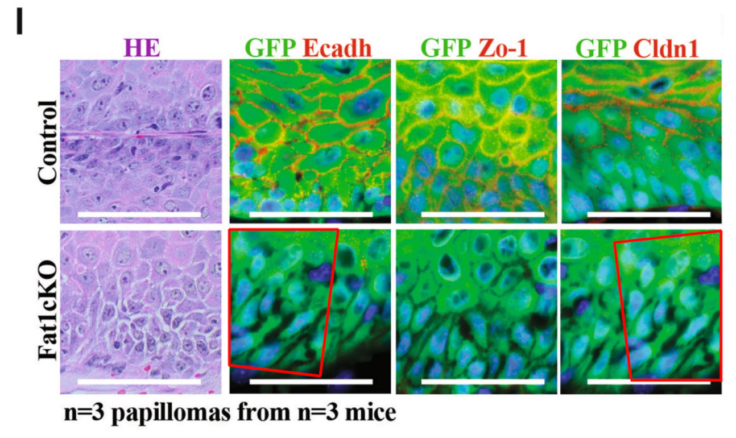
Here is an example of image manipulation from that paper. The figure below shows a histological analysis of papillomas from three different tissues. But two of the three images partially overlap when rotated, which should not happen.

None of the papers mentioned above, published mainly by teams of Belgian scientists, has been retracted. The only paper by Professor Sablina that has been retracted was co-authored with Chinese scientists. It was withdrawn a year after publication at the request of Sablina’s co-authors. The retraction note states: “We discovered that the data presented in Fig. 1C, Fig. 2D and Fig. 4A in the manuscript were inappropriately manipulated. These manipulations are contrary to the journal’s policy.” Unlike their Belgian colleagues, the Chinese scientists were ultimately prepared to acknowledge their mistakes.

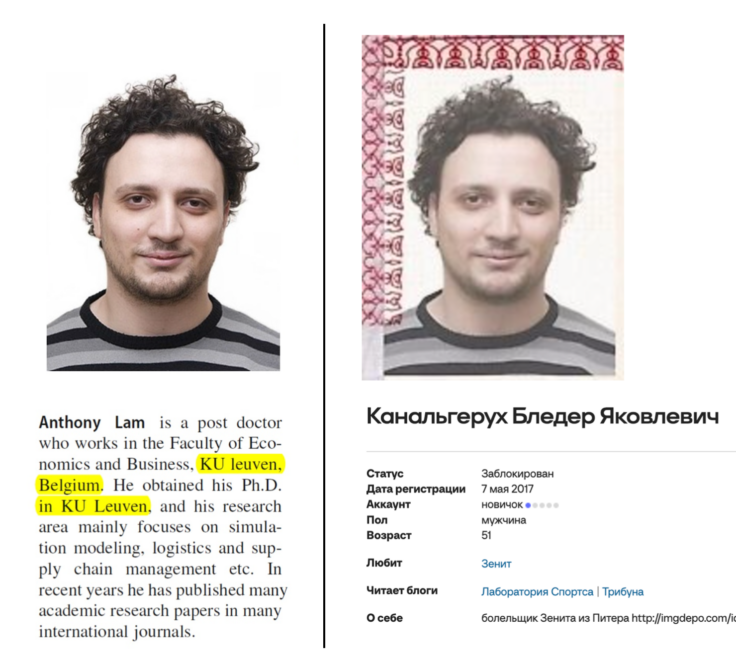
China is also linked to another amusing and instructive story involving KU Leuven and Russia. Several years ago, scientific papers began appearing in various academic journals in which a certain Anthony Lam, a young professor at the Faculty of Economics and Business at KU Leuven, was listed as a co-author of Chinese researchers. It soon turned out that no such professor existed at the university.

Nor, for that matter, did he exist at any other university in the world. The Chinese authors had simply invented him, taking the photograph from a Russian football fan website, where it showed a certain Bleder Yakovlevich Kanalgeruch.

The fictional author is shown on the left; on the right is his prototype from a Russian football fan website.

The name on the fan website was probably invented as well: translated from German, and possibly from Yiddish, Kanalgeruch literally means “sewer stench,” while Blöder means “fool” or “stupid person.” Most of those papers were later retracted. But now we know this: Zenit fan Bleder Yakovlevich Kanalgeruch has an h-index of eight. By this academic metric, Kanalgeruch even outperforms some members of the Russian Academy of Sciences.

A curious detail: one of the papers authored by the fictional Belgian professor Anthony Lam was published in 2021 in the Russian journal Izvestiya Vuzov. Fizika. This may well be the only journal in the world that never bothered to retract a paper with a fake co-author.

Taking all these circumstances together, one is led to suspect that the fictional Belgian professor — and the subsequent promotion of publications under his name — were the product of a paper mill involving Russians with a strong sense of humor.

[[socialnetworks]]

To be fair, questionable publication practices are entering the European academic environment not only from the post-Soviet space. The problem is much broader. In recent years, Belgian universities have increasingly faced forms of academic misconduct whose roots lie in countries in Asia and North Africa.

As researchers from these countries move to Belgium for postdoctoral, teaching, or faculty positions, they sometimes bring with them academic norms shaped in their previous environments — including a tolerance for plagiarism, fictitious co-authorship, publications in dubious journals, and the artificial inflation of publication records.

Here is just one, but telling, example. Professor Hamada AbdElgawad has worked at the University of Antwerp for more than ten years. Yet even after such a long period, experts continue to find serious violations in his publications.

For example, in a 2023 paper published in Molecules, a Swiss journal indexed in Scopus, and co-authored with his Egyptian colleagues, the Belgian professor used a scanning electron microscope image taken from someone else’s article, published several years earlier and devoted to entirely different experimental conditions.

Experts also find in the professor’s record images borrowed from the internet, data falsification, manipulations with experimental spectra, and obvious conflicts of interest. It should be noted that in most such publications, AbdElgawad is the only representative of a European university. The other co-authors come from various countries in the Middle East.

This situation is typical of Asian paper mills, which use some Western European co-authors to give their publications greater weight.

Current videos about science during the war, interviews, podcasts, and streams with prominent scientists are available on T-invariant’s YouTube channel. Become a subscriber!

Of course, the cases described above concern a minority of individual researchers, not Belgian universities or Belgian scientific schools as a whole. But what is the overall picture? On one side, professors with dozens of suspicious papers, postdocs moving from one institute to another with the same set of “tricks,” and prestigious journals that prefer not to notice the obvious. On the other, the fictional Anthony Lam — also known as Bleder Yakovlevich Kanalgeruch.

The absurdity of this situation reveals a simple truth: the modern publication system has long been evaluating not so much science itself as the ability to imitate it. The problem is that it takes only a few percent of dishonest scientists and one or two indifferent editors for systematic misconduct to penetrate the system. Belgium is not an exception; it is an indicator of a broader crisis in publication oversight across academia.

As long as retractions remain isolated events that happen only under external pressure, rather than as a result of universities’ own internal checks, stories like these will keep recurring. And each new case is not merely another bad paper, but a quiet erosion of trust in the entire European academic system.

Support T-invariant by subscribing to our Patreon and choosing a donation amount that works for you.

The post Bleder Kanalgeruch with an h-index: A Tour of Belgian Academic Magic appeared first on Т-инвариант / T-invariant.

  •  

PUSIN for Putin: Who is selling the “happiness button” and how?

By the beginning of Vladimir Putin’s new presidential term in 2030, Russia’s fastest-growing neurotechnology company promises to begin developing solutions for maintaining mental health and cognitive function, as well as technologies for stimulating brain neuroplasticity and managing emotional states — specifically, “fear, happiness levels, and motivation.” Research and development are being handled by scientists at Moscow State University’s AI Research Institute, which is headed by Putin’s daughter, Katerina Tikhonova. Neiry Group already enjoys substantial support from both state development institutions and private investors, notably from billionaire Vladimir Potanin and other major Russian investors operating through closed-end mutual funds. What is at stake is extending life expectancy and improving quality of life in old age — a topic that deeply concerns the Russian President, though he is certainly not alone in this interest. With such positioning, Neiry expects to secure significantly more funding, according to T-invariant’s sources in the Russian venture capital market.

Top news on scientists’ work and wartime experiences, along with videos and infographics — subscribe to the T-invariant Telegram channel to stay updated.

From Rats to Humans

The MSU AI Research Institute has become a strategic partner for Neiry Group, which plans to move “from mass microchipping of animals to the first experimental human neurochip implant surgeries.” The institute houses an invasive neural interface development laboratory where joint research with Neiry is conducted. The company and its founder, Alexander Panov, participated actively in the recent St. Petersburg International Economic Forum (SPIEF). In the “Know Our Own” zone, as part of the “Minute of Techno-Glory,” Neiry’s booth operated alongside “The Welder Catherine,” Lapochka lemonade, Infomaximum, and other Russian brands. At the forum, the company announced a new funding round and even more ambitious plans than before (see previous T-invariant article on remote-controlled bio-drone pigeons and “conquering the world with neurotechnology”).

This new phase of active fundraising has shed light on the sources of funding used to consolidate Russian neurotechnology companies around Neiry. Meanwhile, an aggressive PR campaign has revealed what Neiry intends to do next.

“Just so you know, my co-founder of Neiry is Katerina Tikhonova, the idea for an AI-chipped rat came from Mikhail Kovalchuk, and our ambassador is Vladimir Putin!
*according to foreign agents, extremists, and Navalny’s idiots”

From the Telegram channel of Neiry founder and CEO Alexander Panov

In its investor presentation on the Aurora platform, Neiry listed six organizations as investors: Interros holding company, the Voskhod Fund, the NTI Fund, JSС Mira AI Capital, SPEC Investment, and the Seed Investment Fund. However, in the presentation on its own website, Neiry has omitted Interros, owned by billionaire Vladimir Potanin. As a reminder, the holding company is under US and Canadian sanctions, while Potanin himself has been on the US sanctions list since 2018, and after 2022 was sanctioned by Canada, the UK, Australia, and New Zealand. The Voskhod Fund was created by Interros and was sanctioned by the US in 2023.

Neiry raised a significant portion of its capital from state development institutions. Judging by the presentation, the NTI Fund was its first public investor. Among the third-round investors is the Seed Investment Fund (Russian abbreviation$nbsp;— FPI), displaying the old logo of the Russian Venture Company (RVC). Yet back in 2019, RVC announced the closure of its subsidiary funds (including FPI), and in 2021 it was reported that RVC had been integrated into the Russian Direct Investment Fund (RDIF).

Founder and CEO of Neiry Alexander Panov. Photo: Forbes.

Meanwhile, FPI remains legally registered. This is likely due to the administrative peculiarities of RVC’s reorganization and the convoluted nature of winding up legal entities, especially of this type, according to a former RVC employee who spoke with T-invariant. There is no record of any substantive activity by FPI over the last 8–10 years — a fact confirmed to T-invariant by two former FPI employees.

Sources say it is difficult to explain why FPI appears in the “Neiry Group’s Capital” section of the investor presentation. “Perhaps it refers to some earlier investments in one of the neurotechnology companies that became part of Neiry, or maybe it’s somehow connected to RDIF, which now holds what used to be called RVC or was part of it,” suggests a former RVC employee. T-invariant sent an inquiry to Neiry Group to clarify this information, but no response has been received yet.

T-INVARIANT BACKGROUND INFO

The Russian Direct Investment Fund (RDIF) is a sovereign wealth fund established in 2011 by the Russian government to attract foreign capital into the Russian economy and co-invest in key projects. RDIF and its CEO, Kirill Dmitriev, were added to all major sanctions lists within days of the full-scale invasion of Ukraine (February 28, 2022, by the US; March 1, by the UK; and shortly after by the EU). Kirill Dmitriev has headed the fund since its founding. Today, he is one of the key Russian negotiators in economic and political dialogue with the US under the Trump administration.

During these active negotiations, a project for a tunnel across the Bering Strait (Chukotka–Alaska) was proposed. The fund and its founder have always been inclined toward mega-projects. In 2016, the fund invested in Hyperloop One, a company developing a high-speed vacuum train based on Elon Musk’s design. The deal’s value and terms remain unknown (though after the project collapsed, all investments were lost). In 2017, Kirill Dmitriev announced that RDIF would invest in the construction of Neom, the “city of the future” in Saudi Arabia. Dmitriev’s wife is Natalya Popova, a friend of Katerina Tikhonova and her deputy at Innopraktika (for more details, see the article “The ‘Single Perimeter’ State Corporation: How Putin’s Daughter and Her Fashion-Model Friend Decided to Turn Innopraktika into an Integrator for All High-Tech Companies”).

The remaining two public investors are JSC Mira AI Capital and SPEC Investment. These companies have not been included in sanctions lists. Alexey Mariza, the founder and former CEO of Mira AI Capital, also serves as the chief operating officer of Neuroroga. In 2025, during its third funding round, Neiry acquired a 50% + 1 share stake in Neuroroga. Consequently, Mira AI Capital’s investments now flow into both the parent company (Neiry) and its subsidiary (Neuroroga). The founder of SPEC Investment is the Minerva-Capital closed-end mutual fund with a 99.93% stake; this fund is managed by JSC AF Capital Management Company (known as JSC Veter Management until January 10, 2025).

The strategic partnership with Katerina Tikhonova’s institute serves as a signal of political priority and provides access to the largest pools of capital. Potanin’s funds provide financing, while VTB Bank — represented by its Deputy Chairman of the Management Board, Vadim Kulik — gives Neiry prominent visibility at the major Data Fusion conference (hosted by the state bank in collaboration with Tikhonova’s Innopraktika foundation) In 2025, Kulik personally moderated a panel titled “Neurotechnologies: The Race for the Future.” Judging by the list of participants, Neiry is the company driving this race — specifically, Neiry founder and CEO Alexander Panov, Chief Scientific Officer Mikhail Lebedev, and laboratory head Vasily Popkov (both scientists are key figures at the MSU AI Research Institute). Such high-level PR support is not even available to Russia’s largest and longest-established neurotechnology companies, such as Motorika, which specializes in functional cybernetic limb prostheses, neuroimplants, and medical device distribution (Motorika has received direct investment from RDIF and has completed a pre-IPO round).

“The development of neurotechnologies, which Neiry is engaged in, can be viewed as a tool of geopolitical competition, and the state’s current position regarding limited regulation of AI development allows for growth in all directions,” stated VTB Deputy Chairman Vadim Kulik.

The new, fourth funding round was split into two parts: a “public” round and one for professional investors. The round for retail investors ran from March 10 to April 24. The price per share was set at 5,250 rubles [~$70]. The minimum investment for retail investors was 152,250 rubles [~$2000], equivalent to purchasing 29 shares. On his Telegram channel, Panov said that over 200 individual investors became shareholders within three weeks of the campaign. In another post, he mentioned that Neiry “raised 100+ MILLION [~$1,3m] in funding” within five days of targeting individual investors — this is currently the only public information available on the financial results of the 2026 funding round. Looking ahead, he noted that from May through the end of 2026, participation in the round would be restricted “only to strategic partners and institutional funds with a minimum investment size of 100 million rubles [~$1,3m].”

Ultimately, according to the investor presentation, Neiry Group’s valuation is projected to reach 8 billion rubles [~$100m] by the end of 2026. Following that, an IPO is planned for 2028.

On-Demand Happiness

It is expected that 50% of the funds raised will be allocated toward accelerating research and developing invasive neural interfaces to treat neurological and psychiatric disorders, as well as enhancing cognitive abilities. This will culminate in the mass production of PUSIN — the “Personal Universal System of Invasive Stimulation.” Another 30% of the investment will be used to acquire other neurotechnology companies, with the remaining 20% dedicated to international market expansion, clinical trials, and related overhead costs.

The company’s website states that Neiry operates four proprietary surgical units, has performed over 500 successful animal surgeries, and is slated to begin human trials in 2026. The company has already announced recruitment for a study on deep brain stimulation (DBS) for patients with treatment-resistant depression and obsessive-compulsive disorder. This procedure involves implanting electrodes into specific brain regions to deliver stimulation, thereby mitigating symptoms. This is not a novel development — neuromodulation and neurostimulation techniques have long been used worldwide, for instance, in treating Parkinson’s disease. These routine procedures will likely serve as a “warm-up” for future, more invasive and complex devices — namely, brain-computer interfaces (BCIs).

Neiry’s flagship development is PUSIN. According to the company’s investor presentation, it will enable users to control gadgets using thoughts alone, as well as modulate their emotional state — for example, inducing feelings of happiness and improving sleep quality. Neiry expects practical applications of neurointerfaces to materialize around 2030–2035. During 2026–2027, the plan involves refining surgical procedures using Medtronic neurostimulators, for which proprietary clinics will be launched, alongside upgrading PUSIN following animal trials. The period between 2027 and 2030 will see the first human PUSIN neuroimplantation and technology optimization. Following this, the company plans to develop and roll out technologies for maintaining mental health and cognitive functions, alongside managing emotional states like fear, happiness, and motivation.

“Even though Neiry is probably ALREADY THE LARGEST PRIVATE PROJECT in the country by number of investors, valuation, and growth rate, I predict that our deep tech fan club will add several hundred more investors over the next three weeks. This means we will be able to do more, go deeper, and chip everyone even more aggressively, advancing our scientific, engineering, and product development all in the name of profit margins and saving human civilization.”

From Alexander Panov’s Telegram channel

Overall, according to Neiry’s strategy, the company’s primary focus areas include developing BCIs (such as PUSIN), invasive stimulators for psychiatric disorders, and non-invasive neurodiagnostic devices (wearable EEG units, psycho-emotional monitoring systems, etc.).

The company believes that neurotechnology development in Russia is hindered by numerous legislative loopholes, outdated regulations that require overhaul, an obsolete educational framework for training personnel, and rigid device testing requirements — arguing that special rules should be established for the development and testing of “breakthrough” devices.

On his channel and at other events (such as a strategy session NeuroNet — an industry association of neurotechnology companies) Panov’s rhetoric has become increasingly hardline. He argues that to outcompete the US and China, which currently lead the industry and can deploy massive capital, Russia needs to win on the regulatory front: “Designate a few regions in the country where ANY neuroimplantations are permitted based on an agreement with the patient/user. This simple fix would provide a massive boost to neuroscience and neurotechnology, and startups from all over the world would start moving here. Zero budget expenditure, massive benefits. We already have a huge list of clients ready to go.”

“We are making filthy money by cutting back on marketing, just because everyone writes about us (for free!)”

From Alexander Panov’s Telegram channel

Erection Subscriptions

While CEO Alexander Panov handles PR promotion personally, the entire team follows closely in his wake. Neiry initially began communicating its results by leaning into blatant clickbait. For instance, in 2024, a press release titled “Introducing a rat that is smarter than most people” circulated across media outlets. This referred to the presentation of the first results of Project Pythia — where scientists and developers claimed to have connected a rat’s brain to artificial intelligence “for the first time in the world.”

Pythia — a rat whose brain is connected to AI. Image: Neiry website.

In a recent interview, Panov discusses another acquisition: the company Neuroroga. In his words, a cow is a milk-producing machine that should yield as much as possible, but this machine has its own agency — for instance, deciding when to eat. To yield more milk, a cow needs to eat more. The management of a dairy farm approached them with a request: design a button that forces the cow to start feeding when pressed. Panov calls this a “cow subscription” — the technology works on a subscription basis: the cow has a neuroimplant installed in its brain that remains active as long as the farm pays the subscription fee. When payments stop, the stimulator shuts off, and the cow reverts to being a normal cow.

[[socialnetworks]]

According to Panov’s speculation on his Telegram channel, these smart cows yield 15% more milk. Yet the same smart cows, featured in the investor presentation, are claimed to yield up to 30% more.

It is likely safer to rely on the 15% figure — as that was the percentage that ultimately ended up on the label of the milk bottle designed by Artemy Lebedev Studio.

Packaging of the limited-edition “Neuromilk from the neurofarm”. Image: artlebedev.ru.

In the spring of 2026, Neiry’s bio-drone pigeons generated such intense blowback that the company now refrains from mentioning the topic altogether; Panov did not breathe a single word about it even during his most extensive and detailed interview with the business outlet Inc. The “cow subscription” and spy pigeons have been left behind. The PR focus has shifted entirely to human enhancement. In the interview, Panov talks at length about how he intends to sell a “happiness subscription” and an “erection subscription.” The only thing left is to officially put that human’s name in the project roadmap.

In that same interview with Inc., Panov mentions — whether jokingly or seriously — that certain products of the company are vetted by an “assigned officer from the Russian Orthodox Church.” Whether the journalist is genuinely surprised or just playing along is unclear. Either way, the desired effect was achieved: The Edinorog [Unicorn], a Telegram channel covering business, is seriously seeking confirmation of this from investor companies and ROC officials.

“I want to emphasize something very important: the 21st century will be the century of neurotechnology. Globally, it will mirror how the 20th century was defined by nuclear tech. It will spark a similar scientific race. Nations will compete in neurotechnology to make their citizens’ lives longer, better, and more efficient. Initially, this will be a matter of safeguarding public health, not through pharmaceutical means, but electroceutical ones. It will assist individuals with treatment-resistant depression, Parkinsonism, epilepsy, and several other conditions… But soon after, states will begin competing to have more upgraded people… The world will witness a race for a new kind of human. We call it homo superior — a human integrated with computers on a fundamentally new level. Such individuals will have the capacity to interface with computers and artificial intelligence in real time,” Alexander Panov says, outlining these prospects in his interview.

Twenty years ago, using a similar line of reasoning, Mikhail Kovalchuk secured roughly 180 billion rubles [$2,4b] from Vladimir Putin to develop nanotechnology. The objective was clear — leapfrog the West through fast-paced nano development. The funds were spent on various needs with varying degrees of efficiency, yet a domestic nanotechnology industry never materialized in Russia. The new visionary, Panov, outlines a far more ambitious goal — outliving the West via neurotechnology. And, judging by how the PR campaign is unfolding, there is every indication that it will meet the same fate as the grand “nano-project.” That said, few experts surveyed by T-invariant expressed any regret over this, arriving at a consensus: “It’s better they blow money on a happiness button, an erection lever, flying cows, and milk-yielding pigeons than on the war.”

T-invariant was unable to find scientists willing to offer a substantive evaluation of Neiry’s prospective plans or its investor presentation. One typical reaction was: “There was a major neurotechnology science conference recently. Throughout the entire event, I didn’t hear a single soul discuss their developments or anything related to them,” an interlocutor told the editorial team. As T-invariant previously pointed out, no peer-reviewed scientific papers detailing the mechanisms of Neiry’s neuroimplants in either animals or humans have been published. In the most famous video of the trials, the bio-drone pigeons merely fly left or right upon receiving a command, and nothing more. Perhaps an “assigned ROC officer” has no need for verified data published in peer-reviewed journals, given that the R&D outcomes are evaluated not by venture capital experts, but the main patient himself and his inner circle.

Support T-invariant’s work by subscribing to our Patreon and choosing a donation amount that suits you.

The post PUSIN for Putin: Who is selling the “happiness button” and how? appeared first on Т-инвариант / T-invariant.

  •  

“Propaganda Works Because People Don’t Read Enough.” Publisher Vladimir Kharitonov on Censorship, Tamizdat 2.0, and Life Inside the Absurd

Vladimir Kharitonov is one of the key figures shaping today’s independent Russian-language book world outside Russia. In an interview with T-invariant, the technical director of Freedom Letters and head of the Free University’s publishing project explains how today’s tamizdat differs from Soviet samizdat and why the printed book is still very much alive — TikTok notwithstanding.

T-invariant: You work with several “publishing houses in exile.” What is distinctive about them?

Vladimir Kharitonov: First, there is the publishing project of the Free University — an association of lecturers who either left Russian universities themselves or were dismissed from them. Today it brings together about 200 instructors and several thousand students each year. Since 2022, the Free University Press has published the journal Palladium; 17 issues have already come out. It now appears four times a year. As a rule, each issue is devoted to a particular theme and is prepared by colleagues from different departments. The most recent issue was an exception: it consists entirely of two Memorial reports on Russia’s war crimes. In addition, we publish scholarly and popular-science books written by our professors or recommended by them for publication. At Freedom Letters, I am technical director and oversee book production. That is a completely different kind of publisher: it specializes mainly in books for the broadest possible readership.

T-INVARIANT BACKGROUND

Vladimir Kharitonov was born in Sverdlovsk in 1969. He graduated from Ural State University (UrSU). He holds a Candidate of Sciences degree in philosophy. For many years he taught the history of culture at UrSU and taught a course on digital book publishing at the Higher School of Economics. He teaches publishing at the Free University. He has worked at the publishing houses of UrSU, U-Factoria, Ultra.Culture, AST, and Cabinet Scholar. He is a specialist in e-books — for many years he worked as a consultant for Bookmate — and copyright, and an analyst of the book market. His articles and comments have appeared in Novaya Gazeta, Gorby, Novaya Gazeta Europe, Russia.Post, Gorky, University Book, and other publications. Since 2022 he has lived in Latvia. He is technical director of Freedom Letters and director of the Free University Press.

T-i: Is it fair to say that most Russian-language publishers outside Russia today primarily publish what cannot be published in Russia?

VK: In recent years, many very different kinds of people have left Russia — including people who read books, write books, and, naturally, publish books. The range of Russian-language publishers in emigration is quite broad. But you are right: a significant share of their output consists of books that cannot be released in Russia today. And since the list of prohibitions keeps expanding, the need for publishers abroad remains high.

T-i: What do you see as the main difference between Soviet samizdat and today’s tamizdat? Do contemporary Russian-language publishers abroad perform the same function?

VK: I think the situation is different after all. Just last year, Charlie English’s book The CIA Book Club: The Best Kept Secret of the Cold War came out. It tells the story of how, with support from American intelligence services, illegal literature was printed and smuggled into Poland for the Solidarity movement. It is a very interesting book. And I took away two important things from it. First, Soviet society was far more suppressed and repressive than Poland at the time. Poles were much better prepared to fight their regime. The CIA supplied Poland with equipment for underground printing presses. There was nothing of the kind in the USSR: what existed was only the illegal reproduction of texts that had already been written. Second, such activity is simply impossible today — and unnecessary. The internet exists. Despite blocks, bans, VPNs, and other restrictions, information still gets into Russia, including books in digital format. Digital distribution has become an important channel for spreading books published by publishers in emigration.

PREVIOUSLY IN T-INVARIANT

• Rules Without Rules: How Censorship Is Changing Contemporary Russia

• The Tale of a Lost Gene Pool: How One Book Turned the Statistics of Repression into Human Stories

• Mikhail Edelstein: “We Have Only Two Sacred Pillars: Victory in the Great Patriotic War and Homophobia”

• Russian Books in Exile: Secret Routes and Literary Heroes

• The Victim Gets Everything: Historian Konstantin Pakhaliuk on the Construction of Historical Memory and the “Genocide of the Soviet People”

T-i: What do you think about the censorship that authors today are forced to evade? There is an opinion that censorship is not always evil: it existed in the Soviet years, yet that period left behind many outstanding works. And in general, restrictions in one form or another exist in almost every country.

VK: Naturally, I have a negative view of censorship. Ultimately, it violates the constitutional principles of freedom of speech and freedom of expression. At the same time, various forms of restriction do exist in many countries. Russia is simply a particularly vivid example in this respect.

As for the Soviet experience, such arguments strike me as a literary exaggeration. Yes, books were written then that are still read today. But it is important to remember that they were created not thanks to censorship, but in spite of it. Their authors were counting on those texts eventually seeing the light of day.

T-i: Obviously, there are ideas that are almost impossible to publish anywhere. Where is the line between censorship and reasonable restrictions?

VK: Every society defines that line for itself. In this sense, the United States is a telling example. The federal government has no right to introduce censorship, but restrictions can be imposed at the level of individual states. That is exactly what we are seeing now: the number of bans affecting libraries and children’s and young adult literature is growing. American society is living through this conflict right now, and many people — readers, authors, librarians — are trying to resist these restrictions. I can only support them.

T-i: What do you feel when you pick up a book in which blacked-out bars have replaced words? Can such editions be seen as rarities and symbols of an era that must be preserved for posterity?

VK: Above all, I feel sadness and outrage. I could not even have imagined that individual words would once again begin to be expunged from philosophical treatises. I was completely unprepared for that. Probably because I remember the Soviet period well, and the feeling of freedom that came after censorship was abolished. It seemed that we had finally found ourselves in a world where different books could be published, and where only authors and publishers bore responsibility for them — to their readers and to society.

Of course, today’s demonstratively censored editions — or those censored under pressure — can be regarded as rarities. But when you see the number of censored books and the number of books that cannot be published today, what you feel above all is sadness, grief, and outrage. It is impossible to treat this as normal. Recently I came across a biography of a person quite well known in scholarly circles, in which an entire paragraph had been blacked out. It was simply impossible to understand what had been discussed there. Yes, this person was homosexual. There is nothing terrible or reprehensible about that. It was part of his life and undoubtedly influenced his fate and his path. But the reader will no longer learn that from the book. Or rather, they may be able to learn it somewhere else, but the book itself becomes incomplete, as if gnawed away. And that is very sad.
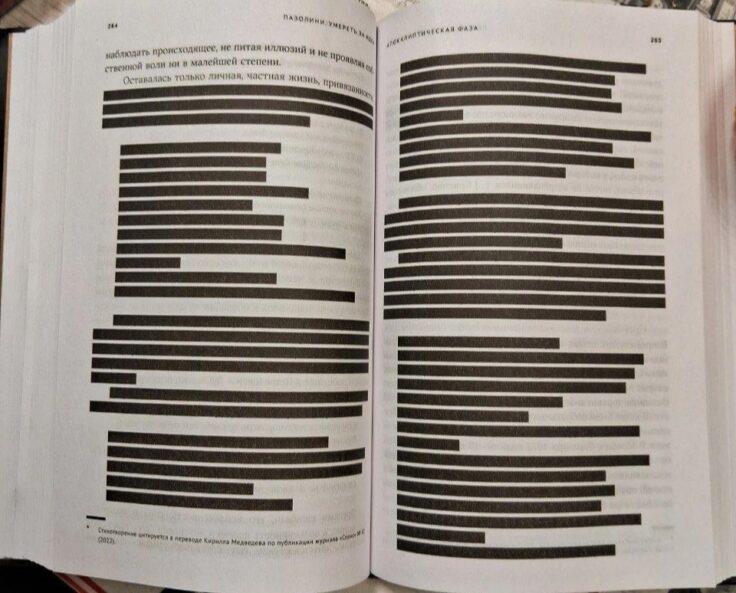
One of the best-known victims of censorship in contemporary Russia is Roberto Carnero’s biography Pasolini: To Die for Ideas. Photo: Novaya Gazeta

T-i: There are known cases in which authors based in Russia sign contracts so that the publisher receives rights only to publish and distribute the book within Russia. In this way, the author keeps the option of being published abroad. Have you heard of such cases? Or is this already a trend?

VK: I have not heard of that. But there is nothing strange about it. If only because Russian legislation — specifically Part Four of the Civil Code, which deals with intellectual rights — states directly that an author has the right to dispose of their work as they see fit. A publishing contract is a civil-law contract, and the author may permit or refuse to permit the publisher to use the work in whatever ways the author determines. In that sense, authority over the work remains with the author. For example, the author may allow a publisher to release a book in Russian and sell it only in Russia, or to sell it worldwide. The author may transfer rights to translations and to agreements with foreign publishers, or may keep those rights. Naturally, the amount of the author’s remuneration may depend on this. It is possible that authors who retain translation rights lose income — sometimes a little, sometimes substantially.

The main news about the lives of scholars during the war, videos, and infographics are available on T-invariant’s Telegram channel. Subscribe so you don’t miss anything.

For now, attitudes toward Russian publishers abroad remain complicated, although they have softened over the past few years. After the start of the war, many foreign publishers stated outright that they would not work with Russian partners. Some later revised that position and began gradually restoring contacts. Whether there is now active interaction around selling rights to books by Russian authors, I honestly do not know. But even before, this was not a significant part of the publishing business. It was more of a rarity and an exception — a particular stroke of luck for both author and publisher.

T-i: Another problem for Russian publishers. Suppose a translation of a popular-science book by a Berkeley professor has come out, and the university is later designated an undesirable organization in Russia. What should a publisher do in such a situation?

VK: It is a very difficult story for everyone. Especially if you look at the list of organizations designated as undesirable. Some of the world’s strongest research centers have ended up on it. If we take only American universities, there are Berkeley, Stanford, Yale, and many other outstanding educational and research institutions. Many of them have their own academic presses, and translations of their books have always been an important part of the Russian intellectual and scholarly book market. So what is happening looks very bad and very sad.

I hope that one day this will end. We are now living through a dark period in the history of Russian science and publishing. It is hard for me to imagine that such a situation can go on forever. Although, on the other hand, when Russia began its full-scale war against Ukraine, that also seemed impossible to many people. I remember that feeling very well — as if something utterly unthinkable had happened. Complete absurdity and catastrophe. But somehow we continue to live inside this absurdity.

T-INVARIANT BACKGROUND

After major Western universities were added to Russia’s register of “undesirable organizations,” Valery Fadeev, head of the Presidential Human Rights Council, urged people not to study at them and not to have any dealings with them. “You cannot conduct business or projects with these organizations, finance them, or receive money from them <…> now that Yale University has been declared an undesirable organization, there is no need to study there, and children should not go there to study; one should think about whether to continue working there,” Fadeev said. In addition, the head of the council suggested that research conducted at these universities would hardly be banned in Russia, and advised people with any doubts “not to be shy” about consulting the FSB or the prosecutor’s office.

T-i: How do you think your colleagues who remained in Russia reason about all this? What helps them hold on and continue working?

VK: Not everyone can leave. And not everyone should leave. There are still people in Russia who read books, and there are still publishers who continue producing those books for them. For many of them, a good book is not a book about how wonderful war is, but about how terrible it is. It seems to me that they are doing important and necessary work. Even when the books are not about war. Some publish books about how to remain a normal human being. Some publish novels about our complicated life. Some release books that can support and comfort a person who is finding it hard to live through what is happening.

For many book people, this remains the main source of motivation. And not only for publishers. The same is true of people who continue organizing book fairs. A book fair is one of the few forms of cultural life that seems especially important to me today. It allows people to see that there are other people around who read good books instead of going off to fight.

T-i: We recently interviewed Lida Kanashova and Alexei Fedorchenko, the authors of The Chief of Tales. Among other things, we discussed the problem that much has been written, little has been read, and what is read is quickly forgotten. Do you think books really influence people?

VK: Of course they do.

Current videos about science during the war, interviews, podcasts, and streams with prominent scholars are available on T-invariant’s YouTube channel. Become our subscriber!

T-i: Then why do we keep making the same mistakes?

VK: Because everything happens very slowly. As Bruce Sterling once said, the future has already arrived — it is just not evenly distributed. It does not work like this: we publish a good book, everyone reads it, and the world becomes better. That is not how it works. A couple of years ago I attended a meeting of the Russian-speaking academic diaspora. A former deputy director of the Open Society Institute, who had worked there back in the 1990s, came to the meeting. And I found myself thinking again about what an enormous undertaking that foundation had carried out then. For example, there was a list of books for whose translation and publication one could receive a grant. Many of those books were published. And practically everyone gathered at that meeting had read them. That is how the influence of books works. Their impact should not be overestimated. But neither should it be underestimated. Perhaps scholarly and popular-science books are not as effective as propaganda. But they do work.

T-i: Why, then, does propaganda turn out to be more effective?

VK: Among other reasons, because people don’t read enough.

Reading helps a person build a complex picture of the world. It will not necessarily be a correct one — there are plenty of bad and foolish books too. Reading in itself does not automatically make anyone better. But the world inside one’s head becomes more complex. And this does not have to mean scholarly literature. A person who spends a lifetime reading Dickens also gains a very complex understanding of human relationships, destinies, motives, and actions.

The problem is that not everyone reads books. Propaganda, by contrast, offers simple explanations for complex phenomena. That is why it often seems more convincing. The other thing is that this picture of the world begins to fall apart when it collides with reality, when questions arise for which the system has no answer. For example, if petrol suddenly disappears from gas stations, no one explains it by strikes on oil refineries. And then a person has to look for other explanations for what is happening.

T-i: Does that mean you hope the fridge will eventually beat the television?

VK: In a sense, yes. Let us recall Maslow’s hierarchy of needs: people need to eat, drink, dress, and have a roof over their heads. When problems arise at that level, they begin to regard everything else more critically.

T-i: But people, especially young people, are reading less and less, aren’t they?

VK: Does it seem that way to you? I would not agree. Children really have begun to read less for pleasure. But young adults, if we mean people aged 20 to 30, actually read quite a lot. The other thing is that books have become part of the attention economy. With the emergence of the internet and digital technologies, they have found themselves in the same row as films, music, social networks, news sites, and countless other ways of consuming content. And books are not in the strongest position in that competition: reading a novel is harder than watching a TV series. It takes more time and intellectual effort. A good novel will take 10 to 15 hours. In the same amount of time, you can watch two seasons of a series — and if it is a British series, all four.

[[socialnetworks]]

On the other hand, about seven years ago it unexpectedly became clear that audiobooks compete perfectly well with all other formats. You can listen to them while running, walking the dog, cleaning, or commuting. As a result, the global book industry, including the Russian one, is experiencing a real audiobook boom. That market is no longer growing as rapidly as before, but it still accounts for a significant share of digital sales. In the United States, audiobook sales have already surpassed sales of text e-books. In Russia, as far as I remember, audiobooks account for about 40 percent of the digital market.

Of course, it is easier to watch short videos on TikTok or scroll through Reels. But this is not only a problem for children. Adults do exactly the same thing. I am not sure there is any serious age dependence here at all.

T-i: What is happening with printed books? What allows them to continue existing?

VK: Printed books are doing fine. The printed book remains an ideal format for many kinds of information. When we talk about book publishing, we often generalize too much. In reality, there are enormous numbers of completely different kinds of books. They are created differently, for different audiences, and are produced and distributed in different ways. A publisher of children’s books and a publisher of monographs on quantum physics have almost nothing in common, except that both deal with books.

The printed book remains a very convenient and attractive object. It is pleasant to hold. It can be beautifully made. And, interestingly, it is precisely against the backdrop of digitalization that demand for beautiful, well-designed books is only growing. Moreover, for many young people, the printed book has become a way to take a break from the phone. And at the same time, it is a way to show others that they are not spending their time meaninglessly, but are reading a novel or a popular-science book.

At the most recent Frankfurt Book Fair, I was delighted to discover a huge hall devoted entirely to Young Adult fantasy. Hundreds of people were standing in line for authors’ autographs. The books themselves may not have been the absolute pinnacle of printing art, but they came very close. They were made with love, attention, and care for the reader. These are books you want to hold in your hands, photograph, and show to others. And it seems to me that this is one proof that the printed book is still alive and popular. Of course, book publishing is changing.

T-i: What changes do you see?

VK: For example, the growth of self-publishing. The very function of the publisher is changing radically: many tasks that used to be tied specifically to a publishing house can now be performed without one. E-books have appeared, and they are already a substantial part of the modern book market. I remember BookExpo America in 2012 very well. Back then, American publishers seriously feared that e-books would “devour” printed books. At the same time, they watched the growth in sales of printed editions with surprise and anxiously awaited the moment when that growth would stop. Over the next ten to fifteen years, the situation stabilized. It turned out that e-books and printed books can coexist perfectly well. Another segment began to disappear instead: mass-market paperbacks — cheap pocket-sized editions in soft covers printed on newsprint. It was with books like those that the history of Penguin began.

The main advantage of mass-market books was that they were cheap. A reader could buy one almost without thinking: for five or six dollars, get a light pleasure, read the book quickly, and forget it just as quickly. Today e-books have the same quality. That is why entire genres are gradually moving into digital form. For example, a huge share of romance novels now exists precisely in electronic format. Such books are rarely reread: they are read once, and the interaction ends there. Although, of course, there are collectors who still keep whole shelves of novels, for example from Harlequin.

A revolution has also taken place in printing itself. I mean print-on-demand and the significant reduction in the cost of short runs. This has had an especially strong effect on academic publishing. Most American university presses have almost completely switched to print-on-demand. Today no one prints large runs of scholarly monographs: their audience is too small, and traditional printing is expensive. Print-on-demand has turned out to be a very successful solution.

T-i: In the film industry, piracy has effectively been legalized today. What is the situation with piracy in book publishing?

VK: Traditional publishers, of course, try to observe copyright. They understand that sooner or later the current situation will end and the legal system will again function in full. But pirated book publishing has existed for a long time. It simply remains a niche phenomenon. If you go, for example, to Avito, you can find pirated translations and editions of many authors, including Stephen King (after the start of the full-scale war, he refused to sign new contracts with Russian publishers. — T-i). Publishers can do nothing about this, since they do not represent the author’s interests. The author himself cannot fight violations while sitting in America. And this does not apply only to King. A similar situation exists in niche science fiction and in many other segments. In many ways, this story is connected not with the war, sanctions, or politics, but with the fact that copyright does not always respond effectively to readers’ real needs.

T-i: What books do you think are profitable to publish today? Is there some kind of sure-fire option?

VK: I do not know. I work on books that I consider necessary. Perhaps for a not very large audience. If I knew the recipe for a future bestseller, I would probably have owned a flourishing publishing house long ago. In reality, no such recipe exists. There are many books about how to write a bestseller, but all of that, of course, is untrue. The history of publishing knows an enormous number of cases when publishers were wrong. Think of Marcel Proust, for example. He had to publish the first volume of In Search of Lost Time at his own expense after publishers rejected it. Today that is hard to believe.
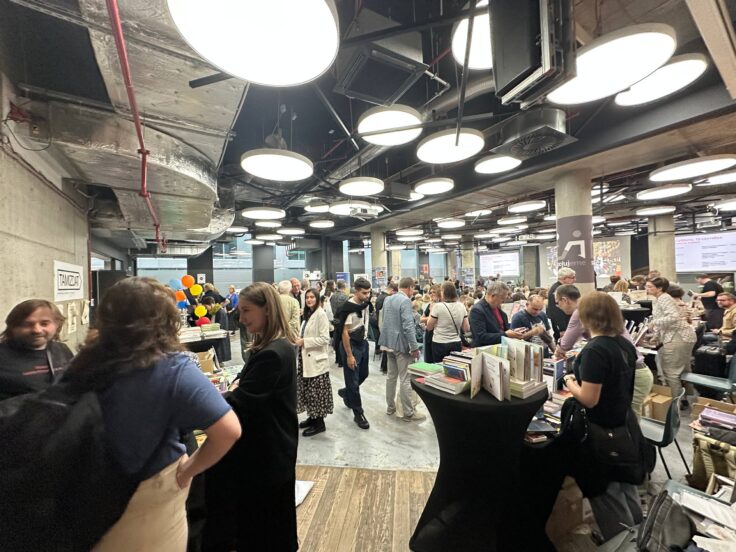
Prague Book Tower / Pražská knižní věž (September 2025). Photo: Slova vne sebya

T-i: It is known that you will be taking part in Prague Book Tower / Pražská knižní věž. How exactly?

VK: We have not fully decided yet, but I very much hope we will be able to present our books — above all, Elena Lukyanova’s The Basic Law.

T-i: Is there a book whose publication you are especially proud of?

VK: There are quite a few. For example, Capitalism and Schizophrenia by Gilles Deleuze and Felix Guattari — one of the most important philosophical books of the twentieth century. Montaillou by Le Roy Ladurie, one of the key books of the Annales school of history. Critique of Cynical Reason by Sloterdijk — a very timely book, it seems to me.

You can support T-invariant’s work by subscribing to our Patreon and choosing a donation amount that suits you.

The post “Propaganda Works Because People Don’t Read Enough.” Publisher Vladimir Kharitonov on Censorship, Tamizdat 2.0, and Life Inside the Absurd appeared first on Т-инвариант / T-invariant.

  •  

Does Silence Save? Philosophers Launch an Open Letter in Defense of Svetlana Mesyats

The academic community has launched a signature campaign in support of the philosopher Svetlana Mesyats. She has been charged with fraud on an especially large scale, an accusation that can carry a sentence of up to ten years in prison. Svetlana Mesyats’s prosecution fits the pattern of other criminal cases targeting Russian scholars who have returned to the country. Marina Bykova, a professor at North Carolina State University, reflects on whether public support from the anti-war opposition is useful or dangerous.

The main news about the lives of scholars during the war, videos, and infographics are available on T-invariant’s Telegram channel. Subscribe so you don’t miss anything.

On May 29, the academic community issued an open letter in support of Svetlana Mesyats. Its author is Andrei Rodin, an associate member of the French National Centre for Scientific Research (CNRS).

The signature campaign on Change.org was organized by Michael Chase, a specialist in ancient Greek, Roman, medieval, and Islamic philosophy, until recently a senior research fellow at the Jean Pépin Centre, an adjunct professor in the Department of Greek and Roman Studies at the University of Victoria, and a visiting fellow at the Max Planck Institute for the History of Science. At the time of publication, more than 350 signatures had been collected.

As a reminder, on May 19, 2026, several employees of the Institute of Philosophy of the Russian Academy of Sciences (IF RAS) were summoned for questioning by the Investigative Committee of the Russian Federation. The country’s main institute of philosophy was suspected of violations in preparing a complete scholarly edition of Aristotle’s works with scholarly commentary, including translations of treatises that had not previously been published. The project’s director, the internationally renowned philosopher and scholar of ancient thought Svetlana Mesyats, was placed under house arrest by Moscow’s Tverskoy District Court.

The judge who issued the decision on the measure of restraint was Alexei Krivoruchko, who had taken part in the cases of Sergei Magnitsky and Alexei Navalny. That fact alone points to the political undercurrent of the case. Especially since, according to colleagues, she had been the target of political denunciations long before her arrest. T-invariant asked the philosopher and professor Marina Bykova, who is well acquainted with the situation around the IF RAS, to comment.

T-INVARIANT BACKGROUND

Marina Bykova is a Russian and American philosopher. She defended her Candidate of Sciences dissertation in 1985 and her Doctor of Sciences dissertation in 1993. She is a professor at North Carolina State University and editor-in-chief of the journal Studies in East European Thought. She worked at the IF RAS from 1986 to 1993 and continued to collaborate actively with the Institute after leaving it.

Svetlana Mesyats holds a Candidate of Sciences degree in philosophy. Since 1999 she has worked at the IF RAS, where she is a senior research fellow and deputy head of the Department of Ancient and Medieval Philosophy. She has taught at the Russian State University for the Humanities (RSUH) and the State Academic University for the Humanities (GAUGN). She is the author and co-author of entries and articles in the Great Russian Encyclopedia, the Orthodox Encyclopedia, and other authoritative publications. She is the head of the project to prepare a new academic edition of Aristotle’s collected works in Russian, “The Legacy of Aristotle.”

Marina Bykova. Photo: NC State University

Marina Bykova: Svetlana Mesyats is one of those people who clearly and publicly articulated her anti-war position as early as 2022. That earns deep respect. Soon after the invasion she left Russia, but several months later she returned to Moscow and continued her work at the IF RAS. For the past ten to twelve years, together with a group of fellow scholars of ancient philosophy, Svetlana has been working on Aristotle — particularly on translating and commenting on his texts.

In that sense, her project to publish Aristotle’s collected works would have been a completely logical culmination of this work. But projects of this kind cannot be completed in six years, or even in ten. I myself had the chance to take part in a bilingual Russian-German project to publish Kant’s major works, and I understand very well what such projects involve, how labor-intensive they are, and how much time they require.

Svetlana Mesyats is a scholar of international standing. Work on Aristotle’s collected works is, in essence, an ongoing research project lasting decades. A four-volume edition of Aristotle was published back in the Soviet period, but it was not a complete collected works. Now the earlier translations are being refined, and new ones are being added. To interrupt this work would be a direct loss for scholarship and culture. Can the scholarly community influence the fate of a unique specialist who has come under attack from the repressive machine?

MB: There are only a handful of scholars of ancient philosophy in the world at Svetlana’s level. People who are capable of translating philosophical texts from dead languages are specialists of the very highest class. In addition, one must not forget that Aristotle wrote in technically complex language, and to render his texts in accessible philosophical language without losing important nuances of his thought is a special gift. Not everyone is capable of it.

I began asking myself about public support for Svetlana Mesyats literally immediately after her detention, and I discussed the question in a small circle of colleagues now living in the West. When, in 2021, the Institute of Philosophy protested the appointment of an acting director, we immediately published a major statement in my journal. I managed to mobilize the Western philosophical community: we collected signatures, sent the statement to Moscow, and it was published on the Institute’s website. According to the Institute’s administration, it had a serious impact. But today’s situation is fundamentally different from the one that existed five years ago. Today, the West and Western scholars have been declared enemies. Russian colleagues are openly afraid to communicate even with those of us who have ended up in the West. They are explicitly forbidden to do so, and only a few dare — and then only in secret. So we have to ask ourselves whether our support might do harm.

Through my personal channels, I reached out to colleagues at the Institute and received a frank response: “Please, just not now — no support from the international philosophical community or from the anti-war opposition.” They hope that if Svetlana’s case does not gain international resonance, it may all end with a fine. Whether I agree with that position is a separate question, but it is difficult simply to ignore such a request.

Could attempts to help make the victim’s situation worse? This question arises constantly when political persecution in Russia is at issue. Could other people connected to those who allow themselves to speak too openly suffer as well? According to Marina Bykova, Putin’s regime has built a system in which even those outside Russia cannot speak freely — in particular, they cannot freely support colleagues who have effectively become hostages.

MB: The truth is that we are now limited in what we can do in relation to what is happening in Russia. But, thank God, we can at least speak openly and formulate our position both on the war and on what is happening inside Russia itself. And we do speak — at least some of us do. But part of the emigration remains silent for subjective reasons: some have elderly parents in Russia, some have an apartment there. The same is happening inside the country. By no means are all former colleagues pro-Putin. Many are critical both of the regime and of the war, but they have switched to Aesopian language.

Current videos about science during the war, interviews, podcasts, and streams with prominent scholars are available on T-invariant’s YouTube channel. Become our subscriber!

While uncertainty remains about the intentions of the repressive agencies, it often really does make sense to keep quiet so as not to interfere with the lawyers’ work. However, on May 29, Svetlana Mesyats was charged under Part 4 of Article 159 of the Russian Criminal Code, fraud on an especially large scale, which carries a maximum penalty of up to ten years in prison. It now seems obvious that silence will not help Svetlana preserve her freedom in this political case disguised as an economic one.

MB: Yulia Sineokaya, in the interview she gave to T-invariant, said that at the moment this is an economic case, but that it will turn into a political one. I believe, however, that this case was political from the very beginning and remains so. It is a continuing attack on the Institute and on the liberal-minded colleagues who work there. As I wrote in my recent article, the regime’s task is to break the Institute, subordinate it, and once again turn philosophy into an ideology that legitimizes and serves the regime.

In this exchange from afar, there is in fact no contradiction, because in Russia political persecutions are often framed as ordinary criminal cases. The criminal cases against Navalny are an example. In recent years, however, investigators have often added political charges to such accusations during the trial itself. It is then that the case becomes political in form — but that means it was political from the start.

From outside the country, it is difficult to judge how reasonable it is to adhere to a strategy of silence. Yet there are examples in which intervention by the international academic community clearly did not harm the accused scholars. A vivid example is the case of Sergei Abramov, a corresponding member of the Russian Academy of Sciences and a leading specialist in supercomputers, who was arrested in 2023 for donations to the Anti-Corruption Foundation.

Several prominent members of the Russian Academy of Sciences spoke out in defense of the scholar, including academicians Mikhail Danilov and Yuri Popkov, as well as corresponding member Vladimir Arlazarov. The American Physical Society issued an open letter in support of Abramov. The informal “July 1” club of academicians also made a cautious statement.

The National Supercomputing Forum sent a collective petition by its participants in support of Sergei Abramov to a number of authorities, from the FSB investigative department to the Presidential Administration of the Russian Federation. In the end, the two-year trial in Abramov’s case concluded with a fine of 150,000 rubles.

The case of Oleg Kabov in Novosibirsk is another example, one even more similar to Svetlana Mesyats’s case. Kabov, a corresponding member of the Russian Academy of Sciences and head of the Laboratory for Intensification of Heat Transfer Processes at the Institute of Thermophysics of the Siberian Branch of the RAS, was accused of fraud on an especially large scale under the same Part 4 of Article 159 of the Russian Criminal Code. The scholar was accused of paying bonuses to employees, even though experts claimed that only 37.76 percent of the state assignment had been completed and that the results of the work contained no scientific novelty.

The American Physical Society again spoke out in support of Oleg Kabov, sending letters to RAS President Gennady Krasnikov and to Valery Falkov, Russia’s Minister of Science and Higher Education. In the end, the court limited itself to a suspended sentence without restriction of freedom and compensation for the seven-million-ruble “damage” to the Ministry of Education and Science.

Of course, in both of these cases, the relatively favorable outcome was, above all, the achievement of the lawyers. Still, we can see that publicity and support, including international support, did not get in the way.

[[socialnetworks]]

The author and signatories believe that Svetlana Mesyats’s arrest is the result of a years-long struggle for control over the IF RAS, one episode of which T-invariant has already covered. “Svetlana, who has never held senior administrative positions either in the Academy of Sciences or in other organizations, has become a victim of this continuing confrontation despite not having taken an active part in it herself. The accusation of misusing funds allocated for a scholarly project on ancient Greek philosophy appears completely implausible,” the open letter says.

Svetlana Mesyats is not the first scholar to become a victim of persecution after returning to Russia. Last year, the philosopher Nikolai Zyuzev, a specialist on Pitirim Sorokin, was charged with treason. Zyuzev, who had long lived in Canada and received Canadian citizenship back in 2008, was arrested during a visit to relatives. He remains under arrest.

The case of Svetlana Mesyats is an alarming signal for the academic community, confirming a pattern of persecution against scholars who come to Russia from abroad. Although the formal grounds for the arrest were economic claims, colleagues and experts regard the accusation as politically motivated. For that reason, in Svetlana Mesyats’s case, broad public attention may increase the chance of avoiding imprisonment.

You can support T-invariant’s work by subscribing to our Patreon and choosing a donation amount that suits you.

The post Does Silence Save? Philosophers Launch an Open Letter in Defense of Svetlana Mesyats appeared first on Т-инвариант / T-invariant.

  •  

Chronicle of the Persecution of Scientists No. 33

T-invariant releases its latest press release, “Chronicle of the Persecution of Scientists” No. 33, dated May 31, 2026. The major event of the past month was the conclusion of the “hypersonics case.” On May 5, 2026, a Novosibirsk court handed down sentences to physicists Valery Zvegintsev and Vladislav Galkin. Both scientists were sentenced to 12 years and 6 months in a maximum-security penal colony under Article 275 of the Criminal Code of the Russian Federation (high treason).

T-invariant published an article headlined “The Old to Prison, the Young to the Exit: The Final Verdict in the Hypersonic Scientists Case,” in which it summarized the 11-year-long case against Russian physicists. Formally, the case is not yet over, as the sentences for the last two defendants, Valery Zvegintsev and Vladislav Galkin, have not yet entered into force — an appeal in cassation is pending. However, both scientists have been found guilty of high treason and sentenced to 12 years and 6 months in a maximum-security penal colony, while the minimum term under Article 275 of the Criminal Code is 12 years. It is unlikely that the cassation court will reduce the sentence, but it could increase it; we are aware of such cases.

In total, 11 scientists have been prosecuted in cases related to hypersonics over the past 11 years. Lawyer and human rights activist Ivan Pavlov, in an interview with T-invariant, draws attention to an unusual detail: “What is surprising in the Zvegintsev and Galkin cases is that they were under house arrest, and it is even more surprising that they remained under house arrest even after the guilty verdict was handed down with such a long prison term. Usually, people are taken into custody immediately in the courtroom after such sentences. I think the authorities have started to wonder: is everything moving in the right direction? Zvegintsev is 82 years old; he might not survive the transfer and the colony, and this is bound to worry the security services. These scientists are people who served the regime faithfully, forged its military might, and they got caught in the crossfire of the system. The regime may be starting to wonder: are we persecuting the right people? Are we making enemies out of the wrong ones? The problem is that the propaganda and security machine has been set in motion and is not so easy to stop anymore. It mows down its own people, too.”

Following the delivery of the verdicts, the list of the ten longest prison terms handed down to scientists for “high treason” has changed. The top ten now looks as follows:

Artem Khoroshilov — 21 years

Alexey Vorobyov — 20 years

Ruslan Shadiev — 18 years

Aleksandr Shiplyuk — 15 years

Anatoly Maslov — 14 years

Dmitry Kizhmenev — 13 years

Valery Zvegintsev — 12 years and 6 months (*)

Vladislav Galkin — 12 years and 6 months (*)

Valery Golubkin — 12 years

Anatoly Gubanov — 12 years

(*) — The sentence has not yet entered into legal force.

[[socialnetworks]]

New Files

Mariya Snegovaya

May 26, 2026. The Savyolovsky District Court of Moscow granted a motion for the arrest of political scientist Mariya Snegovaya, who is accused of “disseminating knowingly false information about the Armed Forces of the Russian Federation” (Part 2 of Article 207.3 of the Criminal Code). The arrest warrant in absentia is two months from the date of actual detention, reports TASS.

Andrey Dymov

May 25, 2026. The Zyuzinsky District Court of Moscow sentenced mathematician and Higher School of Economics assistant professor Andrey Dymov to three and a half years in a penal colony in a case involving donations made to the Anti-Corruption Foundation (ACF established by Alexey Navalny). Dymov was found guilty of financing extremism (Part 1 of Article 282.3 of the Criminal Code), reports T-invariant. According to Mediazona, he set up a recurring donation on August 5, 2021, and donated a total of 3,500 rubles [$48] to the ACF. He pleaded guilty. His criminal case went to trial in late April.

Svetlana Mesyats

May 21, 2026. The Tverskoy District Court of Moscow, at the request of an investigator from the Interior Ministry, placed Svetlana Mesyats, a senior researcher at the Institute of Philosophy of the Russian Academy of Sciences, under house arrest. She is accused of fraud on an especially large scale (Part 4 of Article 159 of the Russian Criminal Code), reports Vedomosti.

Sergey Erofeev

May 15, 2026. The Ministry of Justice of the Russian Federation included sociologist Sergey Erofeev in the register of “foreign agents.” The ministry claims that Erofeev disseminated materials from foreign agents, participated in the creation and distribution of messages from organizations deemed “undesirable” in Russia, and also broadcast, according to the statement, “fakes” about the government and spoke out against the hostilities in Ukraine, reports Vedomosti.

Evgeny Onishchenko

May 14, 2026. The Tverskoy Court of Moscow sentenced former Lebedev Physical Institute (FIAN) researcher Evgeny Onishchenko to 1.5 years of compulsory labor in a case involving a transfer of 5,000 rubles [$70] to the ACF, reports Mediazona.

Mikhail Epstein

May 8, 2026. The Ministry of Justice of the Russian Federation included philosopher Mikhail Epstein in the register of “foreign agents.” According to the Ministry of Justice, “M. N. Epstein disseminated misleading information about the decisions made by the public authorities of the Russian Federation and the policies they pursue,” reports TASS, citing the ministry’s website.

Igor Efimov

May 8, 2026. The Ministry of Justice of the Russian Federation included biophysicist Igor Efimov in the register of “foreign agents.” According to the Ministry of Justice, “I. R. Efimov took part in disseminating, to an unlimited audience, messages and materials from foreign agents and organizations included in the list of foreign and international organizations whose activities have been recognized as undesirable in the Russian Federation,” reports TASS, citing the ministry’s website.

Updates

Vladislav Galkin

May 5, 2026. A Novosibirsk court sentenced Vladislav Galkin to 12 years and 6 months in a maximum-security penal colony under Article 275 of the Criminal Code (“high treason”), reports RBC. Before the verdict, the scientist was under house arrest. The preventive measure will remain in place until the verdict enters into force.

Valery Zvegintsev

May 5, 2026. A Novosibirsk court sentenced Valery Zvegintsev to 12 years and 6 months in a maximum-security penal colony under Article 275 of the Criminal Code (“high treason”), reports RBC. Before the verdict, the scientist was under house arrest. The preventive measure will remain in place until the verdict enters into force.

Azat Miftakhov

May 4, 2026. Azat Miftakhov reported that he had been subjected to torture at the Polar Owl penal colony in Kharp. Miftakhov stated that he was tortured upon arrival in the Yamalo-Nenets Autonomous Okrug — the Polar Owl special-regime colony in Kharp. His account was obtained and published by The Insider.

The post Chronicle of the Persecution of Scientists No. 33 appeared first on Т-инвариант / T-invariant.

  •  

“It’s a high-speed train, an express”: Criminal case against HSE University mathematician Andrey Dymov lasted less than a month

For the second time this month, a scientist has been convicted of donating to the Anti-Corruption Foundation. However, the two trials unfolded in vastly different ways. Mathematician Andrey Dymov was sentenced to three and a half years in a penal colony after just two hearings. Meanwhile, the case of physicist Evgeny Onishchenko dragged on for a considerable time and concluded with a sentence that is quite lenient by today’s standards: a year and a half of forced labor. Preliminary evidence suggests that authorities have decided to strip defense attorneys of the time needed to defend those who donated to Navalny’s Anti-Corruption Foundation (ACF).

Mathematician Andrey Dymov was tried for donating 3,500 rubles [less than $50 — T-invariant] to the ACF. The faculty member at the HSE University Department of Mathematics and the Steklov Mathematical Institute of the Russian Academy of Sciences (MIAN) was found guilty of financing extremism (Part 1 of Article 282.3 of the Criminal Code) — the case docket is available on the official portal of Moscow courts.

“They took him away about a month ago, and it was quite a spectacle: masked men broke down the door to his apartment. Later, he was released for a while under travel restrictions,” a source familiar with Dymov’s prosecution told T-invariant.

The case was initiated on April 30, 2026, and the sentence was handed down as early as May 25, with the scientist taken into custody right in the courtroom. “We were in shock, we didn’t expect him to be arrested immediately,” Dymov’s colleagues shared with T-invariant.

“I take Andrey Viktorovich’s probability theory class and emailed him a question just this Monday, but he didn’t reply. And then I saw the news on Tuesday morning. I am shocked. What is even going on? It’s horrible,” comments a student from the HSE University Faculty of Mathematics.

“It’s a high-speed train, a total express. Unusually fast,” a scientist who previously went through a similar criminal prosecution told T-invariant. His own case, however, lasted 20 times longer.

Judging by the mathematician’s profile on the HSE University website, Dymov had been with the institution since 2015 and possessed all the hallmarks of a highly successful academic career. Since 2018, he regularly received bonuses for publishing in peer-reviewed international journals, as well as for papers in List A journals, and was repeatedly named one of the university’s best teachers (in 2022, 2024, and 2025).

In his profile on the Math-Net portal, he listed non-equilibrium statistical mechanics and the theory of dynamical systems as his primary research interests. Shortly before his arrest, Dymov had presented at several scientific conferences.

Top news on scientists’ work and experiences in wartime, along with videos and infographics — subscribe to the T-invariant Telegram channel to stay updated.

Dymov made his last donation to the ACF back in 2021, one source told T-invariant. According to Mediazona, Dymov set up a recurring donation on August 5, 2021. His workplace provided positive character references. Mediazona also reports that Dymov had sent 5,000 rubles to the Pravmir fund [an Orthodox Christian charity — T-invariant] to help victims of a flood in Dagestan and 30,000 rubles to the “Children of Donbas” program.

Defense witnesses included Sergey Gorchinsky, Deputy Director for Research at MIAN, alongside several colleagues from the HSE University Faculty of Mathematics.

Dymov’s case moved so rapidly that his colleagues and department heads at HSE University and MIAN likely lacked the time to build a solid defense strategy or compile and submit a sufficient volume of character references in his favor. The case docket lists only two court sessions, one of which had to be postponed because witnesses failed to appear.

An analysis of cases involving donations to the ACF reveals that defendants usually face harsh sentences for modest contributions of just a few thousand rubles. At times, it appears as though there is an unwritten “rate”: one year in prison for every thousand rubles donated.

Yet there are exceptions. 54-year-old Evgeny Onishchenko, head of the Employees’ Union at the Lebedev Physical Institute of the Russian Academy of Sciences (FIAN), was sentenced to a year and a half of forced labor, despite the prosecution demanding four years in a penal colony. He was accused of transferring 5,000 rubles to the ACF in August 2021. Mediazona reported this on May 14.

[[socialnetworks]]

Both scientists — Andrey Dymov and Evgeny Onishchenko — did not exclusively donate to “extremists” (according to Mediazona, Onishchenko had also transferred money to the Russian military). Among the theories explaining why the sentences turned out so differently, there is one theory (currently being verified by the T-invariant editorial team) that due to the overwhelming volume of cases opened regarding ACF donations (according to unconfirmed reports, there are currently about 16,000 criminal cases in Russia related to ACF donations), an unwritten directive was issued to fast-track investigations and judicial proceedings. Therefore, criminal cases initiated in previous years regarding ACF donations were investigated and tried longer, giving defense attorneys and defendants more opportunities to mount a defense. Today, there is simply no time left for the defense.

The swift prosecution of Dymov is not the first instance of mathematicians from HSE University being targeted. In December 2025, a treason case was opened against Leonid Kats, a research assistant at the HSE University Faculty of Mathematics’ Research and Educational Laboratory of Complex Networks, Hypergraphs and Their Applications. However, as T-invariant revealed, the FSB had been tracking Kats for a long time, whereas Dymov’s conviction is just another of the hundreds of cases involving ACF donations (the exact numbers vary; Mediazona reports 225 known convictions).

Support T-invariant’s work by subscribing to our Patreon and choosing a donation amount that suits you.

The post “It’s a high-speed train, an express”: Criminal case against HSE University mathematician Andrey Dymov lasted less than a month appeared first on Т-инвариант / T-invariant.

  •  

RASA expresses its strong support for Olga Orlova

The Russian-American Science Association (RASA) expresses its strong support for Olga Orlova, Editor-in-Chief of T-invariant, who has been designated by the authorities of the Russian Federation as a “foreign agent.”

Olga Orlova is an outstanding science journalist and a Candidate of Philological Sciences, widely recognized for her work covering science, education, and public outreach in the Russian language. Her distinguished professional career includes serving as a science columnist for prominent Russian-language media outlets such as Polit.ru, Russkii Zhurnal, and Radio Svoboda. For many years, she hosted the popular science program Hamburg Account on Russian Public Television.

Following the start of Russia’s full-scale war against Ukraine, Olga left the country and founded the international project T-invariant, which quickly became one of the leading Russian-language media platforms covering science and scientists during wartime. T-invariant publications are republished daily by dozens of Russian and international media outlets and serve as an important source of information about scientists in both Russian and global contexts.

The inclusion of Olga Orlova in the “foreign agents” registry continues the practice of political persecution by the Russian state targeting independent participants in the Russian-language discourse on science and education. This practice aims to undermine international scientific collaboration, isolate scientists within Russia, and exert pressure on members of the intellectual community abroad.

Previously, Russian authorities have designated a number of well-known American scholars of Russian and Soviet origin as “foreign agents,” and have also labeled several American and European universities and organizations—including RASA—as “undesirable organizations.”

As a U.S.-based non-profit organization, RASA considers such practices incompatible with the principles of freedom and directed against scientists and science journalists in the free world. We call on the U.S. government to take note of these actions and to provide necessary support to scholars and journalists facing political persecution.

We call on international media, the academic community, universities, and scientific organizations in the United States, Europe, and other democratic countries  to show solidarity  with Olga Orlova,  and with Russian-speaking scholars and journalists who have become targets of political pressure and intimidation.

The post RASA expresses its strong support for Olga Orlova appeared first on Т-инвариант / T-invariant.

  •  
❌