La population de Ceuta, enclave espagnole au Maroc, a manifesté dimanche pour demander l'aide de Madrid et de l'Union européenne, dix jours après le déferlement de plus de 60 000 migrants sur son territoire. Sans ressources naturelles, Ceuta dépend beaucoup du secteur tertiaire et essaie de se réinventer malgré un chômage qui dépasse les 22 %. Mais elle continue d'attirer des milliers de jeunes marocains qui y voient une porte d'entrée vers l'Espagne et l'UE, et la promesse d'une vie meilleure.
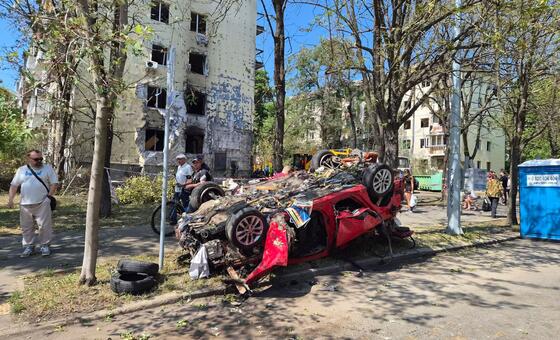
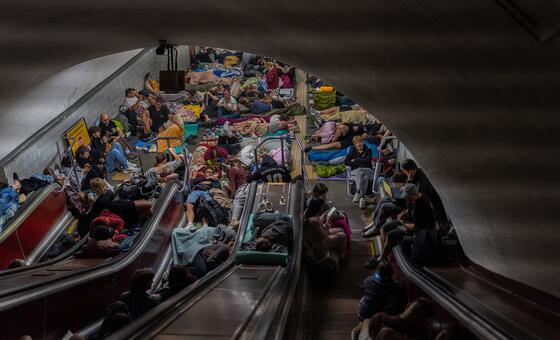
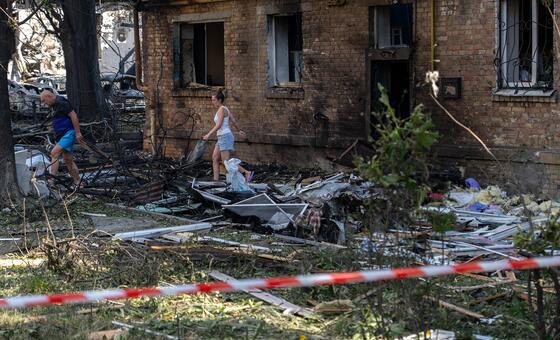
Russia’s ongoing full-scale invasion of Ukraine has left civilians vulnerable to repeated deadly attacks and humanitarian workers and key facilities being targeted and destroyed.
Cover image: picture alliance / NTB | Fredrik Varfjell
Recycling is no longer just an environmental obligation. It has become a geoeconomic imperative directly linked to Europe’s energy security and industrial competitiveness. The European Commission’s Critical Raw Materials Act reflects this change—it has set an ambitious target to source at least 25% of the EU’s annual consumption of strategic raw materials from recycling by 2030.
Europe, however, is making little progress. A recent European Court of Auditors’ report suggests that seven of 26 energy-transition-related minerals have recycling rates between 1% and 5% in the EU. This means, for example, that Europe is recovering just three tonnes from every 100 tonnes of natural graphite contained in batteries. According to the report, there are another ten minerals that Europe does not recycle at all, including lithium, gallium and silicon metal.
As such, recycling battery materials warrants far more attention. This valuable source of critical minerals could lower the continent’s dependence on Chinese mineral value chains; recycling battery materials is also much quicker than relying on the development of mines elsewhere that produce the same materials. However, fragmentation, red tape and unfavourable economics are hampering Europe’s recycling efforts, in part due to a regulatory framework that still treats battery materials as hazardous waste rather than a source of strategically important minerals.
Europeans need to focus on battery materials regulation with an industrial policy lens and pursue strategic partnerships with African countries to make gains in material recovery.
Using black mass and EVs
Recovered minerals from Europe’s waste—including end-of-life electric vehicle (EV) batteries, wind turbines, industrial parts and electrical wiring—are insufficient to meet all of Europe’s mineral needs. However, they can substitute for a share of primary minerals from mining, which would help Europeans derisk from Chinese mineral supply chains far quicker than new mines can come into production.
Europe will have relatively significant EV battery feedstock for recycling in coming years. Europeans were early adopters of EVs and European countries are global leaders in terms of EV sales as a share of total car sales: in Sweden, Denmark and the Netherlands, for example, EVs account for 58%, 56% and 48% of passenger-vehicle sales respectively, while fully electric vehicles comprise 22.6% of cars registered in the EU. High EV adoption means Europe should have a solid supply of EV battery feedstock for recycling facilities, provided it keeps this within the EU for recycling.
In March 2025, the EU re-classified “black mass” (the shredded EV battery waste processed to recover critical minerals) and end-of-life lithium-based, nickel-based and zinc-based batteries as “hazardous waste”. Black mass is important because it contains valuable critical minerals; if Europeans can process this within its borders, it can feed recovered minerals into European industry. This new classification prohibits export of black mass to non-OECD countries, while requiring that shipments within the EU and the OECD have prior notification and consent from the import, export and transit countries involved.
Europe currently exports around 80% of its black mass for refining elsewhere, mostly in Asia; South Korea’s OECD status and cheap recycling capacities make it a key destination, for example. The reclassification of black mass raises bureaucratic barriers to exporting out of the EU, contributing to efforts to prevent recycling feedstock leaking out. However, black mass is now more difficult to move within Europe, too, which makes aggregating feedstock for recycling within the EU a challenge. While Europe has some battery shredding (or pre-treatment) capacity to produce black mass, its refining capacity to recover minerals from black mass has lagged significantly.
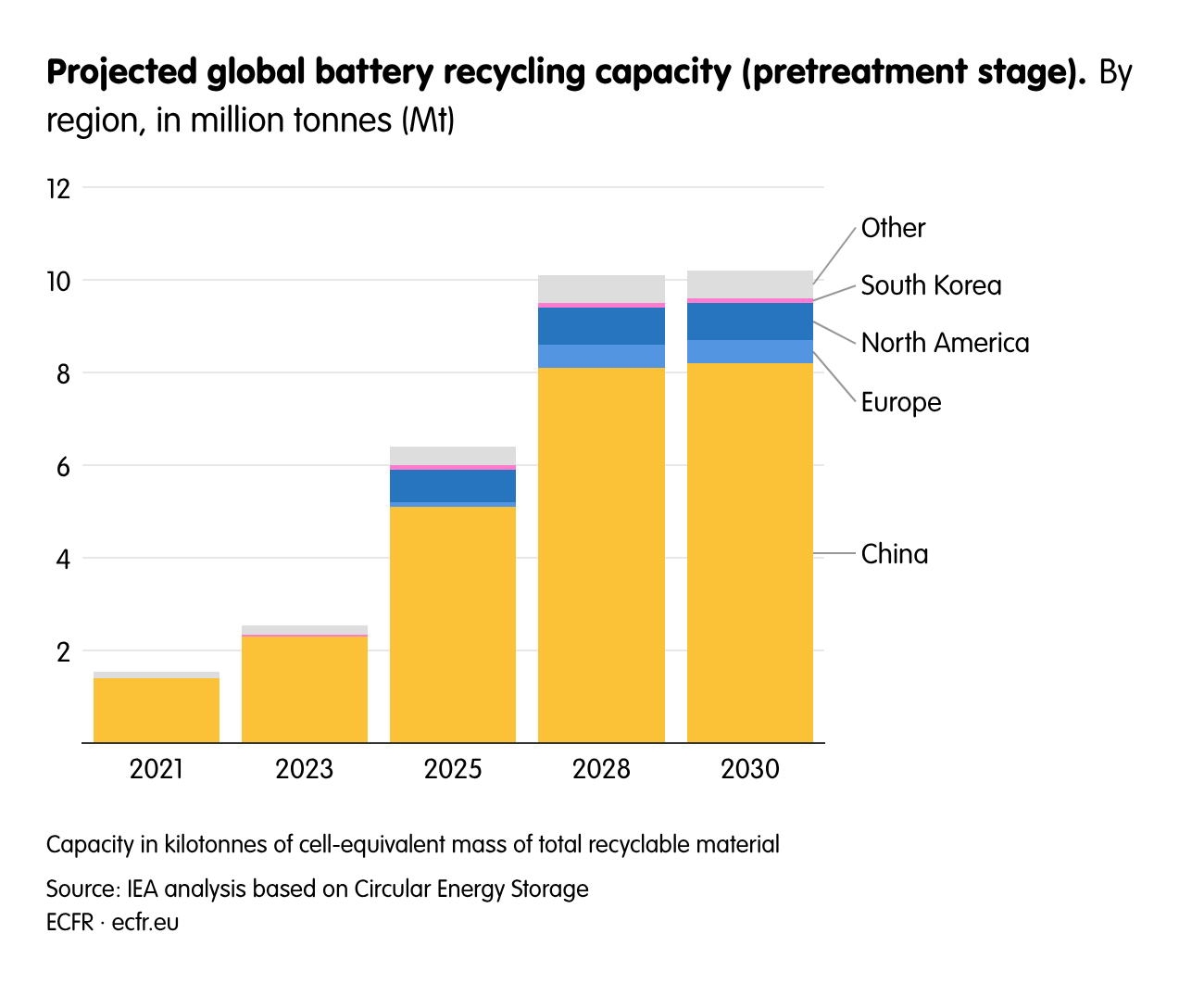
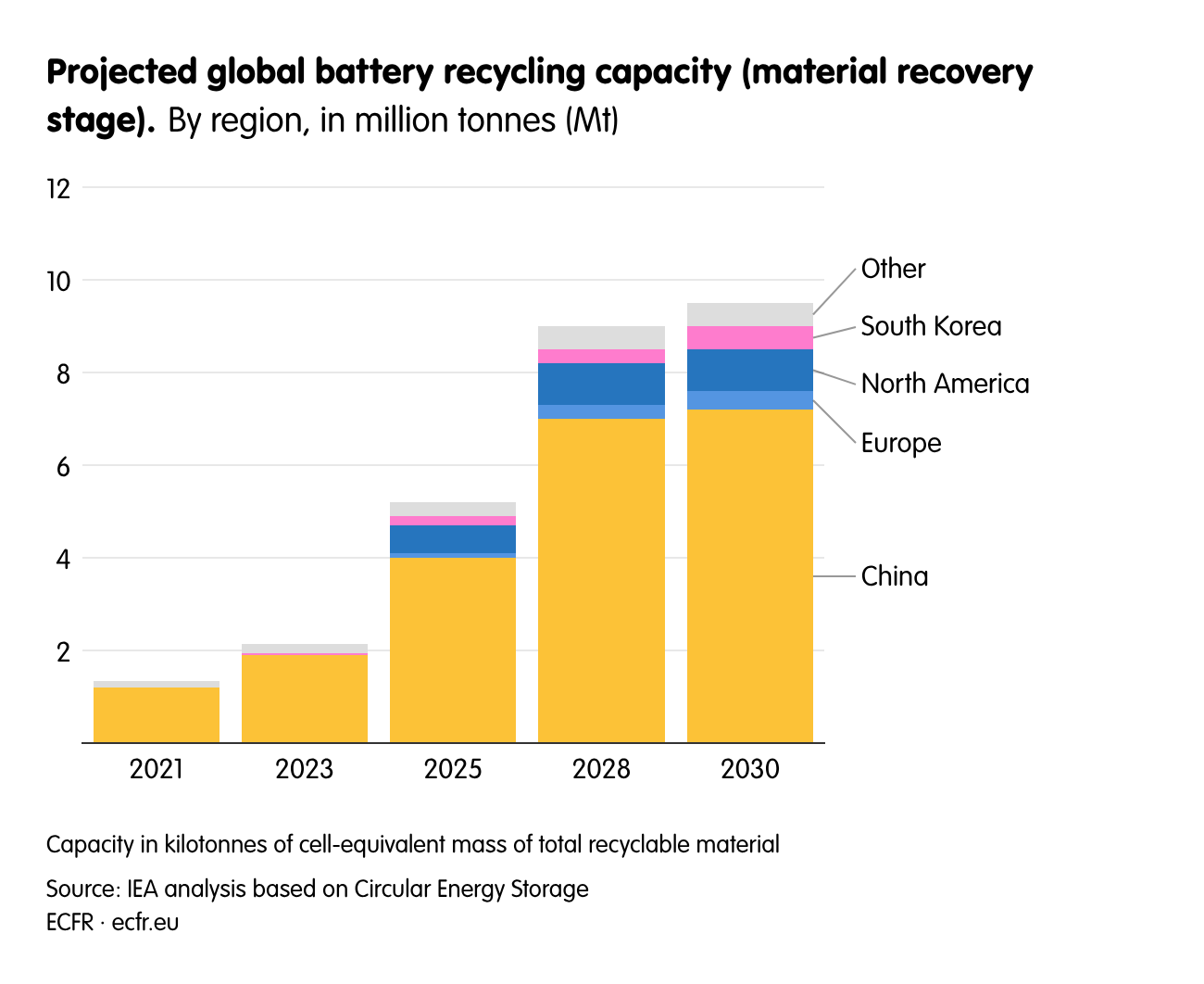
Although forecasts suggest that Europe will slightly raise its material-recovery capacity in the coming years, it remains a minor player. China’s dominant share in global battery recycling capacity for the shredding and material recovery stages, which exceeded 80% in 2025, is set to continue.
Recent analysis estimates that the costs of hydrometallurgical recycling for nickel manganese cobalt (NMC) and lithium iron phosphate (LFP) batteries are respectively 70% and 67% higher in France than in China due to higher labour, energy, environmental compliance, dismantling and transport costs in Europe. China’s scale of feedstock—domestic supply of end-of-life batteries, scrap metal from the local automobile industry, and imported batteries and black mass—has further lowered their recycling costs.
Making battery recycling happen in Europe
The EU can take three clear steps to increase recycling black mass in Europe.
First, Europeans should implement stricter export restrictions on black mass and batteries to fully close off exports and retain the products for material recovery domestically.[1] The US took this position in July 2026, with President Donald Trump empowering federal officials to block exports of end-of-life batteries and electronic waste to contain these products for recycling within the US.
Second, Europeans need to urgently build more recycling capacity to refine black mass: Europe’s hydrometallurgical recycling capacity is less than 3,000 tonnes, which is around one-sixtieth of China’s. Estimates suggest that Europe needs the capacity to recycle 120,000–135,000 tonnes of black mass per year by 2030.
Third—and perhaps most challenging—Europeans need to ensure recycling in Europe becomes more economically viable. Failing this, tough export restrictions will lead to battery waste being stockpiled rather than recycled.
To achieve the above, Europeans need to develop new financing mechanisms—such as building recycling costs into the purchase price of products and using public finance to help offset recyclers’ higher costs in Europe—to make recycling more economically viable. This would be particularly timely as battery technology shifts from NMC to LFP batteries: since the latter are comprised of less valuable minerals, recyclers earn less from the sale of recovered minerals, necessitating support for project viability.
The provision of public finance, preferably at both the EU and member-state level, would help in the development of new technologies and processes that lower recycling costs by reducing energy requirements and improving recovery rates. Patent filings in battery recycling are growing significantly, with 2026 figures showing a 103% growth in filings (adjusted for lag). China leads in patent applications, although US and European companies—notably Belgium’s Umicore—are also active. To make Europe more globally competitive in recycling, Europe must increase its investments in innovation using public finance support.
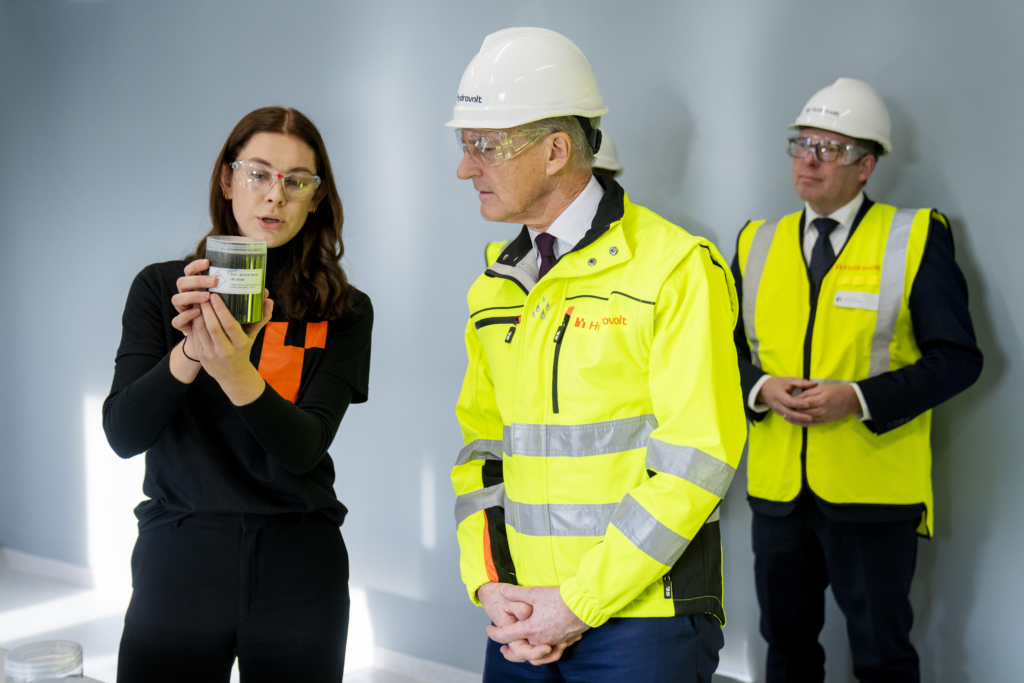
Europeans also need to establish a strong domestic value chain. European battery recyclers, such as Germany’s Cylib and Tozero and Norway’s Hydrovolt, should identify and establish commercial agreements with EU-based offtakers for the minerals they recover—after all, if Europe has to export recovered minerals outside its borders for want of domestic offtakers, gains in recycling will be for nothing. Specifically, this requires European industry that uses recovered minerals (alongside primary source minerals from mining) to refine precursor cathode active material (pCAM) and cathode active material (CAM) stages for EV batteries.
Pursuing EU-Africa partnerships
Europeans should also look internationally to ensure recycling can feasibly reduce existing mineral supply chain dependencies. The EU needs to tap into other recycling feedstock markets and diversify its mineral supply chains by establishing recycling partnerships with OECD and non-OECD countries.
Indeed, the EU has explicitly included recycling within the remit of some strategic partnerships on critical minerals that it has signed with partner countries, including several African countries such as Namibia. By locating recycling and mineral-processing facilities in African countries, they can tackle the cost disadvantages Europeans face with regard to energy, land and labour costs on home soil. Namibia and Kenya are ideal partners: both have transport corridors and port infrastructure that make them well positioned to aggregate regional battery and electronic waste (e-waste); they can harness their abundant renewable energy resources can power material recovery facilities.
EU-Africa cooperation on recycling would also be advantageous to African countries. Joint operations create jobs, expand African mineral processing capabilities and link African mineral supply chains with European industry. Africa-based recycling facilities could also manage the growing quantity of end-of-life batteries and e-waste generated by African countries, notably from solar panels, energy-storage batteries and EV batteries from smaller two- and three-wheeler vehicles.
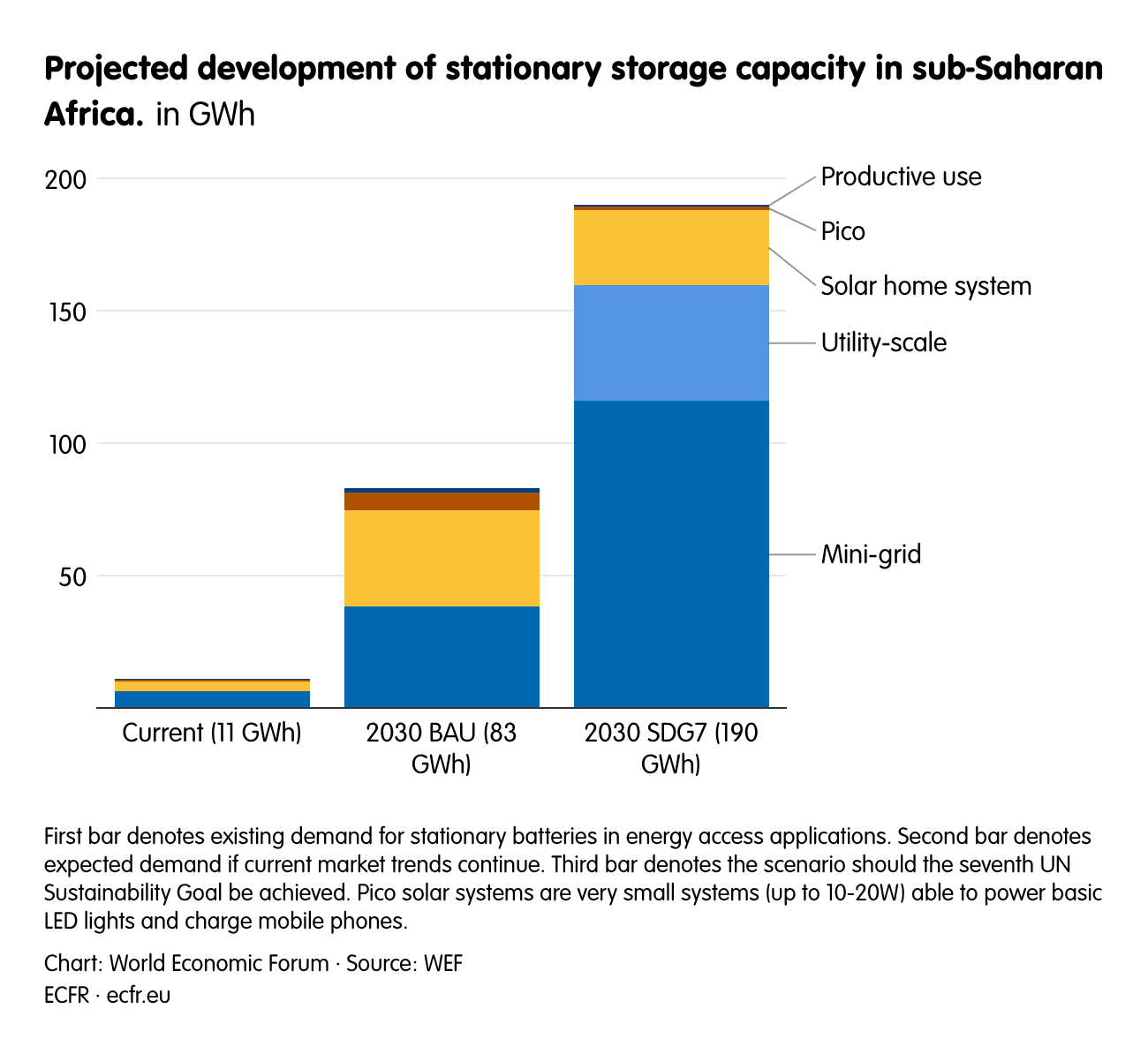
Sub-Saharan Africa’s projected growth in stationary storage capacity alone is significant: following current market trends, it will expand dramatically by 2030, with a storage capacity increase from 11 GWh to 83 GWh. If the region achieves universal access to electricity (SDG7), demand could more than double that, reaching a storage capacity of 190 GWh.
Europe’s road ahead
More recycling facilities are required to handle Africa’s growing volume of end-of-life battery feedstock. This presents an opportunity for growth both in Africa-based recycling, and in Africa-Europe recycling cooperation. However, this is not straightforward. Africa-Europe recycling partnerships need to invest in formalising supply chains for collection and storage; they need to build facilities for shredding batteries and e-waste; and they need to ensure that they can refine black mass to recover valuable materials. They would also need to develop the workforce skills and local-firm capabilities needed for efficient, environmentally-sound operations throughout the supply chain.
For African countries like Namibia and Kenya, such cooperation creates jobs and builds recycling capacity and expertise while integrating African mineral industrialisation into EU mineral supply chains. Recycling operations could also serve as anchor customers for increasing electricity generation and transmission investments in African countries, while local populations also benefit from improved electricity availability. Additionally, recycling in African countries helps address the continent’s growing e-waste management challenges.
For Europe, the increased recovery of critical minerals both domestically and through recycling partnerships with African countries offers greater supply chain diversification, access to minerals from non-OECD black mass and de-risking from Chinese mineral supply chains. All of this will happen faster than if Europeans continue to rely on global mine development. Europeans need to extend their strategic thinking beyond their borders, advancing recycling cooperation through critical minerals partnerships.
[1] Interview with a representative of a mineral analytics company, February 19th, 2026.
Many—perhaps most—Trump administration foreign policy initiatives find ways to make money for people selected by Trump officials. These deals unjustly enrich a chosen few.
They can also create facts on the ground that could bequeath problems to the next US administration. For example, grants of property rights to friends and family by the Trump-controlled Board of Peace could decide who has land and money in Gaza. This would limit the discretion of any approach that aims to increase Palestinians’ role in the place they live in. Other peace deals contain similar long tails.
To address this threat to peace around the world, the next US administration should introduce anti-corruption sanctions from its first day in office. The new administration could bar non-US persons or institutions involved in such transactions from the US itself and from the American financial system. To do this, the administration would use the Global Magnitsky Act and related executive orders, including the Trump-issued executive order 13818.
Europeans can help this along even now. They can begin to declare their expectations that a new US administration will break from the practice of enriching chosen insiders. Such statements will influence preparations for the new administration. Over the next two years, Europeans can also preserve information about US insider dealing while publicly refusing to support or finance such deals where European interests are involved, including in the south Caucasus, Western Balkans, Gaza, Russia and Ukraine. And they can shore up their own sanctions and anti-corruption regimes.
Starting discussions about sanctions now will also send a message about the importance of professional, thorough investigations by journalists, civil society, and especially by congressional committees if Democrats take control of the House or Senate. This information can inform decisions about sanctions. Clear signalling from American and European political leaders now may deter potential foreign partners of the current administration from entering into corrupt deals over the remaining two years of the administration.
What sanctions can and cannot do
Sanctions will not provide complete answers in any situation, and they may not be appropriate in some instances. An understanding of how they work will clarify their importance and some of their limitations.
Executive order 13818 authorises sanctions against any “foreign person” (that is, not a US citizen or person) who participated in:
corruption, including the misappropriation of state assets, the expropriation of private assets for personal gain, corruption related to government contracts or the extraction of natural resources, or bribery
The commercial aspects of President Donald Trump’s foreign policy appear to fall squarely into this framework. Even if not every instance is found to involve corruption, a close look is warranted. For example, Kazakh authorities were reportedly pressed to award a valuable mineral concession to a specific American company (associated with US political insiders, including the president’s family) while the administration considered financing for the development and export of the minerals. This was not an effort to promote a fair process in which American companies could compete—a staple of US government advocacy in any administration—but an attempt to short-circuit the normal process. It appears to involve the essence of the behaviour targeted by the Magnitsky act and executive order.
In Bosnia and Herzegovina, a specific American company was newly created by two US citizens with no relevant experience but with a track record of supporting the president (and one of whom is the brother of a senior official in the first Trump administration). The US lobbied for this company to receive a lucrative concession for a natural gas pipeline, and the US demanded the resignation of a reluctant international official.
American sanctions apply only to non-American citizens. It may seem unfair to leave US beneficiaries of a scheme out of a US response. But the administration’s power to require foreign persons or institutions to provide all relevant information about suspect transactions could impede the activities that unjustly enrich American insiders.
Further, by the end of the Trump administration, many insiders (and possibly some foreign persons) are likely to be covered by presidential pardons. This could make it difficult, if not impossible, to proceed with US criminal investigations, at least not without extensive litigation while the US justice system recovers from Trump’s attacks on its capacity. This could make a new administration look feckless, and foreign partners may expect that Trumpian practices will return in future administrations. Crucially, sanctions are not subject to the pardon power, and their emphasis on non-US persons and institutions will provide some protection against charges that they are part of a partisan agenda.
Another concern may be that sanctions have generally been adopted after careful review by relevant US agencies, including the Justice Department. Given the amount of information available, a reasonable basis for a decision on sanctions can be prepared for day one of a new administration. This decision can be accompanied by a provision that reviews will follow as new information becomes available and US government agencies rebuild enough capacity to conduct them.
The investigative resources of European governments, the US Congress (or parts controlled by Democrats after the 2026 midterms), civil society and independent journalism will provide an ample, well-documented basis for sanctions in many instances. By inviting those who might be subject to sanctions to provide information, the effort will gather more information, more quickly, aiding in decisions about priorities for further sanctions or investigations by congressional or law enforcement authorities.
Significantly, early sanctions may be necessary for a new administration to deliver on promises it makes on issues of foreign and domestic policy. For example, the Trump administration is seeking to have rights to minerals critical to US industrialisation granted to its preferred partners, including in Central Asia, Ukraine and eastern Congo. Individuals holding these rights would be important stakeholders in any policy shifts, even though they may have obtained the rights through insider dealing and could be opposed to the direction a new administration would like to take on policy.
The leverage provided by a policy of using sanctions may be a key instrument of foreign policy
The same situation could occur in other locations. In addition to the examples of Gaza and the Western Balkans noted above, in Venezuela, if a democratic government emerges, it may face challenges from Trump-affiliated companies accustomed to working with Maduro-regime holdovers kept in place by Trump and Marco Rubio. Control of a key trade route from Central Asia to global markets, along with a US-taxpayer funded investment vehicle, is said to be in the process of being placed under the control of a Trump-associated individual. In each instance, more knowledge about what deals are in place and how they came to be will improve both policy and decisions on sanctions. The leverage provided by a policy of using sanctions may be a key instrument of foreign policy.
The list goes on. Even before his second inauguration, a Trump-owned business accepted a $500m investment from a fund controlled by a member of the United Arab Emirates’ ruling family; within weeks the UAE received an exemption to purchase high-end computer chips. A Chinese businessman purchased $50m in a Trump-owned crypto business (part of the president’s $1.2bn windfall from crypto in 2025); weeks later his US criminal problems were resolved by the president.
If other jurisdictions like the EU and Britain join new American sanctions efforts, the costs to the non-US individuals and institutions affected will be real. To do this, the EU might consider how its rule of law initiatives, including its investigative bodies such as OLAF or the European Public Prosecutor’s Office, could prepare to work alongside US sanctions authorities. It could propose that the EU and the US return to coordinating assistance programmes to reinforce public procurement reforms. Various European states have national anti-corruption sanctions programmes; more should consider adopting them.
Some will worry that rapid deployment of sanctions may distract from a new administration’s positive agenda. This will depend on the strength of that agenda. Europeans can help make clear that they regard this as a false choice: a break from the insider dealing of the Trump administration should be part of a new, positive plan for government. This will make it easier for a new administration to adopt sanctions policy as part of leaving Trump practices firmly in the past.
There will, of course, be difficult decisions around the application of sanctions. Not every example of insider dealing will be proven to be corrupt. Some potential targets of sanctions may be important to other US administration initiatives, and if the new administration defers sanctions it may be subject to accusations of hypocrisy. Other countries may object strongly to seeing their institutions or citizens named in sanctions documents. A new administration will face many choices like this; people who want to exercise power from Washington therefore need to prepare now and confront the choice early. It is better to start with a strong tool like sanctions rather than to disarm everywhere pre-emptively in order to avoid hard choices in a few places.
Wise observers of democratic transitions have said that democrats taking power after corrupt regimes should seek to be quick, effective and legal; but that they can be only two of the three. But sanctions might get a new administration closer to three out of three. They provide a legal tool that will help the next administration be quick and effective in stopping the insider enrichment typical of Trump foreign policy while coming with limits (no targeting of US citizens) and with the ability to adjust quickly. By taking up this tool, it will free itself of shackles that would come from those who seek to control the land and property important to peace in many parts of the world. But this will come to pass only if people begin to talk about it now. European leaders have the ability to help make sure that happens.
Les stocks de gaz européens ne sont remplis qu’à 57 %, très loin des niveaux habituels à cette période de l’année. La guerre en Iran et le blocage du détroit d’Ormuz compliquent leur reconstitution et font craindre une nouvelle flambée des prix à l’approche de l’hiver. Explications.
More than 2,500 years after Homer’s epic was first told, Christopher Nolan's blockbuster retelling of The Odyssey has brought the journey back to big screens worldwide. But, behind the sweeping plot is another character facing an odyssey of its own: the Mediterranean Sea.
In a new twist on panda diplomacy, UN Geneva welcomed five young peacocks to the Palace of Nations on Friday, a gift of India that preserves a tradition of keeping the stately birds in the grounds, that predates both the global body and its ill-fated predecessor, the League of Nations.
UN Secretary-General António Guterres condemned on Wednesday the deadliest Russian strikes on Kyiv this year, which killed 17 people and caused extensive damage to civilian infrastructure overnight.
This week, Mark Leonard is joined by Adriana Abdenur, a Brazilian policy expert and co-president of the Global Fund for a New Economy, and Jorge Castañeda, former foreign minister of Mexico and professor at Sciences Po, to explore debates about development and ideas of strategic autonomy across Latin America.
Jorge explains why China’s role is varied across the region, arguing that Mexico and much of Central America remain deeply constrained by their economic ties to the US. Adriana discusses Brazil’s long tradition of strategic autonomy, describing how policymakers engage with China as both an economic partner and a source of ideas on development, technology and global governance.
Together, Mark, Adriana and Jorge explore how intensifying US-China competition is reshaping the region’s choices. Can Latin American countries balance relations with both powers? Is China a model, a market or simply another partner in a multipolar world? And what does strategic autonomy look like in an increasingly coercive geopolitical environment?
This podcast episode was recorded on July 31st 2026.
Cover image: picture alliance / Xinhua News Agency | Li Bo
Reluctance among German decision-makers has long stopped Berlin taking a tougher economic approach towards China. When France, Italy, Lithuania, the Netherlands and Spain recently pressed the European Commission for tougher measures and faster trade defence action against China, Germany not only declined to join, it even called for stronger industrial ties with Beijing.
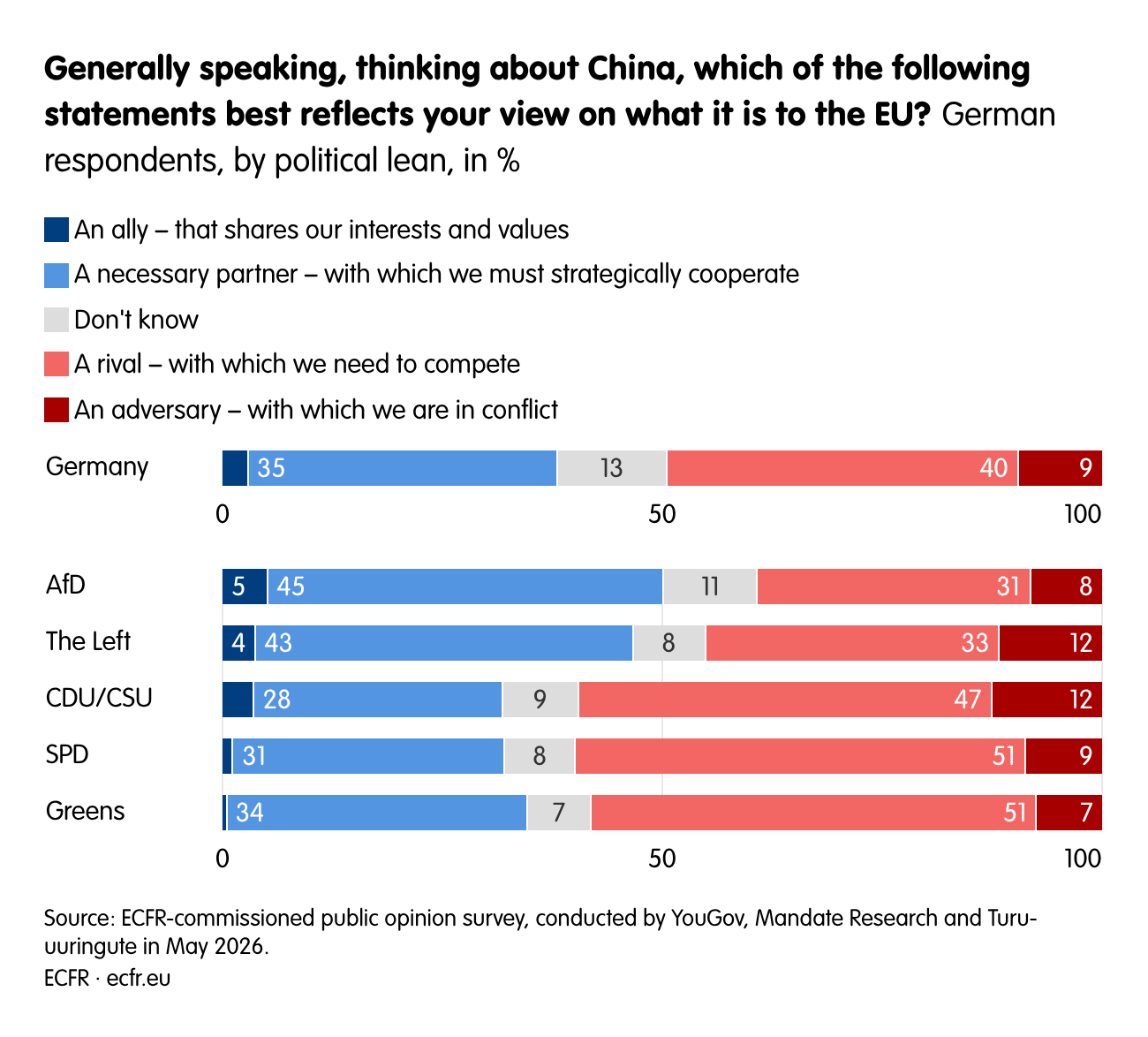
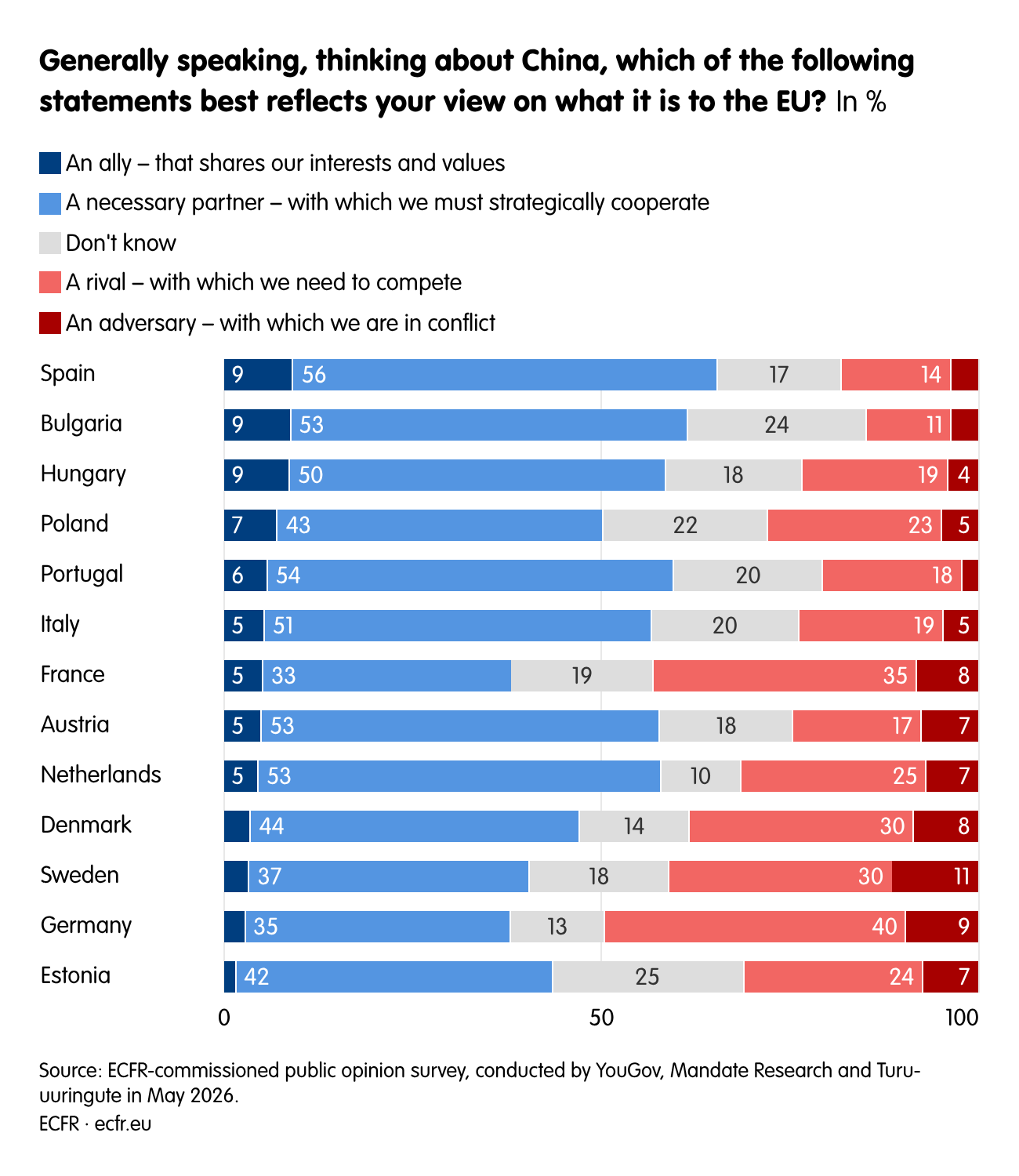
Yet, one thing Berlin should not worry about is voters’ disapproval should it pursue a more hawkish China policy. ECFR polling data find that Germans are the most China-sceptical out of 15 European countries surveyed. No fewer than 60% of Christian Democrat and Social Democrat supporters regard the country as an adversary or rival. In contrast, elsewhere in Europe, majorities still see China as either a “necessary partner” or even an ally. In Italy and Spain, 56% and 65% of people hold this view respectively. (Closest to the sceptical Germans are the French public; President Emmanuel Macron’s increasingly hawkish political posture vis-à-vis Beijing may have found an audience willing to listen.)
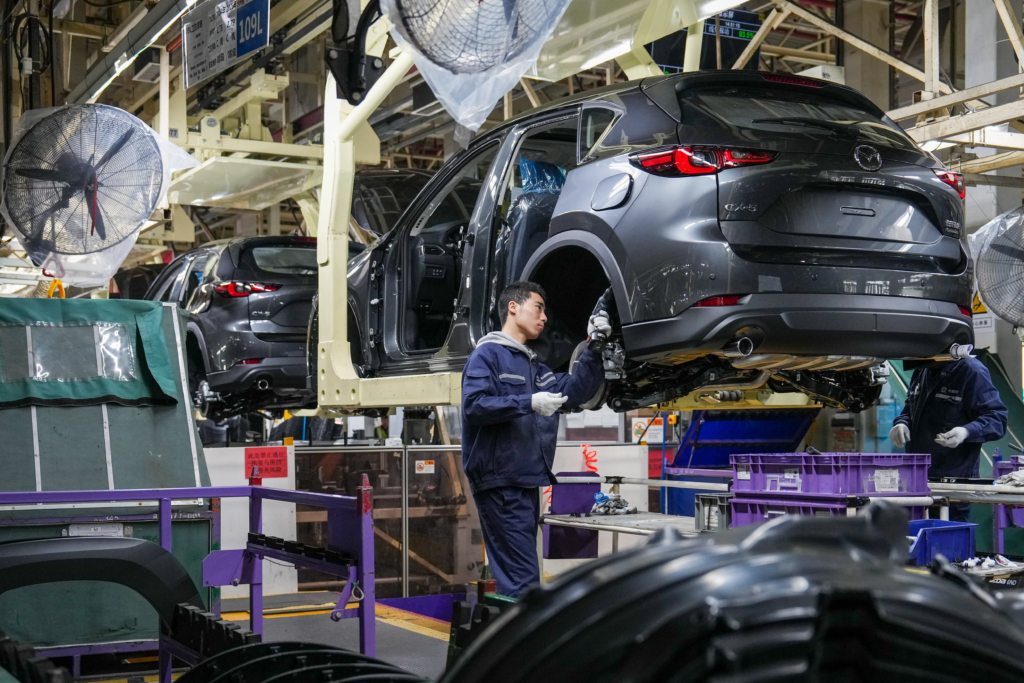
The China shock has hit Germany particularly hard: its manufacturing sector lost around 420,000 jobs between 2019 and 2025 and it continues to shed 10,000 jobs each month. The car industry is paying the highest costs, being squeezed out of a market increasingly dominated by Chinese manufacturers at home and abroad.
The mood in the European Council is shifting, and with Germany’s acquiescence. When EU leaders met in June 2026, they backed a stronger trade defence toolbox of existing measures against China. This included instruments such as the Industrial Accelerator Act’s “Buy European” provisions and limits on high-risk Chinese technology. Despite its past hesitations, Germany no longer acts as a spoiler on firmer EU action, and it has cautiously supported this new direction. Nevertheless, the combination of growing public scepticism towards China, mounting pressure on German industry and appetite for a more assertive policy on the European level creates a political mandate that German decision-makers could yet seize.
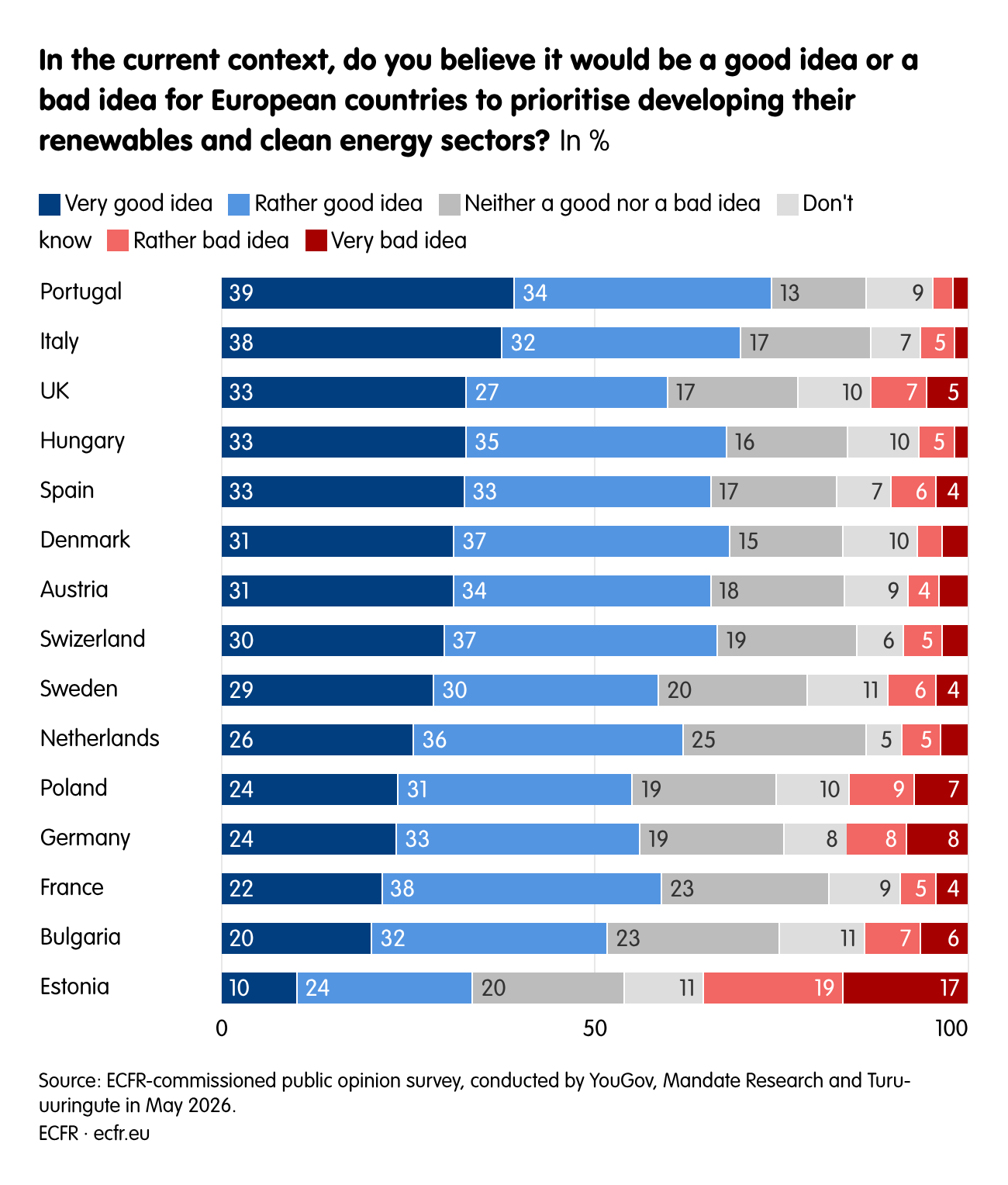
The German public’s views on the energy transition should also prove encouraging for their leaders. Voters want to see investment in renewables: 57% back what would amount to the growing electrification of the economy. Across the countries polled by ECFR, 61% of respondents say they support prioritising renewables and the clean tech sector.
This public support should help persuade leaders, including in Germany, that they can take action to limit emerging dependencies on China. They can accelerate the energy transition while de-risking the clean tech sector through providing support for domestic European industries, from wind to batteries.
For Berlin, and capitals across Europe, it is safer to move ahead rather than delay. Chinese economic policy is already doing irreparable damage to European industry—but European policymakers still need to protect an increasingly electrified economy from weaponisation by China. If they fail to do so, governments will almost certainly pay the price at the ballot box. Those that pursue electrification and economic de-risking as a single package are most likely to reap the political rewards.
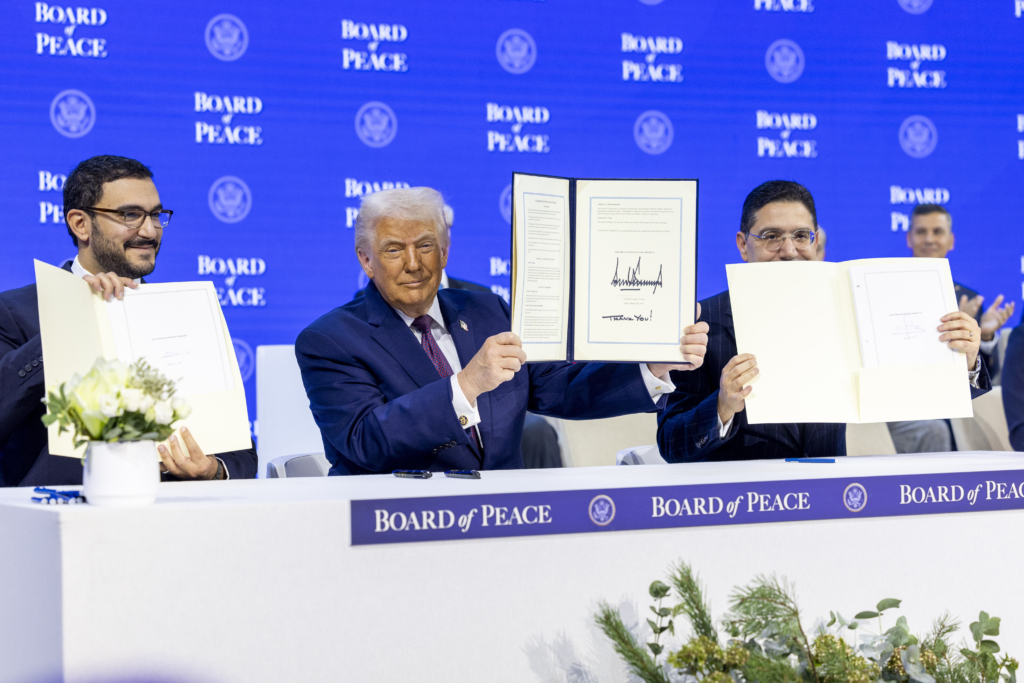
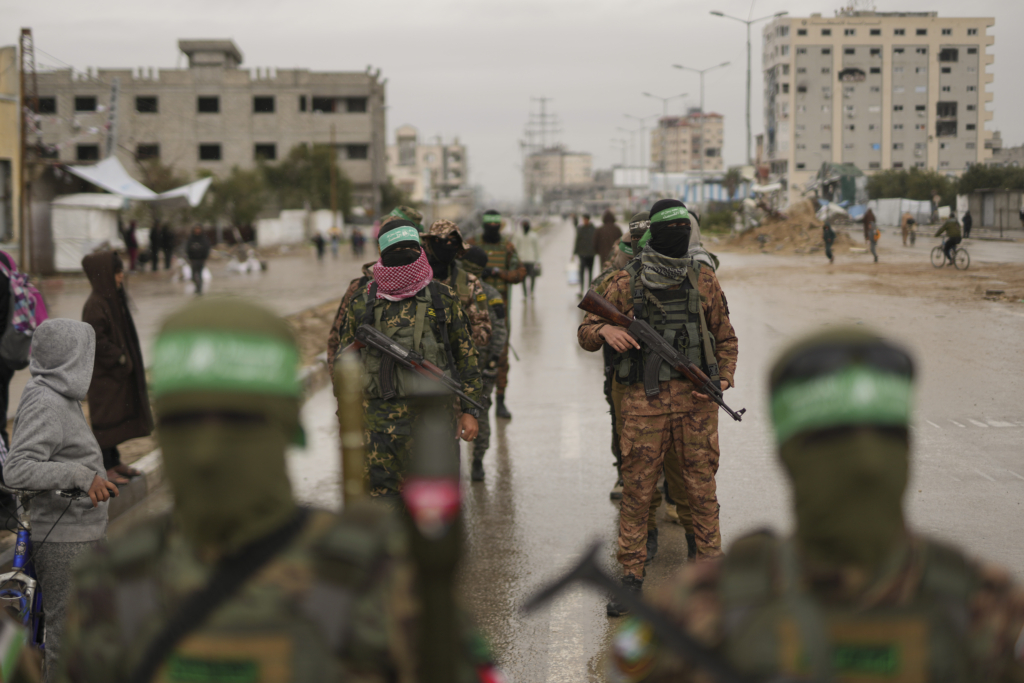
At the end of July, Hamas agreed to a Board of Peace (BoP) roadmap to implement Phase 2 of the three-stage ceasefire agreement. At its core is Hamas’s willingness to decommission its weapons. This would have been unthinkable only a few years ago and offers a realistic pathway for ending the Islamist group’s governance and security control over the devastated Strip.
This process will only begin once Israel has fully complied with its Phase 1 obligations, which it has yet to do. More fundamentally, it will require Israel to accept a process to end its military presence in Gaza and ultimately engage in negotiations towards Palestinian self-determination. Netanyahu and his hardline government have rejected the roadmap out of hand and are now the main threat to the ceasefire deal.
Having been largely sidelined, Europe now has a role to play in ensuring the deal succeeds.
The unfinished phase 1
Announced in September 2025, Trump’s 20-point plan aims to end the war in Gaza in three phases. The first phase conditioned the full cessation of hostilities and emergency relief on the release of Israeli hostages held by Palestinian groups. The second phase aims to remove Hamas from power and begin reconstruction—the roadmap Hamas agreed to in July outlines how this stage will work. The final phase would end with Israel’s full withdrawal from Gaza, the return of the Palestinian Authority (PA) and the launch of a “credible pathway to Palestinian self-determination and statehood”.
At the same time, Israel has continued to demolish Palestinian homes and infrastructure in the 70% of Gaza that remains under its control. Israel may now be seeking to create a new de facto border with Gaza and effectively annex a large chunk of the territory, potentially preparing for the return of Israeli settlements there in the future.
The roadmap
Once Phase 1 is complete, Palestinian factions will begin handing over their heavy weapons to the Palestinian National Committee for the Administration of Gaza (NCAG), a transitional body created as part of the 20-point plan to replace Hamas governance and security control in the Strip. This will include the full alphabet soup of Palestinian armed groups—many of which are more hardline than Hamas—as well as Israeli-backed militias.
Heavy weapons will effectively be placed under lock and key, monitored by the International Stabilisation Force (ISF), which will deploy as a buffer between Israeli forces and NCAG-controlled areas. BoP officials have said Palestinian weapons could ultimately be dismantled and melted down. This would replicate how Northern Ireland’s decommissioning process dealt with weapons held by paramilitary groups. Tunnels and weapons production facilities would also be put out of action.
Small arms like AK-47s will instead be regulated by NCAG through a system of permits. NCAG will also establish a new police force made up of newly trained recruits and members of the Hamas-run civil police vetted and approved by the BoP.
Critically, the roadmap links the decommissioning process “to an Israeli withdrawal, in phases, from the areas under its control in Gaza”. According to previous understandings, Israel would withdraw to a new “Red Line” by the end of Phase 2, and from there to a “Black Line” along Gaza’s perimeter, where it would retain a narrow buffer zone until “Gaza is properly secure from any resurgent terror threat.”
While the contours of Phase 2 are now clear, the final operational details still need to be hammered out between the sides during follow-up talks. Questions also remain over the lack of funding for the NCAG and the status of the ISF, which to date has only around 200 pledged troops from Morocco, though smaller numbers may also come from countries including Kosovo and Uganda. Meanwhile, the new Palestinian police force has yet to begin training in Egypt.
Europe is right to avoid directly funding the BoP. But it has considerable expertise in disarmament and security-sector reform, including through the EU’s EUPOL COPPS mission, which was established to assist the PA police in the West Bank. Europeans should offer critical personnel and technical expertise to support both the decommissioning process and the training of the new Palestinian police force.
The spoiler
The biggest obstacle remains Israel’s opposition to any transitional political process that would eventually force it out of the Strip and into talks on Palestinian self-determination
The biggest obstacle remains Israel’s opposition to any transitional political process that would eventually force it out of the Strip and into talks on Palestinian self-determination. The Israeli government has instead vowed to remain in Gaza and continue its military attacks. It has also opposed NCAG taking over until Hamas fully disarms, and demanded the right to veto troop contributions to the ISF from “hostile” countries such as Turkey and Qatar.
BoP officials now appear to be altering parts of the laboriously negotiated deal (and its own press release) to accommodate Israel’s hardline stance. They now state that Israeli withdrawal beyond the Yellow Line would begin only once the decommissioning process is complete. This appears to contradict the original text and Nikolay Mladenov, the BoP’s high representative, who initially said the two would move forward “in lockstep”. The accompanying Explanatory Note also reinforces this interpretation, outlining “a step-by-step process linking withdrawal phases to verified decommissioning steps.”
Such manoeuvring risks undermining Hamas support for the agreement. Moreover, by conditioning all further Israeli withdrawals on Gaza’s full demilitarisation, the BoP is in effect giving Israel a veto over the process itself, allowing it to deepen its control over the eastern half of Gaza. Given the near impossibility of removing every single Palestinian weapon, as many are held by families, clans, criminal networks and jihadi groups, Israel could argue indefinitely that the conditions for its withdrawal have not been met.
But even BoP efforts to placate Israel have failed to satisfy prime minister Benjamin Netanyahu. He continues to demand that the deal be re-negotiated, insisting that no Israeli redeployment will take place, even to the original Yellow Line, until Hamas has fully disarmed.
The path forward
Having secured Hamas’s unprecedented agreement to decommission its weapons, the BoP now needs to show the political will to implement its own deal. US officials have already warned Israel that US president Donald Trump would be “very, very disappointed” if Netanyahu derailed it. Although the prime minister’s far-right coalition limits his room for manoeuvre, Netanyahu has invested heavily in portraying his close relationship with Trump as a political asset—which means he cannot easily afford a public rupture with him.
Mladenov has won wide international praise for brokering the deal. Rather than modifying the terms he himself negotiated and risk the diplomatic gains already achieved, he should use his current political capital and Trump’s momentary re-engagement to insist that Israel implements rather than rewrites the agreement. If necessary, he should be prepared to call out Israeli obstruction, just as he previously cast Hamas as the main obstacle. Europe can further strengthen his hand by also highlighting Israel’s non-compliance with its obligations, as the Arab and Turkish mediators have done. The EU should also resume discussions on suspending the Association Agreement with Israel unless it complies.
Sustained diplomatic engagement before Israel’s October elections should aim to shift the terms of the domestic debate. The Israeli opposition has also been critical of the deal, accusing Netanyahu of weakness by allowing Hamas to survive, and is unlikely to chart a radical new course on Gaza if it wins. Nevertheless, opposition figures have also acknowledged that Israel’s battlefield gains need to be converted into lasting diplomatic achievements. Europe should use the political framework established by the Gaza roadmap to reinforce this logic and demonstrate how military gains can be converted into a sustainable political settlement.
Ultimately, success will depend on whether both sides conclude that diplomacy offers greater rewards than renewed war. Hamas is unlikely to complete decommissioning unless it believes that concessions today will lead to genuine political gains tomorrow towards Palestinian liberation. Equally, Israel will only embrace a durable ceasefire if it sees political transformation within Hamas that locks it into credible peace negotiations as a means of strengthening its long-term security. This makes Phase 3 every bit as important as Phase 2.
Without a credible pathway towards Palestinian self-determination, decommissioning risks becoming an end in itself rather than the foundation of a lasting Israeli-Palestinian peace. Equally, a future Israeli government will need to view full implementation of the Gaza agreement not as a concession to Hamas, but as the indispensable stepping stone towards normalisation with Saudi Arabia and deeper integration with the Arab and Islamic world. Europe should therefore work with its Arab partners to ensure that the Gaza deal is tied to a regional package. That would allow a future Israeli government to present withdrawal from Gaza and acceptance of a political process leading to a two-state solution not as unilateral compromises, but as part of a US-brokered grand bargain that underpins Israeli integration and security in the region.
Brussels (enr) – Local and regional leaders raised concerns that the next multiannual EU budget risks undermining investment in affordable homes needed to alleviate Europe’s deepening housing crisis.
“Europe’s housing challenge is not simply about building more housing units,” said Kata Tüttő, President of the European Committee of the Regions (CoR), an EU advisory body home to democratically elected regional and local representatives from all 27 Member States.
At a gathering in Brussels on Thursday, they demanded the EU “move from political ambition to concrete investment and delivery,” arguing that failing to invest now will only put affordable housing further out of reach for millions of Europeans.
As negotiations over the EU’s next long-term financial framework gather pace, cities and regions fear that affordable housing could become a casualty of competing spending priorities as several EU member states seek to cut the European Commission’s proposed €2 trillion budget for 2028-2034.
Tüttő called on the European Investment Bank (EIB), the EU’s lending arm, to “mobilise the scale of investment” that cities and regions need to “make communities liveable” by providing essential infrastructure. She cited public transport, as well as energy and water infrastructure, as key examples.
Italian MEP Irene Tinagli, Chair of the European Parliament’s Special Committee on the Housing Crisis (HOUS), said addressing the housing crisis “requires investment, better coordination across all levels of government and a shared commitment from European institutions, Member States, regions and cities”.
The CoR and EIB on Thursday agreed on closer cooperation in key areas including social infrastructure, housing, and energy. The European Investment Bank’s president, Nadia Calviño, said “investing into resilient cities and regions, into cohesion and housing” was a strategic priority.
According to EIB figures, the world’s largest multilateral development bank provided a record €5 billion in financing for housing projects across Europe in 2025. The EIB is targeting an increase to €6 billion this year, Calviño confirmed.
The investments are a contribution to the European Commission’s Affordable Housing Plan, which was launched in December and aims to boost housing supply, mobilise public and private investment, and support Member States and regions in expanding social and affordable housing.
According to the Commission’s estimates, however, the EU needs to build 2 million homes each year to meet current demand, which amounts to an investment of approximately €153 billion per year.
This story was produced by the European Newsroom (enr) in cooperation with the European Committee of the Regions (CoR). The editorial responsibility lies with the enr.
Brussels (enr) – The European Union’s migration commissioner has renewed his call for Germany to gradually end controls at its internal borders, pointing to falling numbers of irregular arrivals and the bloc’s new asylum rules.
It was now time to gradually abolish internal border controls, Magnus Brunner told members of the European Newsroom (enr) network in Brussels.
The Austrian commissioner said the EU’s external borders were better protected and that irregular crossings had fallen sharply. Frontex recorded about one-third fewer irregular crossings at the EU’s external borders in the first half of 2026 than in the same period last year.
The EU’s new Pact on Migration and Asylum also took effect on June 12. Brunner said member states had begun implementing the rules and that the bloc was already seeing progress.
He welcomed steps by individual countries to ease controls. Checks on the border between Germany and Luxembourg on the Trier motorway have been lifted, he said. He also cited the suspension of controls between Austria and Slovenia.
Germany has had checks at its land borders since September 2024. Former Interior Minister Nancy Faeser ordered them, and her successor, Alexander Dobrindt, intensified them in May 2025. Dobrindt has repeatedly extended the measures, which are currently due to remain in place until September.
Brunner also defended the EU’s new Entry/Exit System, known as EES. The digital system records the entry and departure of travellers from outside the EU, Iceland, Liechtenstein, Norway and Switzerland.
He acknowledged that the system had caused problems at some airports, including in Greece and Portugal, but said: “The system itself works very, very well.”
The system has faced criticism over long queues. The Airports Council International Europe has reported waiting times of up to five hours and missed connecting flights.
Brunner said professional truck drivers from the Western Balkans faced a particular problem because they can currently stay in the EU for no more than 90 days in any 180-day period. He proposed that EU member states and Western Balkan countries negotiate long-term visas on a bilateral basis.
Brussels (enr) – European Parliament Foreign Affairs Committee Chairman David McAllister has urged Ukrainian President Volodymyr Zelenskyy to support German Chancellor Friedrich Merz’s proposal for an associate membership for Ukraine as it moves towards joining the European Union.
The proposal is an opportunity that Ukraine should seize, the German centre-right lawmaker told members of the European Newsroom (enr) network in early June. Claims that it would amount to “membership light” or second-class membership were incorrect, he said.
Instead, it would allow Ukraine to become more closely integrated into the EU step by step before full membership, making the benefits of the bloc more visible to its people. One possibility would be for Ukraine to participate in the European Parliament as an observer, McAllister said.
Zelenskyy has expressed opposition to the idea, arguing that it would be unfair for Ukraine to be present in the EU but have no say in its decisions. In a letter to EU leaders, he called for the bloc to move faster and not keep Ukraine in a waiting room until full membership.
Merz said earlier that rapid full EU accession for Ukraine, which is fighting Russia’s invasion, is not realistic. For the interim period, he has proposed allowing Ukraine to attend EU summits and ministerial meetings without voting rights.
His ideas also include an associate member of the European Commission without a portfolio or voting rights, associate members of the European Parliament and an associate judge at the European Court of Justice.
Enlargement Agenda
McAllister said EU enlargement was high on the bloc’s agenda and that the Western Balkans were at the heart of Europe. A stable region was an investment in peace and security, he said.
The CDU politician called for each candidate country to be assessed individually and on its merits rather than treating the Western Balkans as a single group. Montenegro was a clear frontrunner, he said, while North Macedonia’s accession path remained blocked by a political dispute with Bulgaria.
Eight other European countries are officially recognised as EU candidate countries alongside Ukraine: Albania, Bosnia and Herzegovina, Georgia, Moldova, Montenegro, North Macedonia, Serbia and Türkiye.
Russian forces hammered Ukraine with ballistic missiles and long-range drones overnight on Tuesday, killing at least 17 civilians – mainly around Kyiv – and injuring another 44, the UN human rights office in Ukraine reported.
Luxembourg (enr) – The European Investment Bank (EIB) is on course to meet, and potentially exceed, its target of allocating five percent of its financing in the European Union to security and defence projects this year, EIB President Nadia Calviño said.
That would amount to around 4.5 billion euros, according to the EU’s lending arm.
“Tt’s clear that we need more investment in the area of security and defence in Europe,” Calviño told members of the European Newsroom (enr) network in Luxembourg in June. “For the coming years, we are ready to do more to finance Europe’s security and defence capabilities,” the Spanish former economy minister added.
The EIB significantly increased its support for the sector last year in response to Russia’s war against Ukraine and the broader deterioration in the geopolitical situation. Financing for security and defence projects rose to more than 4 billion euros in 2025, four times the previous year’s level and almost five percent of all EIB Group financing in the EU.
“The shift of policy in security and defence has been a turning point for the EIB Group,” Calviño said.
Within only a few years, the bank had expanded its eligibility rules to include purely military projects. It now supports companies and investment funds active across the security and defence sector.
The EIB has gradually eased its financing rules since 2024. It can now provide funding for military equipment, infrastructure, services and technology. Weapons and ammunition remain excluded.
The Luxembourg-based EIB is the EU’s long-term lending institution. Its owners are the bloc’s member states, and its investments are generally intended to support the European Union’s political objectives.
The enr spoke with Calviño on the sidelines of the EIB’s annual Board of Governors meeting, as well as a meeting of EU ministers responsible for economic affairs, finance and the EU budget.
As Russia’s invasion of Ukraine continues, with both sides stepping up airstrikes and drone attacks in recent weeks deep inside each other's territory, the UN Children’s Fund (UNICEF) appealed on Tuesday for greater protection for the war’s youngest victims.
Gdańsk/Brussels (European Newsroom) – Ukrainian cities and regions risk being left out in deciding how billions in reconstruction funds are being used unless they are given a robust role in the planning, governance and implementation of reconstruction support, a joint statement by the European Alliance of Cities and Regions for the Reconstruction of Ukraine warned.
Meeting on the sidelines of the Ukraine Recovery Conference (URC) 2026 in Gdańsk, Poland, the alliance called for a “localisation marker” in donor planning tools and ring-fenced funding with direct local access.
Antje Grotheer, President of the State Parliament in Bremen, Germany, and chair of the European Committee of the Regions’ (CoR) Working Group on Ukraine, argued that local and regional authorities should have a greater voice in donor discussions and reconstruction planning. She stressed that Ukraine’s decentralisation reforms have been key to maintaining resilience during the war.
“We feel there is an increasing need for stronger coordination of support that targets municipalities and regions,” Grotheer said.
Oleksii Riabykin, Deputy Minister for Rebuilding and Minister for Development of Communities and Territories of Ukraine, said his country is already moving from emergency reconstruction to building resilient communities. Experience gained by Ukrainian cities, towns and villages during the war can help strengthen resilience across in Europe, he said.
EU law implementation
The joint statement released Wednesday stressed that over 70 percent of EU law is implemented at local level, but most reconstruction funding for Ukraine is still channeled through national governments, leaving municipalities to compete over the leftovers. At the URC 2026 in Gdańsk, the CoR and its alliance partners demanded a structural fix.
The alliance also encouraged Ukrainian regions to exploit existing EU programmes and platforms. It underscored the contribution of neighbouring EU countries to both Ukraine’s military efforts and its reconstruction, arguing that they should receive targeted support.
EU member states that share a border with Ukraine are Poland, Slovakia, Hungary and Romania.
The alliance brings together EU and Ukrainian local and regional authorities and was co-founded by the CoR, an EU advisory body, in June 2022 following Russia’s full-scale invasion of Ukraine. Its goal is to coordinate an effective reconstruction of Ukraine that involves local and regional authorities rather than centralising the implementation of funds to the state.
The URC was also established after Russia’s full-scale invasion, building on the foundations of the annual Ukraine Reform Conference established in 2017 by supporters of Ukraine, including the European Union.
The URC 2026 takes place on June 25 and 26 and focuses on the sectors most impacted by Russia’s attacks, such as energy, critical infrastructure, and logistics. The lead-up to the conference was overshadowed by escalating dispute between Warsaw and Kyiv. Ukrainian President Volodymyr Zelensky had named an army unit after Ukrainian underground fighters from World War II who are also blamed for massacres of tens of thousands of Poles and Jews in what is now western Ukraine. In response, Poland’s right-wing conservative President Karol Nawrocki stripped Zelensky of a high Polish order of merit.
This story was produced by the European Newsroom (enr) in cooperation with the European Committee of the Regions (CoR). The editorial responsibility lies with the enr.
A la Une de la presse, ce mercredi 5 août, la réunion d’urgence des ministres des Affaires étrangères des pays arabes et musulmans convoquée aujourd’hui par la Jordanie. Le montant astronomique des profits des grandes compagnies pétrolières ces trois derniers mois: 93 milliards de dollars. Les réactions à la réunion, hier, des ministres de l’Intérieur de l’UE sur la crise migratoire à Ceuta. Et une méthode originale pour appréhender les automobilistes téléphonant au volant.
Migration policy is high on the European Union’s agenda. But one month after the bloc’s new rules – known as the Pact on Migration and Asylum – came into force, is the EU beginning to see the desired results?
For Magnus Brunner, European Commissioner for Internal Affairs and Migration, the answer was yes. In an interview with the European Newsroom (enr) published on Thursday, he said that member states have begun implementing the rules and that illegal border crossings into the EU already dropped by 37% in the first half of 2026 compared to the previous year.
In light of these figures and the new rules, the Austrian politician said it is now time to “gradually” abolish internal border controls between EU member states, such as ongoing controls in Germany and Austria. He argued that the EU’s external borders were now better protected and reiterated that the number of irregular border crossings had fallen dramatically.
Journalists also quizzed Brunner about the Entry/Exit System, a new digital entry and exit procedure for people who are not from the EU, Iceland, Liechtenstein, Norway or Switzerland. While admitting concerns from member states and critics that the system is still causing trouble in some member states, he said that it is generally performing as expected.
A major issue, however, remains for professional truck drivers from countries in the Western Balkans, who need to enter the EU to deliver goods. Currently, they can only stay in the EU for a maximum of 90 days within any 180-day period. As a solution, Brunner proposed to EU member states and Western Balkan countries to negotiate long-term visas bilaterally.
The interview was conducted by journalists from European Newsroom partner agencies dpa, APA, and CTK, on behalf of the entire network.

 Login