❌

Reading view

Clavicular Charged With Rape and Drugging in MA - The Bulwark

Gen Z influencer Clavicular has been charged with criminal rape and drugging of a minor, according to a new report from The Bulwark (Left bias). Clavicular's team told several publications that "The Bulwark is exaggerating."

The Report: The Bulwark said it obtained court records that showed the influencer – real name Braden Peters – was charged on Sept. 8 for an incident that happened on May 23, 2025, in Cape Cod, Massachusetts. An arraignment is reportedly scheduled for October 14.

Clavicular's Response: Mitchell Jackson, a representative for Peters, told NBC News (Lean Left), "Braden Peters has not been physically served. As usual the Bulwark is exaggerating." Peters' attorney told TheWrap, "We are aware of the complaint recently filed against Mr. Peters. These are allegations only and remain unproven. Mr. Peters denies the claims and disputes the characterization of events. He will respond through the appropriate legal channels and intends to vigorously defend himself. We will not comment further at this time."

For Context: In April, Peters was sued in Florida by influencer Alorah Ziva – real name Aleksandra Vasilevna Mendoza – who accused him of battery. In the suit, she reportedly alleged that in 2025 he arranged for her to travel to Cape Cod and had sex with her while she was intoxicated. NBC News said online court records it reviewed don't indicate whether the newly reported charges are related to the allegations in the suit. After The Bulwark published its report, Peters wrote on X, "Trying to get my attention in anyway possible, a lawsuit? Seriously… really petty of you."

How The Media Covered It: The Bulwark published its report on the evening of Sept. 21. The story was not widely covered as of early Sept. 22, though several big mainstream outlets that often focus on pop culture stories covered it. The Bulwark and TheWrap (Center) both prominently described Peters as "right-wing." The New York Post (Right) described Peters as a "controversial 'manosphere' streamer" and "infamous 'looksmaxxer.'" Several outlets, including NBC News, TheWrap, TMZ, and The Hollywood Reporter (Lean Left), reported speaking to a representative for Peters.

Written by the AllSides staff (of humans). Learn more. Support our mission. Suggest an improvement to this summary.

  •  

ICE Shooting of Venezuelan Immigrant in Texas Prompts Protests

Immigration and Customs Enforcement (ICE) agents shot and wounded a Venezuelan immigrant on Sunday in Austin, Texas. Media outlets across the political spectrum have reported varying details about his immigration status and reported on emerging protests in the city.

The Details: Wilber Rafael Garces Perez was delivering food for DoorDash when he was shot by an ICE agent. Though few details about the shooting have been officially released, New York Times (Lean Left bias) reported that the ICE agent was with other agents checking license plates when they discovered Garces Perez had a deportation on file. The officers pulled him over and told him they were going to arrest him, and he fled in his vehicle. A short chase ensued, with details unclear if Garces Perez was shot while inside his vehicle or if he was on foot. Garces Perez was reportedly not the target of investigation before the encounter with the agents.

Where Is He Now? Garces Perez told The Times that he was transported from the hospital to a detainment center and that doctors did not remove the bullet from his back before he was removed from the hospital. Garces Perez's attorney Kate Lincoln-Goldfinch said that the bullet was not removed because it was too close to his spine. She also claimed on X that her client "received no pain medication and had to sleep on the floor."

What Is Garces Perez's Immigration Status? The Department of Homeland Security (DHS) said that Garces Perez "illegally entered our country under the Biden administration and had a final order of removal." However, his attorney wrote that he has a legal work permit and entered the country through a legal port of entry and has applied for asylum. According to Newsweek (Center) and New York Times, Lincoln-Goldfinch said that Garces Perez had changed his address in immigration court, but his hearing notice was still accidentally sent to the wrong address, resulting in him missing his appointment. She wrote on X, "I see this all the time in my practice and it's a mistake we can easily correct."

Resulting Protests: Fox News (Right) wrote that a "crowd of angry demonstrators" gathered near the scene of the incident and that they "hurl[ed] obscenities and clash[ed] with authorities." According to Fox, videos of the scene showed people "holding up their phones and carrying flags." Fox highlighted perspectives from Rep. Greg Casar (D-TX), who demanded "a full, independent investigation and the immediate release of body-camera footage" and called the incident part of a "disturbing pattern" from ICE. Fox also included a reaction from Rep. Chip Roy (R-TX), who said that "the war is the one being waged against Americans through mass legal & illegal immigration."

Written by the AllSides staff (of humans). Learn more. Support our mission. Suggest an improvement to this summary.

  •  

The New Hysteria: Mothers Who Kill Their Kids—and the Feminists Who Defend Them

There’s an unmissable irony in the way feminists today are rushing to defend mothers who kill their own children.

In doing so, they have effectively revived the old idea of female hysteria. Hysteria was once a widespread diagnosis, rooted in the belief that women were uniquely prone to mental and behavioural disorders because of their biology.

The term dates back to Ancient Greece, from hystera, meaning “womb”. Hippocrates and Plato even believed the womb could wander through a woman’s body, producing various physical and mental symptoms.

Modern medicine abandoned hysteria as a legitimate diagnosis long ago. Yet when a woman commits an unspeakable act today, we increasingly hear a remarkably familiar argument: her hormones, pregnancy, childbirth, mental state or female biology somehow explain, or even excuse, her irrational behaviour.

The irony is hard to miss here. In their attempt to defend women, they are resurrecting what feminists have long argued is one of history’s most patronising stereotypes about women.

Read more

  •  

Greenland is not for sale: Trump’s Donroe Doctrine and US imperialism

Donald Trump’s campaign to bring Greenland under United States control has often been dismissed as bluster. That is a mistake. Behind the language of a property deal lies a serious attempt to revive an old imperial principle: that Washington may decide the political and economic future of the entire Western Hemisphere. Greenland, strategically placed between North America and Europe, has become a test of that claim – and of whether the sovereignty of a small Indigenous nation counts when it conflicts with the ambitions of a great power.

Trump floated buying Greenland during his first presidency in 2019. After his re-election, the proposal became more aggressive. In December 2024 he declared US “ownership and control” of Greenland as an “absolute necessity.” On January 7, 2025, he refused to rule out military or economic coercion against Greenland and the Panama Canal, saying, “We need Greenland for national security purposes.” He subsequently insisted that the United States would obtain the island “one way or the other.” The claim mixed several arguments: Greenland is vital to missile defense, Russia and China threaten the Arctic, Greenland’s rare-earth deposits are strategically valuable, and Greenlanders would supposedly welcome US rule.

The last claim was demonstrably false. A January 2025 survey conducted in both Greenlandic and Danish found that 85% of Greenland’s population opposed leaving the Danish realm to join the United States, while only 6% supported it. Yet the same poll showed a majority favoring eventual independence. That distinction is central. Greenlanders’ desire to end Danish colonial tutelage cannot be converted into consent to US annexation.

A military relationship without annexation

The security case for US ownership is misleading because Washington already enjoys extensive military rights in Greenland. The relationship began during the Second World War. With Denmark occupied by Nazi Germany, its ambassador in Washington signed a 1941 agreement permitting the United States to defend Greenland and construct facilities there. Denmark sought a US withdrawal after the war, but Cold War strategy prevailed.

The 1951 Defense of Greenland Agreement, concluded under the North Atlantic Treaty, authorized the United States to establish and operate “defense areas.” It enabled the rapid construction of Thule Air Base – renamed Pituffik Space Base in 2023 – at a location ideal for the shortest air and missile routes between the Soviet Union and North America. At its Cold War height, the US operated numerous installations across Greenland. Today Pituffik, Washington’s northernmost military base, performs missile-warning, missile-defense and space-surveillance functions.

The agreement offers Washington wide operational freedom. A 2004 amendment – the Igaliku Agreement – recognized Greenland’s Home Rule government, made Pituffik the sole existing defense area, and required consultation before significant changes or the creation of new defense areas. It also established cooperation on economic, technical, and environmental issues. In other words, if the United States believes more radar, ports, airfields or personnel are necessary, a legal mechanism already exists to negotiate them with Denmark and Greenland. Sovereignty is, therefore, not a military requirement.

The history of the bases also explains why “security” is not a neutral word in Greenland. In 1953, Danish authorities ordered 116 Inughuit – 27 families – to leave the newly established Qaanaaq, while the others relocated to settlements elsewhere in the district. Camp Century was constructed beneath the ice in 1959-60 and was connected with the secret Project Iceworm proposal for an extensive network of nuclear-missile launch sites.

In 1968, a US B-52 carrying four hydrogen bombs crashed on the sea ice at Thule Air Base, causing plutonium and other contamination. The accident exposed the inconsistency between Denmark’s publicly declared policy against nuclear weapons on Danish territory in peacetime and the Danish government’s secret permissions for the US to store nuclear weapons in Greenland. Abandoned installations left fuel, waste and other pollution. Greenlandic reporting continues to question who will pay for future clean-ups. The military relationship protected US strategic interests while its human and environmental costs were disproportionately borne by Greenlanders.

Greenland ceased formally to be a colony in 1953, gained Home Rule in 1979 and expanded self-government in 2009. The Self-Government Act recognizes Greenlanders as a people entitled to self-determination and provides a path to independence. Washington reopened its Nuuk consulate in 2020, and cooperation grew in trade, education, mining, and research. Greenland’s governments (from Kuupik Kleist to Jens-Frederik Nielsen) have welcomed economic ties with Washington, but reject the tendency of Washington to want more and more from the island for its military needs.

From Monroe to Donroe

Trump’s Greenland demand belongs to a wider hemispheric policy. The Monroe Doctrine of 1823 warned European powers against new colonial intervention in the Americas. Presented as anti-colonial, it evolved into a claim of US supremacy. Theodore Roosevelt’s 1904 corollary asserted a right of intervention in Latin America, furnishing ideological cover for occupations, regime changes, and control over strategic assets.

Trump’s supporters rechristened its latest version the “Donroe Doctrine.” The label links pressure on Greenland with demands concerning the Panama Canal, threats against Cuba and Colombia, claims over Canada, and US intervention in Venezuela. In late 2025, the White House formally proclaimed a Trump Corollary to the Monroe Doctrine, asserting US leadership throughout “our hemisphere.” Greenland is swept into this sphere because it is geographically part of North America, even though it is politically tied to Denmark and its Inuit people possess their own right of self-determination. This doctrine contains a revealing contradiction. Trump denounces European control of Greenland as an anachronism while demanding that the island be transferred to the United States. Colonialism is not abolished; the proposed colonizer merely changes. Trump’s references to minerals, sea routes, and military geography reduce Greenland to an asset and its 56,000 people to an obstacle in a transaction between powers.

A crisis inside the Western alliance

Trump’s threats produced an extraordinary rupture between the United States and Europe. Denmark is not an adversary, but a NATO ally whose troops fought alongside US soldiers in Afghanistan. A threat to seize territory from one ally by force attacks the premise of the alliance itself. Danish Prime Minister Mette Frederiksen warned that a US attack on another NATO country would bring the post-war security order to an end. European governments rallied behind the principle that borders cannot be changed by coercion, a principle they invoke against Russia in Ukraine.

The crisis exposed Europe’s dependency. NATO has no comfortable procedure for defending one member against its strongest member. European states rely heavily on US military power while being asked to resist US coercion. Copenhagen responded with careful diplomacy, greater Arctic military spending, and insistence that decisions belong to Greenland and Denmark. France, Germany, the Nordic states, and the European Union expressed solidarity, but the episode sharpened calls for European strategic autonomy. It also damaged Washington’s claim to lead an alliance of democracies against authoritarian revisionism.

On September 18, 2026, Trump announced an emerging trilateral security agreement after months of negotiation, claiming “permanent control” over Greenland’s security. Danish and Greenlandic leaders described it more narrowly: an expansion of US military cooperation that preserves sovereignty and Greenlandic self-determination. The full text remains to be signed and approved. If their account holds, the outcome confirms what was apparent from the beginning: the United States could obtain additional security arrangements without owning Greenland. Yet the pressure that preceded the deal remains a warning about negotiations conducted under threats.

Greenland speaks for itself

Greenland’s response has combined rejection, unity, and political complexity. Kalaallit Nunaat – the Greenlandic name for the country – became the center of declarations that Greenland belongs to its people and is not for sale. In March 2025, large demonstrations in Nuuk, Sisimiut, and Qaanaaq marched under the red-and-white Erfalasorput flag. Protesters told Trump to respect Inuit, their country, and their nationality. Greenland’s political parties, despite deep disagreements over the speed and economic terms of independence, jointly condemned external pressure. Parliament prohibited foreign and anonymous political donations, explicitly defending the integrity of Greenlandic democracy amid great-power interest.

Danish colonialism left profound injuries: forced assimilation, social engineering, unequal development, and decisions taken in Copenhagen about Greenlandic land and people (the entire fourth season of the popular television drama, Borgen, in 2022 centered on a conflict between Copenhagen and Nuuk about the discovery of a new oil field with a China and Russia angle). Many Greenlanders want independence, and some see heightened US interest as leverage for investment and a more equal relationship with Denmark.

Greenland reveals the real content of the Donroe Doctrine: a twenty-first-century claim that geography gives Washington superior rights over neighboring peoples. The answer from Greenland is equally modern and universal. Strategic location does not cancel popular sovereignty, minerals do not erase nationhood, and no great power acquires a country merely by declaring that it needs one.

Vijay Prashad is an Indian historian and journalist. He is the author of forty books, including Washington Bullets, Red Star Over the Third World, The Darker Nations: A People’s History of the Third World, The Poorer Nations: A Possible History of the Global South, and How the International Monetary Fund Suffocates Africa, written with Grieve Chelwa. He is the executive director of Tricontinental: Institute for Social Research, the chief correspondent for Globetrotter, and the chief editor of LeftWord Books (New Delhi). He also appeared in the films Shadow World (2016) and Two Meetings (2017).

This article was produced by Globetrotter.

  •  

The Real Danger of AI is That It is Run by Evil Warmongers

The Real Danger of AI is That It is Run by Evil Warmongers

GlobalResearch.ca

Caitlin Johnstone | caitlinjohnst.one

The biggest AI threat isn’t artificial superintelligence wiping out humanity in a fit of mechanical vengeance like some digital Old Testament God, it’s the same oligarchs and empire managers as usual inflicting the same evils and abuses as usual upon their fellow man.

We’re already presently watching the empire building AI into its killing machines and causing all kinds of horrifying problems while these technologies become more and more complex and unpredictable.

CNN reports that US military AI “almost started a war” with China when it hallucinated intelligence showing a Chinese ship transporting nuclear weapon components to Iran; US military planes were apparently already in the air preparing to attack the vessel before human intelligence picked up on the error.

NEW: An AI-assisted intel report sent the military scrambling to intercept a Chinese ship in the Middle East it believed was transporting components of a nuclear weapons program.

It turned out to be a hallucination. And it "almost started a war." https://t.co/xXZHEE64M6

— Katie Bo Lillis (@KatieBoLillis) September 18, 2026

A recent Pentagon report has officially concluded that an over-reliance on Palantir’s AI-powered command-and-control system Maven contributed to the bombing of a school in Minab which killed 120 children attending classes on the first day of the US-Israeli war with Iran.

We learned early on in the Gaza holocaust that the IDF was using AI to help it bomb suspected Hamas members when they are at home with their families rather than when they are out in the battlefield using a program called “Where’s Daddy?” — a bit of Israeli humor about the fact that they would be killing the children of Palestinian resistance fighters when their fathers came home.

We’re seeing politicians like Bernie Sanders voice concerns that “AI could soon be smarter than humans and function outside of our control,” but the most obvious and imminent threat right now is not that artificial intelligence will outsmart us and escape our control, it’s that it is being fully controlled by humans who are stupid and evil.

Again, we know for a fact that powerful nuclear-armed military forces are knitting AI into all their systems. We’re watching them do it, right in front of our faces. An increasingly complex and confusing element has been added to an environment of already tense and dangerous military standoffs around the world as the US and its allies work to absorb the few remaining nations who have managed to retain sovereignty into the imperial power umbrella. And yet recent weeks have seen the mass media flooded with punditry speculating about possible scenarios under which AI might perhaps wind up leading to human extinction.

We already know the most likely scenario under which AI will get us all killed. If it happens, it will be because rich and powerful sociopaths knit these technologies into war machinery that is designed for killing humans at mass scale. Duh.

These developments are unfolding in the context of a frenetic new arms race with China in which nobody’s willing to tap the brake pedal for fear of falling behind. Any talk of regulation or slowing things down before they get out of control is dismissed because the competition-based systems which currently govern human behavior have thrust us into a nightmare of constant military expansionism and brinkmanship instead of collaboration and harmony, all fueled by the fact that this paradigm makes tech plutocrats and war profiteers obscenely wealthy.

That’s clearly the most immediate existential threat that AI poses to our species right now. There’s also the only slightly less frightening threat of artificial intelligence enabling our rulers to use mass surveillance and autonomous weapons systems to stifle any revolutionary political movement before it gets off the ground, locking us into this freakish capitalist dystopia until the planet is an uninhabitable wasteland.

In any case, this isn’t a new threat. It’s the same old threat with new toys. Capitalism must end, and the empire must fall. Our very existence depends on it.


Original Article: https://www.caitlinjohnst.one/p/the-real-danger-of-ai-is-that-it

  •  

Saudi Airstrikes Reportedly Kill at Least 17 Civilians and Detainees in Yemen

Warning: Graphic photo below Saudi airstrikes that hit Yemen on Monday night into Tuesday killed at least 17 people, including civilians and detainees at a prison, according to Ansar Allah officials and reports in Yemeni media. Abdul Qader al-Murtada, the head of the Yemeni National Committee for Prisoners’ Affairs, said that on Monday night, Saudi […]
  •  

Every American Aircraft Lost Or Damaged During The Iran War, Visualized

Two reports released last week by the U.S. government shed light officially, for the first time, on the damage Iran has inflicted on the Pentagon’s aerial fleet since the war began almost seven months ago. TWZ has combined their accounting with open-source intelligence (OSINT) reporting and our own tracking to produce a comprehensive graphic visualizing what the U.S. has lost – and what it will cost to replace. The picture it paints is not a pretty one, with implications should the U.S. trade blows with a peer adversary in the Pacific.

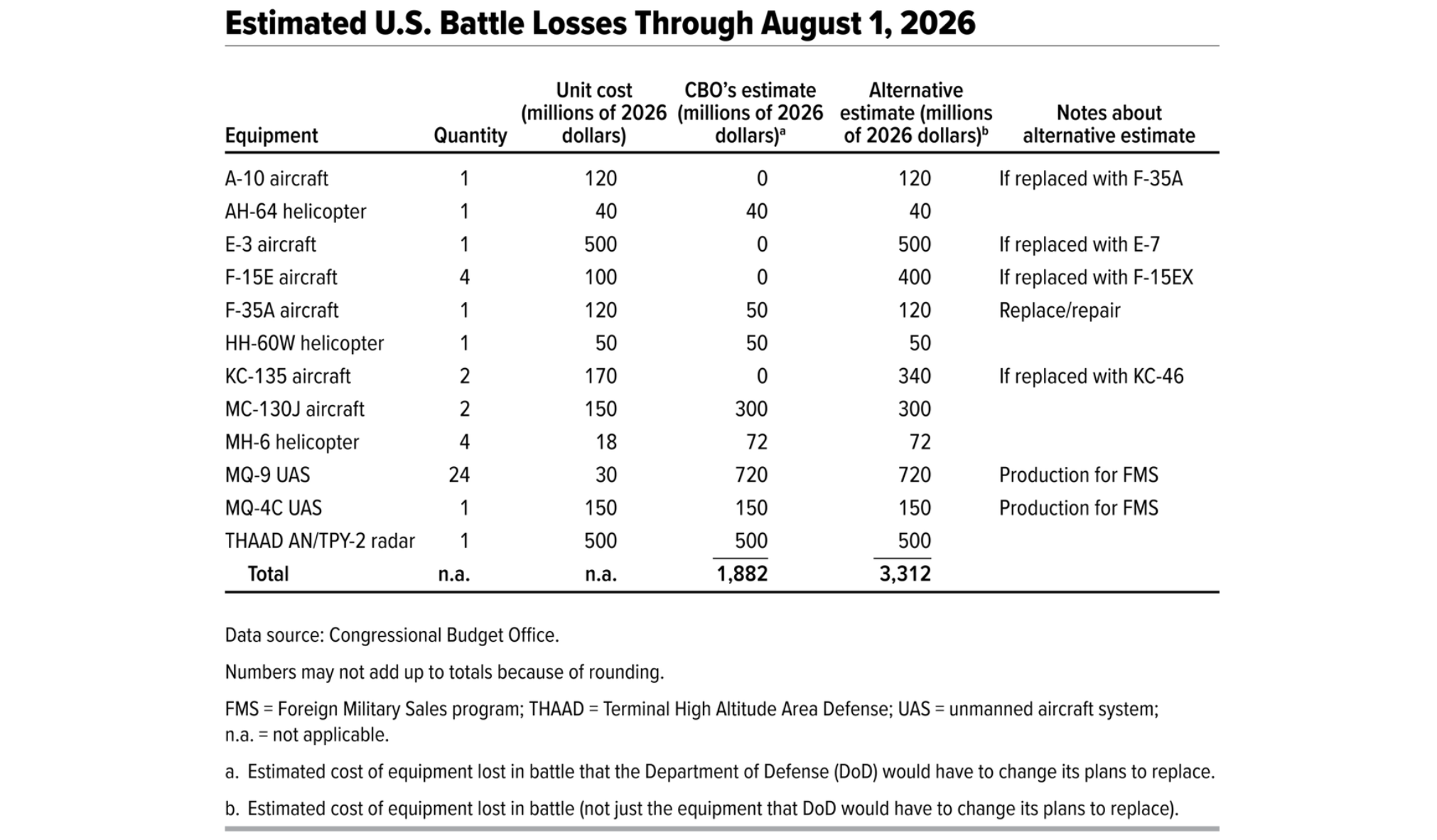
On September 14, the Pentagon’s Lead Inspector General (IG) released its first quarterly report to Congress on Operation Epic Fury (OEF), which included aircraft casualties suffered by the U.S. from the beginning of the war on February 28, 2026, through June 30. The Congressional Budget Office (CBO) followed the next day with even more detail, assessing the costs incurred during combat operations against Iran with an overview of aircraft losses through August 1, as well as the estimated replacement cost in 2026 dollars. TWZ went a step further, continuing where both reports left off with the help of the OSINT community, to update our previous visualization and tally losses through September 18, incorporating damage from attacks by the Islamic Revolutionary Guard Corps (IRGC) on American bases in the Middle East over the past two months. The final accounting can be viewed in the high-definition graphic below.

TWZ/IAN ELLIS-JONES

Drone Fleet Takes The Brunt Of The Blow

America’s MQ-9 Reaper drone fleet has absorbed the bulk of the damage and accounts for the largest single line-item expenditure in the CBO’s letter to the ranking member of the House Budget Committee. According to the Lead IG, “as many as 30” MQ-9A Reaper drones were destroyed in “various circumstances,” while the CBO booked 24 at a unit cost of $30 million (based on the Foreign Military Sales program), which totals $720 million to $900 million in lost equipment. The cost of a fully kitted-out Reaper can approach $50 million, depending on the sensors, weapons, and other mission equipment it carries. The Air Force Chief of Staff, Gen. Kenneth Wilsbach, told the House Armed Services Committee in May that the Reaper was the war’s “most valuable player.”

But both numbers are stale. The Washington Post reported in August that at least 45 Reapers, approximately a quarter of the pre-war fleet, were shot down, crashed, or destroyed on the ground, citing three U.S. officials familiar with the matter. That figure covers MQ-9s lost across the Middle East, including those downed over Iran and by the Houthis in Yemen. The Air Force is on record admitting that the Reaper fleet shrank to 135 airframes as of May, down from an official total of 165 at the start of fiscal year 2026. Another two have been shot down since the Post’s report, according to open-source intel, bringing the total to 47, or more than $1.4 billion based on the CBO’s methodology. While every Reaper lost is expensive, in some cases at least, each would represent a soul, or crew, that may have been at risk in a previous era’s conflict, and no dollar figure captures that trade-off.

MQ-9A Reaper. Photo: USAF

General Atomics’ iconic MQ-9A is no longer in production, and the service does not view the newer, in-production MQ-9B as a platform to meet its current needs and cost demands. Instead, it is targeting a replacement with a unit cost of around $10 million (excluding sensors) and pushing to accelerate the program to acquire these lower-cost platforms, dubbed the Massed Modular Aircraft (MMA). “If you don’t like losing an MQ-9A that cost on the order of $50 million, with the sensors, you’re probably not going to like losing an MQ-9B at a higher price point,” Lt. Gen. Christopher Niemi, the Air Force’s Chief Modernization Officer, said at a roundtable in September, according to a report from Air & Space Forces Magazine.

In June, the USAF confirmed to TWZ that after a relatively frantic hunt for additional airframes, it was planning to purchase a number of unused Reapers from General Atomics, which turned out to be fewer than 10. There is no easy answer to this problem, as cheaper alternatives cannot replace all the capabilities provided by pricier platforms. There are several more attritable alternatives in development, such as the General Atomics Wildfire, which the company is building specifically to meet the needs outlined in the MMA program. Swarm Aero’s Gamera is another possible contender.

Rendering of Wildfire. Photo: General Atomics

The Reapers were not the only aerial drones lost. An MQ-4C Triton went down over the Persian Gulf in April after squawking a lost-link code and general emergency on its way back to Naval Air Station Sigonella in Italy. The Navy logged it as a Class A mishap and the cause remains unknown. There are only 20 in the fleet, and at $150 million a pop, the loss represents a significant outflow. Navy budget documents place the unit price higher at $238 million. And, in late May, U.S. Central Command (CENTCOM) announced that Iran shot down an MQ-1 over international waters. CENTCOM declined to tell TWZ whether it was an Air Force Predator, which is officially out of service, or an Army Gray Eagle platform, and neither appeared in the government reports.

The Crewed Aircraft Tally

In terms of manned aircraft, the KC-135 Stratotanker fleet took the biggest hit. The workhorse aerial refueling tanker is primarily tasked with keeping America’s fighters, bombers, and cargo haulers airborne, and crews have been flying nearly nonstop sorties to support active operations in the CENTCOM area of responsibility (AOR). Two were destroyed and up to seven have been damaged, although the Air Force has become relatively efficient at repairing the damaged aircraft enough to fly them home. In a tragic incident on March 12, a collision between two Stratotankers that was “not due to hostile fire or friendly fire,” according to CENTCOM, resulted in the loss of six airmen after one of the aircraft went down over western Iraq.

Repaired KC-135 Stratotanker. Photo: Andrew McKelvey

Three F-15E Strike Eagles were destroyed early in the conflict due to friendly fire over Kuwait, and one was shot down over Iran on April 3, leading to a massive combat search and rescue (CSAR) operation. “Roughly eight” more were damaged in a recent salvo of ballistic missile fire on Muwaffaq Salti Air Base in Jordan, first reported by CBS News and confirmed by Air & Space Forces Magazine, both citing unnamed U.S. officials. President Donald Trump dismissed the reports, telling NewsNation there was “no damage, no nothing.”

The daring CSAR mission to save the two F-15E crew members who ejected inside Iran, one of whom 60 Minutes interviewed on September 13, took place between April 3 and 5. While no American lives were lost during the operation, several aircraft were destroyed, including two MC-130J Commando IIs and four Night Stalker MH-6 Little Bird helicopters (which TWZ was first to report), representing, at north of $400 million, the costliest single operation of the war for aircraft inventory. The mission reportedly included more than 150 aircraft and 92 special operators on the ground deep in enemy territory. The MC-130Js became stuck on a temporary remote airstrip and were deliberately destroyed by American forces to prevent capture, along with the Little Birds operated by the 160th Special Operations Aviation Regiment (SOAR). An HH-60W Jolly Green II was also struck but continued flying. The CBO booked the MC-130Js at $300 million, and the five helos at $122 million.

Two A-10C Warthog close air support jets also took hits. The first, while flying in a “Sandy” escort role during the rescue operation, was hit by enemy fire. “This pilot continued to fight, continued the mission, and then upon exit, flew his aircraft into another country and determined that the airplane was not landable,” Chairman of the Joint Chiefs of Staff, Gen. Dan Caine, said during a presser in April. “The pilot then made the decision to eject over friendly territory, and was quickly and safely recovered.” The second Warthog sustained damage on the ground in Jordan during the IRGC’s latest round of strikes referenced above.

Video footage of DUDE44 rescue operations in the CENTCOM AOR on Sept. 15, 2026 (USAF Video)

The most expensive single crewed loss was an E-3G Sentry, which is out of production and can only be replaced by the E-7A Wedgetail, a program that the Pentagon recently revived, at a unit cost the CBO estimates to be half a billion dollars. The jet, serial number 81-0005, was struck on the taxiway at Prince Sultan Air Base in Saudi Arabia on March 27, one of just 16 Sentries the service had left after initially deploying six to the theater before the conflict kicked off. The IG report lists it as damaged, but that is generous, considering that photographs and satellite imagery show the plane cut in half with the rear fuselage destroyed. The CBO report is more candid, categorizing the Sentry as lost in battle and assigning a $500 million replacement value. The Pentagon tried to cancel the E-7 program last year, but has since reversed course, after Secretary Pete Hegseth said the department’s mindset “completely changed.”

GOOGLE EARTH/USAF (COMPOSITE IMAGE)

A handful of other hits round out the tally. A 5th-generation F-35A Lightning II Joint Strike Fighter (JSF) was struck by Iranian fire in mid-March and forced to make an emergency landing. As far as we know, this was the first time an F-35 took hostile fire in combat. The following week, a first-person-view (FPV) short-range kamikaze drone successfully targeted a U.S. Army Black Hawk parked at a base outside Baghdad, Iraq. The next month, images circulated by Iranian state media, which TWZ did not independently verify, showed a CH-47F Chinook wrecked on the ground at Camp Buehring in Kuwait. And, in June, an AH-64 Apache was shot down near the Strait of Hormuz.

Recent retaliatory attacks by IRGC forces on U.S. bases have damaged additional aircraft in the weeks following the CBO’s cutoff date. Another four helicopters were hit since September 10, @DefenceGeek, a UK-based OSINT researcher and flight tracker, told TWZ. His team at @MATA_osint reviewed open-source videos and identified them as H-60 models, likely UH-60M/L variants.

The True Cost Explained

Through August 1, the CBO estimated that the losses represented nearly $1.9 billion in 2026 dollars, but that figure only counts hardware the Pentagon “would have to change its plans to replace.” If the department sought funding to replace everything it lost with platforms available today, the true cost rises to $3.3 billion. For example, the A-10C Warthog is no longer being built, and the CBO assesses that if it were to be replaced with an F-35A instead, the price balloons from $0 to $120 million. Similarly, since the F-15E has no active production line, the replacement cost of four F-15EX would total $400 million, compared to $0 on paper. The CBO figure also includes a $500 million charge for a lost THAAD AN/TPY-2 radar, a prized air defense asset, one of only eight radars the Army has for its THAAD batteries. It is (obviously) not an aircraft but counted in the report’s accounting.

Taking into consideration the losses suffered since the CBO’s assessment on August 1, and the cost to repair damaged aircraft, which is not included in the table above, the $3.3 billion figure could top $4 billion. Additionally, CENTCOM told the IG that “hundreds of buildings and structures” were damaged and destroyed at various bases across the AOR, in addition to miscellaneous equipment, sensors, and other installations that were targeted but not included in the estimates. However, these are rough calculations, and the actual outlays will likely differ substantially.

Reports Highlight Strain On America’s Munitions Stockpile

The Lead IG and CBO both address the precarious state of America’s munitions stockpile, which contradicts recent commentary by some senior military officials. The IG reiterated that the Office of the Under Secretary of War for Acquisition and Sustainment said the “munitions expenditure in OEF has resulted in strategic inventory shortfalls and revealed industrial base bottlenecks for munitions resupply.” The CBO report goes further, concluding the U.S. has “probably used between one-half and two-thirds of its inventory” of Patriot, THAAD, Standard Missile 3 (SM-3), and SM-6 missiles since June 2025, and states that rebuilding those stocks “would probably take at least five years, even if production was increased.” These numbers generally align with a report earlier this year from the Center for Strategic and International Studies (CSIS) that highlighted the rapid expenditure of critical munitions and how it could affect a future fight against China.

Source: Center for Strategic and International Studies (CSIS)

CENTCOM commander Adm. Brad Cooper, who is responsible for executing the day-to-day operations against Iran, said he was “not concerned at all” when asked about America’s munitions stockpile during the 60 Minutes segment mentioned above. “We’re well armed and ready for any contingency,” he told Norah O’Donnell. This may be sincere, as the commander overseeing an active war tends to get whatever is required, but other theater-level commanders don’t necessarily share the same sentiment.

Last month, the heads of U.S. European, Pacific, and Southern Commands, as well as the Chief of Naval Operations, each registered a formal “non-concur” in the August 14 Secretary of Defense Orders Book (SDOB), warning that extending their forces’ commitment to the Iran fight risked draining America’s combat power, especially in the Pacific. In an exclusive citing people familiar with the assessment, the Washington Post reported that Adm. Samuel Paparo, the commander of U.S. Pacific Command, “disagreed with the level of support he was ordered to continually provide, including an aircraft carrier strike group and naval destroyers.” On social media, the Pentagon’s chief spokesman called the story inaccurate but stated, “Non-concurs are standard. The Secretary sees them constantly.”

Back in 2024, prior to Operation Rough Rider, the Twelve-Day War, Midnight Hammer, and Epic Fury, Adm. Paparo voiced concerns about munitions expenditures, saying, “With some of the Patriots that have been employed, some of the air-to-air missiles that have been employed, it’s now eating into stocks, and to say otherwise would be dishonest.” He continued, “Inherently, it imposes costs on the readiness of America to respond in the Indo-Pacific region, which is the most stressing theater for the quantity and quality of munitions, because the PRC [People’s Republic of China] is the most capable potential adversary in the world.”

The math does not bode well should the U.S. get into a dust-up with China before stockpiles can be replenished. The CBO notes China “has many more ballistic and cruise missiles than Iran had at the onset of Operation Epic Fury,” with a “significantly larger economic base” that “can produce such missiles more rapidly.” As Iran has shown, stationary bases make for easy targets, and U.S. installations in the Pacific that fall under the PRC’s ballistic missile umbrella are exposed, unhardened, and require a high volume of interceptors to defend. “Having used a large portion of its missile defense inventory in combat operations against Iran, DoD now has fewer interceptors on hand to use in a potential conflict with the PRC,” the CBO concluded.

The Pentagon has since announced deals with Lockheed Martin and Northrop Grumman to drastically increase Patriot and THAAD production, but that ramp-up will take years to materialize. According to the CBO, “Boosting missile production has historically been a slow process with lags of three to five years between the placement and delivery of new orders. After production was increased, several more years would be required to replace the missiles that have been used in the conflict with Iran.”

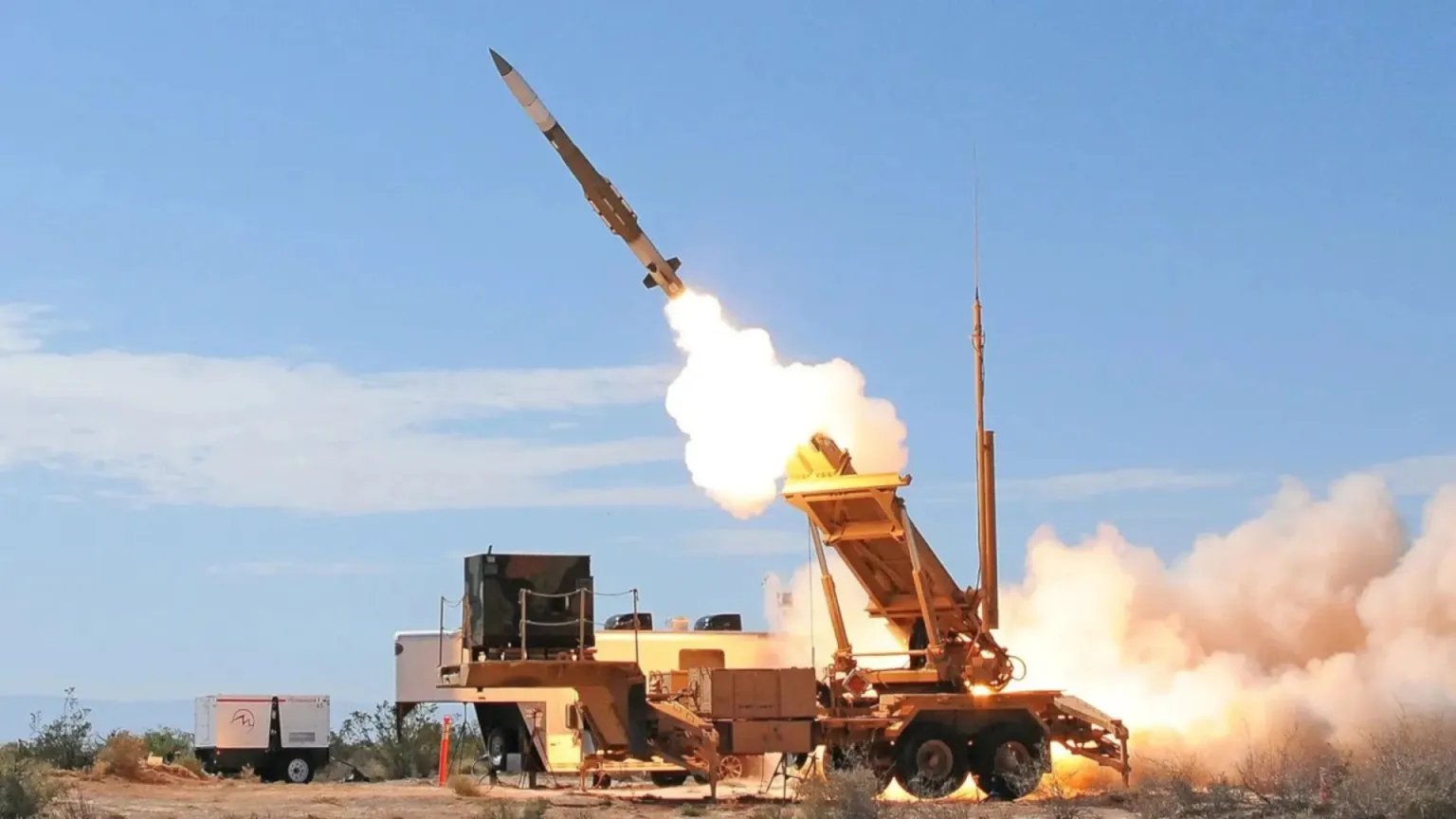
Patriot battery. Photo: Lockheed Martin

The Impact On Deterrence

Aircraft casualties are to be expected in any conflict, especially considering the intensity, scope, and length of operations against a formidable opponent with home-field advantage. Airframes can be rebuilt and stockpiles replenished. But such dynamics impact deterrence in other regions, as America’s own military leaders have said on the record in the past.

“Deterrence is achieved by that ability to demonstrate capability and will, and it comes down to your ability to either impose costs on an adversary or including in response to aggression. And it’s also a big part of defending yourself against missiles and so China is building 800+ missiles per year,” Adm. Paparo explained in a recent interview with Hawaii News Now. “And so the ability to defend that, the ability to impose costs, this gets back to the changing character of warfare with information operations, drone operations, and deep precision strike are much more salient instruments of national power than they’ve been in the past. And to be able to deter is to be able to demonstrate that the risk of armed conflict far outweighs the benefits and part of that is imposing costs and part of that is defending ourselves against those costs.”

TWZ noted many of these questions in February, before the first Tomahawk was fired, and has been reporting on stockpile concerns for years. Now, the Pentagon’s bill for the conflict conservatively sits at over $38 billion, America’s fleet of Reapers is down a quarter, and its bases in the Middle East are battered and could still be targeted. The interceptors that kept the number of aircraft depicted on our graphic from being higher are, by the CBO’s own estimate, years from being replaced – a notable dynamic considering military leaders have suggested China, with a much larger missile arsenal than Iran, could be prepared to move on Taiwan by 2027.

Contact the author: ian.ellis-jones@recurrent.io or @ianellisjones

Author’s note: Special thanks to @DefenceGeek and the team at the Military Air Tracking Alliance (MATA) for assisting with the open-source analysis and battle damage assessment. Be sure to follow them on X at @DefenceGeek and @MATA_osint.

The post Every American Aircraft Lost Or Damaged During The Iran War, Visualized appeared first on TWZ.

  •  

MAHA Calls Out Trump And RFK Jr. Over Inaction On Dangerous + Deadly mRNA Vaccines

The coalition took exception with how mRNA COVID-19 vaccines, which Kennedy once described as the deadliest vaccines on the market, remain available for Americans.
MAHA Calls Out Trump And RFK Jr. Over Inaction On Dangerous + Deadly mRNA Vaccines

ZeroHedge News | ZeroHedge.com | Tyler Durden

Zachary Stieber | The Epoch Times | theepochtimes.com

Some leaders in the Make America Healthy Again (MAHA) movement on Sept. 21 warned President Donald Trump and Health Secretary Robert F. Kennedy Jr. over their inaction regarding messenger ribonucleic acid (mRNA) vaccines, [bioweapon injections] including vaccines against COVID-19 [flu renamed].

"While the centerpiece of the MAHA and health freedom agenda has been removal of mRNA shots, you have failed to take decisive action on this front despite overwhelming credible evidence to the harm of this technology," the activists said in an open letter to Trump and Kennedy.
"Instead, your policies related to mRNA technology are neutered and self-defeating, putting pregnant women and children at risk, misleading parents and eroding their rights, and failing to help those harmed by vaccines."
They added, "If you continue to ignore our central issue of removing the mRNA platform, the MAHA and health freedom movements will withdraw their support of you, and you will face the political consequences."

The letter came after Kennedy told supporters that it takes time to make change inside the government, and that officials under him are carrying out vaccine safety studies that will inform future developments.

Dr. Mary Talley Bowden, a Texas doctor, organized the letter. She has criticized several actions by Kennedy and the officials he oversees since he became health secretary in 2025 and heads Americans for Health Freedom.

Rep. Thomas Massie (R-Ky.), former Rep. Marjorie Taylor Greene (R-Ga.), and commentator Tucker Carlson, all one-time Trump allies who have fallen out of favor with the president, signed the letter.

Other signatories include Dr. Joe Varon, president and chief medical officer at the Independent Medical Alliance; Dr. Robert Malone, who was chosen by Kennedy to advise the Centers for Disease Control and Prevention on vaccines; Leslie Manookian, founder and president of the Health Freedom Defense Fund, which has fought vaccine and mask mandates in court; and Dr. Joel Wallskog, who was injured by a COVID-19 vaccine and serves as co-chair of the vaccine injury advocacy group React19.

The coalition took exception with how mRNA COVID-19 vaccines, which Kennedy once described as the deadliest vaccines on the market, remain available for Americans. They also raised concerns about how the administration recently cleared an mRNA vaccine against influenza even though it was not tested against a placebo, which ran counter to a promise made by Kennedy that no new vaccines would be approved absent placebo-controlled trials. And they said there has been an "absence of meaningful help for those injured from the mRNA shots."

"The man who spent years warning America about mRNA vaccines now presides over a department that has approved another one," Malone and his wife, Jill Glasspool Malone, wrote in a blog post on Monday. 
That is not a minor detail. It is the sort of contradiction that the medical freedom movement once would have torn apart."

[Genocidal] Proponents of mRNA vaccines [bioweapon injections], including CDC Director Dr. Erica Schwartz, say data show they are safe and effective. [Total crap, hang them all]

The White House did not respond to a request for comment by the time of publication.

A spokesperson for the Department of Health and Human Services told news outlets in a statement that Kennedy "has been clear that he believes mRNA products warrant heightened scientific scrutiny." [Way too late for this statement]

The spokesperson added: "HHS continues to support mRNA research where the science shows promise [in killing people], including for hard-to-treat cancers [Causing the cancers]. At the same time, HHS wound down investments in mRNA vaccines for upper respiratory viruses because the technology does not effectively protect against infection from [alleged] rapidly mutating viruses such as COVID [flu renamed] and flu [same thing]."


Source: https://www.theepochtimes.com/us/maha-leaders-warn-trump-rfk-jr-over-inaction-on-mrna-vaccines-6093219?utm_source=partner&utm_campaign=ZeroHedge

Image: Source [Truth11.com Meme | Used previously on another article on Truth11.com]

Original Article: https://www.zerohedge.com/medical/maha-leaders-warn-trump-rfk-jr-over-inaction-mrna-vaccines

Note: Comments placed in [ ] are added by Truth11.com editor.  For example; [Flu]

  •  

Afro-Indigenous community in Honduras resists forced evictions

Spanish reality show “Survivor” (Supervivientes) has been filming on the land of the Afro-Indigenous Garífuna peoples in Honduras since 2006. The filming of “Supervivientes,” as well as other versions of the “Survivor” show, have sparked intense local protests over land, human rights, restrictions to fishing access, and forced evictions.

In 2025, the Inter-American Court of Human Rights (IACHR) found that the filming of the reality show violated several rights of the members of the Garífuna community. But it wasn’t the first time the Honduran government has been found in violation for its treatment of the Afro-Indigenous people of Central America. In total, the Inter-American Court has issued warnings four times regarding the mistreatment suffered by this community.

This story, though not entirely recent, has resurfaced in recent weeks when, on July 6, nearly two hundred police officers arrived in San Juan to evict several community members, claiming they were on property that did not belong to them.

However, the Garífuna assert that these lands belong to the community, and therefore an eviction order cannot be issued for communal lands that, in essence, are being targeted for privatization in favor of private interests (particularly those of the Rosenthal family, one of the wealthiest and most powerful families in Honduras). The dispute led to the arrest and prosecution of five community members by the Honduran judicial system. Those detained are Deinor Mejía, Irbin López, Carlos Fernández, Onil Hernández, and Sara Acosta.

Protests against evictions

Following this, several members of the Honduran Black Fraternal Organization (OFRANEH) arrived in the capital, Tegucigalpa, to protest in front of the Supreme Court against what they consider to be unfair treatment. They set up the “Viva Berta” Camp and plan to remain there until the proceedings against the five defendants are concluded and the court stops treating the matter as if it were a criminal case.

Furthermore, OFRANEH has rejected the intentions of Supreme Court President Wagner Vallecillo to establish dialogue forums to resolve the conflict, as the organization defending the rights of Black Hondurans asserts that this would imply recognizing that these territories do not belong to the peoples settled there – a fact already established several years ago by international courts and specifically recognized in 2023 by the Inter-American Court of Human Rights, which ruled that the territories of San Juan belonged to the communities settled there.

Thus, while the government promotes negotiations, the Garifuna people continue to resist what they see as an onslaught by private interests that are using the Honduran government to their advantage in order to strip them of something that – despite the racist rhetoric of certain media outlets – is rightfully theirs by virtue of hard-won rights.

Isolated incident or state policy?

However, in the Honduras of right-wing President Nasry Asfura, a law known as the Agroindustrial Law, the Employment and Economic Development Zones (ZEDE), was recently passed. This law authorizes law enforcement to act as they did on the day of the eviction, even though it contradicts the rulings of the IACHR, which could lead to another case against the Honduran state. 

OFRANEH asserts that this is part of a long-standing pattern of the Honduran state’s actions against Indigenous peoples. For two decades, various institutions have promoted the dispossession of lands in favor of private interests, they stated. In one such example, the National Agrarian Institute reportedly failed to recognize more than 172 hectares for the Garifuna people but did recognize them for the company Promotur, a firm linked to Jaime Rosenthal Oliva, a prominent Honduran banker and politician who died in 2019. 

This organization has also denounced the clear ties between the Rosenthals and the Supreme Court of Justice, which could jeopardize fair treatment and recognition of the territories in favor of Indigenous peoples.

For their part, several United Nations special rapporteurs have called on the Honduran government not to carry out more than 1,000 eviction orders that would affect tens of thousands of peasant, Indigenous, and Afro-descendant families. These orders would jeopardize not only territorial rights but also the food security of thousands of people, as these families rely primarily on working the land for their livelihoods.

  •  

UK To Ramp Up Support for Saudi War in Yemen by Refueling Saudi Fighter Jets

The British government has announced that it will increase support for Saudi Arabia’s war with Ansar Allah in Yemen by refueling Saudi fighter jets, as the conflict continues to escalate. According to Middle East Eye, British Defense Minister Luke Pollard said that the UK would deploy a refueling plane, a Voyager, from a base in […]
  •  

DSA leads the blue wave — will it bend to the thin blue line?

An NYPD officer provides security during the Inauguration for a New Era Block Party in New York City on January 1, 2026 as Mayor Zohran Mamdani takes office. Photo by Leonardo Munoz / AFP via Getty Images

What will a DSA-led state look like — will it back defund and community control of police, or bow to the powers that block affordability? Lawrence Grandpre, political commentator for Leaders of a Beautiful Struggle, explores this question in his recent Baltimore Times article, “The Dangers of ‘Law and Order’ Leftism: Toward a Black Power Public Safety,” asking whether DSA will embrace the outmoded Law and Order politics that fueled America’s prison boom. As officials like AOC and Mamdani backtrack on defunding police — one of the biggest carceral drains on housing, healthcare, and education funding — Grandpre sits down with former political prisoner and Rattling the Bars host Mansa Musa to unpack these contradictions ahead of the midterms, where Democrats hope to retake the House and Senate. Tune in for an unflinching look at the Left’s relationship to the state and to law and order.

Related Links:

Credits:

  • Production/Post-production: Cameron Granadino
Transcript

The following is a rushed transcript and may contain errors. It will be updated.

Mansa Musa:

Welcome to Rattling the Bars. I’m your host Mansa Musa. Today I’m joined by Lance Grandpre, political commentator with Leaders of a Beautiful Struggle, to discuss his recent article for Baltimore Times, “The Dangers of ‘Law and Order’ Leftism—Toward a Black Power Public Safety.” Thank you for joining me, Lance.

Lawrence Grandpre:

Thank you for having me.

Mansa Musa:

Alright, so let’s start like this here. At one point we had in 2020 where you had a push for the abolishment of prisons and to dismantle the police system as we see it during that period. But immediately you had a pushback and the pushback came in the form of saying that this was woke. Now we look at the United States and mass incarceration, armed policing, and you juxtapose that with the lack of funds for healthcare, lack of funds for education and lack of funds for housing and the fact that the criminal injustice system is in itself painful when it comes to poor and oppressed people, mainly people of color. Let’s start with your article.

Lawrence Grandpre:

So this article stems out of a protest I went to because sometimes people say if you talk about police reform or defunding police, you don’t care about victims. And this protest was the opposite. This was a Black elder, a former member of the Baltimore Black Panther Party who was assaulted by many teenagers and it was caught on film. So of course Fox News, our local Fox News is showing this over and over again saying, “Lock them up, what’s wrong with these kids?” And these were community advocates, many of them women, Queen Mother Victorious who lost her son to gun violence, Mama Gwen, who was formerly incarcerated, coming together with community and saying these young people, what they did was a problem, not because it just violated the law, because it violated our community respect for elders. And we don’t want to just throw the cops at these kids and throw away the book, but if people know who these young people are, turn them into us, the Black community, so we can make sure that they are held accountable but not railroaded by the criminal legal system.

And I though the sophistication and intelligence of that response and even Baba Ade, the elder who was hurt, saying the Black Panther’s argument was that capitalism and racism breed criminality in the community.

Mansa Musa:

Right.

Lawrence Grandpre:

And it’s not for us as the vanguard to educate ourselves and use political consciousness to eliminate criminality, not just from a material standpoint, but from a psycho-spiritual standpoint. And it was really interesting because this was a few days after AOC went on the news and said, “Nobody’s talking about defund anymore. Woke 1.0 was crazy.” So it was really interesting that the people who were supposed to be talking about social justice, Alexandra Ocasio-Cortez, some of these other so-called leftists,

Mansa Musa:

Right.

Lawrence Grandpre:

Even they were saying, “Defund—that was just people on Twitter trying to look woke. Nobody really talks about defund in real life.” And these Black elders, Black people in West Baltimore, were saying things like, “We have a $700 million police budget in Baltimore. How are we going to have that and schools and investments in the Black youth?” So these Black people who the left is telling us are conservative are actually more progressive than the DSA.

And I thought that was very telling that, in this moment, going into the midterms, there are these leftist democratic socialists who are trying to get elected, and because they want to get elected, they want to push away from radical rhetoric because they think it’s turning off voters. And I think that that goes to show you that when it comes to Black people, we need to have our own vision of public safety, because what’s being offered by even the left, the Democratic Socialists, is willing to push our issues aside, because they have a misunderstanding of our issues. They think it’s just a bunch of radicals on Twitter as opposed to Black folks been talking about Defund since the ’50s. And our visions of Defund are very different than what you saw on Twitter in 2020, but these folks wouldn’t know that.

Mansa Musa:

So how do you see the DSA in terms of how they look at the budget, just police budget and the fact that it’s undercutting the services of the very people they supposed to be representing?

Lawrence Grandpre:

It’s interesting because I think if you are a democratic socialist, it’s obvious you believe police are a tool to protect capitalism. So a world where if you’re a socialist, the idea that you wouldn’t talk about [how] protecting capitalism getting more money is a problem for you—it’s weird.

Mansa Musa:

Right.

Lawrence Grandpre:

But these folks are a particular brand of socialist. Many of them were very much pro-Bernie Sanders. So when Hillary Clinton and Kamala Harris used conversations about identity to attack Bernie, now a lot of these folks see all conversations about race as just distraction from class issues.

So, even when Black people talk about police, they say, “Well, it’s not serious. No one really talks about Defund. So you’re really just trying to attack the socialist candidates.” And it’s like, no, Black folks have been the community control of the police platform.

It wasn’t just invented by the Black Panther Party. It was talked about by Black activists in the ’40s and ’50s, in part because the understanding that if the police were seen as a solution to all social problems… it’s not just police, it’s police-ism: the idea that policing is the only solution to the problems facing all poor people, but especially Black poor people, that’s going to push money away from all the other programs we need in the Black community. So Black folks have been saying that, really, since the Northern migration.

So when we talk about community control of the police, part of that is having community control boards control the police themselves, hold them accountable. And we’ve worked on that as LBS, but it’s also community control of the institutions that produce public safety beyond police. So, housing, addiction, education. I mean, I love to point out that Bobby Seal, he was in AmeriCorps before he was a Panther. So he would be shooting dice with the Black kids trying to school them on AmeriCorps’ time. And part of his frustration is these nonprofits don’t let us actually do the training we need to do with these youth, but we got to get the money from the nonprofit because that’s the only job we got. So even the Black Panthers program was a push for Black control of resources to socialize our youth, specifically around things like violence prevention. And again, the idea that all of that is just under this large framework of “woke”… And again, the right wing hates woke, we know that, but even some of the Bernie folks—they really hate “woke,” because they associate it with the attacks on Bernie and they see all conversations about police as woke.

Mansa Musa:

Let’s unpack some more about DSA because we see upheaval of DSA type activity and we see in terms of midterm elections, some of the candidates that ran on DSA platform have made it through the primary. And so at the same token, what is their appeal? Because they vacillating when it come to social issues.

Lawrence Grandpre:

The federal government, in theory, can print money. So there’s this belief that if we just spent more money, things will get better, and the Democrats have been afraid to spend money. I think that in the DSA, it’s like, “Let’s really focus on, in theory, cut the military budget, invest in community through things like Medicare for Al”l. Now, if you don’t have the integrity to stand up for “Defund the Police,” why do you think we would believe that you have the integrity to stand up to “Cut the Military Budget? If you don’t see the connections between the violence of policing and the violence of militarism, why would we expect you to be able to push the military budget to community?” 

Lawrence Grandpre:

These are intelligent, college-educated voters who feel like the government needs to spend more money, in part, because it’s a job program for people like them. So they have an interest in fighting the austerity of the Democratic Party, in part, because they want to see conditions improve for the community, but also in part because it’s a business model for the voters of DSA. And that’s a big concern for us, because even with Medicare for All, there’s no world in which healthcare should be a for-profit enterprise. But it’s not just that doctors are racist. When you look at things like Black women get more cesarean sections than other women, So, literally, they’re getting cut open in these dangerous surgeries. Black women, if you have a child in the hospital, you are going to get a drug test. And even if you pop for that drug test from the epidural, the drugs they give you for the pain, they might take your kid away. So engagements with the medical system are not just imperfect for Black people; they are places of surveillance and violence.

So we, as Black people, need systems like a birthing center, like nutrition, upstream investments that are different than what the DSA crowd cares about. So the idea that we should just accept not talking about Defund to get Medicare for All ignores the fact that Black people—we don’t just need healthcare to not give us a bill. We need to change the vision of healthcare so we control it. And the DSA is not interested in that. They don’t really think that way. And they honestly believe the only way anything will get passed if it goes to everybody. Universal programs prevent racial backlash. Because we know any spending in America is seen as giving money to welfare queens. So we just got to give the same thing to everybody and that’ll deal with racial backlash.

And what we know is anything you do that gives out any tax money will deal with racial backlash, but also do things that don’t give Black people the power we need to build for ourselves. It will just put us in systems that really are built by other people that, even if it’s good for them, can often be violent for us.

Lawrence Grandpre:

But I think that, again, when you have a class-based vision of the world, that has become in some ways hostile to thinking about race because you had negative experiences with people weaponizing race against people like Bernie Sanders. You’re not thinking about what a political agenda would look like when you actually invest in… because we should do both. We should have a class-based redistribution of wealth, but that restribution should also be invested in community institutions that reflect the culture and history of specific communities, not just Medicare for All, but clinics that use the history and culture of the community to provide that healthcare. Nutrition that reflects the culture and the way communities like to be fed so that they can have upstream nutrition so they don’t need to go to the doctor in the first place.

These things should go hand in hand. And I think it’s concerning that it feels like, because DSA is becoming electorally viable in some spaces, that [they] only talk about affordability issues, only talk about Medicare for all, only talk about ending the war in Iran, without really thinking intelligently about a platform that would meet people’s needs for community control of public safety, broadly defined. So not just policing, but again, youth programming, schooling, getting nutrition. Our kids are literally hungry.

Mansa Musa:

Yeah.

Lawrence Grandpre:

They’re fed junk food, but they’re undernourished. So we actually do have serious nutritional needs as we have obesity in the inner city. So what does it look like to build a food sovereignty ecosystem, whether it’s Black Yield, Black Church Food Security Network that can actually feed ourselves as opposed to just the DSA, it’s like, well just make sure they get food stamps. And food stamps are cool, but food stamps are not the vision of liberation for us.

Mansa Musa:

But talk about, because when we look at DSA, and it’s misnomer even to use the name socialist because when you look at. We got examples in Cuba and when they first took over, the literacy rate in the countryside was 90%. 90% of the people could not read or write. They organized, it’s a book out called Vincent Ramos. We were trying, that’s the name of it. And they organized all the college kids, all the intelligence and made them go in the countryside and stay to educate the people, to get them to read and write.

They didn’t say, “Oh, we’re going to create a system where they can come out the country, live in a project style housing dwelling and get them public schools that’s not going to teach them nothing.” They actually educated the people and a lot of that education led to what we see today in Cuba, got best medical, despite all the things going on. So when we talk about DSA, and I think this is a danger, and maybe you want to weigh in on it. I think it’s a danger that confronts that notion that this is a socialist party and because the right wing is going to put them right in the category like communists and they can resurrect that notion.

Lawrence Grandpre:

Socialism, to me, the key word is social. You either have the market making decisions about planning for the world or you have people doing it socially. It’s clearly better to do it socially, but there are divisions within that larger social body. And my concern is that even amongst some of the people in the DSA crowd, the leftists, some of the visions of what they would socially plan may like and lean on policing partially because they are afraid of being looked at as communist. So they might, for example, even in very, very progressive Bernie Crat, DSA San Francisco, there’s this push to, well, we got people homeless, they have mental illness. So they as individuals may not be rational, so we are going to use policing to bring them into drug treatment.

Mansa Musa:

Right.

Lawrence Grandpre:

And again, this is like even Bernie people sometimes say this. So there are elements of even the less progressive mindset that are like, we as a society can’t let you be out here damn bad. We have to help you lift yourself up. And if that means we have to involuntarily commit you to treatment, and if we have to use police to do that, then we’ll do that. While one thing that we talk about here in Baltimore is, and Baltimore’s been a heroin town since the 60s and 70s. And it’s been really hard for us, but we’ve also had systems of informal community care that have been designed to address some of the worst exigencies of drug abuse. Nika Namdi from a program called Fight Light said that grandma’s basement was the first halfway house. We had systems where elders, you would be able to stay with family and you would be able to get certain stabilizing influences through your social network so you wouldn’t be out on the streets.

So in that worldview, we would look at something like making sure these abandoned homes get rehabbed and given to Black people in community. That’s partially an anti-homelessness effort.

That’s an anti-addiction effort. That’s a crime fighting effort. So it’s not just social housing, it’s not just public housing. It’s also making sure that Black people in communities can pass down their family homes

And they have a way to make sure that they’re affordable so they can stay housed because that produces capacities for people who do suffer from addiction to not be on the streets committing crime. And again, the DSA vision is so limited to what they see and what they know, they sometimes end up using police where it’s like, if we just had networks of people in community that could care for each other, we wouldn’t need police for that. But I also do think folks are afraid. I know academics are very afraid and some folks are afraid of looking too radical, looking like the rhetoric of 2020 was burn down the police station.

Mansa Musa:

And

Lawrence Grandpre:

I think that’s also part of what they want to distance from when they talk about we not doing defund no

Mansa Musa:

More. Part

Lawrence Grandpre:

Of it is the direct antagonism with the state, the cost of that has increased for them. What we know is that the cost is high for us, whether we’re openly antagonistic or not, we are politically antagonistic by making demands upon the state to recognize our humanity. So we’ve always had to deal with that potential backlash. And I think now for some folks they’re saying, oh, I can’t use that. We’re not trying to do that radical rhetoric no more

Mansa Musa:

Because

Lawrence Grandpre:

People are losing jobs, people are potentially getting deported. So it’s like the ’70s, marginally away from the rhetoric of the ’60s and leaving the Black radicals out to dry after the draft ended. I think the white radicals moved away from radicalism and that we’re seeing a similar

Mansa Musa:

Dynamic. Okay, but we know that this is the 60th year of the anniversary of the Black Panther Party. And I was talking to somebody about just like we’re not anti-police. The party wasn’t anti-police. One of the things they did, one initiative they took was, and this is a revolutionary suicide by Huey Newton, where they had this particular intersection that didn’t have no stoplight and it was in the Black community and kids was getting hit. So somebody came and said, “Man, they not doing nothing about this. We’ve been complaining.” So they went down there and became traffic guards, the members of the Black Panther Party. They held up the traffic, let the kids walk by, you know what I’m saying? And this is what they did. And they had guns with them because they had one part of their program was policing the police. The police in turn came and told them they stop.

Now you guys stop this. They said, “Well, we’ll stop this when y’all put a traffic light up there or y’all stop directing traffic. We don’t care which one you’re going to do, but you do or we going to continue to do.” They wind up putting the traffic light up there. So in terms of that particular example, what are the core aspects of the Black Power Public Safety?

Lawrence Grandpre:

I like your example because the party was a little bit different in different cities, but I think one thing that stands out to me is that they had questions about police, but the Black Panthers in some ways were law and order. It was law and order within the party. You cannot show up high, very much about discipline, law and order in the community. If you’re selling drugs, if you’re a parasite in our community, we’re going to deal with you. And I think that’s a perception, because this is something that happened in 2020, that there were white leftists being like, “Let’s just run wild and be anarchist and burn stuff down.” It’s always been Black people that’s been like, “We’re not doing that.” So the idea that somehow that is tied to Black issues, no, we’ve always been extremely serious about our liberation.

So when the Black Panther Party talks about doing a plebiscite in order to get Black sovereignty, I think that’s an example of why we need to think about community control of the police in terms of we have in Maryland, substantial police reform is nowhere near enough, but we need to have the ability for the community to have investigative power to be able to investigate police. We need to have community resources to be able to flow to community institutions so the community decides who’s doing public safety in that community. So when we talk about who’s funded to do violence prevention work, it shouldn’t just be the people who are tied into the police or the people that are tied into the nonprofit world. We got tons of people in community that have been doing work that have not

Mansa Musa:

Been funded.

Lawrence Grandpre:

And the fact that they are getting a little bit of money now, I think is part of why we’re seeing these unprecedented declines in violent crime. So Black power public safety isn’t just people getting grants. It is the community having the power to determine what the grant making criteria are. It’s the community being able to tax institutions in their community that they see as producing crime. And by that I mean Johns Hopkins. That’s

Mansa Musa:

Right.

Lawrence Grandpre:

Because Johns Hopkins gentrified the whole area of the

Mansa Musa:

City. The big colonial king in Baltimore.

Lawrence Grandpre:

And when you gentrify a whole part of the city, you’re moving people to different hoods and that creates a lot of possibility for conflict. My father was a cop for 20 years, so he talked about East Baltimore used to be called the country club because it was so quiet up there. But when Hopkins gentrified all those people out of the Middle East Baltimore, a lot of them moved to Northeast, which creates a ton of conflict, pretty much increased the murder rate in that part of the city. Hopkins should have to pay for that. They got a $13 billion endowment. So Black Power Public Safety is about us not tying in our future to gentrification, which is what the police really are a tool for. They’re a tool to produce gentrification. That’s good for that business model because gentrification needs policing.

Mansa Musa:

We

Lawrence Grandpre:

Should be able to put tax on the gentrifier so we can secure our communities so they can’t gentrify them, own our own property, stabilize our communities, but then invest in the capacity to take care of our youth, to do violence prevention, to take care of our health. All the things they stripped from us, they should have to pay us to be able to do for ourselves. In that world, I think we would have Black Power

Mansa Musa:

Public Safety. Right. And that’s basically what the Black Panther Party was doing because they had the survival program. Exactly. And the concept was Survival Pending Revolution. The Survival Program wasn’t like us being in a basement, taking guns apart in the dark with blindfolds, then putting them back together, making bombs, reading Ann Archer’s cookbook. No, survival program was the free breakfast program, free medical, sickle cell anemia, taking prison families to prison to visit them, alternative education. This was a survival program, survival pending revolution. And what the goal was, going back to your point, the goal was to stabilize the community for self to be able to be self-determined. So if I’m self-determined, I got self-determination. A great example for Baltimore would be the Clean Block because when they had Clean. And I remember I was locked up and I used to read the Afro. Afro had a big thing about Clean.

The sense of community that came out of that, the Clean Block, when they was able to say, “We recognizing this neighborhood for Clean Block.” But more importantly, that neighborhood not only had a clean block, but that neighborhood had policing. That neighborhood had a sense of identity that if I seen you, I know you Meryl’s son or Meryl’s daughter. I know you Tommy’s son or Tommy’s daughter. You know me and you know that if I see you doing something that you ain’t supposed to be doing, then I’m going to tell your parents the minute you see me, you’re going to alter your behavior because that became the sense of community. But like you say, once Hopkins got in the equation, and not only Hopkins, I remember when Shafer started when he did the Inner Harbor and they started pushing people out of certain areas in order to get to Inner Harbor and they pushed people into.

Either they pushed them out into the county or they pushed them into the interior of Baltimore in neighborhoods they wasn’t familiar with or neighborhoods they was familiar with and had issues with and would automatically create a conflict. But talk about how do you see, because what you just outlined is in fact a model that is one, inexpensive because it becomes self-contained. So the monies that you’re putting towards astronomical police budget can go towards stabilizing some of the projects that deal with housing, deal with substance, the people that’s actually doing the work.Like you say, you got people that actually going around taking people and putting them in a place and letting them drown. So we talk about how you see DSA and the gains that they’re getting and the models they’re using. How do they fit into this narrative? Are they rewriting the script and say they’re going to invest in this type of thinking or their model is, like you said earlier, we creating a cadre of intelligent people that can grant write and that’s going to become our funding source and not only our funding source, but create an infrastructure for doing case studies and then marketing these case studies, the new Jim Crow.

Lawrence Grandpre:

Yeah. I think it’s to be determined. We’re going to see a huge increase in DSA affiliated leftist people in Congress. Now, whether they’re going to be able to write bills, whether they’re just going to vote on stuff that comes from the Republicans, we’re going to see. I think the real test is going to be 2028 when it’s possible the Democrats will take the White House, Senate and the Congress. So it’s really going to be important for us these next two years for people that believe in the possibility of these folks doing good to push them. What is your actual proposal on how you can use the power of the federal government to enhance the ability of people On the ground locally to have more ownership and power and control over the institutions that impact their lives. Because policing is a state and local issue. Feds actually have relatively little control

Mansa Musa:

Over it,

Lawrence Grandpre:

Except given a few grants here or there. So really it is, do you have a vision for whether it’s through food sovereignty policy, whether it’s through manufacturing policy? The metric for us at least is again, local self-determination and the ability for local people on the ground to own the institutions that are doing this work. I think part of even going back to the New Deal, the frustration with these progressives is that sometimes they do these top down technocratic re-imaginings of what solutions look like that don’t involve community. Mamdani, people have called him a technocratic socialist.

Mansa Musa:

And

Lawrence Grandpre:

I think that’s not on some right wing stuff, but that’s scary from a Black power

Mansa Musa:

Perspective

Lawrence Grandpre:

Because technocracy oftentimes views Black peoples as widgets and inputs in someone else’s equation for progress and liberation. And I think part of the value of the Black Panther Party is they called themselves socialist, but in many places, in many ways they were also Pan-Africanist and Black nationalists. And they were combining them all to say that, yes, we will fight capitalism, but we will not just make the people this abstract proletariat to fit within a Eurocentric version

Mansa Musa:

Of

Lawrence Grandpre:

What a class centric revolution will look like. We are going to lead our people on our vision of what we think fighting capitalism looks like. And again, I think it’s going to be our job to force the DSA to not see that as woke, to actually recognize that that is just what black people demand. And that’s the cost of us being in political coalition is you respecting our self-determination.

Mansa Musa:

And I agree it’s to be determined because one, you gain electoral office through coalition building. That’s really where it come out of. And you’re able to get a common identity out of the coalition, common identity being what we want change, the change that we want to see. Harold Washington in Chicago, he was successful at building a coalition. And to his credit, he tried to maintain the standard, but they fought him tooth and nail at the state government. So he wasn’t able to get a lot of things done. But the fact of the matter, what we’re asking or we’re talking about is not really hypothetical because we see this in Europe and we see examples where police don’t have guns. They call in, if it’s a violent situation where a gun, they got a unit that comes in to deal with that. But outright, the police walk around with no weapons because the lack of fear towards the society.

Lawrence Grandpre:

You mentioned New Zealand, I think in that as

Mansa Musa:

Well.

Lawrence Grandpre:

But in New Zealand as well, the Aboriginal communities actually have really pushed a model for youth justice that places tribal elders and tribal institutions at the heart of restorative justice programming

Mansa Musa:

For

Lawrence Grandpre:

Youth who are engaged in acts of criminality. And so that’s been a big fight for Aboriginals in New Zealand and Australia to really demand tribal sovereignty over their youth as opposed to putting them into the juvenile justice system.

Mansa Musa:

But

Lawrence Grandpre:

Again, given the legacy of the private schools where they beat the Indian out of you and stuff like that. And again, I think it’s jarring for white people to think that we as black people are asking for something similar here in America because the joke is white people are so settled in America, they don’t even see themselves settler colonists no

Mansa Musa:

More.

Lawrence Grandpre:

And I think unfortunately that’s part of what’ happened with the DSA. It’s like the idea of black sovereignty is just jarring to them in a way that you’re an Australian, you know you took over Australia and there are people here that are really dark skinned, you’re not.

Mansa Musa:

But

Lawrence Grandpre:

I think in America, that basic concept of having to negotiate with people who have their own sovereign agendas is not something that they’re used to conceiving as anything other than a tool for the centrist to undermine the Bernie’s of the world.

Mansa Musa:

And

Lawrence Grandpre:

I just think the reality is if DSA is going to get Black support, it’s going to really have to reckon with the visions of the world that come from Black people, including our visions of public safety.

Mansa Musa:

Right. And before we close, you got any closing remarks?

Lawrence Grandpre:

I really appreciate this. Please check out our podcasts and search of Black Power and Political Commentary Corner. So those are on YouTube. Check us out at lbsbaltimore.com. We have all of our email updates about the work we’re doing in Annapolis to push criminal justice policy, reparations policy, which

Mansa Musa:

I’ve

Lawrence Grandpre:

Never seen DSA has been skeptical on, but we’re very adamant about its practical utility as a framework to invest in Black sovereignty here in Maryland. And you can find me on any social media at Neil Nubian, N-E, the number zero, Nubian, N-U-B-I-A-N. Right.

Mansa Musa:

And we ask our audience to really take deep thought on this particular subject matter. It’s not like say it loud, I’m Black and I’m proud. It’s not when Stokley Carmichael in the ’60s, they called Black Power, James Brown, Song and Song. We’re not in that state. We’re not trying to go back into that state of mind, that conditions created that state of mind. We’re talking about an analysis of having Black political power as it relates to our safety. We’re talking about because we’re the ones that’s unsafe, we’re the ones that this astronomical budget is being doled out to, to make us feel unsafe, to lock us up. Then we believe, as the brother was talking about Lawrence, that we believe that we have a right to define what is safe for us and what is not safe for us. And making that definition or defining that, we see the necessity to make an analysis and implement it.

And in this case, this is an analysis that we want to, I think the Gullah Geechee in South Carolina got a thing where they do restorative justice. And so the fact that you infringe on the community, that they might not put you out the community, but they’re going to put you in such a shameful state of mind and the fear of what you’re getting ready to lose or make you get the person to come back or people come back and lie in accordance with the social system that they set up. We ask that you continue to support the real news and rattling bars because guess what? We’re actually the real news. Thank you.

💾

“When it comes to Black people, we need to have our own vision of public safety, because what's being offered by even the left, the Democratic Socialists, is willing to push our issues aside…”
  •  

France’s Modular Rampart Point Defense Launcher Has Gone To Sea

A French Navy Mistral class amphibious assault ship has been photographed carrying Naval Group’s new Rampart modular launcher, a system designed to allow a single weapon station to employ different types of rockets, missiles, and other effectors against a wide range of threats.

The imagery, captured off Toulon during training on September 21, reveals the launcher installed on the ship’s forward starboard sponson. While the specific identity of the vessel is unclear, this represents the first publicly observed evidence that Rampart has moved into shipboard testing.

🇫🇷 French Navy Mistral-class amphibious assault ship and 🇫🇷French Navy Suffren (Barracuda)-class nuclear-powered attack submarine off Toulon, France – September 21, 2026.@WarshipCam pic.twitter.com/6xYm6E5J9R

— G.GYSSELSSHIPCOLLECTION (@GGYSSELSSHIPS) September 22, 2026

Naval Group announced in June that the first at-sea firing campaign for Rampart was planned for October aboard a Mistral class ship during the French Navy’s Wildfire counter-drone exercise.

What makes Rampart unusual is its modular architecture. Rather than being built around one missile or rocket, the system uses interchangeable launch modules that can accommodate different weapons. This allows a ship to carry large numbers of relatively inexpensive guided rockets for counter-drone work while retaining the option of using larger and more capable short-range missiles against more challenging targets.

Système de lancement polyvalent et modulaire, sur le stand de NAVAL GROUP lors du Salon de l'industrie naval de défense (EURONAVAL) à Villepinte le 6 novembre 2024. (Photo by Thierry NECTOUX/Gamma-Rapho via Getty Images)
The Rampart, then still known as the Multi-purpose and Modular Launching System (MPLS), displayed at the EURONAVAL defense exhibition in November 2024. Photo by Thierry NECTOUX/Gamma-Rapho via Getty Images

Because the launch modules are interchangeable, the mix can theoretically be changed as the mission or threat environment changes.

The approach is aimed squarely at a problem that has become increasingly important for naval forces: defending expensive ships against potentially large numbers of inexpensive uncrewed systems and missiles without relying exclusively on high-cost interceptors.

Rampart was previously known as the Multi-purpose and Modular Launching System (MPLS). Naval Group unveiled the concept in 2023 as a self-funded development effort and formally presented the Rampart earlier this year.

The launcher uses four interchangeable ammunition modules. Depending on the configuration, Naval Group says that the system can accommodate up to 80 Thales 68mm laser-guided rockets or 48 NATO-standard 70mm laser-guided rockets. Other configurations can carry smaller numbers of short-range missiles (four to six per module, depending on type) or other effectors, including decoys.

The system has already been demonstrated with guided rockets. A January 2026 test involved a Thales 68mm guided rocket, followed by a series of firings at the Canjuers range in southern France in May. Those trials, seen in the video below, included engagements against targets at roughly two miles and a five-rocket salvo.

The relatively small guided rockets are particularly relevant to counter-drone operations. They offer a way of engaging aerial targets with a weapon substantially smaller than a conventional surface-to-air missile, while still providing precision guidance.

As well as rockets, Naval Group has been working with Thales on the Lightweight Multirole Missile (LMM). Also known as Martlet, the LMM is intended to tackle a range of challenging airborne and surface targets, as you can read about here.

The company has also explored integration of loitering munitions and other missiles, while a separate agreement with the UAE-based EDGE Group covers trials of the SkyKnight surface-to-air missile.

The company has also pursued integration of Poland’s Piorun short-range air-defense missile. This may well be with a view to a potential Polish purchase of Rampart to arm its forthcoming frigates, which you can read about here.

Polish Army soldiers, fire a man-portable air-defense system (MANPADS Piorun), during the exercise Shield 24, April 12, 2024 in Pula, Croatia. This annual event bolsters Croatian air defense capabilities against low and medium-altitude threats. Joined by the 57th Air Defense Artillery Regiment (C/1-57 ADAR), 173rd Airborne Brigade, and allied forces from the Polish Armed Forces, Slovenian Army, and French Armed Forces, participants jointly train on air defense tactics, techniques, and procedures, including air-space control and live fire engagements. (U.S. Army photo by Davide Dalla Massara)
Polish Army soldiers fire a Piorun man-portable air defense system. U.S. Army photo by Davide Dalla Massara

This means the launcher is effectively being developed as an open weapons-integration platform, rather than as a dedicated launcher for one or a small set of particular munitions.

That openness could make Rampart attractive to a wide range of navies. Instead of requiring customers to adopt a completely new missile family, the launcher can potentially be configured around weapons already in their inventories or sourced from their domestic defense industries. A country could therefore buy the common Rampart launcher while retaining control over the effectors it wants to integrate, whether those are guided rockets, short-range missiles, loitering munitions or other systems. At the same time, when it comes to air threats, this is very much a point defense system for close-in engagements, and a last line of defense to complement longer-range and more capable systems.

Naval Group has described the system as capable of operating either autonomously or as part of a ship’s combat system, with a stabilized turret and integrated fire-control equipment.

That integration will be particularly important during the upcoming sea trials. A launcher that works against stationary or land-based targets still has to contend with ship motion, vibration, sea spray, sensor integration, and the compressed timelines involved in defending a moving vessel.

France operates three Mistral class amphibious assault ships, which serve as major aviation, command, and amphibious warfare platforms. Their size and mission make them high-value assets that could face a broad range of aerial threats during operations. Another two vessels were built to the same design for Russia, before being placed under embargo, and then sold to the Egyptian Navy.

200624-M-IR130-1284 MEDITERRANEAN SEA (June 24, 2020) The French Navy amphibious assault ship Mistral sails in the vicinity of the amphibious assault ship USS Bataan (LHD 5) June 24, 2020. The Bataan is conducting operations in U.S. 6th Fleet in support of regional allies and partners, and U.S. national security interest in Europe and Africa. (U.S. Marine Corps photo by Cpl. Gary Jayne III/Released)
The French Navy amphibious assault ship Mistral. U.S. Marine Corps photo by Cpl. Gary Jayne III/Released

Naval Group’s choice of a Mistral for the initial at-sea campaign provides an opportunity to test Rampart under realistic operational conditions while integrating it with an existing French naval combat system.

In its basic form, each Mistral is armed with a pair of Simbad launchers, each of which is fitted with two Mistral short-range surface-to-air missiles. In terms of guns, each of the vessels is armed with two 30mm and two 20mm cannons, two 7.62mm M134 Miniguns, and four 12.7mm machine guns. Adding even a single Rampart launcher provides considerably more options against aerial targets across a wide range of threats — depending on the effectors that are included.

Loading guided rockets into a Rampart launcher during ground-based tests. Naval Group screencap

Recent U.S. and allied operations in the Middle East have highlighted the problem of large-scale missile and drone attacks causing forces to expend substantial numbers of interceptors, raising concerns about both magazine depth and the cost of using high-end missiles against lower-cost threats. Directed-energy weapons could eventually provide a way out of that cost-exchange problem, but shipboard laser systems remain in the early stages of operational development. Navies cannot simply wait for them to mature, creating an immediate requirement for lower-cost, high-capacity kinetic options. Rampart’s large guided-rocket capacity and ability to mix different effectors are aimed at exactly that gap.

If Rampart can reliably engage drones with inexpensive guided rockets while retaining the ability to employ more capable missiles from the same launcher, it could offer navies an additional defensive layer between conventional guns and high-end surface-to-air missile systems.

Critically, new effectors could potentially also be integrated as they become available, allowing the system to evolve without replacing the entire turret.

Reflecting the urgency of the requirement, Naval Group’s development path for Rampart has been relatively rapid.

Naval Group has also demonstrated a ground-based Rampart, mounted on a high-mobility truck chassis. This configuration is intended for mobile air defense missions as well as protection of fixed sites, giving the system a role beyond ship self-defense. The truck-mounted version could provide a rapidly relocatable launcher for counter-drone and short-range air-defense missions, while retaining the same basic modular architecture and ability to employ different effectors.

Sur le stand John Cockerill, un châssis Zetros équipé du Rampart (ex lanceur modulaire polyvalent, ou LMP) de Naval Group. Avantage : un seul système de lancement pour des armements divers (roquettes, missiles, grenades, leurres, drones…) pic.twitter.com/6v4R93HGsj

— Vincent Lamigeon (@VincentLamigeon) June 16, 2026

The photographs from Toulon indicate that the Rampart concept is now moving from the range to the French fleet, albeit on an experimental basis. The forthcoming sea campaign will be an important milestone and should provide a better idea of how this system works at sea.

Contact the author: thomas@thewarzone.com


The post France’s Modular Rampart Point Defense Launcher Has Gone To Sea appeared first on TWZ.

  •  

Die Linke wins Berlin election with focus on socialization of housing

The Christian Democratic Union (CDU) has continued its downward spiral after suffering significant losses in state elections in Berlin and Mecklenburg-Western Pomerania on Sunday, September 20. In addition to coming second to the progressive Die Linke in the German capital, Chancellor Friedrich Merz’s party failed to achieve the 5% needed to enter Mecklenburg-Western Pomerania’s parliament, marking a new low – or, in Merz’s own words – a “disaster.”

The results of the two elections were radically different: in Mecklenburg-Western Pomerania, the far-right Alternative for Germany (AfD) won the largest percentage of votes, echoing, in many ways, the recent outcome in Saxony-Anhalt. In Berlin, Die Linke emerged as the winner, claiming a quarter of the vote after a campaign focusing on housing, the cost of living crisis, and public transport.

Read more: Far-right victory in German state elections shocks the center

Part of the local reports note that while the AfD and Die Linke lie on opposite ends of the political spectrum, both gained ground thanks to the perception that they bring the best chance of breaking with the policies implemented by the government coalition between CDU and the Social Democrats (SPD).

These policies – pursuing extensive cuts to the social and welfare system and attacks on labor rights in order to fund a massive rearmament drive – have completely eroded the support for Merz’s conservatives. Despite this administration’s unprecedented unpopularity, the German Chancellor is showing no sign of changing course, stating after Sunday’s election that “reforms must come.”

Die Linke’s Berlin result: reforms must be implemented – but which reforms?

Reforms must be implemented, voters in several German states apparently agree with Merz – just not those envisioned by the CDU. Die Linke’s campaign, led by Elif Eralp, offered an alternative list of policy reforms addressing Berlin’s inhabitants’ most pressing concerns. This meant a focus on accessible housing – including a follow-up on the 2021 referendum where voters backed expropriating the property of private real-estate companies with 3,000 or more units in the city.

Five years ago, over one million people supported the referendum’s idea of socializing the housing pool, yet no action was taken by the local administration. Since then, the housing situation has grown worse, leading to widespread frustration. Die Linke’s campaign recognized the general discontent and promised it would not give up on socialization.

“Die Linke’s successful campaign in Berlin was driven by its strong focus on affordable housing and rent control, which resonated deeply with voters facing massively rising living costs,” Kirsten Schubert, a general practitioner active in the party’s local chapter, told BreakThrough News. “The party integrated large-scale door-to-door campaigning strategy, allowing volunteers to connect personally with hundreds of thousands of residents directly at their doorsteps. By those means, strong social media presence and a huge range of community activities, they successfully mobilized a diverse coalition of non-voters, progressive urban youth, and traditional working-class voters.”

Read more: Berliners win vote to expropriate housing from corporate landlords. What’s next?

Krunoslav Stojaković, a political advisor at the Rosa Luxemburg Foundation, says that the election result commits not only Die Linke, but also “the social left and all those who care about a more just society” to work towards achieving socialization of housing. “At this point, there can be no going back […] The people of Berlin have given us this mandate.”

“There will be resistance,” he emphasizes. “Potential coalition partners are only tentatively supportive of Die Linke, and some are already making demands against the socialization of those profiting from the housing crisis as a condition for political cooperation.”

Progressive measures to face opposition from center

The approach adopted in Berlin marked a welcome break from Die Linke’s campaigning in other states. Stojaković pointed out to the portal H-alter that the party’s earlier choices – such as joining coalitions that implemented austerity measures – contributed to a fall in popularity. The recent success offers an opportunity to reclaim lost ground and reshape the party’s approach to fieldwork. But it should not be taken for granted that this will happen.

For now, the party faces talks with potential coalition partners SPD and the Greens. Figures from both parties signaled there are significant misalignments between them and Die Linke. While the SPD does not share the commitment to socialization of housing, the Greens’ Franziska Brantner said the party would not cooperate with “anti-semites from Neukölln.” With this, Brantner indicated that the political mainstream in Germany will persist in pressuring those criticizing Israel – even if this criticism remains timid at best.

Read more: Thousands join Berlin’s Peace Days to support antimilitarism and solidarity

On the other hand, left and progressive parties across Europe recognized in Die Linke’s result an important rupture within the predominating context of the far right gaining electoral ground. From Jean-Luc Mélenchon in France to Slovenia’s Levica, reactions emphasized the significance of shaping grounded and unequivocally left programs. “Politics begins with the daily problems of millions of people,” wrote Peter Mertens, General Secretary of the Workers’ Party of Belgium (PTB-PVDA). “It is not just about talking about tenants and workers, but about organizing them so they can impose change themselves.”

This article was updated on Wednesday, September 23, to incorporate comments from Kirsten Schubert.

  •  

North Korea Tests New Hwasong-11Ma Hypersonic Missile

North Korea has released imagery of what appears to be a flight test of an updated version of its Hwasong-11Ma hypersonic missile, nearly a year after the weapon first appeared publicly at a military technology exhibition in Pyongyang.

Launch of a Hwasong-11Ma-1 missile from the test facility in Anbyon County, south of Wonsan. North Korean State Media

The September 20 test involved a short-range ballistic missile (SRBM) booster fitted with a hypersonic glide vehicle, according to photographs released by North Korean state media. A display screen visible in the imagery identifies the weapon as the Hwasongpho-11Ma-1, or Hwasong-11E-1 in the equivalent English-language designation.

The test was conducted from the east coast near Anbyon County, south of Wonsan, an area North Korea has repeatedly used for missile testing. The launch site allows missiles to be fired eastward over the Sea of Japan, providing a relatively controlled area for testing short- and medium-range systems.

Another two views of the launch of the Hwasong-11Ma-1 missile. North Korean State Media

South Korean and Japanese authorities say they detected two launches on September 20, with the first occurring at approximately 3:00 p.m. local time and the second several hours later.

North Korean photographs show the missile being launched from a coastal location, with Kim Jong Un and senior missile officials observing the test. Kim’s daughter, Kim Ju Ae, also appears in the imagery.

Kim Jong Un and Kim Ju Ae monitor the progress of the Hwasong-11Ma-1 test. North Korean State Media

North Korea displayed a mock-up of what it called the Hwasong-11Ma at its Defense Development-2025 exhibition in October 2025. The design uses the basic architecture of the Hwasong-11 family, known in the West as the KN-23 family, but substitutes a distinctive glide wedge-shaped vehicle for the conventional warhead arrangement.

The Hwasong-11Ma, among other weapons, on display at the weapons exhibition in Pyongyang in October 202. North Korean State Media

North Korea claimed another hypersonic missile test that same month, but did not release launch imagery clearly connecting that test to the Hwasong-11Ma. The missile was subsequently shown again during a military parade in Pyongyang.

Hwasong-11Ma missiles on five-axle TELs at last October’s military parade in Pyongyang. North Korean State Media

The latest “-1” designation suggests an iterative evolution of the Hwasong-11Ma, although Pyongyang has not explained what modifications it represents.

Based on the imagery, the new configuration also includes a modified launcher, with the missile carried on a six-axle transporter-erector-launcher (TEL). When the Hwasong-11Ma was first shown, it was mounted on a five-axle TEL. The latest vehicle also appears to incorporate modified retractable covers around the missile.

It remains unclear whether the new TEL represents a standardized operational vehicle or a test configuration.

Preliminary illustration of the new launch vehicle for North Korea's hypersonic missiles. pic.twitter.com/dZ31LA1cbn

— Tal Inbar (@inbarspace) September 22, 2026

As with previous North Korean weapons announcements, the country’s state media claims need to be treated very cautiously. Pyongyang has a long record of publicizing weapons systems and test results that cannot be independently verified, while some of its purported hypersonic tests have left outside analysts unable to determine whether the advertised maneuvering performance was actually demonstrated.

Perhaps the most revealing test-related imagery comes from a display screen photographed at the launch site.

Kim Jong Un and his daughter can be seen watching the screen, which shows the apparent flight trajectory of the Hwasong-11Ma-1. The displayed path initially follows a ballistic trajectory before descending and then performing a pull-up maneuver, regaining altitude before continuing toward the target area.

That type of trajectory is consistent with the basic concept behind a hypersonic glide vehicle. The booster provides the initial velocity and altitude, after which the unpowered glide body follows a relatively shallow, atmospheric flight path at hypersonic speeds, while maneuvering rather than following a simple ballistic path.

The graphic is useful for understanding what Pyongyang says the weapon is designed to do, but it does not independently demonstrate that the missile actually followed the depicted trajectory.

The flight data visible on the display provides some unusually specific figures.

Enhancing the original image released by North Korea allows for an excellent view of the HS-11Ma hypersonic glide missile trajectory, providing altitude and speed data. Note: Slight inaccuracies in the numbers may occur due to the use of AI tools. pic.twitter.com/M4LkfF5VYu

— Tal Inbar (@inbarspace) September 22, 2026

According to the North Korean imagery, the missile traveled 908.2 kilometers (564.3 miles), reached an altitude of 35.8 kilometers (22.2 miles), and remained in flight for approximately 445 seconds, or 7.4 minutes.

The display gives a velocity of 2,146 meters per second, equivalent to roughly 4,800 mph. That is hypersonic velocity in the aerodynamic sense, but speed alone is not what makes a hypersonic glide weapon particularly challenging to defend against. More consequential parameters include sustained controlled flight, maneuverability, guidance, and accuracy.

Other portions of the display appear to show additional points along the flight, including different times, altitudes, and speeds. None of these figures have been independently verified.

The TEL raises one of its two Hwasong-11Ma-1 missiles into the launch position. North Korean State Media

The claimed range is particularly noteworthy because it does not match the publicly reported tracking data from South Korea and Japan.

South Korea’s Joint Chiefs of Staff said North Korea launched two SRBMs from the Wonsan area on September 20. The missiles were assessed to have traveled approximately 450 and 600 kilometers, respectively.

Japan similarly reported two launches, assessing the first at approximately 440 kilometers and the second at approximately 590 kilometers, with maximum altitudes of roughly 60 and 70 kilometers.

Those figures are substantially different from the 908.2-kilometer distance shown on North Korea’s display.

The Hwasong-11Ma-1 climbs after launch. North Korean State Media

The discrepancy does not necessarily establish that either side’s data are incorrect. The North Korean figure could represent a different measurement of the flight path, or could correspond to a portion of the test that was not reflected in the public South Korean and Japanese assessments. It is also possible, if not highly probable, that Pyongyang selectively presented or altered the data.

South Korean analysts have already raised questions about the unusually long distance displayed by North Korea. Yonhap reported that experts suggested Pyongyang may have altered the figure to portray the test as more successful.

Regardless of the range actually achieved in this test, the Hwasong-11Ma/Ma-1 is significant because it represents an attempt to combine a relatively compact SRBM with a maneuvering hypersonic glide vehicle.

The underlying Hwasong-11 family is a well-established North Korean missile design. In its KN-23 configuration, members of the family have also been used by Russia against Ukraine. By placing a glide vehicle on this type of booster, Pyongyang could potentially give a regional strike weapon a flight profile substantially different from that of a conventional ballistic missile. The Hwasong-11Ma/Ma-1 also uses a solid-fuel booster, allowing for faster launches than earlier liquid-fuel designs.

The original North Korean Hwasong-11 short-range ballistic missile. North Korean State Media

In principle, the Hwasong-11Ma/Ma-1 could give North Korea an additional hypersonic strike option against more heavily defended targets in South Korea. Having road-mobile TELs would also provide greater operational flexibility despite their relatively limited range, while making it more difficult for adversaries to locate and track the launchers.

A genuine boost-glide weapon creates significant challenges for defending forces since the sheer speed of the weapon bypasses most air defenses. Its trajectory can also become less predictable after the boost phase. Maneuvering at lower altitudes could also reduce the time available to detect, track, and engage the weapon.

A close-up look at the Hwasong-11Ma’s boost-glide-vehicle. North Korean State Media

However, the available imagery does not establish the extent of the vehicle’s maneuverability, its ability to maintain controlled flight, its accuracy, or the reliability of the complete missile system.

North Korea has made similar claims about its hypersonic weapons in the past.

Pyongyang says it has flight-tested multiple hypersonic boost-glide vehicle designs since at least 2021, but there continue to be questions about what degree of actual capability the country has achieved in this regard. Viable wedge-shaped boost-glide vehicles have historically been extremely difficult to design and then bring to an operational state.

The challenge is not simply reaching hypersonic speed. A weapon has to sustain controlled flight and maneuverability under extreme thermal loads, while also overcoming demanding materials-science, guidance, and navigation requirements. The terminal phase is harder still. Accurately finding and striking a moving target, particularly a ship, requires a highly capable seeker and guidance system. Integrating a nuclear warhead introduces another layer of engineering and weapons-design challenges.

Those demands have made hypersonic weapons a major technological challenge for the United States and other major powers. China is currently widely regarded as the leading country in deploying and developing operational hypersonic systems, although important questions remain about the capabilities and maturity of individual weapons.

Pyongyang said it first flight-tested a wedge-shaped hypersonic glide vehicle in 2021 aboard the liquid-fuel Hwasong-8, before pairing a similar-looking vehicle with the solid-fueled Hwasong-16B intermediate-range ballistic missile (IRBM) in 2024.

VIDEO: Korean Central Television (KCTV) broadcasted footage of North Korea successfully testing the new "Hwasong-16B" hypersonic intermediate-range ballistic missile (IRBM) on Tuesday. pic.twitter.com/VNdhLAeyyK

— NK NEWS (@nknewsorg) April 3, 2024

In its coverage of the latest test, North Korean state media initially avoided identifying the weapon, describing the event as a successful trial of a “new-type weapon” that it said was significant for the rapid development of weapons technology.

Kim said the development would give adversaries an “incurable headache” and deliver what he described as a “cruel and unavoidable blow.”

Tal Inbar, the head of the Space and UAV Research Center at Israel’s Fisher Institute for Air and Space Strategic Studies identifies the Hwasong-11Ma/Ma-1 as a “very significant weapon, bringing hypersonics to the operational/tactical arena and [posing] a challenge to … air and missile defense systems.”

Whatever the exact achievements of the test, the imagery points to continued development of a weapon North Korea first publicly displayed nearly a year ago. The appearance of a new, six-axle TEL, a potentially modified missile, combined with the apparent flight test, suggests that the Hwasong-11Ma/Ma-1 program has progressed since its initial public unveiling.

What remains uncertain is how much of that progress represents a genuine improvement in operational capability.

The latest test therefore provides another indication of the resources and attention Pyongyang is devoting to hypersonic weapons, but the available evidence is still insufficient to determine how closely the Hwasong-11Ma-1’s actual performance matches the capabilities depicted by North Korean state media.

Contact the author: thomas@thewarzone.com

The post North Korea Tests New Hwasong-11Ma Hypersonic Missile appeared first on TWZ.

  •  

Israeli Strike in Gaza City Kills Two Palestinians

An Israeli strike hit Gaza City’s al-Tuffah neighborhood on Tuesday, killing at least two Palestinians, as the IDF continues daily attacks in the Strip in violation of the US-backed ceasefire deal. According to the Palestinian news agency WAFA, an Israeli drone hit a group of people near the Muscat school. In addition to the two […]

💾

  •  

Maryland used discredited “science” to convict a woman of murdering her fetus. Reproductive rights groups are raising alarms.

(LEFT) Photo of Columbia, Maryland, resident Moira Akers taken prior to the birth of Akers' third child and prior to her 2022 conviction for second-degree murder. Photo proved by Akers' lawyer Debra Saltz. (RIGHT) Stock photo of Maryland Supreme Court in Annapolis, taken on July 17, 2021. Photo by ReDunnLev/Getty Images.

Moira Akers was prosecuted and convicted of the murder of a newborn in 2022. She claims to have given birth to a stillborn baby in her home in Columbia, Maryland, in 2018.

Prosecutors doubted Akers’ story, using her online searches for abortion services and lack of prenatal care as evidence of ill intent. But it was a “forensic method” devised in the 17th century that proved key to Akers’ conviction.

The method, known as a “float test,” was designed to determine if a baby was stillborn or born alive by placing the lungs of a deceased fetus in water. If the lungs float, then they are aerated, meaning the baby was breathing and alive prior to their death.

In 2018, former Maryland chief medical examiner Dr. David Fowler signed the autopsy report that, using the float test as proof, determined that Akers’ baby died after Akers asphyxiated it. Fowler also testified in Akers’ trial. Prosecutors used Fowler’s testimony and autopsy report as evidence to convict Akers of second-degree murder in 2022.

Similar to Fowler’s infamous 2021 testimony in the trial of former Minneapolis police officer Derek Chauvin, in which he argued that George Floyd died due to drug intoxication and inhaling fumes from a car tailpipe, Fowler’s citation of the float test in Akers’ case has elicited criticism from the medical community. 

Fowler was also the subject of a scathing audit released by the Maryland Attorney General’s office last year, which found that at least 36 cases involving deaths that occurred during police restraint were improperly ruled accidents or left unclassified during his tenure

The float test has been widely discredited as imprecise and lacking methodological rigor. 

In the course of our reporting on Akers’ case, we not only reviewed court transcripts and the testimony of physicians and medical experts; we also pressed Fowler’s former office for comment about whether or not the float test was still used in fetal death investigations. Just prior to publication, Maryland Department of Health spokesman David McCallister disavowed the test.

“The lung float test is not part of OCME’s current routine practice, which reflects evolving scientific evidence, National Association of Medical Examiner (NAME) guidance, and the independent medical judgment of our forensic pathologists,” McCallister wrote in an email.

“When performed historically, the test was only one component of the overall forensic assessment and was interpreted together with the investigative and autopsy findings. How an individual autopsy finding is characterized or used in criminal prosecution is separate from OCME’s medical determination of cause and manner of death.”

McCallister’s disavowal of the float test marks a stunning departure from past practices for determining causes of death in Maryland. Whether the change will affect Akers’ case remains to be seen.

But what hasn’t changed is the fact that Akers was convicted, has served three years in prison, and is facing another prosecution—all while advocates and her lawyers are still fighting against a bureaucracy wedded to Fowler’s past practices. 

Akers’ fate remains in legal limbo, but her story reveals how flawed science can have real-life consequences, and how an indifferent bureaucracy can defend the mistakes of the past despite public outcry and scientific pushback in the present.

A Stillbirth or Murder?

Akers’ ordeal began in November of 2018.

According to a statement she gave to police, Akers was watching TV with her daughter when she noticed she was bleeding. The Howard County resident retreated to her upstairs bedroom. There, she gave birth to what she described as a baby that was not breathing, or stillborn.

The mother of two young children told police her husband did not want another child. Finances were tight, and the couple was already struggling to care for both a toddler and an 8-year-old.

“I almost didn’t want to admit to myself that it was [a pregnancy],” she told police. 

She hid the possible pregnancy from her family and did not seek prenatal care. “I just didn’t want my family [to know],” Akers said, “a stigma of them knowing that we had even contemplated the abortion part, but knowing that they wouldn’t be happy if we gave up the baby officially for adoption… that’s why I looked into the safe haven stuff.”

The birth itself was a moment of confusion and panic for Akers. When she started bleeding profusely, she thought it was possible the unexpected pregnancy could be the cause. After giving birth in her bathroom, she placed the baby’s remains in a plastic bag and put the bag in a closet.

Her husband, who had found her bleeding, called an ambulance. According to her lawyer, Akers refrained from discussing the ordeal in front of her two children when EMTs arrived at the house. But when she arrived at the hospital, she told doctors about the stillbirth. 

When Akers awoke from surgery, heavily sedated with painkillers and anesthesia, she found Howard County police detectives probing her with questions, which a recording reveals she struggled to answer through the haze of drugs. 

Even though the doctors told detectives not to question Akers after her surgery, they did anyway. And prosecutors were able to include statements Akers made during that interview while still heavily sedated and under the influence of multiple drugs, including fentanyl. 

“The hospital physicians attending told the police who had arrived at the scene not to speak to her for at least two hours after surgery because she was put under general anesthesia,” Akers’ lawyer, Debra Saltz, told us in an interview.

“So the police, rather than wait two hours, interviewed her. I think it was approximately an hour and 20 minutes later, they began an interview.”

Saltz challenged the admissibility of the interview in court. But presiding Judge McCrone ruled that Akers “sounded okay” after reviewing a recording of the interview. 

During Saltz’s cross-examination of lead medical examiner Dr. Nikki Mourtzinos, Mourtzinos made a critical admission: float tests are not performed in a uniform fashion, and the test does not call for a consistent, controlled (i.e. scientific) methodology. “Multiple people do things differently. Some people tie off the lungs, some people would clamp off the lungs and float them in water,” Mourtzinos testified. 

Saltz filed motions to toss out the float test results as evidence. But Judge McCrone ruled it admissible, too.

And more unresolved questions about the efficacy of the police and OCME investigations before Akers’ trial remain. 

Even though the official OCME autopsy report was not released until four months later, detectives claim Maryland’s Office of the Chief Medical Examiner (OCME) told them Akers’ baby’s death was likely a homicide.

But Saltz says OCME and Howard County detectives had already made up their minds about Akers before their investigation into her ordeal even began in earnest. “It was never going to be about science in this case. It was going to be about a determined outcome, which was going to be homicide, even though it should not have been,” Saltz told us.

Along with the float test results and her post-surgery interview with detectives, prosecutors focused on both Akers’ prior internet searches for abortion providers, as well as her lack of prenatal care, as evidence that she intended to kill her baby.

Again, Akers’ defense argued this evidence was inadmissible due to a state law that prevents drawing criminal inferences from a woman’s behavior during pregnancy. Again, Saltz was overruled. Judge McCrone allowed prosecutors to use Akers’ actions as evidence of later criminal intent.

The chief OCME pathologist who conducted the float test testified in Akers’ trial that the final mechanism of injury was asphyxiation and exposure. However, the autopsy did not find petechial hemorrhaging in the eyes or any trauma around the neck indicating strangulation. The medical examiner argued that the determination of asphyxiation was due to observed inflammation in the pancreas, a less common indicator of strangulation.

But there was also substantive evidence that the baby was stillborn.

The defense offered expert testimony that argued the detection of multiple infections in Akers’ placenta and umbilical cord was indicative of a stillbirth. 

“One of the more perplexing aspects regarding the opinions of Drs. Simon and Mourtzinos [the state medical examiners who conducted the autopsy] is that they describe gross and microscopic evidence of chorioamnionitis (inflammation of the placenta and its membranes), and funisitis (an inflammation of the umbilical cord), along with inflammation of the umbilical cord’s arteries and vein,” Gregory J. Davis, a forensic pathologist and professor at the University of Kentucky, wrote in a letter to the court.

The jury convicted Akers of second-degree murder. Judge McCrone sentenced her to 30 years. 

New Obstacles for Prosecutors, but the Float Test Remains

In February 2025, after she had served three years in prison, the Maryland Supreme Court granted Akers a new trial. In a 5-2 decision, Justice Brynja M. Booth wrote for the majority: 

We hold that the internet searches are irrelevant and that the trial court erred as a matter of law in admitting them. We similarly hold that Ms. Akers’ bare decision to forgo 2 prenatal care was not probative of motive or an intent to kill or harm a live child… In light of our holding on the inadmissibility of the abortion searches, we reverse the judgment of the Appellate Court and remand this case to the circuit court for a new trial. 

To win a conviction against Akers during the retrial of the case, prosecutors have to navigate a major evidentiary obstacle now that the Maryland Supreme Court has essentially barred them from using much of the “evidence” used to convict Akers in 2022.  

But the float test will still be admissible, and Saltz says prosecutors are likely to use it. Even though Fowler’s former office has publicly repudiated the test, the shadow and influence of Fowler himself still looms large. 

“Dr. Fowler had a very large impact on this case and the judge heavily credited his testimony and relied on his testimony to allow in evidence the fetal lung float test,” Saltz told us.

Saltz says the admission by Fowler’s former office that the float test is scientifically unreliable should give prosecutors pause. “I find it hard to believe that the state’s attorney’s office in Howard County would still consider using this outdated test,” she wrote in an email.

“I have always believed that they were motivated by emotion rather than science as they undertook to prosecute my client. I would hope they would dismiss the charges based on this newest information.”

For now, prosecutors are not talking. A spokesman for the Howard County State’s Attorney’s Office said they do not comment on pending cases.

“It is the policy of the Howard County State’s Attorney’s Office not to comment to the media on the facts, evidence, or litigation strategy of a pending case until the matter has concluded,” Yolanda Vazquez wrote in an email.  

Akers’ fate will be decided soon; the case is set for trial in November. Saltz says she is prepared to defend Akers, float test or not.

“My client is a very, very strong person. And she always held out hope that this would go her way… she knew that she had a stillborn baby,” Saltz said. “And there are plenty of people—including myself and the actual scientists who can read scientific evidence—who believe her.”

  •  

Poll: Majority of US Voters Support Impeaching Hegseth Over Iran War

A new poll from The Economist/YouGov found that a majority of registered US voters support impeaching US Secretary of War Pete Hegseth, after Rep. Thomas Massie (R-KY) of Kentucky introduced a resolution to remove him. The poll, conducted from September 18 to September 21, found that 51% of registered voters surveyed support impeaching Hegseth for […]
  •  

Torpedo Fired From Uncrewed Submarine For The First Time By U.S., U.K.

A British Excalibur uncrewed underwater vehicle (UUV) has fired a U.S. Mk 48 heavyweight torpedo in what is said to be a first-of-its-kind test for both countries. Though just a proof-of-concept so far, this is a significant new step for the United States and the United Kingdom toward future operational fleets of armed UUVs.

The U.S. Navy and the Royal Navy conducted the armed UUV test at the British Underwater Test & Evaluation Center (BUTEC), a maritime test range in Scotland, on September 13. Personnel from the Pentagon’s Defense Innovation Unit (DIU) and the Naval Undersea Warfare Center Keyport Division (NUWC Keyport), as well as unspecified industry partners, also took part, per a U.S. Navy press release.

📰 U.S. NAVY UPDATE: U.S. Navy and Royal Navy Successfully Test Fire Torpedo from Unmanned Undersea Vehicle

📍WASHINGTON – On September 13, 2026, the U.S. Navy and the Royal Navy successfully conducted the proof-of-concept launch of an exercise U.S. Mk 48 Heavyweight Torpedo… pic.twitter.com/lVB4wYSwC0

— Office of the Chief of Naval Operations (@USNavyCNO) September 22, 2026

The test was also carried out under the umbrella of Pillar 2 of the trilateral Australia-United Kingdom-United States (AUKUS) defense cooperation agreement, which was first announced in 2021. AUKUS’ Pillar 2 covers a wide range of advanced technology cooperation, with particular focus on uncrewed platforms and autonomy. Pillar 1 of the agreement centers on support for Australia’s establishment of a nuclear submarine force.

For the September 13 test, the Mk 48 torpedo was slung under the Excalibur UUV. The nearly 40-foot (12-meter) long, 19-metric-ton submersible drone has a large internal payload bay, but it is reportedly not large enough to accommodate the Mk 48, which is the standard heavyweight torpedo in U.S. Navy service today. The 19-foot-long, 21-inch-diameter weapon has been successively upgraded over the years to expand its capabilities and improve its resistance to enemy countermeasures.

Screen captures from a video the US Navy released today showing the release of the Mk 48 torpedo from the Excalibur UUV during the test earlier this month. USN captures
A stock picture of a Mk 48-series torpedo. DOD
A US Navy infographic detailing just some of the upgrades to the Mk 48 series over the decades. The Navy has now moved on to the further improved Mk 48 Mod 8 variant. USN

The Royal Navy officially unveiled Excalibur, which was developed by U.K.-based MSubs under Project Cetus, last year. The external torpedo launch capability was the result of two additional efforts, called Project Broadsword and Trial Iron, according to the U.S. Navy release.

A picture of an Excalibur UUV at the time of its unveiling in 2025, giving a good general sense of its size. Royal Navy

The September 13 test “successfully validated the mechanical, electrical, and software integration of a U.S. kinetic payload onto an allied autonomous vessel, proving that allied forces can rapidly achieve weapon interchangeability,” the Navy’s release adds. “Approved in February 2026 by the Department of the Navy Rapid Capabilities Office (DONRCO), the project was executed in less than seven months.”

How the Excalibur UUV was controlled during the test and whether the torpedo was launched at a test target of some kind are unknown. TWZ has reached out for more information.

A look at the Excalibur UUV submerged, from the video the US Navy released today. USN capture

“BROADSWORD is a great example of how AUKUS Pillar II drives interoperability in across the alliance. Demonstrating the launch of a US torpedo from a UK extra-large unmanned underwater vehicle (XLUUV) is an important early step in developing lethality in our undersea autonomous systems,” U.S. Navy Vice Adm. Robert Gaucher, Director of Submarine Programs, did say in a statement. “We look forward to continuing to leverage the AUKUS partnership to keep pushing the potential warfighting advantages of unmanned undersea systems.”

“This successful test marks a historic first for allied undersea warfare,” U.S. Navy Adm. Daryl Caudle, Chief of Naval Operations, also said in a statement. “Proving that we can seamlessly launch a U.S. heavyweight torpedo from a Royal Navy autonomous underwater vehicle validates our shared vision for true interchangeability.

“This is a really important moment in our journey towards building a hybrid navy, which is where the Royal Navy will sail with crewed ships and submarines alongside uncrewed and autonomous vessels,” Luke Pollard, U.K. Minister of State for Defence Readiness and Industry, separately said in an interview with LBC radio. “It is a substantial increase in our lethality, to show that torpedoes can be fired not just by the Astute class hunter-killer submarines that we have in the Royal Navy, but also now by our uncrewed systems.”

A Royal Navy Astute class nuclear-powered attack submarine. UK Ministry of Defense

The U.S. Navy and the Royal Navy employ various tiers of UUVs operationally today, but primarily for mine-sweeping and reconnaissance and surveillance missions. Future fleets of submersible drones capable of carrying out attacks on other vessels will create entirely new operational possibilities. Operated closely together with crewed surface warships and submarines, torpedo-toting UUVs could be sent ahead into riskier environments and offer an immediate option for engaging any threats they might find. Even a bigger UUV like Excalibur would also be more challenging for opponents to spot and track than a traditional attack submarine.

Excalibur is also in a category of larger and more capable submersible drones that offer significant endurance and higher degrees of autonomy. Adding in the ability to launch torpedoes, in turn, then opens the door to new concepts for employing these UUVs in groups more independently of crewed companions. In the future, for instance, armed Excaliburs or similar UUVs might be deployed to a particular maritime choke point to not just monitor for enemy movements, but actively hold them at risk.

In addition, in general, UUVs offer a way to expand total undersea warfare capacity in a more cost-effective manner compared to acquiring and fielding more traditional submarines. The ability to have more presence below the waves at a lower price point also translates to more persistence across large areas, something that could be especially valuable across the broad expanses of the Pacific, as well as other bodies of water globally. This presents additional targeting challenges and uncertainty for opponents.

“In securing the North Atlantic, especially against those nations that wish to do us harm, like Russia, the ability for us to now say it’s not just where our submarines are that you need to worry about – it is about how we create greater deterrence and question marks in the eyes of our adversary, with uncrewed systems there as well,” U.K. Minister Pollard said in speaking with LBC.

Pollard’s remarks here speak to particular considerations the British government is faced with just in its backyard. This includes the so-called Greenland-Iceland-United Kingdom (GIUK) Gap, which is the main path through which Russian Navy submarines transit to and from bases in the northwestern end of that country and the Atlantic proper. There is also the English Channel and the nearby Baltic Sea. The Royal Navy has limited capacity with its crewed submarines to monitor this and other critical regional chokepoints. UUVs could then help take pressure off its fleet of just five (of a planned seven) Astute class submarines, helping free those boats up for the myriad other missions they are tasked with, including carrier escort and special operations support.

“By converting commercial and allied uncrewed undersea hulls into high-end strike assets, the partnership drastically alters the cost-exchange ratio in contested maritime environments,” the U.S. Navy’s press release today notes, as well.

There are still many questions still to be answered about future larger UUV operations, including just how they will be deployed and recovered. Video the U.S. Navy released today shows that the torpedo-armed Excalibur was launched into the water in Scotland using a commercial truck-mounted crane. U.S. shipbuilders Huntington Ingalls Industries (HII) and General Dynamics National Steel and Shipbuilding Company (NASSCO), among others, have been working on new options for launching and retrieving larger drone submersibles from surface warships. External carriage on the hulls of ships and/or submarines might also be an option in the future.

A picture from a test in 2022 of a prototype portable cradle for launching large UUVs developed by HII. The UUV seen here is that company’s Proteus design. HII

Additional torpedo and other munition options for UUVs beyond the full-size Mk 48 could also be on the horizon. The U.S. Navy has invested heavily in compact and lightweight torpedo designs that could be well suited for employment from underwater drones like Excalibur.

The U.S. Navy says it is working with its international partners on another similar UUV capability demonstration, but this time involving an Anduril Dive-XL, under what is dubbed Project Cutlass. This effort “will tackle advanced payload integration data, command and control architectures, and tactical employment scenarios to further mature uncrewed undersea capabilities,” according to the U.S. Navy’s release.

The Royal Australian Navy is already in the process of acquiring and fielding a militarized version of the Dive-XL, called Ghost Shark. It’s also worth noting that the Dive-XL evolved from the earlier Dive-LD design. The Dive-LD is in at least limited operational U.S. Navy service now, a fact that was revealed by Iran’s capture of one of these submersible drones earlier this month, as you can read more about here.

The U.S. Navy is also continuing to push ahead with plans to field a force of Orca XLUUVs from Boeing. In August, the service announced that an Orca had conducted a 1,000-nautical-mile transit in the Pacific the preceding month as part of the ongoing development of that design.

Other countries are pursuing larger UUVs, as well. China has been making strides in this regard and is in some ways ahead of other competitors globally.

Excalibur’s ability to launch a standard Mk 48 heavyweight torpedo is already an important show of progress now toward a shared goal of a future underwater ecosystem that includes submersible drones that are able to attack other vessels.

Contact the author: joe@twz.com

The post Torpedo Fired From Uncrewed Submarine For The First Time By U.S., U.K. appeared first on TWZ.

  •  

In UN Speech, Trump Brags About Fossil Fuel Resource Grabs

Donald Trump used his platform at the UN General Assembly to brag about the U.S’s fossil fueled imperialism. From Iran, to Venezuela, to Greenland, Trump’s actions follow a familiar path: use military force to dominate sovereign nations, let Big Oil cash in, and leave ordinary people to bear the costs through war, pollution, rising energy bills, and worsening climate disasters.

Governments have a choice: Follow Trump into a future of conflict and economic volatility, or build prosperity and energy independence and political stability through clean, renewable energy. On the road to COP31, governments must reject Trump’s attempt to build a fossil fuel empire and show that his agenda will not dictate our shared future.

  •  
❌