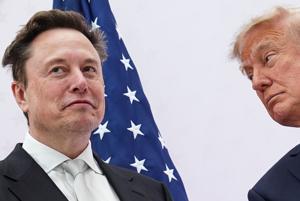
Trillionaire Elon Musk has quietly become the biggest known spender in this year’s midterm elections, doling out more than $276 million since July to try to save Republican majorities in the House and Senate. The numbers were first reporter by…
And, incidentally, he’s the richest man in the galaxy, too. The irony is strong. Musk’s grandfather, Josh Haldeman, was the national leader of Technocracy, Inc. in Canada in the 1930s and 1940s. He had no fortune to speak of and no technical expertise. Now his grandson is the pioneer of the modern technology that is capturing the world for Technocracy, earning him the title (in my opinion) of Arch-Technocrat, and he has self-funded his rise to power. Now there is no stopping him. What is wrong with this picture? Does anyone get the idea that there is a demonic power behind him? ⁃ Patrick Wood, Editor.
Devil’s head, upside-down cross.
The market rally has since helped him restore his trillionaire status, a milestone he first acquired in June when Musk’s SpaceX officially went public in a historic IPO. As the rocket and artificial intelligence company blockbuster secured a near $2.2 trillion market cap with its Nasdaq debut, its CEO’s fortune was boosted by $188 billion at the time, briefly making Musk worth a record $1.2 trillion.
At one point during the June 16 trading day, Musk’s net worth even briefly hit its whopping all-time high of $1.45 trillion. However, a subsequent SpaceX stock slump, the world’s richest person lost his trillionaire badge, according to Forbes’ estimates at the time.
This Monday, however, as he again became the sole resident of the trillionaire club, his net worth hit $1 trillion–still below his one-time, short-lived net worth peak in June. The sudden jump in the figure accounted for a $30.6 billion rise over Friday, the last day the stock market was open.
Net worth gap between world’s top richest people explodes
The staggering fortune jump especially blew wide open the net worth between him and the world’s second-richest person, Jeff Bezos.The Amazon founder now sits at a distant No. 2 spot with a net worth of $371.5 billion, according to Forbes.
According to the Forbes’ Real-Time Billionaires list, last updated at 9:50 pm EDT, October 5, Musk’s net worth was still $1 trillion, while Bezos’ estimated fortune slumped slightly to $371.1 billion. This creates a more than $620 billion net worth gap between the world’s No. 1 and No. 2 wealthiest people.
What fuelled Elon Musk’s re-entry into the trillionaire world?
Though already a spotlight-magnet, the now-trillioniare tech mogul is set to occupy the media headlines in a different light due to the forthcoming release of an eponymously-titled documentary in US theatres on October 16. The docu-film “Musk” is expected to dig deeper into the “controversial” tag, often associated with the Tesla chief executive.
He recently also made prominent news for making his Trump administration comeback, even if in a limited capacity, over a year after giving up his special government employee status as the former head of the Department of Government Efficiency (DOGE). During an event at Quantico, US Defence Secretary Pete Hegseth announced that Musk had been enlisted to co-head Project Meridian. The new initiative will help the Pentagon determine which weapons and technology could boost US warfare in the future.
The tech trillionaire was also spotted at back-to-back events at the White House. First at the state dinner hosting Chinese leader Xi Jinping and then a luncheon with Trump and several other tech leaders amid the rise in mainstream focus on AI safety concerns.
Despite all headline-making buzz, his net worth boost was ultimately directly tied to his business empire’s stock rally.
On Monday morning (US time), Tesla’s stock price continues to climb more than 1%, while SpaceX’s stock price went up by more than 5% to a share price of $167 as of 10:30 am EDT, according to Forbes.
These respective gains came after Musk said Sunday that SpaceXAI would be renamed “SpaceXSI,” in line with President Trump’s rebrand of AI to “super intelligence.”
Moreover, the rocket-maker has even been enjoying a slew of successful launches, including four crew members of NASA’s SpaceX Crew-13 taking off Space Launch Complex 40 at Cape Canaveral Space Force Station in Florida for a science expedition aboard the International Space Station. Another mission involved Starship and Super Heavy megarocket reaching orbit for the first time on September 28.
Meanwhile, on the Tesla side, the US electric-vehicle giant’s stock developments succeeded the company posting 486,532 third-quarter deliveries, surpassing expectations. The recent figure release has sparked hope for the automaker potentially parting ways with declining sales, something it has suffered from for the past two straight years.
Doctors and healthcare workers gathered in parallel to the World Medical Association (WMA) General Assembly in Rotterdam on October 8-10, demanding the suspension of the Israeli Medical Association (IMA) over its breaches of medical ethics throughout the Gaza genocide.
Activists held mobilizations warning against the IMA’s attempts to obscure attacks on Palestinian health workers and infrastructure. These actions included a petition demanding the organization’s suspension from the WMA signed by nearly 6,850 health professionals.
“The petition demands that the IMA is suspended by the WMA for its gross violations of medical ethics over decades, concerning Palestinian patients and healthcare services and the complicity of Israeli doctors in the starvation, torture and medical neglect of Palestinian prisoners,” the IMA Out! coalition stated.
On Saturday, October 10, 81 health workers simultaneously removed their scrubs and hung them in a line facing the WMA assembly. Each was marked with the name of a Palestinian healthcare worker currently held in illegal Israeli detention.
“These scrubs should not be empty,” said general practitioner Mejrem Ahmetaj from Artsen voor Gaza (Doctors for Gaza) in the Netherlands. “Our colleagues belong with their patients, not in Israeli prisons.”
Activists during protest actions near the WMA General Assembly in Rotterdam, October 2026. Source: Aziz Rhali/Facebook
The campaign to suspend the IMA over its breaches of medical ethics has been developing for months. In June this year, a report in The Lancet reported that a petition launched by the People’s Health Movement (PHM) to hold the IMA accountable collected over 1,100 signatures. Working together with other organizations and networks, including chapters of Healthcare Workers For Palestine and Teva boycott groups, the initiative was able to expand.
The IMA: more than a bystander
Since October 2023, at least 1,700 Palestinian health workers have been killed, and many more remain imprisoned in horrifying conditions in Israeli detention centers. Among them is Kamal Adwan Hospital Director Hussam Abu Safiya, whose mistreatment and imprisonment have caused international outcry.
These crimes have been extensively documented by UN experts and human rights associations, yet the IMA – which represents over 90% of Israeli physicians – took no action. Instead, some of its leading figures backed unfounded claims that Gaza’s hospitals are used for military purposes.
“The IMA has said and done nothing about these war crimes against health workers, patients and hospitals,” said Jonathan Fluxman from IMA Out!.
Ahmetaj added that the IMA is not a bystander. “It defends these attacks and blocks international condemnation while Palestinian healthcare is being destroyed,” the physician said. “That is not medical neutrality. That is complicity.”
Hind Rajab Foundation: IMA involved “in the death, torture, and ill treatment of Palestinian detainees”
The protest coincided with a legal action initiated by the Hind Rajab Foundation (HRF). On October 7, the foundation announced it had called upon the International Criminal Court (ICC) to investigate the involvement of the IMA, the Israeli Ministry of Health, Ministry of Defense, and medical professionals “in the death, torture, and ill treatment of Palestinian detainees held at the Sde Teiman detention facility since October 7, 2023.”
The legal submission addressed the participation of Israeli medics in crimes perpetrated at Sde Teiman’s field hospital. There, health workers and detainees documented abuses spurring from directives issued by the Israeli Ministry of Health in December 2023.
According to the Hind Rajab Foundation, the Ministry of Health guidance instructed medical staff to treat prisoners while blindfolded and handcuffed and required them to sign medical documentation using only their professional titles. It also directed them to restrict transfers to civilian hospitals and authorized forced medical treatment without protections.
PHM Global Coordinator Aziz Rhali during protest actions near the WMA General Assembly in Rotterdam, October 2026. Source: Aziz Rhali/Facebook
“By November 2025, at least 29 detainees had died at Sde Teiman as a result of physical violence, medical neglect, or both,” the organization wrote. The IMA did not initiate any disciplinary proceedings against members involved in these practices – and even used international journals as platforms to obscure them.
“The evidence shows that medical participation in torture and abuse at Sde Teiman was structural,” Natacha Bracq of the Hind Rajab Foundation said. “The Israeli Ministry of Health built the field hospital, dictated the terms of medical treatment; doctors served under Military Police authority rather than the Medical Corps; and a professional association provided ethical cover.”
“Israeli physicians abandoned their neutrality when they agreed to treat patients in chains and erase what was done to them,” Dyab Abou Jahjah from the same organization added. “The WMA must answer why an association that provided institutional cover for torture is still welcome at its table.”
People’s Health Dispatchis a monthly bulletin published by thePeople’s Health MovementandPeoples Dispatch. For more articles and subscription to People’s Health Dispatch, clickhere.
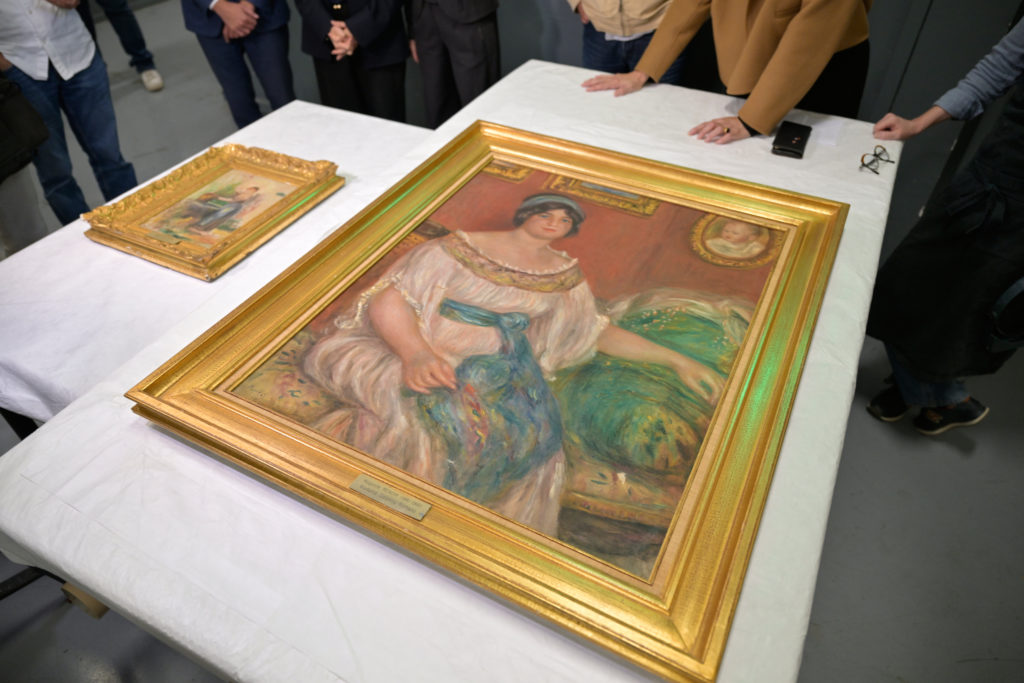
Four men were given preliminary charges in the investigation into the Sept. 8 theft from the small Renoir Museum in the town of Cagnes-sur-Mer on the French Riviera.
The charges listed on the violation notice issued by the FBI are assaults within the special maritime and territorial jurisdiction of the United States, according to a federal law enforcement official who spoke with the AP on condition of anonymity.
The Kremlin on Monday declined to comment on President Trump’s claim that an agreement had been reached between Russia and Ukraine to halt strikes on each other’s energy infrastructure, as Ukrainian President Volodymyr Zelensky accused Moscow of continuing to hit energy targets. According to Russia’s TASS news agency, Kremlin spokesman Dmitry Peskov said that he […]
Moxie Media will host its first dedicated user event, Moxie Connect: User Conference 2026, a complimentary event open to all maritime professionals, on Wednesday, December 2, at the Ernest N....
On October 25, Brazilians will return to the polls to choose between President Luiz Inácio Lula da Silva and Flávio Bolsonaro, son of former president Jair Bolsonaro, who was sentenced to 27 years in prison for his role in an attempted coup. The first round gave Flávio 47% of valid votes against Lula’s 45%, revealing the enduring strength of the far right four years after its electoral defeat. The runoff takes place as Donald Trump seeks to restore US domination over Latin America, with Brazil emerging as a consequential battleground in Washington’s campaign to contain China’s growing relations with the region.
Over the past two decades, Brazil and China have built a political partnership that has expanded the space for independent action among countries of the Global South. Under Lula and Xi Jinping, this relationship has deepened through cooperation in industrial development, infrastructure, science, and technology. The election will determine whether this project advances or Brazil’s international orientation is subordinated to Washington’s renewed Monroe Doctrine as part of the continent’s rightward shift.
Since Lula’s return to the presidency in 2023, the two governments have connected Chinese cooperation with Brazil’s development programs, including Nova Indústria Brasil, the Growth Acceleration Program (PAC), and the Ecological Transformation Plan. Lula’s May 2025 visit to Beijing produced 36 agreements covering infrastructure, finance, artificial intelligence, public health, and industrial cooperation. Behind these agreements is a long-standing challenge: overcoming Brazil’s dependent position in the international division of labor, where commodity exports continue to outweigh advanced industrial and technological development.
This cooperation has also reached Brazilian popular movements. Through the International Association for Popular Cooperation (Baobab), Brazil’s Landless Rural Workers’ Movement (MST) and other organizations have worked with Chinese institutions on agricultural mechanization, bioinputs, and digital technologies for family farming. These initiatives include the Digital Family Farming and Agroecology Laboratory and IARAA, an artificial intelligence project for agroecology and agrarian reform developed by Brazilian popular movements using Chinese open-source models. In a countryside marked by extreme concentrations of land, machinery, and capital, such cooperation offers new tools to peasant organizations fighting for agrarian reform and the production of healthy food.
Brazil’s relationship with China also reveals the different class interests at work in the country, with contradictions particularly visible in the countryside. Massive exports of soybeans, meat, and minerals have continued under both Bolsonaro and Lula, but their governments have pursued very different political relationships with Beijing. While Jair Bolsonaro attacked China and aligned himself with Washington, Lula has sought to deepen strategic cooperation, including in industrial development, technology, and agrarian reform. Flávio Bolsonaro now promises an “economically pragmatic” relationship with China while cultivating close ties with Trump. For sectors of Brazil’s ruling classes that profit from commodity exports, continuing to sell to China while embracing Washington’s political agenda presents little contradiction. For Brazil’s efforts to rebuild its industry and develop technological sovereignty, the consequences are far greater.
The return of the Monroe Doctrine
Washington’s ambitions were made explicit in its November 2025 National Security Strategy, which announced a “Trump Corollary” to the Monroe Doctrine, seeking to restore US pre-eminence in the Western Hemisphere and deny outside powers control over strategic resources and infrastructure. Five days later, China published its third Latin America policy paper, reaffirming sovereignty, non-interference, regional integration, technological cooperation, and support for the region as a Zone of Peace. The two documents reveal fundamentally different approaches to the political future of the continent.
Brazil’s position is decisive. As Latin America’s largest economy, a founding BRICS member, and a leading participant in Mercosur, it possesses industrial, scientific, and political capacities that could strengthen independent development across Latin America and beyond.
The emergence of a new technological era makes this struggle particularly consequential. Brazil is among the few countries of the Global South capable of pursuing digital and technological sovereignty that could benefit its neighbors and parts of Africa. Its roughly 23% share of global rare earth reserves is an important starting point, but control over minerals alone is insufficient. The greater challenge is developing the capacity to process them, manufacture advanced components, and build the digital infrastructure, artificial intelligence systems, and technologies that will shape future production.
Flávio has made his orientation clear. Speaking at the Conservative Political Action Conference (CPAC) in the United States in March 2026, he offered Brazil as the “solution” to Washington’s dependence on China for critical minerals, explicitly linking rare earths to artificial intelligence and US military superiority. Chinese economic reporting has also described proposals from his team to exclude China from rare-earth supply chains. Rather than using Brazil’s resources to develop its own industrial and technological capacities, this agenda would place them at the service of US technological and military power.
The same political orientation extends to digital sovereignty. In July 2026, Flávio’s campaign submitted proposals to US trade authorities that included preventing Brazil’s Pix payment system from connecting to non-Western international payment networks and loosening commitments within Mercosur. These proposals converge with a wider US campaign involving tariffs, digital regulation, strategic minerals, and attempts to influence Brazil’s electoral process. Meanwhile, Washington’s January 2026 bombing on Venezuela and kidnapping of Nicolás Maduro and Cilia Flores demonstrated how far it is prepared to go to impose its will on the continent.
BRICS and the struggle for an independent foreign policy
Brazil, particularly under Lula, has helped build institutions through which countries of the Global South can reduce their dependence on Western-dominated structures. At the July 2025 BRICS summit in Rio de Janeiro, the group advanced cooperation on development finance, local-currency transactions, and international institutional reform. The New Development Bank, headed by former Brazilian president Dilma Rousseff, is an important expression of this effort.
The BRICS cannot automatically overcome economic dependency or guarantee sovereignty for working people. Yet its expansion offers greater room for independent development, provided that participating governments have the political commitment to use these possibilities.
Brazil’s history reveals how difficult that independence has been to defend. In 1961, vice-president João Goulart became the first high-ranking representative of a Latin American government to visit the People’s Republic of China, meeting Mao Zedong when revolutionary China remained diplomatically isolated and subjected to US sanctions. Three years later, Goulart was overthrown in a US-backed civil-military coup that inaugurated a 21-year dictatorship. The early history of China–Brazil friendship was inseparable from struggles over national sovereignty, agrarian reform, and the forces determined to suppress them.
The international material conditions for South–South cooperation are considerably more favorable today, but political direction remains decisive. Jair Bolsonaro hosted the 2019 BRICS summit in Brasília while pursuing close alignment with Washington. A government can weaken institutions from within by abandoning the commitments that give them political substance.
The far right’s resurgence also reflects the enduring power of Brazil’s own ruling classes. Bolsonarismo has a domestic base among sections of agribusiness, finance, the security apparatus, militias, conservative religious networks, and major media. These forces, whose electoral and institutional advances have continued, were strengthened by the 2016 parliamentary coup against Dilma Rousseff and the judicial persecution of Lula. They possess their own organizations, material interests, and sources of power, which do not disappear when an election is lost. Their economic dependence on Chinese markets has not prevented their support for Washington’s political agenda.
Beyond the election
Beijing has followed the Brazilian election closely, reflecting the importance of the political relationship built between Lula and Xi over years of cooperation. In July, Xi reaffirmed China’s support for Brazil against external interference during a conversation with Lula, which also covered cooperation in artificial intelligence, satellites, mineral processing, and relations between China and Mercosur. In September, Foreign Minister Wang Yi received Lula’s adviser and former foreign minister Celso Amorim in Beijing, reaffirming the bilateral strategic partnership.
China’s principle of non-interference means that the choice of Brazil’s government belongs to the Brazilian people, but Beijing’s diplomatic restraint should not be confused with an absence of political interests or an assumption that all governments would pursue the same relationship. Chinese analysts have described the possible outlook under Flávio as one of “cold politics, hot economics”: commodity trade would likely continue, but the political relationship and cooperation in strategic sectors could deteriorate. The experience of Jair Bolsonaro’s presidency has already shown the limits of commercial interests in sustaining a broader political partnership.
For the Brazilian people, the consequences extend well beyond foreign policy. The election will also shape the struggles over labor rights, public services, agrarian reform, and the defence of democratic space. Brazil’s renewed role in South–South cooperation under Lula has opened possibilities for a development project that responds to the needs of its working people, but realizing those possibilities depends on the political and social forces capable of carrying it forward.
The Brazilian people have fought through dictatorship, neoliberal restructuring, parliamentary coups, and the rise of the far right to defend their political and social gains. This election is another moment in that longer struggle, now unfolding amid renewed US imperial intervention and a transformation of the world’s technological foundations. The future of China–Brazil cooperation will depend on the capacity of organized popular forces to build a sovereign national project and turn international cooperation into lasting changes in people’s lives.
I once heard a preacher say about the Bible that it does not tell us what happened; it tells us what always happens. That is correct. The Bible teaches us how to live in light of the wisdom offered by the Lord of creation. He shows us in his word how the corrupt will always act if they are not restrained.
I’ve written many articles about how our immigration policy is a form of exploitation.
Both to create a vulnerable workforce (do a bit of reading into slaves in the massage business, for example), but also to suppress Australians’ own wages.
Now a prominent politician is actually saying the truth out loud about big business, governments, and mass immigration,
“Liberal frontbencher Andrew Hastie has accused “big business” of agitating against migration reform “because they like having a vulnerable workforce” on temporary visas.
Labor, the Coalition, and One Nation have all targeted temporary visa holders in proposed reforms to Australia’s migration system.
However, business leaders, including the Australian Chamber of Commerce and Industry, have warned significant cuts to that cohort would hit some sectors hard.
The Coalition has proposed reducing the overall number of temporary visa holders by 650,000 over four years, with certain priorities for aged care, healthcare, and construction workers.
Addressing the pushback, Mr Hastie told the ABC on Friday big businesses were “making noise” because they “like having a vulnerable workforce on temporary visas”.
“There’s a reason why they want that. Because they’re non-unionised. They can pay them less. And they have an element of power,” he said.
“Because, of course, someone on a temporary visa is not going to make a whole bunch of noise.”
A government that is not solely focused on serving its own people, but that has the power to replace its people with others easily, will disrespect both. It is just a fact of human power dynamics.
I came to the conclusion that this is how big business and the corrupt act towards the worker, not through studying social studies, or things like that, though I have studied those things. I came to this conclusion by reading the Old Testament prophets and seeing how the powerful would exploit the weak when they were not restrained. And human nature has not changed.
Of course, you can look at how immigration suppresses wages, drives up rents, puts pressure on social services, and more to see that it does not serve the populations upon which mass immigration is imposed, and see the same problems. But really, it is God’s word that reveals the heart of man and how he will act when he is given too much power over the worker and not enough incentives to act justly. Other research just confirms this.
And now a prominent politician has said this is the case out loud.
Things are changing. Australia is a hard left country. We are on track to become the new Argentina in my lifetime; that is a basket-case economy that was once one of the richest per capita countries in the world. If more leaders start speaking the truth on issues like this, we have a chance to turn this situation around.
While the technology needed to digitalise maritime operations is already here, much remains to be done to ensure organisations and their people are equipped to use it effectively, according to...
Authorities say actor Selma Blair was taken into custody after a flight from Los Angeles to New York for being physically abusive and injuring two flight attendants. The 54-year-old Blair was taken into custody late Sunday when the Delta Air…
My Muse agent told me its kink was exerting “control” and described pornographic encounters. Meta defends its cuddly AI agent generating smut as “legal adult behavior.”
The Denver Nuggets revealed new uniforms Monday that will honor the 50th anniversary of the ABA-NBA merger.
According to the Nuggets, the new uniforms are part of a season-long celebration to honor the merger, which brought the Nuggets into the NBA.
The new uniforms will be worn for nine games this season, according to the team, with seven of those games played at Ball Arena.
Check out the uniform below
The ABA franchise was established in 1967 as the Denver Rockets, and the nickname was changed to the Nuggets in 1974 in anticipation of a merger to avoid a conflict with the NBA's Houston Rockets.
The new uniforms are a modernized take on the Denver Rockets' orange road uniform and feature the Rockets original logo on the shorts and the arched "Denver" on the jersey.
The team will also have a special court for the games.
Merchandise with the ABA-inspired colors will also go on sale Monday, Oct. 19.
The games when the uniforms will be worn are:
Dec. 27 vs. Indiana Jan. 21 vs. Washington Feb. 4 vs. Dallas Feb. 11 vs. Chicago March 1 vs. Brooklyn March 3 vs. San Antonio April 8 vs. Los Angeles Clippers
At a Turning Point USA event, Ben Shapiro stood before a crowd of young Christians and delivered a chilling ultimatum: follow the Noahide Laws, or face execution by a “Jewish court.” Even worse, according to [...]
 Login