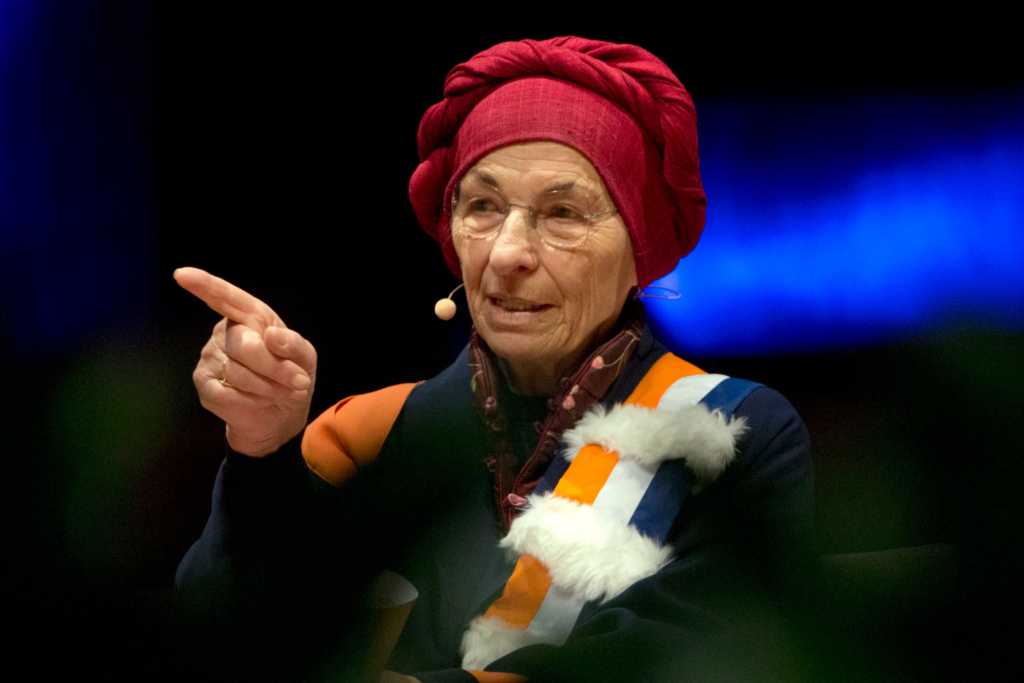
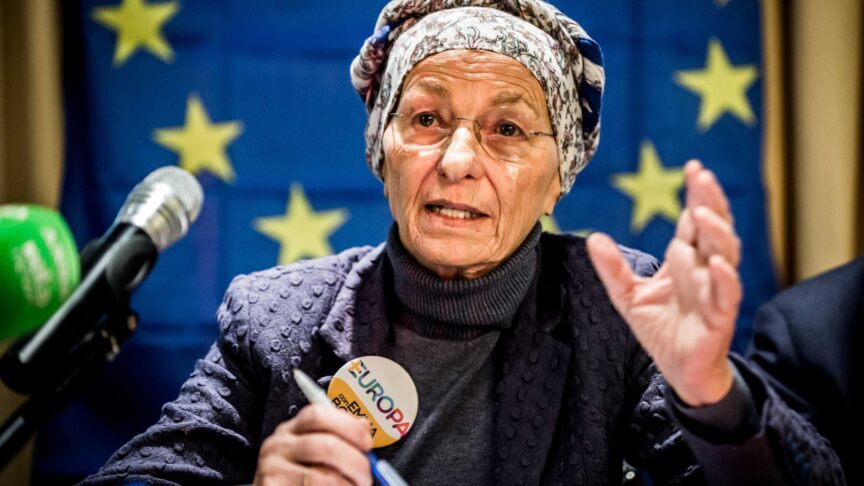
Emma Bonino understood early on that Europe could not afford to turn inwards. For her, Europe was meant to be much more than a common market. She believed that Europe’s role in the world was inseparable from its defence of freedom, democracy and human rights, and that its foreign policy was ultimately about the people behind the decisions made by states. She also helped make European politics a wider space for women, opening paths and challenging expectations along the way. Her legacy is not only in the causes she championed, but in the courage with which she pursued them. The voices of women like Emma, who always fought for our rights, mattered enormously in shaping the Europe we know today. At a time when that Europe is being tested once again, and when civil liberties can no longer be taken for granted, her example matters more than ever.
Cover image: picture alliance / AP Photo/Virginia Mayo
Despite her diminutive stature, Emma Bonino was a giant of European foreign policy. She made a critical difference on a bewildering range of causes. She was a master at operating in a diverse array of settings: protesting on the streets, mobilising NGOs, shaping the agenda of the European Commission, creating unlikely coalitions in the European Parliament and chairing the Italian Senate. She managed to make such a difference in all these places because, wherever she found herself, she was always an activist fighting for civil rights, for justice, for equality.
Emma was also a rebel. She used her charm, humour and honesty to puncture pomposity and force people into a real conversation. She embraced controversy, both in her advocacy for challenging causes like women’s rights, abortion access and drug legalisation, and in her methods such as protests and hunger strikes.
She knew how to translate lofty goals into concrete steps which had some hope of being implemented, whether it was setting up the European Commission’s humanitarian office, campaigning for the establishment of the International Criminal Court, advocating to ban female genital mutilation, or working to change Italian electoral law. She had a sense of history and understood how to use crises to shift the agenda—as she did when she moved to Cairo after 9/11, deciding to learn Arabic and to push for a better understanding between Europeans and the Muslim world. And she was willing to assemble and work with unlikely coalitions to advance her causes, from joint projects with the Egyptian former president’s wife Mrs Mubarak to campaigns with the Pope.
Emma was a founding member of ECFR and helped turn it into the organisation it has become. We assumed when she became Italian foreign minister in 2013 that she would step down as a member, but instead she wanted to stay involved and constantly drew on ECFR’s ideas, expertise and pan-European networks to shape the Italian and European agenda. When she stepped down as foreign minister she became a co-chair of the organisation, and we felt her sense of urgency, ambition and pro-Europeanism in every board meeting.
Emma helped shape the DNA of ECFR. She encouraged us to be courageous, not to be afraid of controversy and to challenge conventional wisdom. She pushed us to be as pragmatic about how to make a difference as we were principled about our goals. Always inspiring others, Emma was a friend and a role model to so many of us—but she didn’t do small talk or make time for idle fun. When the substantive discussions were finished, she would say “va bene” and move on to the next fight (or go out to smoke a cigarette). Her death leaves Europe a greyer and less vital place. We need more Emmas.
Cover image: picture alliance / NurPhoto | Daniel Gnap
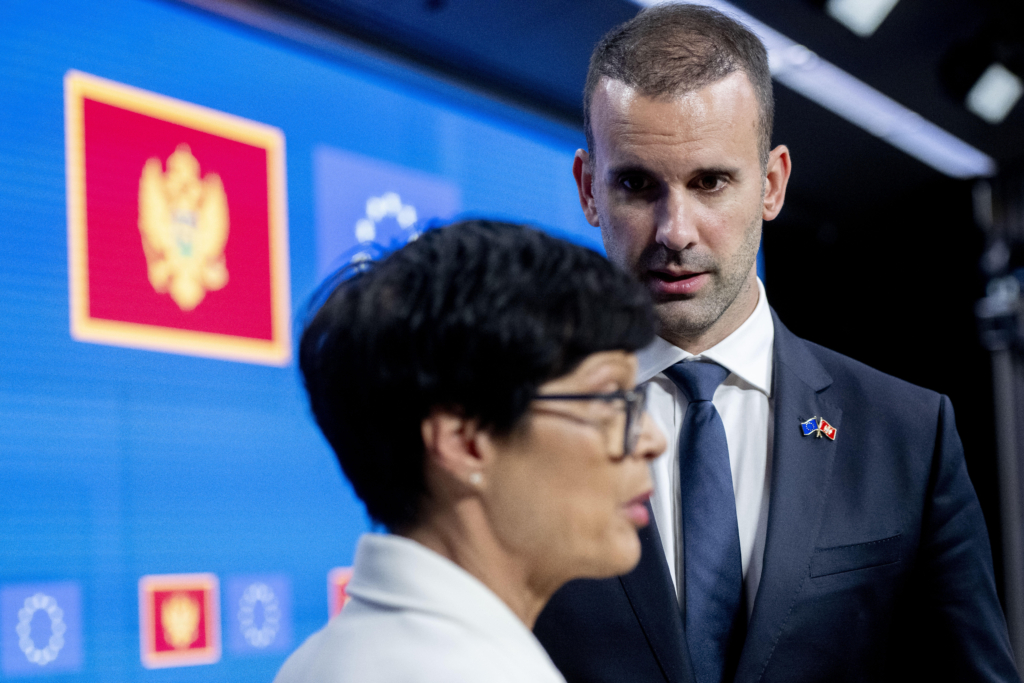
On September 30th, the European Commission is expected to unveil a comprehensive document on EU enlargement, which will be used as a basis for discussion by the European Council in October. The paper is likely to confirm that Montenegro and Albania could finish negotiations soon. But it should also propose ideas on how other countries in the region without this perspective can move forward in their own EU accession journeys.
Any Western Balkan country that joins the EU after waiting over 20 years deserves to be celebrated; the two frontrunners should be commended for making best use of this opportunity and supported to make it over the finish line. But by focusing on these two countries, the EU has prioritised quick wins. Montenegro and Albania have demonstrated commitment to reform, but also have no major bilateral issues to resolve or difficult neighbours to reconcile with.
Montenegro in particular, given its small size and its lack of significant outstanding issues with neighbours, seems ideal for making the case for enlargement as a low-cost and problem-free geopolitical gain. Indeed, commission officials recently compared the annual cost of Montenegro’s entry to the EU per EU citizen to that of a cup of coffee.
However, going for low-hanging fruit must not serve as cover for the EU not achieving its core responsibility in the Western Balkans. It should use its leverage to promote reform and the resolution of bilateral issues, thereby strengthening stability in a region still struggling to overcome its difficult past. The recent funeral of convicted Bosnian Serb war criminal Ratko Mladic demonstrates how important this task remains: the presence of senior Serbian state representatives at his commemoration has caused shock and dismay across the region and within the EU, as well as among many Serbian citizens.
A regional perspective
At the end of the wars of the 1990s, the EU adopted a regional framework towards the Western Balkans. The idea was simple and appealing: improving relations between the Western Balkan countries would go hand in hand with closer ties to the EU. Two decades on, this had led to many challenges and some successes, but only Croatia has become a fully fledged EU member state. While the stagnation in the enlargement process is partly due to a lack of commitment from regional governments, it is also a result of internal EU blockages and a lack of urgency while it dealt with a series of pressing crises.
After Russia’s full-scale invasion of Ukraine in 2022, however, enlargement suddenly became a priority again. The EU understood that it needed to prevent a grey area emerging between itself and Russia. Ukraine and Moldova obtaining candidate status in 2022 revived member-state interest in the dormant case of the Western Balkans enlargement process; Montenegro and Albania recognised the geopolitical opportunity, accelerated their reform efforts and have arrived at a point where EU accession is a realistic possibility.
But the main impetus for this new momentum towards enlargement is dramatically different from what originally drove Western Balkans integration. While the eventual integration of Ukraine and Moldova into the EU aims to strengthen European defences in the face of a common threat, Western Balkan enlargement was meant to foster regional stability and reconciliation among countries that had been at war with each other.
The successful accession of a Western Balkan country may signal to the rest of the region that EU membership is possible and that enlargement is truly a merit-based process, which rewards those advancing reform and making the right geopolitical choices. However, neither the EU nor the Western Balkans can ignore the fact that Kosovo is stuck due to unresolved status issues, Bosnia and Herzegovina carries the burden of a dysfunctional constitution imposed by the international community and North Macedonia is held back by bilateral issues with its EU neighbours.
Focusing on the countries facing fewest obstacles to accession might suit the geopolitical needs of the moment, but it risks losing sight of the original regional dimension of Western Balkans enlargement
Focusing on the countries facing fewest obstacles to accession might suit the geopolitical needs of the moment, but it risks losing sight of the original regional dimension of Western Balkans enlargement.
Towards a new European approach
The European Commission is aware that it needs to provide incentives for countries without an early accession perspective. It is planning to present new proposals on gradual integration in its forthcoming communication on September 30th. A more ambitious and flexible framework for gradual integration, aiming to include countries in parts of the internal market, would encourage reforms and allow the EU to develop a more intelligent and honest approach to conditionality. This is especially necessary for advancing the rule of law and democratic standards, which are all too often neglected in favour of the broader geopolitical picture. This has contributed to the diminished transformative power of the accession process and negatively impacted regional stability.
In addition to exploring options for gradual integration, the EU should revive the diplomatic processes at the heart of what its regional approach was originally meant to achieve. This requires redoubling efforts on the Serbia-Kosovo dialogue, progressing state reform of Bosnia and Herzegovina, and engaging with member states to clear the blockages holding North Macedonia back. This would contribute to regional stability and advance Europe’s geopolitical agenda by reducing opportunities for Russia, China and other actors to exert influence in the region.
The generations that lived through the good and the bad of the regional past are getting older. They might not live to see the European future promised to them at the turn of the century. Many would, however, still remember a line from an old Italian comic book Alan Ford, much loved in former Yugoslavia: “It is much better to be rich and beautiful than to be poor and ugly”. If the EU does not redouble its efforts to close remaining unresolved issues, its membership criteria would effectively follow the same logic. This would be a sad case of the EU abandoning its own ambition and responsibility.
This week, Mark Leonard is joined by Cary Fowler, founder and president of the Food Security Leadership Council and former US global food security envoy, and Jim O’Brien, ECFR distinguished visiting fellow and former US assistant secretary of state for European and Eurasian affairs.
As conflict, climate change and geopolitical fragmentation converge, there is a growing risk of a global food crisis. Russia’s war in Ukraine continues to disrupt grain exports, the blockage of the Strait of Hormuz is restricting fertiliser shipments, and a potentially severe El Niño threatens drought and falling harvests across parts of Africa, Asia and Latin America.
These overlapping pressures will impact hundreds of millions of people who are already food insecure. While mechanisms are in place to mitigate the impact of food insecurity—for example, in 2022, the UN, the US, the EU and regional actors worked together to keep grain flowing from Ukraine and avert a broader catastrophe—many of the conditions that enabled cooperation then are weaker today. This has created a dangerous gap in global leadership.
Together, Mark, Cary and Jim explore how a new international coalition could prevent millions more people from falling into hunger. They discuss the roles of Europe, the UN and major powers such as China, India and Russia; the case for humanitarian ceasefires covering grain exports and fertiliser shipments; and why food security should be treated as a central pillar of global security.
Can governments overcome geopolitical rivalry to address a crisis that no one wants? How severe could the impact of El Niño become in already vulnerable regions? What would a ceasefire covering grain and fertiliser look like in practice? And can Europe coordinate a global response when other leaders are absent?
This podcast episode was recorded on September 9th 2026.
Ukraine is fighting for survival against Russia while its democracy faces a second battle at home. Ukrainians show extraordinary trust in the Armed Forces, family and civic networks—but far less in politicians, government and bureaucrats. Now, high-level corruption scandals, calls for wartime elections, roadblocks to EU accession and possible peace talks with Russia are raising a hard question: can the trust that has helped Ukraine survive the war be turned into a state people believe in?
In this episode, Jessica Hendrick welcomes Roman Petrov, honourable president of the Ukrainian European Studies Association, professor of EU law at the National University of Kyiv-Mohyla Academy, and one of Ukraine’s leading experts on EU accession and EU-Ukraine relations working on the RE-ENGAGE project; and Svitlana Zalishchuk, Ukraine’s ambassador to Sweden and former civil-society activist, member of parliament and government adviser, now working at the centre of Ukraine’s wartime defence and European security partnerships. Roman warns that major decisions on peace could be challenged later if Ukraine’s elections remain suspended. Svitlana pushes back on the picture of low public trust, arguing that the war has actually increased trust in the state—just unevenly—and that public trust itself is part of Ukraine’s national defence capability.
RE-ENGAGE conducted nearly 600 interviews with Kyiv residents last year, at times even moving them into air-raid shelters as alarms sounded across the city. Drawing on the findings, Jessica, Roman and Svitlana discuss how a society can distrust the state so deeply and still defend democracy; what recent corruption scandals reveal about whether the system actually works; and if fast-tracking EU membership risks turning reform into a superficial “copy-paste” of European laws.
How is the far-right AfD’s historic landslide in eastern Germany viewed by those working on EU accession in Kyiv? Why might Ukraine now be better described as a contributor to European defence than a recipient of military aid? And what does Ukraine need to do differently to make its post-war vision last?
Cover image: picture alliance / TASS | Sergei Bulkin
Summary
The Kremlin is promoting Ukraine war veterans and, in so doing, cultivating a proto-elite to fill future vacancies and reinforce Russia’s militarised course.
Through programmes such as “Time of Heroes”, and through elections, at least several thousand actual and nominal veterans now already hold political or government posts.
The new preference for war credentials has supplanted the earlier trend of hiring technocrats. Russian cadre policy has shifted towards “making loyal people competent”, as in other consolidated autocracies. Technocrats will remain important, but their declining influence will gradually reduce the state’s economic and administrative adaptability.
The Kremlin is dispersing veterans across institutions and deliberately mixing combatants with regular officials who have acquired veteran status. This will likely constrain the emergence of a coherent political veterans grouping.
Nevertheless, the 2026 State Duma election is likely to bring around 50 nominal and actual veterans into parliament. Their presence could become an institutional brake on foreign policy moderation after a ceasefire or even future change of the top leadership in Russia.
European governments should remain cool in the face of enhanced rhetoric from the new elite; maintain informal contact (where possible and safe) with less confrontational sections of Russia’s governing class; and keep mobility options open to young Russians, while taking necessary precautions.
Cadres in khaki
Like much else in wartime Russia, the United Russia line-up for the September 2026 State Duma election was settled only at the eleventh hour and with Vladimir Putin personally involved. The five names placed at the top of the ruling party’s nationwide list made for a revealing mix: foreign minister Sergei Lavrov; Moscow mayor Sergei Sobyanin; Yevgeny Poddubny, one of Russia’s best-known pro-war military correspondents; Maria Lvova-Belova, who is subject to an International Criminal Court arrest warrant alongside Putin for her role in the deportation of Ukrainian children; and Vladislav Golovin, a young veteran who lost a leg during Russia’s assault on Mariupol.
This choice offers a snapshot of a broader shift already under way within Russia’s bureaucracy, and one that is likely to accelerate in the coming years. Lavrov represents the old guard bureaucracy; Sobyanin, the mid-2010s class of capable managers with appeal among urban Russians; the other three owe their newfound political prominence largely to the war in Ukraine. Technocrats and qualified administrators, like Sobyanin, whose presence within the elite expanded in the years preceding the 2022 invasion of Ukraine, are receding into the background. They will not disappear altogether, because their expertise remains crucial to keep the Russian economy functioning. But they are no longer a rising force. The war is producing a new elite cohort whose careers and status are inseparable from the war. Like any elite group in other post-Soviet authoritarian systems, this cohort has its own set of functions and tasks, which it performs in the interests of the ruling circle or—in the highly personalist Russian system—for the ruler himself.
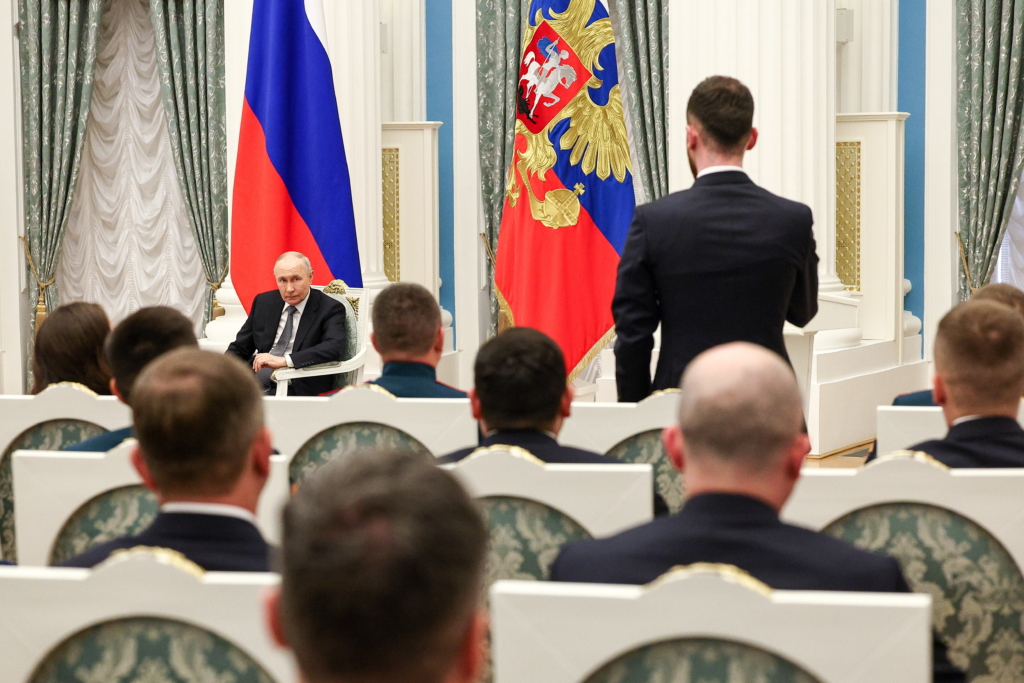
Putin set out his intention to create a new group within the Russian bureaucracy most explicitly in his February 2024 annual address to senior officials. In it, he announced the launch of the “Time of Heroes” programme to retrain military personnel and prepare them for appointments to civilian posts. In particular, Putin said a “genuine elite” should be drawn from contract soldiers and mobilised servicemen who had fought in Ukraine and, after further training, take up positions “across education…, in state-owned enterprises [and] business, in state and municipal administration”. They would replace parts of the old elite, particularly those who had “lined their pockets in the 1990s”. Ultimately, he suggested, they could become the generation to which “Russia might one day be entrusted”.
Between February 2024 and July 2026, Putin returned to this idea at least 22 times based on the Kremlin.ru record of his official and public activities (calculations undertaken by the author). Some of these remarks came during dedicated meetings with officers or their wives. But Putin also raised the subject in less obvious settings, including a forum with municipal leaders and his most recent televised Direct Line, a regular event where he responds to questions from citizens and journalists. During the latter, he repeatedly gave the floor to a specially invited officer and even asked his advice; the officer was later killed at the front.
Putin’s de facto promise to “entrust” Russia to people who had fought in the war, his repeated references to a new elite and the constant emphasis on his personal oversight of the Time of Heroes programme have prompted several explanations.
The most common is that the initiative is meant to support military recruitment by showing that fighting in Ukraine can lead to substantial career opportunities after a return to civilian life. The second sees it as a means of political control: the Kremlin can identify ambitious veterans, bind their careers to the state and absorb them before they organise independently or become political rivals. The third assigns veterans a larger political role. In this reading, Putin is seeking to push aside established business and bureaucratic elites in favour of ideologically conformist loyalists, including veterans, with the supposition that Russia could turn into a closed, North Korean-style militarised autocracy over the next 6-10 years.
Without dismissing any of these three explanations, this paper shows that the Kremlin’s integration of war veterans into the government system is part of a structural, long-term project. The state is creating a new recruitment pool of people tied directly to the war. It is selecting and training them for gradual promotion into positions of power. This marks a genuine shift in Russian cadre policy, away from a “make competent people loyal” model, associated with competitive authoritarianism, to a “make loyal people competent” logic, which is more typical for consolidated dictatorships. In his forthcoming book, “Autocratic Intelligence: How Modern Dictatorships are Getting Smarter”, George Washington University political scientist David Szakonyi identifies a broader tendency across regimes. Despite a steady trend between 2000 and 2020 towards increasing the share of technocrats in government, in more recent years dictators have found it less expensive to build up the competence of those already considered loyal (largely because securing the loyalty of competent officials has become more costly).
The paper maps this new recruitment pool by using a dataset including a named roster of federal Time of Heroes participants, their biographies, actual combat participation and post-programme appointments. These data were supplemented by three interviews with programme lecturers undertaken by the author and by publicly available information on applications and enrolment in regional equivalents of the Time of Heroes programme. The paper also draws on a named roster of 2026 Russian State Duma candidates who identified themselves as war participants, including their biographies and actual combat participation. This is supplemented by aggregate data on serving deputies with military experience elected to all regional and selected municipal legislatures between 2022 and 2025.
The data allow us to test whether two forms of loyalty appear to be rewarded via these programmes. It is assumed, first, that most veterans promoted through the system will owe their careers to Putin personally. The second assumption is that they will have an ideological coherence and loyalty intimately bound up with Putin’s decision to wage war against Ukraine and to a broader clash with NATO.
The findings of the paper confirm that the Russian regime is placing veterans in the middle and upper-middle ranks of the bureaucracy and state-linked structures. It seems to be integrating them into existing elite structures without fully displacing the other main elite groups, including siloviki (individuals with a background in the security services), technocrats and state company managers. The paper further suggests that veterans’ presence will place pressure on bureaucratic and business elites to demonstrate their loyalty to the military by extending tangible support for the war. Over time, these developments have the potential to create a vocal, embedded constituency for a militarised foreign policy orientated towards preparing society and the bureaucratic system for wider confrontation with the West; or protecting Putin’s wartime legacy if the regime weakens or pursues a partial rapprochement with Europe and America.
Putin’s need for new recruitment pools
In democracies, governing elites are renewed through channels such as competitive elections, party turnover and entry from business or civil society. In contrast, autocracies close these channels off. Personnel appointments are thus instrumental to helping the winning coalition in authoritarian regimes reward allies, co-opt rivals and remove potential challengers. Yet regime survival also depends on having competent officials to do the work of running things. This creates what political economists Georgy Egorov and Konstantin Sonin (drawing in part on evidence from Russia) call the “loyalty-competence trade-off”: capable subordinates improve state performance but may gain the networks and authority to threaten the ruler; yet safer loyalists may lack the skills to govern.
The practical challenge for leaders like Putin is to build recruitment pools that provide competence without allowing rivals to emerge. Party-based autocracies can manage this risk through internal career ladders and controlled competition. The ruling party screens, trains and monitors candidates. This gives the leadership a broad pool of officials whose performance it can observe and whose careers it can control. In more personalistic regimes like Russia, capable outsiders have little incentive to build a career in politics or state service and are unlikely to make their abilities more widely known. So the ruler must draw on groups already within reach—or create new recruitment pools by establishing dedicated programmes.
During his first two presidential terms, Putin drew senior personnel from two main recruitment pools. One consisted of his childhood friends, former KGB colleagues and associates from St Petersburg city hall; the other was siloviki. Personal acquaintance was enough to advance members of the first group. Siloviki could gain posts without a direct connection to Putin because they came from a professional and ideological milieu he knew and trusted. The model worked partly because some longtime associates brought genuine economic or administrative expertise along with their loyalty.
By around 2016, the first pool was running dry: most available figures had already received positions while others had fallen out of favour. Although people with a silovik background held around 20% of key posts by 2008, their progression into senior civilian roles later slowed. Instead, the security agencies gained broader powers as the regime grew more repressive.
At the same time, the Kremlin’s need for capable managers increased. The return of gubernatorial elections in 2012 created particular demand for candidates who were loyal, independent of regional elites and able to manage an administration and run a public campaign. Such people were difficult to find, especially as by that time governors in Russia had lost autonomy and faced a growing risk of prosecution.
Putin initially responded by recycling personnel. His third and fourth terms brought frequent rotations of the same figures between senior posts in the bureaucracy and state-owned companies, while some officials remained in place for decades. This produced a personnel bottleneck and left mid-ranking officials with few routes to the top.
A more successful approach emerged after the current supervisor of domestic politics, Sergei Kiriyenko, joined the presidential administration in 2016. He turned previously marginal personnel reserves into an important source of appointments. Kiriyenko created the “School of Governors”, “Leaders of Russia” and other specific cadre programmes, combining competitive selection and training with visible presidential sponsorship. Participants met Putin and were presented as young, effective technocrats. This gave the Kremlin candidates who appeared competent but remained dependent on the regime for advancement. The technocratic turn peaked with Mikhail Mishustin’s appointment as prime minister in 2020 and the subsequent reshaping of the government.
These programmes, together with recruitment into Mishustin’s government, formed a new technocratic pool for mid-to-senior level federal officials (ministers, deputy ministers and departmental directors), as well as senior regional officials. As a result, between 2017 and 2024, almost 400 people were trained through the School of Governors, and 52 graduates went on to become heads of regions. The Leaders of Russia programme produced similar results, with more focus on the federal level. Szakonyi’s biographical database of 1,578 senior Russian officials shows that roughly one in six top officials serving in 2024 was a technocrat, nearly three times the share in 2000.
Yet the prolonged war in Ukraine may have eroded the confidence of Putin and his circle in the technocratic recruitment pool. Technocrats appeared insufficiently committed to the war, while some failed on tasks central to it, including the construction of fortifications in the frontline Kursk region. Russia’s technocratic turn is now losing momentum, and Putin’s relationship even with key figures in this group, such as central bank governor Elvira Nabiullina, appears to be changing. This has made the creation and expansion of a new, more reliably loyal recruitment pool increasingly urgent.
Federal “heroes”: Filling the bureaucracy’s middle ranks
The Time of Heroes programme announced by Putin in February 2024 is the main vehicle for building the recruitment pool needed for his new “elite”. It is run by the Higher School of Public Administration of RANEPA (the Russian Presidential Academy of National Economy and Public Administration). The programme follows the model of earlier cadre initiatives, combining lectures and team building with practical placements. In 2025, it effectively supplanted the technocrat-orientated School of Governors, whose next intake was postponed. (The next section in this paper discusses the regional Time of Heroes variants, which were set up later.)
Time of Heroes is open only to participants in Russia’s war against Ukraine, including contract soldiers and mobilised servicemen with a university degree. Official figures show more than 65,000 people applied online and underwent initial testing for the programme’s two federal cohorts in 2024 and 2025. Just under 170 progressed to in-person training.
Both in-person cohorts began the programme with a two-week voyage aboard a nuclear-powered icebreaker from Murmansk to the North Pole and back. The journey was symbolically important, given the place of the Arctic in the worldview of Russia’s ruling elite. But it also served a political purpose: two weeks of isolation from the outside world provided an intensive opening exercise in cohort-building for participants.
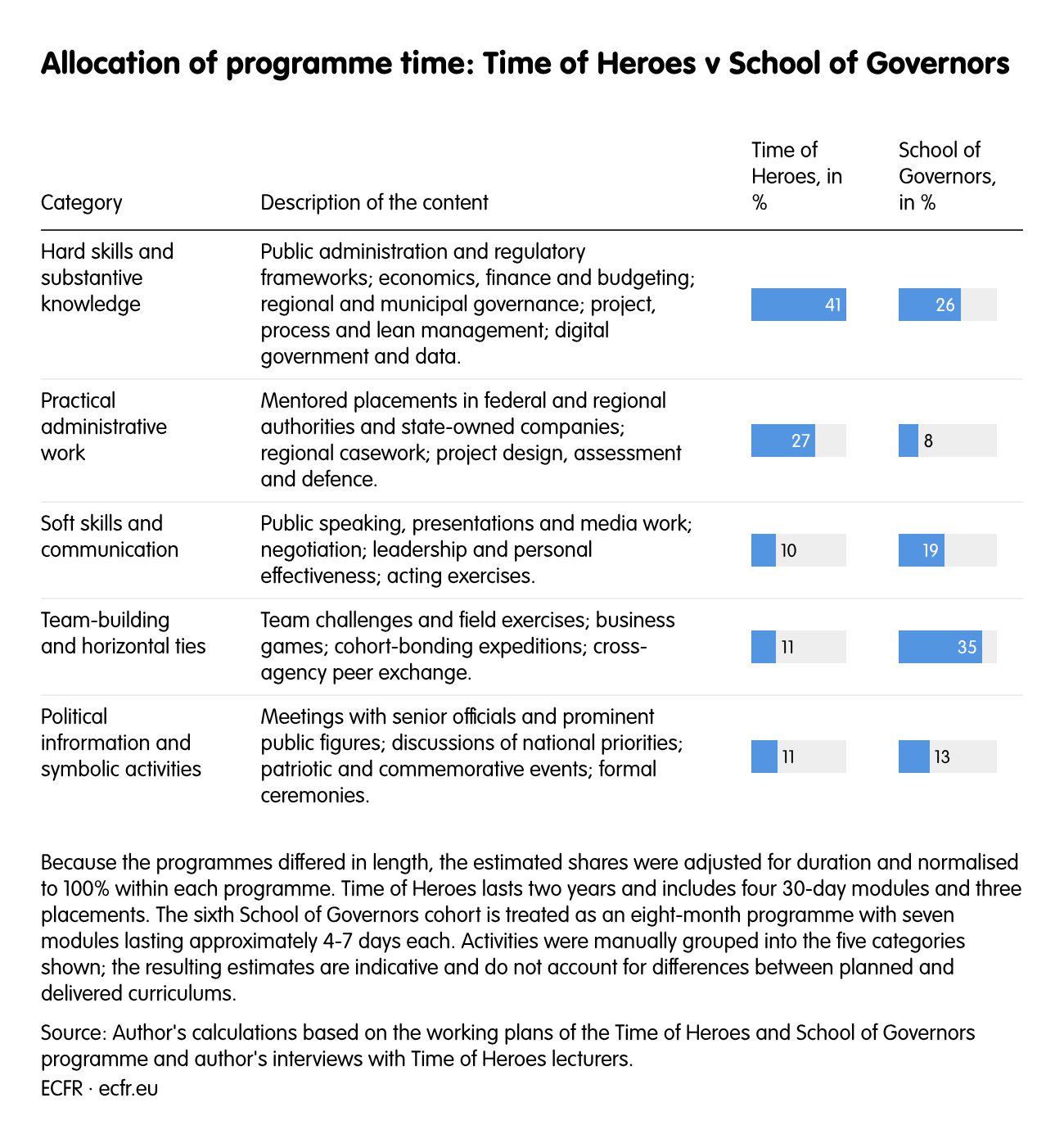
Overall, however, Time of Heroes devotes relatively little time to such activities. Instead, it focuses on honing participants’ hard skills and giving them practical administrative experience. In contrast, School of Governors puts the trainee technocrats through numerous team building, patriotic and sometimes extreme exercises, including jumping into water from a 7-metre-high cliff and lying beneath a moving tank. Hard skills and practical administrative work account for 68% of Time of Heroes compared with 34% of the School of Governors. Team building and activities intended to foster horizontal ties make up just 11% against 35%. For all these differences, the programmes devote a similar share of 11-13% to “political information”: talks by senior stateofficials and propagandists on national priorities and patriotism.
The contrast between the two programmes suggests a shift from the “make competent people loyal” cadre model to “make loyal people competent”. School of Governors appears to have selected recruits for their administrative ability and then worked to bind them more closely to the regime. By contrast, Time of Heroes treats participation in the war as proof of ideological loyalty and concentrates on turning those already trusted by the Kremlin into capable administrators.
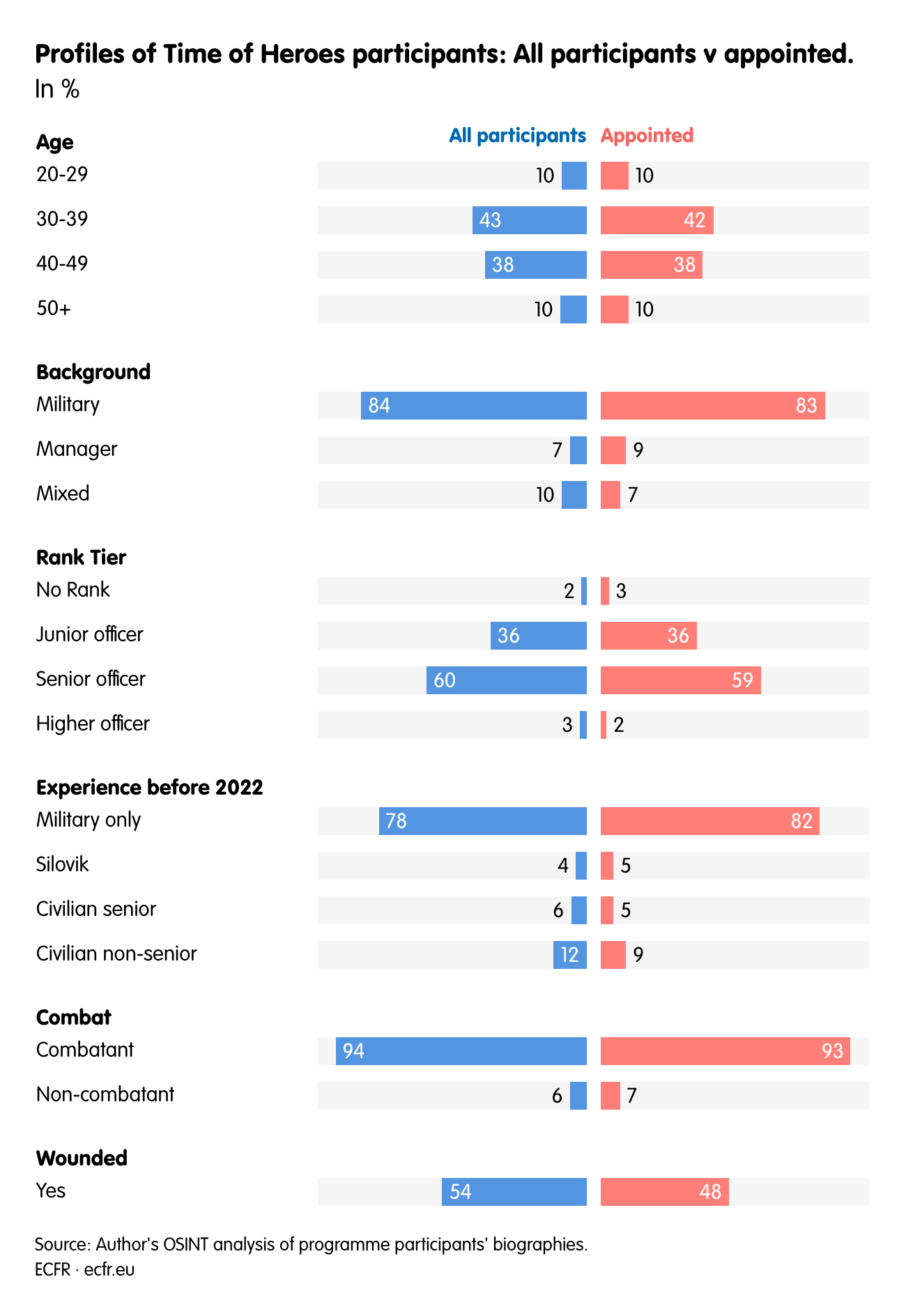
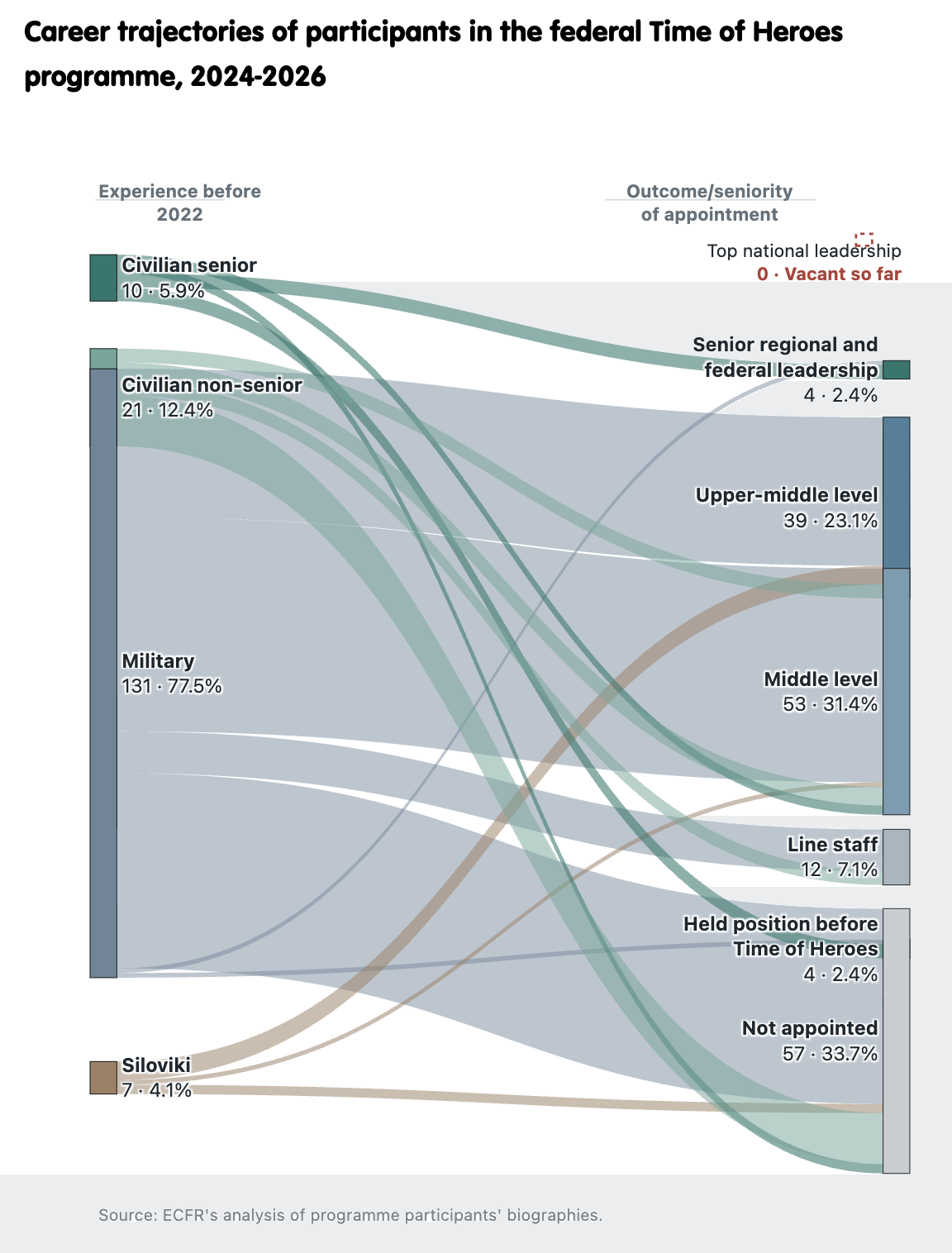
Early expert and media commentary questioned whether the Time of Heroes programme was genuine. It suggested that serving officials and politicians might simply use it to advance their careers without experiencing real combat. But the author’s research of all 169 participants in the two Time of Heroes cohorts (see detailed methodology of data collection and analysis in the appendix) suggests it does provide a genuine route into civilian career for military personnel who have fought in Ukraine.
Of the participants, 84% have exclusively military backgrounds. Another 9% moved between military and civilian work, either joining the armed forces after a brief civilian career or returning to them following the full-scale invasion. Junior officers—from lieutenant to captain—and senior officers—from major to colonel—together account for around 90%; only a handful are generals. Participants’ average age is 40. The programme includes 159 men and 10 women, most of the latter medical officers who worked as critical-care specialists or surgeons, likely close to the frontline.
Drawing on official Russian sources, independent media investigations and Ukrainian projects, we found strong evidence of actual combat participation for 94% of the 156 participants whose records we could assess (out of the 169 in total). Moreover, almost 40% of the recruits have been awarded major combat decorations, with recipients concentrated in the second cohort of the programme. In addition, at least 13 have been accused of war crimes, including involvement in some of the most notorious crimes committed in the Kyiv region in spring 2022. Public records or participants’ interviews indicate that almost half were seriously wounded. Some, including participants later appointed to senior government posts, applied to the programme directly from hospital after sustaining severe injuries.
One lecturer on the programme summed up the participants as “very simple, well-drilled Russian blokes”. Another said that after a trial class on a very specific economic topic, he had to simplify an already adapted syllabus even further to accommodate participants who “could not focus for even half an hour”, which he thought might be a consequence of their injuries.
Progression
Nevertheless, by July 2026, 108 of the 169 participants in the two Time of Heroes cohorts had been appointed to posts at different levels of government or in state-owned companies. Another four had continued working in the government posts they held before entering the programme, although one was later killed in an explosion after returning from the front. Yet none of the biographical or service-related characteristics described above is a statistically significant predictor of receiving an appointment. This confirms thatthe programme appears to genuinely serve as a route for upward mobility and starting point into a civilian career for participants.
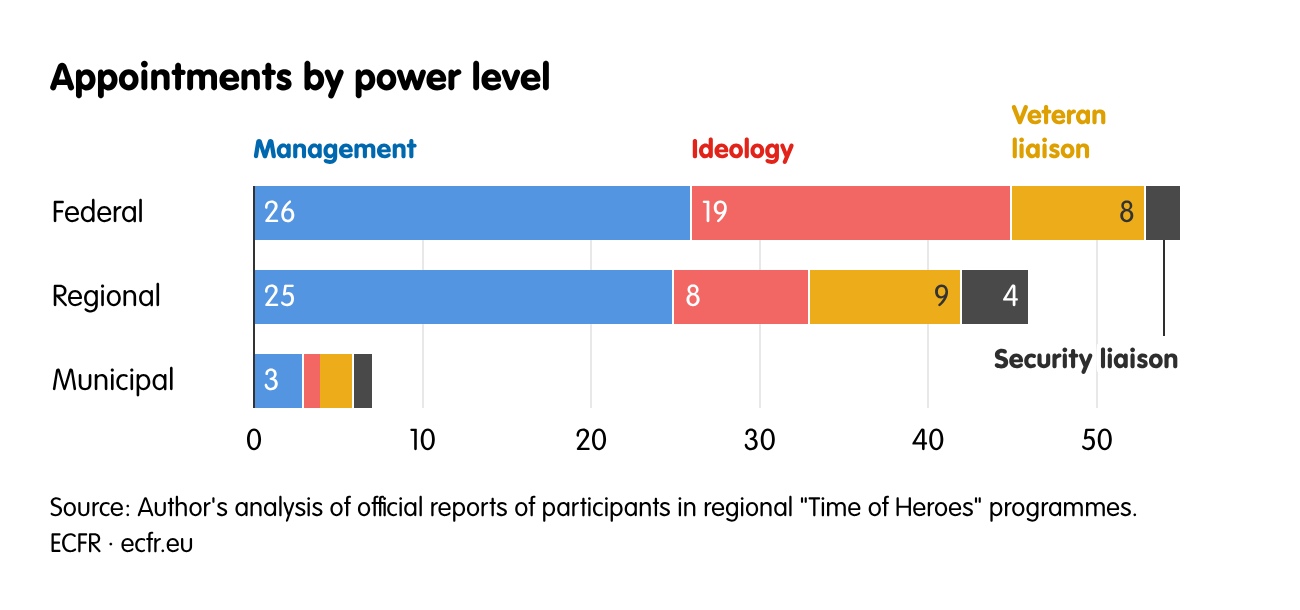
Although Time of Heroes is a federal programme, only just over half entered federal-level bodies. The remainder secured appointments on the regional or municipal level.
For this analysis, all appointments were grouped by their primary function into four categories. “Management” covers posts carrying substantive responsibility for running a particular sector, organisation or segment of the economy, mostly in the form of heading a ministry department or state-company division. “Ideology” includes youth policy, patriotic education and state messaging, including posts in Yunarmiya, Znanie and Movement of the First—state-sponsored organisations for patriotic education, revived from its Soviet predecessors. “Veteran liaison” covers non-security roles supporting veterans and their families. “Security liaison” refers to civilian posts coordinating with the security services in regional government or at strategically important enterprises.
Management is the largest category at both federal and regional levels, accounting for 47-54% of appointments. These posts frequently place veterans in sectors in which they have no relevant education or training. Such mismatches are not unprecedented in the Russian bureaucracy, but they had become less common at federal level as technocratic recruitment gained ground from the mid-2010s. Veteran appointments therefore represent a partial departure from that recent trend.
For roughly the other half of appointees, the Kremlin has found three more clearly defined uses: of ideology, veteran liaison and security liaison, as outlined above. These narrower remits better fit veterans’ profiles, require less general administrative expertise and serve the Kremlin’s immediate and medium-term needs.
Ideological roles are concentrated at the federal level, where they make up 35% of appointments. They turn veterans into public advocates for the war and use them as an additional tool for the ideologisation of primary and secondary education. Golovin, mentioned earlier as the fifth-placed candidate on United Russia’s election list, now heads Yunarmiya’s Main Staff; the youth movement operates through schools and cadet classes. Meanwhile, the federal education ministry department responsible for pupils’ moral and patriotic upbringing is headed by Igor Yurgin, who previously commanded an assault unit of convicts and mobilised soldiers notorious for high-casualty “meat assaults”.
The smaller security liaison category supports security coordination in the regions and at strategically important industrial facilities. Typically, a veteran becomes the civilian institution’s interlocutor with the military and siloviki. Their background is expected to help them understand security requirements while negotiating how these are applied, so that civilian administration or operations are not unduly disrupted. Examples include a deputy governor overseeing public safety and relations with the police and security agencies, or an adviser to the head of the federal civil aviation agency handling relations with the defence ministry.
Veterans’ career trajectories suggest that appointments usually build on existing connections. In 88% of cases in which a veteran received a regional post, it was in their home region (defined as a place of birth, education or extended previous military service). In around 45% of cases, the appointment also matched the institution or region of the participant’s first or second internship in Time of Heroes.
Together with the division of appointments among the four categories, these patterns point to a practical approach adopted by the programme’s supervisors in the presidential administration. On the one hand, their objective is to find managerial posts for as many participants as possible across a wide range of sectors and regions. This gives the Kremlin a pool of loyal candidates who have acquired relevant experience, available for when Putin later calls for a veteran to fill a particular and more high-ranking vacancy. On the other hand, it seems that the supervisors are also using veterans to address medium-term political aims for the regime. This is producing a group that promotes militarised values in education and youth policy, a second group that mediates between the state and dissatisfied servicemen and their families, and a third that connects civilian institutions with the security apparatus.
At this stage, veterans’ longer-term prospects do not appear to differ substantially according to the function of their first appointment. The exception is with the municipal posts, which carry the least status and appear unlikely to provide a route to significant promotion. Across federal and regional appointments, subsequent advancement may depend more on performance and the appointee’s relationship with their senior supervisor than on the initial brief.
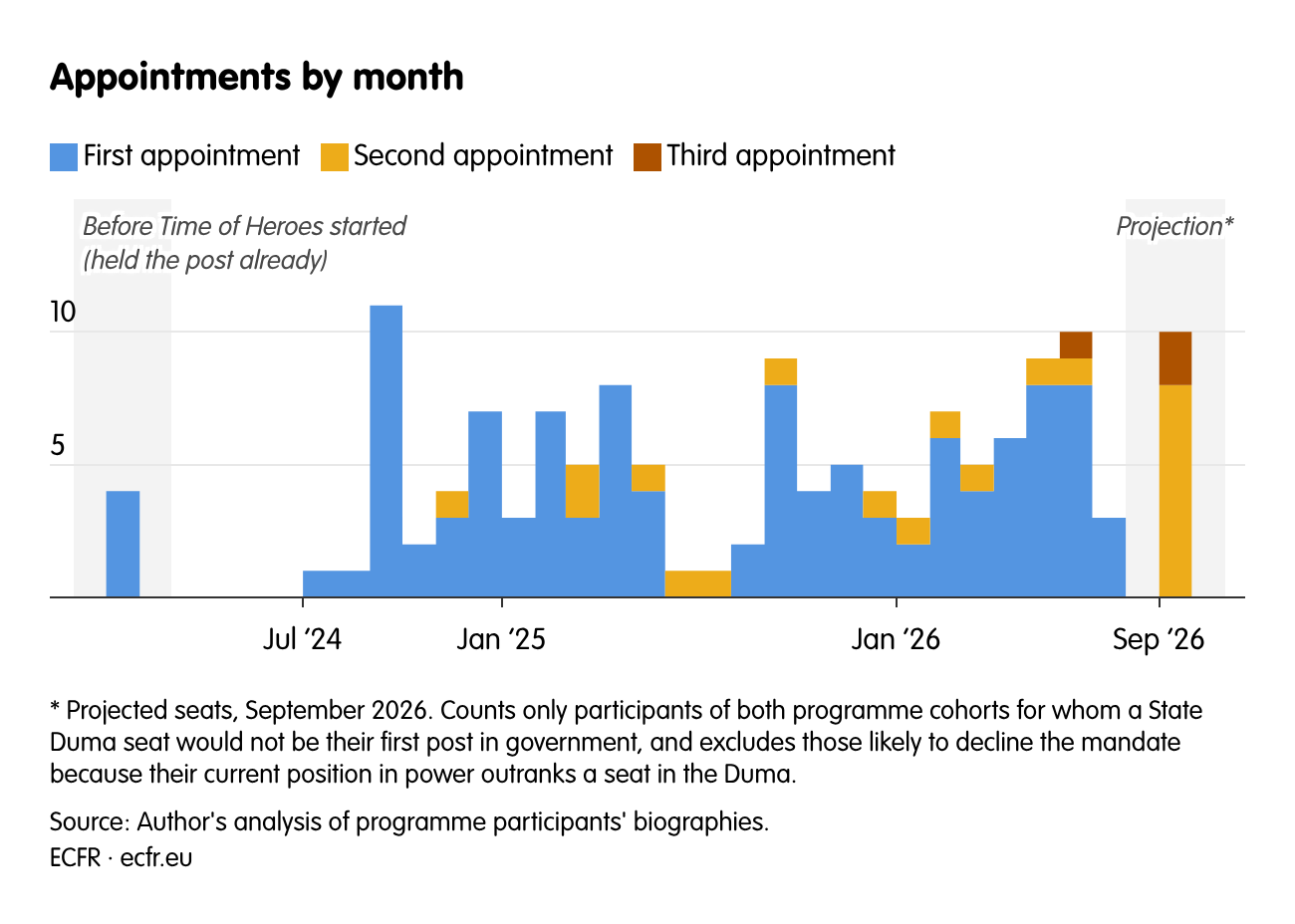
The timing and sequencing of appointments support this interpretation. Initial batches follow Russia’s electoral calendar, peaking around the annual voting day in September. Veterans who perform well in their posts can then be fast-tracked from regional to federal ministry; from deputy director to director of a state organisation; from deputy governor to governor; or some receive a symbolic but higher-status seat on a presidential commission alongside more managerial appointments. For at least 10 veterans, the September 2026 State Duma election is likely to be the next step, giving them a second or third appointment.
One programme lecturer described a similar logic with reference to the project’s length and multiple stages: all the “capable” and “more or less healthy” veterans had already received government posts. Meanwhile, those “in good standing” with their current senior supervisors were being lined up for promotion.
Yet Time of Heroes also serves a third, more immediate political function. When the programme was launched, analysts ofteninterpreted it chiefly as a publicity instrument: by showcasing veterans entering prestigious civilian careers, the Kremlin could present wartime service as a route to social mobility, encourage contract enlistment and reassure servicemen that their participation in the war would be rewarded after their return to civilian life. How far the appointments perform this function becomes clearer when the substantive authority they confer is considered alongside the recipients’ previous careers.
By July 2026, no war veteran had reached the highest state offices, such as federal minister, head of a federal agency or deputy prime minister. Only four of the 108 appointees had reached the next tier down in the nomenklatura hierarchy, which includes governors and presidential envoys.
Of these, only Alexander Shuvaev, appointed governor of Belgorod region in spring 2026, had pursued an exclusively military career before 2022. His promotion illustrates the career ladder envisaged by the programme: after gaining short civilian experience as deputy governor in another region, he was selected when Putin called for a veteran to fill the more senior vacancy, becoming governor of a region bordering Ukraine where his frontline background seems more relevant.
However, the remaining three senior appointees entered the programme with prior political or bureaucratic experience. Artyom Zhoga, among the programme’s first appointees, went straight into the post of presidential envoy to the Urals Federal District. He had fought in Ukraine since 2014 but began building a political career in the occupied territories from 2023. The other two, Yevgeny Pervyshov and Maria Kostyuk, already had bureaucratic careers before 2022; the war and the programme accelerated their advancement into governorships. Kostyuk offers the clearest example of this political function. Formally the programme’s head rather than a participant, she nevertheless appeared on the participant lists supplied to us. The programme’s official website also regularlypresents her governorship as one of the promotions produced by Time of Heroes. Kostyuk has not seen combat, but after her son was killed in 2022, she developed a nationally prominent pro-war media project and moved into veteran policy roles, helping her advance from a senior regional administrative post to governor.
These four senior appointments provide the Kremlin with highly visible examples of the social mobility promised by the programme. But they remain exceptions within its broader record. Ninety-two of the 108 appointments (85%) have settled in the middle and upper-middle ranks. Career military personnel hold most of these posts, which carry real but bounded authority, from heads of departments, units and public organisations to deputy ministers and senior managers in state-linked companies. Another 12 received positions such as advisers and project officers; nine of these came from military backgrounds and the remaining three had held only junior civilian roles before 2022.
Taken together, the appointments reveal a managed career pipeline. Time of Heroes supplies visible success stories for the Kremlin’s recruitment campaign, deploys veterans to meet immediate wartime needs and endows a broader cohort with the civilian experience needed for possible promotion. Advancement remains selective and dependent on existing patrons. This allows the presidential administration to build a reserve of war-linked officials while retaining control over when and how far they rise.
Regional “heroes”: Managing the return from war
In December 2024, Putin again invoked the idea of a new elite and ordered Russia’s regions to set up their own versions of Time of Heroes. Their purpose, he said, was to bring into “regional teams” people for whom “a sense of duty and service to society and the country come first”. Five months later, the Kremlin issued a requirement for Russia’s regions to train up 30-60 veterans each year. (This requirement joined metrics including poverty levels, access to healthcare and demographic trends.) In effect, the shift in federal cadre policy was extended to the regions, to be led largely by technocratic governors appointed under the previous recruitment model.
During 2025, every Russian region except Moscow launched its own equivalent; the capital apparently treated hosting the federal programme as sufficient. Regional programmes largely replicate the federal scheme: they recruit locally rooted combat veterans for posts in their home administrations, combine classroom instruction with practical placements and mentoring by serving officials, and are often delivered through regional RANEPA campuses. Federal Time of Heroes graduates serve as mentors or sit on their public councils.
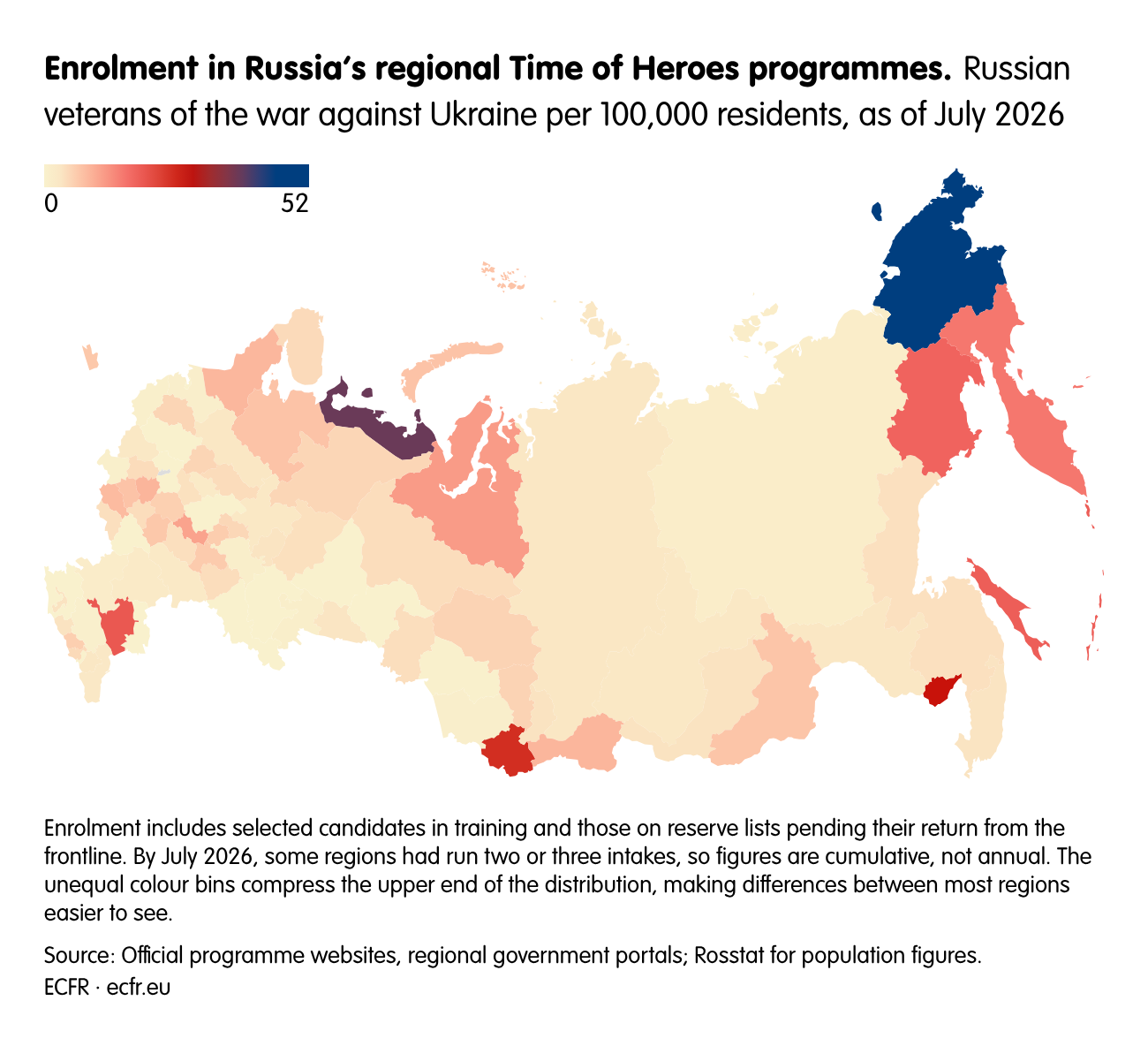
The authoritarian dynamic in Russian centre-region relations rewards governors for demonstrating zealous, often excessive, compliance with Moscow’s demands. This existing dynamic is now also shaped by the Kremlin’s wartime priorities and thus produced the usual bureaucratic competition among regions over meeting the new veteran-training target. This saw governors attempt to give their own programmes maximum publicity, devise inventivenames such as “The Call of Stalingrad” and “Valour of the Mountains”, and try to exceed the targets set by Moscow. By September 2026, one region had already run three separate, consecutive cohorts, more than the federal analogue; 31 (out of more than 80 regions) had formally enrolled more than 60 participants in a single cohort.
According to official regional figures, almost 44,000 people have applied to these programmes since 2024, with nearly 4,500 admitted. This puts the acceptance rate at around 10%, well above the 0.26% acceptance rate for the federal programme. But around 1,200 of those formally admitted to regional programmes remained in a deferred pool because they were still deployed. Both the use and size of this pool grew after the Kremlin introduced a rule preventing programmes from taking personnel away from the front.
In absolute terms, large regions with major military garrisons lead the number of enrolled veterans on their programmes. Moscow oblast received 2,400 applications, followed by Bashkortostan with 2,026 and Krasnodar region with 2,000. Formal enrolment followed a different pattern. Among regions with more than one million residents, Tula recorded the highest rate, with 130 admissions, or 8.93 per 100,000 residents, followed by Kursk (8.19) and Kaliningrad (6.78).
There is no statistically significant relationship between enrolment and either basic regional socioeconomic indicators or confirmed military deaths. Among regions with more than one million residents, the 10 with the highest per capita enrolment together recorded 8.2 confirmed military deaths per 10,000 residents, below the national rate of 9.05. Higher wartime losses therefore did not systematically translate into larger regional training cohorts.
Instead, the scale of regional programmes highly likely depends on an administrative and political choice by governors. The outliers are often regions whose governors have personal reasons to overperform. The Jewish Autonomous Region received almost 11 times the median number of applications, while Tambov enrolled as many participants as Moscow region despite having one-ninth of its population. As noted, governors Kostyuk and Pervyshov took part in the federal Time of Heroes programme and have a personal stake in making the model work. The Republic of Altai accepted 28% of applicants, more than twice the median, and has among the largest number of participants appointed to government posts. Following his demotion from senior federal politics to head of the poor, remote region of Altai, governor Andrei Turchak has strong incentives to regain Moscow’s trust. In Samara region, 93% of the first cohort found posts, while the second intake doubled to 90 participants, exceeding the KPI by 50%. This likely reflects governor Vyacheslav Fedorishchev’s conservative, outspokenly pro-war populism.
The architecture and public image of the regional Time of Heroes reproduce the federal political demand of elite building. However, the programme supervisors in the presidential administration have reportedly also insisted on prioritising short-term administrative function for the veterans in regions. They expect to see them serving as credible intermediaries with other returnees, who might dismiss an ordinary official who had not fought, but would be more willing to engage with a fellow veteran.
This search for intermediaries appears to reflect concern that regions have started to feel the pressure of the ever-growing population of returnees. An estimated 170,000–400,000 people have already come back from the war. Many are struggling to find work and are facing social deprivation, fuelled partly by crimes committed by returnees, with some with previous criminal records and PTSD.
The regions are already feeling this burden, but the pattern of how Russia’s central-regional relations are structured overall is also evident in the context of work with veterans. As recent studies by political scientist András Tóth-Czifra show, federal measures for the integration of veterans are inadequate, and overall the Kremlin is reverting to a familiar tactic: delegating responsibility for returning servicemen without providing regions with additional resources.
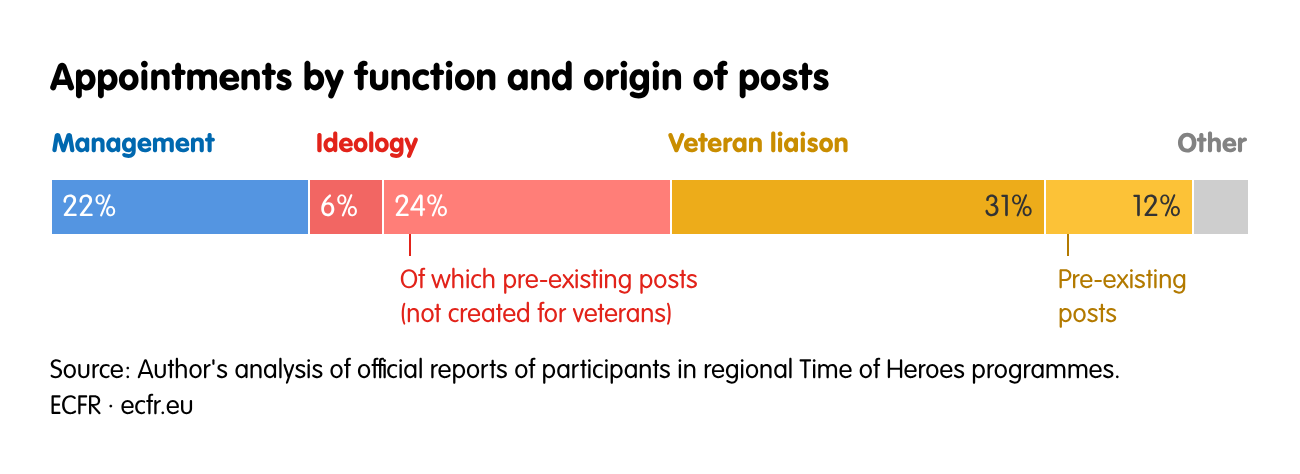
The intermediary function envisaged by the Kremlin, together with this shortage of resources, helps explain why regional appointments differ from those produced by the federal programme. Although information on appointments from regional programmes remains fragmentary, veteran-liaison roles appear to account for 44% of regional appointments. This compares with 18% among graduates of the federal programme, while only 22% enter general management, against 50% federally. Ideological posts are also slightly more common, at 30% compared with 26%.
Regions are not simply filling vacancies, as was largely the case under the federal programme: 31% of all appointments went to newly created or repurposed veteran support posts, including units in regional ministries, agencies and advisers to governors. Six per cent of ideology-related appointments have the samelogic. This is a regional strategy for adapting the federal elite-building model to scarce resources: create a limited administrative infrastructure around the new cohort and use its members to manage the much larger veteran population and social discontent regarding the war.
The shift in cadre policy is thus generating a new regional personnel pool of politically approved veterans, even if most are unlikely to reach senior office. With Moscow demanding their integration but leaving regions to manage the social costs, governors have little choice but to use this cohort to draw a visible line between “good” veterans who serve the state and “bad” returnees associated with crime and disorder, while buffering the tensions that mass demobilisation could bring.
Elected veterans: Blurring the boundaries of veteran status
Elections have become the third and final main route for integrating veterans into elite structures. This was not a significant feature in the first years of the war but became more common following Putin’s 2024 call for a “new elite”.
Russia’s 2026 State Duma election will be the first federal parliamentary contest since the full-scale invasion. The data suggest that a trend of promoting veterans into regional and municipal legislatures is set to continue at the federal level. That being said, (semi-official) ambitions in this regard appear to have tempered over time. In 2025, Kremlin-aligned experts predicted that veterans could take 40% of the Duma’s 450 seats. The estimate later fell to 20%, or 100 seats, and with the final confirmed number of candidates we now know this is yet lower. This retreat may reflectconcerns within the presidential administration that a large veteran bloc would be harder to manage than the existing parliamentary factions.
The main route into the Duma mirrors the pattern seen in regional elections. All parliamentary parties are fielding veterans in this election, but the overwhelming majority of those set to win represent United Russia. Analysis of the 2025 regional election results suggests that United Russia veteran candidates enjoyed an electoral premium, aided by stronger administrative mobilisation as regional officials sought to meet a Kremlin priority. Veterans standing for other parties faced an electoral penalty, reflecting broader public unease and suspicion towards those returning from the war.
Of the 546 veterans who entered United Russia’s 2026 primaries for the State Duma election, the party ultimately registered 83 as candidates, or 15% of the total. Twenty-eight individuals had completed the federal Time of Heroes programme, 17 of whom secured a job following the programme. For 11 participants, election would be their first public post. The remaining 55 presented themselves as war participants but had not taken part in the federal or regional Time of Heroes programme. One federal Time of Heroes lecturer said that programme organisers explained the absence of a third cohort by describing the Duma election as “the real third cohort”.
Unlike the federal Time of Heroes programme, whose participants and appointees were mostly career military personnel with actual combat experience, United Russia’s veteran candidates for the State Duma have a markedly different profile. Analysis of their biographies found that at least 31 of the 83 are unlikely to have seen combat, despite presenting themselves as “SVO participants” (“special military operation” candidates) on the party’s primary website and during the election campaign. Twenty of these candidates were already politicians or officials before 2022, including serving Dumadeputies, regionallegislators, sectoral lobbyists and former Ukrainianofficials who sided with Russia. Most of the 31 claim war participant status through special “volunteer battalions” set up by officials, which independent mediainvestigations have found generally operate far from the frontline.
The filtering out of combat veterans began at the primary stage. Our calculations suggest that 427 of the 463 war-linked contenders excluded from United Russia’s final slate had probably seen combat; even a 25% bonus added to veterans’ results could not overcome the party’s tightly managed selection process. In one single-member district, the bonus produced an apparently unplanned victory for a combat veteran over a three-term Duma deputy. The veteran withdrew two weeks later, allowing party managers to return the nomination to the incumbent.
Based on list positions and the dynamics in single-member districts, our projection suggests 47 likely veteran winners, 25 of whom are career military personnel, with 19 already officials or politicians before 2022, and three from civilian careers without prior public office (who were drafted and participated in the war). Enrolment in Time of Heroes is the clearest marker of favourable electoral prospects: 19 of the programme’s 28 candidates are projected to win—68%, against 51% for the remainder of the list. With only four of the 48 veteran candidates fielded by other parliamentary parties in potentially winnable positions, the next Russian State Duma is likely to contain no more than 50 self-declared war veterans, making up around 11% of its 450 deputies.
The same pattern appears in regional legislatures: veterans remain a limited presence, and confirmed combatants sit alongside politicians who have acquired the label. Although officials claim that hundreds or even thousands of war participants became deputies in elections in 2024 and 2025, most hold unpaid seats on municipal councils. According to our data, by July 2026 in more consequential legislative bodies, such as regional parliaments and the city councils of regional capitals, veterans generally occupy only 6-10% of seats. Beyond the least populous regions, higher veteran representation is found mainly in territories with high confirmed military losses, such as Republic of Tuva, where veterans hold five of 32 seats (16%), and Komi, with five of 30 (17%), as well as annexed territories: in occupied Sevastopol, veterans hold five of 24 seats (21%).
Across the Duma contest and recent regional elections, the evidence points to the same logic as Time of Heroes. The “new elite” is not replacing established groups, although the project is clearly more than a mere publicity exercise. The Kremlin is building a recruitment pool through controlled routes, testing entrants for discipline, competence and political reliability, and reserving higher-status posts for those who are confirmed as loyal and having performed well.
This strategy also has room for nominal veterans. Recent media reports suggest that short, carefully managed trips to the war zone, followed by a return to the same job or a modest promotion, account for a significant share of officials now presented as war participants. Some experts believe that this path to the elite is coordinated and even overseen by the presidential administration, which is also responsible for integrating actual military personnel into government structures.
The profile of the Duma candidates and the wider use of nominal military service demonstrate how the bureaucracy is adapting to a new political fashion. Where officials once joined Leaders of Russia or the School of Governors to present themselves as technocrats, some now acquire a military credential through nominal service. Mixing officials who have briefly donned khaki with career soldiers in executive bodies and legislatures would dilute any “combat brotherhood”, making it harder for veterans to coalesce into a coherent political bloc and allowing the system to absorb them gradually.
The Kremlin has reason for such caution: over the past 30 years, even military figures and combat veterans once regarded as entirely loyal have repeatedly unsettled Russia’s central authorities. Lev Rokhlin tried to mobilise officers against Boris Yeltsin in the late 1990s; Igor Strelkov went from a leading figure in Russia’s 2014 war against Ukraine to an imprisoned Kremlin critic after the full-scale invasion started; and Wagner’s 2023 mutiny exposed the risks posed by an armed network with its own leadership and loyalties.
What Europe should expect and how it should prepare
The routes into the wartime recruitment pool examined in this paper—federal and regional cadre programmes, elections at different levels and officials’ short deployments with “volunteer battalions”—do not capture every group whose influence has grown through Russia’s war against Ukraine. Nearly five years of war have also elevated previously marginal ultraconservative actors such as Konstantin Malofeev, an Orthodox nationalist financier; propagandists and Z-war correspondents, including Poddubny, now placed third on United Russia’s federal list; and officials who have served in Russian occupation administrations in Ukraine.
Two very recent publications help establish both the scale and the institutional significance of this wider wartime reshaping of Russia’s political class. The latest journalistic count, from summer 2026, puts the lower-bound estimated at more than 1,300 formally recognised veterans in government bodies, with their number continuing to rise rapidly year by year. What could still be dismissed in 2024 as Kremlin PR strategy aimed mainly at supporting military recruitment is now harder to treat as merely symbolic. Recent research by Joris Van Bladel interprets this expansion as part of a deeper institutional transformation: Russia is redistributing war experience through political, educational, patriotic and coercive institutions, with veterans becoming the human infrastructure of a state reorganising itself around permanent mobilisation for the war.
The present paper adds an empirical cadre-policy dimension to Van Bladel’s broader argument. Drawing on original data on participants’ backgrounds and subsequent appointments, it shows the Kremlin is embedding both actual and nominal veterans across the state through federal and regional programmes and elections. The previous preference for technocrats is giving way to people whose political credentials derive from the war. Their gradual entry into government at different levels, and into Putin’s personal recruitment pool, suggests that Moscow is staffing the state for a prolonged period of active conflict.
This cadre shift forms part of the wider normalisation of war within the regime’s operation. There is little to suggest Putin is likely to end the war. If anything, increasingly damaging Ukrainian strikes during 2026 appear to have strengthened his resolve to continue, provoking anger and retaliation rather than greater willingness to compromise.
The promotion of veterans, of course, should not be read as evidence that Russia is moving inevitably towards a military regime resembling the classic dictatorships of Latin America or Africa. The system may remain highly personalist even as veterans acquire a larger place within it. Still, their incorporation into the bureaucracy, including in the form of a mixture of actual and nominal veterans and the veterans’ varied presence across different regions, will have medium-term consequences for Russia’s internal evolution. European policymakers should bear this evolution in mind as it considers the possibility of further escalation.
Stay cool in the face of sharpening rhetoric
The Kremlin’s shift in its cadre policy means the number of pro-war voices emanating from within the Russian elite will continue to grow. This will heighten the anti-Western—and especially anti-European—rhetoric. The regime’s controlled recruitment system will usher in the more regular articulating of hardline positions once associated mainly with siloviki and radical conservatives. For instance, career officers with real combat experience have publicly rejected a ceasefire along the current frontline. Nominal veterans, whose political capital depends even more directly on issuing pro-war rhetoric, have campaigned on promises to continue “destroying the enemy’s manpower”.
Up to 50 war veterans may enter the State Duma in September. Even if the current Duma—which mixes federal powerbrokers, sidelined regional leaders, and industry (including military-industrial complex) lobbyists and scattered celebrities—already provides reliable support for aggressive Kremlin initiatives. The veterans cohort in the new assembly will matter chiefly as a source of further self-orientated militarist, repressive and anti-Western proposals and as a parliamentary amplifier of the most aggressive positions.
However, European governments should not read too much into the bombast likely to follow September’s election. Instead, they should take care to monitor the more gradual consequences as veterans ascend the broader power vertical: the Kremlin-centred top-down chain of federal, regional and state-linked institutions, held together by presidential control over appointments, resources and political advancement. These will emerge over the next 4-6 years as today’s mid-ranking appointees move upward and form a constituency whose careers depend on preserving the war as an affirmative political myth. Such a cohort could narrow the scope for normalisation after a ceasefire, during elite turnover or with a future change of leadership.
Still, the bark of elite rhetoric is likely to remain worse than its bite.
Throughout the full-scale war, hawks within the Russian elite have steadily escalated their rhetoric, using increasingly extreme threats and predictions to command attention abroad. Dmitry Medvedev’s recurrentwarnings of nuclear escalation, Nikolai Patrushev’sprediction that Ukraine might cease to exist in 2025 and repeated claims by the SVR (Russia’s foreign intelligence service) of imminent Westernfalse-flag operations illustrate the pattern. Such statements attract international headlines and seek to intimidate policymakers and shape wider public debate, although the dramatic events they threaten or predict have rarely materialised.
European planning should therefore assume considerable continuity in Moscow’s (already highly) confrontational course. Governments should weigh any new railings against observable changes in force posture and operational preparations. They should avoid amplifying them in ways that allow Moscow to set the European public debate.
Prepare for a more polarised post-Putin elite
For now, veterans’ prospects for further advancement depend on their performance in their current (usually first) appointment and on the relationship they build with their immediate superior, whether a senior federal official or regional governor, and with the programme’s curators in the presidential administration. They are dispersed across institutions, placed under the mentorship of incumbent officials and mixed with nominal veterans. This will dilute any shared identity based on combat experience. Most owe their new careers to presidential programmes or individual officials. They have stronger incentives to cultivate these relationships than to organise among themselves.
The September election could weaken this system of controlled distribution. Bringing up to 50 veterans into the State Duma—most with real combat experience—means they will soon be rubbing shoulders with one another day to day. They will also have parliamentary staff whose work can amplify their profile, as can their committee work. It is not too hard to see how a shared agenda around veterans’ benefits, appointments and the commemoration and legacy of the war could bring them together (and help them forge ties with veterans and other supporters outside the Duma).
A formal veterans caucus would not be necessary for them to nevertheless gain in importance. Joint legislation, coordinated public campaigns and informal support for one another’s appointments could gradually turn a shared political credential into an organised interest. Such a network will remain loyal to the Kremlin while its members bargain collectively for budgets, positions, legal privileges and political protection. The opportunity exists to acquire influence within the governing coalition without becoming an autonomous challenger to it.
European governments should not expect the impact of this network to emerge only over time. Its political weight is likely to become apparent during an eventual transformation, when an organised veteran fraction could polarise the post-Putin elite and raise the domestic cost of normalising ties with the West. Such a more organised fraction would strengthen the position of those committed to confrontation with the West against comparatively pragmatic technocrats such as Mishustin or business tycoons cautiously loyal to the Kremlin, such as Andrey Melnichenko.
European leaders, working with other Western governments, should preserve (where possible and safe) informal channels to less confrontational parts of the Russian elite, for whose members the prospect of restoring external ties could become an important source of leverage during a future transition. The point is not to naively hope that these groups can overthrow the current leadership, but to understand and identify those whose positions might be strengthened if a verifiable de-escalation in Ukraine and with the West takes place. This is as opposed to the more hawkish elites, now reinforced by the organised veteran voice.
Expect strains on the regional level
The fashion for technocrats in the Russian government has now given way to a tendency towards khaki. At the federal level, the controlled integration of veterans will leave much of the technocratic group in place because its expertise remains essential to the system. Even so, its influence and share of senior posts will continue to decline. As war credentials and loyalty acquire greater weight in appointments, the economy and bureaucracy will gradually lose some of their capacity to manage the mounting pressures created by the war.
The effects will be more pronounced in the regions, where veteran appointments are expanding faster and Moscow has delegated reintegration without providing adequate resources. The early replacement of technocrat regional governors by veterans alreadypoints to declining managerial standards. Other veteran officials on the regional and local levels have also proved poorly equipped to handle social discontent. In some instances, they have met complaints with military habits of command or open aggression.
Overall, regional systems for employment, rehabilitation and social support for veterans are unlikely to cope with a larger wave of demobilisation. Many returnees will remain marginalised, while public attitudes towards them will continue to be shaped by news of violent crimes perpetrated by veterans and other highly publicised incidents. This will deepen local polarisation and leave some veterans with a strong sense of grievance.
The Kremlin’s response to this is likely to preserve the distinction between small numbers of “good” veterans, rewarded with training, positions and public recognition, and the bulk of the rest: “bad” veterans, whose complaints or political activity are met with repression. This social group may direct its discontent against the authorities while remaining nationalist, militarist and revanchist. They could outlast Putin and create political problems for future Russian governments.
European policymakers should expect disputes over employment and unpaid benefits, crimes involving returnees and local protests to become early signs of strain. These pressures are more likely to produce a prolonged pattern of local violence, repression and administrative failure than any immediate challenge to the federal regime. Scenarios for how to deal with post-war Russia should therefore account for an uneven and potentially violent demobilisation whose destabilising effects will accumulate gradually, without necessarily encouraging liberalisation or opposition to the war.
Keep routes open to younger Russians
As this paper shows, a substantial share of veterans entering government structures are being placed in youth policy and patriotic education. These appointments add a new cadre of wartime loyalists to the ideological infrastructure already embedded in schools and universities. Their importance lies mainly in the institutional authority they acquire. But there are reasons to doubt that veterans will prove persuasive public speakers, especially when addressing younger audiences.
The broader ideological campaign developed in Russia since 2022 has struggled to win over younger Russians. Efforts to recruit university and college students into the new drone forces have increasingly relied on large payments and pressure from university administrations. These exposed the limits of patriotic appeals, and eventually failed. The removal of Yabloko, the only party campaigning for peace, from the 2026 election prompted an unusually young wave of online support, protests and detentions outside the Supreme Court. These episodes do not necessarily mean that younger Russians are broadly anti-war. But they show the state has failed to secure their automatic support, particularly in larger cities where alternative sources of information remain accessible.
Nevertheless, veteran appointments can still reshape the institutions in which this contest takes place. Officials controlling curriculums, grants, promotions and youth organisations can pressure teachers and university administrators to pursue more militarised priorities, while marginalising those who resist. Their careers also present military service and public association with the war as routes to status and advancement. A possible outcome of all this is a growing divide between an educational system imposing wartime values from above and young people who remain sceptical of them.
European governments should make use of this by widening educational and professional mobility for Russians who remain inside the country, without compromising on their own security. This year the German Academic Exchange Service (DAAD) suspended selection inside Russia after being designated an “undesirable organisation” by the Kremlin. However, some European mobility programmes should remain open to Russian-based students and researchers. Security risks for both students and recipient institutions and countries may be addressed by providing remote or third-country selection, individual vetting, secure communications and tailored protection protocols. European governments should also continue funding independent Russian-language media, accredited online education and tools that provide ways to circumvent censorship.
Maintaining these routes would give younger Russians alternatives to state institutions, draw students, teachers and researchers away from an increasingly militarised system, and preserve an educated community with experience outside Kremlin control.
Methodology for data collection and analysis
This paper draws on three linked datasets covering the federal Time of Heroes programme, its regional equivalents and war veteran candidates in the 2026 State Duma election. The coding rules developed for the federal dataset were reused where relevant in the other two; the collection, verification and analysis of each dataset are described separately below.
The analysis of the federal Time of Heroes programme in this paper draws on a participant-level dataset covering the biographies, military service, previous and/or subsequent careers of all participants in its first two in-person cohorts. Built incrementally through OSINT collection, it combines official programme materials with media reports, specialist databases and investigative lookup tools, as detailed below:
Since Time of Heroes publishes no participant roster, complete lists for its two in-person cohorts were initially obtained from a programme lecturer interviewed for this research. The public figures relating to cohorts’ enrolment are 83 and 85 participants. But the first cohort list, which we obtained, also included programme head Maria Kostyuk as an attendee. Although she did not participate in actual combat, after her son was killed in the war in 2022 she developed a nationally prominent pro-war media project and later became head of the programme and the governor of the Jewish Autonomous Region. The programme’s official website cites her governorship in typicalpublications about appointments received by participants. She was therefore included, bringing the dataset to 169 people.
Collecting information on each participant started with a complete scrape of the programme’swebsite andTelegram channel, using the Telegram API and web-scraping tools. It was then expanded through manual search of participants in Russian news agencies and outlets; participants’ own interviews with programme organisers or with regional media; Russian governors’ Telegram channels,earlier investigations by Russian independent media and specific war-related Russian websites and Ukrainian databases.
For a narrow set of indicators that public sources rarely report (participants’ year of birth, military rank and unit and so on), we supplemented this with lookup tools common in Russian-language investigative practice, including caller-ID aggregators such as GetContact and commercial search services indexing leaked and aggregated personal records, such as Himera Search.
Collected biographical, career and service information was cross-checked across multiple sources and converted into standardised analytical variables. Pre-war careers were coded into four categories: career military personnel, security-service commanders, junior civilian employees and senior political or managerial figures. Combat experience was confirmed only where evidence identified a unit and area of operations, provided a first-person account of frontline service, or linked a decoration to a specific episode. Participants documented solely in staff or rear roles, or as volunteers or mobilised servicemen without an identifiable unit or area of deployment, were coded as non-combat. Wounds required direct evidence, such as hospitalisation, amputation, an explicit biographical statement or admission through the programme’s medical track. Where evidence pointed in none of these directions, the relevant indicator was coded as unknown rather than zero.
Participants’ internship and appointment were verified through an official announcement, a news report or the appointing institution’s personnel page. Posts were coded by institutional level, primary function, a five-tier seniority scale and sequence, allowing repeated appointments to be traced as career trajectories. Four participants had already held their posts before entering the programme; these cases were excluded from counts of programme outcomes.
Statistical analysis of this dataset was used to test whether participants’ observable characteristics affected their likelihood of receiving an appointment. Appointees and non-appointees were compared using a two-sample t-test for age and chi-squared tests for categorical variables, including career background, civilian experience, rank tier and so on. A multivariate logistic regression then tested all factors jointly. Wound status approached significance in the bivariate analysis (p≈0.05), but because it was known for around half of participants, no conclusion was drawn from this result.
To supplement the OSINT dataset, the author conducted three semi-structured, in-depth interviews with lecturers who delivered courses or individual modules to one or both federal cohorts of Time of Heroes. The interviews took place online between January and April 2026. To allow the respondents to speak freely, their identities have been withheld.
The analysis of regional Time of Heroes programmes draws on a dataset covering 83 Russian regions, excluding the occupied Ukrainian territories. All data are current to September 1st 2026. A programme was identified in every region except Moscow. As no federal register exists and no region publishes a complete participant roster, the dataset was assembled from open sources through automated collection followed by manual verification:
An initial inventory of websites, Telegram channels and other resources associated with regional programmes was compiled using an LLM-based agent with web-search and browsing tools, which queried Russian-language search engines and followed references from regional government portals. Every link the agent returned was checked by hand for validity, correct regional attribution and actual relevance to the programme.
All accessible material was scraped from the relevant sections of these websites: news feeds, official documents, descriptions of the selection stages and eligibility criteria, and the composition of programme public councils. From this corpus, an LLM-generated set of regular expressions extracted messages containing the numerical parameters, such as number of applications, candidates passing selection, enrolment, reserve enrolment, graduates, appointments and cohort dates. Every extracted figure was then checked manually against its primary link, and corrected where the automated extraction had misattributed a value. In 14 programmes, some of the individual participants were also named on these websites; that information was extracted as well.
Using the Telegram API, the channels of regional governors were downloaded in full, together with a set of further official channels in which mentions of the programmes had surfaced during initial collection. An LLM applying regular expressions identified and extracted messages referring to participants in regional programmes, and from these the fact of a post-programme appointment and any available biographical information. The results were verified manually, and biographical data were supplemented through the same OSINT procedures used for participants in the federal programme. This yielded 436 documented appointments across 79 of the 83 regions.
Enrolment and application counts were normalised per 100,000 residents and tested against basic regional socioeconomic indicators using Spearman rank correlation, followed by partial correlation controlling for population. Each test was recomputed with the smallest-population regions excluded, as their per capita rates are unstable. Raw counts correlate with casualties (ρ = +0.49 for enrolment, +0.62 for applications), but this reflects region size: once population is controlled for, the association between casualties and the number of participants selected falls to near zero and reverses direction relative to the raw correlation (ρ = −0.08 to −0.15), while the association with the number of applications remains weakly positive throughout (ρ = +0.17 to +0.20). The same pattern was found between the number of selected participants and the regional socioeconomic indicators tested.
The analysis of war veterans contesting the September 2026 State Duma election draws on a candidate-level dataset covering nominees whom parties or candidates publicly presented as war participants, with more detailed biographical coding for candidates from the ruling United Russia party. It was assembled through automated collection from party platforms followed by manual verification:
Official sources give different numbers of United Russia candidates with war experience. The United Russia leadership spoke of 76 war participants; the head of the Central Election Commission put the figure at 52. Neither body publishes the criteria behind its figure. By our count, the certified United Russia lists contain 83 such candidates. Our figure comes from a complete download of United Russia’s primary election website, which offered all candidate profiles in machine-readable form. We collected all regional lists, totalling 18,976 people, and filtered them with the “svo”: true (special military operation) field, United Russia’s own marker for war participants. That yielded 1,273 candidates, 546 of whom were running for the State Duma. Each was then matched by full name against the United Russia’s certified list (613 entries: 388 on the federal list and 225 in single-mandate districts). This produced 83 matches.
Individual primary profiles were collected for all candidates carrying United Russia’s war-participant marker. Where available, these provided date and place of birth, education, current employment and position, and a free-text biography. Information on the 83 registered Duma candidates was supplemented through the same OSINT procedures used for the federal Time of Heroes dataset. Cross-matching identified 28 programme participants, whose previously verified biographical records were carried over.
The information was converted into standardised variables using the federal programme’s coding rules. Combat experience required evidence identifying a unit and area of operations, a first-person account of frontline service or a decoration linked to a specific episode. Candidates documented solely in rear, staff or medical-support roles, or in officially sponsored short-deployment formations within the BARS system, such as Kaskad, were coded as non-combat unless separate evidence placed them at the front. Cases with insufficient evidence were coded as unknown rather than zero.
Pre-war careers were divided into five tracks: career military personnel without public office; career military personnel appointed to public office after 2022; civilians without public office; civilians entering public office after 2022; and candidates who already held political or administrative office before 2022. The final category took precedence over all others, while elected and civil service positions were treated equivalently.
For nominees from other parliamentary parties, published candidate lists and biographies were reviewed manually to identify those presented as war participants. This produced 48 additional veteran candidates from the other parliamentary parties.
Likely outcomes were modelled under the most recent reported assumed United Russia party-list result of approximately 45% at around 50% turnout. Projections for single-member districts incorporated the 2021 State Duma election results in the same constituencies and documented cases of informally negotiated districts left by United Russia to candidates from other parties. This allocation placed 47 of United Russia’s 83 veteran candidates in winning positions. Applying the same criteria to the other parliamentary parties placed only four of their 48 war veteran candidates in potentially winnable positions.
Acknowledgments
The author would like to thank ECFR’s editorial and programme teams, especially Jana Kobzova, Adam Harrison and Jeremy Cliffe, above all for the patience that working with him on this policy brief required. Their substantive comments and careful editing greatly improved how the research and its findings are presented.
He is also grateful to political scientists András Tóth-Czifra, Ekaterina Shulmann, Nikolai Petrov and David Szakonyi, as well as journalists Andrey Pertsev, Olesya Shmagun and Tatiana K., for thoughtful discussions of the early findings of this research in settings both formal and less so. Several former Russian officials, who understandably prefer to remain anonymous, also helped the author test his hypothesis that technocrats are gradually going out of fashion in Russia’s wartime bureaucracy.
The author’s deepest thanks go to the (also anonymous) respondents who taught on the federal Time of Heroes programme and generously shared their knowledge and materials.
The author would especially like to thank his wife, Dr Viktoria P., and his friend Mr Churchill the Dog, for their patience, support and very different but equally effective forms of encouragement throughout the project.
All opinions and any remaining errors are the author’s alone.
About the author
Mikhail Komin was a visiting fellow with the Wider Europe programme at the European Council on Foreign Relations and now is a fellow at the Center for European Policy Analysis. His analyses and commentaries have featured in international and Russian independent outlets, including The Economist, the New York Times, Politico, EUobserver, El Mundo, Meduza, TVRain and others. Komin is listed as a foreign agent by the so-called Russian Ministry of Justice.
BEIJING, CHINA - AUGUST 19, 2026 - A humanoid robot plays table tennis with an audience at the 2026 World Robot Conference in Beijing, China on August 19, 2026. | picture alliance / CFOTO | CFOTO
For much of the 20th century, the US represented not just a place on the map. It was also a point in time. When Western Europeans looked at images of America after the second world war—depictions of Hollywood’s glamour, American cars and newfangled labour-saving devices—they thought they were looking into the future.
The American Dream had an especially irresistible draw for Eastern Europeans behind the Iron Curtain, and for tens of millions of Chinese during the opening and reform era that began after Mao Zedong’s death in 1976. China’s great economic reinvention was inspired, in part, by Deng Xiaoping’s awe at American modernity, which he witnessed firsthand during an official visit in 1979.
But fast-forward to 2026, and the positions have been reversed. For most people in most countries, the future can now be seen in China. Just as Hollywood once showed the world what modern life looked like, China is showing African, Latin American and even American young people what an economy built on green energy, mobile payments and other services, and advanced robotics looks like. For Cobus van Staden of the China-Global South Project, the West is “increasingly being framed as backward-looking [and] associated with the past”, a phenomenon presumably accelerated by Trumpism, with its rejection of renewable energy, diversity and its social conservatism.
In the global south, young people aren’t just imitating Chinese practices like drinking hot water or trying out tai chi. They are watching as China reshapes their daily experiences
In many parts of the West, disillusionment has given rise to Chinamaxxing on social media, with American and European influencers performatively embracing Chinese mannerisms and aesthetics. And in the global south, young people aren’t just imitating Chinese practices like drinking hot water or trying out tai chi. They are watching as China reshapes their daily experiences.
This signals a genuine historical rupture. For generations, most countries defined themselves in relation to the West. Some sought (or were convinced) to emulate Western development models like the Washington Consensus, and many were keen to acquire Western technology and aid, or simply to get the West’s approval. Other countries did push back against the West’s influence and attack Western hypocrisy, but their counter-models were themselves defined by opposition to the West.
Either way, West-centrism was the prism through which geopolitics was conducted and interpreted. When countries in the Sahel invited Russia’s Wagner Group mercenaries to help them deal with insurgencies, it was seen as a reaction against France and its traditional role in the region. When Angola invited Sinopec to exploit its oil fields, it was seen as a snub to Portugal and Britain. And then there are the many challenges to US hegemony in the Middle East, Latin America and South-East Asia. Around the world, memories of bloody Western interventions or financial crises still linger.
Yet younger generations around the world are not even pro- or anti-Western so much as they are post-Western. For them, China, not the US, is at the centre of their conceptual universe and envisaged future.
What happened? One of the big differences between countries in the global south and the global north is their demographic profile. In the US and Europe, the median age is 40–50, compared to 19 in Nigeria, and 29 in South Africa, India and Lebanon. That means some 70% of Nigerians aren’t even old enough to have registered the 2003 US invasion of Iraq or the 2008 global financial crisis. As Cobus points out, young West Africans “never knew anything more than the US as we know it now”. The era of Donald Trump encompasses their entire political memory, and they presumably are not very impressed.
This shift in perceptions is not just an African story, of course. In Vietnam, which has long had a fraught relationship with China, young people are becoming less reflexively Sinophobic than their elders. Chelsea Nguyen, a researcher at the London School of Economics, credits the covid-19 pandemic for catalysing this change. The West’s perceived mishandling of the pandemic undermined its status as a model worthy of emulation. Many Vietnamese turned to exploring their own history and that of their Asian neighbours, including China. As in much of Africa, growing exposure to China’s rapid technological progress and Chinese consumer goods transformed the country’s global brand.
Meanwhile, Loubna El Amine, a China scholar at King’s College London, notes that in regions riven by instability—such as the Middle East, where the US itself is a big part of the problem— “a lot of the attraction of China is its absence rather than presence”. The latest Arab Opinion Index bears this out, showing that 77% of respondents view US policies as a threat to the region’s security and stability, compared with just 25% for China—and that was well before Trump launched his catastrophic war against Iran. And, of course, China carries none of the colonial baggage that complicates European interventions (or even peacebuilding efforts) in the region.
Still, China has been known to be aggressive in pursuing its economic agenda in the developing world, whether through predatory loans, acquiring critical national infrastructure or deliberately exporting its domestic overcapacity. Such behaviour ruffles feathers as much in Thailand, Mexico and Nigeria as it does in the US and Europe. Moreover, young people’s widespread distrust of their governments can easily bleed into unhappiness with China when political leaders are seen to be giving it undue privileges.
Since the pivot to China as an exemplar of modernity is in many ways pragmatic and non-ideological, its hold on the popular imagination is still tenuous. Lots of leaders in the West want to compete with China for “soft power”. But the key is not to counter Chinese “propaganda” or improve Western PR. The winners in the battle for hearts and minds will be those who offer real solutions to people’s problems and create more opportunities for prosperity than are currently available.
This article was first published by Project Syndicate on August 18th 2026
Cover image: picture alliance / Hans Lucas | POOL UNION EUROPEENNE / AGENCE HANS LUCAS
European leaders losing sleep over Trump’s economic and territorial threats should spare a thought for their Canadian counterparts. On August 22nd, Canadian prime minister Mark Carney announced that his country was “at war” with the United States after trade negotiations collapsed at the eleventh hour. Trump’s subsequent renaming of Lake Ontario to Lake America echoed the crisis with Greenland in January, when the US called into question Denmark’s sovereignty over the territory and refused to rule out taking it by military force.
Both the EU and Canada, in other words, face a similar conundrum: how to de-risk their relationship with an increasingly predatory United States, which exposes them to security threats from Russia and poses a new threat of its own. It is against this backdrop that Carney will attend commission president Ursula von der Leyen’s State of the European Union Speech in Strasbourg on September 16th. An EU-Canada summit will follow in October. The timing could scarcely be better for Europe and Canada to make common cause. But if European leaders want to shift the relationship into a new gear, they will have to revise their usual approach to how the EU treats third countries, particularly in defence and security, where both sides’ dependence on the US runs deepest.
Blurring the lines
Some Canadians, traumatised by Trump’s bullying, have fantasised about joining the EU. Alas, Article 49 of the Treaty on European Union—its accession clause—restricts membership of the bloc to European states. But the EU need not choose between full membership and arm’s-length third-country status. A strict in-or-out model of security and defence co-operation risks excluding partners like Ukraine, Britain, Norway and Canada from key initiatives and the bloc’s defence technological and industrial base—leaving Europe less safe as a result.
The EU already treats one non-member as something more than an ordinary third country or even one on the path to membership: Ukraine has received notable carve-outs for the European Defence Industry Programme (EDIP) and the EU’s Security Action for Europe (SAFE) mechanism, which offers €150bn in low-interest defence loans—not to mention exemptions in other areas like trade, energy, and telecommunications. In other words, the question is not whether bending the rules is permissible under certain circumstances, but what those circumstances are. Extending the same treatment to Canada (as inoffensive an ally as they come) would be popular at home and would offer a template for how other relationships, including with Britain, could be structured.
There is already a clear trend towards a closer relationship between Brussels and Ottawa, especially on the defence industrial side. In 2021, Canada joined the military mobility project of the EU’s framework for deeper defence co-operation, PESCO. Last year, both sides signed a security and defence partnership and this year they agreed to Canada’s participation in SAFE.
On the bilateral front, Berlin and Ottawa are finalising a strategic partnership agreement which will include elements on defence cooperation, on top of agreements already signed with France, Denmark, and other Nordics. On the procurement side, German shipbuilder ThyssenKrupp Marine Systems won a contest to build 12 submarines for the Royal Canadian Navy—the biggest defence deal in Canadian history. Canada is also considering buying Swedish Gripen fighter jets instead of American F-35s and is building ice-breakers in Helsinki. Finally, Canada is actively involved in deterring Russia with boots on the ground in Latvia, where it leads a multinational brigade as part of NATO’s Enhanced Forward Presence (eFP).
But these efforts are mostly non-binding and aspirational—except for SAFE (which is time-limited) and eFP (which sits outside of EU structures entirely). The EU-Canada summit at the end of October gives Brussels and Ottawa a concrete opportunity to turn these efforts into specific investments, capabilities and operational co-operation.
Under the radar
Canada is an underrated military power. The 2% of its GDP that it currently spends on defence is already more than the 14 smallest EU defence budgets combined
The EU stands to gain more from a closer relationship than one might think. Canada is an underrated military power. The 2% of its GDP that it currently spends on defence is already more than the 14 smallest EU defence budgets combined. Compared to the EU’s biggest defence spenders, it ranks behind only Germany, France, Italy and Poland. And its budget is set to increase significantly as Canada moves to spend 4% by 2030 and C$500bn (€310bn) over the next decade.
Much of that money will be invested in equipment and suppliers outside of Canada. As Carney made clear in a recent speech: “The days of our military sending 70 cents of every dollar to the United States are over.” EU defence projects should open up to countries outside the EU and the European Economic Area. Canada’s armed forces bring significant know-how in Arctic warfare, an area of increasing interest to Europe amid growing threats from both Russia and the US. And its six decades within the joint US-Canadian air-defence command, NORAD, give it rare experience of continental-scale air defence and early warning, just as Europeans scramble to expand their own independent missile-defence network.
Deeper cooperation
The EU can use these resources and capabilities to deter Russia and wean itself off its dependence on America, starting with deeper Canadian co-operation with the EU’s defence projects and agencies. A first step would be encouraging Canada to join further PESCO projects. Canada’s expertise could be of great help in ACCESS, which aims to develop Arctic-capable, GPS-denied electronic warfare and sensor systems, and TWISTER’s space-based early warning strand. Canada could join both without too much red tape (for EU standards) because neither project is supported by the European Defence Agency (EDA). A second step would be an administrative arrangement between Canada and EDA, which would allow Canada to join EDA-supported PESCO projects it is currently ineligible for, as well as joint training, monitoring and research. Since the US already has such an arrangement, extending it to Canada should prove uncontroversial.
But the most ambitious step the EU could take would be to treat Canada as a full-fledged member of the EU’s defence technological and industrial base instead of as a third country. Member states and the commission should write Canada into EDIP’s successor, the ring-fenced defence-spending stream—or “window”—of the upcoming European Competitiveness Fund (ECF), which is currently being negotiated as part of the EU’s next budget.
As it stands, current EDIP rules will likely roll over into the ECF unchanged. Under those rules, a system built in Europe carrying 35% American components would qualify for funding, but a wholly Canadian one would not. When EDIP was being negotiated, members states deliberately created a carve-out for Ukraine. Member states should extend the same preferential terms to Canada under the ECF, but also go further, letting Canada run programmes as well as bid for them.
These would be major concessions and they must not be given away for free. The expectation should be that Canada pay for access, open its own procurement to European firms in return, and align its export controls with the EU’s. As a proof-of-concept, both sides could design at least one major system with no US export-controlled parts in it (a counter-drone system would work very well).
In addition to these efforts, Berlin and Paris should also throw their weight behind Canada’s proposal for a Defence Security and Resilience Bank. They might even propose merging it with Britain’s proposed Multilateral Defence Mechanism to create a coalition spanning Britain, Canada and EU member states.
Skin in the game
As the EU’s borders come under pressure from multiple directions, there is a strong case for expanding Canada’s stake in European territorial integrity. That begins by establishing reciprocity. Europeans shouldn’t scoff at Canadian concerns—just as Denmark flew blood bags to Greenland in anticipation of a US invasion in January, so too have the Canadian Armed Forces modelled a possible US military invasion.
European countries should make it clear to Washington that its statements calling into question its ally’s sovereignty are intolerable. They should also prevail upon Canada to unequivocally pick sides should the US raise the Greenland issue again. In the event of a future military mission to Greenland, similar to the Danish-led Operation Arctic Endurance, or even a mission under the EU’s common security and defence policy, Copenhagen should invite Ottawa to join with boots on the ground, just as it has done in Latvia. Likewise, the EU could bind its anti-coercion instrument to equivalent Canadian countermeasures, ready for joint activation during a crisis.
Boosting Ottawa’s participation in Arctic issues would tie it more closely to the defence of the region more broadly and would give it a bigger role in defending European borders. After all, no serious conversation about the region is conceivable without Canada, whose Arctic territory is vastly larger than that of most other Arctic states. Canada is already part of the region’s multilateral infrastructure, but there is still scope to deepen its co-operation with the EU instruments specifically. One way to bridge the gap would be to take up the European Parliament’s proposal to create a dedicated EU-Canada Arctic cooperation framework with structured dialogues between EU and Canadian institutions.
An additional step which would contribute decisively to European security would be to invite Canada to the Joint Expeditionary Force (JEF), the UK-led coalition of northern European states. Canadian forces have already taken part in JEF exercises in Latvia last year and Carney has participated in virtual meetings of the group. Formally joining JEF, which sits outside NATO and EU structures, would involve little red tape and could happen almost immediately. As the US considers far-reaching troop reductions in Europe, any step that improves interoperability among non-US NATO allies is a win for the entire continent.
A price worth paying
The steps outlined above are likely to draw America’s ire and invite retaliation. The US has repeatedly cast scorn on Carney’s middle powers strategy—an effort to rally mid-sized states against pressure from larger ones—which it increasingly views as a serious challenge to its primacy. Under-secretary of war for policy Elbridge Colby recently suspended the Permanent Joint Board on Defence, a longstanding US-Canadian strategic consultative body, and linked the pause to Canada’s weak defence spending and its middle powers strategy. Both the EU and Canada should expect increasing pushback if they embark on this joint course. But any American paroxysm will prove the point—that both Europe and Canada are better off together than alone or in thrall to Washington. If that means blurring the boundaries between EU member states and third countries, so be it.
To find out what “Europe” means to people today, ECFR commissioned almost 6,000 interviews in six European countries and qualitative desk research across 15 more.
The interviews reveal that most people have strong opinions about Europe and its future; the complementary research found that geopolitical chaos and culture wars are helping the EU become more politicised in domestic debates.
How people feel about Europe may thus affect how they vote in the potentially seismic domestic elections to come, in many of which the far right leads in the polls.
The interviews also found many people want a stronger, more independent and more united Europe. But relatively few can picture a credible route from today’s disruptions to that destination.
This imagination gap is most prevalent among a pivotal constituency we call “the uncertain”. Pro-European leaders need to fill it, lest people become more receptive to politics that reinterpret the past as the future.
These leaders can do so by harnessing the power of “future nostalgia”, or a longing for a time when a better future seemed within reach.
For decades, Europe had quite a successful record. Its countries grew accustomed to living under America’s protection, trading freely with one another, and enjoying peace and prosperity at home. Borders opened and the EU expanded. Europe came to think of itself as one of the world’s economic and political centres of gravity—or even a model for others to follow.
But then, one by one, the cosy assumptions on which Europe had built its post-cold-war existence began to fall apart. It was time for Europe to change its tune. As European Commission president Ursula von der Leyen put it, there was “no time or room for nostalgia… this must be Europe’s independence moment”. Leaders across the continent offered variations on the same theme: Europe must become stronger, more united and more independent.
As the months passed, parts of the public saw Europe moving in that direction. But many others concluded different things from the same events. For some, the disruptions had exposed a system that had long been dysfunctional and captured by elites. Others hesitated, realising that the danger could finally stir Europe from its slumber but that it could also expose divisions impossible to overcome. And then there were some like the Frenchman quoted at the start of this section who just did not care: Europe was and always had been a background hum that barely registered in their lives.
This paper shows that people with views like his are in a minority. “Europe” may not be the most important issue in people’s lives, but it is something a lot of them care about. How people feel about Europe may thus affect how they vote at home and contribute to how much say the far right has in shaping the future of the continent.
The paper draws on 5,834 AI-moderated interviews with European citizens conducted in May and June 2026 in Britain, France, Germany, Italy, the Netherlands and Poland. These capture how ordinary people, in their own words, imagine Europe’s future. They also provide (after weighting) a nationally representative picture of how people’s views are distributed. The interviews are complemented by comparative desk research on public and political debates in 15 EU member states. This examined how Europe and the EU are discussed across national political and media environments.
The main finding of the research is that many Europeans have an “imagination gap”. A lot of the people interviewed—especially among a substantial group we call the “uncertain”—want a stronger, more integrated and more independent Europe. But they often struggle to picture a credible route from today’s disruptions to that destination. The complementary research finds this gap exists at a time when Europe and the EU are becoming more salient in the public debate, and more politicised.
The people we spoke to are hardly alone in their pessimism. ECFR’s 2025 polling revealed Europeans to be notably gloomy about the future of their countries and the world, and that Americans and Turks shared similar sentiments. But pessimism comes with a unique political risk in Europe. Americans who lose faith in the future cannot realistically demand that the US be dismantled. Yet Europeans who lose confidence in the EU can plausibly ask for “less Europe” or even their country’s exit. And European integration has always depended on a future-facing promise: the idea of an “ever closer union” asks people to believe in both what Europe is and what it might become.
So, the imagination gap could help explain why nostalgic politics has become attractive to some voters in Europe. When people struggle to imagine a believable tomorrow, they become more receptive to visions that reinterpret the past as the future. But pro-European leaders should aim to harness a different kind of nostalgia—a “future nostalgia”, to borrow Dua Lipa’s 2020 album title, or a longing for the sense that a better future was within reach. They may need to hurry. As Europe braces for national elections in several influential countries, some with the far right leading in the polls, pro-Europeans need to help ensure a recognisable Europe exists to defend in the years ahead.
Each interview begins with an icebreaker question: “Let’s imagine you have a friend who fell asleep five years ago and has just woken up. This friend asks you: ‘How is Europe doing at the moment?’ How would you describe Europe today—what would you tell them?” In their answers, by far the largest group of respondents (on average 68% across the six countries studied) talks about a general deterioration or loss of normality. Only 12% see opportunity in the crises confronting the continent and frame their responses in terms of Europe’s awakening or renewal.
Respondents speak of Europe’s awakening most often in Poland (21%). This is the most recent one of the six countries studied to join the EU and is closest to the Ukrainian war zone. According to one Pole, born in the 1980s, “Europe is doing reasonably well. It’s trying to strengthen itself and be more independent from the USA.”Read the extended quote from A European from Poland, born in the 1980s03 Or, to quote an older respondent in Germany, where just 13% of people raise these themes, “Crises make you stronger, and I think that applies to Europe as well. Investment in defence is increasing again. The crises have revealed the weak points, and we can start working on them.”Read the extended quote from A European from Germany, born in the 1960s04 Such voices of encouragement are particularly sparse in France, where a mere 5% of respondents describe today’s Europe in terms of awakening or renewal. This is despite a decade of calls for “strategic autonomy” from President Emmanuel Macron.
When it comes to naming Europe’s challenges, people most often talk about war and security, followed by economic pressures. But almost three-quarters of the people interviewed say Europe is coping badly with its greatest challenges. For this, they blame national governments twice as often as European institutions and EU leaders. According to a French respondent, born in the 1960s, “Leaders of the countries do what suits their own country; they don’t see unity and don’t want it.”Read the extended quote from A European from France, born in the 1960s05
Turning to where things are heading, the AI asks: “Some people say that Europe’s future is in danger. How do you react when you hear that?” In response to this, on average 56% agree, against only 21% who disagree.
Still, many of the people interviewed identify strongly with Europe and want it to flourish. When asked what they would like Europe to look like in 20 years, three-quarters describe a positive European vision. They most often talk about unity and political integration, peace and security, and prosperity and well-being. Only around 13% hope for “less Europe” or for the EU’s dissolution.
But big dreams about Europe often come with big doubts. As one German, born in the 1990s, says: “I’m regularly relieved that I live in Europe. It’s not perfect and some things are going in the wrong direction at the moment, but no region in the world is safer, freer and more democratic.” He sees “climate catastrophe and attacks on democracy from the far right” as the greatest challenges facing Europe today—but does not think Europe is handling them very well. Asked about the reasons for this, he replies: “Elections focus too much on the here and now and not enough on the future.” Thinking about Europe in 20 years, he would like it to be “free, democratic, sustainable, less indebted, politically further to the left [and] peaceful”. But, on whether this is likely to happen, his response is a brusque: “No”Read the extended quote from A European from Germany, born in the 1990s06.
Across the countries covered by our interviews, many conversations followed a similar pattern. People appreciate Europe, but they recognise the challenges it faces and express little faith in its collective capacity to deal with them. Even when respondents have big ambitions for Europe, they often talk about them as mere aspirations that are unlikely to become reality.
So, it may no longer be enough to distinguish only between pro-European and Eurosceptic voters. Another important divide is whether people believe European leaders (EU and national alike) can turn their hopes into reality.
Four tunes
And how would you like Europe to look in 20 years’ time?
Most of the people interviewed express strong opinions about Europe’s future. And they tend to imagine that future in one of four ways.
The positive hear an anthem of renewal: today’s disruptions are finally forcing Europe to become stronger and more united. The negative hear a ballad of decline, with each new crisis confirming the continent’s best days are behind it. For the uncertain, the melody of a better Europe is recognisable, but the song is not finished—and they are not convinced it ever will be. Very few people belong to the disconnected, for whom Europe is just a background hum coming from too far away to command much attention.
The tunes vary by country. But the four basic themes recur across borders, genders and generations.
The present: The positive identify strongly as European, and two-fifths of them describe the EU’s situation today in terms of awakening. They are well represented in the electorates of EU-enthusiastic parties like the centrist Civic Coalition in Poland, Liberal Democrats in Britain and D66 in the Netherlands, as well as left-leaning EU-fans like the German Greens and the UK’s Labour Party.
Many of this group see the disruptions of the present as giving the EU the shock it perhaps always needed for its leaders to push for greater European integration and autonomy. One Dutch D66 voter, born in the 1980s, describes this as “a sense of urgency, the realisation that we must stand up for ourselves”. He stresses “a shared awareness from the population”Read the extended quote from A European from the Netherlands, born in the 1980s10 as contributing most to this.
The future: This is not to say the positive think it will be easy. They recognise that to overcome Europe’s problems, political will and institutional reform will be necessary. Many of this group also think the EU will have to address the national vetoes that hinder collective action.
It is common among the positive to worry about the rise of the far right, but they still tend to believe change is possible precisely because the alternative has become so visible: a fragmented Europe, dependent on others and unable to defend itself or its interests. “Five years ago, I think there was more of an illusion of stability,” says one Italian, born in the 1990s, but “today many things are more explicit … so I’d say [Europe has become] more unstable but more honest compared to before.”Read the extended quote from A European from Italy, born in the 1990s11
Still, most of the positive disagree with the idea that Europe’s future is in danger. “It’s a very serious crisis, but I think that with wise policymaking [the danger] can be avoided,”Read the extended quote from A European from Poland, born in 1990s12 says a Civic Coalition voter in Poland. Members of this group want Europe to show leadership and assertiveness internationally. And in 20 years, most of them hope to see a more united and better integrated Europe. They also tend to believe such a future is achievable.
In the world of the positive, the EU does not need to take a fundamentally different direction; rather, it needs to become what it was always meant to be. “We have it in our hands,” says a Dutch D66 voter, born in the 1980s, who has “doubts about the pace, not the direction”Read the extended quote from A European from the Netherlands, born in the 1980s13.
The negative
At the other end of the spectrum sit the negative. This is the largest group in every country studied, except the Netherlands, and is home to almost half of respondents in France, Italy and Germany. The negative hold a near-hegemonic position in the electorates of the far-right Alternative for Germany (AfD), National Rally (RN) in France and Reform UK. They are also strongly present on the Polish right and far right, among Party for Freedom (PVV) voters in the Netherlands, and in the electorate of the progressive populist Five Star Movement in Italy. They are well represented among non-voters in Italy, Germany and Poland, too.
The present: The negative stand out in their strong criticism of today’s Europe, which is characterised by a notable anti-elitist and anti-migrant streak. One Italian, born in the 1980s, describes Europe as: “A community run by people who have only thought about their own well-being until now; they’ve ruined our lives with surreal green ideologies, financing unjust wars, opening up to immigration that is destroying European identity and that of member states. [They are] unprepared on the military front [and] divided as peoples both in terms of collective thinking and economically.”Read the extended quote from A European from Italy, born in the 1980s14
Such pessimism is not always rooted in opposition to European cooperation. Many of the negative instead rail against what they consider the EU’s over-reach: “The EU is pushing itself literally everywhere, even into areas where it was never granted any competencies,”Read the extended quote from A European from Poland, born in 1980s15 says one Pole, born in the 1980s, who votes for the radical-right Konfederacja. It is common for people in this group to describe politicians as self-interested, captured by lobbies or too removed from ordinary life to be able to do the right thing. Negatives tend to interpret the crises piling up—and this group cites migration and inflation above all—as symptoms of deeper decay: “I feel sad for what once was a great place,”Read the extended quote from A European from the UK, born in the 1960s16 says a Reform UK voter, born in the 1960s.
The future: For most of the negative, Europe’s future looks bleak. But variation exists in how they feel about this. One Pole, who was born in the 1980s and votes for the nationalist Law and Justice party (PiS), agrees Europe’s future is in danger and is “pleased about it.”Read the extended quote from A European from Poland, born in 1980s17 Her Italian peer, who votes for the ruling Brothers of Italy party, expresses fear and anxiety: “I am afraid,” she says, before adding, “of war.”Read the extended quote from A European from Italy, born in the 1980s18 Asked about her hopes for Europe in 20 years, she mulls whether the EU will still exist. Other negatives actively want the EU to be whittled down or dismantled altogether. As they see it, less or no Europe would restore national sovereignty and give citizens a more direct say in how they are governed. Some of them want to recover what they feel they have lost: “We lived much better when the European Union didn’t exist,”Read the extended quote from A European from France, born in the 1950s19 says an RN voter in France, born in the 1950s.
The uncertain
Somewhere between the negative and the positive dwell the uncertain. This group accounts for around a third of the public in most of the countries studied (but only around a quarter in Britain). They are common among the electorates of left-wing parties in all six countries, though they also feature prominently among voters of the ruling centre-right parties in Germany, the Netherlands and Poland.
The present: More than half of the uncertain identify strongly as European. Yet they rarely describe Europe today in terms of “awakening” and often bring up themes of decay and loss of normality. “Europe is doing badly, the different countries are not united, and we are facing a war on our doorstep,”Read the extended quote from A European from France, born in the 1960s20 says a French respondent born in the 1960s, who votes for Macron’s Renaissance party.
People in this group often see the case for optimism and pessimism alike. They recognise that the EU has made it through crises before and that the threats of today are producing solidarity. They tend to see support for Ukraine, developments in defence cooperation and the gradual reduction of dependence on the US as indicators that something is shifting for the better.
But political will appears fragile to the uncertain. They worry that nationalist and far-right forces could unravel European cooperation and that a gulf exists between European leaders’ words and their deeds. According to a Polish progressive, born in the 1990s, the EU suffers from a “lack of a common direction, disagreement amongst member states, poor ideas being implemented by force.”Read the extended quote from A European from Poland, born in 1990s21 Another Pole points to “lack of imagination among politicians, the habit that Europe doesn’t need to take responsibility for itself because someone will always save us.”Read the extended quote from A European from Poland, born in 1980s22
The future: When the uncertain think about the future, they worry. Most of them believe Europe’s future is in danger and what becomes of the EU will depend on choices that leaders have not yet made. Like the positive, most uncertain want Europe to become more united and integrated—but they are much less confident that it will.
The disconnected account for only around a tenth of the public in most countries studied, except in Britain, where (perhaps reflecting the country’s non-EU status and the legacy of Brexit) their share rises to 22%. They feature in the electorates of every party but almost never constitute more than 15%. The only exception is the UK’s Conservative Party, in which they account for almost a third.
The present: This group sees Europe’s future as largely not their business because they do not experience it as central to their lives (and this often extends to politics in general). “I don’t ask myself all these political questions,”Read the extended quote from A European from France, born in the 1990s26 says a French respondent, born in the 1990s. Asked to describe today’s Europe to a friend who had just woken from a five-year sleep, a Pole born in the 1980s replies: “Mate. You’ve only just woken up and that’s the first question you’re asking?”Read the extended quote from A European from Poland, born in 1980s27 A Dutch respondent, born in the 1990s, is more direct still: “I just live my life the way I want, and Europe or whatever doesn’t interest me.”Read the extended quote from A European from the Netherlands, born in the 1990s28 Their responses to questions concerning Europe tend to be brief and evasive—don’t know, no idea, don’t care.
The future: When asked what they want Europe to look like in 20 years, the disconnected tend to reach for similar answers: more or less the same, no idea, it doesn’t matter. They are animated neither by fear of European collapse nor by hope for European renewal (although many still describe today’s Europe in terms of deterioration or a loss of normality). For the disconnected, the EU is largely a background institution. It occasionally affects prices and makes rules but otherwise feels remote from everyday life and domestic concerns. This group is unlikely to have much say in Europe’s political direction.
***
That role as a pivotal constituency belongs to the uncertain. This is not to say they are the only ones suffering from an imagination gap. Three-quarters of them are, but so are almost half of the negative and a third of the disconnected. Overall, about half of the European public seem to have an imagination gap. Poland is the exception: only around a third show symptoms there.
What makes the uncertain so pivotal, apart from the group’s size, is that they have not decided where things will end up. This distinguishes them from the positive, for whom Europe is already succeeding; the negative, many of whom have concluded that it cannot; and the disconnected, who just aren’t that bothered. Pro-European leaders will therefore need to focus their attention on filling the imagination gap among the uncertain, particularly given the growing salience and contestation of the EU in the public debate.
The dominance of strong opinions about Europe—positive, negative and uncertain—in the interviews aligns with our complementary research across 15 countries. That research suggests “Europe” has become more prominent in the public debate and thus more politically salient. This is corroborated by findings from other research that points to growing identification with Europe throughout the crises.
Three overlapping dynamics seem to be driving these developments.
First, foreign policy upheavals mean geopolitical questions of European power and vulnerability have landed squarely on people’s kitchen tables. Should we prepare for war? Can our countries defend themselves alone? If not, whom should they consider as their key allies—Americans or other Europeans? And is the EU, conceived as a peace project, still fit for purpose in times of “unpeace”?
Second, the EU is becoming “domesticated”. This is because the bloc’s policymaking increasingly reaches into some of the most politically sensitive areas of people’s lives (migration, climate and the cost of living, for example). Some member states, like Greece and Cyprus, experienced this well before others. In their case, the euro-zone crisis led to a lasting slump in public trust towards the EU.
But now the EU is in the limelight almost everywhere, in part because of Brussels-led policy initiatives. These policy choices are testing people’s vague or instinctive pro-Europeanism against consequences they feel. Should the EU spend more on defence? Is it a good idea to ban plastic straws, or phase out diesel cars and fossil fuel boilers? Should all European countries have mandatory refugee quotas? Such decisions can nudge European citizens towards developing more concrete pro-European attitudes. But they can also make their views more conditional, critical or ambivalent.
Finally, some political actors are stoking the culture wars. As I argued in last year’s Sentiment Compass, “Europe” is a target in the Trumpist political project and those of like-minded forces on this side of the Atlantic. Some well-known social media moguls and platforms play an active and polarising role in this. European far-right politicians need not support Trump or advertise closeness to his administration to draw on a similar repertoire: Brussels is bureaucratic; Europe is weak; the mainstream is ideologically captured; European institutions are obstacles to national sovereignty and cultural authenticity. Such narratives contest what “Europe” is for. They also call into question whose values it represents and whether its institutions deserve citizens’ allegiance.
This is not to say greater salience always translates into less support for a stronger, more united Europe. It can also open up space for a more serious debate in which pro-Europeans can clarify and update the case for integration. Geopolitical insecurity, for example, can strengthen the perceived value of European cooperation in the eyes of the public, as a growing pro-Europeanism of Danes and Swedes suggests.
The politicisation gap
But greater salience can push people to start feeling anxious about Europe’s future. It also strengthens the temptation for political forces to convert the EU into one of the main political and electoral battlegrounds. This is especially the case on the far right. The AfD’s co-leader Alice Weidel, for example, has called for Germany to leave the euro zone and the Schengen area; President Karol Nawrocki in Poland attacks European “follies”. They and others, like RN leader Marine Le Pen, seem to have concluded that trolling the EU gives them a language through which they can explain who they are. Such figures also use it as shorthand for what they oppose and what future they offer.
Pro-European political leaders often struggle to respond with the same confidence. Some react with unconditional defence of the EU (for instance, the Dutch prime minister Rob Jetten and his Spanish counterpart Pedro Sánchez). But that can stop them addressing people’s anxieties about Europe. Other leaders, including Donald Tusk in Poland and Friedrich Merz in Germany, offer a trimmed pro-Europeanism instead (for example, by posing as “realist” on migration and climate). This might bring them closer to a median national voter, but it also risks making far-right views about Europe look more normal.
Leaders thus tend to preach to the positives or bow down to the negatives. Yet it is among Europe’s uncertain that belief in Europe’s future is up for grabs. If the uncertain’s anxieties remain unaddressed, they could veer away from pro-European parties or even detach from politics altogether. And if people choose not to vote or to vote for far-right or Eurosceptic parties in their national elections, the entire continent could move in a direction that renders it unrecognisable in 20 years’ time. This is not to mention that it could become more vulnerable to Russia and even Europe’s old friend across the Atlantic.
One example of how things could be done differently comes from Romania. Speaking on television on Europe Day, President Nicusor Dan offered a nuanced view. He accepted that Europe has made mistakes, but at the same time defended its capacity for self-correction. In a country that has become highly polarised, this may have been an instinctive appeal to Romania’s version of the uncertain.
Other pro-Europeans who take the uncertain seriously may also be able to come up with a better response. In their voting preferences and media habits, the uncertain resemble the positive much more than the negative. (For more evidence, see the bonus track at the end of this paper.) Yet, when asked about Europe’s future, they do not share the positives’ confidence. And if these voters already inhabit relatively pro-European political and media environments (and, as discussed, identify strongly with Europe), their doubts cannot be explained only by exposure to Eurosceptic parties, hostile media and culture wars. Something other than old-school pro-Europeanism might thus be necessary to make them believe in Europe again.
A European from the Netherlands, born in the 2000s
Three recurring concerns appear to be holding the uncertain back: they doubt whether Europe can act when it needs to; whether it can live up to the values it professes and command respect; and whether it can really keep Europeans safe.
European slowness
One of the most striking findings from the interviews was that, across the six countries, respondents often mention Europe’s “slowness” as one of its most frustrating characteristics. This theme comes up most often in the Netherlands and Germany (where Merz once criticised the EU’s “massive over-bureaucratisation of almost all parts of life”). Positive and negative respondents also mention slowness, but the uncertain talk about it even more than any other group.
Many of the uncertain focus on the pace of decision-making. One millennial German, who voted for the centre-right Christian Democrats (CDU/CSU) in 2025 but now prefers the SPD, complains that “the bureaucratic apparatus is far too large and cumbersome. It takes far too long for a decision to be made. Some issues need to be addressed quickly, but by the time everything has gone through all the levels and member states, it’s usually already too late.” Asked who is responsible, he blames both sides: “EU institutions are too bureaucratic and bloated, and the member states don’t want to give up any responsibility or authority whatsoever.”Read the extended quote from A European from Germany, born in the 1980s31
For others, the problem is more structural. As a young Pole, born in the 2000s and looking beyond the mainstream parties, puts it: “The EU fundamentally discusses a lot but does nothing.” He attributes this partly to “the culture of operation of the states with the greatest influence in the EU.”Read the extended quote from A European from Poland, born in 2000s32 A Bavarian, born in the 1970s, who voted CDU/CSU in 2025 but is considering switching parties, says: “Everything takes far too long. By the time Europe reaches agreements, years have passed or nothing happens because one EU country is against it.”Read the extended quote from A European from Germany, born in the 1970s33 Her solution is to replace unanimity with, for example, a three-quarters majority. Similarly, a Dutch respondent who used to vote for the centre-right People’s Party for Freedom and Democracy, born in the 1970s, complains about “Lengthy consultations [and] little or slow decision-making,”Read the extended quote from A European from the Netherlands, born in the 1970s34 blaming member states for this.
But something else emerges from these conversations besides familiar complaints about Brussels bureaucracy. In a faster-moving and more dangerous world, slowness becomes a measure of Europe’s (in)ability to act.
A German man, born in the 1960s, links cumbersome procedures to declining competitiveness: “If a simple approval procedure in Europe takes years and sometimes decades, nobody can compete with such an industry-friendly society as in the USA, China or India.”Read the extended quote from A European from Germany, born in the 1960s35 His compatriot, a Green voter born in the 1990s, goes further, describing Europe as being “in an odd in-between state between the old and a new world order”. Because of regulation and bureaucratic hurdles, she argues, Europe is “not really able to adapt quickly enough and is being massively overtaken technologically by Asia and the USA.”Read the extended quote from A European from Germany, born in 1990s36
So, slowness makes the future the uncertain want hard to believe in. If Europe aspires to become more sovereign and competitive, as several European leaders have promised, then the uncertain first need to see evidence that the EU can make decisions and implement them—and that it can react quickly enough to the fast-changing global environment. This might require the EU to eliminate national vetoes in some areas. Or smaller groups of countries could lead on some initiatives when unanimity between countries is impossible to reach. But whatever the actions, they need to challenge the overwhelming impression of Europe being unable to act. Otherwise, too many people will continue to have the same impression as a British Labour voter, born in the 1990s, according to whom Europe simply “feels slow”Read the extended quote from A European from the UK, born in the 1990s37.
European hypocrisy
The second chord of doubt relates to perceptions of Europe’s lack of integrity. This theme is most common among the negative, but the uncertain also raise it fairly often. It comes up regularly among uncertain supporters of more radical left-wing parties, like LFI in France, Die Linke in Germany, and the Green Party in Britain. Yet the negative and uncertain focus on different things. The negative tend to focus on the dishonesty and hypocrisy of the political class; the uncertain are more likely to point to moments when Europe disappointed them.
Complaints among the uncertain take two main forms: Europe failing to live by the values it professes, and Europe failing to stand its ground when confronted by more powerful actors.
On double standards: “First the silence. Then the hypocrisy”, says an LFI voter who was born in the 1990s. “Russia attacks Ukraine; Russia is the villain. Israel attacks Palestine, but they’re terrorists. It doesn’t make sense.”Read the extended quote from A European from France, born in the 1990s38
On a lack of courage, the EU’s tariff agreement with Donald Trump’s administration seems to have become a powerful symbol. A Die Linke voter in Germany, born in the 2000s, says he felt “terribly ashamed” when “von der Leyen just caved in to the US”. He found it “really embarrassing personally, that we capitulated so hard”. For him, the episode represented something larger: “Every time the EU capitulates, it shows … we don’t want to do anything and would rather cling to the old status quo.”Read the extended quote from A European from Germany, born in the 2000s39
The disappointment about the tariffs crosses political boundaries. A Renaissance voter in France, born in the 1950s, was similarly ashamed of the tariff agreement. She saw it as “Letting ourselves be led by the nose by a madman,”Read the extended quote from A European from France, born in the 1950s40 and used even stronger words to describe what she saw as von der Leyen’s submission to Trump.
Nor does the accusation come only from those who want Europe to confront America or Israel more forcefully. A German, born in the 1980s, who previously voted Green but has since shifted towards Die Linke, is disappointed by what she considers insufficient support for Ukraine. “The usual hypocrisy,” she says. “Words are easy to say—actually providing real help is another matter. It requires genuine action.”Read the extended quote from A European from Germany, born in the 1980s41
This is particularly damaging given European leaders’ rhetoric about sovereignty and independence. The uncertain observe a distance between the Europe they are told is entering its “independence moment” and the one they see backing down when confronted by a stronger power. This does not mean they reject compromises as such, given compromising is something all political actors need to do. But for many uncertain, giving in on values is a no-go. One German, born in the 2000s, was also ashamed of the tariff agreement with Trump but saw it as a demonstration of a broader pattern: “The EU no longer stands unreservedly behind its values. Everything becomes a compromise solution; no solution is confined to true values.”Read the extended quote from A European from Germany, born in the 2000s42
As the “Samples of hope” section will show, shared values come first when the uncertain are asked to explain what being European means for them. So, when leaders in Europe appear to be compromising on these values in their foreign policy, this not only tarnishes Europe’s image abroad but also comes with a political cost at home. The challenge for leaders is to show that people can still take seriously both the values Europe professes and the claims it makes about its own power.
European insecurity
The third chord of doubt is about people’s feelings of insecurity. Half of the uncertain describe war and security as Europe’s greatest challenge. The positive mention it just about as often, but they also tend to refer to the more strategic notion of “geopolitical autonomy” (which fewer of the uncertain do); the negative divide their attention more evenly between inflation, immigration and war.
The uncertain tend to connect insecurity to broader European vulnerabilities, such as dependence on America. They also talk about the EU’s internal divisions and the rise of the European far right. “The USA will increasingly withdraw and Europe must be able to defend itself,”Read the extended quote from A European from Germany, born in the 1980s43 says a German, born in the 1980s, who previously voted SPD and now leans Green. She links this to concerns about the possibility of the AfD entering government and the divisions this could create in the face of Russia. A progressive Dutch voter, born in 2000s, makes a similar connection: “I’m worried about poor cooperation and that Europe is therefore less resilient to external threats—for example Russia, but also the US which wants to portray Europe as weak.”Read the extended quote from A European from the Netherlands, born in the 2000s44
This is not far removed from the positive vision of a more autonomous Europe. The difference lies in the extent of the imagination gap. A Renaissance voter in France, born in the 1950s, describes “war on Europe’s doorstep” as a major problem. But thinking about Europe’s response makes her feel “Europe is doing what it can, but it doesn’t actually have the means.”Read the extended quote from A European from France, born in the 1950s45
Finally, one Italian Five Star Movement voter, born in the 1960s, connects insecurity back to Europe’s slowness. “The first [challenge] is certainly security because the war near our borders has changed the general atmosphere,” she says. But Europe is not tackling it well because “there is often a lack of speed and unity in decision-making.”Read the extended quote from A European from Italy, born in the 1960s46
***
The imagination gap among the uncertain thus comes from things they believe they can observe. They see decisions that take too long, aspirations that sound hollow and threats Europe may lack the means to confront. To close the gap, leaders will have to offer more than an attractive vision of the future. They will have to show people Europe can act, command respect and protect them.
Still, if everything were gloomy in the world of the uncertain, they would belong among the negative. Like the positive, though, they often invoke shared values and principles when explaining what being European means to them. When asked what they would like Europe to look like in 20 years, many hope for greater European unity and political integration. They can also usually identify moments when Europe made them proud.
All these can serve as potential “samples of hope” for pro-European leaders to reconnect with the uncertain. But two aspects appear politically the most crucial: their memories of when Europe made them proud and the type of leadership they admire.
Memory bank
Politicians need to be able to tap into people’s best memories about Europe. When asked about moments when they felt proud of Europe or of being European, the uncertain can usually reach into their own experience and find evidence of Europe behaving in ways they value. This suggests that their attachment to Europe does not come from aspiration alone.
The examples differ widely and reflect the varied national histories of the respondents. They also come from people’s diverse political outlooks and personal experiences—from witnessing the opening of borders to participating in the Erasmus programme of academic exchange.
More than 70 years since European integration began, people still recognise how remarkable the beginning of the story was (even if they were born decades later). As a young Pole, born in the 1990s, says, “Europe emerged from a tremendous crisis after the [second world] war and rose above its divisions—that’s a great reason for pride.”Read the extended quote from A European from Poland, born in 1990s48
A French respondent, born in the 1950s, remembers the 2015 terrorist attacks in his country and the solidarity they generated across the continent: “I had the impression that Europe was entirely with us, the French, and I felt proud to be part of this union.”Read the extended quote from A European from France, born in 1950s51
For an Italian, born in the 1990s, the defining moment was the covid-19 pandemic, when European institutions intervened with economic support and helped secure vaccine distribution. What impressed him was that “for once the interests of individual countries were set aside to advance a broad-reaching, visionary and solidaristic intervention.”Read the extended quote from A European from Italy, born in 1990s54“A much older Italian recalls the 1976 earthquake in Friuli and the aid received from other Europeans.”Read the extended quote from A European from Italy, born in 1940s55
People’s national experiences offer particularly vivid sources of pride. Respondents in Poland often point to their country’s accession to the EU, and the freedom of movement that followed. In the Netherlands, respondents mention the introduction of the euro and European support for Ukraine—but also, rather wonderfully, the “Eurovision Song Contest.”Read the extended quote from A European from the Netherlands, born in 1990s56
The pattern underneath these scattered memories is that people tend to feel proud when European countries act collectively in accordance with something respondents value. When the EU shows solidarity, for example, or protects freedoms. Or when the bloc overcomes national divisions to stand up to external pressure. Or when the EU shows European cooperation can make things happen that individual countries could not achieve alone.
This is almost the mirror image of the hypocrisy described in the previous section. Shame arises when Europe’s leaders proclaim values but fail to act on them, or talk about power while appearing unable to exercise it. Pride wells up when words and actions come together.
These memories thus provide something the uncertain otherwise struggle to find: evidence that collective European agency is possible. Europe has acted. It has overcome national differences. It has shown solidarity. It has occasionally behaved with the ambition and courage the uncertain would like to see more consistently.
Given how much bad news about Europe people see, any piece of good news has a strong chance of standing out and being remembered. Indeed, some people actively seek out more promising stories. One example was the defeat of Viktor Orban in Hungary after 16 years in government. This was fresh in respondents’ minds at the time the interviews took place and was mentioned more than sporadically in the conversations, including among the uncertain. They would certainly welcome more good news like this.
Faces of change
The second sample of hope might prove politically harder to act on. This is about national leaders being able to offer principled leadership at the European level, so that the promise of Europe’s renewal can have a face attached to it. The song of Europe needs its lead singers to tell, and show, people who the leads are—not only who and what they are against.
As things stand, respondents struggle to name any countries, institutions or political figures that would represent, in their eyes, positive examples of European action. Almost half of the respondents (44%) fail to mention anyone; this is also the case among the uncertain. When they do mention someone, they often point to their own country or the leader of the party they vote for.
One European leader bucks this trend: Sánchez. Across the six countries polled (which did not include Spain), 8% mentioned Sánchez specifically, or Spain under his watch, as positive examples. No other country or leader generated comparable admiration. Sánchez and Spain proved especially popular in Italy, where (quite remarkably) a quarter of respondents referred to them, and in France, where 1 in 10 did. In both places, left-wing voters were particularly fond of the Spanish example. And the popularity of Spain and Sánchez was equally visible among positive and uncertain voters, with 10% of each group mentioning them as an example worth following.
Sánchez is a controversial figure. His country lags the rest of Europe in terms of defence spending, even if it has raised its level from previous lows. He is unpopular at home and often seen as using international activity to repair struggling domestic ratings. He does not have many friends in other European capitals, and even fellow social democrats from Denmark criticised his government’s migration policy in reaction to events in Ceuta over the summer. And as the leader of a country far away from Russia and Ukraine, he can afford more assertiveness vis-à-vis the US than his peers in Berlin or Warsaw.
But it is hard to dismiss the fact that today hardly any European leader offers an equally principled foreign policy stance. It is also rare for leaders to place Europe so centrally in their politics, and say things like: “We defend Europe because we can no longer conceive of any other way of being and existing in the world,” or, “the EU is the greatest project of peace and unity in history.”
Macron used to offer a similar form of leadership, using his speeches and interviews to urge other countries to boost Europe’s strategic autonomy. But, as he prepares for retirement and deals with a divided parliament, his star has clearly faded. Across the six countries studied, just 4% mention him as a positive example (though this still puts him in second place). And apart from these two, hardly any other politician not from the respondent’s own country—not even von der Leyen—is mentioned more than sporadically as a positive example. Undoubtedly, there is a vacuum here.
***
Taken together, the conversations suggest that the foundations for belief in the future extend well beyond committed Europhiles. The uncertain retain a language of European belonging, a relatively clear sense of the Europe they would like to see, and memories of moments when collective European action made them proud. Yet they still need convincing that the moments of pride can become the norm in the future, not exceptional memories of the past. And Europe often lacks leaders the uncertain consider an example worth following.
Pro-European leaders cannot afford to be naive about the contested information environment in which arguments (and falsehoods) about Europe circulate. But Europe’s imagination gap cannot be fact-checked away or repaired with the help of influencers alone. Many of the doubts our interviews uncovered come from what people believe they can see with their own eyes. The uncertain and many people in other groups resent decisions that take too long and principles that the EU applies inconsistently. They also see a continent that still seems unable to guarantee its own security or even stand up to those who threaten it. These are matters of policy as much as communication.
In their policymaking and communications, pro-European leaders should take a broader political lesson from our research. This paper has shown how geopolitics and culture wars combine with the domestication of EU policy to increase the salience of Europe in national political competition. But the mainstream has too often participated in this politicisation by offering an unconditional defence of Europe against its critics or by ceding ground to them.
The problem with blind defence is that it polarises voters into “for” and “against” Europe. Some leaders therefore risk treating people’s doubts about Europe’s performance as evidence of insufficient commitment. This could end up alienating the uncertain voters who identify strongly with Europe but who doubt whether what they want for the continent will come to pass. By moving closer to Eurosceptic or far-right views, other leaders allow their opponents to define what is wrong with Europe and what policies might rectify that.
So, pro-European leaders need to take back control of Europe’s politicisation. They should start by going beyond defence of the status quo. Uncertain voters already want the things the mainstream defends, but they worry that something not quite as rosy may lie ahead. To address these anxieties, leaders should acknowledge Europe’s slowness and inconsistencies. They should also speak openly about the EU’s policy failures. But they must offer clear ideas of their own about how to correct them, spelling out why dismantling the capacity Europeans have built together will do nothing of the sort.
But Europe’s mainstream also needs to change its relationship with time. When EU and national leaders alike offer grand visions but do not show how they intend to get there, people seem to doubt they ever will. But showing only small steps with no clear destination looks like crisis management. Leaders need to connect the two more explicitly.
If they do not, the past may become an even more attractive place for people to look for direction. Nostalgic politics thrives on offering familiarity in place of possibility, repackaging versions of yesterday as answers to tomorrow. This is proving only too successful. Far-right parties lead in the polls in several member states, with the AfD winning the largest share of votes in a regional election in Germany in early September. The same weekend as the AfD’s seismic triumph, Britain saw masked protesters clad head to toe in black march on the south coast, just after Reform UK leader Nigel Farage signed a pact with Le Pen’s protégé Jordan Bardella to “stop the boats” crossing the English Channel. All these parties and their many kin across Europe sell the vision of the past as the future. All these parties, in power, would also likely attempt to enact policy agendas to weaken Europe and dismantle its frameworks of cooperation.
Pro-European leaders urgently need to put Europe’s past to work for a different purpose. The conversations in this paper are full of memories of moments when Europe acted collectively, overcame national divisions, stood by its principles or simply made people proud to belong. Leaders will need to help those memories become evidence: reminders that European collective action is possible and that periods of crisis need not last forever. This is the possibility contained in “future nostalgia”. Its promise lies not in a longing to return to yesterday, but in a desire to gain a sense that the tomorrow people want is within reach.
Practical politics with a horizon
So, Europe needs practical politics capable of reproducing future nostalgia. Proponents of European integration once excelled at creating expectations and turning some of their most ambitious plans into reality. Europeans gained a sense of direction from successive waves of enlargement, the removal of borders and the introduction of a common currency. The future exerted a pull on the present.
Today, the direction seems reversed. Politicians manage one emergency after another, while the future increasingly appears to be something threatening. Some of these threats are existential, like war creeping ever closer and the climate disruption that landed so forcefully on Europeans’ doorsteps this summer (and the summers before that). Some are less immediately perceptible, such as Europe’s technological decline and economic “slow agony”. Some, like demographic ageing, are more generational. Others, such as “civilisational replacement”, are based in conspiracy theories but nonetheless provoke anxiety among parts of Europe’s population.
Telling people to “dream big” cannot overcome such a range of fears for the future. Pro-European leaders instead need to govern the present in ways that make a better future imaginable. Future nostalgia therefore describes a capacity that European politics has lost—and might recover—rather than a mirror image of the backward-looking politics it seeks to counter.
Again, the way national leaders respond to Europe’s politicisation will be important. As Europe has become more domesticated, issues like migration that citizens experience as national and personal are increasingly becoming debates about “Europe” itself. So far this has often worked to pro-Europeans’ disadvantage because Europe becomes implicated in people’s grievances; the EU becomes associated with the costs and constraints of policies that touch their everyday lives.
Leaders instead need to make European action today part of a practical account of how they intend to improve people’s lives tomorrow. Many of them have to date struggled to tell this side of the story, leaving Europe’s critics freer to define integration primarily through its costs, constraints and risks. This also gives Eurosceptics space to sell the illusion that the future would be so much easier with less integration.
To reach beyond the most committed Europe-believers, pro-Europeans cannot simply say: “Vote for me because I believe in Europe.” Nor can they tell people to “accept this painful policy because Europe requires it.” Their arguments need to be more concrete: “Here is the problem you care about today. Here is what we can do nationally. Here is what we cannot do nationally and where we need other Europeans. And here is what that combination could make possible five years from now.” If getting there requires changing the way the EU works today, so be it. But those reforms should not become another abstract European project that looks like a distraction; leaders really need to show what policies would bring the desired future within reach.
That would amount to a rather different kind of European politics. It would cast “Europe” as neither an identity proposition nor a distant dream. Europe would instead become part of the causal chain connecting the problems people feel now to tomorrow’s improvements. Pro-European leaders’ task is thus to show people where Europe’s unfinished song is going rather than keep on promising a future masterpiece. It is also to show the public, measure by measure, that Europe is truly capable of keeping the record turning.
Methodology
This paper draws on 5,834 AI-moderated interviews (AIMIs) conducted by Mandate Research on Glaut—a market research platform focused on AI-moderated voice interviews. The interviews were conducted between April 30th and May 15th 2026 across six European countries: France (815 interviews; May 5th-15th), Germany (1,253; April 30th-May 13th), Italy (1,039; April 30th-May 14th), the Netherlands (556; April 30th-May 15th), Poland (989; April 30th-May 15th), and the United Kingdom (1,182; April 30th-May 7th).
Participants were recruited from an online panel provider using quota sampling. After an initial pre-survey, respondents were asked whether they consented to take part in the AIMIs; 5,834 of the original 9,757 respondents (60%) consented to participate and subsequently completed the interview. These final interviewees were weighted according to their demographic and political characteristics to ensure the final sample aligned with the profile of each country’s adult population.
Each interview followed a structured discussion guide. Because the UK was the only non-EU state included in the research, the discussion guide here differed somewhat from the one used in other countries. Interviewees chose between conducting the conversation by providing audio responses (21%) or through a written chat (79%). On average, the interview took just under 18 minutes to complete. Responses were subsequently transcribed, machine translated into English and thematically coded with AI assistance.
The taxonomy of the four segments (the positive, the negative, the uncertain and the disconnected) was designed by the author based on the analysis of the data and interviews. Each interview was allocated to one of the four segments using AI-assisted coding to help manage the large volume of interviews. The research team provided a large language model (LLM) with detailed definitions of these four groups (see below). Acting as a digital research assistant, the model read through each interview, evaluated the respondent’s view of Europe’s future, and—based on the guidelines—assigned the most fitting label to each conversation.
For the purposes of the coding, the following definitions of the four groups were used:
The positive: “Those who feel European, and even if they are concerned about Europe, they still retain hopes about the continent’s capacity to surmount the current challenges. Some of them might feel proud of how it’s already dealing with those, but this is not a must to qualify for this group. The key criteria are feeling European and seeing the light, even if it’s only at the end of a long tunnel.”
The negative: “Those who are the most critical about Europe, the EU, its leadership and where the things are going. They might still be concerned—but for them Europe’s problems might largely be proof that European integration was a bad idea in the first place.”
The uncertain: “Those who feel European but have much less confidence about where things are going. They might display some ambivalence, for example: great hopes, little confidence; or strong attachment to Europe but major disenchantment with leaders.”
The disconnected: “Those who do not necessarily feel European that much and therefore, whatever the state of Europe or its imagined future, it does not concern them that much. They might often lack an opinion or their opinions might be very brief, basic and superficial. They seem as though they do not really care about Europe and its future.”
Similarly, the AI helped to assess the scale of the “imagination gap” by allocating respondents to groups based on the following definitions:
Hopeful but doubtful: “Expresses a clear desire, hope or preference for a positive future (unity, peace, prosperity, geopolitical strength, democracy, environment, and so on) for Europe, but simultaneously expresses scepticism, pessimism or significant doubt that this future will actually materialise. They want the European project to succeed but feel constrained by current political, economic or social realities.”
Hopeful and confident: “Expresses both a desire for a positive European future (unity, peace, prosperity, geopolitical strength, democracy, environment, and so on) and genuine belief or confidence that this future will come to pass. Their positive hopes align directly with their positive expectations for the future.”
Rejecting Europe: “Expresses a hope or desire for less Europe/EU involvement in the future or the dissolution of the EU. This includes individuals who are actively opposed to the European project and believe it is fundamentally flawed.”
Uninvested: “The participant is disengaged on the question of Europe and their future expectations or the participant does not discuss their personal hopes, dreams regarding Europe or the EU”
For this paper, AIMIs were complemented by qualitative research on public and political debates in 15 European countries: Bulgaria, Cyprus, Denmark, France, Germany, Ireland, Italy, Lithuania, the Netherlands, Poland, Portugal, Romania, Slovakia, Spain and Sweden. This comparative desk research examined how Europe is discussed and framed across different national political and media environments. It was carried out—in June 2026, using a standardised questionnaire—by ECFR’s staff and through ECFR’s network of associate researchers.
About the composer
Pawel Zerka is a senior policy fellow at the European Council on Foreign Relations. As lead analyst on public opinion, he spearheads the organisation’s polling and data research on foreign affairs.
Credits
The author would like to thank the European Cultural Foundation (ECF)—especially André Wilkens, Isabelle Schwarz and Tsveta Andreeva—for their unfailing interest and support in exploring the nexus between culture and foreign policy, and for their confidence in developing the European Sentiment Compass as a joint ECFR-ECF partnership and initiative: already in its fifth consecutive year!
The use of AI-moderated interviews for this study would not have been possible without the close assistance of and prior inspiration from our colleagues at Mandate Research who were responsible for the technical and operational part of this endeavour. In particular, Alex Hymer has been a tireless partner in conducting the analysis.
This project is also based on qualitative research conducted by ECFR’s associate researchers, whose hard work needs to be recognised. They included: Hüseyin Silman (Cyprus), Christine Nissen (Denmark), Stephan Naumann (Germany), Harry Higgins (Ireland), Alberto Rizzi (Italy), Justinas Mickus (Lithuania), Niels van Willigen (Netherlands), Lívia Franco (Portugal), Oana Popescu-Zamfir (Romania), Matej Navrátil (Slovakia), and Ludvig Broomé (Sweden). Our colleagues at ECFR offices in Madrid and Sofia—Carla Hobbs, Irene Olombrada, Maria Simeonova and Alexander Velichkov—provided research on Spain and Bulgaria. (The author covered France and Poland, the two countries he knows best.)
A project of this scale is inevitably the result of teamwork. It would be hard to overstate the contribution of Kim Butson, who demonstrated incredible patience, meticulousness and ingenuity as editor. Jeremy Cliffe and Adam Harrison provided sage advice. Special thanks go to Chris Eichberger for graphic design, Nastassia Zenovich for data visualisations, Martin Tenev for his brilliant web design, Andreas Bock for managing the communication side of the project, as well as Angela Mehrer and Karel Solar for leading on the advocacy side. And the author would not get very far without the trust of Susi Dennison and Anna Kuchenbecker, who have supported this project since its inception in 2021.
We are also grateful to MEP Michal Wawrykiewicz for offering the opportunity to discuss this paper in the European Parliament on its launch day; and to MEP Hannah Neumann for accepting our invitation to speak at that event.
Finally, big thanks to Dua Lipa for offering such a well-fitting framing. We will be happy to explore further collaboration.
This year’s project has also been supported (in part) by a grant from the Open Society Foundations.
Any mistakes or omissions are the fault of the author alone.
Bonus track
The charts below provide more evidence on the media habits of the four groups; the shares of the groups within the electorates of each of the six countries’ main political parties; and on people’s hopes for Europe in 20 years in the countries covered.
Saxony-Anhalt has returned 43.8% of the vote for the Alternative for Germany (AfD) in its state election. The result puts the party within reach of forming what would be the first state government run by the far-right in the history of the German federal republic.
The AfD has no executive experience and its Saxony-Anhalt branch is riven with tensions and splits. A chaotic state government could deter voters elsewhere from backing such parties. But if the AfD manages to govern halfway coherently, it will have the chance to pick fights with authorities in both Berlin and Brussels, and significant leeway to try out policies that could later be applied elsewhere. This might then embolden the radical right elsewhere in Europe.
Meanwhile the result increases the pressure on Chancellor Friedrich Merz’s centrist federal coalition. Already before the Saxony-Anhalt election, splits were widening between eastern and western branches of his Christian Democrats (CDU/CSU), and between him and his conservative party base. The result exacerbates these and, in turn, increases the chance that Merz will be too distracted and constrained by domestic politics to provide European leadership.
With France, Italy, Poland and Spain all entering election seasons, a Germany riven by internal drama cannot be the anchor that Europe needs.
Solution
Bold action is needed both in Berlin and beyond Germany. Talk of a party ban is too late and would anyway be unlikely to quell the underlying discontent felt by AfD voters. Action by the federal authorities against stand-out extremists in the party, and its funding streams, is both more realistic and more likely to keep its voters open to persuasion.
Meanwhile the CDU/CSU needs to make a strategic decision about what sort of party it wants to be; including where it will and will not cooperate with parties outside the traditional mainstream. Germany’s other pro-European parties also need to marshal a better answer to the radical right: substantive policies proving that they are on the side of ordinary people rather than powerful interests (Piotr Buras, Jeremy Cliffe and Susi Dennison have made concrete suggestions along these lines where climate policy is concerned.)
Other European capitals should curb their expectations of German leadership and nurture broader sources of impetus, including the new E6 group of major EU economies and the “coalition of the willing” on Ukraine. Merz, for example, is now even less likely to achieve a breakthrough on the EU’s 2028-2034 budget negotiations or on EU accession talks. Other European leaders, including European Commission president Ursula von der Leyen, will need to depend less on him to advance ambitious proposals. European diplomats in Berlin should think hard about how to sell their ideas into a more distracted and inward-looking government.
Context
Saxony-Anhalt is a small and demographically unrepresentative German state, with an atypically old and homogeneous population of 2.1m out of a national total of 83.5m. Nevertheless, its election result has reverberated through European capitals.
The vote on September 6th gives the AfD 39 seats, three short of a majority, requiring the party to seek support either from the left-conservative Sahra Wagenknecht Alliance (BSW) or the right flank of the CDU in order to govern. The only alternative would be a government supported (at least passively) by all five of the other parties, including the socialist Left party, cooperation with which is anathema to the CDU. The development comes as Merz’s fragile “grand coalition” is struggling to pass reforms aimed at reviving Germany’s stagnant economy.
Two upcoming state elections on September 20th—in Mecklenburg-Western Pomerania and in Berlin—could further dent his authority. It is possible, though not currently probable, that he will be forced out as chancellor in the coming months. The obvious frontrunner to replace Merz is Hendrik Wüst, the premier of North Rhine-Westphalia, but his moderate politics may not fit the polarised mood.
This week, Mark Leonard is joined by Jana Puglierin, senior policy fellow and head of ECFR’s Berlin office, in a World in 30 Minutes Emergency Room episode to discuss the latest in German politics.
The AfD’s win in the small eastern state of Saxony-Anhalt was widely expected, but the scale of the result and the collapse of Chancellor Friedrich Merz’s Christian Democrats (CDU/CSU) have still shocked Berlin. For the first time since the second world war, a far-right party is within reach of governing a German Bundesland. Jana unpacks the AfD’s possible paths to power, the pressure on Merz and his grand coalition, and what the result says about the far right’s continued rise in Europe.
Why does an election in a state of two million people matter so much for a country of 84 million? Can the AfD govern without a formal coalition partner, and would CDU lawmakers break the historic “firewall” to make that possible? Why is the party still treated as beyond the pale, even as it leads national polls? And should Europe prepare for a Germany too absorbed in its own crisis to lead?
Cover image: picture alliance / Sipa USA | JNA PRESS
With the British government set to announce new measures targeting Israel’s settlement project, polling by Opinium for ECFR shows that just 18% of UK adults oppose a ban on trade in goods with Israeli settlements in the West Bank and East Jerusalem, compared to 46% who back it. Support rises to nearly three quarters—72% versus 28%—when excluding those who did not voice an opinion.
To date, the UK has sanctioned some two dozen organisations and individuals linked to settler violence. It has also excluded settlement goods from the preferential trade tariffs applied to Israeli products, though stopped short of an outright ban. However, settlement expansion is a state-driven project sustained by domestic economic incentives and foreign financial linkages. Rather than focusing only on its most violent manifestation, a settlement trade ban would challenge these underlying drivers.
Last week, foreign secretary Ed Miliband pledged to go further in challenging Israeli actions that are destroying the possibility of a two-state solution, like the recent construction of the “doomsday” E-1 settlement on the outskirts of East Jerusalem. The settlement ban expected to be announced later today also gives practical meaning to the UK’s recognition of Palestine last year—as demanded by Palestinians themselves. Such action by the British government commands broad support across Britain’s political and regional divides, while opposition is limited.
Labour, Liberal Democrat and Green voters decisively favour the proposed ban. It is also strongly supported by voters who have moved away from Labour, many of whom defected to the Green Party amid dissatisfaction with prime minister Keir Starmer’s response to Israeli actions in Gaza and the West Bank. But backing for the measure extends across party lines: Conservative and Reform voters are also more likely to support than oppose it.
The findings cross the Brexit divide too, with supporters clearly outnumbering opponents among both Remain and Leave voters. The same pattern is evident geographically. Support is highest in London and Scotland, closely followed by Northern Ireland, while supporters also outnumber opponents in every English region and in Wales. Indeed, across every political, regional, age and gender group reported in the survey, support exceeds opposition.
The polling also finds that only 16% of British adults consider it antisemitic to target Israeli settlements. Meanwhile, a two-state solution remains by far the most popular outcome for Israel and Palestine with 40% favouring a Palestinian state alongside Israel, compared with 12% who favour a single shared state and just 8% who prefer the status quo of Israel without a Palestinian state.
ECFR’s polling shows a clear public mandate for the UK to take a leadership role in strengthening international efforts against Israel’s settlement project
ECFR’s polling shows a clear public mandate for the UK to take a leadership role in strengthening international efforts against Israel’s settlement project and to defend the viability of a two-state solution. This would build on similar moves by Belgium, Ireland, the Netherlands and Spain in recent months.
The results also suggest the UK government has the public support to go further: extend the ban to investment and financial services, exclude settlements from all UK agreements with Israel (including the convention for the avoidance of double taxation) and prohibit all British business dealings with settlements (including the purchase of settlement real estate). This should go hand-in-hand with additional sanctions targeting organisations that play an instrumental role in funding and sustaining Israel’s settlement project, such as Ateret Cohanim, the Jewish National Fund’s Himnuta real-estate subsidiary, and the Settlement Division of the World Zionist Organization.
At the heart of the new UK government’s policy reset should be a collective push with its Western partners to finally implement the International Court of Justice’s 2024 advisory opinion on Israel’s occupation. The court underscored the duty of states to “take steps to prevent trade or investment relations that assist in the maintenance of the illegal situation created by Israel in the Occupied Palestinian Territory”. To uphold this approach would also help give effect to the 2016 UN Security Council Resolution 2334, which calls on states to distinguish, in their relevant dealings, between Israel and the Palestinian territories it has occupied since 1967.
A settlement trade ban should mark the beginning of a more consequential British policy towards Israeli settlements. The polling shows that British public opinion is supportive. Having recognised Palestine in principle, the UK must now use its economic weight and diplomatic leadership to preserve it in practice.
Cover image: picture alliance / ASSOCIATED PRESS | Jae C. Hong
Three features of today’s unordered world are converging to create a devastating food crisis. Russia’s war in Ukraine is disrupting agricultural exports from both countries. The enduring blockage of the Strait of Hormuz is restricting fertiliser shipments. And this year’s El Niño (a sporadic warming of the Pacific Ocean generating widespread knock-on effects elsewhere) could be the most drastic on record, causing widespread droughts. As this year’s United Nations general assembly (UNGA) draws near, global food affordability and availability are at risk, and with them millions of lives and global security.
This looming catastrophe coincides with an absence of political leadership, including in multilateral institutions. As recently as 2022 a coalition of leaders convened by the UN secretary-general, António Guterres, managed to curb a food crisis. Today even that convening power is missing, with potentially more dire consequences. Political leaders face a test: amid war, climate crisis and diplomatic turmoil, is it still possible for groups of states and institutions to confront the direst humanitarian urgencies?
This note argues that a solution could still be found, requiring a comprehensive global effort on several fronts: drought, support for farmers, the Black Sea, the Strait of Hormuz and access to fertiliser. In all of this, Europe should lead.
The emerging calamity
Global food prices are already almost 75% higher than their 1999 lows. Almost 2.2 billion people face food insecurity. The coming trio of threats to food supplies will make that worse.
A “super El Niño” will likely bring heat and drought to southern Africa and significantly reduce food production in south and south-east Asia. It may reduce already falling rates of wheat production—which is expected to fall by 3% globally in 2026-27 (8% in the EU, 12% in Australia and 19% in Argentina)—and drive up rice prices.
Meanwhile the Strait of Hormuz remains blocked. It is the largest single conduit for the nitrogen fertilisers most directly linked to yield and is the export route of about half the global supply of sulphur, a vital component of phosphate fertilisers. Thus, about one third of global seaborne fertilisers cannot reach fields, especially afflicting smallholder farmers in sub-Saharan Africa (where fertiliser prices are highest) and south Asia.
All this may well generate wider ripple effects lasting years. Rising prices and exhausted government subsidies in states like Malawi are deterring fertiliser use, which could depress future production. Historically, El Niño events are associated with protectionism (India has imposed export restrictions hitting countries in south-east Asia), which in turn raises prices, lowers margins and curbs investment in future output.
There are two bright spots among the big global agricultural producers: Ukraine and Russia, which together generate 30% of the world’s wheat exports, 20% of its corn, 60% of its sunflower oil and, from Russia alone, 20% of its fertiliser. But there too war has brought disruption. Russia’s attacks on Ukraine’s highly exposed grain and port infrastructure cut the latter’s exports by 75%, and more damage has already been done in August. Ukraine has been striking Russian port facilities and ships in the Black Sea and Sea of Azov, taking over 90% of Russia’s grain export capacity offline.
In 2022, a UN- and Turkey-facilitated arrangement mitigated a similar crisis and kept Russian and Ukrainian grain and fertiliser supplies flowing through alternative routes. US and EU agricultural aid in sub-Saharan Africa also helped. In 2026, by contrast, multiple challenges stand in the way of a similar solution. Logistically, war damage to infrastructure and low water levels in the Danube make it harder to get grain out of the region. Diplomatically, the UN is approaching a leadership transition, the US has turned against the organisation, and there is no global focal point for action.
Preventing the worst
European leaders, including those of the UK and Ukraine if it wants, should move fast to convene a coalition of states influential among the combatants in the Iran and Ukraine conflicts (India, China and Turkey especially) and of states especially exposed to this nutritional crisis (states in sub-Saharan Africa and south and south-east Asia). This coalition could draw on arrangements from the 2022 deal, as well as new links between UN agencies and initiatives like the CGIAR agricultural innovation network. It should seek to transcend political and diplomatic tensions, bringing leaders or at least ministers together on the margins of UNGA in the week of September 21st.
The joint initiative should have the following core elements:
A programme to distribute food relief and technical assistance on drought-resistant agriculture and soil fertility, headed by an adviser to the UN secretary-general and supported by UN agencies. Such assistance works: one led by the CGIAR reached almost 6m African farmers in 2023-5 and, to cite just one example, in Malawi delivered maize yields 64% higher than the national average.
This will need to be funded. The World Food Programme’s conservative pre-El Niño budget needs for 2026 should be covered (only 34% met so far). But the initiative should also marshal resources for the medium-term response to the “super El Niño” and its geopolitical intensifiers. This would include a financial mechanism to subsidise efforts by states to mitigate higher input costs and shift agriculture to drought-resistant strains. A CGIAR-led sustainable productivity growth push should have a budget of $500m over three years, with the first portion delivered fast enough to support the upcoming planting season.
Coalition members should strive for a partial ceasefire between Russia and Ukraine, to include an end to attacks both on ships carrying grain and on ports and infrastructure identified as central to grain, fertilisers and inputs. Its European participants especially could undergird this with support for Ukraine’s farms, including mobile storage units, fertilisers, seed and repairs to infrastructure. Some of this work is already underway.
The programme should also involve an agreement with Iran that fertiliser shipments be allowed to transit the Strait of Hormuz. Several attempts have been made in this direction already, with no results to date. Two elements should be added to make it more attractive. First, Iran’s own fertiliser and urea exports, and fertiliser shipments from other states, should be exempted from the US blockade and Iran’s imports of wheat and rice should be secured. Second, an expert-level group—akin to that used in the 2022 Black Sea arrangement—would oversee implementation and resolve disputes quickly and locally. Part-time negotiators must also secure practical arrangements to ensure results, not just agree on principles.
Unpalatable—but necessary
This effort would still face a series of obstacles. It would require multiple states to cross their red lines—or at least revisit established policies. There is a good chance that the two wars driving up food prices, in Ukraine and Iran, will escalate in the near future. Russia especially would likely be reluctant. The states most affected are a disparate and often antagonistic group. There is no single capital or organisation capable of appealing to all the decision-makers needed for a comprehensive solution.
But within this adversity dwells a constructive role for European governments. Along with the UN secretary-general, and a core group of middle powers including Brazil, Egypt, Kazakhstan, Mexico and Turkey, they can bring together the states most exposed to the crisis as the core of this new group. Along with partners from across the UN system, such as the UN Conference on Trade and Development, the World Food Programme and the Food and Agriculture Organization, they can amplify those countries’ voices and help marshal the resources needed to make the programme outlined above meaningful.
Besides winning over the most affected states, the next step would be to bring on board those states with influence on combatants in the Ukraine and Iran conflicts. This means especially China and India. The UN secretary-general can play a particularly vital role there. Europeans can also help by appealing to Chinese and Indian claims to speak for developing countries in general. In turn, Brazil, India and South Africa can invoke Russia’s claims to share that mantle, as fellow members of the BRICS formation.
Europeans can also play a crucial role in recruiting Ukraine into the programme—even if the latter’s commitment to any ceasefire would depend on Russia’s position. They could see this anti-hunger coalition also as a way to help rally support for Ukraine in the global south, as the Ukrainian president, Volodymyr Zelensky, did in 2022 with his Grain from Ukraine initiative.
In the Strait of Hormuz, meanwhile, the coalition could present free passage for fertiliser exports as a means of trying out the Omani-Iranian technical plans for opening sea routes. It would present this as a win-win proposition: Iran would get some of its exports to global markets; the US would be supporting its Gulf allies; and both parties and their European interlocutors might see the long-term geopolitical benefits of a stabilising anti-hunger act along these lines (for example, curbing mass migration).
This initiative is intended to be a “no regrets” effort. Even if it takes time for the combatants to join—and it will—supporting farmers and global trade will improve the food situation. Progress in addressing hunger should provide an opportunity to highlight the further contribution that progress in the Black Sea and the Strait of Hormuz could bring. This sense of momentum may bring some or all combatants closer to agreement.
It will take leadership from both the most affected states and from wealthier countries to achieve this defiantly cooperative act in a world of unorder. But its very defiance, its assertion that common action is still possible, makes it all the more valuable.
Instructor at the training ground of the Unmanned Systems Troops (UAVS). | picture alliance / Picvario Media | Sergey Elagin
Europe is rearming. Defence budgets are rising, factories are expanding, and new EU instruments are pouring money into ammunition production and joint procurement. But money is only part of Europe’s defence problems. The main constraint is that its systems remain slow, fragmented and poorly suited to an age when military technology can change in months rather than decades.
Three transformations are hitting the continent at once. Russia’s invasion of Ukraine has brought back large-scale war to European soil. Washington’s growing focus on the Indo-Pacific, its renewed interest in Greenland and its push to move NATO from “burden sharing” towards what might be called “burden shifting” mean that Europe will have to provide not only more money for the alliance but also a larger share of its combat power. At the same time, technology is changing warfare faster than traditional procurement systems can keep up.
At present, procurement systems work as follows: a military identifies a requirement; officials draw up specifications; companies compete for a contract and, years later, a system enters service. The problem is that, by then, the technologies shaping the battlefield may have changed dramatically. Promising technologies can become obsolete or fall by the wayside before they ever reach soldiers.
Ukraine has demonstrated a different model. Operational problems generate ideas; engineers turn them into prototypes; soldiers test them; manufacturers improve and scale them; battlefield experience feeds into the next iteration. Technology can also work in the other direction: new capabilities, such as cheap drones, can create tactics that planners had not previously considered.
The real measure of defence-industrial success should not be how many platforms roll off the line, but how fast capability can be imagined, built, tested, industrialised, fielded and adapted again
Europe needs to make this cycle permanent. I propose a model called Adaptive Defence Industrial Ecosystem Management, or ADIEM. The principle is for governments to move from being regulators and buyers to orchestrators of a defence ecosystem that links governments, armed forces, defence and tech companies, start-ups, universities and investors in a continuous loop. The real measure of defence-industrial success should not be how many platforms roll off the line, but how fast capability can be imagined, built, tested, industrialised, fielded and adapted again.
Industrial resilience and human capital are central to this model. Ukraine has shown that sustained operations depend on raw materials, reliable energy, resilient logistics and skilled labour quite as much as on the platforms themselves. And because digital capability now depends as much on software and data engineering as on heavy manufacturing, Europe’s defence sector competes directly with the commercial tech industry for the same scarce talent. This makes the appeal of a defence career a strategic question.
How to make ADIEM work
Reform defence governance. Create permanent structures that bring together military planning, industrial policy, innovation and procurement around shared capability goals. Give them room to depart from standard rules where those rules are the obstacle.
Start with battlefield problems. Build capabilities around what armed forces need to achieve. It works in reverse too: a new system needs a concept of operations written for it before it is bought at scale. Treat these as living documents that evolve with experimentation and real-world lessons.
Make procurement faster and more flexible. Use a hybrid procurement method. While central procurement agencies buy major systems, individual units are allowed to meet certain urgent combat needs. Alongside that, break large procurements into smaller contracts with incremental delivery, allow continuous software updates, use open architecture and speed up certification.
Build a genuine innovation ecosystem. Give start-ups, universities and public labs clear routes to deployment. Reward experimentation and operational relevance over novelty for its own sake.
Achieve affordable mass. Create dedicated programmes for weapon systems that are effective enough, cheap enough to buy in large numbers and simple enough to replace quickly. These include drones, autonomous vehicles, loitering munitions, low-cost intelligence, surveillance and reconnaissance (ISR) systems and electronic warfare.
Invest in human capital. Build a long-term pipeline of software engineers, AI specialists, systems engineers and skilled production workers, and change how the sector is perceived—presenting it as a high-technology field, not just a traditional military one.
Institutionalise experimentation. Set up permanent centres where soldiers, engineers, researchers and industry jointly evaluate new operational concepts and technologies. Test continuously rather than only in the run-up to a procurement decision.
Develop digital defence infrastructure. Invest in a sovereign defence cloud, secure data architecture, digital twins and common digital standards.
Governments also need to reform the institutions through which capability is developed, not just the funding lines that feed them. And while Europe has much of what it needs—sophisticated armed forces, world-class manufacturers, strong universities and a growing defence-tech sector—it still lacks a system capable of connecting them quickly enough. That is the purpose of ADIEM: to connect these actors in a continuously adapting ecosystem, with governments acting as orchestrators rather than simply regulators and buyers.
What happens if your economy is suddenly in crisis, Brussels offers help with strings attached—and Turkey, China or Russia can move faster? What if your country delivers every reform the EU asks for, only for a member state to block the next step anyway? And after years of waiting, would voters still choose to join?
In this special bonus episode, The Neighbourhood goes live from Lisbon for an EU enlargement game. Jessica Hendrick brings together RE-ENGAGE experts representing six EU candidate countries and throws a series of fictional—but very plausible—political and economic shocks at them inspired by real headlines: Russia’s intensified attacks on Ukrainian infrastructure, Ireland’s EU presidency push on enlargement, Iceland’s referendum, Germany’s regional elections and the upcoming 2026 Enlargement Package. Drawing on three years of surveys, interviews and crisis simulations, each expert has to answer for their country.
Playing for each country:
Albania:Morten Bøås, research professor at the Norwegian Institute of International Affairs (NUPI), representing RE-ENGAGE’s Albanian partners at the European University of Tirana
Bosnia and Herzegovina:Damir Kapidžić, director of the Institute for Social Science Research at the University of Sarajevo
Georgia:Ketevan Bolkvadze, senior lecturer in the department of political science at Lund University, originally from Georgia
Moldova:Mathilde T. E. Giske, research fellow at the Norwegian Institute of International Affairs (NUPI), representing RE-ENGAGE’s Moldovan partners at Moldova State University
Serbia:Luka Filipović, research associate at the Institute for Contemporary History in Serbia
Ukraine:Roman Petrov, president of the Ukrainian European Studies Association
The result is part enlargement simulation, part policy conversation and part game night. The experts bargain over a fictional €100 million EU cheque, decide whether the EU can compete with faster offers from other powers, test how easily disinformation could exploit frustration with enlargement, and imagine what would happen if EU membership was finally put to a public vote. Along the way, Serbia proposes keeping its relationship with Brussels “casual”, Bosnia finds a creative use for €100 million, and Ukraine calls for Hungarian “Varangians” when backsliding strikes.
When a crisis hits, does speed matter more than values? Can “Europe never wanted you anyway” become a winning political message? And if a country finally joins the EU, what stops democracy from sliding backwards once the prize of membership is secured?
Cover image: picture alliance / AP Photo/Marco Di Marco
It took Europe’s far-right leaders no time at all to work out what Icelanders meant on August 29th, when they voted 52.8% to 47.2% against resuming negotiations to join the EU: a prosperous democracy had looked hard at Brussels and said no. Britain’s Nigel Farage congratulated them on “voting to keep their independence”. France’s Marine Le Pen went further, calling the result a reminder that “another Europe is possible”.
But Iceland did not vote against Europe—it voted to keep the Europe it already has.The country sits inside the single market through the European Economic Area (EEA) agreement, is part of the Schengen area, and adopts swathes of EU legislation to stay compliant with standards set in Brussels. Short of membership, there is no closer relationship with the EU on offer.
Opposition to tight integration with Europe remains at the fringes of Icelandic politics and does not appear in any party’s manifesto. The foreign ministry’s latest annual survey showed that only 6% of Icelanders believe that international co-operation diminishes our sovereignty, against 69% who think it strengthens it. On the EEA agreement, 58% take a positive view and only 19% a negative one.
The Icelandic electorate has never shown much enthusiasm for politics built on distrust of institutions, conspiracy theories or the dissolution of the post-1945 international system. A country whose biggest annual festival is the Pride parade, and where women hold the offices of president, prime minister, foreign minister, bishop of the national church, mayor of the capital, chief of police and deans of both main universities is not a promising beacon for movements in the West that are uncomfortable with the inclusive nature of liberal democracy.
That being said, there is no denying that there was more than a whiff of culture wars in the no campaign. The masculine energy was palpable, and much effort went into far-fetched notions of an EU plot to expropriate Icelandic wealth. Young people were, by all accounts, targeted on social media and inundated with phone calls; one of the most potent messages was that EU accession could see them drafted into a European army. The yes side also played loose with the facts, not least in assertions that lower euro interest rates would automatically ease young people’s access to the housing market. Highly nationalistic messaging left some voters in a charged emotional state—and those voices were the loudest online, both during the campaign and in celebrating the outcome.
Still, the result was not a victory for the reactionary fringe. The fringe just happened to be on the winning side. The reasons Icelanders voted no are deep, domestic and largely unglamorous: fish, the currency, a comfortable arrangement with the world and a belief that the international order will remain relatively unchanged, despite temporary turbulence.
Iceland already has the Europe it wants
Through the EEA and the European Free Trade Association (EFTA), Icelanders and Icelandic businesses already enjoy the free movement of goods, services, capital and people. Every knowledgeable Icelander understands that without the market access, Iceland would not have prospered as it has. No serious politician dares to entertain abandoning the EEA. In fact, the no side ran on defending the agreement as the better alternative to full membership.
On defence and security, Iceland is a founding member of NATO and has a bilateral defence agreement with the US. For a country of 400,000 people that has never in its history had a military, these two pillars seem more than adequate, untested as they may be.
Full membership in the EU would require amending the constitution, which currently does not permit the transfer of sovereign powers that accession involves. This is sensitive in any debate about independence and sovereignty. As things stand, obligations arising from the EEA agreement only reach Icelandic law when the Icelandic parliament, the Althingi, legislates for them.
Hypervigilance about resources
Iceland owes its rise from poverty to prosperity in the 20th century to controlling the rich maritime resources that surround it. For centuries, foreign fleets exploited those grounds while Icelanders were kept out of large-scale fishing by both restrictions imposed by Denmark (which ruled Iceland from 1380 to 1918) and a lack of financial infrastructure.
At the start of the last century, new technology and financing opportunities unleashed an explosion of entrepreneurial activity in the sector. Iceland then pushed its fisheries zone outwards until it reached its present limit in 1975, over fierce British opposition in stand-offs known as the “cod wars”. It was the closest the country has ever come to a military confrontation. Legal victory in that dispute is a tremendous source of national pride and a standing reminder of the importance of natural resources to our economy. Furthermore, Iceland’s track record in managing this resource compares very favourably with efforts elsewhere.
Accepting the EU’s common fisheries policy is, on the face of it, a requirement for full membership. For most Icelanders, this is where the conversation stops.
It follows that a crucial question is whether Iceland could join the EU and keep control of its fisheries. Accepting the EU’s common fisheries policy is, on the face of it, a requirement for full membership. For most Icelanders, this is where the conversation stops. It is out of the question. Therefore, much of the historical debate about EU membership has revolved around whether a permanent carve-out is possible, and much energy has gone into reading cryptic remarks on the matter from EU representatives. The application launched in 2009 produced no answer. Talks were shelved before this vital question was seriously engaged.
For the yes camp, applying again was the only way to find out the real answer. The no side held that a satisfactory answer was simply not on the table—a belief that makes a no vote logical even for people who do not object to membership in principle. Why board a train if you do not believe it will reach its destination?
Our love-hate relationship with our currency
Since its adoption in 1918, the króna has been one of the most consistent sources of frustration in Icelandic public life. It started out at par with the Danish krone and, by that benchmark, has since lost 99.9% of its value. Long protected by import, export and currency controls, and propped up by punishing interest rates, it has now been largely abandoned by the big Icelandic businesses that operate internationally. They have mostly chosen the euro as their operating currency.
Despite its drawbacks, the flexibility that a national currency provides a small economy reliant on natural resources is not to be discounted. Some economists claim that the currency is a valuable tool to smooth out external shocks and protect Icelanders from economic setbacks turning into societal hardships such as mass unemployment. For many, the costs of maintaining a tiny currency that is attuned to our specific economic conditions are well worth the benefits of keeping unemployment at a minimum. For others, these benefits are overstated, and the costs in perennially high interest rates and market risk do not make economic sense.
Europe looks sluggish from Reykjavík
Iceland’s business and finance community is very focused on topline economic figures that show European growth lagging behind America’s. The prevailing narrative is that Europe buries its entrepreneurial talent under the weight of regulation while the US offers a superior environment for economic activity and technical innovation. Iceland’s business and financial community sees the country’s relative economic success as too valuable to risk with full EU membership.
Counter-narratives that build on broader measures of well-being do not seem to gain traction. Even extensive first-hand experience of European quality of life stands little chance when pitted against economic metrics.
Icelanders often cite Mario Draghi’s bleak assessment of the EU’s competitiveness as evidence that even consummate EU insiders have lost faith. The claim of the EU’s supposed economic feebleness does more than feed the economic debate; it has also become a thinly veiled contribution to the culture-war caricature of a weak Europe in contrast to a muscular America.
The old order still looks solid from the North Atlantic
The biggest disconnect between international affairs experts and the general Icelandic population lies in how each reads the way geopolitics is evolving. Contrary to much international reporting, the volatile state of the world barely featured in the campaign, which was mostly fought on domestic issues. Even threats from the American president, Donald Trump, against our Greenlandic neighbours have not moved the needle. Perhaps most Icelanders viewed the episode as too outlandish to be taken seriously, or too uncomfortable to contemplate.
Icelanders are very supportive of Ukraine and disdainful of Russia’s aggression, but they seem to judge the war far enough away not to affect them. Many are perplexed by America’s current foreign policy yet treat it as a deviation from a norm that will eventually re-establish itself. Bogi Ágústsson, a respected Icelandic journalist, recently told The Economist that Icelanders are in denial about how serious some recent international developments are. I believe most close observers of US politics would tend to agree with him.
During the campaign, warnings about an impending rupture in the world order that underwrites Iceland’s peaceful existence found few takers. The government had brought the referendum forward from a planned 2027 precisely because of these international developments, but worries about Europe’s security and NATO—that now dominate international policy discussions—were simply not top of mind.
In this context, it bears mention that Iceland has never suffered a violent invasion or a hostile occupation, which leaves matters of security and defence largely a theoretical exercise.
Did emotions run too high?
While the referendum’s result does not represent what some far-right European leaders wish it did, some elements of the campaign should give cause for concern. The intensity of the rhetoric was excessive considering the low stakes of the vote. Any accession treaty would itself have gone to a second referendum.
The international reaction to the result also suggested that some elements within Icelandic politics are embedded within the international anti-globalist movement. Micro-targeting, emotional pressure and unsupported claims proved effective. A sense of crisis or impending disaster was invoked, inviting a mindset that loosens the scruples that normally keep political discourse civil and constructive. The success of this approach could provide a campaign blueprint that all parties might find hard to resist in future elections, to the detriment of Iceland’s hitherto relatively civil political culture.
As any fisherman knows, illegal bait might get you an easier catch a few times, but eventually will ruin the fishing for all. Trust in elections is a common stock too, and it does not tend to replenish on demand.
This week, Mark Leonard is joined by Ellie Geranmayeh, deputy director of ECFR’s Middle East and North Africa programme, to unpack a volatile new chapter in the confrontation between the United States and Iran. After months of managed escalation, military strikes have resumed and President Donald Trump has launched an ambitious new sanctions package, dubbed an economic “D-Day”, aimed at squeezing Tehran into submission.
Ellie argues that Washington has returned to a familiar strategy of maximum pressure, betting that unprecedented economic isolation and a blockade of Iranian exports will either force the regime to make major concessions or trigger domestic unrest. But Tehran appears determined to hold out, relying on sanctions-evasion networks, regional diplomacy and the belief that the US will struggle to sustain its campaign over the long term. As both sides continue limited military operations while keeping channels for negotiation open, the prospect of a comprehensive deal remains elusive.
The conversation also explores the domestic pressures facing Iran’s leadership, from a shrinking economy and growing public dissatisfaction to the threat of renewed nationwide protests. Mark and Ellie examine whether economic hardship could destabilise the regime, why Iranian leaders remain sceptical of American commitments and how internal politics in both Washington and Tehran are shaping the path ahead.
Finally, they discuss the wider regional and European implications of the conflict. How are Gulf states positioning themselves between the US and Iran? What risks does the confrontation pose to global shipping through the Strait of Hormuz? And can European governments still play a meaningful diplomatic role as tensions rise and fears grow that the Iran conflict could become increasingly entangled with the war in Ukraine?
This podcast episode was recorded on September 3rd 2026.
Cover image: picture alliance / Hans Lucas | Imen Ben Youssef
The profile of social activism in North Africa is changing. Young people in the region shifted away from demanding regime change after the thwarted hopes of the 2011 Arab uprisings and the 2019 Hirak movement in Algeria. Now, they tend to seek practical improvements in their social and economic conditions rather than wholesale political reform.
Many of these new social movements focus on environmental concerns, and increasingly on the impact of global warming. North Africa is among the regions in the world most affected by climate change. But its countries are also some of the most promising sites for renewable energy generation, given their abundant sunshine and proximity to the European market. Activists have targeted some renewables projects, testifying to a feeling that authorities are failing to ensure energy transitions are fair and meaningful.
These trends in activism in North Africa match a recent turn in European engagement with the region, away from support for political reform and towards socioeconomic issues. This includes cooperation on clean energy projects. But Europeans should bear in mind that cooperation with North African governments on projects that ignore local interests will fall short of the objective of promoting greater opportunity and long-term stability in the region. This underlines the importance of including local businesses and civil society representatives in initiatives from the very start.
Changing social movements
The Arab uprisings and Hirak protests were driven in large part by social and economic concerns, and sought a political remedy by calling for a change of government. But hopes for better politics have since foundered across North Africa. The region’s protests and social movements now tend to focus on practical and often locally based demands for a more effective state and better services for communities. The 2025 Gen Z protests in Morocco, for example, began as a response to failings in maternity health care before swelling into wider calls for social justice. The shift to more issue-based activism reflects North Africans’ disappointment in past attempts at political reform as well as long-simmering social tensions. These include anger at poor governance and the strain rapid urbanisation puts on jobs and housing.
The shift to more issue-based activism reflects North Africans’ disappointment in past attempts at political reform as well as long-simmering social tensions
But climate change is also encroaching ever more on North Africans’ quality of life. Historically a water-scarce region, North Africa is now experiencing extreme temperatures, rising sea levels, drought and desertification. Once-fertile agricultural land is becoming barren, and flooding from extreme weather events exacerbates the problems for farmers and food supplies. Climate change is also contributing to power cuts and water shortages, as well as catastrophes from flash floods to wildfires. One opinion poll in 2024 showed that one in six people in North Africa had experienced harm from climate change in the previous two years (or knew somebody who had), and that 71% of North Africans saw it as a threat.
With governments often failing to implement policies to mitigate climate impacts, social movements have adopted an environmental focus. These movements sometimes blend protest with community self-help initiatives, and are often local rather than national. Their less explicitly political nature brings them a measure of tolerance by authorities, as does the fact that the movements often pursue environmental objectives that governments also embrace. But activists still face similar restrictions to all civil society movements in North Africa, at times drawing surveillance and repression.
Changing the environment
Such climate-related movements have sprung up across North Africa. In Morocco, a group of Tangier-based NGOs and unions halted a building development that would have involved deforestation, and they now publish an annual report on local environmental issues. Youth for Climate Tunisia trains young people to mobilise on climate issues and organises digital campaigns. The Egyptian group Greenish promotes climate education and capacity building for local communities. Algeria has several community-based groups that work on improving access to water and countering desertification.
Other groups focus on wider environmental concerns. Egypt’s VeryNile pioneered efforts to work with local fishers to collect and recycle plastic pollution from the Nile. In Tunisia, local protests against the impact of phosphate processing in Gabès snowballed after a series of toxic gas leaks in October 2025, becoming a mass movement that continues almost a year later.
But North African social movements also mobilise when green transitions disadvantage local communities and marginalised groups. As North African countries increasingly seek foreign investment in renewable energy projects, some communities worry that land and water resources will be diverted to benefit wealthy elites and foreign investors. In Tunisia, solar projects have aroused local opposition because they take land out of community use and reinforce regional inequalities. In Morocco, solar megaprojects such as the plant in Ouarzazate have prompted anger in nearby communities because of the amount of water they consume.
Changing European policy
One thing that unites these disparate movements is that activists seek concrete improvements in quality of life, as well as a bigger role in determining their countries’ futures. This aligns with an increasing sense in Europe that the best way for the EU and member states to promote rights and opportunity in North Africa is through a focus on socioeconomic development.
As the EU’s 2025 Pact for the Mediterranean showed, European policymakers aim to cooperate with North African partners on tangible initiatives that match local government priorities, including in green energy and water management. But the environment-focused social movements should remind European policymakers that working only with governments is not enough to ensure progress on economic and social rights, as I argued in an ECFR policy brief last year. The EU must frame its projects in a way that gives local populations as much agency as possible, by breaking down barriers for small businesses and including civil society in project design and planning.
The EU must also ensure that the projects it supports genuinely offer mutual benefit. In climate policy, the pact’s logic of “a partnership of equals” means European support for renewable energy projects including solar and wind power and the production of green hydrogen. Such projects would then supply clean energy for Europe and promote North African development as well as reduce local energy costs. In turn, greater opportunities and lower prices in the region could help promote the stability that European policymakers also seek.
But not all climate and environmental projects meet these goals—as the local criticisms show. To fulfil the promise of clean energy projects for both sides, Europeans must complement their investment in power generation with other measures to limit environmental trade-offs and to help benefits to flow to local communities. These should include infrastructure development and technology transfer to build up a local clean energy ecosystem. That is the best way for Europe to help ensure that the aspirations expressed in North African environmental movements are met.
VISBY, SVERIGE 20260625 Socialdemokraternas partiledare Magdalena Andersson (S) håller sitt tal under Almedalsveckan. Foto: Henrik Montgomery / TT / Kod 10060 | picture alliance / TT NYHETSBYRÅN | Henrik Montgomery/TT
The Gripen fighter jet came in low over the medieval rooftops of Visby, stood on its tail and climbed vertically out of sight. Hundreds of hands went up holding phones. Every late June, all Swedish party leaders gather for Almedalen Week in this town on Gotland, the Baltic Sea’s most strategic island. This year, the military display drew the only unanimous reaction of the week.
Sweden holds a general election on September 13th, but defence has barely featured in the campaign. All parties take the Russia threat seriously, and all want to face it as one. The election is being fought instead over welfare, migration, crime, climate and the economy—and on many of those, the government parties are losing.
Ulf Kristersson’s centre-right Moderates have held the prime minister’s office for four years, after an agreement in 2022 secured them the support of the far-right Sweden Democrats in exchange for a hard line on migration and crime. The so-called Tidö agreement—named after the castle where it was negotiated—broke a taboo: for the first time the Sweden Democrats had formal influence over a government, though it stopped short of joining the cabinet. Now the four parties supporting Kristersson’s government are trailing the opposition in the polls. The Liberal Party, currently in government, has suffered the most from the cooperation with the Sweden Democrats and is now polling below the 4% threshold to get into parliament.
Many analysts therefore expect Magdalena Andersson of the Social Democratic Party to return as prime minister. Her party governed Sweden for most of the 20th century and again between 2014 and 2022, when the country abandoned centuries of military non-alignment to join NATO. What would an Andersson government mean for Sweden’s foreign policy and its role in the EU? Based on several conversations with key people in the opposition parties, in Almedalen and elsewhere: not a dramatic change. But look closer and the differences start to show.
The maths
The political course will partly depend on the majority Andersson can assemble. A deal with the formerly communist Left Party, which is still formally committed to leaving NATO, would create a different government from one built with the market-liberal Centre Party and perhaps the Christian Democrats—and getting all them into the same majority would require political magic. The Green Party is likely to be part of the coalition either way, although senior figures say the case for being in government is still hotly debated internally.
The most likely outcome is that Andersson will lead a red-green coalition, assembled over months of difficult negotiations. The Greens and the Left would push for a less restrictive migration policy than the Social Democrats are ready to accept, having themselves tightened asylum rules when they were in power. For its part, the Centre Party would press for deregulation and other market liberal reforms Swedish business wants—against the trade unions as well as the Greens and the Left.
If Andersson struggles to hold a red-green government together, a grand coalition between the Social Democrats and the Moderates also cannot be ruled out. But that would require a serious external crisis and a significant change within the Moderates.
Names circulating for foreign ministers or “sherpa” for the prime minister are Paula Carvalho, Morgan Johansson, Ylva Johansson, Ann Linde, Kerstin Lundgren, and Oscar Stenström. Peter Hultqvist is likely to return as defence minister.
What will not change
On many key issues, a government led by the Social Democrats would continue Sweden’s current course, regardless of coalition partners. Support for Ukraine is strong across the Riksdag. NATO membership will not be reopened: the security situation and strong public support for NATO membership discourage the Left Party from pushing its formal position, and the Social Democrats would refuse if it tried.
Sweden rejected the euro in a referendum in 2003 and will not revisit it in the coming four years unless there is a deep economic crisis, although the Centre Party may extract a report on the topic. The country’s dependence on exports keeps every party in favour of open trade. Sweden will also remain one of the EU’s most frugal members in negotiations of the next Multiannual Financial Framework.
‘Magda will be Magda’
Elsewhere, the change will be real. A centre-left government will focus more on relations with the global south and gradually increase aid spending. The Social Democrats have a long tradition of cooperating with countries such as South Africa and Brazil and have deepened those ties while in opposition. If Lula da Silva is re-elected, Andersson will be well-placed to strengthen EU-Brazil engagement. The Social Democrats also want closer relations with African states and OECD countries such as Canada, where Andersson has built a strong rapport with Mark Carney.
This agenda includes climate politics—all red-green parties want greater ambition at home and in Europe. For the Social Democrats, green industrial policy is the way to keep workers on side in the green transition, a view shared by trade unions and many industrial leaders. The Green Party might get the development and environment portfolios back, but they would have to fight with the Centre Party for climate and energy.
Middle East policy would also shift. In 2014, a Social Democratic-led government recognised Palestine, the first EU member state in Western Europe to do so, to loud criticism by the centre-right. An Andersson-led government is more likely to criticise Israel’s actions while also condemning terrorism. The complication is Ebba Busch: her Christian Democrats are strongly pro-Israel, and if they join the coalition, Middle East policy will become more complicated.
Andersson would champion a strong UN and revive the “feminist foreign policy” of Margot Wallström and Ann Linde. But in an EU dominated by the European People’s Party, she would find few allies for traditional social democratic causes. The Nordic and Baltic countries are her natural bloc. Beyond them, only a re-elected Pedro Sánchez in Spain—a big if—would give the Party of European Socialists a large member state. However, leading Social Democrats are keen to avoid comparisons with Sánchez or Denmark’s Mette Fredriksen. “Magda will be Magda”, says one. On other topics, such as support to Ukraine, Sweden will continue to be part of coalitions of the willing.
A rapid increase of defence spending would continue with either Kristersson or Andersson as prime minister, with the Social Democrats also advocating additional resources for civil defence.
The consensus on security policy runs deep. In the all-party Defence Commission’s report this summer, the Social Democrats fully agreed with the government’s assessment of the security situation. A rapid increase in defence spending would continue with either Kristersson or Andersson as prime minister, with the Social Democrats also advocating additional resources for civil defence.
However, a centre-left coalition could face internal conflicts over the envisaged rotating presence of French nuclear-capable aircraft in Sweden or cooperation with Turkey on intelligence and anti-terrorism, both of which the Left Party would resist. Rather than fight it, the coalition might just pay them off. “Magda will buy them out,” says a prominent Social Democrat, comparing to how Fredriksen made a deal with the left-ish Enhedslisten in Denmark, giving them social reforms in exchange for staying out of her cabinet.
And while the Social Democrats accept the role of nuclear weapons in NATO strategy, they press harder than the Moderates on global non-proliferation.
Biting their tongue on Trump
Although senior Social Democrats are highly critical of US president Donald Trump in private, and Andersson expressed solidarity with Denmark when he threatened Greenland, the party will not pick a public fight. It agreed with the conclusions of the Defence Commission, such as the importance of the American security partnership, and even in background talks Social Democrats decline to discuss alternatives to NATO command structures for large military operations. “We presume that SACEUR is responsible”, says one senior figure, referring to NATO’s commander in Europe, who has always been an American. Sweden’s reliance on American aircraft, interceptors and satellites in the sensitive Baltic Sea area leaves Andersson far less room than Sánchez has in Madrid.
If Kristersson survives
None of this is settled. ECFR’s New Politics research shows how volatile European electorates have become, and a late swing could leave Kristersson in office—this time with Sweden Democrats in ministerial posts, as the Moderates have promised.
That would hand the far-right party real power this time. Given its size, it will likely take influential portfolios, such as representing Sweden in EU negotiations on migration policy and home affairs, and perhaps finance and competitiveness too, like the Finns Party in Finland.
Even more importantly, the Sweden Democrats would fully participate in foreign and security policy decisions. In Sweden, ministers make government decisions collectively and are briefed on sensitive intelligence matters at cabinet meetings. While the party has been vocal in criticising Vladimir Putin since its links to Moscow were exposed, the opposition still sees them as a security risk.
***
A new government will bring more of a tilt than a dramatic change in Sweden’s foreign and European policy. This will be important in the decisive year of 2029, when a new president of the European Commission will be chosen—and in a political landscape that might include far-right leadership in France, Italy and Poland. The Gripen will keep flying over Visby whoever wins in September. What changes is Sweden’s place in an EPP-dominated Europe.
Friedrich Merz (CDU), Federal Chancellor, photographed before the government declaration in the German Bundestag in Berlin, 18.03.2026. | picture alliance / photothek.de | Florian Gaertner
Berlin; late August: when politics normally stirs into life after the holiday lull. But this year, the lull never came.
German chancellor Friedrich Merz is beset by approval levels plumbing the depths of the depleted Rhine and Danube. His governing conservative CDU party spent the summer at war with itself over pension reform (not helped by a botched cabinet reshuffle). Some of the chancellor’s staunchest supporters are even openly wondering whether he is still up to the job. To get out of the hole they are in, Merz and his ministers now want to project a sense of Aufbruchstimmung—a feeling of renewal and restart.
Whether they succeed will determine Europe’s future.
Germany’s economy has endured six years of paltry growth. Its traditionally strong industries are screaming for protection against China, US tariffs and energy price shocks (and against their own past decisions). Strong end-of-the-republic vibes suffuse dark political commentary, “mainstream” parties oscillate between panic and despair, and resignation has set in among voters. What until recently seemed little more than a media talking point on an “Andy Burnham moment”—meaning the possibility of Hendrik Wüst, North Rhine-Westphalia’s minister-president, succeeding Merz as chancellor this autumn—could yet become reality.
For decades, Germany was Europe’s byword for political stability and predictability. Today, it is hard to overstate how little is now unthinkable in German politics. All bets are off. Decision-makers elsewhere in Europe should get ready for the possibility of a new kind of Germany: no longer boring, no longer stable—and no longer rich.
Why the Angst is now real
Germany is days away from elections in three eastern states which could shake the government in Berlin to its foundations. First up is Saxony-Anhalt, where on September 6th the far-right populist Alternative für Deutschland (AfD) could rewrite German post-war history and turn the decades-long mantra of “never again” into “actually, maybe”. Polling suggests even an absolute majority for the party is within reach. The AfD, the CDU and the Left could be the only parties to clear the 5% threshold for the state parliament. Two weeks after that possible momentous result, the states of Berlin and Mecklenburg-Vorpommern will also elect new parliaments.
While the situation for the political centre looks a little less dire in the latter two places, complicated three-party coalitions are the likely outcome in both. This will have a compounding effect on the stability of the federal government. The CDU leadership under Merz remains adamant that the “firewall” must hold, ruling out any coalition or cooperation with the AfD. Yet this position is increasingly being questioned by local politicians and by conservative thinkers within and around the party. Many in the CDU are frustrated by what they see as the strategic price of the firewall. With their preferred coalition partner, the liberal Free Democrats, now struggling to clear the 5% threshold almost anywhere, ruling out the AfD leaves the CDU ever-more dependent on centre-left coalitions. In critics’ view, this deprives the party of options and leaves it hostage to the remaining potential coalition partners.
An AfD minister-president would be a brutal demonstration of the political establishment’s inability to provide a convincing vision for the country
An AfD minister-president in one of Germany’s states would be more than a striking political development. It would be a brutal demonstration of the political establishment’s inability to provide a convincing vision for the country’s economic, political and social future. In recent years, German leaders have made more reform announcements than actual reforms. The previous government tried to adapt to the Zeitenwende without imposing any hardship on Germans—and failed. Now, the Merz government seems equally unable to muster the political strength for major reform.
Instead, it has too often looked to the past for answers: back to the combustion engine, back to looser labour rights, back to family values. The only policy area where the government now seems readier to change course is on China, where it has said it will push through a more active European position on protecting markets and punishing China’s predatory economic behaviour. In a revealing commentary, however, Merz himself announced this was enabled, not by his decisive political leadership, but by the altered posture of the German car industry.
This vacuum in dealing with the implications of the changing global environment leaves huge room for the political fringes, especially from the far-right. The AfD’s offer is revisionist—drastically curb immigration and asylum, reverse key elements of the energy transition, challenge European integration, end the euro and pursue a distinctly nationalist approach to foreign policy. All this is deeply unsettling to the political establishment, but resonates with a growing constituency of voters united by restrictive stances on migration and cultural issues.
The strength of the AfD is a symptom, not a cause. It did not rise to prominence overnight and has been part of Germany’s political landscape now for more than a decade. But the party is now within striking distance of actual political power at a time when the country’s political and economic foundations are starting to crumble. The war in Ukraine, volatility in America and conflict over the Strait of Hormuz are stretching the limits of German leaders’ attention as well as the country’s fiscal space. Germany’s long-term trade relationship with China is now a liability and an epic drought has shrivelled what little hope remained for Germany’s economic recovery. Berlin is not only forced to reckon with the failures and missed opportunities of the past decade on everything, everywhere, all at once; but the politicians seem unprepared either to put up a real fight for survival or even adjust to this new reality in a form of managed decline.
No time for Schadenfreude
Germany is hardly the first European country to experience a radical reshaping of its party system and the rise of the far-right; Italy and France have been through similar upheavals. And Germany itself, amid deep economic problems, was called “the sick man of Europe” back in 1999, only to recover and to become the continent’s exporting powerhouse. Why should the rest of Europe now worry so much about Germany’s malaise?
The answer is: because a German crisis is a European crisis. Germany is too economically and politically important to fail. Its economic weight, role at the heart of the EU and position as Europe’s most populous member state mean this would be more than just another episode of national political turbulence. A Germany that is oozing 15,000 industrial jobs each month, becoming even more dependent on technology imports and increasingly incapable of internal reform risks dragging Europe towards fragmentation and exploitation.
Unless political leaders come up with something new, a German pall will blot all major items on the EU’s agenda: the next multiannual financial framework; the future of the bloc’s industrial policy; European efforts to rearm and build resilience; a more autonomous capacity on emerging technologies and the economic muscle to create international leverage behind a new global trading agenda. That is not to mention the serious consequences of a German disengagement for Europe’s continued support for Ukraine.
“German leadership is not optional”, Sweden’s defence minister said at a public event this month, attended by one of the authors. German political elites seem to disagree. Theirs is the third largest economy in the world, sitting at the core of the world’s largest single market, boasting leading international companies and building up one of the largest defence budgets anywhere. Yet they appear to lack any sense of their own domestic, let alone global, agency. The three upcoming state elections may give them their last chance and some momentum to turn things around. But if Berlin becomes entirely enfeebled under the ensuing political fallout, the rest of Europe is likely to suffer in the same way.

 Login