
❌

Reading view

Russia Fires 21 Ballistic Missiles at Kyiv Hours After Witkoff-Putin Peace Talks

Russia launched 21 ballistic missiles against Kyiv in three successive waves overnight on 21–22 October, striking residential buildings, energy facilities and transport infrastructure just hours after President Vladimir Putin held peace negotiations with US presidential envoy Steve Witkoff in St Petersburg.

Ukrainian President Volodymyr Zelenskyy confirmed on Thursday morning that at least two people had been killed and 34 injured, including five children, in Russian attacks affecting 12 Ukrainian regions. The capital sustained extensive damage, with strikes reported against railway and metro infrastructure, shopping centres, industrial premises and a monastery.

The bombardment followed a three-hour meeting between Witkoff and Putin on Wednesday, during which the Russian president indicated his willingness to resume trilateral negotiations involving Moscow, Washington and Kyiv. The Russian attacks continued despite the diplomatic initiative, prompting Zelenskyy to call for renewed international pressure on the Kremlin.

Kyiv Under Three Waves of Ballistic Missiles

In a statement published on Telegram, Zelenskyy said Russian forces had launched three waves of ballistic missiles against the Ukrainian capital, causing numerous direct hits and widespread destruction.

The Ukrainian president referred sarcastically to Russia’s supposed humanitarian intentions, an apparent reference to Witkoff’s description of Putin as a humanitarian during their meeting the previous day.

Emergency services were deployed across several districts of Kyiv, where residential and commercial buildings suffered damage. Part of the capital’s metro infrastructure on the Southern Bridge was affected, disrupting traffic, while a strike on an ambulance station in the Pecherskyi district damaged six emergency vehicles. No medical personnel were injured at that location.

According to Ukrainian military and emergency service reports, the overnight assault also involved 210 attack drones and several types of missiles, including Iskander-M, S-400, Zircon and Oniks weapons.

By Thursday morning, Ukrainian air defences had intercepted or suppressed 181 drones. Russian weapons struck 32 locations, while debris from intercepted drones fell at eight others.

The assault followed several consecutive days of Russian attacks against Kyiv, including earlier strikes on hospitals, residential buildings and the capital’s transport network.

Witkoff’s Meeting with Putin

The timing of the latest bombardment placed renewed scrutiny on Washington’s diplomatic engagement with Moscow.

On 21 October, Witkoff met Putin at the Konstantin Palace in St Petersburg, accompanied by Russian officials, including Kirill Dmitriev, the Kremlin’s representative for international economic cooperation. The discussions lasted approximately three hours.

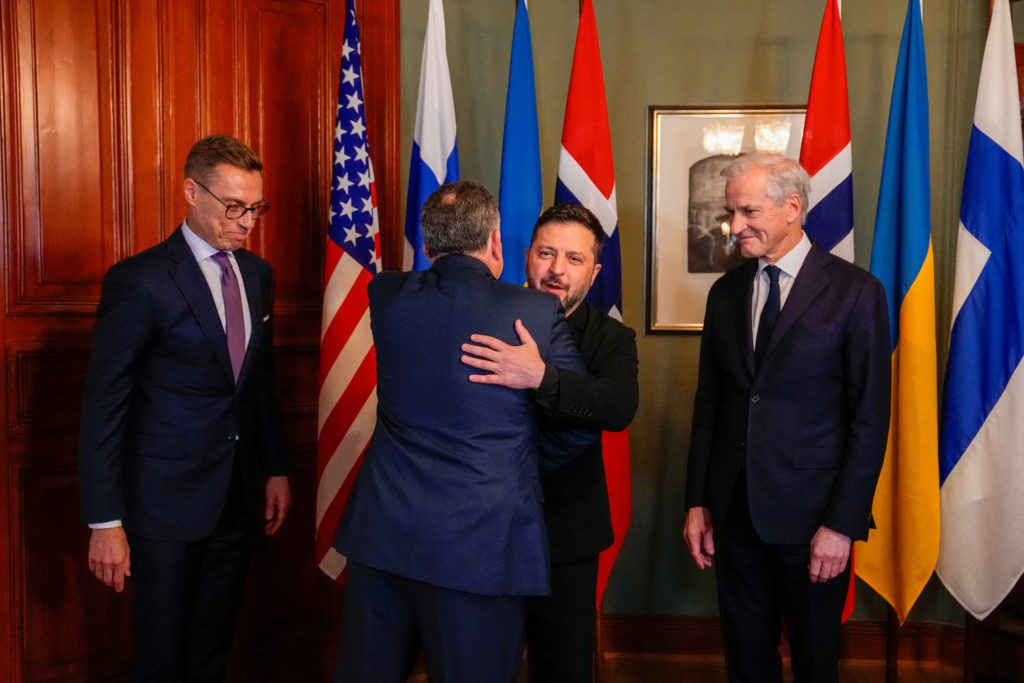
The meeting followed talks in Oslo on 20 October, where Witkoff and Jared Kushner met Zelenskyy alongside Norwegian Prime Minister Jonas Gahr Støre and Finnish President Alexander Stubb.

Following the St Petersburg meeting, Witkoff described the discussions as constructive and indicated that negotiations would continue at the technical level between representatives of the United States, Russia and Ukraine.

Putin reportedly expressed agreement in principle to restarting trilateral negotiations, potentially during the first half of November. However, no agreement on a ceasefire or suspension of Russian attacks was announced.

The meeting also attracted controversy after Witkoff praised Putin as a humanitarian following the release of Stephen Hubbard, a 74-year-old American citizen who had been detained in Russia for more than four years.

The remarks prompted criticism from Republican lawmakers in Washington, who questioned the characterisation of the Russian president while Moscow continued its military campaign against Ukraine.

Zelenskyy Calls for Pressure Rather Than Diplomatic Concessions

Zelenskyy characterised the overnight missile attack as evidence that Russia’s participation in negotiations had not produced any substantive change in its conduct.

He argued that diplomatic efforts to end the war should continue but must be accompanied by measures capable of altering Moscow’s military calculations.

Those measures, according to the Ukrainian president, include stronger air defence capabilities, faster deliveries of interceptor missiles, the ability to destroy Russian ballistic missile launchers and continued economic sanctions.

The latest attacks also place Ukraine’s air defence requirements firmly within the ongoing negotiations with Washington. Kyiv has repeatedly sought additional Patriot missiles and more reliable advance warning of Russian ballistic launches, particularly as repeated strikes place increasing demands on its interception capabilities.

For the Trump administration, the immediate question is whether Russia’s stated willingness to negotiate can produce verifiable commitments to reduce hostilities.

The Kremlin has offered the prospect of further talks without announcing a halt to its offensive operations. Kyiv, meanwhile, continues to face missile and drone attacks against civilian infrastructure even as discussions concerning a possible settlement proceed.

The events of 21–22 October leave Washington’s diplomatic initiative moving forward against the background of an expanding Russian aerial campaign, with no indication that Moscow intends to suspend its attacks while negotiations continue.

  •  
  •  

Trump Presses Ukraine Towards a Settlement Putin May Have No Intention of Accepting

Talks in Oslo have restored diplomatic contact between Kyiv and Washington, but Donald Trump continues to demand concessions from Ukraine while Moscow shows little willingness to compromise. Steve Witkoff’s forthcoming meeting with Russian officials will expose the limits of the American peace initiative.

The latest negotiations over Russia’s war against Ukraine have produced a renewed diplomatic initiative, with US presidential envoy Steve Witkoff preparing to travel to St Petersburg on Wednesday, 21 October, following consultations with Ukrainian and European leaders in Oslo.

President Volodymyr Zelenskyy met Witkoff alongside Norwegian Prime Minister Jonas Gahr Støre and Finnish President Alexander Stubb on Tuesday. Jared Kushner, Donald Trump’s son-in-law, participated remotely. The discussions covered territorial questions, security guarantees, sanctions and proposals for a partial ceasefire.

The meeting concluded with cautious expressions of optimism. Stubb suggested that the negotiating process was back on track, while Støre confirmed that Witkoff would present proposals developed by American, Ukrainian and European representatives to the Russian leadership.

However, the diplomatic improvement contrasts with Trump’s renewed public pressure on Zelenskyy, raising questions about Washington’s negotiating strategy and whether Moscow has any intention of accepting the proposed settlement.

Washington’s contradictory signals

Speaking in the Oval Office on Tuesday, Trump again insisted that Ukraine must reach an agreement with Russia, portraying Moscow’s military position as increasingly advantageous.

His remarks closely resembled arguments advanced during earlier disputes with Zelenskyy, when Washington pressed Kyiv to accept territorial concessions rather than increase pressure on the Kremlin.

Meanwhile, Secretary of State Marco Rubio sought to reassure the Ukrainian leadership that American military cooperation had not been deliberately restricted.

Rubio denied that Trump had ordered changes to intelligence-sharing or weapons assistance. Zelenskyy subsequently confirmed that Ukraine was again receiving American early-warning intelligence concerning Russian ballistic missile attacks.

Nevertheless, serious problems remain. Ukraine has reported delays in deliveries of American-made Patriot interceptors purchased by European allies, while restrictions affecting the military Starshield satellite communications system have not been fully resolved.

These difficulties are particularly serious as Russia intensifies attacks against Ukrainian electricity infrastructure, attempting to undermine civilian services ahead of winter.

The conflicting signals leave Kyiv negotiating with an administration whose diplomatic representatives promise continued cooperation while its president publicly demands Ukrainian concessions.

Security guarantees without NATO membership

Among the proposals discussed in Oslo were security arrangements intended to provide Ukraine with protection comparable to NATO’s Article 5 collective-defence provision.

Zelenskyy acknowledged that American representatives had discussed such guarantees, although their precise obligations and enforcement mechanisms remain undisclosed.

The proposal presents a fundamental negotiating problem.

Russia has consistently opposed Ukrainian NATO membership, partly because the alliance’s collective-defence commitments would increase the consequences of any renewed Russian aggression.

An alternative arrangement offering genuinely comparable protection would consequently encounter many of the same Russian objections.

Conversely, guarantees lacking a credible enforcement mechanism would leave Ukraine exposed to another attack after a ceasefire.

Moscow’s record provides little reassurance. Russia violated Ukraine’s internationally recognised borders in 2014 and launched its full-scale invasion in 2022 despite previous commitments to respect Ukrainian sovereignty.

The Kremlin’s objectives extend beyond territory

Washington’s approach appears increasingly concentrated on securing an agreement involving territorial concessions and restrictions on Ukraine’s future security arrangements.

Yet Putin’s objectives have consistently extended beyond the territories occupied by Russian forces.

The Kremlin has demanded constraints on Ukraine’s military capabilities, international alliances and strategic independence. Accepting territorial gains alone would not necessarily satisfy Moscow’s wider political ambitions.

Russian Foreign Minister Sergei Lavrov has maintained that Moscow is unwilling to make substantial political concessions, while the Kremlin continues to insist that any agreement must address what it describes as the underlying causes of the conflict.

Those conditions have previously included demands that would substantially restrict Ukraine’s sovereignty.

Consequently, even a Ukrainian willingness to consider elements of Washington’s proposals would not guarantee Russian acceptance.

The political calculation behind an energy ceasefire

One possibility under consideration is a limited ceasefire protecting energy and potentially food-related infrastructure.

Zelenskyy has indicated that Ukraine could suspend attacks against Russian energy facilities if Moscow stopped striking Ukrainian infrastructure.

Such an arrangement could reduce immediate civilian suffering. It would also have military and economic consequences.

Ukrainian attacks against Russian refineries, oil terminals and other energy installations have increasingly targeted infrastructure supporting Moscow’s war economy.

A temporary suspension could allow Russia to repair damaged facilities, restore production and stabilise export revenues. Without credible monitoring and enforcement, Moscow could exploit a limited agreement while leaving the wider conflict unresolved.

Trump has additional reasons to seek a rapid diplomatic result. With American congressional elections scheduled for 3 November, his administration is attempting to contain domestic fuel prices and demonstrate progress towards ending the war.

His recent decision to ease restrictions on Russian diesel exports has already provoked concern in Kyiv and European capitals over the potential financial benefits to Moscow.

The danger for Ukraine is that an agreement presented as a diplomatic achievement in Washington could provide Russia with economic relief without altering its military objectives.

The decision awaiting Washington

Witkoff’s visit to St Petersburg will establish whether Moscow is prepared to engage with the proposals developed in Oslo.

Putin could accept a temporary arrangement, particularly one suspending Ukrainian strikes on Russian energy infrastructure, while postponing discussions over territorial and political questions.

Alternatively, Moscow could reject the initiative and maintain its existing demands.

In either case, Washington will face a decision over the consequences of Russian intransigence.

For Kyiv, continued engagement with the United States remains essential because American intelligence, satellite communications and advanced air-defence weapons cannot readily be replaced.

But the prospects for a negotiated settlement will depend less on further Ukrainian concessions than on whether Russia faces sufficient political, military and economic pressure to abandon its maximalist demands.

The Oslo negotiations have restored cooperation between Ukraine, Europe and American mediators. They have not established that Putin is prepared to end the war on terms compatible with Ukraine’s continued independence.

  •  

Vance says Ukraine is a ‘partner’ but has some ‘divergent interests’ from US

Vice President Vance said Ukraine is a “partner” but has some “divergent interests” from the U.S. amid tensions between Washington and Kyiv. “Well, they’re certainly a partner in some ways, but I think we, you know, have some divergent interests from time to time,” the vice president said in an interview with 2WAY, talking about…

  •  

GOP’s Don Bacon rips Trump over ‘disgraceful’ behavior on Ukraine, Russia

Rep. Don Bacon (R-Neb.) on Monday went after President Trump for his recent behavior surrounding the Russia-Ukraine war. “It’s absolutely disgraceful our president is morally blind on this war. He’s pitched his lot in with the dictator and the war criminal, and he’s being harsh and undermining the democracy, the country that wants to be…

  •  

Darline Graham: ‘I would choose to keep the pressure on Russia’

Sen. Darline Graham (R-S.C.) said she would rather keep sanctions on Russia after President Trump signed an executive order to waive the penalties. “The president and I share the same goal, which is to end the war, get gas and diesel prices down, and the sanctions bill is one of the tools we can use…

  •  

Bessent says there was no sanctions relief for Russia after US diesel deal

Treasury Secretary Scott Bessent on Sunday said President Trump did not provide Russia with sanctions relief after striking a deal that allows Russia to supply the U.S. and global marketplace with diesel, despite signing a bill imposing sanctions — set to take effect soon — into law last month. NBC News’s “Meet the Press” host…

  •  

Zelensky says ‘of course’ Ukraine trusts the US, hopes Trump will ‘change his decisions’

Ukrainian President Volodymyr Zelensky on Sunday said “of course” his country trusts the U.S. but hopes President Trump will “change his decisions” after greenlighting a diesel deal with Russia. “Of course we trust America,” the Ukrainian leader told NBC News’s “Meet the Press” host Kristen Welker. “We trust bipartisan support and we trust president of…

  •  

Bessent: Zelensky ‘should be careful’ with ‘reckless’ comments that US slowed down Starlink

Treasury Secretary Scott Bessent said Sunday that Ukrainian President Volodymyr Zelensky “should be careful” with “reckless” comments about the U.S. slowing down Starlink. “President Trump and Secretary [of State Marco] Rubio have categorically said that no one in the Trump administration did that. And I think it is very reckless for President Zelensky to make…

  •  

Pence calls on Trump to restore sanctions, scrap Russia diesel deal

Former Vice President Mike Pence on Sunday called for President Trump to restore sanctions on Russia and condemned his recent diesel agreement with President Vladimir Putin.  “President Trump’s decision to waive sanctions against Russia as Putin continues his brutal war of aggression against Ukraine dishonors the legacy of the late Senator Lindsey Graham and is…

  •  

Zelensky warns US support of Putin is a ‘historic mistake’

Ukrainian President Volodymyr Zelensky advised the U.S. that supporting Russian President Vladimir Putin is a “historic mistake.” “If United States will support Putin, I mean, it’s unbelievable, it’s tragedy, it’s historic mistake and big tragedy. That’s why I think that I don’t want to live in illusions, but I think that we have to be…

  •  

Ukraine strikes St Petersburg with over 1,000 drones

Ukraine launched a massive drone attack on Russia overnight Sunday, striking a major oil terminal in St. Petersburg and a data center, knocking out power to thousands of residents and causing fires. Russian state media described the attack as “one of the biggest drone attacks of the year,” according to a translation from Russian. One…

  •  

St. Petersburg Oil Terminal Set Ablaze Amid Massive Wave of Ukraine Drone Strikes

Ukrainian attacks set an oil export terminal ablaze in St. Petersburg on Sunday, as Kyiv launched more than 1,000 drones across Russia in one of its largest ever aerial bombardments.

The post St. Petersburg Oil Terminal Set Ablaze Amid Massive Wave of Ukraine Drone Strikes appeared first on Breitbart.

  •  
❌