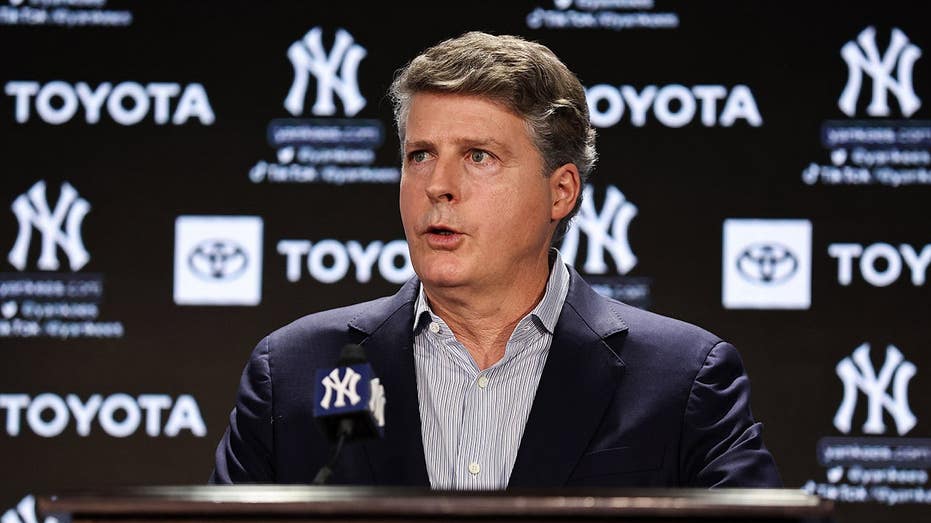
Hal Steinbrenner was not fond of answering questions about Major League Baseball's labor negotiations with the players' association, but he came as close as possible to answering a very important one.
When asked at the New York Yankees' postmortem presser if he was in favor of a salary cap, the team's owner said he "support[s]" the owners' proposals - all of which include a cap.
"I've said before - let me put it this way as a member of the labor policy committee - I helped craft, one of many, the proposals that we have given at the bargaining table. And I support those proposals in their entirety. That's absolutely the case, so that should answer your question," Steinbrenner told reporters.
"What I will say is as a member of the labor policy committee is that we are working hard on our end. We are completely focused on the task ahead of us, on the negotiating. And I'm optimistic we're gonna get a deal done, and we''e gonna get a deal done that's favorable for both sides."
Players have adamantly opposed a salary cap and said it is non-negotiable. The owners are expected to lock out the players on Dec. 1, when the current collective bargaining agreement expires.
The Yankees' $336 million payroll was the third-largest in baseball during the 2026 season, behind the Los Angeles Dodgers ($422 million) and New York Mets ($338 million).
Arguments skew both ways, but a constant has remained in that the highest payrolls continue to go up, while the lowest payrolls remain at a stall. The Marlins' payroll is actually roughly half of what it used to be in 2017, despite a sale of the team and everyone in the league making more money than ever. Meanwhile, the Dodgers have already committed more money in 2030 than 12 teams have this season.
MLB commissioner Rob Manfred has said that owners are simply "listening to our fans" regarding a salary cap and said it "defies human experience... to think that the bottom end of that [payroll] gap has the same opportunity to win the top end." It should be noted, though, that the National League-winning Milwaukee Brewers swept the Dodgers with the 11th-smallest payroll, and they will be facing the Tampa Bay Rays, who have the league's third-smallest payroll. They defeated the Cleveland Guardians, who rank 29th in payroll, in the American League Division Series.
Major League Baseball has never had a salary cap.
"Salary cap is the ultimate excuse not to compete. It's the ultimate excuse for an owner to say, ‘Gee, I would like to make the team better, but you know I can’t,'" interim MLBPA executive director Bruce Meyer said during the All-Star break. "Salary caps are bad for fans. Salary caps prevent teams from doing the things that they believe are in their interest to make the team better."
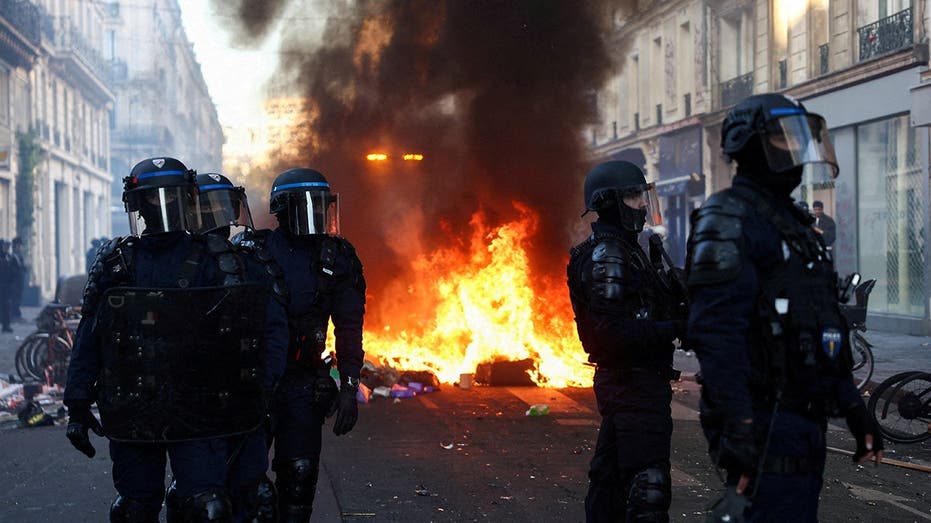
French President Emmanuel Macron vowed Thursday to ban protests by "individuals or groups with no legitimate authority" as he blamed "ultra-left groups" for riots and looting that spread across his country.
Macron made the remarks as thousands of protesters took to the streets of Paris on Thursday, according to The Associated Press, ahead of larger demonstrations set for this weekend.
"Last Saturday we had political and seditious acts by ultra-left groups whose aim is to bring down the Republic," Macron was quoted by Reuters as saying following a meeting with intelligence officials.
The news agency reported that businesses in central Paris have started boarding up their windows over concerns of violence on Saturday. Local authorities also told Reuters that protests planned for Saturday in Lyon have been banned.
Macron said the strategy adopted for the coming days is to ban protests requested by "individuals or groups with no legitimate authority."
"Where trade unions submit requests to hold demonstrations, prefects will examine them in accordance with the law, but alternative routes will be proposed" to protect city centers, businesses and public buildings, Macron said.
"The rules are simple, and I think they're just common sense. The general recommendation is that there should be no demonstrations in the coming days," he said. "For those who still want to protest, if they are trade unions, prefects will propose alternative routes."
Organizers of the Paris protest on Thursday said an administrative court in the city overturned a ban issued by police after they challenged it. The Paris police prefecture previously said the ban was necessary, given the risk of street violence after groups of masked youth clashed with police forces, looted shops and torched cars over the weekend.
The protests began in France in September with calls for education reform, before expanding into larger anti-government demonstrations that French officials say are being fueled by far-left groups.
Protesters gathered peacefully and chanted in the southeastern part of Paris on Thursday while they were watched by a heavy police presence, the AP reported.
Thursday's planned protests were seen as a prelude to Saturday's big demonstration, when activists from the "yellow vest" movement, whose demonstrations over fuel prices shook France in 2018 and 2019, and the CGT labor union, are expected to join.
Hal Steinbrenner was not fond of answering questions about Major League Baseball's labor negotiations with the players' association, but he came as close as possible to answering a very important one.
When asked at the New York Yankees' postmortem presser if he was in favor of a salary cap, the team's owner said he "support[s]" the owners' proposals - all of which include a cap.
"I've said before - let me put it this way as a member of the labor policy committee - I helped craft, one of many, the proposals that we have given at the bargaining table. And I support those proposals in their entirety. That's absolutely the case, so that should answer your question," Steinbrenner told reporters.
"What I will say is as a member of the labor policy committee is that we are working hard on our end. We are completely focused on the task ahead of us, on the negotiating. And I'm optimistic we're gonna get a deal done, and we''e gonna get a deal done that's favorable for both sides."
Players have adamantly opposed a salary cap and said it is non-negotiable. The owners are expected to lock out the players on Dec. 1, when the current collective bargaining agreement expires.
The Yankees' $336 million payroll was the third-largest in baseball during the 2026 season, behind the Los Angeles Dodgers ($422 million) and New York Mets ($338 million).
Arguments skew both ways, but a constant has remained in that the highest payrolls continue to go up, while the lowest payrolls remain at a stall. The Marlins' payroll is actually roughly half of what it used to be in 2017, despite a sale of the team and everyone in the league making more money than ever. Meanwhile, the Dodgers have already committed more money in 2030 than 12 teams have this season.
MLB commissioner Rob Manfred has said that owners are simply "listening to our fans" regarding a salary cap and said it "defies human experience... to think that the bottom end of that [payroll] gap has the same opportunity to win the top end." It should be noted, though, that the National League-winning Milwaukee Brewers swept the Dodgers with the 11th-smallest payroll, and they will be facing the Tampa Bay Rays, who have the league's third-smallest payroll. They defeated the Cleveland Guardians, who rank 29th in payroll, in the American League Division Series.
Major League Baseball has never had a salary cap.
"Salary cap is the ultimate excuse not to compete. It's the ultimate excuse for an owner to say, âGee, I would like to make the team better, but you know I canât,'" interim MLBPA executive director Bruce Meyer said during the All-Star break. "Salary caps are bad for fans. Salary caps prevent teams from doing the things that they believe are in their interest to make the team better."
The head of France's leading leftist trade union has called for strikes to support the youth riots after the government refused to meet demands for minimum wage hikes and more spending on education.
Fears over lack of scrutiny for key sectors as health editor position also to go in cuts aimed at saving £5.5m
The BBC will no longer have a dedicated education editor as part of a cost-cutting drive in which 100 jobs are to go across BBC News under a plan that school leaders described as “deeply regrettable”.
BBC staff have been told that the roles of education editor and social affairs editor are to be combined into a single position as part of a round of changes that will save £5.5m. However, prominent unions and campaigners are saying the reform will dilute scrutiny of two specialisms that are too important to go without a dedicated BBC role.
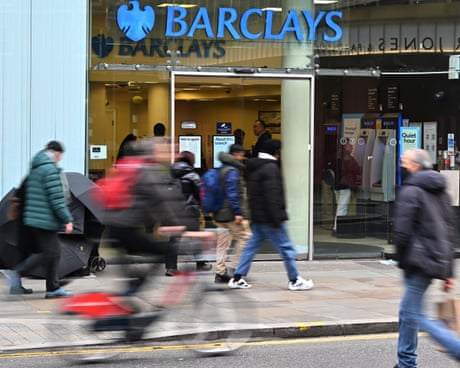
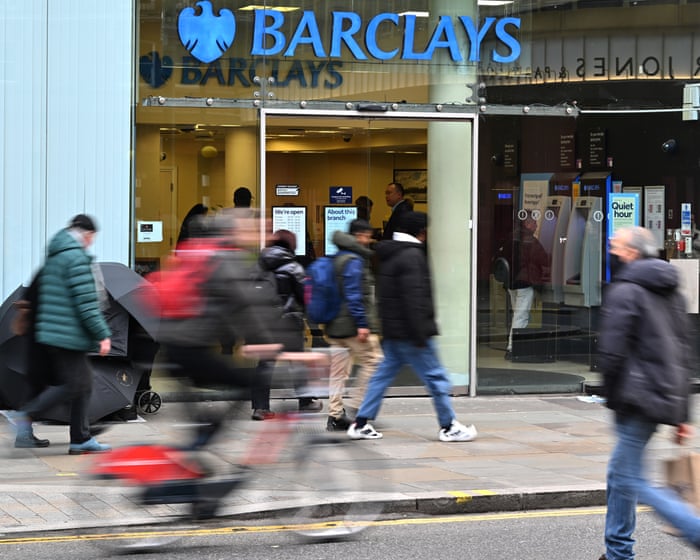
Barclays is cutting 5,000 jobs as part of wider cost-saving plans that its bosses say are being driven by advances in AI.
The job cuts will mean losing about 5% of the bank’s 93,000 global staff, with executives confirming they had already cut 1,000 workers since the start of the year.
This video report was collaboratively produced and is being co-published by Workday Magazine and The Real News Network
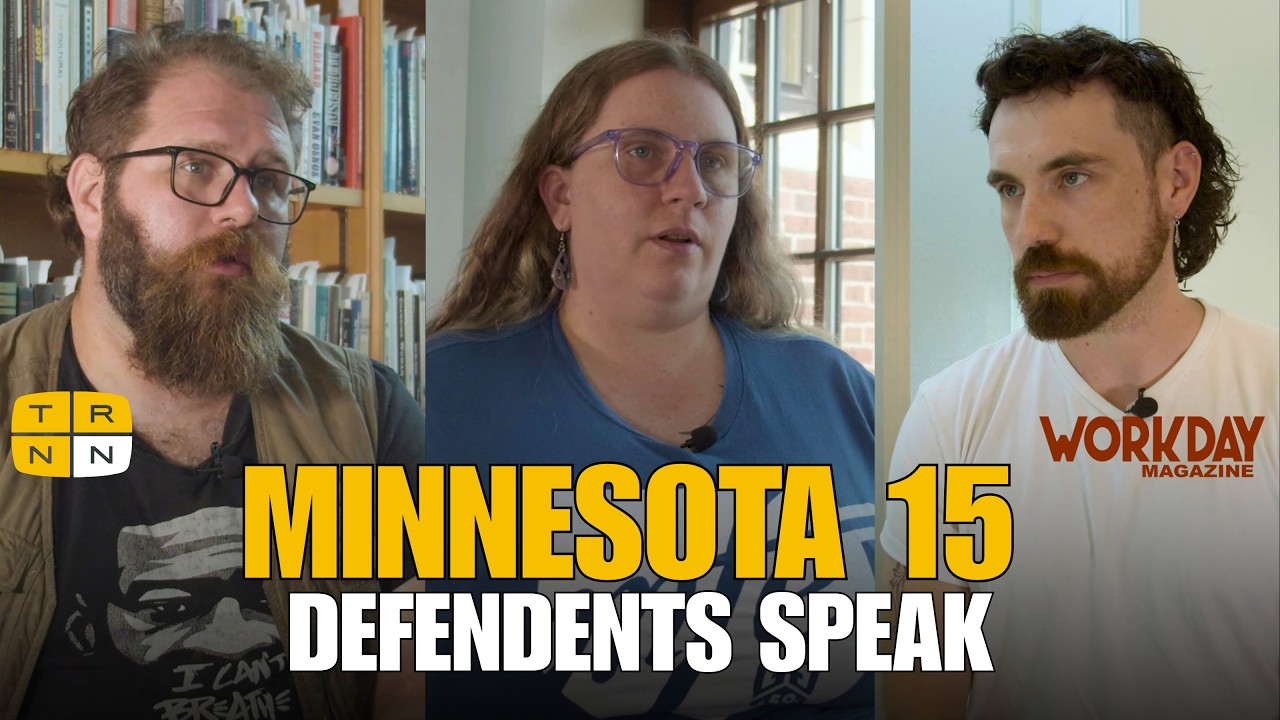
On the morning of June 16, 2026, 15 people were indicted by the federal government for their involvement in community organizing efforts to oppose Operation Metro Surge in Minnesota this past winter. This group of defendants have become known as the “Minnesota 15,” and over half of them are rank-and-file union members or former union members.
In this special report, collaboratively produced by Workday Magazine and The Real News Network, we speak with three of the “Minnesota 15” defendants about the charges against them and the Trump administration’s attacks on dissent and the labor movement today. Interviewees include: Treasure Thoreson (Minneapolis Federation of Educators, Local 59), Alec Stewart (Minnesota Association of Professional Employees), and Emmett Doyle (Northern Midwest Regional Council of Carpenters).
Credits (Workday Magazine):
Reporting and editorial support: Isabela Escalona, Sarah Lazare, Amy Livingston, and Amie Stager
Videography: Isabela Escalona and Amie Stager
Additional photos and videos: Amie Stager and Riley Bruce
Video editing: Isabela Escalona
Credits (TRNN):
Post-production: Maximillian Alvarez, Jocelyn Dombroski, David Hebden, Kayla Rivara
Special thanks to East Side Freedom Library, Minneapolis Central Library, Hosmer Library, and Minneapolis Federation of Educators.
Transcript
The following is a rushed transcript and may contain errors. It will be updated.
Treasure Thoreson:
Tuesday morning, June 16th, I had just woken up. I was in my pajamas. I hear a knock on the door at seven in the morning, and it’s a woman standing there in business clothes with a tactical vest on top that said Homeland Security.
Alec Stewart:
I was in my car backing out of my garage to go to work, coffee in hand. As soon as I backed out of my parking pad, several squads rolled up. A bunch of agents jumped out of the vehicles. I went to just text my aunt, because I have a dog. I assumed I’d be going to jail or something, and that’s when they smashed my window.
Treasure Thoreson:
I see six more agents standing in front of my house. The woman at the door, she just said, “We’re here with a warrant for your arrest for a conspiracy to harm or impede a federal officer.”.
Alec Stewart:
Exposes that while the government was targeting immigrant communities, tearing families apart, abducting children and murdering spokes in the street.
Emmett Doyle:
I had just typed in on my phone the location of the house that we were working on that day. I was boxed in by a vehicle, and so I rolled my window down to ask the guy like, “Hey, what’s the deal? You’re a pretty bad driver. What’s going on?” And then I looked around and I realized that my car had been surrounded. There was a swarm of armed federal officers with HSI on their uniforms.
Alec Stewart:
I do not think it’s a coincidence that over half of us are rank and file union folk. I think that speaks to, again, the working class nature of both the attack by the federal government and the working class predominant response to that attack.
Treasure Thoreson:
We had at least one person from every single site who was plugged into our committee and was able to get information out to their members and arm their building with the knowledge that they needed to face this kind of violence. And people stepped up in really major ways. Everybody did something, whether it was patrols or walking students to and from school, riding in a cab with a kid to and from school, making sure that their parents had rent money. There were some schools in the district that were delivering hundreds of boxes of food every week.
Emmett Doyle:
The unions that did get involved, I think understand what the labor movement is about in a way that some of our other unions have forgotten. An injury to one is an injury to all isn’t just a moral statement. It’s a hard reality of life. And the unions that stood up during Metro search understood that and demonstrated what solidarity means.
Treasure Thoreson:
We got a lot of great information from the Chicago Teachers Union who had been fighting back ice for months at the point when they came here. But we learned a lot from their struggle and were able to adapt that to fit what we were doing here in Minneapolis.
Alec Stewart:
And that was all without coercion, without money exchanging hands. That was just horizontal organizing. And I think how effective that is, how the power of mutual aid and horizontal organizing is evident because of this indictment. This wouldn’t have happened if what thousands of Minnesotans were doing hadn’t worked. I think the success of the January 23rd general strike speaks to that connection of the labor movement and just seeing the numbers and the outpouring of support for such a strike is historic.
Emmett Doyle:
I think that the general strike that happened in Minneapolis terrified the federal government. There were downtown, just hundreds of thousands of workers in the streets marching. And people have to remember this was severe sub-zero. It was a fantastic feeling of power and of joy and of resistance. And unfortunately, the next day that joy and resistance was answered tragically with the brutality of the beating and murder of Valence Preddy. But I think that the general strike was a major turning point in the regime’s logic of violence that they realized they couldn’t defeat the city.
Background music:
Stores are getting thin. There’s passing down that’s going on. Scabs anymore. We’ll put ourselves in union down this year of 34. Can’t you hear the mark? Either sign or behind. See the times get better when we hold that picket line.
Alec Stewart:
The revelation of Operation Puppet Master exposes that while the government was targeting immigrant communities, tearing families apart, abducting children and murdering our neighbors in the street, they were also attempting to disrupt and dismantle one of the facets of Minnesota that makes us so unique. And that is our strong and unified labor movement.
Isaac Sant:
This is not just an attack on me and my friends and our little group. This is an attack on our entire community. They were spying on us from day one. In fact, five days before Operation Metro Surge was declared on November 28th, they began spying on our organizations. These prosecutions were inevitable. Somebody was going to be on trial in there. If it wasn’t us, it was going to be somebody else. It was going to be one of you. We were being prosecuted for doing something that every single person that everybody and their mom in Twin Cities did to resist their federal occupation.
Emmett Doyle:
This case is meant to intimidate the entire community. It’s meant to tie up the time and efforts of many activists. But beyond that, as a conspiracy case, what they’re trying to do is set up a situation where they can expand and expand and expand the conspiracy. They’re trying to use our own solidarity and close-knit community against us through guilt by association.
Treasure Thoreson:
They want us to be separated. They want to separate out the good protestors from the bad protestor. I don’t want folks to feel afraid to stand up for their neighbor and do the right thing.
Alec Stewart:
It was such an obvious threat on what the Twin Cities is all about, which is community connections and helping each other’s neighbors. And the face of fascism, complacency, I think has no place. I think there was just a very justified feeling of standing up.
Emmett Doyle:
The support and solidarity towards us by our community has been overwhelming in just the most amazing way. I
Treasure Thoreson:
Think that they see our ability to bring people together as threatening. However, going after the 15 of us isn’t going to stop anything in Minneapolis or the Twin Cities because this is a place full of great organizers. We can’t let them bully us out of doing the right thing. We need to stand strong in our values and our morals and know that we are protecting our neighbors and that is the right thing to do. They’re afraid of us and that’s why we’re getting this response.
We speak with three union workers who are among the “Minnesota 15” defendants the Trump administration is targeting for organizing to defend their Minneapolis communities from ICE earlier this year.
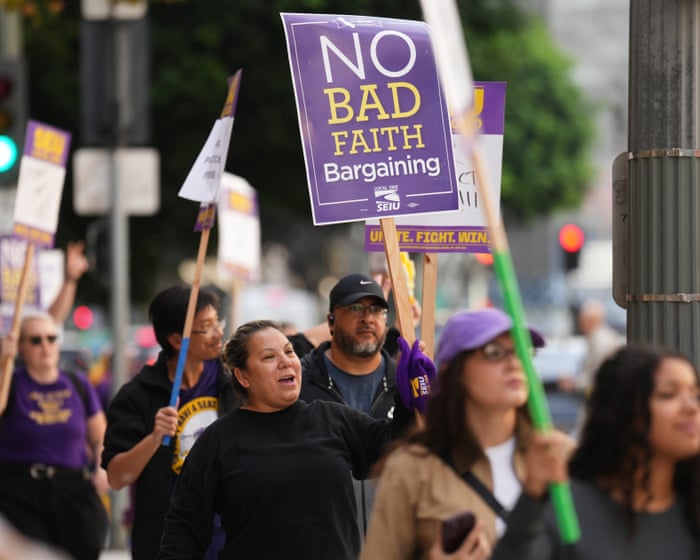
SEIU Local 1000, representing nurses and teachers, pushing for higher wages, telework and affordable healthcare
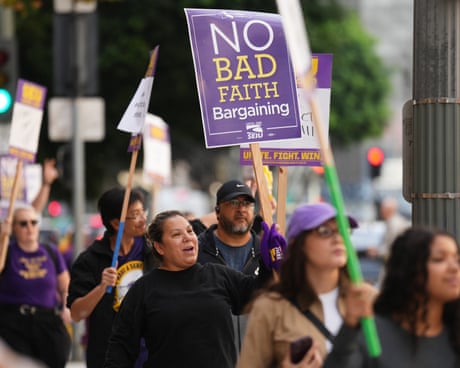
Thousands of California state workers began a sweeping one-day strike on Wednesday, with workers set to rally outside government buildings in several cities, as tensions boiled over lapsed contract negotiations with Governor Gavin Newsom’s administration.
SEIU Local 1000, a union that represents roughly 100,000 public employees, including nurses and teachers, has been pushing for higher wages, flexible telework and affordable healthcare.
The government is meeting today with the social partners as part of the Social Dialogue, at a time when trade union confederations are calling for an upward revision of the
UK defence secretary had been due to unveil proposals on Thursday until concerns were raised at 11th hour
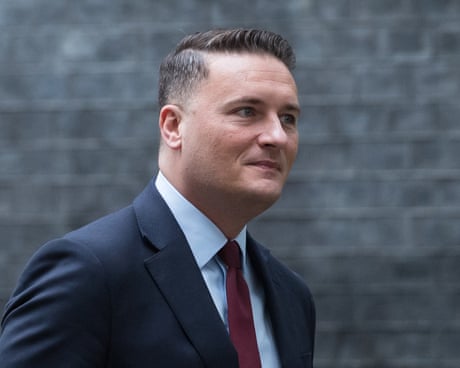
Wes Streeting has been forced to delay the publication of a plan to get more young people into defence industry jobs after pushback from trade unions, the Guardian understands.
The defence secretary had been due to announce the proposals on Thursday, but some unions in the sector are understood to have reacted angrily to the plans, accusing the government of bypassing their members and minimising their roles in job creation.
Union furious as bank scraps remote-first policy from February 2027, requiring all of its UK employees to come in at least twice a week
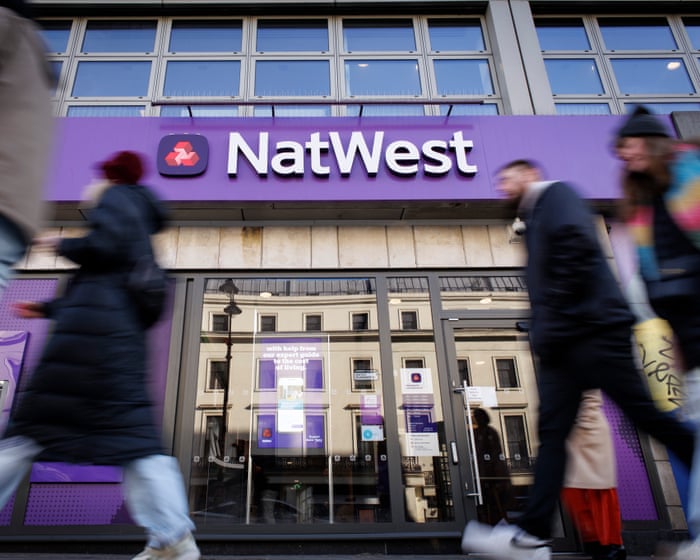
NatWest has ordered 13,000 staff to increase their in-office days from two days a month to two days a week, angering its staff union.
The banking group, which serves customers under the Royal Bank of Scotland, NatWest, Ulster Bank and Coutts brands, will require all of its nearly 40,000 UK staff to follow a strict two days a week office schedule from February 2027, abolishing a remote-first policy for thousands of employees.
The civil servants’ union federation ADEDY has called a strike on Wednesday, October 21, from 11:00 in the morning until the end of the day’s shift. The strike action applies to all employees, regardless of their employment terms, in public-sector services throughout the country. Supported by pupils and university students, the teachers unions have called […]
At a protest against a bill to legalize Waymo in Washington, D.C., earlier in October, the main tagline was: "Robotaxis don't vote; we vote." Little is known about the group behind it, raising questions about who's fueling the pushback against robotaxis in America's major cities.
People First Transportation Alliance (PFTA), the organization in question, describes itself as a "statewide coalition of labor unions" dedicated to putting "people over untested technology." The PFTA states it's a "coalition of community organizations, safe-streets advocates, and faith leaders." However, as The Washington Postreported on Monday, the group appears to have overstated its affiliation with four of the 13 individuals and organizations listed as its founding members.
"Several groups and individuals said statements made about them on the Transportation Alliance website were inaccurate," the Postreported, adding that PFTA "appears to be newly formed, with a minimal social media presence. Its website domain was created in late April, according to the Internet Corporation for Assigned Names and Numbers." The group created its social media accounts in May, but it has no posts and no followers.
Apart from its recent interest in the nation's capital, the PFTA lists New York and Philadelphia as its priorities, two cities led by lawmakers who publicly oppose Waymo's presence. Yet for a relatively unknown, recently created organization, the PFTA has found success in its campaign to shut autonomous vehicles like Waymo out of America's Northeast.
In February, the New York Postreported that Gov. Kathy Hochul (D–N.Y.) withdrew her own proposal—which would have allowed commercial robotaxi services such as Waymo to operate in smaller cities in upstate New York—after a PFTA-led coalition prompted enough backlash to kill support for the measure. A Hochul spokesperson told the Post that it was "clear that the support was not there to advance this proposal."
The PFTA told the Post that the organization would urge the state to "pass legislation requiring a human driver behind the wheel in every vehicle and a comprehensive study leading to a plan to address the impact driverless cars would have on New York State."
The group's resolution comes despite customer support for autonomous vehicles: A 2025 study on Waymo, Uber, and Lyft by Obi—a company that aggregates real-time rideshare prices—found that 70 percent of riders who've used Waymo preferred it over Lyft or Uber and 42.7 percent of all respondents were willing to pay Waymo's premium price (up to $10 more) to use the service.
Despite consumer support, autonomous vehicles can't count on a fair shake from lawmakers in some of the country's largest cities. In New York City, Waymo's permit to operate a pilot program on public streets expired in March. Mayor Zohran Mamdani has so far been noncommittal on renewing the company's permit. At a press conference that same month, he said his administration would be prioritizing workers such as the city's taxi drivers who "for far too long, have been sold a dream of being able to work their way to the middle class, only to have the rug pulled out from under them."
Despite the mystery surrounding the PFTA, its D.C. protest drew enough public support to elicit a statement from a person who will likely be the city's next mayor, current D.C. Councilmember Janeese Lewis George. In a post on X, Lewis George said D.C. was "facing a jobs crisis" that would be exacerbated by "rushing the legalization of autonomous vehicles." She urged the D.C. Council—which is currently considering a punitive proposal to legalize commercial autonomous vehicles—to "get this right and not rush Waymo legislation this year."
It's unclear how much longer Lewis George wants the District's residents to wait before autonomous vehicles are available for use. D.C.'s approach to legalizing commercial robotaxis hardly seems rushed.
Waymo began testing its vehicles in the city nearly two and a half years ago, in spring 2024. The company's co-CEO Tekedra N. Mawakana said its fleet has driven "more than 300,000 miles in Washington, D.C."Meanwhile, the District Department of Transportation (DDOT) has been conducting studies and organizing working groups on autonomous vehicles for nearly a decade. Still, the agency has been unable to draft a regulatory framework that would eventually enable commercial robotaxi use in the nation's capital. In March, UrbanTurf reported that DDOT would be conducting a long-awaited study on autonomous vehicles—originally due in 2022—and "expects to propose recommendations on AV deployment later this year."
Opponents of autonomous vehicles, such as Lewis George and the PFTA, often cite job loss as a reason not to legalize the tech. Still, with only 200 full-time ride-share drivers in a city of roughly 400,000 workers, as Lewis George has reportedly stated, the situation is a far cry from a crisis.
As for PFTA's public safety claims, Waymo's independently reviewed data show that, compared with an average human driver over the same distance, its vehicles caused 95 percent fewer serious-injury-or-worse crashes and 93 percent fewer pedestrian crashes with serious injuries.
PFTA claims it represents the people most directly affected by transportation policy. The little publicly available information suggests the group is more focused on protecting its members' position in the ride-share market than enhancing the experience of riders, who are increasingly opting for robotaxis when given the opportunity.
EU ministers have discussed how to make labour standards compatible with modern technological conditions and workplace culture, such as telework and AI-led staff oversight, without losing competitiveness.
The law in question, called the Quality Jobs Act, covers a wide range of work protection measures, such as common standards for being able to ‘go home’ and disconnect from remote work, and limits to AI role in recruitment or its scrutiny of workers’ performance.
Technological innovation should “benefit both workers and businesses,” said Portuguese labour minister Maria do Rosário Palma Ramalho, addressing the ministers’ council on Monday (19 October) in Luxembourg.
Human oversight is essential, especially where AI systems decide on recruitment or workers’ assessment, she said.
Next to innovation, labour rules needed to ensure “fair and transparent practices, respect for human workers’ rights … and effective social dialog,” said Roxana Mînzatu, the EU commissioner for employment.
“This revolutionary technology has to be regulated” so that it “delivers for all,” Isabelle Schömann, the European Trade Union Confederation (ETUC) deputy general secretary had also said during a conference organised by the centre-left S&D group in the European Parliament on 14 October, commenting on the need for the Quality Jobs Act to curb AI.
The draft Quality Jobs Act that the European Commission plans to present in December aims to update the long out of date 1989 and 1990 health and safety workplace rules.
It would also protect subcontractors and create standards for working in heatwaves, becoming more frequent with climate change.
EU legislators need to ensure minimum standards so that “neither jobs nor businesses are jeopardised” with extreme weather, Yolanda Díaz Pérez, the Spanish labour minister, said ahead of Monday’s debate.
This article continues, but the full version is available only to EUobserver.com subscribers. Visit account.euobserver.com/membership
More than 160 offshore rig workers plan walkout amid rising tensions between unions and oil companies
North Sea workers are preparing to strike at oil rigs across the ageing basin over the coming weeks in a sign of growing tensions between trade unions and oil companies.
The Unite union said on Monday that more than 160 offshore rig workers would take part in a 24-hour strike from Wednesday that could “severely disrupt” UK fuel supplies.
As the Trump administration's short-lived Department of Government Efficiency (DOGE) project implemented its plan to downsize the federal workforce, there was much wailing from the liberal institutions in Washington, D.C.
Federal employee unions filed lawsuits to block the effort. NPR ran profiles of federal workers who, for the first time, faced the prospect of potentially not having absolute job security forever. The Brookings Institution wondered how many jobs the federal government could shed before it crashes.
The answer: plenty. The Trump administration has cut more than 10 percent of the federal workforce, and the government hasn't crashed. Indeed, it hasn't even shrunk—if you're counting by dollars spent instead of people employed.
In a new article for City Journal, Manhattan Institute senior fellow Judge Glock highlights the tremendous gap between the dire predictions about DOGE's cuts and the reality that has emerged, more than a year after DOGE was shut down. Despite having only a modest impact on spending, Glock writes, DOGE "had a massive impact on the federal civil service."
This is true—to a point, more on that in a moment—and notable. Aside from a modest downsizing in the 1990s, the number of people employed by the federal government has been steadily growing for decades. Reversing that trend is one of the few genuinely libertarian accomplishments by the Trump administration.
The cuts to the federal workforce prove that "DOGE worked," argues Glock.
Well, hold on.
Elon Musk and Vivek Ramaswamy (who departed the DOGE project before Trump's inauguration and is now running for governor of Ohio) set some very ambitious goals after being appointed DOGE co-chairs in late 2024. In an op-ed for The Wall Street Journal in November 2024 where they promised "we won't just write reports or cut ribbons. We'll cut costs."
Yes, Musk and Ramaswamy also said they would reduce the federal workforce. But that was presented as a natural consequence of cutting spending, not as the primary goal.
Think about it like this. If I spent months promising my friends and family that I would lose 50 pounds on a new diet, and then didn't lose any weight, would it be fair to say the diet worked?
What if I reduced the number of donuts I eat every day, but still didn't lose any weight? Sure, that might be good for my health in some way—just like reducing unnecessary workers in the federal government is good for America's fiscal health—but it certainly wouldn't mean I had achieved the goal of losing weight.
Finally, even the claim that DOGE cut the federal workforce requires an asterisk. As Glock also notes in his report, the decline in federal workers has been offset by an increase in federal contractors.
It's not a one-for-one trade, of course. The new contractors are overwhelmingly concentrated in places like the Department of Homeland Security and the Pentagon, while the cuts mostly targeted other areas, like the Department of Health and Human Services.
"Most of that increase came from the buildup in homeland-security and defense contracting, including purchases such as surveillance aircraft and tanks, rather than substitutes for government workers," Glock writes. "DOGE achieved real contract savings, but these were more than offset by higher spending elsewhere, reflecting a shift in priorities rather than an overall reduction in contracting."
So, the government is eating fewer donuts but more pizza.
There might be libertarian reasons to prefer contractors over government employees. They are less likely to hold those jobs for life, for one. But there's nothing inherently good about a government policy that cuts jobs in some areas just to create more room in the budget for poorly trained immigration enforcement agents and defense contractors. That may even be a negative outcome for liberty.
In the end, the DOGE project looks less like a meaningful attempt at cutting government spending or employment levels and more like a way to purge parts of the federal workforce likely to get in Trump's way during his second term. "As long as [Trump's] larger commitment is to extending his power rather than rolling back power itself, you shouldn't expect the government to stop growing," as Reason's Jesse Walker wrote last year in comparing DOGE to President Richard Nixon's attempted purge of the civil service.
Did DOGE work? Only if you grade it on a pretty dramatic curve.
Yes, it proved that a president can slash bureaucratic jobs—particularly the bloated managerial and administrative types—without doing much damage to the government's core responsibilities. That's a lesson future administrations should remember.
Maybe, someday, a president will try applying the same logic to government spending too.
French authorities are preparing for hundreds of demonstrations on Saturday, 17 October, as student unrest converges with protests over living costs, public spending and government policy. Up to 40,000 demonstrators are expected in Paris, where police and organisers remain divided over march routes.
France is preparing for a nationwide wave of demonstrations on Saturday, 17 October, with approximately 500 protest actions under consideration and more than 90 marches being organised, according to the Interior Ministry. The mobilisation brings together high-school students, trade unions, farmers and supporters of the Yellow Vest movement, raising the prospect of further confrontation after nearly a month of unrest.
Police estimates suggest that around 40,000 demonstrators could gather in Paris, with approximately 150,000 more expected elsewhere in France. The figures remain preliminary, while authorities warn that some protests could involve road blockades, disruption to essential infrastructure and violent clashes.
Interior Minister Laurent Nuñez initially outlined preparations for 250 gatherings and 80 marches on Friday morning. Subsequent assessments from his office indicated that as many as 500 actions were being considered, although not all had been formally organised.
Paris Faces Dispute Over Demonstration Routes
The authorities are particularly concerned about developments in the capital, where negotiations between police and protest organisers have failed to produce agreement over the proposed routes.
Paris police prefect Patrice Faure has rejected proposals for marches terminating near the Opéra district or Place de la Concorde, citing security concerns surrounding central government institutions.
According to details of the security preparations, police have proposed an alternative route between Place de la Bastille and Place de Clichy. The CGT trade union and climate campaigners have accepted the proposal, but student organisations and Yellow Vest representatives continue to oppose it.
Prime Minister Sébastien Lecornu has convened an interministerial crisis unit to coordinate the government’s response. Security officials have warned that attempts to obstruct major transport routes or critical infrastructure will not be tolerated.
The Interior Ministry has also indicated that stun grenades, whose use was suspended during the student protests, could again be deployed in cases of particularly serious urban violence.
Yellow Vests Return Amid Rising Living Costs
Saturday’s demonstrations are being promoted as a revival of the Yellow Vest movement, which emerged in 2018 following opposition to fuel taxation before developing into a broader protest against living costs, economic inequality and government policy.
The latest mobilisation has gathered support from organisations demanding measures to address rising fuel, energy and food prices. Campaigners are also challenging the government’s proposed 2027 budget and its implications for public services.
The agricultural union Confédération paysanne has called on farmers to join the demonstrations, arguing that rising agricultural fuel costs and deteriorating conditions in rural communities have increased pressure on producers.
The union has also linked its demands to environmental policy, public-service provision and access to affordable food.
The CGT, student unions and climate organisations have similarly expressed support for the protests, while political backing has come from La France Insoumise and the French Communist Party.
Student Protests Enter Their Fourth Week
The mobilisation follows weeks of demonstrations involving secondary-school pupils, teachers and public-sector workers. What began as protests over shortages of teachers, overcrowded classrooms and deteriorating school buildings has developed into a nationwide confrontation over education policy and policing.
As EU Today previously reported, between 400 and 500 secondary schools faced partial or complete disruption earlier this month as students organised blockades and demonstrations.
The movement has subsequently expanded beyond its original educational demands, with student organisations raising concerns about university admissions procedures, police tactics and government spending priorities.
The scale of the unrest has placed considerable pressure on French authorities. According to figures from the Justice Ministry, 6,877 people were placed in police custody during the protests between late September and 8 October, approximately 86 per cent of them minors.
Violence during the demonstrations has resulted in injuries among police officers, students and educational staff. Clashes on 8 October led to 504 arrests and injuries to 48 police officers, according to Interior Ministry figures.
Education Minister Édouard Geffray has announced emergency measures to address teacher shortages, including the deployment of replacement teachers. The ministry says 2,000 of the 3,000 promised replacements have already been assigned, but student organisations maintain that the measures are insufficient.
Growing Pressure on the French Government
The planned demonstrations come as France faces a difficult debate over public spending, taxation and the 2027 budget. Lecornu’s government must balance demands for higher salaries and increased investment in education against mounting pressure to reduce the deficit.
France’s deteriorating public finances have already attracted scrutiny from eurozone partners, while domestic opposition to spending restraint has become a central issue ahead of the 2027 presidential election.
The convergence of student organisations, trade unions and Yellow Vest campaigners could broaden the protests beyond the education sector, particularly if demonstrations over living costs attract participants who have not joined the recent school protests.
However, the extent of that mobilisation remains uncertain. Online protest maps contain substantially more proposed actions than the authorities’ estimates, and participation figures will not be established until Saturday.
For the government, the immediate test will be whether the demonstrations remain peaceful and whether the authorities can prevent disruption to transport networks and public services without provoking further confrontations with protesters.
Thousands protested budget cuts and economic reforms as clashes with police erupted in several Colombian cities.
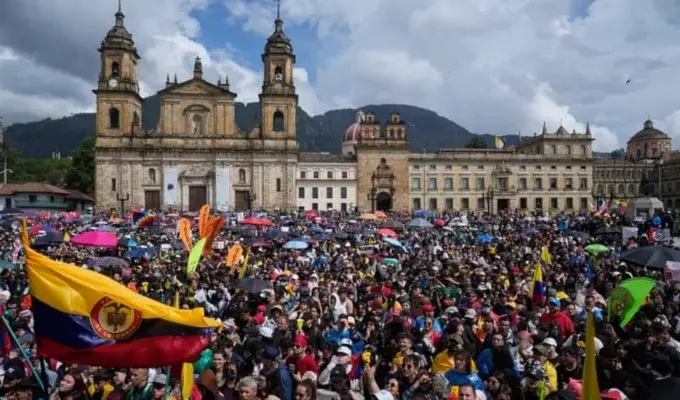
Thousands of people took to the streets across Colombia on Wednesday in the first national strike against President Abelardo de la Espriella’s administration, as police used tear gas, rubber bullets and armored vehicles to disperse demonstrators in several cities.
Protests spread across more than a dozen departmental capitals and municipalities, including Bogotá, Medellín, Cali, Barranquilla, Ibagué, Popayán and Bucaramanga. In Bogotá, four columns of demonstrators converged on Bolívar Square under a security operation monitored by a Unified Command Post.
In Medellín, demonstrations escalated into clashes between protesters and the Mobile Anti-Riot Squadron (ESMAD). Security forces deployed tear gas, rubber bullets and armored vehicles, leading to several arrests. Assaults on members of the press were also reported.
Clashes and serious public disturbances were also recorded in Ibagué and Popayán following police interventions. Human rights organizations, including the NGO Temblores, denounced the presence of armed men carrying rifles on the rooftops of government buildings in Bogotá, describing their deployment as a direct threat to protesters.
The demonstrations brought together trade unions, teachers, university students, Indigenous communities, LGBTQ+ groups and feminist organizations. Opposition figures, including former President Gustavo Petro and Senator Iván Cepeda, also took part.
Protesters called for labor, education and social protections, seeking to preserve measures introduced under the previous administration, including free access to public universities and increases in the minimum wage. They opposed what they described as a neoliberal shift under De la Espriella’s government, citing budget cuts and the administration’s initial economic reforms.
Colombianos:
Me dirijo a ustedes esta noche para entregarles un balance claro, objetivo y contundente de la jornada de manifestaciones que vivió hoy nuestro país.
¡Que quede absolutamente claro! El 98% de las movilizaciones transcurrió de manera pacífica.
Text Reads: Colombians: I address you tonight to deliver a clear, objective, and unequivocal report on the day of demonstrations that our country experienced today. Let it be absolutely clear! 98% of the mobilizations took place peacefully. The vast majority of those who took to the streets exercised their legitimate right to protest in an orderly and respectful manner toward the institutions. That is democracy, and as President of the Republic, I will always defend and guarantee it. At the close of this day, the national tally records a total of 62,000 citizens mobilized. A figure that represents a very small proportion of the Colombian population, but whose rights and guarantees deserve the full respect of the State. From the first day of my Government, I have issued a directive that admits no interpretations: peaceful protest is respected, protected, and guaranteed. But violence, vandalism, and any attempt to violate the rights of others will have no place under my mandate. Because as legitimate as the right to demonstrate is the right of millions of Colombians to work, move freely, and live in tranquility. Here there is a State, here there is authority, and here there is a Government that respects freedoms, enforces the law, and protects the millions of Colombians who rise early every day to work and build the Nation. Firm for the Nation! Long live Christ the King! (A.D.L.E.)
Demonstrators also rejected the restoration of diplomatic relations with Israel and what they described as U.S. interference in Colombia’s affairs.
Tensions mounted after the government signed a decree hours before the marches that changes the rules governing police conduct during public demonstrations. De la Espriella defended the measure as necessary to combat “urban terrorism,” while opposition politicians and social organizations condemned it as an attempt to intimidate protesters.
Senator Cepeda warned that the decree risked returning Colombia to a situation in which fear enabled arbitrary actions by security forces.
“They want to take us back to a time when fear becomes the means through which the security forces act arbitrarily,” Cepeda said.
Trade union sources said organizers were already drawing up a schedule of further mobilizations for the coming months following Wednesday’s mass protests. The campaign could culminate in a general strike in November.
This story originally appeared in Jacobin on Oct. 12, 2026. It is shared here with permission.
Speaking with members of the newly formed AutoZone Workers Union, you would never guess that one of them had just been fired — and that another would be the next morning. That’s what happened to Nathan DuCongé and then David Valencia after they won their union election. On a Zoom call with Jacobin, though, their joy was contagious. DuCongé and his coworkers were all smiles and banter as they talked about their union campaign, how it feels to win, and the unexpected boost they received from filmmaker Boots Riley.
On Friday, September 25, an AutoZone store in White Plains, New York, became the first of the company’s nearly seven thousand American retail locations to unionize. DuCongé and his coworkers, now members of United Auto Workers (UAW) Local 259, said they hadn’t been sure which way the vote would go.
“The deck was really stacked against these workers trying to organize here,” said Brian Murray, an experienced organizer brought on in August by UAW Local 259 Vice President Mike DiGuiseppe. “It was because of their sticking together, the amount of fun they have, and their camaraderie, their solidarity for each other, [that] they were able to overcome a lot of union busting.” He added, “I would have expected [them] to not have succeeded in winning that vote, but they did.”
“We Were Already a Union”
DuCongé moved to New York City two years ago and soon started working for AutoZone as a part-time employee. A year later, he became a parts sales manager. He said he decided to start organizing his store after he was removed from the schedule one Saturday in April, and instead went to a joint meeting of the Emergency Workplace Organizing Committee (EWOC) and the New York City Democratic Socialists of America (NYC-DSA). There he was connected with UAW members who encouraged him to unionize.
By then, DuCongé and Valencia, who was hired several months after him, had already discussed the possibility of a union. Valencia’s turning point came in 2025, when he worked a Fourth of July shift and found out from his paycheck that he wasn’t getting holiday pay. “I went in and I told my manager that day . . . I’m going to make a union.”
“I know this isn’t always the case, but for us, it was already there,’ said Valencia. ‘We were already a union.“
Valencia said he already knew DuCongé’s political orientation when he approached him about unionizing. “We got to talking about it, and it took a long time because we didn’t have the institutional knowledge on where to even begin, until by chance Nate met someone at a DSA meeting. They hooked us up with the UAW, and the rest is history.”
Given the store’s small size, the workers’ specific grievances, and the tight-knit relationships among several key employees, DuCongé and Valencia felt it would be a good place to test whether AutoZone could be organized.
“I know this isn’t always the case, but for us, it was already there,” said Valencia. “We were already a union.”
Do the Job Right
Juan Accostupa, a full-time sales associate who has worked at AutoZone for ten years and trained many of the organizers, described the extra responsibilities workers take on. “We’re not just a retail place. We do a lot of work,” he said. “We unload the trucks, we do installations — batteries, headlights, brake lights, wiper blades, whatever the case might be — and we’re just not getting paid properly.”
“You’re expected to do a lot for so little,” said DuCongé. “These are the kind of things that mechanics are paid to do, right?”
Accostupa said he has made minimum wage throughout his tenure at the store. “Some people think this is, like, a revolution thing. It’s not. We’re just asking for what should be done: better pay and better benefits. That’s it.”
Jess Omelia, a part-time commercial driver who previously worked for a Pepperidge Farm warehouse in Florida with “really great benefits,” said working for minimum wage with little to no benefits was a huge adjustment. “It was a job that I needed at the time, so I took it.”
“Some people think this is, like, a revolution thing. It’s not. We’re just asking for what should be done: better pay and better benefits.“
Omelia said the lack of holiday pay for part-time employees came as a shock. She recalled being put on the schedule for Mother’s Day even though she was the only one among her coworkers with a toddler. “I was the only one there working on Mother’s Day,” she said. “It was only my store manager there. He had given everyone the day off or people had called out to be with their families.”
Workers also cited other reasons for unionizing: inconsistent and last-minute scheduling, inadequate equipment, no say in how they handle their routine responsibilities or in disciplinary procedures, and a push to upsell customers known as “WITTDTJR” — short for the AutoZone slogan “What It Takes To Do the Job Right.”
“We would literally come in and underneath the [sales] numbers every day, there would be a threatening note underneath that you need to get these numbers up,” said Omelia. “You would be punished and your hours would be taken away if you weren’t upselling.”
What Makes a Supervisor?
Workers said their card drive proceeded with little incident until July, when corporate got wind of it. After the workers sent their demand letter and submitted their cards in late July, AutoZone promptly rejected them, saying DuCongé’s involvement as a parts sales manager — a position the company says is supervisory — nullified them.
DuCongé disputes that categorization. Under the National Labor Relations Act, a supervisor must have the authority, using independent judgment, to make or effectively recommend decisions like hiring, firing, disciplining, or promoting other workers — authority DuCongé said he did not have. Rather than fight the issue, which could have delayed an election, the workers resubmitted the cards without him.
“I just felt like it would be selfish if I tried to fight for my eligibility,” said DuCongé. “I never wanted to stand in the way of these people. They’re my friends, my coworkers. It was a good feeling to be able to just help.” He added, “As a member of DSA as well, I felt that as a responsibility. It was kind of like, hey, look, I’m in this organization, I might as well do something that lives up to the organization and the reason why I’m in it.”
Workers said that at a prehearing meeting in late August, AutoZone made clear that it intended to challenge the election not before the National Labor Relations Board but in federal court in Tennessee, where the company is based. At the same meeting, the workers and AutoZone signed an agreement that locked in the list of eligible voters to prevent challenges to votes on election day.
Yet other employees who hold the same position as DuCongé were allowed to vote. Two workers who were transferred to the store in mid-August were also deemed eligible.
“We Will Accept Your Invitation to Fire You”
In the lead-up to the vote, workers reported being subjected to heavy surveillance, multiple antiunion meetings per week, and threats of disciplinary action against the organizers.
“We were having three meetings a week. It was constant . . . and they were really just reading off of a script every time,” said Omelia. “It was just all anti-union. They were extremely against it, said that they would do everything in their power to fight it. If we didn’t like the conditions, [they said] that we could quit and go to another store.”
Valencia said the anti-union messaging relied on half-truths and accusations, including misleading claims about union dues and employees’ ability to communicate with their manager. Organizers, he said, were accused of misleading or threatening workers into voting yes, and were portrayed as using the campaign to land union jobs paid for by workers’ dues.
Workers said AutoZone brought in managers from locations around the country to surveil the store. “There were up to eight, nine people in the store a day, and even the customers were like, ‘What’s going on?’” said Omelia. “There would be times where they’re literally just standing at the back of the store with their arms crossed, just watching us.”
DuCongé said that after the workers submitted their demand letter on July 24, an account under the name of AutoZone CEO Philip Daniele showed up among the viewers of one of his Instagram stories.
In a September 4 recording shared with Jacobin, management threatened to fire DuCongé for union activity on the grounds that he was a supervisor: “If you continue to involve [yourself] in unionization activity, we will accept your invitation to fire you.”
LaborLab, a workers’ rights watchdog group, estimates that AutoZone spent around $200,000 trying to defeat the union. “They do everything except pay you more,” said Murray.
AutoZone in Six
Despite the onslaught of anti-union activity, the workers said the solidarity they felt with one another kept them moving forward. When Omelia’s mother died, her coworkers took up a collection. “I came into work, and they had a little envelope, and they all pitched in to help with my mom’s funeral costs. That’s how close we are.” Accostupa was quick to point out that every manager declined to contribute.
Support also came from outside the store. DuCongé, a filmmaker himself, had posted on social media about how inspiring he found Boots Riley’s new film, I Love Boosters. To his surprise, Riley started reposting updates on their organizing efforts. His first feature, Sorry to Bother You, follows a group of telemarketers who organize and go on strike.
“Boots has been massively influential on my personal life, my filmmaking efforts, but also really, really influential for this campaign,” he told Jacobin. “The solidarity is going beyond the movies and TV shows that he makes.” He added, “I just can’t thank him enough, truly, for helping us out.”
Workers said management kept talking to employees about the election in the twenty-four hours before the vote — and even during it. “On the day of voting, during voting happening, managers were pulling some of those people out of the store, and trying to sway those votes,” said Omelia.
Barred from voting and, he said, from entering the store, DuCongé stayed nearby. He recounted the moment:
I didn’t know what to do with myself, so I just stand on this hill that’s looking down at the store . . . I felt locked onto the ground, and there’s this groundhog sitting right next to me, just also looking out there too. I’m looking at the groundhog, and then eventually it just looks at me, like, “What are you looking at?” It turns out we’re both just looking down at the store. There’s this beautiful sunset and all these crows and everything, and that’s when Mike [DiGuiseppe] texted us the news, and said, “You won.” I just collapsed.
The final tally was 6–4 in favor of the union. Despite the prehearing agreement, and despite his serving as the union’s election observer, Valencia’s vote was challenged during voting, but, in the end, every eligible vote was counted.
After the Win
The day after the vote, AutoZone fired DuCongé. In a recording provided to Jacobin, management tells him: “Effective immediately, AutoZone is terminating your employment as a result of the failure to act appropriately as a manager by engaging in and/or facilitating union activity.”
The following day, another worker was fired for, in DuCongé and Valencia’s words, “not stopping the union.”
Valencia says he was fired too, on October 3, the morning after the Zoom call. Asked on the call whether he was worried about his job, he had said, “If I get fired, I get fired. They’re going to have to come up with a good reason, because I’m in the bargaining unit. It won’t be so easy.”
“If I get fired, I get fired. They’re going to have to come up with a good reason, because I’m in the bargaining unit.“
That same day, AutoZone filed three objections to the election with the National Labor Relations Board, a move the union sees as a delay tactic. The workers seem undeterred.
“We fought for this and we did it. It’s funny, I was telling the staff and everybody else, we were like the Knicks. Knicks in six,” said Accostupa. “The thing about it was we won six and four, 6–4. That was the key.”
Next they intend to help workers at other AutoZone stores organize. “I deliver to other stores, so I see the things that they go through,” said Omelia. “They were watching this election and waiting to see what happened with us to see if they could move forward.”
Valencia says AutoZone runs on the work of people like him and his coworkers. “People come into AutoZone frantic,” he says. “You help them out, you send them on their way with a smile on their face. It’s a good thing. We’re not saving the world, but one person at a time, we’re making their day better.”
“The workers on the ground are really providing all the value to the companies that eat up all the value,” Valencia says, “and all the people at the top that take all the profits that we create. And we just want some kind of compensation that looks closer to the value that we provide.”
Almost half of workers helping families care for children, older people, and people with disabilities, who provide vital domestic support in Europe, have considered quitting due to low pay and bad working conditions, a labour-union report found on Tuesday (13 October).
The 2026 personal and household services (PHS) employment monitor drew on more than 8,000 responses from workers, service users, and employers in 36 countries.
Around one in four respondents worked between 35 and 40 hours per week.
Meanwhile, six in 10 workers reported work-related musculoskeletal disorders, including back pain and tendon inflammation.
One in four also said they had experienced or witnessed verbal abuse, while nearly 15 percent had experienced either sexual harassment, physical, and/or sexual violence.
Care poviders’ mental health is impacted, with around six out of 10 reporting sleeping issues.
But these same workers play “an essential role in providing a dignified life for everybody in our ageing European societies,” Oliver Roethig, regional secretary of UNI Europa said in a statement.
This article continues, but the full version is available only to EUobserver.com subscribers. Visit account.euobserver.com/membership

 Login