❌

Reading view

Italian government to deploy troops to Milan after anti-austerity protests

Giorgia Meloni’s administration has announced the deployment of 500 military troops to Milan after a weekend of intense protests and riots resulted in broken windows at luxury shops. 

But while mainstream coverage has focused on exclusive brands hiding inventory from angry demonstrators, progressive organizations emphasize that the rage witnessed on the streets of several northern Italian cities is a result of the government’s own policies.

“A Louis Vuitton bag can cost €5,600, while the monthly maximum for the wage guarantee fund in 2026 is €1,340,” wrote the grassroots union Unione Sindacale di Base (USB). In a statement on Tuesday, the union cited devastating national statistics, including data showing that over 14% of working-class families live in absolute poverty.

Broken windows can be repaired, USB noted. “Five years of lost wages, an impoverished family, and a denied future cannot be recovered so easily.”

Students oppose austerity at school and beyond

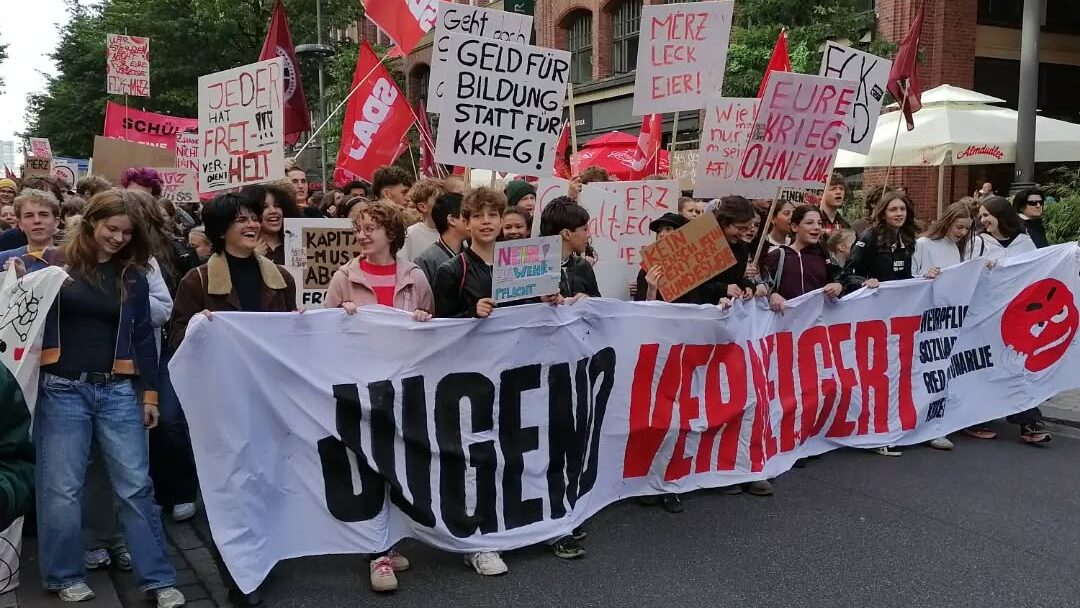
Significant mobilizations preceded the weekend’s protests. On Friday, October 16, roughly 400,000 students flooded the streets for “No Meloni Day”. They criticized the government’s so-called securitization measures which in practice has meant stifling the right to protest, as well as the unabated turn toward war and armament.

Protesters warned that by prioritizing these points over public services and working conditions, Meloni and her ministers knowingly undermine the future of a whole generation. 

Read more: Curfews imposed in French cities as rebellion against austerity grows nationwide

Echoing developments in France, where teachers’ unions have supported students’ demands over recent weeks of historic struggle for a stronger public education system, educators in Italy began circulating appeals to do the same.

“The established order is the worst of all possible worlds – or comes very close to it – and our schools are a mirror of this: they are falling apart, alienating, militarized,” the appeal reads. “Places where the need to stretch one’s legs is labeled ‘indiscipline,’ and where the ‘foreigner’ is blamed for the decline in knowledge, rather than two decades of underfunding and neglect.”

Real solutions, not repression, needed to address social crisis

Trade unions, teachers, and students all denounced the repression authorities unleashed in response to the protests – both after mobilizations in cities and during school occupations. 

“This government – incapable of offering solutions to the social crisis raging across the country – is once again attempting to manage the streets and social discontent solely through the lens of ‘public order,’ while intensifying repression and shrinking the space available for political activity,” emphasized youth organization Cambiare Rotta.

Students opposed the government’s focus on militarization. Source: Cambiare Rotta/Facebook

Teachers specifically called upon others in the system not to endorse crackdowns on students while invoking democratic values. “Democracy today resists in the French and Spanish squares, in the occupied Italian schools, in the resistance to the genocide of the Palestinian people, in the words and deeds of those who oppose the piecemeal world war,” they wrote.

“It is not to be found in threats, in tear gas, in police officers inside schools, or in students maimed by the weapons of our law enforcement. It is not to be found in the unjust rules that too many persist in defending.”

Read more: Mediterranean dockworkers launch historic international strike

The increased protest activity has given hope that the spark that inspired massive mobilizations throughout 2025 might resurface. It comes less than two weeks before a new general strike – and an international dockworkers’ strike in which Italian port workers are set to play a notable role – on October 30.

  •  

Curfews imposed in French cities as rebellion against austerity grows nationwide

Mass mobilizations against austerity policies and their effects are not winding down in France. On Saturday, October 17, roughly 800,000 people joined protests across more than 1,700 assembly points, according to union figures – amplifying demands tabled over a month of student protests and demanding urgent action on the cost of living crisis.

In the aftermath of the protests, the government expanded local authorities’ powers to introduce curfews. This led to overnight movement limitation orders introduced in several cities, including central parts of Paris, Lille, Lyon, and Nice. Many of the curfews target young people in particular, reflecting institutional concern about the success of their recent mobilizations.

Over the past weeks, students launched a wave of school strikes and occupations, resisting the erosion of education services under successive neoliberal governments. Their movement drew support from trade unions and progressive political forces, who joined students on the streets to pressure the Lecornu administration to change course and prioritize public services and labor rights over armament. 

Read more: One barricade after another: How protesters marched on the garrisoned heart of India’s capital

Rallies and marches reinforced the student movement’s demands for accessible, equitable higher education, alongside trade unions’ calls for higher wages. 

They also drew links to other historic moments of mobilization, including the struggle for Algeria’s liberation. Many groups taking part echoed the anniversary of the 1961 demonstration that ended in the massacre of hundreds of people protesting for independence.

Police violence continues

Teachers, families, and elected officials also joined, for a practical reason: to shield students from the law enforcement violence unleashed on their mobilization. 

Saturday’s protests were again met with police violence, with officers relying – unsuccessfully – on tear gas and water cannons to disperse crowds. Serious injuries and cases of severe police brutality were reported throughout the day.

After repeated repression, and with neither the government nor President Emmanuel Macron offering credible solutions to protesters’ grievances, protests turned into riots. While those close to social movements emphasized the events were triggered by years of cuts and unimpeded attacks on workers’ rights, the middle and upper classes were indignant.

Recent protests in France have a decisively antifascist character. Protester’s sign reads: “Always angry, never fascist.” Source: Manon Aubry/Facebook

Macron channeled their reaction in his post-protest speech. He declared those responsible for the looting must be punished, while promising more “dialogue” and offering a mild acknowledgment of people’s concerns over fuel, food, and other essentials. 

“There are people out there who rightfully feel that the price of fuel is too high,” the president said – before shifting responsibility elsewhere. He said rising prices were the result “of what is happening in the Persian Gulf – a war that France was not part of.” 

The speech landed poorly at home and abroad. The Iranian government, for one, has repeatedly called out Macron for applying double standards between protests in West Asia and France, emphasizing that the French president had expressed support for US plans in Iran and that ongoing mobilizations were a logical outcome of the policies he endorsed. 

Students reject Macron’s response

In France, protesters called out Macron for failing – yet again – to identify a concrete way out of the situation facing the country. 

“Since the beginning of this movement, high school and university students have been met with nothing but contempt and police batons in response to their demands,” the university students’ union Union Étudiante wrote. “Yet we have put forward a clear set of demands, widely supported by everyone who took to the streets on October 17.” 

Read more: Madrid teachers and students launch strike to defend public schools

“He did not utter a single word about the high school and university students maimed in the crackdown,” the organization added. “He said nothing at all about the real violence committed on Saturday,” referring to approximately 2,300 arrests made on that day alone – and dozens of young people who were seriously injured over the past weeks.

“It is not a matter of engaging in endless dialogue, but of responding concretely to the needs of high school and university students: income, housing, food services, healthcare, study conditions, access to degrees, and an end to repression.”

Lecornu attempts to blame left for chaos

Prime Minister Sébastien Lecornu’s reaction to the protests drew an equally negative response from progressive forces, especially after he suggested left movements were responsible for chaos and violence.

“What a pathetic politician,” wrote presidential candidate Jean-Luc Mélenchon. “He is responsible for the chaos – chaos he methodically prepared, whether through sheer incompetence or a deliberate ‘strategy of the worst’ aimed at conjuring up a ‘party of order’ that would make people forget his failure on the public finances.”

  •  

Madrid teachers and students launch strike to defend public schools

The public education system in Madrid – teachers and students alike – launched an indefinite strike on Wednesday, October 14. Tens of thousands emptied classrooms and took to the streets, demanding an end to the regional government’s education policy – warning that it promotes privatization.

Episodes of police violence were reported near part of the education sites.

Read more: Spanish unions announce general strike over housing

A joint union front, including sectoral branches of the General Union of Workers (Unión General de Trabajadores, UGT), the Workers’ Commissions (Comisiones Obreras, CCOO), and the General Confederation of Labor (Confederación General del Trabajo, CGT), among others, started building the mobilization months ago. 

While preparing the strike, they tabled demands including wage increases, investment into education infrastructure, and smaller class sizes.

A strike to defend quality public education

“Madrid’s teachers have said ‘enough is enough’ in the face of regional policies that seek to dismantle public services in favor of private management, demonstrating a profound contempt for the inclusive school, one that equalizes, protects, and guarantees real opportunity for the future of children and the working class,” the union front stated.

“This strike is not just for teachers,” UGT Public Services Madrid emphasized in a statement. “We are defending quality public education for students and their families, who are the ones who suffer the consequences of overcrowded classrooms and staff shortages.”

Students on the first day of the strike. Source: Sindicato de Estudiantes

Union demands were endorsed by students, including the student union Sindicato de Estudiantes. “Ceilings are crumbling, there is no air conditioning, facilities are outdated, and students are forced to learn in makeshift and portable classrooms or overcrowded spaces,” the organization stated.

Student union recognizes strike’s “decisive moment”

Students and teachers insist on the responsibility borne for the crisis by the regional People’s Party government led by Isabel Díaz Ayuso. Ayuso was also an often-quoted name in recent housing mobilizations in Madrid, where demonstrators linked the right-wing party’s policies with the ongoing housing crisis – including the eviction of Maricarmen Abascal.

The education strike, Sindicato de Estudiantes wrote, is a “way to involve the entire working class and youth against a reactionary government that not only does business with public education, but is selling our neighborhoods to vulture funds and rentier landlords who speculate on housing, one that steals money from public health to hand it to companies and the corrupt …”

Read more: Students in France are fighting for stronger public education

In their communications, student associations echoed the historic school strikes taking place in France. “Also very present in the minds of Madrid students, as in the entire State, are the events shaking France and Belgium: the enormous student strikes of our colleagues that have filled Paris and dozens of cities, and the brutal police repression that they have had to endure,” they wrote. “We know that we are in a decisive moment, and like them, we will fulfill our task.”

Strong adherence to the education strike gives hope for an even stronger mobilization on November 11, when Spain’s labor movement has called for a general strike to increase wages, fight against the cost of living crisis, and overhaul the country’s housing policy.

  •  

Students in France are fighting for stronger public education

High school and university students in France continued their protests on Tuesday, October 13, demanding government investment in public education. Approximately 480,000 protesters took to the streets in the latest iteration of the mobilization, with families, teachers, and trade unions backing students’ demands. 

Read more: French students shut down schools in historic strike against austerity

The mobilization remains marked by widespread police violence. Police used tear gas and dispersal grenades on crowds, including at Tuesday’s central march in Paris. Hundreds of students were injured and thousands arrested in these incidents, prompting reactions from human rights organizations. 

In response, the public joined students as they blocked high schools and organized marches to physically shield them from potential harm. Trade union members, notably from the education sector, were highly represented in these support lines. 

“The CGT reaffirms the urgent need to address the demands of those who are the country’s future ,” the General Confederation of Labor (CGT) asserted. “The CGT salutes their fighting spirit. It welcomes the strong anti-fascist tone of the demonstrations, which shows that there is no inevitability to the continued flourishing of fascist ideas or to the far right’s rise to power.” 

Students demand access to higher education

Since the beginning of the month, French students have organized three massive demonstrations to warn against the state of education under austerity. “For several weeks, high school and university students have been mobilizing to denounce the deterioration of their study conditions, the Parcoursup system, staff and resource shortages, policies that are dismantling public services, and – more broadly – the future this society holds in store for them,” the trade union federation Solidaires recognized in their statements. 

Trade unions continued their support for student mobilizations. The banner reads: "Electricity and gas workers stand with the youth. Our rage is nuclear." Source: CGT/Facebook
Trade unions continued their support for student mobilizations. The banner reads: “Electricity and gas workers stand with the youth. Our rage is nuclear.” Source: CGT/Facebook

Equal access to higher education has been high on the protesters’ demand list since the beginning. This refers in good part to how students are currently recruited into university courses – the Parcoursup admission platform. Introduced in 2018 under Macronist ministers to replace a previous system that randomized selection for oversubscribed courses, Parcoursup was supposed to “rationalize” admissions.

In practice, however, critics and applicants emphasize the platform allows institutions to apply unclear selection criteria and even discriminate against students from working-class areas.

In September 2026, the left party La France Insoumise warned that 126,652 students were not able to access a course as a result of the system – up from 77,000 in 2023. “This selection process is the product of austerity-driven political choices deliberately implemented by successive Macron-era governments,” the party warned.

“Parcoursup is a social sorting machine,” Solidaires echoed. “The platform organizes competition among young people for places that the State deliberately refuses to create. It transforms the right to study into a privilege, scarcity into selection, and austerity into supposed individual failure.”

Commodification of education

Jean-Luc Mélenchon, the left’s presidential candidate, pointed out that these choices are part of a broader political agenda: “the commodification of education and knowledge.”

Trade union briefs on the subject back this interpretation. At the beginning of this school year, Solidaires warned that thousands of those left without higher education placings are being sacrificed in the name of austerity. 

“But not everyone experiences this violence in the same way,” they wrote. “The wealthiest families can afford private schooling, fund housing on the other side of the country, or sustain a year without studying. Young people from working-class backgrounds, however, have no way out. A lack of options means either being forced into the job market or military service – abandoning their plans for good – or facing precariousness, isolation, and debt at a private institution.”

“We have shifted from an egalitarian system to a discriminatory one: pay for your own future,” Mélenchon concluded in a recent interview.

Read more: Greek university labor leaders face charges after supporting students

The left leader anticipated that student demands will be an important topic during the upcoming election campaign, where the left is contrasting a program of rupture with neoliberal policies to the far right’s intention to build a debt brake not unlike Germany’s. In practice, this would translate into years of sustained attacks on social security and public services. 

Trade unions and progressive organizations announced their support for the youth mobilizations will continue as they build campaigns to resist the government’s intention to impose billions in cuts to pensions and social security while spending record amounts on rearmament.

For their part, student unions invited their members to remain active and join a general mobilization against the cost of living crisis this Saturday, October 17.

  •  

Protesters in Belgium demand end to austerity, climate inaction, and Gaza genocide

Tens of thousands of people took to the streets of Belgium from October 9-12, marching against the government’s austerity and militarization policies, as well as in solidarity with Palestine. 

Read more: Peter Mertens: “We have to restore people’s confidence in collective strength”

“Four mobilizations, one shared struggle: that of the Belgium of those at the bottom — who refuse to foot the bill for a system that benefits a tiny minority, and who refuse to remain complicit in an apartheid state,” wrote the Workers’ Party of Belgium (PTB-PVDA). “They thought they could impose their anti-social measures without resistance. They were wrong.” 

50,000-strong demonstration against austerity

The weekend began with a 50,000-strong demonstration against austerity in Brussels on October 9, building on months of resistance to budget cuts, anti-labor reforms, and threats to pension rights. Various blocs joined the protest, including the youth movement, who demonstrated against tuition hikes, education budget reductions, and attacks on services they depend on – notably public transport. 

“The government is desperately trying to balance its budget,” the General Labour Federation of Belgium (ABVV-FGTB) wrote in their protest call. “And to find the missing billions, it seems to have made a habit of always digging into the same pockets: ours. Yours.”

“If money is needed, the government should go get it where it actually is: from great fortunes, capital income, big corporations and their lucrative handouts.”

Protests on October 9, 2026. Source: ABVV-FGTB/Facebook

The Confederation of Christian Trade Unions (ACV-CSC) echoed concerns about the unfair distribution of the burden envisioned by the De Wever–Bouchez administration. “The budget must be balanced, but the distribution of the burden must also be fair,” the confederation’s leader Marie-Hélène Ska said. “The Prime Minister appeals to everyone’s sense of responsibility. It is time for him, too, to abandon dogmas and clichés and put forward an honest proposal.” 

“Twenty months into this government’s term, social resistance remains very much alive,” wrote PTB-PVDA President Raoul Hedebouw. “Many young people are also taking to the streets to protest austerity measures and stand up for their future.”

Protests reject complicity in genocide, inadequate climate policies

The following day, Palestine solidarity groups around the country joined the global day of action against genocide and occupation with local actions. Like other European governments, the De Wever–Bouchez administration has failed to take substantial steps to hold Israel accountable for crimes committed in the Gaza Strip since October 7, 2023, causing widespread anger at home. 

This failure has gone hand in hand with plans for massive investment in armament at the expense of public services and climate justice policies.

60,000 people joined a climate march on October 11. Source: Comac/Facebook

As a result, on Sunday, October 11, approximately 60,000 people – once again with strong participation from the youth – joined a climate march. 

The demonstration’s demands were heavily influenced by the memory of the past summer, when heat waves and wildfires ravaged parts of the country. Due to previous cuts to public services, firefighting forces responded to the crisis in inadequate numbers, with implications for their health and overall response capacity. 

“We need a genuine plan to tackle heatwaves, strengthened public and emergency services, and massive investment in public transport, home insulation, and renewable energy that is accessible to everyone,” PTB-PVDA said.

“The De Wever–Bouchez government wants to balance the budget by targeting our public services and imposing austerity,” Hedebouw wrote, drawing a direct link between the government’s cut drive and the state of essential services like firefighting. “But if we cut funding for public services, we will all pay the price. What will happen during the next fire if we have fewer firefighters and insufficient equipment?”

Wealth tax demands

The protests rolled out as the government is trying to balance the national budget. Yet the scale of the response indicates the chosen path will remain contested every step of the way. 

Another sign came on Monday, October 12, as trade unions in the public sector called for strikes and mobilizations to protect these services and the workers who make them run.

“The plans currently on the table are unacceptable to many people,” Hedebouw emphasized. “They see their purchasing power steadily eroding while fuel prices skyrocket. Yet at this very moment, De Wever is proposing a VAT hike, an attack on wage indexation, and further cuts to our healthcare system.”

Protesters insisted the government should design and implement policies that would enable adequate funding for labor rights, public services, and climate transformation – policies that begin with a millionaire tax as outlined by the country’s left.

  •  

Spanish unions announce general strike over housing

Spanish trade unions representing millions of workers have announced a general strike for November 11. The announcement comes amid nationwide mobilizations for the right to housing and only days after Prime Minister Pedro Sánchez called early elections for November 29.

Read more: Housing crisis leads to snap election in Spain

The strike was announced by the two largest union organizations, the General Union of Workers (UGT) and the Workers’ Commissions (Comisiones Obreras, CCOO), alongside the General Confederation of Labor (CGT), Basque unions ELA and LAB, and the Galician confederation CIG.

It will be the country’s first general strike in 14 years, excluding the feminist strike of March 8, 2018. 

Housing and wages are the same struggle

“A key demand of this strike is to vindicate decent salaries to afford housing,” the Madrid Tenants Union wrote.

In their strike call, unions emphasized several demands that have been on their agenda for months. These include reductions in working hours, wage increases, health and safety measures in the workplace, eradicating precarious employment and progress in collective bargaining – a process that has been obstructed by employers for almost a year.

Yet, echoing the sentiment voiced on the streets, where hundreds of thousands have protested and erected encampments against a predatory housing system, the trade union call links all these demands to the right to housing.

“This is a strike with very clear foundations and labor demands,” CCOO’s Carlos Gutiérrez said. “Is it being called because working families cannot access affordable housing? Yes. But we cannot separate the inability to access affordable housing from the wage situation in our country and what is happening in the workplace.”

Maricarmen Abascal during a protest in June 2026. Source Sindicato de Inquilinas e Inquilinos de Madrid/Facebook

The general strike builds on a protest wave triggered by the eviction of 87-year-old Maricarmen Abascal in late September. After years of battle to keep the home she had been living in for 70 years, Abascal was carried out of the apartment on a stretcher. She remained hospitalized until Wednesday, October 7, when the Madrid Tenants Union announced her death.

“Although a historic agreement was reached that would have allowed her to return to her home, this solution came too late,” the organization wrote. “An absolutely avoidable situation, following an agonizing process.”

A strike against all who “do nothing to solve the housing crisis”

Many of those participating in the protests recognized that Sánchez’s administration failed to implement policies that would truly address the housing crisis. Yet union and civil society statements emphasize the problem goes much further than the behavior of a specific political option.

“It’s important to make clear that this is not a strike against any particular government, but against those who do nothing to solve the housing crisis, and also against the employers, who have kept the Agreement for Employment and Collective Bargaining (AENC) blocked for nearly a year,” Patricia Ruiz from UGT was quoted as saying in Público.

Political parties from the center-left to the left have largely expressed support for the strike. Even PSOE figures who share the responsibility for not addressing the housing crisis signaled support for concerns outlined by trade unions.

While a general strike held only a couple of weeks ahead of an election would usually spell trouble for the incumbent administration, local political analysts say this is a peculiar situation that could swing both ways. 

Read more: Far right exploits Ceuta incident to call for border crackdown

Right-wing options are polling high, but ongoing housing mobilizations could steer the electoral campaign away from scapegoating migrants toward issues of social justice – topics they are generally keen to avoid.

  •  

French students shut down schools in historic strike against austerity

Massive school protests are ongoing in France, where students have been mobilizing for their right to education – and against the austerity measures undermining it. Roughly 1,800 high schools were forced to shut down on Tuesday, October 6, as students – supported by trade unions, families, and progressive politicians – took to the streets. According to trade unions, over 450,000 people participated in protests across the country.

Students at 90% of French universities organized actions on the same day, adding even more weight to the historic mobilization.

The students’ main demands include urgent measures to address the critical situation in French schools: a shortage of teaching and support staff, oversized classes, and dilapidated buildings – particularly in working-class areas. Protesters are also calling for more manageable timetables, affordable and quality food and student housing, and an equitable education system.

Austerity at the roots of the protests

The situation in schools is strongly linked to years of neoliberal policies pushed by President Emmanuel Macron and several administrations. The mobilizations are taking place amid widespread discontent over the planned continuation – and harshening – of the same policies.

The country’s public deficit reached 5.1% of GDP in 2025, and debt interest rates represent a growing driver of this deficit. In 2025, the interest burden amounted to around €66 billion across all public administrations; it is expected to reach €91 billion in 2027 and approximately €120 billion in 2030, warned Francesco Tirro for Progetto Me-Ti.

Read more: Tens of thousands of Chilean students demand ‘not a single peso less for education’

Mainstream economists suggest the only way to address that deficit is through cuts – an approach the current administration is only too eager to try, including through attacks on the pension and education systems.

Police repression against students

In response to the protests, French authorities have unleashed a rarely seen wave of police violence against students. The Ministry of Interior recorded approximately 5,000 arrests between September 21 and October 2, with 85% of those detained underage. Police used rubber bullets and dispersal grenades on children, leading to serious injuries – including protesters losing limbs and vision.

“Footage and testimonies widely reported over the last week raise alarming concerns about the dangerous use of tear gas, batons and restraint techniques by police,” said Anne Savinel-Barras from Amnesty International France. The organization emphasized that authorities must ensure the response to demonstrations is “necessary and proportionate,” and that “children and young people peacefully demanding their right to education are protected rather than being beaten, tear-gassed, or arbitrarily detained.”

Source: Sophie Binet/X

While human rights organizations appealed for an end to state-sanctioned violence against students, things were much quieter among the European political establishment. Where reactions were formulated, they were mild at best.

Unions and left support the students

Different progressive movements have sharpened their support for the student demonstrations over the past week, resulting in thousands of trade union members and dozens of elected officials forming cordons between police and students to shield the youth. “All over the country, union members have turned out in large numbers to provide protection and support for high school students,” one of the main student associations, Union Syndicale Lycéenne, stated on Tuesday.

“Today’s high school and university students are tomorrow’s workers, and they shouldn’t have to pay the price for austerity policies,” the General Confederation of Labor (Confédération Générale du Travail, CGT) emphasized. “When there is a shortage of teachers, when classrooms are overcrowded, when buildings are falling apart, and when young people see their future prospects shrinking, the answer cannot be repression.”

Progressive politicians, notably from La France Insoumise (LFI), also joined the protests, providing physical protection for students. As the mobilization began to roll out from Créteil, home of LFI’s Clémence Guetté and several other members, the left party was among the first to offer support – and remained by their side as repression grew. One of the most notable examples was Saint-Denis mayor Bally Bagayoko, filmed as he protected students from more violence.

“The coming together of labor unions, the youth movement, and the parliamentary left-wing opposition forms a kind of ‘tortoise formation’ of mutual protection, making a broader collective momentum possible,” emphasized left presidential candidate Jean-Luc Mélenchon.

Read more: Students and teachers in Italy strike against right-wing reforms and militarization

Solidarity statements came from youth organizations in other European countries, including Greece. “Young people are reacting massively to the cuts in education spending, given that the French government, as in the rest of the EU, is spending billions on military equipment at the expense of wages, healthcare and education,” the Communist Youth of Greece (KNE) wrote in a statement, foreshadowing more student struggles to follow.

  •  

Housing crisis leads to snap election in Spain

Spanish Prime Minister Pedro Sánchez announced a snap election for late November after two housing bills were defeated in a parliamentary vote on Friday, October 2. The bills came amid widespread mass mobilizations demanding urgent action on the country’s housing crisis, following the eviction of an 87-year-old woman in Madrid.

Hundreds of thousands of people took to the streets of approximately 50 cities over the weekend in support of these demands.

“It is true that there are still many injustices to correct, many social goals to achieve, and many problems to solve – above all in the areas of inequality, public services, and access to housing,” Sánchez said in his speech on Monday, as he appealed to voters to give progressive forces more decisive electoral support to allow them to implement reforms more easily.

Real estate speculation drives housing crisis

While Sánchez’s administration has profiled itself as one of the more progressive governments in Europe in terms of international policy, national movements remain frustrated by the lack of decisiveness it has approached making changes at home – including in housing policy.

For years, tenants unions have been warning against the different ways house-owners, particularly real estate speculation funds, have exacerbated housing insecurity for the general population.

Existing anger spilled over as Maricarmen Abascal, an elderly tenant in Madrid, faced eviction from the home she had lived in for 70 years. After the development company Urbagestión Desarrollo e Inversión SL acquired the house Abascal lived in, they imposed a 275% rent increase that she was not able to meet, leading, after a lengthy legal process, to her eviction at the end of last month.

Read more: Die Linke wins Berlin election with focus on socialization of housing

The mobilizations that followed addressed a wider set of problems. “Maricarmen’s situation reflects a housing model that prioritizes real estate profits while abandoning the very people who built our neighborhoods over the decades,” Madrid Tenants’ Union (Sindicato de Inquilinas e Inquilinos de Madrid) warned.

“Most serious of all is that this situation cannot be understood without considering the weight of laws inherited from the Franco regime that denied women basic rights,” the union emphasized in May. “The original contract was signed solely by Maricarmen’s father because the legal system of the time rendered women invisible within the family. Had that same contract been signed today, both parents would have been named as holders, and Maricarmen would remain fully protected.”

“Yet an extremely restrictive interpretation of the regulations has ultimately weighed more heavily than social reality, than the desire to protect those who rent, and more than seventy years of roots in a neighborhood,” they added. “For the Madrid Tenants’ Union, the position is clear: no formalistic interpretation of the law can justify evicting an 87-year-old woman from the home where she has lived her entire life simply to boost the profitability of a real estate investment.”

Unions promise building general strike for housing

The protests formulated several demands to the government, including a ban on eviction of vulnerable tenants where alternative housing is not available; a limit to short-term and room rentals; a rent freeze; and an extension for contracts ending in 2026 and 2027.

Such demands were generally by the public, as well as by trade unions. “Housing and work are not separate struggles,” unions wrote, pledging to work towards a general strike for housing. “The rise in rents is a direct transfer of wealth from the working class to rentierism. Our wages end up, month after month, in the pockets of the rentiers who control our homes.”

The uproar pushed Sánchez’s government to reflect these demands in two bills it presented to parliament. Most considered this a significant breakthrough for the housing movement despite the official texts not fully corresponding to the protesters’ vocabulary and the vote taking place on two separate proposals. 

Watered down or not, right-wing and far-right parties voted against both bills.

Read more: Far-right leaders gather in Madrid to “make Europe great again”

“We have a democracy held hostage by rentiers and speculators,” the progressive party Podemos wrote as protests rolled out over the weekend. “The housing mobilization must keep growing and move toward a general strike until the speculators and those who defend them in the institutions have nowhere left to hide.”

“Between now and November 29, the voices of all of us who want peace must be heard,” Irene Montero from Podemos added after the snap election announcement. “Those of us who want our sons and daughters to avoid war and to have healthcare and education, instead of money being spent on weapons; who want homes to live in; who want jobs and time to spend with our loved ones; and who want the cost of living to go down.”

  •  

‘Cut ties with Palantir’, say UK’s health workers

On Thursday, October 1, health workers, patients, and activists protested Palantir’s role in the National Health Service (NHS) at more than 40 locations across England. Their demonstrations were part of a global week of action demanding that governments cut ties with the spy-tech firm over human rights and privacy concerns.

Rallies took place in front of Palantir’s London headquarters, as well as in Liverpool, Manchester, Newcastle, Sheffield and many more cities.

“Palantir’s tools are used by the Israeli military in Gaza and by ICE to track and surveil migrants in the US,” campaign groups – including Just Treatment, Health Workers for a Free Palestine, Medact, and Global Justice Now – stated. “A company profiting from human rights violations has no place in the NHS or in any of our public services.”

Palantir’s track record opposes core health values

Palantir currently holds a £330 million (approximately USD 436 million) NHS contract and has rolled out the service’s Federated Data Platform (FDP), managing sensitive patient data. The project has drawn criticism from virtually every group involved in the NHS: data workers say it lags behind local systems; patients share privacy and data ownership fears; and health workers insist Palantir’s record opposes the very values their profession embodies.

“I cannot stay true to that [Hippocratic] oath and tolerate Palantir continuing to profit from, and grow its malign business model through an NHS contract,” said physician Rhiannon Osborne from Medact at Thursday’s rally. “Every pound we give them helps to legitimize and sustain human rights abuses and erosion of democratic rule of law across the world.”

Read more: The global economic benefit from the genocide of Palestinians

A central concern is the company’s support for Israel throughout the genocide in Gaza. “When we strive to save every possible life, they champion their ability to kill and celebrate their role in the repeated war crimes committed by Israel – including unprecedented deliberate attacks on the doctors, nurses, and paramedics I worked with,” pediatric neurologist Omar Abdel-Mannan stated. “No moral government should tolerate their involvement in our NHS or indeed any of our public services.”

Campaigners repeated calls for Prime Minister Andy Burnham to end the contract as soon as possible. Under an exit clause in the original agreement, that moment could arrive as early as February 2027. Campaigners and several commissions are pressing the government to notify Palantir of its intention to withdraw ahead of this date.

“The government only has two months to say no to Palantir and the momentum is all with us,” Good Law Project activists said at the rally in London. “All the energy is to say no to Palantir, say no to their global human rights abuses, say no to their crap technology that doesn’t work and get Palantir out of the NHS.”

Unions back appeal to bar Palantir from public sector contracts

Calls to break Palantir’s grip on public services resonate beyond Britain. On September 28, more than 120 groups and unions called upon European governments and the European Commission to “scrap all existing public sector contracts with the US tech company Palantir.” As reported by the European Federation of Public Service Unions (EPSU), the appeal seeks to end current agreements and bar the firm from future public contracts. It also urges governments to develop “alternative data solutions compatible with public service,” echoing NHS data workers’ recommendations.

Read more: Palantir profits from European public services but avoids millions in taxes that fund them, new report shows

“Palantir’s ramping up of ‘war-related’ support for Israel during the genocide in Gaza and the apparent disdain of its leadership for democracy are just two clear signs that this company serves the interests of the rich and powerful, not the general public,” said Tim Bierley of Global Justice Now. “Yet it has been allowed to embed dubious technologies across our public services, giving it access to sensitive data and creating worrying new technical dependencies.” 

“The UK must work with other countries to end dependence on companies involved in human rights abuses, and end the outsourcing of the public sphere to a dangerous class of big tech oligarchs.”

People’s Health Dispatch is a monthly bulletin published by the People’s Health Movement and Peoples Dispatch. For more articles and subscription to People’s Health Dispatch, click here.

  •  

Standoff in the North of Ireland over loyalist ‘Orange’ march continues

Since Sunday, September 27, residents of Garvaghy Road in Portadown have prevented the Orange Order’s Drumcree march from passing through their community. Linking arms, locals and supporters warned that the parade could undo years of progress against sectarian violence in the north of Ireland.

More than 4,000 people signed petitions opposing the march, yet authorities formally allowed it to move ahead. First, the Parades Commission approved a limited procession. Then, the Court of Appeal lifted an injunction imposed by the High Court, paving the way for the march attempt on Sunday.

Read more: On anniversary of Easter Rising, calls for Irish unity are strengthened

Negotiations to end the stand-off continued Thursday evening. According to local media, an earlier proposal suggested residents would accept the Orange Order’s legal right to walk down the road in return for the Order choosing not to march. The organization rejected the deal, insisting on passing through the neighborhood.

Stand-offs at Drumcree previously used to launch loyalist attacks

Recent events carry particular weight because of Drumcree’s history. During the Troubles, loyalist stand-offs in the area became a notable flash point of violence, with effects rippling out beyond Portadown. Following the Good Friday Agreement, the march had been rerouted for almost 30 years.

“The Orange Order organized stand-offs at Drumcree (particularly in 1995, 1996, 1997 and 1998) were regularly used by unionist death squads as a rallying cry and pretext to launch attacks, block roads, and intimidate Catholic families,” Garvaghy Road Residents Coalition spokesperson Breandán Mac Cionnaith wrote in August. “At least ten murders were carried out in Portadown and other areas during this period by those same death squads.”

Speaking to the People Before Profit party, Mac Cionnaith emphasized that the march had been rerouted because of the devastation it unleashed. “I always make a point that people need to remember that between 1996 and 1999, 21 people lost their lives across the north because of killings and murders carried out by loyalists acting in support of Drumcree,” he said. “Several of those victims were our neighbors, they were our friends, they lived in this community.”

Read more: Ireland, Scotland, and Wales independence parties pledge cooperation toward self-determination

Past decades gave the Garvaghy Road community a chance to rebuild, yet the memory of the violence was passed on through generations. “My family moved to England to escape the viciously sectarian climate around the marches,” one resident said. “My aunt went to school with Robert Hamill, a young man kicked to death by loyalists in the midst of the marches.”

“For 28 years, the Garvaghy Road community has lived in peace,” wrote Chris Hazzard of Sinn Féin. “That peace didn’t need a solution – it needed protection. Forcing an unwanted, sectarian march through this area defies all logic.”

“Why did the Orange Order want to march down a Catholic community?”, asked Sinn Féin’s Vice President and First Minister of Northern Ireland Michelle O’Neill. “It’s about supremacy, it’s about domination, it’s about ‘we’re in charge,’ and this community deserve better than that.”

“There is no going back, we’re not going back to the days of the past. What I want is to build upon the progress that’s been made over the last 28 years. What I want to do is actually ensure that we continue to let this community to flourish. Right now, what this community is being told by the Orange Order and political unionism is that they’re second class citizens and that their rights can be railroaded over.”

Solidarity messages from as far as Palestine

Progressive organizations, parties, musicians and artists across Ireland have voiced support for Garvaghy Road, many joining protesters in Portadown to warn against the standoff’s possible ripple effects. “The Garvaghy Road community is still living with the legacy of traumatic street conflict and state violence stretching back decades,” the Irish Republican Socialist Party wrote. “This latest attempt by the Orange order is merely a continuation of that conflict.”

Messages of solidarity arrived from as far as Palestine, where a Gazan teenager wrote in support of Garvaghy Road residents. “I know what it feels like when basic peace and dignity are stripped away, and how painful it is to fight for safety in your own home,” she emphasized. “The residents of Garvaghy Road deserve to live in peace without fear or intimidation, just as every family in Gaza does.”

  •  

NATO chief says ‘no imminent danger’ but rearmament of Europe continues in full swing

More rearmament talks are underway in Brussels as European politicians continue building an increasingly tense anti-Russian discourse. On Wednesday, September 30, defense ministers and industry representatives joined the Euronews Defense and Space Summit, focusing on the bloc’s growing defense expenditure and member cooperation.

The summit took place after weeks of allegations of hybrid attacks on EU members, which pushed the already tense rearmament narrative permeating the European political establishment up a couple more notches. It also followed, by only a couple of days, the Council of the EU’s announcement of the next phase of five European Defense Projects of Common Interest (EDPCIs) – projects that “allow EU countries to work together on major defense initiatives that are too large or too complex for individual countries to develop on their own.”

Read more: “Militarization of rules and minds” in Europe threatens workers and welfare

While separate, the two events shared several points in common, starting with a focus on increasing coordination between EU countries to arm more efficiently – and spend the billions of euros planned for defense over the coming years. They also emphasized sections of the military sector to receive the most attention – including drones and military capacities in Eastern Europe. 

This geographical focus goes beyond EU members, expanding to – at least – Ukraine and Moldova. Most EDPCIs – like the Drone and Counter-Drone European Resolve (DECODER) and the Eastern Flank Watch – list Ukraine as a partner. Ukrainian arms entrepreneurs were also present at the summit in Brussels, including leading figures from Fire Point, one of the country’s most prominent arms companies.

Very imminent investments into arms

While NATO Secretary General Mark Rutte stated in his summit intervention that there is “no imminent danger” to the alliance members’ territories, he and others did not hold back in offering anticipations of an unstable period.

Belgian Minister of Defense Theo Francken, for one, anticipated “more hybrid threat actions” and an overall “dark winter for Europe” – a scenario he seems to want to address by spending more on arms and cutting social services, as he has explicitly stated on numerous occasions.

“Europe has been very good in investing in soft power, in social security,” Francken said. “And it’s beautiful to have a pension system, to have social welfare systems when someone gets sick, when somebody loses his job – we have everything. But when there’s a war or there’s hybrid threats, we don’t have anything.”

Considering the significant amount of money European countries have already invested into armament, his assessment that “we don’t have anything” is inaccurate at best. 

It also remains contested on a regular basis on the streets of many European cities, where trade unions, students, and peace movements continue to protest against austerity budgets that aim to provide for war.

Europe needs a policy that builds security with its neighbors

In addition to large-scale demonstrations against social security and labor cuts in France’s proposed 2027 budget and student strikes against conscription in Germany last week, mobilizations are expected to grow over the coming months – including an international youth strike in November.

“We reject the militarization of our societies and support the young people who are refusing it,” the Stop ReArm Europe coalition wrote on September 23. “Thousands of high school students and university students across Europe are rising up to refuse militarization and the return of conscription.”

Read more: German students say ‘we don’t want to go to war’

“Nearly 20 million children in the EU – one in four – live at risk of poverty or social exclusion,” the group added. “Meanwhile, governments have committed to military spending that the EU’s own Defense Commissioner, Andrius Kubilius, puts at €7 trillion by 2035.”

“The trillions earmarked for militarized security will leave us staring down the barrel of a gun and indebted to global financiers,” Stop ReArm wrote, calling for a solidarity- and care-based alternative. “This must go hand in hand with a non-aligned foreign policy that resolves conflicts through diplomacy, upholds international law and human rights, and builds common security for all: security with our neighbors, not against them.”

  •  

German students say ‘we don’t want to go to war’

Thousands of students across Germany were once again on strike against conscription and militarization on Friday, September 25. Actions took place in at least 100 localities as young people demanded a sharp turn from the government’s chosen path.

“We don’t want to be forced into military service and we don’t want to go to war,” the students wrote in declaration after their last strike in May.

Read more: German students expand their strike against conscription and militarization to 150 cities

This is the fourth time students have exchanged classrooms for streets since the end of 2025. The mobilization has strengthened in resistance to the Merz administration’s plans to build the “strongest conventional army in Europe” – including by drawing more people into the Bundeswehr, the German armed forces.

While authorities insist military recruitment remains voluntary, students have warned of a clear tendency toward outright conscription. Local strike committees and activists also emphasized the widespread repression ahead of actions. This included scheduling of exams on strike days and locking-in students on school grounds, they pointed out.

Billions for the Bundeswehr, cuts for schools and youth services

Over recent months, the government has sent thousands of questionnaires to map voluntary interest in joining the armed forces. According to German media, the response has been underwhelming: tens of thousands of students have disclaimed no interest whatsoever. Not even a multi-million-euro budget allocated to promoting the army has been able to shake this opinion.

“They sell us war service as an ‘adventure’ while we know that what awaits us is coertion, humiliation, sexism, right-wing extremism, and racism,” the student declaration adds.

Instead of taking the message seriously, authorities recently advanced the implementation of medical checks among their targeted population, drawing further frustration from students.

“We don’t want compulsory questionnaires, fines, draft physical examinations, conscription assessment centres across the country, nor planned integration of the Federal Volunteer Service into military service,” they wrote. “These are means to prepare the reintroduction of the draft and thus another war originating from Germany.”

“In case of conscription, we’ll be trained as cannon fodder, forced into the trenches,” students added. “War costs us our lives, while corporations like Rheinmetall make record profits.”

Read more: Ulrike Eifler: ‘The workplace is a place where we have to fight against war’

Students on strike have expressed solidarity with other ongoing struggles against militarization and budget cuts. They stated they would join peace demonstrations planned for early October in Berlin and Stuttgart, as well as a trade union-backed mobilization against budget cuts on Saturday, September 26.

Their decision reflects the widespread understanding that youth and education services are among those impacted by this round of austerity. According to junge Welt, the federal ministry responsible for education will face close to €1 billion in cuts – while €140 billion will be made available for so-called defense in 2027.

“Every tank, every rocket we pay for with dilapidated schools and social cuts,” students remarked.

  •  

European leaders fixate on Russia, avoid criticizing US at UNGA

Artificial intelligence was the concept of choice among European speakers during the first days of the United Nations General Assembly (UNGA). Prime ministers and presidents recognized opportunities and invoked stronger regulation – then returned to advocating for more military spending, planning deterrence, and avoiding harsh words for the Trump administration.

Read more: The AI frontier asks to be paced: anatomy of a panic

“I’m afraid I may lack originality in describing it [the situation in the world],” French President Emmanuel Macron remarked, referring to the overlaps between interventions. For once, he was not wrong. Most European speeches described the world in terms of crisis, yet failed to spell out the connections between that situation and the behavior of the United States. Macron’s speech was no true exception.

Instead, most seemed keen to endear themselves to the Trump administration. New-ish British Prime Minister Andy Burnham called the UK “America’s closest ally” and announced a new “AI defense partnership” with the US – giving listeners something to truly worry about when AI is concerned.

The East European anti-communist set

Others were even friendlier to the UNGA host country. Romanian President Nicușor Dan said it was a particular pleasure to address the assembly in the US, “a country with which Romania shares a long history of friendship, a nation towards which Romanians look with respect and gratitude, including for its essential contribution to the fall of the Iron Curtain and the opening of my country’s path towards democracy and freedom.”

Read more: Hybrid threats: Romania continues to self-sabotage through militarization

Remarks directed against Eastern European countries’ socialist past were echoed by Polish President Karol Nawrocki and Croatian Prime Minister Andrej Plenković. These speeches reaffirmed commitment to the West, including the North Atlantic Treaty Organization (NATO), and gratitude for positive changes these leaders perceived over the past 30 years.

“Millions of Romanians know from their own experience the difference between a communist system that oppressed them and stifled their initiative and freedom of choice, and a democracy that rewards work, innovation, and personal responsibility,” Dan added. 

None of these Eastern European leaders addressed the mass unemployment, emigration, and crumbling public services that soared while “work, innovation, and personal responsibility” took over.

Peace through protection, resilience through military strength

European interventions went to great lengths to reaffirm support for Ukraine and, perhaps more notably, criticism of the Putin administration. Plenty used the floor to repeat the belief that European countries must rearm in the face of a perceived – and still materially nonexistent – “Russian threat.”

As Ukrainian President Volodymyr Zelenskyy referred to a vision of “peace through protection” and showcased defense cooperation agreements, Burnham talked of resilience through military strength. 

Read more: ‘Ukraine is no longer a sovereign country,’ says sociologist Volodymyr Ishchenko

Some commended themselves for quickly approaching NATO’s 5% expenditure commitments. Others turned to “obstructions” of freedom of navigation – referring, of course, to the closure of the Strait of Hormuz caused by the illegal US-Israel war on Iran. Yet most European speeches did not even mention the US in this context, let alone offer comparable words of condemnation dedicated to Russia.

Spain vows to continue believing “humanity can continue to progress”

As has become customary, the speech delivered by Spanish Prime Minister Pedro Sánchez was among the few to stray from the underwhelming regional tone. Sánchez, whose administration has been attacked by the US government on several occasions, spoke of the conditions facing the world today as exacerbated by the selfishness, ignorance, and cruelty of some UN member states – not naming anyone in particular.

He singled out cruelty as the worst of these pillars driving powerful nations’ behavior in international spaces: “A cruelty that no longer flinches at the sight of a starving child’s ribs or a hospital reduced to rubble.”

Read more: Over 1 million years of children’s lives lost in Gaza during genocide, study finds

Sánchez said Spain would not give in to attacks on multilateral institutions, nor would it stop believing “that humanity can continue to progress.”

“We are not going to do it, because we want to live up to our children’s expectations. Because we know that, in a few years, future generations will look back. They will study this decisive decade. And they will ask us what role each of us played. They will ask us what we did when some countries began to break the rules and others decided to turn a blind eye. They will ask what we did when defending what we believed in began to cost dearly. And when that happens, we want to be able to tell them that we did not stop fighting. We did not. We want to be able to tell them that we gave everything to leave them a more peaceful, sustainable, and fairer world.”

  •  

Die Linke wins Berlin election with focus on socialization of housing

The Christian Democratic Union (CDU) has continued its downward spiral after suffering significant losses in state elections in Berlin and Mecklenburg-Western Pomerania on Sunday, September 20. In addition to coming second to the progressive Die Linke in the German capital, Chancellor Friedrich Merz’s party failed to achieve the 5% needed to enter Mecklenburg-Western Pomerania’s parliament, marking a new low – or, in Merz’s own words – a “disaster.”

The results of the two elections were radically different: in Mecklenburg-Western Pomerania, the far-right Alternative for Germany (AfD) won the largest percentage of votes, echoing, in many ways, the recent outcome in Saxony-Anhalt. In Berlin, Die Linke emerged as the winner, claiming a quarter of the vote after a campaign focusing on housing, the cost of living crisis, and public transport.

Read more: Far-right victory in German state elections shocks the center

Part of the local reports note that while the AfD and Die Linke lie on opposite ends of the political spectrum, both gained ground thanks to the perception that they bring the best chance of breaking with the policies implemented by the government coalition between CDU and the Social Democrats (SPD).

These policies – pursuing extensive cuts to the social and welfare system and attacks on labor rights in order to fund a massive rearmament drive – have completely eroded the support for Merz’s conservatives. Despite this administration’s unprecedented unpopularity, the German Chancellor is showing no sign of changing course, stating after Sunday’s election that “reforms must come.”

Die Linke’s Berlin result: reforms must be implemented – but which reforms?

Reforms must be implemented, voters in several German states apparently agree with Merz – just not those envisioned by the CDU. Die Linke’s campaign, led by Elif Eralp, offered an alternative list of policy reforms addressing Berlin’s inhabitants’ most pressing concerns. This meant a focus on accessible housing – including a follow-up on the 2021 referendum where voters backed expropriating the property of private real-estate companies with 3,000 or more units in the city.

Five years ago, over one million people supported the referendum’s idea of socializing the housing pool, yet no action was taken by the local administration. Since then, the housing situation has grown worse, leading to widespread frustration. Die Linke’s campaign recognized the general discontent and promised it would not give up on socialization.

“Die Linke’s successful campaign in Berlin was driven by its strong focus on affordable housing and rent control, which resonated deeply with voters facing massively rising living costs,” Kirsten Schubert, a general practitioner active in the party’s local chapter, told BreakThrough News. “The party integrated large-scale door-to-door campaigning strategy, allowing volunteers to connect personally with hundreds of thousands of residents directly at their doorsteps. By those means, strong social media presence and a huge range of community activities, they successfully mobilized a diverse coalition of non-voters, progressive urban youth, and traditional working-class voters.”

Read more: Berliners win vote to expropriate housing from corporate landlords. What’s next?

Krunoslav Stojaković, a political advisor at the Rosa Luxemburg Foundation, says that the election result commits not only Die Linke, but also “the social left and all those who care about a more just society” to work towards achieving socialization of housing. “At this point, there can be no going back […] The people of Berlin have given us this mandate.”

“There will be resistance,” he emphasizes. “Potential coalition partners are only tentatively supportive of Die Linke, and some are already making demands against the socialization of those profiting from the housing crisis as a condition for political cooperation.”

Progressive measures to face opposition from center

The approach adopted in Berlin marked a welcome break from Die Linke’s campaigning in other states. Stojaković pointed out to the portal H-alter that the party’s earlier choices – such as joining coalitions that implemented austerity measures – contributed to a fall in popularity. The recent success offers an opportunity to reclaim lost ground and reshape the party’s approach to fieldwork. But it should not be taken for granted that this will happen.

For now, the party faces talks with potential coalition partners SPD and the Greens. Figures from both parties signaled there are significant misalignments between them and Die Linke. While the SPD does not share the commitment to socialization of housing, the Greens’ Franziska Brantner said the party would not cooperate with “anti-semites from Neukölln.” With this, Brantner indicated that the political mainstream in Germany will persist in pressuring those criticizing Israel – even if this criticism remains timid at best.

Read more: Thousands join Berlin’s Peace Days to support antimilitarism and solidarity

On the other hand, left and progressive parties across Europe recognized in Die Linke’s result an important rupture within the predominating context of the far right gaining electoral ground. From Jean-Luc Mélenchon in France to Slovenia’s Levica, reactions emphasized the significance of shaping grounded and unequivocally left programs. “Politics begins with the daily problems of millions of people,” wrote Peter Mertens, General Secretary of the Workers’ Party of Belgium (PTB-PVDA). “It is not just about talking about tenants and workers, but about organizing them so they can impose change themselves.”

This article was updated on Wednesday, September 23, to incorporate comments from Kirsten Schubert.

  •  

Von der Leyen’s State of the EU: best of times for businesses, worst of times for working class

It is rarely a good sign when European politicians open their speeches by quoting Charles Dickens. So alarms should have sounded the moment European Commission President Ursula von der Leyen declared this to be the best and the worst of times at the start of her State of the European Union address on September 16.

Things went downhill from there: the EU leader painted a picture of the region that stands in complete contrast to the general experience of its people, amounting to a summary of the bloc’s worst achievements.

“Von der Leyen has achieved the feat of not mentioning a single measure to help Europeans cope with the soaring cost of living across Europe, at a time when an ever-growing number of people are now forced to choose between housing, food and transport,” said Manon Aubry, Co-President of The Left in the European Parliament.

“Fiscal sustainability” and concern for businesses

In the lengthy address, von der Leyen laid out what she considered the EU’s successes, including raising military spending by almost 80% over the past five years and “reducing dependence” on Russian fossil fuels. However, this interpretation does not correspond to what people are experiencing, as outlined by The Left in a dedicated dossier. Growing military spending benefits only the arms industry. And attempts to replace cheaper Russian gas have essentially boiled down to committing to more expensive and environmentally devastating US LNG imports.

While recognizing growing energy prices, von der Leyen offered no tangible response to this problem plaguing EU households. On the other hand, she demonstrated notable concern for businesses, signaling the continuation of eroding labor and environmental protections along the lines implemented by right and far-right parties at the EU level.

Read more: Peter Mertens: “Don’t be afraid, seize the opportunities of 2026 with both hands”

The likelihood of maintaining the status quo was also noticeable when von der Leyen turned to the deadly wildfires that hit Europe this summer, devastating communities from Belgium and France to Spain and Greece. Trade unions and progressive analysts have warned for years that fire preparedness is severely impaired by a lack of planning and, specifically, shortages of firefighters. Yet there was no commitment in the address to invest more in essential public service workers. Instead, the EC President referred to the ongoing need for overall “fiscal sustainability” – meaning Europeans should expect no relief from austerity programs.

“The best of times is clearly reserved for billionaires, multinational energy companies, and war profiteers,” remarked Member of the European Parliament Marc Botenga from the Workers’ Party of Belgium (PTB-PVDA). “The other side of the coin for workers: austerity and rising prices.”

The EU’s failed foreign affairs policy

Based on the vision tabled by von der Leyen, there is also little to look forward to in Europe’s international and trade policy. “It’s hard to think of an area where the EU has been more inactive and less effective than in foreign affairs,” The Left wrote, referring to the union’s ongoing disregard of international law in relation to the genocide in Gaza and its approach to the Trump administration. 

“The President has praised Saudi Arabia’s war on Yemen, she has stood with Trump as he bombed Tehran and the European Commission has sided with the USA as they brought the global economy to a standstill in the Strait of Hormuz,” the progressive bloc warned.

The EU’s relationship with the US has continued to be one of submission, with elected regional leaders going to great lengths (unsuccessfully) to appease Donald Trump. Even when the region announced it would stand firm against US threats – in Greenland or on tariffs – this did not translate into practice.

In the context of von der Leyen’s speech, this boiled down to announcing Canada would become the “first associate member of the EU” and listing trade agreements signed with India, Mercosur, and Indonesia – met by the people of these countries with understandable concern.

Read more: Indian left opposes free trade agreement with EU, calls it “wholesale surrender” of country’s economic interests

Von der Leyen’s speech showed no sign of breaking with disdain towards nations outside the West. In addition to continuing animosity toward China, it offered a glimpse into plans involving countries rich in critical materials. The EC President announced the launch of a European Corporation on Critical Raw Materials – designed to secure and stockpile supplies for Europe’s industry and defense – with obvious implications for mineral-rich territories like Ukraine, Greenland, and several African countries. For the more skeptical listeners, this also carried weird echoes of the East India Company.

The State of the EU’s vision, it goes without saying, comes with further promises of an even stricter migration framework – on the pretext of situations like the one experienced in Ceuta earlier this year – that allow the erosion of basic human rights like asylum. Von der Leyen’s speech pledged even more finances for Frontex and suggested that outsourcing migration enforcement to third countries will continue, as endorsed by recent EU legislation.

“This policy of externalizing migration control has contributed to grave human rights violations, arbitrary detentions and systematic violence against people on the move,” The Left warned, calling for a union rooted in solidarity rather than violence and militarization.

  •  

Anti-militarism unites progressives across Europe

The left’s capacity to build knowledge, organization, and struggle was a central theme at this year’s ManiFiesta, introduced during a discussion of Peter Mertens’ new book, “The Last Days of the Old Normal“. In the context of Europe’s ongoing armament, these questions are crucial not only for progressive movements in core countries but also for those building alternatives in Central and Eastern Europe.

The festival featured several sessions examining developments in Central and Eastern Europe, including an intervention by Ukrainian sociologist Volodymyr Ishchenko on the class character of the Ukraine war. Another session – “East of the former wall: the AfD, the industrial crisis, and the war economy” – brought together Markéta Juřicová of the Czech party Levice, Orsolya Haboczki from the Hungarian progressive movement Szikra, German Bundestag representative Cem Ince from Die Linke, and Member of the European Parliament Marc Botenga from the Workers’ Party of Belgium (PTB-PVDA). 

They discussed how the growth of the far right in core EU countries is interacting with events eastwards – and what lessons Western left movements can learn from their Eastern counterparts.

Read more: ‘Ukraine is no longer a sovereign country,’ says sociologist Volodymyr Ishchenko

As Juřicová and Haboczki pointed out, while movements in the West are worried about the popularity of parties like the Alternative for Germany (AfD), many nations in Central and Eastern Europe already have experience with far-right participation – even leadership – in government. More than 15 years of Viktor Orbán’s rule in Hungary, Haboczki noted, offers an important lesson on far-right governments’ economic agendas and tactics. As the Orbán administration used identity issues to capture opposition parties’ attention, it channeled resources into the hands of the local bourgeoisie and served transnational capital by securing huge state subsidies, she said. 

Right-wing parties in Eastern Europe also look to their international peers for inspiration. In the Czech Republic, Juřicová said, the far right “loves” the AfD, picking and choosing many of the same topics the German group campaigns on. The discussion signaled this is particularly important to recognize as the growth of extreme right parties is fueled largely by popular dissatisfaction with mainstream parties’ programs. 

Read more: Far-right victory in German state elections shocks the center

Ince emphasized this was the case in Germany, where a large share of AfD votes came from those believing the party would bring upheaval compared to the status quo, marked by massive job losses and cuts to welfare. But while European progressives recognize this, they still struggle to incorporate it into their programs, recent experiences show. Instead, many of them ponder attempts to prevent the far right from seizing institutional power by providing support to establishment parties, failing to shape a concrete alternative to both the mainstream and the extreme right.

In Central and Eastern Europe, the work of progressive parties is further complicated by the need to rebuild credibility after decades of vilification of socialism and austerity measures implemented by liberal options, Haboczki added. 

Read more: “We cannot eat grenades once the grains no longer grow:” European peace movements organize against militarization

While recognizing workers’ material concerns in Central and East Europe is imperative for building local alternatives, the panel showed, it will also be necessary to build region-wide partnership to challenge topics dominating the narrative in Germany, Belgium, and other core countries.

Militarization stands out among these topics, Botenga and Ince outlined in their interventions, though its implementation might differ by sub-region. Botenga added that German industry stands to gain the most from European armament, yet these gains will not trickle down to the working class – meaning the left in the region can find in anti-militarism a common cause to rally around. 

Ince echoed these observations by emphasizing that, even as their profit lines stand to gain from billions of euros directed towards rearmament, German companies continue to shift significant parts of their operations to countries including Poland, Slovakia, and the Czech Republic – making most of eroded workplace protections and labor rights. This shows that the left across Europe must work together to protect workers’ interests everywhere, building a joint struggle for peace and civilian industry, he indicated.

  •  

Ireland, Scotland, and Wales independence parties pledge cooperation toward self-determination

Leaders of pro-independence parties in Ireland, Scotland, and Wales met in Cardiff on Monday to sign a memorandum of understanding laying out a plan for strengthened cooperation. The document commits Sinn Féin, the Scottish National Party (SNP), and Plaid Cymru to deepen exchanges on renewable energy, economic policy, and, notably, “supporting the right of each nation to determine its own future.”

“For the first time ever, people across these islands have First Ministers in Scotland, in Wales, and in the North of Ireland who are all committed to independence from the United Kingdom,” the memorandum states. “For people watching across these islands – for people watching around the world – there could be no clearer sign that Westminster’s time is coming to an end.”

Read more: Welsh by-election shows far right isn’t the only alternative to establishment parties

The agreement includes commitments to break with the economic policy shaped in London and to build a different approach that would “create good jobs, tackle inequality and ensure that wealth and opportunity are spread more fairly.” It also outlines an energy strategy promising to leverage the three regions’ renewable resources to bring more affordable energy to communities.

However, the provision that has attracted most attention is the commitment to realize the three nations’ right to self-determination. “We call for the British Government to prepare for, plan and facilitate constitutional change in each jurisdiction,” the party leaders wrote. “No Westminster government has the right to block democracy or undermine the principle that our people will decide their own future,” they added.

The meeting followed comments by British Prime Minister Andy Burnham on the possibility of independence referendums in Scotland and Ireland. Burnham ruled out – in different terms – such public votes, drawing criticism from independence-oriented parties. 

In Ireland, his remarks were called out for contradicting Good Friday Agreement provisions that foresee a path to the island’s unity. “It is not an option that the British government can choose whether or not to exercise based on what is politically convenient, but a legal obligation that plays a critical role in underpinning the relative peace achieved since 1998,” the Workers’ Party of Ireland wrote.

Read more: On anniversary of Easter Rising, calls for Irish unity are strengthened

The SNP insisted their ongoing efforts for achieving independence must be contextualized as a response to the aftermath of the 2014 referendum, where unionist parties argued that staying in the UK provided more stability and predictability. Following that vote – where a majority of Scots opted for remaining in the UK – British authorities failed to live up to such arguments, the party said, including when it comes to the protection of public services. “Westminster blocked legislation designed to protect the NHS from being opened up to US healthcare corporations in post-Brexit trade deals, treating our public health service like a garage sale item,” the SNP wrote.

Pro-union critics suggested the memorandum’s commitments risk diverting public attention from everyday issues toward lengthy constitutional discussions. However, Sinn Féin, the SNP and Plaid Cymru contrasted this with a different approach, insisting that independence would allow more space for challenging harmful policies imposed by the British government and for realizing a different vision of society.

  •  

‘Achilles Shield’ marks new step in Greece-Israel military cooperation

At the end of August, the Greek government signed the “Achilles Shield” agreement – a €3 billion “defense” deal with Israel. Under the terms, Israeli companies including Rafael Advanced Defense Systems and Israel Aerospace Industries (IAI) will develop and build anti-aircraft and anti-ballistic systems for Greece.

“This is the largest defense export deal in the history of Israel-Greece relations, and one of the largest in the history of the State of Israel,” the occupation’s Ministry of Defense stated. “Greece’s choice of Israeli technology as the backbone of its most ambitious air defense buildup program in the past decade reflects the depth of trust built between the two countries.”

“Under the deal, Israel will build Greece a comprehensive, multi-layered air defense array, drawing entirely on Israeli-made systems and on the extensive operational experience Israel’s defense establishment has gained during the war.”

The “war” in the statement being the genocide Israeli forces have been conducting in Gaza since October 7, 2023.

An influx of Israeli investments in Greece

According to journalist Vangelis Ilias, the new deal should be contextualized within broader trends of Greek capital and subsequent governments deepening ties with the occupation power.  While the current Mitsotakis administration did not initiate this trend, he says, it deepened it both before and since the genocide in Gaza began. “Over the past 6-7 years, we have witnessed an influx of Israeli investment funds into Greece, both in the real estate sector and through the acquisition of former public – but not exclusively public – companies in various sectors of the economy, one of which is defense.”

Israeli real estate investments in Greece have already had a notable impact on people’s everyday lives, driving up rents and making housing more unaccessible. Endeavors in the defense sector might have been more lowkey, Ilias adds, but they are widespread and expanding under the sight of NATO and European institutions. “In the south of the country, in Kalamata, there is a large Greek Air Force base that also falls under the NATO umbrella as an International Pilot Training Center,” he says, emphasizing the presence of Elbit Systems in the area.

Israeli companies have also purchased local military enterprises, including Intracom Defense, operating in electronic warfare and drone production. “Through this acquisition, the Israeli state-owned company IAI gained access to the European Defense Fund (EDF), an EU mechanism intended exclusively for financing European defense procurement programs – something that was made possible only thanks to the active support of the Greek government,” Ilias adds.

“[Achilles Shield] has been promoted by the domestic media and the elite as an agreement that shields Greece,” he adds. “[Under the claim] that the money being spent, while not going to healthcare and education, or toward supporting the incomes of citizens who are still trying to recover from the years of economic crisis, protects us from those who seek to harm the country, with Turkey always implied in this context,” he explains. 

“In this era of crises, military buildup, and preparations for a full-scale war, they are trying to present this not only as something reasonable but also as something necessary, where strategic agreements between states take precedence over the needs of the people and international law, overlooking genocides or the ethnic cleansing of an entire people.”

The deal’s Achilles’ heel: reliance on Israeli arms

While Greek officials described the deal as a breakthrough for Greek sovereignty, critics have warned of dangers on several fronts. To begin with, in the announced distribution of funds, local industry expects only €750 million of the total €3 billion. The rest goes to Israeli arms companies making the genocide in Gaza technically feasible.

And despite the amount of money being spent, parts of the agreement have been presented inconsistently to the public. “We’re talking about a complex system of sophisticated weapons utilizing artificial intelligence, with a central control unit that operates based on computer code, Ilias emphasizes. “There has been extensive debate over whether this code will belong to Israel or be controlled by Greece. So far, the government’s responses to a barrage of questions from the opposition have been neither reassuring nor consistent. This remains to be clarified.”

The expenditure has been heavily criticized by left movements, including the Communist Party of Greece (KKE), in the context of EU armament taking place at the expense of labor rights and social services. “Costing more than €3 billion, this agreement forms part of the broader ‘2030 Agenda’ arms program serving NATO’s needs, for which our people are paying dearly – tens of billions of euros – at the expense of their rights and needs,” the KKE pointed out.

Like most other EU governments, the Mitsotakis administration has announced harmful labor and social reforms just as it committed billions for Israeli arms producers. This new-old austerity agenda has met widespread resistance. Recently, tens of thousands demonstrated in Thessaloniki demanding dignified wages and pensions, efficient public healthcare, and investments in education. “Not one euro for imperialist wars,” they insisted.

The “Achilles Shield” deal also adds to the case made by academics and activists worldwide that Israel is using the Gaza genocide to market its weapons. This is apparent not only from the purchase list, but from official statements as well. The Israeli Ministry of Defense announced similar deals are part of a broader strategy “to expand defense exports as a central tool for strengthening the IDF’s force buildup, influencing Israel’s foreign policy standing worldwide, and bolstering the Israeli defense industry and economy.”

Critics have argued that Greece’s arms deal risks making the country captive to Israel’s defense industry and alienating it from other countries in the region. “In practice, strategic relations with the murderous state of Israel, together with joint military preparations, are adding fuel to the fire of imperialist rivalries in the region, as well as the conflicts between the bourgeois classes of Turkey and Israel, and of Greece and Turkey, in the Aegean and the Eastern Mediterranean, with the peoples being the victims,” the KKE emphasized.

Read more: Amid mass protests in the West, Israel’s military footprint expands in Eastern Europe

“Greece’s ruling class has made a strategic choice to align itself closely with the Western alliance,” Ilias says, referencing events since the Greek Civil War. “It is particularly worth noting that, as a result, the Greek people have borne the brunt of the bloodshed.”

And while the post-Civil War regime attempted to crush “the popular and anti-imperialist movement that existed in the country,” he concludes, they did not succeed. 

“This is partially why we still see today such a stark contrast between the ruling class and the organized, collective reactions of significant segments of the Greek people throughout the country against the genocide perpetrated by the Israeli state against the Palestinian people. These reactions are multifaceted, with segments of the working class – beyond just the youth – actively participating.

  •  

25 years later, survivors still struggle with health impacts of 9/11

On September 11, 2001, attacks on the World Trade Center towers released a dust cloud containing pulverized cement, glass fiber, and asbestos, among other toxins – marking the health of thousands of community members and first responders. Twenty-five years later, New York City has announced it will finally release the full records on the day’s health impact.

In a statement released by the city administration, Manhattan Borough officials emphasized the dust and smoke to which first responders were exposed to contained over 2,500 contaminants and faced long-term health consequences, including respiratory illnesses and cancers.

“For 25 years, four different Mayoral administrations kept from the public, the US Congress, and the City Council documents showing what the City actually knew about the danger of the toxic chemicals in Lower Manhattan and Western Brooklyn after the World Trade Center collapse, even as City officials continued messaging to the public that the air was ‘safe and acceptable,’” the organization 9/11 Health Watch stated on September 8.

The risks posed by the contamination were known from the very beginning, given the date of the towers’ construction and the materials used at the time. From health professionals to left-wing activists, many emphasized the hazardous potential of the dust and insisted the effects could not be resolved in a matter of days. Despite these warnings, local health structures and administration assured people of air safety in affected areas as early as a week later – and did not change course even as their own analyses indicated elevated levels of toxic elements like lead.

City officials saw survivors as liabilities, documents show

Newly released documents expose that city officials were aware of the health risks posed by the toxic dust, yet they prioritized minimizing financial threats to the city budget. One of the related documents, the Harding memo, shows that by October 2001 the City feared it could face over 10,000 claims as a result of its health advice. 

Official reassurances to residents that it was safe to return to their homes too early contributed to thousands of people, including children, experiencing symptoms like rashes, heavy coughs, and nosebleeds, leaving them exposed to long-term health impacts.

The memo clearly indicates that city officials knew community members might realize official advisories led them to return to the impact area too soon – “causing toxic exposure or emotional harm” – and that rescue workers could complain they “were provided with faulty equipment or no equipment (i.e. respirators).”

Read more: The Trump Effect: pushing global health to the brink

Among the workers most exposed to the pollution were cleanup and recovery officers, along with members of the police and fire departments. Firefighters were particularly affected. Several reports over the years recorded the evolving health conditions they contracted as a result, including lung diseases, sarcoidosis, several types of cancer, and mental health issues. While some of these impacts could have been minimized by wearing appropriate gear, many of those arriving first relied on basic dust masks. “Respirators, which provide the actual protection needed, were seldom used on 9/11 and in the early days,” the Fire Department’s 2026 report notes.

“Firefighters described walking through dense clouds of dust and smoke in the hours immediately after the attack, in which ‘the air was thick as soup,’” a 2004 study pointed out. “FDYN responders inhaled this thick, polluted air,” the Fire Department also noted, “a situation made worse by the strenuous work that required increased respiratory effort and open-mouth breathing.”

Post-9/11 health landscape still evolving

With many conditions caused by the substances present in the dust taking decades to develop, the post-9/11 health landscape is still evolving – requiring ongoing monitoring and care. Despite leading to hundreds of additional deaths and chronic conditions, these cases have seen significantly less interest compared to the deaths caused directly by the attack on the WTC towers. 

The absence of a public healthcare system in the US also meant that 9/11 survivors could not automatically count on receiving the care they need. This is only one of the consequences of a system where health is treated as a commodity, as emphasized by socialist health professionals and activists. In 2006, one of these analysts, Vicente Navarro, pointed out that thousands of preventable deaths occurring each year in the US are directly linked to the lack of a strong public health system.

“The number depends on how one defines ‘preventable deaths,’” he wrote. “But even the conservative figure of 18,000 deaths per year is six times the number of people killed in the World Trade Center on 9/11. That event outraged people (as it should), but the deaths resulting from lack of health care seem to go unnoticed.”

People’s Health Dispatch is a fortnightly bulletin published by the People’s Health Movement and Peoples Dispatch. For more articles and to subscribe to People’s Health Dispatch, click here.

  •  
❌