For the first time, an Indian Air Force (IAF) Dassault Rafale fighter aircraft was refueled by a Royal Australian Air Force (RAAF) Airbus KC-30A Multi-Role Tanker Transport (MRTT) taking part in Exercise “Pitch Black” 2026.
The refueling of the Indian Rafale—making their debut at “Exercise Pitch Black”—was conducted during the second week of the exercise, which began on 20 July and runs through August 7, 2026. The jets that refueled mid-air have been identified as a single-seat Rafale EH and a twin-seat Rafale DH, as noted by Janes.
According to the Australian Department of Defense, the KC-30A, operating from RAAF Base Darwin, refueled 14 fighter aircraft from partner nations during a five-hour sortie over Australia’s Northern Territory. Meanwhile, the Royal Australian Air Force (RAAF) highlighted the mission on X with video footage that also showed RAAF Super Hornets, Republic of Korea Air Force F-15Ks, and German Eurofighter Typhoons being refueled mid-air.
Flight Lieutenant Sara Whitehead, commander of the KC-30A, said, “The first to visit the aerial bowser were two IAF Rafales, completing fuel transfers by wing-mounted hose-and-drogue before returning to their missions.”
Before this, the RAAF KC-30A Multi-Role Tanker Transports refueled IAF Su-30MKIs during Exercise Pitch Black 2018 for the first time.
— Royal Australian Air Force (@AusAirForce) July 28, 2026
Notably, the latest refueling event was the visible execution of an agreement signed by Australia and India in November 2024, enabling RAAF KC-30As to refuel aircraft of the Indian Armed Forces. It is, however, noteworthy that the KC-30s refueled the IAF’s most advanced fighter jet, which has now become the cornerstone of its air power.
Interestingly, the Rafales arrived in Australia a little over a year after the May 2025 India–Pakistan crisis, in which Indian fighters engaged Chinese-origin Pakistani aircraft, and at a time when India is advancing plans for the acquisition of 114 additional Rafales.
This is not the first time that a refueling aircraft of a partner nation has refueled Indian Rafales. Earlier, for instance, the first IAF Rafales were mid-air refueled by French Air Force Airbus A330 Multi-Role Tanker Transport (MRTT) aircraft during their ferry flight from Merignac (Bordeaux), France, to Al Dhafra Air Base in the UAE.
Separately, the UAE Air Force Airbus MRTT tankers provided in-flight refueling for several subsequent ferry flights of IAF Rafales from France to India, enabling non-stop flights.
Having said that, the latest long-range deployment to Australia tested the Rafale’s strategic reach and ability to sustain operations far from home bases.
IAF Rafale being refueled mid-air by RAAF’s KC-30 (Picture courtesy of RAAF)
The Indo-Pacific is a vast theater where combat aircraft need extended range and endurance. Therefore, this kind of mutual support strengthens collective readiness, deterrence, and the ability to sustain operations far from home bases — goals repeatedly highlighted in India–Australia statements about a “free and open Indo-Pacific.”
The IAF Rafale’s debut in Pitch Black comes at a time when India and Australia are strengthening their defense ties. For the ongoing drills, the IAF sent at least four Rafales, two Boeing C-17 Globemaster III transport aircraft, one Ilyushin Il-78 Midas aerial refueling aircraft, and an estimated 120 troops to RAAF Base Darwin.
The IAF Rafales were expected to fly alongside the F-35 stealth fighters during these keenly watched multinational drills.
Fielding Rafales for the first time in 2026 and successfully receiving Australian tanker support underscores deepening air-power cooperation. It complements other engagements, including maritime patrol aircraft interactions and joint exercises, and signals growing ability to operate together in coalition settings.
India-Australia Strengthen Defense Ties
Earlier this week, Australian High Commissioner Philip Green stated that India has become a “top-tier” security partner for Australia, noting that Indian Prime Minister Narendra Modi’s recent trip to Melbourne has strengthened security ties.
India and Australia have developed one of the fastest-growing defense partnerships in the Indo-Pacific, based on the Comprehensive Strategic Partnership signed in 2020. This core framework is apparently built on shared democratic values, economic ties, and a common vision of a free, open, peaceful, stable, and prosperous Indo-Pacific
After this, the two sides signed the Mutual Logistics Support Arrangement to provide reciprocal logistical support and facilitate more complex exercises and deployments. Subsequently, New Delhi and Canberra inked the Air-to-Air Refueling Arrangement in 2024.
The defense ties received a further boost this month as Narendra Modi and Australian Prime Minister Anthony Albanese signed the Joint Declaration on Defense and Security Cooperation during the third Annual Leaders’ Summit in Melbourne. It renews and expands the 2009 framework, committing the two sides to deeper strategic consultations, more complex exercises, faster interoperability and information sharing, expanded aircraft deployments from each other’s territories, and greater personnel exchanges.
Not just that, the two sides agreed on a Maritime Security Collaboration Roadmap focused on operational coordination, information sharing, and capability development in the maritime domain—the area of greatest geographic and strategic overlap.
Beyond Bilateral defense frameworks, India and Australia are bound by a host of institutional mechanisms, such as the QUAD, which also includes the US and Japan.
Meanwhile, the military cooperation spans all three services and has grown in frequency and complexity. In addition to Air Force-focused Pitch Black, India and Australia have participated in naval exercises such as Exercise Malabar, AUSINDEX, Milan, and Kakadu.
Additionally, the two sides have participated in AustraHind, an exercise that brings together the armies of the two countries, which now appears to be expanding to include amphibious or littoral elements.
India has also reportedly participated in Talisman Saber, hosted by Australia in 2025, and is looking forward to an enhanced role planned for the 2027 edition.
In his latest interview, Green also highlighted the value of common platforms such as the Boeing P-8 maritime patrol aircraft, bolstering interoperability.
The two sides frequently engage with each other’s industries. For instance, Australia participated in Aero India 2025, while a delegation from India attended the Avalon Australian International Airshow 2025.
A key driver of this close defense partnership is the shared concern about regional stability, freedom of navigation, and the rules-based order in the Indo-Pacific. Although maritime security has been the strongest pillar of alignment amid shared threats and China’s rapid expansion in the Indian and Pacific Oceans, the defense industrial collaboration is expanding through trade missions, industry roundtables, and efforts to build resilient supply chains and co-develop capabilities.
The Rafale’s debut in Pitch Black and the refueling exhibit the strength of ties between the two states.
Contact the author at sakshi.tiwari13 (at) outlook.com
Bringing Ukraine into NATO is a way to demonstrate to Russia that Europe intends to protect its ally, Ukrainian President Volodymyr Zelensky.
This is the peace strategy of former British Prime Minister Boris Johnson, very similar to that of US President Donald Trump, who adamantly declared that the escalation of attacks on civilian oil facilities targeted by the Kiev army would force Moscow to negotiate (video).
Trump’s unfortunate statement stems from the fact that, on the one hand, he wants to please his moderate electorate, now tired of constant and costly wars, and on the other, he must answer to his real masters: the Zionist financial lobbies that divide up most of the speculation in the arms industry.
So he can continue to pretend to seek a peace agreement in Ukraine amidst the many exclamations he himself has encouraged with his continued support for Zelensky, but if he were to win the elections again in 2028 it would be inevitable for him to be dragged by the United Kingdom, NATO and the European Union into a direct war against Russia.
Russian Foreign Minister Sergey Lavrov, commenting on US Secretary of State Marco Rubio’s latest remarks that the proposals for a Ukrainian settlement made at the Alaska summit had failed, emphasized the importance of clarifying who truly bears responsibility for the outcome.
He reaffirmed that Russia’s conscience remains clear, underscoring the principle that “a man’s word is his bond: you say you’re going to do something, and then you do it.”
Lavrov pointed out that Kiev’s dismissive rejection of US proposals, formulated at the Alaska summit, is primarily driven by the continued influx of weapons, a significant portion of which originates from the United States.
The Kremlin’s response, obviously, was the destruction of multiple Ukrainian energy facilities and the annihilation of over 200 gas stations in the country (video below), causing serious damage to the population that Zelensky has no say in.
As two exceptional analysts, journalist Tucker Carlson and pacifist Roger Waters of Pink Floyd, point out below, every military strategy is now hastily geared toward triggering NATO’s Third World War against Russia.
Johnson appears to be the ideal provocateur for several reasons:
Johnson presented his peace plan for Ukraine, a plan to start World War III
Former British PM Boris Johnson presented his “fake peace-plan for Ukraine”, a plan which might trigger the finally outbreak of World War III during an interview on Sunday Morning with Trevor Phillips on SkyNews.
“One of the ways to end the war is for Washington, London, Paris and other capitals to reiterate what used to be the official policy: Ukraine should join NATO. You can’t hear it anymore. Today, you will no longer hear statements that Ukraine should become part of the North Atlantic Alliance”.
“You know how Putin will react to this? Putin will react by making a deal, because now he has no reason to believe that we are serious. Until he hears that the game is over and that the West has a long—term strategic goal of making Ukraine part of NATO, he will continue to put pressure on Ukraine, and some will continue to seek to divide it”.
Tucker Carlson: “The United States is waging a war against Russia”
“The United States is waging a war against Russia. American taxpayers’ money is being spent to help Ukraine target drones and missiles at targets in Russia”.
The famous journalist and oponionist Tucker Carlson warned in a new video.
“If you look at the situation more broadly, you can see that one country, the United States, is simultaneously waging two wars: one against Iran, the other against Russia. Make no mistake: the United States is at war with Russia. The Trump administration’s intelligence data, obtained from the CIA and other intelligence agencies, is being used by the Ukrainian government to target drones and missiles”.
“Thus, the U.S. government, at the expense of American taxpayers, is waging a war against the Russian government, regardless of whether U.S. citizens realize it or not and whether they want it or not. And, of course, most Americans, in his opinion, do not understand this. What is the result? Destabilize the Russian regime? Divide Russia into fifteen separate republics? Not yet“.
“This will lead to an increase in global energy prices, as Russia produces about 12% of the world’s oil and about 5% of petroleum products. And the war that the United States is waging against Russia is a war against energy. Russian oil refineries were attacked by missiles or drones, which were guided by the help of the United States”.
Roger Waters on the West militarization and the EU leaders’ attempts to frighten the war with Russia
Roger Waters in an interview with RT — about the militarization of the West and the attempts of European leaders to frighten the war with Russia:
“I often tell people, ‘Do you know who Russians are? They won the Second World War (and 25 million of them died!), saving the world for us. Do you want to fight them?”
The co-founder of Pink Floyd, in a conversation with RT host Rick Sanchez, noted that the leaders of the European Union are “rattling weapons in front of Russia.”
J. K. Rowling nasceu em Yate, Inglaterra, a 31 de julho de 1965. A escritora britânica notabilizou-se pela mundialmente aclamada série literária Harry Potter, que se tornou num fenómeno ímpar na literatura e, posteriormente, no cinema. É considerada uma das autoras mais lidas e influentes do mundo, tendo alcançado um estatuto financeiro e cultural sem […]
No dia 30 de julho de 1928, nasceu, na Amareleja, Eunice Muñoz, mulher das Artes que viria a cumprir o sonho de ser atriz, tornando-se numa referência absoluta da representação em Portugal. É considerada uma das melhores atrizes portuguesas de todos os tempos, uma figura incontornável no cinema, na televisão e, sobretudo, no teatro, chão […]
For Eater, Bettina Makalintal reports on a refreshing trend in the restaurant industry: businesses embracing lo-fi, handwritten communications and announcements in response to the ceaseless AI slop we’re served across social media these days. From a grocery store’s hand-illustrated flyers to a burger joint’s Sharpie-scribbled menu specials, restaurants are choosing advertising with a human touch and rejecting polished AI-generated graphics.
It’s hard to think of a path of more friction than choosing to run a restaurant; why add even more friction to that? In these conditions, yes, it costs more to hire a photographer to promote your new menu than to generate one with AI, but it’s also increasingly clear that many people would rather see a badly taken, lo-fi photo than an engineered AI image. For one thing, it feels like a reflection of one’s values. To me, a restaurant that employs AI art is capitulating to the culture of slop, akin to reheating premade food from Sysco. It’s impossible to square with a value system that cares about craft and integrity.
Every adult who purports to care about a free press should read at least one story about the frustrating hurdles and bad-faith nitpicking confronted by student journalists (and their advisors). Earlier this year, a young reporter for the Redwood High School Bark found a few local references in the US Department of Justice’s public files concerning Jeffrey Epstein, the sex offender who died in 2019 while awaiting trial on sex-trafficking charges. Soon, the high school faced legal threats, and administrators grew concerned that students had published inaccurate information. Ara Rosenthal tells the story of the steady, diligent young journalists who weathered the worries and pressures of the adults around them—and kept their story intact.
For Men’s Health, Brian Underwood investigates the flood of sunscreen misinformation on Instagram and TikTok, where influencers push inaccurate data about chemical UV filters, play chemist and promote their own DIY formulas, or even encourage no sun protection at all. Underwood sorts fact from fear, talking with dermatologists, chemists, and professionals who are working to reshape the messaging around sun exposure and sunscreen.
Environmental concerns may have also shown up in your feed, with suggestions that these same filters are poisoning our oceans, giving rise to a whole category of sunscreens labeled “reef safe”—a meaningless marketing term that’s not regulated by the FDA (the same goes for products labeled “natural” or “organic”). Dr. Nelson’s point about “low-relevance models” is something to consider here too: The research demonstrating that oxybenzone, octinoxate, and other active ingredients may lead to reef bleaching was done in a lab setting where coral was exposed to levels of these chemicals significantly higher than has been found in the natural environment. It conveniently left out the fact that inorganic filters like zinc oxide (the one typically used in “reef safe” formulas) would have the same effect in similar doses.
Australians rejected the idea of creating the Indigenous Voice to Parliament advisory body in October 2023. Two years after this stinging defeat, the state of Victoria signed a treaty with its First Peoples.
Nel dicembre del 1910, la sabbia di Meroë restituì due occhi ancora aperti.
La missione archeologica guidata da John Garstang stava scavando un piccolo edificio sacro nell’attuale Sudan quando, sotto i gradini dell’ingresso, apparve una testa di bronzo. Era più grande del naturale, pesava circa diciassette chilogrammi e conservava un dettaglio rarissimo: pupille di vetro inserite in anelli metallici e iridi di calcite. Il volto aveva lineamenti regolari, capelli disposti con cura sulla fronte e un’espressione immobile, costruita per comunicare autorità.
Gli archeologi riconobbero Augusto.
La testa dell’imperatore, realizzata probabilmente in Egitto fra il 27 e il 25 a.C., apparteneva in origine a una statua più alta di un uomo. Il corpo era scomparso. La testa era stata trasportata per centinaia di chilometri verso sud e deposta sotto l’accesso di quello che il British Museum descrive come un santuario della Vittoria. La collocazione appare intenzionale: chi entrava nell’edificio passava sopra il volto del sovrano di Roma.
Per quasi duemila anni Augusto rimase sotto i piedi dei suoi nemici.
La storia di quel gesto conduce a una guerra combattuta lungo il Nilo alla fine del I secolo a.C., quando Roma aveva appena trasformato l’Egitto in una provincia. A sud si estendeva il regno di Kush, una potenza africana governata da una donna il cui nome non compare nei resoconti romani. Le iscrizioni locali la chiamano Amanirenas.
Il regno oltre la frontiera egiziana
Quando Ottaviano conquistò l’Egitto, Kush possedeva una storia millenaria. I suoi sovrani avevano dominato l’Egitto nell’VIII e nel VII secolo a.C., fondando la XXV dinastia. Il centro del potere si era poi spostato a Meroë, fra il Nilo e il fiume Atbara: una città di palazzi, templi, officine e necropoli dominate da piramidi dalle pareti ripide.
I siti archeologici dell’isola di Meroë testimoniano l’estensione delle relazioni costruite dal regno. L’architettura univa elementi kushiti, egizi, mediterranei e mediorientali; le officine lavoravano il ferro, mentre carovane e vie fluviali trasportavano oro, avorio, animali, ceramiche e prodotti di lusso. Kush partecipava ai commerci del mondo antico da una posizione autonoma, collegando l’Africa interna alla valle del Nilo e al Mediterraneo.
La regione più contesa era la Bassa Nubia, a sud della prima cateratta. Templi, comunità e funzionari egizi e kushiti occupavano uno spazio nel quale i confini cambiavano senza interrompere i rapporti religiosi ed economici. Meroë e i Tolomei avevano cercato a lungo di controllarlo; Roma voleva ora rendere stabile e redditizia la nuova provincia.
La documentazione kushita presenta una difficoltà particolare. Gli abitanti di Meroë utilizzavano una propria lingua e una propria scrittura. Gli studiosi conoscono il valore fonetico dei segni e riescono quindi a pronunciare molti testi; gran parte del loro significato rimane ancora incerta. Come mostra una recente sintesi sui rapporti fra Meroë e l’Egitto, la storia del regno deve essere ricostruita accostando archeologia, iscrizioni non pienamente comprese e testimonianze scritte dai suoi avversari.
La sovrana che Roma chiamò Candace
Amanirenas regnò negli ultimi decenni del I secolo a.C. Il suo nome appare in iscrizioni meroitiche insieme ai titoli qore e kandake. Il primo indicava la sovranità regale; il secondo designava una donna della famiglia dominante, spesso la madre del re, e in alcuni casi una sovrana capace di governare in prima persona.
Gli autori greci e romani trasformarono quel titolo nel nome proprio “Candace”. Cassio Dione parla di lei come della guida degli “Etiopi”, termine con il quale gli antichi indicavano le popolazioni poste a sud dell’Egitto. Strabone la descrive come una donna virile e cieca da un occhio. Sono poche parole, diventate il nucleo di quasi ogni racconto moderno su Amanirenas.
La veridicità dell’accecamento e la sua causa restano sconosciute. La ferita ricevuta in battaglia appartiene alla ricostruzione moderna. Anche l’aggettivo “virile” rivela lo sguardo di un autore per il quale il comando militare femminile rappresentava un’anomalia. Il racconto di Strabone conserva informazioni preziose, ma le dispone dentro una narrazione favorevole a Roma.
L’identificazione della Candace di Strabone con Amanirenas è molto probabile, ma non esplicita. Le iscrizioni associano la sovrana ad Akinidad, personaggio di rango elevato coinvolto negli eventi. È stato spesso presentato come suo figlio, benché il legame familiare rimanga incerto. Della guerra possediamo nomi e titoli isolati; le decisioni della corte di Meroë restano fuori dalla nostra portata.
Roma arriva alla prima cateratta
Nel 30 a.C., un anno dopo la vittoria di Azio, Ottaviano prese possesso dell’Egitto. La morte di Marco Antonio e Cleopatra chiuse la storia del regno tolemaico e consegnò a Roma una delle regioni più ricche del Mediterraneo. Augusto affidò il governo della provincia a prefetti scelti direttamente da lui, evitando che un senatore potesse impadronirsi delle risorse e del grano egiziano.
La frontiera meridionale richiedeva uomini e fortezze. Nel 25 a.C. il prefetto Elio Gallo portò gran parte delle truppe in Arabia meridionale; la spedizione fallì e lasciò temporaneamente meno protetta la valle del Nilo.
Intanto, in Bassa Nubia cresceva l’opposizione alle richieste fiscali romane. L’esercito kushita avanzò verso nord, forse per sostenere le comunità in rivolta e ristabilire l’influenza di Meroë. Nell’autunno del 25 a.C. attaccò Syene, l’attuale Assuan, Elefantina e File: fece prigionieri, saccheggiò gli insediamenti e abbatté statue del nuovo signore dell’Egitto.
Fra quelle immagini potrebbe essersi trovato il colosso di bronzo al quale apparteneva la testa scoperta nel 1910.
Il volto portato a sud
Augusto comprese presto il valore politico del proprio ritratto. Monete e statue diffusero nell’impero un volto eternamente giovane, riconoscibile per le ciocche ordinate sulla fronte e per un’espressione controllata. Quelle immagini trasformavano un uomo lontano in una presenza quotidiana. Comparivano nelle piazze, nei templi e negli edifici pubblici, rendendo visibile l’autorità romana.
Recidere una testa imperiale significava quindi colpire qualcosa di più di una statua. I Kushiti portarono a sud prigionieri e immagini di Augusto. Molte sarebbero state restituite durante le successive trattative; il bronzo di Meroë rimase nel regno e assunse una funzione nuova.
La sabbia protesse i lineamenti e gli occhi intarsiati, mentre il peso dei passi continuava a gravare sopra la soglia. Il ritratto concepito per affermare il potere di Roma divenne un trofeo. La propaganda imperiale venne utilizzata contro il suo stesso artefice: Augusto continuava a essere riconoscibile, ma la sua posizione comunicava la sconfitta simbolica dell’invasore.
L’identità di chi decise di seppellire la testa resta sconosciuta. Il gesto appartiene comunque alla guerra combattuta durante il regno di Amanirenas e alla rappresentazione kushita di quel conflitto. Nelle decorazioni del santuario comparivano inoltre prigionieri davanti a un sovrano di Meroë; la scena del re vittorioso sui nemici apparteneva a una tradizione figurativa più antica e alla propaganda regale più che alla cronaca certa di una battaglia.
Petronio risale il Nilo
Roma reagì con il nuovo prefetto d’Egitto, Gaio Petronio. Strabone gli attribuisce meno di diecimila fanti e ottocento cavalieri contro trentamila Kushiti: numeri costruiti per esaltare l’efficienza romana e da leggere con cautela. Il dato essenziale è che l’esercito di Meroë fu respinto.
Petronio conquistò Pselchis, presso l’attuale el-Dakka, e avanzò verso Premnis, identificata con Qasr Ibrim. Prigionieri e bottino furono inviati a nord; secondo Strabone, mille catturati raggiunsero Augusto e altri furono venduti come schiavi.
Secondo Strabone e la versione più concisa di Cassio Dione, Petronio avanzò fino a Napata, antico centro regale e religioso vicino alla quarta cateratta, e la distrusse. La notizia celebrava una penetrazione romana impressionante. Alcuni studi recenti ne dubitano: la distanza di oltre settecento chilometri da Qasr Ibrim, il caldo e le difficoltà di rifornimento rendono incerta una marcia tanto rapida. La devastazione di Napata potrebbe essere stata amplificata o collocata nel racconto per dare alla spedizione una conclusione esemplare.
Petronio tornò verso l’Egitto e fortificò Qasr Ibrim con quattrocento uomini e provviste per due anni. Dall’alto di una rupe, la posizione controllava i movimenti sul Nilo. Amanirenas non considerò conclusa la guerra: le forze kushite tentarono di riprendere la fortezza e costrinsero il prefetto a tornare in sua difesa.
Gli scontri principali erano terminati a vantaggio di Roma; Kush restava fuori dal suo dominio.
Gli ambasciatori sull’isola di Samos
Il conflitto terminò lontano dal campo di battaglia. Amanirenas inviò ambasciatori a trattare. Strabone racconta che, quando Petronio ordinò loro di rivolgersi a Cesare, i delegati risposero di non sapere chi fosse né dove trovarlo. Il prefetto fornì una scorta e li fece accompagnare fino all’isola di Samos, dove Augusto si trovava durante il viaggio verso la Siria.
L’aneddoto permette allo scrittore romano di rappresentare i Kushiti come estranei all’ordine imperiale. La sostanza dell’accordo racconta una realtà diversa. Nell’inverno del 21-20 a.C. gli ambasciatori ottennero condizioni molto favorevoli: Roma abbandonò le posizioni più avanzate, limitò la propria zona d’influenza alla parte settentrionale della Bassa Nubia e cancellò gli obblighi economici imposti a Kush.
Strabone scrive che Augusto concesse tutto ciò che gli ambasciatori chiedevano e rinunciò perfino ai tributi. Il linguaggio presenta la pace come un atto di generosità imperiale. Dal punto di vista di Meroë, il risultato aveva un significato concreto: il regno rimaneva indipendente, era esente da tributi e conservava il controllo del proprio territorio centrale.
Anche Roma ottenne ciò di cui aveva bisogno. La frontiera egiziana divenne più stabile e una lunga campagna verso sud non assorbì altre truppe. Nei secoli successivi il confine conobbe tensioni e incursioni, ma fu anche attraversato da mercanti, pellegrini, sacerdoti e funzionari. Templi e culti della Bassa Nubia continuarono a collegare le due sponde politiche.
Le legioni avevano prevalso sul campo. Amanirenas trasformò la resistenza in un successo diplomatico.
La voce incisa a Hamadab
Quattro anni dopo il ritrovamento della testa di Augusto, la missione di Garstang scavò un piccolo tempio a Hamadab, pochi chilometri a sud di Meroë. Ai lati dell’ingresso si trovavano due grandi stele. Una rimase sul posto; l’altra venne trasferita al British Museum.
La stele di Hamadab misura più di due metri e presenta oltre quaranta righe in scrittura meroitica. Nella parte superiore Amanirenas e Akinidad compaiono davanti a divinità, mentre una fascia mostra prigionieri legati. I nomi dei due governanti sono leggibili. Nel testo compare anche la parola Areme, che molti studiosi interpretano come il nome di Roma.
Potrebbe trattarsi della versione kushita della guerra combattuta fra il 25 e il 21-20 a.C. L’ipotesi è affascinante e rimane discussa. La comprensione della lingua meroitica è ancora insufficiente per ottenere una traduzione continua. Possediamo dunque un lungo testo forse dedicato al conflitto, la cui voce ci raggiunge soltanto per frammenti.
Per oltre duemila anni la storia di Amanirenas è dipesa soprattutto da autori legati al mondo romano. Strabone descrisse la sovrana attraverso il genere e il corpo; Cassio Dione ridusse la guerra a una sequenza di vittorie di Petronio. Le iscrizioni restituiscono nomi, titoli e immagini, senza offrirci ancora il racconto che la corte di Meroë voleva tramandare.
La vittoria sotto i piedi
Definire Amanirenas la regina che sconfisse Roma sarebbe semplice e impreciso. Le truppe kushite ottennero un successo iniziale, poi furono battute e persero diverse posizioni. La rappresaglia di Petronio penetrò profondamente nel territorio del regno, anche se l’arrivo a Napata resta discusso. Il costo umano della guerra ricadde sui prigionieri, sugli abitanti ridotti in schiavitù e sulle comunità attraversate dagli eserciti.
Il risultato finale andò oltre le vittorie di Petronio. Kush conservò il proprio governo, evitò il tributo e ottenne una frontiera negoziata. Amanirenas emerge meno come l’eroina solitaria costruita dalla leggenda e più come una sovrana capace di sostenere la guerra, assorbire una sconfitta e riconoscere il momento della diplomazia.
La testa bronzea fu portata a Londra nel 1911. Oggi gli occhi di vetro e calcite continuano a fissare i visitatori del British Museum. La loro eccezionale conservazione dipende dal luogo nel quale il ritratto venne sepolto e dal significato che i Kushiti attribuirono alla sua presenza.
Il volto creato per rendere Augusto presente ai confini dell’impero è arrivato fino a noi perché, oltre quel confine, qualcuno decise di deporlo sotto i propri passi.
This week, Mark Leonard is joined by LuHan Gabel, associate director of the Ideas Workshop at the Open Society Foundations; Ooi Kee Beng, political historian and executive director of the Penang Institute; and Chelsea Nguyen, research assistant in the Department of International History at the London School of Economics.
LuHan highlights how young people in China are increasingly questioning the meaning of development and modernity beyond material progress. Kee Beng reflects on Malaysia’s complex relationship with China, arguing that their growing engagement is reconnecting South-East Asia to older historical patterns of regional interaction. Chelsea explains how, in Vietnam, attitudes towards China have shifted dramatically since the covid-19 pandemic, with young people becoming more curious about Chinese technology and society.
Together, Mark, LuHan, Kee Beng and Chelsea explore whether a post-Western, rather than anti-Western, generation is taking shape across the region. How did the covid-19 pandemic reshape perceptions of China in South-East Asia? Which aspects of Chinese modernity resonate most with younger generations? Is China becoming a new reference point for development and aspiration? And what do these shifts mean for Europe’s role in an increasingly multipolar world?
This podcast episode was recorded on July 10th 2026.
Quanto costa oggi un metro cubo di gas? Il PSV, il riferimento del mercato all’ingrosso, è aggiornato quotidianamente; il suo andamento può incidere sulle offerte indicizzate e, nel tempo, sulla spesa in bolletta. Il costo effettivo dipende però anche dai consumi, dalle condizioni del contratto e dalle altre componenti applicate.
Nel mercato tutelato, il prezzo della sola materia prima gas per oggi 25 Ottobre 2026 è fissato da ARERA in 0,843182 €/Smc, l’ultimo valore mensile disponibile, relativo a Settembre 2026. A questo si aggiungono costi di trasporto, oneri e imposte, che variano per ogni utente. Nel mercato libero, invece, il prezzo di uno Smc di metano è stabilito dalle singole società.
Prezzo della materia prima in €/Smc Tutelato: prezzo definito mensilmente da ARERA. Libero: varia da fornitore a fornitore, spesso è legato al PSV oppure bloccato per 12 o 24 mesi.
Il costo del gas per i clienti del servizio di tutela della vulnerabilità
Per i clienti vulnerabili che usufruiscono del servizio di tutela, l’ultimo prezzo ARERA disponibile per la materia prima è 0,843182 €/Smc, riferito a Settembre 2026. Il valore è aumentato del 22,8% rispetto ai 0,686448 €/Smc di Agosto 2026. È un prezzo della sola componente di approvvigionamento, non il costo complessivo del gas in bolletta.
Il dato del PSV offre un’indicazione sull’andamento all’ingrosso, ma non coincide direttamente con il prezzo tutelato mensile. Il 25 Ottobre 2026 il PSV si attesta a 92,44 €/MWh: è in aumento dello 0,4% rispetto al giorno precedente e si trova vicino al massimo degli ultimi 30 giorni, pari a 93,11 €/MWh.
Il costo del gas nel mercato libero
Nel mercato libero il prezzo della materia prima può essere fisso, cioè bloccato per un periodo definito, in genere 12 o 24 mesi, oppure indicizzato e quindi collegato all’andamento del PSV secondo le condizioni contrattuali. Le offerte cambiano da un operatore all’altro e possono includere sconti, bonus o servizi aggiuntivi: per confrontarle occorre verificare prezzo, eventuali quote fisse e durata delle condizioni economiche.
Come si compone il prezzo in bolletta
La bolletta comprende diverse voci: materia prima, trasporto e gestione del contatore, oneri di sistema e imposte. Nel servizio tutelato i valori delle componenti sono regolati secondo le disposizioni applicabili. Nel mercato libero trasporto, oneri e imposte restano regolati, mentre il prezzo della materia gas è definito dal fornitore in base all’offerta sottoscritta.
Quanto spenderai in bolletta
La tabella riporta una stima puramente indicativa della sola spesa per la materia prima, calcolata applicando 0,843182 €/Smc, ultimo prezzo ARERA disponibile, a consumi annui ipotetici. Il numero di componenti del nucleo familiare non determina da solo i consumi: riscaldamento, acqua calda, efficienza dell’abitazione e abitudini incidono sensibilmente. Sono esclusi trasporto, oneri, imposte e quote fisse.
Nucleo familiare
Consumo annuo ipotizzato
Materia prima tutelata: stima annua
2 persone
500 Smc
421,59 €
3 persone
700 Smc
590,23 €
4 persone
1.000 Smc
843,18 €
Nel mercato libero la spesa per la materia prima può risultare più alta o più bassa in base all’offerta attiva; le cifre sono quindi indicative e non rappresentano il totale della bolletta. Per stimare il costo effettivo è necessario considerare i consumi reali e tutte le componenti riportate nel contratto e in fattura.
PUN (Prezzo Unico Nazionale): il prezzo base all’ingrosso
Il 25 Ottobre 2026 il PUN si attesta a 224,22 €/MWh, pari a 0,224 €/kWh. Il valore è in calo del 3,3% rispetto al giorno precedente, quando era pari a circa 0,232 €/kWh. È inoltre inferiore del 7,4% alla media degli ultimi sette giorni, pari a 0,242 €/kWh, ma resta del 2,7% sopra la media degli ultimi trenta giorni, di 0,218 €/kWh.
Negli ultimi trenta giorni il prezzo ha oscillato tra 0,173 e 0,263 €/kWh. Il dato odierno non è vicino né al massimo né al minimo del periodo. Il PUN rappresenta il riferimento all’ingrosso: non coincide con il prezzo finale pagato in bolletta, che comprende anche componenti commerciali, rete, oneri e imposte.
Arera – Tariffa tutelata: monoraria e bioraria (F1 / F2–F3)
I valori Arera disponibili riguardano i prezzi delle fasce per il servizio tutelato e si fermano a Settembre 2026. Per quel mese, i prezzi indicati sono pari a 0,242 €/kWh in F1, 0,174 €/kWh in F2 e 0,304 €/kWh in F3; il valore monorario F0 è 0,205 €/kWh. Si tratta di prezzi in €/MWh convertiti in €/kWh. Non sono disponibili nel contesto i valori tutelati di Ottobre 2026, quindi non è possibile proporre un confronto aggiornato per il mese in corso.
Periodo
Monoraria F0
F1
F2
F3
Settembre 2026
0,205 €/kWh
0,242 €/kWh
0,174 €/kWh
0,304 €/kWh
La tariffa monoraria applica un prezzo unico ai consumi, mentre quella bioraria distingue le fasce orarie: F1 corrisponde in genere alle ore diurne dei giorni lavorativi; F2 e F3 comprendono le ore serali, notturne, i fine settimana e i festivi, secondo le definizioni previste dalla tariffa.
Costo energia elettrica nel mercato libero
Nel mercato libero il costo della componente energia dipende dall’offerta sottoscritta: può essere indicizzato al PUN oppure a prezzo fisso, e può includere spread e quote commerciali. Per un’offerta indicizzata, il PUN di oggi costituisce un riferimento di 0,224 €/kWh, ma non equivale necessariamente al prezzo applicato al cliente. Per conoscere la spesa effettiva occorre verificare le condizioni economiche del contratto e le altre voci riportate in bolletta.
Cosa significa per le famiglie
Sintesi immediata: il PUN è pari a 0,224 €/kWh, ma non rappresenta il costo completo della luce per la famiglia. Il prezzo finale include anche trasporto e gestione del contatore, oneri di sistema, imposte e le eventuali componenti commerciali previste dall’offerta. Con i dati forniti non è possibile calcolare un costo complessivo per kWh, tasse e oneri inclusi.
Per dare un ordine di grandezza, una famiglia che consuma 2.700 kWh l’anno (circa 225 kWh al mese, equivalenti a 7,4 kWh al giorno) spenderebbe circa 50,45 € al mese per la sola energia, se tutti i consumi fossero valorizzati al PUN odierno di 0,224 €/kWh. La cifra è puramente indicativa: non è una stima della bolletta completa e non considera il prezzo contrattuale effettivo, le altre componenti o la distribuzione dei consumi nelle fasce orarie.
Cartello riassuntivo Data: 25 Ottobre 2026 PUN: 0,224 €/kWh Variazione giornaliera: -3,3% Media 7 giorni: 0,242 €/kWh Media 30 giorni: 0,218 €/kWh Esempio 2.700 kWh/anno: circa 50,45 €/mese per la sola energia al PUN odierno
Andamento storico dei prezzi dell’energia
La serie giornaliera disponibile mostra un aumento progressivo del PUN: da 0,095 €/kWh il 25 Ottobre 2025 a 0,224 €/kWh il 25 Ottobre 2026. Nell’ultimo mese il prezzo ha raggiunto un massimo di 0,263 €/kWh il 19 Ottobre 2026 e un minimo di 0,173 €/kWh il 27 Settembre 2026. Dopo la flessione rispetto al picco recente, il valore odierno resta superiore alla media mensile, ma non si colloca vicino agli estremi degli ultimi trenta giorni.
Il dato va interpretato come riferimento all’ingrosso e non come previsione della bolletta: l’importo effettivo dipende dall’offerta scelta, dai consumi e dalle componenti regolate applicabili.
Il PUN del 25 Ottobre 2026 si attesta a 0,224224 €/kWh. Nell’ultimo giorno di osservazione i prezzi orari sono oscillati tra un minimo di 0,149614 €/kWh e un massimo di 0,283569 €/kWh. L’energia è risultata più economica alle ore 13 e più costosa alle ore 21.
Andamento giornaliero del PUN
Giorno
Valore medio nel giorno
Variazione rispetto al giorno precedente
25/10/2026
0,224224 €/kWh
-3,30%
24/10/2026
0,231871 €/kWh
-3,57%
23/10/2026
0,240440 €/kWh
+6,69%
22/10/2026
0,225366 €/kWh
-10,71%
21/10/2026
0,252400 €/kWh
-2,51%
20/10/2026
0,258892 €/kWh
-1,42%
19/10/2026
0,262630 €/kWh
+16,69%
18/10/2026
0,225071 €/kWh
-3,15%
17/10/2026
0,232398 €/kWh
-1,10%
16/10/2026
0,234977 €/kWh
+2,43%
15/10/2026
0,229399 €/kWh
+8,80%
14/10/2026
0,210850 €/kWh
-0,28%
13/10/2026
0,211438 €/kWh
-9,00%
12/10/2026
0,232343 €/kWh
+27,40%
11/10/2026
0,182310 €/kWh
-16,40%
10/10/2026
0,219274 €/kWh
-5,89%
09/10/2026
0,232991 €/kWh
+6,47%
08/10/2026
0,218835 €/kWh
-0,65%
07/10/2026
0,220273 €/kWh
-5,57%
06/10/2026
0,233267 €/kWh
+11,03%
05/10/2026
0,210091 €/kWh
+9,45%
04/10/2026
0,191943 €/kWh
+5,99%
03/10/2026
0,181097 €/kWh
-16,23%
02/10/2026
0,216173 €/kWh
+2,96%
01/10/2026
0,209949 €/kWh
+3,96%
30/09/2026
0,201961 €/kWh
-0,52%
29/09/2026
0,203022 €/kWh
-0,26%
28/09/2026
0,203553 €/kWh
+17,81%
27/09/2026
0,172775 €/kWh
-3,26%
26/09/2026
0,178599 €/kWh
-12,54%
Andamento mensile del PUN
Mese
Valore medio nel mese
Ottobre 2026
0,223541 €/kWh
Settembre 2026
0,207542 €/kWh
Agosto 2026
0,179999 €/kWh
Luglio 2026
0,157038 €/kWh
Giugno 2026
0,132505 €/kWh
Maggio 2026
0,119351 €/kWh
Aprile 2026
0,119466 €/kWh
Marzo 2026
0,143400 €/kWh
Febbraio 2026
0,114405 €/kWh
Gennaio 2026
0,132665 €/kWh
Dicembre 2025
0,115490 €/kWh
Novembre 2025
0,117085 €/kWh
Ottobre 2025
0,107021 €/kWh
Andamento del PUN
Nel breve periodo il prezzo giornaliero mostra oscillazioni marcate: dopo il rialzo del 19 Ottobre 2026, il valore è sceso nei giorni successivi, pur alternando nuovi aumenti e flessioni. Il dato del 25 Ottobre, in calo del 3,30% rispetto al giorno precedente, resta quindi inserito in un quadro di volatilità.
La tendenza di medio-lungo periodo è invece nettamente crescente. La media mensile è passata da 0,107021 €/kWh nell’Ottobre 2025 a 0,223541 €/kWh nell’Ottobre 2026, più che raddoppiando nell’arco di un anno. Anche negli ultimi mesi la crescita è stata sostenuta, con un aumento dai 0,157038 €/kWh di Luglio ai 0,207542 €/kWh di Settembre; il dato di Ottobre è aggiornato al 25 del mese.
Cos’è il PUN
Il PUN, o Prezzo Unico Nazionale, è il riferimento del mercato all’ingrosso italiano dell’energia elettrica. Esprime il prezzo dell’energia scambiata sul mercato e può variare nel tempo in base, tra gli altri fattori, alla domanda, alla disponibilità degli impianti e alle condizioni di produzione e approvvigionamento.
Impatto su offerte indicizzate Per le offerte luce indicizzate, le variazioni del PUN si riflettono sulla componente energia secondo le condizioni stabilite dal contratto. Un prezzo all’ingrosso in aumento può quindi tradursi in una spesa maggiore, mentre una diminuzione può ridurre il costo della componente energia. Il prezzo finale in bolletta comprende anche le altre voci previste, come trasporto, oneri e imposte.
Implicazioni per la gestione della domanda Quando il contratto e il contatore consentono di valorizzare i consumi per fascia oraria, spostare alcune attività flessibili verso le ore meno costose può aiutare a contenere la spesa. È utile confrontare le fasce e le condizioni della propria offerta, senza trascurare le abitudini di consumo e le eventuali quote fisse.
Serbia is in the middle of its largest protest movement in decades. What began in 2024 with the deadly collapse of the Novi Sad railway station canopy has grown into a much deeper crisis of trust—one in which citizens are mobilising in huge numbers while confidence in political parties and state institutions continues to collapse.
In this episode, Jessica Hendrick welcomes Igor Bandović, director of the Belgrade Centre for Security Policy and head of the Belgrade Security Conference; and Luka Filipović, research associate at the Institute for Contemporary History in Belgrade working on the RE-ENGAGE project. Igor argues that Serbia is now in “authoritarian suspension”: the government still holds the machinery of power but is increasingly losing its ability to convince citizens that institutions work in the public interest. Luka points to an equally striking finding from the research—trust between citizens is strengthening even as trust in formal institutions falls.
Drawing on the student-led protests, the debate over snap elections and Serbia’s complicated relationships with Brussels, Moscow, Beijing and Washington, Jessica, Luka and Igor discuss whether a leaderless movement can turn civic mobilisation into political change, why the EU’s approach to Serbia has struggled to build democratic credibility, and how Belgrade’s strategy of “geopolitical shopping” is reshaping the country’s place between East and West.
Can Serbia’s protest movement convert public anger into lasting democratic change? Has Europe prioritised stability over democracy for too long? And how long can Belgrade continue balancing between competing powers before that strategy begins to break down?
This week, Mark Leonard is joined by Loubna El Amine, lecturer in political theory at King’s College London and affiliate of the Lau China Institute, and Cobus van Staden, head of research at the China-Global South Project. They draw on insights from Africa and the Middle East to examine how younger generations in these regions view China, Europe and the US, and together they discuss the new “China-native generation”.
Cobus explains why many young Africans increasingly associate China with modernity, technological progress and economic opportunity, while Loubna posits that, in the Middle East, China is often viewed less as an aspirational model. Instead, China has become more of a counterweight to US influence—it is a relatively neutral actor and potential balancing force in the Middle East’s changing geopolitical landscape.
Together, Mark, Cobus and Loubna explore whether a new post-Western, rather than anti-Western, generation is emerging. They discuss the political consequences of China’s growing presence, the legacy of colonialism and the challenges of building intellectual and economic connections beyond traditional Western frameworks.
How is China changing ideas of development across Africa? Why does it occupy such a different place in the Middle Eastern political imagination? Can South-South partnerships create new pathways for growth and influence? And what do these changes mean for Europe’s relationships throughout the world?
This podcast episode was recorded on July 10th 2026.
Cover image: picture alliance / AP Photo/Virginia Mayo | Virginia Mayo
Problem
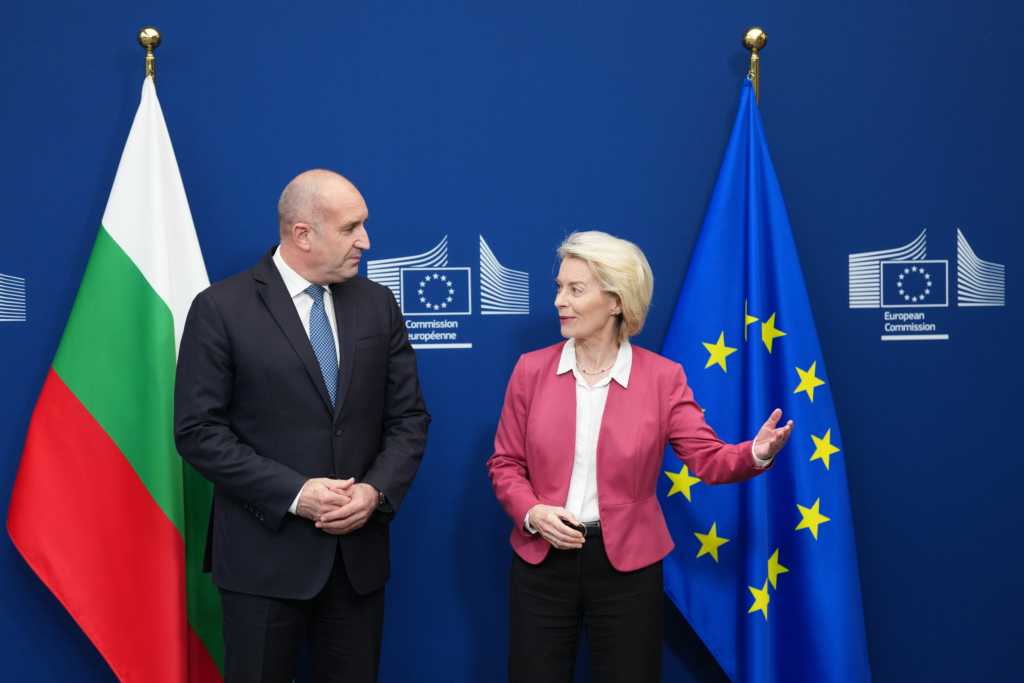
Bulgaria has agreed to host up to eight American refuelling tankers at its Bezmer military base to support US operations in the Middle East. The announcement came just days after prime minister Rumen Radev withdrew his country from the European coalition of the willing (CoW) for Ukraine, arguing that military support would only prolong the war and that Bulgaria lacks the resources to contribute.
Radev has put the final decision on Bezmer to a vote in Bulgaria’s parliament, allowing him to spread the political responsibility and limit direct ownership of the move. Now the prime minister can maintain his rather clumsy position: by rejecting military support for Ukraine (despite previous parliament votes) and justifying logistical support for American military operations elsewhere, he hopes to preserve US security guarantees without dedicating Bulgaria to Europe’s developing security architecture.
These decisions expose a growing inconsistency in Bulgaria’s strategic posture. Sofia is distancing itself from European efforts to strengthen Ukraine and is planning for its own defence, while simultaneously supporting Washington’s military operation in the Middle East. Rather than aligning with the broadly pro-European consensus and anti-American sentiments in Bulgarian society, Radev is attempting to balance competing security frameworks without sufficiently considering European security interests.
This ambiguity also presents a broader challenge for Europe. As the Trump administration continues to conduct foreign policy through bargaining, some European governments appear tempted to pursue bilateral arrangements with Washington rather than invest in European unity. Such behaviour risks weakening collective defence, precisely when strategic coordination is needed.
Solution
European security cannot rely on member states choosing cooperation only when politically convenient. The EU needs to engage more actively with the Bulgarian government and push back on Radev’s form of hedging while political conditions remain favourable, to help strengthen defence cooperation among the EU’s 27 member states.
The EU should also reinforce the political and practical incentives for participation in common defence initiatives, for example through its Multiannual Financial Framework (MFF) and other European defence instruments. At the same time, it needs to reduce opportunities for external powers—particularly China, Russia and the US —to exploit divisions, institutional weaknesses and the strategic ambiguity encouraged by MAGA. Bulgaria’s recent work to delist two Russian oligarchs and a Russian patriarch from the EU’s 21st sanctions package is an example of Russia’s growing leverage over the government in Sofia.
Overall, the EU should treat Bulgaria as an urgent political case rather than a lost cause. This is especially true given that, in 2027, Europe will see several major elections which have the potential to return governments that are more concerned with nationalism than European unity. This, in turn, would constrain the political space in which governments committed to a strong European foreign and security policy can act.
Context
Since taking office in May 2026, Radev has gradually shifted Bulgaria’s foreign policy away from alignment with its European partners. Bulgaria did not join the international agreement to establish the Special Tribunal for the Crime of Aggression against Ukraine, nor did Radev attend May’s B9 summit in Bucharest. Bulgaria’s decision to leave the CoW has attracted strong criticism from pro-European parties and raises broader questions about Bulgaria’s long-term strategic orientation.
The latest move in Bezmer follows the previous deployment of as many as 15 US tanker aircraft at Sofia Airport between February and June, which sparked political controversy. The government ended the deployment, which was linked to arrangements for (unsuccessful) discussions on Bulgaria’s inclusion in the US Visa Waiver Program, on June 30th.
Delays in military modernisation and uncertainty surrounding planned defence-industrial cooperation, including a Rheinmetall partnership, are compounding Sofia’s lack of clarity about whether it intends to become a consistent contributor to Europe’s security architecture. As it stands, Radev appears to be pursuing more transactional, case-by-case relationships with both Europe and the US.
Cover image: picture alliance / photothek.de | Thomas Trutschel
Summary
The war in Ukraine will eventually end, but probably in a ceasefire that leaves Russia, Europe and America locked in open-ended, low-grade, chaotic confrontation.
Europe has the greatest stake. It is closest to the conflict and would carry much of the cost should it escalate. America will still have an interest in maintaining stability, but other, more pressing priorities will likely come first.
American and European policymakers should keep that confrontation stable enough to prevent it from tipping into another war. They should aim for a state of “managed disorder”, where rivalry continues but becomes less likely to escalate.
They can achieve managed disorder through a staged framework that combines credible deterrence, compartmentalised cooperation and conditional, reversible incentives.
To succeed, the framework will need to accommodate divisions between America and Europe, and within Europe itself. It will also need to give Ukraine, Russia, China and other players in the region clear incentives to comply with the framework, and clear costs for defecting from it.
After the ceasefire
It is 2028. The war in Ukraine ended in an uneasy ceasefire eighteen months ago. Russian forces remain in occupied territories, and Ukrainian forces hold defensive positions, armed with American weapons and European money. The ceasefire talks failed to establish either a buffer zone or an observer mission because the parties could not agree on the terms. Europeans have given vaguely formulated “security guarantees” with an ill-defined American backstop, but NATO has no clear presence near the contact line.
One morning, Ukrainian intelligence detects Russian armoured movements towards the ceasefire line. The government in Kyiv claims Russia is preparing for invasion; officials in Moscow insist it is routine repositioning. Within 48 hours, shooting starts and each side blames the other. Russian forces cross the ceasefire line at three points. Calls go out to European capitals and Washington, but no one agrees on what the intelligence shows. The security guarantors reach for the ceasefire documents and find they say different things depending on who is reading them.
Nobody knows what to do—whether NATO should respond militarily, whether European states should act alone, or whether America, focused since 2027 on a series of interventions in Latin America, should engage at all. Nobody has agreed what the rules are, what triggers intervention, what constitutes a proportionate response or who decides.
The outcome of this scenario is chaos and escalation driven by uncertainty and domestic political pressure. These are the conditions that precede catastrophic wars. The goal of this paper is to help prevent that scenario or, more precisely, to ensure clear answers exist before the shooting starts. The post-war environment in Europe will be unstable in the near term and perhaps for a generation or more because the war will almost certainly end without a genuine peace settlement that resolves key questions of sovereignty, security, power or identity. The wounds are too deep and the sides too evenly matched to agree on a comprehensive peace.
This is not an unusual situation after inconclusive wars. To adapt the historian Michael Howard’s insight, the end of fighting does not itself create peace. Between war and peace lies a large and dangerous space of armistices, frozen conflicts and unstable political settlements. The task for American and European policymakers will be to build enough structure around that dangerous space to prevent it from producing the next war.
America and Europe can do this by transitioning from chaotic confrontation with Russia to “managed disorder”: a state in which rivalry remains, but becomes less vulnerable to accident, panic and domestic political pressure.
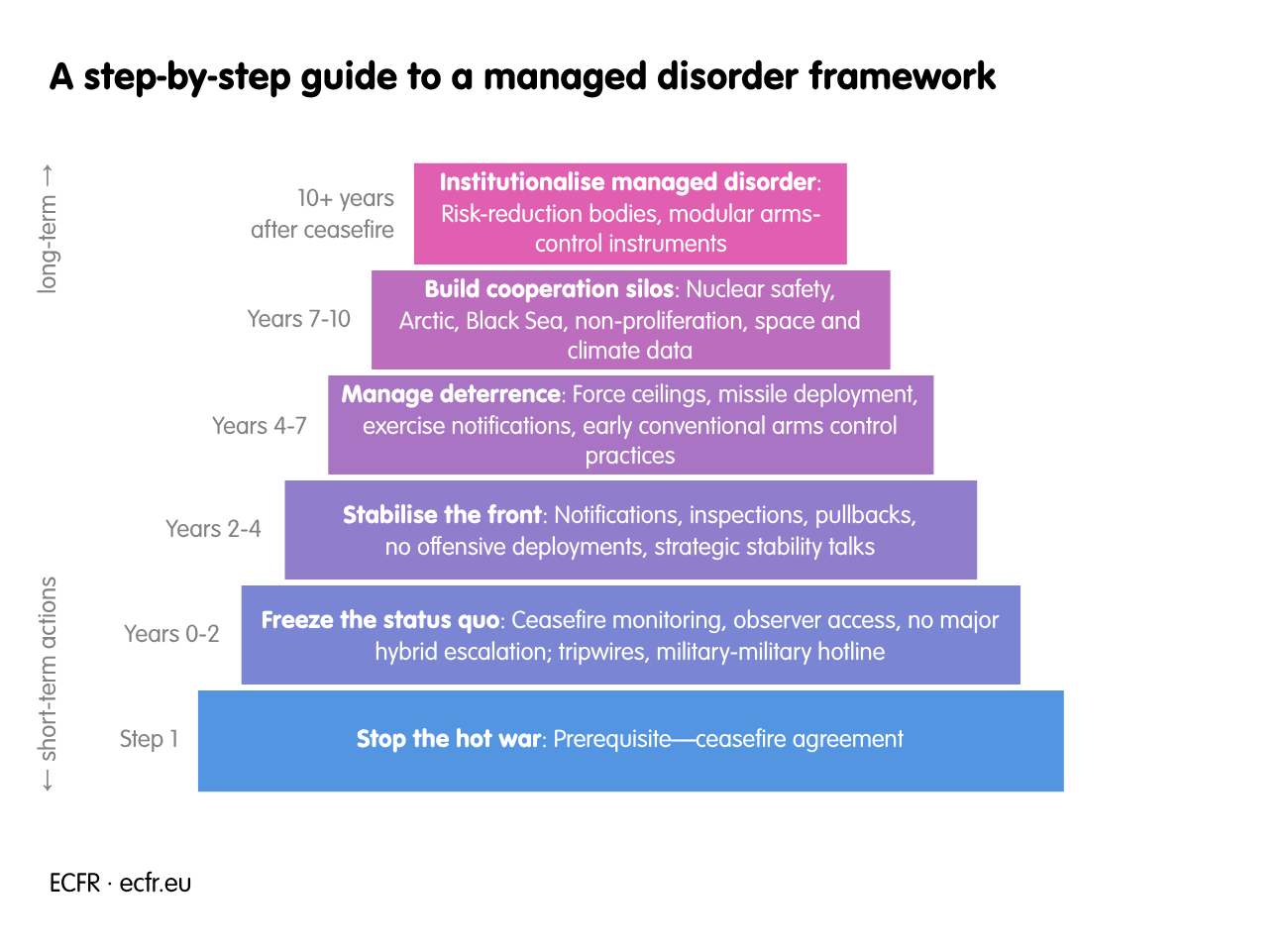
To achieve this state of managed disorder, this paper proposes a staged framework built on verification, certification and conditional incentives. The framework would temporarily freeze facts on the ground, but not legitimise them, and give the main actors reason to adhere to agreements. This would help American and European policymakers maintain stability in Europe, defend Ukraine and deter further revisionism while reducing the risk of escalation. It would also give Russia a sense of safety and a seat at the table to discuss European security. Hostility would persist but it would be channelled into rules, limitations and predictable behaviour.
Managed disorder does not imply legitimising territorial conquest or rewarding aggression. It also falls well short of a durable settlement. Importantly, it does not require “trust”, a commodity that is generally lacking in international affairs and particularly in relations with Russia.
However, building such a system will be politically hard. Russia may prefer chaos to managed disorder. Ukraine may reject any arrangement that appears to freeze partition. European states will disagree over deterrence, sanctions, reconstruction, enlargement and engagement with Moscow, and the US may remain indispensable but unreliable. But these are not objections to managed disorder; they are the reasons it is needed. Its purpose is precisely to manage these political pressures through rules, incentives and procedures before a crisis makes improvisation the only option.
This paper traces the hard road to the modest achievement of managed disorder. It first outlines the sources of disorder after the war in Ukraine and why the key players might find managed disorder preferable to the alternatives. It then describes a staged plan to get from a ceasefire in Ukraine to a hopeful but realistic stability. The plan accepts that the future is contingent and will certainly surprise us. It therefore seeks to adapt to circumstances even as it keeps in mind where we want to go and what we want to avoid.
The sources of post-war disorder
The war in Ukraine is likely to leave relations between Russia, Europe and the United States in significant disorder. A ceasefire, armistice or exhausted pause in the fighting would stop large-scale violence but not settle the question of sovereignty over contested territories. Russian forces will probably remain on Ukrainian territory while Ukraine continues to assert its territorial integrity. Europe will still face a revisionist Russia on its borders and the United States will still have to decide how much of European security it intends to underwrite.
This state of affairs will be the first source of disorder. The ceasefire will probably not resolve any of the geopolitical ambiguity. It will also likely fail to clarify what counts as a violation or establish who monitors the ceasefire, who enforces it and who decides when one side has broken it. This is the central danger of the post-war moment. Although major combat may be absent, every movement of forces, artillery exchange, drone incident, act of sabotage and political crisis in Kyiv or Moscow could result in renewed escalation.
The second source of disorder lie within the West itself. America and Europe will not enter this period as a single strategic actor, even though they will retain important common interests—both will want to prevent a wider war, avoid nuclear escalation and stop Russia from conquering Ukraine outright. For the US, Russia will remain a nuclear power and a disruptive actor, but no longer the organising threat of American strategy. Washington will increasingly focus on China, the Western Hemisphere and the fiscal costs of global leadership. Europe will have no such luxury. Russia will stay a nearby military threat, and Ukraine’s reconstruction will become a European problem. Any failure of deterrence will unfold on Europe’s doorstep.
This divergence means that the Atlantic alliance will become less automatic, even if it does not collapse. The US may remain essential for nuclear deterrence, intelligence, sanctions enforcement and crisis diplomacy with Moscow, but it may also grow less willing to sustain Ukraine’s conventional defence, less patient with European divisions and more tempted by bilateral understandings with Russia that promise quick gains or theatrical success. Europe will fear both American abandonment and American freelancing. It will need Washington to work towards managed disorder, but will no longer be able to count on it to take the lead.
Europe will also generate disorder of its own. The war has produced a rhetorical consensus—Ukraine must survive and Europe must do more for its own defence—that hides deep disagreements. Poland, Sweden and other eastern and northern states will judge any post-war arrangement through the lens of deterrence, vulnerability and Russian deception. Spain, Italy and others will place more weight on stability, fiscal pressures and eventual economic normalisation with Russia. Some governments, such as those in the Baltics, will want to accelerate Ukraine’s integration into the EU and the European defence economy. Yet others, like Poland, will worry that Ukraine’s accession—and its agricultural exports, corruption, security needs—could transform the bloc in ways it cannot control.
These divisions will shape security policy and domestic debates. Russia will try to exploit them. Any post-war arrangement must therefore manage Europe as much as it manages Russia. It must prevent European disunity from becoming an instrument of Russian strategy.
Ukraine itself will form a further source of disorder. It will depend on American and European weapons and money for years after the fighting stops—creating leverage but also resentment. If Ukraine concludes that a post-war order locks in partition while offering only vague promises of future integration, it may resist the whole idea. If Europe concludes that Ukraine is using its support to pursue military aims that Europe cannot sustain, European commitment may fracture. This arrangement, therefore, cannot simply constrain Ukraine. It must give Ukraine a visible future: a defensible state, deepening European integration, reconstruction and a credible non-military path to eventual territorial restoration.
Russia will create the most obvious source of disorder, but not necessarily through renewed invasion. Moscow may accept a ceasefire because it believes time is on its side. It may calculate that Ukraine will become politically divided, that European publics will tire, that American attention will wander and that sanctions will erode. It may use the pause in fighting to rebuild forces, probe American and European resolve, influence European politics and normalise its gains—all while formally conceding nothing. A ceasefire may therefore mark not the end of Russian revisionism, but its movement into a different register.
American and European policymakers should not assume Russia fears disorder the way they do. Disorder may serve Russian purposes. Ambiguity can help Moscow test thresholds. For instance, hybrid operations impose costs on the West while preserving deniability. Political interference can weaken European unity without triggering a military response. For America and Europe, deterring a second invasion of Ukraine may well be the easier task; the harder one will be to curb Russia’s appetite for exploiting turbulence around Europe’s borders.
The post-war order will also face regional spillover. Ukraine will remain the epicentre of the confrontation with Russia, but Moldova, the Black Sea and the Arctic could face intensified coercion too. Africa and the Middle East may offer Russia opportunities to punish Europe indirectly through migration, mercenary activity, energy disruption or political leverage. A system that manages only the line of contact in Ukraine will not contain all of the disorder stemming from the conflict.
China will add another layer of complexity. Its economic weight can cushion Russia from Western pressure, but Beijing’s interest in stability also constrains Moscow’s options.
The final source of disorder will come from the absence of accepted leaders. During the cold war, the US claimed and largely exercised the role of Western leader. That world will not return. Europe cannot yet replace America: the EU cannot speak with the speed or unity of a state. NATO can deter, but it cannot resolve every political dispute a bad ceasefire creates. Individual European leaders may speak to officials in Moscow, Washington or Kyiv, but none can credibly represent the whole continent. In that vacuum, others will try to manage the disorder: private envoys, Gulf intermediaries, business figures, transactional American negotiators or ad hoc coalitions formed in crisis. Without rules, the system will fill with middlemen.
These sources of disorder will keep producing flashpoints that risk a return to war. Maintaining stability in post-conflict Europe will take conscious, active management. A comprehensive settlement to the Russia question remains out of reach for now, so the aim should be to prevent a bad and incomplete peace from decaying into a more dangerous confrontation.
The incentives that will shape a settlement
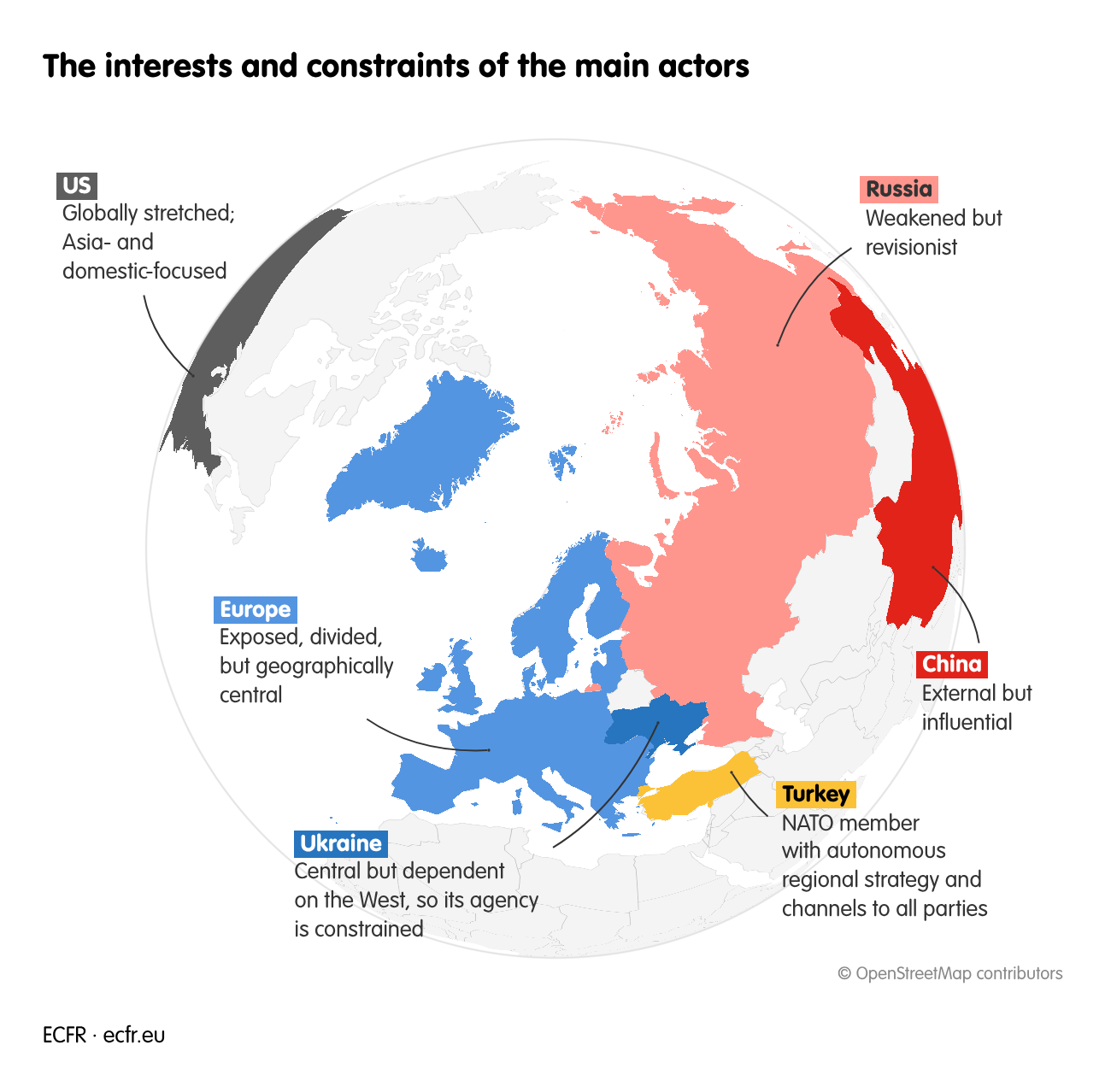
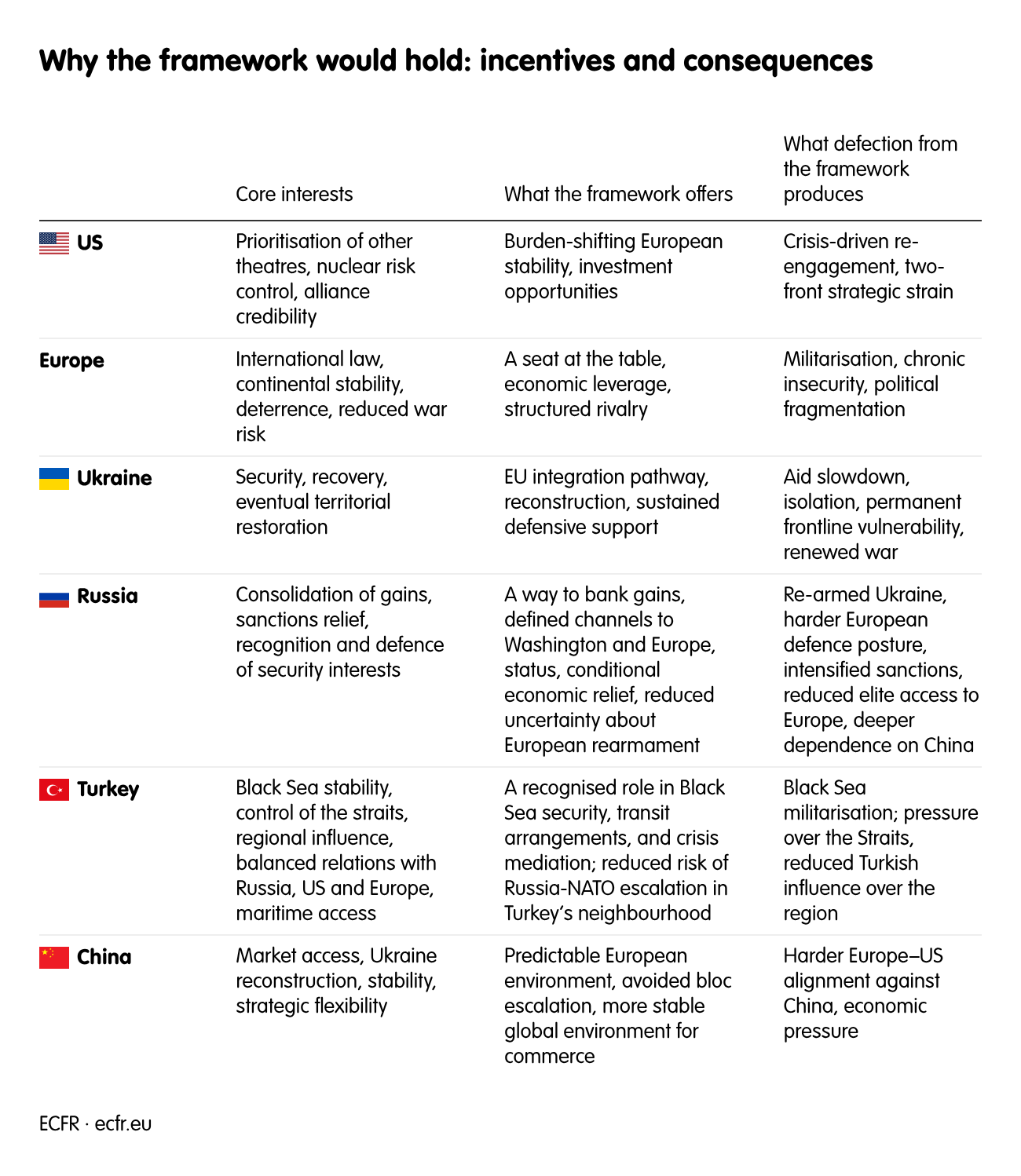
Managed disorder will hold together only as long as its incentives do. America and Europe, Ukraine, Russia, Turkey and China each bring different interests, so the system of managed disorder must align incompatible motives around a limited common interest: avoiding a return to uncontrolled war.
Ukraine is the hinge
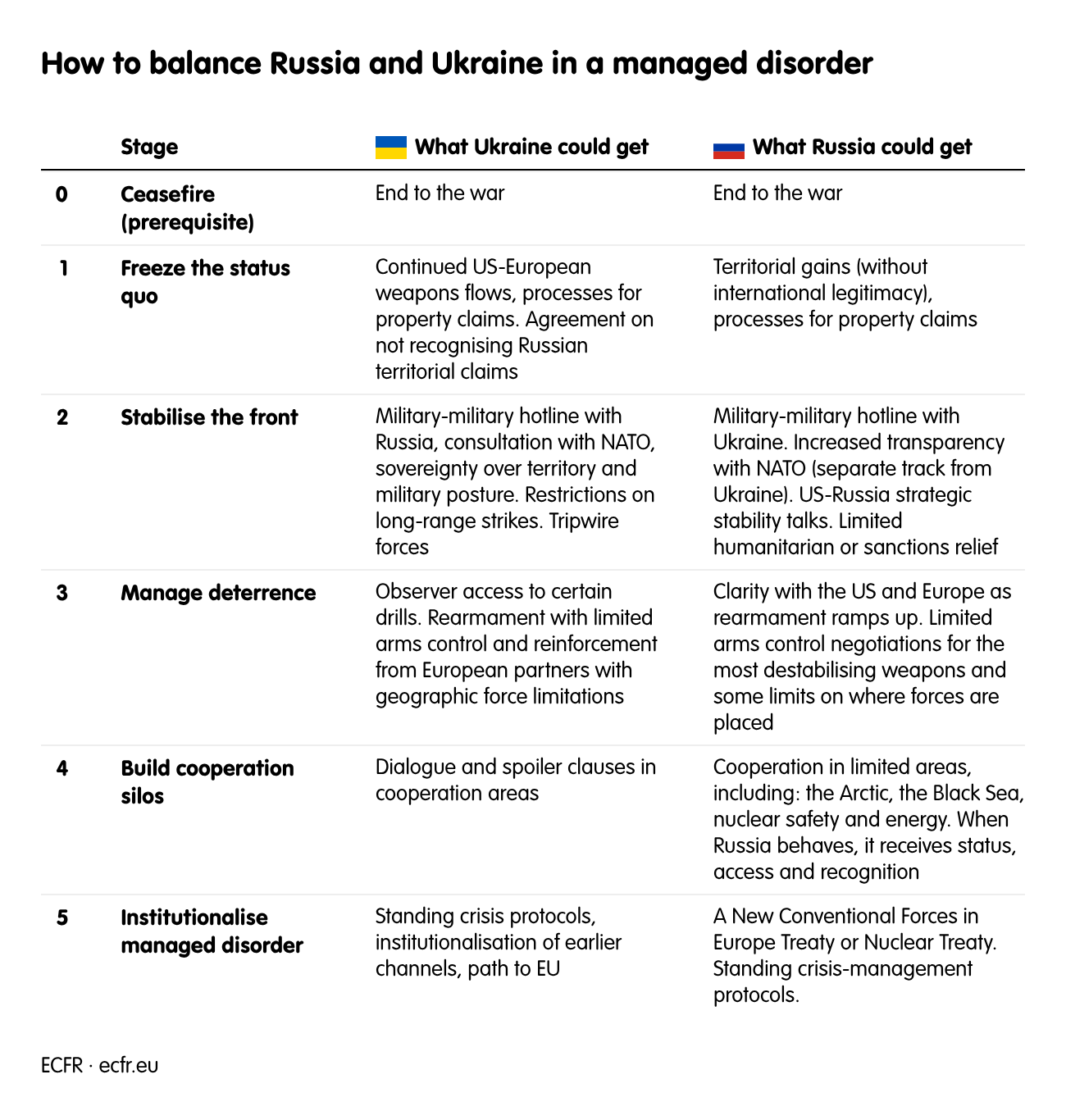
Stabilising and strengthening Ukraine is the foundation of the entire system. For that, Ukraine must want to comply with it rather than be forced to because it needs American and European money and weapons to rebuild itself and deter Russia. The benefits need to be tangible and politically defensible at home. Therefore, in addition to sustained military aid, joint defence production and reconstruction funding, a stable system must offer Ukraine a path into the EU and a credible route to recovering lost territory without renewed fighting. Ukraine will not abide by the rules of managed disorder if it experiences it only as a restraint on its actions rather than as a route to a stronger Ukrainian state.
The main part of that route goes through EU membership. Europe should tie the pace of Ukraine’s accession—market access, regulatory alignment, reconstruction funding—to its conduct within this system. Cooperation opens the door; obstruction closes it. No Ukrainian government can afford to turn its back on a European future.
That pull is real, but it has limits. EU membership is economic and political; the bloc’s mutual-assistance clause, Article 42.7, carries none of NATO’s integrated command structure or binding defence commitments. However, Ukrainian officials under domestic pressure may present accession as delivering that protection anyway, leaving the public expecting a NATO-style military response that Article 42.7 was never built to provide. Any actual security guarantee will need its own separate instrument with defined triggers, scope and decision-making process.
In any case, Ukraine will benefit more from sustained American and European military aid, joint defence production and a homegrown arms industry than from any ambiguous or unenforceable security guarantee. The country will need artillery, air defence, drones and the factories to build them for decades to come. But offensive or long-range systems—capable of striking deep into Russian territory—should come from Western allies only if Russia attacks again, keeping the line between defending Ukraine and arming it for renewed war visible to Moscow and to sceptical Western publics.
Ukraine’s own expanding arms industry will blur that line. Washington and European capitals can condition their weapons transfers, but they cannot control what Ukraine builds. To manage disorder, therefore, they should tie reconstruction, defence-industrial cooperation and military assistance to rules about defensive posture and escalation.
The territorial question needs careful handling. A settlement must preserve Ukraine’s claim to the occupied lands—legally, politically and morally. Refusing to recognise Russia’s conquests should remain a core principle. But America and Europe must be honest too: Ukraine cannot retake its territory by force. Restoration will come through Ukrainian resilience, European integration, legal non-recognition, diplomacy and long-term shifts in the balance of power—not a bet on a better war later. Ukraine can keep hoping for its territory back without believing that another war is the way to get it.
Coalition dynamics will shape compliance with managed disorder too. Poland, Lithuania, Latvia and Estonia—Ukraine’s strongest backers—will have to be part of any difficult trade-offs. If these countries can support a compromise, Ukrainian leaders can argue that managed disorder strengthens Ukraine rather than abandons it, and western European governments can show that restraint does not mean appeasement. If they oppose it, critics in Kyiv and across Europe will portray the arrangement as a deal made over Ukraine’s head and at the expense of Europe’s most vulnerable states. In that case, neither Ukrainian nor European leaders could easily sell compliance at home.
In the end, Western policymakers must design Ukraine’s decision space, not just hope it will make the right decisions. They must show that cooperation deliversEU integration, reconstruction, military assistance, long-term deterrence and a path to restoring territory by weakening Russia over time—West Germany pulled off exactly that with the East, decades later. Obstruction delivers economic stagnation, dwindling aid, isolation and an indefinite war footing with nothing to show for it. The goal is to make cooperation the rational, defensible choice for any government in Kyiv.
Russia’s calculations
This paper does not assume that Moscow wants peace or even managed disorder. The only assumption is that a ceasefire would reveal some Russian interest in pausing large-scale war. The task is to exploit that pause to make restraint more attractive to Moscow than going back to war.
The logic is structured choice. Russia should know exactly what it gets for playing by the rules and what it loses for breaking them. If Russia complies, the rewards should be tangible—for instance, sanctions relief is immediate but reversible. If Russia violates the rules, the costs should be just as immediate—for example, suspended sanctions snap back automatically.
Military realities can reinforce this logic. The war has cost Russia dearly in soldiers, equipment, ammunition and political attention. Yet Russian weakness should not lull the US and Europe into assuming that Moscow’s appetite for aggression has diminished. Russia’s calculation will change only if Ukraine, armed by Europe, can defend itself. A second full-scale invasion would offer no easy win. Russia would confront a better-prepared Ukraine, a more fortified eastern flank and a Western sanctions system built to escalate rather than merely restore previous penalties.
Economic incentives can also matter, though they will not by themselves drive Russian policy. The Kremlin has shown it will sacrifice prosperity for war and ideology. But Russians value access to markets, targeted relief and the ability to travel, which shape interests inside the system, especially once the immediate demands of wartime mobilisation recede. Sanctions can thus create constituencies for restraint. Relief should remain selective, staged and reversible. It should reward observable behaviour, not political promises. And it should be designed so that renewed escalation hurts the specific people and networks that benefit from playing along.
None of this guarantees Russian cooperation. Moscow may still conclude that exploitable disorder serves it better than regulated confrontation, particularly if it can strike a bilateral understanding with Washington over Europe’s head. Western policymakers should therefore expect Russian violations and aim to narrow Russia’s room to exploit ambiguity.
Moscow does not need to like managed disorder to live with it. It only needs to face a world in which restraint brings some gains and cheating brings higher costs. Of course, the Russian government has not always responded to such incentives. No amount of pressure guarantees good behaviour. All any arrangement can do is make every alternative worse.
Turkey as a partner
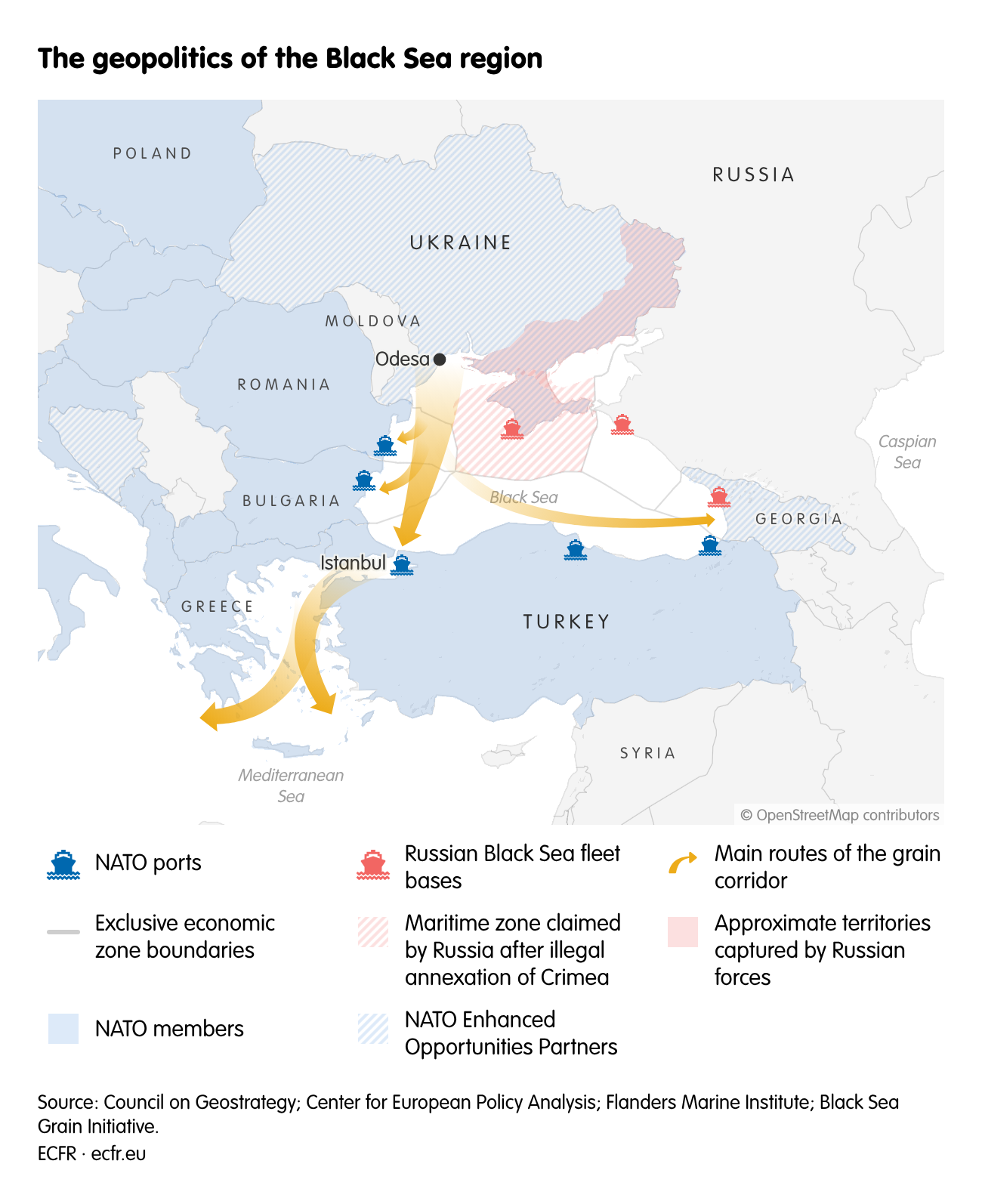
Turkey belongs in this system because the Black Sea cannot be managed without it. Ankara controls access to the Black Sea through the Bosphorus and Dardanelles Straits, has direct interests in maritime security and commerce, and has maintained working channels with both Russia and Ukraine throughout the war. Any post-war arrangement that touches naval access, grain routes, energy transport, Russian warship movements, or the security of Ukraine’s southern coast will require Turkish participation. Ankara can either reinforce the framework or complicate it. Managed disorder should therefore treat Turkey as a necessary regional partner.
China in the background
The other major power shaping Russia’s future options is China. The two are not formal allies, but their partnership is more than a marriage of convenience. Russia needs Chinafor markets, technology, diplomatic cover and long-term economic resilience. Moscow’s options depend as much on what Beijing will tolerate as on what Washington and European capitals will permit.
China need not endorse managed disorder for its interests to tacitly reinforce it. Beijing benefits from a stable Russia that checks American and European power, but not from a Russia that collapses or continually destabilises Europe. Endless war raises energy prices, invites secondary sanctions and risks escalation that could disrupt China’s own growth and global positioning. A structured post-war settlement that freezes borders, channels competition and conditions economic reintegration offers China predictability without forcing political alignment. If American and European sanctions tie relief to Russian conduct and penalises circumvention, Beijing may find it cheaper to let the system work than to help Russia rearm—provided the system leaves Russia viable as a geopolitical ally for China and a source of natural resources.
Economic interests pull in the same direction. Beijing values access to European markets and reconstruction opportunities in Ukraine. Western leaders should therefore make clear that stability unlocks better China-Europe economic ties, while a collapse of managed disorder would push Europe toward militarisation, protectionism and tighter technological coordination with the United States. China can benefit from this arrangement without choosing between Europe and Russia, so long as it prefers predictability and stability to escalation and sanctions spirals.
Managed disorder also needs a China clause. If Russia uses China to rearm and restock its munitions, the consequences cannot fall on Moscow alone. Europe should tighten its China policy, deepen coordination with America and target Chinese firms enabling violations with economic pressure. China must understand that helping Russia evade these rules costs Beijing more than it benefits it, while tolerating stability keeps the door to European markets open.
In this sense, China is neither an adversary nor an essential partner, but a structural constraint that can reinforce, undermine or passively enable whatever security order emerges in Europe. A system that links market access to stability, invites selective Chinese participation and penalises circumvention turns Beijing, intentionally or not, into a stakeholder in restraint.
The path to managed disorder
How the war in Ukraine ends will go a long way towards deciding the path to managed disorder. A fully disarmed or “neutralised” Ukraine is unacceptable to Kyiv and unsustainable for Europe. A permanently offensive Ukraine capable of striking deep into Russian territory would risk escalation and be unacceptable to Moscow. The same would be true if Ukraine were to host Western troops.
Between these poles lies the most workable model: a defensible, resilient Ukraine that is armed to deter, but not configured for offensive operations. This “steel porcupine” posture follows the same logic as cold war West Germany: strong enough to make conquest costly but not positioned as a launchpad for offensive war. It separates Ukraine’s legal and political claim to territorial restoration from the military means that could reignite the war, without conceding Russia’s territorial gains.
Europe is likely to bear long-term responsibility for Ukraine’s rebuilding, military assistance and eventual integration into European institutions. Even a supportive United States may commit fewer resources over time. A framework for managed disorder must ensure that Europe can sustain Ukrainian security on its own if America steps back, while leaving room for deeper US involvement should political conditions allow.
To reach that state, American and European policymakers will need to work amid mistrust, division and partial compliance. They must create a system in which Ukrainian restraint earns visible progress, and Russian violations bring consequences and compliance rewards. Importantly, they should also ensure European disagreement does not become paralysis and American involvement strengthens the system without owning it.
Designing around a divided West
Washington and European capitals share core interests yet diverge in priorities, attention and risk tolerance. The challenge will be to design a system that can operate with those differences built in.
America
A future American administration, whether populist or merely pragmatic, is likely to approach Russia as a file to manage rather than a sustained strategic priority beyond its nuclear dimension. To the extent it figures in US strategic calculations, Russia is more likely to be seen as part of America’s larger competition with China. Commitments to European security that once seemed permanent will depend on electoral cycles and budgetary politics.
That is why managed disorder should rely on European initiative and pre-agreed processes rather than sustained American focus: durability must be built into the mechanism itself, not assumed from Washington’s resolve.
Europe
European nations will see the landscape through a nearer lens. Russia is not a distant power but a neighbour capable of altering borders by force. European governments agree that Ukraine must survive yet disagree on what survival means: integrated or merely defended, heavily armed or cautiously defensible, anchored fully to Europe or held at strategic arm’s length. Populist and anti-migrant parties are often averse to sustained defence expenditure and will sometimes be open to friendly relations with Russia.
Given the European disagreements and the American focus on China, a genuine transatlantic consensus on a post-war order is unlikely to emerge. What is achievable and necessary is interoperability: a structure in which Europe and the US can act together when aligned and continue functioning when they are not. A framework to achieve managed disorder will therefore need to do two things. First, its stages, tracks and certification mechanisms should be designed to keep working whether or not Washington and European capitals are pulling in the same direction. Second, it should be designed for a permanently divided Europe. Its purpose should be to prevent disagreement from becoming paralysis.
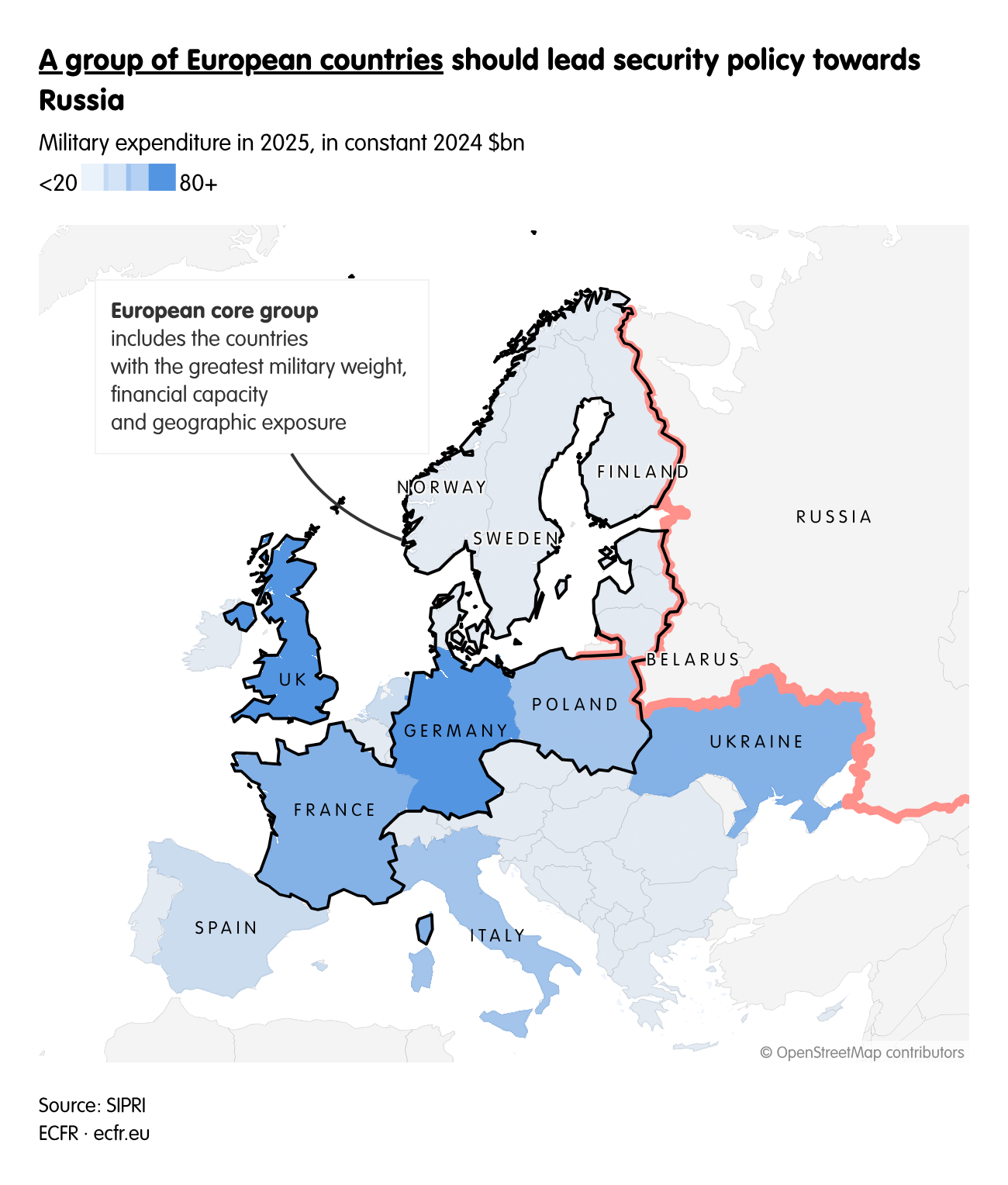
That means creating aEuropean core group: a few countries that can negotiate sanctions positions, military support thresholds, monitoring standards and responses to Russian violations before each crisis arrives. It should include the countries with the greatest military weight, financial capacity and geographic exposure—France, Germany, Poland and the UK, as well as the Nordic and Baltic states. The core group should drive the security logic; EU institutions should anchor the economic, sanctions, enlargement and legitimacy logic.
How to stop Russia from setting the security debate
Russia will seek to widen any post-war process beyond the line of contact in Ukraine. It will want to discuss NATO enlargement, American and Western European basing, missile deployments, military exercises, the Black Sea and the military balance along its western frontier. Europe and the US should expect these demands, but they should neither dismiss them reflexively nor accept them on Russia’s terms. Some issues do raise genuine risks of miscalculation between Russia and NATO. Large military exercises near borders, missile deployments, ambiguous troop movements, air and naval incidents, cyber operations against critical infrastructure and uncontrolled activity in the Black Sea can create crises regardless of the justice of the underlying political claims.
To stop Russia from setting the terms of the debate, European leaders should pursue two distinct negotiations. The first would revolve around the ceasefire and subsequent security arrangement in Ukraine, and must preserve Ukraine as a principal actor. The second concerns the wider Russia-Europe security environment and must prevent either Moscow or Washington from treating Europe as an object of negotiation. Russia will try to conflate the two tracks so that it can use NATO-Russia talks to extract constraints on Ukraine or claim that whatever Kyiv gives up, the West gave up too. European policymakers should resist this and keep the two discussions separate, though separation also has risks: if either track collapses, the other will suffer because both tracks are needed to ensure regional security. The first maintains immediate stability along the line of contact between Russia and Ukraine; the second tackles the wider geopolitics.
Russia will prefer to discuss regional security with America rather than with Europe. It will try to cast Europe as the object of negotiation, not a participant in it. If the American leadership is distracted by other priorities or tempted by bilateral deals with Moscow, it might even support that Russian position. The answer for Europe is to define the terms of engagement with Russia in advance, with frontline states fully involved and with clear limits on what can and cannot be negotiated.
To do that, Europeans need the core group to define common positions before the United States and Russia enter any serious dialogue. European leaders cannot prevent every American side channel with Moscow, but they can limit the damage by insisting in advance on the principles that should govern any regional security conversation. These might include no recognition of territorial conquest, no Russian veto over its neighbours’ alliance decisions, no limits on Ukraine’s sovereign choices and no economic relief without behavioural restraint.
This regional security agenda will make many European leaders uncomfortable. Frontline states will fear that any discussion of basing, exercises, missiles or notification requirements gives Moscow a path back to influence over their security. They have reason to worry. Russia has used previous security conversations to claim rights over its neighbours. It has, for example, consistently used the indivisible security clause of the 1999 Charter for European Security to assert that it has the right to deny its neighbours membership in Western security organisations such as NATO. Despite this record, to exclude regional security from the framework would leave Moscow free to raise it bilaterally with Washington or exploit it during crises.
Regional security therefore is one of the central tests of managed disorder. If the US and Europe refuse to discuss it at all, Russia will use the refusal to justify probing, escalating and direct talks with America over Europe’s head. If they discuss it on Moscow’s terms, it will legitimise coercion and weaken the states most exposed to its power. The only viable course lies between those failures: to create a framework that channels Russian security demands into reciprocal, verifiable and limited mechanisms.
A framework for managed disorder
Every actor has reason to tolerate managed disorder over the alternatives, but tolerance does not sustain itself; it has to be built into rules. Managed disorder therefore rests on at least three mutually reinforcing principles:
Separate where necessary:Europe should first reduce its exposure to Russia with stronger defences and less dependence on Russian energy. Ukraine should tie itself economically more closely to Europe and be able to hold its ground militarily. Effective deterrence is a precondition for any dialogue.
Compartmentalise where you can:Certain issues—nuclear risk, Arctic exploitation, climate change and counter-proliferation—are in everyone’s interest to manage together. Even Russia wants to avoid, say, nuclear war or environmental collapse. The parties should fence such issues off from more neuralgic ones, such as Ukrainian sovereignty, to prevent crises from cascading into areas of mutual benefit. Cooperation here is a limited and mutually beneficial transaction, not the embryo of a broader relationship.
Make engagement conditional: Russia should earn sanctions relief, diplomatic reintegration and economic access by meeting specific, verifiable benchmarks. These rewards should be reversible and calibrated, so that, for Russia, compliance pays and violations are costly. This system does not require faith—just working mechanisms.
Within these pillars, Europe can emphasise defensive resilience and sanctions, while America manages nuclear and global issues. Both are compatible with the same architecture, if properly sequenced.
The stages of managed disorder
Managed disorder will not arrive by some grand bargain. It must grow semi-organically from whatever unsatisfactory deal ends the Ukraine conflict. Progress will be uneven and contingent: each stage will require stability in the previous one and give Russia incentives to value restraint over escalation. Optimistically, it will take years to move from ceasefire management to durable rules, and probably a decade or more before habits, institutions and political constituencies for restraint begin to take root. The framework will thus also need to “fail well” in the sense that Ukraine and Europe need to be able to bounce back if there is a setback.
The sequencing below shows how war-termination mechanisms can become stabilisation tools, then arms-control practice, then institutions. This is deliberate. America and Europe should commit openly to this trajectory, making clear that progress depends on Russia sticking to core principles. Even so, however technical the criteria for moving from one stage to the next may look, all the parties will accept progress only if their domestic politics allow it.
Stage 0: Secure a ceasefire (prerequisite)
A ceasefire, negotiated principally between Ukraine and Russia, is the prerequisite for everything that follows. It would be good if that ceasefire laid the groundwork for a more stable peace, but experience suggests that it will only nod in that direction and leave much unsaid. In the end, the purpose of a ceasefire is to stop the shooting rather than to ensure permanent peace. In Ukraine, that would be an accomplishment in itself and would at least open the door to the more sustainable process outlined below.
Stage 1: Freeze the status quo (~years 0-2 after ceasefire)
The first phase is about preventing a return to large-scale violence, preserving Ukraine’s survival and creating minimum conditions for a wider managed confrontation. It should embed the principle that behaviour has consequences. Monitoring and verification should come first—they enable later agreements by normalising inspections, data exchanges and the idea of measurable compliance. Those, in turn, provide the basis for rewarding Russian restraint.
This phase should establish baseline rules and mechanisms.
Military movements
No renewed large-scale offensive action.
No forcible changes to a clearly delineated line of control.
No systematic attacks on European critical infrastructure.
No escalatory hybrid campaign against EU or NATO states.
Restrictions on long-range missiles and strike platforms near the line of contact.
The goal is to contain friction along the line of control and normalise external verification so that incidents do not spiral.
Communication and monitoring
Humanitarian corridors and prisoner-of-war exchanges as first channels of dialogue.
A Russian-Ukrainian military hotline with protocols for reporting ceasefire violations, troop movements, drone incidents and humanitarian emergencies.
A joint or tripartite monitoring mechanism, potentially with UN endorsement even if not UN-staffed.
Monitoring in this phase should not be confused with Western intelligence assessments. A ceasefire mechanism needs visible procedures that both Russia and Ukraine can invoke when incidents occur. The American and European governments will also rely on classified intelligence, satellite imagery and Ukrainian reporting to assess whether Russia is preparing to attack again, but Russia need not accept those assessments for America and Europe to act on them. The two systems serve different purposes: the ceasefire mechanism manages incidents and referees disputes; intelligence assessments guide deterrence and enforcement.
Administrative
A process for property claims, compensation and occupied-territory inventories.
Property claims will likely be one of the war’s most politically corrosive legacies. The framework must acknowledge them early, even if it cannot resolve them. Ukrainians have lost homes, businesses and land in occupied territories. Russian state assets and other linked private assets are frozen or seized across Europe. European nationals, companies and institutions have outstanding claims from pre-war investments. Left unaddressed, these grievances will curdle into domestic pressure against any government trying to sustain the framework. Experience from other post-conflict settlements suggests that unresolved property claims only get harder to settle and easier for spoilers to exploit the longer they sit.
This stage should therefore set up a dedicated arbitration channel for property claims, compensation and an inventory of assets in occupied territories. It should give affected populations a visible, legitimate process they can trust to address their claims eventually, even if immediate restitution is impossible. Otherwise, these issues become structural weaknesses that Russia, populist parties or affected lobbies can later exploit to fracture European cohesion.
No formal milestone marks the end of Stage 1—readiness to advance is a practical judgement. Triggers for progression to the next stage could include six to twelve months without major violations, inspectors consistently granted access or functioning communication demonstrated during minor incidents.
Stage 2: Stabilise the front (~years 2-4)
Once violence subsides, the next task is to keep it that way. This requires partial demilitarisation and transparency along the Ukraine-Russia and NATO-Russia contact lines. The logic resembles the earliest cold war confidence-building measures: small, technical arrangements that reduce risk without requiring political alignment.
Two tracks
Stage 2 creates, as noted, the two parallel negotiation tracks with Russia: one on the Ukraine-Russia contact line, Track A, and the other on NATO-Russia, Track B. Progress or failure in one track should have no bearing on the other, and the scope of Track B explicitly excludes Ukraine’s sovereign choices. Ukraine should be consulted before any Track B arrangement that materially affects its security. It should have no veto over NATO decisions, but it should not be treated as an object of them either.
The purpose of the negotiations would be to make the signs towards confrontation easier to read. Russia should be able to tell which US and European actions reflect routine deterrence from those signalling preparation for escalation, just as America and Europe need a clear read on which Russian moves stay within declared force posture and which mark renewed aggression. Ukraine, in turn, should know what kinds of Russian movements will trigger US and European responses—and frontline European states should trust that de-escalation measures will not come at their expense. The framework seeks to reduce the danger that military ambiguity becomes political panic.
Transparency measures and limits on destabilising deployments would increase predictability without weakening deterrence. The test is practical: a measure belongs in the framework if it reduces miscalculation while preserving the ability to defend Ukraine and NATO territory.
Examples of measures for each track include:
Track A—Contact line management (Ukraine-Russia, Western-facilitated)
Reduced-force and weapon-limited zones on both sides of the line of contact.
Restrictions on long-range strike systems or designated platforms near the line.
Direct communication channels between local Ukrainian and Russian commanders, with agreed protocols for use during incidents.
On-the-ground monitoring and inspection access, potentially with neutral observers.
Verified pullbacks of heavy artillery or long-range systems from designated exclusion belts.
Track B—NATO-Russia military transparency (NATO-led, Ukraine consulted)
Advance notification of exercises above a defined unit size along NATO’s eastern flank.
Hotlines between NATO and Russian military commands with agreed rules of use.
Observer arrangements for major exercises under agreed formats.
Early data exchange on force levels and positions where this increases predictability without weakening deterrence.
Technology-enabled transparency—such as satellite imagery, opensource intelligence aggregation, pattern detection—to support rather than replace agreed notification and inspection procedures.
A restart of American-Russian strategic stability talks.
Crisis channels
Stage 2 should also expand crisis communications into separate channels, each with a limited purpose. A Ukraine-Russia channel should manage incidents along the line of contact. Exercises, air and naval encounters, forward deployments and missile notifications would run through a separate NATO-Russia military channel. A political channel—bringing together the European core group, the US, Ukraine and Russia—should handle cases that risk triggering sanctions snapback or military escalation. And the Black Sea requires a fourth channel, covering naval movements, commercial shipping, mine clearance, port access and other maritime incidents, with Turkey centrally involved.
The Black Sea requires special attention. Ukraine’s security depends on its land frontier as much as it does on Odesa—the country’s principal port and the conduit for the bulk of its grain exports, without which Ukraine would be cut off from global maritime trade. Turkey’s control of the Black Sea and its diplomatic channels to both Moscow and Kyiv make it indispensable here.
These channels should be linked by notification rules but should not be merged into a single negotiation. Their value lies precisely in compartmentalisation: failure in one channel should not bring down the rest.
Overall, these measures create predictability rather than normality. The metrics are practical: fewer surprises, lower risk of misinterpretation, calmer borders. Communication at the tactical level buys stability at the strategic one. The aim of the monitoring is to make suspicious behaviour visible enough, early enough that American and European governments can respond before ambiguity becomes paralysis.
Informal progression to Stage 3 could follow after 9–18 months of ceasefire compliance, a functioning inspection regime or verified pullbacks of heavy artillery or long-range systems from designated exclusion belts.
Stage 3: Manage deterrence (~years 4-7)
If stabilisation holds, America and Europe should shift their focus from military capability to deterrence. The relationship with Russia may remain adversarial, but it must be clear why and, within limits, predictable.
This stage should distinguish rearmament from deployment. At first, it should leave Europe, Ukraine and Russia to rebuild their armed forces. Capping rearmament outright would be unpopular, difficult to verify and potentially damaging to deterrence. The early aim is narrower: to curb the most destabilising forms of rearmament by regulating where forces are placed, how movements are notified, which exercises require observers, which long-range systems create escalation risks and what kinds of external assistance to Russia would trigger penalties. In short, managed disorder should allow rearmament but make it less surprising, less offensive in posture and less likely to spark a crisis.
Hybrid activity is a harder problem because Moscow has made it part of its regional strategy. Disinformation and cyberattacks cannot be managed through traditional arms control. The US and Europe cannot negotiate a clean cyber or hybrid non-aggression pact with Russia, but they can set conditions for participation in a wider framework. Russia cannot stop the drone war in Ukraine while continuing an infrastructure war across Europe and still expect sanctions relief and cooperation. A reduction in major hybrid attacks should become part of the price of entry into the framework.
This will require clear thresholds. Not every disinformation campaign warrants a crisis response, and not every cyber incident will carry a signature that all governments accept. But hybrid attacks on critical infrastructure, electoral processes, or political figures should carry consequences when evidence reaches agreed standards. The US and Europe should create a certification process that assesses such activity and links it to sanctions, diplomatic access and the pace of wider engagement. Attribution will remain contested, but the absence of perfect attribution cannot excuse permanent grey-zone coercion.
Both sets of rules—on rearmament and on hybrid activity—belong to the same emerging arms-control agenda, which could include:
Geographically bounded force ceilings near Ukraine and NATO’s eastern flank.
Reciprocal notification of major troop movements and exercises.
Observer access to certain drills under agreed formats.
A dialogue on missile deployments and dual-use systems, initially without formal treaties.
Additional transparency measures for storage or deployment locations of sensitive weapons.
Agreed thresholds for major hybrid activity, including sabotage of critical infrastructure, coercive migration operations, cyber operations against essential services and attacks on defence production, linked to certification and penalties rather than formal arms-control limits.
The US would lead this part because of nuclear considerations, while Europe anchors the conventional posture. Russia may well test boundaries, so deterrence must remain credible. But even imperfect predictability is safer than total opacity.
Triggers for informal progression to the next stage could include routine functioning of transparency mechanisms, no large undisclosed deployments near the line or political space inside EU and US capitals for conditional economic measures.
Cooperation in limited areas can help keep the wider framework from collapsing. Even after a ceasefire in Ukraine, Russia will still be able to destabilise Europe indirectly through hybrid operations within European borders and its wider neighbourhood. A managed framework will therefore need to go beyond Ukraine without assuming that cooperation in one domain signals goodwill or leads to broader reconciliation.
The purpose of functional cooperation is twofold. First, it can give Russia limited, visible benefits from predictable behaviour. Moscow values status, access and the recognition that it is an indispensable interlocutor. Carefully chosen cooperation channels can provide these at relatively low cost, provided they remain conditional and reversible. Second, such channels can reduce Russia’s incentive to use theatres outside Europe as pressure points. If Russia gains a stake in, say, Arctic safety, it may have more to lose from turning it into a battlefield.
The US and Europe should choose these areas carefully. Cooperation should start soon after a ceasefire wherever interests overlap. It can include humanitarian and economic essentials—fertiliser and food exports, prisoner-of-war exchanges—alongside maritime and safety measures such as Black Sea commercial shipping and nuclear safety. The early purpose is to improve people’s safety and daily lives rather than to preserve the peace. If the framework holds, functional cooperation can institutionalise and spread into two further clusters: maritime and Arctic cooperation, such as search-and-rescue and maritime deconfliction; and technical safety cooperation, such as space debris monitoring, counter-proliferation and climate and environmental data exchange.
The Arctic presents a distinct challenge. Before the war, it was one of the few spaces where Russia, America and Europe cooperated despite wider tensions, but that cooperation has since collapsed. Finland and Sweden’s accession to NATO, Russia’s militarisation of the High North, competition over energy and shipping routes, and Chinese interest in Arctic access have turned the region into a sharper theatre of rivalry. A functional Arctic track could help prevent accidents, manage search-and-rescue obligations, preserve basic environmental data exchange, and reduce the risk that military incidents in the High North spill into wider confrontation.
Functional cooperation could also help manage the Black Sea, building on the channel already established in Stage 2. The aim should be to cut the risk that a naval incident spirals into a wider escalation.
These channels should also serve as tests of Russian behaviour. Russia cannot expect cooperation in the Arctic while sabotaging European energy infrastructure, or maritime deconfliction while strangling Ukraine’s economy in the Black Sea. Functional cooperation should therefore rest on a spoiler clause: major destabilisation in one domain should cut benefits in others, though minor incidents, such as temporary denial of port access, should not automatically break compartmentalised cooperation. The point is to preserve communication during confrontation, but without allowing these channels to become sanctuaries for Russian bad behaviour. A standing certification mechanism should assess whether Russian actions remain compatible with continued participation; major violations, such as sabotage of critical infrastructure or using mercenary forces to destabilise European interests abroad, should trigger wider consequences.
Functional silos can also discipline European divisions by allowing limited contact with Russia where it serves security, while preventing that contact from becoming a general political thaw. This distinction lets hardline states accept narrow, security-driven engagement without conceding that Russia has been forgiven, while allowing more accommodating states to engage practically without waiting for a broader reconciliation that may never come. Silos also give European publics a clear rationale: certain risks require communication even among enemies.
The task for the bilateral re-engagement is to prevent unconditional normalisation by channelling it: bilateral contacts should be registered, reported to the core group where security-relevant and subject to spoiler clauses. Left unmanaged, bilateral contacts could become the pathway through which sanctions erode and Europe fragments.
China may play a limited role in this stage in areas where its interests—Arctic access, nuclear stability, maritime trade—align with predictability. Beijing will understand that stability preserves the economic access it values; Russian defection narrows it.
After a sustained period of compliance, the framework should offer Russia visible but reversible dividends for restraint: expanded diplomatic channels, ministerial-level meetings, greater facilitation of agricultural and fertiliser exports, enhanced participation in Black Sea or nuclear-safety mechanisms, and broader bilateral contacts. The aim is to show that restraint changes the terms of engagement.
The trigger for the next stage might be two to four years of stable front lines, deterrence and transparency mechanisms working as intended, and proof that narrow cooperation holds without spilling over or being exploited.
If earlier stages mature and survive disruptions, an institutional architecture can begin to consolidate. Many elements may start earlier but will take shape over the long term. Institutionalisation marks a recognition that competition must be permanently managed. This day may never arrive, but it matters as an aspiration. Comparable cold war institutions took 25 years or more to emerge. For example, the Conference on Security and Co-operation in Europe (CSCE) was launched in the early 1970s but it only became a standing institution, the Organisation for Security and Co-operation in Europe (OSCE), in 1995.
Potential forms for institutions include:
A US-Europe-Russia Risk Reduction Commission meeting at ministerial and military-to-military levels.
A modular arms-control instrument replacing parts of the Conventional Armed Forces in Europe and Intermediate-Range Nuclear Forces frameworks, eventually bringing in other countries—notably China.
A dual-track diplomatic structure: Washington–Moscow for nuclear or global issues; Europe–Moscow for regional security and Ukraine arrangements.
A standing crisis-management protocol with predefined escalation control steps.
An institutional layer consolidating the crisis channels of earlier stages, created through standing bodies, regularised military contacts and agreed evidentiary standards.
This stage is ambitious, uncertain and far off. It would require political durability inside Russia, Ukraine, the US and Europe. But it should remain visible as the horizon. The framework must offer a picture of a stable destination even if the road there is long.
The path to stability runs through this framework; it structures a rivalry that will continue whether we prepare for it or not. The logic is incremental: ceasefire enables monitoring, monitoring enables transparency, transparency enables limits, limits enable rules, rules enable institutions. Each step must be earned through behaviour, not granted on faith. None of this works, however, if Europe cannot act as one.
How to overcome division paralysis in Europe
European cohesion will require a system that stops any single state from vetoing responses that the group has already agreed. The model should borrow from the Iran nuclear deal of 2015: participating states determine upfront what counts as a violation and what counts as a compliance milestone. Those criteria, once set, cannot be revised downward. The states most exposed to Russian pressure would write their red lines into the rules before the politics of the moment can erode them. A standing committee of the participating states then decides by qualified majority whether Russia has met a given criterion. If it has, the agreed reward or penalty follows automatically—unless a majority votes to block it.
This process flips the usual logic. The current system requires consensus to impose a snapback or advance a tranche of sanctions relief; the new one will require consensus to waive either. A hypothetical pro-Russian Hungarian or Slovak government seeking to delay consequences will need to openly vote to do so and bear public responsibility for that choice, rather than block it quietly through procedural abstention. Similarly, a frontline state such as Poland or a Baltic country will need to find a majority to block rewards once Russia demonstrably meets an agreed milestone. Frontline states appear to lose power here, but their red lines have already been written into the rules.
Spelling out in advance which consequences are appropriate for a breach would also help keep Europe united: cautious states will not tolerate escalation over every minor incident, and hawkish ones will not tolerate impunity for major violations. Proportionality will keep both cautious and hawkish states invested in the framework, rather than defecting to national responses. A three-tier system would make this balance work: minor procedural breaches might suspend talks or freeze a tranche of sanctions relief; material violations—such as denial of inspection access—may trigger limited snapback; major ones, such as attacks on defence production, should trigger full enforcement. This governance mechanism is only part of what will enable Europe to act cohesively within the framework; practical principles must also operate across every stage, beginning with crisis communication.
Operating rules
Several rules should apply throughout the framework. Managed disorder cannot rest on hopeful assumptions about Russian restraint or rationality. The framework must treat future violations as probable and place the burden on Russia to prove it is complying, not on America or Europe to show that it is not. In practice, that means adopting a presumption-of-violation approach: if, say, Russia denies inspectors access to a missile site, the refusal counts as a breach and triggers penalties. Sanctions relief, military deployments and cooperation channels continue only when Russia’s behaviour is visible and verifiable. If Moscow wants the benefits of a more predictable relationship, it must make compliance easy to see.
Crisis communication should begin from the outset. In a post-war environment, contact matters more than cooperation. Channels should allow the parties to clarify incidents and prevent local violence from escalating. These channels should be compartmentalised—for example, a line-of-contact mechanism should not depend on progress in NATO-Russia talks—so no single crisis can consume the whole framework.
Technology can help in this process, but monitoring cannot depend on it alone. Surveillance, satellite imagery, financial tracking, customs data, open-source intelligence and AI-assisted pattern detection can all improve visibility. But they cannot substitute for political judgment, agreed evidentiary standards and negotiated consequences.
In all stages, sanctions relief should be tied to periodic certification rather than ad hoc diplomacy. The certification mechanism described above—which includes the EU, the US, Ukraine and relevant European core group states—should govern the pace of sanctions relief, the triggering of snapback provisions, and the determination of whether conditions for stage progression have been met. It cannot eliminate political discretion, as that is impossible, but it can narrow it by defining operational and measurable criteria as precisely as possible. If Russia blocks inspections, moves forces without notification, conducts major hybrid attacks or violates agreed military limits, the default should be suspension or reversal of relief unless participating governments decide otherwise.
Why the alternatives are worse
Managed disorder will make no one happy. It will not deliver justice for Ukraine, reconciliation with Russia, strategic autonomy for Europe, or a restored US-European consensus on Russia. It will leave many questions unresolved and many grievances intact. But the relevant comparison is not with an ideal peace that cannot exist. The relevant comparison is with the conceivable alternatives. All of them are worse than managed disorder.
The alternatives below are ideal types. Few policymakers advocate for any of them in pure form. But examining each in isolation reveals why none can resolve the underlying problem and why mixing them without a governing framework tends to magnify their worst features.
The first alternative is regime change in Moscow. Many Europeans and Americans have concluded that no stable order with Russia can exist while Vladimir Putin or a Putinist system remains in power—a view with real force, given how central revisionism, militarism and hostility to the West have become to the current government’s legitimacy. But as a strategy, regime change offers no credible path from the world we inhabit to the world we want. Neither the US nor Europe can engineer a liberal transition in Moscow or build a European security order on the assumption that Russia will soon become a different country. Nor can they rely on sanctions, battlefield losses or elite discontent to produce a more palatable successor. A Russia after Putin could become less aggressive, but it could also become more nationalist, more chaotic or more determined to prove that the war was not lost.
The second alternative is permanent isolation. This approach would contain Russia through sanctions, diplomatic exclusion and military pressure. It has obvious appeal. Russia should pay a lasting price for aggression. But isolation alone will not manage the next phase. Sanctions will erode without a political strategy. European governments will divide over costs and enforcement. China, Turkey, the Gulf states and others will create channels around US and European pressure. Russia will adapt and wait for fatigue in the US and Europe. Permanent isolation may punish Russia, but it will not by itself create rules for regional security or Ukraine’s defence.
The third alternative is normalisation. This approach would treat a ceasefire as the end of the problem and move quickly toward restored diplomatic channels, trade and a wider European conversation with Moscow. Some governments and firms will want this as soon as large-scale fighting stops. They will argue that Europe needs stability to recover and a way to stop Russia from becoming still more dependent on China. Some engagement with Moscow will eventually prove necessary. But normalisation without conditions would reward aggression without securing restraint. It would tell Russia that conquest brings only a temporary crisis followed by eventual reintegration. It would weaken Ukraine, divide Europe and invite Moscow to test whether another round of coercion might yield another round of concessions. Engagement has value only when it forms part of a structure of leverage. Without that structure, it becomes appeasement by exhaustion.
The fourth alternative is unmanaged confrontation. This outcome is the most likely default because it requires no decision. Europe and America would continue to arm Ukraine unevenly, maintain sanctions haphazardly, talk to Russia episodically and respond to crises as they arise. NATO would reinforce some areas, neglect others and debate deployments after Russia tests them, leaving Ukraine dependent yet insecure. Russia, meanwhile, would keep probing European defences with hybrid tactics, even as Washington cuts its own deals with Moscow. European governments might denounce such freelancing while failing to offer a coherent alternative. In this world, rivalry persists and even grows, and no one sets the rules.
Unmanaged confrontation gives Russia more ambiguity to exploit, gives the United States more room to improvise over Europe’s head, and hands European governments more opportunities to defect from common positions. It also leaves Ukraine with less clarity about what the US and Europe will support and what they will not. Every crisis becomes a test of will, credibility and domestic politics. The result would not be principled firmness. It would be recurrent improvisation under pressure.
These alternatives also share a deeper flaw. Each assumes that one element of the problem can solve the whole: Russian transformation, Russian isolation, Russian reintegration or Western toughness. None can. The post-war confrontation will require deterrence and dialogue, punishment and incentives, European unity and coalitions of the willing, Ukrainian agency, American involvement and European hedging. Any strategy that chooses only one side of these tensions will collapse when reality supplies the other.
An operating system for a bad peace
If this trajectory does not take hold, the alternative is easy to imagine because it resembles the past decade: a ceasefire that freezes rather than manages the conflict, Russia regrouping and probing again when the balance shifts, Europe tiring under sanctions and domestic cost, the US distracted and inconsistent, and Ukraine trapped in recurrent wars. In such a world, escalation would be governed by crises rather than rules, and could arrive suddenly, triggered by accident, misunderstanding or opportunity.
America and Europe cannot choose a world without Russia, nor can they wish away their own disunity. But both Europeans and Americans can choose whether to confront Russia through chaos or through structure. Managed disorder is a strategy for containing escalation, preserving Ukrainian sovereignty, limiting Russian coercion and ensuring that rivalry remains predictable rather than world-ending.
The path forward begins in Ukraine. If policymakers treat war termination as the end of the problem, they will fail to respond to broader Russian concerns and leave Europe vulnerable to the next Russian offensive. If they instead treat war termination as the opening phase of a long process, they can shape the incentives and capacities that will govern the next decade.
A structured adversarial framework, rooted in credible deterrence and bounded by conditional cooperation, is the best available foundation. Managed disorder is not permanent peace, reconciliation or a just settlement. It is an operating system for a bad peace.
About the authors
Jeremy Shapiro is the research director of the European Council on Foreign Relations. His areas of focus include US foreign policy and transatlantic relations.
Samuel Charap is Distinguished Chair in Russia and Eurasia Policy and a senior political scientist at RAND. His research interests include the foreign policies of Russia and the former Soviet states; European and Eurasian regional security; and US-Russia deterrence, strategic stability and arms control.
Bob Deen is the General Director of the Netherlands Institute for International Relations “Clingendael” and specialises in matters of European security, with a focus on Eastern Europe, the Caucasus and Central Asia. Before joining Clingendael in 2020, he worked as Head of Section and Senior Adviser to the OSCE High Commissioner on National Minorities.
Hiski Haukkala is the director of the Finnish Institute of International Affairs. He is also an adjunct professor of international relations at Tampere University and a senior research associate at RAND Europe. He is the author of numerous books and articles on EU foreign policy, Russia and International Relations.
Ivan Krastev is chair of the Centre for Liberal Strategies, Sofia, and a permanent fellow at the Institute for Human Sciences, Vienna. He is the author of “Is It Tomorrow Yet? Paradoxes of the Pandemic”, among many other publications.
Hanna Notte is the director of the Eurasia programme at the James Martin Center for Nonproliferation Studies. Based in Berlin, she has written extensively about Russian foreign policy and is the author of We Shall Outlast Them: Putin’s Global Campaign to Defeat the West (W. W. Norton & Co).
Jim O’Brien is a distinguished visiting fellow at the European Council on Foreign Relations. He previously served as Assistant Secretary of State for European and Eurasian Affairs in the Biden administration.
Acknowledgments
This paper is the collaborative product of a working group that met several times over the course of more than a year, comprising the authors above and Michael Kimmage of the Kennan Institute. Jeremy Shapiro took the pen on this paper, but the working group shaped, debated and contributed to it in essential ways. All of the members of the working group except Michael Kimmage fully endorse the paper.
The authors would also like to thank Kat Fytatzi for her patient and incisive editing. Kat’s editing was painful, but in exactly the right way. Nastassia Zenovich applied her usual genius for the graphical representation of extremely verbal ideas to a paper that badly needed it. She has our eternal gratitude. We’d also like to thank the Andrew Carnegie Foundation for the funding and patience that made this project possible.
For the second July running, a controversial decision from President Volodymyr Zelensky has sparked protests across Ukraine. Last year it was his attempt to weaken two anti-corruption bodies. This time it is the dismissal of his popular young defence minister, Mykhailo Fedorov, after just six months on the job. Zelensky cited a breakdown of relations between the ministry of defence and the military leadership as a key reason for his decision.
Fedorov was blunter. In a scathing statement, he criticised the commander-in-chief of the armed forces Oleksandr Syrsky for choosing loyalty over performance, sticking to outdated ways of war fighting, and sabotaging necessary reforms. “Instead of working out how to asymmetrically defeat Russia”, Fedorov said, “[Syrsky] has worked out how to split the country.” Such internal strife is the last thing Ukraine needs. But Fedorov’s allegations also call into question whether Western military assistance for Kyiv is being used in the best possible way.
The solution
Zelensky has proposed Yevhen Khmara to replace Fedorov, subject to approval by parliament. Khmara is a respected military commander and the acting head of Ukraine’s security service, so has credentials as a military leader. But Ukraine’s parliament must also decide whether he can be a trustworthy manager in the job.
This is, of course, Ukraine’s sovereign decision to make. But it is a consequential one for the rest of Europe, too: at the end of the second quarter, defence accounted for roughly 80% of Ukraine’s annual budget, with almost a third of this coming from external partners (who also supply a lot of the country’s civilian needs). The EU and European countries are by far Kyiv’s biggest financial and miliary backers. And how these funds are spent matters for Ukraine’s success; as does whether its military strategy, supplies, recruitment and procurement are aligned. The resources also need to be used efficiently. Fedorov’s allegations thus deserve proper scrutiny.
Ukraine’s European partners should not back any one choice of new defence minister. But they should make clear that, whether it is Khmara or somebody else, Fedorov’s replacement must be a credible, competent and trusted partner. This means he or she should be proven as a commander, but also be able to continue Ukraine’s defence reforms and address problems related to mobilisation, relations with the military, and corruption in the sector. Fedorov’s replacement should also be committed to continuing to build up the country’s defence technology base.
Context
Before he became defence minister in January 2026, Fedorov headed Ukraine’s digital governance revolution. He transferred his tech-savviness to the ministry of defence and is widely credited with Ukraine’s recent advances in defence technology which helped turn the tide against Russia. Several military commanders have defended Fedorov’s work as defence minister and supported his claims against Syrskyi; others in the military have spoken in favour of the commander.
In his statement, Fedorov remained loyal to Zelensky but rumours about the outgoing official’s political ambitions have been circulating for weeks. Whether there is any truth in them or not, protesters see this as a motivation behind the president’s reshuffle. And the views of the public matter. Ukraine’s defence is a whole-of-society affair, partly sustained by volunteers and the private sector. So, Zelensky will need to dispel these rumours—a country at war can hardly afford to make decisions based on political preference at the expense of competence or defence logic.
The onus is now on Zelensky to convince everyone that Khmara is the man for the job. While parliament approved a new government led by Sergy Koretsky on July 15th, this did not include the names of the president’s (constitutionally required) proposals for defence and foreign ministers. Barring an extraordinary session, MPs will only reconvene in mid-August. This means they have time to reflect and engage in a dialogue. This should result in a defence minister who commands not just the president’s trust but also that of the military, society—and international partners.

 Login