O projeto, liderado por Nuno Apóstolo, do Instituto Multidisciplinar do Envelhecimento (MIA-Portugal) da Universidade de Coimbra (que integra Centro de Inovação em Biomedicina e Biotecnologia), é o vencedor do Prémio Inovação Bluepharma | Universidade de Coimbra 2025, distinguindo uma abordagem terapêutica inovadora para o tratamento da doença de Alzheimer e de outras tauopatias, um conjunto […]
The landing of a private helicopter on the famous beach of Sarakiniko on the island of Milos has provoked strong reactions and questions about the incident. The Civil Aviation Authority of Greece intervened a few hours after the incident became known. Footage filmed by a local businessman showed the helicopter landing, the passengers to disembark […]
The body of a man found in the sea west of the island of Symi on Wednesday has been identified as the missing German yacht passenger, the Greek Coast Guard announced on Thursday. that of the eighth passenger of a sailboat who had been missing since August 2, the Hellenic Coast Guard announced on Thursday. […]
Τhe 26-year-old boxer suspect for the murder of 38-year-old British national Elisabeth Jane Ross has been remanded in custody after appearing before an investigating magistrate on Thursday. The defendant, who entered Greece as an unaccompanied minor from Afghanistan in 2016, has been charged for the offenses of intentional homicide, robbery and weapons possession.. The body […]
Cover image: picture alliance / Xinhua News Agency | Li Bo
Reluctance among German decision-makers has long stopped Berlin taking a tougher economic approach towards China. When France, Italy, Lithuania, the Netherlands and Spain recently pressed the European Commission for tougher measures and faster trade defence action against China, Germany not only declined to join, it even called for stronger industrial ties with Beijing.
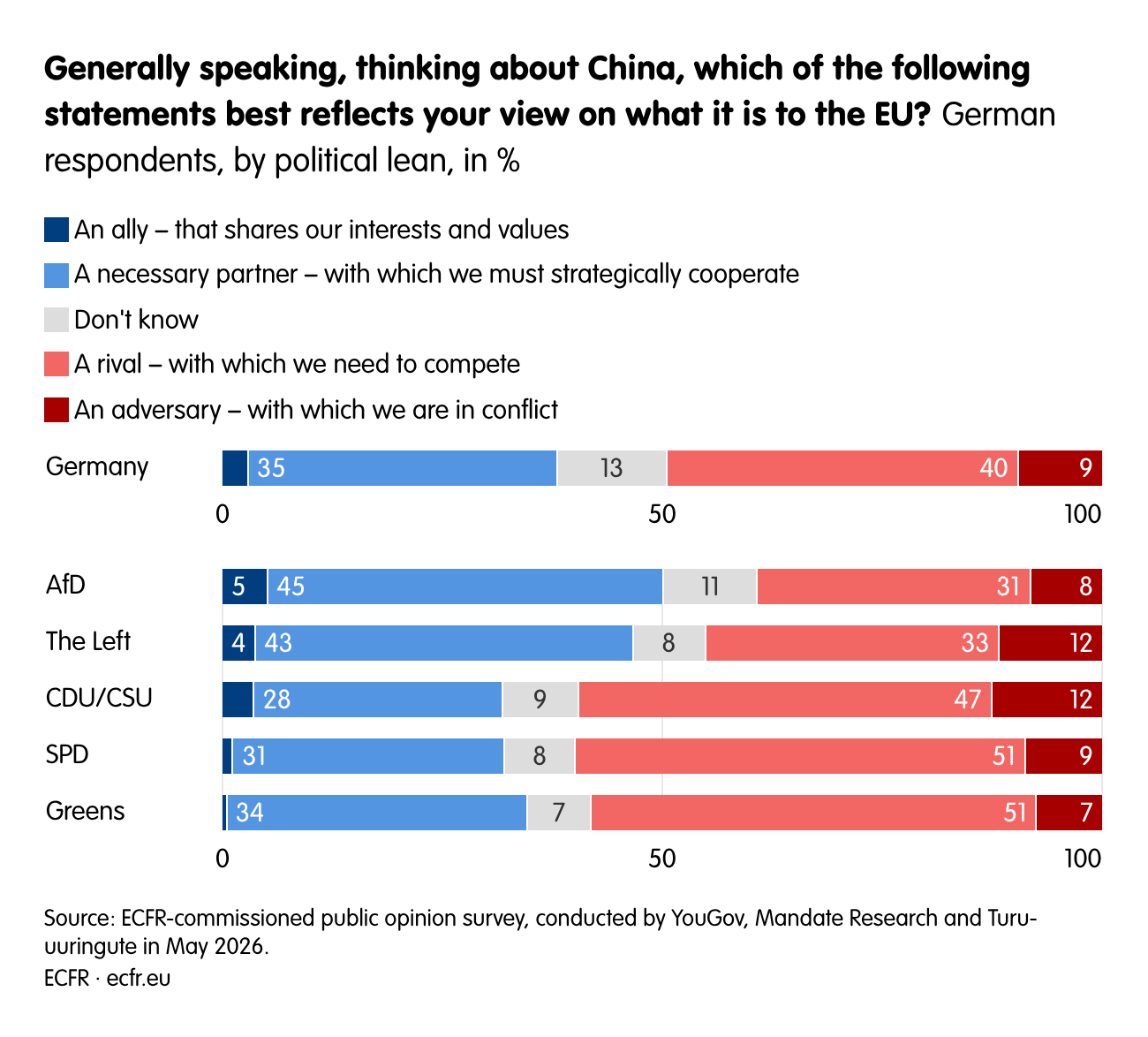
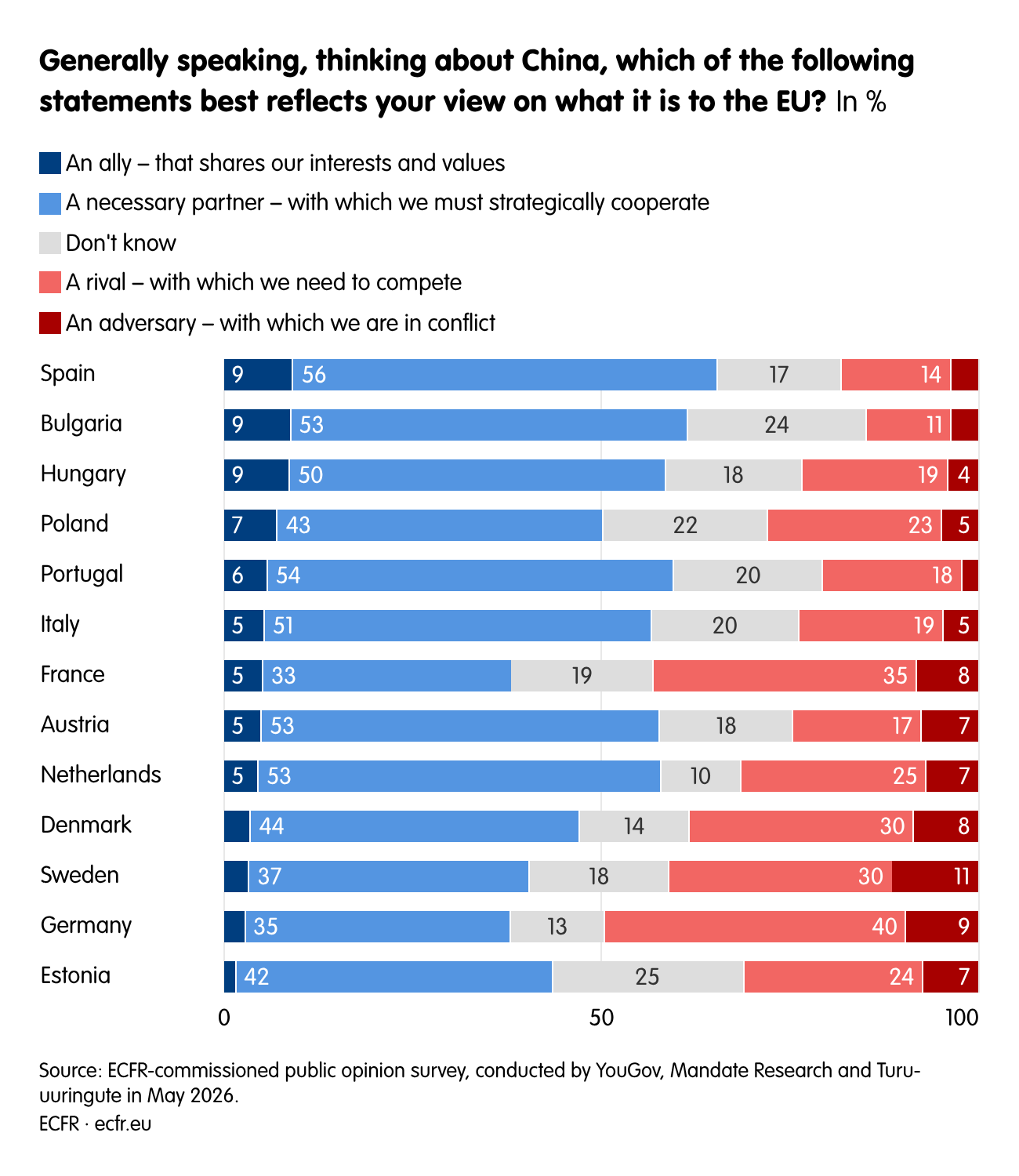
Yet, one thing Berlin should not worry about is voters’ disapproval should it pursue a more hawkish China policy. ECFR polling data find that Germans are the most China-sceptical out of 15 European countries surveyed. No fewer than 60% of Christian Democrat and Social Democrat supporters regard the country as an adversary or rival. In contrast, elsewhere in Europe, majorities still see China as either a “necessary partner” or even an ally. In Italy and Spain, 56% and 65% of people hold this view respectively. (Closest to the sceptical Germans are the French public; President Emmanuel Macron’s increasingly hawkish political posture vis-à-vis Beijing may have found an audience willing to listen.)
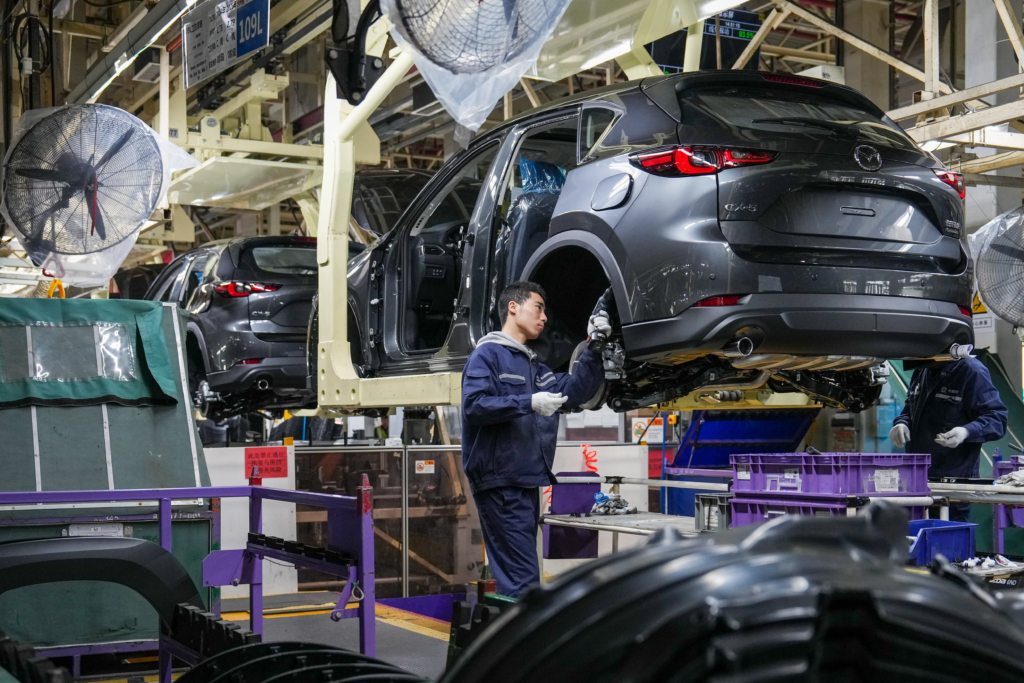
The China shock has hit Germany particularly hard: its manufacturing sector lost around 420,000 jobs between 2019 and 2025 and it continues to shed 10,000 jobs each month. The car industry is paying the highest costs, being squeezed out of a market increasingly dominated by Chinese manufacturers at home and abroad.
The mood in the European Council is shifting, and with Germany’s acquiescence. When EU leaders met in June 2026, they backed a stronger trade defence toolbox of existing measures against China. This included instruments such as the Industrial Accelerator Act’s “Buy European” provisions and limits on high-risk Chinese technology. Despite its past hesitations, Germany no longer acts as a spoiler on firmer EU action, and it has cautiously supported this new direction. Nevertheless, the combination of growing public scepticism towards China, mounting pressure on German industry and appetite for a more assertive policy on the European level creates a political mandate that German decision-makers could yet seize.
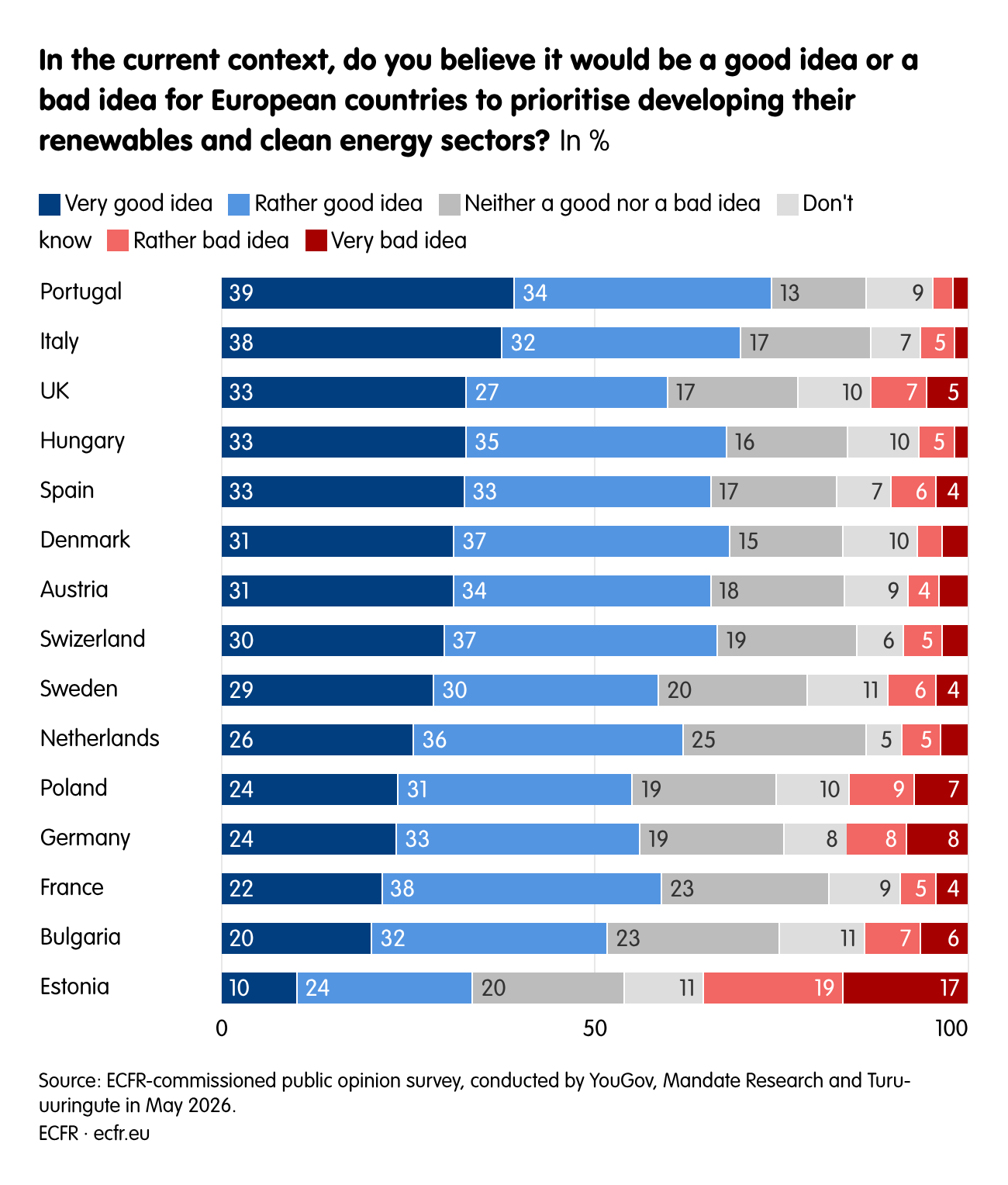
The German public’s views on the energy transition should also prove encouraging for their leaders. Voters want to see investment in renewables: 57% back what would amount to the growing electrification of the economy. Across the countries polled by ECFR, 61% of respondents say they support prioritising renewables and the clean tech sector.
This public support should help persuade leaders, including in Germany, that they can take action to limit emerging dependencies on China. They can accelerate the energy transition while de-risking the clean tech sector through providing support for domestic European industries, from wind to batteries.
For Berlin, and capitals across Europe, it is safer to move ahead rather than delay. Chinese economic policy is already doing irreparable damage to European industry—but European policymakers still need to protect an increasingly electrified economy from weaponisation by China. If they fail to do so, governments will almost certainly pay the price at the ballot box. Those that pursue electrification and economic de-risking as a single package are most likely to reap the political rewards.
Ready to test your knowledge of hue, value, and saturation? Rivka Galchen’s latest for The New Yorker is a trove of fascinating details about our understanding of color. Galchen opens with the buzziest tidbit: an experiment conducted by a vision scientist who used a laser to stimulate a selection of his own cone cells and glimpse a color unknown outside of his laboratory. From there, she roams—through philosophy and art history, from studios to pigment shops—complicating our understanding of perception with each new turn of her titular question.
In the children’s novel “The Midnight Fox,” by Betsy Byars, the main character daydreams about digging in his back yard and coming across a “brand-new color.” A friend of mine remembers being captivated by this scene, and trying to picture the color. “I felt like I could conceive of it, but I couldn’t see it,” she said. The eighteenth-century Scottish philosopher David Hume considered at length whether a person who had seen every shade of blue except for one would be able to picture that one un-experienced shade; he concluded that the answer was yes. In my youth, I spent an afternoon wondering if I would have been able to imagine the fluorescent yellow of highlighter markers if I’d never seen it.
Holbrook Mohr and Mitch Weiss | The Atavist Magazine | July 2026 | 2,284 words (8 minutes)
This is an excerpt from issue no. 178, “Toxic Lies.”
January 3, 2026
In the isolation ward of a hospital in Birmingham, Alabama, a nurse approaches Ron Fowler’s bed, cell phone extended in her hand.
“You have a call,” she says.
Fowler’s eyes flutter open. He tugs off his oxygen tube and, with trembling fingers, accepts the phone.
“Thanks,” he whispers, before turning his attention to us—the callers.
From his voice it’s clear that something is very wrong; he sounds nothing like his usual self. He’s due the next day to meet us for an interview in Paducah, Kentucky, where he and his friend Chuck Deuschle worked at a uranium-enrichment plant that helped fuel America’s nuclear arsenal. Years ago they blew the whistle on the government and its contractors for poisoning thousands of atomic workers. “Can’t make it,” Fowler chokes out. “Blood clots. Hospital. They may have to remove some toes—if those clots don’t reach my heart first. If they do…” He trails off, the terrible ending hanging in the air.
The Atavist, our sister publication, publishes one deeply reported, elegantly designed story each month. Support The Atavist by becoming a member.
Fowler, soon to turn 77, is desperate to talk before it’s too late—to pull up the memories one more time and commit them to the historical record. He and Deuschle had both moved to Kentucky to work at the nuclear plant, only to discover a grim secret: The facility was exposing people to dangerously high levels of radiation and toxic chemicals, and had concealed the truth about it from employees and the surrounding community. This went on for decades. Faced with a choice—either walk away or stay and sound the alarm—Fowler and Deuschle returned to work, day after day.
More than thirty years later, lying in the hospital with cancer, Fowler is certain that the plant doomed him to a slow, painful death. At 83, Deuschle is also fighting a serious health issue: an unexplained autoimmune disease. They believe their fellow whistleblowers—Deuschle’s wife, Kay, and their friend Garland “Bud” Jenkins—succumbed to illnesses caused by the plant. Still, they’d do it all again. Someone had to reveal the callous disregard the government and the plant’s operators had shown their own people.
Fowler and Deuschle have never shared their story in full—the details of what it was like to live, breathe, and possibly die from their commitment to the truth. But they want people to know, particularly in light of recent news reports: In August 2025, more than a decade after the plant was shut down, a private firm announced that it planned to revive uranium-enrichment operations there. To Fowler and Deuschle, it seems wrong to begin a new chapter in Paducah’s nuclear story. Many former employees are still seeking compensation for their exposure to radiation. Will future generations of workers be any safer?
Fowler struggles for each breath.
“Time’s up,” the nurse says gently, reaching for the phone. “You need to rest.”
Fowler grips the device tighter.
“Call tomorrow when you meet with Chuck,” he implores. “I’m staying alive until then.” He pauses for a moment. “Just make sure Chuck’s with you. Promise me.”
We promise.
1.
One morning in late 1991, Ron Fowler stood in front of the bathroom mirror, parting his hair to the side and noting the first strands of gray at his temples. His beard was neatly trimmed, his black slacks and white dress shirt crisply pressed. He was ready. Today would be his first day at the Paducah Gaseous Diffusion Plant, a uranium-enrichment facility about ten miles outside Paducah, Kentucky. This was more than just a job—it was the start of a new life.
Fowler was a health physicist, an expert in the science of radiation protection. For years he’d traveled the country to train workers at nuclear plants in safety protocols. The pay was great, but being on the road weeks at a time had worn him down. When he moved to Paducah in his early forties, Fowler had already lived in Illinois, Pennsylvania, Maryland, Virginia, and Arkansas. Paducah promised stability: the perfect place to settle through retirement. His wife’s parents even moved from Illinois to be nearby.
After eating breakfast—a sausage patty and a scrambled egg—he kissed his wife, Sandi, goodbye and slipped out the door. He steered his green Oldsmobile Delta 88 through the country roads outside Paducah and let his mind drift back to his childhood in Florence, South Carolina. Life there had been simple. His father, who dropped out of school in the fourth grade, supported the family by working on the railroad. Florence was a place where men had jobs, women tended to the home and children, everyone went to church, and neighbors helped neighbors who fell on hard times. Paducah felt just as close-knit. Folks looked out for one another, and honest labor was rewarded.
Situated on the Ohio River where it meets the Tennessee, Paducah owes its origins to trade; it was founded in 1827 by William Clark of the Lewis and Clark expedition and named for a powerful Native American tribe. The area is naturally beautiful—the city is surrounded by rolling hills and sprawling plains dotted with ponds. For Fowler, a keen fisherman, it was paradise. Paducah had about 27,000 residents when he arrived. It was big enough to have all the right shops, yet small enough that restaurant owners knew whether regulars preferred barbecue or fried catfish, the local staples.
As Fowler drove, the plant appeared in the distance. It spread over some 3,500 acres—750 of them secured by fences and gates—and sat amid modest homes and farms. The community was proud of this place because of its long history supporting the military. Originally, it was a TNT munitions factory, built during World War II. Later, as Cold War tensions escalated, officials scouted locations for a uranium feed facility to supply weapons-production sites in Piketon, Ohio, and Oak Ridge, Tennessee, with the material required to make nuclear bombs. Paducah native Alben Barkley leveraged his position as Harry S. Truman’s vice president, campaigning aggressively to repurpose the munitions factory in his hometown. He recognized that the project likely would inject billions into the local economy and transform living standards for the region’s blue-collar workforce.
Construction of the nuclear plant began in 1951. By the following year, it was enriching uranium for atomic bombs and the Navy’s nuclear fleet. Rising from the countryside, the gleaming buildings looked like modern marvels, and the economic windfall lifted Paducah residents’ spirits. Meanwhile, employees at the plant—everyone from nuclear technicians to welders, cooks, and janitors—were united in patriotic pride. Their jobs paid well, and the workers believed that they were helping fend off communism. It was no wonder Life magazine printed a photo spread of the site.
As the Cold War thawed, the mission changed but the jobs remained. The plant began recycling materials—gold, among other things—extracted from dismantled atomic weapons while continuing to enrich uranium, now for nuclear power plants instead of bombs. Wages allowed families to buy homes and cars and afford vacations—the American middle-class dream. The plant operated like a self-contained town for its 1,700 employees: It had its own security force, fire department, library, post office, and health clinic. A shuttle service ferried employees around the plant’s grounds. Workers participated in golf leagues and fishing tournaments. The Uranium Enrichment News kept everyone informed about goings-on at the site.
Though the plant was owned by the Department of Energy, it was run by contractors. Union Carbide initially oversaw operations, followed by Martin Marietta, which later merged with Lockheed to become Lockheed Martin. Management changed, but to employees that just meant a different name on their paychecks. The people on the ground were like family—fiercely loyal to one another and to the plant they called the Atomic City.
Fowler smiled as he drove through a security gate into a sprawling lot. He parked by the administrative building and checked in with a secretary, who called someone to escort him to his department. From there he would lead health and safety training sessions. The federal government had known as early as 1944 that radiation was hazardous and had issued policies to limit worker exposure. It was Fowler’s job to help ensure that regulations were enforced, to protect both employees and the surrounding community from contamination.
He had barely settled in when a coworker poked his head in.
“Want to see the place?”
The complex was huge—more than five hundred buildings connected by nearly twenty miles of access roads. Fowler was impressed until, as he rounded a corner on his tour, a yellow triangular sign with the radiation symbol caught his eye. There was no step-off pad in sight. In a nuclear facility, a step-off pad is a buffer zone between a hazardous area and a clean one. Workers at the Paducah site were supposed to remove radiation-tainted clothing and footwear before crossing through these zones to ensure they didn’t unwittingly transfer dangerous materials to other parts of the plant or transport it home with them.
Fowler flagged down a worker leaving the building where the warning sign was posted. “You don’t have a step-off pad down here,” Fowler said. The worker shrugged and said there was nothing to worry about.
“That sign says otherwise,” Fowler said. He explained that protocol required a pad and training for workers so they knew how to use it.
The worker’s expression was unchanged as he walked away.
Fowler’s pulse quickened as he imagined invisible particles on boot soles spreading throughout the plant or, worse, tracking onto kitchen floors or into rooms where children played. He hurried to his division manager’s office. The supervisor listened, then leaned back in his chair and tapped a pen on his desk calendar. He said he’d call a meeting about the issue.
That night at home, Fowler sat at the kitchen table watching Sandi cook. Normally, he’d have been joking with his wife about her limited culinary range—she often made breakfast for dinner—but tonight his mind was elsewhere. The sizzle from the stove filled the silence between them.
Sandi knew something was wrong. In the years since they first met at a bar in Joliet, Illinois, she’d become attuned to her husband’s moods. Despite his imposing frame—six foot two, 245 pounds—Fowler had always been the gentle sort and quick to laugh. Their courtship progressed quickly, and within four months of meeting Fowler had moved in to her family’s home in Aurora. They married there so her father, a former school principal paralyzed from a stroke, could attend.
“What is it, Ron?” Sandi asked, spatula in hand.
He sighed. “Something’s not right at work.”
“What do you mean?”
“The way they treat radiation—like it can’t hurt them. No precautions,” Fowler said.
“That doesn’t make sense,” Sandi replied, frowning.
“I know.” Fowler shook his head. “I’ve never seen anything like it.”
Uranium is a silvery-white radioactive metal. More than 99 percent of it found in nature is U-238, and the rest is U-235, an isotope that can sustain the chain reactions needed to fuel nuclear power production and atomic weapons. Enrichment is the process of increasing the concentration of U-235 in a supply of uranium. At different points, enrichment produces one powder Paducah workers called black oxide—not to be confused with the coating of the same name applied to some metals to improve corrosion resistance—and another, uranium tetraflouride, that’s known as green salt. Eventually, uranium hexafluoride, a colorless crystalline solid, is heated into a gas that’s pushed through microscopic porous barriers. This process, called gaseous diffusion, separates U-235 from U-238; at plants like the one in Paducah, it’s done hundreds of times in a cascade until the desired enrichment level is reached.
Uranium enrichment is hazardous business. Fowler knew that any leak, spill, or accident at the Paducah plant could damage kidneys and lungs, irritate skin, and increase cancer risk. More insidiously, simple mistakes or oversights by workers could have that same result. During his first few weeks on the job, Fowler explored the plant on his own, and what he found unsettled him. Employees worked in radioactive areas without protective suits or masks. Some couldn’t read and might not understand warning signs. People left the site after their shifts without changing clothes or showering, likely conveying radioactive dust home to their families. Some workers even warmed their lunch on top of machines in hazardous areas.
Fowler knew that things needed to change, and quickly. He took his concerns to the plant manager, Steve Polston, who heard him out and then called a meeting about step-off pads—the very issue Fowler had flagged on his first day. At the meeting, Fowler outlined the safety gaps he’d observed at the plant, but it seemed to him as though the senior managers in the room could barely feign interest. He heard what would become something of a refrain: “We’ve been doing it this way for years.” He was also told that Department of Energy officials visited the site regularly and hadn’t raised concerns.
More worried than ever, Fowler spent the next several months developing new safety protocols. He beamed with satisfaction as he handed the plan to Polston. In the period that followed, however, he became frustrated with how officials implemented the measures. Even when company-issued safety equipment was made available, Fowler noticed that much of it was obsolete. And he watched in disbelief as employees poked holes in respirator masks to smoke while working.
“I’m not making progress,” he told Sandi one night between sips from a can of Miller Lite. “No one is listening.” He likened his work to “scooping water out of the ocean.”
Sandi, who had studied his training manual to understand his work, gently touched his arm. “Be patient,” she suggested. “Maybe you just have to get to know the people better.”
Fowler’s shoulders dropped. “It seems like more than that,” he said.
When Jessica Black was 16 years old, she told a story to North Carolina police detectives that helped convict five friends of murder. Decades later, she’s still trying to correct the record. Matthew Bremner’s feature for Financial Times is a brisk tick-tock of efforts by Black and her incarcerated friends to overturn criminal convictions they claim were built on disturbing intimidation tactics.
The investigators do not accept these firm denials. To them, they seem likely to be the initial stories of a group of boys who know more than they are saying. As officers move in and out of interview rooms, carrying information from one interrogation to the next, the pressure intensifies. They tell the teenagers that their friends are already telling their side of it, that they should too. Under North Carolina law in 2002, police are permitted to exaggerate, even to suggest they have evidence they do not possess. There is no rule requiring a parent or other adult to be present while 14- and 15-year-olds are questioned. For most of their time in these rooms, the five boys are alone. When I interviewed him in late 2025, Tolliver told me that a detective asked him to hold out his arm. “That’s the vein,” he told him. “This is where the lethal injection would go.”
Part of ceiling of the newly renovated Emergency Department (ER) in the General Hospital of Corinth, collapsed less than a month after the inauguration by Health Minister Adonis Georgiadis. According to hospital personnel, the collapse occurred in the exact same area where the inauguration took place, putting employees, patients and attendants at risk. In a […]
A 55-year-old man has been arrested by police when it was found out that he was keeping the body of his father in a deep freezer for years in order to collect his pension payments. The case was discovered after relatives/neighbors complained to police that they have not seen the old man for years. The […]
For China Books Review, Zhang Er reflects on growing up in Beijing during the Cultural Revolution, and how she owes her love of reading to Auntie Zou, a librarian who stripped banned books of their covers and any pages marked with the library seal of the Workers’ Club, smuggled them home, and secretly loaned them to her. Even amid the chaos of that era, Er remembers this part of her childhood as magical, a time “where characters sprung from their pages and interwove with each other’s lives,” and she imagined worlds far beyond the one she lived in.
By the time I was 12 or 13, I could read fast enough to finish the weekly book loan in two days, so I had time to spare before returning it to Auntie Zou. By then I had made a good friend, Yu Ping, who loved reading too. Her home was three blocks from mine. I would bicycle to her place and deliver the book to her. Yu Ping would read day and night to finish the book and return it to me before the due date. We would keep the book wrapped in old newspapers, so that we could read in class without getting into trouble, while our teachers repeated the same quotations from Mao, week after week.
British tourists on the island on Kefalonia showed their gratitude and paid for water bottles for the firefighters battling the big blaze on the island in the Ionian Sea over the weekend. Local media kefaloniapress.gr reported about the spontaneous “Thank you!” incident that apparently occurred on Sunday, August 2. The post published today, Tuesday, August […]
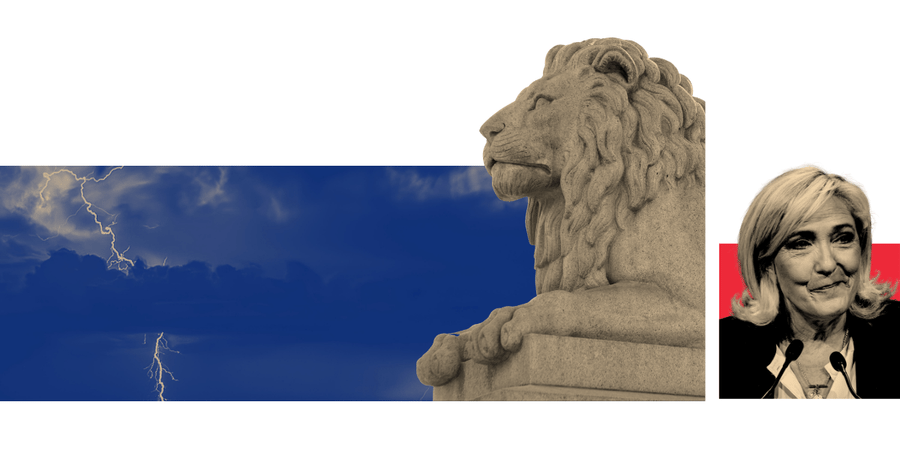
Marine Le Pen’s candidacy for president means Europeans should brace for the possibility of a France wholly different to the one they know.
A Rassemblement National government would be hostile to the EU and a disruptive partner on numerous issues facing Europe; including on Russia, enlargement, climate and migration.
The party is divided over whether and how to work with other right-wing parties in France; and how to position the country within Europe and the Western alliance.
Le Pen is likely to work in a “duo” with party leader, Jordan Bardella, but there are notable differences between their outlooks. Europeans should pay attention to these.
European political leaders would struggle to influence a Le Pen-led government, but nor should they expect a unified European far-right to emerge. They would be wise to begin their preparations now.
Note: This policy brief is a second edition of an earlier paper published on June 9th 2026. It updates the prior analysis in light of Marine Le Pen’s confirmation that she will run for the French presidency.
The restoration of a matriarch
In the early hours of November 2nd 1976, a bomb exploded outside the Paris home of the far-right leader Jean-Marie Le Pen and his family. The perpetrators were never found. His youngest daughter, Marine, 8 years old at the time of the attack, later seethed that the family was not shown “the slightest sign of solidarity or compassion” by the French authorities. Today, as Marine Le Pen launches into her fourth—and most competitive—bid for France’s presidency, that quote reveals something of the woman who might soon occupy the Elysée Palace. If she wins, European policymakers will need to understand this self-defined outsider and how her family’s and party’s long years in the political wilderness shape her domestic and international agenda.
That insurgent self-perception may seem odd now. After all, the National Rally (Rassemblement National, RN) is far ahead in polling for the first round of the election, is accepted by an increasing share of French polite society, and is close to some of the country’s most powerful economic elites. But it still explains why the rest of Europe should brace for the possibility of a French president who sees herself as a rebel against the country’s and the EU’s established norms and institutions. As this paper will argue, a Le Pen presidency of France would be a significantly more formidable challenge to European orthodoxies than Giorgia Meloni is in Italy or Viktor Orban was in Hungary.
*
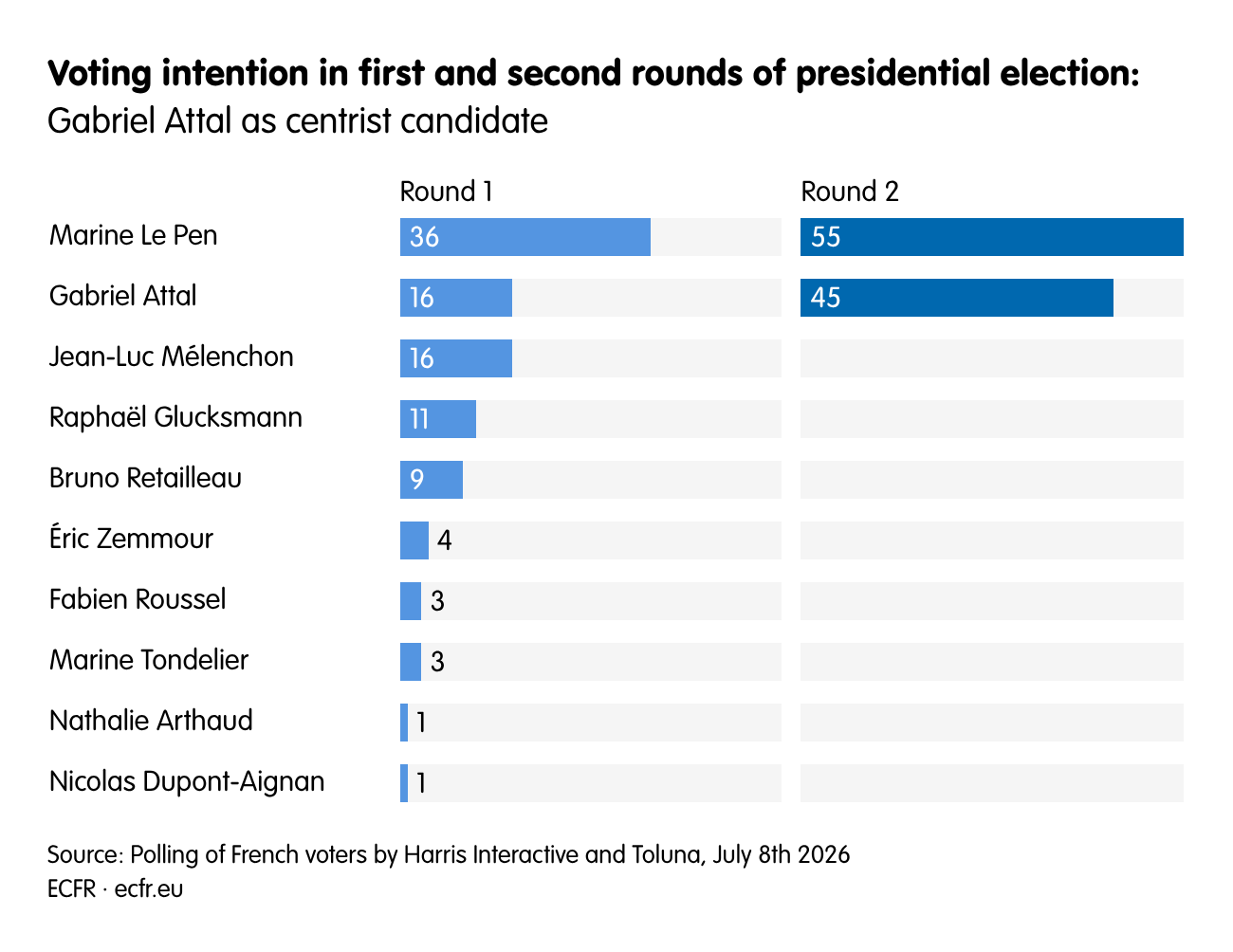
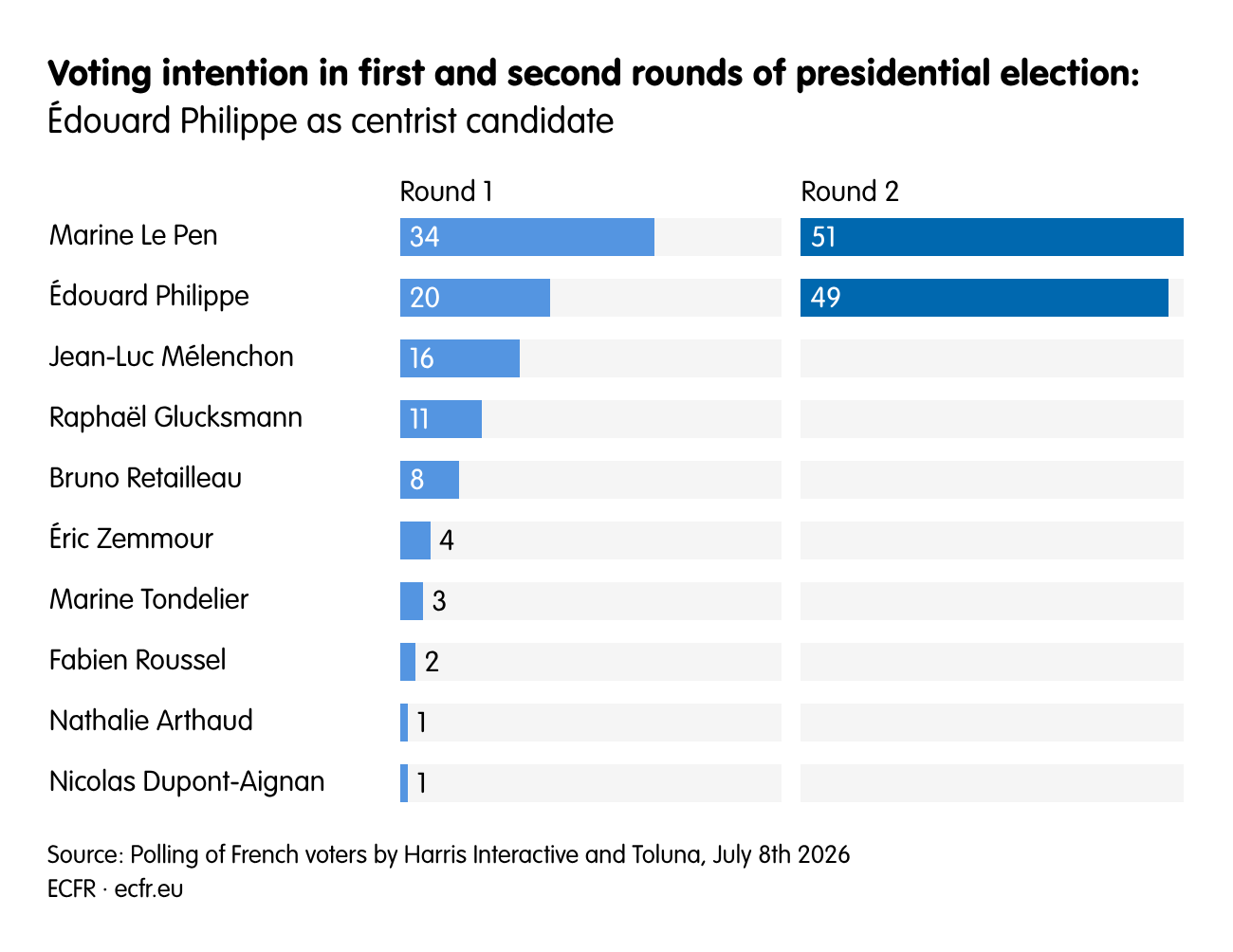
Only one thing is certain about the result of France’s presidential election next year: President Emmanuel Macron’s decade in power will come to an end. Who replaces him is an open question, with any number of conceivable outcomes. The exact field of candidates is not yet clear, not even in Macron’s centrist camp, where two former prime ministers—Édouard Philippe and Gabriel Attal—are vying for primacy. French presidential election campaigns are often volatile; both those in 2017 and 2022 saw major shifts over the half-year before polling day. But current polling suggests that the RN party candidate is on track to win the first round, on April 18th 2027, and to enjoy good prospects in the second, due on May 2nd.
The RN went through months of speculation over who would represent it at the presidential election. In March 2025, Marine Le Pen was convicted of embezzling European parliamentary funds and received a five-year ban on standing for election. Over recent months, Jordan Bardella, the RN’s untested young leader and Le Pen’s protégé, was talked about as the party’s best hope.
On July 7th 2026, however, the Court of Appeal reduced Le Pen’s ineligibility penalty, which enabled her to run. It also required her to serve a year of house arrest with an electronic ankle tag. That evening, Le Pen announced that she would seek the presidency and would appeal to the Court of Cassation. The penalty is suspended until France’s highest court rules on the case, which could take place as late as April 2027.
Her candidacy has significant implications for the rest of Europe. Le Pen is an experienced campaigner and an established (though also divisive) figure in France. Her bid for the presidency is perhaps more likely to survive the heat of the campaign than a Bardella run would have. The fact that she is the candidate probably increases the chances of the French far-right coming to power for the first time since Marshal Pétain, the puppet leader of Vichy France.
Le Pen is marked by the RN’s long years in the wilderness. She believes in radical solutions. As president, she would likely be a confrontational and abrasive force in Europe.
To reiterate, the outcome of the election remains wide open. But the scale of the potential rupture of a Le Pen win means policymakers elsewhere in Europe must both understand the RN and prepare for that eventuality. To that end, the authors of this paper have extensively researched the party’s Europe and foreign policies. The following study is based on in-depth interviews with an array of senior RN figures and external experts as well as analysis of the party’s speeches, legislative proposals, voting records and electoral programmes. The result is a series of five theses about what a Le Pen win next year would mean for Europe.
Understanding an RN presidency
Point 1: Marine Le Pen’s candidacy reaffirms her primacy inside the RN, although her duo with Bardella will endure
Marine Le Pen’s decision to run for president despite her upheld conviction—and in contradiction of her own prior statements—is a reminder of her centrality to the RN. She is still the party’s dominant leader. The decision also dispelled the illusion that Bardella constitutes a real alternative to her leadership. It showed that today’s RN is still Marine Le Pen’s inheritance and achievement.
The party was founded as the National Front (FN) in 1972 by Jean-Marie Le Pen, along with French former members of the Waffen-SS and other nostalgists for colonial French Algeria. It drew together different threads of the far-right. For decades most French citizens considered it beyond the pale. When Jean-Marie Le Pen narrowly made it into the second round of the 2002 presidential election, it shocked both France and Europe. He was roundly defeated by 82% to 18% by then-president Jacques Chirac.
Taking the reins of the party from her father in 2011, however, Marine Le Pen pursued a strategy of “dédiabolisation” (“detoxification”). This saw her expel Jean-Marie from the party in 2015 over his racist and anti-Semitic comments. After her resounding defeat to Macron in 2017 she intensified the process, renaming the party and dropping its commitment to “Frexit” (leaving the EU).
In 2019, she appointed a fresh-faced young activist from a deprived Paris suburb to lead the RN’s campaign for the European Parliament election. Jordan Bardella delivered the party’s first ever first-placed result in a national election and was rewarded with the RN presidency in 2021. He would play a central role in the party’s 2022 presidential campaign—a much closer contest—and in its triumphant win in the 2024 European vote. Le Pen further empowered Bardella when she announced he would be her choice for prime minister. When it looked like she might be banned from running, Bardella became her natural replacement as a presidential hopeful.
Nevertheless, despite Bardella’s rapid rise and growing public profile, the RN remains firmly in Le Pen’s hands. For nearly half a century, the promotion of family members, such as Marine Le Pen’s niece Marion Maréchal, and significant turnover among the lower levels of the party has kept power within the Le Pen clan. Many of the party’s cadres remain more loyal to her than to Bardella, and were determined that she should run rather than him.
Now that the party is back behind its leader, Le Pen will continue to highlight the duo she forms with Bardella—as she did on prime-time television when she launched her campaign. She once again promised to make him prime minister if she becomes president. Running a “ticket” for the French presidency is unprecedented and anathema to the function. But it has a distinct advantage: broadening her voter coalition while keeping the party together.
Le Pen’s own political base has two main parts. First, an anti-elite and disaffected working- and middle-class electorate in the northern post-industrial Pas-de-Calais region that she has represented since 1998 (as a councillor, MEP and in the National Assembly), And, second, a chain of strongholds along the Mediterranean coast, which adhere to long-term RN positions hostile to immigration and taxes.
By contrast, Bardella appears more economically liberal and temperamentally closer to other parts of the French right, including the conservative flank of the Republicans (LR, the rump centre-right force) and culturally reactionary forces like Éric Zemmour’s far-right Reconquest. He is also more engaged with the wider European right, especially Meloni in Italy. Within the RN itself this aligns him more with a more bourgeois and younger new electorate.
Over the last year, Bardella had even started to sand down some of the party’s most abrasive ideas. Where Le Pen cleaves to some of the party’s old Putin-friendly instincts on Russia, he has spoken in defence of Ukraine’s sovereignty. He also broke from Le Pen on pensions reform, suggesting dropping the fixed retirement age and moving to a more contributory system. Where Le Pen went to Budapest to help out an embattled Orban, he struck a friendly tone towards Germany and even met with the country’s ambassador in Paris. All this created expectations in Brussels and other EU capitals that a President Bardella might be closer to the bloc’s economic orthodoxies and more open, at least, to compromises.
Le Pen’s candidacy firmly relegates him to a subordinate position within the party. Gone, too, is the spectre of a somewhat more conciliatory RN presence in the Elysée Palace if the party wins power next year. “Bardellism cannot exist, as it is ultimately Marinism”, Jean-Philippe Tanguy, a senior RN figure, has said. The reassertion of Le Pen’s primacy within the RN thus makes the party both more likely to take power and more likely to disrupt the rest of the EU and its foreign policies if it does.
Point 2: An RN presidency would be a rupture in French and European politics
France is a highly centralised state, and its president wields executive power more akin to an American president than to counterparts in its European neighbours. The country also remains a pivotal power in Europe as one of its two nuclear-armed countries and half of the Franco-German motor that long drove the European project.
News of an RN win would therefore send shockwaves around the continent, stunning the mainstream. It would also lift the spirits of much of Europe’s radical right after a difficult 2026 in which its pre-eminent governing leader, Orban, lost power and its links with Trump turned out to be liabilities. After all, the RN has been unapologetic in its support for fellow “patriots” across Europe. Le Pen campaigned for Orban, and Bardella has engaged closely with Meloni and her government in Italy and Nigel Farage’s Reform in the UK.
Farther afield, the RN has been increasingly welcomed by fellow nationalists like Israel’s Likud government, which hosted Bardella and other far-right leaders in 2025. The Trump administration has professed its own commitment to supporting “patriotic parties” and would react favourably to an RN win. This is despite Bardella’s and Le Pen’s efforts to cool their party’s earlier enthusiasm for the US president.
The RN would revel in the sense of rupture. In private, party leaders compare their potential accession to power to left-winger François Mitterrand’s historic victory in 1981—which they see as the only true political change France has undergone in the last 50 years.
*
Thus empowered, the RN would want to enact its programme. Although foreign and defence policy may not be its top policy priority, “fixing” France’s relationship with the EU is bound to be one.
In its 2019 and 2024 European election campaign manifesto, the RN suggested transforming the European Commission into a mere secretariat of the EU, leaving legislative initiative only to the European Council. The party decries attempts to expand qualified majority voting, refuses any new transfers of competencies on foreign and defence policy to the commission—and seeks European allies in that endeavour.
The RN is vehemently against EU common taxation and borrowing. Both Le Pen and Bardella have proposed slashing the French contribution to the EU budget (by “between €2bn and 3bn”, as Bardella suggested, equivalent to 9-14% of the French payment in 2024). RN MPs have already put forward severalamendments to the budgetary laws to that effect. In July, Bardella has even advocated reducing the contribution by half. In place of European joint spending, the party wants the creation of a sovereign wealth fund to back “sovereign industries” in defence, technology and energy.
The party’s antipathy towards NATO means it plans to prioritise national-level defence instead. The RN has committed to maintaining current defence spending, but argues this should support France’s own military-industrial infrastructure first and foremost. Even if it has paused an earlier plan to leave NATO’s integrated command, at least for “as long as the war [in Ukraine] goes on”, Le Pen revived the idea as recently as May 2026.
The strictly national principle applies to energy too. The RN has promised to lower French energy costs, notably by breaking from EU-wide electricity pricing (which often depends on gas prices less relevant to France’s nuclear-heavy energy system) and thus allegedly reducing the French retail price. And, despite claiming to be concerned about the consequences of climate change, the RN is relentless in its opposition to the European Green Deal and its insistence that French nuclear energy should exempt the country from EU climate strictures.
Overall, if Le Pen were to become president, the RN’s highly disruptive European agenda would inevitably put France on a path to confrontation with European partners and institutions. As the fight against the EU is both a symbolic and a policy priority for the RN, other European leaders may have to find a way to negotiate on some of the demands—that for a budget rebate, for example—in order to prevent French vetoes.
Point 3: The RN’s inexperience and lack of interest in foreign policy would make France an erratic partner, especially in a crisis
Europe’s best hope, in the event of a Le Pen presidency, may reside in the fact that foreign policy would not be the top priority for the RN in power.
First, the RN’s foreign policies often remain vague or only partially formed. Despite its long-standing presence in the French political landscape, the party has no national governing experience and only in 2022 won a significant share of seats in the National Assembly. With little network among the French diplomatic establishment, RN leaders have rarely engaged closely with foreign policy debates. The party prefers to hide behind references to General de Gaulle’s pro-independence foreign policy to justify criticisms of the EU or NATO without being too specific.
According to RN insiders, the party’s foreign policy decisions emanate from private discussions between Le Pen and Bardella, with the occasional counsel of the advisory group Les Horaces. If she attains power in 2027, Le Pen may seek to attract more experienced figures from the traditional right (from LR or UDR) or from the military to lead on top foreign policy positions.
Second, the RN is clearly prepared to change its tone on international topics when political expediency dictates. RN figures privately insist that foreign policy cannot win it elections, but can lose it ones. They blame Le Pen’s defeat in April 2022 on her failure convincingly to pivot away from Russia after its full-scale invasion of Ukraine two months earlier.
The party abandoned Frexit after the UK’s Brexit turned out to be a disaster. It curbed its old openness to strongmen such as Putin (repaying a contentious loan to a Russian bank in 2023) and Syria’s Bashar al-Assad. In recent years, it attempted to erase its anti-Semitic past by adopting a strongly pro-Israel line. Since February 2022, the party has walked a tightrope: paying lip service to Ukraine’s right to self-defence while criticising sanctions against Russia as costly to French consumers and opposing some military aid to Kyiv as escalatory. Having greeted Trump’s re-election in 2024, the party has become a nimble critic as his erratic foreign policies have made alignment with him a political liability.
It is safe to assume, then, that, even with Le Pen as candidate, the party will tend towards orthodox language on most foreign policy ahead of the election. It has a vested interest in a campaign that focuses on topics such as immigration, crime and purchasing power (where the party is most confident), rather than one that debates France’s role in Europe or global geopolitics (where it is more uncertain and, in some cases, divided).
And even if the party wins power, the domestic agenda will likely come first. This can be summarised as: countering cultural and industrial decline by pursuing “national preference”. In policy terms it would include harsher law-and-order measures (especially on migration and crime), trade protectionism and efforts to reverse green policies in the hope of revitalising industry, and prioritising French nationals over foreigners in accessing welfare or public services. European partners should reckon on an RN presidency being most intransigent on EU matters related to those domestic priorities—and possibly being more open to negotiation in other areas.
In sum, however, they should expect a Le Pen foreign policy that is unclear, evolving or even contradictory. Under her leadership, France would take few initiatives and rather behave as a blocker. For example, it is hard to imagine an RN president responding decisively to a security crisis on Europe’s eastern flank. If under pressure from EU member states to be tougher on Russia, she would likely seek concessions and negotiations rather than further action.
If it does anything proactively, such a presidency would concentrate on disentangling France from EU policies that contradict its domestic goals. At best, the RN’s lack of interest and inexperience may be an opportunity for other European governments to shape some of the outcomes, as long as they keep their expectations low.
Point 4: How broad and how European? The strategic debates running through the RN
Today’s RN is infused by two strategic debates that would shape Le Pen’s tenure as president.
Movement or coalition?
The first has to do with the RN’s political identity: the party is struggling to determine whether it seeks to forge an union des droites (union of the right) or whether its outsider populist status remains its core identity.
In the long years the FN and the RN spent on the political margins, the Le Pens’ “neither left, nor right” approach appealed to disillusioned voters who rejected all forms of politics. It acknowledged the cordon sanitaire between the mainstream right and their parties. Even back in the FN days, Jean-Marie Le Pen crushed several internal attempts to unite the right. Marine Le Pen remains firmly opposed to any such efforts today.
If she is elected, it is unclear how Le Pen will position herself towards other right-of-centre French parties. Her instinct seems to be that working with them would dilute the RN and prevent it from conducting truly disruptive policies. Given her aversion to compromise and her long years of ostracism by the mainstream political class, Le Pen would struggle to extend a hand to others to form a majority in the National Assembly.
She may, however, continue using Bardella as a useful bridge to other parties of the right, at both national and European levels. In an interview with Le Figaro after Le Pen’s official launch of her presidential bid, he insisted that, as prime minister, he would seek to gather the right-wing electorate back to his party in order to build a “solid majority”.
It is reasonable to expect that, if Le Pen allows Bardella to forge these links at home, she will let him do so abroad too. If so, Bardella would continue building alliances with the European right spanning conservatives and various families of the radical right, likely with immigration as a focal point. The RN has already demonstrated its ability to build coalitions with other far-right parties and the European People’s Party to advance tougher migration legislation in the European Parliament. It would likely continue to do so if elected. Bardella has indicated that he wouldshare this agenda with leaders such as Meloni and German chancellor Friedrich Merz and seek to work with them.
Rival futures
The second faultline within the RN today is between rival conceptions of national sovereignty, a point that came across especially strongly in the authors’ interviews with senior party figures. Le Pen and the “old guard” around her have long held the view that France must resist Anglo-American hegemony and EU technocracy alike. They treat Washington and Brussels as equal threats to French autonomy.
Yet a new generation around Bardella—having come of age against the backdrop of the 2015 terror attacks in Paris and the Russian full-scale invasion of Ukraine—has adopted an identity-based sense of Europeanness. It acknowledges the need for European cooperation against common threats, as long as this cooperation is “chosen”. It is inclined to invoke a shared Western and European cultural affinity.
For example, on Russia and Ukraine, Le Pen and the old guard have continued to blame NATO’s enlargement for “provoking” Russia. This fits their antipathy to Washington and Brussels. Their old ideological affinities with Moscow as a counterweight to American hegemony allow them to imagine a future in which Russia might even be a partner in a multipolar order once the war ends. But Bardella has admitted the “naivety” of Europeans in the face of the Russian challenge. Despite a less-than-keenly pro-Ukrainian voting record in the European Parliament, he has also spoken in favour of Ukrainian national sovereignty and against Russian imperialism.
These debates will continue within the RN—especially because Le Pen has been unwilling to sweep aside Bardella’s “union of the right” and rhetorically “pro-Ukraine” positions. For as long as she wants the electoral breadth he brings, the tension will persist.
Point 5: The likeliest outcome of an RN presidency would be a more isolated France in a weaker EU
The disruptive nature of RN policies towards Europe means France’s relationship with European partners would deteriorate over time.
At first, the RN would likely seek to reassure the financial markets and its international partners. Victory for the party may be accompanied by protests and strikes, and the new government would face economic limitations like France’s high levels of debt. In this context, Le Pen may want to project stability. Nevertheless, the RN has promised to engage on a number of priorities that will put it at odds with other European governments—including those led by the right—as well as EU institutions.
Opting out of the EU-wide electricity pricing could push up prices for other member states; quitting the migration pact would put greater pressure on others; curbing the French contribution to the EU budget would force others to pay more and possibly trigger an infringement procedure. More generally, Paris governing in a spirit of French exceptionalism would roil Europe’s collective efforts on common challenges.
Enlargement could prove an especially inflammatory topic. Plenty of European governments have concerns about bringing Western Balkans countries, Moldova and especially Ukraine into the EU. But if the RN wins the French presidency, it will be the most outspokenly opposed government among major European states. It has warned that enlargement would ruin French agriculture and suppress French wages; intensify the EU budgetary demands on France; and further centralise power within the EU at the cost of individual states. The accession of Ukraine, with its vast agricultural industry, particularly alarms the RN.
The long-term result of these trends would likely be some degree of French isolation. The party’s policies and instincts would set Le Pen up for conflict with the European Commission—but also with other national governments, including right-wing counterparts. Although others in the EU might conceivably come around to RN doubts about enlargement, the insistence on French national priority will alienate even ideologically sympathetic forces elsewhere.
Tensions could emerge with other far-right leaders, such as Meloni, over issues like migration. Despite broad ideological alignment on reducing migration, the RN prioritises national sovereignty over the management of borders and migration flows. By contrast, Brothers of Italy has advocatedgreater EU coordination and burden-sharing. As a result, a cohesive far-right alliance at the EU level should not be taken for granted. If these conflicts escalate, an “empty chair” moment, where France simply withdraws from EU meetings as it did under de Gaulle in 1965, is not unthinkable.
At a time when nationalist parties are rising in other major EU states, including Germany, an RN presidency could encourage unilateralism there too. The result could be doubly paradoxical: a lonelier right-wing France in a more right-wing Europe, and a more nationalist France more exposed to the interference of external powers like China, Russia and the US.
How the rest of Europe can move into “brace position”
As the rest of Europe faces up to the possibility of President Le Pen, the risk is that leaders and other policymakers bunch around one of two poles: complacency (the over-confident belief that she could simply be “handled” like any other challenging leader); and panic (the fatalistic assumption that an RN-led France would automatically mean the beginning of the end of the European project). Of the two courses, the first—the assumption of business as usual—currently looks like the greater risk. But neither is advisable.
This paper has shown that an RN win is a real possibility and would herald great disruption for the EU and its place in the world. It has argued that a Le Pen presidency would see itself ultimately as a radical insurgency against the French and European establishment. But it has also explored some of the complexities and shed some light on how the rest of Europe should think about them. In particular, leaders elsewhere on the continent should:
Abandon all precedents when thinking about an RN-led France
As president, Le Pen would be as fundamentally rooted in French traditions and peculiarities as equivalent leaders are in those of their countries. Trump’s America is simply too different to be closely relevant to France, despite the executive power both presidents wield. Orban’s Hungary does not fit either, with its distinctive tale of state capture and subordination to kleptocratic interests. Meloni’s Italy, meanwhile, is a complex story of creeping authoritarianism at home but emollience internationally. A Le Pen presidency would bear passing resemblances to each, but be sui generis.
Seek to understand the party and its instincts
Le Pen is a familiar figure, but her party has never held national power before and has evolved over time. Knowing how it ticks will be essential. This should lead decision-makers to engage with the party now, including by pursuing carefully calibrated efforts to meet with its senior figures to assess their true intentions. The decision of the German government to make contact with Bardella, for example, was the right one—though Europeans should be wary about reading Le Pen’s positions and instincts via Bardella and his circle.
Brace for a wider, but not necessarily more unified, European right
An RN win would be significant for Europe’s far-right. But ECFR’s research points firmly away from the idea of a coherent and durable European “union of the far-right” of any sort. The radical right has an emphatic sense of momentum, but that is not the same thing as a common project. Indeed, dismantling European integration is likely to generate conflicts over budgets and policies on issues like borders, energy, industry and defence—even between governments of similarly nationalist ideological hues.
Manage expectations when seeking to work with an RN-led France
Even in today’s more plural Europe, France is too big and too important to be circumvented entirely in a world of predators. Perhaps there would even be some limited common ground (most likely to be around defence, geoeconomics and building strategic autonomy). There could even be the possibility to mould a party that is still uncertain about its exact foreign policy agenda. But, especially under Le Pen rather than Bardella, this would still be a significantly less predictable, less collegiate and less European France than the one partners have known under Macron.
Prepare to deploy all the arts of European and international politics
An RN-led presidency would be complicated and disruptive. It would call for real diplomatic skill and political leadership in the EU and the rest of Europe, especially in powerful states like Germany, Italy, Poland, Spain and, outside the bloc, Britain. In some cases, the task at hand might be to moderate France and bind it into groups of other states on matters of common and agreed interest. In others, it would be to build coalitions of the willing where France was reluctant to join. This would be a good time to deepen relationships between Brussels, Berlin, Rome, Warsaw, Madrid and London, as well as other capitals.
The other futures
Europeans prepare for the possibility of Le Pen as president of France, they should keep in mind that an array of outcomes is still possible. There is also a significant chance of a moderate candidate making it to the second round and rallying the republican front once again against the RN. And in today’s volatile and fragmented French politics, there is even the possibility of a far-right against far-left runoff. But polls are polls, and probabilities are probabilities. This paper is a response to one major possibility among several—and an urgent call to France’s European partners to be ready.
About the authors
Célia Belin is a senior policy fellow at the European Council on Foreign Relations and head of its Paris office.
Jeremy Cliffe is editorial director and senior fellow at the European Council on Foreign Relations. He co-heads the New Politics Project within the European Power programme.
Camille Lons is a policy fellow and deputy head of the Paris office at the European Council on Foreign Relations.
Constance Victor is the Paris office coordinator at the European Council on Foreign Relations.
Acknowledgments
We would like to start by thanking ECFR colleagues, including Piotr Buras, Teresa Coratella, Agathe Demarais, Janka Oertel, Nicu Popescu, Jana Puglierin, Marta Prochwicz Jazowska, Herman Quarles, Jeremy Shapiro, Vessela Tcherneva and Pawel Zerka who gave thoughtful comments on various drafts. We would also like to thank Zineb Bouziane for her thorough research support in the earlier stages of this project.
We are grateful to experts such as Catherine Fieschi, Jacob Ross and Victor Mallet for engaging with us and offering constructive feedback. We also would like to acknowledge the politicians, journalists and thinkers we interviewed over the course of this research; while we respect their anonymity, we thank each of them for their time and insights.
The task of editing the two editions of this paper fell to Kim Butson and Adam Harrison and we are grateful for their time and dedication in bringing it to completion. Thanks also go to Chris Eichberger for offering beautiful visuals to complement our work.
Dopo l’estensione del 2020, il golden power ha ridotto le operazioni di fusione e acquisizione nei settori più innovativi dell’economia italiana. L’effetto è stato particolarmente intenso nel primo biennio, per poi attenuarsi fino a scomparire.
O Jardim 5 de Outubro, no centro de Lagoa, recebe no dia 7 de agosto, entre as 18h00 e as 21h00, a primeira edição das Lagoa Sunset Sessions.
A entrada é livre e o cartaz musical junta as atuações de Daniel Sax e de Deejay Cabrita, prometendo animar o final de tarde para quem vive ou visita a cidade.
O evento é organizado pela União das Freguesias de Lagoa e Carvoeiro (UFLC), com o apoio da Câmara Municipal de Lagoa, e junta-se a um verão onde têm sido realizadas várias iniciativas que procuram valorizar os espaços públicos locais. Depois do sucesso das Carvoeiro Sunset Sessions, no passado dia 25 de julho, e do ciclo de concertos que decorreu ao longo de julho no Passadiço da Praia do Carvoeiro, onde a música se cruzou com provas de vinhos e produtos locais, chega agora a vez do centro de Lagoa acolher este novo momento de convívio.
Para o presidente da UFLC, José Manuel Fernandes, trazer esta primeira edição das Sunset Sessions ao Jardim 5 de Outubro faz todo o sentido: “Queremos que os nossos espaços mais queridos sejam também palco de bons momentos. O Jardim 5 de Outubro é um lugar de todos, e nada melhor do que estrearmos aqui esta iniciativa, com música a juntar residentes e turistas num final de tarde diferente”
Com este novo evento, a UFLC continua a apostar em levar cultura e lazer a diferentes pontos da freguesia, tornando estes espaços mais vividos e acessíveis a todos.
A 26-year-old foreign national has been arrested for the murder of the 38-year-old British woman whose body was found in a suitcase in Kypseli district of Athens last month. The man has reportedly confesses to the murder and a case file was filed against him for manslaughter, robbery and violation of weapons laws. The woman’s […]
When Leslie Buck was discovered dead in her home in 2002, Mystic, Connecticut, went into shock. What had happened to the grade school teacher and who had wanted her to die? For journalist Brenna Ehrlich, this one was personal; Buck had been her teacher in grade one. In her latest for Rolling Stone, Ehrlich returns to Mystic to learn more about who Leslie Buck was and why she was murdered.
And Anna Greene, my second-grade teacher, told me about the poems she found in Leslie’s desk after she died — that she read at the funeral. There’s one about the kids who are different, “who don’t fit,” who “dance to a different drum.” For some reason, that hit me harder than police reports or autopsies. More than the horrors that true-crime often focuses on. I still can’t read it without crying. Maybe because I definitely was one of those kids, or maybe it’s just because it shows that she truly saw her students — all of them. Or maybe it’s a much-needed reminder that Leslie Buck isn’t a story, a case to be solved. She was a person. And she deserves to be remembered.
Parliament in Greece has approved a government bill concerning the country’s two major water utilities, EYDAP and EYATH in Athens and Thessaloniki respectively. The bill passed amid strong opposition criticism that the legislation could lead to the privatization of water services. The bill, introduced by the Ministry of Environment and Energy, passed with support from […]
The genocide in Gaza has created some 60 tons of rubble. In doing so, it has released asbestos, lead, and other toxic materials, guaranteeing “an epidemic of cancer, lung disease, and brain damage,” Helen Epstein writes, “[that] could come to rival in lethality the war’s bombs and bullets.” Research is starting to make visible the scale of dangerous fallout, but there are limitations:
To confirm [scientist Yaakov] Garb’s estimates, it would be necessary to test soil samples from the areas he has identified as particularly likely to be contaminated. But the Israeli government seems to be obstructing efforts to carry out such tests, let alone assist the current and future victims of this environmental catastrophe. Aid workers and others entering Gaza attend an official briefing where they are informed that it is forbidden to leave the enclave with even small amounts of soil or sand. Once in the Strip, any scientists surreptitiously collecting research material risk being spotted by overhead surveillance drones. At departure checkpoints every piece of luggage is emptied onto a conveyor belt, and border guards carefully inspect each item. Several people told me they knew researchers whose soil samples had been confiscated. Palestinian researchers in Gaza have no capacity to conduct such experiments on their own, since the enclave lost all twelve of its universities and scores of scientists in the bombing. Without the Israeli government’s cooperation, only remote assessment and modeling like Garb’s can even begin to determine the scale and location of toxic contamination in which Gaza’s population now lives.

 Login