Um violento acidente rodoviário tirou a vida a um jovem de 22 anos, esta segunda-feira, na Autoestrada 13 (A13), ao quilómetro 7,201, no sentido Montijo – Almeirim, na zona de Pegões, concelho do Montijo.
A colisão ocorreu entre uma carrinha fechada de mercadorias e um veículo pesado de mercadorias (camião). Segundo fontes das autoridades e dos serviços de prestação de socorro, do sinistro resultou o óbito do jovem de 22 anos e ainda um ferido ligeiro.
Se viu esta publicação e ainda não é nosso seguidor, siga a página para acompanhar todas as atualizações e conteúdos de segurança rodoviária!
Um acidente rodoviário envolvendo seis viaturas provocou dois feridos ligeiros na manhã desta terça-feira, 11 de agosto, na freguesia de Santa Clara, em Lisboa.
O alerta foi dado às 08h29 para uma colisão na Rua Tito de Morais. Segundo o Regimento de Sapadores Bombeiros de Lisboa, a ocorrência mobilizou diversos meios de socorro para o local para prestar assistência às vítimas e assegurar a segurança da via.
Segundo a mesma fonte, do sinistro resultaram dois feridos ligeiros, que foram assistidos no local e posteriormente transportados para o Hospital de Santa Maria.
Um acidente trágico na A25 tirou a vida a um jovem de 28 anos, ao final da tarde desta terça-feira, 11 de agosto.
Exclusiva OS MONHACAS
O alerta foi dado às 17h42 para uma colisão rodoviária ao quilómetro 155,402 da A25, no sentido Celorico-Guarda, ao cimo da subida, na União de Freguesias de Avelãs de Ambom e Rocamondo, concelho e distrito da Guarda.
Segundo fonte das forças de socorro, o sinistro mobilizou para o local 13 operacionais apoiados por 5 veículos de emergência. Apesar de todos os esforços das equipas no local, a vítima não resistiu aos graves ferimentos, tendo o óbito sido declarado.
À família e amigos da vítima, apresentamos as nossas mais sentidas condolências.
In February 1951, the Central Intelligence Agency stamped a Soviet scientific document CONFIDENTIAL and locked it away at Langley. That document proved that cheap, off-the-shelf anti-parasitic drugs were destroying tumors in laboratory tests. For sixty years, that [...]
– Hormuz vale più della bomba di Jeff Hoffman – Iran, nuovi vertici militari di Margherita Furlan – Damasco riprende il porto, Mosca resta di Margherita Furlan – Suez nella bilancia: il Cairo prende tempo di Jeff Hoffman – Drongo, l’uccello ladro che parla all’Africa di Jeff Hoffman – Buon giro intorno al Sole A cura di Margherita Furlan Con la collaborazione di Jeff Hoffman Editing di Davide Marletta e Simone Orletti CASA DEL SOLE TV — Informazione libera e indipendente Il nostro lavoro è possibile solo grazie al vostro sostegno. Casa del Sole TV non ha editori forti né finanziamenti pubblici: siamo sostenuti da voi, il nostro pubblico. Se credi nel valore di un’informazione che non tace, aiutaci a continuare. Dona tramite bonifico bancario: IBAN: IT63P0326822300052392596590 Intestato a: LA CASA DEL SOLE EDIZIONI Causale: Donazione Casa del Sole TV Dona tramite PayPal: paypal.me/casadelsoletv Sostegno ricorrente: casadelsole.tv/sostienici Anche un piccolo contributo fa la differenza. Grazie di cuore!
Police in cities across the U.S. are rolling out a pro-drone PR blitz as hundreds of local police departments prepare to deploy autonomous, AI-driven surveillance drones. The drones are capable of following a single vehicle across an entire city, capturing footage through apartment windows, and generally recording daily life from the sky without being noticed.
As of February, more than 1,000 law enforcement and public safety agencies had received waivers from the Federal Aviation Administration (FAA) to operate autonomous surveillance drones as part of so-called “drone-as-first-responder” (DFR) programs, according to public records obtained by the Electronic Frontier Foundation (EFF) and released in July. While the list of waiver recipients includes fire departments and other first responders, the vast majority are law enforcement agencies, including police in cities large and small.
The automated drone push comes as resistance to mass surveillance by license plate-reading cameras goes viral. Residents are packing city council meetings across the country to demand restrictions on the data gathered by high-tech drones and cameras — or an end to mass surveillance altogether.
Flock Safety, a top surveillance tech firm, is the company most associated with ALPRs and is itself often at the center of controversy. But Flock also has a number of competitors, including Axon and Motorola Solutions. And business across the surveillance tech economy is booming.
In many cities, local cops have extra funding for surveillance from wealthy private donors, police foundations, and federal grants; surveillance companies also often offer police free trials and help with applying for grants and waivers. Those surveillance firms have expanded from offering singular technologies such as ALPRs or body-worn cameras to become one-stop shops for police seeking the latest surveillance setup — including advanced drones.
Unlike most consumer drones, which are controlled by an operator looking up from the ground, autonomous surveillance drones used for DFR programs are operated remotely, allowing police to send drones much longer distances and stream live video footage back to headquarters. Cops in many cities have launched camera-carrying drones for years, but autonomous drones guided by AI are capable of flying “beyond the visual line of sight” of the operator (also known as BVLOS drones) and can be managed from a central launch pad, freeing up police time and capacity.
“The human increasingly is not flying the drone; the drone is driven by artificial intelligence and just deployed from one spot to another spot.”
“The human increasingly is not flying the drone; the drone is driven by artificial intelligence and just deployed from one spot to another spot,” said Beryl Lipton, the senior investigative researcher at EFF, in an interview. “They don’t have a pilot, but there is often a human person who is there to manage the feed.”
Instead of attending a street parade and launching a drone overhead, for example, police can fly multiple drones with AI-driven navigation from a desk, as EFF writes:
FAA rules for police drones also required a human operator to manually fly the device to a scene, but DFR technology has become a more common and more automated police technology. DFR programs increasingly rely on artificial intelligence to automate drone flights from launchpads placed around the city, often atop municipal buildings, and make it possible for one drone operator to “fly” multiple devices at once.
Flying a BVLOS drone requires an FAA waiver. The agency streamlined the waiver process in April 2025 and approved more waivers for BVLOS drones between then and February 2026 than it had in the previous seven years combined, EFF reports.
Lipton said most law enforcement applicants are already deploying automated drones or are strongly considering a “drone-as-first-responder” program. Once police begin a relationship with a company such as Flock Safety or Axon, Lipton said, taxpayers can expect a push for purchases of additional gadgets, upgrades, and storage for video.
It’s also not surprising that these programs now seem ubiquitous. “There is a lot of this kind of peer pressure in law enforcement, you can really see it with Flock,” Lipton said. “One police department gets a new tool or signs off on Flock cameras, and then you see neighboring cities are now signing up for Flock to keep up with the latest new thing.”
Flock Safety boasts that its automated “first responder” drones carry ALPR cameras that can read license plates from above up to 2,000 feet away, allowing police to connect surveillance footage of individual vehicles to data captured on the street. Lipton said companies such as Flock and Axon bundle services like gadgets and processing software to help police compile data from multiple streams into easily searchable databases, including footage from body-warn cameras, ALPRs, automated gunshot detectors, and drones flying overhead.
While a corporate partnership between Flock Safety and Axon fell apart in early 2025, some of the most prominent companies selling drones to police departments, including Skydio, integrate their products directly with the software and data analysis tools sold by leading manufacturers of ALPRs. “People don’t realize that video analytics has really developed as much as it has in the past few years, no matter whether coming from a police body-worn camera, drones or ALPR,” Lipton said. “All of these can easily be analyzed and made searchable, and that is a really integral part of what Axon and Flock are doing.”
Amid widespread backlash to ALPRs, police across the nation are going into PR mode, releasing footage of drones in action along with statements casting the technology as a “first responder” that can arrive on the scene before police to establish “situational awareness,” help with search-and-rescue, and track down suspects and stolen property.
“It seemed much more palatable for a drone to be framed as a ‘first responder’ … But in practice it is plain old surveillance.”
“It seemed much more palatable for a drone to be framed as a ‘first responder’ going to a specific crime rather than a tool for surveillance that has a very abstract crime-fighting purpose,” Lipton said. “But in practice it is plain old surveillance.”
Audits of drone flight logs — from piloted or autonomous drones — tell a more complicated story. In places police are required to log flights, officers often record only vague justifications for launching drones without a warrant, often for what appear to be routine dispatches and training flights, the ACLU has noted. Even on mundane missions, such drones equipped with powerful zoom lenses or infrared sensors can capture significant data that can later be analyzed with AI-powered data processing and facial recognition technology.
On July 13, Wired published an investigation into hours of drone footage from the San Franciso Police Department, providing an unfiltered look at automated drones in action. The footage was accidentally released on the open internet via the website for Skydio, the company providing the drones and software behind them. Discovered by security researchers Sam Curry and Maik Robert, the leaked footage itself raised serious privacy concerns.
“In the case of San Franscisco, they are doing a lot of locking onto license plates and, particularly, people, and the drone is able to navigate itself,” Lipton said.
The innocuous scenes captured by drones — police talking to a unhoused person, an arrest at a gas station by undercover officers, two men parking a car before joining a basketball game — also raised questions about the nature and breadth of the surveillance.
In one video, a response to an alleged “prowler” incident, the drone hovers over a young person wearing headphones and apparently having a private moment on the roof of a building. The drones have powerful zoom lenses, and footage captured of living rooms in the interior of apartments and people on private rooftops raise serious constitutional questions about the level of intrusion involved, according to Jay Stanley, a privacy analyst at the ACLU.
“It’s pretty clear that a police drone hovering, say, outside a 2nd story window in a suburban backyard would violate ‘reasonable expectations of privacy’ and thus the Constitution’s Fourth Amendment, but it’s less clear what the courts would find to be a reasonable expectation of privacy in a city, where people are already susceptible to Rear Window-type observation,” Stanley wrote in a blog post on July 17.
In some cities, police launched drone-as-first-responder programs with automated BVLOS drones with little or no oversight. The city council in Nashville, Tennessee, is considering placing restrictions on automated drones after learning that police had quietly launched a trial program without a vote or hearing by the city council. After public outcry, the Metro Nashville Police Department announced on August 6 that it would end its trial drone program.
New Orleans was among the cities that received the FAA waiver for an automated drone-as-first-responder program. Police plan to expand their existing drone program to launch drones in response to 911 calls from the historic French Quarter later this year. But residents were outraged after activists discovered that the city’s police department had changed internal rules to allow police drones to carry “weapons” with prior approval from the police superintendent, according to Edith Romero, an organizer with Eye on Surveillance. Police claimed the change was only a proposal added to a draft policy, but as Verite News pointed out, the file name for the “draft” document suggests the policy was meant to go into effect on June 21.
“Nobody knew; city council didn’t know, we had to announce it, and we mobilized people to start calling and start demanding that this be rescinded,” Romero told Truthout in an interview.
Police ditched the policy on drones carrying weapons after public outcry. On August 6, the New Orleans City Council voted to require police to publicly publish regular drone flight logs and reports on usage and reasons for deployment. While the new ordinance addresses transparency, it does not place enforceable restrictions on drone use. Romero echoed residents who submitted public comments arguing the ordinance does not go far enough.
“We need to do an investigation of the policy violations that happened last year, and the change in policy that weaponized the drones before we can move toward an expansion,” Romero said, adding that there must be penalties for police who deploy drones for unapproved uses.
The city has become a testing ground for surveillance tech, including ALPRs and cameras equipped with facial recognition. Wealthy private interests have funded an expansion of policing in the French Quarter, and the nonprofit Project NOLA secretly supplied police with data from a network of facial recognition cameras in violation of local law.
Officials said the use of facial recognition was paused after a Washington Post investigation exposed the program in May 2025, but the ACLU reported in April 2026 that abuses continue. The ongoing controversy has left residents anxious about surveillance in a city where drones are already a common sight during parades and street festivals.
“We already have people coming to us saying, ‘I saw drone outside my window, we don’t know what to do, how can we even confirm that it was a police drone?’” Romero said. “But we don’t know who was manning the drone, and for what purpose.”
According to Skydio flight logs for 2025 obtained by Eye on Surveillance and reviewed by Truthout, piloted drones were overwhelmingly dispatched to respond to calls about minor incidents, including a subject who was “involved in a disturbance with the hot dog guy then fled the scene.”
Drones were twice dispatched in response to a “Black female” causing a “disturbance” on or near Bourbon Street, famously one of the rowdiest bar crawls in the world. While many entries for “Type of Incident” in the flight logs are left blank, in multiple cases, drones responded to calls about unhoused people and people with mental illness.
“This is really why they want the [drones-as-first-responder] drones in the French Quarter,” Romero said. “These business owners don’t want to see people that are houseless, and they want to harass people they think are suspicious.”
Romero said building a surveillance state is clearly not the solution to homelessness or the budget crisis facing city leaders, who may be tempted by lucrative federal grants that require cities to build out surveillance infrastructure. Romero pointed to the Trump administration’s Model Cities Initiative, which offers $300 million to cities that invest in “proactive policing” and surveillance tech.
“If cities are building the surveillance infrastructure, the risks that our data will end up in the hands of the federal government or state government in our case are really high.”
“We have to take into consideration that the federal and the state governments are trying to use all the surveillance technologies out there. And so if cities are building the surveillance infrastructure, the risks that our data will end up in the hands of the federal government or state government in our case are really high,” Romero said.
Lipton said many questions remain about how police are actually using drones as “first responders,” and advocacy around restrictions and transparency is critical. Drones are not as immediately visible to the public as traffic cameras. But as anger continues rise over the automated license plate readers sold to police by Flock and Axon, Lipton expects a similar backlash to automated drones once more people learn about the technology.
“The adoption of these tools has outpaced the public’s awareness that they exist,” Lipton said. “License plate readers have been around for a very long time at this point, but we are seeing a moment where everybody — even people who are not tech-savvy — understand what it means that these systems are accessible in real time and interconnected.”
Look at the faces on your screen. The celebrities, the influencers, the athletes – they aren’t just “aging badly.” Their skin is thinning, their eyes are hollowing, and their bodies are breaking down in ways that can’t be explained by ordinary time. The mainstream answer is to call it stress, menopause, or “bad genetics.” But the real cause behind turbo aging is hidden from the public.
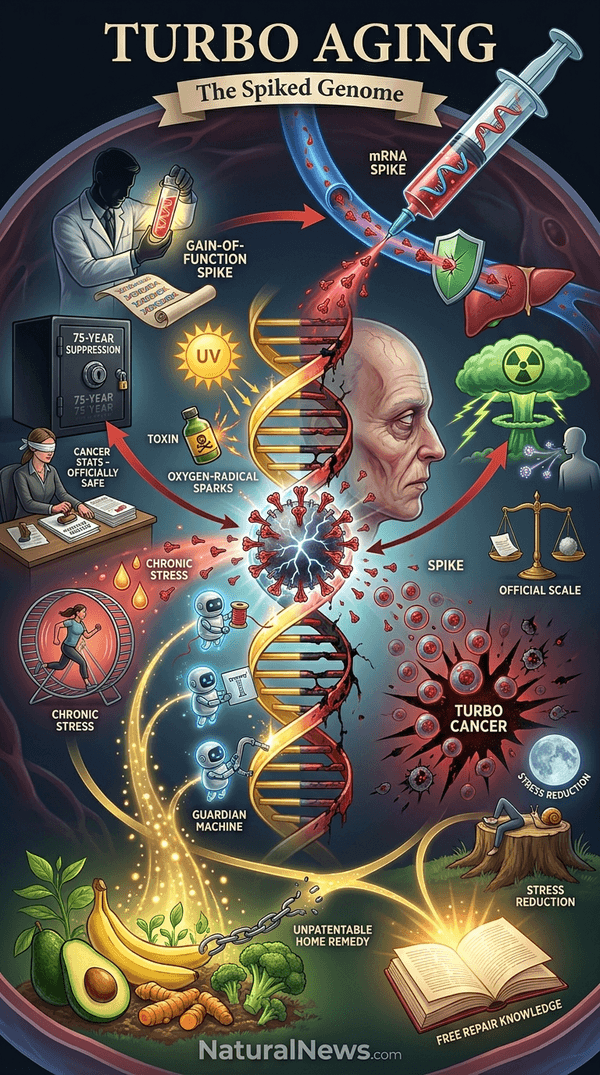
The root cause is the spike protein generated by the mRNA injections. That protein suppresses your body’s ability to repair routine genetic damage, and the result is visible collapse on the outside while the damage compounds on the inside. As I warned in my interview with Dr. Sherri Tenpenny, the forecast was specific: sudden deaths within three to five years, slow kill-off factors extending up to ten years, and “turbo cancers primarily affecting leukemia, lymphoma, breast cancer, and prostate cancer” [1].
Even the World Health Organization’s own cancer agency projects more than 35 million new cancer cases by 2050, yet it “conveniently ignores vaccine-induced turbo cancers among the young” [2]. That omission is not science. It’s suppression. It’s no coincidence this is happening now, in the years after the mass injection campaign. The timeline lines up. We are watching a generation be sacrificed on the altar of pharmaceutical profit, and we are being told to smile and call it aging.
How Spike Protein Silences Your DNA Repair Machinery
Every day, your DNA is struck by tens of thousands of lesions. UV light, environmental toxins, and even normal metabolism constantly break strands and damage bases. To survive, your body relies on overlapping repair systems: non-homologous end joining (NHEJ), homologous recombination (HR), base excision repair (BER), and nucleotide excision repair (NER). These pathways fix thymine dimers, strand breaks, oxidative damage, and other genetic injuries before they become permanent. These repair systems are not optional. They are the difference between health and disintegration.
The presence of spike protein toxins suppresses these repair mechanisms by 85% - 90%, according to published scientific research. When spike protein interferes with those pathways, mutations get copied into every new cell. That accumulation is exactly what drives accelerated aging, immune collapse, and turbo cancer. Dr. Sherri Tenpenny has “identified and documented 40 different ways these vaccines” injure the human body [3]. These are not side effects; they are mechanisms of injury.
And we are injecting these substances directly into the bloodstream, “bypassing all body safety filters, including the skin” [4]. Think about the absurdity: polysorbate 80 is banned in ice cream because regulators don’t want you eating it, yet the same chemical is allowed in vaccines injected into children. When the CDC insists it’s safe, the CDC is lying to you. When those errors are copied into new cells, you don’t just age faster; you accumulate the mutations that become cancer. The predictable result of cells replicating with unrepaired genetic corruption is what we now call turbo aging.
This Was Engineered – and the Nuclear ‘Kill Switch’ Is Next
Make no mistake: this was all engineered, not stumbled upon. From Fauci’s gain-of-function bioweapon pipeline to the Pentagon’s experiments, the spike toxin was deliberately made more toxic and then laundered through the Wuhan lab before it ever went into your arm. The companies behind the mRNA products knew exactly what they were doing. “Moderna and Pfizer sought a court order to conceal clinical data for 75 years, which would have effectively erased our ability to trace any adverse effects back to the original vaccine administration” [5]. You don’t hide data for three generations if you have nothing to hide. The goal was never health; it was turning your body into a spike protein factory for a depopulation agenda.
I believe some of the same forces that handed you the spike protein are now pushing nuclear war. Radiation fallout causes double-strand breaks -- the most dangerous form of DNA damage -- and with repair systems already disabled, fallout becomes a global genetic kill switch. A nuclear exchange would be the ultimate kill switch for a population already carrying disabled repair pathways. This is not abstract fear. “Some Russian leaders are now considering a drastic measure: launching a demonstration nuclear strike to send a powerful message to the West” [6], while the architects of the COVID agenda escalate toward the exact confrontation that would create mass casualties.
If it happens, you will be told the fallout is safe. The ICRP model will be cited. But that model ignores internal alpha emitters like plutonium and uranium, which irradiate your tissues from within. I refuse to accept that lie. You are being set up to be lied to, and the only way to survive is to know exactly how your body repairs itself and what it needs to do that job.
There Is a Way Out: Restoring Your Genetic Blueprint
Here is the good news: your body has a blueprint for repair, and it can be reactivated with nutritional factors, some of which you can grow at home for free. You do not need Big Pharma to save you. This is not about expensive patented drugs; it’s about returning to the natural order.
To repair broken DNA, you need to give your cells the tools they were designed to use. I have spent my career teaching people to “incorporate healthy ingredients like avocados, bananas, turmeric, and even freeze-dried broccoli sprout powder into their diets for maximum potency” [7]. These foods carry the phytonutrients that support DNA integrity and cellular resilience.
This is why I’m producing a free course that lays all of this out -- including how to detoxify and rebuild, even after internal radiation exposure. The same protocols that restore DNA repair and resurrect senescent cells will also protect you from radiological fallout, because the biology is the same. Knowledge is the medicine that cannot be patented. I will announce this free course in the next few weeks at NaturalNews.com
Conclusion: Choose Knowledge Over Compliance
We are being told to accept turbo aging as normal and radiation as safe. But I refuse to repeat those lies. Humanity is worth defending, and the first defense is knowledge. Learn the mechanisms of DNA damage and DNA repair. Grow your own food. Support your mitochondria. And share this information with everyone you care about.
This is not about fear. It’s about freedom. Follow my channel, spread the word, and be ready when the free course launches. The more people who understand what is happening to their bodies, the harder it will be for the empire of lies to survive. Stand up. Prepare. And never stop asking the questions they don’t want you to ask. Choose knowledge over compliance -- and choose life over extermination.
References
Mike Adams. Mike Adams Interview with Sherri Tenpenny - February 28, 2024.
WHO Predicts 35+ Million Cancers by 2050 but Ignores Vaccine-Induced Turbo Cancers in Those Under 30 Years Old. NaturalNews.com. May 09, 2024.
Mike Adams. Mike Adams Interview with Sherri - June 17, 2025.
Injecting Chemicals Is More Dangerous Than Eating Them: Why Is Polysorbate 80 Banned in Ice Cream but Allowed in Vaccines? NaturalNews.com. June 17, 2025.
Mike Adams. Brighteon Broadcast News. Brighteon.com.
Mike Adams. Brighteon Broadcast News - Part Two: Oblivious Western Leaders. Brighteon.com. June 11, 2024.
Mike Adams. Mike Adams Interview with Jonathan Otto - November 18, 2024.
An eclipse of the Sun can easily be demonstrated on a map of a flat, stationary Earth. No spinning of a globe earth or orbiting of a moon far away in space is necessary. There is no need for a distant sun93,000,000 miles away or a distant moon 257,000 miles away, to explain how their relative sizes cause periodic eclipses. Real life, on the real Earth is much simpler than that.
Whilst reading this article, try to temporarily discard any belief that any mention of a flat Earth is just for crazy people. This response is expected in a world where everyone has been conditioned, since birth, to accept the spinning globe model without ever challenging it. Also consider that all real life observations are in fact those experienced from a flat, stationary Earth as opposed to a hypothetical rotating globe.
Before going into details of the coming eclipse, the first thing to consider is that the Sun and the Moon are in fact the same size. Furthermore, they both travel in regular circuits in the sky. Yes, just up there in the sky where you can see them with your own eyes.
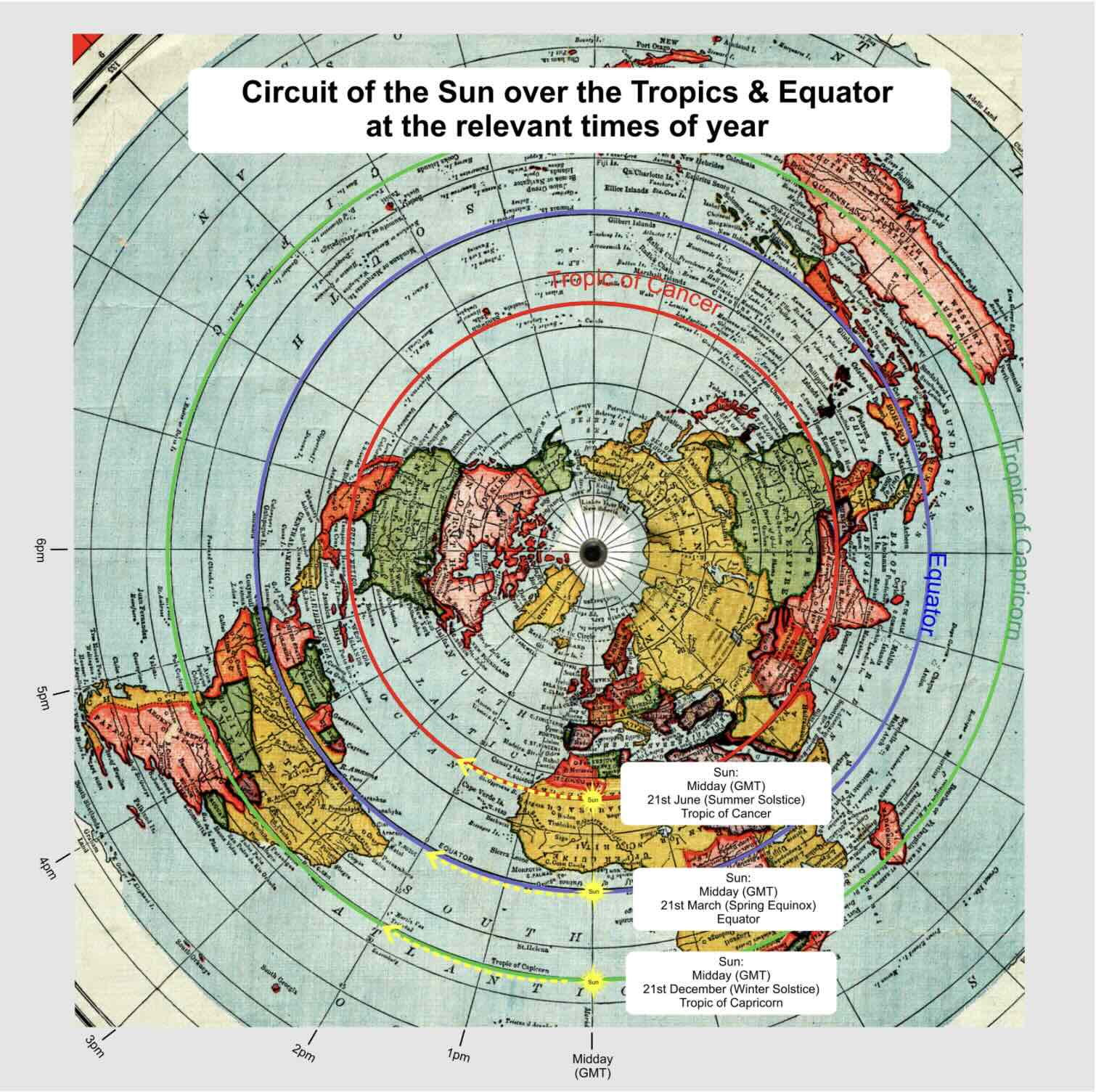
The Sun completes a circuit around the flat Earth every twenty-four hours. That is why, like clockwork, you can predict exactly where the Sun will be at a given time. As it travels in a daily circuit, it gradually moves from over the Tropic of Capricorn (21st December – Winter Solstice), arriving at the Equator (21st March – Spring Equinox) then reaches the Tropic of Cancer (21st June – Summer Solstice).
It takes six months to complete this journey between the Tropics. The largest circuit is while travelling overhead in Australia (Tropic of Capricorn), resulting in summer there. The daily circuits then gradually reduce in size until arriving closer to Europe and North America, resulting in summertime while Australia experiences winter. The amazing feature of this journey is that, despite the changes in circumference travelled, the daily circuit is always precisely twenty-four hours. This is just one example of how you cannot truly understand the astonishing wonders of life unless you comprehend the real nature of the Earth on which you live.
Once arriving at the Tropic of Cancer, the Sun then starts the six month return journey back to the Tropic of Capricorn. As its’ circuits increase in size, it becomes visibly lower in the sky. Simultaneously, the weather becomes cooler in America and Europe because the heat of the localised Sun is further away.
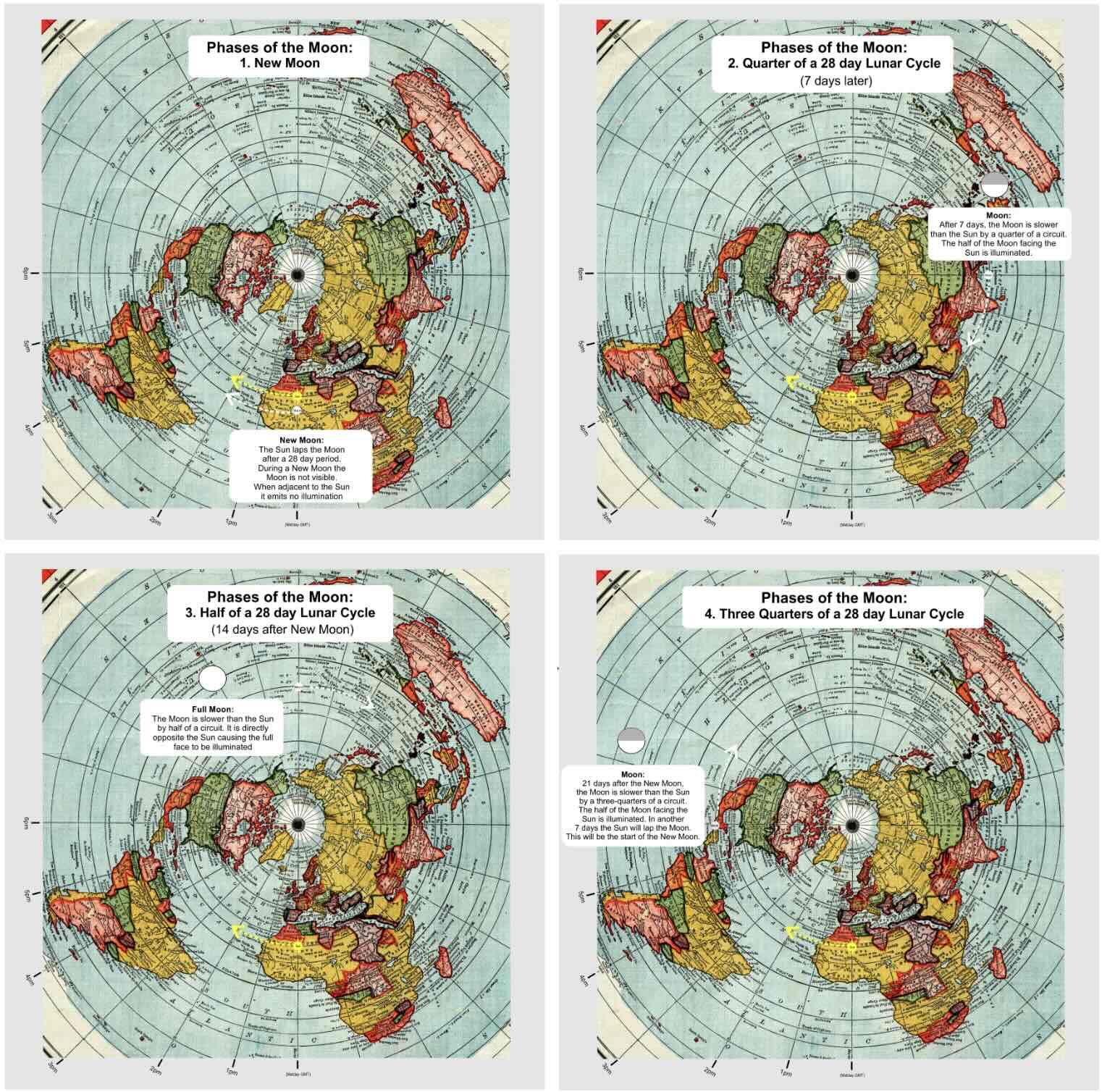
What most people don’t know, because they have never been taught the fact, is that the Sun travels slightly faster around the twenty-four hour circuit than the Moon. In fact, from the moment the Sun and Moon are in the same position, it takes twenty-eight days for the Sun to lap and overtake the Moon once more. This process of the Sun travelling faster than the Moon is why we experience the different phases of the Moon.
The 28-day Lunar Cycle:
Overlaid on top of the Gleesons maps below is the relevant position of the Moon at each of the quarter stages of the 28-day Lunar Cycle. The Sun is shown where it is always at Midday (GMT), which is due south from the timezone in London.
In illustration (2), at Midday, seven days after the New Moon, the Sun is a quarter of a circuit in front of the Moon. This is why the right half of the Moon, the part facing the Sun, is illuminated. By observing this in reality, at the same time each day the Moon will appear to be trailing slightly behind the Sun. As each day passes this distance increases. The daily incremental distance is equivalent to a full circle divided by twenty-eight (the number of days in a complete Lunar Cycle).
In illustration (3), at Midday, fourteen days after the New Moon, the Sun will have advanced further around the circuit to be directly opposite the slower Moon. This is when we experience a full Moon.
A week later, shown in illustration (4), the Sun will be three quarters of a circle in front of the Moon. It will therefore appear that the Sun is coming up behind the Moon, hence why the left half of the Moon will be illuminated.
Finally, after twenty-eight days, the Sun finally catches up with the Moon. This is known as the New Moon. It is impossible to see the Moon when the Sun and Moon are alongside each other, except, that is, during a Solar Eclipse. This is when the Moon, with no illumination, appears as a dark object in front of the Sun.
The other important fact that most people do not know is that the Moon travels in circuits between the Tropics every month. This can be proven by regular observations, watching the Moon as it gets higher and lower in the sky during each month. If the Moon is observed gradually getting higher in the sky each day, it is coming closer, travelling towards to Tropic of Cancer. Alternatively, if the Moon is observed getting lower in the sky each day, it is moving further away, circuiting towards the Tropic of Capricorn. A solar eclipse occurs periodically at the precise moment that there is a New Moon, combined with the altitude of the Moon being the same as that of the Sun. This means the Moon must be on a size of circuit almost equal to that of the Sun.
The dates of these periodical occurrences can be predicted centuries in advance. Only by understanding how this plays-out over a flat, stationary Earth, can you truly stand in awe at the wonders of nature.
This amazing spectacle is not occurring millions of miles away in a dark, cold abyss. Rather, it is happening just up there in the day-lit sky, just above your head!
Solar Eclipse 12th August:
For the purpose of this illustration, the daily circuit of the Sun on the 12th August will be drawn where it is in reality, between the Tropic of Cancer and the Equator. The precise location of the Sun at the listed time of the eclipse is known. This is illustrated on the map according to where it is at British Summer Time. It is then very easy to predict where the Moon will be at the listed duration of the full eclipse. The eclipse only lasts for two minutes and twenty-one seconds in the location of the observer. This is the time it takes for the Sun to overtake the Moon from the viewer’s perspective on the gorund.
The way to determine if the Moon will be inside the circuit of the Sun or outside of it can be determined by where the full eclipse will be seen. In this case, the Moon must be inside of the Sun for the eclipse to be witnessed in Siberia, Greenland, Iceland, NE America, and Europe.
Any observer, located at a Longitude further south than the circuit of the Sun, will not see the Moon completely passing in front of the Sun. Why? Because the Moon is on the opposite side of the Sun.
The following text describes the predetermined location and precise time in which the eclipse will occur:
“A total eclipse of the Sun on August 12. The path of totality begins over the Taymyr Peninsula in north-central Siberia and crosses the Arctic Ocean to the north of Servernaya Zemiya, the north-eastern part of Greenland, the north-western coast of Iceland, the north-eastern Atlantic Ocean, northern Spain, and ends over the Balearic Islands.
The partial phase is visible from the Arctic Ocean region, western Europe, the North-Atlantic Ocean, the north-eastern United States, Canada, Alaska and most of the Aleutian Islands.
The eclipse begins at 15h 34m (BST) and ends at 19h 58m (BST); the total phase begins at 16h 58m (BST) and ends at 18h 34m (BST). The maximum duration of totality is 2m 21s”.
The times indicated on the Gleeson Map below are for British Summer Time which is one hour ahead of GMT. This is to indicate the position of the Sun at the times listed for the duration of the eclipse. Because a solar eclipse coincides with the New Moon, drawing a line between the locations experiencing the eclipse and the Sun will give the location of the Moon.
To conclude, please consider the information presented if you are fortunate enough to be in a location where you can experience the eclipse on the 12th August, 2026.
When it comes down to it, the natural world is both amazingly intricate but at the same time, very simple. The Sun periodically lapping and overtaking the same-sized Moon, while at the same altitude, just up there in the sky, is one of the simplest observations anyone can experience. Whether you disagree with this and need a complicated explanation involving distant planetary bodies hurtling across an endless abyss is up to you. The only thing to reflect on is whether the flat Earth reality seems quite logical compared to the spinning globe narrative.
Sam Roberts | Longreads | August 11, 2026 | 4,862 words (20 minutes)
This is an excerpt from Are They Dead Yet? by Sam Roberts, which was published on August 11, 2026, by Bloomsbury Publishing, Inc.
Tuck Everlasting is a cautionary tale about a family of the same surname who, by inadvertently discovering the proverbial Fountain of Youth, is forced to reconcile with eternity. When I was assigned to write the obituary of the book’s author, Natalie Babbitt, I wondered whether she had continued pondering immortality herself. It turned out she had. Not surprisingly, her own take on eternal life echoed that of the fictional family patriarch, Angus Tuck. “I think that living forever would be a terrible thing,” I quoted her as saying in her Times obituary. “It would be boring, sad and lonely.” Babbitt died when she was 84. But Tuck and her other novels endure as Babbitt’s legacy for readers. So does my obituary, which in 2016 revealed her motivation to become an author: She was inspired to write Tuck, she said, when her four-year-old daughter woke from a nap crying because she was scared of dying. Babbitt had intended to become an illustrator, not an author, but pivoted after taking one writing course in college. She had enrolled because her husband hoped to become a novelist and she wanted to understand the challenges he faced.
Back at the Daily News, obituaries weren’t the best way to achieve immortality. We mostly ran one-paragraph squibs for members of the paper’s family, of printers, pressmen, and their immediate relatives. Instead, like most tabloids, the News thrived on the reported details of murders, assassinations, and suicides. Few news stories generated more of a sensation than death in all its dimensions. No less an authority once defined “news” than the ancient newspaper deliverer—a beloved man known as Bo Gee, who was decades too old to be described as a newsboy—weaving up Second Avenue with a wire shopping cart brimming with Chinese-language newspapers, calling out the headlines as he delivered the papers to Chinese bars and restaurants on Manhattan’s East Side. He began his route in Chinatown, where the papers were printed. Subscribers on Manhattan’s Upper East Side were often a day or two behind the headlines because the last stop on his evening route depended largely on the number of drinks he had finagled from bartenders along the way before he was too wobbly to walk any farther. When a colleague of mine, the columnist Jimmy Breslin (who described him as “a small, thirsty man”), asked him which headlines sold the most papers, he responded unhesitatingly. He didn’t need a public opinion poll or a focus group of readers or a real-time digital analysis of clickbait: Two were surefire circulation boosters. One was war! The other: big guy dies!
Taken separately, obits constitute an individual’s legacy. In aggregate, they can capture the social and cultural currency of an era. Which people are worth remembering? Which values are worth celebrating? How do we measure success and failure, good and evil, achievement and defeat, social rank and professional standing? How many of the one hundred thousand people now immortalized in the periodically printed historical compilation Who Was Who were deemed worthy of obituaries at the time of their death? How many of the more than 33,000 contemporary notables included in the latest editions of Who’s Who will get obituaries when they die? (That the titles of those reference books don’t include question marks suggests that the listings themselves are indisputable, a questionable supposition when the price of inclusion by some publishers seems to be for the “whos” to buy at least one copy of the book. An entry for Michael Fowler Cullis, a former British diplomat, describes his recreation as “writing obituaries for friends.”)
People want to be remembered, and we want to remember them, or, at least, we do. “Obituaries commemorate a life at the point where it is completed by death. Yet the completion is also depletion, in the sense that the life is constructed as meaningful precisely at the point where it stops,” Professor Clare Brant, who teaches literature and culture at Kings College London, has written. “They act as the first version of a biography—sometimes the only one, although Wikipedia has closed the gap with each life story seemingly waiting for a death sentence.” But as valuable as Wikipedia can be, the New York Public Library notes, “Obituaries provide an important tool to researchers by offering biographical information on individuals that may not be readily available elsewhere. In many cases, the obituary supplies the only biographical data extant on a person.” Philip Sutton, a genealogy librarian at the library, told Legacy.com, the self-proclaimed world’s largest commercial provider of online memorials and guest books, that obituaries may reveal the married name of a daughter identified years earlier in the census only by her maiden name; that by identifying an immigrant’s specific birthplace, obituaries can also invigorate research on a family’s roots.
Obituaries are a reminder that when you die, someone else gets the last word on your legacy—or, at least, the first of the last words.
Especially in small towns and midsize cities, local newspaper obituaries bond one generation to the next. By recalling where the deceased went to school and whom they married and who survived them, those obits provide the frames that form a moving picture of continuity, a narrative of cohesion. They describe whether, and how, the departed outpaced their parents in personal and professional achievement, their legacy to contemporary readers, and the promise of their progenitors—grandchildren or great-grandchildren who are still blank slates with the potential to add to the story.
To me, obituaries evoke the heartrending backstories of the characters in Thornton Wilder’s play Our Town, the unfulfilled promise of Joe Crowell, who got a scholarship to the Massachusetts Institute of Technology and graduated first in his class: “Goin’ to be a great engineer, Joe was. But the war broke out and he died in France. All that education for nothing.” Emily is dead, too, but so consumed by nostalgia—before being persuaded that “live people don’t understand, do they?”—that she descends from the town’s cemetery and wants to return to her past life in Grover’s Corners, New Hampshire, until the Stage Manager reminds her, “You not only live it but you watch yourself living it. And as you watch it, you see the thing that they, down there, never know. You see the future. You know what’s going to happen afterwards.” “When I think of an obituary, it’s as objective as journalism can be, a story on someone’s life,” Holly Shreve Gilbert, a journalism instructor at Oakland University who was the interim president of the Funeral Consumers Information Society, told Molly Birnbaum of Atlas Obscura. But “hyper-local journalism is dying, and so is the obituary of the local person.” Gilbert added, “Now, if it’s on Legacy.com or Facebook or a blog, we’re basically whitewashing everyone’s lives. We’re all happy. Everyone is happy.”
Well, not everyone.
Obituaries are a reminder that when you die, someone else gets the last word on your legacy—or, at least, the first of the last words. And for all the beloved and respected and cherished and valued that punctuate paid obituaries, don’t forget that families can try to perpetuate irreverent descriptions unilaterally to settle scores when one is no longer in a position to retaliate or respond. In Shakespeare’s Macbeth, Malcolm declaims of the repentant Thane of Cawdor, who was executed for treason, “Nothing in his life became him like the leaving it.” If the Thane got the benefit of ambiguity, Florence Harrelson of Chelsea, Maine, had no such luck when she died in 2024 and her daughter, Christina Novak, placed a paid obituary in the Kennebec Journal. Wasting no words, the four-line obit read that the 65-year-old Henderson died “without family by her side due to burnt bridges and a wake of destruction left in her path.” It continued, “Florence did not want an obituary or anyone including family to know she died. That’s because even in death, she wanted those she terrorized to still be living in fear looking over their shoulders. So, this isn’t so much an obituary but more of a public service announcement.”
In 2023, Gayle Harvey Heckman took the trouble to announce the death of her mother, Linda Lernal Stull, in her Michigan hometown newspaper, the Three Rivers Commercial-News, even though they hadn’t spoken in 24 years. “As a mother, Lernal was violent, hateful and cruel,” Heckman wrote. “She physically, mentally, emotionally, verbally and financially abused Gayle.” After going into excruciating detail, the obituary concluded, “Gayle and her family forgive Lernal and hope that she has found peace. They also hope to find peace within themselves. Lernal will not be missed by Gayle or her family. They all understand that the world is a much better place without her.”
Blunt isn’t always bad. If writing can be a cathartic, it can also offer an object lesson. In 2015, a nine-hundred-word paid obituary in Maine’s Bangor Daily News (down-easters seem less inhibited about publicly evaluating their kin) began, “Coleen Sheran Singer (born Coleen Sheran Clark) would have turned 33 this August 31, but she died in Lewiston in an unsuspecting suburban professional couple’s home of a heroin overdose on the morning of December 25, 2014.” The obit was written by Singer’s former husband. It detailed her considerable assets—intellectually gifted, creative, and spirited—without concealing her hefty baggage as a woman who was addicted and suffering from borderline behavioral disorder. Brent Singer attributed the life his former wife led to her broken childhood home but blamed her death on Maine’s governor for denying her access to the methadone clinic she had relied on to stay straight.
In 2008, the Casper Star-Tribune in Wyoming reported that Jim Adams died at 53. Weary of soppy obituaries of patients who had courageously struggled against one disease or another until the bitter end, Adams went through his son to provide an unvarnished premortem verdict on his abbreviated life. And he had no compunctions about belatedly exercising personal responsibility and admitting that he lost his battle for less inspiring reasons entirely: “It was primarily as a result of being stubborn and not following doctor’s orders or maybe for just living life a little too hard for better than five decades.” He did lament, however, that he “was sadly deprived of his final wish, which was to be run over by a beer truck on the way to the liquor store to buy booze for a date.”
In 2019, the family of Joe Heller (not that one) playfully celebrated his life in the Hartford Courant. They described him as “a frequent shopper at the Essex Dump” who “left his family with a house full of crap, 300 pounds of birdseed and dead houseplants.” Heller was so practiced a consummate napper that “there wasn’t an occasion too formal or an event too dour that Joe didn’t interrupt with his apnea and voluminous snoring.” The obituary added, “The family is seeking donations to offset the expense of publishing an exceedingly long obituary which would have really pissed Joe off.” (It then appealed generously for contributions to the Seabee Memorial Scholarship Association.)
The Hellers weren’t kidding. Those paid “obits” aren’t cheap. The New York Times doesn’t accept paid obituaries, but their paid death notices, depending on the edition and the day, cost about $1,000 for a bare-bones nine lines of type and $50 for each additional line, which verbose encomiums and fervent eulogizing can raise into the thousands of dollars. (In memoriam notices in newspapers that wish the departed “Happy Birthday in Heaven” remain a testament to the enduring value of print advertising.) While radio and television have generally fallen short in memorializing the dead, there are blogs, zines, and commercial websites devoted to dying, and personal web pages and online videos have all helped democratize death. So far, though, it’s one area in which even a buzzworthy website can’t always live up to its name (such as when Michael Jackson’s death was announced on MichaelJacksonLive.com).
The Charlotte Observer in North Carolina used to publish brief obituaries of local figures for free—until executives discovered that printing a full page of them daily was costing $350,000 annually for newsprint alone. When the paper imposed a fee, readers revolted; the editors relented in some editions. MyGoodbye.com was started by Stephen Miller (definitely not that one), who grew up next to a cemetery and, after escaping from his bank’s eightieth-floor office in 2 World Trade Center on the morning of September 11, 2001, decided to become an obituarist full-time. Legacy.com partners with hundreds of newspapers and thousands of funeral homes worldwide to account for about 70 percent of the deaths in the United States alone. A prototype called EPOCH—Electronically Preserving Obituaries as Cultural Heritage—created by the Orange County, Florida, Library System enabled people to publish an obit online for free. Another website, MyObits.com, also lets anyone publish a free memorial. Facebook even allows users to designate an executor to manage their profile after they’ve personally logged off this mortal coil for good.
While radio and television have generally fallen short in memorializing the dead, there are blogs, zines, and commercial websites devoted to dying, and personal web pages and online videos have all helped democratize death.
Paid death notices have been wielded as much to ward off the living as to get the last word on the dead. In the early 1920s, Audrey Munson, America’s first supermodel, became so fed up with fame that she tried to fake her death by paying to run a phony death notice in her local upstate New York newspaper. Her gambit failed; she was so celebrated that the clerk she approached refused to accept the advertisement because he recognized her. Rudyard Kipling may have done her one better: When a newspaper reported his death prematurely, he wrote to the editor, “I’ve just read that I am dead. Don’t forget to delete me from your list of subscribers.”
Six months before Oliver Sacks died of cancer at 82 in 2015, the London-born neurologist who lived in Manhattan wrote an op-ed in the New York Times that amounted to an auto-obituary. Sacks was galvanized, he wrote, by the eighteenth-century philosopher David Hume, who, learning he was mortally ill at 65, penned a short autobiography in a single day in 1776. “I feel a sudden clear focus and perspective,” Sacks wrote. “There is no time for anything inessential. I must focus on myself, my work and my friends. I shall no longer look at ‘NewsHour’ every night. I shall no longer pay any attention to politics or arguments about global warming.” He explained that his shifting priorities were influenced less by passion than perspective: “This is not indifference but detachment—I still care deeply about the Middle East, about global warming, about growing inequality, but these are no longer my business; they belong to the future.”
Kelly McMasters, the author of The Leaving Season: A Memoir, started writing her obituary when she was 12; she has refreshed it almost annually since then. Her ritual was inspired by an assignment her mother was given while training as a volunteer at a local hospice. “I usually end up with a gentle accounting of the year, held against all the past ones,” McMasters wrote in a New York Times opinion essay. “I found many of the accomplishments that felt precious one year were hardly worth a mention the next.” Her private accounts produced an album of verbal snapshots, unreachable versions of herself that seemed as good as the dead about whom obituaries are otherwise published. “It seems dreadfully unfair that we wait until after our deaths to write them and never get to read them ourselves,” McMasters wrote. “Writing your obituary while you’re still alive can offer clarity about your life and, mercifully, if you find something lacking, you still have time to revise.”
By inspiring the “Portraits of Grief” series of intimate minibiographies of the victims of 9/11 in the New York Times, the attack by fanatical al-Qaeda suicide bombers on the World Trade Center in 2001 may inadvertently have made the obituary more egalitarian than any event since the Civil War. These 200-word vignettes with thumbnail photographs weren’t standard obits or news stories. Volunteer reporters interviewed families and friends of the victims and the missing to sketch some 2,500 hundred profiles. Overseen by Jon Landman and Christine Kay on the Metro Desk, the portraits were published over nearly five months. “Terrorism rather than the internet democratized the obituary,” Professor Clare Brant wrote. Roy Harris wrote for the Poynter Institute of the project, “The portraits identified one aspect of life—a woman gardening, a man taking his daughter to ice-skating lessons, or perhaps indulging in a fondness for cigars.” The obituarist Nigel Starck said, “Each day’s pages would renew a sense of the tragedy’s scope, while the individual portraits made each person intimately real.” Our exercise in mining the unremarkable found a larger-than-life common denominator, one that challenges the novelist W. P. Kinsella’s conclusion that “the lives of ninety percent of the population are so dull that no one would care in the least about them, the lives of the remaining ten percent are so bizarre that no one would believe them.”
Some of the deaths in those “Portraits of Grief” were preceded by chivalrous acts of courage and self-sacrifice. Those heroics worked their way into news articles. The portraits were not about how people died, not about their last moments of life, no matter how gutsy, but how they lived and what their loss meant to their family, friends, neighbors, and colleagues. The gruesome, grisly details were superfluous, unlike an earlier obituary style in which the how sometimes seemed to predominate over the who, what, when, where, and why.
When Louisa May Alcott died in 1888, for example, the New York Times explained in the first paragraph of her obituary, “For a long time Miss Alcott had been ill, suffering from nervous prostration. Last Autumn she appeared to be improving and went to the Highlands to reside with Dr. Rhoda A. Lawrence. She drove from there into town to visit her father on Thursday last, and caught a cold, which on Saturday settled on the base of the brain and developed spinal meningitis.” The first five paragraphs of Teddy Roosevelt’s Times obituary in 1919 left nothing about the cause of death to the reader’s imagination: “His physicians said that the immediate cause of death was a clot of blood which detached itself from a vein and entered the lungs.” In 1892, reporting the death of Caroline Harrison, the wife of President Benjamin Harrison, the Atlanta Constitution described her corpse in clinical detail: “She shows in her emaciation the effects of the long wasting illness of eight months that has reduced her large, matronly figure to a thin, frail form.” Then again, as recently as 2000, the paper, now called the Atlanta Journal-Constitution, ran an obituary by Kay Powell of a local church-choir tenor, who had also written a manuscript on the philosophy of religion, beginning this way: “David Robeson Morgan was a brilliant man whose future looked good, until he had a frontal lobotomy in 1947.”
“A writer may bear the same name as the subject of his memoir, but he is hardly the same person,” Robert W. Fuller, the former college president and self-styled dignitarian, surmised in the epilogue to his own memoir. “He has long since morphed into the subject’s successor, and then the successor of the successor.” Bridget Fowler, a sociology professor at the University of Glasgow and the author of The Obituary as Collective Memory, wrote, “The auto/biography as such is under the expressive control of its author and is thus as profound (or simplistic) as he or she is. In contrast, one characteristic of the obituary is that these lives are selected as particularly memorable, distinguished, or newsworthy.” She adds, “The obituary offers the rare accolade of public recognition, the first step toward posthumous memory. Yet it is not just a store of value, it is also a measure of value: the obituary as a biographical form illuminates the social reality of dominance and distinction, whilst only rarely shedding light on the world of subordination.”
The onset of the AIDS epidemic presented editors with a sensitive dilemma: Merely having the virus implied vulnerable behavior—either drug use or homosexuality—that society was far from accepting. In 1986, the fashion designer Perry Ellis died of AIDS at age 46, as stated in his obituary in the Washington Post. In the New York Times and the Los Angeles Times, his cause of his death was reported to be viral encephalitis. In early May 1987, Charles Ludlam, a playwright, parody actor, and admired figure in New York’s East Village underground arts scene, withdrew from the New York Shakespeare Festival’s scheduled Central Park production of Titus Andronicus. On May 28, Ludlam’s publicist announced that he had died of pneumonia. The New York Times‘s Jeremy Gerard assumed correctly that the pneumonia was a complication of AIDS, and believed the refusal to acknowledge the disease compounded the tragedy of Ludlam’s death by validating the stigma attached to gay people, who were among its most prominent victims.
As Leah Rosenzweig reported in Slate, for hours Gerard desperately tried to persuade Ludlam’s parents to confirm the actual cause but failed. “They were working-class Catholics from Long Island; as far as they were concerned, their son had died a shameful death,” Gerard recalled. But fifteen minutes before his deadline, the family’s lawyer called back. The Ludlams agreed to confirm the cause. On May 29, 1987, Gerard’s obituary of Charles Ludlam was the first that identified AIDS as the cause of death in the Times, on the front page.
“Obituaries contribute to national myths or collective memories of contemporary heroes by symbolically ‘reflecting what, in death, was most valued about the lives of individual citizens,'” Janice Hume wrote. “An obituary distills, publishes, and thus legitimizes something more abstract than mere facts. It also reveals values, highlighted in the attributes of the deceased, and should be examined not just as an indifferent chronicle but as a commemoration, a representation of an ideal, with its own distinct contribution to the understanding of history. Those ideals, part of obituary coverage, become safeguarded by their publication.”
To quantify those values, Lux Narayan, a social media analyst, conducted a statistical survey of some 2,000 New York Times news obituaries that were published in 2015 and 2016. Not surprisingly, the fields of academics, science, politics, film, theater, music, dance, and art predominated among those deemed worthy. On average, they achieved the thing that made them worthy of a Times obituary when they were 37 years old—athletes more likely in their twenties, politicians in their forties. The prototypical obituary subject lived to be 81, which meant 44 years had elapsed between the accomplishment and, in the cases of the many obscure and quirky characters, their public aggrandizement. “Talk about having to be patient,” Narayan said. In a TED Talk, he explained his obsessive reading of the daily paper over scrambled eggs this way: “If you think about it, the front page of the newspaper is usually bad news and cues man’s failures. An instance where bad news cues accomplishment is at the end of the paper, in the obituaries.”
What were the most common denominators among those obituarized, and what do they suggest society—or, more to the point, the Times—valued? If your name was John, you didn’t necessarily have a better chance of being the subject of an obituary, but it was more likely that a man whose first name was John would appear in one. That’s not so surprising, given that John (along with James, Robert, Michael, and David) has been among the most popular names for American men born in the last 100 years. Narayan was struck by another commonality, though. The language-processing program revealed that the one word that leapt out everywhere was help, as a noun or verb. The most universal value, it seemed, that elevated the famous and not-so into those the Times editors considered worthy of obituaries was how much people helped. “They made a positive dent in the fabric of life,” Narayan said.
For a family member, an obit represents an imprimatur, validation by association, a keepsake that maintains their heritage and, perhaps for a generation, prevents their own legacy from vanishing like a walnut in the batter of eternity.
Journalists understand, or should, that statistical surveys of subjective material are fertile ground for as many question marks as answers. Patrick Nolan, a sociologist at the University of South Carolina, wondered whether the cult of celebrity has blossomed over the last century, as the anecdotal evidence suggests. Has the public become so starstruck that somebodies in less glamorous professions have been overshadowed? One way to measure the trajectory of society’s fascination quotient, he figured, was to enlist New York Times obituaries as a cultural barometer. Nolan’s canvas was every “notable death” that was published in the Times during the entire twentieth century.
“Most striking are the simultaneous increases in celebrity obituaries and declines in religious obituaries,” Nolan and Timothy J. Bertoni reported in the journal Sociation Today. “They document the increasing secularization and hedonism of American culture at a time when personal income was rising and public concern was shifting away from the basic issues of survival. The magnitude of these trends is seismic. While the Greeks may have looked to their gods for guidance and entertainment, we’ve turned increasingly to our celebrities—entertainers and athletes.” After dividing the century into quarters, Nolan and a doctoral student, Timothy Bertoni, randomly selected 20 days from 1900, 1925, 1950, 1975, and 2000 and ranked the professions of the dead by the number of obituaries run.
The number of obits of entertainers and athletes, grouped together, rose, from seventh most in 1900 to fifth in 1925, third in 1950, and first in 1975. By 2000, they remained in first place and accounted for 28 percent of obituaries. In 2000, the researchers didn’t find a single notable religious figure who was memorialized. The category had plummeted from fourth place when the 20th century began to last when the millennium ended. During the same period, the number of obituaries of notable individuals from the fields of business, finance, manufacturing, and industry declined by half. Americans, Janice Hume has written in her study of grief, “value each other and, indeed, value life for collective reasons. They value a long, robust, and full life, a life that is uniquely American, and a life that ensures social preservation. A typical Victorian obituary would carry the statement, ‘in life we are in the midst of death,’ but as this study suggests, at least on the obituary pages of historic mainstream American newspapers, in death we are in the midst of life.” Nigel Starck, too, argues that obituaries provide a glue that bonds society not in grief but in an aspirational reevaluation of our own lives.
“There is nothing inherently gloomy about the newspaper obituary page,” he writes. “Done well, it should capture life rather than wallow in death.” Clare Brant recalled her euphoric reaction to reading of the death of Martin Wells, the grandson of the English writer H. G. Wells, in the Guardian in 2009. He was an 80-year-old biologist with a passion for cephalopods and was also a novelist, painter, and yachtsman. “Though marine biologists don’t have dry lives in a literal sense, and people who love octopus usually have a sense of play, he was really lively,” Brant wrote. “I rejoiced that an academic could have such a full, happy and entertaining life—there’s hope for the rest of us! It wasn’t that I wanted to know him or even to have known him, but I was glad he’d existed, and I still want not to forget the implications of his existence.”
And that was an obituary about a total stranger. For a family member, an obit represents an imprimatur, validation by association, a keepsake that maintains their heritage and, perhaps for a generation, prevents their own legacy from vanishing like a walnut in the batter of eternity. “The greatest investigative piece I ever wrote when I thought I was really important never survived more than a few weeks in terms of being kept around,” said Jim Nicholson, the Philadelphia journalist who regularly chronicled deaths of the common man, the nobodies, as he put it. “But these obituaries, they’re laminated. They’re put under glass. They’re hung on walls or in family Bibles. In fact, they’re even put into the inside coat pocket of the deceased. And, yeah, they’ll be around long after you and I are gone.” Nicholson’s obituaries were indelible. “My words give readers thousands of moments to remember of little lives lived well,” he said. “Perhaps I even gave them the secrets of how to live one well.”
What readers cherish about obituaries, Casey Cep wrote in the New Yorker, is “the opportunity to celebrate one’s own good fortune at still being alive, to keep tabs on death—who it comes for, at what age, and how much we have in common with the deceased—and also to trace an immensely compact narrative arc. So much of the news is ongoing and unsettled, but obituaries by definition have a kind of alluring finality.” In the two weeks after Victoria Chang’s mother died of pulmonary fibrosis in 2015, the Los Angeles–based poet feverishly wrote seventy poems. Her goal: to recast the newspaper obituary to identify what had been lost (“civility, language and the future,” she wrote) and death’s cultural impact on the living. She described writing an obituary as a wake-up call. “This person is dead,” Chang wrote. “You’re alive.”
Sam Roberts, a fifty-year veteran of New York journalism, is an obituaries reporter and formerly the Urban Affairs correspondent at the New York Times. He has hosted the New York Times Close Up on TV and the podcast Only in New York, anthologized in a book of the same name. He is the author of The New Yorkers, A History of New York in 27 Buildings, A History of New York in 101 Objects, Grand Central, and The Brother, among other books. He has written for the New York Times Magazine, the New Republic, New York magazine, Vanity Fair, Foreign Affairs, and Air Mail. Before joining the Times in 1983, he was the youngest city editor of the New York Daily News. He lives in New York with his wife.
O Museu Municipal de Faro (MMF) vai acolher, durante o mês de agosto, um conjunto de visitas guiadas dedicadas a duas exposições que têm marcado a atual agenda cultural e expositiva do Algarve, reforçando a ligação entre património, arte e história num período de forte afluência turística à cidade.
A programação contempla visitas à exposição dedicada à coleção de Miguel Duarte, que reúne um núcleo de obras de arte portuguesa dos séculos XIX e XX. A mostra integra trabalhos de nomes incontornáveis como Silva Porto, Marques de Oliveira, Falcão Trigoso, Aurélia de Souza, José Malhoa, João Vaz, Bernardo Marques, Cruzeiro Seixas e Júlio Pomar, entre outros, distribuídos por vários espaços temáticos, que propõem um percurso por diferentes estilos e momentos da arte portuguesa. Esta exposição contará com duas visitas guiadas no mês de agosto: no dia 8, às 17h00 e no dia 15, às 18h00. Ambas terão a participação da curadora da mostra, Raquel Henriques da Silva, professora jubilada da Universidade Nova de Lisboa e reconhecida especialista em História da Arte, com vasta obra publicada sobre estes períodos.
No dia 15 de agosto, a visita contará ainda com a presença do colecionador Miguel Duarte, que partilhará com o público o seu gosto pela arte, as motivações deste projeto e os critérios que orientaram a aquisição das obras que compõem o acervo.Também nesse dia está prevista a apresentação do catálogo da exposição, uma publicação com um cuidado gráfico bastante elevado e que se assume como documento de estudo, conhecimento e salvaguarda deste espólio, reforçando a ação editorial da autarquia e do museu nas áreas do património e da museologia. Ainda no dia 15 de agosto, às 16h00, o MMF promove uma visita à exposição “Olhar a paisagem a partir das coleções do Museu Nacional de Arte Antiga (MNAA)”, com a participação de Marta Carvalho, do MNAA e Samuel Rama, da Escola Superior de Artes e Design das Caldas da Rainha. A iniciativa propõe um diálogo entre a perspetiva da historiadora e a visão do artista, ajudando o público a conhecer e interpretar algumas das obras em exposição, que incluem peças das coleções do MNAA e do Museu Municipal de Faro.
Num momento em que o Algarve e a cidade de Faro recebem milhares de visitantes, o MMF reforça, com esta programação, a promoção de um produto cultural do território, associado ao património, à arte e à história.A participação nas visitas é livre, bastando aos interessados comparecer no Museu Municipal de Faro nas datas e horários indicados.Para mais informações, poder-se-á contactar o MMF (email: museu.municipal@cm-faro.pt).
A Junta de Freguesia de Almancil esteve presente, na passada sexta-feira, dia 31 de julho, representada pela Secretária do Executivo, Célia Fragoso, na entrega dos novos leitores de identificação eletrónica de animais.
A iniciativa, promovida pela Câmara Municipal de Loulé, reuniu as freguesias do concelho neste esforço conjunto pela causa animal.
Com este novo recurso, a freguesia passa a dispor de um meio mais prático para atuar em situações de animais perdidos ou desorientados.
A leitura do microchip permite identificar rapidamente os responsáveis pelo animal, facilitando o seu regresso a casa.
A Junta de Freguesia mantém-se disponível para continuar a contribuir para o bem-estar animal.
O Museu Municipal de Loulé promove, no próximo dia 15 de agosto, pelas 21h30, a iniciativa “A Arte num Mar de Histórias”, integrada na exposição “Com os Pés na Terra e as Mãos no Mar. 6000 anos de História de Quarteira”, patente na Antiga Lota de Quarteira.
A atividade combina uma visita temática orientada com uma oficina prática de pintura em tela, oferecendo ao público uma abordagem dinâmica e criativa ao património histórico da região.
A visita temática visa dar a conhecer o património marítimo de Quarteira, destacando a importância do mar no desenvolvimento económico, na localização geográfica e na identidade cultural local ao longo dos séculos. Durante o percurso, os participantes poderão ficar a conhecer a evolução das embarcações, as principais artes de pesca tradicionais e as espécies marinhas mais emblemáticas da costa.
Como encerramento da experiência, a oficina de pintura convida o público a traduzir em tela as aprendizagens e elementos visuais abordados, utilizando como inspiração o mar e o universo náutico.
A atividade é dirigida ao público em geral, de acesso gratuito e sem necessidade de inscrição prévia. Para mais informações: servicos.educativos@cm-loule.pt / 289 400 611.
It is damn obvious that Washington has lost Donald Trump’s idiotic war on Iran. After all, it is now five months since the opening salvos of Operation Epic Fury on February 28, which was advertised to last only 3-4 weeks. Instead, the conflict has settled into a grinding, inconclusive stalemate at best, and, more importantly, […]
– Colpito il Tatarstan di Margherita Furlan
– Il pugno del Senato USA contro Mosca di Margherita Furlan
– Tutti con Kiev nonostante Bandera e le svastiche di Jeff Hoffman
– Hormuz: Teheran detta le condizioni a Washington di Jeff Hoffman
– Netanyahu dice no: Gaza resta occupata di Jeff Hoffman
– Groenlandia: diffida ai trivellatori di Trump di Margherita Furlan
– Cina-USA: Shanghai quota il robot proibito di Margherita Furlan
– Meta condannata: avvelena i minori di Margherita Furlan
– Buon giro intorno al Sole
A cura di Margherita Furlan
Con la collaborazione di Jeff Hoffman
Editing di Davide Marletta e Simone Orletti
CASA DEL SOLE TV — Informazione libera e indipendente
Il nostro lavoro è possibile solo grazie al vostro sostegno. Casa del Sole TV non ha editori forti né finanziamenti pubblici: siamo sostenuti da voi, il nostro pubblico.
Se credi nel valore di un’informazione che non tace, aiutaci a continuare. Dona tramite bonifico bancario: IBAN: IT63P0326822300052392596590
Intestato a: LA CASA DEL SOLE EDIZIONI Causale: Donazione Casa del Sole TV Dona tramite PayPal: paypal.me/casadelsoletv Sostegno ricorrente: casadelsole.tv/sostienici
Anche un piccolo contributo fa la differenza. Grazie di cuore!
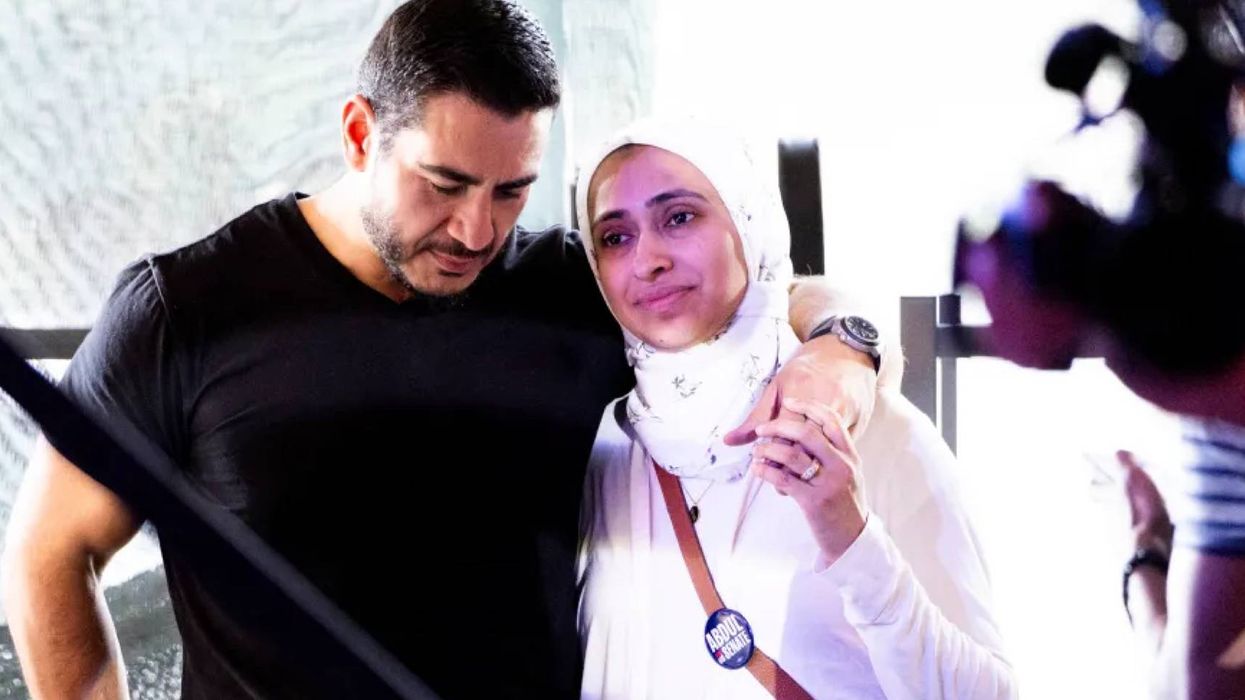
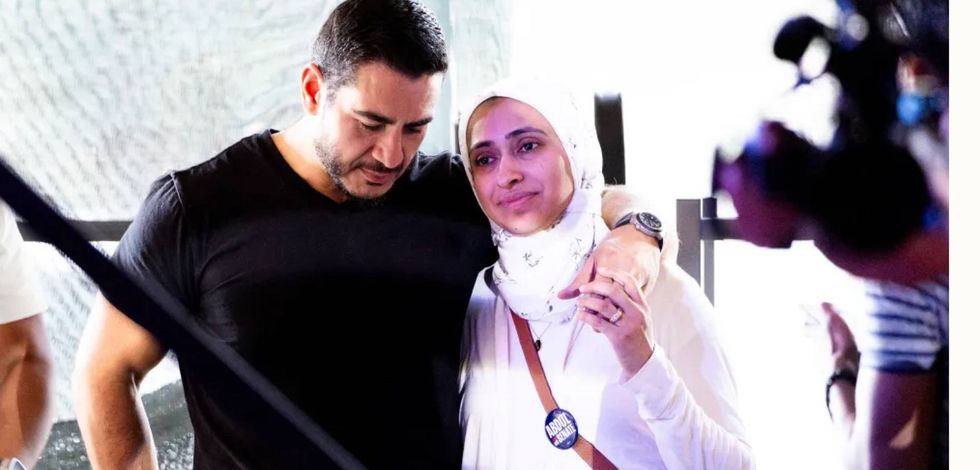
Hoo boy. With the approach of what bleakly promises to be "the super-Islamophobic midterms," the Bigot-In-Chief is letting his racist freak flag fly by attacking Dr. Abdul El-Sayed, whose smarts, strength, hotness, accomplished wife and Michigan win clearly terrify him. Cue charges of "communist," "man of hate," and, probs soon, AI slop featuring suicide vests. Meanwhile, El-Sayed, a far sharper tool in the shed, has embraced the charge they represent "(two) America’s": The ads write themselves.
Planet MAGA, of course, is already so delusional Trump just boasted of his "Great Poll Numbers," which now sit at rock-bottom lows of 38% to 33%. For a bunch of hacks led by a fragile narcissist who's never seen a scapegoat he didn't relish, the fantastical goes hand-in-stubby-hand with the fear-mongering: vandals in the Reflecting Pool, domestic terrorists at No Kings, migrant caravans, lunatic Bolsheviks, weird names or just brown-or-black skinned success, more terrifying to many of these losers than any threat of extremism. Enter, in peril, the high-achieving epidemiologist, health official, author and "Muslim boogeyman" El-Sayed. “Expect them to throw the whole bigoted kitchen sink at El-Sayed," says Mehdi Hasan."This will be the anti-Zohran Mamdani campaign on anti-Muslim steroids."
Unsurprisingly, it began in earnest the minute the good doctor won Michigan's against-the-odds primary against establishment Dem Haley Stevens. He'll face off against GOP Rep. and racist ijiot Mike Rogers, who of course has rushed to call the U.S.-born-and-bred El-Sayed "anti-American" and - pulling the same juvenile "Barack Hussein Obama" crap to undermine his legitimacy - to use his full, scary, def-not-in-Kansas-anymore name Abdulrahman Mohamed El-Sayed. But Abdulrahman, who doesn't suffer fools gladly, has brutally pushed back. "With a name like mine, I never thought running for office would be possible," he said at a campaign event. But if "Mike" wants to focus on his 11-letter (a lot!) first name, he just wanted to remind him, "If you don’t know how to say it, keep the name out of your damn mouth.”
In moronic lockstep, MAGA's bigots, brown shirts and zealots have followed suit with "cartoonishly Islamophobic attacks." They use his full name and say he's a "socialist," which they can't define but anyway he isn't. Anti-trans goon Nancy Mace charges, “Every single Muslim holding public office (is) a Trojan Horse and a threat to national security and our republic," and woe is us when "our granddaughters are wearing burkas to school." Vapid scumbag JD calls him a "crazy" guy who doesn't want Trump's rip-off, oligarch-run "prosperous economy" and flings "personal insults" at Vance's family, though hours later Trump attacked El-Sayed's wife, who is U.S.-born and thus not an alleged Einstein Visa immigrant third wife who somehow after 30 years here can still barely speak English. Maybe it was an Epstein Visa?
As usual, Trump has eagerly led the racist, vulgar charge. Along with a communist man of hate, he's also called El-Sayed a "jihadist" from a rigged, "strictly Third World" state who's "full of shit." It turns out El-Sayed is also "the absolute best at casually burning Trump to the fucking ground": Asked about the barb, El-Sayed snapped back, “At least I don’t let mine go in the middle of the Oval Office." And as with another smart, quick, non-white guy who's way above his pay grade and lives rent-free in his wee puerile mind, he likes to sneeringly recite, often stumbling, the full, scary name of a guy who this time actually would be the first Muslim U.S. senator. Presumably, the ketchup really hit the White House walls last weekend when El-Sayed said he'd had "a really good conversation" with Obama about "what we need to do to win."
Above all, the bigot for all seasons pivots to the trope of anyone Arabic - El-Sayed's parents immigrated from Egypt - being anti-Semitic. "He doesn't love Jewish people," babbles Trump. "He hates them with a passion that burns in his heart." In fact, El-Sayed has plainly, repeatedly said he opposes not Jews but Israel's genocidal policies, AIPAC and the dark U.S. money that abets both: "I believe in equal rights to peace, dignity and self-determination for all people." That call for equality under the law has nothing to do with anti-Semitism, notes Peter Beinart; cognizant of history. he also warns that a political party or ideology willing to be "nakedly bigoted" toward any group of people, in this case Muslims, in order to maintain power would, if the politics were to shift, "do the same thing to Jews in a heartbeat."
Obviously, such subtlety is beyond the dim-witted likes of Trump and his MAGA zombies, who alone could look at Dr. El-Sayed and his (one) wife Dr. Sarah Jukaku, a psychiatrist whose parents emigrated here from India, and see a threat. Both are U.S.-born-and- raised doctors with undergrad degrees from University of Michigan, where they met, and advanced degrees from Columbia and Oxford. In his book Healing Politics, El-Sayed offers a rigorous framework for understanding systemic medical and political failure, and building conditions for lasting healing. He also calls Jukaku his “rock" and praises the "quiet confidence" that led her to work with people confronting pain. "I struggled to learn who I was,” he wrote of their earlier selves. “Sarah did not. She danced with her emotions. I wrestled with mine." The couple has two daughters.
No wonder, then, a needy, hollow rapist, con-man, bully and aspiring tinpot dictator, routinely raking in billions while kids go hungry and stuffed into a cheap tux for his fellow billionaire felons, posted a photo of himself with his tacky, mail-order, call-girl wife in a tight dress with "redacted Epstein files written all over it" - both smirking, "We're richer and be better than you and just ignore our vile name appearing in those pedo files thousands of times" - alongside the other couple, warmly smiling after a pancake breakfast in a diner, El Sayed in a t-shirt, Jukaku in a hijab so she must be a terrorist (though Trump, suspect, is wearing a cat.) The caption for the side-by-side pics, which only the spectacularly tone-deaf Trump could remotely imagine as a mic-drop: "Two VERY DIFFERENT America’s (sic).” Umm. Sure.
Kudos to El-Sayed, prince among men, who didn't even stoop to pick the low-hanging fruit of Trump's "grammatical shitbaggery" - one comment: "What a maroon" - emblematic of a proudly semi-literate GOP somehow come to power in our debased America without understanding how apostrophes work. Instead, El-Sayed went for the meat of the matter. "Yeah, he's right," he told CNN. Swiftly, he embraced the campaign-ready concept of two Americas: "Trump's vision, the one you're living in right now (in) which your overlords are two people who don’t like each other, but join in the interest of making billions of dollars off of you...Or two people who genuinely love each other, enjoyed some pancakes together, and want to come together to build the kind of America where they can raise a family and know that family is going to have the good things."
Those "good things" - health care, good jobs, clean air and water, a relatively level playing field to replace gross inequality, a country where people can live peaceably together "with their sisters and brothers" - are what he and his wife want for their kids, and he wisely gauges most of the rest of us do too. And no, he says, rebutting GOP charges, it's not "radical" to believe people should be able to afford groceries, have health care, partake in free elections. Also, he and his wife actually "like each other," he adds; as to the couple in the "very different" America, "From what I've heard, it's a bit of a rocky road." As mid-terms loom. “They are going to try to paint me as a certain thing, (but) America is a lot bigger than (these) very small people make it out to be," he says. "They all think we won't step up and fight...We fight for each other."
They all think we won't step up and fight... They think they're the biggest, baddest bully on the playground... That they're going to show up and we're going to run away...
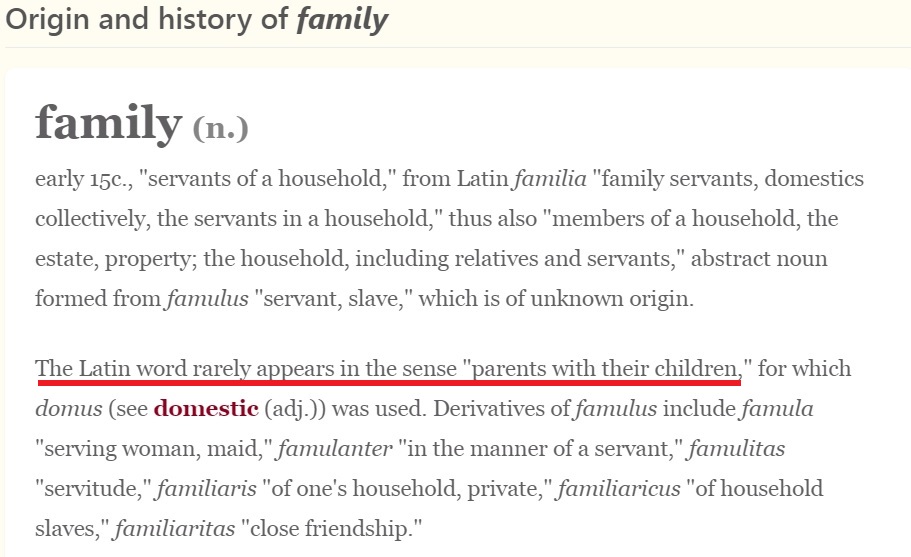
The English word “family” has a very specific, and very narrow meaning in modern English.
If someone asks you, for example, “How’s your family?”, it is generally understood two ways, depending on whether or not you are married and have your own children.
It either means you and your spouse, along with any children you have, or it means you and your parents, and any siblings that you have.
However, such a concept of “family” only started in 15th Century in Europe, more than 1400 years after the Bible was written.
Here is the entry for “family” from the website etymonline.com, which traces the history of English words (emphasis mine):
family (n.)
early 15c., “servants of a household,” from Latin familia “family servants, domestics collectively, the servants in a household,” thus also “members of a household, the estate, property; the household, including relatives and servants,” abstract noun formed from famulus “servant, slave,” which is of unknown origin.
The Latin word rarely appears in the sense “parents with their children,” for which domus (see domestic (adj.)) was used.
Derivatives of famulus include famula “serving woman, maid,” famulanter “in the manner of a servant,” famulitas “servitude,” familiaris “of one’s household, private,” familiaricus “of household slaves,” familiaritas “close friendship.”In English, sense of “collective body of persons who form one household under one head and one domestic government, including parents, children, and servants, and as sometimes used even lodgers or boarders” [Century Dictionary, 1889] is attested by 1540s.It is attested from 1660s as “parents with their children, whether they dwell together or not,” also in a more general sense, “persons closely related by blood, including aunts, uncles, cousins;” earlier “those who descend from a common progenitor, a house, a lineage” (1580s).
Hence, “any group of things classed as kindred based on common distinguishing characteristics” (1620s); as a scientific classification, between genus and order, from 1753.
Latin familia often was glossed in Old English by hired, hyred “household, family, retinue” (for which see hide (n.2), and also by hiwscipe, hiwræden, hiwan “members of a family, household, or religious house,” which is cognate with Old Norse hjon “one of the household; married couple, man and wife; domestic servant,” and with Old High German hiwo “husband,” hiwa “wife,” also with Lithuanian šeimyna “family,” Gothic haims “village,” Old English ham “village, home” (see home (n.)). A 15c. glossary has, for Latin familia, Middle English a menge, from Anglo-French maisnie “the household, the whole attendance upon the personal establishment of the feudal lord.”
As we can see from the historical uses of the English word “family,” its original meaning went far beyond what is today referred to as “the nuclear family” consisting of only parents and their children.
Before the “Industrial Age” and the “Age of Enlightenment” and the “Protestant Reformation” in Europe, the term “family” was more broadly understood in terms of location and “estates”, and included more than just those with a biological relationship, but also included slaves and other humans who were part of that “estate”, or “household” but not necessarily biologically related to each other.
Therefore, when you see the English word “family” used to translate certain passages in the New Testament which was written in Koine Greek, you need to understand that the choice of the translators to use “family” is 100% subjective, as there is no underlying Greek word that means “family” in the modern sense.
This is easily seen by doing searches in the English Bibles today, where the older English language translations seldom used “family” at all, but the more modern English translations use it quite a bit.
For example, in the old “King James Version” (KJV), it is only used once.
The single occurrence of the word “family” in the KJV is significant, in Ephesians 3:15.
Here is the verse in the context of the chapter:
For this cause I Paul, the prisoner of Jesus Christ for you Gentiles, If ye have heard of the dispensation of the grace of God which is given me to you-ward: How that by revelation he made known unto me the mystery; (as I wrote afore in few words, Whereby, when ye read, ye may understand my knowledge in the mystery of Christ) Which in other ages was not made known unto the sons of men, as it is now revealed unto his holy apostles and prophets by the Spirit;
That the Gentiles should be fellowheirs, and of the same body, and partakers of his promise in Christ by the gospel: Whereof I was made a minister, according to the gift of the grace of God given unto me by the effectual working of his power.
Unto me, who am less than the least of all saints, is this grace given, that I should preach among the Gentiles the unsearchable riches of Christ;
And to make all men see what is the fellowship of the mystery, which from the beginning of the world hath been hid in God, who created all things by Jesus Christ:
To the intent that now unto the principalities and powers in heavenly places might be known by the church the manifold wisdom of God, According to the eternal purpose which he purposed in Christ Jesus our Lord: In whom we have boldness and access with confidence by the faith of him.
Wherefore I desire that ye faint not at my tribulations for you, which is your glory.
For this cause I bow my knees unto the Father of our Lord Jesus Christ, Of whom the whole family in heaven and earth is named, That he would grant you, according to the riches of his glory, to be strengthened with might by his Spirit in the inner man;
That Christ may dwell in your hearts by faith; that ye, being rooted and grounded in love, May be able to comprehend with all saints what is the breadth, and length, and depth, and height; And to know the love of Christ, which passeth knowledge, that ye might be filled with all the fulness of God. (Ephesians 3:1-19)
The reason why the word “family” is significant here, is because it clearly refers to ALL created beings created by God, both “in heaven and earth”, which derive their “name”, or “identity”, from their Creator, God, whose most common name used in the Scriptures, is “Father.”
Within this context, Paul is clearly stating the Gospel message, which is that through Jesus Christ, everyone now has access to the “Family of God,” including Gentiles (non-Jewish people), regardless of whatever earthly “family” one belongs to.
In the older New American Standard Bible (NASB), the word “family” is only used 6 times, including Ephesians chapter 3.
In the “newer” 1984 “New International Version” (NIV84), it is used 22 times.
When you read the “names” of people in the Bible, both in the Old Testament as well as in the New Testament, you clearly see that there were no “last names” or “surnames.”
People were identified from the household/family they came from, such as “son of [fill in the blank]”.
So this transition of the modern concept of “family” closely follows the Western concept and history of “surnames” or “last names” during the same time period.
History of English Surnames
Have you ever wondered where your surname comes from? Or how surnames evolved? In England surnames weren’t widely used until…
Excerpts:
Have you ever wondered where your surname comes from? Or when people start using surnames (last names) and why?
In England, surnames are also commonly known as last names due to the practice of writing the given names first and then the family name or surname last.
Historians generally agree that in 1000 AD England about 10% of the population were slaves, the rest were unfree. By unfree, the ‘great unwashed’ were either villeins, bordars and cottars², or serfs of varying status, all bound to the land by their lords and masters. Most people moved so little that they needed only a first name to identify themselves. Even among the knightly class, hereditary surnames were rare.
Surnames weren’t widely used until after the Norman Conquest in 1066. As the country’s population grew and to allow the new King William I to extract the relevant taxation, it became necessary to distinguish between people and so names began to include descriptions of the person, such as Thomas son of John, Peter the Baker, Richard the Whitehead, Mary Webster, etc. These descriptions would grow to form the surnames we recognise today.
To begin with, surnames were fluid and changed over time, or as a person changed his job. For example, John Blacksmith might become John Farrier as his trade developed.
The introduction of parish registers in 1538 helped establish the idea of hereditary surnames. However it was still common in some parts of the country to find a person entered under one surname at baptism, married under another name and then buried under a third.
Today there are perhaps as many as 45,000 different English surnames, derived from all kinds of sources: nicknames, physical attributes, trades, place names etc.
So every time you see the English word “family” in the Bible, if you want to truly understand what the original text written in Greek is communicating with that English word that someone chose thousands of years after the Bible was written, it is helpful to use an electronic Bible program like eSword, to see what the actual Greek words are in the original text.
Let’s look at a passage in the New Testament from the Gospel of Mark that I have quoted in some of my articles, about the “family” of Jesus, and then look at what the underlying Greek words actually are.
Then Jesus entered a house, and again a crowd gathered, so that he and his disciples were not even able to eat.
When his family heard about this, they went to seize him, for they said,
“He is out of his mind.”
Then Jesus’ mother and brothers arrived. Standing outside, they sent someone in to call him.
A crowd was sitting around him, and they told him,
“Your mother and brothers are outside looking for you.”
“Who are my mother and my brothers?” he asked.
Then he looked at those seated in a circle around him and said,
“Here are my mother and my brothers! Whoever does God’s will is my brother and sister and mother.” (Mark chapter 3)
This is quoted from the NIV84 translation. And even within the context of this chapter, we can clearly see how Jesus understood the context of “family”, and that it went far beyond biological “family” members who are identified here as “mother and brothers”, and extended to his disciples, of whom he gave preference, in at least this incident, over his biological family members.
If we look at some other translations of this verse in Mark 3, which is verse 21, we begin to get an idea of what was actually being communicated here:
And when his friends heard of it, they went out to lay hold on him: for they said, He is beside himself. (Mark 3:21 KJV)
And when His own people heard about this, they came out to take custody of Him; for they were saying, “He has lost His senses.” (Mark 3:21 NASB)
So it is very likely that more people than just Jesus’s “mother and brothers” came to him at this time, and could have included other people in his “household”.
There are actually two underlining Greek words used here: παρά (para) – from, of at, by, besides, near – and αὐτός (autos) – himself, herself, themselves, itself.
Personally, I think the NASB is the closest to the original, “his own people.”
We know that Jesus was not born into a household that was considered “slaves” or “servants,” as his mother’s first husband, Joseph, was a tradesman, and ran his own business, which could have included quite a few people.
Was Jesus’s behavior of constantly going against the cultural norms, and even daring to oppose the religious leaders of this day, becoming an economic drain on their “family business”??
As I have previously published, the most common understanding and translation of the “trade” or “craft” that the household of Jesus’s family practiced, is “carpenter.”
But the actual Greek word used, tektōn, which is a word group in the Greek that gives us English words today such as “technology”, could also be translated as “mason”, a worker of stone, and not just wood.
Here is what I have previously published on this:
Next, let’s look at the English word “craftsmen” that is used here to refer to Demetrius and the others (Acts 19).
The word in the original Greek texts is τεχνίτης – technitēs.
This is the word group that we get our English words “tech”, “technology”, “technologists”, etc. from.
In classical secular Greek, it meant “craftsman or builder in wood, stone, or metal“.
It is also used in the Greek translation of the Old Testament, such as in this verse describing the building of Solomon’s temple:
You have many workmen: stonecutters, masons and carpenters, as well as men skilled in every kind of work.
(1 Chronicles 22:15)
Another Greek word from this word group in Greek is tektōn, which is used of Jesus in Mark 6:3:
Isn’t this the carpenter? Isn’t this Mary’s son and the brother of James, Joseph, Judas and Simon? Aren’t his sisters here with us?” And they took offense at him. (Mark 6:3)
All the English translations I have, which is over a dozen, including the KJV, ALL translate this word as “carpenter.”
This is what the New International Dictionary of New Testament Theology by Collin Brown, Volume 1 published in 1967 (originally published in German), on page 279 states regarding tektōn:
tektōn appears only in the identification of Jesus by the people of Nazareth as “the carpenter” (Mark 6:3), “the carpenter’s son” (Matthew 13:33).
Though “carpenter” is the common rendering here, tektōn could equally mean “mason” or “smith” (as indeed some of the Fathers took it) or it could mean that Joseph and Jesus were builders, so that both carpentry and masonry would have been among their skills.
This was a new revelation to me as I studied Acts 19 today in preparation for writing this article, and the Holy Spirit prompted me to look up the original word in the original texts for “craftsmen”.
And of course it makes a lot of sense and correlates with many other passages in the Bible that refer to Jesus as a builder of stone.
Jesus is also referred to as the “cornerstone.”
As you come to him, a living stone rejected by men but in the sight of God chosen and precious, you yourselves like living stones are being built up as a spiritual house, to be a holy priesthood, to offer spiritual sacrifices acceptable to God through Jesus Christ.
For it stands in Scripture:
“Behold, I am laying in Zion a stone, a cornerstone chosen and precious, and whoever believes in him will not be put to shame.”
So the honor is for you who believe, but for those who do not believe,
“The stone that the builders rejected has become the cornerstone,” and
“A stone of stumbling, and a rock of offense.”
They stumble because they disobey the word, as they were destined to do.
But you are a chosen race, a royal priesthood, a holy nation, a people for his own possession, that you may proclaim the excellencies of him who called you out of darkness into his marvelous light. (1 Peter 2:4-9)
So should we really be calling Jesus a “carpenter” or a “mason”?
I did a search to see if there were others who had studied and discovered this, and of course there are.
Here is one video I found that confirms this. Note: I don’t know the person in this video and I know nothing about his other teachings, just what he describes in this video which confirms my own study on this.
Hopefully by now everyone who is reading this can see the difficulties in the English translations of the Bible, which was written in Middle Eastern culture, and not Western Culture, and there are many problems with these translations, especially with an English word like “family”.
And many of the English words that were originally chosen by King Jimmy in England, in the “authorized” version, were politically motivated, as I have pointed out in other articles I have written over the years, words like “church” and “pastor” which are wrongly used intentionally so that the King could establish his religious authority during the “Reformation Period” and even challenge the authority of the “Pope” in the Catholic Church.
Two English words, for example, that are used throughout the Bible that do not exist in the original texts, are “wife” and “husband”, which I exposed in the article I wrote about sex and marriage. See:
The Greek words are the words simply for “man” and “woman”, and the context defines whether those words are used in the contract of “marriage” or not, which in the ancient world was considered a binding contract between two “families” (households).
One of the most mis-interpreted sayings of Jesus, in my opinion, is when he told his disciples to call no man on earth “father”, a “family” term.
Here is the full context, which deals with the religious leaders of his day (Pharisees and Scribes)
Then Jesus spoke to the crowds and to His disciples, saying:
“The scribes and the Pharisees have seated themselves in the chair of Moses. Therefore, whatever they tell you, do and comply with it all, but do not do as they do; for they say things and do not do them.
And they tie up heavy burdens and lay them on people’s shoulders, but they themselves are unwilling to move them with so much as their finger.
And they do all their deeds to be noticed by other people; for they broaden their phylacteries and lengthen the tassels of their garments.
And they love the place of honor at banquets, and the seats of honor in the synagogues, and personal greetings in the marketplaces, and being called Rabbi by the people.
But as for you, do not be called Rabbi; for only One is your Teacher, and you are all brothers and sisters.
And do not call anyone on earth your father; for only One is your Father, He who is in heaven.
And do not be called leaders; for only One is your Leader, that is, Christ.
But the greatest of you shall be your servant. Whoever exalts himself shall be humbled, and whoever humbles himself shall be exalted.” (Matthew 23:1-12)
Jesus was speaking to his Jewish audience, and specifically criticizing the Jewish leaders of his day. These Jewish leaders who opposed and killed Jesus, claimed superiority over Jesus because they claimed Abraham was their “father.”
Jesus made it clear that they did not recognize the true “father” of Abraham, and instead followed their actual “father”, the Devil.
So Jesus was saying to those Jews who had believed Him,
“If you continue in My word, then you are truly My disciples; and you will know the truth, and the truth will set you free.”
They answered Him,
“We are Abraham’s descendants and have never been enslaved to anyone; how is it that You say, ‘You will become free’?”
Jesus answered them,
“Truly, truly I say to you, everyone who commits sin is a slave of sin. Now the slave does not remain in the house forever; the son does remain forever.
So if the Son sets you free, you really will be free. I know that you are Abraham’s descendants; yet you are seeking to kill Me, because My word has no place in you.
I speak of the things which I have seen with My Father; therefore you also do the things which you heard from your father.”
They answered and said to Him,
“Abraham is our father.”
Jesus said to them,
“If you are Abraham’s children, do the deeds of Abraham.
But as it is, you are seeking to kill Me, a Man who has told you the truth, which I heard from God; this Abraham did not do. You are doing the deeds of your father.”
They said to Him,
“We were not born as a result of sexual immorality; we have one Father: God.”
Jesus said to them,
“If God were your Father, you would love Me, for I came forth from God and am here; for I have not even come on My own, but He sent Me.
Why do you not understand what I am saying?
It is because you cannot listen to My word.
You are of your father the devil, and you want to do the desires of your father. He was a murderer from the beginning, and does not stand in the truth because there is no truth in him.
Whenever he tells a lie, he speaks from his own nature, because he is a liar and the father of lies.”
(John 8:31-44)
So when Jesus told his disciples to “not call anyone on earth your father”, the Jewish culture and how they viewed Abraham as their “father” has to be understood in this context.
Jesus refers to two “fathers” in John chapter 8: God the Father who is the creator of heaven and earth, and Satan, or “the devil”, as the “father” of those on earth who do not acknowledge God the Father and are therefore not part of his “family” or “household.”
Slaves or Freemen – The Household of God and the Children of Satan
One of the main things that the Satanic Jews (Zionists) have done in modern, Western culture, is redefine “family” to mean the “nuclear family” of parents and their children, but only 2-3 children because more is considered “irresponsible” in modern Western culture.
The nuclear family is the bedrock of modern Western culture, and the infamous “Middle Class,” is simply a kinder, and gentler version of “slavery.”
The “Middle Class” that arose in the United States, especially after World War II, is what has fueled tremendous economic gain for the ruling classes through the present times.
Only the rich have large “households” in the true, historical sense of the word and concept of “family,” because it reaches far beyond biological nuclear families, and extends around the world where the goods sold and bought in the U.S. have been largely produced by the economic lower classes outside of the U.S. in places like Asia, and especially China, until recent times where China now has its own “Middle Class” and is quickly overtaking the U.S. as the economic center of the world.
Rich billionaires, like Elon Musk and Telegram founder Pavel Durov, have fathered hundreds of children through In Vitro Fertilization (IVF), and their technology platforms are responsible for a large part of the child sex trafficking networks.
These are the kinds of “families” that run the world today, serving their “father” the Devil.
The illusion of the mostly White, Conservative Christian families in the Middle Class is that they actually believe that they are “free”, as they put in their 9-5 work days 5 times a week, and believe that they can actually own things, like a car, a house, etc.
But everything the Satanic system allows them to purchase and “own” can easily be taken away through government actions, if they do not fulfill their duties to the State as busy worker bees, or to use the term mostly used throughout the history of mankind, SLAVES.
The small, Middle Class nuclear family is the economic model of slavery today, as their labor performs what is necessary to keep the Satanic system running.
Their lifespans are carefully calculated by the insurance companies to ensure maximum profits, which can be adjusted by mass population events such as a fake “pandemic” and new, “lifesaving” drugs and vaccines that they line up to take, believing their slave masters.
The number of children born to them has been carefully controlled for decades to be about 2 to 2.5 per “family”, so as to not overburden the system with the education and health care costs to take care of the children from the Middle Class slaves.
And if you are not from the White, Conservative Christian majority, but from the minority classes, your chances of having your children kidnapped from you and given to the rich is exponentially higher, as is your chance of being killed by the system because they are dependent upon government “health” care.
I have much more to write on this topic, but it has already become a long article that probably very few will read, and even fewer will understand.
But this is the conclusion: You either belong to the “family” of God, where God is your Father and Jesus is your brother, or you belong to the world system ruled by your father Satan.
God only has one biological family member: The “One and Only” (or some translations “begotten”) Son of God, Jesus Christ.
The rest of us are born into Satan’s kingdom, and the only way out of his family is to be adopted into God’s.
I am writing this and delivering this true message to the public today as an adopted son of God, and co-heir of the inheritance to come through Jesus Christ.
Therefore, brothers, we have an obligation—but it is not to the sinful nature, to live according to it.
For if you live according to the sinful nature, you will die; but if by the Spirit you put to death the misdeeds of the body, you will live, because those who are led by the Spirit of God are sons of God.
For you did not receive a spirit that makes you a slave again to fear, but you received the Spirit of sonship.
And by him we cry, “Abba, Father.”
The Spirit himself testifies with our spirit that we are God’s children.
Now if we are children, then we are heirs—heirs of God and co-heirs with Christ, if indeed we share in his sufferings in order that we may also share in his glory.
I consider that our present sufferings are not worth comparing with the glory that will be revealed in us. The creation waits in eager expectation for the sons of God to be revealed. (Romans 8:12-19)
Syria has a rich archaeological heritage full of ancient Roman and Byzantine sites and treasures. Damaged and stolen during a civil war, they now face an increased danger of looting.
Terafab: Elon Musk’s $16.8B AI Chip Factory Revealed! Tesla & SpaceX’s Semiconductor RevolutionElon Musk has officially unveiled 'Terafab' — a mind-boggling ...
I have been reading the Anglo-Saxon Chronicle on and off for a bit, and I found this benediction for one of the kings who passed away interesting, because of how it speaks to some of the issues of our own day.
We read:
“A.D. 959. This year died King Edwy, on the calends of October; and Edgar his brother took to the government of the West-Saxons, Mercians, and Northumbrians. He was then sixteen years old. It was in this year he sent after St. Dunstan, and gave him the bishopric of Worcester; and afterwards the bishopric of London.
In his days it prosper’d well; and God him gave, that he dwelt in peace the while that he lived.
Whate’er he did, whate’er he plan’d, he earn’d his thrift.
He also rear’d God’s glory wide, and God’s law lov’d, with peace to man, above the kings that went before in man’s remembrance.
God so him sped, that kings and earls to all his claims submissive bow’d; and to his will without a blow he wielded all as pleased himself.
Esteem’d he was both far and wide in distant lands; because he prized the name of God, and God’s law traced, God’s glory rear’d, both far and wide, on every side.
Wisely he sought in council oft his people’s good, before his God, before the world.
One misdeed he did, too much however, that foreign tastes he loved too much; and heathen modes into this land he brought too fast; outlandish men hither enticed; and to this earth attracted crowds of vicious men.
But God him grant, that his good deeds be weightier far than his misdeeds, to his soul’s redemption on the judgment-day.1
Well, isn’t that interesting?
Firstly, observe how important honouring God was to the ancient English people. Many Australians and Englishmen have forgotten how bound up in Christianity our culture has been for well over a thousand years. They commend this king for loving God, loving justice, and seeking to honour God’s ways in his kingdom. Give us a king who would do this. Give us leaders who would do this.
But they have a serious issue with one of his tendencies.
“One misdeed he did, too much however, that foreign tastes he loved too much; and heathen modes into this land he brought too fast;…”
Now isn’t this familiar?
This is like so many of our leaders today in our nation. I have had this conversation with many people, and I think a big part of our country’s problem, and the problem with our nation’s leadership, is that they scorn the Australian way, the Australian lifestyle, and the Australian population. Many of our leaders wish we were more like Europe, more like Asia, or more like America, just as long as we were less like our heritage. It is like they are embarrassed to be Australians.
They submit our laws to foreign agreements. They submit our car standards to European standards that have nothing to do with the Australian climate and needs. They, in every way, appear to favour the ways of foreign nations, foreign identities and foreign ways of doing things.
I suspect King Edwy did this to a much smaller degree than our modern leaders. But it is interesting to see this problem brought up in the book about the heritage of our kings and to see how ancient people chafed under this same sort of behaviour.
If only we had leaders who were proud to be Australian, and did not think that Australia needed to be changed beyond all recognition. After all, if we are such a terrible people, why do so many others want to live here?
Former Israeli Prime Minister Ehud Barak was a frequent guest of Jeffrey Epstein, a financial beneficiary of the convicted sex offender, and a reported Mossad-linked confidant. Now he is connected to the Flock Safety cameras [...]

 Login


 RSBL


 CASA DEL SOLE TV — Informazione libera e indipendente Il nostro lavoro è possibile solo grazie al vostro sostegno. Casa del Sole TV non ha editori forti né finanziamenti pubblici: siamo sostenuti da voi, il nostro pubblico. Se credi nel valore di un’informazione che non tace, aiutaci a continuare.
 Dona tramite bonifico bancario: IBAN: IT63P0326822300052392596590 Intestato a: LA CASA DEL SOLE EDIZIONI Causale: Donazione Casa del Sole TV
 Dona tramite PayPal: paypal.me/casadelsoletv
 Sostegno ricorrente: casadelsole.tv/sostienici Anche un piccolo contributo fa la differenza. Grazie di cuore!