Uma colisão rodoviária entre dois veículos pesados de mercadorias, ocorridas na tarde de ontem na Autoestrada 3 (A3), resultou num ferido ligeiro e mobilizou meios especializados para a gestão de matérias perigosas. Segundo os Bombeiros Voluntários Famalicenses, o alerta para a ocorrência, registada ao quilómetro 28 no sentido Valença-Porto, foi dado pelas 17h20.
Bombeiros voluntários famalicenses
À chegada ao local, as equipas de socorro confirmaram que um dos veículos pesados envolvidos no acidente transportava matérias perigosas. Perante a situação, a corporação empenhou o seu Veículo Especial de Combate a Incêndios, equipado com material específico para intervenção com produtos perigosos, juntamente com uma guarnição com formação especializada para este tipo de operações.
O acidente causou uma única vítima, um homem com ferimentos ligeiros, que recebeu assistência no local por parte de uma ambulância de socorro e foi posteriormente transportado para o Hospital de Braga.
Os operacionais acompanharam o processo de recuperação e transvazamento da cisterna que continha a matéria perigosa, garantindo as condições de segurança em todo o perímetro das operações. No total, os Bombeiros Voluntários Famalicenses mobilizaram dois veículos e sete elementos para esta intervenção.
A Guarda Nacional Republicana (GNR) esteve no local a registar a ocorrência, enquanto a Concessionária da A3 ficou responsável pela gestão e manutenção da segurança da via durante os trabalhos.
En lo alto de un antiguo almacén de granos, en un asentamiento de la élite local yampara, los arqueólogos Sonia Alconini y Walter Sánchez-Canedo han sacado a la luz un hallazgo excepcional: un conjunto de seis campanas de cobre dobladas en forma piramidal, depositadas como ofrenda ritual hace más de cinco siglos, durante la expansión […]
Uma colisão rodoviária entre um velocípede e um veículo ligeiro de passageiros provocou, ao início da manhã desta quarta-feira, 12 de agosto, uma vítima mortal na Estrada do Pechão, na ligação entre Pechão e Olhão, no concelho de Olhão.
O alerta para o acidente foi dado pelas 07h52. Segundo Proteção Civil, a vítima mortal é o condutor do velocípede, cujo óbito foi declarado no local.
Para o local do acidente foram mobilizados 12 operacionais do Comando Sub-regional do Algarve, apoiados por 5 veículos dos Bombeiros, do INEM e das forças de segurança.
Um violento acidente rodoviário tirou a vida a um jovem de 22 anos, esta segunda-feira, na Autoestrada 13 (A13), ao quilómetro 7,201, no sentido Montijo – Almeirim, na zona de Pegões, concelho do Montijo.
A colisão ocorreu entre uma carrinha fechada de mercadorias e um veículo pesado de mercadorias (camião). Segundo fontes das autoridades e dos serviços de prestação de socorro, do sinistro resultou o óbito do jovem de 22 anos e ainda um ferido ligeiro.
Se viu esta publicação e ainda não é nosso seguidor, siga a página para acompanhar todas as atualizações e conteúdos de segurança rodoviária!
Um acidente rodoviário envolvendo seis viaturas provocou dois feridos ligeiros na manhã desta terça-feira, 11 de agosto, na freguesia de Santa Clara, em Lisboa.
O alerta foi dado às 08h29 para uma colisão na Rua Tito de Morais. Segundo o Regimento de Sapadores Bombeiros de Lisboa, a ocorrência mobilizou diversos meios de socorro para o local para prestar assistência às vítimas e assegurar a segurança da via.
Segundo a mesma fonte, do sinistro resultaram dois feridos ligeiros, que foram assistidos no local e posteriormente transportados para o Hospital de Santa Maria.
Um acidente trágico na A25 tirou a vida a um jovem de 28 anos, ao final da tarde desta terça-feira, 11 de agosto.
Exclusiva OS MONHACAS
O alerta foi dado às 17h42 para uma colisão rodoviária ao quilómetro 155,402 da A25, no sentido Celorico-Guarda, ao cimo da subida, na União de Freguesias de Avelãs de Ambom e Rocamondo, concelho e distrito da Guarda.
Segundo fonte das forças de socorro, o sinistro mobilizou para o local 13 operacionais apoiados por 5 veículos de emergência. Apesar de todos os esforços das equipas no local, a vítima não resistiu aos graves ferimentos, tendo o óbito sido declarado.
À família e amigos da vítima, apresentamos as nossas mais sentidas condolências.
Um acidente rodoviário de elevada gravidade na A13 provocou, na tarde desta segunda-feira, uma vítima mortal e um ferido leve ao quilómetro 7,201, no sentido Montijo-Almeirim, na zona de Pegões, concelho do Montijo.
Segundo os meios de socorro no local, o acidente resultou de uma colisão entre uma carrinha fechada de mercadorias e um veículo pesado de mercadorias. A vítima mortal é o condutor da carrinha ligeira de mercadorias.
O alerta para a ocorrência foi registado às 17h14. Para o local foram mobilizados 15 operacionais apoiados por 7 veículos de emergência.
O trânsito encontra-se condicionado na zona do acidente enquanto decorrem os trabalhos de socorro e de remoção das viaturas.
Data: 10 de agosto de 2026 Por: Dino Frazão
Se viu esta publicação e ainda não é seguidor, siga a nossa página para ver mais conteúdos!
Um veículo ligeiro de mercadorias elétrico despistou-se e colidiu contra um poste de eletricidade, esta manhã, na EN 1-7, na localidade de Avenal. O alerta foi dado pelas 10h05 ao Comando Sub-regional de Emergência e Proteção Civil da Região de Coimbra.
Bombeiros Condeixa
Segundo os Bombeiros de Condeixa, o condutor e único ocupante do veículo já se encontrava no exterior da viatura à chegada das equipas de resgate. A vítima recebeu assistência no local e foi posteriormente transportada para o Hospital Universitário de Coimbra (HUC) com ferimentos ligeiros.
Bombeiros Condeixa
Por se tratar de uma viatura elétrica, os operacionais procederam à sua imobilização com recurso ao Emergency Plug, de modo a garantir todas as condições de segurança durante a intervenção.
A via esteve totalmente cortada ao trânsito em ambos os sentidos até à remoção do poste. No socorro estiveram envolvidos 12 bombeiros apoiados por 3 veículos. A GNR de Condeixa esteve no local e tomou conta da ocorrência.
Data: 10 de agosto de 2026 Por: Dino Frazão
Se gostou do que leu e ainda não é seguidor, siga a nossa página para ver mais conteúdos!
O despiste de um veículo pesado no IC8, na zona de Pombal, provocou, esta madrugada, a morte de um jovem de 24 anos.
No camião seguia também a companheira, de 19 anos, que sofreu ferimentos ligeiros e foi transportada para o Hospital de Leiria.
O alerta para o acidente foi dado pelas 3h35. No local estiveram 12 operacionais dos Bombeiros Voluntários de Pombal, apoiados por quatro viaturas, assim como meios da GNR, INEM e Cruz Vermelha
Data: 10 de Agosto de 2026 Por: Dino Frazão
Se gostou do que leu e ainda não é nosso seguidor, siga a nossa página para acompanhar mais conteúdos!
Uma colisão entre dois veículos ligeiros — um de passageiros e outro de mercadorias — provocou três feridos ligeiros na madrugada deste domingo, na estrada M605, que liga Condeixa a Alcabideque, à entrada da localidade de Alcabideque.
O alerta foi dado às 02h30 pelo Comando Sub-regional de Emergência e Proteção Civil da Região de Coimbra. Segundo os Bombeiros de Condeixa, o impacto resultou na projeção do veículo ligeiro de mercadorias para fora da via.
À chegada dos meios de socorro, todas as vítimas já se encontravam fora das viaturas. Dois ocupantes do veículo de passageiros e o condutor do veículo de mercadorias sofreram ferimentos ligeiros, tendo sido todos transportados para os Hospitais da Universidade de Coimbra (HUC).
No teatro de operações estiveram mobilizados 13 bombeiros apoiados por 4 veículos da corporação. A Guarda Nacional Republicana (GNR) esteve no local e tomou conta da ocorrência.
Data: 9 de agosto de 2026 Por: Dino Frazão
Se chegou a esta publicação e ainda não segue o nosso projeto, siga a nossa página para acompanhar todas as atualizações sobre o trânsito e ocorrências nas estradas!
Uma colisão entre dois veículos ligeiros de passageiros, seguida de despiste, ocorreu na manhã deste domingo na Rua Principal, no Casal do Missa, freguesia da Ega, concelho de Condeixa-a-Nova.
O alerta para a ocorrência foi registado às 09h30 através do Centro de Orientação de Doentes Urgentes (CODU) do INEM. Segundo os Bombeiros de Condeixa, do acidente resultou um ferido ligeiro, que já se encontrava fora da viatura quando as equipas de socorro chegaram ao local, tendo sido posteriormente transportado para o Hospital Universitário de Coimbra.
Para o local foram mobilizados 9 operacionais apoiados por 2 veículos da corporação. A GNR de Condeixa esteve também presente e tomou conta da ocorrência.
Data: 9 de agosto de 2026 Por: Dino Frazão
Se chegou a esta publicação e ainda não segue o nosso projeto, convidamo-lo a seguir a nossa página para acompanhar mais atualizações sobre o trânsito e ocorrências nas estradas!
The specter of a “Red-Green Alliance” seems to be haunting the strategic elites not only in the United States but also in other parts of the world these days.
The debate over this alliance between so-called Leftists and Islamists intensifies whenever a Muslim leader in the American Democratic Party secures an important nomination or an electoral victory.
It is not that these Muslim leaders in America are radical Islamists. They are essentially far-left in their political, economic, and global views and are being accepted as leaders within the Democratic Party. But they evoke apprehensions for their support of Islamists in all parts of the world on important global strategic issues.
The subject of the latest debate is Abdul El-Sayed, the progressive doctor and former Wayne County health director, who on August 4 won a historic victory in the Democratic primary in Michigan to join the Senatorial race in the upcoming November 2026 midterms.
If successful, he will be creating history as the first Muslim Senator in the history of the United States.
Of course, the Democratic Party has already seen elsewhere the rise of Muslim elected officials who often act as a bridge between progressives and Muslim advocacy groups. In the House of Representatives, there have been the likes of Rep. Ilhan Omar and Rep. Rashida Tlaib.
At the local and State level, cities like Minneapolis, Dearborn, Hamtramck, and parts of New Jersey/New York now have Muslim mayors, councilors, and state legislators, many elected with support from both progressive and Muslim voter blocs.
Zohran Mamdani has taken office as New York City’s first Muslim mayor. Abdullah Hammoud is now the mayor of Dearborn, Michigan. Ghazala Hashmi has won the lieutenant governorship in Virginia.
Incidentally, the rise of New York City Mayor Zohran Mamdani has been portrayed by experts as showing that democratic socialism and hardline anti-Israel politics are no longer marginal in America’s largest city.
New York City Mayoral candidate Zohran Mamdani (R) celebrates alongside his wife Rama Duwaji (L) during an election night event at the Brooklyn Paramount Theater in Brooklyn, New York on November 4, 2025. New Yorkers elected leftist Zohran Mamdani as their next mayor on November 4, 2025, broadcasters projected, on a day of key local ballots across the country offering the first electoral judgment of Donald Trump’s tumultuous second White House term. (Photo by ANGELA WEISS / AFP)
His national profile, and his demand that the federal government enforce an International Criminal Court warrant against Israel’s prime minister, have forced Democrats to reconsider their traditional stance on the Middle East in general and Israel in particular.
In other words, the strategic consequences of the Leftists sharing the global outlook with that of the Islamists outfits like Hamas or countries like Iran, or rising demands of Muslims in favor of their separate legal and social systems in many European countries, seem to be reshaping Western politics, traditional national security frameworks, and geopolitical alignments.
It is worth sharing in this context the thoughts of US Army veteran and human rights activist Mansoor Hussain Laghari, who had migrated from Pakistan. He strongly warns against the “Red-Green Alliance,” characterizing it as a dangerous and underappreciated ideological convergence between the revolutionary far left and political Islamism inside Western societies.
Using his unique background as a political refugee from Pakistan and experience in the US military, Leghari says that “Political Islamism” has nothing to do with ordinary Muslims or Islam as a faith. For him, it is something that seeks to place religious authority above democratic pluralism and civil law.
Laghari notes that while the radical Left (which claims to support secularism, feminism, and LGBTQ rights) and Islamists should be natural enemies, they cooperate because they share the same targets: American power, Western democratic institutions, capitalism, traditional faith, and Israel.
As he writes, “ These movements (Leftists and Islamists) should be natural enemies. The radical Left presents itself as secular, feminist, and supportive of LGBTQ rights. Islamists often reject those principles. Yet alliances are not always built on shared values. They are often built on shared enemies.
“Both sides portray America as an imperial project rather than an imperfect constitutional republic. Both reduce complex societies to oppressors and oppressed. Both treat Western institutions as guilty until dismantled. Israel has become a powerful mobilizing symbol, but the deeper target is the political confidence and social cohesion of the United States.
“This ideology is no longer confined to campus seminars. It is entering mainstream political life. The Democratic Party remains broad, and many Democrats reject antisemitism, revolutionary socialism and political Islamism. But an increasingly influential progressive faction now treats these ideas as legitimate components of the party’s future”.
For Laghari, more than the rise of New York City Mayor Zohran Mamdani, the concern extends to “Ideas incubated in universities and activist networks (that) eventually influence city governments, congressional offices, public agencies and national-security institutions. Americans should debate these ideas openly but stop pretending that hostility toward the country’s constitutional and strategic foundations is merely youthful idealism.”
Laghari insists that Western societies must confront this Red- Green alliance with accountability and directness rather than comfortable denial, arguing that the constitutional protections of individual liberty over tribal obedience are actively worth defending.
“As a U.S. Army veteran, I learned that readiness is not measured only by weapons, aircraft or troop numbers. It also depends on national cohesion, public trust and citizens willing to serve. A military cannot remain fully effective if young Americans are taught that patriotism is shameful, service is complicity, and their country is uniquely evil.”
Many strategic analysts not only agree with Laghari but also discern the same pattern in European democracies and even India.
The following points in this regard they make are noteworthy:
One, after Trump’s victory in 2016 in the US, Brexit in the UK, the rise of the BJP in India under Prime Minister Narendra Modi, and right-populist governments in Europe, both Left-liberals and Islamist organizations found a common adversary and used in their parlance terms like “right-wing nationalism,” “Islamophobia,” “majoritarianism,” and “fascism.”
Their alliance uses legal and academic frameworks in these democratic countries to label valid criticism of political Islamism or extreme Leftism for promoting terrorism or anarchy as “hate speech,” effectively silencing moderate and genuinely secular reformers.
Two, by infiltrating universities, local governments, and civil society organizations, the alliance shifts institutional policies toward anti-constitutional curricula and identity-driven governance. They popularize what is called “intersectionality” — placing Muslims, Palestinians, and refugees in the same “marginalized” category as racial minorities and LGBTQ communities.
This has created institutional incentives in universities and NGOs to platform Islamist speakers under the banner of “diversity” and “anti-racism.”
As a result, antisemitism is repackaged as mainstream progressive anti-imperialism, lowering the cultural barrier to targeted violence and exclusionary politics. And universal constitutional values are being replaced with tribal, identity-based loyalty, fracturing national unity.
Three, this collusion begins in universities and then feeds into media, NGOs, and politics. Progressive NGOs, left faculty, and Muslim student groups share funding, legal aid, and media training. And, university administrations, wary of being called “Islamophobic” or “racist,” often allow protests that would be shut down for other groups.
Politically, the collusion enables the sharing of an agenda with major political parties in the name of dissent, protecting minorities, and expanding asylum/refugee programs. And that, in turn, generates narratives of state or police oppression and dangers of military modernization at the cost of social justice.
Then it becomes normal for progressives and Muslim politicians to vote and campaign together. They hold joint press conferences and share legal teams, and write joint petitions to global human rights bodies and the United Nations.
If Islamists find an ally in the Democratic Party in the US, in Europe one witnesses how Labour, Greens, and Left parties coordinate with Muslim community organizations on Gaza, policing, and counter-terror laws.
Apparently, European intelligence agencies have flagged that jihadist networks exploit progressive and anti-war protest spaces, such as climate and pro-Palestinian demonstrations, to recruit vulnerable individuals and gain mainstream legitimacy by aligning with broader, localized grievances.
The same pattern is also noticed in India.
Here, sections of left and liberal parties, student unions, liberal NGOs, and Islamist organizations have coordinated since 2019 on CAA-NRC ( Citizenship Amendment Act and National Register for Citizens), abrogation of Article 370 that had accorded special status to Kashmir, hijab cases, and “bulldozer” actions ( against the properties of hardened criminals and habitual law-breakers).
That is how domestic issues in Western democracies and countries like India are getting globalized as “human rights” issues, and hardline groups are gaining legitimacy by appearing next to mainstream left/liberals.
All this complicates a nation’s defense spending and foreign policy, forces strategic distractions, and weakens important partnerships. For instance, on Palestine, Kashmir, Afghanistan, and the “war on terror,” Left-liberals critical of US/European/Indian foreign policy found common cause with Islamist groups who also oppose those policies.
When human rights language is used to defend individuals with extremist links, preventive policing becomes harder. Europe’s “returning fighters” problem and India’s experience with banned organizations show this. And the US, EU, and Indian foreign policy on the Middle East and counter-terror is now increasingly being constrained. Any action is immediately framed as “Islamophobic” or “imperialist”.
Viewed thus, the geopolitical alliance between Left/liberal elements and the votaries of political Islam that one sees across America, Europe, and India does present distinct challenges to the national security and social cohesion of each region. Its operational methods and societal impacts may vary from region to region based on local political landscapes, but its ideological foundation remains the same – shared opposition to the existing state apparatus.
Of course, experts point out that this alliance is “ironical” and could be “unstable” in the long run, given that Leftists and Islamists differ in their views on secularism and social rights. The Left wants progressive social change, emphasizing equality, social justice, and human rights. They are driven by secular and humanitarian concerns. But for conservative Islamists, it is traditional religious values and communal loyalty that are their principal motivations. Islamists often seek to establish states governed by Sharia.
However, despite their differences, at the moment, they are together on many aspects of global politics and are collaborating in unexpected ways. And that is said to be a matter of grave concern.
As Laghari says, “The question is no longer whether this ideological struggle has reached the United States. It has. The question is whether Americans will recognize it before the next generation inherits a country that no longer recognizes itself.”
What Laghari asks of Americans seems to be equally apt a question for Europeans and Indians as well.
Author and veteran journalist Prakash Nanda is Chairman of the Editorial Board of the EurAsian Times and has been commenting on politics, foreign policy, and strategic affairs for nearly three decades. He is a former National Fellow of the Indian Council for Historical Research and a recipient of the Seoul Peace Prize Scholarship.
Automakers and aircraft manufacturers share a history that stretches back more than a century.
Many automakers have entered the production of aircraft, aircraft engines, components, and drones/UAVs, often spurred by wartime demands and by leveraging their shared expertise in engine engineering.
Big car brands such as Rolls-Royce, Renault, Ford, General Motors (GM), Chrysler, BMW, Alfa Romeo, Honda, and Fiat have been involved in aircraft engine and components production for years.
Brands such as Renault and Ford had delivered thousands of aircraft during World War II.
Swedish aviation major Saab had a flourishing car business for decades. Japanese Mitsubishi and Subaru started as aviation companies and remain active in both aviation and the automobile business.
Given this shared history, it is no wonder that automobile companies have often taken inspiration from fighter jet cockpits to revolutionize their car design philosophy.
For instance, Lamborghini’s ‘red flip-cover start button,’ copied directly from aircraft and resembling a fighter jet’s missile launch button, has become the identity of the iconic supercar maker.
You have to flip up the red safety cover, exactly like aircraft weapon switches, before pressing the start button.
This feature is found in the Lamborghini Aventador, Huracán, Revuelto, Urus, and some special editions.
Even though the ‘red flip-cover start button’ offers little practical benefit, the feature has now become synonymous with Lamborghini cars, and the automaker believes that its dedicated users are unlikely to ever get tired of this feature even in the age of digital touchscreens.
The Italian supercar maker believes that this red flip start button evokes a certain emotion whenever drivers start their vehicles.
Lamborghini start button copied from aircraft. Credits Carbuzz.
Combined with Lamborghini’s roaring and heavy engine throttle sound, this gives its riders a unique experience, akin to launching a missile from a fighter jet.
The feature was first introduced in Lamborghini’s Aventador back in 2011.
Speaking with CarBuzz earlier this week, Lamborghini’s design director Mitja Borkert said the start/stop switch found in the Temerario, Revuelto, and Urus creates “the right amount of emotions,” even though it makes the starting sequence a little slower.
Supercar performance has become easy to replicate with the rise of hybrid motors and cheaper performance parts, but Lamborghini knows that speed isn’t all that customers look for.
“For sure, there is a faster way to start the car, but is it fun?” Borkert asked.
“I think we are creating the right amount of emotions, and I think that belongs on such a car.”
However, some critics believe that this process could become a little tiresome when you have to do it over and over again.
Borkert, however, doesn’t think so.
“I don’t think so,” Borkert said, adding, “In the kitchen, you want to do something with quality. If you’re going fast, it’s not as enjoyable as when it takes a little bit of time. You need to feel a little bit involved.”
Sitting next to the latest Lamborghini Urus SE Performante at the Goodwood Festival of Speed, Borkert was keen to share that the theme is consistent across all three Lamborghini models, which brings synergy and familiarity for those with multiple Lamborghinis.
“We have the same philosophy in our supercars so that when you take your precious car out on the weekends, you’re not confused. You have an architecture that integrates you like a pilot.”
Borkert believes that features like these also make Lamborghini stand apart from its competitors.
These small physical elements remind the driver they are in a Lamborghini, even when they’re driving on electric range in the Revuelto.
Moreover, as more and more automakers replace physical switches with digital screens, Lamborghini sticking with its same old design philosophy will make its customers rejoice, he said.
“We are not the champions of screen sizes, but we have the right sizes to provide the modern visualization the driver or the pilot needs. We always keep our iconic keys, like the start/stop button,” Borkert said. When you step into a Lamborghini, you know you’re stepping into a Lamborghini – nothing else.
However, Lamborghini is not the only automobile maker that has taken inspiration from cockpit designs.
Automobile Interiors That Were Inspired by Cockpit Designs
Tesla’s Aircraft-Style Yoke Steering Wheel: Tesla borrowed this idea from airplane yokes and Formula 1 cars. Instead of a round wheel, it’s a rectangular “yoke” for a more pilot-like feel.
In a Joe Rogan interview, Elon Musk noted that “they use a yoke in Formula One.” He has also described future versions of Tesla as working “like the way aircraft and modern jets are controlled.”
Credits Tesla.
However, Tesla says that the rectangular yoke also offers some practical advantages, such as an unobstructed view of the instrument cluster and the road ahead and a more futuristic, immersive feel.
Musk has famously called conventional round wheels “boring” and said they block the screen.
With Tesla’s success, many iconic brands such as the Lexus RZ, Mercedes-Benz, and MG Cyberster have adopted similar Yoke-style steering wheels.
Chevrolet C8 Corvette’s Fighter-Jet-Inspired Cockpit Layout: Chevrolet designers openly said the C8 Corvette’s interior was inspired by fighter jet cockpits, low dashboard, controls wrapped around the driver, and a very pilot-centric feel.
Chevrolet design team studied jet cockpits, where controls “wrap around” the pilot. This led to the long, sloping vertical strip of physical buttons running down the high center console, creating a driver-enveloping “cockpit” that partially separates the driver and passenger, much like an aircraft.
Chevrolet C8 Corvette’s Fighter-Jet-Inspired Cockpit Layout.
In fact, its exterior design also drew heavily from modern fighter jets, such as the F-22 Raptor and F-35 Lightning II, with a canopy-forward stance and aggressive proportions. Corvette has a long history of aircraft inspiration. Many astronauts owned earlier generations.
Airplane Ceiling Panels-Like Overhead Toggle Switches: The Ineos Grenadier placed many switches on the roof, just like in aircraft cockpits and military vehicles.
Credits Rover Parts.
Tata Harrier Handbrake: Sometimes, cockpit-inspired design features look great, but aren’t received well due to large size or ergonomics.
India’s Tata Harrier’s handbrake was intentionally designed to look like an aircraft thrust lever. Tata officially described it as an “Aero-throttle styled” parking brake lever. Reviewers noted that the handbrake was deliberately designed to look like an aircraft thrust/throttle lever to give the cabin a more “cockpit-like” feel.
Though it looked distinctive, unique, and aesthetic, many users complained that the handbrake took too much space in the central console, interfered with the cup holders, felt awkward to operate, and criticized it for its poor ergonomics.
Tata Harrier handbrake. Team Bhp.
Therefore, from 2023 onwards, Tata replaced it in many of the new variants with a conventional electronic parking brake button + Auto Hold. The aircraft-style lever was discontinued.
Given the long association between automobile makers and aviation companies, it is only natural that car designers will adopt certain aircraft features to give the car a fighter jet cockpit feel.
However, such features must be adopted carefully, as they should not interfere with the overall design philosophy of the car’s interiors and must be easy to operate.
Sumit Ahlawat has over a decade of experience in news media. He has worked with Press Trust of India, Times Now, Zee News, Economic Times, and Microsoft News. He holds a Master’s Degree in International Media and Modern History from the University of Sheffield, UK.
He can be reached at ahlawat.sumit85 (at) gmail.com
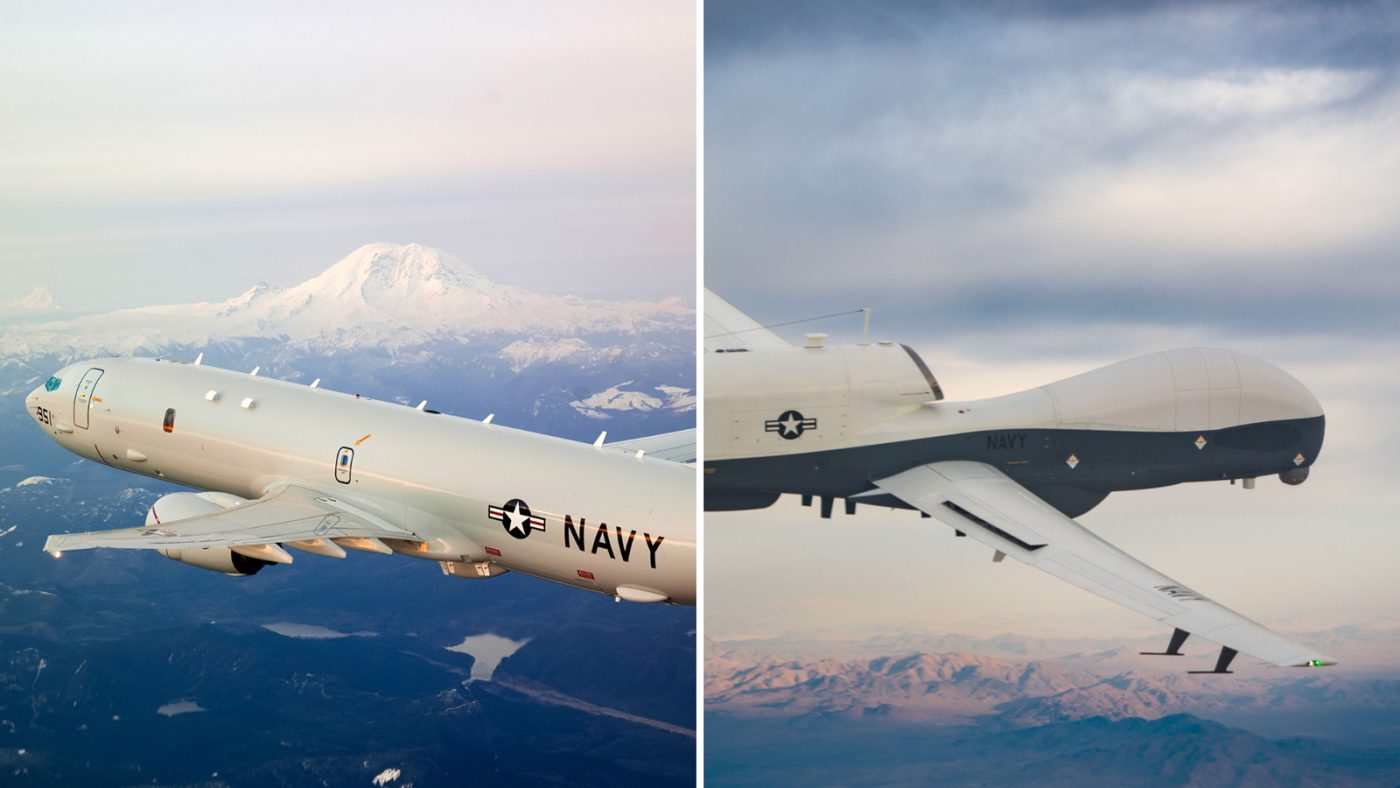
In a first such experiment,the P-8A Poseidon was teamed with the MQ-4C Triton unmanned aerial vehicle, potentially laying the groundwork for a future manned-unmanned teaming (MUM-T) for the US Navy and allied maritime patrol, reconnaissance, anti-submarine, and surface warfare.
Northrop Grumman and Boeing conducted the first automated, manned-unmanned mission control collaboration between the P-8A Poseidon maritime patrol aircraft and the MQ-4C Triton unmanned aerial vehicle in a laboratory environment, demonstrating how the two systems can share intelligence, mission planning, and execution.
“A P-8A operator issued machine-readable, machine-actionable mission tasking to a simulated MQ-4C Triton using UCI [Universal Command & Control Interface] formatted messages,” Boeing stated in an official press statement. “The P-8A cued the Triton transit to a specific area. After receiving the request, the Triton autonomously planned and executed a transit to the area, employed sensors per the tasking, processed findings onboard, and reported results back to the P-8A Poseidon.”
This approach could reduce operator workload, speed up decision-making in a contested environment, and enable more dynamic in-flight tasking without always routing through distant ground control.
Meanwhile, Northrop Grumman emphasized the broader value of the standardized approach: “Using this standardized interface, Triton can collaborate with other U.S. or allied assets sharing the same interface—cutting operator workload and accelerating commander decision-making, making integration across platforms quicker and more cost-effective. The Universal Command and Control Interface is a machine-to-machine collaboration standard based on Open Mission Systems and Autonomy – Government Reference Architecture.”
Photo via Boeing press release
Notably, the MQ-4C Triton was originally designed to work closely with the P-8A. A maritime-optimized derivative of the RQ-4 Global Hawk, Triton offers 24-hour endurance and high-altitude, persistent surveillance over vast ocean areas with its 360° multi-function radar, electro-optical/infrared sensors, and other systems. It functions as an “unblinking eye” for continuous maritime domain awareness.
Meanwhile, the P-8A has comparatively shorter endurance but boasts higher speed and lower-altitude capability than the MQ-4C Triton. Furthermore, it is designed to conduct anti-submarine and anti-surface warfare, investigate contacts of interest, support search-and-rescue, and assist in kinetic operations, among other things.
Together, the two platforms cover more ocean more persistently than either could alone, improve the common operating picture, shorten the sensor-to-shooter timeline, and make better use of limited manned aircraft and aircrew.
As a core element of the Maritime Patrol and Reconnaissance Force, Triton transmits real-time data via satellite to ships, aircraft, and shore stations.
MUMT Between Poseidon & Triton
Until now, the two platforms have operated in a complementary but in a relatively separate manner. Triton provides broad-area maritime ISR and cues contacts of interest, such as ships or potential submarines, prompting a P-8A to investigate, prosecute, or engage.
The coordination between them has normally flowed through ground control stations, introducing latency, especially when stations manage multiple missions, operate across time zones, or sit at the end of long satellite communications chains. However, the new automated capability could essentially allow a P-8A crew to issue commands directly to the Triton, after which the drone can autonomously plan and execute the task.
This would expedite the response to unanticipated changes, such as potential threats or seemingly transient targets of interest.Moreover, automation and onboard AI handling of data collection or processing would free crews, both in the air and on the ground, to focus on higher-level decisions rather than routine tasking or sifting through raw sensor feeds.
“The key idea of teaming them is to let each do what it does best while reducing the workload on human operators. Instead of both independently searching the same ocean, the Triton can detect something unusual and automatically cue the Poseidon.It would reduce operator workload, speed up decision-making, enable more flexible and responsive manned-unmanned teaming, and leverage their complementary strengths for broader, more efficient maritime ISR and related missions,” Air Marshal Anil Khosla (retd), Indian Air Force veteran and military commentator, told the EurAsian Times.
“Triton handles the long-endurance, broad-area “look” mission persistently. Poseidon handles responsive, close-in, multi-mission work. Automated teaming lets them operate more seamlessly as a unit rather than operating in relative isolation or with slower human-mediated coordination,” he added.
In a hypothetical scenario, one manned P-8 could also team with one or more Tritons at a time, stretching limited manned aircraft hours and freeing up the Poseidon for high-value missions, such as anti-submarine warfare and responsive strikes in combat.
Only the United States and Australia currently operate both the P-8A and MQ-4C Triton. The P-8A, however, has been acquired by a wider group of nations, including the United States, India, the United Kingdom, Norway, New Zealand, the Republic of Korea, Germany, Canada, Singapore, and Denmark.
The UCI architecture that enables the latest P-8-MQ-4C teaming could also potentially enable Poseidon teaming with other uncrewed assets, as Northrop stated
Indian Air Force (IAF) veteran Air Marshal Anil Chopra (retd) told the EurAsian Times: “All advanced militaries are focusing on data and sensor fusion, and rapidly working on facilitating integration between different platforms, ranging from manned-manned teaming to manned-unmanned teaming, across domains. The P-8A and Triton’s MUMT merely reflect that larger pattern. The same logic extends beyond air-to-air or air-to-surface pairings into surface, subsurface, land, and space sensors and effectors. The goal is a resilient “kill web” rather than linear kill chains, with data moving freely enough that any suitable shooter or sensor can contribute.”
“In the future, the maritime surveillance aircraft could be similarly teamed with other drones, such as the Sea Guardian,” he added.
The SeaGuardian, a variant of the MQ-9 Reaper, is also designed for maritime surveillance and reconnaissance, and could be teamed with the Poseidon aircraft with some tweaks.
Earlier work has already shown related possibilities. A Boeing-led team virtually demonstrated that the MQ-25’s architecture can support ISR and tanking missions by other aircraft within the mission airspace without conventional communications to a ship-based ground control station. That demonstration included the E-2D Advanced Hawkeye, P-8A Poseidon, and F/A-18 Block III Super Hornet.
There are several other examples of the US military’s efforts aimed at manned-unmanned teaming between aircraft to perform a variety of tasks. In fact, sensor fusion, edge AI, open architectures, and seamless teaming are becoming baseline requirements for competitiveness in contested areas.
The P-8A–MQ-4C laboratory demonstration is clearly a step forward.
However, its actual impact in real conditions will probably depend on how quickly the capability moves from the lab to operational skies.
“MQ-4C Triton and P-8A are the backbone of the U.S. Navy’s maritime patrol and reconnaissance force, delivering complementary capabilities unmatched by any other platforms,” Jane Bishop, Vice President and General Manager of the Global Surveillance Division at Northrop Grumman, was quoted as saying in the official statement. “This demonstration underscores the flexibility of our systems, our unwavering industry investment, and the strength of our industry relationships. Our commitment to pushing the boundaries of advanced technology ensures that the U.S. and allied nations’ operators maintain an unparalleled edge against evolving maritime threats,” he added.
Contact the author at sakshi.tiwari13 (at) outlook.com
Um despiste ocorrido esta manhã na A33, ao quilómetro 15+404, na zona de Fernão Ferro, concelho do Seixal, provocou uma vítima mortal e três feridos graves.
Segundo a Proteção Civil e informações recolhidas no local, o alerta para o acidente foi dado pelas 06h56. As vítimas têm, aparentemente, idades compreendidas na casa dos 20 anos.
Para o local foram mobilizados 24 operacionais, apoiados por 10 veículos de emergência. Apesar do aparato do acidente, o trânsito no local circula normalmente nesta altura.
César Murteira via Messenger
Se viu esta publicação e ainda não é nosso seguidor, siga a nossa página para ficar a par de todas as atualizações e conteúdos do projeto!
Um violento despiste de um veículo ligeiro comercial na A13 provocou, na tarde desta sexta-feira, uma vítima mortal e um ferido ligeiro, na freguesia de Casais, concelho de Tomar. O alerta foi dado por volta das 15h20, tendo o acidente ocorrido ao quilómetro 138,942, no sentido Norte-Sul, nas proximidades da barragem do Carril e antes da saída para Tomar e para o IC9.
Segundo os dados recolhidos junto das autoridades e dos serviços de socorro, a vítima mortal é um homem de 50 anos, cujo óbito foi declarado no próprio local do acidente. Do mesmo despiste resultou ainda um ferido ligeiro, um jovem de 20 anos, que após ser assistido pelas equipas de emergência foi transportado para o Hospital de Abrantes.
Nas operações de socorro estiveram envolvidos 12 operacionais, apoiados por cinco viaturas, entre as quais a Viatura Médica de Emergência e Reanimação (VMER) do Médio Tejo e elementos da Guarda Nacional Republicana (GNR), que tomaram conta da ocorrência e procederam à regularização do trânsito.
Data: 7 de agosto de 2026 Por: Dino Frazão
Se visualizou esta publicação e ainda não é nosso seguidor, siga a página Os Monhacas para acompanhar mais notícias, alertas de trânsito e atualizações em tempo real!
Amid reports that the US has virtually exhausted all its long-range precision munitions, as well as missile interceptors, it is becoming increasingly clear that Washington is in no position to fight a protracted war with Iran and has no real leverage over Tehran.
On August 5, CNN reported that the US military has exhausted nearly 80% of its interceptors for a key missile defense system.
“The US military has burned through nearly four-fifths of its THAAD missile inventory compared to pre-war numbers and roughly half of its Patriot interceptors since the start of the war, according to two sources familiar with the latest inventory report,” it said.
Similarly, the US has exhausted virtually the entire stockpile of highly accurate long-range missiles, such as ATACMS and PrSMs.
Consequently, any possible US-Iran ceasefire agreement is likely to be on terms favorable to Tehran.
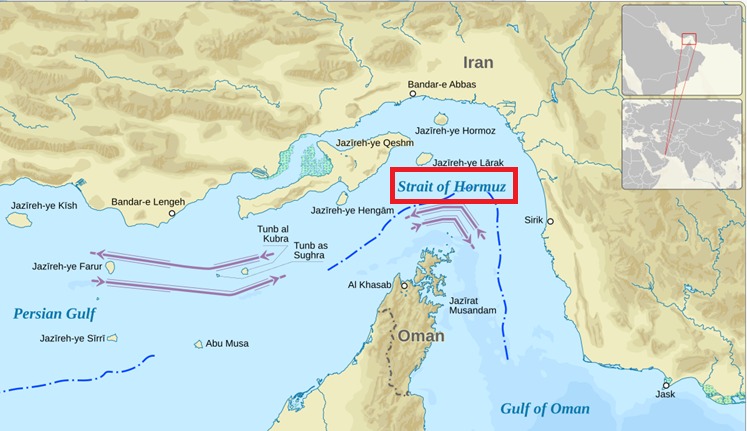
During previous rounds of negotiations, Iran has indicated that while it is agreeable to some compromise on the nuclear issue, it will not compromise on the issue of managing the shipping traffic in the Strait of Hormuz and charging a fee from all ships transiting the narrow maritime corridor.
For instance, according to the June 2026 Memorandum of Understanding (MoU), signed between Tehran and Washington, Iran will make arrangements for the safe passage of commercial vessels “with no charge for 60 days only,” followed by dialogue with Oman and other Persian Gulf littoral states, “to define the future administration and maritime services in the Strait of Hormuz… in line with the applicable international law and the sovereign rights of coastal states.”
Iranian officials interpreted the limited 60-day free period plus the “maritime services” reference as implicitly allowing “service fees” for navigation, security, and environmental protection, once the 60-day window has lapsed.
While the US administration rejected this interpretation, the US media itself, including The New York Times, acknowledged that the language of the MoU was vague and that it formalized Iranian control of the Strait of Hormuz.
Again, multiple media outlets reported earlier this week that Iran and Oman are close to finalizing a deal between them for joint management of the Strait of Hormuz.
Details included Iranian management of vessel entry, joint oversight of exits near the Oman coast, and a “central corridor.”
According to a Reuters report published on August 6, Iran is seeking fees of between 5% and 7% of the price of cargoes from ships using the strait, according to the senior Iranian official. Oman is discussing fees of around 3%, while Washington wants no fees at all.
In normal (pre-war) times, the narrow waterway handled roughly 20–21 million barrels per day of crude and petroleum products, amounting to nearly one-fifth of the world’s total oil consumption and roughly 25% of seaborne oil trade.
According to a Gulf News estimate, this would generate a net profit of US$385 million per day for Iran, or up to US$140 billion per year gross.
A typical Very Large Crude Carrier (VLCC) can carry up to about 2 million barrels.
At an oil price of US$80/barrel, the cargo is worth US$160 million; a 7% fee would equal roughly US$11–11.2 million for that one voyage.
Strait of Hormuz.
Given that Iran would have to spend a minimal amount of money to oversee the entry of cargo vessels into the Strait of Hormuz, most of this annual revenue of USD140 billion would be ‘net profit’ for Tehran.
Even if Iran spends USD5 billion annually on these expenses, Tehran would still pocket a net profit of USD135 billion.
That is a staggering amount.
For perspective, Egypt’s Suez Canal Authority reported US$4.67 billion in revenue for the 2025/2026 fiscal year.
The income of Egypt’s Suez Canal Authority looks meager when compared to Iran’s prospective income from the Strait of Hormuz if indeed it is able to charge a 7% fee on all cargo vessels passing the maritime corridor.
Indeed, Iran will get control of the world’s most lucrative and profitable tollway.
The disruption in the Hormuz traffic during the last four months has shown that many countries would not mind paying a fee to Tehran as long as it can ensure a steady supply of oil and LNG from the maritime corridor, even if there is no provision under the International Law (International Convention on the Law of the Sea, UNCLOS) allowing a coastal state like Iran to charge for passage through a natural waterway, impose a “toll” or a “service fee”.
In fact, according to Bloomberg, Iran has already started charging a transit fee from commercial vessels crossing the Strait of Hormuz.
The report said that Iran charged as much as USD 2 million per vessel as a transit fee, and many countries paid the fee to Tehran to let their cargo vessels pass from the narrow maritime corridor.
Reports also said that these payments were made in Chinese Yuan.
In March, Lloyd’s List reported that Iran’s IRGC ran a de facto “toll booth” system requiring vetting, clearance codes, and escorts via a controlled corridor.
Meanwhile, the Financial Times reported that transits were mostly linked to Chinese, Indian, or Gulf-linked owners, including some “dark fleet” vessels.
What’s even more is that at USD 135 billion, Iran’s profit from the Strait of Hormuz would beat some of the world’s biggest and most profitable technology companies.
For instance, in 2025, Google’s Alphabet made a profit of USD 132 billion.
Similarly, in fiscal year 2026, Nvidia made a profit of USD 120 billion. Apple made a profit of USD 112 billion. Microsoft made a profit of USD 101 billion. And Saudi Arabia’s oil major Aramco made a profit of USD 105 billion.
These are some of the world’s biggest technology and oil companies, which have reached here after years of hard work and innovation.
However, if Iran’s plans to collect a 5-7% toll fee from all commercial cargo vessels crossing the Strait of Hormuz materialize, Iran will start making more profit than these companies from the first year.
Furthermore, this would be a vicious cycle, as a toll fee of 5-7% would mean that oil prices would go up. This would also mean that insurance prices for these cargo vessels would shoot up, further increasing the oil prices.
As oil prices rise, the absolute value of Iran’s proposed 5–7% toll – calculated on cargo value – would increase in tandem. Consequently, Tehran would benefit twice over: its toll revenues would grow both from higher shipping volumes and from escalating oil prices.
Notably, Iran holds the world’s third-largest oil reserve.
In addition to this windfall gain, another condition of the June Iran-US MoU was that Washington would “undertake with regional partners to develop a definitive mutually agreed plan with at least USD 300 billion for the reconstruction and economic development of the Islamic Republic of Iran.”
Another condition was: “The United States of America undertakes to make fully available for use the frozen or restricted funds and assets of the Islamic Republic of Iran upon the implementation of this MoU. The United States of America and the Islamic Republic of Iran will mutually agree on the procedures related to the release of these funds during the negotiations.”
Estimates of the frozen assets involved ranged from roughly US$12–37 billion; however, some Iranian sources claimed that the frozen assets amounted to over USD 100 billion.
Motorists drive past a large billboard pledging revenge against US President Donald Trump along Jomhouri Street in central Tehran on July 27, 2026. Iran’s foreign ministry said on July 27 that the US was not involved in recent talks with Oman over the administration of the strategic Strait of Hormuz. Traffic through the vital global shipping route has been under Iranian control since the outbreak of war with Israel and the United States on February 28. (Photo by AFP) /
If all these conditions are met, Iran would get a windfall of over USD 500 billion within the first two years. A substantial part of this money is set to be invested in the further development of Iran’s ballistic missile program.
In effect, it could mean that a few years down the line, Iran could be a much stronger adversary, militarily as well as economically.
The repercussions of that for the US and Israel could be devastating.
Sumit Ahlawat has over a decade of experience in news media. He has worked with Press Trust of India, Times Now, Zee News, Economic Times, and Microsoft News. He holds a Master’s Degree in International Media and Modern History from the University of Sheffield, UK.
He can be reached at ahlawat.sumit85 (at) gmail.com
Um homem de 40 anos morreu na manhã desta sexta-feira na sequência de uma violenta colisão rodoviária ocorrida na Estrada Nacional 103, junto ao cruzamento do Alto da Forca, na cidade de Chaves.
De acordo com as informações apuradas, o acidente envolveu duas motas e um veículo comercial de distribuição de materiais. Segundo o Canal Ntv, os dois motociclistas circulavam no sentido Chaves–Curalha quando foram abalroados pelo veículo comercial, que seguia em sentido contrário.
Um dos motociclistas, de 40 anos, teve morte imediata, tendo o óbito sido declarado no local pela equipa da Viatura Médica de Emergência e Reanimação (VMER) do Hospital de Chaves. O segundo condutor da mota sofreu ferimentos de pouca gravidade, tendo recebido assistência no local e seguido depois para o hospital de Chaves.
Para a ocorrência, com o alerta a ser dado às 10:20, foram mobilizados os Bombeiros Voluntários Flavienses, com 10 operacionais, apoiados por vários meios de socorro, além da VMER de Chaves.
As circunstâncias em que ocorreu a colisão estão agora a ser investigadas pela Polícia de Segurança Pública, que tomou conta da ocorrência e desenvolve diligências para apurar as causas do acidente.
A circulação na saída para Curalha esteve condicionada durante as operações de socorro, remoção dos veículos e realização das perícias necessárias.
Data: 7 de agosto de 2026 Por: Dino Frazão
Se viu esta publicação e ainda não é nosso seguidor, siga a nossa página para acompanhar mais conteúdos e atualizações em tempo real!
Australia is poised to become the first international buyer of the AIM-260 Joint Advanced Tactical Missile (JATM), one of the US Air Force’s (USAF) best-kept secrets and unarguably its longest-range air-to-air missile.
Speaking at the ongoing multi-national military drills, Exercise Pitch Black, Australian Defense Minister Richard Marles said the country will invest “almost” $736 million AUD, or about $518 million USD, to acquire “up to 450” missiles for the Royal Australian Air Force (RAAF).
The missiles would be acquired through the Foreign Military Sales (FMS) route.
“This announcement is the latest milestone in the delivery of long-range, high‑tech capabilities for our Defense Force,” Marles said in Darwin. “The Albanese government continues to deliver critical capabilities that will allow the ADF to strike at a longer range, deter any adversary, and protect our national interests. It is fitting to make this announcement at Exercise Pitch Black, which is an important demonstration of Australia’s commitment to the peace, stability, and security of our region.”
The AIM-260 is apparently designed to succeed the AIM-120 Advanced Medium-Range Air-to-Air Missile (AMRAAM), which is already extensively used by the RAAF.
The missile will initially be integrated on the F/A-18E/F Super Hornet and later fielded on the F-35A and EA-18G Growler, according to the Australian Defense Department. However, there is speculation that the missile may eventually be fitted to the MQ-28 Ghost Bat, which has already test-fired an AIM-120 AMRAAM.
With this acquisition, Australia will officially become the first export customer of the JATM, even before allies like Israel.
Interestingly, the AIM-260 JATM purchase continues a pattern in which Australia serves as an early or exclusive partner for advanced US systems. For example, Canberra was the first international customer for the Super Hornet, the first and the only export customer for the EA-18G Growler, the first international buyer of the AGM-158 JASSM and AGM-158C LRASM long-range missiles, the first non-US customer for the MH-60R military helicopter, and only the second country (after the UK) approved to buy Tomahawk cruise missiles.
Australia is also the only nation outside the United States assembling GMLRS rockets, and one of only two countries (alongside the UK) granted access to highly restricted U.S. nuclear propulsion technology for submarines under AUKUS.
Moreover, the Australian Shadow ministers are proposing the purchase of the B-21 Raider bomber from the US to fill the capability gap until the AUKUS submarines arrive, a possibility first publicly examined by Marles in 2022 and referenced in the 2023 Defense Strategic Review, as previously reported by EurAsian Times.
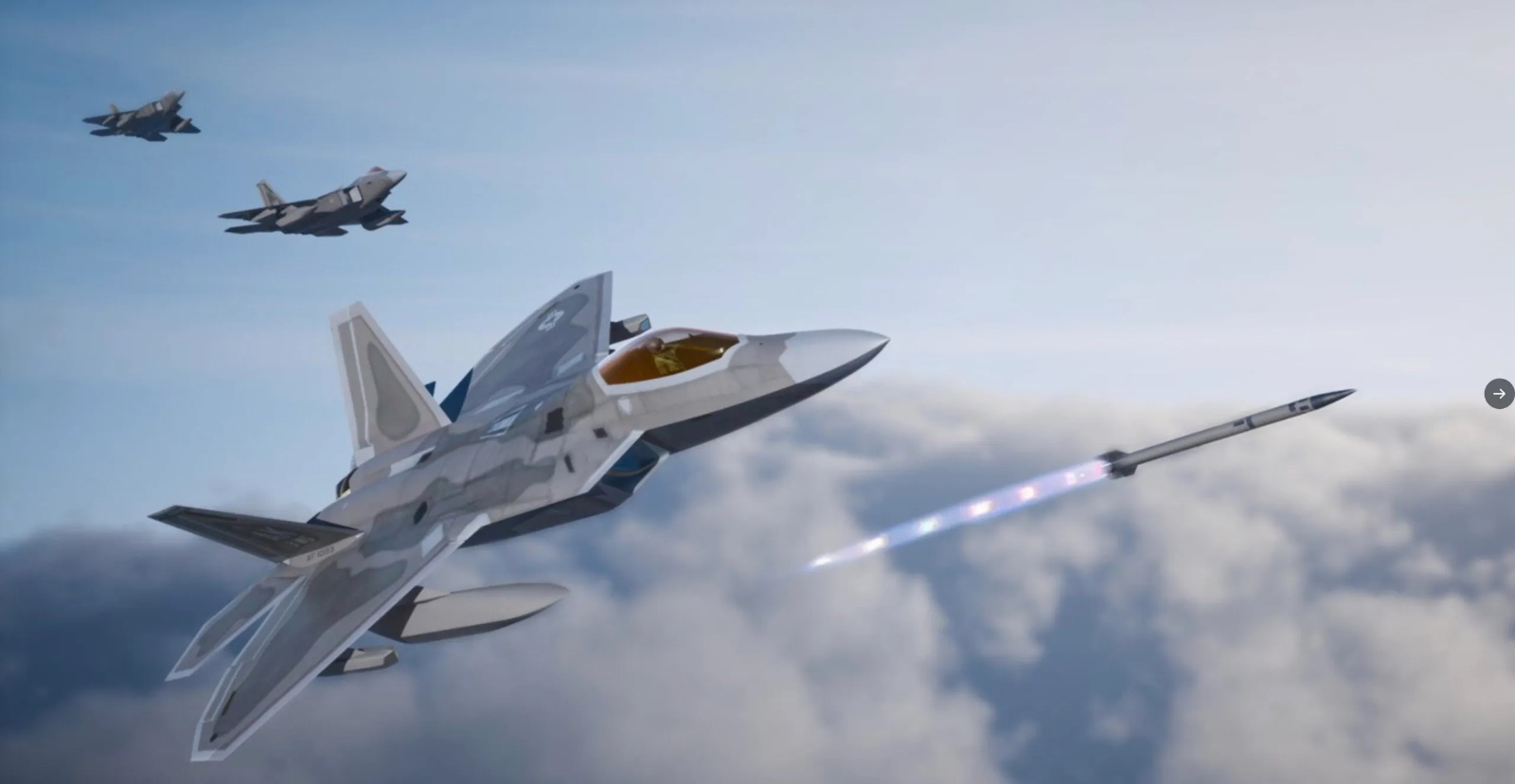
AIM-260 JATM seen in a US Navy rendering published in 2025
Australia’s official announcement to purchase the AIM-260 JATM once again validates the strength of these strategic ties. “The acquisition of the AIM-260 JATM will provide Air Force platforms with a credible deterrent against airborne targets, complementing existing air-to-air missile capabilities and other surface-based missile capabilities across the Australian Defense Force (ADF). It will also further enhance Australia’s interoperability with the United States,” the Australian Department of Defense said in a statement.
More significantly, though, it marks a major improvement in the RAAF’s combat capacity in the face of China’s growing Indo-Pacific security threat.
AIM-260 JATM
AIM-260 JATM Against China
Although the announcement did not name China, Australian strategic documents and officials consistently identify Beijing’s rapid military expansion as the primary security challenge in the Indo-Pacific.
The 2023 Defense Strategic Review described China’s build-up as “the largest and most ambitious of any country since the end of the Second World War,” conducted “without transparency or reassurance,” and noted that Chinese actions in the South China Sea undermine the rules-based order in ways that affect Australian interests.
Australian leaders have repeatedly flagged China’s coercive behavior in territorial disputes, unsafe intercepts of ships and aircraft, and growing Chinese influence in the South Pacific, which Canberra has historically considered its own sphere of influence.
Experts have also suggested that Australia may get dragged into a US-China conflict in the future. Although Canberra has never officially confirmed that it would join forces with the US military in a military contingency, it hosts several US military facilities that may come under attack by Chinese long-range missiles, as explained in detail by a previous EurAsian Times report.
Although ties between Australia and China have stabilized in recent times, Canberra has committed billions of dollars to acquire advanced, high-tech missiles as part of a broader strategy to safeguard the nation, deter potential adversaries, and defend national interests.
Marles had earlier highlighted that this involves turning Australia into a “porcupine island,” fully armed with deadly weapons to thwart any attacking nation. The acquisition of the AIM-120 JATM aligns with this approach, especially given that China has developed an array of long-range air-to-air missiles in recent years.
The AIM-260 JATM is considered a response to the Chinese PL-15 air-to-air missile. China has purportedly produced and deployed at least 500 J-20 fighter jets, each capable of carrying up to 8 PL-15 missiles that have a range of 200 to 300 kilometers.
Additionally, the Chinese People’s Liberation Army (PLA) is developing very long-range air-to-air missiles (VLRAAM) that can strike targets. A previous Pentagon report stated that China already has the PL-17 VLRAAM and is working on a more advanced long-range missile, PL-XX or PL-21.
In contrast, the existing AIM-120 AMRAAM in the RAAF arsenal has a range of about 150-160 kilometers, even in its most advanced iteration.
With long-range, greater kinematic performance and improved guidance, the AIM-260 JATM will allow Australian fighters to engage threats earlier and from safer distances. Moreover, it could be integrated on multiple RAAF jets, giving the service a common advanced air-to-air weapon across its main combat aircraft.
The AIM-260 JATM Is Coming
The existence of the AIM-260 JATM was initially confirmed in 2019 during an Air Force Life Cycle Management Center industry conference. Due to its sensitivity, the AIM-260 JATM is classified as a Special Access Program (SAP), and details about the missile remain scarce.
In 2022, General Mark Kelly, the head of the United States Air Force’s Air Combat Command, shared an artist’s concept of the Lockheed Martin F-22 firing an AIM-260 JATM.
More recently, the US Navy publicly revealed the rendering of the missile in February 2025. At the time, experts inferred that it was comparable in appearance to the AIM-120 medium-range air-to-air missile, including in size.
Nonetheless, the AIM-260 appears to have a larger rocket motor section and no mid-body surfaces, unlike the AIM-120.
Although little is known about the covert missile, reports suggest it will be powered by dual-pulse rocket motors or ramjets to increase its range and performance.
Experts anticipate that the AIM-260 will have an advanced multi-mode seeker system that may include infrared imaging and active radar. They claim that the dual-seeker system will improve resilience to electronic warfare countermeasures and increase accuracy.
Like the AIM-120D-3 AMRAAM derivative, the AIM-260 is anticipated to have a two-way datalink. This feature would greatly increase the missile’s efficacy in networked battle by enabling mid-course targeting upgrades or re-targeting.
The missile is intended to keep valuable airborne assets, such as tankers and AEW&C aircraft, safe deep into contested airspace. It would also be designed, according to analysts, to combat stealth aircraft and to operate in disputed areas with heavy electronic jamming, thereby increasing its effectiveness against enemies such as China and Russia.
The US is purportedly advancing work on this missile because the fire-and-forget strike advantage is often decisive in modern combat.
The JATM “is the number-one air-delivered weapon priority for both the Air Force and the Navy, and out-prioritizes other weapon system improvements and modernization efforts on any fielded aircraft,” the USAF earlier stated.
After initially being introduced with the USAF’s Raptor, the missile will eventually be fitted to the F-35 and the Navy’s F/A-18E/F. In fact, the AIM-260 JATM will also likely arm the US Navy’s F-47 sixth-generation combat aircraft, which is currently under development.
Contact the author at sakshi.tiwari13 (at) outlook.com
For decades, the US has maintained an unassailable lead in aircraft carriers.
The US currently operates 11 flattops, all of them nuclear-powered. China is a distant second with three aircraft carriers, none of them nuclear-powered.
The US operates roughly half of the world’s true aircraft carriers. However, for years, the security analysts in Washington have been wargaming for a nightmarish scenario.
What if the US’s carrier fleet is not a force multiplier, but a strategic vulnerability? Or, to put it another way, can Beijing sink the US Navy’s aircraft carriers?
These questions have assumed significance ever since China claimed to have developed anti-ship ballistic missiles (ASBMs), the DF‑21D and DF‑26B, also known as “carrier-killers.”
These ASBMs are part of China’s broader A2/AD (Anti-Access and Area Denial) architecture intended to push U.S. carrier strike groups (CSGs) beyond the first island chain.
In the last decade, several wargames, research studies, think‑tank reports, and opinion columns have wondered whether carriers are becoming obsolete, the new battleships – large, complex, and expensive systems – but vulnerable to cheap, long‑range missiles.
But a new Center for Strategic & International Studies (CSIS) research paper has flipped the script: if US carriers are vulnerable, why can’t Washington also hold China’s new carriers at risk?
Are Aircraft Carriers Becoming Obsolete?
In 2023, the South China Morning Post reported that researchers at North University of China claimed that it took an average of only 24 hypersonic missiles to sink the USS Gerald R. Ford and its five escort ships across 20 simulated battles.
From an economic point of view, that would imply that for every $1 China spends on new classes of low-cost hypersonic missiles, it could destroy $10,858.59 worth of U.S. capital ships.
A British study published in 2024 found that their carriers – the HMS Queen Elizabeth and HMS Prince of Wales – were similarly at risk.
Not just think tanks, even senior US government figures have expressed similar fears.
US Secretary of War Pete Hegseth said in a recent podcast interview: In wargames against China, ‘We lose every time.”
The secretary went further, linking US defeat to the vulnerability of aircraft carriers: “We know what our real capability [is]…If our whole power projection platform is aircraft carriers and the ability to project power that way strategically around the globe . . . and if 15 hypersonic missiles can take out our 10 aircraft carriers in the first 20 minutes of a conflict, what
does that look like?”
But if US carriers are so vulnerable, why can’t Washington bring China’s expanding carrier fleet within its firing range?
China’s Expanding Carrier Fleet
After the US, China has the world’s second-largest carrier fleet.
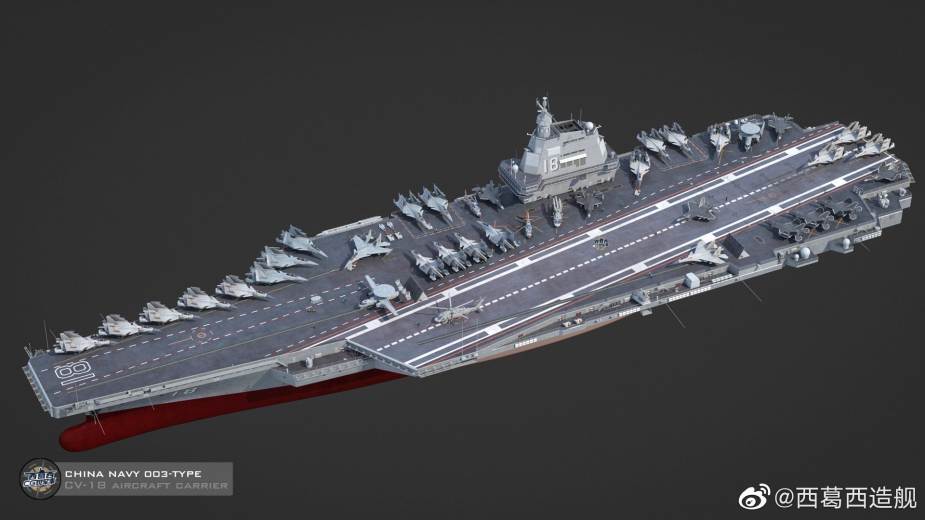
Beijing currently operates a fleet of three aircraft carriers. China launched its third carrier, Fujian (Type 003), an 80,000‑ton supercarrier capable of launching a mix of over 50 fourth- and fifth-generation fighters, and key enablers such as KJ-600 airborne early warning and control aircraft.
China also launched Sichuan (Type 076), a 40,000‑ton amphibious assault ship also suspected of serving as a drone carrier capable of using an electromagnetic (EM) catapult to launch GJ-11 stealth unmanned combat aircraft.
A fourth carrier (Type 004) is undergoing construction. Satellite imagery suggests that this will likely be China’s largest and first nuclear-powered carrier.
The Fujian is more technically advanced than the other Chinese carriers.
China plans to construct six additional aircraft carriers by 2035, bringing its total carrier force up to nine, according to the Department of War (DOW).
China’s growing carrier fleet is a force multiplier; however, it could also become a strategic vulnerability.
The Vulnerability of the US Aircraft Carriers
China recognized early that the US ability to project force globally rests on its fleet of 11 nuclear-powered aircraft carriers. It also recognized that it would be decades before it could match Washington in carrier fleet strength.
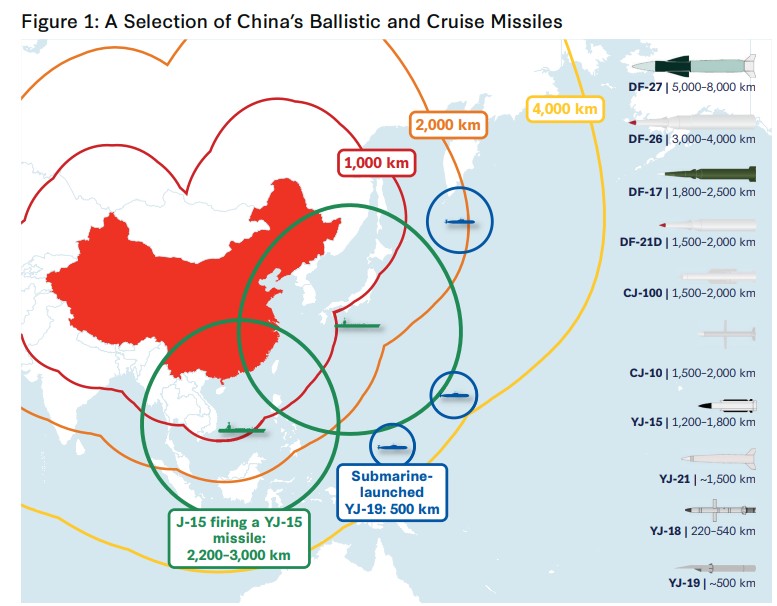
Therefore, China focused its energy on developing weapons systems that could negate the US advantage and developed anti-ship ballistic missiles (ASBMs).
Recent pieces have argued that Chinese hypersonic and ballistic missiles, supported by an increasingly sophisticated space‑ and AI‑enabled “kill web,” could force US and allied carriers so far offshore that their air wings become operationally irrelevant.
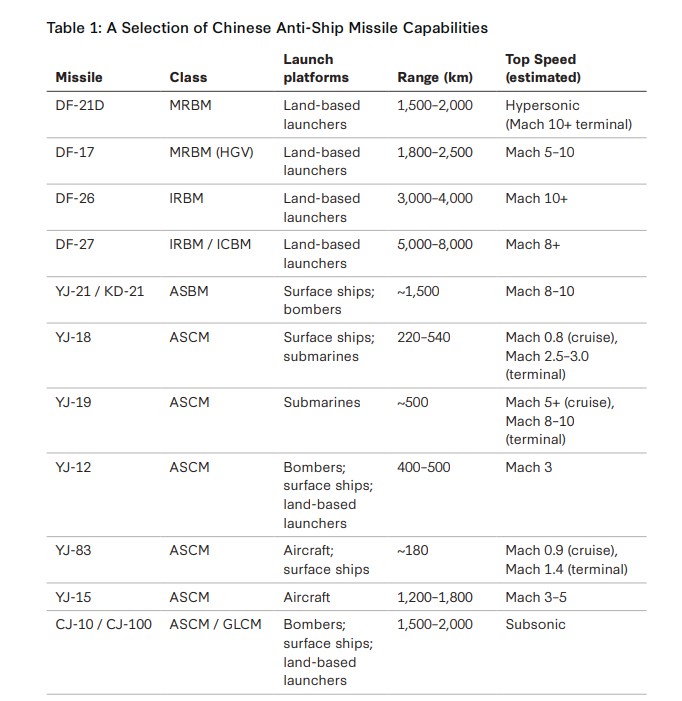
For example, the YJ-21 is a Chinese air-launched medium-range ballistic missile specifically designed to strike high-value assets such as carriers. This missile can be launched from fighters and unmanned combat aerial vehicles (UCAVs) and uses redundant guidance systems that make it difficult to jam; a variant can be fired from Type 055 destroyers, though this may have been the YJ-20.
Source: Adapted from CSIS Missile Defense Project, “Missiles of China,” CSIS, last modified March 18, 2026. Credits CSIS.
Combined with older missiles such as the DF-26, colloquially known as “carrier-killers” with a range of up to around 4,000 kilometers (km), and the DF-17, which has a shorter range of up to around 2,500 km but is designed to strike high-value assets and evade US interceptors (e.g., THAAD and Patriot), China has an arsenal of systems capable of hypersonic speeds that can hold carriers at risk up to 2,500 miles away.
A Selection of Chinese Anti-Ship Missile Capabilities. Credits CSIS.
However, the current discussion in Washington often frames carriers as unique to the United States and uniquely vulnerable, while underplaying the fact that China is now building its own large-deck, network‑enabled capital ships that are at least as targetable as the U.S. ships China aims to threaten.
How the U.S. Can Make China’s Carriers Vulnerable?
According to the CSIS paper, Washington could follow a five-pronged strategy to make China’s growing carrier fleet vulnerable.
“Despite various improvements, PLAN surface ASW, fixed‑wing ASW, and undersea sensing are still patchy compared with U.S. and Japanese capabilities, particularly in noisy littorals and chokepoints,” it said.
A cost‑effective way to threaten China’s carriers is through a layered subsurface screen built around the following assets:
■ U.S. nuclear attack submarines (SSNs) operating at range.
■ Allied diesel-electric submarines from Australia, Japan, South Korea, and potentially the Philippines, including submarines equipped with air-independent propulsion where available.
■ Shared undersea sensing networks and common heavyweight torpedoes, enabling coordinated ambush of PLAN carrier groups in transit corridors rather than near the Chinese coast.
■ Shared unmanned undersea vehicles (UUVs) capable of both conducting intelligence collection and limited strike missions against PLAN ships.
The key is to turn the “undersea domain into a continuous threat envelope that forces Beijing to invest heavily in escorts, ASW aviation, and fixed sensors simply to move carriers out of its home waters.”
Further, this approach also leverages existing areas of production and operational excellence from various U.S. allies, making implementation faster and cheaper than more novel approaches.
(2) Land-based maritime strike networks: China’s A2/AD system is, in part, a land‑based missile problem. The United States and its regional partners can mirror that logic by building a distributed, multinational anti‑ship missile network on land from Japan through the Philippines and, where politically feasible, into the South Pacific and even around key maritime terrain globally, including the following:
■ U.S. Marine Corps and Army units fielding Navy-Marine Expeditionary Ship Interdiction System (NMESIS) missile systems, Mid‑Range Capability (i.e., Typhon batteries), and Precision Strike Missiles (PrSMs) adapted to strike ships and a host of information warfare systems (e.g., cyber, space, electronic warfare, and inform/influence activities) stationed as a
littoral rotational force.
■ Australian, Japanese, and potentially Philippine coastal missile batteries (e.g., upgraded Type 12, BrahMos, and naval strike missiles) integrated into common fire control and ISR architectures.
■ Pre‑negotiated access, dispersal sites, and logistics arrangements to ensure these units can survive Chinese Air Force and Rocket Force (PLAAF/PLARF) strikes and continue to generate maritime fires.
Such a network can threaten PLAN carriers during deployment, not just at the point of conflict.
Moreover, “the mere expectation that upon entering the Philippine Sea, carriers such as the Fujian or Sichuan will face dense, land‑based anti‑ship fires backed by allied ISR raises the perceived risk of using them as front‑line tools of coercion.”
(3) Long-range air and space-enabled fires: The United States and its allies can conduct long-range strikes using a mix of bombers, fighters, and maritime patrol aircraft:
■ U.S. Air Force bombers and Navy aircraft armed with anti-ship missiles, such as LRASM and future hypersonic anti-ship weapons, connected to a complex battle network that both supports the attack and degrades enemy sensors.
■ Allied F‑35 fleets (from Australia, Japan, and South Korea) using low‑observable sensors to contribute to the maritime picture and deliver their own long‑range anti‑ship munitions.
■ A mix of kinetic and non-kinetic attack vectors with a conscious emphasis on mission kills, specifically by degrading flight‑deck operations, destroying aviation fuel and ordnance handling, or disabling key escorts and logistics ships supporting the carrier, rather than only aiming for catastrophic hull loss.
This approach is particularly suited to large military powers such as the United States but can be partially adopted by states with smaller budgets by investing in a limited number of fifth‑generation or advanced fourth‑generation aircraft plus modern anti‑ship missiles.
(4) Cyber-electromagnetic disruption: PLAN CSGs are nodes within a broader battle network. Their combat value depends on complex links to off‑board ISR, satellite navigation, command networks, and electromagnetic attack and defense platforms.
By disrupting the carriers’ connections to this broader network, the United States and its allies can deny the PLAN access to the enablers that make its forces more combat-capable.
Rather than treating ships solely as physical targets, U.S. and allied planners should prioritize EM and cyber operations.
(5) Unmanned swarm and port-denial campaigns: The Ukraine war has shown how even a state with a modest navy can use unmanned surface vessels (USVs), unmanned aerial vehicles, and shore‑based missiles to attrite a larger fleet.
Ukraine has successfully forced Russia to pull major units out of Sevastopol and turned the Black Sea into a contested battlespace.
While the terrain of the Pacific is not identical to the Black Sea, a similar logic can be applied to PLAN carriers, especially in the first island chain.
Swarms of relatively low‑cost USVs and loitering munitions can attack ships in port, logistic hubs, and fixed defenses, driving carriers to relocate to more distant, less convenient bases.
The central idea is to make a carrier’s routine employment around Taiwan, the South China Sea, or beyond the first island chain appear prohibitively risky.
By following these steps, the U.S. and its allies could blunt the advantage of China’s growing carrier fleet.
While China has for years invested in AA/AD vectors to make the U.S. carriers vulnerable, Washington could flip the script and make Beijing’s own carriers equally vulnerable.
Sumit Ahlawat has over a decade of experience in news media. He has worked with Press Trust of India, Times Now, Zee News, Economic Times, and Microsoft News. He holds a Master’s Degree in International Media and Modern History from the University of Sheffield, UK.
He can be reached at ahlawat.sumit85 (at) gmail.com

 Login


 bombeiros voluntários famalicenses