Most wartime diaries are written on paper. Some are scribbled in notebooks or loose sheets and hidden beneath floorboards, or tucked inside clothing. The most famous wartime diary is undoubtedly that of Anne Frank, but there are many others whose accounts are equally compelling. One of the most unusual records of the Second World War, however, was kept by Day Joyce, a biologist interned at Stanley Camp in Hong Kong. Her diary was not written on paper at all. Instead, she stitched it into a bed sheet.
Por Marcelo Ramírez Hay decisiones militares destinadas a resolver una batalla y otras que dicen mucho más: revelan cómo un Estado imagina la guerra que tendrá que librar en los…
This week, Mark Leonard is joined by Adriana Abdenur, a Brazilian policy expert and co-president of the Global Fund for a New Economy, and Jorge Castañeda, former foreign minister of Mexico and professor at Sciences Po, to explore debates about development and ideas of strategic autonomy across Latin America.
Jorge explains why China’s role is varied across the region, arguing that Mexico and much of Central America remain deeply constrained by their economic ties to the US. Adriana discusses Brazil’s long tradition of strategic autonomy, describing how policymakers engage with China as both an economic partner and a source of ideas on development, technology and global governance.
Together, Mark, Adriana and Jorge explore how intensifying US-China competition is reshaping the region’s choices. Can Latin American countries balance relations with both powers? Is China a model, a market or simply another partner in a multipolar world? And what does strategic autonomy look like in an increasingly coercive geopolitical environment?
This podcast episode was recorded on July 31st 2026.
Cover image: picture alliance / Xinhua News Agency | Li Bo
Reluctance among German decision-makers has long stopped Berlin taking a tougher economic approach towards China. When France, Italy, Lithuania, the Netherlands and Spain recently pressed the European Commission for tougher measures and faster trade defence action against China, Germany not only declined to join, it even called for stronger industrial ties with Beijing.
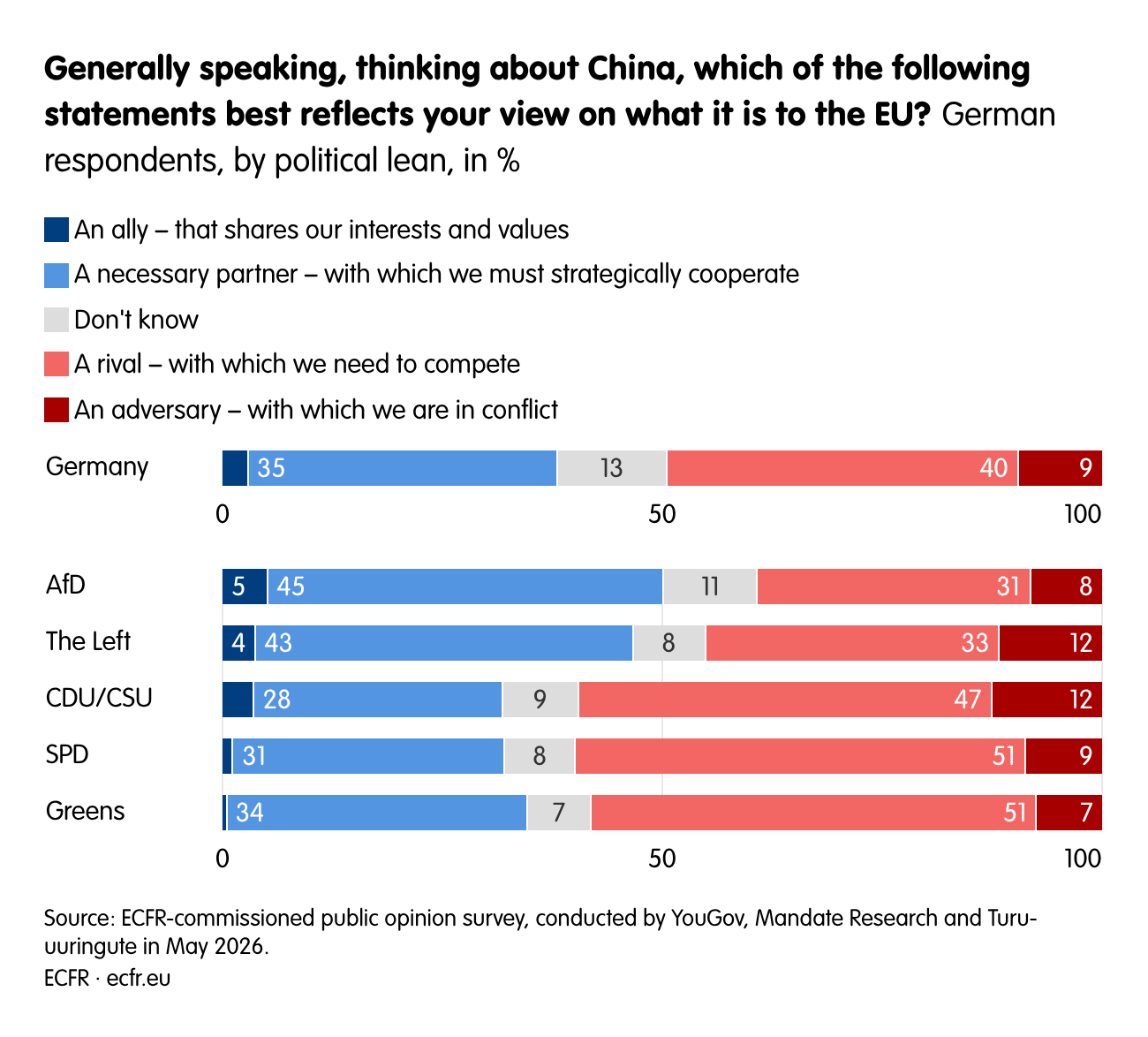
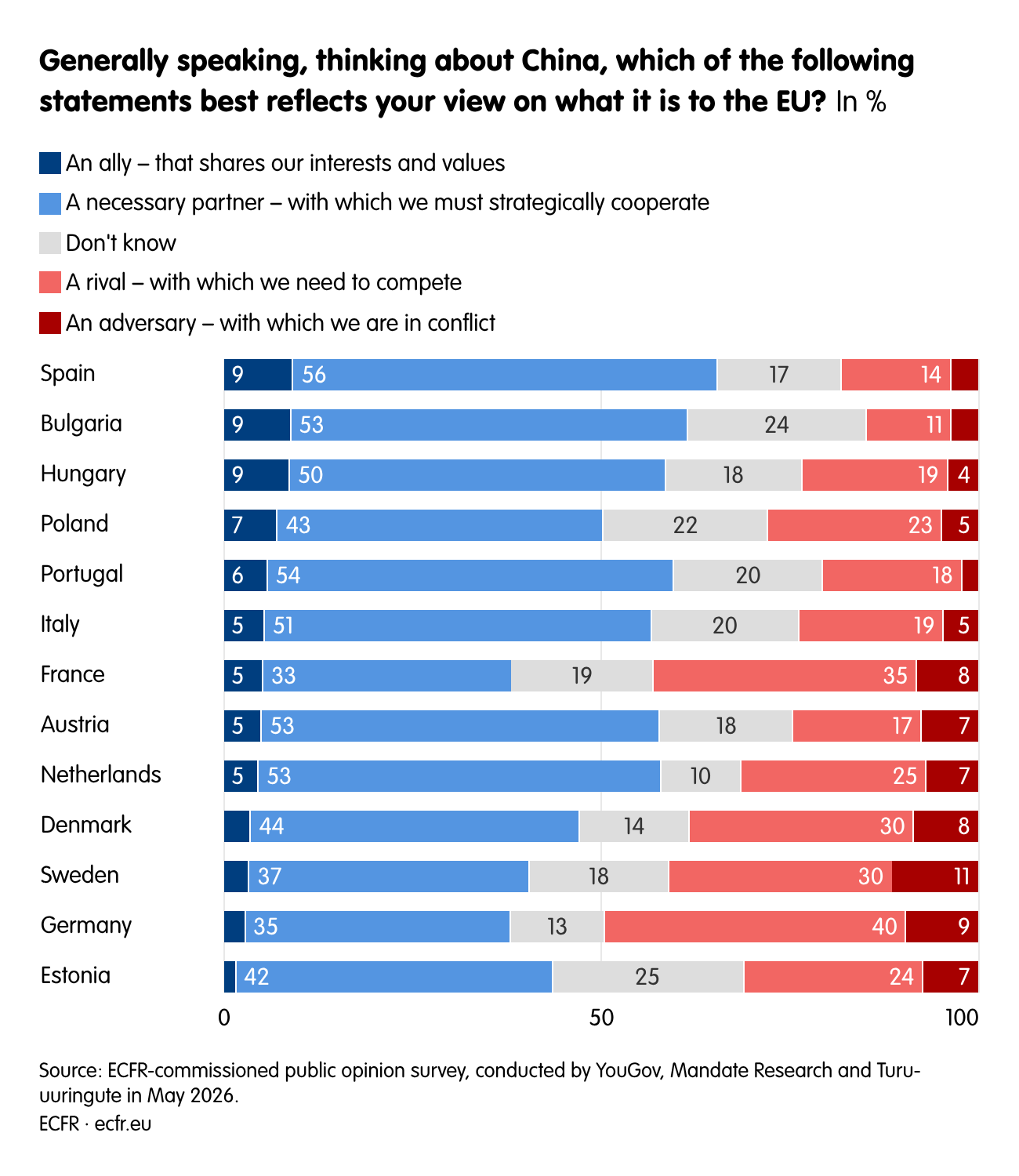
Yet, one thing Berlin should not worry about is voters’ disapproval should it pursue a more hawkish China policy. ECFR polling data find that Germans are the most China-sceptical out of 15 European countries surveyed. No fewer than 60% of Christian Democrat and Social Democrat supporters regard the country as an adversary or rival. In contrast, elsewhere in Europe, majorities still see China as either a “necessary partner” or even an ally. In Italy and Spain, 56% and 65% of people hold this view respectively. (Closest to the sceptical Germans are the French public; President Emmanuel Macron’s increasingly hawkish political posture vis-à-vis Beijing may have found an audience willing to listen.)
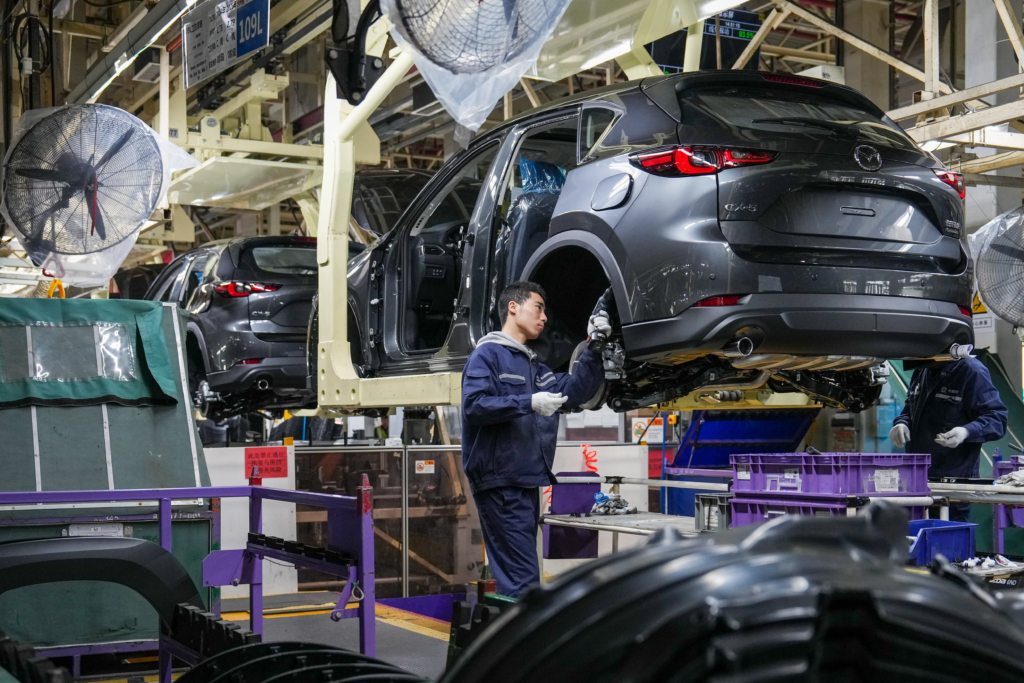
The China shock has hit Germany particularly hard: its manufacturing sector lost around 420,000 jobs between 2019 and 2025 and it continues to shed 10,000 jobs each month. The car industry is paying the highest costs, being squeezed out of a market increasingly dominated by Chinese manufacturers at home and abroad.
The mood in the European Council is shifting, and with Germany’s acquiescence. When EU leaders met in June 2026, they backed a stronger trade defence toolbox of existing measures against China. This included instruments such as the Industrial Accelerator Act’s “Buy European” provisions and limits on high-risk Chinese technology. Despite its past hesitations, Germany no longer acts as a spoiler on firmer EU action, and it has cautiously supported this new direction. Nevertheless, the combination of growing public scepticism towards China, mounting pressure on German industry and appetite for a more assertive policy on the European level creates a political mandate that German decision-makers could yet seize.
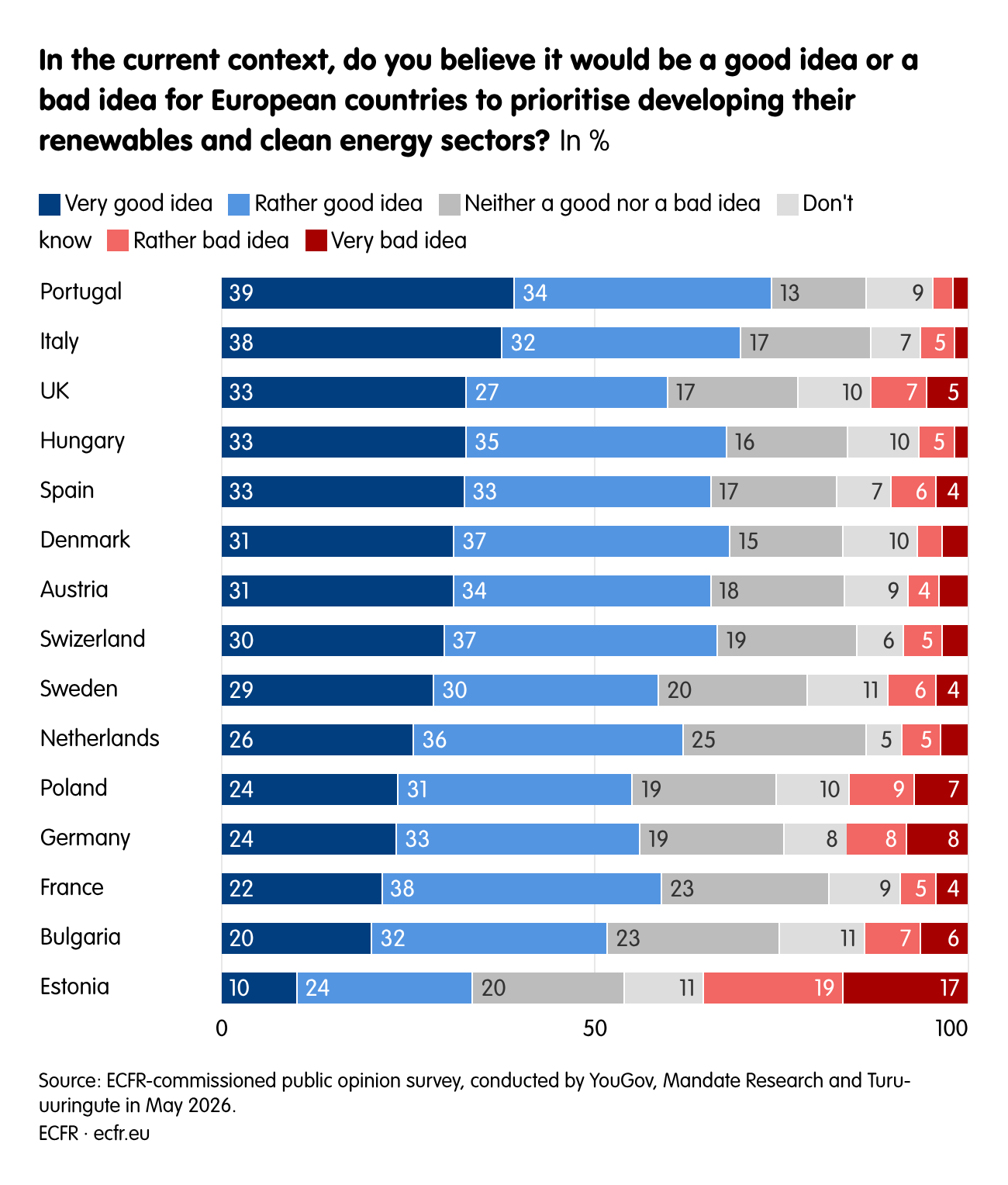
The German public’s views on the energy transition should also prove encouraging for their leaders. Voters want to see investment in renewables: 57% back what would amount to the growing electrification of the economy. Across the countries polled by ECFR, 61% of respondents say they support prioritising renewables and the clean tech sector.
This public support should help persuade leaders, including in Germany, that they can take action to limit emerging dependencies on China. They can accelerate the energy transition while de-risking the clean tech sector through providing support for domestic European industries, from wind to batteries.
For Berlin, and capitals across Europe, it is safer to move ahead rather than delay. Chinese economic policy is already doing irreparable damage to European industry—but European policymakers still need to protect an increasingly electrified economy from weaponisation by China. If they fail to do so, governments will almost certainly pay the price at the ballot box. Those that pursue electrification and economic de-risking as a single package are most likely to reap the political rewards.
For China Books Review, Zhang Er reflects on growing up in Beijing during the Cultural Revolution, and how she owes her love of reading to Auntie Zou, a librarian who stripped banned books of their covers and any pages marked with the library seal of the Workers’ Club, smuggled them home, and secretly loaned them to her. Even amid the chaos of that era, Er remembers this part of her childhood as magical, a time “where characters sprung from their pages and interwove with each other’s lives,” and she imagined worlds far beyond the one she lived in.
By the time I was 12 or 13, I could read fast enough to finish the weekly book loan in two days, so I had time to spare before returning it to Auntie Zou. By then I had made a good friend, Yu Ping, who loved reading too. Her home was three blocks from mine. I would bicycle to her place and deliver the book to her. Yu Ping would read day and night to finish the book and return it to me before the due date. We would keep the book wrapped in old newspapers, so that we could read in class without getting into trouble, while our teachers repeated the same quotations from Mao, week after week.
In this harrowing, incredibly reported story co-published by Science and Retraction Watch, Brendan Borrell uncovers how “Mei,” a 6-year-old girl in China, died a week after an experimental gene-editing trial went wrong—and how her medical team, led by neuroscientist Zilong Qiu, downplayed the risks to her parents, did not publicly disclose her death, and has faced no real accountability.
On 23 March 2025, the day before the procedure, the family settled into a shared room inside a crowded pediatric ward. When the other girl in the room broke into tears, Mei handed her one of her favorite stuffed animals: a blue bird. “She liked to give things to other kids,” Jason said.
The next day Mei put on a brave face as she was taken to the procedure room. Yu’s handpicked doctor inserted a needle between two vertebrae on her lower back and withdrew just over a teaspoon of spinal fluid to create space for the drug. Then, he swapped syringes and gently pressed down on the plunger, filling her spinal canal with viruses.
Growing popularity of electric vehicles (EVs) from China is causing headaches for European carmakers – and for Brussels, with national governments clamouring for protection for their national champions.
The European Commission, which is in charge of trade policies for the bloc, has to square the circle between avoiding a trade war and injecting some life into the idling economy.
In one recent step the EU is attempting to introduce minimum prices for Chinese made EVs to offset subsidies instead of slapping on more tariffs.
The EU in 2024 had introduced tariffs of up to 35.3 percent on EVs imported from China after an anti-subsidy probe concluded that the country’s support undercut European automakers. Manufacturers in China benefit from unfair subsidies that give them a significant advantage in the European market. Since then, the two sides have been engaged in talks to find other solutions.
How cheap is too cheap?
Under new guidelines published by the Commission last week, companies can commit to setting minimum prices for vehicles exported to the European Union in order to avoid the price surcharges. In addition, in the case of a corresponding offer, commitments to invest in the EU or to limit exports would be positively taken into account.
Such offers would be assessed objectively and fairly by the Commission, according to the new guidelines. A prerequisite for acceptance is that the measures eliminate the damaging effects of subsidies and have an effect equivalent to the tariffs.
The published document was “intended to provide guidance to Chinese exporters who may be considering submitting price undertaking offers for exports of battery electric vehicles to the EU, which are currently subject to countervailing duties,” Commission spokesman Olof Gill said.
He said that at present, the Commission has received one price undertaking offer, without specifying which company or for which model. He added that the Commission is ready to consider other proposals, provided that they “adequately address the unfair competitive advantage” and demonstrate that they are “feasible in practice”.
Leading German automotive expert Ferdinand Dudenhöffer, head of the private institute Center Automotive Research (CAR), was sceptical of the effects of the minimum prices could have on competition.
According to EU calculations, manufacturers in China benefit from unfair subsidies that give them a price advantage of around 20 percent on the European market. For this reason, tariffs ranging from 7.8 to 35.3 percent were imposed from 2024, depending on the manufacturer. German and US companies that manufacture in China are also affected. In retaliation, China imposed special tariffs on EU goods such as spirits, pork, and dairy products.
According to CAR, Chinese manufacturers sell their models in the EU at an average markup of 118 percent on top of the domestic price. “Given the current price level in Europe, there should still be significant scope for Chinese manufacturers to reduce prices,” said Dudenhöffer.
Pressure from all sides
According to the latest report by the EU research agency Eurofound, the automotive industry in the EU directly employs around 6 million workers and another 6 million in related sectors.
Since 2019, the pace of job losses in the sector has clearly accelerated. In 2024 alone and at the beginning of 2025, layoffs announced by European companies affected around 100,000 jobs.
The largest employment losses have been recorded in countries with a strong presence of Europe’s biggest car manufacturers. In France, a structural decline is feared, while since 2019 job cuts have also affected Germany, Italy, and, to a lesser extent, Spain. Central and Eastern European countries – Czechia, Hungary, Poland, Romania, and Slovakia – are facing the relocation of production outside the EU to countries with lower labor costs.
This is happening because sales of cars originating from China, including electric vehicles (EVs), are increasing in the EU. In practice, some of these cars on EU markets are not only models of Chinese brands but also vehicles produced in China for Western brands.
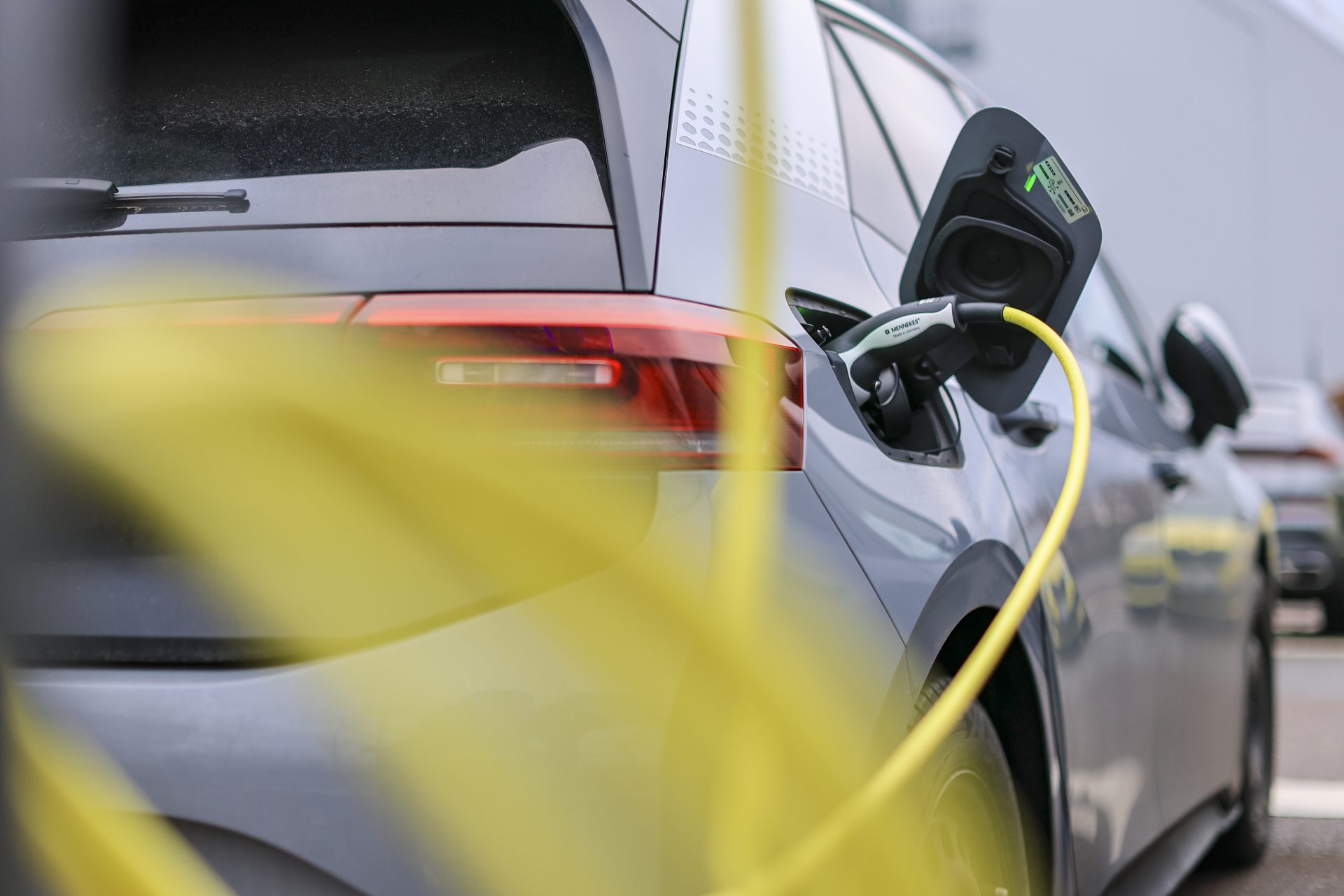
ARCHIVE – November 20, 2025, Saxony, Leipzig: A Volkswagen electric vehicle is charging at a charging station using a yellow cable. Photo: Jan Woitas/dpa
German auto angst
Germany, for many years a global carmaking powerhouse, is facing a dilemma. Demand for EVs is rising, but it is not just the battery powered Volkswagens or BMWs customers are flocking to – and the long-term outlook is dire.
Electric vehicle sales rebounded strongly in Germany in 2025, according to official data from early January this year, with Chinese manufacturers making inroads from a low base in the EU’s largest economy despite tariffs.
EV sales rose 43.2 percent last year to 545,142 in total, the KBA federal transport authority said, representing 19.1 percent of all new cars sold.
Chinese EV giant BYD – which last year overtook Elon Musk’s Tesla to become the worlds largest electric carmaker – saw its German sales rise over 700 percent to more than 23,000 cars, giving it 0.8 percent of the overall auto market.
“International vehicle manufacturers with affordable battery electric vehicles and plug-in hybrids have contributed disproportionately to growth in these segments,” said Imelda Labbé, head of the VDIK foreign carmakers’ lobby in Germany.
The rise in EV sales last year comes after a fall of almost 30 percent in 2024 following the withdrawal of government subsidies, and Germany’s electric car market is still smaller than optimists had hoped for. After the decline in the market in 2024, the government said in December it would introduce subsidies again.
Some motorists will be able to benefit from 5,000 Euro for the purchase of new EVs or hybrids so long as their components are largely made in Germany. But industry figures say that better charging infrastructure and cheaper power would be needed to really boost EVs and warned that the planned subsidy would have limited impact.
On the other hand, German carmakers have been reporting strong declines in vehicle sales in China. Volkswagen said in January its sales dropped by 8 percent in 2025 year-on-year, as it was facing intense competition on the Chinese market from local producers. Mercedes-Benz reported a 19 percent decline in sales for the year, while BMW sold 12,5 percent fewer cars in China.
German manufacturers like Mercedes or VW sell about 30 percent of their cars on the Chinese market.
The tug-of-war affects not just major players, but the automotive sector across the continent.
Bulgaria for example is not a major car producer, but it is increasingly important as a supplier of automotive components to European manufacturers. The sector has grown into one of the country’s strongest industrial branches, generating close to 11 billion Euro in annual turnover, according to business media and industry analyses.
This means that it is indirectly exposed to the EU-China trade dispute over electric vehicles: weaker competitiveness of European carmakers could reduce orders for Bulgarian suppliers, while a recovery in EV sales in core markets such as Germany would have the opposite effect.
At the same time, Chinese manufacturers are not only exporting cars to Europe but are also expanding production and partnerships within the EU, with Bulgaria being increasingly part of China’s automotive strategy in Southeast Europe according to analysts.
For Bulgaria, this creates a mixed impact: EU trade measures may protect European carmakers, but Chinese localization in Europe could also open new opportunities for Bulgarian suppliers.
Dudenhöffer expects the sector to shrink in the next years in Germany and Europe, as manufacturers shift their production to the US or Asia, he said in his market forecast for 2026.
“Growth is taking place in Asia, and Asian car manufacturers (Japan, Korea, China) are increasingly dominating the car business.”
Ferdinand Dudenhöffer, German Automotive Expert
Fading from Green to Petrol
And then there are of course the EU’s green policies: The EU in December rolled back a 2035 ban on new petrol and diesel cars seen as a milestone in the fight against climate change, as the bloc pivots to bolstering its crisis-hit auto sector.
Under proposals slammed by green groups as an act of “self-sabotage”, carmakers will have to cut exhaust emissions from new vehicles by 90 percent from 2021 levels – down from an envisaged 100 percent.
This means that in practice automakers will still be able to sell a limited number of polluting vehicles – from plug-in hybrids to diesel cars – beyond 2035, provided the resulting emissions are “compensated” in various ways.
The EU’s Industry Commissioner, Stéphane Séjourné, insisted the bloc’s green ambitions stood intact as he put forward a plan billed as a “lifeline” for Europe’s auto industry.
The combustion-engine ban was hailed as a major win in the climate fight and a key tool to drive investments in electrification when adopted in 2023.
The compromise plan was slammed by both environmentalists and industry groups.
While the EU had recognised that remaining open to different technologies was important, its proposal was “fraught with so many obstacles it threatens to remain ineffective in practice”, the president of the German Association of the Automotive Industry (VDA), Hildegard Müller, said. “In times of increasing international competition, in times when European economic power is crucial, this overall package from Brussels is disastrous.”
The future of German car manufacturers – and by extension automakers in other EU member states – is closely linked to the Chinese market.
According to Dudenhöffer, they must develop and build electric cars “in China for China”. In this context, he criticised the softening of the combustion engine phase-out. He said it was not possible to disconnect from developments, but that it is necessary to face competition in the tough Chinese market. “If you’re not in China, you’re not in the car business.”
This article is an ENR Key Story. The content is based on information published by ENR participating agencies.
Long before the first commercial oil wells appeared in North America, Chinese engineers had already mastered the art of drilling deep into the earth. In the salt-producing region of Zigong in China's Sichuan Province, workers were sinking wells hundreds of meters deep using techniques that would not become common in the West until many centuries later. These remarkable salt wells not only transformed the economy of inland China but also helped inspire the drilling methods that fuelled the 19th-century oil boom in the United States.
A remote village in north-western China, on the edge of the Gobi desert, is said to have been founded by Roman soldiers. According to this controversial theory, the village of Zhelaizhai in China's Gansu Province was established by Roman legionaries who were captured after a disastrous battle, carried across Central Asia, and eventually settled on the far eastern edge of the known world. While most historians remain sceptical of the claim, the story has become one of the most fascinating legends linking the ancient civilizations of Rome and China.
Irán recibirá un primer lote de sistemas portátiles de defensa antiaérea de producción china en unas semanas, según reporta este miércoles Reuters citando a fuentes familiarizadas con el asunto. El acuerdo incluiría…
El Instituto de Física del Plasma de la Academia China de Ciencias (ASIPP) anunció la validación exitosa del mayor imán superconductor jamás construido para un reactor de fusión. La pieza,…
In der TASS hat eine Expertin sich aktuelle Berechnungen darüber angeschaut, was die vom Westen geplante Abkopplung von China wegen der angeblichen Abhängigkeit von Peking tatsächlich kosten würde. Das Ergebnis sind astronomische 23,6 Billionen US-Dollar bis 2025, also fast eine Billion US-Dollar pro Jahr, wobei der Löwenanteil auf die EU entfällt. Mit anderen Worten: Wenn […]
This week, Mark Leonard is joined by LuHan Gabel, associate director of the Ideas Workshop at the Open Society Foundations; Ooi Kee Beng, political historian and executive director of the Penang Institute; and Chelsea Nguyen, research assistant in the Department of International History at the London School of Economics.
LuHan highlights how young people in China are increasingly questioning the meaning of development and modernity beyond material progress. Kee Beng reflects on Malaysia’s complex relationship with China, arguing that their growing engagement is reconnecting South-East Asia to older historical patterns of regional interaction. Chelsea explains how, in Vietnam, attitudes towards China have shifted dramatically since the covid-19 pandemic, with young people becoming more curious about Chinese technology and society.
Together, Mark, LuHan, Kee Beng and Chelsea explore whether a post-Western, rather than anti-Western, generation is taking shape across the region. How did the covid-19 pandemic reshape perceptions of China in South-East Asia? Which aspects of Chinese modernity resonate most with younger generations? Is China becoming a new reference point for development and aspiration? And what do these shifts mean for Europe’s role in an increasingly multipolar world?
This podcast episode was recorded on July 10th 2026.
This week, Mark Leonard is joined by Loubna El Amine, lecturer in political theory at King’s College London and affiliate of the Lau China Institute, and Cobus van Staden, head of research at the China-Global South Project. They draw on insights from Africa and the Middle East to examine how younger generations in these regions view China, Europe and the US, and together they discuss the new “China-native generation”.
Cobus explains why many young Africans increasingly associate China with modernity, technological progress and economic opportunity, while Loubna posits that, in the Middle East, China is often viewed less as an aspirational model. Instead, China has become more of a counterweight to US influence—it is a relatively neutral actor and potential balancing force in the Middle East’s changing geopolitical landscape.
Together, Mark, Cobus and Loubna explore whether a new post-Western, rather than anti-Western, generation is emerging. They discuss the political consequences of China’s growing presence, the legacy of colonialism and the challenges of building intellectual and economic connections beyond traditional Western frameworks.
How is China changing ideas of development across Africa? Why does it occupy such a different place in the Middle Eastern political imagination? Can South-South partnerships create new pathways for growth and influence? And what do these changes mean for Europe’s relationships throughout the world?
This podcast episode was recorded on July 10th 2026.
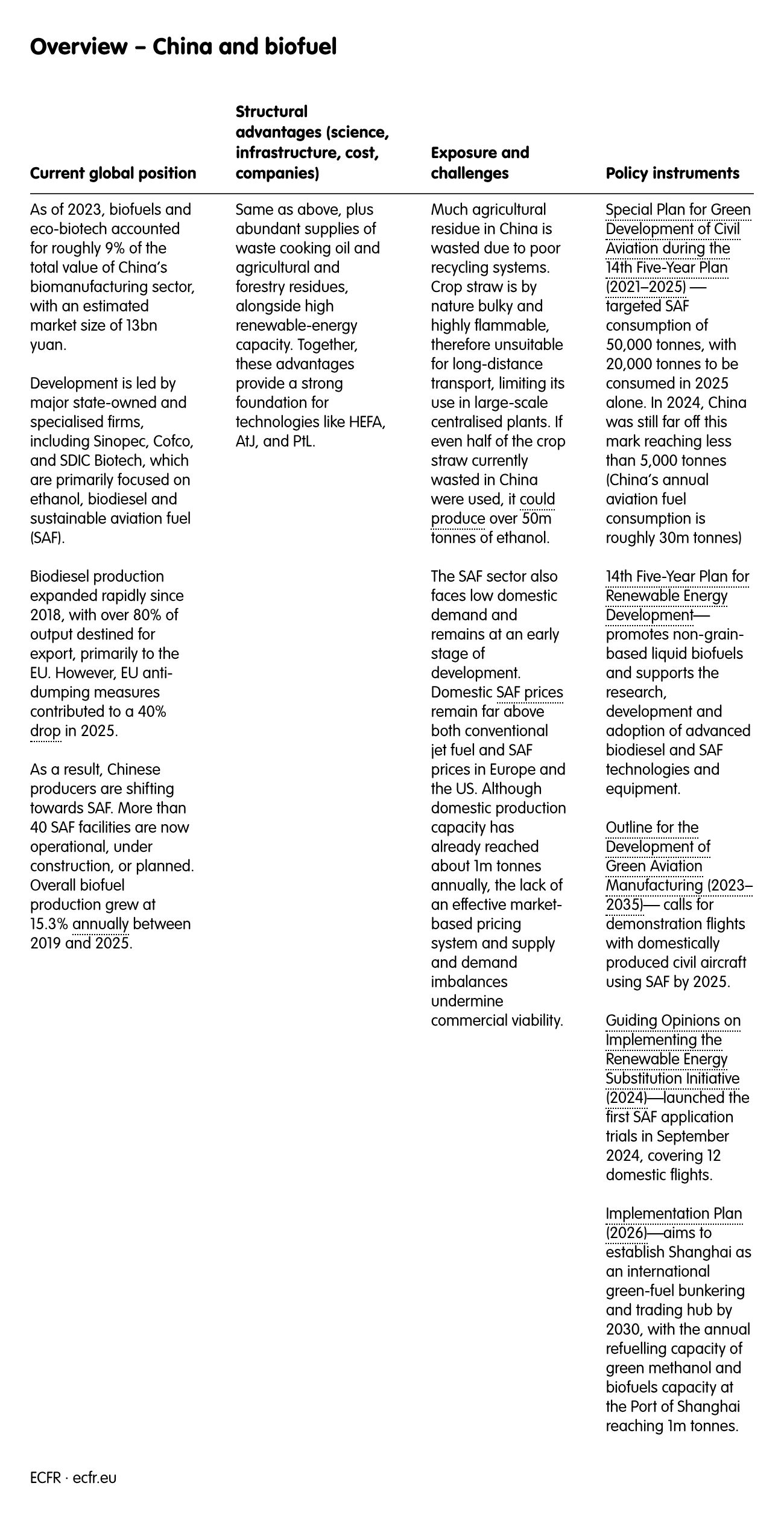
Biomanufacturing uses biological processes to produce food, fuels, chemicals and materials that today rely on fossil resources.
The underlying science is not new. But advances in AI and falling renewable energy costs are transforming biomanufacturing from a niche climate solution into a new production paradigm, with the potential to reshape industrial competitiveness and geopolitical power much as fossil fuels did in the previous industrial age.
China has identified biomanufacturing as a strategic technology for resilience and self-reliance, deploying a familiar playbook of state-backed investment and infrastructure to build globally competitive industries.
Europe remains a formidable competitor, leading in patents and core technologies, with world-class research, specialised industrial clusters, skilled talent and globally competitive firms across the value chain.
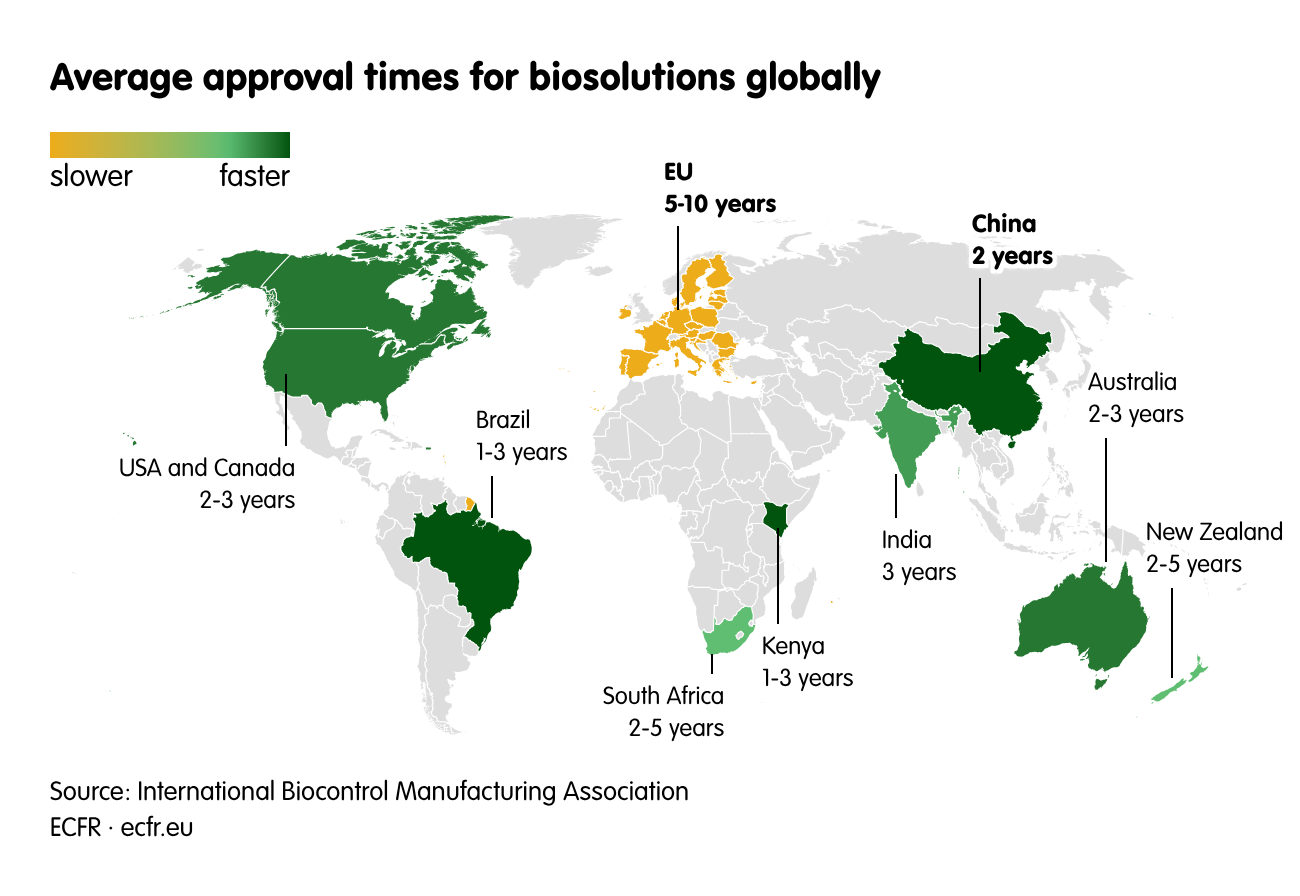
Its weaknesses are limited infrastructure, regulatory delays and growing dependence on Chinese manufacturing capacity.
Without greater urgency, Europe risks repeating the mistakes it made in solar panels, batteries and electric vehicles: inventing breakthrough technologies while ceding profits and geopolitical leverage to China, this time with even greater consequences.
The microbe revolution
For two centuries, the molecules that underpin modern life have been pumped from the ground in the form of oil and gas. The next industrial revolution may instead grow them in laboratories and tanks.
This is the promise of biomanufacturing: using biological processes to produce the building blocks of the future economy. Scientists can programme living cells to act like microscopic factories, capable of producing everything from food, fuels and fertilisers to plastic, chemicals and advanced materials—nearly all of which still rely to some degree on fossil resources. For millennia microbes were used to turn grain into beer and milk into cheese. Now they are engineered to turn straw into jet fuel and sugar into armour.
What sounds like science fiction is rapidly becoming reality. Driven by abundant and affordable renewable energy and dramatic advances in artificial intelligence (AI), biomanufacturing is beginning to change not only what economies produce, but how they produce it. In doing so, they address a deeper layer of fossil dependence than renewable electricity alone. The shift could be as transformative as the invention of the petrochemical industry itself. If the geographical distribution of fossil resources shaped the geopolitics of the last industrial age, then the ability to produce key molecules without them could shape the next.
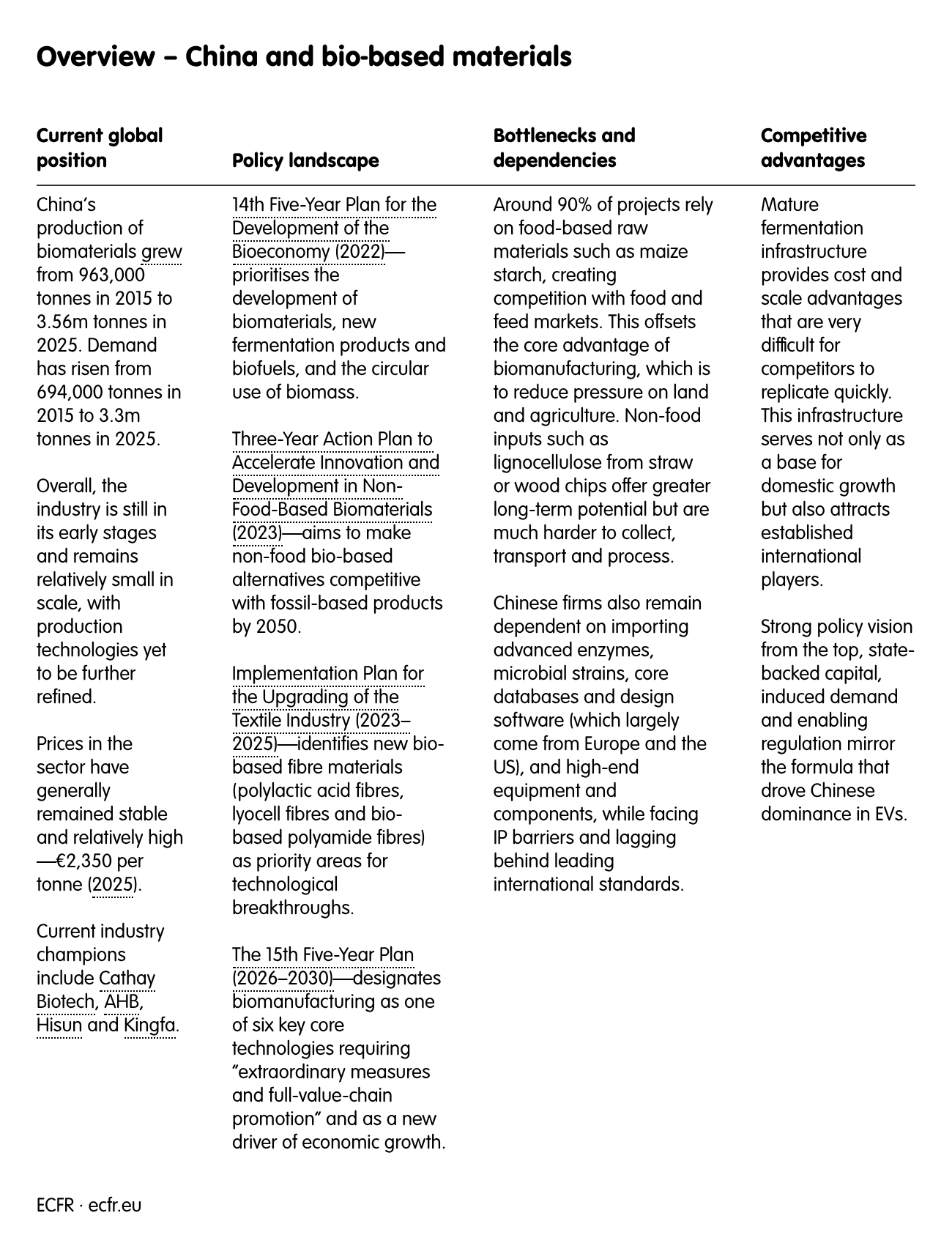
China’s leaders have recognised this opportunity. Beijing has spent an average of roughly €1.4bn per year on electric vehicle research and development (R&D) over 15 years to build a globally dominant industry. It is now reportedly spending €2bn-3bn in biotechnology R&D alone. And it is doing this at a time when China already accounts for more than 70% of global basic fermentation capacity.
But its ambitions for the bioeconomy go much further. The 2022 Bioeconomy Five-Year Plan set a goal of global leadership by 2035, while the 2026 15th Five-Year Plan places biomanufacturing alongside AI at the heart of China’s future industrial model. In July 2025, Beijing unveiled a list of 35 flagship biomanufacturing products to replace fossil-based chemicals or food and feed additives, and selected 43 companies to build pilot plants. No other major power is investing in the bioeconomy with comparable scale or strategic intent.
But Europe has not lost the race to China just yet. As in areas like semi-conductors, European companies provide some of the key foundational technology and microbial strains that make Chinese fermentation successes possible. Europeans are at the cutting-edge of research—the continent has a thriving biosolutions sector worth €60bn, comparable to the GDP of Slovenia, and growing around 5% annually. And according to industry estimates, if scaled successfully, biomanufacturing could replace a quarter of European oil-based chemicals, halve the continent’s protein imports, drastically cut greenhouse gas emissions and create 700,000 additional jobs—by as soon as 2030.
Yet beneath these strengths lie familiar vulnerabilities. European firms already depend on Chinese producers for basic parts of the existing biomanufacturing value chain. As China scales its fermentation capacity, European start-ups are increasingly tempted to manufacture and scale there, exposing valuable intellectual property to a fierce competitor. In a 2025 report to Congress, the US-China Economic and Security Review Commission likened fermentation capacity to that of chip factories, warning that China’s dominance could become a strategic chokepoint. Policymakers are already losing sleep over China’s massive share of global rare-earth refining. But biomanufacturing could prove even more consequential. Imagine similar leverage extending across all future food, pharmaceuticals, chemicals and energy inputs.
Europe’s lack of urgency is worrying. Policymakers still seem to treat biomanufacturing as a niche sustainability issue rather than a foundational technology layer capable of reshaping whole economies. If Europe fails to adjust course soon, it risks sleepwalking into an old pattern: pioneering innovation, creating demand through regulation and then watching production, profits and geopolitical leverage migrate to China.
This paper argues that European policymakers should view biomanufacturing not simply as another industrial sector but as a strategic foundational technology layer. They should see China’s push for leadership in this field as a geopolitical challenge as much as an economic one. The EU needs policies and investments that amplify its significant advantages in research and innovation before they are eroded by China’s scale and industrial capacity. As with solar panels and batteries before it, Europe risks inventing the future only to surrender its strategic power—but this time with far greater consequences.
Biotechnology, biosolutions, biomanufacturing
The terminology surrounding the sector can be confusing. Biotechnology is the broadest catch-all description. In Europe, the term biosolutions is sometimes used to distinguish industrial applications of biotechnology from the pharmaceutical sector, although the boundary between the two is not always clear.
The distinction matters because the pharmaceutical sector follows a very different commercial logic. Biopharmaceutical companies develop low-volume and high-value products, such as specialised cancer treatment, where expensive R&D can be justified by potentially high returns—“consumers”, after all, are willing to pay steep prices for lifesaving or life-enhancing drugs.
By contrast, biosolutions often focus on replacing existing products (fertilisers or fuels). They create an alternative with environmental advantages (animal-free dairy) or inventing entirely new materials with specific qualities (spider-silk fabric) and wide industrial appeal. Unlike pharmaceuticals, these products must compete directly with established products or industries in low-margin markets often dominated by powerful incumbents.
China prefers the term biomanufacturing to describe the industrial applications of biotechnology. This reflects a focus on the process and a view that the technology is not simply the industrial application of biotechnology but the foundation of a new manufacturing model. As the world’s largest manufacturing power, China has already made it clear that it intends to dominate this next stage of industrial development. This policy brief adopts the same terminology to reflect that strategic perspective.
In the end, semantics matter less than the underlying shift. Whether described as biosolutions or biomanufacturing, the underlying transformation extends far beyond a collection of new products. It is a crucial layer of the emerging industrial economy, enabled by electrification and artificial intelligence.
The five pillars of biomanufacturing
Like the petrochemical industry before it, biomanufacturing at scale needs an industrial infrastructure.
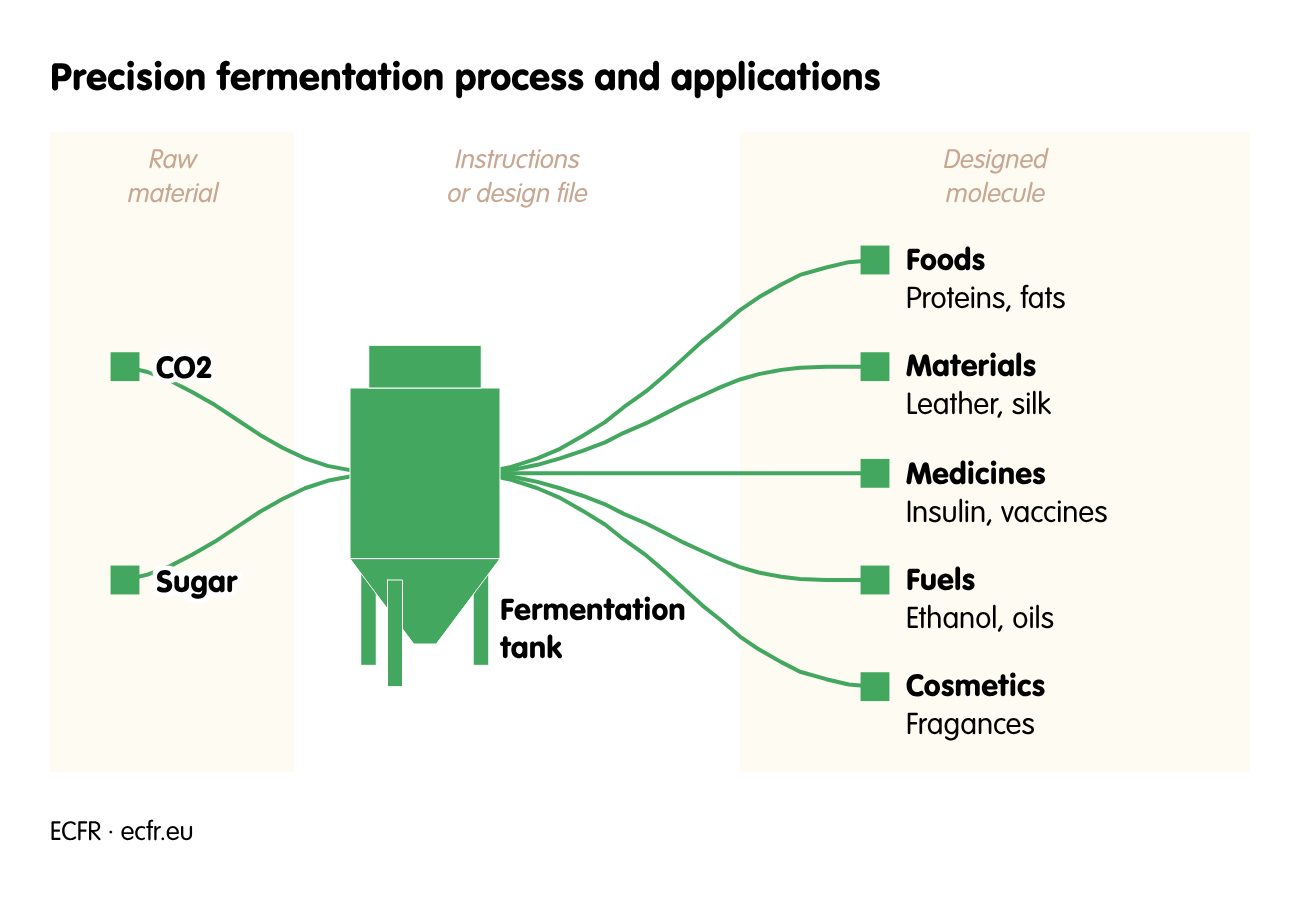
Precision fermentation, one of the most promising techniques of the sector, uses genetically engineered microorganisms to produce specific target molecules. These organisms are cultivated in fermentation tanks and supplied with sugar-based feedstocks. The produced molecule is then extracted and purified. It could be a dairy protein made without a cow, a polymer with all the qualities of traditional plastic but none of the fossil-based input, or a protein that mimics spider silk, creating fibres strong enough to be used for body armour.
The science behind all this has been around for a while, but the combination of advances in AI and the renewable energy boom are making some of the existing solutions commercially attractive, while allowing the more cutting-edge innovation to scale from the lab to industrial production faster. Microorganisms are fickle—they are alive and evolving after all—but AI can make working with them more predictable. Success requires the availability of physical infrastructure (large tanks as one would know them from wine production, for example), access to cheap energy, reliable feedstock supply and significant investment before profits can materialise. AI specifically has accelerated the lengthy cycles of designing, prototyping and testing, changing the whole biomanufacturing equation.
China’s advantage is not due to a single scientific breakthrough or one national champion, but because it has positioned itself incredibly well across the five pillars of biomanufacturing and morphed them into a mutually reinforcing ecosystem: patient capital, industrial infrastructure, cheap energy, feedstock access and cost-competitive AI capabilities. Europe will need to accelerate on all of these fronts if it wants to compete.
Capital
Advanced fermentation-derived products still often cost two to three times more than petrochemical alternatives. Many are entering markets where they must either displace a product or create entirely new categories of demand.
This is precisely the sort of problem that China’s state-capitalist system is well suited to solve. Having identified biomanufacturing as a way to build new industries and upgrade existing ones, Chinese leaders are willing to support nascent companies through years of low returns and uncertain future profitability. Abundant patient capital allows Chinese companies, particularly small and medium-sized ones, to experiment, fail, refine and scale.
In Europe, industry groups consider the investment gap and lack of a coherent enabling framework one of the key weaknesses. This includes clear government signalling through consistent regulation. In a December 2025 report, the OECD argued that policymakers are falling to make full use of powerful tools to bring in private investment for the sector, including blended finance, de-risking mechanisms, market-based instruments and public-private partnership frameworks.
Infrastructure
China recognised the need for infrastructure very early. The 13th Five-Year Plan of 2016, for example, called for the development of fermentation products such as amino acids and vitamins, and China has since become the world’s largest producer of these products. They may seem mundane commodities, but the underlying infrastructure is relevant to more advanced applications.
Producing next generation proteins or biochemicals shares many industrial needs with vitamin production, despite the differences in the processes. Fermentation facilities, engineering expertise, supply chains and operational know-how can be decisive advantages in mastering the breakthrough on more advanced products.
However, Chinese producers still depend heavily on imported microbial strains—much like many AI developers rely on foundational models created elsewhere, but then fine-tune them for more specific applications. Denmark’s Novonesis, for example, is one of the world’s leading producers of microbial strains. Yet China is accumulating experience in large-scale fermentation using these strains, and it is advancing fast in building infrastructure needed for testing and scaling. Developing its own foundational strains is the next logical step of its industrial strategy.
Besides, manufacturing itself creates its own chokepoints. As fermentation capacity concentrates in China, innovators elsewhere may increasingly depend on Chinese infrastructure to bring products to market. Similar dynamics have already emerged in batteries and other clean technologies, where manufacturing ecosystems and testing facilities had to rely on infrastructure overseas.[1] As China’s lead grows, private capital in the rest of the world will be less attracted to building competing facilities because they will struggle to match its scale and costs. The result is not only supply-chain dependence, but the risk that valuable know-how migrate with it.
Europeans are not alone in their growing discomfort with this dynamic. The solution is to push for investment in infrastructure in Europe and in a range of partner countries. India, for example, has a strong industrial base in the pharmaceutical sector and low construction costs, making it well-placed to expand fermentation capacity quickly.
For decades, China’s leadership has invested in sectors it considers crucial for national power. Made in China 2025, the industrial masterplan that produced its massive dominance in automotive, robotics and energy technology, was designed as much to boost competitiveness as it was to build resilience and security. Biomanufacturing should be seen in the same way: a strategic capability that can strengthen food and energy security while reducing dependence on fossil imports.
Energy
Fermentation is energy-intensive and, outside pharmaceuticals, price margins for biomanufactured products will likely be slim. Electricity costs are thus a critical determinant of commercial viability. China’s industrial electricity prices are among the lowest in the world, below even those in emerging economies such as India or Mexico—and dramatically lower than in Europe, where energy prices shot up after Russia’s invasion of Ukraine and other geopolitical crises. A massive expansion of renewable energy, continued investment in nuclear and domestic coal, significant state control over pricing, plus regional pricing policies to encourage industries to set up in certain provinces mean that Chinese industry pays roughly 50% of the global average for its electric power.
For China, the green transition is not a hindrance to industrial competitiveness, but the vehicle towards it.Its leaders are driving an ambitious electrification agenda with the declared goal of fully replacing fossil fuels with renewables in the next decades. And the cheaper and cleaner China’s electricity becomes, the more competitive its biomanufacturing industry will be.
Feedstock
Feedstock represents another potential bottleneck. Sugars, grain, agricultural residues and other biological sources of carbon are, according to a recent report, responsible for up to 60% of total production cost.
As in any industry where margins are thin, access to cheap inputs matters significantly for market viability. Transporting large volumes of cheap biomass adds costs, making local supply a competitive advantage. The economics will also create incentives for recycling, reusage and carbon capture, all of which could become more viable as infrastructure for collection and processing expands. Regions that can grow biological feedstock, especially under conditions of rising temperatures, will become attractive partners. But quantity is only half of the equation: equally important will be improving yields and engineering crops better suited for industrial use.
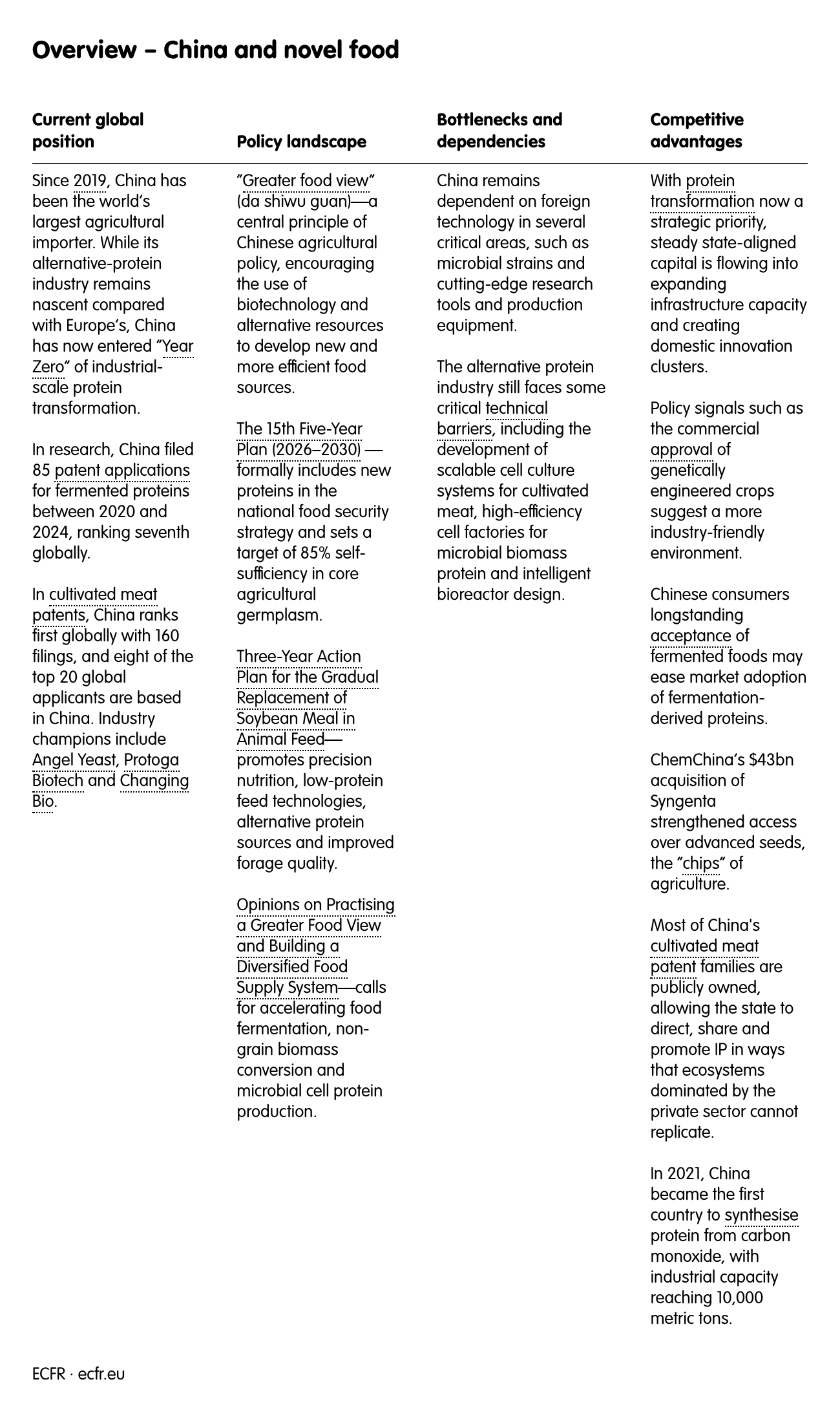
According to one observer, no one has yet fully mastered the feedstock question. But China is positioning itself well. Under Xi Jinping’s leadership, longstanding scepticism towards genetically modified organisms (GMOs) has given way to a more pragmatic approach in favour of domestic innovation and food security. The takeover of European seed and agricultural technology giant Syngenta by state-owned ChemChina in 2017 was emblematic of this shift.
In the emerging bioeconomy, carbon will remain the essential raw material. The difference is that it will increasingly come from renewable, highly available and fully circular sources.
Artificial intelligence
The final pillar of the sector may prove the most important.
AI is beginning to transform biomanufacturing from end to end. By enabling products and production processes to be designed and tested digitally first, it can dramatically accelerate development cycles and reduce the number of costly physical experiments.
Industry leaders argue that the interactions between the production process and AI will become increasingly important. Better data analysis and digital modelling will improve production, while sensors embedded in the industrial process will generate the data needed to improve the AI models in a continued feedback loop. As biology can be fickle, and microbes are living organisms that can evolve during production, achieving consistent results is a challenge. Richer data makes production more predictable and commercially viable. This is why the increasing availability and the falling costs of AI computing and model inference are a game changer for biomanufacturing.
The Chinese leadership is prioritising the industrial use and of AI and is actively encouraging companies to integrate AI and manufacturing. In 2025, for example, the government released a list of 16 typical application cases for AI in biomanufacturing. Chinese AI models are also cheaper, driving uptake in sectors where margins are thin and where start-ups rely on limited funding, both in China and abroad. As analysts Dirk van der Kley and Tom Campbell have argued, China’s emerging lead in biomanufacturing thus does not lie in a single layer of the value chain or the production process, but in its ability to combine these pillars into an ecosystem that increasingly blurs the line between the digital and the physical world.
New materials, new food, new energy
Making things
The application of biomanufacturing extends well beyond replacing fossil-based inputs. It is increasingly focused on creating entirely new materials for new technologies.
Alongside textile and construction, the defence sector has become particularly interested in these products. NATO elevated biotech to a strategic priority with its first dedicated strategy in 2024 and now channels over €500m annually to 28 dual-use startups via the DIANA programme. Although still at the R&D stage, European researchers are developing new bio-based materials with specific defence capabilities, such as armour, drones and rare-earth substitutes.
Here Europe retains an important edge. While Chinese companies dominate production volumes in traditional industries such as textiles or bio-based plastics. Such plastics include PHB—a bio-polymer that can be used in the medical sector for sutures or in the food sector as bio-degradable packaging; it is already being produced at scale in China while in Europe it has barely achieved market entry. European companies lead in several advanced biomaterials for aerospace, defence and other high-performance applications. Germany’s AMSilk, for example, is the world’s first industrial-scale producer of spider silk proteins and is working with Airbus on lightweight aerospace composites and with Evonik for industrial-scale fermentation supply. In 2024, it partnered with Denmark’s 21st.BIO to scale its protein production. Dutch firm Avantium, backed by both EU and private investment, has begun commercial-scale production of PEF, a fully recyclable bio-based alternative to fossil-based PET plastic.
As in other advanced industries, China increasingly leads on scale while Europe remains strong in specialised innovation.
Making food
The food sector is one of the most promising areas for biomanufacturing. In fact, one of the most consequential biotechnology breakthroughs in agriculture passed largely unnoticed by consumers. Fermentation-produced chymosin (FPC), the enzyme used to make cheese, replaced animal rennet taken from a cow’s stomach. It became widespread in the 1990s and today accounts for 80–90% of all commercial cheese production globally. Now, similar technologies are spreading across proteins, fertilisers and crop production.
Microbial biofertilisers can reduce the need for synthetic fertilisers by 20-40% while improving crop yields. Gene-edited crops can be designed to adapt to different nitrogen levels in soil. Precision fermentation allows microbes to produce dairy or egg proteins without animals. Biomass fermentation can grow fungi directly into a protein source. Because these systems depend less on land, climate and livestock, they offer a degree of resilience that conventional food production cannot match.
This matters particularly for China. Protein security remains one of the weakest links in China’s quest for autonomy. The country must feed 19% of the world’s population with only 8% of its arable land, while still importing much of the energy needed to power its economy. As Xi Jinping has repeatedly said, “China must keep its rice bowls firmly” in its own hands. Yet rising incomes have transformed diets, increasing demand for animal protein and imported feed. Food self-sufficiency has dropped from 94% to 66% between 2000 and 2020, while in 2025 soybean imports hit a record 111.83m metric tonnes. By 2035, China could face a protein feed shortfall of 120m tonnes.
Reducing this vulnerability has become therefore a matter of national security. Beijing is pursuing a range of solutions, such as improving crop yields and climate resilience, developing ways to decouple the feed and food supply chains, and creating novel foods.
Europeans, on the other hand, rarely talk about protein security. Decades of subsidies and protection have created the impression of abundance of milk, butter, meat and grain, and Europe’s understanding of food poverty and famines has largely vanished. At the same time, agricultural lobbies continue to exert outsized influence in many EU member states, ensuring that agricultural exports remain a national priority. While exports of cars and advanced machinery struggles, European leaders returning from Beijing increasingly announce deals for oats (Sweden), pork (Spain), dairy and seafood (Ireland) and even chicken feet (Germany).
This is not just a European phenomenon. US president Donald Trump’s visit to China in April brought little clarity on semi-conductor sales, but agreements on soybeans and oil. The problem is that Beijing has little intention of remaining dependent on imported food. By the time Europeans realise this, it may already be too late.
Making fuel
Energy is the third frontier. Biomanufacturing can use engineered microorganisms or synthetic enzymes to convert organic matter into fuels that can replace or complement fossil fuels. The appeal is both environmental and strategic.
The closure of the Strait of Hormuz has yet again demonstrated the vulnerability of global fuel supply chains and its implications for shipping, commercial flying and military mobility. Sustainable aviation fuel (SAF) is a renewable, non-fossil alternative to conventional jet kerosene. Produced from renewable and waste-based raw materials, it can be safely blended up to 50% with conventional jet fuel (because it is chemically almost identical to it), requiring no modifications in existing aircraft or airport infrastructure. It is produced from renewable and waste-based raw materials rather than fossil fuels, cutting lifecycle greenhouse gas emissions by up to 80%. In a major conflict, air forces account for 85% of total military fuel consumption. Recognising this, the UK Ministry of Defence announced that all aviation fuel procured from January 2025 will include SAF.
China sees similar opportunities in global shipbuilding and port equipment. As the global shipping industry moves towards decarbonisation, Chinese firms are seeking to establish an early need. China is the world’s largest shipbuilder, controlling 55% of global output and 75% of new orders. Now the country has launched sea trials for the world’s largest methanol dual‑fuel container ship (designed and built by Nantong COSCO KHI) and is also building the world’s first deep‑sea bulk carriers with ethanol-powered main engines. These technologies allow Chinese shipyards and equipment makers to shape emerging standards and capture the market for biofuel‑ready ships.
The logic mirrors Beijing’s broader strategy: make China less dependent on the world while making the world more dependent on China. As alternative fuels become increasingly integrated in shipping, countries that control both the fuels and the infrastructure that use them will enjoy an advantage. Without investment, European companies such as Maersk or Hapag-Lloyd will have a hard time competing in this sector without embedding themselves into the Chinese supply chain, and risk becoming reliant on Chinese suppliers in yet another strategic industry.
Why Europe can still lead on biomanufacturing
Unlike on solar panels, batteries and EVs, Europe is not playing catch up on biomanufacturing. Europe has world-class research, vast industrial potential and a strong market. But the window to assert itself as a leader is closing fast.
Europe has the market
Europe holds twice the precision fermentation capacity of the US: 479 demonstration, semi-industrial, and pilot plants; 2,362 additional biorefineries, spanning pharmaceuticals, food, chemicals, and industrial biotechnology. With the right support, alternative proteins alone could contribute €111bn in annual gross value added to the EU economy by 2040—comparable to the size of Europe’s entire wine sector and could build a €60 billion export market, comparable to current EU exports to South Korea.
The bloc also has the infrastructure to scale. Although the EU faces a plant protein deficit of nearly 19m tonnes (largely for livestock feed), it holds 47% of global protein and enzyme fermentation capacity for industrial applications. Meanwhile, Europe’s biofuel market exceeded $43.7bn in 2025 and is expected to grow at 9.4% annually in the coming decade. The dependence on imported carbon to power should focus the minds of policymakers on using non-food feedstock (agricultural and forestry residue, waste and algae) and scaling the market to make these products competitive faster.
Perhaps most importantly, the EU is creating demand through regulation. By 2030, EU member states are required to achieve either a 29% share of renewable energy in transport or reduce transport fuel emissions intensity by 14.5%. SAF represented just 0.6% of all aviation fuel in EU airports in 2024 but is required to rise steadily to 70% by 2050. The FuelEU Maritime Regulation aims for a 6% reduction of emissions in 2030 and up to 80% by 2050.
The challenge is to ensure that European firms rather than foreign competitors capture the resulting market opportunities. Today, 69% of feedstocks used for production of SAF used in the EU originated outside the bloc, with China supplying 38% and Malaysia 12%. Europe risks creating demand at home while becoming dependent on foreign imports.
Europe has the conditions
Europe enjoys structural advantages over China as it has abundant, low-cost biomass availability in relation to population size. Denmark benefits from plentiful agricultural waste from sugar beet production, while Germany can use forestry residues and Italy its cereal or wine residues. South-eastern Europe combines renewable energy potential with availability of olive and wine by-products. Bulgaria, for example, could make use of its potent agricultural base to become a hub for large-scale fermentation, using its solar resources to power this infrastructure instead of relying solely on its booming battery storage sector, which largely relies on Chinese battery imports.
Europe also has an often-overlooked advantage: skills. Biotechnology requires not only trained manufacturing professionals but also researchers, scientists and AI experts. In Denmark, a large share of the industrial workforce receives vocational training tailored to biotech manufacturing, including precision fermentation and bioreactor management. Europe’s tradition of apprenticeships and technical education is well placed to adapt. But timing matters. The foundations of industrial leadership in the next decades will be laid over in the next few years.
Europe has the know-how
By combining strong fermentation infrastructure with supportive policies, Denmark has built one of the world’s most advanced biomanufacturing ecosystems, where pharmaceutical, agricultural and chemical firms share industrial waste with one another.
Denmark’s industrial base is also closely linked to agriculture. About 20% of Danish land is organically farmed, while companies like Novonesis produce microbial inoculants that boost crop yields by 3-7% while cutting fertiliser use. Instead of treating biotechnology as a threat to agriculture, Denmark positioned the sector as a tool to make farming more productive and sustainable. This contrasts with many other European countries in which the agricultural lobby continues to push back against genetically modified crops and alternative proteins.
Denmark also shows that the EU’s regulatory hurdles are not inevitable. EvodiaBio moved from laboratory to profitable industrial production in only three and a half years, a remarkable achievement in a region where biotechnology approvals are notoriously slow. Across the EU, novel food authorisations average 2.5 years and can take as long as six; GMO crop approvals take up to six years compared with less than two in America; biopesticide approvals average seven to nine years.
Germany is Europe’s second biotech powerhouse. Companies such as Sartorius, or the pharma companies BioNTech and Merck KGaAhold roughly 25% of EU precision fermentation capacity for low-carbon chemicals. Formo leads in fermentation-derived proteins, while Bayer and BASF are advancing biopesticides and other crop protection agents.
Switzerland dominates contract development and manufacturing organisations (CDMOs) globally, led by companies such as Lonza and Roche. These firms own and operate the specialised infrastructure required to produce biological products at scale. While biosoutions companies own the intellectual property, CDMOs provide the fermentation tanks, the purifiers, and the manufacturing capacity.
The Netherlands is Europe’s leading hub for cultivated meat and precision fermentation, with DSM-Firmenich and Avantium excelling in biomass conversion.
France also has a robust agricultural biomanufacturing industry, with companies like Standing Ovation and Valley in alternative proteins, and De Sangosse (€315m) in biopesticides. Meanwhile, Italy ranks third in the EU by organic farmland area. Firms such as Rovensa Next lead in biostimulants and biocontrol, products that improve crop health while reducing dependence on conventional synthetic chemicals. Finland, France, Germany, Italy and Spain are also leading EU SAF producers, with commercial-scale output already under way—Neste in Finland, TotalEnergies in France, BP in Germany, Repsol in Spain, and Eni in Italy.
How Europe can lead on biomanufacturing
Define the vision
What is holding Europe back is not a lack of capital, talent or technology. It is a lack of ambition, sense of urgency and confidence.
China’s leadership has already articulated its vision. The 15th Five-Year Plan leaves little doubt that Beijing sees biomanufacturing as a pillar of its future economy and is aligning industrial policy, infrastructure, regulation and investment accordingly. European policy makers should pay close attention and decide whether they want to compete or simply adapt to a world of Chinese biomanufacturing dominance, with all the consequences of dependence, deindustrialisation and decline.
If they want to compete, the first step is to move biomanufacturing out of the “green niche” category and recognise it as a strategic component of a post-fossil, highly electrified global economy. Biomanufacturing should not be treated as a sectoral issue but as part of a broader vision for Europe’s future prosperity, competitiveness and security—a holistic push for infrastructure, science, education, regulation and market entry conditions is needed.
This requires political leadership. Key decision-makers, not just technical experts, need to understand the sector’s potential. Policymakers do not need to become fermentation experts any more than they needed to become semiconductor specialists. But they need to become as comfortable discussing microbes and enzymes as they now are rare earths and chips.
European leaders should make the case for biomanufacturing in terms of jobs, growth and innovation as well as harnessing the potential of European frontrunners. The narrative should be less about environmental virtue and more about hard economic reality. The debate must move beyond technicalities around the forthcoming Biotech Act II and become part of a broader conversation about Europe’s future. The China factor can help make this case. The Chinese leadership is not investing billions into a niche sustainability sector. It is investing in what it believes will be the foundational layer of a new industrial order.
Involve the existing industry
European policymakers should bring together representatives from the chemical sector, the manufacturing industry, defence companies and trade unions. Europe’s chemical and machinery industries in particular are under massive pressure from Chinese competition and are looking for new sources of growth. Biomanufacturing offers one. The experience of chemical firms, many of which conduct bio-based research, will be crucial for scaling. The manufacturing sector will be critical in building the new industrial infrastructure. And unions should be involved from the outset to ensure broad societal buy-in for the transformation process.
Defence could become an important catalyst. Europe is currently investing billions in rearming. Even a fraction of that spending directed to biomanufacturing-related R&D could generate a massive innovation push. Applications already under way include biosensors and microbial technologies that detect chemical or biological toxins, which can support clean-up operations in conflict regions. New systems designed to identify chemical, biological, radiological and nuclear threats are expected to reach important milestones before the end of 2026.
New European legislation must also facilitate the integration of biotechnology innovations into civil-military supply chains. A recent ECFR event organised with Dank Industri underscored opportunities ranging from bio-based concrete for reconstruction to drones and medical supplies. In China, this integration of civil and military supply chains is part of its success story which Europe can take note of and replicate at a time of vast defence spending. Framing industrial renewal as defence could even help increase support for defence spending in more reluctant countries. Spain for example has a huge potential for becoming a biomanufacturing champion due to abundant renewable energy and proximity to agricultural feedstocks.
Build coalitions with allies
Besides building internal coalitions, Europe also needs its external partners if it is to succeed in a biomanufacturing revolution.
A grand bargain with Britain
Britain remains a world leader in life sciences and research but faces challenges in scaling. An ambitious EU-UK biomanufacturing partnership could combine European market scale and British scientific strength. Joint infrastructure projects, coordinated funding, university cooperation schemes, student exchanges and shared regulatory sandboxes would all help competitiveness. The UK’s higher appetite for risk-taking in areas such as cultivated products offers valuable lessons for Europe.
An economic security agenda with Japan
Japan’s biomanufacturing sector is smaller than China’s but highly mature and deeply embedded in agricultural, food and chemical supply chains. Patent activity has been consistently high in synthetic and engineering biology but remains dominated by large corporations and public research institutes. Public agencies and private investors support early-stage funding but Japanese companies lack the necessary infrastructure to grow, such as fermentation facilities. But Japan’s manufacturers are also deeply embedded in Asia-Pacific supply chains, making the country a potential hub rather than a standalone actor. Biomanufacturing should become a dedicated pillar in all EU-Japan exchanges, not just from a business but also from an economic security perspective. Japan’s concerns with Chinese coercion closely mirrors Europe’s own.
A dedicated Trade and Technology Council track for India
India has both the potential and the ambition to become an important actor in biotech. It combines a strong pharmaceutical industry with growing renewable energy capacity, while alsoplanning to expand manufacturing. Investments in biomanufacturing have been significant and its regulatory approval processes are much faster than Europe’s, a huge advantage in a fast-moving sector. The recently concluded EU-India Free Trade Agreement provides an opportunity for joint projects and technology exchanges. Biomanufacturing should become a priority track of the regular EU-India Trade and Technology Council, sounding out options for joint research and investment.
Speed up the action
The 2025 EU Bioeconomy Strategy sets out an ambition vision for bioplastics and biobased packaging, textiles, chemicals, construction products and fertiliser. The commission aims to launch theBio-based Europe Alliance to address gaps across the value chain that prevent companies from scaling up at the Global Bioeconomy Summit in Ireland in September 2026. The forthcoming Biotech Act II is expected to address regulatory hurdles and streamline access to European funding. The proposed European Competitiveness Fund could support biobased materials, biomanufacturing and innovative food products and biochemicals. On paper, momentum is building.
The question is whether biomanufacturing will be treated as a standalone sector or become an integral part of European industrial policy. The upcoming Industrial Accelerator Act mentions bio-based solutions only in passing, an omission that should be fixed during negotiations with the European Parliament.
Industry concerns[1] remain strikingly consistent: speed of permitting, over-regulation and lack of access to capital. Shell lost $600m in investments when it cancelled a SAF plant in the Netherlands in 2025, illustrating the risk that continues to deter private capital despite legislative demand signals. To unlock their own markets, governments will need to reduce those risks by providing guarantees, offtake agreements and funding from EU vehicles, such as the new European Competitiveness Fund.
Faster permitting, investment and regulatory simplification must go hand in hand with broader competitiveness policies and responses to Chinese overcapacity. China’s success stems not only from the scale of its investments but from its ability to integrate policy, infrastructure and strategic objectives.
That may be the most important lesson for Europe. If the continent wants to defend its market, preserve its innovation power and defend its manufacturing future, it cannot afford to let its biotechnology assets slip away.
[1] Interviews with biomanufacturing industry representatives between May 2025 and May 2026 in Copenhagen, Brussels, Berlin from a range of European countries.
The race is still open
China’s challenge to Europe’s traditional industries does not stop at cars and solar panels. As the rise of biomanufacturing shows, the competition now extends to the future of industrial production itself. The technologies discussed in this paper are still emerging but the foundations of industrial leadership are already being laid.
China’s leadership understands this. Through a combination of industrial policy, regulatory framework, state-backed capital, and the creative and entrepreneurial force of its companies, Beijing is positioning itself to shape the next industrial revolution.
Europe should take that ambition very seriously. The continent has the talent, the money, the sophisticated industrial clusters, and the network of international partners. It has the ingredients required to build a successful biomanufacturing ecosystem and to emerge as an additional pole in a world increasingly defined by technological rivalry.
Europe has a fair chance to accomplish this. To do so, policymakers in member states and in Brussels must look beyond protecting the incumbents and relieve the regulatory burden, and instead build the conditions for new industries to thrive. Bringing in private capital through the European Competitiveness Fund, the Industrial Accelerator Act, the Biotech Act II and the next EU budget will be key.
Biomanufacturing is not simply another climate technology—it is a new way of producing food, materials, chemicals and energy, driven by advances in biology, data, renewables and AI. The countries that master these technologies will define the rules of the future economy, the ones who do not even try will remain stuck in the industries of the past.
[1] Interviews with industry representatives from the batteries sector in March and May 2036 in various European locations and during the DARE* batteries taskforce meetings.
About the authors
Janka Oertel is a distinguished policy fellow with the European Power programme at the European Council on Foreign Relations. She leads the DARE* project, a three-year initiative focused on European competitiveness and clean technology transition.
Nina Schmelzeris a research assistant for the DARE* initiative at the European Council on Foreign Relations, based in Berlin. She supports a wide range of activities related to Europe’s industrial competitiveness, clean technology leadership and security within the context of global geopolitical and economic shifts.
Acknowledgments
The authors would like to thank Cam Watson, Dirk van der Kley and Nicolas Krink for their fantastic comments to this text and leading intellectual contribution to the overall research landscape; Sofie Carsten Nielsen of Dansk Industri and Emmanuel Molding Nielsen of Think Tank Europa for their support in deepening our understanding of the industry and connecting us to key companies; and Massimo Portincaso from Arsenale Bioyards for providing valuable insights into an entrepreneur’s approach to biomanufacturing and his conceptual framing of “neo-industrial”. Taisa Sganzerla did an outstanding job editing this unusually technical publication and added valuable insights and framing. And yet again, Sonia Li has provided invaluable support on research and conceptualisation. The publication is part of the DARE* initiative. All mistakes remain solely the authors’ responsibility.

 Login